BIRD ENEMIES
Reading edition
I
recognize honor innocent complimentary
assassin retorts bugaboo apparently
suspect thrush social intolerable
How surely the birds know their enemies! See how the wrens and robins and bluebirds pursue and scold the cat, while they take little or no notice of the dog! Even the swallow will fight the cat, and, relying too confidently upon its powers of flight, sometimes swoops down so near to its enemy that it is caught by a sudden stroke of the cat’s paw. The only case I know of in which our small birds fail to recognize their enemy is furnished by the shrike; apparently the little birds do not know that this modest-colored bird is an assassin. At least, I have never seen them scold or molest him, or utter any outcries at his presence, as they usually do at birds of prey.
But the birds have nearly all found out the trick of the jay, and when he comes sneaking through the trees in May and June in quest of eggs, he is quickly exposed and roundly abused. It is amusing to see the robins hustle him out of the tree which holds their nest. They cry, “Thief! thief!” to the top of their voices as they charge upon him, and the jay retorts in a voice scarcely less complimentary as he makes off.
The jays have their enemies also, and need to keep an eye on their own eggs. It would be interesting to know if jays ever rob jays, or crows plunder crows; or is there honor among thieves even in the feathered tribes? I suspect the jay is often punished by birds which are otherwise innocent of nest robbing.
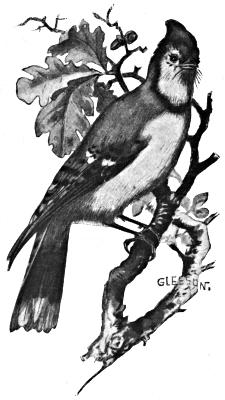
One season I found a jay’s nest in a cedar on the side of a wooded ridge. It held five eggs, every one of which had been punctured. Apparently some bird had driven its sharp beak through their shells, with the sole intention of destroying them, for no part of the contents of the eggs had been removed. It looked like a case of revenge—as if some thrush or warbler, whose nest had suffered at the hands of the jays, had watched its opportunity, and had in this way retaliated upon its enemies. An egg for an egg. The jays were lingering near, very demure and silent, and probably ready to join a crusade against nest robbers.
The great bugaboo of the birds is the owl. The owl snatches them from off their roosts at night, and gobbles up their eggs and young in their nests. He is a veritable ogre to them, and his presence fills them with consternation and alarm.
One season, to protect my early cherries, I placed a large stuffed owl amid the branches of the tree. Such a racket as there instantly began about my grounds is not pleasant to think upon. The orioles and robins fairly “shrieked out their affright.” The news instantly spread in every direction, and apparently every bird in town came to see that owl in the cherry tree, and every bird took a cherry, so that I lost more fruit than if I had left the owl indoors. With craning necks and horrified looks the birds alighted upon the branches, and between their screams would snatch off a cherry, as if the act was some relief to their feelings.
The chirp and chatter of the young of birds which build in concealed or inclosed places, like the woodpeckers, the house wren, the high-hoe, the oriole, etc., is in marked contrast to the silence of the fledgelings of most birds that build open and exposed nests. The young of the sparrows, warblers, flycatchers, thrushes, etc., never allow a sound to escape them; and on the alarm note of their parents being heard, sit especially close and motionless, while the young of chimney swallows, woodpeckers, and orioles are very noisy.
The owl, I suspect, thrusts its leg into the cavities of woodpeckers and into the pocket-like nest of the oriole, and clutches and brings forth the birds in its talons. In one case, a screech owl had thrust its claw into a cavity in a tree, and grasped the head of a red-headed woodpecker; being apparently unable to draw its prey forth, it had thrust its own round head into the hole, and in some way became fixed there, and had thus died with the woodpecker in its talons.
II
mishap tragedies desiccated vicinity
tragic vermin intolerable purgatory
comic couple cavity explosion
The life of birds is beset with dangers and mishaps of which we know little. One day, in my walk, I came upon a goldfinch with the tip of one wing securely fastened to the feathers of its back, by what appeared to be the silk of some caterpillar. The bird, though uninjured, was completely crippled, and could not fly a stroke. Its little body was hot and panting in my hands as I carefully broke the fetter. Then it darted swiftly away with a happy cry.
A record of all the accidents and tragedies of bird life for a single season would show many curious incidents. A friend of mine opened his box stove one fall to kindle a fire in it, when he beheld in the black interior the desiccated forms of two bluebirds. The birds had probably taken refuge in the chimney during some cold spring storm, and had come down the pipe to the stove, from whence they were unable to ascend.
A peculiarly touching little incident of bird life occurred to a caged canary. It laid some eggs, and was so carried away by its feelings that it would offer food to the eggs, and chatter and twitter, trying, as it seemed, to encourage them to eat. The incident is hardly tragic, neither is it comic.
Certain birds nest in the vicinity of our houses and outbuildings, or even in and upon them, for protection from their enemies, but they often thus expose themselves to plague of the most deadly character.
I refer to the vermin with which their nests often swarm, and which kill the young before they are fledged. In a state of nature this probably never happens; at least I have never seen or heard of it happening to nests placed in trees or under rocks. It is the curse of civilization falling upon the birds which come too near man. The vermin is probably conveyed to the nest in hen’s feathers, or in straws and hairs picked up about the barn or henhouse. A robin’s nest will occasionally become an intolerable nuisance from the swarms upon swarms of minute vermin with which it is filled. The parent birds stem the tide as long as they can, but are often compelled to leave the young to their terrible fate.
One season a phœbe bird built on a projecting stone under the eaves of the house, and all appeared to go well till the young were nearly fledged, when the nest suddenly became a bit of purgatory. The birds kept their places till they could hold out no longer, when they leaped forth and fell dead upon the ground.
After a delay of a week or more, during which I imagine the parent birds purified themselves by every means known to them, the couple built another nest a few yards from the first, and proceeded to rear a second brood; but the new nest developed into the same bed of torment that the first did, and the three young birds, nearly ready to fly, perished as they sat within it. The parent birds then left the place.
I imagine the smaller birds have an enemy in our native white-footed mouse, though I have not proof enough to convict him. But one season the nest of a chickadee which I was observing was broken up in a position where nothing but a mouse could have reached it. The bird had chosen a cavity in the limb of an apple tree which stood but a few yards from the house. The cavity was deep, and the entrance to it, which was ten feet from the ground, was small.
Barely light enough was admitted to enable one to make out the number of eggs, which was six, at the bottom of the dim interior. While one was peering in and trying to get his head out of his own light, the bird would startle him by a queer kind of puffing sound. She would not leave her nest like most birds, but really tried to blow, or scare, the intruder away; and after repeated experiments I could hardly refrain from jerking my head back when that little explosion of sound came up from the dark interior.
One night the nest was harried. A slight trace of hair or fur at the entrance led me to infer that some small animal was the robber.
A weasel might have done it, as they sometimes climb trees, but I doubt if either a squirrel or a rat could have passed the entrance.
A pair of the least flycatchers, the bird which is a small edition of the pewee, one season built their nest where I had them for many hours each day under my observation. The nest was a very snug and compact structure placed in the forks of a small maple about twelve feet from the ground. The season before a red squirrel had harried the nest of a wood thrush in this same tree, and I was apprehensive that he would serve the flycatchers the same trick; so, as I sat with my book in a summerhouse near by, I kept my loaded gun within easy reach.
One egg was laid, and the next morning, as I made my daily inspection of the nest, only a fragment of its empty shell was to be found. This I removed, mentally imprecating the rogue of a red squirrel. The birds were much disturbed by the event, but after much inspection of it and many consultations together, concluded, it seems, to try again.
Two more eggs were laid, when one day I heard the birds utter a sharp cry, and on looking up I saw a cat-bird perched upon the rim of the nest, hastily devouring the eggs. I soon regretted my precipitation in killing her, because such interference is generally unwise. It turned out that she had a nest of her own with five eggs in a spruce tree near my window.
Then this pair of little flycatchers did what I had never seen birds do before: they pulled the nest to pieces and rebuilt it in a peach tree not many rods away, where a brood was successfully reared. The nest was here exposed to the direct rays of the noonday sun, and to shield her young when the heat was greatest, the mother-bird would stand above them with wings slightly spread, as other birds have been known to do under like circumstances.
III
peculiar species expressive courage
curious dismay desperate assault
subtle rescue deranged enemy
Probably the darkest tragedy of the nest is enacted when a snake plunders it. All birds and animals, so far as I have observed, behave in a peculiar manner toward a snake. They seem to feel something of the same loathing toward it that the human species experience. The bark of a dog when he encounters a snake is different from that which he gives out on any other occasion; it is a mingled note of alarm, inquiry, and disgust.
One day a tragedy was enacted a few yards from where I was sitting with a book: two song sparrows were trying to defend their nest against a black snake. The curious, interrogating note of a chicken who had suddenly come upon the scene in his walk first caused me to look up from my reading. There were the sparrows, with wings raised in a way peculiarly expressive of horror and dismay, rushing about a low clump of grass and bushes.
Then, looking more closely, I saw the glistening form of the black snake, and the quick movement of his head as he tried to seize the birds. The sparrows darted about and through the grass and weeds, trying to beat the snake off. Their tails and wings were spread, and, panting with the heat and desperate struggle, they presented a most singular spectacle. They uttered no cry, not a sound escaped them; they were plainly speechless with horror and dismay. Not once did they drop their wings, and the peculiar expression of those uplifted palms, as it were, I shall never forget.
It occurred to me that perhaps here was a case of attempted bird charming on the part of the snake, so I looked on from behind the fence. The birds charged the snake and harassed him from every side, but were evidently under no spell save that of courage in defending their nest.
Every moment or two I could see the head and neck of the serpent make a sweep at the birds, when the one struck at would fall back, and the other would renew the assault. There appeared to be little danger that the snake could strike and hold one of the birds, though I trembled for them, they were so bold and approached so near to the snake’s head. Time and again he sprang at them but without success. How the poor things panted, and held up their wings appealingly!
Then the snake glided off, barely escaping the stone which I hurled at him. I found the nest rifled and deranged; whether it had contained eggs or young I know not. The male sparrow had cheered me many a day with his song, and I blamed myself for not having rushed at once to the rescue, when the arch enemy was upon him.
There is probably little truth in the popular notion that snakes charm birds. The black snake is the most subtle of our snakes, and I have never seen him have any but young, helpless birds in his mouth.
—John Burroughs.