PART II.
Reading edition
Stephan had been with the violin-maker about six weeks, when one day the little Gretchen, his master's daughter, rushed in to tell them the cows were coming down from the Alp.
It is the custom in the Bavarian Tyrol to send the cows to small pastures high up among the mountains where the grass is green and plentiful, being watered by the dews and mists, and less exposed to the scorching sun. Here the cows remain all the summer under the care of two or three men, called "senner," or women, called "sennerinnen," who are always busily engaged making butter and cheese, and rarely come down to the valley, even for a day, till the season is over, when, collecting their tubs, milk-pans, and other dairy utensils, they descend the mountain with great rejoicings and consider the day a festival.
This return is an event of importance in every village. Brand, like his neighbors, hastened out with his little daughter, and told Stephan to follow them. The gay procession wound slowly along the main road, accompanied by a band of music playing a cheerful Tyrolese air. The cows came trooping along, decorated with garlands of wild flowers, preceded by peasants in their gayest costumes, carrying blue and white flags. The "sennerinnen" wore their brightest neckerchiefs and gowns, and seemed quite rejoiced to be down among their friends again.
Stephan joined his mother in the crowd, and they were in the full enjoyment of the scene when he suddenly exclaimed: "See, mother, there's the lost goat!" and sure enough there it was, limping along by the side of a "sennerin." One leg was evidently broken or severely injured, but otherwise the little animal looked well and fat.
Old Bridgetta had likewise seen it, and the three hastened to question the "sennerin," who seemed very glad to find the owner, and told them it had been brought to the Alp by a peasant, who gave her a florin to take care of it and bring it down to the village as soon as she could. He did not tell her where he had found it, or indeed any particulars, so she supposed the poor little thing had fallen over some precipice and broken its leg, which was, however, nearly well.
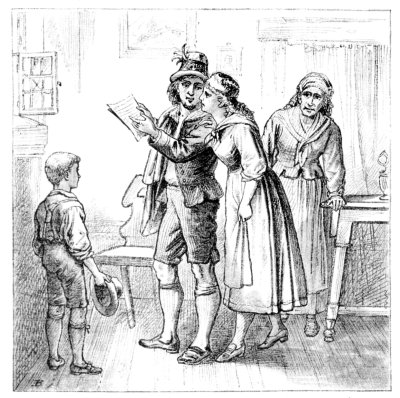
STEPHAN SHOWS THE BARON'S LETTER TO GRETCHEN. [SEE PAGE 775.]
"Goats don't often fall in that way,—stones are much more likely to have caused the mischief," said Bridgetta, with a meaning look at Stephan, which was, however, only noticed by his mother, who replied:
"Well, Bridgetta, if you still think so badly of my boy, you can keep the money as a recompense for the damage done to your goat, though I am quite convinced he has had nothing to do with it Some day we shall hear the truth of the whole affair, and of that I make no doubt."
"I don't want your money," said the old woman, testily, "and shall return it as soon as I have sold the other goat;"—whereupon, she took the leading-string from the "sennerin" and hobbled off with her new-found property, apparently as little pleased as possible.
The next day, the five florins were sent back, and then Stephan told his mother, for the first time, how he had promised to return the money if he ever found the goat again. This now seemed impossible, for he knew neither the name nor address of the gentleman. The money was, therefore, put away safely, and the savings of a few months soon made up the original sum of six florins, but still nothing could be heard of the giver.
Time wore on, and the boy was rapidly becoming an expert workman. He had regularly swept the warehouse for three years, then finding he could earn more by violin-making during the time so occupied, he resigned in favor of a boy as poor as he had been. Brand had pronounced him quite worthy of regular work, having often tested his ability by leaving to him the most difficult parts of the instruments. He had made himself a zither, and could play all those national airs so peculiarly the property of the mountaineers, and which are so suited to the plaintive sweetness of that instrument.
Before Stephan was eighteen, his fame as a zither-player had spread far and wide; no marriage, or festival of any kind, was complete without his well-looking, good-humored face.
One day, Stephan was putting away his tools when he was sent for by a nobleman, who had stopped overnight at the village, and he soon came back with the news the Baron Liszt had engaged him to act as guide to the Krotten Kopf mountain the next day, and Brand was also wanted to help to carry the wraps and needful provisions.
Early in the morning the party started. The Baroness accompanied her husband, and there were one or two gentlemen with their wives. Stephan and Brand, laden with shawls, umbrellas, and knapsacks, then led the way with the slow, steady pace always adopted by the mountaineers, who know that speed avails nothing when great heights have to be climbed, as it cannot possibly be kept up, and only exhausts the strength at the onset. After climbing two hours, a turn in a very steep portion of the path brought them suddenly upon a green plateau, walled in, as it were, by mountain peaks, which looked of no particular height till the ascent began. Though the sun had scarcely set, yet, at such an elevation, the air was more than chilly, and as the Baroness put on a warm shawl she said, one could easily account for the fresh looks of the "sennerinnen," who spend the intensely hot months in so cool and healthful an atmosphere; for the Alps are never scorched and dried up as elsewhere during the summer. The Esterberg Alp, as it is called, consists of two large tracts of rich meadow, green and fresh as in our own fertile land, with a border of underwood straggling some distance up the mountain, and whence at midday issue the clear sounds of the musical cow-bells, the only signs of life in that wild, solitary spot.
They soon came in sight of a long low house, one-half of which was devoted to the cows and the hay. The earth around was trodden down and bare; a few flowers grew against the house-wall, and some milk-pans were ranged along it to dry. The door was opened by a wild-looking man devoid of shoes and coat; his long, shaggy hair looked as if it had never experienced the kindly influence of a comb or brush. He had evidently been roused from a heavy sleep, but soon understanding that they wished to spend the night in the hut, he told them, in a most singular German dialect, that the "oberschweizer," or chief, was away, but that he alone could arrange all that was needful; for he was accustomed to attend to the visitors who came there in the warm weather.
The "senner" prepared the meal, consisting of a large bowl full of a dark chopped pancake called "schmarren," often the only food of the cowherds for weeks together.
The next consideration was a resting-place. They had been warned that they would get nothing but hay, so it was no surprise when the "senner" led the ladies out to one side of the house, where, mounting a short ladder, he placed his lantern in the center of a large hay-loft, one side of which was open to the free air of heaven, which blew in, fresh and cool, as also it did from numerous chinks in the roof, through which the clear moonbeams shone, rendering the lantern a matter of form. The man proceeded to arrange the hay in heaps, so that each person could recline or sit, as most conducive to rest. Only those accustomed (as, indeed, most mountain climbers in Bavaria are) to spending a night half-buried in hay, can sleep. The hours of the night were spent by the ladies in laughing at one another and discussing the absurdity of spending a night ranged against the sides of a hay-loft, with heads tied up in handkerchiefs, like wounded soldiers in a hospital.
Meantime, the gentlemen sat outside enjoying their cigars by moonlight, and relating their hunting adventures. "Ah," said the Baron, after one of the stories, "that reminds me of a northern friend of mine who was staying with us some years ago. He was very short-sighted, but passionately fond of a hunt, so we made up several parties, at which he appeared in spectacles, to the great amusement of us all. He took our jokes in good part, and enjoyed himself without doing any mischief for a time. One unlucky day, however, I missed our path, and had to descend the mountain in search of some landmark from which to start afresh. Suddenly, with the exclamation: 'Hush! a chamois!' he leveled his rifle, and before I could say one word he had shot——a goat! He was too much vexed to laugh, so I had it all to myself, and it was some minutes before I could assist him to raise the little animal, whose leg was broken. The flock was not far off, and the herd-boy was evidently searching the wood, having heard the shot. Now it never would have done to let such an unsportsmanlike event get wind, so we carried the goat to some distance, when, meeting a peasant, we paid him to leave it at a hut on a neighboring Alp, and request it should be taken down to the valley at the first opportunity. I never mentioned the subject to any one but my brother Heinrich. Some time after, he was hunting in the same locality, and came upon a lad who was crying, with a regular mountain voice, for the loss of that very goat, for which it seemed his mother had to pay. I must confess, the consequence of kidnapping the animal for a time had never struck me, and I was therefore glad to know that my brother had given the lad money enough to pay all damages. But come, it is time we tried our hay-berths, for if we can't sleep we can rest."
Stephan, who had been eagerly listening, exclaimed: "Oh, please sir, wait a moment. I was that boy to whom the gentleman gave the money, and he told me he should expect it returned if I ever found the goat. Some time afterward I did find it, and I have always carried the money sewn into my coat-pocket in case I should meet the gentleman again when I am away from home, but I never did so; perhaps, sir, you will be kind enough to give it to him," he added, beginning to unfasten the little packet from the lining of his side-pocket.
Turning to Brand, the Baron asked if he knew anything of this romantic goat story.
"Yes, indeed, sir, and so does every one in the village, for the boy got into trouble with the neighbors, who all thought he had been throwing stones at the animal, and they even turned him out of his situation, but, as luck would have it, something else was offered the same day, so that it did not hurt him or his mother either."
"It was the best thing that ever happened to me. I had always wished to make violins and zithers, and owing to that accident I got my wish," said Stephan, in reply to the Baron's expressions of regret.
"As to the money," said the Baron, "we will make an exchange; you shall have my purse, which contains about ten florins, and I will take your little bag, just as it is, as a proof of Bavarian honesty and honor. We shall see more of one another," he added; "meantime, don't forget that we must be off by four in the morning. Good-night!"
The moon still shone when the travelers commenced their mountain journey. Slowly they wound their way round the ever-ascending path. About half-way up they came to a small rocky plain, where some young cattle were grazing. Their alarmed wild movements proved how rarely human beings passed their high-walled prison. From this point their climbing became a real labor, but before long they arrived at the summit, where, amidst much laughter and want of breath, they all threw themselves on the ground and gave vent to their satisfaction at being nearly 7,000 feet above the sea, and to their admiration of the glorious view.
But their stay on the summit was short, as they wished to make the descent of the mountain in one day. They did not reach Partenkirchen till nearly midnight, nor Mittenwald till the following day, where, of course, their adventures were related, and Stephan's story was soon the talk of the village. He became a perfect hero for the time, and many a neighbor shook hands and hoped he would forgive the doubt cast upon his word, although years had since passed and the goat of contention had been gathered to its fathers.
Some time after, a letter came to the Post Inn for Stephan, causing much curiosity in the village, as it was the first he had ever received. It came from the Baron, who offered him an excellent situation on his estate, under the forester, who, being childless and old, would not only instruct Stephan in his duties, but would soon leave the management in a great measure to him; moreover, he himself might hope to succeed as Forester, if he found the life suited to his taste. A week was given him for consideration. He did not at all like the idea of leaving his native place, to which he was attached with that intensity of feeling said to be peculiar to the mountaineers; but so good an offer was not to be refused, especially as Herr Dahn and Brand both approved of his going. So the letter was written to tell the Baron he would come in a few weeks, as requested. Meantime his old master gave him an order for a zither of the best quality, to be made of handsome wood, inlaid with mother-of-pearl, and as the price was of no consequence, he was to make it quite a specimen instrument, to show how well he could work. Stephan was very much pleased with the commission, and when, at the end of three weeks, it was finished, his delight was great when Herr Dahn pronounced it "One of the very best he had ever had in his warehouse, and quite fit for the king." The day came for Stephan's departure, but it was not a sad one, as everything was arranged for him to return in three months to fetch Gretchen, his old master's daughter, who had promised to marry him, and Stephan's mother was to live with them.
Stephan's letters were most satisfactory. He liked the new life and the old Forester, and was sure Gretchen would admire the pretty houses, the large balcony, along the rails of which he was growing some of the beautiful dark carnations she was so fond of, and he knew she would rejoice to see the glowing mountain-peaks rising from the dark pine woods at sunset.
The wedding-day arrived at last, and in the course of the second evening,—for the festivities lasted two days,—some strangers staying in the village came up to see the dancing, which took place in a very large room in the inn. Among them was the Baron Liszt, who, after dancing the last waltz with Gretchen, requested the visitors would remain a few minutes, as he had something to show them.
A box was then brought in by the hostess, dressed in her best costume and fur cap. She placed it with much solemnity before the Baron, who lifted the lid, took out the beautiful zither that Stephan had made with such care, and handing it to the pretty, blushing Gretchen, he said he could offer her nothing better as a wedding gift than this specimen of her husband's talent, which he hoped she would always keep and use as a token of his respect and admiration for Bavarian honesty and truth. Then, shaking hands with them both, he took leave amidst loud acclamations and waving of hats; and so ended the wedding of Stephan and Gretchen.