Part 2 — JACK-IN-THE-PULPIT.
Reading edition
So, here's October come again. Another pleasant year gone by, another lot of sermons done, and nobody the worse! Dear, dear, how time does fly in cheerful company, to be sure!
Well, my dears, keep a bright lookout for the new volume, and, meantime, don't open your eyes too wide while I bring to your notice
THE LARGEST MAN.
Albany, N.Y.
Dear Jack-in-the-Pulpit: Perhaps some of your other boys, who, like myself, wish to grow big and strong, would like to hear about the largest human being ever known,—Goliath of Gath,—a person almost large enough to need introduction by installments, but he is so well known that the ceremony is needless.
As nearly as I can make out, he was between ten and eleven feet high. When he went to battle he wore a coat-of-mail weighing one hundred and fifty-six pounds,—as heavy as a good-sized man; and the rest of his armor amounted to at least one hundred and fifteen pounds more. The head of his spear weighed eighteen pounds,—as heavy as six three-pound cans of preserved fruit,—and this he carried at the end of a long and heavy shaft!
Think what might happen if a man equally big and strong should live among us now, and insist on taking part in our games and sports? If he joined a boat-club, a curious six-oared crew could be made up, with him at one side and five other men opposite. And just imagine him "booming along" on a velocipede! If he joined the champion Nine, and hit a ball, where would that ball go to? If he called for a "shoulder-high" ball, wouldn't the catcher have to climb a step-ladder to catch behind the giant? And if he threw a ball to a base-man, wouldn't he be apt to throw it clean through him?
Probably no one can answer these questions, but they are interesting all the same, to yours sincerely,
R.V.D.
CATCHING BIRDS ON THE WING.
As if a man could ever hope to do that, or even to do so much as fly! And yet, word has already come to me of a man who has made a machine with which he actually has flown, up, down, with the wind, against the wind, and, in fact, any way he wished!
The particular machine he used looked, I'm told, rather like a big bolster-case blown full of air, and with a light frame-work of hollow brass tubes strapped to it underneath. In this frame-work was a seat for the man, and near him were two circular fans, which he turned round very fast indeed; one of the fans made the machine fly backward or forward, and the other made it go up or down, as he liked.
Now, this certainly seems to be a step ahead, or, rather, a flap upward; but you needn't expect to be chasing and catching eagles and albatrosses on the wing by dropping salt on their tails; at least, not just yet, my dears. The time for that sort of fun may come, perhaps; but it would be well not to crow too loudly at present.
THE BEE AND THE ANEMONE.
Des Moines, Iowa.
Dear Jack-in-the-Pulpit: The bee you told us of in your August sermon did not mistake the anemone for a flower. At least, I think not. No bee ever makes such a mistake as to settle on a poisonous flower, and I believe that this bee went to the anemone for water and not for honey. Bees will settle on pieces of straw afloat in the water, when seeking for water, and I believe they know, even while on the wing, where to find honey. Good-bye.—Your friend.
N.E.H.
FRANGIPANI SCENT AND PUDDINGS.
"Let's begin with the puddings, and make sure of them," as a little boy once remarked. Well, then, in former times, Frangipani puddings were of broken bread, and their queer name is made from two words,—frangi, meaning "to break," and panus, "bread"; but, after some time, these puddings were made with pastry-crust and contained cream and almonds.
Frangipani scent, however, was named after a great marquis who first made it, getting it from the jasmine plant. And the marquis got his name from an ancestor whose duty it had been to break the holy bread or wafer in one of the church services, and who on that account was called "Frangipani," or "Breaker of Bread."
Now, this way of explaining how words come to be formed, sounds well enough, no doubt. But how are we to know, in this case, that the marquis didn't invent the pudding as well as the scent? However, I must leave you to puzzle out the problem for yourselves, my dears, while I give you some information about
A SEALED POSTMAN.
You've all heard of sealed letters, of course, and seen some, too, no doubt; but did you ever hear of the letter-carrier, also, being sealed? Well, a bit of news has come saying that, among the Himalaya Mountains, the men who carry the mails on horseback are sealed to their saddles, in such a way that while they can ride easily enough they cannot get down from their seats; and, what is more, the mail-packages are sealed to the men! Once started on the route, the seals are not allowed to be broken, except by the postmaster at the next station, and, if they happen to get broken otherwise than by accident, the carrier is severely punished.
The result of this sealing is that a mail-carrier who wishes to steal the letters in his charge is obliged to steal also the saddle and horse,—and himself as well, I suppose.
Nice places these carriers have to ride through, at times! Why, in some parts, the road is so steep that, in going down, the rider is kept upright by a rope passed under his arms and held in the hands of two men who are above him on the mountain. If it were not for this, the rider would fall over the head of his horse, or else cause the horse itself to go over head first.
Altogether, the postmen of the Himalayas must have a hard time of it.
WIND-HARPS.
East Saginaw, Mich.
Dear Jack-in-the-Pulpit: Please will you or any of your "chicks" tell me how to make a wind-harp, or Eolian harp?
Your friend, Minnie Warner.
Time and again have I heard tell of wind-harps and the sweet music the wind coaxes out of them. The sighing and singing of the breezes through the tree-tops must be something like it, no doubt. But I never heard a wind-harp's song, and of course don't know how to make one. Perhaps, some of you know, however, and if so I shall be obliged if you will send me word, so that I can pass it on to Minnie and the rest of my chicks.
"THE JOY OF THE DESERT."
In Africa is a vast, dreary waste, called the Desert of Sahara. In widely scattered spots of this desert there grows a tree that sends its roots down to springs far beneath the parched ground. Sometimes these springs are so far down that the trees are planted in deep holes, something like wells, so that the roots may reach water. Hardly anything except this tree can grow in that desert.
The fruit of the tree is delicious food; the long trunk makes poles for tents; the leaf-stalks make many kinds of basket and wicker work, walking-sticks and fans; the leaves themselves are made into bags and mats; and the fibers at the base of the leaf-stalks are twisted into cordage for tents and harness. The sap of the tree, drawn from a deep cut in the trunk near the top, after standing a few days, becomes a sweet and pleasant liquor. Cakes of the fruit pounded and kneaded together "so solid as to be cut with a hatchet," are carried by travelers going across the terrible desert.
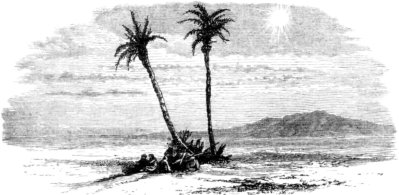
Besides all this, trees of this kind, planted in groups, cast a shade which keeps the ground moist, so that other fruit-trees can live beneath them.
When the tree is about one hundred years old, it ceases to bear fruit, and is cut down for timber; but in its long life it has made its owner rich and a great many people comfortable.
The paragram which told me all this said, further, that this tree is the date-palm, and is called "The Joy of the Desert." Well may it be so called, I should think; though once I heard some of the children of the red school-house say they hated "dates." Perhaps they meant "dates" of some other kind.
BABIES IN BOOTS.
Where do you suppose Tartar mothers carry their little children?
Not on their shoulders, nor on their hips, nor in their arms, nor at their backs, nor on their heads.
Well, I'm told they carry them in their boots! These are made of cloth, and each is large enough to hold a child five years old!
ROOK COURTS AND BLACKBIRD POWWOWS.
Dear Jack-in-the-Pulpit: In England, where I come from, I have seen meetings of vast numbers of birds, though never as many of such different kinds as those named by Z.R.B. in the letter which you gave us in July. Sometimes, a great number of rooks gather in a ring, and in the center of it is one lonely, dejected-looking rook, who holds his head down in silence. The other rooks seem to hold a consultation, chattering and cawing back and forth, sometimes one alone and sometimes all together, until they seem to decide what to do.
Then three or four old, solemn-looking rooks fly upon the lonely one and put him to death, as if he had been found guilty of some dreadful crime.
In this country, during spring, the blackbirds meet almost daily in the tops of high trees, especially elms and locusts, and there they chatter by the hour. Sometimes a few will fly off, angrily, with quick, sharp notes, to some tree a little way off. After a while, two or three more birds will join them from the large body. Then, perhaps, some of them will go back as "peace commissioners," and after a few more flights back and forth, and endless chatter, the little party may return to the main body; or, increasing in number, may form a second crowd as noisy as the first.
No doubt you have heard and seen many such powwows, dear Jack. Long may you live to watch the birds and repeat to us their wisdom! Truly your friend,
C.B.M.
AN INTERVAL NOT ON THE PROGRAMME.
I'm told that at Pompeii, Italy, in the year 79, a play was being acted in one of the theaters, when a storm of cinders fell, buried the whole city, and, of course, put a stop to the play, which has never been completed. A few months ago, however, an operatic manager named Languri made up his mind to have a new theater just where the old one stood; so, he printed in the Italian newspapers a notice that ran something like this:
"After a lapse of eighteen hundred years, the theater of Pompeii will be re-opened, with the opera of 'La Figlia del Reggimento.' I ask the continuation of the favor shown to my predecessor, Marcus Quintus Martius, and beg to assure the public that I shall make every effort to equal the rare qualities he displayed during his management."
If only Marcus Quintus Martius and his actors, and musicians, and the ancient audience, could have been at that re-opening of their long-buried theater, how they would have stared!