Volume 13 / Part 2 — ST. NICHOLAS DOG STORIES.
Reading edition
X.—A CLEVER LITTLE YELLOW DOG.
By John R. Coryell.
One cold winter night, not long ago, I took pity on a poor little dejected-looking yellow puppy, and invited him into my house. Having once taken him in, it was quite out of the question to think of turning him out again. I was not afraid that I might be robbing anybody, for he was the kind of dog that very few persons care to have. He was dirty-yellow in color, very lank of body, and he seemed to be made up of ill-assorted parts of different kinds of dogs. His legs, particularly, seemed intended for some other dog and acted as if they never would become reconciled to carrying the queer body to which they were joined.
I should have preferred a handsome dog, but since I had no choice, I determined to do my duty by the little outcast, and to give him such an education that in the beauties of his mind the ugliness of his body would be overlooked.
The first thing needed for him was a name; and I tried to think of something appropriate, but soon gave it up, and in default of a better title called him Bob. To teach him the name was easy. I merely called out the word "Bob!" every time I fed him. As it was important that he should learn to look to me as the source of all his happiness and instruction, I permitted no one else to feed him. It took him about a week to learn his name, and to recognize the fact that all the blandishments he could lavish on the cook would be of no avail, and that his only hope was in me.
At the very outset, I had made up my mind that under no circumstances should he receive angry words or blows. He was a broken-spirited, affectionate little puppy, and I was resolved that if there was no way of teaching him except by brutality, he should remain ignorant all his life. The abject way in which, to this day, he runs from a child makes me feel sad. I fancy that much of his early life was spent in dodging stones or snow-balls thrown by boys—not cruel, but thoughtless boys.
It was necessary to control him, and I quickly discovered an easy way. He was such a sensitive little fellow that when he once learned to love me, he seemed to know by the tones of my voice whether I was pleased with him, and to have me pleased seemed to be the one object of his life. Therefore, if I saw him doing anything wrong, I had only to say sharply and firmly, "No, Bob!" and down would go the tail and ears, and he would slink shame-facedly to his special corner and from there watch me until I would call him to me and pat his head.
After a while, a quiet "No, Bob!" would effect the same result. This was a great victory, and made most of the subsequent teaching merely a matter of patience.
The first real lesson was when I undertook to make him sit up. If he had only known what I wished him to do, he would gladly have done it; but the words "Sit up!" meant nothing to him. He was almost too willing, for when I took hold of him to put him into a sitting position, he became as limp as a wet rag, and seemed to be trying to put himself into a condition to be twisted into any shape I chose.
Then I put him into a corner and set him up, saying continually, "Sit up! Sit up!" I held him up for a while and then took my hand away, but at once he collapsed as if all the stiffening had suddenly left his back-bone. Then I showed him a piece of sugar, of which he was very fond, and immediately he was himself again. Once more, and many times more, I put him in position in the corner, until at last, seemingly by accident, he failed to fall over when I took my hand away. I did not tax his endurance, but at once gave him the sugar.
It took him about three days to grasp the idea that "sit up!" meant a special performance, and that to achieve it meant a lump of sugar. Then I put him through the same process in the middle of the room. He missed the support of the wall at first, and fell over; whereupon he looked foolish. One fact was evidently firmly fixed in his mind, however,—the fact that there was sugar to be had if only he could do as I wished him to do. All the time that he was struggling for balance, he kept his eye on the lump of sugar, which I had on the floor beside me. Finally that lesson was learned, and he could sit up if I would put him in position. He knew, too, what "sit up!" meant.
After that, I would not feed him until he had first sat up; but it was a long time before he gained sufficient confidence in himself to sit up without help. At first I helped him up by both paws; then I helped by holding only one paw; then I merely touched one paw; then I only motioned, as if about to touch the paw; and finally I simply said, "Sit up!"
I think Bob reasoned this all out in his own mind and concluded that there must be some strange and beautiful power in the words "sit up!" for he could see that whenever he did it, he had something to eat. I am obliged to confess that Bob loved to eat; and after he had learned to sit up, he was inclined to perform the feat morning, noon, and night, and it was, of course, impossible to make him go away without first giving him a morsel, however small, of food.
AWAITING FURTHER ORDERS.
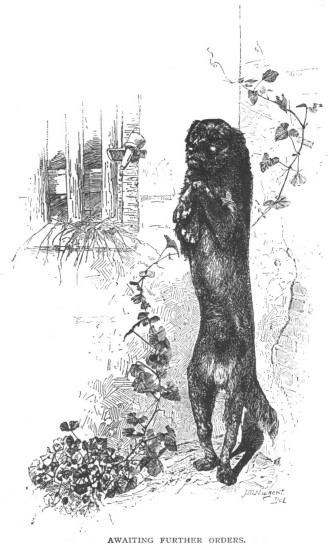
Lessons in standing up, walking and waltzing followed, and they were all easily taught. In teaching him anything, I was always careful to associate the action required of him with certain words. Standing, walking on his hind legs, and waltzing were always "stand up!" "walk!" "waltz about!" I never taught him more than one thing at a time, so that there should be no possibility of his misunderstanding the meaning of the word or words used.
In teaching him to stand up, I first made him sit; then by holding a piece of sugar over his head, I induced him to stand erect,—while I kept repeating, "Stand up!" "Stand up!" After he had learned this lesson, I made him first sit, then stand, and then, by going from him and saying "Walk!" I made him follow me until he understood the connection between the words and the action, even when I was at the other end of the room. I taught him to "waltz" by making him go around and around after a piece of sugar held over his head when he was standing up.
To make him go to his corner and lie down, without hurting his feelings, was difficult. If I said sharply, "Go to your corner and lie down!" he would go; but he would feel so badly that he could not play for half an hour. But by repeating the command in gradually softening tones and by giving him a piece of sugar each time, he eventually learned that he was not thereby in disgrace.
Seeing, however, how a sharp word would make his ears and tail droop, I took advantage of this fact, and whenever he had done wrong I would always say "Naughty!" a dozen times over, until at last I had only to whisper "Naughty!"—and down would go those ensigns in a moment. On the other hand, if I said "Good dog!" he was immediately on the alert, ears up, head cocked to one side, and tail wagging, ready for any kind of sport.
After he had learned to walk, I taught him to go slowly when I said "like a gentleman!" and quickly when I said "like a schoolboy!" To teach him these things required patience principally; but I found that to teach him some things taxed my ingenuity as well.
I wished him to speak both softly and loudly; but how to make him do it puzzled me. For Bob seldom barked except when engaged in uproarious play, and at such times he was not susceptible to instruction. One day, however, he had been playing with a little rubber ball, running after it and bringing it to me until I was tired, a condition in which he never seemed to be.
To stop the game I put my foot on the ball, and picked up a book to read. Bob waited a few moments to see what I was going to do, and finding I was not going to play, tried to push my foot away with his nose. Failing in that, he pulled with one paw. That also failed, and Bob was puzzled. He retired a few steps, placed his head between his forepaws on the floor and looked at me. I pretended not to see him, curious to know what he would do. He remained perfectly still for nearly a minute, and then, as if determined to attract my attention somehow, he barked.
There was my clew; I gave him the ball at once. In a few moments I again placed my foot on the ball, and waited until I saw he was about to bark, when I said, "Shout! Shout!" He barked, and I gave him the ball. I repeated this several times a day, and day after day, until he learned to bark whenever he wanted the ball and I said "Shout!" Then I made him shout for his meals, and finally, he would "shout" whenever I told him to do so.
"BOB" JUMPING.
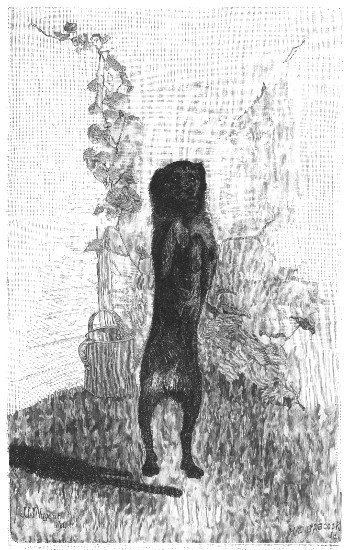
To make him speak softly, I took advantage of a fashion he had of whining when he wished to go into the yard for a frolic. I would go to the door and say, "Want to go out?" Bob would at once respond by preparing to rush out the moment the door was opened. Then I would say, "Speak softly!" and keep repeating the words until he whined. After a while he would whine the moment I said, "Speak softly!"
Another thing that I taught him was to fall down and lie motionless when I said, "Dead!" This I accomplished by taking hold of his forefeet in one hand and his hindfeet in the other, and suddenly dropping him on his side on the floor, as I said the word "Dead!" several times.
At first, Bob thought I was playing some new game with him, and prepared for a good time, but I had only to say "No!" to him to make him sedate at once. By this time he had learned that when I repeated a thing several times, it was because he was to learn something; and the little fellow really seemed to try to understand what I wished him to do.
After I had pulled his feet from under him a number of times, and had made him lie still until I said, "Alive!" I tried tapping a hindfoot and a forefoot, at the same time saying "Dead!" He was a long time learning this trick; and several times when I thought he had learned to do it when I simply tapped his feet, I was obliged to go back and pull his feet from under him. In time, however, he learned to fall the moment I touched the side of one hindfoot. From that to motioning at the foot, and finally, merely saying "Dead!" the progress was quick. To make him jump up, I always said "Alive!"
To make him go "lame" was very easy. I tied a long string to one forefoot, and by saying, "Lame!" and at the same time making him walk, while I prevented him from putting the tied foot down, he soon learned to go on three legs.
One of the funniest things he learned to do was to take his piece of carpet, shake it well, and put it back in its place. It was through an accident that I thought of teaching him to do this. I had been accustomed to shake out his carpet in the yard every morning. One morning I threw it on the grass to air. In a moment Bob had it in his mouth and was worrying it, shaking it, and growling. He was playing, but I saw that I could teach him something, and at once said, "Make your bed!" By repeating this, morning after morning, he at last learned to pick up his carpet, carry it out into the yard, shake it, and carry it back. I could never teach him to lay it down properly, however; he seemed to think it was as good in a heap as if nicely smoothed out.
After I had taught Bob a number of tricks, I determined to write a play for him. I do not believe that any human actor ever had audiences more appreciative than his, when he performed in his "play." His little friends were always ready to give him sugar by the handful if I did not interfere, and Bob was always ready to take all that was offered. The "play" was nothing more than a simple little story into which were introduced the words which I used in commanding him to perform his various tricks. I would repeat the story, and when I came to a word of command, such as "dead," I would emphasize it so that Bob would at once do whatever he had been taught to do at the sound of that word. The play I wrote was about as follows:—
"Once upon a time there was a little dog named Bob [here Bob would run to me, and wait expectantly]. Usually he was a very good dog [wag, wag, would go his tail], but once in a while he was very naughty [down would drop ears and tail]. When he was a good dog [happy again], he would sit up and show any little boy or girl how to behave. At such times, he would speak softly [prolonged whine], as a polite dog should, though once in a while he would become excited, and shout, shout, shout [furious barking], as impolite children are sometimes apt to do.
"When a lady entered the room where he was, he would always stand up, ready to give her his chair if she wished it; or if she preferred to go into the garden or the street, he would go with her and walk like a gentleman. When he played, however, he could run like a schoolboy. But once he was in the ball-room, he could waltz about as well as the best dancer there.
"If any one ever said to him, 'go to your corner and lie down' he would do so at once like the well bred dog he was. But he was always obedient and would come immediately as soon as one said Bob.
"I was very sorry to hear one day that this remarkable dog was dead. I felt so badly that I went to his house, but was pleasantly surprised when I reached there, to find that he was very much alive."
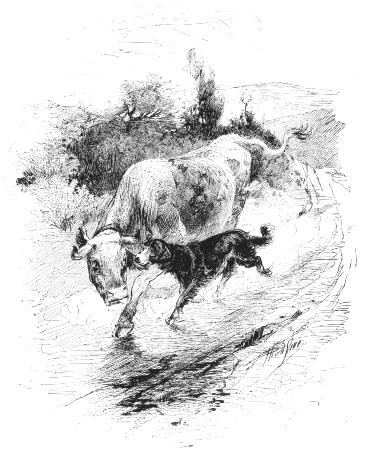
FETCH BRINGS IN THE PERVERSE COW.
What will be the limit of Bob's education I do not know, for he continues to learn with increasing ease every day. In addition to all that has been described, he can now, at the proper order of command, sneeze, catch a piece of meat from his nose at the word "three," jump over a cane, turn a somersault, and play tag.
XI.—A DOG THAT COULD COUNT.
By E. P. Roe.
Old Fetch was a shepherd dog and lived in the Highlands of the Hudson. His master kept nearly a dozen cows, and they ranged at will among the hills during the day. When the sun was low in the west, his master would say to his dog, "Bring the cows home"; and it was because the dog did this task so well, that he was called Fetch. He would run to a flat rock and hold his ear down close to it, having learned that he could thus catch the far-off tinkle of the cow-bells better than in any other way. If he could not hear them he would range about until he did, and then he was off like a shot in the direction of the sound.
One sultry day he departed as usual upon his evening task. From scattered, shady, and grassy nooks, he at last gathered all the cattle into a mountain road, leading to the distant barnyard.
Switching off the flies with their tails, the cows jogged slowly homeward, the tinkle of their bells gradually becoming more and more distinct to the milkmaid who was awaiting them. One of the cows was known to be a little perverse, and on that evening she gave fresh evidence of willfulness. One part of the road ran through a low, moist spot bordered by a thicket of black alder, and into this the cow pushed her way, and stood quietly. The others passed on, followed some distance in the rear by Fetch. He was panting from his exertions in the hot evening, his tongue lolling from his mouth as he slowly and languidly pursued his way.
Indeed he had quite discarded his usual vigilance, and the perverse cow took advantage of it.
As the cows approached the barnyard gate, he quickened his pace, and hurried forward, as if to say, "I'm here, attending to business." But his complacency was disturbed as the cows filed through the gate. He whined a little, and growled a little, attracting his master's attention. Then he went to the high fence surrounding the yard, and standing on his hindfeet peered between two of the rails. After looking at the herd carefully for a time, he started off down the road again on a full run. His master now observed that one of the cows was missing, and he sat down on a rock to see what Fetch was going to do about it. Before very long he heard the furious tinkling of a bell, and soon Fetch appeared bringing in the perverse cow at a rapid pace, hastening her on by frequently leaping up and catching her ear in his teeth. The gate was again thrown open, and the cow, shaking her head from the pain of the dog's rough reminders, was led through it in a way that she did not soon forget. Fetch looked after her a moment with the air of one remarking to himself, "You'll not try that trick again," and then he lay down quietly to cool off in time for supper.
XII.—A CLEVER SHEEP DOG.
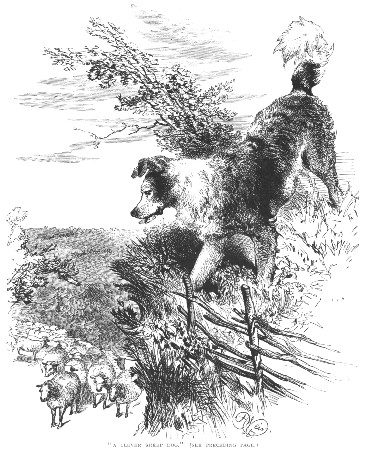
A recent English writer tells the following story of an ingenious sheep-dog that, when the flock took a wrong road, would turn them back without worrying them. His owner had hesitated for some time before he made up his mind to have a dog, as he had often seen dogs ill-use the poor sheep. But believing that in most cases the dogs' harshness toward the sheep was due to bad training, and not to their naturally evil dispositions, he resolved to make trial of one. The dog he procured was young; and he trained it after his own ideas. He soon found the docile creature a very useful helper in driving a flock from one pasture to another. The sheep often took a wrong turn, and then scampered off as fast as they could go. At such times, most shepherds who had dogs were accustomed to send the dog after the flock, at the top of its speed. Of course, it soon overtook them, but the sheep were often much frightened, and not infrequently hurt by falling down or by rushing against one another. To prevent this, the shepherd mentioned would order his dog "Smart" to go to the other side of the hedge, saying, "Now, go ahead, and bring 'em back!" Smart would promptly obey, and would noiselessly run along behind the hedge, sometimes even climbing a little slope by the roadway, whence he could overlook the flock and see just where each sheep was moving. As soon as Smart, by peeping over or through the hedge, had satisfied himself that he was ahead of all the sheep, he would come coolly out of the hedge and bring them back down the lane so gently as not to cause them the least alarm. Smart never attempted to get ahead of a flock in the way common to most of the dogs in that vicinity,—by rushing past them and frightening them; but looking at his master and wagging his tail, he would cross the hedge, overtake them, and quietly drive them back into the right road.
XIII.—A STORY OF TWO BUCKETS.
By Charlotte M. Vaile.
There they were hanging, one of them out of sight in the cool, deep water, and the other swinging empty in the sunshine, as Daisy Hadley and her dog Bruno came up to the well. The little girl and the big dog had been rambling about all the morning, following the brook through fields of sunflowers and poppies, or climbing the rocks on the sides of the mountains; but they were tired and thirsty now, and Daisy looked wistfully at the empty bucket, wishing she were strong enough to pull it down and bring the other, full and dripping, up in its place.
"Bruno," she said reproachfully, "I wish you could draw me some water." Bruno was a great, shaggy Newfoundland, that had been Daisy's play-mate ever since she could remember. He was a wonderful dog. Daisy herself would have told you that there were only a few things he could not do, but unfortunately managing that well was one of them. So there was no help for it, and Daisy was turning reluctantly away when she caught sight of Mr. Paul Gregg, one of the other summer boarders in the Park.
"A CLEVER SHEEP DOG." (SEE PRECEDING PAGE.)
If he had not come up just then, there would have been no story to tell, and the buckets might have gone up and down in the well to this day without taking part in any more remarkable event. But he did come up; and Daisy's face brightened, for they were great friends, though she was only a little girl in the Kindergarten, and he was a tall young student. He stopped when Daisy said she wanted some water; and putting down his botanical box, he began to draw some gloves over his rather soft hands.
"I don't like this kind of a well at all," said Daisy. "It isn't half as nice as the one at my grandfather's. That had only one bucket, with a rope that went 'round and 'round a great roller; and there was a handle that I could turn myself."
"This is a very old and respectable kind of a well, though," said Mr. Gregg, taking hold of the rope. "There must have been such wells as long ago as Shakspere's time."
"How do you know?" asked Daisy, who was sure that Shakspere lived a great while ago, though she could not have told when.
"Shakspere, you know, Daisy," said Mr. Gregg, "was a great poet who lived hundreds of years ago, and in a play he wrote, called 'King Richard II.,' he tells about just such a well as this. Richard was one of the kings of England, and a very unlucky king he was, though I can't deny that he brought his troubles on himself, for he was anything but a wise and prudent ruler. At last his cousin Prince Henry raised a great army and forced Richard to give up the crown. Poor King Richard did not show much spirit when his troubles came; but, according to Shakspere, he made a very neat speech, when his clever cousin Henry told him that he had decided to become King himself. Among other things, Richard said that the crown he must give up was
'Like a deep well That owns two buckets filling one another; The emptier ever dancing in the air, The other down, unseen, and full of water; That bucket down, and full of tears, am I, Drinking my griefs, whilst you mount up on high.'"
While Mr. Gregg was talking, the buckets in the well had changed places. The one which had swung in the air so lightly at first had gone down out of sight, and the other had come up ready to be emptied and to take its place in the sunshine.
Mr. Gregg paused now as he poured out some of the water. Daisy was silent too, trying to understand it all.
"What became of King Richard?" she asked presently.
"He died in prison," said Mr. Gregg. "Some say his cousin Henry, who took his place as king, had him put to death; and now," he added, turning away from the well, "I think that I will see if your mother is ready to go to dinner with us."
Then he turned toward the cottage and left Daisy standing by the well. She had not understood it all, but she felt very sorry for the unhappy king, and she thought she knew why he said he was like the bucket in the deep, dark water when he sank under his grief and shame never to see any more bright days.
She was leaning on the side of the well, with her hand upon the rope, thinking very earnestly of it all and trying to catch a glimpse of the bucket that was hanging there in the dark, when something dreadful happened. Before she knew it, she had leaned over too far. She lost her balance and fell over the side of the well. Down, down went the bucket, more swiftly than it had ever gone before, and with it, but holding desperately to the rope, went Daisy! There was only time for one terrible cry—and she was out of sight in the well!
There was no one there to save her,—Yes, there was Bruno! He heard the cry. He saw his little friend go down, and with a bark that rang across to the mountains, he rushed to the well. He leaped frantically against the low wooden side just as the bucket which had been in the water rose even with its edge. Somehow he managed to fling his heavy paws on it, then his whole body, and then, all at once, it was Bruno that was going down, down, but clinging to the bucket and howling as he went,—and Daisy was coming up!
It was only for a minute, therefore, that Daisy was in the water. The next moment, thanks to the sudden pull at the other end of the rope, she was rising again; and just as Bruno, loosened his hold of the bucket, and dropped heavily into the water, Mr. Paul Gregg reached the side of the well, seized the rope and drew Daisy to the top, gasping, shivering, and frightened almost to death.
As soon as Daisy could speak, she said, "Save Bruno!" But they had already begun to do that, and they did save him, of course. The brave old fellow was none the worse for his adventure. He dried himself in the sunshine, and then lay down beside the rocking-chair where Daisy sat folded in a soft wrap, with vaseline on her blistered hands.
Daisy was none the worse for it either, in the end; though at first, when her mother asked her how it happened and she tried to say something about a "poor king," and "a bucket-full of tears," the poor lady was afraid the plunge had affected her daughter's mind, and to this day she is in doubt whether Shakspere or King Henry or Mr. Paul Gregg was responsible for the accident.
One thing however, was clear. It was Bruno who had saved her. Had he really meant to go down with the bucket and rescue her? Daisy never had a doubt of it herself. For the rest of the season he was the hero of the Park. The summer guests bought him a silver collar beautifully engraved, and Mr. Paul Gregg declared that he should propose his name as an honorary member of the Humane Society.
But Bruno's head was not turned with all those honors. He rambled through the fields with Daisy as he had done before, and when she put her arms around his neck, and said that he should be her dearest friend forever, he was happier than if his collar had been made of gold, or than if he had been elected president of the Humane Society.