Volume 13 / Part 2 — A NEW VIEW OF THE MOON.
Reading edition
By Eva Lovett Carson.
A little boy just two years old, Or maybe two months older, Came riding home across the lot, Perched on his father's shoulder. "Look, Oswald! Hold your head up straight! (Do stop that dreadful drumming!) See, just above where Mamma stands A little moon is coming!" The baby lifts his round blue eyes; The moon laughs at their glancing. To see the wonder of his gaze 'Most sets the moon a-dancing. Frowning, he solved the problem soon; Indignantly he spoke it: "Papa, dat's not the big wound moon; I fink somebody b'oke it!"
Away—ho, away!—Let us off on a quest! To the North—to the South—to the East—to the West! To the West, to find where the sunsets go When the skies are as red as roses a-blow; To the East, to see whence the mornings come; To the South, the Summer to track to her home; To the North, by the gleam of the Polar Star, And Night's aurora flaming afar, To seek, in the keen and biting weather, The lodestone that holds the world together.
Now and then somebody writes out the very thoughts of the birds; and then again, others tell me very prettily just what they think ought to be felt by the tuneful-minded little creatures. Here, for instance, comes this scrap of verse from my friend Emily A. Braddock that I hope not only you children, but all of my birds will hear. I don't allude so much to the sparrows and such stay-at-homes as to my migratory, or go-away birds. I'm sure they'd be delighted at a poet's way of putting things. It will give them something to go for. As for myself, I've not started yet, so we'll proceed to discuss a certain odd saying for which it seems the world is indebted to one sort of these migratory birds:
"EVERYTHING IS LOVELY, AND THE GOOSE HANGS HIGH."
This expression, the Little School-ma'am says, is a corruption of an old-fashioned saying that originated in the early days of this country.
As most of you know, wild geese, when they migrate in autumn, form themselves into lines shaped like the letter V, the leader flying at the point, the two lines following; and as they sail away, far above the trees, and beyond all danger from guns—on those cold mornings when the air is clear, and the sky beautifully blue—they seem full of glee, and join in a chorus, "Honk, honk, honk!"
Any one who has heard those curiously sounding notes, the Little School-ma'am says, never could mistake them for anything else. And the folks on the earth below who heard the birds' wild call, in old times, realized the happiness of the winged creatures in being so high and safe. And so it became quite natural, when two persons met each other under peculiarly favorable circumstances for this or that enterprise, for them to say: "Everything is lovely and the goose honks high!"
GIRLS! TO THE RESCUE!
Before we leave our dear birds, moreover, I have a special message for you this month in their behalf:
"You must not forget, friend Jack," says the Deacon, "to give the boys and girls, especially the girls, my May-time sermon about the Audubon Society."
Forget it? Not I, indeed! Nor would you, if you could have seen the honest and hearty indignation of the good Deacon and the Little School-ma'am, as he read to her a printed circular telling all about the monstrous wrong which the Audubon Society has nobly begun to fight. You must know, dear girls, that this "monstrous wrong" is the custom of wearing feathers and skins of birds on your hats and dresses. As I am an honest Jack, I don't see how girls and their mammas, who, as everybody knows, are supposed to have hearts more tender than men or boys, could ever have been induced to follow so abominable a fashion. "Abominable" is rather a strong word, I suppose; but it is the very one which the good Deacon used when he read the printed slip. And the Little School-ma'am—bless her!—actually gave a nod of satisfaction when she heard it. As for me, no word would be too strong to express my feelings on the subject.
But I'll be content now with giving you what the Deacon calls "two plain facts" about this fashion, and letting them speak for themselves. "You must know then," says the Deacon, "that a single collector of ornamental feathers in this country has declared that he handles every year about thirty thousand bird-skins, almost all of which are used for millinery purposes; and that another man collected from the shooters in one small district within four months, about seventy thousand birds!
"Now, Jack," adds the Deacon, "tell your young hearers to ask themselves and their parents, whether this slaughter shall continue? The Audubon Society says 'no!' Its membership is free to every one who is willing to lend a helping hand to its objects. And its objects are to prevent as far as possible, first, the killing of any wild birds not used for food; second, the destruction of nests or eggs of wild birds; and third, the wearing of feathers as ornaments or trimmings for dress. And certainly women and girls can do much, in fact everything, for this third object."
All the older readers of St. Nicholas will remember the army of bird-defenders which it established years ago. The Deacon says that there is a call for a new army, and all that you need do to join it, my girls, is to refuse to wear feathers on your hats or dresses. If all the women and girls who now follow that cruel fashion would but abandon it, the needless slaughter of the birds would soon be at an end.
ABOUT LITTLE LORD FAUNTLEROY.
"Felixstow," Brightwood (near Washington).
Dear Jack-in-the-Pulpit: I am a little boy just six years old. I live in the country about six miles from Washington. I am very much interested in reading "Little Lord Fauntleroy," because Mrs. Burnett, the lady who wrote it, was out at our house last spring, and told us the story, and I want to see if she changed it before she put it in the book. I tell you, her own little boys, Lionel and Vivian, are nice fellows to play with! I have a nice pony named Joe, lots of chickens, a dog, and two cats, but I like digging in the ground most. I raised a lot of pop-corn last year. Somebody is writing this for me, but I am telling him what to write. My little brother Paul bothers me considerably when I want to make things.
Good bye, dear Jack; you are a nice fellow. Your friend,
Felix Renouf Holt.
"Felix is not alone," says the Little School-ma'am, "in his admiration for Little Lord Fauntleroy. The children of the Red School House all are charmed with his lordship, and for myself I consider him one of the very sweetest and noblest little boys in English literature."
FISHING FOR NECKLACES.
According to my friend, Ernest Ingersoll, a large proportion of the red coral used by jewelers in making ornaments comes from the Mediterranean coast of Algeria, where it is gathered chiefly by an ingenious machine. Nets, the meshes of which are loose, are hung on the bars of a cross, and dragged at the bottom of the sea among the nooks and crevices of the rocks. These nets, winding about the branches of the coralline growth, break off its branches, which adhere to the meshes. When he thinks it is laden, the fisherman draws the net to the surface and helps himself to the coral. This is sold in various markets, and afterward worked into ornaments, necklaces, bracelets, and other pretty articles for girls and their mammas.
A SUGGESTION TO THE BOTTLED FISH.
Reading, Mass.,
Dear Jack-in-the-Pulpit: I read in the February number about the bottled fish. I think it is very queer. In "Grimm's Fairy Tales" there is a story about a fox that crept into a hole where there was something to eat. After he ate it he grew so fat that he could not get out, and he stayed there till the farmer found him and killed him. I suppose it was the same way with the fish, only he fed on oysters, and as I think there are no farmers at the bottom of the sea, he stayed there till he was drawn up. If I had been that fish, I would have starved myself till I was thin enough to get out. I have taken St. Nicholas since I was two years old, and my mamma says she brought me up on it, so you see I have been well brought up.
I remain yours truly, E. S. K. Packard.
THE NEWSPAPER PLANT.
You are to be told in this month's St. Nicholas, I hear, about a curious "lace-leaf," a "vegetable necktie," and a "caricature plant." If so, this is a good time for me to show you a curiosity called the newspaper plant, which the Little School-ma'am described the other day to the young folk of the Red School House.
It seems that in certain far-away countries called New Mexico and Arizona, there are great tracts of desolate desert lands, where the very hills seem destitute of life and beauty, and where the earth is shriveled from centuries of terrible heat. And in these desert-tracts grow a curious, misshapen, grotesque and twisted plant that seems more like a goblin tree than a real one.
Of all the trees in the world, you would imagine this to be the most outcast and worthless—so meager a living does it obtain from the waste of sand and gravel in which it grows. And yet this goblin tree is now being sought after and utilized in one of the world's greatest industries—an industry that affects the daily needs of civilization, and is of especial importance to every girl and boy who reads the pages of St. Nicholas.
Those wise folk, the botanists, call our goblin tree by its odd Indian name of the "Yucca" palm.
THE YUCCA PALM.
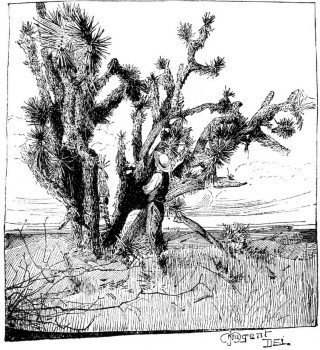
This plant of the desert for a long time was considered valueless. But not long ago it was discovered that the fiber of the Yucca could be made into an excellent paper.[E] And now one of the great English dailies, the London Telegraph, is printed upon paper made from this goblin tree. Indeed, the Telegraph has purchased a large plantation in Arizona, merely for the purpose of cultivating this tree, and manufacturing paper from it. So, you see, the Yucca is now a newspaper plant.
ONE MORE LIVING BAROMETER.
Dear Jack: As you have told us so much about living barometers, I want to tell you that I have one. Mine is a red squirrel. Just before a "cold snap" she will be surly and sleepy. When she is angry, she will spread her lower teeth apart. She will play like a kitten. I call her Gipsy, and she is my chief pet.
Your constant reader, M. M. M.