Part 2 / Act 5 — VERSES IN MEMORY OF DUNBAR COLLEGIATE CHURCH.
Reading edition
There is a Temple in ruin stands,
Fashion’d by long-forgotten hands.
Out upon Time! it will leave no more
Of the things to come than the things before!
——What we have seen our sons shall see,
Remnants of things that have pass’d away,
Fragments of stone, rear’d by creatures of clay!—
Byron.
350The first notice we have of the church of Dunbar is in the Taxatio of Lothian, in 1176, where Ecclesia de Dunbar cum capella de Whytingeham is assessed at 180 merks.—Chalmers’ Cal. From the earliest times, the Earls of Dunbar appear to have been proprietors of the whole parish, and patrons of the church and its subordinate chapels. In 1342, during the reign of David II., Patrick, fifth of that name, and tenth Earl of Dunbar and March, converted the parochial church into a collegiate form.—It was confirmed by William, bishop of St Andrew’s, and besides being the first establishment of that kind known in Scotland, was anciently the richest in the deanry of Lothian. With its subordinate chapels, it was valued at 180 merks, a greater valuation than any other could bear at the same period. At the Reformation, when the church ceased to be collegiate, the archpriestry of Dunbar was stated at £80.
On the forfeiture of the earldom of March, in 1434–5, the patronage of the church fell to the crown. During the reign of James III., it was enjoyed, with the earldom of Dunbar, by the Duke of Albany. It again fell to the king, on the forfeiture of his traitorous brother in 1483; and now belongs to the Duke of Roxburgh, as principal heritor of the parish.
The interior of churches, as well as of domestic buildings, having been much improved within the present century, the collegiate church had long been found inconvenient for a modern audience, accordingly this venerable fabric was condemned, and a handsome new church, from a plan of Gillespie, erected on its site, in 1819.
351
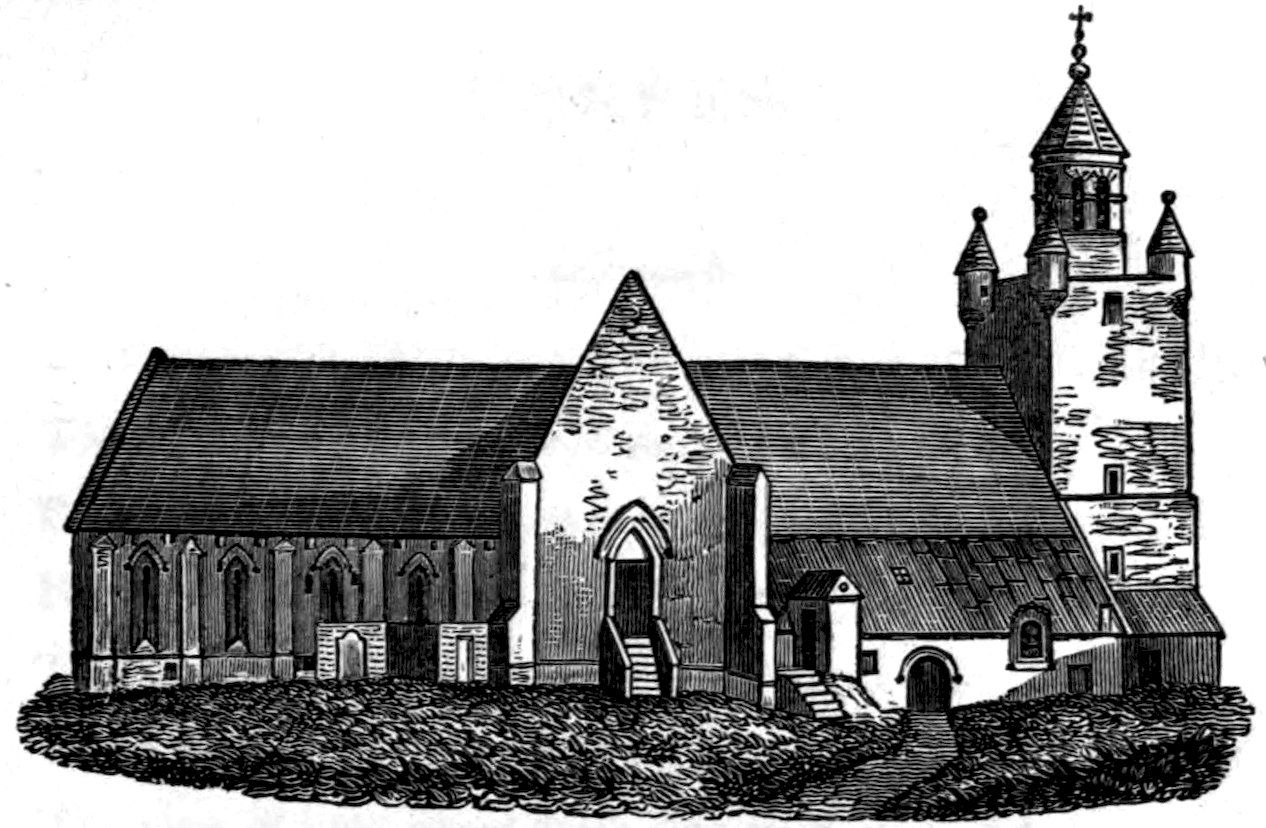
DUNBAR COLLEGIATE CHURCH.
353
VERSES.
Thou tempest-stricken veteran! must thou fall
Beneath the weight of years?—Time long has smooth’d
His scythe on thy grey front; and thou hast braved
The gusty whirlwind, and the thunder-crash,
Through many a stormy hour; and thou hast seen
The sons of men come forth like flowers, and fade,
Four sluggish centuries; yet thou must fall,
And, like the Architect who plann’d thy fane,
Be gulf’d and lost in the Lethean stream.
O thou! who in thy ample arms enfold’st
The unnumber’d charters of the human race,
Come from thy mountain-heap of chronicles,
Thou meditative goddess! and declare
To thy devoted son, whate’er thou knowest
Of this fallen fabric, that, by thee inspired,
My song may be most mournful, yet most true:
354Then will I weave a wreath of evergreens,
And place it on the lofty brow of Fame,
To mock the spoiler Time, and tell the world
The faded glories of this ancient church.
First the proud Catholic, with his pompous forms,
Worshipp’d within these walls. For ages rung
The lofty aisles to the deep organ-peal,
While from the silver censers incense blazed
Before the altar, and the mass was sung:
Peace to the souls of that noble race,
Who form’d this fair and goodly place;
The Holy Spirit will gild their path,
While wandering through the caves of Death;—
And the Mother of God, like Etham’s fire,
Will lead them to the heavenly choir.
This life is but a passing dream,
Where all is false, but the things unseen—
Those glorious visions of the sky
That wake Devotion’s midnight sigh,
When the heart communing with its God,
Longs for its last—its blest abode!
This life is like a story told,
That in the telling waxes old;—
355A breath—a bubble on the stream,—
Verily life is but a dream!—
Peace to the souls of that noble race,
Who form’d this fair and goodly place.
Illustrious March! who rear’d this ancient fane
A gift to heaven—it has outlived thee long!—
Where are thy honours now? They only swell
The herald’s chronicle!—Thy wide domains
Are in the hands of strangers; and thy church
Moulders beneath the giant-crush of Time!
But long ere Time had wrought this church’s fall,
Its worshippers had changed the despot-creed
That bound their fathers; for a learned race,
Nursed in the polemics of Germany,
Had caught a ray from Heaven, and boldly launch’d
Their legal thunders ’gainst the papal throne;
And then, Dunbar, within thine ancient walls,
The Presbyter, in sober vestments stood,
Best fitted for his office, and declared
The simple doctrines of the Man of Grief!—
Ere England’s naval arm had smote the Dutch,
Swarm’d with a pirate horde these fertile shores:
Then sigh’d the matron o’er her infant charge,
Lest the war-whoop at midnight roused his sire,
While on the turrets of thine ancient pile,
356The drowsy sentinel held his weary watch,
And as the morning broke, with searching eye
Scann’d the horizon, fearful lest the shades
Of night had veil’d a foe.——
Nor be thy pulpit-dignities forgot,
Though differing in their creeds, one common lot
Awaits them now before their awful Judge.
I see them rise, in sacerdotal robes,
With meditative eye “that loves the ground.”
First sage Dunbar, of Moray’s noble house,
Deck’d in his gaudy Romish garb appears,
Avowedly zealous;—next walks Manderston,
The advocate of Mary’s hapless cause;
And next, in humbler weeds and solemn state,
The presbyterian Simpson, whose keen eye
Glanced deep into the murderer’s wounded soul,
And dragg’d the horrid secret from its den.
His mighty mind read deep that mystic page
Graved with the characters of future fate;
Foretold the sabbath-breaker’s fearful end,
Saw the mad mother raving o’er her child,
And the lost drave strew’d on the stormy shore.
Then follow Stevenson, the wise and good,
Edina’s ornament, and learning’s pride;—
And Wood, his prince’s favourite, he who won
The mitre of the Isles, and preach’d the cross
357To the lone dwellers of the western main;—
And last, Carfrae, whose native eloquence
Has never been surpass’d within these walls.
But, lo! a Spirit rises from yon towers,
(Whose ruins tremble on the wave-worn cliff;)
Veil’d in the mist of years, it stretches forth
Its viewless arm, and strikes the solemn pile.
The temple trembles to its deepest base,
And its rent fragments strew the hallow’d ground.
And, see! the work of ruin has begun
Within the sanctuary,—a motley crew
Have ta’en possession of the sacred place.
The house of prayer is now an antic stage,
Where boys delight to sport the idle hour;—
And, lo! exalted ‘midst his mad compeers,
An urchin mounts the rostrum, while the crowd
Pick up the fragments of the broken pews,
And pelt their comrade in his pulpit chair.
How changed, since, in the sunny morn of life,
I sat amidst these dear-remember’d pews,
Nor thought the service long! The Roman youth
Hung not with more delight when Cicero spoke,
Than I have listen’d to the holy man.
Returning to these scenes, but late I saw
A crowd of stranger-faces worship there,
And I was left alone.—Where have ye fled,
358Ye dear companions of those pleasant days,
When hope was young like you, fair as the blooms
Before the wintery wind has sear’d their bud?—
Ye rosy-cheeked host, where have ye fled?—
There, in that corner pew, demurely sat,
With scented ’kerchief and a sprig of thyme,
A Frigid Maid, in antiquated state.
Wo to the luckless youth, whom woman’s smile
Had lured astray;—we to the hapless maid
Whom man’s seductive voice had won to vice,
And blighted the red roses on her face;—
It was this Gorgon’s food to feed upon
The strife of others; in her gossip chair
She sat a demon in a woman’s form;
And though ’twas said, that fifty circling years
Had shed a natural whiteness on her head,
With artificial curls and deep-laid rouge,
Still with the changing dresses of the times
Most awkwardly she mimicked the young.
Beneath the middle arches of the church
I’ve seen the Superannuated Fop,
With plaited ruffle and huge periwig,
Smart spectacles and golden-headed cane,
The pleasant dandy of an earlier school,
Sit pompously. ’Twas said, and it was true,
Cards, chess, and draughts, at intervals amused
359The heavy burden of his useful life.
He roll’d in plenty,—but his wines were sour,
His viands tasteless. When he would enjoy,
Avarice was scowling by, foreboding want.
Thus Providence, all-righteous, balances
The fate of mortals,—and the man who seeks
To hoard up human comforts, hath a blight
Within that blasts enjoyment, and amidst
The bowers of paradise he pines a slave.
There sat, with lengthening phiz, The Hypocrite;
“All things to all men,” was his favourite text.
He scoff’d at the profane,—yet never shunn’d
Their company when a foaming bowl went round:
He vilified the lecherous,—yet would “lip
A wanton” in the dark. He was your friend—
Sat at your board; but if on slight occasion
His interest clash’d with thine, then ‘mediately
He stood estranged.—He was a backbiter,
The old man’s contumely—the maiden’s curse!
Religion, politics, were still his theme;
While pliant as the ash that shades the stream,
Grew his opinion, wavering with the times—
The basest were anointed while they ruled,
But out of place, detested by this wretch!
Yet deem not that within these sacred walls
None bore the image of their Maker’s face.
360Because amidst a bed of flowers upsprings
A host of weeds—O, yes! a multitude
Of innocent, honest, upright characters,
Worshipp’d within these walls, that practised all
The shining virtues of a Christian life.
There might be seen the Honest-hearted Man,
Whose tongue was still the echo of his mind,
In sober vestments, listening earnestly
To hear the word of life. He was not free
From early prejudices, cherish’d long,
That look’d like bigotry. New psalmody
Was his abhorrence, tinkling itching ears
With its vain sounds; and innovations all
He could not brook; yet still he was a man
That loved his God, and sought to serve mankind.
Near to the pulpit sat the Simpering Maid,
Wafting her soul in pleasant sounds to heaven,
The toast of half the parish. She, alas!
Long since eclipsed, has hung her beauteous head,
Like flowers that wither in the noontide ray;
For Beauty, like the hues that colour life,
Has but its passing tribute. Novelty
Delights the soul, and yonder blue expanse
Seems not so fair as evening’s changing clouds,
That shape their varied colours in the sky.
Now, arm’d, destruction’s satellites advance,
361And like a stream long pent, at once bursts forth,
O’erwhelming all. The lofty rafters fall,
And roofs, in crashing masses, tumble down,
While the foundation shakes as if the ground
Was struggling with an earthquake’s hot embrace.
Spare, vandal! spare, that splendid monument,
Where lie the ashes of illustrious Home!
Else shall each mailed warrior start to life,
And with his stony gauntlet strike thee down.—
Yes! thou shalt spare that honour’d sepulchre,
And it will stand a princely ornament
To grace the new-born church, that, Phœnix-like,
Shall spring forth from the ashes of its sire.
And spare! O spare! that tablet in the wall,
That marks where Stevenson all lowly lies.
It is too late!—the massy pickaxe falls,
And the stone, graved with letters of renown,
In splinters mixes with ignoble heaps.—
And, see! the busy workmen have begun
To clear the old foundations of the church.
Now in its dark and secret sepulchres
The spade makes devastation, and turns up
The bones of those who long have slept in state.
Go tell Nobility, that he’s a fool,
And wastes his wealth in vain! I’d rather sleep
In yonder green-arch’d cell, with nature’s shroud
362Above my breast, where morning’s smiles might fall,
Or evening’s tears bedew my lonely bed,
Than be twice-buried in these graves of stone,
To prop the basis of some future church.
See, where the labourer turns a precious load
Uncourteously. That little heap of earth,
Once thought—and breathed—and lived—and felt like me!—
’Tis the last relic of an only child,
A doting mother fondled at her breast.
The miniature, image of herself.—
His morn was cloudless—Spring’s delicious breath
Was deem’d too keen to kiss his baby face,—
His walks were in the garden’s shades at noon;
His food was fruits and cream, and choicest sweets;
His bed was roses, like the Stagyrite’s,
Music and Painting cheer’d his leisure hours,
While Poetry’s soft voice beguiled his youth,
And his fond parents only lived for him.—
Alas! how would the foolish woman weep
To see her darling’s ashes toss’d aside
Beside some beggar’s brat,—some untamed boy
Who fed on charity,—to whom, at eve,
A barn or byre was choicest luxury.
Now myriads crowd, like pilgrims on a march,
To take a last look of their early Friend!—
363Yes! midst the many chequer’d scenes of life
The church was still their Friend. When blithe and young,
The lessons taught within her hallow’d walls
Reform’d their manners and improved their heart.
In active manhood, when love’s gentle thrill
Beat in the bosom, and the stripling paid
His marriage-tithes, and to the altar led
The lovely object of his youthful choice,
(Blushing like virtue at her own applause,)
This church then hail’d him as a worthy Friend.—
And when the circling months had blest the bed
With fruit in season, sponsor-like it gave
The child a name.—Nor less in grief, than joy,
Has this fallen fabric acted friendly part;
Administering consolation in distress,
And wafting prayers for thee when hope was gone.
No more the sailor, homeward bound, will hail
Thy well-known turrets, shining on the steep,
A blessed sea-mark. Oft at sight of thee,
How nimbly slipt the cordage through his hands,
For he was near his home;—and wife, and friends,
And social canns of grog were flowing fast,
In fond anticipation ere they came.
Upon thy towers, it was a pleasant sight
To view the varied landscape, hill and dale
364Promiscuous mingling, stretching far away.
Eastward St Abbs his promontory dips
In the blue wave. Behind the dusky lines
Of Lammermoor extend in mountain-pride,
While Doon Hill, sloping, bares its reddening sides
To meet the ploughshare, glittering on the steep.
Beneath it lies the haunted glens of Spot,
Where Hecate’s children held unhallow’d feats
Around the rowan-tree,—the cauldron smoked,
While the Rigwoody Witch, with horrid oaths,
Startled the bird of night.—But sweeter spread
The glen of Ossydean, at morn or eve,
Where patient angler, by the winding stream
Secures his prey; and Broxmouth’s tufted woods,
Fann’d by the sea-breeze, stretching to the sea,
Where the Protector, with his fierce brigade,
Subdued the Covenanters. Peaceful now
Sails on her gentle lake, among the trees,
The downy cygnet, gazing at herself
In the clear waters. Nearer, through the shades,
Rural Lochend, in pensive beauty stands;
There spreads the Latch, a pleasant rendezvous,
Where it was sweet, at Sabbath’s morn, to hear
The church bell’s melody, as through the copse
We saunter’d to the Common’s daisied walk;
Southward Dunpender rears his verdant head;
365Far west the Pentlands hide their pointed tops
In the ethereal sky; and Fife’s dark shores
Bound the wide-swelling Forth; the hermit May
Stands with his torch; and Berwick’s lofty Law
Shines isolated; and the craggy Bass
Shows its white cliffs; while, underneath, is seen
Dunbar’s grey towers, that tremble on the steep;
Her harbour snug—her battery, picturesque;
Her rocky caverns, and her pebbly shores!
Yon setting sun, that gilds the watery west,
Sheds on the glories of that fallen church
His farewell rays. Another morn, and then
There’s not a sculptured fragment left to tell
Where stood a temple. I will stand and gaze
A last adieu!—and then return, and gaze,—
’Tis parting with a loved familiar friend,
Endear’d by early, long, and sweet acquaintance;
For every stone of hers is chronicled
Deep in my memory, there to bloom for ever;
More lovely in the shade of future years,
When mellow’d by the softening hues of time.
Poor pilgrim of a day! thou too must fall,
Like art’s strong works, amidst the waste of years;
But the Great Architect who plann’d thee first,
Will model thee again more beauteously,
When his own Zion he builds and repairs.
366The Church-yard Soliloquy
Ye sepulchres, and sculptured monuments!
Whose uncouth rhythmes often wake a smile
Where Pity’s tear should fall,—I come to muse
Upon the silent tenants you enshrine;
And, lo! like peopled mists in highland glens,
They live before me in their earthly shapes.—
Whose is that cherub-form? Pale roseate hues
Bloom on her faded cheek. Her little hands
Are stretch’d toward me.—Ha! she flies—she flies!—
I start entranced, as from a waking dream,
And kneel upon my sister’s viewless grave.
She died in infancy,—and I have wish’d
That we had closed our pilgrimage together;
Then had I ’scaped a world of guile and wo,
And fallen, like her, upon the lap of heaven,
Pure as a snowdrop on a virgin’s breast.
Ah! little did I think, when late I dew’d
Thy mossy dwelling with a brother’s tears,
That my poor heart should feel a deeper sting;
That with a father’s feelings I should weep
A darling child, nipt in the bud of life,
Gone, ah! too soon, to mix his dust with thine!
367Unnumber’d figures float, in dim review,
That wear the form of images forgot,
Wash’d from the mind’s eye by the flood of time
Like lines upon the sand; yet I have seen
These forms and faces breathe and act like me,
Smile at a jest, or melt at tales of wo;
Warm with the glow of hope, exult in joy;
Grow pale with rank disease, and waste with sorrow;
Now they have paid life’s ruthless creditor,
Nor left a trace to mark their path behind.
There walks the bridegroom with his pensive bride,
Whom I saw church’d in yon dismantled pew,
In all the dazzling glow of health and beauty,
Blushing with roses.—Ah! how faded now
Her nameless beauties and bewitching smiles;—
No ringlets wanton on that horrid face,
Those cheeks are sunk, that swell’d with sweet expression;
Those eyes are dim, that beam’d like shining stars
Before heaven’s gates, and tenantless their sockets;
While on that breast, where Love delighted dwelt,
The loathsome worm has made a gorgeous feast!
Death strikes the coward swain; the warrior bold
He smites amidst his bright career of honour!
So Ramsay fell, the noble and the brave,
When life was big with promise; here, behold!
368Maternal love has rear’d a monument,
And the green turf becomes a hallow’d spot,
When water’d by a mother’s holiest tears.
And, haply, in these burial solitudes,
Some wo-struck youth, at eve, may meditate,
What time the moon, in pensive loveliness,
Leads forth her blue-eyed sisters, and from heaven
Chases the dusky Queen: Then as he mourns
A brother’s loss, or weeps the death of friends,
He sees that last and lonely green-arch’d cell,
Where he will also find a quiet home.
And does there slumber in forgotten dust,
Some earlier bard, who hail’d this ancient church
With heavenly melody?—Alas! such fate
Awaits the framer of this lowly lay!
A few short years, and nameless is the spot
Where the lone thistle blossoms on his grave.
369
NOTES TO VERSES ON DUNBAR COLLEGIATE CHURCH.
Page 335, line 21.
Ere England’s naval arm had smote the Dutch,
Swarm’d with a pirate horde these fertile shores.
These lines allude to a visit paid to the Forth by that noted marine-adventurer, Paul Jones, in September, 1779. His squadron lay at anchor for some days off Dunbar, during which period the town was inundated with soldiers, and the people were busily employed throwing up batteries on the kirk hill, &c. In consequence of a vessel called the Rodney, (afterwards one of the Greenland ships belonging to the port) running into Dunbar harbour for shelter, a brig of the enemy’s weighed anchor, and nearly run on shore in pursuit of her. The squadron, having stood up the Forth, were seen nearly opposite Leith on the 17th, when a violent south-west wind arising (aided, as was said, by the prayers of a goodly minister of Kirkcaldy,) fortunately drove them rapidly back again, and laid them alongside his Majesty’s ships the Serapis and Countess of Scarborough, near Flamborough-head, which Jones captured after a desperate engagement. They had the Baltic fleet in convoy, which luckily escaped during the conflict. The enemy carried their prizes to the Texel, having on board 300 prisoners, whom they had taken during their cruise in the North seas. For these exploits the king of France rewarded Paul Jones with the military order of merit, and a gold-hilted sword.
In May, 1781, Captain Fall, another, but less noted adventurer, appeared off Dunbar, under peculiar circumstances. A small privateer had been fitted out from that port, which, after a long absence, appeared one morning, to the indescribable astonishment 370of the inhabitants, not with a prize, but followed by a huge privateer in chase! Having run snugly on shore, under shelter of the haven, she opened her broadside on the enemy, whom she provoked to send a few shots into the town, one of which struck a log of wood near the castle. It is even said that the volunteers of those days pelted her with musquetry from the pier! This insufficient mode of warfare against so formidable an enemy might have been attended with serious consequences to the town, had not a veteran seaman sent a well-directed shot from a heavy carronnade which lay on the island, and nearly carried away the pirate’s mast. This had the desired effect of making him sheer off.
Page 356, line 10.
First, sage Dunbar, of Moray’s noble house,
Deck’d in his gaudy Romish garb appears.
Columba Dunbar, descended from the Earls of Moray, was dean of the church of Dunbar in 1411, whence he was promoted to the see of Moray.
Page 356, line 12.
——Next, walks Manderston,
The advocate of Mary’s hapless cause.
John Manderston was canon of the college church of Dunbar in 1567, and was one of those appointed by the Archbishop of St Andrews to attend the court on a divorce sued for by Lady Jean Gordon against the Earl of Bothwell, while Queen Mary was detained at Dunbar.
Page 356, line 15.
The presbyterian Simpson, whose keen eye
Glanced deep into the murderer’s wounded soul,
And dragg’d the horrid secret from its den.
Andrew Simpson was master of the school of Perth, and taught Latin with much success. He had sometimes under his charge 300 boys, many of them sons of the principal nobility. He left Perth at the Reformation, 1560, and became minister of Dunning and Cargill, from which he was translated, in 1564, to Dunbar, where he 371sustained the double office of master of the grammar school and minister of the parish.
In 1570, Mr Simpson was called to attend the Rev. John Kello, minister of Spot, in his sickness, who was shortly after convicted, and executed for the unnatural murder of his wife. This unhappy man having related a remarkable dream he had had to Mr Simpson, the latter had no hesitation in retorting upon him, as Nathan said unto David,—Thou art the man!—This struck so deep into the culprit’s heart, that he made instant confession, and, when afterwards on the scaffold, he ascribed the disclosure of this horrible deed to the soul-piercing discernment of this pious priest, in these memorable words:—
“Ther was not small support in the mouth of some faythfull brethren, to bring me to this confessione of my awin offence. Bot, above all, Mr Andro Symsone, minister of Dumbar, did so lyvlie rype foorth the inward cogitationes of my hert, and discover my mynd so planelie, that I persuaded myself God spak in him; and besydis vtheris notable coniecturies which he trulie dedvced befoir my eyes, he remembrit me of ane dreame, which in my grit seikness did appearandlie present the self ... at this tyme did God move my hart to acknowledge the horror of my awin offence, and how far Sathan had obteinit victorie ower me.”—Bannatyne’s Trans. Scot. p. 47.
Page 356, line 25.
And Wood, his prince’s favourite. He who won
The Mitre of the Isles, and preach’d the cross
To the lone dwellers of the western main.
Andrew Wood, Bishop of the Isles, was son to David Wood, a minister, by Miss Guthrie, sister to John Guthrie of Guthrie. He was first minister of Spot, and then of Dunbar, and was created Bishop of the Isles in 1678. He received a dispensation from the king to hold the benefice of Dunbar together with the said bishoprick. He was translated to the see of Caithness in 1680, where he continued till the revolution in 1688. He died at Dunbar in 1695, aged 76 years.—Keith’s Cat. p. 129.
372Page 361, line 6.
Spare, vandal! spare, that splendid monument,
Where lie the ashes of illustrious Home.
Sir George Home was created Earl of Dunbar[22] by James VI., and died at Whitehall, Jan. 29, 1611. “His body,” says Crawfurd, “being embalmed, and put into a coffin of lead, was sent down to Scotland, and with great solemnity interred in the collegiate church of Dunbar, where his executors erected a very noble and magnificent monument of various-coloured marble, with a statue as large as life.”—Crawfurds Officers of State, vol. i. p. 399. This superb monument was situated in the east aisle of the collegiate church, and as that part of the old wall against which it stood was incorporated with the modern building, it still retains its original situation in the new edifice.
Page 361, line 41.
And spare, O spare! that tablet in the wall,
That marks where Stevenson all lowly lies.
This tablet was situated on the right of the door, leading into the south-east aisle. Of the elaborate inscription, the name of Stevenson alone was legible; but it may be seen in full in “Monteith’s Theatre of Mortality.” He was 30 years professor of philology and philosophy in Edinburgh, and 25 years minister of Dunbar.
Page 364, line 16.
Where the Protector with his fierce brigade
Subdued the Covenanters.
Cromwell entered Dunbar on Sunday, 1st September, 1650, the day preceding the battle of Dunbar, and encamped in the neighbourhood of the church, taking up his quarters in Broxmouth-house. Tradition says, that he fortified the church-yard.
373