Part 2 / Act 5 — THE LOST DRAVE OF DUNBAR; OR, THE WITCH OF KEITH.
Reading edition
249
THE LOST DRAVE.
This poem is founded on the following calamity, recorded in the Session Minutes of Dunbar:
July 27th, 1712, the minister (Thomas Wood) had been ordaining elders, when, says the minute, “The elders are exhorted to walk exampelary in their good behaviour before the people, and to be carefull to delete scandallous persons, or such as break the Sabbath-day. Morover he (the minister) read to them a minute left be his predecessors, mentioning how dreadful a disaster had fallen upon the people of this place for breaking the Lord’s day; ordains the same to be Regarat. Qch is as followeth:
“Mr Simpson, minister at Dalkeith,[11] son to Mr Andrew 250Simpson, minister at Dumbar, in his exposition of the XXXIId. Psalm, hath these words:—‘A fearfull judgement of God fell furth at Dumbar about the year of God 1577, qrof I was an eyewitness. My father, Mr Andrew Simpson, of good memory, being minister thereof, qho, going to the church, saw a thousand boatts setting their netts on the Sabbath. He weeped, and feared that God would not suffer such contempt. It being a most calm day as ever was seen at that season;—at midnight, when they went furth to draw their netts, the wind arose so fearfully, that it drowned eight score and ten boatts, so that there was reckoned in the coast side fourteen score of widdows!”
From another account of the same calamity, found written on the leaf of an old Bible, and said to have been copied from the Armenian Magazine, it appears, that at this period Dunbar was the station for the Dutch as well as for the Scotch fishery.
251
THE LOST DRAVE OF DUNBAR.
Soft blew the gales of autumn on thy cliffs,
Dunbar! and fann’d the beauteous glowing Forth,
While vessels bounded o’er the spangled waves,
And shoals of herrings skimm’d below the keels,
Like silver fishes ’neath the crystal floor
Of eastern palaces, when prosperous years
Had brought a vast assemblage to thy shores
From Holland and the Isles: a greedy race,
Who riches sought despite of God and man,
And lured thy sons to death with tenfold horror!
On Sabbath morn, the church’s early bell
Call’d pious men to solemn deeds of prayer,
When the ungodly fishers launch’d their drave
Upon the shining sea. A thousand boats
Spread their brown oars, and darken’d all the strand,
As when the Indian chiefs, in fierce canoes,
Come forth to battle;—and ’twas sad to see
The fishers cast their black nets in the brine,
252While godly men were journeying to church.
Out spake the zealous priest, with warning voice,
Against such mark’d and foul contempt of God,
And his most blessed holy ordinances;
But, mocking the old man, they turn’d away
Their ears from his rebuke, while some exclaim’d,
“Delays are dangerous,” others: “We make hay
“In sunshine;” thus, in vulgar witticisms,
They sneer’d at the good man’s prophetic words.
That morning’s calm was like the meteor’s glare,
That dazzles to destroy its wareless victim;
For when the boatmen, at night’s lonely hour,
Return’d to draw their nets, loud roar’d the gale,
As if from Greenland’s cold unfathom’d caves
Winter had come with all his host of storms.
The seaman’s face turn’d pale, as boats on boats
Rush’d fearfully o’er yawning vortices;
While, like a monster, lash’d the sea around,
Now gorging and next vomiting her prey,
And shoals of scaly fry, sheer upward thrown,
Came down like sheeted hail upon the decks!
Prows split on prows—the splinter’d oars were slipt;
And shiver’d sails flew from the shatter’d masts
In dread confusion, as when horror stalks
Amid the thunder of the British line!
Despairing groans and bursting hearts were there,
253And parting spirits spoke most horrid things,
Lisping the name of Jesus!—others plunged,
Breasting the roaring wave, and swearing sank
Into the dark abyss, while shadowy forms
Rung words of dreadful import in their ears!—
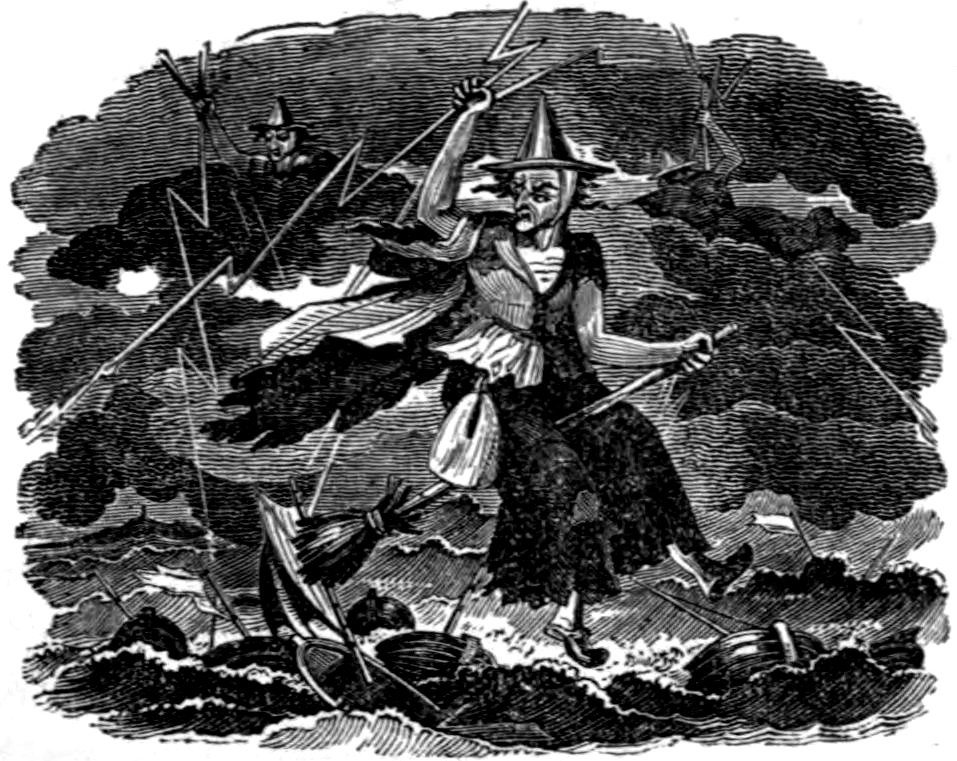
But, chief amid the demons of the storm,
High soar’d, pre-eminent, the Witch of Keith,
Clear seen by her own lightnings, as she strode
The quivering mast, and trill’d this wayward song:
The Witch’s Song.
Cummer, go ye before, cummer, go ye;
If ye will not go before, cummer, let me!
The child fed on milk like a floweret on dew,
In the dread hour of trial its purpose may rue;
While through the red levin we wrestle the storm,
And give the lost drave to the fish and the worm!
The tempest has thicken’d, since merrily we flew
O’er the deep glens of Humbie, ere chanticleer crew.
By the green skirts of Lammer we rallied our host,
And dug the morass where the pedlar was lost:
A charm we found hid, in the pit’s central cell,
’Twill conjure a legion of devils from hell!
254Haste! haste! where yon skipper is lab’ring in vain,
In his crazy old shallop the helm to regain,
Take Rutterkin, mewing, and plunge her below,
Where the mermaid is rinsing her visage of snow;
Then a shout will be heard, rising slowly and loud,
That will make the bones rattle that rot in the shroud.
There’s fire in his bosom that never will drown;
For the baby is strangled that no one will own;—
There’s cattle a-hungering though pasture be near;—
There’s hypocrites praying in fervour and fear!
Cummer, go ye before, cummer, go ye;
If ye will not go before, cummer, let me!
Thus sung the Witch of Keith; anon she sat
Revelling with Satan; and, with eldriche glee,
Laugh’d loud to see the drowner’s agony!
There shone the Sorcerer, Fein of potent power,
(The key-keeper of the air’s artillery,)
With the accursed crew, that ofttimes held
Unhallow’d meetings in North Berwick’s fane,
Plotting destruction ’gainst the royal James;
Wretches that pilfer’d church-yards, and would cut
The wedding-ring from off the putrid finger!
O heavens! it was a soul-subduing sight,
Where those of nearest kin were doom’d to perish!
255The father spurn’d the son—brother the brother—
Each push’d the other down, as wild he strove
To catch the floating wreck, while the stout youth
Triumph’d above his old grey-headed sire!
Amid these fearful scenes some seamen gain’d
That ridge of rocks that stretch ’neath March’s Dyke—
Short was their respite—headlong on the rocks
The coming wave dash’d out their dizzy brains!
While hollow groans came echoing to the shore.
At these appalling sounds, the deer was roused
In Broxmouth’s shades: thence, bounding up the hill,
He dripping stood in Thurston’s lonely glen.
Wo to the hapless beast; for from their lair
He roused a gang of witches,—in revenge
A fearless hag assumed the greyhound’s form,
And chased the frighten’d stag o’er hill and glen,
Till, ere he wist, in Bransley’s fatal moss
He found a sepulchre, watery and deep!
Returning thence, for safety, the elf took
The colley’s shape; and singling from the herd,
That clad the hills, the sleekest milk-white ox,
Drove the astounded creature passive on
To where the sisters held their rites profane.
Muttering a spell, they took the lusty steer,
And bound him limb to limb, and then baptised
A brindled cat; which done, they buried both
256Deep in the earth alive: a sovereign charm
’Gainst rank disease:—then mincing signs they tore
Three shrivell’d fragments from a dead man’s hand,
And pounded them to powder!—precious stuff!
To work the hest of Satan. Noxious clouds
Rose from the cauldron as the faggots blazed,
When gathering, round and round, “Aroynt!” they cried
Sweeping the welkin with their winged brooms,
Oceanward, bent on hell-imagined deeds.
Amongst this train, there was a youthful quean,
Comely, dark-featured, called Isobel Young,
Who vow’d revenge on one, whose scandalous tongue
Had done her injury, named “Crazy George!”
Bell, lighting on his boat, grasp’d firm the helm,
And dash’d him pellmell through the broken waves:
Then, with a grin, she leer’d in George’s face,
And mutter’d “Grist!”—next onward reckless steer’d
Towards the shore, nor stopt, till, grazing, shook
The little shallop on the rutted rocks;
When, smarting, like a living thing it veer’d,
And sought once more the bosom of the storm:
But when the shatter’d mast fell overboard
With its torn drapery, the poor man roar’d!
Clasping the gunwale.—Bell, again, cried “Grist!”
George gnash’d his teeth, and pray’d that Christ would save
257His soul from Satan!—sovereign talisman
Was in these words; for ‘mediately the fiend
Vanish’d in flame, still muttering, “Grist, grist, grist!”
Now ’midst the dismal pauses of the storm
The seaman’s wail was heard, echoing among
The Castle’s caverns, (like the hopeless groan
Of wretch in its lone dungeons,) as he call’d
On God to bless his wife and helpless boys!
But still these awful words rung in his ear,
Darkening portending fate: “Ye would not come
“When mercy waited on thee; now, when floods
“Of mighty waters rush upon thy soul,
“The Lord forsakes thee!”...
The beacon blazes high on Trowness Point,
Tinging the ruins of St Dennis’ church,
That seem in flames, while gleaming wide and far,
Like thickening stars upon the robe of night;
The lights are gathering, and the sea-fowl’s scream,
(Roused from her aerie nest on lone St Abbs,)
With noisy flapping wings, and mazy flight,
Deepens the mournful music of the storm!
Matrons—and maids—and lovers—crowd the strand!
And hands are wrung, and silken tresses tore;—
And swollen hearts choke up the power of speech;—
And children seek their fathers—who have none!—
258And wives their husbands—who are husbandless!—
And sires their sons—who now must beg their bread!—
And maids their lovers—wed away to death!—
The Angel of Destruction stalks abroad,—
And who can stay his arm, or bound his course?
When morning shone upon the troubled sea,
Like gleams of gladness on the face of horror,
Unnumber’d images of death appear’d
To catch the aching eye. A firm-built boat,
That braved the stormy night, drew near the harbour,
With two lorn men on board, (the rest had died
Through dire fatigue, worn at the faithless oar;)
But Hope, alas! smiled only to betray;
For a voracious wave, with ruthless fury,
Shiver’d their skiff on that lone rock, where now
An Iron Pole the sailor’s beacon stands!—
A vessel, laden, drifted to the shore,
Below the Washing Rocks, and met the waves,
As vaulting up, in clouds of foam, they lash’d
The weeping heavens. O, it was pitiful
To see the trembling Dutchmen how they raved
In terror at the gale, and inly sigh’d
For the cold breeze that fans the Zuyder Zee;
As evermore the rock-chafed breakers fell
With roaring deafening noise.—Forth on the deck
259A gallant youth appear’d, and wound a rope
Around his manly waist, then fearless plunged
Amidst the boiling surf, and sought the shore.
Long, long, he buffeted the waves, and sunk;
Till, like a sea-bird, rising from the depths
Of ocean’s coral beds, again he held
His fearless course, and near exhausted landed
Amidst glad shouts, upon the pebbly strand;
When, from his panting sides, a rope unwove,
Was firmly braced upon the strand, and form’d
A smooth-declining angle from the vessel,
Whereon a cott was slung, which glided soft
Piloted to the shore, and from its bosom
Leap’d forth a lady, veil’d in silvery foam,
Like Agenor’s royal daughter when she stood
On the Dictean coast. None ever knew
For what, or whence, these sea-beat wanderers came,
(Perchance some Danish princess, tempest-tost!)
The seamen answer’d all interrogatories
Forbiddingly.—The strangers went away
In mystery,—and their secret went with them!
Pale Desolation sat upon the beach
Weeping o’er human woe—a gloomy picture!—
Like the grim after-scenery of a battle,
(Where fiends joy o’er the havoc fools have made.)
260Boats lay keel up, beating among the rocks,
And splinter’d spars lay thick as harvest stubble;—
While ghastly corpses drifted to the shore,
Clench’d in the sand, or ’tangled in the weeds;—
And many push’d to gain the ocean’s edge,
Gazing, knee-deep, in silent breathless horror,
Trembling lest the next wave should waft a friend;—
And wretched women, with their screaming babes,
Delirious sought their husbands’ lifeless forms!
There stood an old man by the sea and wept,
And tore his hoary locks, and raved, and swore—
His sole support, his only son was drown’d!
And by yon Castle’s cliffs, a virgin bride
Beheld her lover’s bloated carcass floating;
She spoke not, but, wild gazing, madly sprung,
And made her bridal-bed on the green billow!
How various are the hues that tinge the mind,
So nicely shaded, that philosophy
Might spend eternities and never trace them,
A novice in the school of vain conjecture!
Cold, cold, and gentle was the icy grief
That chill’d the bosom of forsaken Mary!
Losing itself in settled melancholy.
Long on that rock, where art, with curious skill,
Has scoop’d a cave, and wells a crystal spring,
261She sat on that dread day in musing sorrow;
And oft, in after times, she sought that spot,
Where, robed in many colours, she would braid
Her hair with sea-weed, and with varied shells
Picture the perish’d drave—and sob—and sing.
A buxom matron had six gallant sons
In this sad enterprise. She slumbering lay
In morning dreams, and saw them all return
Laden with treasures from the gorgeous deep;
Each held a foaming jar in his glad hand,
Filling a silver cup with rosy wine,
To pledge their mother’s health. With joyous face
They bade her drink.—She raised herself in bed,
Stretch’d forth her hand to grasp the proffer’d cup—
It fell—she woke!—when, horrors! one by one
Their death-cold forms were brought into her cottage:
Henceforth her senses in wild mazes wander’d,
And she was seen, a broken-hearted woman,
Singing for evermore these plaintive rhymes.
Song.
My heart is on the faithless wave,
That bore my love away:—
The sun that gilds both tree and tower,
Brings me no happy day!—
262The ways of life are dimly seen,
They shine through sorrow’s tear;
When all is bright with pleasure’s beam,
Misfortune’s shades appear.
My creel hangs in a corner now,
That leapt with silver fry;
And I, whose maurlain aye was full,
In poverty must sigh!
O friendship’s a deceitful gleam,
That gilds our happy years;
But, like the sunshine of a dream,
It leaves us in our tears.
Yon castle bows its lofty head,
Where gilded turrets shone;
Now that it lies in ruin’s bed,
Its fate is like my own!
The lads who’d bleed to save it still
Are pillow’d on the deep;
Their winding sheet the ocean’s brine!—
Their monument its steep!
The violin’s mute in Jeanie’s cot,
Its master’s now at rest!
263The wave, when dewy evening falls,
Is curling o’er his breast.
My cheerful hearth is desolate;
My children all are gone!
And in a weary world I’m left
To struggle through alone.
Some say, there’s joy in weeping long,
That gladness springs from grief;
To me, nor weary day, nor night,
Can ever bring relief!
The ways of life are dimly seen,
They shine through sorrow’s tear;
When all is bright with pleasure’s beam
Misfortune’s shades appear.
From dark Northumbria to the Orcades,
Echo’d in Scotland’s bays the voice of wo,
Like that wild yell that rises when th’ Hindoo
Ascends the funeral pile. Lost mothers mourn’d
Like Niöbe for their children; pining maids
Wander’d like Suilmatha on the beach,
In search of the dear lonely bark that bore
Their absent lovers, who must ne’er return!
The bud, unblossom’d then, was doom’d to shed
Its earliest tears while listening to this tale;
264And the cold Dutchman, leaning on his oar,
Would smooth his rugged brow, distend his soul,
Then bless his dank canals, and doff his pipe,
When he was told his kinsman’s fearful fate
On thy rough shores, Dunbar! And princes too
Might weep the fate of those whose toils obscure
Enrich’d a nation; even as Charles wept
Beside the fisher’s tomb where Beuckel slept!
END OF THE LOST DRAVE.
265
NOTES TO THE LOST DRAVE; WITH AN ACCOUNT OF THE WITCHES OF EAST LOTHIAN.
“If any of you have a sheep sick of the giddies, or a hog of the mumps, or a horse of the staggers, or a knavish boy of the school, or an idle girl of the wheel, or a young drab of the sullens, and hath not fat enough for her porrage, or butter enough for her bread, and she hath a little help of the epilepsy, or cramp, to teach her to roll her eyes, wry her mouth, gnash her teeth, startle with her body, hold her arms and hands stiff, &c. And then with an Old Mother Nobs hath by chance called her Idle Young Housewife, or bid the Devil scratch her; then no doubt but Mother Nobs is the Witch, and the young girl is owl-blasted!”—Harsenet’s Declar. p. 131.
Page 251, line 13.
When the ungodly fishers launched their drave
Upon the shining sea.
The manner in which this fishery is carried on is similar to the plan of the old Dutch fishery, which renders it extremely beneficial to the country. The boats belong partly to fishermen, (who employ the rest of the year in catching white fish,) and partly to landsmen, who build and equip them in the way of adventurers. An adventure of this kind is called a Drave.
In ancient times a certain quantity of herrings was taken for the king’s kitchen. This was afterwards commuted into a tax of ten shillings upon every sizeable boat. There was also a duty paid to the High Admiral’s deputy, who presided over the fishery.—Camp. Sur. vol. i. p. 419. This has fallen into desuetude. The fishers, however, appoint one of their number, whom they style Admiral, to arrange the order of sailing, &c. and two chancellors, to whom all their disputes are referred.
266
A CONCISE ACCOUNT OF THE WITCHES OF EAST LOTHIAN.
To avoid crowding so small a poem with a mass of notes, which might be multiplied ad infinitum, I shall, as briefly as possible, notice those mysterious personages, whose deeds once formed the evening’s tale and the morning’s debate of our ancestors.
The first apparently belonging to this county is the Gyre Carling, queen of the fairies, the Great Hag or Mother Witch of the Scottish peasantry. The subjoined fragment, copied from the Bannatyne MS. into the Border Minstrelsy by Sir Walter Scott, and more recently transcribed by Mr David Laing into his Select Remains of the Ancient Popular Poetry of Scotland, is presented to the reader, as descriptive of the abode and other properties of that monstrous lady.
The Gyre Carling.
In Tiberius tyme, the trew Imperiour,
Quhen Tinto hills fra skraiping of toun-henis was keipit,
Thair dwelt ane grit Gyre Carling in awld Betokis bour,
That levit upoun Christiane menis flesche and rewt heids unleipit;
Thair wynit ane hir by, on the west syde, callit Blasour,
For luve of hir lauchane lippis, he walit and he weipit;
He gadderit ane menzie of modwartis to warp doun the Tour;
The Carling with ane yren club, quhen that Blasour sleipit,
Behind the heill scho hatt him sic ane blaw,
Quhil Blasour bled ane quart
Of milk pottage inwart,
The Carling luche, and lut a fart,
North Berwick Law.
The king of Fary than come with elfis mony ane,
And sett ane sege, and ane salt, with grit pensallis of pryd;
And all the Doggis fra Dumbar was thair to Dumblane,
With all the tykis of Tervey, come to thame that tyd,
They gnew doune with thair gomes mony grit stane:
The Carling schup her on ane sow, and is her gaitis gane,
Grunting our the Greik sie, and durst na langer byd,
For bruklyng of bargane, and braking of browis:
The Carling now for dispyte,
Is mareit with Mahomyte,
And will the doggis interdyte,
For scho is Quene of Jowis.
267Sensyne the Cockis of Crawmound crew nevir a day,
For dule of that devillisch dem wes with Mahoun mareit.
And the Henis of Hadingtoun sensyne wald not lay,
For this wyld wilroun witch thame widlit sa and wareit;
And the same North Berwick Law, as I heir wyvis say,
This Carling, with a fals cast, wald away careit,
For to luk on quha sa lykis, na langer scho tareit;
All this langour for luve before tymes fell,
Lang or Betok was born,
Scho bred of ane accorne;
The laif of the story to morne,
To you I sall telle.
In another burlesque poem, entitled, Ane Interlude on the Laying of Lord Fergus’s Gaist, Bettokis Bower again occurs:—
“Listen, lordis, I sall you tell,
Off ane very grit mervell,
Off Lord Fergussis gaist,
How mekle Sir Andro it chest
Unto Beittokis bour,
The silly sawle to succour.
The “little gaist,” besides committing other misdemeanors,
“It ran to Pencatelane,
And wirreit ane awld chaplane.”
Another of the Gyre Carling’s popular appellations was Nicnevin. Montgomery, in his Flyting, describes her array and her elriche company on All-hallow even:
“Nicneven with her nymphes, in number anew,
With charms from Caitness and Chanrie of Ross,
Whose cunning consists in casting of a clew.
These “venerable virgins, whom the world call witches,” continues he,
“Backward raid on brod sows, and some on black bitches;
Some, on steid of a staig, oure a starke Monke straide.
Fra the how to the hight, some hobles, some hatches;
With their mouthes to the moone, murgeons they maid.
Some, be force, in effect, the four windes fetches;
And, nyne times, withershins, about the thorne raid.
Montgomery’s Poems, p. 117. Edit. 1821. 8vo.
Sir David Lindsay, in his Introductory Epistle to his “Dream,” tells the Kingis Grace, how he had “fenyit mony fabill” to comfort him when he was sorry;
“And of mony uther plesand history,
Of the reid Ettin, and the Gyre Carling.”
268From such a character the transition is easy to the
——Accursed crew, that oft times held
Unhallow’d meetings in North Berwick’s fane,
Plotting destruction ’gainst the royal James.—P. 254.
Agnes Sampson, or Symson, called the Wise Wife of Keith, (in Humbie parish,) was one of those who confessed having dealings with his satanic majesty, before King James VI., in the winter of 1590. She is characterized by Archbishop Spotswood, as “a woman not of the base and ignorant sort of witches, but matron-like, grave and settled in her answers, which were all to some purpose;” and Sir James Melville informs us, that she was a renowned midwife.
Agnes was accused by the Holyrood-house tribunal of having renounced her baptism, and of having received the devil’s mark; of raising storms to prevent the queen’s coming from Denmark; of being at the famous meeting of witches at North Berwick church, &c. where the devil presided, not “in the shape of beast,” but, most uncourteously, in the habit of a priest!—Arnot’s Crim. Trials.
At first Agnes denied the accusations brought against her by the king’s majesty and the lords assembled, but being ordered to prison to undergo the torture, she returned to her judges in a frame of mind suitable to make the following confession, which I shall give in the words of Glanvil:—
Confession of Agnes Sampson to King James, then of the Scots.
“Item, Fyled and convict for sameckle as she confessed before his majesty, that the devil in man’s likeness met her going out in the fields from her own house at Keith, betwixt five and six at even, being alone, and commandit her to be at North Berwick kirk the next night. And she past then on horseback, conveyed by her good-son, called John Cooper, and lighted at the kirk-yard, or a little before she came to it, about eleven hours at even. They danced along the kirk-yard; Geilie Duncan plaid to them on a trump; John Fien mussiled led all the rest; the said Agnes and 269her daughter followed next. Besides, there were Kate Grey, George Moilis’s wife, Robert Greirson, Katherine Duncan Buchanan, Thomas Barnhil and his wife, Gilbert Macgil, Joh. Macgil, Katherine Macgil, with the rest of their complices, above an hundred persons, whereof there were six men, and all the rest women. The women made first their homage and then the men. The men were turned nine times widdershins about, and the women six times. John Fien blew up the doors, and blew in the lights, which were like mickle black candles sticking round about the pulpit. The devil startit up himself in the pulpit like a mickle black man, and every one answered “Here.” Mr Robert Grierson being named, they all ran hirdie girdie, and were angry: for it was promised he should be called Robert the Comptroller, alias Rob the Rower, for expriming of his name. The first thing he demandit was as they kept all promise, and been good servants, and what they had done since the last time they had convened. At his command they opened up three graves, two within, and ane without the kirk, and took off the joints of their fingers, toes, and neise, and parted them amongst them: and the said Agnes Sympson got for her part a winding-sheet and two joints. The devil commandit them to keep the joints upon them while they were dry, and then to make a powder of them to do evil withal. Then he commandit them to keep his commandments, which were to do all the evil they could. Before they departed they kissed his breech; the record speaks more broad, as I noted before. He had on him ane gown and ane hat, which were both black; and they that were assembled, part stood and part sate: John Fien was ever nearest the devil, at his left elbock; Graymaical keeped the door.”—Glanvil’s Sadducismus Triumphatus, p. 399.
Agnes having confessed many miraculous and strange things to his majesty, he branded her and her gang as a body of “extreme liars,” when, taking him a little aside, “she declared the very words which passed between the king’s majesty and the queen at Upslo, in Norway, on the night of their marriage; whereat the king wondered greatly, and swore by the living God that he believed all the devils in hell could not have discovered the same, and gave the more credit to what she afterwards declared.”—Newes from Scotland.
270The above confession had its natural effect upon a weak mind. James, who before wavered in his belief, now became an advocate for the truth of the damnable doctrine of witchcraft; and in the third chapter of the second book of his Dæmonologie, has made a kind of paraphrase on the above deposition.
Cummer, go ye before; cummer, go ye;
If ye will not go before, cummer, let me!—P. 253.
These are the words said to have been sung by Agnes Sampson and two hundred of her associates, when they landed from their riddles or cives, and danced a reel on the shore of North Berwick, when on their way to hold their unhallowed meetings in the church.
Take Rutterkin, mewing, and plunge her below
Where the mermaid is rinsing her visage of snow.—P. 254.
“Moreover, Agnes confessed, that at the time his majesty was in Denmarke, shee being accompanied with the parties before specially named, tooke a cat and christened it, and afterward bound to each part of that cat the cheefest part of a dead man, and several joyntes of his bodie; and that in the night following the said cat was convayed into the middest of the sea by all these witches, sayling in their riddles or cives, as is aforesaid, and so left the said cat right before the town of Leith, in Scotland; this doone, there did arise such a tempest in the sea, as a greater hath not bene seene. At another time John Fien, attempting to catch a cat for that purpose, she proving too nimble, he was carried about in the air after her in a wonderful manner.”—Newes from Scotland.
Thus sung the Witch of Keith; anon she sat
Revelling with Satan.—P. 254.
Glanvil thus continues his relation. Agnes sailed “with her fellow-witches in a boat to a ship, where the devil caused her to drink good wine, she neither seeing the mariners nor the mariners her. But after all, the devil raised a wind whereby the ship perished. Her baptizing, and using other ceremonies upon a cat, with other witches, to hinder the queen’s coming into Scotland. Her raising of a spirit to conjure a picture of wax for the destroying of Mr John Moscrope.”
271There shone the sorcerer Fien, of potent power,
The key-keeper of the air’s artillery.—P. 254.
John Fien (alias Cunningham, alias Doctor Fian,) master of the school of Saltpans in Lothian, belonged to the aforesaid company.—“That which is observable in John Fien,” says Glanvil, “is, that the devil appeared to him not in black, but in white raiment; but proposed as hellish a covenant to him as those fiends that appear in black. As also lying dead two or three hours, and his spirt tane (as the phrase in the record is); his being carried, or transported to many mountains, and, as he thought, through the world, according to his own depositions. His hearing the devil preach in a kirk in the pulpit, in the night by candle-light, the candle burning blue. That in a conventicle, raising winds with the rest, at the king’s passage into Denmark, by casting a cat into the sea, which the devil delivered to them, and taught them to cry Hola when they first cast it in. His raising a mist at the king’s return from Denmark, by getting Satan to cast a thing like a football (it appearing to John like a wisp) into the sea, which made a vapour or reek to arise, whereby the king’s majesty might be cast upon the coast of England. His hearing the devil again preach in a pulpit in black, who after pointed them to graves, to open and dismember the corps therein; which done, incontinently they were transported without words. His opening locks by sorcery, as one by mere blowing into a woman’s hand while he sate by the fire. His raising four candles on the luggs of an horse, and another on the top of the staff of his rider in the night, that he made it as light as day; and how the man fell down dead at the entering within his return home,” with several other charges similar to those mentioned in Agnes Simpson’s indictment.
Geillies Duncan, who was his accuser, confessed that he was their clerk or register, and that no man was allowed to come to the devil’s readings but he. “After thrawing of the doctor’s head with a rope, whereat he would confess nothing, he was persuaded by faire means to confesse his follies, but that would prevail as little,” till, at length, by dint of exquisite torture, he was compelled 272to confess any thing; and was then strangled and burned on the Castlehill of Edinburgh, Jan. 1591.
“Most of the winter of 1591,” says Spotswood, “was spent in the discovery and examination of witches and sorcerers. Amongst these Agnes Samson, commonly called the Wise Wife of Keith, was the most remarkable.” She confessed that the Earl of Bothwell had moved her to inquire what should become of the king, &c. Richard Graham, another notorious sorcerer, who was apprehended at the same time, made the like accusation against Bothwell.—Spotswood, p. 383.
Barbara Napier was convicted, May 8, 1591, for consulting Agnes Simpson, to give help to Dame Jean Lyon, Lady Angus; for which she was worried at a stake, and burned to ashes!—MS. Just. Rec.
“The tricks and tragedies the devil played then among so many men and women in this country (says Sir James Melville,) will hardly get credit by posterity! the history whereof, with the whole depositions, was written by Mr James Carmichael, minister of Haddington.[12] Among other things, some of them did shew, that there was a westlandman, called Richard Graham, who had a familiar spirit, the which Richard (Graham,) they said, could both do and tell many things, chiefly against the Earl of Bothwell. Whereupon the said Richard Graham was apprehended and brought to Edinburgh; and, being examined before his majesty, I being present, he granted that he had a familiar spirit, which shewed him sundry things; but he denied that he was a witch, or had any frequentation with them. But when it was answered again, how that Amy Simson had declared, that he caused the Earl of 273Bothwell address him to her, he granted that to be true, and that the Earl of Bothwell had knowledge of him by Effie Machalloun and Barbary Napier, Edinburgh women. Whereupon he was sent for by the Earl of Bothwell, who required his help to cause the king’s majesty his master to like well of him. And to that effect he gave the said Earl some drug or herb, willing him at some convenient time to touch therewith his majesty’s face. Which being done by the earl ineffectually, he dealt again with the said Richard to get his majesty wrecked, as Richard alleged; who said he could not do such things himself; but that a notable midwife who was a witch, called Amy Simson, could bring any such purpose to pass. Thus far the said Richard Graham affirmed divers times before the council; nevertheless he was burnt, with the said Simson, and many other witches. This Richard alleged, that it was certain what is reported of the fairies; and that spirits may take a form, and be seen, though not felt.”—Melville’s Memoirs, p. 388. Edit. 1752.
Amongst this train, there was a youthful quean,
Comely, dark-featured, called Isobel Young,
Who vow’d revenge on one, whose scandalous tongue
Had done her injury, named “Crazy George!”—P. 256.
The next to be introduced to the reader is Isobel Young, spouse to George Smith, portioner in East Barns, (near Dunbar,) who was tried for witchcraft in 1629. She was accused of having stopped by enchantment George Sandie’s mill,[13] twenty-nine years before; of having prevented his boat from catching fish, while all the other boats at the Herring Drave, or herring-fishery, were successful; and that she was the cause of his failing in his circumstances, and of nothing prospering with him in the world; that she threatened mischief against one Kerse, who thereupon lost the power of his leg and arm; that she had the Devil’s mark, &c.
Some articles of the indictment are curious:—“Item, she went in a very tempestuous night, when the milne horses were scarcely 274able to ride it, over the water to her house, and fra her house back againe to the milne, when there was no bridge neither of stone nor timber over the water, unwet. Item, she destroyed the cattle of William Meslet, in great suddainty, and that by taking off her curch at the barne-door, and running about thrice within the barne widdershins. Item, she resett Christian Grinton, a witch, in her house, whom the pannel’s husband saw one night to come out at ane hole in the roof, in the likeness of a cat, and theirafter transform herself in her own likeness; whereupon the pannel told her husband, that it should not faire weill with him, which fell out accordingly; for next day he fell down dead at the pleuch, and was brought hame by the pannel in William Meslet’s chair. Item, she took a sickness off her husband, and laid it on his brother’s son, who came to the barne, and saw the firlott running about, and the stuff popling on the floor; and he ran upon the pannel with a sword to kill her for bewitching him, and strak the lintell of the door in following; the mark whereof is to be seen yet, and that he died thereof. Item, her apparition was seen in John Bryson’s stable, under night, riding on ane meir, seen by David Nisbet, servand; and since, by her sorcerie, the meir cast her foal, and died. Item, for thir forty years, for curing of hir bestiall, she has been in use to take a quick ox, with a cat, and a great quantity of salt, and to burie the ox and cat quick with the salt, in a deep hole, as a sacrifice to the devil.”—“The truth of this article,” observes the abridger of the Criminal Record, “was, that their bestiall being diseased of the routting evil, the pannel’s husband was going to the Laird of Lee to borrow his curing-stane; whereupon their servant, James Nisbet, told them that he had seen bestiall cured by taking a quick ox, and burying him in a pitt, and by calling the rest of the bestiall over that place; whereupon they practised it once or twice, and were not the better; on which they went to the said Laird of Lee’s. The ladie refused the stone, but gave flaggons of water wherein it was steiped, which giving the bestiall to drink, in their apprehension it cured them. And for using the foresaid remedy, her husband, (but never the pannel,) was ordained by the Presbytery of Dunbar to make satisfaction for the scandalous fact, and to divest others theirfra. It is the ordinar practice of husbandmen of the 275best sort, who were never suspect nor dilated of witchcraft, in many parts of the kingdom.”—See Sharpe’s Pref. to Law’s Memorialls.
“Mr Laurence Macgill and Mr David Primrose appeared as counsel for the prisoner. They pleaded, that the mill might have stopped, the boat catched no fish, and the man not prospered in the world, from natural causes, &c.; but the counsel for the prosecution replied, that these defences ought to be repelled, and no proof allowed of them, because contrary to the libel. The prisoner in her defences contradicted what was charged by the public prosecutor in the indictment. Her defences were, therefore, overruled, and she was convicted, strangled, and burnt!”—See Arnot’s Crim. Trials, p. 396.
I must now introduce a different personage into this unsanctified company, who appeared in our horizon about 1653. When Cromwell’s “iron brigade of disciplined independents” passed through Dunbar, conquering and to conquer, a prophetess appeared in the person of Hannah Trapnall, as we learn from the following document:
“Jan. 16.—A Brevate of Hannah, whom some call a Prophetess, in Whitehall.
“There is one Hannah, a maid that lives at Hackney, near the city of London, the same that was formerly at Dunbar, a member of Mr John Simpson’s church (as is said) who lives at one Mr Robert’s, an ordinary in Whitehall, to whom many hundreds do daily come to see and hear, who hath now been there about a fortnight. Those that look to her, and use to be with her, say she neither eateth nor drinketh, save only sometimes a toast and drink, and that she is in a trance, and some say that which she doth is by a mighty inspiration, others say they suppose her to be of a troubled mind, and people flocking to her so as they do causeth her to continue this way, and some say worse, as every one gives their opinions as they please, but this is visible to those that see and hear her. Her custom is to pray sometimes an hour, and sometimes two hours, and then sings two hymns, in two several tunes, and then prays again, &c. Her matter is various, full of variety, for the Lord Protector, that God would keep him close to himself, as he hath hitherto, so still to have his heart set upon the things of the 276Lord, not to be vain, nor regard earthly pomp and pleasure, and things below, but the things of God and his people; that he may be delivered from carnal councils, and being seduced to please the men of the world, and those that seek unrighteousness; that he may not leave the council of the godly, to hearken to them who are worldly wise, and earthly politicians, but wise in the wisdom of God.”
“Hannah, the maid that prayed at Whitehall, of whom you have the particulars before, this day (Jan. 16.) rose and went from Whitehall home, speedily and lustily.”—See Several Pro. in State Affairs in Cromwelliana.
About this time a warlock drove a lucrative trade, called Sandie Hunter (alias Hamilton,) whom it is said the devil nicknamed Hattaraick. He was originally a knolt herd in East Lothian, and was famous for curing diseases both in man and in beast, by words and charms. Wherever Hattaraick went, none durst refuse him an alms. One day he came to the gate of Samuelston, when some friends after dinner were taking to horse. A young gentleman, brother to the lady, switched him about the ears, saying, “You warlock carle, what have you to do here?”—whereupon the fellow went away grumbling, and was heard to say, “You dear buy this ere it be long.” After supper the gentleman took horse and departed, and crossing Tyne water to go home, he passed through a shaddy piece of a haugh called the Allers. What he saw there he would never reveal; but next day he was in a high state of delirium, and had to be bound. The Lady Samuelston hearing of this said, “Surely the knave Hattaraick is the cause of this trouble; call for him in all haste.” When the warlock came, “Sandie,” says she, “What is this you have done to my brother William?”—“I told him,” replied he, “I should make him repent his striking of me at the yait lately.” She giving the rogue fair words, and promising him his sack full of meal, with beef and cheese, persuaded the fellow to cure him, which was speedily effected. When Hattaraick came to receive his wages, he told the lady her brother would shortly leave the country never to return; upon which, she caused him make a disposition of his property to the defrauding of his brother George. After the warlock had pursued his lucrative 277calling for some time, he was apprehended at Dunbar, taken to Edinburgh, and burnt on the Castlehill.—Satan’s Invisible World. Sinclair, from whom the substance of the above is copied, says, that he had the information from the gentleman’s brother.
The lands of Samuelston were so much infested by the “weird sisters” in 1661, that John, Earl of Haddington, to appease his tenants, was under the necessity of presenting a petition to his majesty’s commissioner for the purpose of getting them tried by a court of judicature. The following extract from this commission shews, that the arts of darkness continued to be practised by numerous bodies, to the no small terror of the lieges:—
Edr. 3d Apryll, 1661.
COMMISSION FOR JUDGEING OF WITCHES, &c. IN SAMUELSTON.
To the Right Hon. His Maties Commissioner, his Grace, and the Lordis, and Others of the Parliament appoyntit for the Articles. The humble petitioun of Johne Earl of Hadintoun,
Sheweth,—That upon severall malefices committit of late within and about my landis of Samuelstoune, thair being severall persones suspect of the abominable sin of witchcraft, apprehendit and searched, the markes of witches wer found on thame in the ordinarie way. Severallis of thame haif made confessioun, and haif dilatit sundrie others within the saidis boundes, and haif acknowledged pactioun with the devile. Thair names are these, Elspet Tailyeor in Samuelstoune, Margaret Bartilman, Mareoun Quheitt, Jonet Carfrae. These haif maid confessioun alreadie. Otheris they haif dilatit as partakeris of the same cryme with thame, viz. Christiane Deanes, Agnes Williamsone. Thes are dilatit be the former, and the markes ar found on thame, quha ar lykwayes apprehendit, otheris ar lykwayes dilatit by thame, namelie, Helene Deanes, George Milnetowne, Patrik Cathie, Anna Pilmure, Elizabeth Sinclair, Margaret Baptie, Jonet Maissone, and Margaret Argyile, Elspeth Crawfurd. Thes ar dilatit be the former confessing, 278bot ar not as yet apprehendit nor searched. And trew it is, that throw the frequencie of the said sin of witchcraft, in the saidis boundes, my haill tenentes there threatnes to leave my ground without justice be done on thes persones. And becaus the lawes ar now silent, this sin becomes daylie more frequent. Also, thair (ar) two otheris persones apprehendit for thift in the foresaide boundes, quhom I haif intertained in prisone, within the tolbuith of Hadingtoun, upon my awin chairges thes ten weikis bygane; and other two ar apprehendit for robberie committit be thame within my boundes and landes of Byres thes twentie weikes bygane; within the tolbuith of Edinburgh, upon my own chairges.”
The Lord Commissioner and Lords of the Articles, after hearing the petition, granted a commission for putting to death such of the above persons as were found guilty of witchcraft by confession, and for trying the others, which, if we may credit tradition, was put into execution. The field in Samuelston where they were burnt was called the Birlie Knowe, and was situated on the south side of the village, between the Tyne and the mill-dam, where, within these few years (it being now ploughed up,) kimmers bleached their linens clean, and found it a very useful spot, unhallowed as it was.
A few years had only elapsed, when, to appease the ravings of superstition, another race of ill-fated women were doomed to the faggots. In 1677, Elizabeth Moodie, a poor hypochondriac servant-woman, in Haddington, was imprisoned as a witch, and (as usual) made confessions, and accused others. The account of her imprisonment is mentioned in the council records of the burgh.—20th April, 1677. “The whilk day, John Sleich, younr. being commissionat to consult with my Lord Advocat anent Elizabeth Moodie, imprisoned as a witch, judged it convenient that the prisoner should confess before a fenced court, and to subscribe before two notars and four witnesses, whilk accordingly is done,—and she having delated oyrs, the councill ordaines them to be apprehended and (examined,) and refers the way thereof to the magistrates.
“The counsell appoints John Sleich, younr. to be their commissioner to go to Edinburgh with the confessions and delations of 279the witches, and obtain from the secret councill commissions for trial and assisse.
The concluding part of these barbarous proceedings are detailed in Lord Fountainhall’s MS.—“There is one Margaret Kirkwood, (says he) in Haddington, that hangs hirselfe; some say she was so strangled by the devill and witches. The same happened on a Sunday, in the afternoon: shee hes a serving woman in the church, called Elizabeth Moodie, who makes some disturbance and noise during the sermon, and numbers till shee reach fiftynine, which was her mistresse’s age, and then cryes, the turne was done, which was found to be the very instant in which her mistresse was making away hirselfe; upon this being apprehended and examined, shee denied till shee was searched and pricked; and after the alledged marques were found upon hir, shee confessed hirself to be a witch, (shee was burnt for it in the beginning of June, 1677!) and the particular circumstances of it, as I heard her acknowledge them. The said Margaret Kirkwood, who hanged herselfe, being wealthie, there were severalls who put in for the gift of her escheat, amongs others the toune of Hadington,” &c.—Lord Fountainhall’s MS. In Satan’s Invisible World there is a further account of Elizabeth Moodie, agreeing in most particulars with the preceding.
The year following, (Sept. 1678) eight or ten miserable-looking women were brought before the criminal court from Sir Robert Hepburn of Keith’s lands, and from the parishes of Ormiston, Crichton, and Pencaitland. They were accused by two witches who had suffered at Salt-Preston in the month of May. These miscreants (probably with a view to avoid exquisite torture) “were ready to file, by their delation, sundry gentlewomen and others of fashion; but the justices discharged them, thinking it either the product of malice or melancholy, or the devil’s deception, in representing such persons as present at their fieldmeetings, who truly were not there.”—Fountainhall’s Decisions, vol. i. p. 15. They also affirmed that Mr Gideon Penman, curate of Crighton, was present at their unhallowed meetings. Kirkton, in his secret and true History of the Church of Scotland, p. 190, gravely says, “Mr Giden Penman, curat at Creighton, was well known to be a witch; divers eye-witnesses deponed they 280had many times seen him at the witches’ meetings, and that the devil called him ordinarily, Penman, my chaplane. Also upon a time, when Satan administered communion to his congregation, Penman sat next his elbow; and that when their deacon had served the table with wafers in the popish fashion, when their remained two wafers more than served the company, the deacon laid down his two wafers before the devil, which two the devil gave to Penman, and bid him goe carrie these to the papists in Winton.” Penman narrowly escaped punishment, and lost his kirk.
“Sept. 11th, 1678.—Catharine Liddel exhibited a complaint against one Rutherford, baron bailie to Morison of Preston-grange, and against David Cowan in Tranent, bearing that they had seized upon her an innocent woman, and had defamed her as a witch, and detained her under restraint as a prisoner; and that the said Cowan had pricked her with long pins in sundry places of her body, and bled her and tortured her most cruelly. The defences were, that she was delated by other witches, and was therefore apprehended;—that she was kindly used and kept in a private house; that she and her son-in-law consented that she might be searched for the vindication of her innocence, &c.; that the pricker learned his trade from Kincaid, a famed pricker; 2d, That he never came unsent for, because he was either called by sheriffs, magistrates of burghs, ministers, or bailies of baronies; 3d, The trade was not improbat or condemned by any law; 4th, All divines or lawyers who write on witchcraft, as Perkins, Delrio, &c. acknowledge there are such marks, called by them stigma sagarum. In the defence it was urged, that consent was denied;—that the pricker was a cheat, who abused the people for gain; and the Chancellor remembered that he had incarcerated Kincaid the pricker at Kinross, for abusing the country there. The Lords of Privy Council declared the woman innocent, and ordained it to be publicly intimated in her parish church the Sunday following. They reproved Rutherford, the baron-bailie, for his rashness, and ordered the pricker to prison to remain during their pleasure. Prohibited in future any inferior judge or baron-bailie from incarcerating the lieges on suspicion of witchcraft, without a warrant from Lords of 281Privy Council or Justiciary; as also found they might not use any torture by pricking, as by withholding them from sleep, &c. but reserved all that to themselves and the justices, and those who acted by their commission.”—See Fountainhall’s Decis. vol. i. p. 16.
A more salutary decree could not have been issued by the Privy Council. It appears from the deposition, that Kincaid had abused the innocent for gain, under the sanction of the clergy and magistracy; and here, though we must make allowance for prejudice and ignorance, yet he imposed on the candid Fountainhall himself, as we have seen in the trial of Elizabeth Moodie.
In 1698 we find the following notice in the session records of Spott.—“The session, after a long examination of witnesses, refer the case of Marion Lillie, for imprecations and supposed witchcraft to the presbytery, who refer her for trial to the civil magistrate. Said Marion, generally called the Rigwoody Witch;”—and, in 1705, we learn from the same register, that many witches were burnt on the top of Spott Loan, which was probably the last execution for this imputed crime in East Lothian.
In a MS. volume of sermons, preached in the parish of Stenton, at a communion in 1702, during the incumbency of the Rev. Mr Stark, the following passage occurs in debarring unworthy communicants: “I debar all witches and warlocks; all who have renounced their baptism, and who are in compact or contract with the devil.”
The very name of witch was now regarded with so much abhorrence and dread, that Dec. 21st, 1707, Margaret Rankine was cited before the kirk-session of Pencaitland, merely for calling Margaret Nicolson witch! This Rankine stoutly denied; but as she had been frequently before the same tribunal for other offences, she was considered a person incapable of church discipline, and remitted to the civil magistrate, with a request, that “the minister and elders of Winton may inform Bailie Smith, the Earl of Winton’s bailie, thereof, that he may take a course with her.”—Sess. Rec. Pencait.
I may close these remarks with an anecdote of Helen Sharpe, who lived in Haddington about fifty years ago. My informant, when a girl at the school, remembers the terror she spread among 282old and young. Helen was seen stalking about, decked in her linsey-wolsey gown, checked worsted apron, blue hood and cloak, with her crooked headed staff. One dark winter night the midwife was sent for to one of the wives of Clerkington. After vaulting with howdie suppleness behind Ralph at the Custom-stone, she knew not where she was, till she and her companion stood at the miller’s door. It appeared as if they had been whirled rapidly through the air in a wonderful manner. Helen’s next exploit was bewitching Provost Dudgeon’s kye, in consequence of having been refused sour milk by his lady. Next morning not a drop of milk would come from the witch-struck udders. In future they took care to be more bountiful. When Helen died, several candles were found in her chest, supposed to be kept for midnight meetings, and no hallowed purpose.
The ages are happily now passed, when a convent of pretty nuns run the risk of being metamorphosed into a bevy of squirrels; and perhaps the finest apology for witchcraft on record, and that which is most applicable to modern times, is that of Furius Cresinus, who, when accused of magic, because he had better crops of corn than his neighbours, brought before them for his defence his heavy ploughs and spades, and sun-burnt daughters, and said, These were the charms that he made use of!—Pliny’s Nat. Hist.
Nearly allied to witchcraft is the theory of ghosts and apparitions. There are few who have not read “The Wonderful and True Account of the Laird of Cool’s Ghost,” which appeared to Mr Ogilvie, minister of Innerwick, about a hundred years ago. Mr Maxwell, the laird of Cool, had been a very wicked man; and as he could not get rest in his grave, till some reparation was made to those whom he had wronged upon earth, sundry conversations took place between his apparition and Mr Ogilvie, near Brandslee, for this very proper purpose. The ghost came commonly mounted on horseback, which horse, gentle reader, was the redoubtable Andrew Johnston, one of his tenants, who had departed this life forty-eight hours before his master! The conversations that took place, which are mixed up with more arguments than these spiritual visitants are commonly understood to use, were found amongst Mr Ogilvie’s papers after his decease, and were too valuable to be withheld from the world. We can scarcely conceive 283that they were dictated by malice, but rather that they were flesh and blood confessions and opinions, thrown into a ghostly form.
The next and last story of this kind which I shall intrude upon the reader, is one which I picked up when in search of matter of a different nature; and which, but for its remarkable termination, might be easily explained away.
A Tale of Garleton.
Rather more than fifty years ago, an old maiden lady,[14] of good family, was the tenant of one of the now decayed wings of the mansion-house of Garleton. She is described as a tall thin figure, who wore a black silk cloak and bonnet, and walked with a large cane, ornamented with a gold chain and tassel. She had also a great deal of eccentricity in her conduct; for she often walked at dead of night and early dawn, till she was so wetted by the dews and the long dank grass, that, on her return home, she had to shift her clothes or go to bed. Add to this, that she had the misfortune to be a papist, and was very ostensible in her devotions; so that we need not wonder that she was regarded by the superstitious of the neighbourhood with no small degree of terror and aversion.
Having sauntered out one morning till near sunrise, she sat down on the Craggy Hill, when “an odd-looking man,” as she termed him, approached her. She waved her cane to keep off the intruder, who, after muttering something, went away. The lady immediately returned home; but, during the day, could not banish the unwelcome visitor from her thoughts. At night, after locking the outer door, and placing the key below her pillow, she went to bed, as usual, at a late hour. In vain she endeavoured to compose herself to sleep, and to dissipate the troublous thoughts that rose in her mind; at length she heard the outer door open, and a heavy foot come tramping up the creaking stairs; something opened the door, and entered the room adjoining to her bed-closet; the door of the latter next opened, and she again beheld the unwelcome visitor—the spectre of the morning.
She was only able to articulate, “Who comes there?” when 284the stranger replied, “This is my native place, and I have a long history to tell you!” The lady, thinking the intruder was a robber, pointed to a small box containing her keys, and bade him take what he wanted, and begone. The mysterious personage still wished to speak; but as she waved her hand, and inclined not to listen, he disappeared. As he retired, she again heard the heavy foot tramping down the creaking stairs, till the slashing of the outer door announced his exit.
Although the lady passed a sleepless night, she was unwilling to disturb the inmates of her house, which consisted only of a maiden lady and a domestic. Next morning, when the servant came for the key of the outer door, she told her what had happened, and that she imagined robbers had been in the house. The maid had also the imperfect recollection of some noise; but it was like the noise of a dream. At her lady’s desire she immediately went to the press where the family plate was deposited, but found it unmolested; the silver wine-cup stood on the mantlepiece, below the crucifix, untouched, and the outer door remained fast: in short, every thing stood in its place, as on the preceding evening.
It was the impression of the less superstitious part of the neighbourhood, that the old maiden lady was superannuated, and that the ghastly visitant was the creature of a dream. Be this as it may, on that very day twelvemonth, the Lady of Garleton was seized with a convulsive fit in the evening, and expired about the same hour at midnight that she had had an interview with the unwelcome visitor. I have only to add, that the person from whom I had the preceding story is of unquestionable veracity; and that she had often heard it from the lady’s own lips.
The ruins of the mansion-house stand at the foot of Garleton hills, a fine miniature specimen of Highland scenery. Amidst scenes like these, the author of Douglas poured forth his immortal strains to the midnight air. Upon a sequestered dell, nearly opposite Kilduff, called Ravensdale, or, more familiarly, Watty’s Howe, Mr Home pursued his declamatory studies, to the no small terror of the benighted traveller, who hence conjectured that the place was haunted.
285