One Hundred and one Revival Spiritual Songs (continued 2)
Reading edition
Shout, ye little flock, and blest You on Jesus’ throne shall rest.
There your seat is now prepared, There your kingdom and reward.
Fear not, brethren; joyful stand On the borders of your land.
Christ, your Father’s darling son, Bids you undismayed go on.
Lord, submissive make us go, Gladly leaving all below.
Only thou our leader be, And we still will follow thee.
See ’Till the Warfare is Over’, OSH 76, for melodic and textual relationships.
No. 244 GENERAL ROLL CALL, REV 356
Pentatonic, mode 2 with cadentially raised seventh (I — 3 IV V — VII)
play
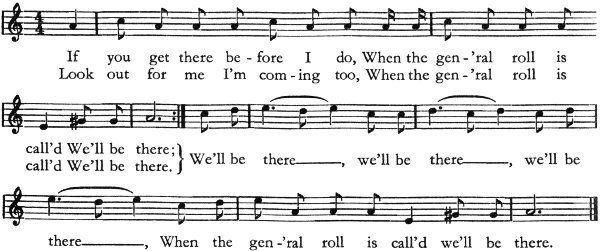
If you get there before I do, When the gen’ral roll is call’d We’ll be there; Look out for me I’m coming too, When the gen’ral roll is call’d We’ll be there. We’ll be there, we’ll be there, we’ll be there, When the gen’ral roll is call’d we’ll be there.
237
We’re pressing on to Canaan’s land, We’ll join the blood-wash’d pilgrim band.
Then we’ll go up the shining way, And praise the Lord through endless day.
The tune is attributed, in the Revivalist, to J. Baker. Two negro spirituals based melodically and textually on this song are in Dett, pp. 121 and 166.
No. 245 SHOUTING PILGRIM, SWP 163
Hexatonic, mode 2 A (I II 3 IV V — 7)
play
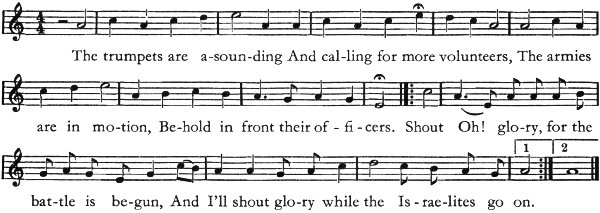
The trumpets are a-sounding And calling for more volunteers, The armies are in motion, Behold in front their officers. Shout Oh! glory, for the battle is begun, And I’ll shout glory while the Israelites go on.
I love to live rejoicing, I cannot bear to live lukewarm, Although there’s many blames me for trusting in the Lord alone. Shout Oh! glory, for I love to praise the Lord, And I’ll shout glory while I hear the gospel word.
I love to live a-shouting, I feel my Savior in my soul, Sweet heaven drawing nigher, I feel the living waters roll. Shout Oh! glory, for the glory is begun, And I’ll shout glory while the work is going on.
The time is fast approaching when all religion will be tried, When Jesus with his jewels will ornament his lovely bride. Shout Oh! glory, for my soul is full of love, And I’ll shout glory when I meet you all above.
I see the flame arising.—Had I the pinions of a dove, My soul would then realize the wonders of redeeming love. Shout Oh! glory, for there’s glory in my soul, And I’ll shout glory while I feel the current roll.
The current is a-spreading and sinners coming home to God, A-weeping and a-mourning, and finding favor in the Lord. Shout Oh! glory, and my song shall never end, And I’ll shout glory to the sinner’s dearest friend.
238
No. 246 BOUND FOR THE PROMISED LAND, OSH 128
Hexatonic, mode 2 A (I II 3 IV V — 7)
play
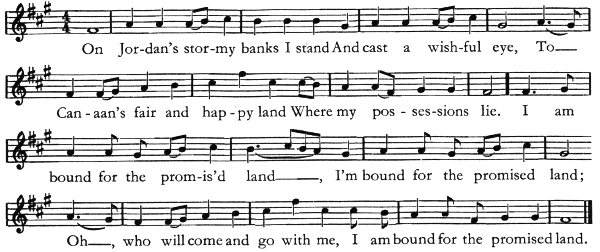
On Jordan’s stormy banks I stand And cast a wishful eye, To Canaan’s fair and happy land Where my possessions lie. I am bound for the promis’d land, I’m bound for the promised land; Oh, who will come and go with me, I am bound for the promised land.
Further stanzas of the text are given under ‘Jordan’. The combination here of the widely sung words of Samuel Stennett and an especially folkish revival phrase has resulted in an enormously well liked spiritual. Found also SOH 51, HH 154, SOC 114, HOC 47, WP 53, GOS 512. Its first appearance in the fasola books seems to have been in the Southern Harmony of 1835 where it is attributed to Miss M. Durham. The tune is like ‘I’ll Go and Enlist for a Sailor’, Sharp, Morris Dances, Set viii, No. 6.
No. 247 LISBON or I CAN NOT TARRY HERE, SOC 182
Pentatonic, mode 2 (I — 3 IV V — 7)
play
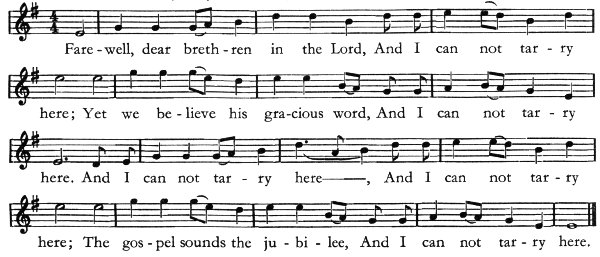
Farewell, dear brethren in the Lord, And I can not tarry here; Yet we believe his gracious word, And I can not tarry here. And I can not tarry here, And I can not tarry here; The gospel sounds the jubilee, And I can not tarry here.
239
This song is attributed to Henry F. Chandler and dated 1854. ‘The Irish Girl’, as sung in Virginia, shows a similar rhythmic trend but is less closely related tonally. See Sharp, ii., 254. Greater melodic resemblance is seen in ‘Our Goodman’ Sharp, i., 269, tune “D”.
No. 248 I WANT TO GO TO GLORY, SWP 168
Hexatonic, cannot be classified (I II 3 IV V 6 —)
play
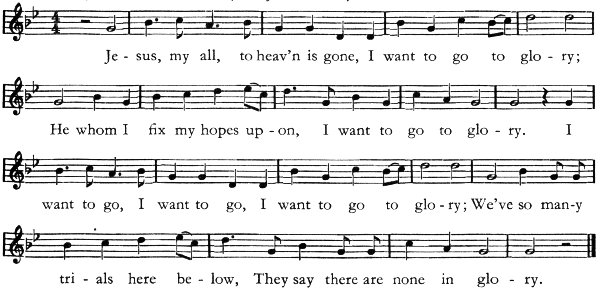
Jesus, my all, to heav’n is gone, I want to go to glory; He whom I fix my hopes upon, I want to go to glory. I want to go, I want to go, I want to go to glory; We’ve so many trials here below, They say there are none in glory.
The full text, by Samuel Medley (1738-1799), may be found under ‘River of Jordan’ in this collection. The Southern and Western Pocket Harmonist gives this tune “as sung by Rev. M. L. Little”. An old Irish song in Petrie, No. 1164, shows noteworthy similarities. See also ‘I Want a Seat in Paradise’, in this collection, for further tune relationships.
No. 249 CHRISTIAN RACE, REV 76
Heptatonic dorian, mode 2 A + B (I II 3 IV V VI 7)
play
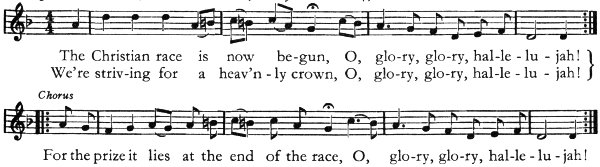
The Christian race is now begun, O, glory, glory, hallelujah! We’re striving for a heav’nly crown, O, glory, glory, hallelujah! Chorus For the prize it lies at the end of the race, O, glory, glory, hallelujah!
240
We’ll run the race and gain the prize, O, glory etc. Our heav’nly mansion in the skies, O, glory etc. Chorus
We’ll lay aside our every weight, The way is narrow and straight the gate.
In earnest cry we’ll wrestle along; Then on a kingly throne sit down.
Omnipotence is on our side, And God himself will be our guide.
Then when the race we’ve nobly run, He’ll count us worthy of a crown.
The form of the above is “as sung by Rev. G. C. Wells”.
No. 250 I YIELD, REV 443
Heptatonic, minor (I II 3 IV V 6 VII)
play
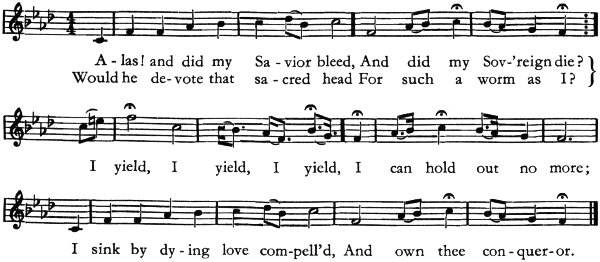
Alas! and did my Savior bleed, And did my Sov’reign die? Would he devote that sacred head For such a worm as I?
I yield, I yield, I yield, I can hold out no more; I sink by dying love compell’d, And own thee conqueror.
I suggest the possibility that the editor of the Revivalist made his tune over from one which was originally in the dorian mode.