Ninety-eight Folk-Hymns (continued 2)
Reading edition
No. 133 NEW PROSPECT or O LAND OF REST, OSH 390
Pentatonic, mode 3 (I II III — V VI —)
play
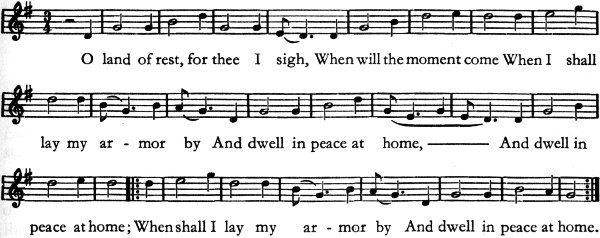
O land of rest, for thee I sigh, When will the moment come When I shall lay my armor by And dwell in peace at home, And dwell in peace at home; When shall I lay my armor by And dwell in peace at home.
No tranquil joy on earth I know, No peaceful, sheltering dome; This world’s a wilderness of woe, This world is not my home.
Our tears shall all be wiped away When we have ceased to roam, And we shall hear our Father say, “Come, dwell with me at home.”
J. S. James, editor of the 1911 Original Sacred Harp, attributes tune and words to W. S. Turner of Georgia. It is found also, GOS 390.
Close relatives of this tune are ‘Deep Spring’ in this collection, ‘Lord Thomas and Fair Eleanor’, Sharp, i., 118; and ‘Little Musgrave and Lady Barnard’, Sharp, i., 166.
152
No. 134 I LOVE THEE, OL 318
Pentatonic, mode 3 (I II III — V VI —)
play
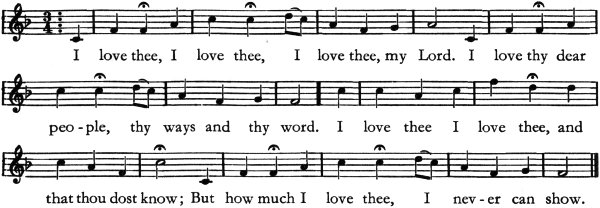
I love thee, I love thee, I love thee, my Lord. I love thy dear people, thy ways and thy word. I love thee, I love thee, and that thou dost know; But how much I love thee, I never can show.
I’m happy, I’m happy, O wondrous account! My joys are immortal, I stand on the mount! I gaze on my treasure, and long to be there, With Jesus and angels, my kindred so dear.
O Jesus, my Savior, with thee I am blest! My life and salvation, my joy and my rest! Thy Name be my theme, and thy love be my song! Thy grace shall inspire both my heart and my tongue.
O who’s like my Savior? He’s Salem’s bright King; He smiles, and he loves me, and helps me to sing: I’ll praise him and bless him, with notes loud and shrill, While rivers of pleasure my spirit do fill:
O Jesus, my Savior! I know thou art mine; For thee all the pleasures of sin I resign: Of objects most pleasing I love thee the best; Without thee I’m wretched, but with thee I’m blessed.
Tho’ weak and despised, by faith I now stand, Preserv’d and defended by Heaven’s kind hand: By Jesus supported, I’ll praise his dear name, Regardless of danger, of praise, or of blame.
I find him in singing, I find him in prayer; In sweet meditation he always is near: My constant companion, Oh may we ne’er part! All glory to Jesus, who dwells in my heart!
The text is attributed to John Adam Granade, the “Billy Sunday” of the revival movement which reached a high point in its trend at about the beginning of the nineteenth century. Granade was the author of many widely sung texts.
153
The tune is clearly of the ‘Lord Lovel’ family. Compare, for example, the melody which Sharp found in North Carolina; see Sharp, i., 38, A. Its earliest appearance in American religious song books seems to have been in Ingalls’ Christian Harmony, 1805, p. 44.
No. 135 NEW BRITAIN or HARMONY GROVE, SOH 8
Pentatonic, mode 3 (I II III — V VI —)
play
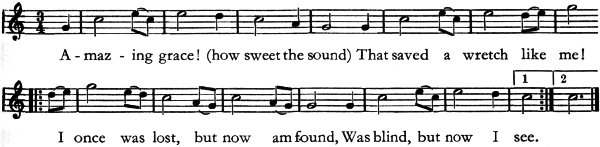
Amazing grace! (how sweet the sound) That saved a wretch like me! I once was lost, but now am found, Was blind, but now I see.
The poem is by Newton. The tune’s source is unknown to the southern compilers. It goes also under the names ‘Symphony’, ‘Solon’, and ‘Redemption’. Found also, WP 27, GCM 105, OSH 45, HH 104, SOC 190, TZ 90, VH 19, Church Harmony 91. A close relative of the tune is ‘Primrose’ in this collection. Further stanzas of the text are given under ‘Melody’.
I recorded this tune also as it was sung by F. Fagan Thompson of Vanderbilt University, Nashville, Tennessee, February, 1936. I reproduce here his version, one in which the tune is slowed and many graces are introduced, as an excellent illustration of the widespread southern folk-manner in the singing of hymns of this sort.
very slow
play
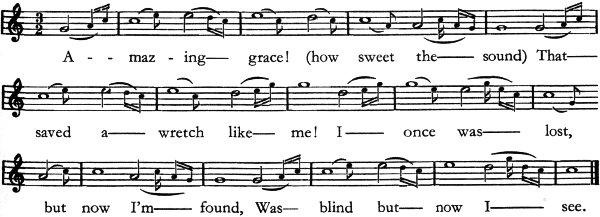
Amazing grace! (how sweet the sound) That saved a wretch like me! I once was lost, but now I’m found, Was blind but now I see.
154
No. 136 SPIRITUAL SAILOR, SOH 41
Heptatonic aeolian, mode 2 A + b (I II 3 IV V 6 7)
play
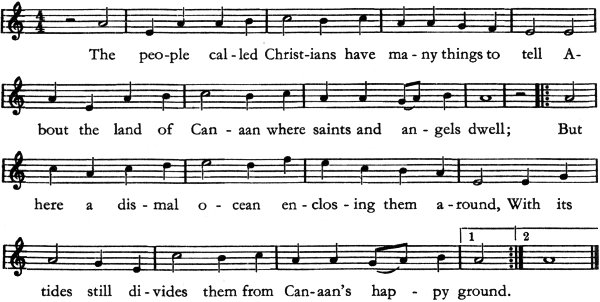
The people called Christians have many things to tell About the land of Canaan where saints and angels dwell; But here a dismal ocean enclosing them around, With its tides still divides them from Canaan’s happy ground.
Many have been impatient to work their passage through, And with united wisdom have tried what they could do; But vessels built by human skill have never sailed far, Till we found them aground on some dreadful, sandy bar.
The everlasting gospel hath launch’d the deep at last; Behold the sails expanded around the tow’ring mast! Along the deck in order, the joyful sailors stand, Crying, “Ho!—here we go to Immanuel’s happy land!”
We’re now on the wide ocean, we bid the world farewell! And though where we shall anchor no human tongue can tell; About our future destiny there need be no debate, While we ride on the tide, with our Captain and his Mate.
To those who are spectators what anguish must ensue, To hear their old companions bid them a last adieu! The pleasures of your paradise no more our hearts invite; We will sail—you may rail, we shall soon be out of sight.
The passengers united in order, peace, and love; The wind is in our favour, how swiftly do we move! Though tempests may assail us, and raging billows roar, We will sweep through the deep, till we reach fair Canaan’s shore.
155
The Southern Harmony gives the maker of this song as I. Neighbours, who may indeed have been the author of the text. This text is clearly a parody, and the tune a close variant, of ‘When the Stormy Winds do Blow’ or ‘You Gentlemen of England’, a song of seafaring which appears to have been widely sung in England over a long period. References to a ‘Stormy Winds’ ballad reach back to 1660. The tune with different texts appeared as ‘Saylers for my Money’, ‘The Bridegroom’s Salutation’, ‘You Calvinists of England’ and ‘England’s Valour and Holland’s Terrour’. See Vincent Jackson, English Melodies from the 13th to the 18th Century, p. 114.
Other melodic relatives which have come to my notice are ‘The Trees do Grow High’, Sharp, One Hundred English Folk-Songs, No. 25; and ‘John Anderson My Jo John’, The Singer’s Companion, p. 72, and SMM, No. 146.
No. 137 IDUMEA, OSH 47
Pentatonic, mode 2 (I — 3 IV V — 7)
play
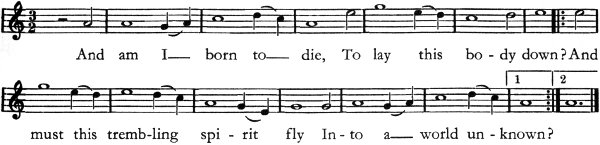
And am I born to die, To lay this body down? And must this trembling spirit fly Into a world unknown?
Waked by the trumpet’s sound, I from the grave shall rise, To see the Judge with glory crowned, And view the flaming skies.
How shall I leave the tomb? With triumph or regret? A fearful or a joyful doom? A curse or blessing meet?
I must from God be driv’n, Or with my Saviour dwell; Must come at His command to heav’n, Or else depart—to hell.
The words are by Charles Wesley. The tune is claimed by Ananias Davisson in his Kentucky Harmony (1815) whence it was borrowed by practically all the subsequent book compilers in the South. The tune was used for the secular ballad ‘Lord Lovel’; see White Spirituals, 177. Also found KYH 33, GCM 36, SOH 31, 156 UH 19, KNH 36, HH 224, SOC 55, HOC 44, TZ 122, MOH 38, Church Harmony, p. 35, GOS 184, PB 246. An imitation of this tune is GOS 325. ‘Lord Thomas and Fair Eleanor’, Davis, p. 570, shows the same trend, as does also ‘Young Hunting’, Sharp, i., 112.
No. 138 BOZRAH, GOS 59
Hexatonic, mode 2 b (I — 3 IV V 6 7)
play
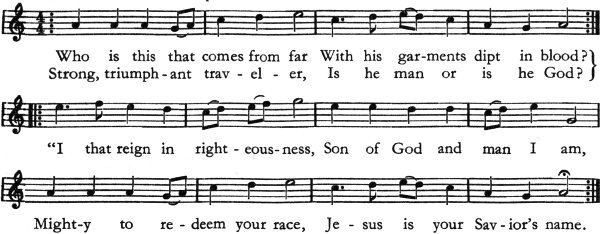
Who is this that comes from far With his garments dipt in blood? Strong, triumphant traveler, Is he man or is he God? “I that reign in righteousness, Son of God and man I am, Mighty to redeem your race, Jesus is your Savior’s name.
“Wide, ye heavenly gates, unfold, Closed no more by death and sin; Lo, the conquering Lord behold; Let the King of glory in.” Hark, th’angelic host inquire, “Who is He, th’almighty King?” Hark again, the answering choir Thus in strains of triumph sing:
“He whose powerful arm, alone, On His foes destruction hurled; He who hath the victory won; He who saved you by His blood; He who God’s pure law fulfilled; Jesus, the incarnate Word; He whose truth with blood was sealed; He is heaven’s all-glorious Lord.”
The melodic sentence at the beginning and at the end is a favorite. It may be found, for example, also in ‘Greenwood Siding’, Cox, p. 522. A variant of the tune is ‘When I First Left Old Ireland’, Petrie, No. 863. See ‘I Will Arise’ in this collection for further tune relationships.
157
No. 139 NEW ORLEANS, PB 255
Heptatonic aeolian, mode 2 A + b (I II 3 IV V 6 7)
play
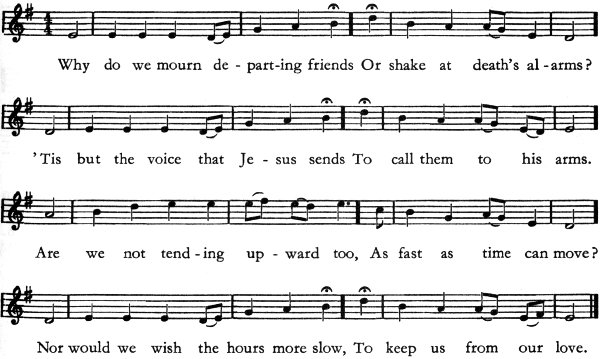
Why do we mourn departing friends Or shake at death’s alarms? ’Tis but the voice that Jesus sends To call them to his arms. Are we not tending upward too, As fast as time can move? Nor would we wish the hours more slow, To keep us from our love.
For variant forms of the tune see ‘Marion’ and ‘I Will Arise’ in this collection. Among its related secular tunes are ‘Greenwood Siding’ (‘Cruel Mother’), Cox, p. 522; an unnamed tune in Petrie, No. 193; ‘Oh Love it is a Killing Thing’, Petrie, No. 469; and ‘When First I left Old Ireland’, Petrie, No. 863. A remarkable tune resemblance and one which opens to the imagination surprising vistas as to the possible age of the ‘New Orleans’ tune, is to be seen in the Whitsuntide church melody ‘Iam Christus astra ascenderat’ from the eleventh century:
play

Iam Christus astra ascenderat regressus unde venerat.
The same melodic trend is seen also in the German tune set to ‘Christ der du bist der helle Tag’ from the year 1568. See Hymns Ancient and Modern, Nos. 178 and 604.
158
No. 140 HOLY SON OF GOD, REV 365
Hexatonic, mode 2 A (I II 3 IV V — 7)
play
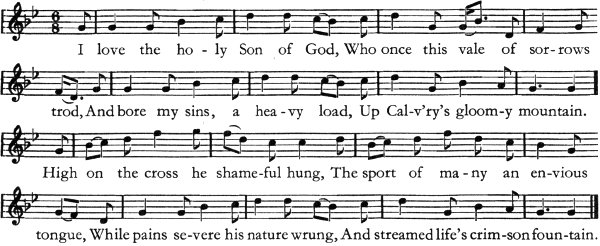
I love the holy Son of God, Who once this vale of sorrows trod, And bore my sins, a heavy load, Up Calv’ry’s gloomy mountain. High on the cross he shameful hung, The sport of many an envious tongue, While pains severe his nature wrung, And streamed life’s crimson fountain.
Oh, why did not his fury burn, And floods of vengeance on them turn? Amazing! See his bowels yearn In soft compassion on them. No fury kindles in his eyes; They beam with love, and when he dies, Father, forgive, the sufferer cries, They know not—Oh, forgive them.
No. 141 WORTHY THE LAMB, SWP 92
Heptatonic aeolian, mode 2 A + b (I II 3 IV 6 7)
play
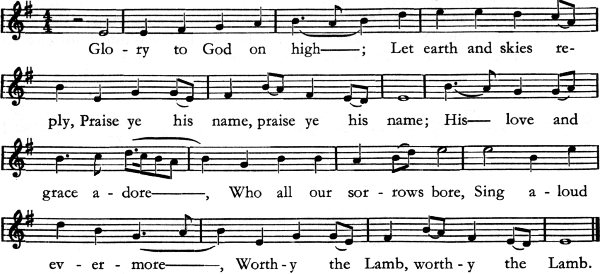
Glory to God on high; Let earth and skies reply, Praise ye his name, praise ye his name; His love and grace adore, Who all our sorrows bore, Sing aloud evermore, Worthy the Lamb, worthy the Lamb.
159
Jesus, our Lord and God, Bore sin’s tremendous load, Praise ye his name, praise ye his name; Tell what his arm has done, What spoils from death he won; Sing his great name alone; Worthy the Lamb.
While they around the throne Cheerfully join as one, Praising his name, praising his name, Those who have felt his blood Sealing their peace with God, Sound his dear fame abroad, Worthy the Lamb.
Three more stanzas of the text are in the Southern and Western Pocket Harmonist. The tune is attributed to Bradshaw.
No. 142 CAPTAIN KIDD, COH 73
Hexatonic, mode 4 b (I II 3 IV V — 7)
play
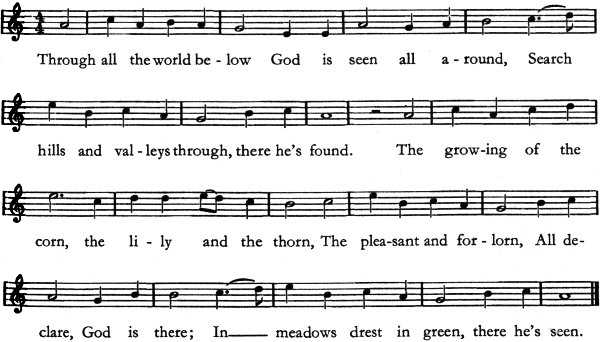
Through all the world below God is seen all around, Search hills and valleys through, There he’s found. The growing of the corn, The lily and the thorn, The pleasant and forlorn, All declare, God is there; In meadows drest in green, There he’s seen.
160
See springing waters rise, Fountains flow, rivers run; The mist that veils the sky Hides the sun; Then down the rain doth pour, The ocean it doth roar, And beat upon the shore; And all praise in their ways The God who ne’er declines His designs.
The sun with all his rays Speaks of God as he flies; The comet in her blaze, God she cries. The shining of the stars, The moon when she appears, His awful name declares; See them fly through the sky, And join the solemn sound All round.
Not India’s hills of gold, Where the wonders are told, Nor zephyrs strong and bold Can unfold The mountain Calvary, Where Christ our Lord did die. Hark, hear the Savior cry, Mountains quake, heavens shake, Christ, call’d to heaven’s host, Left their coast.
The tune is ascribed to Nicholson. The oldest American recording known to me is in the four-shape-note manuscript song collection made by Catherine Alderice in or near Emmittsburg, Md., 1800-1830, p. 37. Miss Gilchrist calls attention to the secular ‘Captain Kidd’ ballad, of which the above is a parody, as it appeared, twenty-five verses long, in Our Familiar Songs and Who Made Them, published in America, 1889. She describes it as “a sort of dying speech and testament probably dating from about 1701 in which year Kidd and nine of his associates were hanged in Execution Dock.... There were many other eighteenth century songs, built on this peculiar stanzaic plan, celebrating other notorious characters, ‘Admiral Benbow,’ ‘Jack (or Sam) Hall.’” Other American spiritual songs in this collection having the same stanzaic form are ‘Wondrous Love’ and ‘Remember Sinful Youth’.
161
No. 143 JERUSALEM, SOH (1835) 60
Heptatonic aeolian, mode 2 A + b (I II 3 IV V 6 VII).
play
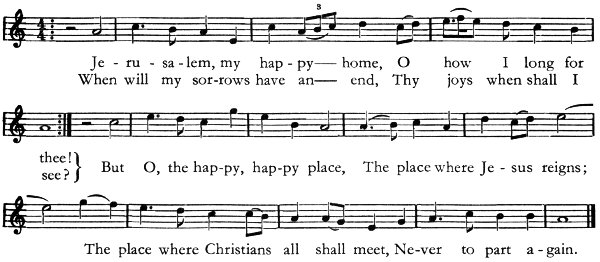
Jerusalem, my happy home, O how I long for thee! When will my sorrows have an end, Thy joys when shall I see! But O, the happy, happy place, The place where Jesus reigns; The place where Christians all shall meet, Never to part again.
Further stanzas of the text are given under ‘Long-Sought Home’ in this collection. The song is attributed to Benjamin White. This is Benjamin Franklin White, brother-in-law of, and co-worker with, William Walker (compiler of the Southern Harmony) and author subsequently of the Sacred Harp. See White Spirituals, 84.
No. 144 ROBY, OL 273
Heptatonic dorian, mode 2 A + B with altered 3rd (I II 3 [III] IV V VI 7)
play
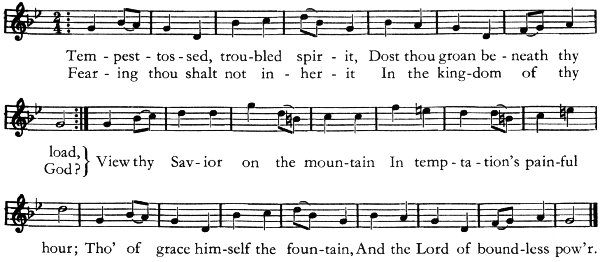
Tempest tossed, troubled spirit, Dost thou groan beneath thy load, Fearing thou shalt not inherit In the kingdom of thy God? View thy Savior on the mountain In temptation’s painful hour; Tho’ of grace himself the fountain, And the Lord of boundless pow’r.
162
Do thy blooming prospects languish? Sayest thou still, “I’m not his child?” View thy Savior’s dreadful anguish, Famished in the gloomy wild. Not a step in all thy journey, Thro’ this gloomy vale of tears, But thy Lord hath trod before thee; He thy way to glory clears.
The Olive Leaf compiler informs us that this song which was a favorite with the late Rev. Wesley P. Arnold, of Georgia, was “learned of some dear Baptist friends in Iridell Co., N. C., in 1839, and called ‘Roby’, their name.”
No. 145 REMEMBER SINFUL YOUTH or SOLEMN THOUGHT, SOH 29
Pentatonic, mode 2 (I — 3 IV V — 7)
play
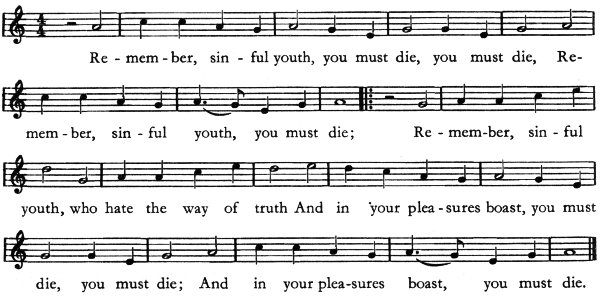
Remember, sinful youth, you must die, you must die, Remember, sinful youth, you must die; Remember, sinful youth, who hate the way of truth And in your pleasures boast, you must die, you must die; And in your pleasures boast, you must die.
Uncertain are your days here below, here below, Uncertain are your days here below, Uncertain are your days, for God hath many ways To bring you to your graves here below, here below, To bring you to your graves here below.
The God that built the sky, great I AM, great I AM, The God that built the sky, great I AM, The God that built the sky, hath said, (and cannot lie), Impenitents shall die, and be damn’d, and be damn’d, Impenitents shall die, and be damn’d.
163
And, O my friends, don’t you, I entreat, I entreat, And, O my friends, don’t you, I entreat, And, O my friends, don’t you your carnal mirth pursue, Your guilty souls undo, I entreat, I entreat, Your guilty souls undo, I entreat.
Unto the Saviour flee, ’scape for life! ’scape for life! Unto the Saviour flee, ’scape for life! Unto the Saviour flee, lest death eternal be Your final destiny, ’scape for life! ’scape for life! Your final destiny, ’scape for life!
The mood of the poem indicates a considerable age for it. That the song as a whole was decidedly among the stock of orally transmitted ones is indicated by the many claimants to its authorship. Such claimants in the southern books are F. Price, William Caldwell, James Carrell and Ananias Davisson. Found also, UH 56, KNH 108, HH 225, SKH 66, CHH 361. The stanzaic form is that of ‘Captain Kidd’ in this collection. In his Christian Harmony, William Walker adds the note that “I learned it [the tune] from my dear mother (who now sings in heaven) when I was only three years old,—the first tune I ever learned.” That was in 1812. That the song was even older, however, is shown by its appearance in Ingalls’ Christian Harmony of 1805, p. 39.
No. 146 WEEPING SAVIOR, OSH 33
Hexatonic, mode 2 A (I II 3 IV V — 7)
play
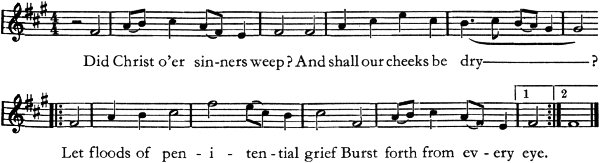
Did Christ o’er sinners weep? And shall our cheeks be dry? Let floods of penitential grief Burst forth from every eye.
The Son of God in tears, Angels with wonder see; Be thou astonished, O my soul; He shed those tears for thee.
164
He wept that we might weep; Each sin demands a tear; In heav’n alone no sin is found, And there’s no weeping there.
The text is attributed to Benjamin Beddome, and the tune to Joseph Barnby, and to E. J. King. The first, sixth, and seventh measures had only quarter notes in the Sacred Harp. The slurred eighth notes are inserted from a variant of the tune found in the Olive Leaf. They represent probably an effort on the part of the editor of that song book to present the tune as really sung.
No. 147 DETROIT, SOH 40
Hexatonic, mode 2, b (I — 3 IV V 6 7)
play
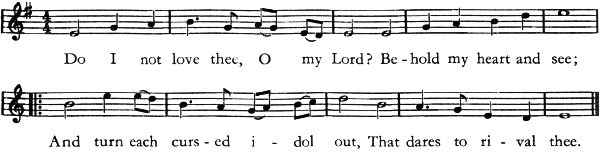
Do I not love thee, O my Lord? Behold my heart and see; And turn each cursed idol out, That dares to rival thee.
Hast thou a lamb in all thy flock I would disdain to feed? Hast thou a foe before whose face I fear thy cause to plead?
Would not my ardent spirit vie With angels ’round thy throne, To execute thy sacred will, And make thy glory known?
Thou know’st I love thee, dearest Lord, But Oh! I long to soar Far from the sphere of mortal joys, That I may love thee more.
Philip Doddridge is credited with the words. The tune is attributed to ‘Bradshaw’ in the Southern Harmony. Found also, UH 33, KNH 23, OSH 39, HH 158, SOC 175, HOC 22, WP 24, SKH 85, GOS 282. The melody is similar to a number of those given by Sharp (i., 150ff.) with ‘The Wife of Usher’s Well’.
165
No. 148 I SHALL BE SATISFIED, REV 62
Hexatonic, mode 4 b minorized (I II 3 IV V — 7 [VII])
play
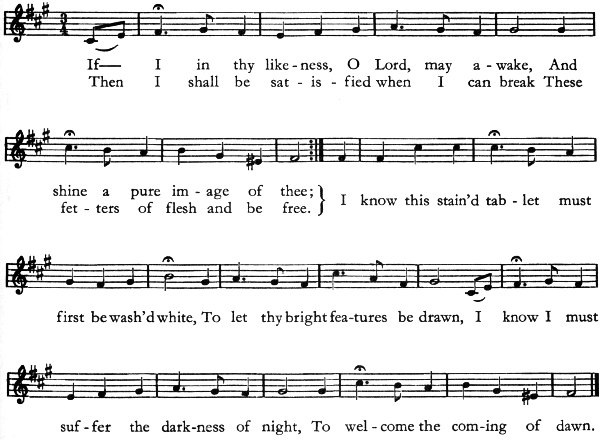
If I in thy likeness, O Lord, may awake, And shine a pure image of thee; Then I shall be satisfied when I can break These fetters of flesh and be free. I know this stain’d tablet must first be wash’d white, To let thy bright features be drawn, I know I must suffer the darkness of night, To welcome the coming of dawn.
Then I shall be satisfied when I can cast The shadows of nature all by, When this cold dreary world from my vision is past, And let this soul open her eye. I gladly shall feel the blest morn drawing near, When time’s dreary fancy shall fade, If then in thy likeness I may but appear, I rise with thy beauty arrayed.
One more stanza of text in the Revivalist. The song is used “as sung by Rev. G. C. Wells.” It is reminiscent of the ‘Henry Martin’ tune; see Gould and Sharp, English Folk-Songs for Schools, p. 22.
166
No. 149 EDGEFIELD, OSH 82
Heptatonic aeolian, mode 2 A + b (I II 3 IV V 6 7)
play
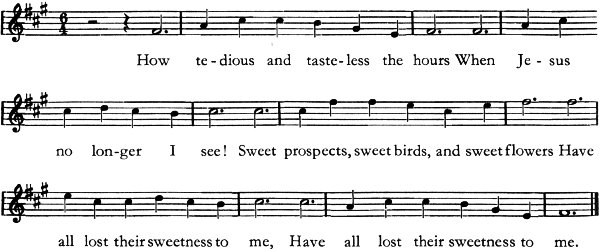
How tedious and tasteless the hours When Jesus no longer I see! Sweet prospects, sweet birds, and sweet flowers Have all lost their sweetness to me, Have all lost their sweetness to me.
The tune is attributed, in the Sacred Harp, to J. T. White, a Georgian, and is dated 1844. It is a variant of ‘When the Cock Crows it is Day’, Petrie, No. 478. The fuller text, attributed to John Newton, is given under the song ‘Green Fields’ in this collection.
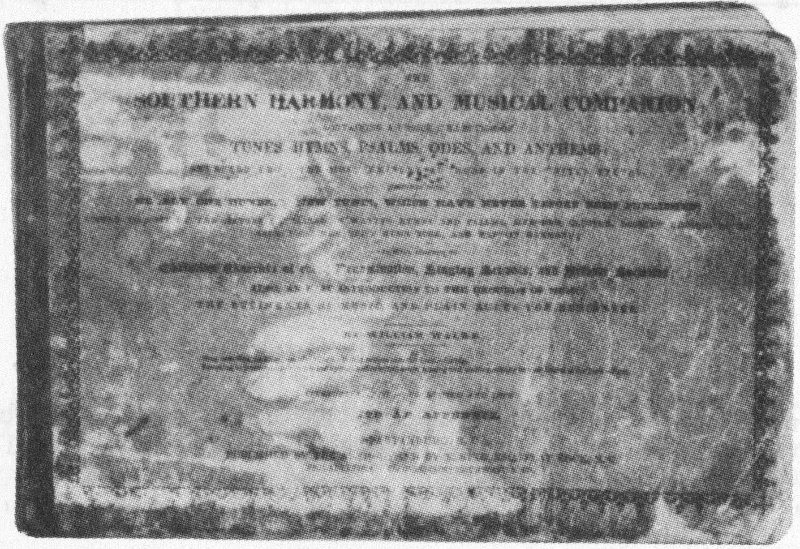
From its first appearance in 1835 up to the time of the Civil War, 600,000 copies of The Southern Harmony went into southern homes. Twenty-four songs from this book are in the present collection.
167