SPENSER’S FAERIE QUEENE (continued 4)
Reading edition
One mother, when as[407] her foolehardie chyld xi Did come too[408] neare, and with his talants play, Halfe dead through feare, her litle babe reuyld, And to her gossips[409] gan in counsell say; How can I tell, but that his talants[410] may Yet scratch my sonne, or rend his tender hand? So diuersly themselues in vaine they fray; Whiles some more bold, to measure him nigh stand, To proue how many acres he did spread of land. Thus flocked all the folke him round about, xii The whiles that hoarie king, with all his traine, Being arriued, where that champion stout After his foes defeasance did remaine, Him goodly greetes, and faire does entertaine, With princely gifts of yuorie and gold, And thousand thankes him yeelds for all his paine. Then when his daughter deare he does behold, Her dearely doth imbrace, and kisseth manifold. And after to his Pallace he them brings, xiii With shaumes, and trompets, and with Clarions sweet; And all the way the ioyous people sings, And with their garments strowes the paued street: Whence mounting vp, they find purueyance meet Of all, that royall Princes court became, And all the floore was vnderneath their feet Bespred with costly scarlot of great name, On which they lowly sit, and fitting purpose frame. What needs me tell their feast and goodly guize, xiv In which was nothing riotous nor vaine? What needs of daintie dishes to deuize, Of comely seruices, or courtly trayne[411]? My narrow leaues cannot in them containe The large discourse of royall Princes state. Yet was their manner then but bare and plaine: For th’antique world excesse and pride did hate; Such proud luxurious pompe is swollen vp but late.
Then when with meates and drinkes of euery kinde xv Their feruent appetites they quenched had, That auncient Lord gan fit occasion finde, Of straunge aduentures, and of perils sad, Which in his trauell him befallen had, For to demaund of his renowmed guest: Who then with vtt’rance graue, and count’nance sad, From point to point, as is before exprest, Discourst his voyage long, according his request. Great pleasure[412] mixt with pittifull regard, xvi That godly King and Queene did passionate, Whiles they his pittifull aduentures heard, That oft they did lament his lucklesse state, And often blame the too importune fate, That heapd on him so many wrathfull wreakes: For neuer gentle knight, as he of late, So tossed was in fortunes cruell freakes; And all the while salt teares bedeawd the hearers cheaks. Then said that[413] royall Pere in sober wise; xvii Deare Sonne, great beene the euils, which ye bore From first to last in your late enterprise, That I note, whether prayse, or pitty more: For neuer liuing man, I weene, so sore In sea of deadly daungers was distrest; But since[414] now safe ye seised haue the shore, And well arriued are, (high God be blest) Let vs deuize of ease and euerlasting rest. Ah dearest Lord, said then that doughty knight, xviii Of ease or rest I may not yet deuize; For by the faith, which I to armes haue plight, I bounden am streight after this emprize, As that your daughter can ye well aduize, Backe to returne to that great Faerie Queene, And her to serue six yeares in warlike wize, Gainst that proud Paynim[415] king, that workes her teene: Therefore I ought craue pardon, till I there haue beene.
Vnhappie falles that hard necessitie, xix (Quoth he) the troubler of my happie peace, And vowed foe of my felicitie; Ne I against the same can iustly preace: But since[416] that band ye cannot now release, Nor doen vndo; (for vowes may not be vaine) Soone as the terme of those six yeares shall cease, Ye then shall hither backe returne againe, The marriage to accomplish vowd betwixt you twain. Which for my part I couet to performe, xx In sort as through the world I did proclame, That who so kild that monster most deforme, And him in hardy battaile ouercame, Should haue mine onely daughter to his Dame, And of my kingdome heire apparaunt bee: Therefore since[417] now to thee perteines the same, By dew desert of noble cheualree, Both daughter and eke kingdome, lo I yield to thee. Then forth he called that his daughter faire, xxi The fairest Vn’ his onely daughter deare, His onely daughter, and his onely heyre; Who forth proceeding with sad sober cheare, As bright as doth the morning starre appeare Out of the East, with flaming lockes bedight, To tell that[418] dawning day is drawing[419] neare, And to the world does bring long wished light; So faire and fresh that Lady shewd her selfe in sight. So faire and fresh, as freshest flowre in May; xxii For she had layd her mournefull stole aside, And widow-like sad wimple throwne away, Wherewith her heauenly[420] beautie she did hide, Whiles on her wearie iourney she did ride; And on her now a garment she did weare, All lilly white, withoutten spot, or pride, That seemd like silke and siluer wouen neare, But neither silke nor siluer therein did appeare.
The blazing brightnesse of her beauties beame, xxiii And glorious light of her sunshyny face To tell, were as to striue against the streame. My ragged rimes are all too rude and bace, Her heauenly lineaments for to enchace. Ne wonder; for her owne deare loued knight, All were she dayly with himselfe in place, Did wonder much at her celestiall sight: Oft had he seene her faire, but neuer so faire dight. So fairely dight, when she in presence came, xxiv She to her Sire made humble reuerence, And bowed low, that her right well became, And added grace vnto her excellence: Who with great wisedome, and graue eloquence Thus gan to say. But eare he thus had said, With flying speede, and seeming great pretence, Came running in, much like a man dismaid, A Messenger with letters, which his message said. All in the open hall amazed stood, xxv At suddeinnesse of that vnwarie sight, And wondred at his breathlesse hastie mood. But he for nought would stay his passage right, Till fast before the king he did alight; Where falling flat, great humblesse he did make, And kist the ground, whereon his foot was pight; Then to his hands that writ he did betake, Which he disclosing, red thus, as the paper spake. To thee, most mighty king of Eden faire, xxvi Her greeting sends in these sad lines addrest, The wofull daughter, and forsaken heire Of that great Emperour of all the West; And bids thee be aduized for the best, Ere thou thy daughter linck in holy band Of wedlocke to that new vnknowen guest: For he already plighted his right hand Vnto another loue, and to another land.
To me sad mayd, or rather widow sad, xxvii He was affiaunced long time before, And sacred pledges he both gaue, and had, False erraunt knight, infamous, and forswore: Witnesse the burning Altars, which he swore, And guiltie heauens of his bold periury, Which though he hath polluted oft of[421] yore, Yet I to them for Judgement iust do fly, And them coniure t’auenge this shamefull iniury. Therefore since[422] mine he is, or free or bond, xxviii Or false or trew, or liuing or else dead, Withhold, O soueraine Prince, your hasty hond From knitting league with him, I you aread; Ne weene my right with strength adowne to tread, Through weakenesse of my widowhed, or woe: For truth is strong, her[423] rightfull cause to plead, And shall find friends, if need requireth soe, So bids thee well to fare, Thy neither friend, nor foe, Fidessa. When he these bitter byting words had red, xxix The tydings straunge did him abashed make, That still he sate long time astonished As in great muse, ne word to creature spake. At last his solemne silence thus he brake, With doubtfull eyes fast fixed on his guest; Redoubted knight, that for mine onely sake Thy life and honour late aduenturest, Let nought be hid from me, that ought to be exprest. What meane these bloudy vowes, and idle threats, xxx Throwne out from womanish impatient mind? What heauens? what altars? what enraged heates Here heaped vp with termes of loue vnkind, My conscience cleare with guilty bands would bind? High God be witnesse, that I guiltlesse ame. But if your selfe, Sir knight, ye faultie find, Or wrapped be in loues of former Dame, With crime do not it couer, but disclose the same.
To whom the Redcrosse knight this answere sent, xxxi My Lord, my King, be nought hereat dismayd, Till well ye wote by graue intendiment, What woman, and wherefore doth me vpbrayd With breach of loue, and loyalty betrayd. It was in my mishaps, as hitherward I lately traueild, that vnwares I strayd[424] Out of my way, through perils straunge and hard; That day should faile me, ere I had them all declard. There did I find, or rather I was found xxxii Of this false woman, that Fidessa hight, Fidessa hight the falsest Dame on ground, Most false Duessa, royall richly dight, That easie was t’[425] inuegle weaker sight: Who by her wicked arts, and wylie skill, Too false and strong for earthly skill or might, Vnwares me wrought vnto her wicked will, And to my foe betrayd, when least I feared ill. Then stepped forth the goodly royall Mayd, xxxiii And on the ground her selfe prostrating low, With sober countenaunce thus to him sayd; O pardon me, my soueraigne Lord, to show The secret treasons, which of late I know To haue bene wroght by that false sorceresse. She onely she it is, that earst did throw This gentle knight into so great distresse, That death him did awaite in dayly wretchednesse. And now it seemes, that she suborned hath xxxiv This craftie messenger with letters vaine[426], To worke new woe and improuided scath, By breaking of the band betwixt vs twaine; Wherein she vsed hath the practicke paine Of this false footman, clokt with simplenesse, Whom if ye please for to discouer plaine, Ye shall him Archimago find, I ghesse, The falsest man aliue; who[427] tries shall find no lesse.
The king was greatly moued at her speach, xxxv And all with suddein indignation fraight, Bad on that Messenger rude hands to reach. Eftsoones the Gard, which on his state did wait, Attacht that faitor false, and bound him strait: Who seeming sorely chauffed at his band, As chained Beare, whom cruell dogs do bait, With idle force did faine them to withstand, And often semblaunce made to scape out of their hand. But they him layd full low in dungeon deepe, xxxvi And bound him hand and foote with yron chains. And with continuall watch did warely keepe; Who then would thinke, that by his subtile trains He could escape fowle death or deadly paines? Thus when that Princes wrath was pacifide, He gan renew the late forbidden banes, And to the knight his daughter deare he tyde, With sacred rites and vowes for euer to abyde. His owne two hands the holy knots did knit, xxxvii That none but death for euer can deuide; His owne two hands, for such a turne most fit, The housling fire did kindle and prouide, And holy water thereon sprinckled wide; At which the[428] bushy Teade a groome did light, And sacred lampe in secret chamber hide, Where it should not be quenched day nor night, For feare of euill fates, but burnen euer bright. Then gan they sprinckle all the posts with wine, xxxviii And made great feast to solemnize that day; They all perfumde with frankincense[429] diuine, And precious odours fetcht from far away, That all the house did sweat with great aray: And all the while sweete Musicke did apply Her curious skill, the warbling notes to play, To driue away the dull Melancholy; The whiles one sung a song of loue and iollity.
During the which there was an heauenly noise xxxix Heard sound through all the Pallace pleasantly, Like as it had bene many an Angels voice, Singing before th’eternall maiesty, In their trinall triplicities on hye; Yet wist no creature, whence that heauenly sweet Proceeded, yet eachone felt secretly Himselfe thereby reft of his sences meet, And rauished with rare impression in his sprite. Great ioy was made that day of young and old, xl And solemne feast proclaimd throughout the land, That their exceeding merth may not be told: Suffice it heare by signes to vnderstand The vsuall ioyes at knitting of loues band. Thrise happy man the knight himselfe did hold, Possessed of his Ladies hart and hand, And euer, when his eye did her behold, His[430] heart did seeme to melt in pleasures manifold. Her ioyous presence and sweet company xli In full content he there did long enioy, Ne wicked enuie, ne[431] vile gealosy His deare delights were able to annoy: Yet swimming in that sea of blisfull ioy, He nought forgot, how he whilome had sworne, In case he could that monstrous beast destroy, Vnto his Faerie Queene backe to returne: The which he shortly did, and Vna left to mourne. Now strike your sailes ye iolly Mariners, xlii For we be come vnto a quiet rode, Where we must land some of our passengers, And light this wearie vessell of her lode. Here she a while may make her safe abode, Till she repaired haue her tackles spent, And wants supplide. And then againe abroad On the long voyage whereto she is bent: Well may she speede and fairely finish her intent.
FINIS LIB. I.
FOOTNOTES:
THE SECOND BOOKE OF THE FAERIE QVEENE. Contayning, THE LEGEND OF SIR GVYON, OR Of Temperaunce.
Right well I wote most mighty Soueraine, i That all this famous antique history, Of some th’aboundance of an idle braine Will iudged be, and painted forgery, Rather then matter of iust memory, Sith none, that breatheth liuing aire, does know, Where is that happy land of Faery, Which I so much do vaunt, yet no where show, But vouch antiquities, which no body can know. But let that man with better sence aduize, ii That of the world least part to vs is red: And dayly how through hardy enterprize, Many great Regions are discouered, Which to late age were neuer mentioned. Who euer heard of th’Indian Peru? Or who in venturous vessell measured The Amazons[432] huge riuer now found trew? Or fruitfullest Virginia who did euer vew?

Yet all these were, when no man did them know; iii Yet haue from wisest ages hidden beene: And later times things more vnknowne shall show. Why then should witlesse man so much misweene That nothing is, but that which he hath seene? What if within the Moones faire shining spheare? What if in euery other starre vnseene Of other worldes he happily should heare? He wonder would much more: yet such to some appeare. Of Faerie lond yet if he more inquire, iv By certaine signes here set in sundry place He may it find; ne let him then admire, But yield his sence to be too blunt and bace, That no’te without an hound fine footing trace. And thou[433], O fairest Princesse vnder sky, In this faire mirrhour maist behold thy face, And thine owne realmes in lond of Faery, And in this antique Image thy great auncestry. The which O pardon me thus to enfold v In couert vele, and wrap in shadowes light, That feeble eyes your glory may behold, Which else[434] could not endure those beames[435] bright, But would be dazled with exceeding light. O pardon, and vouchsafe with patient eare The braue aduentures of this Faery knight The good Sir Guyon gratiously to heare, In whom great rule of Temp’raunce goodly doth appeare.
FOOTNOTES:
Cant. I.
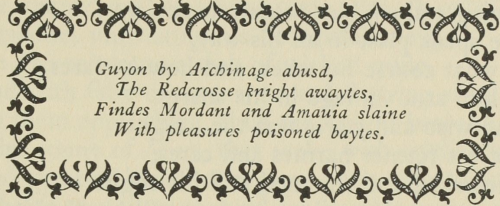
Guyon by Archimage abusd, The Redcrosse knight awaytes, Findes Mordant and Amauia slaine With pleasures poisoned baytes.
That cunning Architect of cancred guile, i Whom Princes late displeasure left in bands, For falsed letters and suborned wile, Soone as the Redcrosse knight he vnderstands[436] To beene departed out of Eden lands, To serue againe his soueraine Elfin Queene, His artes he moues, and out of caytiues[437] hands Himselfe he frees by secret meanes vnseene; His shackles emptie left, him selfe escaped cleene. And forth he fares full of malicious mind, ii To worken mischiefe and auenging woe, Where euer he that godly knight may find, His onely hart sore, and his onely foe, Sith Vna now he algates must forgoe, Whom his victorious hands did earst restore To natiue[438] crowne and kingdome late ygoe: Where she enioyes sure peace for euermore, As weather-beaten ship arriu’d on happie shore. Him therefore now the obiect of his spight iii And deadly food[439] he makes: him to offend By forged treason, or by open fight He seekes, of all his drift the aymed end: Thereto his subtile engins he does bend,[440] His practick wit, and his faire filed tong, With thousand other sleights: for well he kend, His credit now in doubtfull ballaunce hong; For hardly could be[441] hurt, who was already stong.
Still as he went, he craftie stales did lay,[442] iv With cunning traines him to entrap vnwares, And priuie spials plast in all his way, To weete what course he takes, and how he fares; To ketch him at a vantage[443] in his snares. But now so wise and warie was the knight[444] By triall of his former harmes and cares,[445] That he descride, and shonned still his slight: The fish that once was caught, new bait will hardly bite. Nath’lesse th’Enchaunter would not spare his paine, v In hope to win occasion to his will; Which when he long awaited had in vaine, He chaungd his minde from one to other ill: For to all good he enimy was still. Vpon the way him fortuned to meet, Faire marching vnderneath a shady hill, A goodly knight, all armd in harnesse meete, That from his head no place appeared to his feete. His carriage was full comely and vpright, vi His countenaunce demure and temperate, But yet so sterne and terrible in sight, That cheard his friends, and did his foes amate: He was an Elfin borne of noble state, And mickle worship in his natiue land; Well could he tourney and in lists debate, And knighthood tooke of good Sir Huons hand, When with king Oberon he came to Faerie land. Him als accompanyd vpon the way vii A comely Palmer, clad in blacke attire, Of ripest yeares, and haires all hoarie gray, That with a staffe his feeble steps did stire, Least his long way his aged limbes should tire: And if by lookes one may the mind aread, He seemd to be a sage and sober sire, And euer with slow pace the knight did lead, Who taught his trampling steed with equall steps to tread.
Such whenas Archimago them did view, viii He weened well to worke some vncouth wile, Eftsoones vntwisting his deceiptfull clew, He gan to weaue a web of wicked guile, And with faire[446] countenance and flattring stile, To them approching, thus the knight bespake: Faire sonne of Mars, that seeke with warlike spoile,[447] And great atchieu’ments great your selfe to make, Vouchsafe to stay your steed for humble misers sake. He stayd his steed for humble misers sake, ix And bad tell on the tenor of his plaint; Who feigning then in euery limbe to quake, Through inward feare, and seeming pale and faint With piteous mone his percing speach gan paint; Deare Lady how shall I declare thy cace, Whom late I left in langourous[448] constraint? Would God thy selfe now present were in place, To tell this ruefull tale; thy sight could win thee grace. Or rather would, O would it so had chaunst, x That you, most noble Sir, had present beene, When that lewd ribauld with vile lust aduaunst Layd first his filthy hands on virgin cleene, To spoile her daintie corse[449] so faire and sheene, As on the earth, great mother of vs all, With liuing eye more faire was neuer seene, Of chastitie and honour virginall: Witnesse ye heauens, whom she in vaine to helpe did call. How may it be, (said then the knight halfe wroth,) xi That knight should knighthood euer so haue shent? None but that saw (quoth he) would weene for troth, How shamefully that Maid he did torment. Her looser golden lockes he rudely rent, And drew her on the ground, and his sharpe sword[450] Against her snowy brest he fiercely bent, And threatned death with many a bloudie word; Toung hates to tell the rest, that eye to see abhord.
Therewith amoued from his sober mood, xii And liues he yet (said he) that wrought this act, And doen the heauens afford him vitall food? He liues, (quoth he) and boasteth of the fact, Ne yet hath any knight his courage crackt. Where may that treachour then (said he) be found, Or by what meanes may I his footing tract? That shall I shew (said he) as sure, as hound The stricken Deare doth chalenge by the bleeding wound. He staid not lenger talke, but with fierce ire xiii And zealous hast away is quickly gone To seeke that knight, where him that craftie Squire Supposd to be. They do arriue anone, Where sate a gentle Lady all alone, With garments rent, and haire discheueled, Wringing her hands, and making piteous mone; Her swollen eyes were much disfigured, And her faire face with teares was fowly blubbered. The knight approching nigh, thus to her said, xiv Faire Ladie, through foule sorrow ill bedight, Great pittie is to see you thus dismaid, And marre the blossome of your beautie bright: For thy appease your griefe and heauie plight, And tell the cause of your conceiued paine. For if he liue, that hath you doen despight,[451] He shall you doe due recompence againe, Or else his wrong with greater puissance maintaine. Which when she heard, as in despightfull wise, xv She wilfully her sorrow did augment, And offred hope of comfort did despise: Her golden lockes most cruelly she rent, And scratcht her face with ghastly dreriment, Ne would she speake, ne see, ne yet be seene, But hid her visage, and her head downe bent, Either for grieuous shame, or for great teene, As if her hart with sorrow had transfixed beene.
Till her that Squire bespake, Madame my liefe[452], xvi For Gods deare loue be not so wilfull bent, But doe vouchsafe now to receiue reliefe, The which good fortune doth to you present. For what bootes it to weepe and to wayment, When ill is chaunst, but doth the ill increase, And the weake mind with double woe torment? When she her Squire heard speake, she gan appease Her voluntarie paine, and feele some secret ease. Eftsoone she said, Ah gentle trustie Squire, xvii What comfort can I wofull wretch conceaue, Or why should euer I henceforth desire[453] To see faire heauens face, and life not leaue, Sith that false Traytour did my honour reaue? False traytour certes (said the Faerie knight) I read the man, that euer would deceaue A gentle Ladie, or her wrong through might: Death were too little paine for such a foule despight. But now, faire Ladie, comfort to you make, xviii And read, who hath ye wrought this shamefull plight;[454] That short reuenge the man may ouertake, Where so he be, and soone vpon him light. Certes (saide she) I wote not how he hight, But vnder him a gray steede did he[455] wield, Whose sides with dapled circles weren dight; Vpright he rode, and in his siluer shield He bore a bloudie Crosse, that quartred all the field. Now by my head (said Guyon) much I muse, xix How that same knight should do so foule amis, Or euer gentle Damzell so abuse: For may I boldly say, he surely is A right good knight, and true of word ywis: I present was, and can it witnesse well, When armes he swore, and streight did enterpris Th’aduenture of the Errant damozell, In which he hath great glorie wonne, as I heare tell.
Nathlesse he shortly shall againe be tryde, xx And fairely quite[456] him of th’imputed blame, Else be ye sure he dearely shall abyde, Or make you good amendment for the same: All wrongs haue mends, but no amends of shame. Now therefore Ladie, rise out of your paine, And see the saluing of your blotted[457] name. Full loth she seemd thereto, but yet did faine; For she was inly glad her purpose so to gaine. Her purpose was not such, as she did faine, xxi Ne yet her person such, as it was seene, But vnder simple shew and semblant plaine Lurckt false Duessa secretly vnseene, As a chast Virgin, that had wronged beene: So had false Archimago her disguisd, To cloke her guile with sorrow and sad teene; And eke himselfe had craftily deuisd To be her Squire, and do her seruice well aguisd. Her late forlorne and naked he had found, xxii Where she did wander in waste wildernesse, Lurking in rockes and caues farre vnder ground, And with greene mosse cou’ring her nakednesse, To hide her shame and loathly filthinesse; Sith her Prince Arthur of proud ornaments And borrow’d beautie spoyld. Her nathelesse Th’enchaunter finding fit for his intents, Did thus reuest, and deckt with due habiliments. For all he did, was to deceiue good knights, xxiii And draw them from pursuit of praise and fame, To slug in slouth and sensuall delights, And end their daies with irrenowmed shame. And now exceeding griefe him ouercame, To see the Redcrosse thus aduaunced hye; Therefore this craftie engine he did frame, Against his praise to stirre vp enmitye Of such, as vertues like mote vnto him allye.
So now he Guyon guides an vncouth way xxiv Through woods and mountaines, till they came at last Into a pleasant dale, that lowly lay Betwixt two hils, whose high heads ouerplast, The valley did with coole shade ouercast, Through midst thereof a little riuer rold, By which there sate a knight with helme vnlast, Himselfe refreshing with the liquid cold, After his trauell long, and labours manifold. Loe yonder he, cryde Archimage alowd, xxv That wrought the shamefull fact, which I did shew; And now he doth himselfe in secret shrowd, To flie the vengeance for his outrage dew; But vaine: for ye shall dearely do him rew, So God ye speed, and send you good successe; Which we farre off will here abide to vew. So they him left, inflam’d with wrathfulnesse, That streight against that knight his speare he did addresse. Who seeing him from farre so fierce to pricke, xxvi His warlike armes about him gan embrace, And in the rest his readie speare did sticke; Tho when as still he saw him towards pace, He gan rencounter him in equall race. They bene ymet, both readie to affrap, When suddenly that warriour gan abace His threatned speare, as if some new mishap Had him betidde[458], or hidden daunger did entrap. And cryde, Mercie Sir knight, and mercie Lord, xxvii For mine offence and heedlesse hardiment, That had almost committed crime abhord, And with reprochfull shame mine honour shent, Whiles cursed steele against that badge I bent, The sacred badge of my Redeemers death, Which on your shield is set for ornament: But his fierce foe his steede could stay vneath, Who prickt with courage kene, did cruell battell breath.
But when he heard him speake, streight way he knew xxviii His error, and himselfe inclyning sayd; Ah deare Sir Guyon, well becommeth you, But me behoueth rather to vpbrayd, Whose hastie hand so farre from reason strayd, That almost it did haynous violence On that faire image of that heauenly Mayd, That decks and armes your shield with faire defence: Your court’sie takes on you anothers due offence. So bene they both attone[459], and doen vpreare xxix Their beuers bright, each other for to greete; Goodly comportance each to other beare, And entertaine themselues with court’sies meet. Then said the Redcrosse knight, Now mote I weet, Sir Guyon, why with so fierce saliaunce, And fell intent ye did at earst me meet; For sith I know your goodly gouernaunce, Great cause, I weene, you guided, or some vncouth chaunce. Certes (said he) well mote I shame to tell xxx The fond encheason, that me hither led. A false infamous faitour late befell Me for to meet, that seemed ill bested, And playnd of grieuous outrage, which he red A knight had wrought against a Ladie gent; Which to auenge, he to this place me led, Where you he made the marke of his intent, And now is fled; foule shame him follow, where he went. So can he turne his earnest vnto game, xxxi Through goodly handling[460] and wise temperance. By this his aged guide in presence came; Who soone as on[461] that knight his eye did glance, Eft soones of him had perfect cognizance, Sith him in Faerie court he late auizd; And said, Faire[462] sonne, God giue you happie chance, And that deare Crosse vpon your shield deuizd, Wherewith aboue all knights ye goodly seeme aguizd.
Ioy may you haue, and euerlasting fame, xxxii Of late most hard atchieu’ment by you donne, For which enrolled is your glorious name In heauenly Registers aboue the Sunne, Where you a Saint with Saints your seat haue wonne: But wretched we, where ye haue left your marke, Must[463] now anew begin, like race to runne; God guide thee, Guyon, well to end thy warke, And to the wished hauen bring thy weary barke. Palmer, (him answered the Redcrosse knight) xxxiii His be the praise, that this atchieu’ment wrought, Who made my hand the organ of his might; More then goodwill to me attribute nought: For all I did, I did but as I ought. But you, faire Sir, whose pageant next ensewes, Well mote yee thee, as well can wish your thought, That home ye may report thrise[464] happie newes; For well ye worthie bene for worth and gentle thewes. So courteous conge both did giue and take, xxxiv With right hands plighted, pledges of good will. Then Guyon forward gan his voyage make, With his blacke Palmer, that him guided still. Still he him guided ouer dale and hill, And with his steedie[465] staffe did point his way: His race with reason, and with words his will, From foule intemperance he oft did stay, And suffred not in wrath his hastie steps to stray. In this faire wize they traueild long yfere, xxxv Through many hard assayes, which did betide; Of which he honour still away did beare, And spred his glorie through all countries wide. At last as chaunst them by a forest side To passe, for succour from the scorching ray, They heard a ruefull voice, that dearnly cride With percing shriekes, and many a dolefull lay; Which to attend, a while their forward steps they stay.
But if that carelesse heauens (quoth she) despise xxxvi The doome of iust reuenge, and take delight To see sad pageants of mens miseries, As bound by them to liue in liues[466] despight, Yet can they not warne death from wretched wight. Come then, come soone, come sweetest death to mee, And take away this long lent loathed light: Sharpe be thy wounds, but sweet the medicines bee, That long captiued soules from wearie thraldome free. But thou, sweet Babe, whom frowning froward fate xxxvii Hath made sad witnesse of thy fathers fall, Sith heauen thee deignes to hold in liuing state, Long maist thou liue, and better thriue withall, Then to thy lucklesse parents did befall: Liue thou, and to thy mother dead attest, That cleare she dide from blemish criminall; Thy litle hands embrewd in bleeding brest Loe I for pledges leaue. So giue me leaue to rest. With that a deadly shrieke she forth did throw, xxxviii That through the wood reecchoed againe, And after gaue a grone so deepe and low, That seemd her tender heart was rent in twaine, Or thrild with point of thorough piercing paine; As gentle Hynd, whose sides with cruell steele Through launched[467], forth her bleeding life does raine, Whiles the sad pang approching she does feele, Brayes out her latest breath, and vp her eyes doth seele. Which when that warriour heard, dismounting straict xxxix From his tall steed, he rusht into the thicke, And soone arriued, where that sad pourtraict Of death and dolour[468] lay, halfe dead, halfe quicke, In whose white alabaster brest did sticke A cruell knife, that made a griesly wound, From which forth gusht a streme of gorebloud thick, That all her goodly garments staind around, And into a deepe sanguine dide the grassie ground.
Pittifull spectacle of deadly smart, xl Beside a bubbling fountaine low she lay, Which she increased with her bleeding hart, And the cleane waues with purple gore[469] did ray; Als in her lap a louely[470] babe did play His cruell sport, in stead of sorrow dew; For in her streaming blood he did embay His litle hands, and tender ioynts embrew; Pitifull spectacle, as euer eye did view. Besides them both, vpon the soiled gras xli The dead corse of an armed knight was spred, Whose armour all with bloud besprinckled was; His ruddie lips did smile, and rosy red Did paint his chearefull cheekes, yet being ded:[471] Seemd to haue beene a goodly personage, Now in his freshest flowre of lustie hed, Fit to inflame faire Lady with loues rage, But that fiers fate did crop the blossome of his age. Whom when the good Sir Guyon did behold, xlii His hart gan wexe as starke, as marble stone, And his fresh bloud did frieze with fearefull cold, That all his senses seemd bereft attone:[472] At last his mightie ghost gan deepe to grone, As Lyon grudging in his great disdaine, Mournes inwardly, and makes to himselfe mone; Till ruth and fraile affection did constraine[473] His stout courage[474] to stoupe, and shew his inward paine. Out of her gored wound the cruell steele xliii He lightly snatcht, and did the floudgate stop With his faire garment: then gan softly feele Her feeble pulse, to proue if any drop Of liuing bloud yet in her veynes did hop; Which when he felt to moue, he hoped faire To call backe life to her forsaken shop; So well he did her deadly wounds repaire, That at the last she gan to breath out liuing aire.
Which he perceiuing greatly gan reioice, xliv And goodly counsell, that for wounded hart Is meetest med’cine, tempred with sweet voice; Ay me, deare Lady, which the image art Of ruefull pitie, and impatient smart, What direfull chance, armd with reuenging[475] fate, Or cursed hand hath plaid this cruell part, Thus fowle to hasten your vntimely date; Speake, O deare Lady speake: help neuer comes too late. Therewith her dim eie-lids she vp gan reare, xlv On which the drery death did sit, as sad As lump of lead, and made darke clouds appeare; But when as him all in bright armour clad Before her standing she espied had, As one out of a deadly dreame affright, She weakely started, yet she nothing drad: Streight downe againe her selfe in great despight[476] She groueling threw to ground, as hating life and light. The gentle knight her soone with carefull paine xlvi Vplifted light, and softly did vphold: Thrise he her reard, and thrise she sunke againe, Till he his armes about her sides gan fold, And to her said; Yet if the stony cold Haue not all seized on your frozen hart, Let one word fall that may your griefe vnfold, And tell the secret of your mortall smart; He oft finds present helpe, who does his griefe impart. Then casting vp a deadly looke, full low[477] xlvii Shee sight[478] from bottome of her wounded brest, And after, many bitter throbs did throw With lips full pale and foltring tongue opprest, These words she breathed forth from riuen chest; Leaue, ah leaue off, what euer wight thou bee, To let a wearie wretch from her dew rest, And trouble dying soules tranquilitee. Take not away now got, which none would giue to me.
Ah farre be it (said he) Deare dame fro mee, xlviii To hinder soule from her desired rest, Or hold sad life in long captiuitee: For all I seeke, is but to haue redrest The bitter pangs, that doth your heart infest. Tell then, O Lady tell, what fatall priefe Hath with so huge misfortune you opprest? That I may cast to compasse your reliefe, Or die with you in sorrow, and partake your griefe. With feeble hands then stretched forth on hye, xlix As heauen accusing guiltie of her death, And with dry drops congealed in her eye, In these sad words she spent her vtmost breath: Heare then, O man, the sorrowes that vneath My tongue can tell, so farre all sense they pas: Loe this dead corpse, that lies here vnderneath, The gentlest knight, that euer on greene gras Gay steed with spurs did pricke, the good Sir Mordant[479] was. Was, (ay the while, that he is not so now) l My Lord my loue; my deare Lord, my deare loue, So long as heauens iust with equall brow[480] Vouchsafed to behold vs from aboue, One day when him high courage did emmoue, As wont ye knights to seeke aduentures wilde, He pricked forth, his puissant force to proue, Me then he left enwombed of this child, This lucklesse child, whom thus ye see with bloud defild. Him fortuned (hard fortune ye may ghesse) li To come, where vile Acrasia does wonne, Acrasia a false enchaunteresse, That many errant knights hath foule fordonne: Within a wandring Island, that doth ronne And stray in perilous gulfe, her dwelling is;[481] Faire Sir, if euer there ye trauell, shonne The cursed land where many wend amis, And know it by the name; it hight the Bowre of blis.
Her blisse is all in pleasure and delight, lii Wherewith she makes her louers drunken mad, And then with words and weedes of wondrous might, On them she workes her will to vses bad: My lifest[482] Lord she thus beguiled had; For he was flesh: (all flesh doth frailtie breed.) Whom when I heard to beene so ill bestad, Weake wretch I wrapt my selfe in Palmers weed, And cast to seeke him forth through daunger and great dreed. Now had faire Cynthia by euen tournes liii Full measured three quarters of her yeare, And thrise three times had fild her crooked hornes, Whenas my wombe her burdein would forbeare, And bad me call Lucina to me neare. Lucina came: a manchild forth I brought: The woods, the Nymphes, my bowres, my midwiues weare, Hard helpe at need. So deare thee babe I bought, Yet nought too deare I deemd, while so my dear I sought. Him so I sought, and so at last I found, liv Where him that witch had thralled to her will, In chaines of lust and lewd desires ybound, And so transformed from his former skill, That me he knew not, neither his owne ill; Till through wise handling and faire gouernance, I him recured to a better will, Purged from drugs of foule intemperance: Then meanes I gan deuise for his deliuerance. Which when the vile Enchaunteresse perceiu’d, lv How that my Lord from her I would repriue, With cup thus charmd, him parting she deceiu’d; Sad verse, giue death to him that death does giue, And losse of loue, to her that loues to liue, So soone as Bacchus with the Nymphe does lincke:[483] So parted we and on our iourney driue, Till comming to this well, he stoupt to drincke: The charme fulfild, dead suddenly he downe did sincke.
Which when I wretch, Not one word more she sayd lvi But breaking off[484] the end for want of breath, And slyding soft, as downe to sleepe her layd, And ended all her woe in quiet death. That seeing good Sir Guyon, could vneath From teares abstaine, for griefe his hart did grate, And from so heauie sight his head did wreath, Accusing fortune, and too cruell fate, Which plunged[485] had faire Ladie in so wretched state. Then turning to his[486] Palmer said, Old syre lvii Behold the image of mortalitie, And feeble nature cloth’d with fleshly tyre, When raging passion with fierce tyrannie Robs reason of her due regalitie, And makes it seruant to her basest part: The strong it weakens with infirmitie, And with bold furie armes the weakest hart; The strong through pleasure soonest falles, the weake through smart. But temperance (said he) with golden squire lviii Betwixt them both can measure out a meane, Neither to melt in pleasures whot[487] desire, Nor fry[488] in hartlesse griefe and dolefull teene. Thrise happie man, who fares them both atweene: But sith this wretched woman ouercome Of anguish, rather then of crime hath beene, Reserue her cause to her eternall doome, And in the meane vouchsafe her honorable toombe. Palmer (quoth he) death is an equall[489] doome lix To good and bad, the common Inne of rest; But after death the tryall is to come, When best shall be to them, that liued best: But both alike, when death hath both supprest, Religious reuerence doth buriall teene, Which who so wants, wants so much of his rest: For all so great shame after death I weene, As selfe to dyen bad, vnburied bad to beene.
So both agree their bodies to engraue; lx The great earthes wombe they open to the sky, And with sad Cypresse seemely it embraue, Then couering with a clod their closed eye, They lay therein those corses tenderly, And bid them sleepe in euerlasting peace. But ere they did their vtmost obsequy, Sir Guyon more affection to increace, Bynempt a sacred vow, which none should aye releace. The dead knights sword out of his sheath he drew, lxi With which he cut a locke of all their heare, Which medling with their bloud and earth, he threw Into the graue, and gan deuoutly sweare; Such and such euill God on Guyon reare, And worse and worse young Orphane be thy paine, If I or thou dew vengeance doe forbeare, Till guiltie bloud her guerdon doe obtaine: So shedding many teares, they closd the earth againe.
FOOTNOTES:
Cant. II.
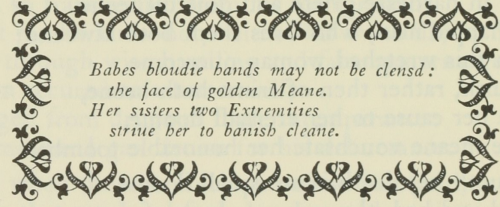
Babes bloudie hands may not be clensd:[490] the face of golden Meane. Her sisters two Extremities[491] striue her to banish cleane.
Thus when Sir Guyon with his faithfull guide i Had with due rites and dolorous lament The end of their sad Tragedie vptyde, The litle babe vp in his armes he hent; Who with sweet pleasance and bold blandishment Gan smyle on them, that rather ought to weepe, As carelesse of his woe, or innocent Of that was doen, that ruth emperced deepe In that knights heart, and wordes with bitter teares did steepe.
Ah lucklesse babe, borne vnder cruell starre, ii And in dead parents balefull ashes bred, Full litle weenest thou, what sorrowes are Left thee for portion of thy liuelihed, Poore Orphane in the wide world scattered, As budding braunch rent from the natiue tree, And throwen forth, till it be withered: Such is the state of men: thus enter wee Into this life with woe, and end with miseree. Then soft himselfe inclyning on his knee iii Downe to that well, did in the water weene (So loue does loath disdainfull nicitee) His guiltie hands from bloudie gore to cleene. He washt them oft and oft, yet nought they beene For all his washing cleaner. Still he stroue, Yet still the litle hands were bloudie seene; The which him into great amaz’ment droue, And into diuerse doubt his wauering wonder cloue. He wist not whether blot of foule offence iv Might not be purgd with water nor with bath; Or that high God, in lieu[492] of innocence, Imprinted had that token of his wrath, To shew how sore bloudguiltinesse he hat’th[493]; Or that the charme and venim, which they druncke, Their bloud with secret filth infected hath, Being diffused through the senselesse truncke, That through the great contagion direfull deadly stunck. Whom thus at gaze, the Palmer gan to bord v With goodly reason, and thus faire bespake; Ye bene right hard[494] amated, gratious Lord, And of your ignorance great maruell make, Whiles cause not well conceiued ye mistake. But know, that secret vertues are infusd In euery fountaine, and in euery lake, Which who hath skill them rightly to haue chusd, To proofe of passing wonders hath full often vsd.
Of those some were so from their sourse indewd vi By great Dame Nature, from whose fruitfull pap Their welheads spring, and are with moisture deawd; Which feedes each liuing plant with liquid sap, And filles with flowres faire Floraes painted lap: But other some by gift of later grace, Or by good prayers, or by other hap, Had vertue pourd into their waters bace, And thenceforth were renowmd, and sought from place to[495] place. Such is this well, wrought by occasion straunge, vii Which to her Nymph befell. Vpon a day, As she the woods with bow and shafts did raunge, The hartlesse Hind and Robucke to dismay, Dan Faunus chaunst to meet her by the way, And kindling fire at her faire burning eye, Inflamed was to follow beauties chace[496], And chaced her, that fast from him did fly; As Hind from her, so she fled from her enimy. At last when fayling breath began to faint, viii And saw no meanes to scape, of shame affrayd, She set[497] her downe to weepe for sore constraint, And to Diana calling lowd for ayde, Her deare besought, to let her dye a mayd. The goddesse heard, and suddeine where she sate, Welling out streames of teares, and quite dismayd With stony feare of that rude rustick mate, Transformd her to a stone from stedfast virgins state. Lo now she is that stone, from whose[498] two heads, ix As from two weeping eyes, fresh streames do flow, Yet cold through feare, and old conceiued dreads; And yet the stone her semblance seemes to show, Shapt like a maid, that such ye may her know; And yet her vertues in her water byde: For it is chast and pure, as purest snow, Ne lets her waues with any filth be[499] dyde, But euer like her selfe vnstained hath beene tryde.
From thence it comes, that this babes bloudy hand x May not be clensd with water of this well: Ne certes Sir striue you it to withstand, But let them still be bloudy, as befell, That they his mothers innocence may tell, As she bequeathd in her last testament; That as a sacred Symbole it may dwell In her sonnes flesh, to minde reuengement, And be for all chast Dames an endlesse moniment. He hearkned to his reason, and the childe xi Vptaking, to the Palmer gaue to beare; But his sad fathers armes with bloud defilde, An heauie load himselfe did lightly reare, And turning to that place, in which whyleare He left his loftie steed with golden sell, And goodly gorgeous barbes, him found not theare. By other accident that earst befell, He is conuaide, but how or where, here fits not tell. Which when Sir Guyon saw, all were he wroth, xii Yet algates mote he soft himselfe appease, And fairely fare on foot, how euer loth; His double burden did him sore disease. So long they traueiled with litle ease, Till that at last they to a Castle came, Built on a rocke adioyning to the seas;[500] It was an auncient worke of antique fame[501], And wondrous strong by nature, and by skilfull frame. Therein three sisters dwelt of sundry sort, xiii The children of one sire by mothers three; Who dying whylome did diuide this fort To them by equall shares in equall fee: But strifull[502] minde, and diuerse qualitee Drew them in parts, and each made others foe: Still did they striue, and dayly disagree; The eldest did against the youngest goe, And both against the middest meant to worken woe.
Where when the knight arriu’d, he was right well xiv Receiu’d, as knight of so much worth became, Of second sister, who did far excell The other two; Medina was her name, A sober sad, and comely curteous Dame; Who rich arayd, and yet in modest guize, In goodly garments, that her well became, Faire marching forth in honorable wize, Him at the threshold met, and well did enterprize. She led him vp into a goodly bowre, xv And comely courted with meet modestie, Ne in her speach, ne in her hauiour, Was lightnesse seene, or looser vanitie, But gratious womanhood, and grauitie, Aboue the reason of her youthly yeares: Her golden lockes she roundly did vptye In breaded[503] tramels, that no looser heares Did out of order stray about her daintie eares. Whilest she her selfe thus busily did frame, xvi Seemely to entertaine her new-come guest, Newes hereof to her other sisters came, Who all this while were at their wanton rest, Accourting each her friend with lauish fest: They were two knights of perelesse puissance, And famous far abroad for warlike gest, Which to these Ladies loue did countenaunce, And to his mistresse each himselfe stroue to aduaunce. He that made loue vnto the eldest Dame, xvii Was hight Sir Huddibras, an hardy man; Yet not so good of deedes, as great of name, Which he by many rash aduentures wan, Since errant armes to sew he first began; More huge in strength, then wise in workes he was, And reason with foole-hardize ouer ran; Sterne melancholy did his courage pas, And was for terrour more, all armd in shyning bras.
But he that lou’d the youngest, was Sans-loy, xviii He that faire Vna late fowle outraged, The most vnruly, and the boldest boy, That euer warlike weapons menaged, And to all lawlesse lust encouraged, Through strong opinion of his matchlesse might: Ne ought he car’d, whom he endamaged By tortious wrong, or whom bereau’d of right. He now this Ladies champion chose for loue to fight. These two gay knights, vowd to so diuerse loues, xix Each other does enuie with deadly hate, And dayly warre against his foeman moues, In hope to win more fauour with his mate, And th’others pleasing seruice to abate, To magnifie his owne. But when they heard, How in that place straunge knight arriued late, Both knights and Ladies forth right angry far’d, And fiercely vnto battell sterne themselues prepar’d. But ere they could proceede vnto the place, xx Where he abode, themselues at discord fell, And cruell combat ioynd in middle space: With horrible assault, and furie fell, They heapt huge strokes, the scorned life to quell, That all on vprore from her settled seat[504] The house was raysd, and all that in did dwell; Seemd that lowde thunder with amazement great Did rend the ratling skyes with flames of fouldring heat. The noyse thereof cald[505] forth that straunger knight, xxi To weet, what dreadfull thing was there in hand[506]; Where when as two braue knights in bloudy fight With deadly rancour he enraunged fond, His sunbroad shield about his wrest he bond, And shyning blade vnsheathd, with which he ran Vnto that stead, their strife to vnderstond; And at his first arriuall, them began With goodly meanes to pacifie, well as he can.
But they him spying, both with greedy forse xxii Attonce vpon him ran, and him beset With strokes of mortall steele without remorse, And on his shield like yron sledges bet: As when a Beare and Tygre being met In cruell fight on lybicke Ocean wide, Espye a traueiler with feet surbet, Whom they in equall pray hope to deuide, They stint their strife, and him assaile on euery side. But he, not like a wearie traueilere, xxiii Their sharpe assault right boldly[507] did rebut, And suffred not their blowes to byte him nere, But with redoubled buffes them backe did put: Whose grieued mindes, which choler did englut, Against themselues turning their wrathfull spight, Gan with new rage their shields to hew and cut; But still when Guyon came to part their fight, With heauie load on him they freshly gan to smight. As a tall ship tossed in troublous seas, xxiv Whom raging windes threatning to make the pray Of the rough rockes, do diuersly disease, Meetes two contrary billowes by the way, That her on either side do sore assay, And boast to swallow her in greedy graue; She scorning both their spights, does make wide way, And with her brest breaking the fomy waue, Does ride on both their backs, and faire her selfe doth saue. So boldly he him beares, and rusheth forth xxv Betweene them both, by conduct of his blade. Wondrous great prowesse and heroick worth He shewd that day, and rare ensample made, When two so mighty warriours he dismade: Attonce he wards and strikes, he takes and payes, Now forst to yield, now forcing to inuade, Before, behind, and round about him layes: So double was his paines, so double be his prayse.
Straunge sort of fight, three valiaunt knights to see xxvi Three combats ioyne in one, and to darraine A triple warre with triple enmitee, All for their Ladies froward loue to gaine, Which gotten was but hate. So loue does raine In stoutest minds, and maketh monstrous warre; He maketh warre, he maketh peace againe, And yet his peace is but continuall iarre: O miserable men, that to him subiect arre. Whilst thus they mingled were in furious armes, xxvii The faire Medina with her tresses torne, And naked brest, in pitty of their harmes, Emongst them ran, and falling them beforne, Besought them by the womb, which them had borne, And by the loues, which were to them most deare, And by the knighthood, which they sure had sworne, Their deadly cruell discord to forbeare, And to her iust conditions of faire peace to heare. But her two other sisters standing by, xxviii Her lowd gainsaid, and both their[508] champions[509] bad Pursew the end of their strong enmity, As euer of their loues they would be glad. Yet she with pitthy words and counsell sad, Still stroue their stubborne rages to reuoke, That at the last suppressing fury mad, They gan abstaine from dint of direfull stroke, And hearken to the sober speaches, which she spoke. Ah puissaunt Lords, what cursed euill Spright, xxix Or fell Erinnys, in your noble harts[510] Her hellish brond hath kindled with despight, And stird you vp to worke your wilfull smarts? Is this the ioy of armes? be these the parts Of glorious knighthood, after bloud to thrust[511], And not regard dew right and iust desarts? Vaine is the vaunt, and victory vniust, That more to mighty hands, then rightfull cause doth trust.
And were there[512] rightfull cause of difference xxx Yet were not better, faire it to accord, Then with bloud guiltinesse[513] to heape offence, And mortall vengeaunce ioyne to crime abhord? O fly from wrath, fly, O my liefest Lord: Sad be the sights, and bitter fruits of warre, And thousand furies wait on wrathfull sword; Ne ought the prayse of prowesse more doth marre, Then fowle reuenging rage, and base contentious iarre. But louely concord, and most sacred peace xxxi Doth nourish vertue, and fast friendship breeds; Weake she makes[514] strong, and strong thing does increace, Till it the pitch of highest prayse exceeds: Braue be her warres, and honorable deeds, By which she triumphes ouer ire and pride, And winnes an Oliue girlond for her meeds: Be therefore, O my deare Lords, pacifide, And this misseeming discord meekely lay aside. Her gracious wordes their rancour did appall, xxxii And suncke so deepe into their boyling brests, That downe they let their cruell weapons fall, And lowly did abase their loftie crests To her faire presence, and discrete behests. Then she began a treatie to procure, And stablish termes betwixt both their requests, That as a law for euer should endure; Which to obserue in word of knights they did assure. Which to confirme, and fast to bind their league, xxxiii After their wearie sweat and bloudy toile, She them besought, during their quiet treague, Into her lodging to repaire a while, To rest themselues, and grace to reconcile. They soone consent: so forth with her they fare, Where they are well receiu’d, and made to spoile Themselues of soiled armes, and to prepare Their minds to pleasure, and their mouthes to dainty fare.
And those two froward sisters, their faire loues xxxiv Came with them eke, all were they wondrous loth, And fained cheare, as for the time behoues, But could not colour yet so well the troth, But that their natures bad appeard in both: For both did at their second sister grutch, And inly grieue, as doth an hidden moth The inner garment fret, not th’vtter touch; One thought their[515] cheare too litle, th’other thought too mutch. Elissa (so the eldest hight) did deeme xxxv Such entertainment base, ne ought would eat, Ne ought would speake, but euermore did seeme As discontent for want of merth or meat; No solace could her Paramour intreat Her once to show, ne court, nor dalliance, But with bent lowring browes, as she would threat, She scould, and frownd with froward countenaunce, Vnworthy of faire Ladies comely gouernaunce. But young Perissa was of other mind, xxxvi Full of disport, still laughing, loosely light, And quite contrary to her sisters kind; No measure in her mood, no rule of right, But poured out in pleasure and delight; In wine and meats she flowd aboue the bancke, And in excesse exceeded her owne might; In sumptuous tire she ioyd her selfe to prancke, But of her loue too lauish (litle haue she thancke.) Fast[516] by her side did sit the bold Sans-loy, xxxvii Fit mate for such a mincing mineon, Who in her loosenesse tooke exceeding ioy; Might not be found a franker franion, Of her lewd parts to make companion; But Huddibras, more like a Malecontent, Did see and grieue at his bold fashion; Hardly could he endure his hardiment, Yet still he sat, and inly did him selfe torment.
Betwixt them both the faire Medina sate xxxviii With sober grace, and goodly carriage: With equall measure she did moderate The strong extremities of their outrage; That forward paire she euer would asswage, When they would striue dew reason to exceed; But that same froward twaine would accourage, And of her plenty adde vnto their need: So kept she them in order, and her selfe in heed. Thus fairely she attempered her feast, xxxix And pleasd them all with meete satietie, At last when lust of meat and drinke was ceast, She Guyon deare besought of curtesie, To tell from whence he came through ieopardie, And whither now on new aduenture bound. Who with bold grace, and comely grauitie, Drawing to him the eyes of all around, From lofty siege began these words aloud to sound. This thy demaund, O Lady, doth reuiue xl Fresh memory in me of that great Queene, Great and most glorious virgin Queene aliue, That with her soueraigne powre, and scepter shene All Faery lond does peaceably[517] sustene. In widest Ocean she her throne does reare, That ouer all the earth it may be seene; As morning Sunne her beames dispredden cleare, And in her face faire peace, and mercy doth appeare. In her the richesse of all heauenly grace[518] xli In chiefe degree are heaped vp on hye: And all that else this worlds enclosure bace[519] Hath great or glorious in mortall eye,[520] Adornes the person of her Maiestie; That men beholding so great excellence, And rare perfection in mortalitie, Do her adore with sacred reuerence, As th’Idole of her makers great magnificence.
To her I homage and my seruice owe, xlii In number of the noblest knights on ground, Mongst whom on me she deigned to bestowe Order of Maydenhead, the most renownd, That may this day in all the world be found:[521] An yearely solemne feast she wontes to make[522] The day that first doth lead the yeare around; To which all knights of worth and courage bold Resort, to heare of straunge aduentures to be told. There this old Palmer shewed himselfe that day, xliii And to that mighty Princesse did complaine Of grieuous mischiefes, which a wicked Fay Had wrought, and many whelmd in deadly paine, Whereof he crau’d redresse. My Soueraine, Whose glory is in gracious deeds, and ioyes Throughout the world her mercy to maintaine, Eftsoones deuisd redresse for such annoyes; Me all vnfit for so great purpose she employes. Now hath faire Phœbe with her siluer face xliv Thrise seene the shadowes of the neather world, Sith last I left that honorable place, In which her royall presence is †introld[523]; Ne euer shall I rest in house nor hold, Till I that false Acrasia haue wonne; Of whose fowle deedes, too hideous to be told,[524] I witnesse am, and this their wretched sonne, Whose wofull parents she hath wickedly fordonne. Tell on, faire Sir, said she, that dolefull tale, xlv From which sad ruth does seeme you to restraine, That we may pitty such vnhappy bale, And learne from pleasures poyson to abstaine: Ill by ensample good doth often gayne. Then forward he his purpose gan pursew, And told the storie of the mortall payne, Which Mordant and Amauia did rew; As with lamenting eyes him selfe did lately vew.
Night was far spent, and now in Ocean deepe xlvi Orion, flying fast from hissing snake, His flaming head did hasten for to steepe, When of his pitteous tale he end did make; Whilest with delight of that he wisely spake, Those guestes beguiled, did beguile their eyes Of kindly sleepe, that did them ouertake. At last when they had markt the chaunged skyes, They wist their houre was spent; then each to rest him hyes.
FOOTNOTES:
Cant. III.
Vaine Braggadocchio getting Guyons horse is made the scorne Of knighthood trew, and is of fayre Belphœbe fowle forlorne.
Soone as the morrow faire with purple beames i Disperst the shadowes of the mistie night, And Titan playing on the eastern streames, Gan cleare the deawy ayre with springing light, Sir Guyon mindfull of his vow yplight, Vprose from drowsie couch, and him addrest Vnto the iourney which he had behight: His puissaunt armes about his noble brest, And many-folded shield he bound about his wrest. Then taking Congé of that virgin pure, ii The bloudy-handed babe vnto her truth Did earnestly commit, and her coniure, In vertuous lore to traine his tender youth, And all that gentle noriture ensu’th: And that so soone as ryper yeares he raught[525], He might for memorie of that dayes ruth, Be called Ruddymane, and thereby taught, T’auenge his Parents death on them, that had it wrought.
So forth he far’d, as now befell, on foot, iii Sith his good steed is lately from him gone; Patience perforce; helpelesse what may it boot To fret for anger, or for griefe to mone? His Palmer now shall foot no more alone: So fortune wrought, as vnder greene woods syde He lately heard that dying Lady grone, He left his steed without, and speare besyde, And rushed in on foot to ayd her, ere she dyde. The whiles a losell wandring by the way, iv One that to bountie neuer cast his mind, Ne thought of honour euer did assay His baser brest, but in his kestrell kind A pleasing vaine of glory vaine[526] did find, To which his flowing toung, and troublous spright Gaue him great ayd, and made him more inclind: He that braue steed there finding ready dight, Purloynd both steed and speare, and ran away full light. Now gan his hart all swell in iollitie, v And of him selfe great hope and helpe conceiu’d, That puffed vp with smoke of vanitie, And with selfe-loued personage deceiu’d, He gan to hope, of men to be receiu’d For such, as he him thought, or faine would bee: But for in court gay portaunce he perceiu’d, And gallant shew to be in greatest gree, Eftsoones to court he cast t’auaunce[527] his first degree. And by the way he chaunced to espy vi One sitting idle on a sunny bancke, To whom auaunting in great brauery, As Peacocke, that his painted plumes doth prancke, He smote his courser in the trembling flancke, And to him threatned his hart-thrilling speare: The seely man seeing him ryde so rancke, And ayme at him, fell flat to ground for feare, And crying Mercy lowd, his pitious hands gan reare.
Thereat the Scarcrow wexed wondrous prowd, vii Through fortune of his first aduenture faire, And with big thundring voyce reuyld him lowd; Vile Caytiue, vassall of dread and despaire, Vnworthie of the commune[528] breathed aire, Why liuest thou, dead dog, a lenger day, And doest not vnto death thy selfe prepaire. Dye, or thy selfe my captiue yield for ay; Great fauour I thee graunt, for aunswere thus to stay. Hold, O deare Lord, hold your dead-doing hand, viii Then loud he cryde, I am your humble thrall. Ah wretch (quoth he) thy destinies withstand My wrathfull will, and do for mercy call. I giue thee life: therefore prostrated fall, And kisse my stirrup; that thy homage bee. The Miser threw him selfe, as an Offall, Streight at his foot in base humilitee, And cleeped him his liege, to hold of him in fee. So happy peace they made and faire accord: ix Eftsoones this liege-man gan to wexe more bold, And when he felt the folly of his Lord, In his owne kind he gan him selfe vnfold: For he was wylie witted, and growne old In cunning sleights and practick knauery. From[529] that day forth he cast for to vphold His idle humour with fine flattery[530], And blow the bellowes to his swelling vanity. Trompart fit man for Braggadocchio[531], x To serue at court in view of vaunting eye; Vaine-glorious man, when fluttring wind does blow In his light wings, is lifted vp to skye: The scorne of knighthood and trew cheualrye, To thinke without desert of gentle deed, And noble worth to be aduaunced hye: Such prayse is shame; but honour vertues meed Doth beare the fairest flowre in honorable seed.
So forth they pas, a well consorted paire, xi Till that at length with Archimage they meet: Who seeing one that shone in armour faire, On goodly courser[532] thundring with his feet, Eftsoones supposed him a person meet, Of his reuenge to make the instrument: For since the Redcrosse knight he earst did weet, To beene with Guyon knit in one consent, The ill, which earst to him, he now to Guyon ment. And comming close to Trompart gan inquere xii Of him, what mighty warriour that mote bee, That rode in golden sell with single spere, But wanted sword to wreake his enmitee. He is a great aduenturer, (said he) That hath his sword through hard assay forgone, And now hath vowd, till he auenged bee, Of that despight, neuer to wearen none; That speare is him enough to doen a thousand grone. Th’enchaunter greatly ioyed in the vaunt, xiii And weened well ere long his will to win, And both his foen with equall foyle to daunt. Tho to him louting lowly, did begin To plaine of wrongs, which had committed bin By Guyon, and by that false Redcrosse knight, Which two through treason and deceiptfull gin, Had slaine Sir Mordant, and his Lady bright: That mote him honour win, to wreake so foule despight. Therewith all suddeinly he seemd enraged, xiv And threatned death with dreadfull countenaunce, As if their liues had in his hand beene gaged; And with stiffe force shaking his mortall launce, To let him weet his doughtie valiaunce, Thus said; Old man, great sure shalbe thy meed, If where those knights for feare of dew vengeaunce Do lurke, thou certainly to me areed, That I may wreake on them their hainous hatefull deed.
Certes, my Lord, (said he) that shall I soone, xv And giue you eke good helpe to their decay, But mote I wisely you aduise to doon; Giue no ods to your foes, but do puruay Your selfe of sword before that bloudy day: For they be two the prowest knights on ground, And oft approu’d in many hard assay, And eke of surest steele, that may be found, Do arme your selfe against that day, them to confound. Dotard (said he) let be thy deepe aduise; xvi Seemes that through many yeares thy wits thee faile, And that weake eld hath left thee nothing wise, Else neuer should thy iudgement be so fraile, To measure manhood by the sword or maile. Is not enough foure quarters of a man, Withouten sword or shield, an host to quaile? Thou little wotest, what this right hand can: Speake they, which haue beheld the battailes, which it wan. The man was much abashed at his boast; xvii Yet well he wist, that who so would contend With either of those knights on euen coast, Should need of all his armes, him to defend; Yet feared least his boldnesse should offend, When Braggadocchio said, Once I did sweare, When with one sword seuen knights I brought to end, Thence forth in battell neuer sword to beare, But it were that, which noblest knight on earth doth weare. Perdie Sir knight, said then th’enchaunter bliue, xviii That shall I shortly purchase to your hond: For now the best and noblest knight aliue Prince Arthur is, that wonnes in Faerie lond; He hath a sword, that flames like burning brond. The same by my deuice[533] I vndertake Shall by to morrow by thy side be fond. At which bold word that boaster gan to quake, And wondred in his mind, what mote that monster make.
He stayd not for more bidding, but away xix Was suddein vanished out of his sight: The Northerne wind his wings did broad display At his commaund, and reared him vp light From off the earth to take his aerie flight. They lookt about, but no where could espie Tract of his foot: then dead through great affright They both nigh were, and each bad other flie: Both fled attonce, ne euer backe returned eie. Till that they come vnto a forrest greene, xx In which they shrowd themselues from causelesse feare; Yet feare them followes still, where so they beene, Each trembling leafe, and whistling wind they heare, As ghastly bug their haire on end does[534] reare: Yet both doe striue their fearfulnesse to faine. At last they heard a horne, that shrilled cleare Throughout the wood, that ecchoed againe, And made the forrest ring, as it would riue in twaine. Eft through the thicke they heard one rudely rush; xxi With noyse whereof he from his loftie steed Downe fell to ground, and crept into a bush, To hide his coward head from dying dreed. But Trompart stoutly stayd to taken heed[535] Of what might hap. Eftsoone there stepped forth A goodly Ladie clad in hunters weed, That seemd to be a woman of great worth, And by her stately portance, borne of heauenly birth. Her face so faire as flesh it seemed not, xxii But heauenly pourtraict of bright Angels hew, Cleare as the skie, withouten blame or blot, Through goodly mixture of complexions dew; And in her cheekes the vermeill red did shew Like roses in a bed of lillies shed, The which ambrosiall odours from them threw, And gazers sense with double pleasure fed, Hable[536] to heale the sicke, and to reuiue the ded.
In her faire eyes two liuing lamps did flame, xxiii Kindled aboue at th’heauenly makers light, And darted fyrie beames out of the same, So passing persant[537], and so wondrous bright, That quite bereau’d the rash beholders sight: In them the blinded god his lustfull fire To kindle oft assayd, but had no might; For with dredd[538] Maiestie, and awfull ire, She broke his wanton darts, and quenched base desire. Her iuorie forhead, full of bountie braue, xxiv Like a broad table did it selfe dispred, For Loue his loftie triumphes to engraue, And write the battels of his great godhed: All good and honour might therein be red: For there their dwelling was. And when she spake, Sweet words, like dropping honny she did shed, And twixt the perles and rubins softly brake A siluer sound, that heauenly musicke seemd to make. Vpon her eyelids many Graces sate, xxv Vnder the shadow of her euen browes, Working belgards, and amorous retrate, And euery one her with a grace endowes: And euery one with meekenesse to her bowes. So glorious mirrhour of celestiall grace, And soueraine moniment of mortall vowes, How shall fraile pen descriue her heauenly face, For feare through want of skill her beautie to disgrace? So faire, and thousand thousand times more faire xxvi She seemd, when she presented was to sight, And was yclad, for heat of scorching aire, All in a silken Camus lylly whight, Purfled vpon with many a folded plight, Which all aboue besprinckled was throughout[539] With golden aygulets, that glistred bright, Like twinckling starres, and all the skirt about Was hemd with golden fringe
Below her ham her weed did somewhat traine, xxvii And her streight legs most brauely were embayld In gilden buskins of costly Cordwaine, All bard with golden bendes, which were entayld With curious antickes, and full faire aumayld: Before they fastned were vnder her knee In a rich Iewell, and therein entrayld The ends[540] of all their[541] knots, that none might see, How they within their fouldings close enwrapped bee. Like two faire marble pillours they were[542] seene, xxviii Which doe the temple of the Gods support, Whom all the people decke with girlands greene, And honour in their festiuall resort; Those same with stately grace, and princely port She taught to tread, when she her selfe would grace, But with the wooddie Nymphes when she did play[543], Or when the flying Libbard she did chace, She could them nimbly moue, and after fly apace. And in her hand a sharpe bore-speare she held, xxix And at her backe a bow and quiuer gay, Stuft with steele-headed darts, wherewith she queld The saluage beastes in her victorious play, Knit with a golden bauldricke, which forelay Athwart her snowy brest, and did diuide Her daintie paps; which like young fruit in May Now little gan to swell, and being tide, Through her thin weed their places only signifide. Her yellow lockes crisped, like golden wyre, xxx About her shoulders weren loosely shed, And when the winde emongst them did inspyre, They waued like a penon wide dispred[544], And low behinde her backe were scattered: And whether art it were, or heedlesse hap, As through the flouring forrest rash she fled, In her rude haires sweet flowres themselues did lap, And flourishing fresh leaues and blossomes did enwrap.
Such as Diana by the sandie shore xxxi Of swift Eurotas, or on Cynthus greene, Where all the Nymphes haue her vnwares forlore, Wandreth alone with bow and arrowes keene, To seeke her game: Or as that famous Queene Of Amazons, whom Pyrrhus did destroy, The day that first of Priame she was seene, Did shew her selfe in great triumphant ioy, To succour the weake state of sad afflicted Troy. Such when as hartlesse Trompart her did vew, xxxii He was dismayed in his coward mind, And doubted, whether he himselfe should shew, Or fly away, or bide alone behind: Both feare and hope he in her face did find, When she at last him spying thus bespake; Hayle Groome; didst not thou see a bleeding Hind, Whose right haunch earst my stedfast arrow strake? If thou didst, tell me, that I may her ouertake. Wherewith reviu’d, this answere forth he threw; xxxiii O Goddesse, (for such I thee take to bee) For neither doth thy face terrestriall shew, Nor voyce sound mortall; I auow to thee, Such wounded beast, as that, I did not see, Sith earst into this forrest wild I came. But mote thy goodlyhed forgiue it mee, To weet, which of the Gods I shall thee name, That vnto thee due worship I may rightly frame. To whom she thus; but ere her words ensewed, xxxiv Vnto the bush her eye did suddein glaunce, In which vaine Braggadocchio was mewed, And saw it stirre: she left her percing launce, And towards gan a deadly shaft aduaunce, In mind to marke the beast. At which sad stowre, Trompart forth stept, to stay the mortall chaunce, Out crying, O what euer heauenly powre, Or earthly wight thou be, withhold this deadly howre.
O stay thy hand,[545] for yonder is no game xxxv For thy fierce arrowes, them to exercize, But loe my Lord, my liege, whose warlike name[546] Is farre renowmd through many bold emprize; And now in shade he shrowded yonder lies. She staid: with that he crauld out of his nest, Forth creeping on his caitiue hands and thies, And standing stoutly vp, his loftie crest Did fiercely shake, and rowze, as comming late from rest. As fearefull fowle, that long in secret caue xxxvi For dread of soaring hauke her selfe hath hid, Not caring how, her silly life to saue, She her gay painted plumes disorderid, Seeing at last her selfe from daunger rid, Peepes foorth,[547] and soone renewes her natiue pride; She gins her feathers foule disfigured Proudly to prune, and set on euery side, So shakes off shame, ne thinks how erst she did her hide. So when her goodly visage he beheld, xxxvii He gan himselfe to vaunt: but when he vewed Those deadly tooles, which in her hand she held, Soone into other fits he was transmewed, Till she to him her gratious speach renewed; All haile, Sir knight, and well may thee befall, As all the like, which honour haue pursewed Through deedes of armes and prowesse martiall; All vertue merits praise, but such the most of all. To whom he thus; O fairest vnder skie, xxxviii True be thy words, and worthy of thy praise, That warlike feats doest highest glorifie. Therein haue I[548] spent all my youthly daies, And many battailes fought, and many fraies Throughout the world, wher so they might be found, Endeuouring my dreadded name to raise Aboue the Moone, that fame may it resound In her eternall trompe, with laurell girland cround.
But what art thou, O Ladie, which doest raunge xxxix In this wilde forrest, where no pleasure is, And doest not it for ioyous court exchaunge, Emongst thine equall peres, where happie blis And all delight does raigne, much more then this? There thou maist loue, and dearely loued bee, And swim in pleasure, which thou here doest mis; There maist thou best be seene, and best maist see: The wood is fit for beasts, the court is fit for thee. Who so in pompe of proud estate (quoth she) xl Does swim, and bathes himselfe in courtly blis, Does waste his dayes in darke obscuritee, And in obliuion euer buried is: Where ease abounds, yt’s eath to doe amis; But who his limbs with labours, and his mind Behaues with cares, cannot so easie mis. Abroad in armes, at home in studious kind Who seekes with painfull toile, shall honor soonest find. In woods, in waues, in warres she wonts to dwell, xli And will be found with perill and with paine; Ne can the man, that moulds in idle cell, Vnto her happie mansion attaine: Before her gate high God did Sweat ordaine, And wakefull watches euer to abide: But easie is the way, and passage plaine To pleasures pallace; it may soone be spide, And day and night her dores to all stand open wide. In Princes court, The rest she would haue said, xlii But that the foolish man, fild with delight Of her sweet words, that all his sence dismaid, And with her wondrous beautie rauisht quight, Gan burne in filthy lust, and leaping light, Thought in his bastard armes her to embrace. With that she swaruing backe, her Iauelin bright Against him bent, and fiercely did menace: So turned her about, and fled away apace.
Which when the Peasant saw, amazd he stood, xliii And grieued[549] at her flight; yet durst he not Pursew her steps, through wild vnknowen wood; Besides he feard her wrath, and threatned shot Whiles in the bush he lay, not yet forgot: Ne car’d he greatly for her presence vaine, But turning said to Trompart, What foule blot Is this to knight, that Ladie should againe Depart to woods vntoucht, and leaue so proud disdaine? Perdie (said Trompart) let her passe at will, xliv Least by her presence daunger mote befall. For who can tell (and sure I feare it ill) But that she is some powre celestiall? For whiles she spake, her great words did apall My feeble courage, and my hart oppresse, That yet I quake and tremble ouer all. And I (said Braggadocchio) thought no lesse, When first I heard her horne sound with such ghastlinesse. For from my mothers wombe this grace I haue xlv Me giuen by eternall destinie, That earthly thing may not my courage braue Dismay with feare, or cause one[550] foot to flie, But either hellish feends, or powres on hie: Which was the cause, when earst that horne I heard, Weening it had beene thunder in the skie, I hid my selfe from it, as one affeard; But when I other knew, my selfe I boldly reard. But now for feare of worse, that may betide, xlvi Let vs soone hence depart. They soone agree; So to his steed he got, and gan to ride, As one vnfit therefore, that all might see He had not trayned bene in cheualree. Which well that valiant courser did discerne; For he despysd to tread in dew degree, But chaufd and fom’d, with courage fierce and sterne, And to be easd of that base burden still did erne[551].
FOOTNOTES:
Cant. IIII.
Guyon does Furor bind in chaines, and stops Occasion: Deliuers Phedon[552], and therefore by Strife[553] is rayld vpon.
In braue pursuit of honorable deed, i There is I know not what[554] great difference Betweene the vulgar and the noble seed, Which vnto things of valorous pretence Seemes to be borne by natiue influence; As feates of armes, and loue to entertaine, But chiefly skill to ride, seemes a science Proper to gentle bloud; some others faine To menage steeds, as did this vaunter; but in vaine. But he the rightfull owner of that steed, ii Who well could menage and subdew his pride, The whiles on foot was forced for to yeed, With that blacke Palmer, his most trusty guide; Who suffred not his wandring feet to slide. But when strong passion, or weake fleshlinesse Would from the right way seeke to draw him wide, He would through temperance and stedfastnesse, Teach him the weake to strengthen, and the strong suppresse. It fortuned forth faring on his way, iii He saw from farre, or seemed for to see Some troublous vprore or contentious fray, Whereto he drew in haste it to agree. A mad man, or that feigned mad to bee, Drew by the haire along vpon the ground, A handsome stripling with great crueltee, Whom sore he bett, and gor’d with many a wound, That cheekes with teares, and sides with bloud did all abound.
And him behind, a wicked Hag did stalke, iv In ragged robes, and filthy disaray, Her other leg was lame, that she no’te walke,[555] But on a staffe her feeble steps did stay; Her lockes, that loathly were and hoarie gray, Grew all afore, and loosely hong vnrold, But all behind was bald, and worne away, That none thereof could euer taken hold, And eke her face ill fauourd, full of wrinckles old. And euer as she went, her tongue did walke v In foule reproch, and termes of vile despight, Prouoking him by her outrageous talke, To heape more vengeance on that wretched wight; Sometimes she raught him stones, wherwith to smite, Sometimes her staffe, though it her one leg were, Withouten which she could not go vpright; Ne any euill meanes she did forbeare, That might him moue to wrath, and indignation reare. The noble Guyon mou’d with great remorse, vi Approching, first the Hag did thrust away, And after adding more impetuous forse, His mightie hands did on the madman lay, And pluckt him backe; who all on fire streight way, Against him turning all his fell intent, With beastly brutish rage gan him assay, And smot, and bit, and kickt, and scratcht, and rent, And did he wist not what in his auengement. And sure he was a man of mickle might, vii Had he had gouernance, it well to guide: But when the franticke fit inflamd his spright, His force was vaine, and strooke more often wide, Then at the aymed marke, which he had eide: And oft himselfe he chaunst to hurt vnwares, Whilst reason blent through passion, nought descride, But as a blindfold Bull at randon fares, And where he hits, nought knowes, and whom he hurts, nought cares.
His rude assault and rugged handeling viii Straunge seemed to the knight, that aye with foe In faire defence and goodly menaging Of armes was wont to fight, yet nathemoe Was he abashed now not fighting so, But more enfierced through his currish play, Him sternely grypt, and haling to and fro, To ouerthrow him strongly did assay, But ouerthrew himselfe vnwares, and lower lay. And being downe the villein sore did beat, ix And bruze with clownish fistes his manly face: And eke the Hag with many a bitter threat, Still cald vpon to kill him in the place. With whose reproch and odious menace The knight emboyling in his haughtie hart, Knit all his forces, and gan soone vnbrace His grasping hold: so lightly did vpstart, And drew his deadly weapon, to maintaine his part. Which when the Palmer saw, he loudly cryde, x Not so, O Guyon, neuer thinke that so That Monster can be maistred or destroyd: He is not[556], ah, he is not such a foe, As steele can wound, or strength can ouerthroe. That same is Furor, cursed cruell wight, That vnto knighthood workes much shame and woe; And that same Hag, his aged mother, hight Occasion, the root of all wrath and despight. With her, who so will raging Furor tame, xi Must first begin, and well her amenage: First her restraine from her reprochfull blame, And euill meanes, with which she doth enrage Her franticke sonne, and kindles his courage, Then when she is withdrawen, or strong withstood, It’s eath his idle furie to asswage, And calme the tempest of his passion wood; The bankes are ouerflowen, when stopped is the flood.
Therewith Sir Guyon left his first emprise, xii And turning to that woman, fast her hent By the hoare lockes, that hong before her eyes, And to the ground her threw: yet n’ould she stent Her bitter rayling and foule reuilement, But still prouokt her sonne to wreake her wrong; But nathelesse he did her still torment, And catching hold of her vngratious tong[557], Thereon an yron lock[558] did fasten firme and strong. Then when as vse of speach was from her reft, xiii With her two crooked handes she signes did make, And beckned him, the last helpe she had left: But he that last left helpe away did take, And both her hands fast bound vnto a stake, That she note stirre. Then gan her sonne to flie Full fast away, and did her quite forsake; But Guyon after him in haste did hie, And soone him ouertooke in sad perplexitie. In his strong armes he stiffely him embraste, xiv Who him gainstriuing, nought at all preuaild: For all his power was vtterly defaste, And furious fits at earst quite weren quaild: Oft he re’nforst, and oft his forces fayld, Yet yield he would not, nor his rancour slacke. Then him to ground he cast, and rudely hayld, And both his hands fast bound behind his backe, And both his feet in fetters to an yron racke. With hundred yron chaines he did him bind, xv And hundred knots that did him sore constraine: Yet his great yron teeth he still did grind, And grimly gnash, threatning reuenge in vaine; His burning eyen, whom bloudie strakes did staine, Stared full wide, and threw forth sparkes of fire, And more for ranck despight, then for great paine, Shakt his long lockes, colourd like copper-wire, And bit his tawny beard to shew his raging ire.
Thus when as Guyon Furor had captiu’d, xvi Turning about he saw that wretched Squire, Whom that mad man of life nigh late depriu’d, Lying on ground, all soild with bloud and mire: Whom when as he perceiued to respire, He gan to comfort, and his wounds to dresse. Being at last recured, he gan inquire, What hard mishap him brought to such distresse, And made that caitiues thral, the thral of wretchednesse. With hart then throbbing, and with watry eyes, xvii Faire Sir (quoth he) what man can shun the hap, That hidden lyes vnwares him to surpryse?[559] Misfortune waites aduantage to entrap The man most warie in her whelming lap. So me weake wretch, of many weakest one[560], Vnweeting, and vnware of such mishap, She brought to mischiefe through occasion[561], Where this same wicked villein did me light vpon[562]. It was a faithlesse Squire, that was the sourse xviii Of all my sorrow, and of these sad teares, With whom from tender dug of commune nourse, Attonce I was vpbrought, and eft when yeares More rype vs reason lent to chose our Peares, Our selues in league of vowed loue we knit: In which we long time without gealous feares, Or[563] faultie thoughts continewd, as was fit; And for my part I vow, dissembled not a whit. It was my fortune commune to that age, xix To loue a Ladie faire of great degree, The which was borne of noble parentage, And set in highest seat of dignitee, Yet seemd no lesse to loue, then loued to bee: Long I her seru’d, and found her faithfull still, Ne euer thing could cause vs disagree: Loue that two harts makes one,[564] makes eke one will: Each stroue to please, and others pleasure to fulfill.
My friend, hight Philemon, I did partake[565] xx Of all my loue and all my priuitie; Who greatly ioyous seemed for my sake, And gratious to that Ladie, as to mee, Ne euer wight, that mote so welcome bee, As he to her, withouten blot or blame, Ne euer thing, that she could thinke or see, But vnto him she would impart the same: O wretched man, that would abuse so gentle Dame. At last such grace I found, and meanes I wrought, xxi That I that Ladie to my spouse had wonne; Accord of friends, consent of parents sought, Affiance made, my happinesse begonne, There wanted nought but few rites to be donne, Which mariage make; that day too farre did seeme: Most ioyous man, on whom the shining Sunne[566] Did shew his face, my selfe I did esteeme, And that my falser friend did no lesse ioyous deeme. But ere[567] that wished day his beame disclosd, xxii He either enuying my toward good, Or of himselfe to treason ill disposd,[568] One day vnto me came in friendly mood, And told for secret how he vnderstood That Ladie whom I had to me assynd, Had both distaind her honorable blood, And eke the faith, which she to me did bynd; And therfore wisht me stay, till I more truth should fynd. The gnawing anguish and sharpe gelosy, xxiii Which his sad speech infixed in my brest, Ranckled so sore, and festred inwardly, That my engreeued mind could find no rest, Till that the truth thereof I did outwrest, And him besought by that same sacred band Betwixt vs both, to counsell me the best. He then with solemne oath and plighted hand Assur’d, ere long the truth to let me vnderstand.
Ere long with like againe he boorded mee, xxiv Saying, he now had boulted all the floure, And that it was a groome of base degree, Which of my loue was partner Paramoure: Who vsed in a darkesome inner bowre Her oft to meet: which better to approue, He promised to bring me at that howre, When I should see, that would me nearer moue, And driue me to withdraw my blind abused loue. This gracelesse man for furtherance of his guile, xxv Did court the handmayd of my Lady deare, Who glad t’embosome his affection vile, Did all she might, more pleasing to appeare. One day to worke her to his will more neare, He woo’d her thus: Pryene (so she hight) What great despight doth fortune to thee beare, Thus lowly to abase thy beautie bright, That it should not deface all others lesser light? But if she had her least helpe to thee lent, xxvi T’adorne thy forme according thy desart, Their blazing pride thou wouldest soone haue blent, And staynd their prayses with thy least good part; Ne should faire Claribell with all her art, Though she thy Lady be, approch thee neare: For proofe thereof, this euening, as thou art, Aray thy selfe in her most gorgeous geare, That I may more delight in thy embracement deare. The Maiden proud through prayse, and mad through loue xxvii Him hearkned to, and soone her selfe arayd, The whiles to me the treachour did remoue His craftie engin, and as he had sayd, Me leading, in a secret corner layd, The sad spectatour of my Tragedie; Where left, he went, and his owne false part playd, Disguised like that groome of base degree, Whom he had feignd th’abuser of my loue to bee.
Eftsoones he came vnto th’appointed place, xxviii And with him brought Pryene,[569] rich arayd, In Claribellaes clothes. Her proper face I not descerned[570] in that darkesome shade, But weend it was my loue, with whom he playd. Ah God, what horrour and tormenting griefe My hart, my hands, mine eyes, and all assayd? Me liefer were ten thousand deathes[571] priefe, Then wound of gealous worme, and shame of such repriefe. I home returning, fraught with fowle despight, xxix And chawing vengeance all the way I went, Soone as my loathed loue appeard in sight, With wrathfull hand I slew her innocent; That after soone I dearely did lament: For when the cause of that outrageous deede Demaunded, I made plaine and euident, Her faultie Handmayd, which that bale did breede, Confest, how Philemon her wrought to chaunge her weede. Which when I heard, with horrible affright xxx And hellish fury all enragd, I sought Vpon my selfe that vengeable despight To punish: yet it better first I thought, To wreake my wrath on him, that first it wrought. To Philemon, false faytour Philemon I cast to pay, that I so dearely bought; Of deadly drugs I gaue him drinke anon, And washt away his guilt with guiltie potion. Thus heaping crime on crime, and griefe on griefe, xxxi To losse of loue adioyning losse of frend, I meant to purge both with a third mischiefe, And in my woes beginner it to end: That was Pryene; she did first offend, She last should smart: with which cruell intent, When I at her my murdrous blade did bend, She fled away with ghastly dreriment, And I pursewing my fell purpose, after went.