SPENSER’S FAERIE QUEENE (continued 2)
Reading edition
And all the way, with great lamenting paine, xliv And piteous plaints she filleth his dull eares, That stony hart could riuen haue in twaine, And all the way she wets with flowing teares: But he enrag’d with rancor, nothing heares. Her seruile beast yet would not leaue her so, But followes her farre off, ne ought he feares, To be partaker of her wandring woe, More mild in beastly kind, then that her beastly foe.
FOOTNOTES:
Cant. IIII.
To sinfull house of Pride, Duessa guides the faithfull knight, Where brothers death to wreak Sansioy doth chalenge him to fight.
Young knight, what euer that dost armes professe, i And through long labours huntest after fame, Beware of fraud, beware of ficklenesse, In choice, and change of thy deare loued Dame, Least thou of her beleeue too lightly blame, And rash misweening doe thy hart remoue: For vnto knight there is no greater shame, Then lightnesse and inconstancie in loue; That doth this Redcrosse knights ensample plainly proue. Who after that he had faire Vna lorne, ii Through light misdeeming of her loialtie, And false Duessa in her sted had borne, Called Fidess’, and so supposd to bee; Long with her traueild, till at last they see A goodly building, brauely garnished, The house of mightie Prince it seemd to bee: And towards it a broad high way that led, All bare through peoples feet, which thither traueiled.
Great troupes of people traueild thitherward iii Both day and night, of each degree and place, But few returned, hauing scaped hard, With balefull beggerie, or foule disgrace, Which euer after in most wretched case[134], Like loathsome lazars, by the hedges lay. Thither Duessa bad him bend his pace: For she is wearie of the toilesome way, And also nigh consumed is the lingring day. A stately Pallace built of squared bricke, iv Which cunningly was without morter laid, Whose wals were high, but nothing strong, nor thick, And golden foile all ouer them displaid, That purest skye with brightnesse they dismaid: High lifted vp were many loftie towres, And goodly galleries farre ouer laid, Full of faire windowes, and delightfull bowres; And on the top a Diall told the timely howres. It was a goodly heape for to behould, v And spake the praises of the workmans wit; But full great pittie, that so faire a mould Did on so weake foundation euer sit: For on a sandie hill, that still did flit, And fall away, it mounted was full hie, That euery breath of heauen shaked it: And all the hinder parts, that few could spie, Were ruinous and old, but painted cunningly. Arriued there they passed in forth right; vi For still to all the gates stood open wide, Yet charge of them was to a Porter hight Cald Maluenù, who entrance none denide: Thence to the hall, which was on euery side With rich array and costly arras dight: Infinite sorts of people did abide There waiting long, to win the wished sight Of her, that was the Lady of that Pallace bright.
By them they passe, all gazing on them round, vii And to the Presence mount; whose glorious vew Their frayle amazed senses did confound: In liuing Princes court none euer knew Such endlesse richesse, and so sumptuous[135] shew; Ne Persia selfe, the nourse of pompous pride Like euer saw. And there a noble crew Of Lordes and Ladies stood on euery side, Which with their presence faire, the place much beautifide. High aboue all a cloth of State was spred, viii And a rich throne, as bright as sunny day, On which there sate most braue embellished With royall robes and gorgeous array, A mayden Queene, that shone as Titans ray, In glistring gold, and peerelesse pretious stone: Yet her bright blazing beautie did assay To dim the brightnesse of her glorious throne, As enuying her selfe, that too exceeding shone. Exceeding shone, like Phœbus fairest childe, ix That did presume his fathers firie wayne, And flaming mouthes of steedes vnwonted wilde Through highest heauen with weaker hand to rayne; Proud of such glory and aduancement vaine, While flashing beames do daze his feeble eyen, He leaues the welkin way most beaten plaine, And rapt with whirling wheeles, inflames the skyen, With fire not made to burne, but fairely for to shyne. So proud she shyned in her Princely state, x Looking to heauen; for earth she did disdayne, And sitting high; for lowly she did hate: Lo vnderneath her scornefull feete, was layne A dreadfull Dragon with an hideous trayne, And in her hand she held a mirrhour bright, Wherein her face she often vewed fayne, And in her selfe-lou’d semblance tooke delight; For she was wondrous faire, as any liuing wight.
Of griesly Pluto she the daughter was, xi And sad Proserpina the Queene of hell; Yet did she thinke her pearelesse worth[136] to pas That parentage, with pride so did she swell, And thundring Ioue, that high in heauen doth dwell, And wield the world, she claymed for her syre, Or if that any else did Ioue excell: For to the highest she did still aspyre, Or if ought higher were then that, did it desyre. And proud Lucifera men did her call, xii That made her selfe a[137] Queene, and crownd to be, Yet rightfull kingdome she had none at all, Ne heritage of natiue soueraintie, But did vsurpe with wrong and tyrannie Vpon the scepter, which she now did hold: Ne ruld her Realmes[138] with lawes, but pollicie, And strong aduizement of six wisards old, That with their counsels bad her kingdome did vphold. Soone as the Elfin[139] knight in presence came, xiii And false Duessa seeming Lady faire, A gentle Husher, Vanitie by name Made rowme, and passage for them did prepaire: So goodly brought them to the lowest staire Of her high throne, where they on humble knee Making obeyssance[140], did the cause declare, Why they were come, her royall state to see, To proue the wide report of her great Maiestee. With loftie eyes, halfe loth to looke so low, xiv She thanked them in her disdainefull wise, Ne other grace vouchsafed them to show Of Princesse worthy, scarse them bad arise. Her Lordes and Ladies all this while deuise Themselues to setten forth to straungers sight: Some frounce their curled haire in courtly guise, Some prancke their ruffes, and others trimly dight Their gay attire: each others greater pride does spight.
Goodly they all that knight do entertaine, xv Right glad with him to haue increast their crew: But to Duess’ each one himselfe did paine All kindnesse and faire courtesie to shew; For in that court whylome her well they knew: Yet the stout Faerie monist the middest crowd Thought all their glorie vaine in knightly vew, And that great Princesse too exceeding prowd, That to strange knight no better countenance allowd. Suddein vpriseth from her stately place xvi The royall Dame, and for her coche doth call: All hurtlen[141] forth, and she with Princely pace, As faire Aurora in her purple pall, Out of the East the dawning day doth call: So forth she comes: her brightnesse brode doth blaze; The heapes of people thronging in the hall, Do ride each other, vpon her to gaze: Her glorious glitterand[142] light doth all mens eyes amaze. So forth she comes, and to her coche does clyme, xvii Adorned all with gold, and girlonds gay, That seemd as fresh as Flora in her prime, And stroue to match, in royall rich array, Great Iunoes golden chaire, the which they say The Gods stand gazing on, when she does ride To Ioues high house through heauens bras-paued way Drawne of faire Pecocks, that excell in pride, And full of Argus eyes their tailes dispredden wide. But this was drawne of six vnequall beasts, xviii On which her six sage Counsellours did ryde, Taught to obay their bestiall beheasts, With like conditions to their kinds applyde: Of which the first, that all the rest did guyde, Was sluggish Idlenesse the nourse of sin; Vpon a slouthfull Asse he chose to ryde, Arayd in habit blacke, and amis thin, Like to an holy Monck, the seruice to begin.
And in his hand his Portesse still he bare, xix That much was worne, but therein little red, For of deuotion he had little care, Still drownd in sleepe, and most of his dayes ded; Scarse could he once vphold his heauie hed, To looken, whether it were night or day: May seeme the wayne was very euill led, When such an one had guiding of the way, That knew not, whether right he went, or else astray. From worldly cares himselfe he did esloyne, xx And greatly shunned manly exercise, From[143] euery worke he chalenged essoyne, For contemplation sake: yet otherwise, His life he led in lawlesse riotise; By which he grew to grieuous malady; For in his lustlesse limbs through euill guise A shaking feuer raignd continually: Such one was Idlenesse, first of this company. And by his side rode loathsome Gluttony, xxi Deformed creature, on a filthie swyne, His belly was vp-blowne with luxury, And eke with fatnesse swollen were his eyne, And like a Crane his necke was long and fyne, With which he swallowd vp excessiue feast, For want whereof poore people oft did pyne; And all the way, most like a brutish beast, He spued vp his gorge, that all did him deteast. In greene vine leaues he was right fitly clad; xxii For other clothes he could not weare for heat, And on his head an yuie girland had, From vnder which fast trickled downe the sweat: Still as he rode, he somewhat still did eat, And in his hand did beare a bouzing can, Of which he supt so oft, that on his seat His dronken corse[144] he scarse vpholden can, In shape and life more like a monster, then a man.
Vnfit he was for any worldly[145] thing, xxiii And eke vnhable[146] once to stirre or go, Not meet to be of counsell to a king, Whose mind in meat and drinke was drowned so, That from his friend he seldome[147] knew his fo: Full of diseases was his carcas blew, And a dry dropsie through his flesh did flow: Which by misdiet daily greater grew: Such one was Gluttony, the second of that crew. And next to him rode lustfull Lechery, xxiv Vpon a bearded Goat, whose rugged haire, And whally eyes (the signe of gelosy,) Was like the person selfe, whom he did beare: Who rough, and blacke, and filthy did appeare, Vnseemely man to please faire Ladies eye; Yet he of Ladies oft was loued deare, When fairer faces were bid standen by: O who does know the bent of womens fantasy? In a greene gowne he clothed was full faire, xxv Which vnderneath did hide his filthinesse, And in his hand a burning hart he bare, Full of vaine follies, and new fanglenesse: For he was false, and fraught with ficklenesse, And learned had to loue with secret lookes, And well could daunce, and sing with ruefulnesse, And fortunes tell, and read in louing bookes, And thousand other wayes, to bait his fleshly hookes. Inconstant man, that loued all he saw, xxvi And lusted after all, that he did loue, Ne would his looser life be tide to law, But ioyd weake wemens hearts to tempt[148] and proue If from their loyall loues he might then moue; Which lewdnesse fild him with reprochfull paine Of that fowle euill, which all men reproue, That rots the marrow, and consumes the braine: Such one was Lecherie, the third of all this traine.
And greedy Auarice by him did ride, xxvii Vpon a Camell loaden all with gold; Two iron coffers[149] hong on either side, With precious mettall full, as they might hold, And in his lap an heape of coine he told; For of his wicked pelfe[150] his God he made, And vnto hell him selfe for money sold; Accursed vsurie was all his trade, And right and wrong ylike in equall ballaunce waide. His life was nigh vnto deaths doore yplast, xxviii And thred-bare cote, and cobled shoes he ware, Ne scarse good morsell all his life did tast, But both from backe and belly still did spare, To fill his bags, and richesse to compare; Yet chylde ne kinsman liuing had he none To leaue them to; but thorough daily care To get, and nightly feare to lose his owne, He led a wretched life vnto him selfe vnknowne. Most wretched wight, whom nothing might suffise, xxix Whose greedy lust did lacke in greatest store, Whose need had end, but no end couetise, Whose wealth was want, whose plenty made him pore, Who had enough, yet wished euer more[151]; A vile disease, and eke in foote and hand A grieuous gout tormented him full sore, That well he could not touch, nor go, nor stand: Such one was Auarice, the fourth[152] of this faire band. And next to him malicious Enuie rode, xxx Vpon a rauenous wolfe, and still did chaw Betweene his cankred teeth a venemous tode, That all the poison ran about his chaw[153]; But inwardly he chawed his owne maw At neighbours[154] wealth, that made him euer sad; For death it was, when any good he saw, And wept, that cause of weeping none he had, But when he heard of harme, he wexed wondrous glad.
All in a kirtle of discolourd say xxxi He clothed was, ypainted full of eyes; And in his bosome secretly there lay An hatefull Snake, the which his taile vptyes In many folds, and mortall sting implyes. Still as he rode, he gnasht his teeth, to see Those heapes of gold with griple Couetyse, And grudged at the great felicitie Of proud Lucifera, and his owne companie. He hated all good workes and vertuous deeds, xxxii And him no lesse, that any like did vse, And who with gracious bread the hungry feeds, His almes for want of faith he doth accuse; So euery good to bad he doth abuse: And eke the verse of famous Poets witt He does backebite, and spightfull poison spues From leprous mouth on all, that euer writt: Such one vile Enuie was, that fifte[155] in row did sitt. And him beside rides fierce reuenging Wrath, xxxiii Vpon a Lion, loth for to be led; And in his hand a burning brond he hath, The which he brandisheth about his hed; His eyes did hurle forth sparkles fiery red, And stared sterne on all, that him beheld, As ashes pale of hew and seeming ded; And on his dagger still his hand he held, Trembling through hasty rage, when choler in him sweld. His ruffin raiment all was staind with blood, xxxiv Which he had spilt, and all to rags yrent, Through vnaduized rashnesse woxen wood; For of his hands he had no gouernement, Ne car’d for bloud in his auengement: But when the furious fit was ouerpast, His cruell facts he often would repent; Yet wilfull man he neuer would forecast, How many mischieues should ensue his heedlesse hast.
Full many mischiefes follow cruell Wrath; xxxv Abhorred bloudshed, and tumultuous strife, Vnmanly murder, and vnthrifty scath, Bitter despight, with rancours rusty knife, And fretting griefe the enemy of life; All these, and many euils moe haunt ire, The swelling Splene, and Frenzy raging rife, The shaking Palsey, and Saint Fraunces fire: Such one was Wrath, the last of this vngodly tire. And after all, vpon the wagon beame xxxvi Rode Sathan[156], with a smarting whip in hand, With which he forward lasht the laesie teme, So oft as Slowth still in the mire did stand. Huge routs of people did about them band, Showting for ioy, and still before their way A foggy mist had couered all the land; And vnderneath their feet, all scattered lay Dead sculs and bones of men, whose life had gone astray. So forth they marchen in this goodly sort, xxxvii To take the solace of the open aire, And in fresh flowring fields themselues to sport; Emongst the rest rode that false Lady faire, The fowle Duessa, next vnto the chaire Of proud Lucifera[157], as one of the traine: But that good knight would not so nigh repaire, Him selfe estraunging from their ioyaunce vaine, Whose fellowship seemd far vnfit for warlike swaine. So hauing solaced themselues a space xxxviii With pleasaunce of the breathing fields yfed, They backe returned to the Princely Place; Whereas an errant knight in armes ycled, And heathnish shield, wherein with letters red Was writ Sans ioy, they new arriued find: Enflam’d with fury and fiers hardy-hed, He seemd in hart to harbour thoughts vnkind, And nourish bloudy vengeaunce in his bitter mind.
Who when the shamed shield of slaine Sans foy xxxix He spide with that same Faery champions page, Bewraying him, that did of late destroy His eldest brother, burning all with rage He to him leapt, and that same enuious gage Of victors glory from him snatcht away: But th’Elfin knight, which ought that warlike wage, Disdaind to loose[158] the meed he wonne in fray, And him rencountring[159] fierce, reskewd the noble pray. Therewith they gan to hurtlen[160] greedily, xl Redoubted battaile ready to darrayne, And clash their shields, and shake their swords[161] on hy, That with their sturre they troubled all the traine; Till that great Queene vpon eternall paine Of high displeasure, that ensewen might, Commaunded them their fury to refraine, And if that either to that shield had right, In equall lists they should the morrow next it fight. Ah dearest Dame, (quoth then the Paynim bold,) xli Pardon the errour[162] of enraged wight, Whom great griefe made forget the raines to hold Of reasons rule, to see this recreant[163] knight, No knight, but treachour full of false despight And shamefull treason, who through guile hath slayn The prowest knight, that euer field did fight, Euen stout Sans foy (O who can then refrayn?) Whose shield he beares renuerst[164], the more to heape disdayn. And to augment the glorie of his guile, xlii His dearest loue the faire Fidessa loe Is there possessed of the traytour vile, Who reapes the haruest sowen by his foe, Sowen in bloudy field, and bought with woe: That brothers hand shall dearely well requight So be, O Queene, you equall fauour showe. Him litle answerd th’angry Elfin knight; He neuer meant with words, but swords to plead his right.
But threw his gauntlet as a sacred pledge[165], xliii His cause in combat the next day to try: So been they parted both, with harts on edge[166], To be aueng’d each on his enimy. That night they pas in ioy and iollity, Feasting and courting both in bowre and hall; For Steward was excessiue Gluttonie, That of his plenty poured forth to all; Which doen, the Chamberlain Slowth did to rest them call. Now whenas darkesome night had all displayd xliv Her coleblacke curtein ouer brightest skye, The warlike youthes on dayntie couches layd, Did chace away sweet sleepe from sluggish eye, To muse on meanes of hoped victory. But whenas Morpheus had with leaden mace Arrested all that courtly company, Vp-rose Duessa from her resting place, And to the Paynims lodging comes with silent pace. Whom broad awake she finds, in troublous fit, xlv Forecasting, how his foe he might annoy, And him amoues with speaches seeming fit: Ah deare Sans ioy[167], next dearest to Sans foy, Cause of my new griefe, cause of my new ioy[168], Ioyous, to see his ymage in mine eye, And greeu’d, to thinke how foe did him destroy, That was the flowre of grace and cheualrye; Lo his Fidessa to thy secret faith I flye. With gentle wordes he can her fairely greet, xlvi And bad say on the secret[169] of her hart. Then sighing soft, I learne that litle sweet Oft tempred is (quoth she) with muchell smart: For since my brest was launcht with louely dart Of deare Sansfoy, I neuer ioyed howre, But in eternall woes my weaker hart Haue wasted, louing him with all my powre, And for his sake haue felt full many an heauie stowre.
At last when perils all I weened past, xlvii And hop’d to reape the crop of all my care, Into new woes vnweeting I was cast, By this false faytor, who vnworthy ware His worthy shield, whom he with guilefull snare Entrapped slew, and brought to shamefull graue. Me silly maid away with him he bare, And euer since hath kept in darksome caue, For that I would not yeeld, that to Sans-foy I gaue. But since faire Sunne hath sperst that lowring clowd, xlviii And to my loathed life now shewes some light, Vnder your beames I will me safely shrowd, From dreaded storme of his disdainfull spight: To you th’inheritance belongs by right Of brothers prayse, to you eke longs his loue. Let not his loue, let not his restlesse spright Be vnreueng’d, that calles to you aboue From wandring Stygian shores, where it doth endlesse moue. Thereto said he, Faire[170] Dame be nought dismaid xlix For sorrowes past; their griefe is with them gone: Ne yet of present perill be affraid; For needlesse feare did neuer vantage none, And helplesse hap it booteth not to mone. Dead is Sans-foy, his vitall paines are past, Though greeued ghost for vengeance deepe do grone: He liues, that shall him pay his dewties last, And guiltie Elfin bloud shall sacrifice in hast. O but I feare the fickle freakes (quoth shee) l Of fortune false, and oddes of armes in field. Why dame (quoth he) what oddes can euer bee, Where both do fight alike, to win or yield? Yea but (quoth she) he beares a charmed shield, And eke enchaunted armes, that none can perce, Ne none can wound the man, that does them wield. Charmd or enchaunted (answerd he then ferce) I no whit reck, ne you the like need to reherce.
But faire Fidessa, sithens fortunes guile, li Or enimies powre hath now captiued you, Returne from whence ye came, and rest a while Till morrow next, that I the Elfe subdew, And with Sans-foyes dead dowry you endew. Ay me, that is a double death (she said) With proud foes sight my sorrow to renew: Where euer yet I be, my secrete aid Shall follow you. So passing forth she him obaid.
FOOTNOTES:
Cant. V.
The faithfull knight in equall field subdewes his faithlesse foe, Whom false Duessa saues, and for his cure to hell does goe.
The noble hart, that harbours vertuous thought, i And is with child of glorious great intent, Can neuer rest, vntill it forth haue brought Th’eternall brood of glorie excellent: Such restlesse passion did all night torment The flaming corage of that Faery knight, Deuizing, how that doughtie turnament With greatest honour he atchieuen might; Still did he[171] wake, and still did watch for dawning light. At last the golden Orientall gate[172] ii Of greatest heauen gan to open faire, And Phœbus fresh, as bridegrome to his mate, Came dauncing forth, shaking his deawie haire: And hurld[173] his glistring beames through gloomy aire. Which when the wakeful Elfe perceiu’d, streight way He started vp, and did him selfe prepaire, In sun-bright armes, and battailous array: For with that Pagan proud he combat will that day.
And forth he comes into the commune[174] hall, iii Where earely waite him many a gazing eye, To weet what end to straunger knights may fall. There many Minstrales maken melody, To driue away the dull melancholy, And many Bardes, that to the trembling chord Can tune their timely voyces cunningly, And many Chroniclers, that can record Old loues, and warres for Ladies doen by many a Lord. Soone after comes the cruell Sarazin, iv In wouen maile all armed warily, And sternly lookes at him, who not a pin Does care for looke of liuing creatures eye. They bring them wines of Greece and Araby, And daintie spices fetcht from furthest Ynd, To kindle heat of corage priuily: And in the wine a solemne oth they bynd T’obserue the sacred lawes of armes, that are assynd. At last forth comes that far renowmed Queene, v With royall pomp and Princely maiestie; She is ybrought vnto a paled greene, And placed vnder stately canapee, The warlike feates of both those knights to see. On th’other side in all mens open vew Duessa placed is, and on a tree Sans-foy his shield is hangd with bloudy hew: Both those the lawrell girlonds to the victor dew. A shrilling trompet sownded from on hye, vi And vnto battaill bad them selues addresse: Their shining shieldes about their wrestes[175] they tye, And burning blades about their heads do blesse, The instruments of wrath and heauinesse: With greedy force each other doth assayle, And strike so fiercely, that they do impresse Deepe dinted furrowes in the battred mayle; The yron walles to ward their blowes are weake and fraile.
The Sarazin was stout, and wondrous strong, vii And heaped blowes like yron hammers great: For after bloud and vengeance he did long. The knight was fiers, and full of youthly heat: And doubled strokes, like dreaded thunders threat: For all for prayse and honour he did fight. Both stricken strike, and beaten both do beat, That from their shields forth flyeth firie light, And helmets hewen[176] deepe, shew marks of eithers might. So th’one for wrong, the other striues for right: viii As when a Gryfon seized of his pray, A Dragon fiers encountreth in his flight, Through widest ayre making his ydle way, That would his rightfull rauine rend away: With hideous horrour both together smight, And souce so sore, that they the heauens affray: The wise Southsayer seeing so sad sight, Th’amazed vulgar tels of warres and mortall fight. So th’one for wrong, the other striues for right, ix And each to deadly shame would driue his foe: The cruell steele so greedily doth bight In tender flesh, that streames of bloud down flow, With which the armes, that earst so bright did show[177], Into a pure vermillion now are dyde: Great ruth in all the gazers harts did grow, Seeing the gored woundes to gape so wyde, That victory they dare not wish to either side. At last the Paynim chaunst to cast his eye, x His suddein eye, flaming with wrathfull fyre, Vpon his brothers shield, which hong thereby: Therewith redoubled was his raging yre, And said, Ah wretched sonne of wofull syre, Doest[178] thou sit wayling by black Stygian lake, Whilest here thy shield is hangd for victors hyre, And sluggish german doest thy forces slake, To after-send his foe, that him may ouertake?
Goe caytiue Elfe, him quickly ouertake, xi And soone redeeme from his long wandring woe; Goe guiltie ghost, to him my message make, That I his shield haue quit from dying foe. Therewith vpon his crest he stroke him so, That twise he reeled, readie twise to fall; End of the doubtfull battell[179] deemed tho The lookers on, and lowd to him gan call The false Duessa, Thine the shield, and I, and all. Soone as the Faerie heard his Ladie speake, xii Out of his swowning dreame he gan awake, And quickning faith, that earst was woxen weake, The creeping deadly cold away did shake: Tho mou’d with wrath, and shame, and Ladies sake, Of all attonce he cast auengd to bee, And with so’exceeding furie at him strake, That forced him to stoupe[180] vpon his knee; Had he not stouped so, he should haue clouen bee. And to him said, Goe now proud Miscreant, xiii Thy selfe thy message doe to german deare, Alone he wandring thee too long doth want: Goe say, his foe thy shield with his doth beare. Therewith his heauie hand he high gan reare, Him to haue slaine; when loe a darkesome clowd Vpon him fell: he no where doth appeare, But vanisht is. The Elfe him cals alowd, But answer none receiues: the darknes him does shrowd. In haste Duessa from her place arose, xiv And to him running said, O prowest knight, That euer Ladie to her loue did chose, Let now abate the terror[181] of your might, And quench the flame of furious despight, And bloudie vengeance; lo th’infernall powres Couering your foe with cloud of deadly night, Haue borne him hence to Plutoes balefull bowres. The conquest yours, I yours, the shield, and glory yours.
Not all so satisfide, with greedie eye xv He sought all round about, his thirstie[182] blade To bath[183] in bloud of faithlesse enemy; Who all that while lay hid in secret shade: He standes amazed, how he thence should fade. At last the trumpets[184] Triumph sound on hie, And running Heralds humble homage made, Greeting him goodly with new victorie, And to him brought the shield, the cause of enmitie. Wherewith he goeth to that soueraine Queene, xvi And falling her before on lowly knee, To her makes present of his seruice seene: Which she accepts, with thankes, and goodly gree, Greatly aduauncing his gay cheualree. So marcheth home, and by her takes the knight, Whom all the people follow with great glee, Shouting, and clapping all their hands on hight, That all the aire it fils, and flyes to heauen bright. Home is he brought, and laid in sumptuous bed: xvii Where many skilfull leaches him abide, To salue his hurts, that yet still freshly bled. In wine and oyle they wash his woundes wide, And softly can[185] embalme on euery side. And all the while, most heauenly melody About the bed sweet musicke did diuide, Him to beguile of griefe and agony: And all the while Duessa wept full bitterly. As when a wearie traueller[186] that strayes xviii By muddy shore of broad seuen-mouthed Nile, Vnweeting of the perillous wandring wayes, Doth meet a cruell craftie Crocodile, Which in false griefe hyding his harmefull guile, Doth weepe full sore, and sheddeth tender teares: The foolish man, that pitties all this while His mournefull plight, is swallowd vp vnwares, Forgetfull of his owne, that mindes anothers cares.
So wept Duessa vntill euentide, xix That shyning lampes in Ioues high house were light: Then forth she rose, ne lenger would abide, But comes vnto the place, where th’Hethen knight In slombring swownd[187] nigh voyd of vitall spright, Lay couer’d with inchaunted cloud all day: Whom when she found, as she him left in plight, To wayle his woefull case she would not stay, But to the easterne coast of heauen makes speedy way. Where griesly Night, with visage deadly sad, xx That Phœbus chearefull face durst neuer vew, And in a foule blacke pitchie mantle clad, She findes forth comming from her darkesome mew, Where she all day did hide her hated hew. Before the dore her yron charet stood, Alreadie harnessed for iourney new; And coleblacke steedes yborne of hellish brood, That on their rustie bits did champ, as they were wood. Who when she saw Duessa sunny bright, xxi Adornd with gold and iewels shining cleare, She greatly grew amazed at the sight, And th’vnacquainted light began to feare: For neuer did such brightnesse there appeare, And would haue backe retyred to her caue, Vntill the witches speech she gan to heare, Saying, Yet[188] O thou dreaded Dame, I craue Abide, till I haue told the message, which I haue. She stayd, and foorth Duessa gan proceede, xxii O thou most auncient Grandmother of all, More old then Ioue, whom thou at first didst breede, Or that great house of Gods cælestiall, Which wast begot in Dæmogorgons hall, And sawst the secrets of the world vnmade, Why suffredst thou thy Nephewes deare to fall With Elfin sword, most shamefully betrade? Lo where the stout Sansioy doth sleepe in deadly shade.
And him before, I saw with bitter eyes xxiii The bold Sansfoy shrinke vnderneath his speare; And now the pray of fowles in field he lyes, Nor wayld of friends, nor laid on groning beare, That whylome was to me too dearely deare. O what of Gods then boots it to be borne, If old Aveugles sonnes so euill heare? Or who shall not great Nightes[189] children scorne, When two of three her Nephews are so fowle forlorne. Vp then, vp dreary Dame, of darknesse Queene, xxiv Go gather vp the reliques of thy race, Or else goe them auenge, and let be seene, That dreaded Night in brightest day hath place, And can the children of faire light deface. Her feeling speeches some compassion moued In hart, and chaunge in that great mothers face: Yet pittie in her hart was neuer proued Till then: for[190] euermore she hated, neuer loued. And said, Deare daughter rightly may I rew xxv The fall of famous children borne of mee, And good successes, which their foes ensew: But who can turne the streame of destinee, Or breake the chayne of strong necessitee, Which fast is tyde to Ioues eternall seat? The sonnes of Day he fauoureth, I see, And by my ruines thinkes to make them great: To make one great by others losse, is bad excheat. Yet shall they not escape so freely all; xxvi For some shall pay the price of others guilt: And he the man that made Sansfoy to fall, Shall with his owne bloud price that he hath spilt. But what art thou, that telst of Nephews kilt? I that do seeme not I, Duessa am[191], (Quoth she) how euer now in garments gilt, And gorgeous gold arayd I to thee came; Duessa I, the daughter of Deceipt and Shame.
Then bowing downe her aged backe, she kist xxvii The wicked witch, saying; In that faire face The false resemblance of Deceipt, I wist Did closely lurke; yet so true-seeming grace It carried, that I scarse in darkesome place Could it discerne, though I the mother bee Of falshood[192], and root of Duessaes race. O welcome child, whom I haue longd to see, And now haue seene vnwares. Lo now I go with thee. Then to her yron wagon she betakes, xxviii And with her beares the fowle welfauourd witch: Through mirkesome aire her readie way she makes. Her twyfold Teme, of which two blacke as pitch, And two were browne, yet each to each vnlich, Did softly swim away, ne euer stampe, Vnlesse she chaunst their stubborne mouths to twitch; Then foming tarre, their bridles they would champe, And trampling the fine element, would fiercely rampe. So well they sped, that they be come at length xxix Vnto the place, whereas the Paynim lay, Deuoid of outward sense, and natiue strength, Couerd with charmed cloud from vew of day, And sight of men, since his late luckelesse fray. His cruell wounds with cruddy bloud congealed, They binden vp so wisely, as they may, And handle softly, till they can be healed: So lay him in her charet, close in night concealed. And all the while she stood vpon the ground, xxx The wakefull dogs did neuer cease to bay, As giuing warning of th’vnwonted sound, With which her yron wheeles did them affray, And her darke griesly looke them much dismay; The messenger of death, the ghastly Owle With drearie shriekes did also her bewray; And hungry Wolues continually did howle, At her abhorred face, so filthy and so fowle.
Thence turning backe in silence soft they stole, xxxi And brought the heauie corse with easie pace To yawning gulfe of deepe Auernus hole. By that same hole an entrance darke and bace With smoake and sulphure hiding all the place, Descends to hell: there creature neuer past, That backe returned without heauenly grace; But dreadfull Furies, which their chaines haue brast, And damned sprights sent forth to make ill men aghast. By that same way the direfull dames doe driue xxxii Their mournefull charet, fild with rusty blood, And downe to Plutoes house are come biliue: Which passing through, on euery side them stood The trembling ghosts with sad amazed mood, Chattring their yron teeth, and staring wide With stonie eyes; and all the hellish brood Of feends infernall flockt on euery side, To gaze on earthly wight, that with the Night durst ride. They pas the bitter waues of Acheron, xxxiii Where many soules sit wailing woefully, And come to fiery flood of Phlegeton, Whereas the damned ghosts in torments fry, And with sharpe shrilling shriekes doe bootlesse cry, Cursing high Ioue, the which them thither sent. The house of endlesse paine is built thereby, In which ten thousand sorts of punishment The cursed creatures doe eternally torment. Before the threshold dreadfull Cerberus xxxiv His three deformed heads did lay along, Curled with thousand adders venemous, And lilled forth his bloudie flaming tong: At them he gan to reare his bristles strong, And felly gnarre, vntill dayes enemy Did him appease; then downe his taile he hong And suffered them to passen quietly: For she in hell and heauen had power equally.
There was Ixion turned on a wheele, xxxv For daring tempt the Queene of heauen to sin; And Sisyphus an huge round stone did reele Against an hill, ne might from labour lin; There thirstie Tantalus hong by the chin; And Tityus fed a vulture on his maw; Typhœus ioynts were stretched on a gin, Theseus condemned to endlesse slouth by law, And fifty sisters water in leake[193] vessels draw. They all beholding worldly wights in place, xxxvi Leaue off their worke, vnmindfull of their smart, To gaze on them; who forth by them doe pace, Till they be come vnto the furthest part: Where was a Caue ywrought by wondrous art, Deepe, darke, vneasie, dolefull, comfortlesse, In which sad Æsculapius farre a part[194] Emprisond was in chaines remedilesse, For that Hippolytus rent corse he did redresse. Hippolytus a iolly huntsman was, xxxvii That wont in charet chace the foming Bore; He all his Peeres in beautie did surpas, But Ladies loue as losse of time forbore: His wanton stepdame loued him the more, But when she saw her offred sweets refused Her loue she turnd to hate, and him before His father fierce of treason false accused, And with her gealous termes his open eares abused. Who all in rage his Sea-god syre besought, xxxviii Some cursed vengeance on his sonne to cast: From surging gulf two monsters straight were brought, With dread whereof his chasing steedes aghast, Both charet swift and huntsman ouercast. His goodly corps on ragged cliffs[195] yrent, Was quite dismembred, and his members chast Scattered on euery mountaine, as he went, That of Hippolytus was left no moniment.
His cruell stepdame seeing what was donne, xxxix Her wicked dayes with wretched knife did end, In death auowing th’innocence of her sonne. Which hearing his rash Syre, began to rend His haire, and hastie tongue, that did offend: Tho gathering vp the relicks[196] of his smart By Dianes meanes, who was Hippolyts frend, Them brought to Æsculape, that by his art Did heale them all againe, and ioyned euery part. Such wondrous science in mans wit to raine xl When Ioue auizd, that could the dead reuiue, And fates expired could renew againe, Of endlesse life he might him not depriue, But vnto hell did thrust him downe aliue, With flashing thunderbolt ywounded sore: Where long remaining, he did alwaies striue Himselfe with salues to health for to restore, And slake the heauenly fire[197], that raged euermore. There auncient Night arriuing, did alight xli From her nigh[198] wearie waine, and in her armes To Æsculapius brought the wounded knight: Whom hauing softly disarayd of armes, Tho gan to him discouer all his harmes, Beseeching him with prayer, and with praise, If either salues, or oyles, or herbes, or charmes A fordonne wight from dore of death mote raise, He would at her request prolong her nephews daies. Ah Dame (quoth he) thou temptest me in vaine, xlii To dare the thing, which daily yet I rew, And the old cause of my continued paine With like attempt to like end to renew. Is not enough, that thrust from heauen dew Here endlesse penance for one fault I pay, But that redoubled crime with vengeance new Thou biddest me to eeke? Can Night defray The wrath of thundring Ioue, that rules both night and day?
Not so (quoth she) but sith that heauens king xliii From hope of heauen hath thee excluded quight, Why fearest thou, that canst not hope for thing, And fearest not, that more thee hurten might, Now in the powre of euerlasting Night? Goe to then, O thou farre renowmed[199] sonne Of great Apollo, shew thy famous might In medicine, that else hath to thee wonne Great paines, and greater praise, both neuer to be donne. Her words preuaild: And then the learned leach xliv His cunning hand gan to his wounds[200] to lay, And all things else, the which his art did teach: Which hauing seene, from thence arose away The mother of dread darknesse, and let stay Aueugles sonne there in the leaches cure, And backe returning tooke her wonted way, To runne her timely race, whilst Phœbus pure In westerne waues his wearie wagon did recure. The false Duessa leauing noyous Night, xlv Returnd to stately pallace of dame Pride; Where when she came, she found the Faery knight Departed thence, albe his woundes[201] wide Not throughly heald, vnreadie were to ride. Good cause he had to hasten thence away; For on a day his wary Dwarfe had spide, Where in a dongeon[202] deepe huge numbers[203] lay Of caytiue wretched thrals, that wayled night and day. A ruefull sight, as could be seene with eie; xlvi Of whom he learned had in secret wise The hidden cause of their captiuitie, How mortgaging their liues to Couetise, Through wastfull Pride, and wanton Riotise, They were by law of that proud Tyrannesse Prouokt with Wrath, and Enuies false surmise, Condemned to that Dongeon mercilesse, Where they should liue in woe, and die in wretchednesse.
There was that great proud king of Babylon, xlvii That would compell all nations to adore, And him as onely God to call vpon, Till through celestiall doome throwne out of dore, Into an Oxe he was transform’d of yore: There also was king Crœsus, that enhaunst His heart too high through his great riches store; And proud Antiochus, the which aduaunst His cursed hand gainst God, and on his altars[204] daunst. And them long time before, great Nimrod was, xlviii That first the world with sword and fire warrayd; And after him old Ninus farre did pas In princely pompe, of all the world obayd; There also was that mightie Monarch layd Low vnder all, yet aboue all in pride, That name of natiue syre did fowle vpbrayd, And would as Ammons sonne be magnifide, Till scornd of God and man a shamefull death he dide. All these together in one heape were throwne, xlix Like carkases of beasts in butchers stall. And in another corner wide were strowne The antique ruines of the Romaines fall: Great Romulus the Grandsyre of them all, Proud Tarquin, and too lordly Lentulus, Stout Scipio, and stubborne Hanniball, Ambitious Sylla, and sterne Marius, High Cæsar, great Pompey, and fierce Antonius. Amongst these mighty men were wemen mixt, l Proud wemen, vaine, forgetfull of their yoke: The bold Semiramis, whose sides transfixt With sonnes owne blade, her fowle reproches spoke; Faire Sthenobœa, that her selfe did choke With wilfull cord[205], for wanting of her will; High minded Cleopatra, that with stroke Of Aspes sting her selfe did stoutly kill: And thousands moe the like, that did that dongeon fill.
Besides the endlesse routs of wretched thralles, li Which thither were assembled day by day, From all the world after their wofull falles, Through wicked pride, and wasted wealthes decay. But most of all, which in that[206] Dongeon lay Fell from high Princes courts, or Ladies bowres, Where they in idle pompe, or wanton play, Consumed had their goods, and thriftlesse howres, And lastly throwne themselues into these heauy stowres. Whose case when as the carefull Dwarfe had tould, lii And made ensample of their mournefull sight Vnto his maister, he no lenger would There dwell in perill of like painefull plight, But early rose, and ere that dawning light Discouered had the world to heauen wyde, He by a priuie Posterne tooke his flight, That of no enuious eyes he mote be spyde: For doubtlesse death ensewd, if any him descryde. Scarse could he footing find in that fowle way, liii For many corses, like a great Lay-stall Of murdred men which therein strowed lay, Without remorse, or decent funerall: Which all through that great Princesse pride did fall And came to shamefull end. And them beside Forth ryding vnderneath the castell wall, A donghill of dead carkases he spide, The dreadfull spectacle of that sad house of Pride.
FOOTNOTES:
Cant. VI.
From lawlesse lust by wondrous grace fayre Vna is releast: Whom saluage nation does adore, and learnes her wise beheast.
As when a ship, that flyes faire vnder saile, i An hidden rocke escaped hath vnwares, That lay in waite her wrack for to bewaile, The Marriner yet halfe amazed stares At perill past, and yet in[207] doubt ne dares To ioy at his foole-happie ouersight: So doubly is distrest twixt ioy and cares The dreadlesse courage[208] of this Elfin knight, Hauing escapt so sad ensamples in his sight. Yet sad he was that his too hastie speed ii The faire Duess’ had forst him leaue behind; And yet more sad, that Vna his deare dreed Her truth had staind with treason so vnkind; Yet crime in her could neuer creature find, But for his loue, and for her owne selfe sake, She wandred had from one to other Ynd, Him for to seeke, ne euer would forsake, Till her vnwares the fierce Sansloy did ouertake. Who after Archimagoes fowle defeat, iii Led her away into a forrest wilde, And turning wrathfull fire to lustfull heat, With beastly sin thought her to haue defilde, And made the vassall of his pleasures vilde. Yet first he cast by treatie, and by traynes, Her to perswade, that stubborne fort to yilde: For greater conquest of hard loue he gaynes, That workes it to his will, then he that it constraines.
With fawning wordes he courted her a while, iv And looking louely, and oft sighing sore, Her constant hart did tempt with diuerse guile: But wordes,[209] and lookes, and sighes she did abhore, As rocke of Diamond stedfast euermore. Yet for to feed his fyrie lustfull eye, He snatcht the vele, that hong her face before; Then gan her beautie shine, as brightest skye, And burnt his beastly hart t’efforce her chastitye. So when he saw his flatt’ring arts to fayle, v And subtile engines bet from batteree, With greedy force he gan the fort assayle, Whereof he weend possessed soone to bee, And win[210] rich spoile of ransackt chastetee. Ah heauens, that do this hideous act behold, And heauenly virgin thus outraged see, How can ye vengeance iust so long withhold, And hurle not flashing flames vpon that Paynim bold? The pitteous maiden carefull comfortlesse, vi Does throw out thrilling shriekes, and shrieking cryes, The last vaine helpe of womens great distresse, And with loud plaints importuneth the skyes, That molten starres do drop like weeping eyes; And Phœbus flying so most shamefull sight, His blushing face in foggy cloud implyes, And hides for shame. What wit of mortall wight Can now deuise to quit a thrall from such a plight? Eternall prouidence exceeding thought, vii Where none appeares can make her selfe a way: A wondrous way it for this Lady wrought, From Lyons clawes to pluck the griped pray. Her shrill outcryes and shriekes so loud did bray, That all the woodes and forestes did resownd; A troupe of Faunes and Satyres far away Within the wood were dauncing in a rownd, Whiles old Syluanus slept in shady arber sownd.
Who when they heard that pitteous strained voice, viii In hast forsooke their rurall meriment, And ran towards the far rebownded noyce, To weet, what wight so loudly did lament. Vnto the place they come incontinent: Whom when the raging Sarazin espide, A rude, misshapen[211], monstrous rablement, Whose like he neuer saw, he durst not bide, But got his ready steed, and fast away gan ride. The wyld woodgods arriued in the place, ix There find the virgin dolefull[212] desolate, With ruffled rayments, and faire blubbred face, As her outrageous foe had left her late, And trembling yet through feare of former hate; All stand amazed at so vncouth sight, And gin to pittie her vnhappie state, All stand astonied at her beautie bright, In their rude eyes vnworthie of so wofull plight. She more amaz’d, in double dread doth dwell; x And euery tender part for feare does shake: As when a greedie Wolfe through hunger[213] fell A seely Lambe farre from the flocke does take, Of whom he meanes his bloudie feast to make, A Lyon spyes fast running towards him, The innocent pray in hast he does forsake, Which quit from death yet quakes in euery lim With chaunge of feare, to see the Lyon looke so grim. Such fearefull fit assaid her trembling hart, xi Ne word to speake, ne ioynt to moue she had: The saluage nation feele her secret smart, And read her sorrow in her count’nance sad; Their frowning forheads with rough hornes yclad, And rusticke horror all a side doe lay, And gently grenning, shew a semblance glad To comfort her, and feare to put away, Their backward bent knees teach her humbly to obay.
The doubtfull Damzell dare not yet commit xii Her single person to their barbarous truth, But still twixt feare and hope amazd does sit, Late learnd what harme to hastie trust ensu’th, They in compassion of her tender youth, And wonder of her beautie soueraine, Are wonne with pitty and vnwonted ruth, And all prostrate vpon the lowly plaine, Do kisse her feete, and fawne on her with count’nance faine. Their harts she ghesseth by their humble guise, xiii And yieldes her to extremitie of time; So from the ground she fearelesse doth arise, And walketh forth without suspect of crime: They all as glad, as birdes of ioyous Prime, Thence lead her forth, about her dauncing round, Shouting, and singing all a shepheards ryme, And with greene braunches strowing all the ground, Do worship her, as Queene, with oliue girlond cround. And all the way their merry pipes they sound, xiv That all the woods with doubled[214] Eccho ring, And with their horned feet do weare the ground, Leaping like wanton kids in pleasant Spring. So towards old Syluanus they her bring; Who with the noyse awaked, commeth out, To weet the cause, his weake steps gouerning, And aged limbs on Cypresse stadle stout, And with an yuie twyne his wast[215] is girt about. Far off he wonders, what them makes so glad, xv Or[216] Bacchus merry fruit they did inuent, Or Cybeles franticke rites haue made them mad; They drawing nigh, vnto their God present That flowre of faith and beautie excellent. The God himselfe vewing that mirrhour rare, Stood long amazd, and burnt in his intent; His owne faire Dryope now he thinkes not faire, And Pholoe fowle, when her to this he doth compaire.
The woodborne people fall before her flat, xvi And worship her as Goddesse of the wood; And old Syluanus selfe bethinkes not, what To thinke of wight so faire, but gazing stood, In doubt to deeme her borne of earthly brood; Sometimes Dame Venus selfe he seemes to see, But Venus neuer had so sober mood; Sometimes Diana he her takes to bee, But misseth bow, and shaftes, and buskins to her knee. By vew of her he ginneth to reuiue xvii His ancient loue, and dearest Cyparisse, And calles to mind his pourtraiture aliue, How faire he was, and yet not faire to this, And how he slew with glauncing dart amisse A gentle Hynd, the which the louely boy Did loue as life, aboue all worldly blisse; For griefe whereof the lad n’ould after ioy, But pynd away in anguish and selfe-wild annoy. The wooddy Nymphes, faire Hamadryades xviii Her to behold do thither runne apace, And all the troupe of light-foot Naiades, Flocke all about to see her louely face: But when they vewed haue her heauenly grace, They enuie her in their malitious mind, And fly away for feare of fowle disgrace: But all the Satyres scorne their woody kind, And henceforth nothing faire, but her on earth they find. Glad of such lucke, the luckelesse lucky maid, xix Did her content to please their feeble eyes, And long time with that saluage people staid, To gather breath in many miseries. During which time her gentle wit she plyes, To teach them truth, which worshipt her in vaine, And made her th’Image of Idolatryes; But when their bootlesse zeale she did restraine From her own worship, they her Asse would worship fayn.
It fortuned a noble warlike knight xx By iust occasion to that forrest came, To seeke his kindred, and the lignage right, From whence he tooke his well deserued name: He had in armes abroad wonne muchell fame, And fild far landes with glorie of his might, Plaine, faithfull, true, and enimy of shame, And euer lou’d to fight for Ladies right, But in vaine glorious frayes he litle did delight. A Satyres sonne yborne in forrest wyld, xxi By straunge aduenture as it did betyde, And there begotten of a Lady myld, Faire Thyamis the daughter of Labryde, That was in sacred bands of wedlocke tyde To Therion, a loose vnruly swayne; Who had more ioy to raunge the forrest wyde, And chase the saluage beast with busie payne, Then serue his Ladies loue, and wast in pleasures vayne. The forlorne mayd did with loues longing burne, xxii And could not lacke her louers company, But to the wood she goes, to serue her turne, And seeke her spouse, that from her still does fly, And followes other game and venery: A Satyre chaunst her wandring for to find, And kindling coles of lust in brutish eye, The loyall links of wedlocke did vnbind, And made her person thrall vnto his beastly kind. So long in secret cabin there he held xxiii Her captiue to his sensuall desire, Till that with timely fruit her belly sweld, And bore a boy vnto that saluage sire: Then home he suffred her for to retire, For ransome leauing him the late borne childe; Whom till to ryper yeares he gan aspire, He noursled[217] vp in life and manners wilde, Emongst wild beasts and woods, from lawes of men exilde.
For all he taught the tender ymp, was but xxiv To banish cowardize and bastard feare; His trembling hand he would him force to put Vpon the Lyon and the rugged Beare, And from the she Beares teats her whelps to teare; And eke wyld roring Buls he would him make To tame, and ryde their backes not made to beare; And the Robuckes in flight to ouertake, That euery beast for feare of him did fly and quake. Thereby so fearelesse, and so fell he grew, xxv That his owne sire and maister of his guise Did often tremble at his horrid vew, And oft for dread of hurt would him aduise, The angry beasts not rashly to despise, Nor too much to prouoke; for he would learne The Lyon stoup to him in lowly wise, (A lesson hard) and make the Libbard sterne Leaue roaring, when in rage he for reuenge did earne. And for to make his powre approued more, xxvi Wyld beasts in yron yokes he would compell; The spotted Panther, and the tusked Bore, The Pardale swift, and the Tigre cruell; The Antelope, and Wolfe both fierce and fell[218]; And them constraine in equall teme to draw. Such ioy he had, their stubborne harts to quell, And sturdie courage tame with dreadfull aw, That his beheast they feared, as a[219] tyrans law. His louing mother came vpon a day xxvii Vnto the woods, to see her little sonne; And chaunst vnwares to meet him in the way, After his sportes, and cruell pastime donne, When after him a Lyonesse did runne, That roaring all with rage, did lowd requere Her children deare, whom he away had wonne: The Lyon whelpes she saw how he did beare, And lull in rugged armes, withouten childish feare.
The fearefull Dame all quaked at the sight, xxviii And turning backe, gan fast to fly away, Vntill with loue reuokt from vaine affright, She hardly yet perswaded was to stay, And then to him these womanish words gan say; Ah Satyrane, my dearling, and my ioy, For loue of me leaue off this dreadfull play; To dally thus with death, is no fit toy, Go find some other play-fellowes, mine own sweet boy. In these and like delights of bloudy game xxix He trayned was, till ryper yeares he raught, And there abode, whilst any beast of name Walkt in that forest, whom he had not taught To feare his force: and then his courage haught Desird of forreine foemen to be knowne, And far abroad for straunge aduentures sought: In which his might was neuer ouerthrowne, But through all Faery lond his famous worth was blown. Yet euermore it was his manner faire, xxx After long labours and aduentures spent, Vnto those natiue woods for to repaire, To see his sire and ofspring auncient. And now he thither came for like intent; Where he vnwares the fairest Vna found, Straunge Lady, in so straunge habiliment, Teaching the Satyres, which her sat around, Trew sacred lore, which from her sweet lips did redound. He wondred at her wisedome heauenly rare, xxxi Whose like in womens wit he neuer knew; And when her curteous deeds he did compare, Gan her admire, and her sad sorrowes rew, Blaming of Fortune, which such troubles threw, And ioyd to make proofe of her crueltie On gentle Dame, so hurtlesse, and so trew: Thenceforth he kept her goodly company, And learnd her discipline of faith and veritie.
But she all vowd vnto the Redcrosse knight, xxxii His wandring perill closely did lament, Ne in this new acquaintaunce could delight, But her deare heart with anguish did torment, And all her wit in secret counsels spent, How to escape. At last in priuie wise To Satyrane she shewed her intent; Who glad to gain such fauour, gan deuise, How with that pensiue Maid he best might thence arise. So on a day when Satyres all were gone, xxxiii To do their seruice to Syluanus old, The gentle virgin left behind alone He led away with courage stout and bold. Too late it was, to Satyres to be told, Or euer hope recouer her againe: In vaine he seekes that hauing cannot hold. So fast he carried her with carefull paine, That they the woods[220] are past, and come now to the plaine. The better part now of the lingring day, xxxiv They traueild had, when as they farre espide A wearie wight forwandring by the way, And towards him they gan in hast to ride, To weet of newes, that did abroad betide, Or tydings of her knight of the Redcrosse. But he them spying, gan to turne aside, For feare as seemd, or for some feigned losse; More greedy they of newes, fast towards him do crosse. A silly man, in simple weedes forworne, xxxv And soild with dust of the long dried way; His sandales were with toilesome trauell torne, And face all tand with scorching sunny ray, As he had traueild many a sommers day, Through boyling sands of Arabie and Ynde; And in his hand a Iacobs staffe, to stay His wearie limbes vpon: and eke behind, His scrip did hang, in which his needments he did bind.
The knight approching nigh, of him inquerd xxxvi Tydings of warre, and of aduentures new; But warres, nor new aduentures none he herd. Then Vna gan to aske, if ought he knew, Or heard abroad of that her champion trew, That in his armour bare a croslet red. Aye me, Deare dame (quoth he) well may I rew To tell the sad sight, which mine eies haue red: These eyes did see that knight both liuing and eke ded. That cruell word her tender hart so thrild, xxxvii That suddein cold did runne[221] through euery vaine, And stony horrour all her sences fild With dying fit, that downe she fell for paine. The knight her lightly reared vp againe, And comforted with curteous kind reliefe: Then wonne from death, she bad him tellen plaine The further processe of her hidden griefe; The lesser pangs can beare, who hath endur’d the chiefe. Then gan the Pilgrim thus, I chaunst this day, xxxviii This fatall day, that shall I euer rew, To see two knights in trauell on my way (A sory sight) arraung’d in battell new, Both breathing vengeaunce, both of wrathfull hew: My fearefull flesh did tremble at their strife, To see their blades so greedily imbrew, That drunke[222] with bloud, yet thristed[223] after life: What more? the Redcrosse knight was slaine with Paynim knife. Ah dearest Lord (quoth she) how might that bee, xxxix And he the stoutest knight, that euer wonne? Ah dearest dame (quoth he) how might I see The thing, that might not be, and yet was donne? Where is (said Satyrane) that Paynims sonne, That him of life, and vs of ioy hath reft? Not far away (quoth he[224]) he hence doth wonne Foreby a fountaine, where I late him left Washing his bloudy wounds, that through the steele were cleft.
Therewith the knight thence marched forth in hast, xl Whiles Vna with huge heauinesse opprest, Could not for sorrow follow him so fast; And soone he came, as he the place had ghest, Whereas that Pagan proud him selfe did rest, In secret shadow by a fountaine side: Euen he it was, that earst would haue supprest Faire Vna: whom when Satyrane espide, With fowle reprochfull words he boldly him defide. And said, Arise thou cursed Miscreaunt, xli That hast with knightlesse guile and trecherous train Faire knighthood fowly shamed, and doest vaunt That good knight of the Redcrosse to haue slain: Arise, and with like treason now maintain Thy guilty wrong, or else thee guilty yield. The Sarazin this hearing, rose amain, And catching vp in hast his three square shield, And shining helmet, soone him buckled to the field. And drawing nigh him said, Ah misborne Elfe, xlii In euill houre thy foes thee hither sent, Anothers wrongs to wreake vpon thy selfe: Yet ill thou blamest me, for hauing blent My name with guile and traiterous intent; That Redcrosse knight, perdie, I neuer slew, But had he beene, where earst his armes were lent, Th’enchaunter vaine his errour should not rew: But thou his errour shalt, I hope now prouen trew. Therewith they gan, both furious and fell, xliii To thunder blowes, and fiersly to assaile Each other bent his enimy to quell, That with their force they perst both plate and maile, And made wide furrowes in their fleshes fraile, That it would pitty any liuing eie. Large floods of bloud adowne their sides did raile; But floods of bloud could not them satisfie: Both hungred[225] after death: both chose to win, or die.
So long they fight, and fell[226] reuenge pursue, xliv That fainting each, themselues to breathen let, And oft refreshed, battell oft renue: As when two Bores with rancling malice met, Their gory sides fresh bleeding fiercely fret, Til breathlesse both them selues aside retire, Where foming wrath, their cruell tuskes they whet, And trample th’earth, the whiles they may respire; Then backe to fight againe, new breathed and entire. So fiersly, when these knights had breathed once, xlv They gan to fight returne, increasing more Their puissant force, and cruell rage attonce, With heaped strokes more hugely, then before, That with their drerie wounds and bloudy gore They both deformed, scarsely could be known. By this sad Vna fraught with anguish sore, Led with their noise, which through the aire was thrown,[227] Arriu’d, where they in erth their fruitles bloud had sown. Whom all so soone as that proud Sarazin xlvi Espide, he gan reuiue the memory Of his lewd lusts, and late attempted sin, And left the doubtfull battell hastily, To catch her, newly offred to his eie: But Satyrane with strokes him turning, staid, And sternely bad him other businesse plie, Then hunt the steps of pure vnspotted Maid: Wherewith he all enrag’d, these bitter speaches said. O foolish faeries sonne, what furie mad xlvii Hath thee incenst, to hast thy dolefull fate[228]? Were it not better, I that Lady had, Then that thou hadst repented it too late? Most sencelesse man he, that himselfe doth hate, To loue another. Lo then for thine ayd Here take thy louers token on thy pate. So they to[229] fight; the whiles the royall Mayd Fled farre away, of that proud Paynim sore afrayd.
But that false Pilgrim, which that leasing told, xlviii Being in deed old Archimage, did stay In secret shadow, all this to behold, And much reioyced in their bloudy fray: But when he saw the Damsell passe away He left his stond, and her pursewd apace, In hope to bring her to her last decay. But for to tell her lamentable cace, And eke this battels end, will need another place.
FOOTNOTES:
Cant. VII.
The Redcrosse knight is captiue made By Gyaunt proud opprest, Prince Arthur meets with Vna greatly with those newes distrest.
What man so wise, what earthly wit so ware, i As to descry the crafty cunning traine, By which deceipt doth maske in visour faire, And cast her colours dyed deepe in graine, To seeme like Truth, whose shape she well can faine, And fitting gestures to her purpose frame,[230] The guiltlesse man with guile to entertaine? Great maistresse of her art was that false Dame, The false Duessa, cloked with Fidessaes name. Who when returning from the drery Night, ii She fownd not in that perilous house of Pryde, Where she had left, the noble Redcrosse knight, Her hoped pray,[231] she would no lenger bide, But forth she went, to seeke him far and wide. Ere long she fownd, whereas he wearie sate, To rest him selfe, foreby a fountaine side, Disarmed all of yron-coted Plate, And by his side his steed the grassy forage ate.
He feedes vpon the cooling shade, and bayes iii His sweatie forehead in the breathing wind, Which through the trembling leaues full gently playes Wherein the cherefull birds of sundry kind Do chaunt sweet musick, to delight his mind: The Witch approching gan him fairely greet, And with reproch of carelesnesse vnkind Vpbrayd, for leauing her in place vnmeet, With fowle words tempring faire, soure gall with hony sweet. Vnkindnesse past, they gan of solace treat, iv And bathe in pleasaunce of the ioyous shade, Which shielded them against the boyling heat, And with greene boughes decking a gloomy glade, About the fountaine like a girlond made; Whose bubbling waue did euer freshly well, Ne euer would through feruent sommer fade: The sacred Nymph, which therein wont to dwell, Was out of Dianes fauour, as it then befell. The cause was this: one day when Phœbe fayre v With all her band was following the chace, This Nymph, quite tyr’d with heat of scorching ayre Sat downe to rest in middest of the race: The goddesse wroth gan fowly her[232] disgrace, And bad the waters, which from her did flow, Be such as she her selfe was then in place. Thenceforth her waters waxed[233] dull and slow, And all that drunke thereof, did[234] faint and feeble grow. Hereof this gentle knight vnweeting was, vi And lying downe vpon the sandie graile, Drunke of the streame, as cleare as cristall glas;[235] Eftsoones his manly forces gan to faile, And mightie strong was turnd to feeble fraile. His chaunged powres at first them selues not felt, Till crudled cold his corage gan assaile, And chearefull bloud in faintnesse chill did melt, Which like a feuer fit through all his body swelt.
Yet goodly court he made still to his Dame, vii Pourd out in loosnesse on the grassy grownd, Both carelesse of his health, and of his fame: Till at the last he heard a dreadfull sownd, Which through the wood loud bellowing, did rebownd, That all the earth for terrour seemd to shake, And trees did tremble. Th’Elfe therewith astownd, Vpstarted lightly from his looser make, And his vnready weapons gan in hand to take. But ere he could his armour on him dight, viii Or get his shield, his monstrous enimy With sturdie steps came stalking in his sight, An hideous Geant horrible and hye, That with his talnesse seemd to threat the skye, The ground eke groned vnder him for dreed; His liuing like saw neuer liuing eye, Ne durst behold: his stature did exceed The hight of three the tallest sonnes of mortall seed. The greatest Earth his vncouth mother was, ix And blustring Æolus his boasted sire, Who with his breath, which through the world doth pas, Her hollow womb did secretly inspire, And fild her hidden caues with stormie yre, That she conceiu’d; and trebling the dew time, In which the wombes of women[236] do expire, Brought forth this monstrous masse of earthly slime, Puft vp with emptie wind, and fild with sinfull crime. So growen great through arrogant delight x Of th’high descent, whereof he was yborne, And through presumption of his matchlesse might, All other powres and knighthood he did scorne. Such now he marcheth to this man forlorne, And left to losse: his stalking steps are stayde Vpon a snaggy Oke, which he had torne Out of his mothers bowelles, and it made His mortall mace, wherewith his foemen he dismayde.
That when the knight he spide, he gan aduance xi With huge force and insupportable mayne, And towardes him with dreadfull fury praunce; Who haplesse, and eke hopelesse,[237] all in vaine Did to him pace, sad battaile to darrayne, Disarmd, disgrast, and inwardly dismayde, And eke so faint in euery ioynt and vaine, Through that fraile fountaine, which him feeble made, That scarsely could he weeld his bootlesse single blade. The Geaunt strooke so maynly mercilesse, xii That could haue ouerthrowne a stony towre, And were not heauenly grace, that him did blesse, He had beene pouldred all, as thin as flowre: But he was wary of that deadly stowre, And lightly lept from vnderneath the blow: Yet so exceeding was the villeins powre, That with the wind it did him ouerthrow, And all his sences stound[238], that still he lay full low. As when that diuelish yron Engin wrought xiii In deepest Hell, and framd by Furies skill, With windy Nitre and quick Sulphur fraught, And ramd with bullet[239] round, ordaind to kill, Conceiueth fire, the heauens it doth fill With thundring noyse, and all the ayre doth choke, That none can breath, nor see, nor heare at will, Through smouldry cloud of duskish stincking smoke[240], That th’onely breath him daunts, who hath escapt the stroke. So daunted when the Geaunt saw the knight,[241] xiv His heauie hand he heaued vp on hye, And him to dust thought to haue battred quight, Vntill Duessa loud to him gan crye; O great Orgoglio, greatest vnder skye, O hold thy mortall hand for Ladies sake, Hold for my sake, and do him not to dye, But vanquisht thine eternall bondslaue make, And me thy worthy meed vnto thy Leman take.
He hearkned, and did stay from further harmes, xv To gayne so goodly guerdon, as she spake: So willingly she came into his armes, Who her as willingly to grace did take, And was possessed of his new found make. Then vp he tooke the slombred sencelesse corse, And ere he could out of his swowne awake, Him to his castle brought with hastie forse, And in a Dongeon deepe him threw without remorse. From that day forth Duessa was his deare, xvi And highly honourd in his haughtie eye, He gaue her gold and purple pall to weare, And triple crowne set on her head full hye, And her endowd with royall maiestye: Then for to make her dreaded more of men, And peoples harts with awfull terrour tye, A monstrous beast ybred in filthy fen He chose, which he had kept long time in darksome den. Such one it was, as that renowmed Snake xvii Which great Alcides in Stremona slew, Long fostred in the filth of Lerna lake, Whose many heads out budding euer new, Did breed him endlesse labour to subdew: But this same Monster much more vgly was; For seuen great heads out of his body grew, An yron brest, and backe of scaly bras, And all embrewd in bloud, his eyes did shine as glas. His tayle was stretched out in wondrous length, xviii That to the house of heauenly gods it raught, And with extorted powre, and borrow’d strength, The euer-burning lamps from thence it brought[242], And prowdly threw to ground, as things of nought[243]; And vnderneath his filthy feet did tread The sacred things, and holy heasts foretaught. Vpon this dreadfull Beast with seuenfold head He set the false Duessa, for more aw and dread.
The wofull Dwarfe, which saw his maisters fall, xix Whiles he had keeping of his grasing steed, And valiant knight become a caytiue thrall, When all was past, tooke vp his forlorne weed, His mightie armour, missing most at need; His siluer shield, now idle maisterlesse; His poynant speare, that many made to bleed, The ruefull moniments of heauinesse, And with them all departes, to tell his great distresse. He had not trauaild long, when on the way xx He wofull Ladie, wofull Vna met, Fast flying from the[244] Paynims greedy pray, Whilest Satyrane him from pursuit did let: Who when her eyes she on the Dwarfe had set, And saw the signes, that deadly tydings spake, She fell to ground for sorrowfull regret, And liuely breath her sad brest did forsake, Yet might her pitteous hart be seene to pant and quake. The messenger of so vnhappie newes[245] xxi Would faine haue dyde: dead was his hart within, Yet outwardly some little comfort shewes: At last recouering hart, he does begin To rub her temples, and to chaufe her chin, And euery tender part does tosse and turne: So hardly he the flitted life does win, Vnto her natiue prison to retourne: Then gins her grieued ghost thus to lament and mourne. Ye dreary instruments of dolefull sight, xxii That doe this deadly spectacle behold, Why do ye lenger feed on loathed light, Or liking find to gaze on earthly mould, Sith cruell fates the carefull threeds vnfould, The which my life and loue together tyde? Now let the stony dart of senselesse cold Perce to my hart, and pas through euery side, And let eternall night so sad sight[246] fro me hide.
O lightsome day, the lampe of highest Ioue, xxiii First made by him, mens wandring wayes to guyde, When darknesse he in deepest dongeon droue, Henceforth thy hated face for euer hyde, And shut vp heauens windowes shyning wyde: For earthly sight can nought but sorrow breed, And late repentance, which shall long abyde. Mine eyes no more on vanitie shall feed, But seeled vp with death, shall haue their deadly meed. Then downe againe she fell vnto the ground; xxiv But he her quickly reared vp againe: Thrise did she sinke adowne in deadly swownd, And thrise he her reviu’d with busie paine: At last when life recouer’d had the raine, And ouer-wrestled his strong enemie, With foltring tong, and trembling euery vaine, Tell on (quoth she) the wofull Tragedie, The which these reliques sad present vnto mine eie. Tempestuous fortune hath spent all her spight, xxv And thrilling sorrow throwne his vtmost dart; Thy sad tongue cannot tell more heauy plight, Then that I feele, and harbour in mine hart: Who hath endur’d the whole, can beare each part. If death it be, it is not the first wound, That launched hath my brest with bleeding smart. Begin, and end the bitter balefull stound; If lesse, then that I feare,[247] more fauour I haue found. Then gan the Dwarfe the whole discourse declare, xxvi The subtill traines of Archimago old; The wanton loues of false Fidessa faire, Bought with the bloud of vanquisht Paynim bold: The wretched payre transform’d to treen mould; The house of Pride, and perils round about; The combat, which he with Sansioy did hould; The lucklesse conflict with the Gyant stout, Wherein captiu’d, of life or death he stood in doubt.
She heard with patience all vnto the end, xxvii And stroue to maister sorrowfull assay, Which greater grew, the more she did contend, And almost rent her tender hart in tway; And loue fresh coles vnto her fire did lay: For greater loue, the greater is the losse. Was neuer Ladie loued dearer day, Then she did loue the knight of the Redcrosse; For whose deare sake so many troubles her did tosse. At last when feruent sorrow slaked was, xxviii She vp arose, resoluing him to find A liue or dead: and forward forth doth pas, All as the Dwarfe the way to her assynd: And euermore in constant carefull mind he fed her wound with fresh renewed bale; Long tost with stormes, and bet with bitter wind, High ouer hils, and low adowne the dale, She wandred many a wood, and measurd many a vale. At last she chaunced by good hap to meet xxix A goodly knight, faire marching by the way Together with his Squire, arayed meet: His glitterand armour shined farre away, Like glauncing light of Phœbus brightest ray; From top to toe no place appeared bare, That deadly dint of steele endanger may: Athwart his brest a bauldrick braue he ware, That shynd, like twinkling stars, with stons most pretious rare. And in the midst thereof one pretious stone xxx Of wondrous worth, and eke of wondrous mights, Shapt like a Ladies head, exceeding shone, Like Hesperus emongst the lesser lights, And stroue for to amaze the weaker sights; Thereby his mortall blade full comely hong In yuory sheath, ycaru’d with curious slights; Whose hilts were burnisht gold, and handle strong Of mother pearle, and buckled with a golden tong.
His haughtie helmet, horrid all with gold, xxxi Both glorious brightnesse, and great terrour bred; For all the crest a Dragon did enfold With greedie pawes, and ouer all did spred His golden wings: his dreadfull hideous hed Close couched on the beuer, seem’d to throw From flaming mouth bright sparkles fierie red, That suddeine horror to faint harts did show; And scaly tayle was stretcht adowne his backe full low. Vpon the top of all his loftie crest, xxxii A bunch[248] of haires discolourd diuersly, With sprincled pearle, and gold full richly drest, Did shake, and seem’d to daunce for iollity, Like to an Almond tree ymounted hye On top of greene Selinis[249] all alone, With blossomes braue bedecked daintily; Whose[250] tender locks do tremble euery one At euery little breath, that vnder heauen is blowne. His warlike shield all closely couer’d was, xxxiii Ne might of mortall eye be euer seene; Not made of steele[251], nor of enduring bras, Such earthly mettals soone consumed bene: But all of Diamond perfect pure and cleene It framed was, one massie entire mould, Hewen out of Adamant rocke with engines keene, That point of speare it neuer percen could, Ne dint of direfull sword diuide the substance would. The same to wight he neuer wont disclose, xxxiv But when as monsters huge he would dismay, Or daunt vnequall armies of his foes, Or when the flying heauens he would affray; For so exceeding shone his glistring ray, That Phœbus golden face it did attaint, As when a cloud his beames doth ouer-lay; And siluer Cynthia wexed pale and faint, As when her face is staynd with magicke arts constraint.
No magicke arts hereof had any might, xxxv Nor bloudie wordes of bold Enchaunters call, But all that was not such, as seemd in sight, Before that shield did fade, and suddeine fall: And when him list the raskall routes appall, Men into stones therewith he could transmew, And stones to dust, and dust to nought at all; And when him list the prouder lookes subdew, He would them gazing blind, or turne to other hew. Ne let it seeme[252], that credence this exceedes, xxxvi For he that made the same, was knowne right well To haue done much more admirable deedes. It Merlin was, which whylome did excell All liuing wightes in might of magicke spell: Both shield, and sword, and armour all he wrought For this young Prince, when first to armes he fell; But when he dyde, the Faerie Queene it brought To Faerie lond, where yet it may be seene, if sought. A gentle youth, his dearely loued Squire xxxvii His speare of heben wood behind him bare, Whose harmefull head, thrice heated in the fire, Had riuen many a brest with pikehead square; A goodly person, and could menage faire[253] His stubborne steed with curbed canon bit, Who vnder him did trample[254] as the aire, And chauft[255], that any on his backe should sit; The yron rowels into frothy fome he bit. When as this knight nigh to the Ladie drew, xxxviii With louely court he gan her entertaine; But when he heard her answeres loth, he knew Some secret sorrow did her heart distraine: Which to allay, and calme her storming paine, Faire feeling words he wisely gan display, And for her humour fitting purpose faine, To tempt the cause it selfe for to bewray; Wherewith emmou’d[256], these bleeding words she gan to say.
What worlds delight, or ioy of liuing speach xxxix Can heart, so plung’d in sea of sorrowes deepe, And heaped with so huge misfortunes, reach? The carefull cold beginneth for to creepe, And in my heart his yron arrow steepe, Soone as I thinke vpon my bitter bale: Such helplesse harmes yts better hidden keepe, Then rip vp griefe, where it may not auaile, My last left comfort is, my woes to weepe and waile. Ah Ladie deare, quoth then the gentle knight, xl Well may I weene, your griefe is wondrous great; For wondrous great griefe groneth in my spright, Whiles thus I heare you of your sorrowes treat. But wofull Ladie let me you intrete, For to vnfold the anguish of your hart: Mishaps are maistred by aduice discrete, And counsell mittigates the greatest smart; Found neuer helpe, who neuer would his hurts impart. O but (quoth she) great griefe will not be tould, xli And can more easily be thought, then said. Right so; (quoth he) but he, that neuer would, Could neuer: will to might giues greatest aid. But griefe (quoth she) does greater grow displaid, If then it find not helpe, and breedes despaire. Despaire breedes not (quoth he) where faith is staid. No faith so fast (quoth she) but flesh does paire. Flesh may empaire (quoth he) but reason can repaire. His goodly reason, and well guided speach xlii So deepe did settle in her gratious thought, That her perswaded to disclose the breach, Which loue and fortune in her heart had wrought, And said; Faire[257] Sir, I hope good hap hath brought You to inquire[258] the secrets of my griefe, Or that your wisedome will direct my thought, Or that your prowesse can me yield reliefe: Then heare the storie sad, which I shall tell you briefe.
The forlorne Maiden, whom your eyes haue seene xliii The laughing stocke of fortunes mockeries, Am th’only daughter of a King and Queene, Whose parents deare, whilest[259] equall destinies Did runne[260] about, and their felicities The fauourable heauens did not enuy, Did spread their rule through all the territories, Which Phison and Euphrates floweth by, And Gehons[261] golden waues doe wash continually. Till that their cruell cursed enemy, xliv An huge great Dragon horrible in sight, Bred in the loathly lakes of Tartary, With murdrous rauine, and deuouring might Their kingdome spoild, and countrey wasted quight: Themselues, for feare into his iawes to fall, He forst to castle strong to take their flight, Where fast embard in mightie brasen wall, He has them now foure yeres besiegd to make them thrall. Full many knights aduenturous and stout xlv Haue enterprizd that Monster to subdew; From euery coast that heauen walks about, Haue thither come the noble Martiall crew, That famous hard atchieuements still pursew, Yet neuer any could that girlond win, But all still shronke, and still he greater grew: All they for want of faith, or guilt of sin, The pitteous pray of his fierce crueltie haue bin. At last yledd with farre reported praise, xlvi Which flying fame throughout the world had spred, Of doughtie knights, whom Faery land did raise, That noble order hight of Maidenhed, Forthwith to court of Gloriane I sped, Of Gloriane great Queene of glory bright, Whose kingdomes seat Cleopolis is red, There to obtaine some such redoubted knight, That Parents deare from tyrants powre deliuer might.
It was my chance (my chance was faire and good) xlvii There for to find a fresh vnproued knight, Whose manly hands[262] imbrew’d in guiltie blood Had neuer bene, ne euer by his might Had throwne to ground the vnregarded right: Yet of his prowesse proofe he since hath made (I witnesse am) in many a cruell fight; The groning ghosts of many one dismaide Haue felt the bitter dint of his auenging blade. And ye the forlorne reliques of his powre, xlviii His byting sword, and his deuouring speare, Which haue endured many a dreadfull stowre, Can speake his prowesse, that did earst you beare, And well could rule: now he hath left you heare, To be the record of his ruefull losse, And of my dolefull disauenturous deare: O heauie record of the good Redcrosse, Where haue you[263] left your Lord, that could so well you tosse? Well hoped I, and faire beginnings had, xlix That he my captiue langour[264] should redeeme, Till all vnweeting, an Enchaunter bad His sence abusd, and made him to misdeeme My loyalty, not such as it did seeme; That rather death desire, then such despight. Be iudge ye heauens, that all things right esteeme, How I him lou’d, and loue with all my might, So thought I eke of him, and thinke I thought aright. Thenceforth me desolate he quite forsooke, l To wander, where wilde fortune would me lead, And other bywaies he himselfe betooke, Where neuer foot of liuing wight did tread, That brought not backe the balefull body dead; In which him chaunced false Duessa meete, Mine onely foe, mine onely deadly dread, Who with her witchcraft and misseeming sweete, Inueigled him to follow her desires vnmeete.
At last by subtill sleights she him betraid li Vnto his foe, a Gyant huge and tall, Who him disarmed, dissolute, dismaid, Vnwares surprised, and with mightie mall The monster mercilesse him made to fall, Whose fall did neuer foe before behold; And now in darkesome dungeon, wretched thrall, Remedilesse, for aie he doth him hold; This is my cause of griefe, more great, then may be told. Ere she had ended all, she gan to faint: lii But he her comforted and faire bespake, Certes, Madame, ye haue great cause of plaint, That stoutest heart, I weene, could cause to quake. But be of cheare, and comfort to you take: For till I haue acquit your captiue knight, Assure your selfe, I will you not forsake. His chearefull words reuiu’d her chearelesse spright, So forth they went, the Dwarfe them guiding euer right.
FOOTNOTES:
Cant. VIII.
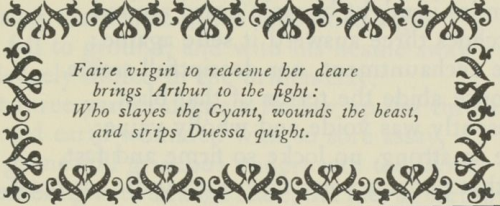
Faire virgin to redeeme her deare brings Arthur to the fight: Who slayes the Gyant[265], wounds the beast, and strips Duessa quight.
Ay me, how many perils doe enfold i The righteous man, to make him daily fall? Were not, that heauenly grace doth him vphold, And stedfast truth acquite him out of all. Her loue is firme, her care continuall, So oft as he through[266] his owne foolish pride, Or weaknesse is to sinfull bands made thrall: Else should this Redcrosse knight in bands haue dyde, For whose deliuerance she this Prince doth thither guide. They sadly traueild thus, vntill they came ii Nigh to a castle builded strong and hie: Then cryde the Dwarfe, lo yonder is the same, In which my Lord my liege doth lucklesse lie, Thrall to that Gyants hatefull tyrannie: Therefore, deare Sir, your mightie powres assay. The noble knight alighted by and by From loftie steede, and bad the Ladie stay, To see what end of fight should him befall that day. So with the[267] Squire, th’admirer of his might, iii He marched forth towards that castle wall; Whose gates he found fast shut, ne liuing wight To ward the same, nor answere commers call. Then tooke that Squire an horne of bugle small, Which hong adowne his side in twisted gold, And tassels gay. Wyde wonders ouer all Of that same hornes great vertues weren told, Which had approued bene in vses manifold.
Was neuer wight, that heard that shrilling sound, iv But trembling feare did feele in euery vaine; Three miles it might be easie heard around, And Ecchoes three answerd it selfe againe: No false enchauntment, nor deceiptfull traine Might once abide the terror of that blast, But presently was voide and wholly vaine: No gate so strong, no locke so firme and fast, But with that percing noise flew open quite, or brast. The same before the Geants gate he blew, v That all the castle quaked from the ground, And euery dore of freewill open flew. The Gyant selfe dismaied with that sownd, Where he with his Duessa dalliance fownd, In hast came rushing forth from inner bowre, With staring countenance sterne, as one astownd, And staggering steps, to weet, what suddein stowre[268] Had wrought that horror strange, and dar’d his dreaded powre. And after him the proud Duessa came, vi High mounted on her manyheaded beast, And euery head with fyrie tongue did flame, And euery head was crowned on his creast, And bloudie mouthed with late cruell feast. That when the knight beheld, his mightie shild Vpon his manly arme he soone addrest, And at him fiercely flew, with courage fild, And eger greedinesse through euery member thrild. Therewith the Gyant buckled him to fight, vii Inflam’d with scornefull wrath and high disdaine, And lifting vp his dreadfull club on hight, All arm’d with ragged snubbes and knottie graine, Him thought at first encounter to haue slaine. But wise[269] and warie was that noble Pere, And lightly leaping from so monstrous maine, Did faire auoide the violence him nere; It booted nought, to thinke, such thunderbolts to beare.
Ne shame he thought to shunne[270] so hideous might: viii The idle stroke, enforcing furious way, Missing the marke of his misaymed sight Did fall to ground, and with his heauie sway So deepely dinted in the driuen clay, That three yardes deepe a furrow vp did throw: The sad earth wounded with so sore assay, Did grone full grieuous vnderneath the blow, And trembling with strange feare, did like an earthquake show. As when almightie Ioue in wrathfull mood, ix To wreake the guilt of mortall sins is bent, Hurles forth his thundring dart with deadly food, Enrold in flames, and smouldring dreriment, Through riuen cloudes and molten firmament; The fierce threeforked engin making way, Both loftie towres and highest trees hath rent, And all that might his angrie passage stay, And shooting in the earth, casts vp a mount of clay. His boystrous club, so buried in the ground, x He could not rearen vp againe so light, But that the knight him at auantage[271] found, And whiles he stroue his combred clubbe to quight Out of the earth, with blade all burning bright He smote off his left arme, which like a blocke Did fall to ground, depriu’d of natiue might; Large streames of bloud out of the truncked stocke Forth gushed, like fresh water streame from riuen rocke. Dismaied with so desperate deadly wound, xi And eke impatient of vnwonted paine, He loudly brayd with beastly yelling sound, That all the fields rebellowed againe; As great a noyse, as when in Cymbrian plaine An heard of Bulles, whom kindly rage doth sting, Do for the milkie mothers want complaine, And fill the fields with troublous bellowing, The neighbour woods around with hollow murmur ring[272].
That when his deare Duessa heard, and saw xii The euill stownd, that daungerd her estate, Vnto his aide she hastily did draw Her dreadfull beast, who swolne with bloud of late Came ramping forth with proud presumpteous[273] gate, And threatned all his heads like flaming brands. But him the Squire made quickly to retrate, Encountring fierce with single sword in hand, And twixt him and his Lord did like a bulwarke stand. The proud Duessa full of wrathfull spight, xiii And fierce disdaine, to be affronted so, Enforst her purple beast with all her might That stop out of the way to ouerthroe, Scorning the let of so vnequall foe: But nathemore would that courageous swayne To her yeeld passage, gainst his Lord to goe, But with outrageous strokes did him restraine, And with his bodie bard the way atwixt them twaine. Then tooke the angrie witch her golden cup, xiv Which still she bore, replete with magick artes; Death and despeyre did many thereof sup, And secret poyson through their inner[274] parts, Th’eternall bale of heauie wounded harts; Which after charmes and some enchauntments said, She lightly sprinkled on his weaker parts; Therewith his sturdie courage soone was quayd, And all his senses were with suddeine dread dismayd. So downe he fell before the cruell beast, xv Who on his necke his bloudie clawes did seize, That life nigh[275] crusht out of his panting brest: No powre he had to stirre, nor will to rize. That when the carefull knight gan well auise, He lightly left the foe, with whom he fought, And to the beast gan turne his enterprise; For wondrous anguish in his hart it wrought, To see his loued Squire into such thraldome brought.
And high aduauncing his bloud-thirstie blade, xvi Stroke one of those deformed heads so sore, That of his puissance proud ensample made; His monstrous scalpe downe to his teeth it tore, And that misformed shape mis-shaped more: A sea of bloud gusht from the gaping wound, That her gay garments staynd with filthy gore, And ouerflowed all the field around; That ouer shoes in bloud he waded on the ground. Thereat he roared for exceeding paine, xvii That to haue heard, great horror would haue bred, And scourging th’emptie ayre with his long traine, Through great impatience of his grieued hed His gorgeous ryder from her loftie sted Would haue cast downe, and trod in durtie myre, Had not the Gyant soone her succoured; Who all enrag’d with smart and franticke yre, Came hurtling in full fierce, and forst the knight retyre. The force, which wont in two to be disperst, xviii In one alone left hand he now vnites, Which is through rage more strong then both were erst; With which his hideous club aloft he dites, And at his foe with furious rigour smites, That strongest Oake might seeme to ouerthrow: The stroke vpon his shield so heauie lites, That to the ground it doubleth him full low[276]: What mortall wight could euer beare so monstrous blow? And in his fall his shield, that couered was, xix Did loose his vele by chaunce, and open flew: The light whereof, that heauens light did pas, Such blazing brightnesse through the aier threw, That eye mote not the same endure to vew. Which when the Gyaunt spyde with staring eye, He downe let fall his arme, and soft withdrew His weapon huge, that heaued was on hye For to haue slaine the man, that on the ground did lye.