Front matter (continued 3)
Reading edition
Peromyscus has a large number of living and extinct species and exhibits a wide range of morphological variation, whereas Baiomys has a small number (7) of species and exhibits a narrow range of morphological variation. The small number of known species of pygmy mice suggests their conservatism in elaboration of morphological characters. Possibly this is because the habitat, or even the ecological niche, occupied in geological time by these mice was restricted, geographically and in kind. If the habitat of the pygmy mice oscillated between savannah and arid grassland, then an hypothesis can be made possibly accounting for the origin of species of these mice. My idea is that the geographical distribution of Baiomys today reflects a predilection on the part of these mice for a relatively uniform warm climate. Therefore, in the past, in times of warmer continental climate, these mice moved toward favorable habitat northward from an area in central and northern México. In cooler periods, the mice moved southward as habitats to the north became unfavorable.
Dr. W. B. Davis (in. litt.) informs me that B. taylori was uncommon in Brazos County, Texas, approximately 15 years ago, and suggests that the abundance there now of this mouse and my taking it in 1958 northward nearly to the southern border of Oklahoma reflects a definite movement northward. Movement in the same direction in late years has been suggested for the nine-banded armadillo and the hispid cotton rat (Hall, 1959:373) that are associated with warm climates to the south. These movements possibly reflect only minor fluctuations of climate, but in a long period of warmth movements northward would be expected to be pronounced and extensive.
Extinct species of Baiomys may have originated as a result of extension northward of the geographical range and subsequent retreat southward of the northern populations, as follows: (1) the range of the genus moved northward in a warm period; (2) in cooler times, most of the mice in the north disappeared and only isolated colonies remained in small patches of remaining habitat still favorable to the mice; (3) the small populations of isolated pygmy mice after a time changed through mutations, recombinations and subsequent selection to a degree that prevented crossbreeding once populations from the south again moved northward and came in contact with previously isolated stocks; (4) then competition caused further divergence in morphological characters. Such an hypothesis would account for the morphological differences between the extinct B. kolbi and B. rexroadi. The extinct B. brachygnathus, presumably a dweller of a xerophytic grassland, may have had its origin from a B. minimus-like stock in the manner outlined.
FORMATION OF THE RECENT SPECIES
The morphological difference between the extinct B. minimus and the living B. musculus is not great, and musculus seems to be the product of the B. sawrockensis-B. minimus line of development. Morphological characters of the parental stock of the two living species, musculus and taylori, may have been intermediate between those of B. minimus and those of B. musculus. The principal part of the range of Baiomys today is in México, and probably was there through much of Pleistocene time. Extension northward of the species and retreat southward of those northern populations of pygmy mice would not only have left isolated populations in the north, but would have allowed the mice that retreated south to share a common gene pool. Therefore, populations of pygmy mice occurring to the south in central México might be expected to maintain a relatively high degree of heterozygosity in morphological and behavioral characters. The occurrence of any physical or biotic barrier that would have separated this homogeneous group would be conducive to speciation. There is evidence that a barrier occurred in the Pleistocene in central México sufficient to separate the supposed interbreeding, relatively homogeneous populations of pygmy mice. According to Sears (1955:529) and De Terra et al. (1949:51), parts of the higher regions in the Valley of México, and the transverse volcanic zone in central México were glaciated. On the mountain Ixtaccihuatl, De Terra (op. cit.:52) found evidence of four marked advances of ice, from oldest to youngest, as follows: Salto, ice advanced to 3100 meters; Xopano, ice at 3200-3300 meters; Trancas, ice to 3400 meters; Ayolotepito, ice to 4350 meters. The Salto advance is correlated by De Terra (loc. cit.) with the Iowan glacial period. The advance of ice down the mountain sides in the transverse volcanic zone was accompanied by cool moist climates or pluvial periods. Such climates probably altered habitat formerly suitable for Baiomys. There is no record of Baiomys known to me exceeding 8000 feet in elevation, although the lower edge of the ice on Ixtaccihuatl is at approximately 15,300 feet (4600 meters, Sears, loc. cit.). Presumably, the advance of ice down the mountains forced the pygmy mice to move to lower altitudes. Pluvial conditions possibly rendered the habitat even at lower altitudes uninhabitable for the mice, with the result that none continued to live in the transverse volcanic zone, but only north and south thereof. Long-continued separation of these northern and southern segments allowed species formation to occur. As climatic and habitat conditions became more favorable in central México, the two species moved back toward each other, and eventually their geographic ranges overlapped.
An analysis of external and cranial characters of pygmy mice (see Figure 12) reveals that both species are essentially largest to the north and smallest to the south. There are exceptions to this cline in both species. For example, B. taylori analogous is a large subspecies; it lives allopatrically in the southern part of the range of the species. B. musculus pallidus is not the largest subspecies; it lives allopatrically in the northern part of the range of the species. In west-central México, where the two species are sympatric, B. taylori is smaller than elsewhere and B. musculus is larger than elsewhere. B. t. analogous lives in the mountains of the transverse volcanic zone in central México. Its large size may be a result of the cooler climate in the mountains. B. t. allex, the smallest subspecies, lives sympatrically with B. musculus musculus at lower elevations in west-central México. The small size of allex could be a result of the warmer climate of the lower elevations. B. m. pallidus, at lower elevations in southern Oaxaca, is smaller than other subspecies of musculus to the south at higher elevations. B. m. musculus lives at low elevations along the coast of west-central México. Unlike B. m. pallidus, B. m. musculus is large at lower elevations. It occurs sympatrically with B. t. allex. It is my idea that during the period of separation, when the two species were evolving, larger subspecies evolved to the north or at higher altitudes where climates were cooler; smaller subspecies evolved to the south or at lower elevations; the two cognate species, musculus and taylori, made contact at lower elevations where individuals of taylori may have been smallest, but individuals of musculus were not the largest of the species. The differences, therefore, between the two species in their initial contact probably were slight. Hybrids, if they occurred, were probably inviable, sterile, or ill-suited for occupancy of the habitat of either of the parental stocks. The occurrence of hybrids, therefore, would result in what geneticists call "gamete wastage," and any further divergence in the parental stock, either in external characters (size and shape of body and head), or behavior, useful in recognition of species, would be favored by natural selection (see Dobzhansky, 1951:225; and Koopman, 1950:147). The two species seem to have diverged more in external characters where they occur together than in areas where they live separately (see Figure 12). The two species could be confused if a sample of adults of taylori from 7 mi. S La Belle, Jefferson County, Texas, were compared to a sample of adults of musculus from Tehuantepec, Oaxaca (see Figure 12). No confusion in species identity would arise, however, if a sample of adults was taken from the area where the two species live together (see Figure 12). Brown and Wilson (1956:49) pointed out that where two closely related species occur together, characters (morphological, ecological, physiological, or behavioral) of each species are easily distinguished. However, where the two species are allopatric, the two closely related species so resemble one another that the species are not easily distinguished. This phenomenon has been called "character displacement" by Brown and Wilson (loc. cit.).
In the area where the two species of pygmy mice occur together, there seems to be a disparity in numbers between them. Hooper (1952a:91) has recorded the collection of both B. musculus and B. taylori in a single trap line. A series of pygmy mice collected from San Gabriel, Jalisco, contained one taylori and 33 musculus; another sample from La Resolana, Jalisco, had a ratio of 25 taylori to 6 musculus. The disparity in numbers where the two species occur together has been further substantiated by collections of the University of Kansas. Possibly this disparity in numbers is a result of interspecific competition. Hooper (op. cit.:90) pointed out that where the range of B. musculus (typical of arid tropical lowlands) meets that of B. taylori (typical of arid temperate highlands), the two geographic ranges interdigitate with parts of the range of musculus extending into the highlands and parts of the range of taylori extending into the lowlands. In the lowlands, musculus may be better adapted to environmental conditions and, therefore, more successful in competition with taylori for available habitat. The reverse situation may exist in the highlands. Also, the fact that musculus is more of a diurnal animal than is taylori may account for the difference in numbers of individuals of the two species taken in trap lines. Many collectors set their traps in late afternoon or evening and retrieve them in early morning. Such a schedule might not yield many musculus. If interspecific competition does occur in the area where the two species occur, any change in habits or microhabitat by either species that would reduce this competition would be favored by natural selection (see Mayr, 1949:518; Lack, 1944:262-263; and Brown, 1958:154-155). Brown (op. cit.:154), as I understand him, pointed out (taking account of Gause's principle) that when two species having similar ecological valences move into the same niche in the same locality, one of three things must eventually happen: (a) the two species occupy different geographic ranges; (b) they compete and one is eventually eliminated; (c) the two species, because of differentiation or specialization, exploit different aspects of the niche. In Baiomys, (c) seems to apply. Natural selection probably would favor a continuation of diurnal activity in musculus and nocturnal activity in taylori, thereby preventing frequent meeting of the two species.
AREAS OF PRESENT DIFFERENTIATION
In both species of Baiomys, the most distinct subspecies, B. t. allex and B. m. musculus, occur in the area where the two species are sympatric. Seven subspecies, or 44 per cent, occur either in or adjacent to the transverse volcanic zone. This area is the major area of active differentiation. Incipient subspecies are also evident in these areas. A secondary area of differentiation is indicated within the range of B. musculus in Guatemala, El Salvador and Honduras. Three subspecies occur in this area (grisescens, handleyi and nigrescens) and incipient subspeciation is in evidence there.
ZOOGEOGRAPHIC POSITION
Hooper (1949:25) regards Baiomys as a member of the rodent fauna of the arid, western Sonoran region, whereas Hershkovitz (1958:609) suggests that Baiomys is a nearctic-neotropical varicant (a kind that occurs in contiguous zoogeographic regions without our knowing in which region the taxon originated). The findings from my study do not contradict either of the above suggestions. Because of the close resemblance of Baiomys to certain hesperomine mice of South America, it is postulated that Baiomys, in more primitive form than now, occurred farther south in past times than it does now. Fossils show that primitive stocks of the genus in late Pliocene or early Pleistocene times occurred also north of the present range of the genus. The belt in west-central México between nearctic and neotropical regions is the current center of distribution of the genus and probably has been for a considerable time.
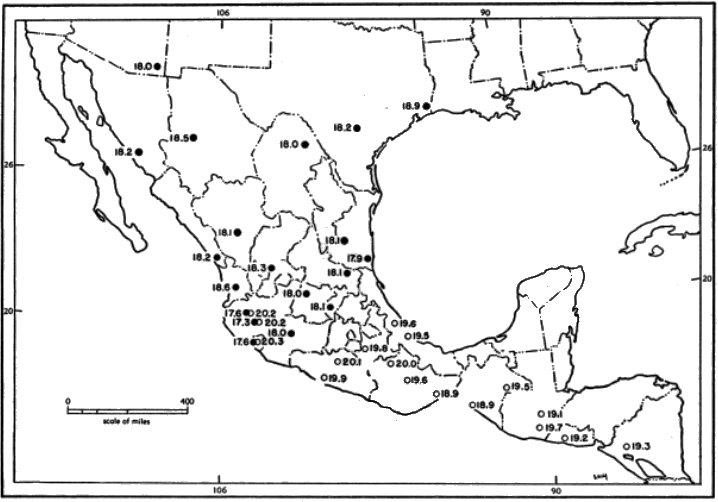
Fig. 12. Averages of the occipitonasal lengths of skulls of adults at 19 localities of occurrence (solid symbols) of Baiomys taylori, and at 17 localities of occurrence (open symbols) of Baiomys musculus. Note that the occipitonasal length decreases from north to south in each of the two species, and that in the region where the two species occur together, west-central México, B. taylori is smallest and B. musculus is largest. Average, extremes, number of specimens averaged (in italic type), and name of locality, from north to south for each species, are as follows:
Baiomys taylori 18.0 (17.5-18.6) 15, 91/2 mi. W New Mexico state line, Ariz. 18.9 (18.2-19.4) 6, 7 mi. S. La Belle, Jefferson Co., Texas. 18.2 (17.8-18.5) 10, San Antonio, Bexar Co., Texas. 18.2 (18.0-18.5) 5, 2 mi. W Miñaca, Chihuahua. 18.0 (17.6-19.0) 22, 6 mi. SW San Gerónimo, Coahuila. 18.2 (18.1-18.3) 3, Ciudad Obregón, Sonora. 18.1 (17.4-18.5) 5, vic. (see p. 649) Durango, Durango. 18.1 (17.5-18.5) 9, Jaumavé, Tamaulipas. 18.2 (17.7-18.9) 19, 15 mi. N Rosario Chelé, Sinaloa. 17.9 (17.4-18.3) 27, vic. (see p. 655) Altamira, Tamaulipas. 18.3 (17.9-18.7) 9, Valparaíso, Zacatecas. 18.1 (18.1-18.2) 4, Ciudad del Maíz, San Luis Potosí. 18.6 (18.3-18.9) 8, Tepic, Nayarit. 18.0 (17.7-18.4) 18, 4 mi. N, 5 mi. W León, Guanajuato. 18.1 (17.5-18.9) 28, 6 mi. E Querétaro, Querétaro. 17.7 (17.1-18.1) 17, 1 mi. SSE Ameca, Jalisco. 17.3 (16.8-17.9) 10, 2 mi. SSE Autlán, Jalisco. 18.0 (17.5-18.6) 10, 1 mi. S, 11 mi. W Zamora, Michoacán. 17.6 (17.4-18.2) 8, Colima, Colima. Baiomys musculus 20.2 (19.9-20.3) 6, vic. (see p. 622) Ameca, Jalisco. 20.2 (19.9-20.3) 6, 2 mi. SSE Autlán, Jalisco. 19.6 (19.2-20.1) 6, Jalapa, Veracruz. 20.3 (19.7-20.9) 9, Colima, Colima. 19.5 (19.0-20.0) 10, Cerro Gordo, Veracruz. 19.8 (19.4-20.3) 6, 6 mi. S Izucár de Matemores, Puebla. 20.0 (18.8-20.5) 7, Teotitlán, Oaxaca. 20.1 (19.7-20.7) 7, 1 km. NW Chapa, Guerrero. 19.9 (19.4-20.4) 8, 5 mi. ESE Tecpán, Guerrero. 19.5 (19.1-20.1) 22, 3 mi. ESE Oaxaca, Oaxaca. 19.5 (19.1-19.9) 11, Valley of Comitán, Chiapas. 18.9 (18.2-20.1) 17, Tehuantepec, Oaxaca. 18.9 (18.4-19.7) 15, 6 mi. NW Tonalá, Chiapas. 19.1 (18.8-20.4) 10, 1 mi. S Rabinal, Guatemala. 19.7 (18.8-20.4) 10, Lake Amatitlán, Guatemala. 19.2 (18.4-19.8) 26, vic. (see p. 625) San Salvador, El Salvador. 19.3 (18.9-19.9) 24, 8 mi. S Condega, Estelí, Nicaragua.
CONCLUSIONS
1. Two Recent species, each polytypic with eight subspecies, and five fossil species are recognized.
2. The phyletic trends in the genus Baiomys have been from an ancestral stock that possessed relatively brachydont teeth having raised cingular ridges and orthodont to proödont incisors, to species having hypsodont teeth with reduced cingular ridges and retrodont incisors.
3. Reduction of cingular ridges in pygmy mice is associated with an existence in open grassland (more xeric than mesic), whereas, the presence of cingular ridges is associated with an existence in a savannah habitat (more mesic than xeric).
4. Shifts of geographical range of populations of pygmy mice at and near the periphery of their geographic range may account for the differentiation of the extinct species.
5. The two living species, B. musculus and B. taylori, are seemingly derived from a common ancestor that in morphological structure was intermediate between B. minimus and B. musculus.
6. The living species of pygmy mice resulted from a geographic separation, perhaps occurring in the Iowan glacial period (See De Terra, 1949:51) in the transverse volcanic zone of central México.
7. The two species are now sympatric in west central México, where morphological characters (size and shape of body and length of skull) differ most. Where the two species are allopatric, these same morphological characters differ least.
8. This is a documented instance of character displacement in mammals.
9. On the basis of internal morphological characters studied (auditory ossicles, hyoid apparatus, and baculum), Baiomys seems to be more closely related to a South American hesperomine, perhaps Calomys, than to any North American cricetine.
10. Pygmy mice were more widely distributed in the past than they are at present. Part of the ancestral stock of the pygmy mice may have emigrated from North America into South America in a brief period in the Pliocene; if so, it is easy to understand why certain South American hesperomines resemble Baiomys.
11. The combination of morphological and behavioral characters in the living pygmy mice warrants generic status for them. If Baiomys were treated as a subgenus of the genus Peromyscus, there would be adequate justification for including in the genus Peromyscus a number of other genera, some of them occurring in South America. Such lumping of genera would reduce our understanding of the natural relationships among this group of cricetine rodents.
LITERATURE CITED
Allen, J. A.
1903. List of mammals collected by Mr. J. H. Batty in New Mexico and Durango, with descriptions of new species and subspecies. Bull. Amer. Mus. Nat. Hist., 19:587-612, November 12.
Allen, J. A., and Chapman, F. M.
1897. On a collection of mammals from Jalapa and Las Vigas, state of Veracruz. Bull. Amer. Mus. Nat. Hist., 9:197-208, June 16.
Axelrod, D. I.
1950. Evolution of the desert vegetation in western North America. Carnegie Inst. Washington (Contrib. Paleo.), Publ. 590(6):215-306, 4 figs., 3 pls., 1 table, December 27.
Bailey, V.
1905. Biological survey of Texas. N. Amer. Fauna, 25:1-222, 16 pls., 24 figs., October 24.
Baker, R. H.
1951. Mammals from Tamaulipas México. Univ. Kansas Publ., Mus. Nat. Hist., 5:207-218, December 15.
Blair, W. F.
1941. Observations on the life history of Baiomys taylori subater. Jour. Mamm., 22:378-383, 1 fig., November 14.
1942. Systematic relationships of Peromyscus and several related genera as shown by the baculum. Jour. Mamm., 23:196-204, 2 figs., 1 table, May 14.
1952. Mammals of the Tamaulipan Biotic Province in Texas. Texas Jour. Sci., 4:230-250, 1 fig., 2 tables, June 30.
1953. Population dynamics of rodents and other small mammals. Advances in Genetics, 5:1-41, 1 table.
Blair, W. F., and Blossom, P. M.
1948. Variation in the pygmy mouse (Baiomys taylori) from Texas and Arizona. Contrib. Lab. Vert. Biol., Univ. Michigan, 40:1-7, 3 tables, March.
Blossom, P. M., and Burt, W. H.
1942. A new race of pygmy mouse (Baiomys) from Arizona. Occas. Papers, Univ. Michigan, 465:1-4, October 8.
Booth, E. S.
1957. Mammals collected in Mexico from 1951 to 1956 by the Walla Walla College Museum of Natural History. Walla Walla College Publs., Dept. Biol. Sci. and Biol. Station, 20:1-19, 4 unnumbered figures, July 10.
Brown, W. L.
1958. Some zoological concepts applied to problems in evolution of the hominid lineage. Amer. Scientist, 46:151-158, 1 fig., June.
Brown, W. L., Jr., and Wilson, E. O.
1956. Character displacement. Soc. Syst. Zool., 5:49-64, 6 figs., June.
Burt, W. H.
1936. A study of the baculum in the genera Perognathus and Dipodomys. Jour. Mamm., 17:145-156, 6 figs., 2 tables, May 14.
1938. Faunal relationships and geographic distribution of mammals in Sonora, México. Miscl. Publ. Mus. Zool., Univ. Michigan, 39:1-77, 2 tables, 26 maps, February 15.
Clark, F. H.
1941. Correlation and body proportions in mature mice of the genus Peromyscus. Jour. Genetics, 26:283-300, 8 tables, May.
Collins, H. H.
1918. Studies of normal moult and of artificially induced regeneration of pelage in Peromyscus. Jour. Exper. Zool., 27:73-95, 3 figs., 2 pls., October.
1924. Studies of the pelage phases and of the nature of color variations in mice of the genus Peromyscus. Jour. Exper. Zool., 38:45-107, 57 figs.
Dalquest, W. W.
1953. Mammals of the Mexican state of San Luis Potosí. Louisiana State Univ. Studies, Biol. Ser., 1:1-229, 1 fig., December 28.
Davis, W. B.
1944. Notes on Mexican mammals. Jour. Mamm., 25:370-403, 1 fig., 3 tables, November 12.
Davis, W. B., and Russell, J. R., Jr.
1954. Mammals of the Mexican state of Morelos. Jour. Mamm., 35:63-80, February 10.
Deterra, H., Romero, J., and Steward, T. D.
1949. Tepexpan Man. Viking Fund Publ. in Anthropology, 11:1-160, 22 figs., 37 pls., 10 tables.
Dice, L. R.
1943. The biotic provinces of North America. Univ. Michigan Press, Ann Arbor, viii + 78 pp., 1 map.
Dice, L. R., and Leraas, H. J.
1936. A graphic method for comparing several sets of measurements. Contrib. Lab. Vert. Genetics, Univ. Michigan, 3:1-3, 1 fig., July.
Dobzhansky, T.
1951. Genetics and the origin of species. Columbia Univ. Press, x + 364 pp., 23 figs., 15 tables.
Duellman, W. E.
1958. A monographic study of the colubrid snake genus Leptodeira. Bull. Amer. Mus. Nat. Hist., 114(1):1-152, 25 figs., 31 pls., 25 maps, 30 tables, February 24.
Dunn, E. R.
1940. Some aspects of herpetology in lower Central America. Trans. New York Acad. Sci., 2:156-158, April.
Ellerman, J. R.
1941. The families and genera of living rodents with a list of named forms (1758-1936). British Museum (Nat. Hist.), London, 2: xii + 690, 50 figs., March 21.
Felten, H.
1958. Nagetiere (Mammalia, Rodentia) aus El Salvador. Senckenbergiana Biologica, 39:133-144, August 30.
Findley, J. S.
1955. Speciation of the wandering shrew. Univ. Kansas Publ., Mus. Nat. Hist., 9:1-68, 18 figs., 1 table, December 10.
Gazin, C. Lewis
1942. The late Cenozoic vertebrate faunas from the San Pedro Valley, Ariz. Proc. U. S. Nat. Mus., 92(3155):475-518.
Gidley, J. W.
1922. Preliminary report on fossil vertebrates of the San Pedro Valley, Arizona, with descriptions of new species of Rodentia and Lagomorpha. U. S. Geol. Surv. Prof. Paper, 131:119-131, 2 pls., March 15.
Goldman, E. A.
1951. Biological investigations in México. Smiths. Miscl. Coll., 115: xiii + 476, frontispiece, 71 pls., 1 map, July 31.
Goldman, E. A. and Moore, R. T.
1945. The biotic provinces of México. Jour. Mamm., 26:347-360, 1 fig., November 14.
Goodwin, G. G
.
1934. Mammals collected by A. W. Anthony in Guatemala, 1924-1928. Bull. Amer. Mus. Nat. Hist., 68:1-60, pls. 1-5, December 12.
1942. Mammals of Honduras. Bull. Amer. Mus. Nat. Hist., 79:107-195, May 29.
1959. A new pygmy mouse of the genus Baiomys from Oaxaca, Mexico. Amer. Mus. Novit., 1929:1-2, March 5.
Hall, E. R.
1959. Geographic distribution of contemporary organisms, pp. 371-373, in Zoogeography. Publ., Amer. Assoc. Adv. Sci., 55:x + 509 pp. January 19.
Hall, E. R., and Kelson, K. R.
1959. The mammals of North America. 2 Vols., xxx + 1083 pp. (79 pp. index), 553 figs., 500 maps, March 31, 1959.
Hall, E. R., and Villa-R., B.
1949. An annotated check list of the Mammals of Michoacán, México. Univ. Kansas Publ., Mus. Nat. Hist., 1:431-472, pls. 4-5, 1 fig., December 27.
Hershkovitz, P.
1944. A systematic review of the neotropical water rats of the genus Nectomys (Cricetinae). Miscl. Publ. Mus. Zool., Univ. Michigan, 58:1-101, 4 pls., 5 figs., 2 maps, 19 tables, January 4.
1955. South American marsh rats Genus Holochilus with a summary of sigmodont rodents. Fieldiana-Zool., Chicago Nat. Hist. Mus., 37:639-673, 6 figs., 29 pls., 5 tables, June 19.
1958. A geographical classification of neotropical mammals. Fieldiana-Zool., Chicago Nat. Hist. Mus., 36:583-620, 2 figs., 13 tables, July 11.
Hibbard, C. W.
1941. Paleoecology and correlation of the Rexroad Fauna from the upper Pliocene of southwestern Kansas, as indicated by the mammals. Univ. Kansas Sci. Bull., 27:79-104, 1 fig., December 15.
1952. A contribution to the Rexroad Fauna. Trans. Kansas Acad. Sci., 55:196-208, 2 figs., June 18.
1953. The saw rock canyon fauna and its stratigraphic significance. Papers, Michigan Acad. Sci., Arts and Letters, 38:387-411, 5 figs., April 27.
1958. Summary of North American Pleistocene mammalian local faunas. Papers, Michigan Acad. Sci., Arts and Letters, 43:3-32, 1 table.
Hoffmeister, D. F.
1951. A taxonomic and evolutionary study of the pinon mouse, Peromyscus truei. Ill. Biol. Monogr., 21:x + 104, 5 pls., 24 figs., 7 tables, November 12.
1956. Mammals of the Graham (Pinaleno) Mountains, Arizona. Amer. Midland Nat., 55:257-288, 7 figs., 1 table, April.
Hooper, E. T.
1947. Notes on Mexican mammals. Jour. Mamm., 28:40-57, February 15.
1949. Faunal relationships of recent North American rodents. Miscl. Publ. Mus. Zool., Univ. Michigan, 72:1-28, 5 tables, May 20.
1952a. Notes on the pygmy mouse (Baiomys), with description of a new subspecies from México. Jour. Mamm., 33:90-97, 3 figs., February 18.
1952b. A systematic review of the harvest mice (genus Reithrodontomys) of Latin America. Miscl. Publ. Mus. Zool., Univ. Michigan, 77:1-255, 9 pls., 24 figs., 12 maps, 7 tables, January 16.
1953. Notes on the mammals of Tamaulipas, México. Occas. Papers Mus. Zool., Univ. Michigan, 544:1-12, March 25.
1955a. Extra teeth in the pygmy mouse, Baiomys musculus. Jour. Mamm., 36:298-299, May 26.
1955b. Notes on Mammals of western México. Occas. Papers Mus. Zool., Univ. Michigan, 565:1-26, November 9.
1957. Dental patterns in mice of the Genus Peromyscus. Miscl. Publ. Mus. Zool., Univ. Michigan, 99:1-59, 24 figs., 3 tables, March 28.
1958. The male phallus in mice of the genus Peromyscus. Miscl. Publ. Mus. Zool., Univ. Michigan, 105:1-24, 1 fig., 24 pls., 1 table, December 29.
Hunsaker, D., Raun, G. G., and Swindells, J. E.
1959. Range expansion of Baiomys taylori in Texas. Jour. Mamm., 40:477-478, August 20.
Koopman, K. F.
1950. Natural selection for reproductive isolation between Drosophila pseudoobscura and Drosophila persimilis. Evolution, 4:135-148, 3 figs., 7 tables, June.
Lack, D.
1944. Ecological aspects of species formation in passerine birds. Ibis, 86:260-286, July.
Layne, James N.
1959. Growth and development of the eastern harvest mouse, Reithrodontomys humulis. Bull. Florida State Mus., 4:61-82, 5 figs., April 27.
Leopold, A. S.
1950. Vegetation zones of México. Ecol., 31:507-518, 1 fig., 1 table, October.
Lowery, G. H., and Dalquest, W. W.
1951. Birds from the state of Veracruz, México. Univ. Kansas Publ., Mus. Nat. Hist., 3:531-649, 7 figs., 2 tables, October 10.
Lukens, P. W., Jr.
1955. The mammals of the Chilpancingo area of the Mexican state of Guerrero. Unpublished Master's dissertation, Texas Agricultural and Mechanical College of Texas. 209 pp.
Mayr, E.
1949. Speciation and selection. Proc. Amer. Phil. Soc., 93:514-519, December.
Mearns, E. A.
1907. Mammals of the Mexican boundary of the United States … Pt. 1, Families Didelphidae to Muridae. Bull. U. S. Nat. Mus., 56:xv + 530, 13 pls., 126 figs., numerous tables, April 13.
Merriam, C. Hart
1892. Descriptions of new mammals collected by E. W. Nelson in the states of Colima and Jalisco, México. Proc. Biol. Soc. Washington, 7:164-174, September 29.
Moore, R. T.
1945. The transverse volcanic biotic province of central México and its relationship to adjacent provinces. Trans. San Diego Soc. Nat. Hist., 10:217-236, 1 map, 4 tables, August 31.
Osgood, W. H.
1909. Revision of the mice of the American Genus Peromyscus. N. Amer. Fauna, 28:1-285, 8 pls., 12 figs., several tables, April 17.
Packard, R. L.
1958a. New subspecies of the rodent Baiomys from Central America. Univ. Kansas Publ., Mus. Nat. Hist., 9:397-404, 2 tables, December 19.
1958b. The taxonomic status of Peromyscus allex Osgood. Proc. Biol. Soc. Washington, 71:17-20, April 11.
Ridgway, R.
1912. Color standards and color nomenclature. Published by the author, Washington, D. C., iii + 43 pp., 53 pls.
Rinker, G. C.
1954. The comparative myology of the mammalian genera Sigmodon, Oryzomys, Neotoma, and Peromyscus (Cricetinae), with remarks on their intergeneric relationships. Miscl. Publ. Mus. Zool., Univ. Michigan, 83:1-124, 18 figs., 2 tables, June 4
.
Russell, R. J., Jr.
1952. A new subspecies of pygmy mouse, Baiomys musculus, from Morelos, México. Proc. Biol. Soc. Washington, 65:21-22, January 29.
Sears, P. B.
1955. Palynology in southern North America, Part 4: Pleistocene Climate in México. Bull. Geol. Soc. America, 66:521-530, 6 figs., 1 pl., 1 table, May.
Simpson, G. G.
1945. The principles of classification and a classification of mammals. Bull. Amer. Mus. Nat. Hist., 85:xvi + 350, October 5.
1950. History of the fauna of Latin America. Amer. Sci., 38(3):361-389, 10 figs.
Smith, H. M.
1949. Herpetogeny in México and Guatemala. Ann. Association Amer. Geogr., 39:219-238, 1 fig., 1 table, September.
Sprague, J. M.
1941. A study of the hyoid apparatus of the cricetinae. Jour. Mamm., 22:296-310, 5 figs., August 14.
Stickel, L. F., and Stickel, W. H.
1949. A Sigmodon and Baiomys population in ungrazed and unburned Texas prairie. Jour. Mamm., 30:141-150, 3 tables, May 23.
Stuart, L. C.
1954. A description of a subhumid corridor across northern central America, with comments on its herpetofaunal indicators. Contrib. Lab. Vert. Biol., Univ. Michigan, 65:1-26, 6 maps, 6 pls., March.
Tamayo, Jorge L.
1949. Atlas Geografico general de México, con cartas fisicas, biologicas, demograficas, sociales, economicas, y cartogramas, Mexico, 24 maps, December 12.
Thomas, O.
1888. On the small mammals of Duval County, Texas. Proc. Zool. Soc. London, pp. 443-450.
True, F. W.
1894. On the relationships of Taylor's Mouse, Sitomys taylori. Proc. U. S. Nat. Mus., 16:757-758, February 7.
Twente, J. H., and Baker, R. H.
1951. New records of mammals from Jalisco, México, from barn owl pellets. Jour. Mamm., 32:120-121, 1 table, February 15.
Van Gelder, R. G.
1959. A taxonomic revision of the spotted skunks (Genus Spilogale). Bull. Amer. Mus. Nat. Hist., 117(5):229-392, 47 figs., 32 tables, June 15.
White, J. A.
1951. A practical method for mounting the bacula of small mammals. Jour. Mamm., 32:125, February 15.
1953. The baculum in the chipmunks of western North America. Univ. Kansas Publ., Mus. Nat. Hist., 5:611-631, 19 figs., December 1.
Wilson, R. W.
1937. Pliocene rodents of western North America. Carnegie Inst. Washington, Publ. 487:21-73, 2 figs., July 23.
Wood, A. E., and Wilson, R. W.
1936. A suggested nomenclature for the cusps of the cheek teeth of rodents. Jour. Paleon., 10:388-391, 2 figs.
Transmitted March 4, 1960.
28-3030

UNIVERSITY OF KANSAS PUBLICATIONS
MUSEUM OF NATURAL HISTORY
Institutional libraries interested in publications exchange may obtain this series by addressing the Exchange Librarian, University of Kansas Library, Lawrence, Kansas. Copies for individuals, persons working in a particular field of study, may be obtained by addressing instead the Museum of Natural History, University of Kansas, Lawrence, Kansas. There is no provision for sale of this series by the University Library, which meets institutional requests, or by the Museum of Natural History, which meets the requests of individuals. However, when individuals request copies from the Museum, 25 cents should be included, for each separate number that is 100 pages or more in length, for the purpose of defraying the costs of wrapping and mailing.
* An asterisk designates those numbers of which the Museum's supply (not the Library's supply) is exhausted. Numbers published to date, in this series, are as follows:
Vol. 1. Nos. 1-26 and index. Pp. 1-638, 1946-1950.
*Vol. 2. (Complete) Mammals of Washington. By Walter W. Dalquest. Pp. 1-444, 140 figures in text. April 9, 1948.
Vol. 3. *1. The avifauna of Micronesia, its origin, evolution, and distribution. By Rollin H. Baker, Pp. 1-359, 16 figures in text. June 12, 1951.
*2. A quantitative study of the nocturnal migration of birds. By George H. Lowery, Jr. Pp. 361-472, 47 figures in text. June 29, 1951.
3. Phylogeny of the waxwings and allied birds. By M. Dale Arvey. Pp. 473-530, 49 figures in text, 13 tables. October 10, 1951.
4. Birds from the state of Veracruz, Mexico. By George H. Lowery, Jr., and Walter W. Dalquest. Pp. 531-649, 7 figures in text, 2 tables. October 10, 1951.
Index. Pp. 651-681.
*Vol. 4. (Complete) American weasels. By E. Raymond Hall. Pp. 1-466, 41 plates, 31 figures in text. December 27, 1951.
Vol. 5. Nos. 1-37 and index. Pp. 1-676, 1951-1953.
*Vol. 6. (Complete) Mammals of Utah, taxonomy and distribution. By Stephen D. Durrant. Pp. 1-549, 91 figures in text, 30 tables. August 10, 1952.
Vol. 7. *1. Mammals of Kansas. By E. Lendell Cockrum. Pp. 1-303. 73 figures in text, 37 tables. August 25, 1952.
2. Ecology of the opossum on a natural area in northeastern Kansas. By Henry S. Fitch and Lewis L. Sandidge. Pp. 305-338, 5 figures in text. August 24, 1953.
3. The silky pocket mice (Perognathus flavus) of Mexico. By Rollin H. Baker. Pp. 339-347, 1 figure in text, February 15, 1954.
4. North American jumping mice (Genus Zapus). By Philip H. Krutzch. Pp. 349-472, 47 figures in text, 4 tables. April 21, 1954.
5. Mammals from Southeastern Alaska. By Rollin H. Baker and James S. Findley. Pp. 473-477. April 21, 1954.
6. Distribution of Some Nebraskan Mammals. By J. Knox Jones, Jr. Pp. 479-487. April 21, 1954.
7. Subspeciation in the montane meadow mouse. Microtus montanus, in Wyoming and Colorado. By Sydney Anderson. Pp. 489-506, 2 figures in text. July 23, 1954.
8. A new subspecies of bat (Myotis velifer) from southeastern California and Arizona. By Terry A. Vaughan. Pp. 507-512. July 23, 1954.
9. Mammals of the San Gabriel mountains of California. By Terry A. Vaughan. Pp. 513-582. 1 figure in text, 12 tables. November 15, 1954.
10. A new bat (Genus Pipistrellus) from northeastern Mexico. By Rollin H. Baker. Pp. 583-586. November 15, 1954.
11. A new subspecies of pocket mouse from Kansas. By E. Raymond Hall. Pp. 587-590. November 15, 1954.
12. Geographic variation in the pocket gopher, Cratogeomys castanops, in Coahuila, Mexico. By Robert J. Russell and Rollin H. Baker. Pp. 591-608. March 15, 1955.
13. A new cottontail (Sylvilagus floridanus) from northeastern Mexico. By Rollin H. Baker. Pp. 609-612. April 8, 1955.
14. Taxonomy and distribution of some American shrews. By James S. Findley. Pp. 613-618. June 10, 1955.
15. The pigmy woodrat, Neotoma goldmani, its distribution and systematic position. By Dennis G. Rainey and Rollin H. Baker. Pp. 619-624, 2 figures in text. June 10, 1955.
Index. Pp. 625-651.
Vol. 8. 1. Life history and ecology of the five-lined skink, Eumeces fasciatus. By Henry S. Fitch. Pp. 1-156, 26 figures in text. September 1, 1954.
2. Myology end serology of the Avian Family Fringillidae, a taxonomic study. By William B. Stallcup. Pp. 157-211, 23 figures in text, 4 tables. November 15, 1954.
3. An ecological study of the collared lizard (Crotaphytus collaris). By Henry S. Fitch. Pp. 213-274, 10 figures to text. February 10, 1956.
4. A field study of the Kansas ant-eating frog, Gastrophryne olivacea. By Henry S. Fitch. Pp. 275-306, 9 figures in text. February 10, 1956.
5. Check-list of the birds of Kansas. By Harrison E. Tordoff. Pp. 307-359, 1 figure in text. March 10, 1956.
6. A population study of the prairie vole (Microtus ochrogaster) in northeastern Kansas. By Edwin P. Martin. Pp. 361-416, 19 figures in text. April 2, 1956.
7. Temperature responses in free-living amphibians and reptiles of northeastern Kansas. By Henry S. Fitch. Pp. 417-476, 10 figures in text, 6 tables. June 1, 1956.
8. Food of the crow, Corvus brachyrhynchos Brehm, in south-central Kansas. By Dwight Platt. Pp. 477-498. 4 tables. June 8, 1956.
9. Ecological observations on the woodrat, Neotoma floridana. By Henry S. Fitch and Dennis G. Rainey. Pp. 499-533, 3 figures in text. June 12, 1956.
10. Eastern woodrat, Neotoma floridana: Life history and ecology. By Dennis G. Rainey. Pp. 535-646, 12 plates, 13 figures in text. August 15, 1956.
Index. Pp. 647-675.
Vol. 9. 1. Speciation of the wandering shrew. By James S. Findley. Pp. 1-68, 18 figures in text. December 10, 1955.
2. Additional records and extensions of ranges of mammals from Utah. By Stephen D. Durrant, M. Raymond Lee, and Richard M. Hansen. Pp. 69-80. December 10, 1955.
3. A new long-eared myotis (Myotis evotis) from northeastern Mexico. By Rollin H. Baker and Howard J. Stains. Pp. 81-84. December 10, 1955.
4. Subspeciation in the meadow mouse, Microtus pennsylvanicus, in Wyoming. By Sydney Anderson. Pp. 85-104, 2 figures in text. May 10, 1956.
5. The condylarth genus Ellipsodon. By Robert W. Wilson. Pp. 105-116, 6 figures In text. May 19, 1956.
6. Additional remains of the multituberculate genus Eucosmodon. By Robert W. Wilson. Pp. 117-123, 10 figures in text. May 19, 1956.
7. Mammals of Coahuila, Mexico. By Rollin H. Baker. Pp. 125-335, 75 figures in text. June 15, 1956.
8. Comments on the taxonomic status of Apodemus peninsulae, with description of a new subspecies from North China. By J. Knox Jones, Jr. Pp. 337-346, 1 figure in text, 1 table. August 15, 1956.
9. Extensions of known ranges of Mexican bats. By Sydney Anderson. Pp. 347-351. August 15, 1956.
10. A new bat (Genus Leptonycteris) from Coahuila. By Howard J. Stains. Pp. 353-356. January 21, 1957.
11. A new species of pocket gopher (Genus Pappogeomys) from Jalisco, Mexico. By Robert J. Russell. Pp. 357-361. January 21, 1957.
12. Geographic variation in the pocket gopher, Thomomys bottae, in Colorado. By Phillip M. Youngman. Pp. 363-385, 7, figures in text. February 21, 1958.
13. New bog lemming (genus Synaptomys) from Nebraska. By J. Knox Jones, Jr. Pp. 385-388. May 12, 1958.
14. Pleistocene bats from San Josecito Cave, Nuevo León, México. By J. Knox Jones, Jr. Pp. 389-396. December 19, 1958.
15. New Subspecies of the rodent Baiomys from Central America. By Robert L. Packard. Pp. 397-404. December 19, 1958.
16. Mammals of the Grand Mesa, Colorado. By Sydney Anderson. Pp, 405-414, 1 figure in text. May 20, 1959.
17. Distribution, variation, and relationships of the montane vole, Microtus montanus. By Emil K. Urban. Pp. 415-511. 12 figures in text, 2 tables. August 1, 1959.
18. Conspecificity of two pocket mice, Perognathus goldmani and P. artus. By E. Raymond Hall and Marilyn Bailey Ogilvie. Pp. 513-518, 1 map. January 14, 1960.
19. Records of harvest mice, Reithrodontomys, from Central America, with description of a new subspecies from Nicaragua. By Sydney Anderson and J. Knox Jones, Jr. Pp. 519-529. January 14, 1960.
20. Small carnivores from San Josecito Cave (Pleistocene), Nuevo León, México. By E. Raymond Hall. Pp. 531-538, 1 figure in text. January 14, 1960.
21. Pleistocene pocket gophers from San Josecito Cave, Nuevo León, México. By Robert J. Russell. Pp. 539-548, 1 figure in text. January 14, 1960.
22. Review of the insectivores of Korea. By J. Knox Jones, Jr., and David H. Johnson. Pp. 549-578. February 23, 1960.
23. Speciation and evolution of the pygmy mice, genus Baiomys. By Robert L. Packard. Pp. 579-670, 4 plates, 12 figures in text. June 16, 1960.
Index will follow.
Vol. 10. 1. Studies of birds killed in nocturnal migration. By Harrison B. Tordoff and Robert M. Mengel. Pp. 1-44, 6 figures in text, 2 tables. September 12, 1956.
2. Comparative breeding behavior of Ammospiza caudacuta and A. maritime. By Glen E. Woolfenden. Pp. 45-75, 6 plates, 1 figure. December 20, 1956.
3. The forest habitat of the University of Kansas Natural History Reservation. By Henry S. Fitch and Ronald R. McGregor. Pp. 77-127, 2 plates, 7 figures in text, 4 tables. December 31, 1956.
4. Aspects of reproduction and development in the prairie vole (Microtus ochrogaster). By Henry S. Fitch, Pp. 129-161, 8 figures in text, 4 tables. December 19, 1957.
5. Birds found on the Arctic slope of northern Alaska. By James W. Bee. Pp. 163-211, pls. 9-10, 1 figure in text. March 12, 1958.
6. The wood rats of Colorado; distribution and ecology. By Robert B. Finley, Jr. Pp. 213-552, 34 plates, 8 figures in text, 35 tables. November 7, 1958.
7. Home ranges and movements of the eastern cottontail in Kansas. By Donald W. Janes. Pp. 553-572, 4 plates, 3 figures in text. May 4, 1959.
8. Natural history of the salamander, Aneides hardyi. By Richard F. Johnston and Schad Gerhard. Pp. 573-585. October 8, 1959.
9. A new subspecies of lizard, Cnemidophorus sacki, from Michoacán, México. By William E. Duellman. Pp. 587-598, 2 figures in text. May 2, 1960.
10. A taxonomic study of the Middle American Snake, Pituophis deppei. By William E. Duellman. Pp. 599-612, 1 plate, 1 figure in text. May 2, 1960.
Index will follow.
Vol. 11. 1. The systematic status of the colubrid snake, Leptodeira discolor Günther. By William E. Duellman. Pp. 1-9, 4 figs. July 14, 1958.
2. Natural history of the six-lined racerunner, Cnemidophorus sexlineatus. By Henry S. Fitch. Pp. 11-62, 9 figs., 9 tables. September 19, 1958.
3. Home ranges, territories, and seasonal movements of vertebrates of the Natural History Reservation. By Henry S. Fitch, Pp. 68-326, 6 plates, 24 figures in text, 8 tables. December 12, 1958.
4. A new snake of the genus Geophis from Chihuahua, Mexico. By John M. Legler. Pp. 327-334, 2 figures in text. January 28, 1959.
5. A new tortoise, genus Gopherus, from north-central Mexico. By John M. Legler. Pp. 335-343. April 24, 1959.
6. Fishes of Chautauqua, Cowley and Elk counties, Kansas. By Artie L. Metcalf. Pp. 345-400, 2 plates, 2 figures in text, 10 tables. May 6, 1959.
7. Fishes of the Big Blue River Basin, Kansas. By W. L. Minckley. Pp. 401-442, 2 plates, 4 figures in text, 5 tables. May 8, 1959.
8. Birds from Coahuila, México. By Emll K. Urban. Pp. 443-516. August 1, 1959.
9. Description of a new softshell turtle from the southeastern United States. By Robert G. Webb. Pp. 517-525, 2 pls., 1 figure in text, August 14, 1959.
10. Natural history of the ornate box turtle, Terrapene ornata ornata Agassiz. By John M. Legler. Pp. 527-669, 16 pls., 29 figures in text. March 7, 1960.
Index will follow.
Vol. 12. 1. Functional morphology of three bats: Eumops, Myotis, Macrotus. By Terry A. Vaughan. Pp. 1-153, 4 plates, 24 figures in text. July 8, 1959.
2. The ancestry of modern Amphibia: a review of the evidence. By Theodore H. Eaton, Jr. Pp. 155-180, 10 figures in text. July 10, 1959.
3. The baculum in microtine rodents. By Sydney Anderson. Pp. 181-216, 49 figures in text. February 19, 1960.
4. A new order of fishlike Amphibia from the Pennsylvanian of Kansas. By Theodore H. Eaton, Jr., and Peggy Lou Stewart. Pp. 217-240, 12 figures inv text. May 2, 1960.
More numbers will appear In volume 12.
Transcriber's Notes
The text presented is that of the original printed version except for the revisions below and a few assumed typesetting errors. The subsection headers under "VARIATION WITH AGE" were converted to italic only to match the rest. All other section title formatting retained as printed. The words Miscellaneous and Monograph were abbreviated as Miscl. and Mongr. respectively. Except for the two variant spellings of one word (Mexico/México) which were retained, the most prevalent form of accented words was used.
Both decimal and whole and fractional part of numbers (i.e., 91/2) were retained as printed. Where a relative size as indicated for illustrations (i.e., × 3), they may not be correct for the displayed images as resolution of monitors vary. Each set of footnotes were placed at the end of each species account. The list of KU Publications were compiled after the article's text.
Typographical Corrections
Page Correction
591 proödent ⇒ proödont
694 hesperomyines ⇒ hesperomines