Front matter (continued 2)
Reading edition
Remarks.—Hooper (1952a:93-94) reported specimens from the coastal strip of southern Chiapas as the most intensely pigmented, whereas, specimens from central and western Chiapas were distinctly paler. Crania of specimens from the coastal region of southern Chiapas were smaller than crania from the central highlands and mountains of Chiapas. My studies essentially corroborate the findings of Hooper. The gradation of color between the pale brown pallidus to the north in Oaxaca, and the brownish-black nigrescens to the south in Chiapas is extremely gradual. Specimens from the central and western parts of Chiapas (see Figure 10 for localities) are difficult to assign to either pallidus or nigrescens. Equal justification exists for assignment to either subspecies. I have assigned the specimens to nigrescens because they are geographically closer to the type locality of nigrescens. Specimens from Reforma, Oaxaca (assigned by Hooper, 1952a:93-94, to nigrescens), are nearly identical in size and color to paratypes of pallidus. I assign the Reforma specimens to pallidus.
The darkest of all the specimens examined and assigned to nigrescens are from 1 mi. NW San Salvador and 1 mi. S Los Planes, El Salvador. The variations in color in this subspecies closely correspond to degree of relative humidity; the palest samples are from areas of low relative humidity and the darkest are from areas of high relative humidity. In view of the present state of differentiation of specimens from the southern coastal areas of Chiapas and mountainous areas of El Salvador, it would seem that populations there might be incipient subspecies.
Specimens examined.—Total 319. Chiapas: 17 mi. W Bochil, 1[14]; 15 mi. W Bochil, 1[14]; 14 mi. W Bochil, 1[14]; Bochil, 6[15]; Ocuilapa, 3500 ft., 5[16]; 5 mi. NNW Tuxtla Gutiérrez, 9; 11 km. W Tuxtla Gutiérrez, 800 m., 2[15]; 10 km. W Tuxtla Gutiérrez, 800 m., 2[15]; Tuxtla Gutiérrez, 2600 ft., 8[16], 11; Ocozocoautla, 10[15], 2[16]; 25 mi. E Comitán, Las Margaritas, 1250 m., 5[17], 24[15]; Cintalpa, 555 m., 1[14], 18[15], 3[17]; Jiquilpilas, 2000 ft., 1[16]; San Bartolome, 3[16]; type locality, 5700 ft., 26[16] (including the type); 15 mi. SW Las Cruces, 1; Villa Flores, 600 m., 12[15]; 23 mi. S Comitán, 1[14]; 15 mi. S, 2 mi. E La Trinitaria, 4; 30 mi. S Comitán, 2[14]; 35 mi. S Comitán, 1[14]; 3 mi. E Arriga, 1[14]; 6 mi. NW Tonalá, 19; Tonalá, 8[16]; Los Amates, 1[14]; Pijijiapan, 10 m., 7[15]; Mapastepec, 45 m., 25[15], 4[17].
Guatemala: Chanquejelve, 1[14]; Nentón, 3000 ft., 1[16]; Jacaltenango, 5400 ft., 8[16]; La Primavera, 5[14]; 4 mi. S Guatemala City, 4700 ft., 3; 5 mi. S Guatemala City, 4050 ft., 10; 6 mi. S Guatemala City, 4680 ft., 1; Lake Amatitlán, 4500 ft., 13[16]; El Progresso (Distrito Santa Rosa), 3[15]; 2 mi. N, 1 mi. W Cuilapa, 2980 ft., 1[14]; 1 mi. WSW El Molino (Distrito Santa Rosa), 2; 21/2 mi. W, 21/4 mi. N San Cristobal, 2900 ft., 1; El Zapote, 1[15].
El Salvador: 1 mi. NW San Salvador, 29; 1 mi. S Los Planes, 15.
Marginal Records.—Chiapas: Bochil; 25 mi. E Comitán, Las Margaritas, 1250 ft. Guatemala: Chanquejelve; La Primavera; Jacaltenango, 5400 ft.; 4 mi. S Guatemala City, 4700 ft.; El Progresso. El Salvador: 1 mi. NW San Salvador; 1 mi. S Los Planes. Guatemala: El Zapote. Chiapas: Mapastepec, 45 m.; Pijijiapan, 10 m.; 6 mi. NW Tonalá; 15 mi. SW Las Cruces; Cintalpa, 555 m.; Ocuilapa, 3500 ft.
Baiomys musculus pallidus Russell
Baiomys musculus pallidus Russell, Proc. Biol. Soc. Washington, January 29, 1952; Davis and Russell, Jour. Mamm., 35:75, February 10, 1954; Miller and Kellogg, Bull. U. S. Nat. Mus., 205:512; Hall and Kelson, The Mammals of North America, 2:662, March 31, 1959.
Peromyscus musculus brunneus, Elliot, Field Columb. Mus. Publ., 115(8):203, 1907 (part).
Peromyscus musculus [musculus], Osgood, N. Amer. Fauna, 28:257, April 17, 1909 (part).
Baiomys musculus musculus, Miller, Bull. U. S. Nat. Mus., 79:137, December 31, 1912 (part); Miller, Bull. U. S. Nat. Mus., 128:318, April 29, 1924 (part); Davis, Jour. Mamm., 25:394, December 12, 1944 (part); Hooper, Jour. Mamm., 28:50, February 15, 1947 (part); Goldman, Smith, Miscl. Coll., 115:336, July 31, 1951 (part); Miller and Kellogg, Bull. U. S. Nat. Mus., 205:512, March 3, 1955 (part); Booth, Walla Walla Publs., Dept. Biol. Sci., 20:15, July 10, 1957 (part); Hall and Kelson, The Mammals of North America, 2:661, March 31, 1959 (part); Goodwin, Amer. Mus. Novitates, 1929:1, March 5, 1959.
B. [aiomys] m. [usculus] musculus, Hooper, Jour. Mamm., 33:97, February 18, 1952 (part).
B. [aiomys] m. [usculus] nigrescens, Hooper, Jour. Mamm., 33:97, February 18, 1952 (part).
Baiomys musculus nebulosus Goodwin, Amer. Mus. Novitates, 1929, March 5, 1959.
Type.—Adult female, skin and skull; No. 4501 Texas A&M Cooperative Wildlife Collection; 12 kms. NW Axochiapán, 3500 feet, Morelos, Republic of México, obtained on July 28, 1950, by W. B. Davis, original number 5112.
Range.—Guerrero thence eastward into Morelos and west central Puebla along the southern edge of the Transverse Volcanic Biotic Province (Goldman and Moore, 1945:349), south into Oaxaca, see Figure 10. Zonal range: largely Arid Lower Tropical Subzone of Goldman (1951:330). Occurs from near sea level in Oaxaca and Guerrero up to 6550 feet in Oaxaca.
Diagnosis.—Size medium for the species; dorsum Buffy Brown in palest series to Olive-Brown in darkest series, individual hairs Warm Buff, Neutral Gray basally, some with black tips and a subterminal band of Warm Buff, guard hairs of dorsum black-tipped, gray basally; hairs on sides creamy-buff, gray basally; face same color as back fading to white on throat; vibrissae white-tipped, pale brown basally; venter, whitish with tinges of buff on lower throat, individual hairs having tips white to buffy-white, light gray basally; dorsal surface of forefeet and hind feet whitish to flesh-color; tail indistinctly bicolored, brownish above, grayish brown below; zygoma bowed as in B. m. grisescens; tail short; average and extreme external and cranial measurements for 17 adults from Tehuantepec, Oaxaca, are: total length, 117.3 (110-126); length of tail vertebrae, 46.9 (41-51); length of body, 70.4 (65-76); length of hind foot, 15.8 (15-16); occipitonasal length, 18.9 (18.2-20.1); zygomatic breadth, 10.1 (9.7-10.6); postpalatal length, 6.9 (6.6-7.5); least interorbital breadth, 3.8 (3.6-3.9); length of incisive foramina, 4.4 (4.2-4.7); length of rostrum, 6.7 (6.3-7.2); breadth of braincase, 9.3 (8.7-9.7); depth of cranium, 6.6 (6.4-6.8); alveolar length of maxillary tooth-row, 3.2 (3.1-3.4); for photographs of skull, see Plate 1g, and Plate 3g.
Comparisons.—For comparisons with B. m. brunneus and B. m. infernatis, see accounts of those subspecies.
From B. m. musculus, B. m. pallidus differs in: dorsum more olive-gray and brown, less ochraceous on either side of mid-dorsal region; face below eye grayish, not buffy; sides gray with buffy overtone, not creamy with light yellow overtones; venter grayish-white rather than an olive-buff; zygomata more tapering anteriorly; maxillary part of zygoma narrower when viewed from above; external and cranial dimensions smaller.
From B. m. nigrescens, B. m. pallidus differs in: dorsum paler, fewer black hairs medially; face paler, less sooty; vibrissae brownish with white tips rather than black with brownish tips; venter paler; dorsal surface of forefeet and hind feet whitish to flesh-colored rather than sooty to dusky-white; tail paler; nasals slightly more attenuated; averaging slightly larger in external and cranial measurements.
Remarks.—Russell (1952:21) described pallidus, on the basis of specimens from the arid Balsas Basin, of Morelos, as pale gray dorsally. After examining the original material from Morelos, I find the dorsal color of pallidus to be much closer to a buffy brown than a pale grayish. Even so, smaller size differentiates pallidus from musculus. B. m. infernatis, not B. m. pallidus, is the most pallid of all named subspecies of B. musculus.
B. m. pallidus intergrades to the northwest with B. m. musculus, to the northeast with B. m. infernatis, and to the southeast with B. m. nigrescens.
According to Goodwin (1959:2), B. m. nebulosus (named on the basis of one specimen) differs from B. m. musculus [= pallidus] from southern Oaxaca in: darker and longer pelage; larger skull; interorbital region broader and less constricted posteriorly. From B. m. nigrescens and B. m. brunneus, B. m. nebulosus differs as follows: pelage longer and softer; skull larger.
Study of specimens of B. musculus from Oaxaca reveals considerable variation in external and cranial measurements as well as color, corresponding to that reported by Goodwin (loc. cit.). Specimens from higher altitudes average somewhat darker and larger in external and cranial size than those at lower elevations. These differences seem to be microgeographic and not of subspecific rank. Among specimens that I have studied in Oaxaca are several from different localities (KU 63052, an adult male, from 3 mi. W Miahuatlán; KU 68964, an adult male from 3 mi. W Mitla, 6000 ft.; KU 63055, an adult female from 3 mi. S Candelario, 1200 ft.) that, according to Goodwin (in. litt.) match nebulosus in reported color, size of body and skull (except for the region of the rostrum).
Two of the three specimens (KU 63052 and 63055) are the darkest of a series in which the palest are inseparable from B. m. pallidus. Goodwin, who kindly compared the three specimens with the type of nebulosus, mentioned (in. litt.) that the skull of the type has a slenderer rostrum. Included in the series of skulls of B. m. pallidus from 3 mi. W Mitla are several adults (not seen by Goodwin) with slender rostra. B. m. nebulosus is judged to be a synonym of B. m. pallidus.
Populations of pygmy mice occurring in partially isolated areas of highland in Oaxaca seem to me to be incipient subspecies.
Specimens examined.—Total 824 all from the Republic of México and distributed as follows: Puebla: 2 mi. S Atlixco, 5800 ft., 1; 1 mi. SSW Tilapa, 5800 ft., 2; 6 mi. SW Izucár de Matemores, 7; Piaxtla, 3900 ft., 4[18]; Acatlán, 4100 ft., 1. Morelos: 5 mi. W Tepoztlán, 6000 ft., 7[19]; 1 mi. W Tepoztlán, 6000 ft., 9[19]; 2 mi. SW Tepoztlán, 7000 ft., 1[20]; Cuernvaca, 9[19]; 6 mi. W Yautepec, 4500 ft., 1[20]; Yautepec, 12[19]; 3 mi. N Alpuyeca, 4000 ft., 2[20]; Puente de Ixtla, 2[19]; Tetecala, 4[21]; 2 km. S Jonacatepec, 4500 ft., 6[20]; type locality, 6 (including the type). Guerrero: Yerbabuena, 1800 m., 1; Cueva de tia Juana [= 1.5 km. SSW Yerbabuena], 1; Laguna Honda, 1840 m. [= 1.5 km. S Yerbabuena], 3; 9 mi. SE Taxco, 3800 ft., 1[22]; 17 km. S Taxco, 4000 ft., 2[20]; Iguala, 5[19]; 3.2 km. SSE Iguala, 970 m., 1; 1 km. SSE Texcaizintla, 1600 m., 2; Teloloapán, 20[19], 5[24]; 1 km. N Chapa, 1470 m., 6; Chapa, 1470 m., 5; El Limón, 3[18]; 21/2 mi. W Mexcala, 2100 ft., 1[20]; Río Balsas, 1[18]; Ayusinaha [= Ayotzinapa], 1[18]; Tlapa, 3900 ft, 1[18]; 2.5 mi. S Almolonga, 5600 ft., 13[20]; 1 km. N Zihuatanejo, 1; Zihuatanejo Bay, 4[19]; Las Gatas [= 2 km. S. Zihuatanejo], 2; 2 km. SSE Zihuatanejo, 9; 4 mi. W Chilpancingo, 5800 ft., 3[20]; Chilpancingo, 4800 ft., 14[18], 21[19], 45[21]; 2 mi. N Tixtla, 4400 ft., 3[20]; 3.2 km. S Chilpancingo, 4; Cd. Chamilpa [= 12 km. ESE Chilpancingo], 5; Tlalixtaquilla, 4200 ft., 2[18]; 15 km. S. Chilpancingo, 4300 ft., 10[20]; 1 mi. SW Colotlipa, 2700 ft., 16[20]; 2 mi. SW Colotlipa, 2700 ft., 1[20]; Achuitzotla, 2800 ft., 7[20]; 8 mi. SW Colotlipa, 1[20]; 5 mi. S Rincón, 2600 ft., 2[20]; 8 mi. SW Tierra Colorado, 600 ft., 1[20]; Río Aguacatillo, 30 km. N Acapulco, 1000 ft., 3[20]; 5 mi. ESE Tecpán, 50 ft., 9; Ejido Viejo, 12 km. NNW Acapulco, 1; 2 mi. NNW Acapulco, 7; Acapulco, 3[18], 3[21]; Omentepec, 200 ft., 7[18]. Oaxaca: 4 mi. E Huajuapám, 5000 ft., 1; 2 mi. NW Tamazulapán, 6550 ft., 1; Yalalag, 3000 ft., 5[18]; 11 mi. NW Oaxaca [City], 1; Yaganiza, 3900 ft., 1[18]; Oaxaca [City], 5000 ft., 15, 7[21], 7[19], 5[24]; 3 mi. ESE Oaxaca [City], 30; 4 mi. ESE Oaxaca [City], 5050 ft., 1; 10 mi. SE Oaxaca [City], 1[22]; Cerro Ocotepec, 1[23]; Tepantepec, 9[23]; 1 mi. E Tlacolula, 5500 ft., 53[19]; 3 mi. W Mitla, 11; Jalapa, El Campanario, 1[23]; 2 mi. SE Matalán, 5950 ft., 14; Lachiguiri, 2[23]; Tres Cruces, 10[23]; Agua Blanca, 11[23]; San José, 1[23]; Reforma, 30[19], 7[21], 10[23], 6[24] Totolapa, 1[18]; Nejapa, 85 km. WNW Tehuantepec, 500 m., 12[19], 6[24]; Chicapa, 2[18]; Gueladu [= Jalapa], 6[23]; Juchitán, Laguna Superior; Manteca, 8[23], 1[23]; San Bartolo, 3000 ft., 1[18]; Ejutla, 1400 m., 21[19]; El Bambita, Tequisitlán 4[23]; Mixtequilla, 2[23]; Guiencola, 5[23]; Tehuantepec, 200 ft., 26[18], 11[19]; Sola de la Vega, 26[19], 3[24]; Huilotepec, 13[18], 3[23]; Santa Lucia, 24[23]; Cerro de Paste, Tenango, 7[23]; Sta. C. Quieri, 3[23]; Santa Marie Ecatepec, Zarzamora, 13[23]; Rincón Bamba, 11[23]; 3 mi. W Miahuatlán, 5300 ft., 1; Miahuatlán, 12[19], 1[23], 6[24]; San Juan Acaltepec, 5[23]; Zapotitlán, 1[23]; Llano Grande, 3[18]; Pinotepa, 700 ft., 2[18]; Juquila, 8[18]; Arroyo, San Juan, north of Cerro Otate, 1[23]; Cerro Otate, 3[23]; 3 mi. S Candelaria, 1.
Marginal records.—Morelos: 5 mi, W Tepoztlán, 6000 ft. Puebla: 2 mi. S Atlixco, 5800 ft.; Acatlán, 4100 ft. Oaxaca: 2 mi. NW Tamazulapán, 6550 ft; Tepantepec; Oaxaca [City], 5000 ft; Yalalag, 3000 ft; Jalapa, El Campanario; Reforma; Huilotepec; 3 mi. S Candelaria; Cerro Otate; Pinotepa, 700 ft. Guerrero: Acapulco; Zihuatanejo Bay; El Limón; 9 mi. SE Taxco, 3800 ft.
Baiomys musculus pullus Packard
Baiomys musculus pullus Packard, Univ. Kansas Publs., Mus. Nat. Hist., 9:401, December 19, 1958.
Baiomys musculus grisescens, Goodwin, Bull. Amer. Mus. Nat. Hist., 79(2):161, May 29, 1942 (part); Miller and Kellogg, Bull. U. S. Nat. Mus., 205:513, March 3, 1955 (part); Hall and Kelson, The Mammals of North America, 2:661, March 31, 1959 (part).
Type.—Adult female, skin and skull; No. 71605 University of Kansas Museum of Natural History; 8 mi. S Condega, Estelí, Nicaragua, obtained on July 15, 1956, by A. A. Alcorn, original number 4218.
Range.—West-central Nicaragua, from Matagalpa northwest into the valley of the Río Estelí, east as far as Jinotega, see Figure 10. Zonal range: Upper Tropical Life-zone.
Diagnosis.—Size medium to small for the species; dorsum Fuscous-Black, individual hairs black-tipped with a subterminal band of Ochraceous-Buff, Neutral Gray at base; some hairs on dorsum all black to Neutral Gray at base; hair on sides Neutral Gray tinged with blackish; face blackish, becoming buffy on sides of head, and white on throat; vibrissae black; tail unicolored Chaetura Black; forefeet and hind feet sooty to dusky-white; mid-ventral region of venter white, hairs white to base; in region of anus and throat, hairs white-tipped, Neutral Gray at base; average and extreme external and cranial measurements of the type and 16 paratypes are as follows: total length, 117.3 (111-121); length of tail vertebrae, 47.2 (44-50); length of body, 70.4 (66-74); length of hind foot, 15.5 (14-17); length of ear from notch, 11.9 (10-13); occipitonasal length, 19.3 (18.9-19.8); zygomatic breadth, 10.2 (9.7-10.6); postpalatal length, 7.0 (6.8-7.3); least interorbital breadth, 3.9 (3.8-4.1); length of incisive foramina, 4.3 (4.0-4.6); length of rostrum, 7.0 (6.5-7.4); breadth of braincase, 9.6 (9.3-10.0); depth of cranium, 7.0 (6.8-7.3); alveolar length of maxillary tooth-row, 3.1 (3.0-3.2); for photographs of skull, see Plate 1h, and Plate 3h.
Comparisons.—From B. m. grisescens, B. m. pullus differs in: dorsum and tail darker; sides and lateral parts of venter grayish instead of buffy-brown, thus forming distinct mid-ventral white stripe; average length of body and tail significantly longer, thus total length greater; maxillary tooth-row significantly shorter; slightly larger in other cranial and external dimensions.
From B. m. nigrescens, B. m. pullus differs in: dorsum slightly darker; face grayish, not sooty; mid-ventral white stripe (absent in most specimens of nigrescens) present and becoming grayish laterally; tail darker, less hairy, and averaging significantly longer; smaller in most external and cranial dimensions.
Remarks.—B. m. pullus resembles B. m. nigrescens in size and color but can readily be distinguished from nigrescens by the shorter tail. B. m. pullus intergrades with nigrescens as shown by specimens, referable to B. m. nigrescens, from 1 mi. NW San Salvador and from 1 mi. S Los Planes, El Salvador. In color of the dorsum, specimens from these localities are intermediate between nigrescens and pullus.
The mid-ventral white stripe characteristic of pullus is present in three of 28 adults from El Salvador. Goodwin (1942:160) reported white hairs on the pectoral region of several topotypes of B. m. grisescens. The areas of white hairs on the venter of grisescens occur in approximately 10 per cent of the specimens examined, whereas in pullus, the frequency of occurrence is 90 per cent. The areas of white hairs in grisescens are in broad patches on the pectoral region, while in pullus, a white stripe passes from the pectoral region to the inguinal region in both males and females. I know of no selective advantage that the presence of this white stripe would confer on the mice.
Specimens examined.—Total 46, all from Nicaragua, and distributed as follows: Type locality, 32 (including the type); 9 mi. NNW Estelí, 8; 8 mi. NNW Estelí, 3; San Rafael Del Norte, 1 (Amer. Mus. Nat. Hist.); 1 mi. NW Jinotega, 1; Matagalpa, 1 (Amer. Mus. Nat. Hist.).
Marginal records.—Nicaragua: San Rafael Del Norte; Matagalpa; type locality.
Baiomys taylori Northern Pygmy Mouse (Synonymy under subspecies)
Type.—Hesperomys (Vesperimus) taylori Thomas, Ann. Mag. Nat. Hist., Ser. 5, 19:66, January, 1887.
Range.—Southeastern Arizona and southwestern New Mexico, south into Chihuahua and Durango, just east of the Sierra Madre Occidental, thence southeast through Zacatecas, Aquascalientes, Jalisco, Querétaro, and Guanajuato; two fingerlike projections extend northward, one on the west along the coast of Sinaloa into southern Sonora, and the other on the east covering eastern San Luis Potosí, Tamaulipas, eastern Coahuila, Nuevo León, into south, southeast, and north-central Texas. Southern margin of range in central México approximates the 19th degree of latitude (see Figure 11). Arid lower and arid upper subdivisions of the Tropical Life-zone in south; principally Lower Sonoran and Lower Austral life-zones in north.
Characters for ready recognition.—Unless otherwise noted, characters are usable for the age-categories of adult and old adult. Differs from B. musculus in: hind foot less than 16 millimeters; occipitonasal length less than 19 millimeters; zygomatic breadth less than 10 millimeters; rostrum deflected ventrally at frontoparietal suture rather than curving gradually toward anteriormost point of nasals; cingular ridges and secondary cusps on teeth reduced or absent; basihyal having entoglossal process much reduced or absent, shoulders of basihyal not protruding anteriorly, but more flattened (characteristic of all age categories); baculum having narrower shaft, knob-shaped tip, wings at base projecting laterally, baculum less than 3 millimeters long; short process of incus attenuate; muscular process of posterior crus of stapes reduced.
Characters of the species.—Size small (extremes in external measurements of adults: total length, 87-123; length of tail vertebrae, 34-53; length of hind foot, 12-15; length of ear, 9-12). Upper parts pale drab or reddish-brown to almost black; underparts grayish to cream-buff.
Geographic variation.—Eight subspecies are here recognized (see Figure 11). Features that vary geographically are mostly the same as those that do so in B. musculus (see page 609).
External and cranial size is less in B. t. allex, the southernmost subspecies, and progressively more in B. t. paulus, B. t. taylori, B. t. ater, B. t. subater, B. t. fuliginatus, B. t. canutus, and B. t. analogous. Size is largest in subspecies that occur at higher altitudes. Those subspecies are B. t. analogous and B. t. fuliginatus. The correlation with Bergman's Rule is less exact in B. taylori than in B. musculus. It is noteworthy that the smallest subspecies, B. t. allex, occurs in the area where the two species are sympatric.
There is close correlation in B. taylori, as also in B. musculus, of darker pelages with zones of high relative humidity. The subspecies having dark pelages are: analogous, fuliginatus, and subater. The two first-mentioned subspecies occur at high altitudes, and the other, subater, occurs in the humid coastal region of Texas. The paler subspecies, taylori, canutus, and allex, occur at lower altitudes. Two subspecies that occur at relatively high altitudes, ater and paulus, are reddish-brown. The color of pelage in these subspecies resembles the color of soil upon which they live. Blair and Blossom (1948:5) demonstrated close correlation of color of soil with color of pelage in B. t. ater by use of an Ives tint photometer.
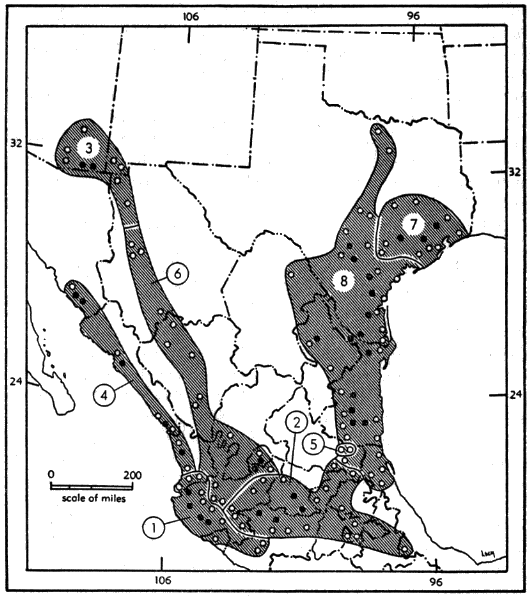
Fig. 11.
Distribution of
Baiomys taylori
. Known localities of occurrence are represented by circles and black dots; the former denote localities that are peripheral (marginal) for the subspecies concerned.
1. B. t. allex 2. B. t. analogous 3. B. t. ater 4. B. t. canutus 5. B. t. fuliginatus 6. B. t. paulus 7. B. t. subater 8. B. t. taylori
Natural History
Habitat and numbers.—The habitat occupied by the northern pygmy mouse ranges from sparse grassy areas along rock walls in central México (see Davis, 1944:394), and mesquite-cactus associations in southern Texas (Blair, 1952:242) to heavy stands of grasses such as Bouteloua sp., Andropogon sp., Hilaria sp., and sacaton grass intermixed with Yucca glauca in New Mexico, Arizona (see Hoffmeister 1956:281), and Chihuahua. Baker (1951:213) reports the species from 2 km. W El Carrizo, Tamaulipas, in dense grass and weeds at the edge of a cornfield. Hooper (1953:7) recorded the northern pygmy mouse in a cultivated field overgrown with herbaceous vegetation at Pano Ayuctle, Tamaulipas. In the State of Sinaloa, Hooper (1955b:13) obtained specimens in grass and among shrubs and vines bordering a fallow field. The northern pygmy mouse, in general, lives in situations more xerophytic and more grassy than does the southern pygmy mouse.
The northern pygmy mouse, as the southern pygmy mouse, is locally abundant in its geographic range. Stickel and Stickel (op. cit.: 145) pointed out that on the third night of live-trapping in Bexar County, Texas, there was a sudden increase in unmarked pygmy mice trapped. This increase in numbers, after the resident population was seemingly marked, followed a one-half inch rainfall. Collectors from the University of Kansas, myself included, have had similar experiences in trapping these mice. In the Mexican states of Guanajuato, Querétaro, and Jalisco, B. taylori is one of the commonest small mammals. In New Mexico and Arizona and the Mexican states of Sonora and Sinaloa, nevertheless, these mice are rare.
Stickel and Stickel (loc. cit.) thought that the home range normal for B. taylori in a grassy habitat was less than 100 square feet, but Blair (1953:10) thought that a complete home range had not been recorded by Stickel and Stickel.
Behavior.—The northern pygmy mouse is crepuscular to nocturnal and where I trapped in northern Mexico was one of the first small rodents to appear in my traps in the evening. Hall and Villa-R (1949:460) recorded this habit in Michoacán. Observations of wild-taken B. taylori held in captivity, lend support to its being crepuscular. Captives were rarely active in bright lights, but in diffuse or dim lights the same mice were active.
Blair (1941:381) pointed out that captive B. t. subater were much more tolerant of one another than mice of the genus Peromyscus. He pointed out also that males aided in care of young. In one litter born in captivity in the course of my study, the female killed the male when the young were four days old. In another instance, the female and two eight-day-old young were killed by the male. Until that time, the male, female, and young had lived together peacefully. In other litters born in captivity, adult males did not harm the other mice.
I have noted, as Blair (loc. cit.) did, that B. taylori utters high-pitched squeals in a "singing" posture resembling that of the coyote, yet remains silent when being handled.
The northern pygmy mouse makes runways in the grass, in miniature resembling those of Microtus, and often uses runways constructed by Sigmodon. A small firm nest of finely shredded plant material (mostly grasses) is constructed in burrows or under logs, rocks, or fallen cactus plants. Thomas (1888:447) recorded nests of fine curly grass and cornsilk. Secondary refuge nests are not uncommon. Thomas (loc. cit.) states, "If other mice live in the same place, the individuals of Baiomys watch till others disappear, then suddenly steal part of the other nest and run to their own with it."
Enemies and food.—Little is recorded of the animals that prey upon the northern pygmy mouse. Twente and Baker (1951:120) found remains of B. taylori in 16 per cent of barn owl pellets (Tyto alba pratincola) collected 21 mi. SW Guadalajara, Jalisco. Presumably most of the crepuscular and early nocturnal raptorial birds and carnivorous mammals feed on these mice.
Food of B. taylori consists in part of grass seeds and leaves, prickly pear (Opuntia sp.) and the softer exposed parts of roots of vegetation among which the mice reside.
Reproduction.—The northern pygmy mouse breeds throughout the year. The only months in which I have not recorded pregnant females or females with young are June and October. Forty-one records of embryos or young per litter average 2.48 (less than in B. musculus), and range from as few as one to as many as four per litter.
Baiomys taylori allex (Osgood)
Peromyscus allex Osgood, Proc. Biol. Soc. Washington, 17:76-77, March 21, 1904; Elliot, Field Columb. Mus. Publ., 105(6):135, July 1, 1905; Lyon and Osgood, Bull. U. S. Nat. Mus., 62:124, January 15, 1909.
Baiomys taylori allex, Packard, Proc. Biol. Soc. Washington, 71:17, April 11, 1958; Hall and Kelson, The Mammals of North America, 2:659, March 31, 1959 (part).
[Peromyscus] allex, Elliot, Field Columb. Mus. Publ., 95(4):175, July 15, 1904.
Peromyscus taylori paulus, Osgood, N. Amer. Fauna, 28:255, April 17, 1909 (part).
Baiomys taylori paulus, Miller, Bull. U. S. Nat. Mus., 79:137, December 31, 1912 (part); Miller, Bull. U. S. Nat. Mus., 128:317, April 29, 1924 (part); Ellerman, The Families and Genera of Living Rodents, British Mus. Nat. Hist., 2:402, March 21, 1941 (part); Poole and Schantz, Bull. U. S. Nat. Mus., 178:259, March 6, 1942; Goldman, Smith. Miscl. Coll., 115:373, July 31, 1951 (part); Miller and Kellogg, Bull. U. S. Nat. Mus., 205:512, March 3, 1955 (part); Hall and Kelson, The Mammals of North America, 2:659, March 31, 1959 (part).
Baiomys taylori analogous, Hall and Kelson, Univ. Kansas Publs., Mus. Nat. Hist., 5:367, December 15, 1952 (part).
Type.—Adult male, skin and skull; No. 33429/45452 U. S. Nat. Mus. (Biol. Surv. Coll.); Colima (City), Colima, Republic of México, obtained on March 7, 1892, by E. W. Nelson, original number 2029.
Range.—Colima, western lowlands of Michoacán and Jalisco, thence north into southern half of Nayarit, see Figure 11. Zonal range: arid lower tropical, approximates northern half of the Nayarit-Guerrero Biotic Province of Goldman and Moore (1945:349). Occurs from near sea level in Nayarit, up to 4000 feet in Jalisco.
Diagnosis.—Size small for the species; dorsal ground color pale grayish-brown, near Isabella color; mid-dorsal region washed with blackish, individual guard hairs black to base, other hairs black-tipped with subterminal light olive bands, Neutral Gray at base; laterally, black-tipped hairs less abundant, hairs grayish-white to base; venter Pale Gull Gray to whitish, distal half of individual hairs white, proximal half Neutral Gray; hairs in regions of throat and chin white to base; facial region colored like dorsum, becoming paler below eye; in region of mouth, hairs white to base; dorsalmost vibrissae black to base, others white to base; ears flesh-colored, sparsely haired; tail unicolored, sparsely haired for the species; dark blotches on tail of some series (particularly the paratypical series); dorsal and ventral parts of forefeet and hind feet flesh-colored, whitish to gray in some series. Slightly smaller in most cranial dimensions. Maxillary part of zygoma forming almost a right angle with rostrum, rather than tapering at less than a right angle to rostrum; supraoccipital rounded posteriorly rather than indented on each side of foramen magnum; cranium, relative to length of rostrum, more nearly square; interparietal large relative to size of cranium. Average and extreme measurements of five adults from 2 mi. SSE Autlán are as follows: total length, 100.0 (93-107); length of tail vertebrae, 40.0 (37-44); length of body, 60.0 (56-63); length of hind foot, 14.0 (14); length of ear from notch, 10.5 (10-11); occipitonasal length, 17.3 (16.8-17.9); zygomatic breadth, 9.1 (8.7-9.4); postpalatal length, 6.3 (6.0-6.6); least interorbital breadth, 3.4 (3.3-3.5); length of incisive foramina, 3.9 (3.8-4.0); length of rostrum, 5.5 (5.2-5.8); breadth of braincase, 8.6 (8.0-8.9); depth of cranium, 6.4 (6.0-6.7); alveolar length of maxillary tooth-row, 3.0 (2.8-3.1); for photographs of skull, see Plate 1i and Plate 4a.
Comparisons.—For comparisons with B. t. canutus, see account of that subspecies. From B. t. analogous, B. t. allex differs in: external and cranial dimensions less; dorsal coloration paler; tail and ears paler and less hairy; dorsum and belly paler; dorsal and ventral parts of forefeet and hind feet paler; median parts of incisive foramina less constricted on either side of midline and wider open laterally; interparietal larger in relation to skull; interorbital breadth greater relative to occipitonasal length.
B. t. allex differs from B. t. paulus as follows: dorsum gray with yellowish-brown wash rather than fawn to buff; tail unicolored in most series, less hairy; hind feet flesh-colored to light sooty, rather than whitish; rostrum slightly longer relative to occipitonasal length; incisive foramina differ from those of paulus in much the same way as from analogous.
Remarks.—Osgood (1909:255-256) dismissed as taxonomically unimportant the differences in color of pelage and size of cranium that he observed between the specimens from Colima (City), Colima, representative of allex and those representing paulus and chose to synonomize allex with paulus. The differences that Osgood (loc. cit.) deemed "… scarcely worthy of recognition …," are, in fact, not only worthy of recognition, but also important in an understanding of the evolution of Baiomys taylori (see speciation p. 659). Recently, I (1958b:17-18) studied ten specimens from Colima (City), Colima, and chose to regard Peromyscus [= Baiomys] allex as a subspecies. I suggested (loc. cit.) that the geographic range of B. t. allex might encompass the southern part of Nayarit, and western Jalisco. Subsequent study of specimens from these areas reveals that the populations there are referable to allex. Most of the specimens obtained from these areas, however, merit special comment.
In color of pelage, those populations from south of the Río Grande de Santiago and northwest of Guadalajara (4 mi. SE Ahuacatlán; 1 mi. E Ixtlán; Etzatlán) show evidence of intergradation with paulus to the east and south (Magdalena, Tequila, and Tala, Jalisco), and with populations more closely adjacent to the south bank of that river. Intergradation is indeed complex in this area. Specimens from some localities seem to be intergrades between allex and paulus; from other localities, some specimens are referable to allex, and the others to paulus; from still other localities, all specimens are referable to allex.
A series of 39 specimens from 1 mi. SSE Ameca, 4000 ft., Jalisco, are uniformly grayish-brown. This series averages grayer than paratypes of allex. There is little, if any, difference between the series from 1 mi. SSE Ameca and paratypes of allex in external size of body, hind foot, length of ear, and size and conformation of the cranium. Populations from Ameca and vicinity might be expected to average considerably larger inasmuch as they occur at higher altitudes (see Bergman's Rule, p. 609) then the material from the lower coastal plains to the south in Colima and Michoacán, and at lower elevations in the west in Jalisco and Nayarit. The means of external and cranial measurements are not significantly different between the specimens from the highlands and those from the lowlands. In the area of Ameca where the two species B. musculus and B. taylori occur together, interspecific competition seems to have limited, perhaps even reduced, size of external and cranial parts of taylori (see p. 660).
In color, specimens from the northern part of the valley of the Río Tepalcatepec (10 mi. S, 1 mi. W Apatzingán) in Michoacán resemble paratypes of allex. Intergradation probably occurs to the north with analogous.
In the eight specimens from 13 mi. E and 1 mi. N Talpa de Allendé, the skull, as reflected in occipitonasal length and zygomatic breadth relative to length of body, is larger than in other specimens here assigned to allex. The median part of the belly of the eight specimens is buff-colored rather than whitish-gray as in typical allex; the mid-dorsal region also averages darker than in any other specimens referred to allex. Additional specimens are needed from this and closely adjacent areas, especially to the west on the coastal plain, in order to determine more accurately the taxonomic status of the mice there. At present, it seems best to refer them to allex. Possibly the population represented by the eight specimens is an incipient subspecies.
There is no evidence of hybridization or intergradation of populations of B. t. allex with any population of B. musculus where the two species occur together.
Specimens examined.—Total 233, all from the Republic of México, distributed as follows: Nayarit: 3 mi. SE Mirador, 7; 2 mi. S. Compostela, 2900 ft., 5; 4 mi. N Santa Isabel, 3800 ft., 2[25]; 2 mi. N Santa Isabel, 3800 ft., 22[25]; 4 mi SE Ahuacatlán, 5200 ft., 2[26]; 1 mi. E Ixtlán, 4000 ft., 13[25]; 1 mi. E Ixtlán del Río, 3700 ft., 1; 2 mi. WNW Valle de Banderas, near sea level, 1. Jalisco: Arroyo de Gavalán, 16[28]; Etzatlán, 6[27]; Mascota, 3900 ft., 6[27]; 7 mi W Ameca, 15[25]; 6 mi. W Ameca, 15[25]; 3 mi. W Ameca, 5[25]; Ameca, 4000 ft., 11[27]; 1 mi. SSE Ameca, 4000 ft., 38; 2 mi. N Resolana, 1500 ft., 28[25]; 13 mi. E, 1 mi. N Talpa de Allendé, 8; 2 mi. SSE Autlán, 5; 1 mi. N San Gabriel, 4000 ft., 1[25]; Las Canoas, l[28]. Colima: Type locality, 10[27] (including the type). Michoacán: 9 mi. S Lombardia, 1500 ft., 1; 3 mi. W Apatzingán, 1000 ft, 1; Apatzingán, 3[25]; 10 mi. S, 1 mi. W Apatzingán, 800 ft., 10.
Marginal records.—Nayarit: 3 mi. SE Mirador; 1 mi. E Ixtlán del Río. Jalisco: Etzatlán; Ameca; 2 mi. N Resolana; Las Canoas. Michoacán: 9 mi. S Lombardia; 10 mi. S, 1 mi. W Apatzingán. Colima: type locality. Nayarit: Valle de Banderas.
Baiomys taylori analogous (Osgood)
Peromyscus taylori analogous Osgood, N. Amer. Fauna, 28:256, April 17, 1909 (part); Elliott, Check-List Mamm., N. Amer. Cont., West Indies and Neighboring Seas, Suppl., Amer. Mus. Nat. Hist., p. 44, January 8, 1917.
Baiomys taylori analogous, Miller, Bull. U. S. Nat. Mus., 79:137, December 31, 1912; Miller, Bull. U. S. Nat. Mus., 128:318, April 29, 1924; Ellerman, The Families and Genera of Living Rodents, British Mus. Nat. Hist., 2:402, March 21, 1941; Poole and Schantz, Bull. U. S. Nat. Mus., 178:259, March 6, 1942; Davis, Jour. Mamm., 25:394, December 12, 1944; Hooper, Jour. Mamm., 28:50, February 15, 1947; Hall and Villa-R., Univ. Kansas Publs., Mus. Nat. Hist., 1:460, December 27, 1949; Hall and Villa-R., Anal. del Inst. Biol., 21:196, September 28, 1950; Goldman, Smith. Miscl. Coll., 114:373, July 31, 1951 (part); Hall and Kelson, Univ. Kansas Publs., Mus. Nat. Hist., 5:367, December 15, 1952 (part); Villa-R., Anal. del Inst. Biol., 23:435, May 20, 1953; Miller and Kellogg, Bull. U. S. Nat. Mus., 205:512, March 3, 1955; Hooper, Occas. Papers Mus. Zool. Univ. Michigan, 565:13, March 31, 1955; Packard, Proc. Biol. Soc. Washington, 71:17, April 11, 1958.
Peromyscus musculus brunneus, Elliot, Field Columb. Mus. Publ., 115(8):203, 1907 (part).
Peromyscus musculus [musculus], Osgood, N. Amer. Fauna, 28:258, April 17, 1909 (part).
Baiomys musculus musculus, Hall and Villa-R., Univ. Kansas Publs., Mus. Nat. Hist., 1:460, December 27, 1949 (part); Hall and Villa-R., Anal. del Inst. Biol., 21:196, September 28, 1950 (part).
Baiomys taylori taylori, Dalquest, Louisiana State Univ. Studies (Biol. Sci. Ser.), 1:155, December 28, 1953 (part); Hall and Kelson, The Mammals of North America, 2:660, March 31, 1959 (part).
Baiomys taylori allex, Hall and Kelson, The Mammals of North America, 2:659, March 31, 1959 (part).
Baiomys musculus musculus, Hall and Kelson, The Mammals of North America, 2:661, March 31, 1959 (part).
Type.—Adult male, skin and skull; No. 120261 U. S. Nat. Mus. (Biol. Surv. Coll.); Zamora, Michoacán, Republic of México, obtained on January 15, 1903, by E. W. Nelson, and E. A. Goldman, original number 15764.
Range.—Central and eastern Jalisco south into Michoacán, east through Guanajuato, Querétaro, thence into Estado México, and Distrito Federal, and west-central Veracruz, see Figure 11. Zonal range: approximately the Transverse Volcanic Biotic Province of Moore (1945:218) and of Goldman and Moore (1945:349). Occurs from 5000 feet, 7 mi. S Ocotlán, Jalisco, up to 8000 feet in Ixtapalapa, Distrito Federal.
Diagnosis.—Size large for the species; dorsum dark Sepia to near blackish medially in freshly taken specimens (Sepia fading to near Fuscous in prepared specimens); belly slaty-gray, hairs Deep Neutral Gray near tips and Dusky Neutral Gray at bases; hairs on back black-tipped with subterminal band of Ochraceous-Tawny (guard hairs blackish to base); hairs of throat and chin white-tipped, gray at bases; dorsal vibrissae black, ventral and anteriormost vibrissae white; hairs on face and sides black-tipped, and Ochraceous-Tawny at base; ears sparsely haired, individual hairs grayish, blackish, and ochraceous; tail sooty to blackish dorsally, lighter ventrally; forefeet and hind feet sooty brown on dorsal and ventral surface. Skull relatively broad interorbitally; zygoma broad and squared; cranium larger in all dimensions than in most other subspecies. Average and extreme measurements of 10 adults from 1 mi. S, 11 mi. W Zamora, 5400 ft., Michoacán, are: total length, 109.4 (102-121); length of body, 64.3 (58-72); length of tail, 44.9 (39-51); length of hind foot, 14.6 (14-15); occipitonasal length, 18.0 (17.5-18.6); zygomatic breadth, 9.4 (9.1-9.7); postpalatal length, 6.6 (6.2-7.2); least interorbital breadth, 3.5 (3.3-3.8); length of incisive foramina, 4.0 (3.8-4.2); length of rostrum, 6.2 (5.8-6.5); breadth of braincase, 8.7 (8.5-8.9); depth of cranium, 6.6 (6.3-6.9); alveolar length of maxillary tooth-row, 3.1 (3.0-3.3); for photographs of skull, see Plate 2a and Plate 4b.
Comparisons.—For comparisons with B. t. allex, B. t. canutus, B. t. paulus, and B. t. fuliginatus, see accounts of those subspecies. From B. t. taylori, B. t. analogous differs as follows: sides and dorsum darker, differing most in freshly prepared specimens; dorsal surface of forefeet and hind feet darker; basal part of hairs on belly darker gray; frontal bones less constricted, causing less taper anteriorly in interorbital space; interparietal wider transversely; basioccipital more expanded laterally, narrowing more abruptly at suture between basioccipital and basisphenoid.
Remarks.—The pelage of analogous becomes paler with wear as pointed out by Osgood (1909:257). A paratype, U. S. Nat. Mus. 120260, and several specimens from 1 mi. S, 11 mi. W Zamora, Michoacán, are grayish rather than brownish-black. All of these are old adults having the terminal black parts of the hairs on the dorsum nearly worn away. Excluding such grayish individuals, B. t. analogous, like B. t. subater and B. t. fuliginatus, is uniformly brownish-black. Both analogous and fuliginatus occur in relatively high mountainous country on dark soils or pedregals, and all three of the aforementioned subspecies occur in zones of high relative humidity.
B. t. analogous intergrades with B. t. paulus (see account of that subspecies) and B. t. allex south and west of Lago de Chapala in Jalisco. Additional specimens are needed from Querétaro and San Luis Potosí in order to ascertain whether or not B. t. analogous intergrades with B. t. fuliginatus or B. t. taylori. Specimens from western Jalisco, in the past referred to B. t. analogous, are referable to B. t. allex (see account of that subspecies). Specimens obtained west of, and bordering, the Río del Naranjo in Jalisco show a mixture of characters of both B. t. allex and B. t. analogous. For example, specimens from 2 mi. N Ciudad Guzmán resemble analogous on the dorsum, whereas, on the belly, the individual hairs are white-tipped, pale gray at the base, and in over-all appearance are whitish-gray, unlike typical analogous (being like allex instead). The dorsal surface of the forefeet are sooty to light brownish (as in analogous), whereas, the hind feet are flesh-colored (as in allex). Another series of specimens from 4 mi. W León, Guanajuato, are intergrades between B. t. analogous and B. t. paulus. These specimens are grayish to brownish on the dorsum, have sooty forefeet and hind feet (more nearly as in analogous than in paulus), are grayish-white on the venter, and have a distinctly bicolored tail (resembling that of paulus more than that of analogous). When the average of cranial characters is considered, both series are best referred to analogous.
Hooper (1947:50) pointed out that specimens from the pedregal San Gerónimo, Distrito Federal, were more nearly black than topotypes and generally showed less brownish hues typical of analogous. I have examined this series and several others from this area (see Specimens examined, p. 640) and am convinced that these populations average darker. Actually, the dorsum is more nearly black and the venter is more buffy than in typical analogous. The hairs of these individuals average longer than in other populations of analogous. Skulls of the specimens from the pedregal are indistinguishable from those of paratypes of analogous. The populations from the Distrito Federal seem to be incipient subspecies.
Specimens examined.—Total 696, all from the Republic of México, distributed as follows: San Luis Potosí: Hacienda Capulín, 5[33]; 3.3 mi. N Tamazunchale, by-road, 2[34]; 1 mi. N Tamazunchale, 700 ft., 1[35]. Veracruz: Acultzingo, 4[29], 1[31]. Jalisco: 1 mi. S Jalostotitlán, 5700 ft., 5; 7 mi. NW Tepatitlán, 3[29]; 6 mi. N, 4 mi. E Tepatitlán, 6400 ft., 25; 21/2 mi. E Tepatitlán, 6200 ft., 15; 2 mi. S, 1/2 mi. W Tepatitlán, 9; near Tepatitlán, 2; 5 mi. SW Arrandas, 6700 ft., 6; 2 mi. E Zapotlanejo, 23; 21/2 mi. E Puente Grande (51/2 mi. SW Zapotlanejo), 3; 8 mi. S Guadalajara, 10[29]; 3 mi. ENE Santa Cruz de las Flores, 9; 4 mi. NE Ocotlán, 5050 ft., 18; 13 mi. S, 91/2 mi. W Guadalajara, 1; 2 mi. WNW Ocotlán, 5000 ft., 15; 13 mi. S, 15 mi. W Guadalajara, 2; Ocotlán, 5000 ft., 8[30]; 1 mi. S Ocotlán, 5000 ft., 12; 27 mi. S, 12 mi. W Guadalajara, 9; 11/2 mi. N Mazatmitla, 6[29]; 1/2 mi. NW Mazatmitla, 4; 3 mi. WSW Mazatmitla, 4; 2 mi. N Ciudad Guzmán, 5000 ft., 18. Guanajuato: 4 mi. N, 5 mi. W León, 7000 ft., 25; 5 mi. S Salamanca, 2[29]; 5 mi. E Celaya, 6000 ft., 6; 1 mi. E Yuriria, 5725 ft., 3; Salvatierra, 5775 ft., 8; NE edge Acambaro, 6050 ft., 10; Acambaro, 3[30]. Querétaro: Tolimán, 7[30]; 6 mi. E Querétaro, 6550 ft., 37. Hidalgo: Tula, 2050 m., 1[31]. Michoacán: 2 mi. E La Palma, SE side Lago de Chapala, 7; type locality, 4000 ft., 10[30] (including the type); 9 mi. E Zamora (Camenaro), 2[29]; 1 mi. S, 11 mi. W Zamora, 5400 ft., 17; S Cuitzeo, 36[29]; Jiquilpan, 4800 ft., 15; 11 mi. W Jiquilpan, 6700 ft., 2; 1 mi. E Jiquilpan, 7; 1 mi. E Zinapecuaro, 6300 ft., 17; 41/2 mi. NE Tarequato (Tarecuato), 6600 ft, 1; Tanganciguaro (Tangancicuaro), 5500 ft., 4; 2 mi. N Tarecuato, 7200 ft., 1; 2 mi. S Maravatio, 6650 ft, 6; 2 mi. SE Zacapu, 6600 ft., 11; 1 mi. N Tinquindin (Tinguindin), 6300 ft., 2; 3 mi. E Morelia, 6600 ft., 3; 11 mi. E, 2 mi. S Morelia, 1; 2 mi. SE Hidalgo (Villa Hidalgo), 6; 11/2 mi. N Los Reyes, 1; E Los Reyes, 18[29]; Los Reyes, 8[30]; 3 mi. W, 1 mi. N Pátzucuaro, 6600 ft., 2; N Pátzucuaro, 2[29]; Pátzucuaro 9[31], 4[30], 4[29]; Uruapan, 1[29]; E Uruapan, 12; 21/2 mi. E Uruapan (La Presca), 2[29]; 2 mi. SW Zitacuaro, 1; 1 mi. E, 6 mi. S Tacámbaro, 4000 ft., 11[37]; La Huacana, 1[30]. Mexico: Templo del Sol, Pyramídes de San Juan, Teotihuacán, 8000 ft., 1; 31 km. E México City, 7500 ft., 11[36]; 17 km. E México City, 7500 ft, 1[36]; Cerro La Caldera, 11 mi. ESE México, 2350 m., 5; 4 km. ENE Tlalmanalco, 2290 m., 9; Hacienda Córdoba (Córdova), 6. Mexico, D. F.: Cerro de la Estrella, Ixtapalapa, 2450 m., 1; 3/4 mi. S, 1 mi. E Churubusco, 2400 m., 2; 5 km. S México City, South of Cd. Universitaria, l[32]; Pedregal San Angel, 2.6 mi. S Monumento a Obregón, 2; El Pedregal, 1 km. S San Angel, 2260 m., 1; Falda SW Cerro Zacatepec, 3.9 mi. SW Monumento a Obregón, 1; 2 mi. N Tlalpan, Zacayuca, 2380 m., 5; Tlalpan (Pedregal), 2400 m., 21[31]; San Gerónimo, 37[29], 6[38]; Santa Rosa, 2700 m., 1[32]; Tlalpan, 8; 3/4 mi. SW Las Fuentes, Tlalpan, 2450 m., 25[30]; Tepepán, 6[29]; Rancho La Noria, 1 mi. W Xochimilco, 2270 m., 4; 500 meters N Xochitepec, 2250 m., 7; 200 m. N San Mateo Xalpa (Jalpa), 2390 m., 2.
Marginal records.—San Luis Potosí: Hacienda Capulín; 1 mi. N Tamazunchale. Hidalgo: Tula, 2050 m. Mexico: Templo del Sol, Pyramídes de San Juan, Teotihuacán. Veracruz: Acultzingo. Mexico: 4 km. ENE Tlalmanalco. Mexico, D. F.: 200 m. N San Mateo Xalpa (Jalpa), 2390 m. Michoacán: 2 mi. SW Zitacuaro; 1 mi. E, 6 mi. S Tacámbaro; Uruapan. Jalisco: 2 mi. N Ciudad Guzmán; 27 mi. S, 12 mi. W Guadalajara; 13 mi. S, 15 mi. W Guadalajara; 7 mi. NW Tepatitlán; 1 mi. S Jalostotitlán, 5700 ft. Guanajuato: 4 mi. N, 5 mi. W León. Querétaro: 6 mi. E Querétaro, 6550 ft.; Tolimán.
Baiomys taylori ater (Blossom and Burt)
Baiomys taylori ater Blossom and Burt, Occas. Papers Mus. Zool., Univ. Michigan, 465:2, October 8, 1942; Blair and Blossom, Contrib. Lab. Vert. Biol., Univ. Michigan, 40:1, March, 1948; Hoffmeister and Goodpaster, Ill. Biol. Monogr., 24(1):115, December 31, 1954; Miller and Kellogg, Bull. U. S. Nat. Mus., 205:511, March 3, 1955; Hoffmeister, Amer. Midland Nat., 55:281, April, 1956; Packard, Jour. Mamm., 40:146, February 20, 1959; Hall and Kelson, The Mammals of North America, 2:659, March 31, 1959 (part).
Peromyscus taylori paulus, Osgood, N. Amer. Fauna, 28:256, April 17, 1909 (part).
Baiomys taylori [ater], Justice, Jour. Mamm., 38:520, November 20, 1957.
Type.—Adult male, skin and skull; No. 85425, University of Michigan, Museum of Zoology; 7 mi. W Hereford, Cochise County, Arizona, obtained on March 25, 1941, by Philip M. Blossom, original number 2195.
Range.—Southeastern Arizona, north to Graham County, thence east to the Animas Valley, Hidalgo County, New Mexico; south to northern Chihuahua and northwest to the southern border of Cochise County, Arizona, see Figure 11. Zonal range: largely lower Sonoran (Apachian Biotic Province of Dice, 1943:56). Occurs from 4300 feet in Chihuahua up to 6200 feet in New Mexico.
Diagnosis.—Size medium for the species; dorsum between Mummy Brown and Prouts Brown; individual tips of hairs intermixture of black and Ochraceous-Tawny, bases of all hairs slate-gray; sides of body and face, Buffy Brown to Cinnamon Brown; belly Cinnamon Buff, proximal half of individual hairs Deep Neutral Gray, distal half white; in region of throat, proximal fourth of individual hairs gray, distal three-fourths white; dorsal vibrissae black to base, ventral vibrissae white to base; tail brownish above, gray below; dorsal and ventral surface of forefeet and hind feet buffy to gray; interparietal somewhat compressed anteroposteriorly. Average and extreme cranial measurements of 15 adults from 91/2 mi. W New Mexico State Line, 51/2 mi. N Mexican border, Cochise County, Arizona, are as follows: occipitonasal length, 18.0 (17.5-18.6); zygomatic breadth, 9.5 (9.2-9.9); postpalatal length, 6.6 (6.0-7.1); least interorbital breadth, 3.6 (3.4-3.8); length of incisive foramina, 4.0 (3.8-4.2); length of rostrum, 6.1 (5.7-6.4); breadth of braincase, 8.6 (8.4-9.1); depth of cranium, 6.5 (6.3-6.9); alveolar length of maxillary tooth-row, 3.2 (3.1-3.4). Average and extreme external measurements for six adults from 9 mi. W Hereford, Cochise County, are as follows: total length, 106.3 (98-115); length of tail vertebrae, 42.3 (39-46); length of body, 64 (59-69); length of hind foot, 13.6 (13-14.2); length of ear from notch, 11.1 (10.5-11.5); for photographs of skull, see Plate 2b, and Plate 4c.
Comparisons.—For comparisons with B. t. canutus, see account of that subspecies. From B. t. paulus, the subspecies to the southeast, B. t. ater differs in: dorsum darker brown; tail less strikingly bicolored; belly buffy rather than whitish to white-gray; forefeet and hind feet darker dorsally and ventrally; posterior margin of basioccipital bowed anteriorly in a broad U-shape with a secondary small median anteriorly directed U-shaped curve, rather than bowed anteriorly in a simple U-shape; interparietal more compressed anteroposteriorly; coronoid process of mandible so acutely recurved that tip of coronoid points posteroventrally and appears sickle-shaped.
Remarks.—Blossom and Burt (1942:1) described B. t. ater as the darkest of the known subspecies. It is dark, but specimens from some parts of the ranges of B. t. analogous, B. t. fuliginatus, and B. t. subater exceed in melanins the darkest individuals of ater. Blair and Blossom (1948:5) also concluded by the use of an Ives tint photometer that B. t. subater was significantly darker than B. t. ater.
When paratypes of ater and specimens of B. t. paulus are compared, the darkest individuals of ater exceed but slightly the darkest of paulus. The darkest specimens of paulus occur in southern Zacatecas, and northern Jalisco, and the palest of the series are in northern Durango and southern Chihuahua. When paratypes of ater and paulus are compared, the difference in color is readily distinguishable. Specimens from 11/2 mi. N San Francisco, in northern Chihuahua, appear to be intermediate in color between ater and paulus except for a faint tinge of buff ventrally. In characters of the crania, these specimens resemble ater and are referred to that subspecies. A slightly different pattern of color is present in pygmy mice from the Peloncillo Mountains and the Animas Valley of New Mexico; the upper parts resemble those of paratypes of ater, but the venter has only the faintest suggestion of the buffy wash. Crania of these specimens from New Mexico are inseparable from those of paratypes of ater, and the specimens are, therefore, referred to ater.
When specimens are arranged by localities from Arizona east into southern New Mexico, thence south into Chihuahua and Durango, gradual intergradation in color is evident from dark in the north to pale browns in the south, whereas, size and shape of interparietal and size and shape of coronoid process of the lower jaw divide quite distinctly into two morphological types in central Chihuahua.
Cranial variation in size and proportion among adults is slight throughout the range of ater compared to variation detected in other subspecies of Baiomys taylori. Perhaps such a relatively stable pattern of characters of the crania reflects the homogeneity of the gene pool, with respect to these characters, of the populations sampled. The fact that the color of the pelage of this subspecies varies considerable throughout its known range and that the crania do not is perhaps a clue to the mode of inheritance of characters in these mice. Seemingly, color of pelage is inherited independently of characters of the cranium. The relative lack of variability in the crania of ater may result from uniform environmental conditions, which have served to select for uniform characters in the populations. All of the other wide-ranging subspecies of B. taylori occupy more diverse habitats than ater. Secondly, the rather abrupt change in the cline of measured characters of the crania between ater and paulus in central Chihuahua suggests a secondary zone of intergradation. The probable cessation of gene flow in the past between these two subspecies, allowing ater to be isolated for a time, may also, in part, account for the relative lack of variability in the crania of ater.
Specimens examined.—Total 58, distributed as follows: Arizona: Graham County: 11/2 mi. SW Ft. Grant, Graham Mts., 1[39]; Pima County: 11/2 mi. ENE Greaterville, Thurber Ranch, 2[39]; Santa Cruz County: Patagonia, 3[39]; Cochise County: 9 mi. W Hereford, 10[43]; type locality, 2[43] (including the type); 5 mi. W Hereford, 5[43]; 91/2 mi. W New Mexico State Line, 51/2 mi. N Mexican border, 20[42]; 3 mi. E, 1 mi. N Chiricahua, 1[42]. New Mexico: Hidalgo County: 18 mi. S, 2 mi. W Animas, 2; 22 mi. S, 2 mi. W Rodeo, 6000 ft., 1[40]; 22 mi. S, 2 mi. E Rodeo, 6000 ft., 3[40]; 251/2 mi. S Animas, 6200 ft. (in Big Bill Canyon), 1[40]. Chihuahua: 51/2 mi. N, 2 mi. W San Francisco, 5100 ft., 1; 21/2 mi. N, 3 mi. W San Francisco, 5200 ft., 1; 11/2 mi. N San Francisco, 5100 ft., 4; Casas Grandes, 4300 ft., 1[41].
Marginal records>—Arizona: 11/2 mi. SW Ft. Grant, Graham Mts. New Mexico: 18 mi. S, 2 mi. W Animas; 251/2 mi. S Animas (in Big Bill Canyon). Chihuahua: 11/2 mi. N San Francisco; Casas Grandes. Arizona: Patagonia; 11/2 mi. ENE Greaterville, Thurber Ranch.
Baiomys taylori canutus, new subspecies
Peromyscus taylori paulus, Osgood, N. Amer. Fauna, 28:255, April 17, 1909 (part).
Peromyscus musculus [musculus], Osgood, N. Amer. Fauna, 28:256, April 17, 1909 (part).
Baiomys taylori paulus, Miller, Bull. U. S. Nat. Mus., 79:137, December 31, 1912 (part); Miller, Bull. U. S. Nat. Mus., 128:317, April 29, 1924 (part); Burt, Miscl. Publ., Mus. Zool., Univ. Michigan, 39:54, February 14, 1938; Goldman, Smith. Miscl. Coll., 115:373, July 31, 1951 (part); Miller and Kellogg, Bull. U. S. Nat. Mus., 205:512, March 3, 1955 (part); Hooper, Occas. Papers Mus. Zool., Univ. Michigan, 565:13, March 31, 1955; Hall and Kelson, The Mammals of North America, 2:659, March 31, 1959 (part).
Baiomys musculus musculus, Goldman, Smith. Miscl. Coll., 115:336, July 31, 1951 (part).
Type.—Adult male, skin and skull; No. 62075, University of Kansas, Museum of Natural History; 1 mi. S Pericos, Sinaloa, Republic of México; obtained on June 14, 1954, by A. A. Alcorn, original number 1754.
Range.—Central Nayarit northward through western Sinaloa, to as far north as south-central Sonora, see Figure 11. Zonal range: Lower arid tropical, closely approximating the Sinaloan Biotic Province of Goldman and Moore (1945:349). Occurs from near sea level at Escuinapa (43 feet), Sinaloa, to 3200 feet at a place 2 mi. WNW Tepic, Nayarit.
Diagnosis.—Dorsal ground color Buffy Brown (some specimens near Olive Brown); proximal fourth of individual guard hairs of dorsum black-tipped, distal three-fourths dark grayish; dorsal underfur black-tipped having subterminal band of Buffy Brown; hair around eyes buffy to base; belly Pallid Neutral Gray with overtones of buff; individual hairs in region of chin whitish-gray to bases; vibrissae blackish to bases except ventralmost, those being white to base; tail Dark Olive above, slightly paler below. Average and extreme external measurements of 13 adults from 15 mi. N Rosario, Chelé, Sinaloa, 300 ft., are as follows: Total length, 109.6 (99-120); length of tail, 43.4 (38-49); length of body, 66.2 (58-75); length of hind foot, 11.2 (10-12). Average and extreme cranial measurements of 19 adults from the same place are as follows: occipitonasal length, 18.2 (17.7-18.9); zygomatic breadth, 9.6 (9.2-10.1); postpalatal length, 6.9 (6.5-7.3); least interorbital breadth, 3.6 (3.4-3.8); length of incisive foramina, 3.9 (3.5-4.2); length of rostrum, 5.9 (5.5-6.6); breadth of braincase, 8.7 (8.3-8.9); depth of cranium, 6.5 (6.2-6.7); alveolar length of maxillary tooth-row, 3.1 (3.0-3.2); breadth of zygomatic plate, 1.8 (1.6-2.0); for photographs of skull, see Plate 2c, and Plate 4d.
Comparisons.—From B. t. ater, B. t. canutus differs in: dorsum slightly grayer; belly whitish to pale-gray with only faint tones of buff, rather than cinnamon-buff to buff-gray; forefeet and hind feet flesh-colored to grayish above instead of whitish to flesh-colored; tail paler above, less hairy, scales more evident; interparietal relatively larger from anteriormost to posteriormost points; incisive foramina tapering less abruptly posteriorly, not constricted towards midline; over-all size of body and cranium somewhat larger.
From B. t. paulus, B. t. canutus differs in: dorsum grayish-brown rather than fawn-colored (not differing appreciably from extremes of darker brown specimens of paulus); forefeet and hind feet flesh-colored to grayish above rather than white above; tail less hairy, unicolored to faintly bicolored rather than distinctly bicolored; braincase slightly larger; alveolar length of maxillary tooth-row slightly less.
From B. t. analogous, B. t. canutus differs in: dorsum paler, less of dark brown hues; belly paler; forefeet and hind feet slightly paler, less sooty above; tail less hairy, paler and having scales evident; jugal of zygoma extending ventrally to a point immediately above, instead of below, level of alveolus of upper molars; nasals more nearly truncate anteriorly; infraorbital foramina less deeply notched toward midline of skull; body and skull averaging smaller throughout.
From B. t. allex, B. t. canutus differs in: dorsal ground color grayish rather than fawn color having grayish overtones; underfur on dorsum darker gray; dorsal surface of forefeet and hind feet flesh-colored to grayish rather than flesh-colored; incisive foramina tapering to a point posteriorly rather than rounded posteriorly; interparietal relatively smaller; body and skull averaging larger throughout.
Remarks.—Burt (1938:54) reluctantly assigned specimens from Ciudad Obregón to B. t. paulus, probably being influenced by the resemblance in size. He suggested that, perhaps, a distinct subspecies occurs in the State of Sonora. Study of larger series of specimens than were available to Burt reveals that populations of pygmy mice inhabiting the northwest coastal plains of México are indeed distinct.
The darkest of the material assigned to canutus is from Nayarit (for specific localities see specimens examined). According to Tamayo (1949:Carta de Suelos), color of soil changes from chestnut in northern Sinaloa to black in southern Sinaloa and northern Nayarit. There seems, therefore, to be a close correlation between color of pelage and color of soil in this area. In Nayarit, particularly in the central and southern parts, the mice are intermediate in color between the paler, grayer population to the north and the more brownish samples, representative of allex to the south. The coastal vegetation changes from the arid tropical thorn forests of the north and central parts of Sinaloa to a savannah in Nayarit, thence to a tropical deciduous forest farther south (see Leopold, 1950:508).
In size and color, specimens from 3 mi. SE Tepic and 2 mi. SW Rosa Morada are intermediate between the larger, grayer canutus and the smaller, light-brownish allex. In size of cranium, these specimens are more nearly like canutus, and are referred to that subspecies. Mice from the western coastal plain are relatively homogeneous as regards size of body and skull, except that those from 13.5 mi. S Acaponéta, Nayarit, average somewhat larger.
B. t. canutus, like B. t. subater, is predominantly a lowland or coastal subspecies. The pallor of the former, that lives on generally paler soils, presumably is of adaptive value.
Pygmy mice are seemingly rare in the northern part of the range of this subspecies. J. Raymond Alcorn and Albert Alcorn were successful in collecting only two specimens from the type locality after three successive nights of trapping with 100 traps set each night. Only six specimens are known from Sonora. These were obtained in the irrigated regions of Ciudad, Obregón, and Navajoa. Charles Sibley obtained one specimen 10.6 mi. SE Ciudad Obregón in a "maguey field." I obtained one specimen 1 mi. NNW Navajoa in a sparse grassway, 20 feet wide, bordering an open sewer, which coursed northward into the Río Mayo. Irrigated wheat fields bordered the grassway and ditch.
Specimens examined.—Total 70 all from the Republic of México and distributed as follows: Sonora: [Ciudad] Obregón, 4[44]; 10.6 mi. SE [Ciudad] Obregón, 1[45]; 1 mi. NNW Navajoa, 1. Sinaloa: type locality, 2 (including the type); Culiacán, 175 ft., 2[46]; Mazatlán, 1[48]; 15 mi. N Rosario, Chelé, 300 ft., 35[47]; Rosario, 3[46]; Escuinapa, 5[48]; Railroad Station Escuinapa, 43 ft., 2[45]. Nayarit: Acaponéta, 4[46]; 13.5 mi. S Acaponéta Junction, 6[49]; 2 mi. SW Rosa Morada, 2; 2 mi. WNW Tepic, 3200 ft., 1; 3 mi. SE Tepic, 1.
Marginal records.—Sonora [Ciudad] Obregón. Sinaloa: type locality; Escuinapa. Nayarit: Acaponéta; 3 mi. SE Tepic. Sinaloa: Mazatlán.
Baiomys taylori fuliginatus, new subspecies
Baiomys taylori taylori, Dalquest, Louisiana State Univ. Studies (Biol. Sci. Ser.) 1:155, December 28, 1953 (part).
Baiomys taylori taylori, Booth, Walla Walla Publs. Dept. Biol. Sci., 20:15, July 10, 1957 (part).
Type.—Adult male, skin and skull; No. 36765, University of Kansas, Museum of Natural History; 10 mi. E, 2 mi. N Ciudad del Maíz, 4000 ft., San Luis Potosí, Republic of México; obtained on January 17, 1950, by J. R. Alcorn, original number 10400.
Range.—Occurs in the Sierra Madre Oriental of the northeastern third of San Luis Potosí. Zonal range: Upper Tropical (see Dalquest, 1953:10); approximates a part of the Sierra Madre Oriental Biotic Province of Goldman and Moore (1945:349, 356). Occurs from 2000 feet at El Salto up to 4000 feet at Ciudad del Maíz.
Diagnosis.—Size large for the species; ground color of dorsum Chaetura Drab; individual guard hairs of dorsum black to base, distal fourth of hairs of underfur in posterior half of dorsum tipped with grayish-brown, proximal three-fourths Dark Neutral Gray; in anterior region of dorsum, posterior to ears, distal third of hairs grayish-brown and proximal two-thirds Dark Neutral Gray to base; sides slightly paler than dorsum; ground color of belly Neutral Gray, individual hairs of belly and throat tipped with Pallid Neutral Gray, basally Deep Neutral Gray to Dark Neutral Gray; tips of individual hairs of face Ochraceous-Tawny; lateral vibrissae whitish, dorsal and ventral vibrissae black to base; forefeet and hind feet sooty above and below, thigh bearing some white-tipped hairs; tail near Chaetura Drab above, Pale Neutral Gray below; anterior part of jugal projecting slightly ventrally and forming small protuberance at point of articulation with maxillary part of zygoma; jugal extending anteriorly nearly to lacrimal. In most cranial measurements averaging as large as B. t. analogous. Average and extreme measurements of the type and three additional paratypes, all adults, are: total length, 105.5 (101-109); length of tail, 39.8 (35-42); length of body, 65.8 (63-68); length of hind foot, 14.3 (14-15); length of ear from notch, 11 (11); occipitonasal length, 18.1 (18.1-18.8); zygomatic breadth, 9.6 (9.3-9.8); postpalatal length, 6.5 (6.0-6.7); least interorbital breadth, 3.4 (3.3-3.6); length of incisive foramina, 4.0 (3.8-4.2); length of rostrum, 6.3 (6.1-6.4); breadth of braincase, 8.8 (8.6-8.9); depth of cranium, 6.7 (6.5-6.8); alveolar length of maxillary tooth-row, 3.2 (3.1-3.3); for photograph of skull, see Plate 2d, and Plate 4e.
Comparisons.—From B. t. taylori, B. t. fuliginatus differs in: dorsum slightly darker than in darkest taylori; tail densely haired, bicolored rather than unicolored; belly sooty to grayish rather than grayish to whitish; forefeet and hind feet sooty to grayish rather than flesh-colored; incisive foramina less bowed laterally, more nearly straight; interparietal compressed anteroposteriorly, less diamond-shaped.
From B. t. paulus, B. t. fuliginatus differs in: dorsum dusky to blackish rather than fawn color; belly sooty to grayish rather than buffy to whitish-gray; forefeet and hind feet sooty to grayish rather than whitish; zygoma more nearly forming a right angle with rostrum or skull, less tapered anteriorly; anterior part of jugal possessing ventral projection; jugal extending nearly to lacrimal on posterior surface of maxillary part of zygoma.
From B. t. analogous, B. t. fuliginatus differs in: mid-dorsal region blacker, less brownish; tail distinctly bicolored rather than unicolored to faintly bicolored; incisive foramina not constricted medially; presphenoid broader (at narrowest point); jugal differs much the same as it does from paulus; nasals anteriorly truncate instead of rounded.
Remarks.—Dalquest (1953:155-157) and Booth (1957:15) assigned all of the pygmy mice that they examined from the state of San Luis Potosí to B. t. taylori. Examination of all of the material that was available to Dalquest, plus additional specimens at the University of Kansas Museum of Natural History, reveals that there are three subspecies in San Luis Potosí. B. t. taylori occurs in the eastern part of the State at lower altitudes; B. t. analogous occurs to the southeast at higher altitudes; B. t. fuliginatus occurs in the northeastern part of the State in the Sierra Madre Oriental.
Specimens obtained from Ebano, Pujal, and Tamuín, representative of B. t. taylori, are much paler on the belly and on the ventral surface of the forefeet and hind feet than are specimens from Ciudad del Maíz, representative of B. t. fuliginatus. The tail in B. t. taylori is nearly unicolored and less hairy than in the paratypical series of fuliginatus. Specimens from 4 km. NE Ciudad Valles are nearly intermediate in color of the belly, dorsum, forefeet and hind feet, and tail, between the palest mice from the coastal plain and the darker mice in the mountains of the northeastern part of the State (specimens from El Salto average paler, however, than the type and paratypes). These specimens seem to be intergrades between B. t. taylori to the east on the coastal plain and fuliginatus to the northwest in the mountains. It seems best to refer the mice from 4 km. N Ciudad Valles to B. t. taylori on the basis of the average of external and cranial characters. Specimens from 6 mi. SW San Gerónimo, Coahuila, also referred to B. t. taylori, resemble in color the mice from 4 km. N Ciudad Valles. When more specimens are obtained from the front range of the Sierra Madre Oriental, at lower altitudes, the manner in which these two subspecies intergrade with one another will be better understood. At present, populations from higher altitudes in the mountains seem to represent a dark subspecies; populations from the coastal plain represent a pale subspecies, and those from the lower slopes and high valleys seemingly are intergrades. B. t. fuliginatus occurs in a somewhat limited strip of chernozem soil (or suelos negros of Tamayo, 1949: Carta de Suelos). The populations occurring at lower altitudes on the coastal plain are on generally paler soils.
Specimens examined.—Total 39, all from the Republic of México, as follows: San Luis Potosí: El Salto, 24 Mus. Nat. Hist., Louisiana State Univ., 7 Amer. Mus. Nat. Hist.; type locality, 8 (including the type).
Marginal records.—See specimens examined.
Baiomys taylori paulus (J. A. Allen)
Peromyscus paulus, J. A. Allen, Bull. Amer. Mus. Nat. Hist., 19:598, November 12, 1903; Elliot, Field Columb. Mus. Publ., 105(6): 136, July 1, 1905.
Baiomys taylori paulus, Miller, Bull. U. S. Nat. Mus., 79:137, December 31, 1912 (part); Miller, Bull. U. S. Nat. Mus., 128:317, April 29, 1924 (part); Ellerman, The Families and Genera of Living Rodents, 2:402, March 21, 1941 (part); Goldman, Smith, Miscl. Coll., 115:373, July 31, 1951 (part); Hall and Kelson, Univ. Kansas Publs., Mus. Nat. Hist., 26:367, December 15, 1952; Goodwin, Bull. Amer. Mus. Nat. Hist., 102:318, August 31, 1953; Miller and Kellogg, Bull. U. S. Nat. Mus., 205:511, March 3, 1955 (part); Packard, Proc. Biol. Soc. Washington, 71:17, April 11, 1958; Packard, Jour. Mamm., 40:146, February 20, 1959; Hall and Kelson, The Mammals of North America, 2:659, March 31, 1959 (part).
[Peromyscus] paulus, Elliot, Field Columb, Mus. Publ., 95(4):136, July 15, 1904.
Peromyscus taylori paulus, Osgood, N. Amer. Fauna, 28:255, April 17, 1909 (part).
Peromyscus musculus [musculus], Osgood, N. Amer. Fauna, 28:256, April 17, 1909 (part).
Baiomys taylori [= paulus], Twente and Baker, Jour. Mamm., 32:121, February 15, 1951.
Baiomys musculus musculus, Goldman, Smith. Miscl. Coll., 115:336, July 31, 1951 (part).
Baiomys taylori allex, Hall and Kelson, The Mammals of North America, 2:659, March 31, 1959 (part).
Type.—Adult male, skin and skull; No. 21165, American Museum of Natural History; Río Sestín, Durango, Republic of México; obtained on April 15, 1903, by J. H. Batty, original number 455.
Range.—Central Chihuahua south through Durango (west to eastern edge of Sierra Madre Occidental), to Zacatecas and Aguascalientes, thence west into northern and northwestern Jalisco, see Figure 11. Zonal range: Lower Sonoran, approximately the Chihuahua Desert Biotic Province of Goldman and Moore (1945:349). Occurs from 4000 feet 2 mi. ESE Tequila, Jalisco, up to 6700 feet 2 mi. W Miñaca, Chihuahua.
Diagnosis.—Size medium to small for the species; dorsum Buffy Brown to fawn color; dorsal ground color of unworn pelage of adults varying from Buffy Brown in darkest series (especially those from higher altitudes) to Avellaneous with grayish overtones in palest series; worn pelage in mid-dorsal region of adults fawn to grayish; terminal parts of individual hairs buffy, gray basally; guard hairs on dorsum black-tipped, grayish basally; belly Light Gull Gray, distal half of hairs white, proximal half Neutral Gray; hairs in region of throat and chin white to base (some specimens with faint buffy overtones); forefeet dusky below, whitish above; hind feet whitish above, ventral surface whitish to dusky; dorsal and lateral vibrissae black, other vibrissae white. Average and extreme measurements of six adults from the type locality are as follows: total length, 109 (106-117); length of tail, 44.5 (43-48); length of body, 63 (57-69); length of hind foot, 13.1 (12.7-14.0); occipitonasal length, 17.5 (17.4-18.0); zygomatic breadth, 9.3 (9.1-9.5); postpalatal length, 6.6 (6.2-6.9); least interorbital breadth, 3.5 (3.4-3.6); length of incisive foramina, 3.8 (3.6-4.1); length of rostrum, 5.9 (5.7-6.0); breadth of braincase, 8.6 (8.5-8.8); depth of cranium, 6.6 (6.2-6.9); alveolar length of maxillary tooth-row, 3.2 (3.1-3.4); for photographs of the skull, see Plate 2e and Plate 4f.
Comparisons.—For comparisons with B. t. allex, B. t. canutus, B. t. ater, and B. t. taylori, see accounts of those subspecies. From B. t. analogous, B. t. paulus differs as follows: dorsal color paler having more reddish-brown than blackish-brown tones; venter whitish to buffy, instead of gray to light-gray; tail bicolored (not unicolored), usually having more hairs; hind feet white (not sooty) above. Cranially, B. t. paulus differs from B. t. analogous in: skull slightly smaller in all dimensions; maxillary part of zygoma narrowing and forming oblique angle rather than a near right angle with rostrum; anterior incisive foramina constricted posteriorly; tips of nasals truncate (less rounded).
Remarks.—J. A. Allen (1903:599) correctly pointed out that young specimens, in first pelage, were gray brown; young adults were darker and more varied with some blackish; adults and old adults were buffy to grayish. The change in color of pelage with increasing age is more pronounced in paulus than in other subspecies of B. taylori. Of two males collected on April 12, 1949, one, an adult, is buffy brown, and the other, an old adult with worn pelage, is grayish-brown. In mice in the earlier stages of adulthood, underfur of the dorsum is buffy at the tips and gray basally. With increased wear, the buffy tip is lost. Consequently, mice in the later stages of adulthood are grayish.
B. t. paulus intergrades with ater to the north in Chihuahua (see account of that subspecies), with analogous to the south in Jalisco, and with allex (see account of that subspecies) to the southwest in Nayarit and Jalisco. The zone of intergradation between paulus and analogous in Jalisco approximately borders the Río Grande de Santiago from the western part of the State to the northwest shore of Lago de Chapala. Nineteen specimens from 2 mi. WNW Lagos de Moreno in northwest Jalisco seem to be intermediate between paulus and analogous in color, averaging slightly grayer than typical paulus. The series of 19 is referable to paulus on the basis of cranial characters.
A series of 34 specimens from 3 mi. W La Venta, Jalisco (referable to paulus), is indistinguishable in color of pelage from two series of paulus from 5 mi. N Durango, and from 8 mi. NE of Durango, except that the antiplantar surfaces of the hind feet are sooty as in analogous. Seemingly, features of color mentioned above as diagnostic of the two subspecies are either present or absent and there is no tendency toward intermediacy in color in the population from 3 mi. W La Venta.
The Río Grande de Santiago may have acted in the past as a physical barrier reducing gene flow between allex and paulus and in separating completely the two populations for limited periods.
Specimens examined.—Total 176, all from the Republic of México and distributed as follows: Chihuahua: Rancho Sanignacio, 4 mi. S, 1 mi. W Santo Tomás, 1; El Rosario, 6700 ft., 1; 2 mi. W Miñaca, 6900 ft., 11; Balleza, 1[50]. Durango: Rosario, 1[51]; type locality, 14[51] (including the type); San Gabriel, 2[51]; Rancho Santuario, 2[51]; 1 mi. N Chorro, 6450 ft., 1; 8 mi. NE Durango, 6200 ft., 2; 5 mi. N Durango, 6400 ft., 2. Zacatecas: Valparaíso, 6500 ft., 10[50]. Aguascalientes: 18 mi. W, 2 mi. S Aguascalientes, 6000 ft., 1; 16 mi. S Aguascalientes, 5[52]. Jalisco: 1 mi. NE Villa Hidalgo, 6500 ft., 1; 2 mi. WNW Lagos de Moreno, 6370 ft., 19; 2 mi. ESE Tequila, 4000 ft., 11; 3 mi. W La Venta, 33, 1[53]; 12 mi. W Guadalajara, 3[54]; Atemajac, 12[50]; 4 mi. W Guadalajara, 5100 ft., 3; 2 mi. N, 1/2 mi. W Guadalajara, 11; 2 mi. NW Magdalena, 4500 ft., 7[50]; 1 mi. N Tala, 4400 ft., 3; 3 mi. W Tala, 4300 ft., 18.
Marginal records.—Chihuahua: Rancho Sanignacio, 4 mi. S, 1 mi. W Santo Tomás; El Rosario; Balleza. Durango: Rosario, 6700 ft.; 1 mi. E Zarca (Blossom and Burt, 1942:1); 1 mi. N Chorro, 6450 ft. Zacatecas: Valparaíso, 6500 ft. Aguascalientes: 1 mi. N Chicalote (Blossom and Burt, 1942:4). Jalisco: 2 mi. WNW Lagos de Moreno, 6370 ft.; 4 mi. W Guadalajara, 5100 ft.; 3 mi. W Tala, 4300 ft.; 2 mi. NW Magdalena, 4500 ft. Durango: 5 mi. N Durango, 6400 ft.; type locality. Chihuahua: 2 mi. W Miñaca, 6900 ft.
Baiomys taylori subater (V. Bailey)
Peromyscus taylori subater, V. Bailey, N. Amer. Fauna, 25:102, October 24, 1905; Lyon and Osgood, Bull. U. S. Nat. Mus., 62:139, January 15, 1909; Osgood, N. Amer. Fauna, 28:255, April 17, 1909; Elliot, Check-List Mamm. N. Amer. Continent, West Indies and Neighboring Seas, Suppl., Amer. Mus. Nat. Hist, p. 44, January 8, 1917.
Baiomys taylori subater, Miller, Bull. U. S. Nat. Mus., 79:136, December 31, 1912; Miller, Bull. U. S. Nat. Mus., 128:317, April 29, 1924; Anthony, Field Book of North American Mammals, p. 348, 1928; Baker, Jour. Mamm., 21:223, May 14, 1940; Ellerman, The Families and Genera of Living Rodents, 2:402, March 21, 1941; Blair, Jour. Mamm., 22:378, November 14, 1941; Poole and Schantz, Bull. U. S. Nat. Mus., 178:259, March 6, 1942; Blair, Jour. Mamm., 23:196, May 14, 1942; Blair and Blossom, Contrib. Lab. Vert. Biol., Univ. Michigan, 40:1, March, 1948; Miller and Kellogg, Bull. U. S. Nat. Mus., 205:511, March 3, 1955; Hall and Kelson, The Mammals of North America, 2:659, March 31, 1959.
Baiomys taylori [= subater], Taylor and Davis, Texas Game, Fish and Oyster Comm. Bull., 27:56, August, 1947 (part).
Type.—Subadult female, skin and skull; No. 32616/44539 U. S. Nat. Mus. (Biol. Surv. Coll.); Bernard Creek, near Columbia, Brazoria County, Texas; obtained on February 25, 1892, by W. Lloyd, original number 1122.
Range.—Southeastern Texas, north of Matagorda Bay west to Lavaca County, north to Brazos and Walker counties thence east to Jefferson County, see Figure 11. Occurs from near sea level in Brazoria and Galveston counties, up to 500 feet in western part of range. Zonal range: Humid division of lower Austral (the western part of the Austroriparian Biotic Province of Dice, 1943:18-21).
Diagnosis.—Size medium to large for the species; mid-dorsal region Clove Brown (sooty in freshly captured specimens); some parts of mid-dorsal region all blackish; individual guard hairs of dorsum black-tipped, Deep Neutral Gray basally; underfur black-tipped with subterminal band of light buff, Neutral Gray at base; belly grayish-white, laterally Isabella Color; distal three-fourths of hairs in region of throat and chin white, proximal fourth light gray; in median region of belly distal half of individual hairs white, proximal half dark gray; vibrissae in most specimens black to base. Average and extreme cranial measurements of six adults from 7 mi. S La Belle are as follows: occipitonasal length, 18.9 (17.5-19.4); zygomatic breadth, 9.6 (9.1-9.9); postpalatal length, 6.8 (6.2-7.2); least interorbital breadth, 3.7 (3.4-3.9); length of incisive foramina, 4.0 (3.6-4.2); length of rostrum, 6.5 (6.1-6.8); breadth of braincase, 8.7 (8.3-8.9); depth of cranium, 6.7 (6.6-6.8); alveolar length of maxillary tooth-row, 3.1 (2.9-3.2). Average and extreme external measurements of four adults from Richmond are as follows: total length, 111.5 (108-118); length of tail vertebrae, 43.5 (41-47); length of body, 68 (67-71); length of hind foot, 14 (13-15); for photographs of the skull, see Plate 2f, and Plate 4g.
Comparisons.—Because B. t. subater intergrades only with B. t. taylori to the south and west, subater is compared only with taylori. Young adults of both subspecies in unworn pelage show best the colors that differentiate the two subspecies. Old adults of subater in worn pelage appear grayish, resembling taylori, and at that age, only certain cranial characters are of taxonomic use. Cranially, subater differs from taylori in: presphenoid not shaped like an hour-glass; parapterygoid processes thicker medially; interparietal diamond-shaped instead of elongated and compressed. Skull slightly larger in most measurements.
PLATE 1
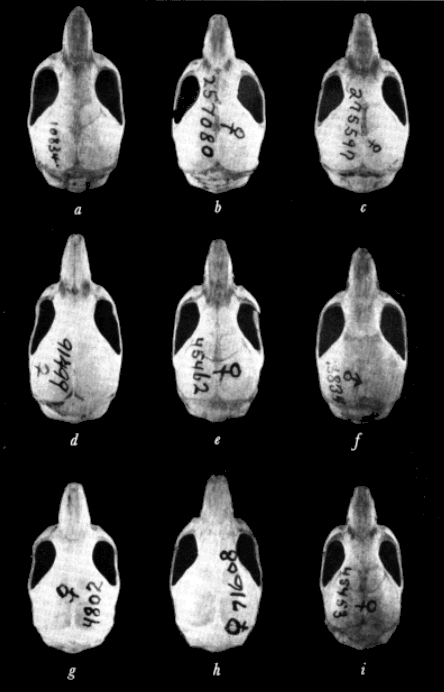
Photographs of skulls in dorsal view of
Baiomys
. × 2.
a. B. m. brunneus, ♀ ad., 10834, AMNH, Jalapa, Veracruz. b. B. m. grisescens, ♀ ad., 257080, USNM, Comayabuela, Honduras. c. B. m. handleyi, ♀ ad., 275597, USNM, Sacapulas, Guatemala. d. B. m. infernatis, ♀ ad., 91499, MZUM, Teotitlán, Oaxaca. e. B. m. musculus, ♀ ad., 45462, USNM, Colima, Colima. f. B. m. nigrescens, ♂ ad., 76834, USNM, Comitán, Chiapas. g. B. m. pallidus, ♀ ad., 4802, Texas A & M, Axochiapán, Morelos. h. B. m. pullus, ♀ ad., 71608, KU, 8 mi. S Condega, Nicaragua. i. B. t. allex, ♀ ad., 45453, USNM, Colima, Colima.
PLATE 2
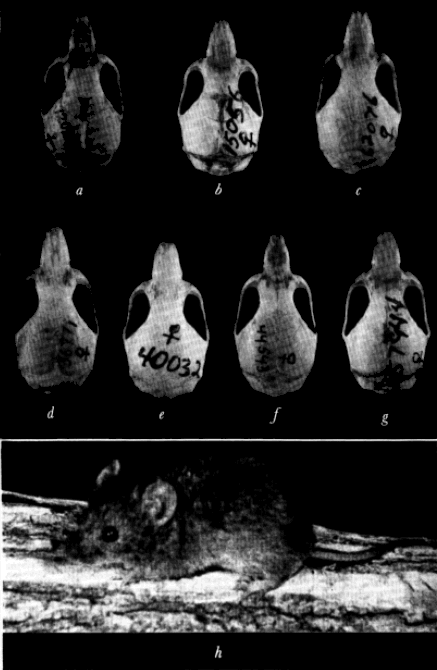
Photographs of skulls (
a-g
) in dorsal view of
Baiomys
. × 2.
a. B. t. analogous, ♀ ad., 120265, USNM, Zamora, Michoacán. b. B. t. ater, ♀ ad., 15056, UI, 11/2 mi. ENE Greaterville, Arizona. c. B. t. canutus, ♀ ad., 62076, KU, 1 mi. S Pericos, Sinaloa. d. B. t. fuliginatus, ♀ ad., 36771, KU, type locality. e. B. t. paulus, ♀ ad., 40032, KU, 18 mi. W, 2 mi. S Aguascalientes. f. B. t. subater, ♀ ad., 44543, USNM, type locality. g. B. t. taylori, ♀ ad., 57944, KU, 5 mi. E San Antonio, Texas. h. Photo. of captive ♂ B. t. taylori, 25 mi. E Austin, Texas. × 1.
PLATE 3
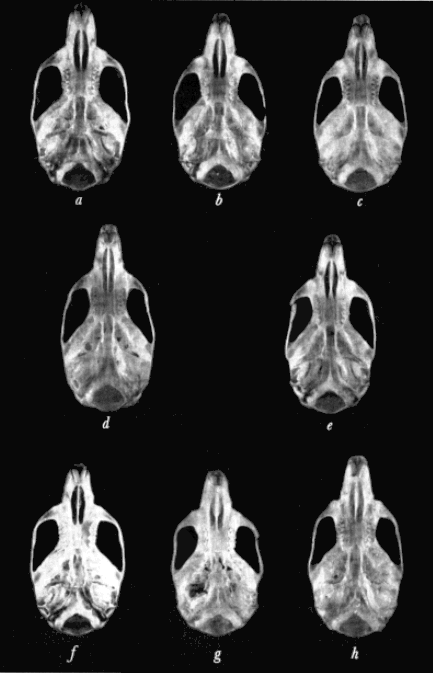
Photographs of skulls in ventral view of
Baiomys
. × 2.
a. B. m. brunneus, ♀ ad., 10834, AMNH, Jalapa, Veracruz. b. B. m. grisescens, ♀ ad., 257080, USNM, Comayabuela, Honduras. c. B. m. handleyi, ♀ ad., 275597, USNM, Sacapulas, Guatemala. d. B. m. infernatis, ♀ ad., 91499, MZUM, Teotitlán, Oaxaca. e. B. m. musculus, ♀ ad., 45462, USNM, Colima, Colima. f. B. m. nigrescens, ♂ ad., 76834, USNM, Comitán, Chiapas. g. B. m. pallidus, ♀ ad., 4802, Texas A & M, Axochiapán, Morelos. h. B. m. pullus, ♀ ad., 71608, KU, 8 mi. S Condega, Nicaragua.
PLATE 4
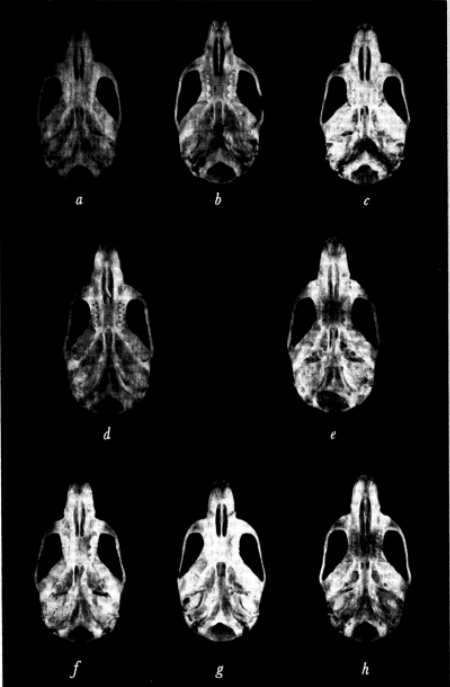
Photographs of skulls in ventral view of
Baiomys
. × 2.
a. B. t. allex, ♀ ad., 45453, USNM, Colima, Colima. b. B. t. analogous, ♀ ad., 120265, USNM, Zamora, Michoacán. c. B. t. ater, ♀ ad., 15056, UI, 1 mi. ENE Greaterville, Arizona. d. B. t. canutus, ♀ ad., 62076, KU, 1 mi. S Pericos, Sinaloa e. B. t. fuliginatus, ♀ ad., 36771, KU, type locality. f. B. t. paulus, ♀ ad., 40032, KU, 18 mi. W, 2 mi. S Aguascalientes. g. B. t. subater, ♀ ad., 44543, USNM, type locality. h. B. t. taylori, ♀ ad., 57944, KU, 5 mi. E San Antonio, Texas.
Remarks.—This subspecies retains its chief diagnostic character, blackish mid-dorsal region, throughout nearly all parts of its range. Specimens from the general area of Matagorda Bay and Lavaca County grade into taylori in characters of color and crania. The Colorado and Brazos rivers seemingly serve as barriers reducing gene flow between taylori and subater. These rivers may well have been important factors in the origin and the limitation of these two seemingly closely-related subspecies.
Baiomys taylori subater is not differentiated in color of pelage and characters of crania from B. t. taylori to the same degree that B. t. paulus is differentiated from B. t. analogous, or that B. t. taylori is differentiated from several of the other subspecies of Baiomys taylori. B. t. subater probably is a more recent occupant of the area in which it now lives than is the case with any other one of the subspecies of taylori. Sufficient time probably has not elapsed to allow for formation of more distinctive phenotypic patterns.
Specimens examined.—Total 65, all from Texas and distributed as follows: Brazos County: 1/2 mi. NW College Station, 1[55]; 3 mi. W College Station, 1 mi. W Easterwood Airport, 1[55]; College Station, 1[55]. Walker County: Huntsville, 1[55]. Hardin County: Sour Lake, 1[57]. Jefferson County: 7 mi. S Labelle, 10. Harris County: 6 mi. NE Crosby, 1[56]. Colorado County: 10 mi. N Eagle Lake, 1[55]; 9 mi. N Eagle Lake, 1[55]; 2 mi. W Eagle Lake, 1; Eagle Lake, 1[55], 5. Fort Bend County: Richmond, 4[57]. Galveston County: Texas City, 6[58]; Virginia Point, 1[57]. Brazoria County: Austin Bayou near Alvin, 2[57]; 14 mi. SSE Alvin, 2[59]; type locality, 7[57] (including the type). Lavaca County: 4 mi. W Hallettsville, 1[55]; 1 mi. SW Hallettsville, 3[55]; 13.7 mi. SW Hallettsville, 2[55]; 4 mi. NE Yoakum, 11.
Marginal records.—Texas: Huntsville; Sour Lake; 7 mi. S La Belle; Virginia Point; 14 mi. SSE Alvin; type locality; 4 mi. NE Yoakum; 4 mi. W Hallettsville; 1/2 mi. NW College Station.
Baiomys taylori taylori (Thomas)
Hesperomys (Vesperimus) taylori Thomas, Ann. Mag. Nat. Hist., ser. 5, 19:66, January, 1887.
Baiomys taylori [taylori], Mearns, Bull. U. S. Nat. Mus., 56:381, April 13, 1907; Stickel and Stickel, Jour. Mamm., 30:141, May 23, 1949.
Baiomys taylori taylori, Miller, Bull. U. S. Nat. Mus., 79:136, December 31, 1912; Miller, Bull. U. S. Nat. Mus., 128:317, April 29, 1924; Anthony, Field Book of North American Mammals, p. 327, 1928; Ellerman, The Families and Genera of Living Rodents, 2:402, March 21, 1941; Taylor and Davis, Texas Game, Fish and Oyster Comm. Bull., 27:56, August, 1947 (part); Blair, Texas Jour. Sci., 2:104, March 31, 1950; Goldman, Smith. Miscl. Coll., 115:373, 426, July 31, 1951; Baker, Univ. Kansas Publs., Mus. Nat. Hist., 5:212, December 15, 1951; Blair, Texas Jour. Sci., 4:242, June 30, 1952; Hooper, Occas. Papers, Univ. Michigan, Mus. Zool., 544:7, March 25, 1953; Dalquest, Louisiana State Univ. Studies (Biol. Sci. Ser.), 1:155, December 28, 1953 (part); Blair, Adv. in Genetics, 5:10, January 27, 1954; Miller and Kellogg, Bull. U. S. Nat. Mus., 205:511, March 3, 1955; Baker, Univ. Kansas Publs., Mus. Nat. Hist., 9:273, June 15, 1956; Packard, Proc. Biol. Soc. Washington, 71:17, April 11, 1958; Hall and Kelson, The Mammals of North America, 2:659, March 31, 1959 (part).
Cricetus (Vesperimus) taylori, Thomas, Proc. Zool. Soc. London, 68:446, November 20, 1888.
Sitomys taylori, Merriam, Proc. Biol. Soc. Washington, 7:170, September 29, 1892.
Sitomys (Baiomys) taylori, True, Proc. U. S. Nat. Mus., 16(972):758, February 7, 1894; J. A. Allen, Bull. Amer. Mus. Nat. Hist., 6:181, May 31, 1894.
S. [itomys] taylori, Rhoads, Proc. Acad. Nat. Sci. Philadelphia, 46:256, October, 1894.
Peromyscus (Baiomys) taylori, J. A. Allen, Bull. Amer. Mus. Nat. Hist., 8:65, April 22, 1896.
[Peromyscus] taylori, Trouessart, Cat. Mamm., 1:517, 1898.
Peromyscus taylori [taylori], Elliot, Field Columb. Mus. Publ., 105(4):135, July 1, 1905; V. Bailey, N. Amer. Fauna, 25:101, October 24, 1905; Elliot, Field Columb. Mus. Publ., 115(8):203, 1907; Osgood, N. Amer. Fauna, 28:253, April 17, 1909.
Type.—Adult male, skin and skull; No. 87.11.24.1, British Museum, Natural History; San Diego, Duval County, Texas; obtained by William Taylor.
Range.—North-central to southeastern Texas, excluding the coastal plain north of the region of Matagorda Bay, thence south into the southern part of Tamaulipas and west into Coahuila and Nuevo León, see Figure 11. Occurs from near sea level in Texas up to 1500 feet in Coahuila. Zonal range: mostly Lower Austral (in México and southeastern half of Texas, the Tamaulipas Biotic Province of Goldman and Moore, 1945:349, and Blair, 1952:230).
Diagnosis.—Size medium for the species; dorsum grayish in freshly taken specimens to Hair Brown in preserved specimens; individual guard hairs of dorsum black-tipped, grayish basally, underfur black-tipped with a subterminal band of olive-buff; sides of body pale-grayish near venter, individual hairs buffy proximally, grayish basally; belly pale grayish, individual hairs white-tipped, Pale Neutral Gray basally; throat and chin colored as is belly; forefeet and hind feet sooty-gray dorsally, sparsely-haired ventrally, thus appearing flesh-colored; tail unicolored gray to sooty-gray. Average and extreme cranial measurements of 22 adults from 6 mi. SW San Gerónimo, Coahuila, are as follows: occipitonasal length, 18.0 (17.4-19.0); zygomatic breadth, 9.6 (9.2-10.2); postpalatal length, 6.5 (5.9-7.1); least interorbital breadth, 3.6 (3.3-3.8); length of incisive foramina, 4.0 (3.6-4.3); length of rostrum, 6.1 (5.7-6.7); breadth of brain case, 8.8 (8.5-9.1); depth of cranium, 6.5 (6.0-7.0); alveolar length of maxillary tooth-row, 3.1 (3.0-3.3). Average and extreme external measurements of 19 adults from 6 mi. SW San Gerónimo are as follows: total length, 102.2 (95-115); length of tail vertebrae, 39.4 (21-46); length of body, 62.8 (53-76); length of hind foot, 14.0 (12-15); length of ear from notch, 10.7 (10-12); for photographs of skull, see Plate 2g, and Plate 4h.
Comparisons.—For comparisons with B. t. subater, B. t. analogous, and B. t. fuliginatus, see accounts of those subspecies. From B. t. paulus, found to the southwest, B. t. taylori differs as follows: dorsum grayish rather than fawn-colored; hairs on dorsal parts of forefeet and hind feet sooty-gray (not white to white-brown); venter gray to Light Drab-Gray, rather than whitish with gray overtones; tail unicolored instead of bicolored; skull averaging slightly larger over-all; maxillary part of zygoma forms right angle with rostrum rather than obtuse angle; incisive foramina extending posteriorly to anterior plane of first upper molars instead of to a transverse plane at middle of right and left first upper molars; bullae less inflated; interorbital region broader relative to length of skull; rostrum sloping gently from frontonasal suture to anterior tip of nasals rather than declining abruptly from frontonasal suture to anterior tip of nasals.
Remarks.—The geographic range of taylori is relatively large, and the subspecies is locally variable. Nevertheless, none of the external and cranial measurements of specimens assigned to this subspecies differs significantly from the corresponding measurements of material from the type locality and adjacent areas in southeastern Texas. In southeastern Texas, south of the Guadalupe River, south to the coastal plain of Tamaulipas, this subspecies differs in color (being paler) from B. t. subater with which taylori might be confused. The foothills of the Sierra Madre Oriental in western Tamaulipas, north through Nuevo León and Coahuila, seem to mark the southwestern limit of the range assignable to taylori.
On December 27, 1958, a specimen, KU 81552, was obtained 3 mi. N Bowie, Montague County, Texas. This record station extends the known range of B. taylori 65 miles northward from the previous northernmost locality, listed by Hunsaker, Raun, and Swindells (1959:447). Two specimens, KU 81553 and 81554, were collected by the author 2 mi. NE Cedar Hill, Dallas County, Texas, on October 31, 1958. These two specimens, plus the single specimen from Bowie County are all paler with more buffy bellies than either B. t. taylori or B. t. subater. They may represent an incipient subspecies. I tentatively assign them to B. t. taylori because of the pale rather than dark (like B. t. subater) pelage. Additional specimens are needed from these areas and from the hiatus between the ranges of B. t. taylori and B. t. subater the better to understand the manner in which these two subspecies intergrade.
Among named subspecies of Baiomys taylori, B. t. taylori most closely resembles B. t. subater to the north in Texas. Nine specimens examined from Yoakum are intergrades between taylori and subater. These specimens have the sooty dorsal color of subater, but ventrally are inseparable from topotypes of taylori. In length of body and tail, specimens from Yoakum are like subater, but in length of hind foot, they are intermediate between the two subspecies. Cranially, they are like subater. When all characters are considered, the specimens are best referred to subater. Bailey (1905:103) suggested that specimens from the southern part of the range, which he ascribed to subater, tended to a more grayish color than topotypes of subater, therefore, grading into taylori. The zone of intergradation runs from Matagorda Bay northwest through Lavaca County, thence north to the Colorado River, and closely follows the boundary between the Lower Austral and Humid Division of Lower Austral Life-zone as plotted by Bailey (loc. cit.). Findley (1955:44) pointed out that where two life-zones meet, the resulting populations of shrews are mostly intergrades. Such is the case between these two subspecies of Baiomys taylori in an area where life-zones might seem less important than in the mountainous west.
In the southern part of the range of taylori, intergradation occurs between B. t. taylori in western Tamaulipas and B. t. fuliginatus in the mountains of San Luis Potosí.
Dalquest (1953:156) found no indication of intergradation between the two species, B. taylori and B. musculus, in San Luis Potosí. After examination of specimens from San Luis Potosí, I am in agreement that they are all referable to the species taylori.
Specimens examined.—Total 435. Texas: Montague County: 3 mi. N Bowie, 1. Dallas County: 2 mi. NE Cedar Hill, 2. Travis County: 8 mi. NW Austin, 2[60]; Austin, 2[60]; 4 mi. E Austin, 4[60]; 5 mi. E Austin, 3[60]; 6 mi. E Austin, 16[60], 1; 7 mi. E Austin, 1[60]; 15 mi. E Austin, 1[60]; 4 mi. S Austin, 1[60]. Bastrop County: 25 mi. E Austin, 2. Kendall County: Boerne, 1[61]. Bexar County: 1 mi. N Randolph Field, 3[64]; 5 mi. ENE (on U. S. Highway 81) San Antonio, 1; 3 mi. NE San Antonio, 1; San Antonio, 26[61], 11[62], 1[63]; 5 mi. E San Antonio, 11; 41/2 mi. E Sayers, 3. Gonzales County: 7 mi. S Luling, 2[60]. Wilson County: 4 mi. W LaVernia, 3; 12 mi. W Floresville, 1. Atascosa County: 9 mi. SW Somerset, 1. Goliad County: 8 mi. NE Goliad, 1[60]. Bee County: Beeville, 1[61]. Aransas County: Aransas (Wildlife) Refuge, 1[65]; 5 mi. E Copana Bay, 1[65]; 4.6 mi. NE Rockport, 5[60]; 4.5 mi. NW Rockport, 2[60]; 3 mi. N, 2 mi. E Rockport, 4; Rockport, 1[60], 1[61], 1[63]; 11/2 mi. SW Rockport, 1[60]; 2 mi. SW Rockport, 2[60]; 13.4 mi. SW Rockport, 1[60]; 14 mi. SW Rockport, 1. San Patricio County: Welder Wildlife Refuge, 7. Duval County: type locality, 2[61], 1[66]. Nueces County: Corpus Christi (south Nueces Bay), 1[64] (Cleveland Mus. Coll.). Kleberg County: 2 mi. S Riviera, 3[65]. Brooks County: 3 mi. S Falfurrias, 2[65]. Hidalgo County: 6 mi. S McAllen, 17[60]. Willacy County: 28 mi. E Raymondville, 10[65]. Cameron County: Brownsville, 31[61], 23[62], 5[64]. Coahuila: 6 mi. SW San Gerónimo, 32. Nuevo León: Santa Catarina, 1[61]; 14 mi. N Monterrey, 1950 ft., 2[67]; Monterrey, 1[61]; 20 km. N General Terán, 3[64]. Tamaulipas: Near Headwaters Río Sabinas, 8 km. W, 10 km. N El Encino, 400 ft., 1; Camargo, 5[61]; Charco Escondido, 20 mi. S Reynosa, 3[67]; Matomoras, 5[61]; Ejido Santa Isabel, 2 km. W Inter-American Highway, 2000 ft., 7; Hidaglo, 7[61]; Hda. Station Engracia, 4[63]; 4 mi. N La Pesca, 1; 29 mi. N Ciudad Victoria, 1[67]; Ciudad Victoria, 6[61], 3; Jaumavé, 2400 ft., 6[64], 10; Sierra de Tamaulipas, 3[64]; 25 mi. N El Manté, 3 km. W Inter-American Highway (on Rancho Pano Ayuctle), 300 ft., 4; 6 mi. N Gomez Farias (on Rancho Pano Ayuctle), 1; 5 mi. NE Gomez Farias, 12[64], 1[62]; 70 km. (by highway) S Ciudad Victoria, 2 km. W El Carrizo, 5[62], 2; Antigua Morelos, 5[64]; 6 mi. N, 6 mi. W Altamira, 31; 5 mi. N, 5 mi. W Altamira, 4; Alta Mira (Altamira), 2[61]; 1 mi. S Altamira, 6; 10 mi. NW Tampico, 1. San Luis Potosí: Ebano, 5[68]; 4 km. NE Ciudad Valles, 1; Ciudad Valles, 1; 3 km. W Tamuín, 1[68]; Tamuín, 6[68]; Pujal, 300 m., 1[64]. Veracruz: Tampico Alto, 50 ft., 1; Potrero Llano, 350 ft., 1; Ozulama, 2; Cerro Azul, 350 ft., 1.
Marginal Records.—Texas: 3 mi. N Bowie; 2 mi. NE Cedar Hill; 25 mi. E Austin; 7 mi. S Luling; 8 mi. NE Goliad; Aransas (Wildlife) Refuge; 3 mi. N, 2 mi. E Rockport; Corpus Christi (South Nueces Bay); 2 mi. S Riviera; 28 mi. E Raymondville; Brownsville. Tamaulipas: Matomores; 4 mi. N La Pesca; 1 mi. S Altamira. Veracruz: Tampico Alto; Ozulama; Cerro Azul; Potrero Llano. San Luis Potosí: Ciudad Valles. Tamaulipas: Antigua Morelos; 70 km. S Ciudad Victoria, 2 km. W El Carrizo; Jaumavé; Hidalgo. Nuevo León: 20 km. N General Terán; Santa Catarina. Coahuila: 6 mi. SW San Gerónimo. Texas: 9 mi. SW Somerset; Boerne; 8 mi. NW Austin.
.
EVOLUTION AND SPECIATION
The history of the genus dates back to the early late Pliocene, but morphological change since then has been slight insofar as can be judged from lower jaws. Baiomys seems to have been relatively conservative also in types of habitat occupied.
According to Wilson (1937:59), the late Pliocene was a time of decided expansion of myomorph rodents, more particularly cricetines. Furthermore, at this time, the climate in the interior basin of southwestern North America presumably was becoming arid, if we can judge from the spread of elements of the Madro-Tertiary flora. Axelrod (1950:266) points out that the drier, continental climate initiated in the early Tertiary probably had its culmination in middle Pliocene time. Some floras of early late Pliocene of the southwestern United States reflect a climate slightly cooler and more moist than the climates of the middle Pliocene. However, late Pliocene times reflect an arid climate. The flora of the southwestern interior basin of North America in early late to late Pliocene was intermediate between the previous grassland floras of the middle Pliocene and the savannah flora of upper Pliocene. Axelrod (loc. cit.) suggests that this intermediate flora of the interior basin of southwestern North America resulted from the folding of the Cascades and uplifting of the Sierra Nevada and Peninsular ranges to the south. The development of these mountains produced greater aridity to the lee of the mountains, thus accounting for the grassland-savannah flora. Pygmy mice probably originated in that time, I judge in México, and moved northward and southward in a grassland-savannah habitat that seemingly existed as far north as what is now Meade County, Kansas (where the Sawrock fauna lived). Further evidence for occupancy of a grassland-savannah habitat by ancestral pygmy mice stems from the distribution of the living species, B. taylori, that at present occupies territory adjacent to parts of the Sonoran and Chihuahuan deserts. B. taylori seems to be morphologically more specialized for life in an arid grassland than was B. sawrockensis.
The geographic range of ancestral pygmy mice possibly extended farther south in late Pliocene time than the range of B. musculus does now. Anyhow, B. sawrockensis of the early late Pliocene dwelt in a more mesic type of habitat than B. musculus does, and such habitat may have existed from the Pacific lowlands of Central America to the Caribbean lowlands of northern South America (see Duellman, 1958:136, and Dunn, 1940:156) during late Pliocene times. An ancestral stock of hesperomine mice, not greatly different from Baiomys, may have emigrated from the North American continent into South America across the continuous land connection, which Simpson (1950:395) suggests was formed in the Chapadmalalan age (= Blancan age of North American terminology). The length of time of interchange of genes between northern and southern populations of mice across the Central American land connection probably was brief. Duellman (op. cit.:129) pointed out that once the Panamanian portal was closed, the warm counter equatorial current, El Niño, combined with the uplifting of the Andes, began to produce heavy rain forests in Central America and northern South America in late Pliocene or early Pleistocene times. These forests presumably isolated the stock in North America from that in South America where the latter probably evolved rapidly into kinds that differed from one another and from Baiomys in shape of body, type of pelage, and shape of skull. Internal structures such as hyoid apparatus, auditory ossicles, and baculum remained almost unchanged, as for example in Calomys now living in South America. The present resemblance in internal morphological features between it and Baiomys, I judge, reflects taxonomic relationships more accurately than do shape and conformation of body and skull that seem to respond more rapidly to external environmental changes. The cranial characters distinguishing Baiomys musculus from Calomys laucha are as follows: posterior lacerate foramina between second, rather than first, upper molars; parapterygoid fossa shallower; mesopterygoid fossa as wide or wider, instead of narrower, than parapterygoid processes; burr for attachment of superficial masseter muscle hypertrophied instead of well-developed. In other cranial characters studied, the two genera closely resemble each other. Such similarities of crania between Calomys and Baiomys may reflect convergence, but the total of internal and external morphological characters shared, I think reflects true relationships.