SPANISH JOHN (continued 3)
Reading edition
And to my surprise, these men, who were wont to smell an insult afar off, and whose courage in the field was unquestioned, received this intolerable tirade as quietly as school-boys after a whipping—and so the matter rested, and they went their way and we ours.
I wrote to Mr. Constable, then Secretary to the Duke of York, of the resolution of my comrades, and, by return of post, I received orders from His Royal Highness to repair to Boulogne, which I immediately complied with, accompanied by Father O'Rourke.
On reaching Boulogne, we enquired our way to Mr. Constable's lodgings, and upon knocking at his chamber-door it was opened by the Duke himself.
"Welcome, Mr. McDonell, welcome; and you, too, Father O'Rourke. You see we are so few we have dispensed with ceremony here in Boulogne." he said, giving a hand to each of us.
"We ourselves dispensed with it, and most of our following as well, in Paris, your Highness," said Father O'Rourke, laughing, "though I don't know that we'd have been any more had we used all the ceremony of the Court of Spain;" and then, without waiting to be introduced to the other gentlemen present, he began the story of his farewell speech to the volunteers from Italy, and set them all a-laughing heartily with his impudence.
I was somewhat taken aback, but thought it best to offer no remonstrance; indeed, I could not imagine any company which would have put Father O'Rourke out of countenance. I felt ill at ease, not having shifted myself, as I had not expected to see any one save Mr. Constable; but Father O'Rourke talked and moved among them all in his rusty cassock without an apology for his condition. However, I soon forgot such trifles in my interest in the company gathered. Besides His Highness, there were the Duke of Fitz-James, son of the great Duke of Berwick, and many noblemen of distinction and general officers, among whom I was introduced to the Count Lally-Tollendal, whose unjust execution at the hands of his enemies some years later aroused the sympathies of all Europe.
The plans of the Prince and hopes of aid from King Louis were discussed with the utmost freedom and with much hope, for it was confidently expected an expedition for Scotland would be equipped immediately, which the Duke was to command, as it was on this promise he had come from Italy.
But one week went by, and then another, and yet we had no satisfaction from the Court, not even excuses, and I could not but observe that, though others still had implicit faith in some action by King Louis, the Duke began to lose heart.
"Ah, the poor young man," said Father O'Rourke, "my heart is sore for him. He has more sense than the rest of them, and faith, I think, has more heart, too, and so takes it harder. Do you know, Giovannini, 'tis a great misfortune to be born in the ranks of princes; they're the only class of men I know of that are untrustworthy as a whole. King David knew the breed well, and did not he write 'Put not your trust in princes' (Nollite confidere in principibus)? and here is the Duke eating his heart out because he is learning the bitter text King David preached thousands of years ago."
We were seated in a lonely place outside the town, overlooking the sea, and watched the lights below us gently rising and falling on the fishing-vessels and other craft at anchor, and marked among them the bright lanthorns of a man-of-war which topped all the others.
Presently we heard footsteps, and the Duke came up alone; it was not so dark but he could recognize us, which he did very quietly, and, advancing, seated himself between us, saying, "Do not move, gentlemen, and forget I am the Duke for an hour. My heart is sick of empty forms which mean nothing," and he sate in silence for a long time with his elbows on his knees and his chin in his hands gazing out over the sea.
At length he said, slowly, as if to himself, "I would give ten years of my life to be on board that frigate with the men I would choose and a fair wind for Scotland. To think of my poor brother longing and wondering why some support does not come, and I idle here with empty hands," and something like a sob ended his words.
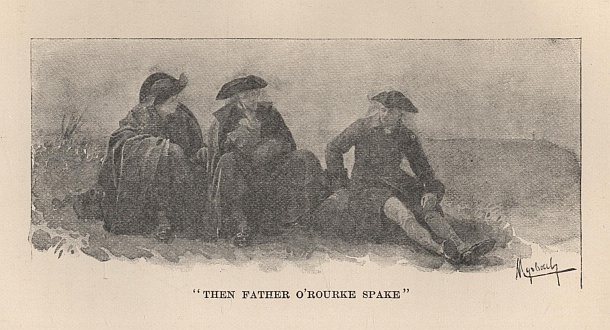
Then Father O'Rourke spake in a voice as gentle as if he comforted a woman. "Your Highness, when we were children, the story we loved best to hear was the one our mother never told us—about 'The Little Red Hen.' Who 'The Little Red Hen' was, or where she came from, or what she did, we never could learn. She was just 'The Little Red Hen,' and had no story at all. But her story which no one ever heard was better than that of 'Brian Boru,' or 'Malachi of the Collar of Gold,' or 'Rookey the Water Witch,' any of whom would come out without much coaxing and parade up and down until we knew them through and through, while the very name of 'The Little Red Hen' would quiet the biggest trouble that ever broke our hearts. My own belief is that she stayed at home and kept the breath of life in the family by laying her eggs and scratching up food for the chickens; but wherever she was, there was no cackling to lead us to her. She was just doing her work, helping the tired hearts and healing the sore ones, and all these years no one ever set eyes on her, more than on the dew that falls at night on the thirsty land."
And that was all; no beginning, no end, and I wondered what he was at, with his silly stories of Red Hens, fit only for a lot of bare-legged children; but the Duke must have seen something else, for after a little he broke into a more lively humour and said, half laughing, "Upon my word, Father O'Rourke, you Irish are a wonderful people!"
"We are all that, your Highness," he returned, with great complacence. "We are a terrible convenient people to have about when everything is going right, and, for the matter of that, when everything is going wrong as well, if we only have some one with a strong hand to lead us; but make us all equal and we are no more use than a lot of chickens with their heads cut off."
"THEN FATHER O'ROURKE SPAKE"
"Father O'Rourke," said the Duke, suddenly, "sing me that song I heard of your singing at Lyons."
"I will with all my heart, your Highness," and, making his big voice as soft as a girl's, he began without any further words:
"Oh the water, the water."
When he had finished, the Duke sate silent a little, then he rose and said, "Gentlemen, I thank you for the first hour of quiet I have had for weeks. Come, let us go back." And at the door of his lodgings he bade us good-night, saying to Father O'Rourke, "Don't be surprised if I should come to you some day to hear the rest of the story of 'The Little Red Hen.'"
The forebodings of the Duke came true; no expedition was forthcoming, and he was obliged to send in single vessels such aid as could be procured. One left Dunkirk in the beginning of April with three hundred men and many officers, but I was still bidden to remain.
Shortly afterwards the Duke commanded me to repair to Dunkirk and there await him. He there sent me the grateful assurance that I was to start almost at once charged with considerable monies, which he was about raising, and also letters for the Prince, and at the same time confided to me that he had almost transmitted a large sum by the hands of Creach, or "Mr. Graeme," as he styled him—news I was sadly disappointed to hear, for I could not bring myself to trust the man in any particular.
In a few days the Duke arrived, and the next day was invited to dinner by my Lord Clare, then in command of the French troops in and about the place. As Father O'Rourke and I were considered to be in the Duke's retinue, we were also asked. Lord Clare, observing my uniform, enquired of the Duke who I was, and was informed I was a Highland gentleman named McDonell, a Lieutenant in the Spanish Army in Italy. After some further conversation with the Duke, he addressed himself to me, saying, without any introduction:
"Mr. McDonell, I have a company now vacant in my regiment, and if you will accept, it is this moment at your service."
I rose, and, commanding myself as well as possible under this surprise, said: "Your Excellency has my most humble thanks for your handsome offer, but I only left my late service, wherein I had gained some recognition, in order to devote myself to my protectors and benefactors, the Royal Family, to whom I am bound by the strongest ties of gratitude."
The Duke looked at me with a real pleasure in his eyes, and I was proud that I could afford him even a passing gratification.
Presently the Duke requested his Lordship to grant him a favour.
"I am sure your Highness will not ask anything beyond my poor powers," he answered.
"There are no political complications in this," laughed the Duke. "I would only ask that my friend, Father O'Rourke, be requested to sing for us a song which has been running through my head since I first heard it from him the other night."
Whereupon Lord Clare requested him to sing, and straightway he began, for the fiftieth time that I had heard him, at the same old song. And herein lies the poverty of these rhymers, for if by any chance they hit something that tickles the ear, they must be harping on it until the patience of their intimates is wearied beyond words. But I could afford to let him win his reward, for I considered I had cut no inconsiderable figure before the company myself.
Two or three days later we left Dunkirk for St. Omer, where I at last received my orders. I was to return secretly to Dunkirk and there take passage in a swift sailing cutter, lately captured from the English, and carry a sum of three thousand guineas, together with important despatches and letters for the Prince.
The Duke was very down the last night we spent together, and once or twice repeated:
"Oh the waiting, the waiting, The cruel night of waiting, When we brake the bread of sorrow and drank our bitter tears."
"Mr. McDonell," he said, "it is impossible to tell how things may turn, but should they prove against us, give me your word not to desert the Prince."
"Your Royal Highness," I answered, "I swear by my mother's soul I will not leave Scotland while he is in any danger, and neither threat nor peril will tempt me to be unfaithful to him in word or thought."
"It is enough," he said; "I can trust you without the oath."
The next morning we parted from him, embracing him like any private gentleman, as he wished to keep his incognito absolute; so he took his way into Flanders, and we to Dunkirk, there to join some twenty-five officers, all volunteers for Prince Charles. We found our vessel ready for sea, and before sunset were safely on board, meeting old friends and making new ones.
It was night by the time we ran out of the harbour, and many an anxious hour we had of it, for it was no easy matter to make the run from France to Scotland in the year '46, when every sail was looked upon with suspicion.
I need make no apologies for our anxiety when we were signalled to lay to by the first English ship we met; and the invitation was quickly followed by a puff of smoke and the boom of a gun. A sense of danger is largely quickened by unfamiliarity, and though any of us would have made little of attacking a battery on shore, this sea fighting was a new and uncomfortable outlook. But when we saw what a pair of heels our privateer, fitly named the Swallow, could show, we soon recovered our confidence, and after this it was a mere matter of speculation how long anything we met could stand up to us at all.
Our crew of about fifty was a mixed lot, French and Scotch, but they were thorough at their business, and it was curious to see how true the Captain could judge of the exact room he must give to any suspicious sail—it was a game of hare and hounds all the time, for no sooner were we rid of one than we would fall in with another to take up the running; but none of them served to do more than raise our spirits and take our minds off the discomfort most landsmen find at sea. We encountered various weather, but the worst only brought out the sailing qualities of the Swallow, until at length we made the coast of Scotland, and all eagerly looked to the end of our voyage, which was to be at Inverness; indeed, the Captain counted on making Cromarty Head before night, and to lay there till the morning.
That day at dinner Father O'Rourke gave us another taste of his song-making, which was greatly appreciated on account of the reference to the "White Cockade," always a favorite quickstep with the Jacobite Regiments:
Merrily, merrily blows the wind from off the coasts of France; The Channel open wide before, God send us now good chance! Give us the green seas rolling free and but way enough to steer, And we'll leave the swiftest foe in the wake of the Swallow Privateer!
Then here's to the Swallow, flying true! And here's to the Prince and his Bonnets Blue! And here's to the heart of each wife and maid That is beating for the Laddie with the White Cockade!
Drearily, drearily sets the wind down from the Northern Seas, But she dips to the rollers big and black, and her bonnie breast she frees, From her tapering mast she flies on the blast her signals fluttering clear To the friends that pray for the coming home of the Swallow Privateer!
Then here's to the Swallow, flying true! And here's to the Prince and his Bonnets Blue! And here's to the heart of each wife and maid That is beating for the Laddie with the White Cockade!
Mightily, mightily booms the wind out of the setting sun; We will double the great ships like a hare, we will fight where we cannot run, Till we win to land, and with sword in hand we will follow the Chevalier Who will bless the winds that filled the wings of the Swallow Privateer!
Then here's to the Swallow, flying true! And here's to the Prince and his Bonnets Blue! And here's to the heart of each wife and maid That is beating for the Laddie with the White Cockade!
It was with the highest expectations that we looked forward to landing on the morrow and joining the Prince, of whose movements we were in ignorance, except that we were to rendezvous at Inverness.
In the latter part of the night I was awakened by an ugly scream from Captain Lynch, one of the officers of our company.
"What is the matter?" I asked, in some alarm.
"I dreamed the Devil had hold of me by the heels, and about to dash my brains out."
"Perhaps the Devil is not so very far off," I returned; and then, being somewhat restless, part from the heat and part from our being so near our landing, I thought I would take a turn on the deck. No sooner had my eyes got accustomed to the light than, to my alarm, I made out the dim outline of a great ship, which must have come up during the night, unseen and unheard by our sentinels, and was lying-to between us and the entrance to the bay. I at once made my discovery known to the Captain, who, coming hurriedly on deck, swore with a great oath I had saved their lives, for she was no other than an English man-of-war on the outlook for such as we. Then, without more ado, he slipped his anchor, got up sail as quietly as possible, and, in a fever of anxiety, we waited to see whether the tide which was setting on shore or the light winds which were moving would prove the stronger. At length our sails gently filled and began to draw, so we crept round under the shadow of the land until we got the full wind, and stood out to sea with thankful hearts for the danger we had so narrowly escaped.
Great was the surprise of my comrades when aroused to find we were again making for the open instead of ending our voyage; but, as Father O'Rourke said: "Captain Lynch, your patron saint evidently thinks that even a little extra salt water is better for you than the inside of an English prison. The truth is that Irishmen are such favourites that even the Devil himself will do them a good turn at times."
Though I thought to myself there were others fully as deserving as the Irish, I said nothing.
As our intended landing was now impossible, our Captain determined to stand round the Orkneys for Loch Broom, in Cromarty, on the West coast.
We had an easy run, and as soon as we were signalled from the shore, and on lying-to, a boat was put out. In the stern there were seated two gentlemen, one of whom, the Captain informed me, was a McKenzie, and in the other Father O'Rourke and I only too soon recognized Creach.
"This means trouble of some sort," I remarked; "we would never find him so far afield if things were going right."
"I fear it, too," he answered, and before long our worst apprehensions were realized.
We withdrew at once to the cabin where I met Creach, or Graeme, as he still called himself, without remark, for I recalled my word to the Duke and felt there was something too weighty on hand for even the remembrance of a personal quarrel. In a few moments we heard, to our dismay, that Culloden had been fought and lost the very day we had sailed from Dunkirk; that the clans were scattered and no one knew what had become of the Prince.
After the dreadful news had been given time to sink into our benumbed senses, I asked for personal friends, and heard, to my sorrow, from McKenzie, that my Uncle Scottos, who had been among the very first to join the Prince, and was much esteemed by him, had died like a soldier and a gentleman in his service in the first charge at Culloden.
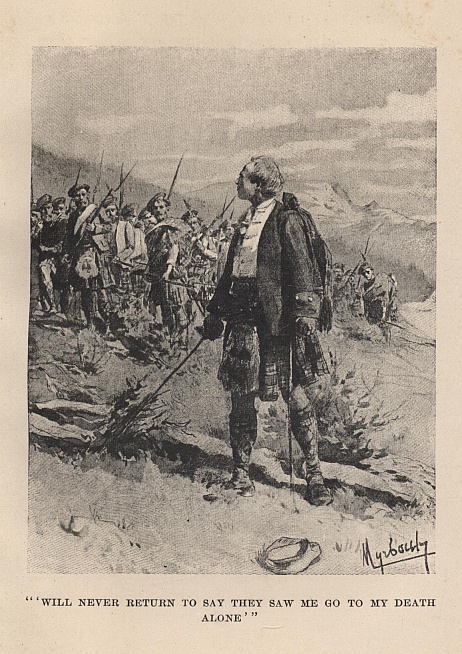
When the body of his clan refused to answer the signal to charge, and stood still and dumb under the insult which had been put upon them in placing them in the left instead of the right wing, he cursed and swore like one possessed, as did others. But finding it of no avail, he changed of a sudden, and, turning to his own men, threw his bonnet on the ground, crying to them, with tears in his words: "Let them go! But my own children will never return to say they saw me go to my death alone!" and with that he charged, every one of his own following him. It was fine, but of no effect, for the English swept them off the face of the earth by a point-blank fire before ever steel met steel. He was picked up and carried off by two of his men; but finding the pursuit grow too hot, he called a halt.
"'WILL NEVER RETURN TO SAY THEY SAW ME GO TO MY DEATH ALONE'"
"Put me down here!" he said, and quickly taking off his dirk, sporran, and watch, he sent them to his son with the message that his end had come as he had always wished, "Sword in hand and face to the foe," and bade them leave him.
And so died one of the gallantest gentlemen, and probably the best swordsman in all Scotland.
Besides, I lost many other of my friends and kinsmen, as I afterwards learned; but this was no time for private mournings, and I turned at once to the business in hand. My comrades decided there was nothing to do but return, and proposed our action should be unanimous.
"Gentlemen," said I, "in the face of such tidings as we have received, no one can doubt but your resolve is justified, and had I simply volunteered for military service, as you have done, I would not hesitate to give my voice to your decision, which I hold to be honourable in every way. But I am charged with private despatches and other matters for the Prince by the Duke of York, and I am not free until I have at least attempted to carry out my mission, for which I know I have your good wishes, and so must go on alone."
"Not alone, my son," broke out Father O'Rourke, and stretched out his big hand to me across the table. "I am curious, gentlemen, to see Scotland, and am sure I cannot do so better than in company with our friend here."
"But, sir, how can you expect to travel about here in your cassock? You would only have to meet the first loyal man to be arrested," objected Creach, the first time he had spoken to either of us.
"Thank you for your suggestion, sir, though doubtless the word 'loyal' was a bit of a slip on your part. I am too well accustomed to meeting blackguards of every description to fear even a 'loyal' man!" Whereupon every one looked at him in surprise to hear him so address Creach, who, however, thought well to make no reply; and shortly after our conference broke up, Creach returning to shore, whilst Mr. McKenzie remained with us until we had formed some plan.
Father O'Rourke arranged with Captain Lynch, who had volunteered from the Hungarian service, and was near as big a man as himself, that he should provide him with a spare uniform, and, when once arrayed, he presented so fine an appearance that we, one and all, made him our compliments upon it.
"Captain Lynch," said he, at dinner, "I have another favour to ask before we part, and that is for the loan of your name while I am playing at this masquerade. I know it is a ticklish thing to ask, this loaning of names, but as I have always been particular of my own, I can promise you I know how to care for yours."
"Faith, you can have it, and welcome, provided you are careful not to mislay it, for 'tis the only bit of property my poor father ever left me," replied the Captain, with great good-nature.
"Never fear, you'll have it back safe and sound. I'll make good kitchen of it, so it won't be worn out, and if they hang me, I'll take care they'll do so under all my true name and title."
Seeing that Father O'Rourke approved, I determined that half the sum I carried was quite enough to risk, so I did up one thousand guineas in one bag, five hundred in another, and confided the remaining fifteen hundred to Captain Lynch to return to the Duke, together with a letter explaining our intentions, and with farewells all around, followed by many a good wish from our comrades, Father O'Rourke and I clambered down the side, followed by Mr. McKenzie, and were rowed ashore. We gave the boat's crew something, and waving a farewell to those on ship-board, picked up our portmanteaus and struck inland.
VI
How we supped with a thief, and the outcome thereof.
There were one or two ragged creatures near by watching us as we landed, but though we shouted to them and made signs, they not only refused to come to our aid, but made off amongst the rocks as we advanced.
"Well, Giovannini, is your heart bursting with pride over your country and countrymen?" asked Father O'Rourke, in Italian, as we struggled and panted with our loads over the rough track up the hillside under the hot spring sun.
"Indeed, this is none of my country, thank God! This only belongs to the McKenzies," said I, ashamed somewhat of the reception we had met.
"Oh, indeed! and to what particular tribe of cattle do they belong?" he asked.
I stopped short in my way and dropped my portmanteau, determined to put an end to his nonsense at once.
"Now, Father O'Rourke—" I began, but he interrupted me with:
"Captain Lynch, if you please, Mr. McDonell, and your superior, remember, as regards rank!" drawing himself up to his full height. He looked so droll standing there in his fine uniform, with his sword and cocked hat and bag wig quite à la mode de Paris, that I could not help bursting out laughing.
He waited until I was done, and then said, very gravely, "Well, 'pon my word! but I'm rejoiced that I've found my way to your funny-bone at last. But if the sight of a fist like this and a foot like that are the only approaches to a Highlander's sense of humour—and I am bound to apply the back of the one and the toe of the other whenever I am forced to a jest—I take it, my better part is to make poor Captain Lynch a sad dog like yourself."
"Mr. McKenzie," he ran on, addressing our guide, who, it was plain to see, was much puzzled at our behaviour, "are you much given to humour in these parts?"
"No sir," he answered, "none that I ever heard of."
"Then why in the name of the Isle of Man did you take up with that creature you brought on board ship?"
Seeing the poor man was bewildered, I explained that his companion, Mr. Graeme, was meant.
"Och, him—-he would just be coming to Colin Dearg with the others after the battle."
"Is that old Colin Dearg, Laggy?" I asked.
"None other," he answered; "and it is to him, very probable, that Ardloch will be sending you."
Ardloch, I explained to Father O'Rourke, was a Mr. McKenzie, to whose place we were bound, and Colin Dearg, or Red Colin, another, both staunch Jacobites.
"Well, well, 'tis a puzzlesome country this, where the men not only do without breeches, but throw off as well the names their fathers gave them; had I known more, I needn't have used such punctilio in borrowing the Captain's. Would not O'Rourke of Brefni, or just Brefni, tout court, have a grand sound; seeing it wouldn't be decent for me to go in petticoats, and I am anxious to make a good impression?"
But I would not answer him, for I could see he was in one of his most provoking humours; so I shouldered my portmanteau and trudged on, and he was forced to follow.
He was not abashed, however, and tried to draw out McKenzie; but the latter was shame-faced and could hardly answer to his follies, so I had to beg him to desist, as the poor man could not understand his funning.
"I don't find him different from the rest of his countrymen," he returned; but I would not answer.
Ardloch received us warmly, and gave us a hearty meal, with good whiskey to follow, and then proposed we should hire a boat—leaving McKenzie behind, as it was better Father O'Rourke's transformation should not be talked over—and go up Little Loch Broom to Laggy, where we would find a number of officers, fresh from the Prince, who might give us some directions where to look.
"Do you look upon everything as lost?" I asked him, at parting.
"That depends on what you mean by 'everything,'" he answered, slowly. "If you mean any attempt to bring the rebellion to life again now, I would say yes. But if you mean to keep the fire alive, then no. The clans cannot all be scattered as yet, for nothing goes to pieces in that way, and I doubt not but there will be some for making a stand in spite of all. But money must be had to keep them together. They have been out since August last, and no Highlander will stay away from home long, even for fighting. 'Tis against all custom. What plunder they got is long since gone, and they will be wearying for home. For home! God help them, many will never see it again! But money, Mr. McDonell—if money can be had, men can be had too, and the Prince can, at the worst, be safely covered until the time opens for escape."
Then my heart rose within me for the first time, for in my hands lay the possible means of safety for the Hope of all loyal hearts.
We at once proceeded, and before nightfall reached Laggy, where we were met by old Colin Dearg, a burly, bearded ruffian with a great shock of red hair, Big William McKenzie of Killcoy, a major, and Murdock McKenzie, a lieutenant in the Earl of Cromarty's Regiment, with about sixty men, and thought ourselves as safe as in the heart of France.
We learned that some were still in arms for Prince Charles, especially the regiment of Glengarry, in which were my kinsmen and friends, and that of Cameron of Lochiel. So we begged for an early supper, and engaged guides and a horse that we might set out at once to join them.
Our baggage and little stores we had carried up from the beach, but I was much annoyed at hearing one of the men, on lifting my portmanteau, remark it was "damned heavy."
"Do you think we are such fools as to travel without powder and ball in time of war?" said I, and hoped it had passed unnoticed; but the fellow threw it down outside the house door, saying lead would not suffer for a little fresh air, at which old Colin Dearg laughed, and said:
"No doubt such gentlemen will have their ruffles there. I will carry it in myself."
"Don't think of it," said I, much put out, and, raising it, I placed it in a corner of the room where I could easily keep my eye on it, and wished from the bottom of my heart we could set off.
Old Colin Dearg was most offensive, although pretending to an extreme courtesy. He disclaimed having seen Creach, or Graeme, since the day before, but we were certain this was a blind, as we could see he knew who the supposed Captain Lynch was, and kept pushing him with questions about the Imperial service, until I feared for the latter's temper. But nothing could move Father O'Rourke when he had not a mind to it, and he rattled on as though he noticed nothing.
The old man pretended to rate the women who were preparing our supper, but I knew well it was all a pretext, though why he was anxious to keep us I could not make out. At length, when he could delay no longer, we sate down in a great room, but, to my dislike, in total darkness, save for the little blaze on the hearth and what light could reach us through the open door. This was bad enough; but on sitting down with the officers, and a Mr. Gordon, who was to be of our company, the room was speedily filled with the riff-raff of men idling about, who took their places behind us.
Colin Dearg would not sit down with us, but pretended to busy himself bustling about and shouting out orders to the women and encouragements to us to eat heartily of his fare, which he called by all the wretched names in the world, though it was good enough. I was most uneasy, but Father O'Rourke held the company with his talk, while I quietly assured myself that my portmanteau was safe, though I chafed sadly at the precious time we were wasting. At length I put ceremony aside and insisted we must be off; whereupon we drank a single glass from our store to Prince Charles's health and better fortunes, and I rose from the table and went to the corner where I had left my portmanteau, and my heart almost leaped into my mouth when I saw it was gone; but at the same time, old Colin said, behind me, "Never fear, McDonell! You'll lose nothing here; I have fastened your things on the pony myself."
So out we went into the starlight, and there found the pony loaded with our belongings, and with short farewells set off with Mr. Gordon and our guides on our night march.
We could not speak of our feelings before Mr. Gordon, but I knew Father O'Rourke had enjoyed our entertainment as little as myself; so all night long we tramped, gathering such news as we might from our companions of the battle, which was vague but disheartening enough. At daybreak we arrived at a very considerable house—indeed, a gentleman's seat—which Mr. Gordon informed us was that of McKenzie of Dundonald, to whom we were recommended by old Colin Dearg, who was his uncle. Dundonald was at Inverness, whither he had gone that he might not be suspected of favoring the Prince's cause, but his lady was at home.
We led our pony into the court-yard, and there unloaded him, where Mr. Gordon declared he could accompany us no farther, his shoes being worn out.
"Very well," said I, "after we have a nap I will provide you with a second pair I have in my portmanteau."
But no; he would have them now, so he might try them on, and, accordingly, to humour him, I undid the upper straps of my portmanteau. Scarcely had I done so than I saw the leather had been slit.
My cry of dismay brought Father O'Rourke and Mr. Gordon over me at once, and with shaking hands I undid the straps and threw it open. The larger canvas-bag, which held the thousand guineas, was gone!
"O God in Heaven," I groaned, sinking on the ground, "that there are such damned scoundrels in this world!" And for the first time since a child I could not restrain myself, and burst into tears.
Father O'Rourke turned over the things, but I knew it was useless, and then said, in the strangest, dryest kind of voice:
"Well, I call on you to witness this happened in Scotland, and in the Highlands."
"Stop, sir," I cried; "this is intolerable! None of your insulting reflections on countries. There are more rogues hanged in Ireland than ever existed in Scotland."
"Yes, we find the quickest end to put them to is a rope's end."
"Look you here, sir, you have done nothing but insult me from the day you met me, and had you any right to the sword you carry, I would read you a lesson that would last you to the end of your life!"
"Thankful am I," he returned, as cool as ever, "that I never was under such a school-master. But let us spare our iron for those scoundrels, and especially for that smooth-tongued, red-headed, black-hearted Colin Dearg. If I could only have my left hand comfortable on his dirty throttle. I wouldn't need the other to feel his pulse with. Cheer up, Giovannini! If we've any luck we'll have it safely back, and you'll hand it to the Prince yet. Courage, my lad! Surely old campaigners like you and me are not to be outfaced by a lot of sneaking blackguards like these!"
"I'll lay my soul," I said, slowly, having forgotten all my rage—and I believe now Father O'Rourke only provoked me to distract my attention from my trouble—"I'll lay my soul that scoundrel Creach is at the bottom of this!"
"Like enough," he answered, for he had been back, though that smooth tongued fox denied it. "And what's more, Giovannini, I'd be curious to know if the Prince ever received the money he carried. I doubt it."
"So do I; but let us get back. First, though, I must put the rest of our money in safety. I must see Lady Dundonald."
"Faith, I don't suppose her ladyship is thinking of stirring for hours yet."
"Never mind, she must stir this time, for I cannot stand on ceremony."
So I sent a message to her chamber, with Captain McDonell's compliments—my rank as Lieutenant commanding my late Company entitled me to claim the title—and saying that he must instantly have speech with her.
She very civilly returned that I might use the freedom I asked; upon which I went to her bedroom, where I found her maid in attendance.
"Madam, only the distressing circumstances in which I am placed will excuse my intrusion, for which I offer my apologies." Thereupon I told the circumstances of the robbery. "I return at once with my comrade, Captain Lynch, and, please God, will recover the money; but I am quite aware, if circumstances so fall out, these rascals will not hesitate to add murder to robbery. Therefore, madam, I place these five hundred guineas in your honourable keeping. If I am killed, I bequeath them to you to be handed on to One you know of"—not caring to be more particular, for in such times "least said is soonest mended"—"if not, I will return to claim them. The only satisfaction I have is that we discovered the theft on arriving at your house, for I must certainly have blamed your people and not those passing under the denomination of officers and gentlemen. Madam, may God be with you, and I wish you a good-morning."
So I bowed myself out of the room, handing the gold to the maid.
I found our guides refused to return, and evidently Mr. Gordon had no stomach for the business, though he was clearly innocent. However, we offered so high a figure that at length one volunteered, and, wearied though we were, we set out.
We wasted neither time nor words by the way, until we came in sight of Laggy, when we called a council of war.
"My advice is to send the man in, call out the officers—particularly Colin Dearg, whom I would shoot on sight—and then make inquiries," said Father O'Rourke.
"You're learning the ways of the country quickly," I said, with some raillery. "No; we'll tax Colin Dearg with the theft, and pretend we do not suspect the others in the least, and so can urge them to use their influence with him to return the money. Much may be done by an appeal to their honour, if they think we don't suspect them."
"Then they've the finest sense of honour for a lot of truculent cowards I ever met with," he answered.
"Now there you are mistaken, Father O'Rourke; a Highlander may be truculent, but he is not of necessity a coward, and it is rarely that his sense of honour entirely deserts him."
"Not even when he is a thief?"
"No, not even then—if you know how to take him. And besides this, remember, if my people are still in arms, we will have that money wherever they have stored it, and a vengeance on every McKenzie in the country. As it is, no one knows of my return as yet, and if we are killed these scoundrels have only to produce the letters which they will find on me from the Duke of York, and not only escape all punishment, but probably claim a reward as well."
"Well, well, I agree. You know the breed better than I," he said; and so we came out in front of the house and sent our man in with word to Colin Dearg and the officers that we would speak with them.
With a little delay they appeared, and after them trooped out about thirty men, all armed.
"The top of the morning to you, gentlemen! What service can I and my poor house render you?" sneered that old scoundrel, Colin Dearg.
We saluted the officers, but took no notice of him or his words, and I addressed myself to them.
"Gentlemen, I have been robbed of one thousand guineas as we supped with you in this house. Were it a trifle of money of my own, I would rather lose it than bring any honourable man under so vile an imputation, but I was entrusted with the money for Prince Charles, God bless him! and I know I can rely on your aid in its recovery."
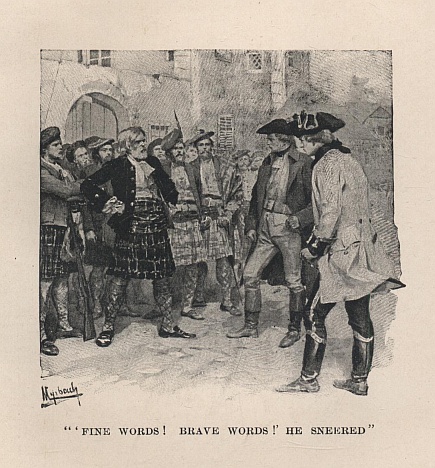
"'FINE WORDS! BRAVE WORDS!' HE SNEERED"
There was not a move, and I looked at each face in vain for some response, but they only glowered at me as if I had never spoken. Then throwing all pretence aside, I went on:
"Do I need to urge that with this money men can be kept together, who will otherwise scatter, if not for safety, at least to provide for families helpless and alone? That this money will keep them at their posts? That each guinea of it may mean a drop of the Prince's blood? And that the man who has robbed me of it to-day may be as guilty of murder before his God as if he had pistolled the Prince with his very hand? Gentlemen! Gentlemen! I would not plead for myself! I plead for One who has the highest claims over us all that one man can have over another. I ask your help in the name of God's anointed King, and in the name of the Prince, his son!" And there I stopped, for I had no other words in my heart.
Old Colin Dearg immediately broke into loud lamentations: his house was disgraced forever; he would never lift up his head again; never had such a thing happened to a McKenzie; and it was a black day that ever brought such a tale to his old ears, and so on. He would search the house till not a stone remained standing; he would strip his people of their skin, if need be, rather than such an imputation should lie against his honour, and that of his name; and forthwith disappeared among his people, pretending to search and question them.
We allowed this empty work to go on, until he saw fit to return with word that the money could not be found.
"No, it cannot be found, you lying, red-headed, old scoundrel," said I, "because you think yourself safe now! But you keep it at your peril! for a day will come when you will wish your thieving fingers were burned to the bone before they touched the Prince's gold, you double-dyed traitor!"
"Fine words! Brave words!" he sneered, planting himself well in front of his following, with arms a-kimbo. "A likely story that the likes of you, two broken men, skulking over here from France with baggages loaded with stones, trying your foreign thieves' tricks with quiet gentlemen, should have a thousand guineas! I don't believe a word of it!" And thereon he turned off into the house with a good show of carelessness, no doubt thinking it unwise to trust our patience any further.
"Now, gentlemen," said Big William Killcoy, "the country is unsafe, and you are far from home, but your road is open before you!"
"The game is up," I said to Father O'Rourke, in Italian, "we had better beat a retreat," which we did with sore hearts but in good order; and they said not a word further, nor did they attempt to molest us as we once more plodded the bitter miles that lay between us and Dundonald.
VII
How Father O'Rourke and I fell in with broken men and saw the end of a Lost Cause.
The morning broke into as fine and merry a day as ever smiled on two miserable hearts; my own seemed dead in its utter brokenness. Besides this, we were so wearied with our long exertions that walking had become a pain. "What will the Duke think? What will the Duke think?" ran through my head without ceasing, for I could find no answer. But the worst of things must end at length, and we arrived at Dundonald.
Here we were welcomed by a hearty breakfast, and after asking for men who could be trusted, we posted two of them as sentries under Mr. Gordon, for we could not feel our lives were safe while in the McKenzie country; then throwing ourselves on a bed, dressed and armed as we were, we slept for some hours without moving.
When we awoke somewhat refreshed, we were able, through the kindness of Lady Dundonald, to procure guides on whose faithfulness she assured us we might rely. She further advised us to make our way to Loch Airkaig, in Lochiel's country, "for there you will find those you seek, though I am not supposed to know such things, and still less to be harbouring the Prince's men in Dundonald's absence," she said, smiling.
"Madam," said Father O'Rourke, "you have only done an act of Christian charity of which your own good heart must approve, and which has done much to comfort us in our own hard case. We have a right to look for kindness in woman, but we do not always look for sensibility such as you have evinced."
"Captain Lynch, you make me ashamed of my poor efforts, and I pray you and Captain McDonell to receive them as some token of my regret this thing should have happened among my own people."
"Madam," said I, "you cannot be held responsible for being a McKenzie."
"No more than you for being a dundering blockhead," said Father O'Rourke, rudely.
"That is merely his way of saying, madam," he continued, with a bow, "that your kindness to us will place you in our minds above all other women, whatever name they may ornament."
So thereupon I left the compliments to him, as I never made any pretence to skill in the art, and proceeded to get our baggage in order.
I received the bag of guineas again into my charge, and taking a respectful leave of this most amiable lady, we set forth.
We had no cause to complain of our guides, who were faithful and intelligent, and led us almost due south over wild and almost inaccessible mountains, for all the roads and even open places had to be avoided on account of parties of the English who were scouring the country in all directions; and, to our impatience, we wasted many days lying close when the danger was too pressing, so that we were nearly three weeks in making the journey.
At last we drew near to Loch Airkaig, and from where we looked down I saw a body of Highland troops. We came forward without hesitation, and, on answering their sentries in Gaelic, which had come back to me readily enough after a little practice, I satisfied them of our intents and they allowed us to approach.
"Whose command are you?" I asked.
"Young Coll Barisdale," was the answer.
"We are in luck; come on," I cried, "these are my own people, and are commanded by my cousin, Coll McDonell of Barisdale."
"I suppose you'll be related to nearly every man of note we'll meet in the country now," Father O'Rourke said, with a laugh.
"Very near," said I; "but come on."
As we approached my cousin came out to meet us, and I remembered his face though I had not seen him since I was a lad.
"Well, Barisdale, and how are you?" said I, not making myself known, but willing to put a joke on him.
"Sir, you have the advantage of me," says he, drawing himself up mighty stiff; "I do not remember that I ever had the honour of seeing you before."
"Man, man!" I said, "and is that the way you will be disowning your kith and kin—this comes of consorting with Princes," I said, aside, with a droll look to Father O'Rourke. "Things have come to a pretty pass when Barisdale does not know Scottos because he wears a foreign uniform."
At this he saw my end and received us most courteously. "Come away, come away, you and Captain Lynch, too! Well! well! to think of my meeting with Little John, grown up into a man. 'Tis enough to make me feel like a grandfather!" and we all sate down under some pines and heartily discussed the meat and drink his people set before us.
His news was bad enough, but I was greatly relieved to hear Mr. Secretary Murray was with Lochiel at his seat of Auchnacarrie, and that though Lochiel had been badly wounded through both legs, he was recovering, after having made the narrowest of escapes as he was borne thither. That a meeting of Lord Lovat, Lochiel, Glengarry, Glenbucket, and others had taken place at Murlagan, near the head of the Lake, on the fifteenth of May—we were now at the twentieth—that it was decided to gather what men could be found, and either make a stand or obtain terms from the Duke of Cumberland, now at Fort Augustus. Lochgarry, Colonel Donald McDonald, would be here to-morrow with the rest of Glengarry's regiment, and he, Coll, had just gathered these men in our own country, Knoidart, and was on his way slowly to the rendezvous at Glenmallie, but he could not count even on his own men with any certainty, as there had been no pay, and the want at home was heart-breaking. It was the same story that drove the loss of the money deeper and deeper into my heart like a crying that would not be stilled. He did not know what had become of the Prince, but assuredly he had not been killed in the battle, as he had passed by Loch-na-Nuagh, in Arisoig, on the twenty-first of last month, and that doubtless, ere this, Lochiel would have had tidings of him. I told Barisdale we would proceed on the morrow to Auchnacarrie and see Mr. Secretary Murray, and would then determine on our future movements.
After a long night, we took a guide and men to carry our baggage and set out—the first comfortable marching we had yet done, for the weather was fine and there was no more danger of meeting an English soldier here than in the Corso. We recovered our old spirits; indeed, we had done so the moment we fell in with our own people.
That same evening we arrived at Auchnacarrie, and were most kindly received by Lochiel, a perfect figure of a Highland gentleman; indeed, he reminded us much of our own gallant Colonel MacDonnell, who fell at Velletri. There he was, lying in a state most men would have found evil enough, with most likely a reward out for his capture, dead or alive, his fortunes broken and his house falling about his ears. But he banished all thought of his personal loss and suffering in his anxiety to fittingly provide for the entertainment of his guests, who were constantly arriving; to soothe those who were finding fault with everything from the beginning, and they were many; to hold together his men, who were desperate and almost at the point of mutiny for arrears of the pay so sadly needed; and, above all, to inspire somewhat of his own great spirit into the downhearted. Truly, a man one might worship!
I had almost a hesitation in meeting him, for it was my Uncle Scottos whom the Prince had sent to induce him to join his Cause, and I could not but reflect on what the outcome had been. But at his first words my apprehensions vanished. "Welcome, McDonell!" he said, "we have a common loss, and that is enough for friendship. Donald McDonell was as good a gentleman as ever drew sword, and I am proud to welcome his nephew."
Mr. Secretary Murray we found very different from the gentleman we had seen in the Santi Apostoli; he had lost all his fine airs, and, as Father O'Rourke said, had as much rattle to him as a wet bladder. From the bottom of my heart I wished that my business had been with his host instead of him. Indeed, I remember the curious feeling came over me that I would with as much confidence hand over the money to Creach as to him. Not that I then had any doubt of his honesty—for I will not pretend to be a prophet now that everything is over—but I had rather pin my faith to a stout scamp provided he have some sense of honour—and I have met few men without it in my time—than to an indifferent honest man who is badly frightened.
However, as I had my orders, and it was not for me to question them, I handed over the five hundred guineas with the Duke's letters and took his receipt for them, at the same time promising to give him a statement in writing of the robbery at Loch Broom, signed by Father O'Rourke and myself, in the morning.
"And now, Mr. Secretary, I would like to ask a private question," I said. "Did Creach—or Graeme, if you like—ever deliver the money he was entrusted with?"
"I do not know; I never received any," he answered, hurriedly, and then asked, anxiously, "have you heard anything of him?"
"Heard of him? Damn his smooth, white face! We have heard of him, and seen him, and had a taste of his quality, too! He was at the bottom of this robbery, or my name is not McDonell! And hark you, Mr. Secretary. Your head, and better heads too, I will add without offence, are not worth a tallow dip while that scoundrel is above ground. Think you vermin of his kind will run any risk while safety is to be bought by a little more of his dirty work? He will sell you and Lochiel, and, God help him, the Prince too, if he has opportunity, and you only have yourselves to thank for it."
His own face was as white as Creach's by this time, and, seeing nothing was to be gained by going farther, now that I had relieved my mind, I left him to sleep on the pillow I had furnished and returned to Lochiel's, where I found him and Father O'Rourke in as lively a conversation as if there were not a trouble within or without the four walls.
"Well, McDonell," he said, "I have to thank you for the day you joined forces with Father O'Rourke and marched on my poor house of Auchnacarrie. 'Tis the best reinforcement I have had for many a long day."
"Faith, 'tis a long day since we began campaigning together," laughed the priest. "It all began in the inn at Aquapendente," and thereupon he must tell the story of our adventure with Creach, at which Lochiel laughed heartily; indeed, Father O'Rourke's stories seemed to jump with his humour, and he was never tired of his company during the time we spent with him.
A day or so afterwards, it was proposed that I should cross the Lake with Mr. Secretary Murray to hold a consultation with Lord Lovat, at Glendesherrie, bearing messages from Lochiel. Thither we went and found an old man bent with illness and his own weight, and of a temper most uncertain. Indeed, he did nothing but grumble and swear most of the time we were there, and at first would return no sensible answer to the projects we laid before him.
"Why in the name of all that is evil do you come to me with your fiddle-faddle plans when I am ready to step into my grave?" he grumbled. "Whom am I to believe? Where in the devil are the sixteen thousand men that were coming from France? Where are the ships with supplies and money that were only waiting for a fair wind? Has no wind blown off the coast of France since it blew the Prince here last July with a beggarly following not fit for a private gentleman? Had he come absolutely alone it might have been better, for then he would have been without some of his rattle-brained councillors, not even excepting yourself, Mr. Murray of Broughton," the old man said, with a sneer and a low bow that brought the blood in a rush to Mr. Secretary's face. "If even money had been sent, something might have been done—might be done even yet; but here are these men clamouring for return to their homes, where their wives and little ones have been starving and dying for want of support, and this, too, when no man can say how long his head will be above his shoulders. Pay the men who are here! Let them send something to their homes in the hills, and I'll answer for it they will stand even yet. But, my God! how can you ask human creatures to do more than they have done, with starvation at home as well as in their own bellies?
"And what has your Prince done? Pranced and prinked at balls, and chucked silly wenches under the chin. Listened to the blatherings of Irish adventurers, greedy only for themselves. Estranged, if not insulted, every man of weight and sensibility. Made paper proclamations and scattered paper titles that will rob the men who receive them of life and lands and everything else."
"Not everything, my Lord," I objected, for I was tired of this long tirade; "honour is left."
"Honour!" he snorted, "and who are you to talk of honour? A fine specimen you have given us of it, not to carry a sum of money that I would have entrusted to one of my drovers."
"I know nothing of your drovers, my Lord, and I beg leave to withdraw, as I cannot stay and listen to insults, which your age and infirmities prevent my answering as they deserve."
"You can answer them till you're black in the face, if that's any satisfaction to you! And, what's more, if you will but provide me with a new backbone and another pair of legs, nothing would give me a greater pleasure than to see some of your new-fangled tricks at the fence. Tell me now," he went on, in an entirely new tone, "did you ever learn anything abroad better than your Uncle Scottos taught you at home?"
"Never," I answered, somewhat softened. And the strange part is that before I parted from his Lordship I was only full of admiration for his courage and address; for, now that he had blown off all his black vapours, no one could be more engaging, and he discussed each plan with a keen insight that was admirable. He questioned me much on Rome and my experiences, and was very apt with his bits of Latinity, which I made no effort to cap, I think a little to his disappointment, until I saw that he began to weary, for his infirmity was visible upon him. So we took leave, and I shook hands for the first and last time with Simon Fraser, Lord Lovat.
We returned to Auchnacarrie that same evening, and the next day one Donald McLeod came and was closeted for a long while with Lochiel and Mr. Secretary Murray. When he left, I was told he was from the Prince, who was in a safe place, and that my letters were confided to his care. I never dreamed at the time of enquiring about the money I had handed Murray, supposing it had gone too, but long afterwards was told by McLeod himself that Mr. Secretary had informed him that he had only sixty louis d'ors, which was barely sufficient for himself, so he went back to the Prince without a shilling of the money that the Duke had raised with so much pains, and which I had so hardly delivered.
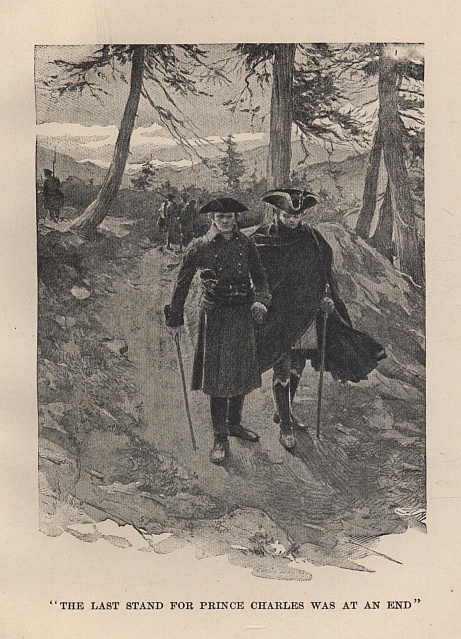
"THE LAST STAND FOR PRINCE CHARLES WAS AT AN END"
At the time I discovered this, I put Mr. Secretary down as low as Creach; but feeling then ran high against him, and nothing was too black to lay at his door; but since then I have considered it like enough that old fox, Lovat, may have wheedled it out of him, for he was in such miserable fear that he was easy to work upon; and, at all events, the man had quite enough on his weary shoulders without this addition to carry about through the rest of his miserable life. And if I am right that Lovat got it, it was a rare turn of justice that Mr. Secretary should be the one who swore away his life.
At daybreak—it was the 27th of May—we were expecting to be awakened by the General Gathering on the pipes, but instead we were awakened by the warning notes of the "Cogadh no Sith" (War or Peace) and rushed out to hear the news that Lord London was advancing upon us, hardly a quarter of a mile distant. Our eight hundred men were gathered at once, and Lochiel, being borne by four stout Highlanders, made his escape in a boat which was kept for such an emergency, while we set out in all haste for the west end of Loch Airkaig, which we reached just in time to escape another body of soldiers sent to intercept us.
At dusk we separated with sad farewells but brave wishes, and by bodies, which quickly dwindled smaller and smaller, every man took his own way, and the last stand for Prince Charles was at an end.
VIII
How I fared in my attempt to recover the stolen money, and how Father O'Rourke and I came face to face with unlooked-for company in the Inn at Portree.
We, in company with my kinsmen, pushed our way rapidly towards Knoidart. Although it had been perfectly plain to us both—for Father O'Rourke had picked up no mean bit of soldiering in his campaigning—that any successful stand was out of the question—for the cordon was every day tightening round Lochiel, and, worse than this, some of the principals, like Lovat, were disheartened, and only anxious to make their peace on any terms—Murray, who was to some extent the representative of the Prince, was badly frightened, and most of the Highlanders were wearying to return home. This was all patent to us, and yet we could not help feeling a sense of dejection with the others, most of whom knew no reason whatever for anything they did, beyond that they were ordered to it by their chiefs.
But nothing like a spice of danger will cheer a lagging spirit, and for the first twelve hours we had enough of it and to spare. But though at times nearly surrounded, being able to scatter on any approach, we had an advantage over what troops we met, and were not slow to avail ourselves of our opportunities. "Faith, I've not done so much running away since I was at school!" Father O'Rourke declared; and, indeed, to see him one would swear he had the heart of a school-boy in him still.
However, we were soon beyond actual danger, and now made our way openly enough, until one evening we stood on the highway, and before us I pointed out to Father O'Rourke the chimnies of Crowlin, my father's house, which I had left as a boy of twelve, six years before.
"THERE! THAT IS CROWLIN"
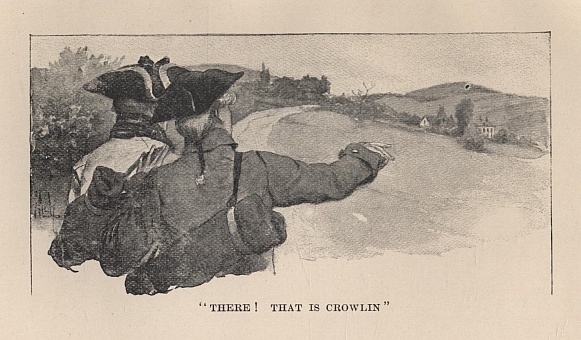
Eighteen may not seem a great age to my reader, and does not to me to-day, when I can cap it with fifty years and more, but on that June day in the year '46, when I stood and knocked the dust of the road off my shoes, I felt like a man who had spent a lifetime away from all he had known as a boy, and my heart grew so big within me that I could hardly say the words, "There! that is Crowlin."
"Aye, Giovannini, and the man is blessed that has a Crowlin to come back to," Father O'Rourke said, laying his hand on my shoulder.
"Oh, I don't mean that, Father; 'tis a poor place enough," I answered, for fear he should think I was vaunting it.
"And I didn't mean that either, Giovannini," he said, smiling. "But let us be going."
So on we went, each familiar object breaking down the first feeling of separation until the years between vanished before a voice within, saying, "I saw you yesterday! I saw you yesterday!" as we passed the big rock by the bend of the road, and followed the little path with the same turns across the fields and over the brook, with the same brown water slipping between the same stepping-stones. "You crossed o'er yesterday! You crossed o'er yesterday!" it seemed to say; and so on, until the dogs rushed out barking at us from the house itself.
"Go in first, lad—go in. I'll stay and make friends with the collies," said Father O'Rourke, seating himself, and I left him.
I found my father sadly changed; much more so than I had gathered from the news I had received; indeed, it was easy to see that his disease was fast nearing its end. He was greatly brightened by my return, and heartily welcomed Father O'Rourke, the more so when he learned his true character, and they took to each other at once.
When I saw the great, bare house—all the more forlorn for the lot of rantipole boys and girls, children of my poor Uncle Scottos—wanting the feeling of a home, that somehow seems absent without a woman about—for my sister Margaret was the same as adopted by Lady Jane Drummond—and my poor father waiting his end among his books, alone, year in year out, I first realized something of what my absence had meant to him, and of the effort it had cost him to send me away.
It was decided we should remain where we were for the present, until something definite was heard from the Prince, which might lead to further action. As it would only have courted danger, which I hold a man has no right to do, we put off our uniforms and soon were transformed by the Highland dress.
To me it was nothing, this change to a kilt and my own short hair, replacing the bag wig with a blue bonnet, but Father O'Rourke would fain have returned to the cassock he had left behind him on board the Swallow, and was most uncomfortable for many days until he learned to manage the kilt "with decency, if not with grace," as he said himself.
"Oh, Isaiah, Isaiah!" he groaned; "little did I dream you were preaching at me when you commanded, 'Uncover thy locks, make bare the leg' (Discooperi humerum, revela crura)," and he would pretend to cover up his great knees with his short kilt, to the delight of the children, who were hail-fellow-well-met with him from the hour of his arrival.
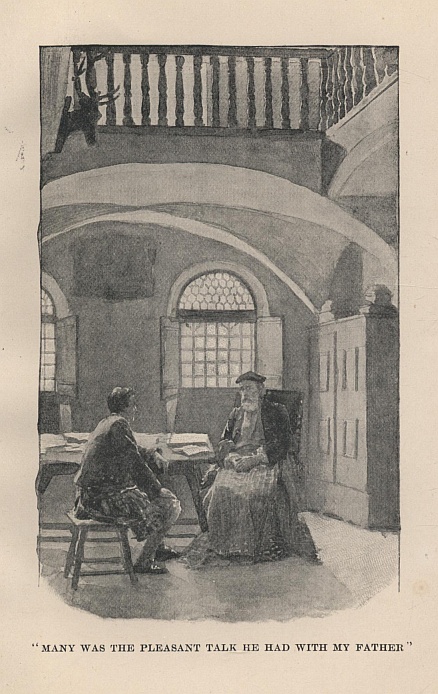
Many was the pleasant talk he had with my father, who was full of his remembrances of Rome and the College he so loved in the via delle Quattro Fontane. With him he stopped all his tomfooleries, and I was surprised to see what excellent reason he would discourse, and take a pleasure in it too. But it must not be taken he only amused himself and my father, for more than one weary journey did he make into the hills to minister to some wounded unfortunate there in hiding, sore needing the spiritual consolation he alone could carry. As the "Sagairt an t-Saighdeir" (the Soldier Priest) he was soon known and demanded far and near, and no request ever met with a refusal, no matter what danger might offer.
I may mention it was now the common people began to speak of me as "Spanish John," a name that has stuck fast to the present; indeed, such names serve a purpose useful enough where a whole country-side may have but one family name, and I can assure you, the McDonells never wanted for Johns. There were Red Johns, and Black Johns, and Fair Johns, and Big Johns, and Johns of every size and colour and deformity. Had they known a little more geographically, they might have come nearer the mark; but it is not for me to quarrel with the name they saw fit to fasten upon me, as most of them knew as little difference between Spain and Italy as between Mesopotamia and Timbuctoo.
The English were about at times, and more than once we had to take to the heather, and lie skulking for days together in the hills; but no harm came to Crowlin. Indeed, I thought but little of the ravages committed, though they have been made much of since, for waste many a mile of country had I helped to lay, and that a country like to the Garden of Eden compared with this tangle of heath and hill. It was only the fortune of war; and, after all, there was many a one who lived on without being disturbed, always ready to lend a hand to those less fortunate.
"MANY WAS THE PLEASANT TALK HE HAD WITH MY FATHER"
Early in June we heard the news of the capture of old Lord Lovat, in Loch Morar, and before the end of the month that Mr. Secretary Murray had also fallen into the hands of the Government, About this time too we heard some ugly reports of one Allan McDonald Knock, of Sleat, in the Isle of Skye, and, though a cousin of our own, it was said he was the head of the informers and spies, and from the description we suspected that Creach was his coadjutor.
As soon as our country began to get more settled, I resolved to go North and see if I could come on any chance of recovering the stolen money; for now the Prince would need it more than ever, as the last news we had of him was in South Uist, in great straits for every necessity. Accordingly, I set out alone, and, on arriving in the McKenzie country, I put up for a night with a Mr. McKenzie, of Torridon, who had been out as a Lieutenant-Colonel in my cousin Coll Barisdale's regiment.
I made some inquiries, and found old Colin Dearg was still in the country, but was careful not to disclose the object of my visit, which was an easy enough matter, as our talk ran on the troubles of our friends and the Prince.
The next morning, while the lady of the house was ordering breakfast, I went for a solitary stroll, to turn over my plans and decide how I might best approach the matter. I had not gone far before I met a well-dressed man, also in Highland clothes, taking the morning air, and with him, after civil salutations, I fell into discourse about former happenings in the country.
What was my astonishment to hear him of his own accord begin the story of the French officers who came to Loch Broom, and how the thousand guineas had been cut out of their portmanteau by Colin Dearg and the others, Major William McKenzie of Killcoy, and Lieutenant Murdock McKenzie, from Dingwall, both officers of Lord Cromarty's regiment.
"A pretty mess they made of the matter," he said, "and were well despised through all the country for their behaviour; but had they only taken my advice there would never have been a word about it."
"Indeed!" said I, astonished beyond measure. "And pray, sir, what did you advise?"
"Och, I would have cut off both their heads and made a sure thing of it, and there never would have been another word about the matter."
I looked at him with a good deal of curiosity, for I can assure you it gives a man a strange feeling to hear his taking off talked over to his face as a matter of course.
"Who were they," I asked, "and from what country?"
"The oldest, and a stout-like man, was Irish. The youngest, and very strong-like, was a McDonell, of the family of Glengarry," he answered.
"How did they know the money was there? Did these officers speak of it?" I asked, thinking I might as well get at the whole story.
"No," said he, "but another officer, who had been with old Colin since the battle, went on board their ship when they landed and told him the youngest one was sure to have money."
"Was his name Creach or Graeme," I went on.
"I don't just remember, but his face was as white as a sick woman's," was the answer, which fixed my man for me beyond a doubt.
"And what was done with the money?"
"Colin Dearg got three hundred guineas, William Killcoy three hundred, and Lieutenant Murdock McKenzie three hundred."
"And what of the other hundred?"
"Two men who stood behind the Irish Captain with drawn dirks, ready to kill him had he observed Colin Dearg cutting open the portmanteau, got twenty-five guineas each, and I and another man, prepared to do the like to the young Captain McDonell, got the same," he answered, very cool, as if it were a piece of business he did every day.
"Now, are you telling the truth?" I asked, sternly.
"As sure as I shall answer for it on the Last Day," he said, warmly.
"And do you know to whom you are speaking?"
"To a friend, I suppose, and one of my own name."
"No, you damned rascal!" I roared, and caught him by the throat with my left hand, twitching out my dirk in my right, and throwing him on his back. "I am that very McDowell you stood ready to murder!" And I was within an ace of running him through the heart, when I suddenly reflected that I was quite alone, in a place where I was in a manner a stranger, and among people whom I had every reason to distrust. I got up, thrust my dirk into its sheath, and walked off without a word, leaving the fellow lying where I had thrown him.
I met Mr. McKenzie in the entry, who asked me where I had been.
"Taking a turn," said I.
"Have you met with anything to vex you?"
"No," said I, smiling.
"Sir," said he, "I ask your pardon, but you went out with an innocent and harmless countenance, and you come in with a complexion fierce beyond description."
"Come, come, Mr. McKenzie," said I, laughing, "none of your scrutinizing remarks; let us have our morning."
"With all my heart," said he, pouring out the whiskey.
I made some cautious inquiries about the man of my morning adventure, to which Torridon replied he was a stranger to the place, but he believed him to be probably a soldier in Lord Cromarty's regiment.
As soon as I could decently do so, I took leave of my host and hastened to put into execution a plan I had formed.
My cousin John, Glengarry, was the head of our family and my chief, and to him I determined to apply. I therefore set out at once for Invergarry, where I found the castle entirely dismantled and abandoned, so that when the Duke of Cumberland appeared somewhat later he found only bare walls to destroy; but destroy them he did, so completely that he did not even leave a foundation.
I found Glengarry easily enough, living in retirement in a safe place among his own people, and paid my respects to him with great good will; indeed, few chiefs had greater claims than he.
His father, Alastair Dubh, was one of the best warriors of his day, and had performed feats at Killiecrankie that a man might well be proud of. There, too, the chief's elder brother, Donald Gorm, fell gloriously, having killed eighteen of the enemy with his own sword.
His eldest son, Alastair, was now in the Tower of London, a prisoner, and Æneas, his second, had been accidentally shot at Falkirk six months before, whilst in arms for the Prince.
He, himself, had not been out, but no more had Clanranald; indeed, in many cases it was thought best the heads of the families should not be involved, in the event of the rising not proving favourable; but this turned out to be a sorry defence in more cases than one, amongst which was Glengarry's own.
After hearing my story, he said, laughing, "Man! but this would make a pretty quarrel with the McKenzies if we only had these troubles off our hands. I would send with you men enough to turn their whole country upside down, and you might consider the money as safe as if you had it in your own sporran. But what can I do? You dare not take any body of men across the country, and, more than that, I haven't them to send, even if you could. But let us sleep over it, and we will see what can be done in the morning."
I told him my plan was to go straight to Dundonald, who was an honourable man, and through him try and work on his uncle, old Colin Dearg; and could he but provide me with five or six men, by way of a life-guard, it was all I would ask.
When we parted on the morrow, Glengarry said: "There are your men! but promise me there will be no lives wasted unless something can be gained. I have given you five picked men, and they must not be thrown away; but if the money can be got, and fighting is wanted, you have five better swords at your back than ever were dreamed of among the McKenzies; and whether you send them all back or not, I'll be satisfied so long as you make good use of them."
We made our way with all possible speed and precaution until we arrived at Dundonald's, and with him I was well pleased, more particularly at his reception of my plans, and his promise to send for old Colin and have him meet us at a place appointed.
Thither we all repaired, and after inquiring from Dundonald the particulars of the house, which I found simple enough, for it was all one floor without partitions and but a single door, I laid out my plan of action to my men.
Should old Colin keep the appointment, it would most probably be after dark, and he was sure to come with a strong following, more particularly if he suspected I was in the matter, which well might be the case after my meeting of the previous week. So I determined as follows: my men should seat themselves just within the door, not allowing any one to separate them, and see they kept their arms clear that they might be drawn the moment I made the signal. At this, the two I named were to keep the door, and the other three pass out and at once fire the house at both ends, and then return to back up the others at the door, where they could easily cut down the McKenzies as they attempted to make their way out.
As for me, I would seat myself between Dundonald and old Colin Dearg, and at the first serious offensive motion I would do for both of them at once with my dirk and pistol, knock out the light, and try to make for the door. If I chanced to get there alive, they would know my voice, as I would shout our rallying cry, "Fraoch Eilean!" but if I failed, to see that every soul within perished along with me. There was a good chance of escaping, as I held the start of the fight in my own hands, and I counted that between the surprise and the dark I ran no risk beyond the ordinary. I regretted that my plan should include Dundonald, but as he was a McKenzie that could not be helped.
I was right in every particular, for it was dark when old Colin appeared, and he was followed by forty or fifty men, carrying, apparently, only short sticks, but under their coats I perceived they had their dirks ready. They entered the house, and, without giving them a moment to settle or to disconcert our plan, I entered boldly and seated myself as I proposed, my men keeping together near the door.
After a short pause, every one eying me and mine, and we returning it, though without offence, Dundonald mentioned the cause of our visit in as becoming a manner as the subject would admit of, speaking in English, so that what was offensive might not be understood by the men.
"And why, Dundonald, should you come inquiring of me about a matter of which I know nothing?" asked Colin Dearg, in a silky voice, like the old fox he was.
"Now, Colin Dearg McKenzie," said I, shortly, "I have neither time nor stomach for smooth words. You cut that gold out of my portmanteau with your own hands and kept three hundred guineas of it, while the other six went to your fellow-thieves. I have it from the wretch you bribed with twenty-five more to murder me if I saw you at your dirty work. So none of your lies, but make what restitution you can, and prove you have some honesty left in you by handing over the Prince's money."
The old man never made an attempt to defend himself, but after a minute said, sulkily, "Och, well! There's no use making such a pother about the matter now; the money is gone, and I cannot give it back if I would, so there is an end of it all."
"No," I said, in Gaelic, so all might understand; "because the thief has spent the money that does not end the matter."
"What more would you have?" asked the old man, still sulky.
"The gallows!" I said, firmly; and with a growl the crowd caught at their dirks; but at the same moment I whipped out my dirk and pistol, and, covering both old Colin and Dundonald, swore I would kill them both if the first step was made towards me, and, as I spoke, my men took possession of the door.
"For the love of God, my children, stand you still—stand you still!" screamed old Colin, and not a man moved.
Every man in the room was on his feet, crowding towards the table where we stood, I facing them all, holding both Dundonald and old Colin as my sureties at the point of my weapons, my men keeping the door as I knew, though I dared not so much as glance towards them, and every one strained up to the point of outburst, only waiting for the next move.
I chose to keep the lead in my own hands. "Now, then! What have you got to say for yourself?" I demanded from old Colin.
"I might say I have only taken my own," he returned, with amazing quiet. "But 'tis ill talking with a dirk against one's ribs. Move it a little from me and let me talk as a gentleman should," he went on, with a coolness that brought forth a murmur of admiration from his people.
"Your own?" I cried, amazed at his audacity.
"My own, certainly; and not only mine, but my children's as well! Think you a few paltry gold pieces will pay the debt of the Prince towards me and mine? We have given what your gold is as dirt beside! We have given lives that all the gold under Heaven cannot buy back. We have broken hearts for his sake that all the louis d'ors in France cannot mend. I and mine have ruined ourselves beyond redemption for his Cause, and, when we have winter and starvation before us, why should I not take what comes to my hand for those nearest to me, when it can be of no use elsewhere?"
There came answering groans and sighs of approval from his following at this fine-sounding bombast, and I was at a loss how to cut it short or see my way to an end, when, taking advantage of my distraction, he suddenly gave some signal, and, quick as thought, a blade flashed out beside him, and I only saved myself by a chance parry with my dirk.
Then I lost control of myself. "Take that, you Red Fox!" I shouted, and, raising myself, I struck Colin Dearg McKenzie above the breastbone, so that he went down under my hand like an ox that is felled. With my pistol-hand I knocked over the only light, and jumped for the door, shouting "Fraoch Eilean!" and before they could recover, I had passed out under the swords of my men.
"Fire the thatch now! Fire the thatch!" I shouted; but even as I spoke the red flame began running up the roof, and our men joined us again.
Every heart was beating and every arm tingling to begin, for we knew we could hold the door against any number, but, to our surprise, no man attempted to make his way out, though the dry thatch was beginning to crackle and discommode us with its glare. There was a silence like the dead within.
I approached the door. "Dundonald! What is the matter with you, within? Come out yourself alone, and I give you my word of honour you shall go unharmed. Then let the others come as they can."
"McDonell!" he called back. "Colin is dead. They have no heart for fighting."
"Then let them burn! But come you out!" for I could not bear that he, a gentleman, should perish with cattle such as these.
"That I will never do! We either go out together, or my blood will be on your hands with theirs!" he answered.
"My God, Dundonald! What folly is this?" I cried, much distressed at his obstinacy. But there came no sound save the crackling of the thatch.
My men said never a word; it was my private quarrel, and though I knew they would be satisfied with whatever I might decide, I was in a sore quandary what to do, and in my perplexity I leaned towards mercy.
"Dundonald! If they will say together, 'He was a thief and came to his death by my hand honestly,' and if you will come out to us, we will stand by and let them depart unharmed. There is no time to lose; the roof is wellnigh gone!"
At this there was a babel of tongues within, while my men grunted their approval behind me. Then came a cry from the house: "Red Colin was wrong, and came to his end fairly and honestly at the hand of Little John McDonell!"
"That will do!" I cried. "Come you out first, and the others may follow!"
We stood off to one side, prepared against any sudden rush; but Dundonald stepped out of the door alone, sheathing his sword as he did so, and placed himself in our midst. Then appeared four men bearing the stalwart body of old Colin Dearg between them in a plaid, and after trooped the others. They passed us without a word or look, and kept on their way in silence up towards the hills, not even turning when the roof crashed in, sending a shower of sparks and flame into the darkness overhead.
"Dundonald," I said, when the night had shut them out from us, "I trust you bear me no ill-will for this business? My hand could not reason when it baulked his last treachery."
"No, McDonell," he answered, with much openness, "he was my kinsman and I owed him my support, but, now that he is gone, I will never lay his going against you." And thereupon we shook hands and parted very good friends.
On my return to Glengarry, I was supported by his approval of my action. And, after giving suitable acknowledgments to the men, dismissed them and made my way back to Crowlin, where I found them much disturbed at my long absence, and fearful I had fallen into the hands of the English.
It was now about the beginning of July, and hearing that the Prince would most likely be in Skye, Father O'Rourke and I determined we should take our way thither to volunteer our services, and accordingly took leave of my father. He was most willing we should go, and never complained of our leaving, although we could see that he was daily drawing nearer to his end. But he was anxious about our apprehension, as many had been taken of late. Major Ferguson had laid waste the lands of Lansdale, and, among others, my cousin Coll Barisdale's fine house, Traigh, was burned to the ground. This my father felt keenly, and felt too that the next blow might fall even nearer home.
So we crossed over, intending to make for Trotternish, on Lord McDonald's estate, but heard news soon after landing that the Prince had gone on, probably to the main-land.
However, we kept on, and after spending the first night with Rory McDonald of Fortymenruck, pushed as far as Portree, as I thought Father O'Rourke might as well see the principal place in the Island.
When we reached Portree, we went into a tavern to obtain refreshment after our march of twenty miles, and desired the landlord to fetch us something to drink. Upon this he informed us there were gentlemen in the next room who would like to have the pleasure of our company if we thought proper to indulge them. I inquired their names, and, on hearing them, desired him to present our compliments and we would join their party.
In the next room we found nine or ten gentlemen, some of whom I knew and others I had heard of, and, after partaking of what they had, I called for more liquor to our account. While the landlord was preparing this the door opened, and who should appear on the threshold but Captain Creach. At the sight of us his white face turned even a shade paler; however, I could not but admire the address with which he recovered himself and entered with perfect assurance, greeting the company, all of whom evidently knew him, calling him Graeme, as usual. My first impulse was to seize and denounce him before them all, but Father O'Rourke's hand was on me under the table, and I reflected that my mission from the Duke not being yet at an end, I was still bound in my word; so I managed to conceal my feelings, and when he was introduced I bowed as if I had never seen him before, which he returned as collected as a tax-gatherer.
What I had called for now came in, but I noticed that Creach did no more than touch his lips to his glass, upon which one of the company rallied him, and I heard him say he did not choose to drink more.
"Why is that, sir?" I said, pretending to be somewhat gone in liquor.
"I try to avoid giving offence," he said, very pointedly, "and sometimes if I am warmed with liquor I am apt to blunder out something which might not please."
"Oh, I am not particular as to my company, Mr. Creach," I said, hoping he might take me up on the name, but he made no move. "I am a peaceable man myself, and promise you not to take offence at anything, provided you apologize immediately afterwards. Now, here's a health I cannot let pass—to my host of last night, Rory McDonald Fortymenruck!"
He drank with the rest.
I began again at once. "Here's to the Prince and his better fortunes, and a curse on any one who plays him false!"
He drank this too.
I was thinking out something, more pointed, when he stopped me by asking why I did not propose the health of my cousin, Allan McDonald Knock.
Here was an opening as good as another, and I took it.
"Is he a friend of yours?"
"He is, sir."
"Then, sir, I do not drink to him, because he lies under grave imputations."
"And pray, sir, what may they be?" he asked.
"Oh, I only have them on hearsay," I said, drawing him on.
"And what do you hear?"
"Only that he is a coward and an informer, and, of course, a scoundrel, whose health any gentleman would refuse to drink," I answered, mighty cool.
"What!" said he; "do you really believe him a coward?"
"That is his general character."
"Then, sir," said he, "if you will send him a challenge I will bear it, and if he will not fight you, I will."
"Oh, do not trouble yourself. If you are anxious for fighting, you have a sword by your side, and so have I. Why lose any time? Out with you at once, and I will give you all the fighting you can stomach between this and doomsday," and I made as if I would rise.
As a matter of fact, I would not then have fought with the reptile for worlds, but since I could not lay hands on him, it was some little satisfaction to outface him before his company, and I made no objections when the others interfered, but only thought that Mr. Creach had added a long bit to his reckoning when he asked me to drink to the health of Allan Knock in the inn at Portree.
IX
How Father O'Rourke kept the Black Pass; of the escape of the Prince and my own mischance that followed, but of how the Day of Reckoning between me and Creach came at last.
We felt that Skye was not the safest place for us after my brush with Creach, for, with such a creature in leash with Allan Knock, no decent man's liberty was worth a rush in days when a whisper was sufficient to secure his arrest, so we made our trip a short one and returned to the main-land.
We and all felt relieved that the Prince had returned from the Islands, whither he had gone much against the wishes of his best friends, and his escape might have been effected long since had he not taken wrong advice from those who knew nothing of the country. And if I may criticize, without blame however, His Royal Highness, perhaps from too great an openness in his own temper, was not a discerning judge of those about him, many of whom were men of no character whatever, and to-day I can see the truth of Father O'Rourke's words which I had resented so heartily in Rome.