SPANISH JOHN (continued 2)
Reading edition
"How so, sir?" I said, in surprise.
"You would not understand," he said, more gently. "When the day comes, out with your sword, if you must, and strike—I would be the last to say you nay—but this chamber-plotting and convert-making, I despise it all! Whom have you met there?"
I told him, and of how kind many of the gentlemen had been to me, in particular Mr. Murray and Mr. Sheridan.
"I know nothing bad of either of them," he said, in a disdainful way. "But you have no call to be in such company at your age. I shall speak to Father Urbani before I leave Rome this time, and, if he permits, you shall have a training that will fit you for something better than any one of this secret-whispering pack will ever come to. I will make a soldier of you, McDonell, which is the best use God ever made of man, and the best use you can make of yourself for your King. But come, I am going to the Palace myself, only you must go through the Piazza and not by any back door, like a lackey or a priest."
So we went on together across the Place and through the main entrance, where the guards saluted the Colonel as we passed hand-in-hand, and I could not but feel I had shared in the honour. I was left in a waiting-room while the Colonel was closeted with the King, and when he joined us again we went through to a large room where quite a company of gentlemen were gathered.
After greeting some of them, and bowing somewhat haughtily to the room at large, the Colonel seated himself at a table, while I remained standing near him looking round the company with some curiosity, for there were many new faces, and the Colonel's words had set me to wondering why he should hold so lightly these men whom I had believed most devoted of all to the King.
I was thus engaged in my survey and speculation, when I caught sight of a face hat struck me like a blow and sent the blood tingling through every vein in my body. There, only separated from me by the width of the room, modishly dressed and smiling, stood Captain Creach conversing with two gentlemen. He saw me at the same moment, but his white face gave no more sign than a face of stone, and he went on with his talk as quietly as if I had been at Aquapendente and he alone in Rome.
I did not hesitate a moment—indeed, hesitation has seldom been one of my faults—but making my way across the room, I stepped close to him and said, in as calm a tone as I could command: "Captain Creach, I am surprised to see you in Rome!"
The three gentlemen all faced me at my speech, and Creach, without a change in his wicked face, said: "Young sir, is your address intended for me?"
"I spoke to you by name, sir," I said, with distinctness.
"Then am I famous, indeed," said he, laughing lightly.
"You may laugh, Captain Creach," said I, and was going on, but he interrupted me, speaking very civilly, but angering me all the more for it:
"I see by your dress you are of the Scots College, young gentleman"—for, as usual, I had on my purple soutane with its crimson sash, and over it my black, sleeveless soprano, with my three-cornered hat under my arm—"but there is one lesson you have not as yet learned, and that is, how to address a gentleman. I am not Captain Creach, as you imagine, but Captain Graeme, late of the Hungarian service, and, to the best of my belief, this is the first time I have ever had the honour of addressing you."
He was so quiet and cool that I was dumfounded; but I knew he was lying, though I had never heard a gentleman lie before.
"Not Captain Creach? Not Captain Creach?" I stammered.
"No, sir, 'Not Captain Creach,'" he repeated, mocking me, whereat some of the gentlemen laughed, but one of them broke in with:
"Damn it! this comes of bringing brats where they have no business. Creach! You little fool! This is no more Creach than you are. This is Captain Graeme, late of the Imperial service. There, beg his pardon now, and don't put your foot in it again, like a wise lad," and his tone was kind, though his words were rough.
"Your pardon, sir," I said, "but this is Captain Creach, of the Regiment Irlandia; I have reason to know him only too well."
"Here, MacDonnell," called out my new acquaintance, "this bantling of yours is doing you no credit; come here and smooth him down."
The Colonel rose, frowning, and came over to where we formed a centre, Creach standing on one foot and tapping the other with his long, fashionable cane.
"What's the matter?" he said, severely.
"Colonel MacDonnell," I cried, "may I say a word to you in private?" and seeing I was in deadly earnest, he took me into an anteroom and bade me speak.
Then I told him the whole story of our adventure at Aquapendente, and that I was as sure this man was Creach as I was I had a soul. "I don't care what he says, sir, that is Captain Creach, of the Regiment Irlandia."
"My dear lad," he said, firmly, "get that notion out of your head at once. We have not, and never had in my day, any Captain Creach, or any man of the name, even in our ranks. There is a Captain Creach in Lord Clare's Regiment, whom I know for a gallant gentleman, but he has not seen Italy for many a long year. Now, wait a moment—will you apologize to this gentleman?"
"No, sir, saving your presence, I will not."
"Very well; that is settled. Will you give me a promise?"
"Yes, sir, I will promise you anything I may with honour."
"That is right. You cannot be too careful of that last," he said, smiling, and then went on gravely: "My boy, I hope some day to have you under my own eye in my own company, and till then I want you to do what is best to bear yourself with credit, Now promise me again you will do as I ask, on your honour."
"I will, sir, on my honour."
"Then you will never come within these doors again unless the King sends for you, and as soon as you go home you will tell Father Urbani where you have been this winter. Do you understand?"
"I do, sir."
"Very well. Now, honour for honour. I will take up your affair with this man Creach, or Graeme, or whatever else he may call himself, and you may rest satisfied that your quarrel will not suffer. And now, God bless you, my lad, and when you are older you will thank me for this day's work. Good-bye!" And he shook my hand warmly, and stood watching me until I passed out into the hall.
I may as well admit here, that at times I am slow at displacing any idea which has once taken root in my mind, and it was not until some years after I conceived the explanation that Creach was never this fellow's name at all, but for some reason best known to himself he had chosen to fare under it when we met with him at Aquapendente, otherwise honourable men would never have answered for him as they did. But this is by the way.
I went forth from the Palace with my head in a whirl; for, though I was satisfied with the part I had played towards Creach, there was my promise to the Colonel, and, despite every effort I might make, my visits did not appear to me so defensible as before. I tried to argue to myself that I had not been forbidden; but, somehow, that did not seem sufficient, and I was the more uncomfortable when I called to mind the Colonel's dislike of the company I had been in the habit of keeping.
However, it must be faced, and so, after the evening meal, I asked to be allowed to see the Rector and was admitted to his room. When I entered he was sitting at his table alone, and somehow, when I saw his kind old face, I knew suddenly why none of my excuses would answer; I had been deceiving this old man who had been like a father to me, who had never treated me save with kindness, and had trusted me without questioning. I was so overcome that I could not speak—overwhelmed with an utter sense of wretchedness—until he stretched out his hand and said, gently, "Come."
"Oh, Father," I cried, "let me leave the College! Let me go away!" too miserable to think of anything else.
"No, no, Giovannini. That would be a coward's way of meeting trouble. Come, tell me what the matter is, and we'll see if there is not some better way out than turning your back on it," and he patted me on the cheek as if I were still a child. Indeed, I felt like one then, and for the matter of that always did when talking with him.
So I blundered out the story of my doings, to all of which he listened in his quiet, gentle way, helping me out when I found it hard to go on, until the whole story was told, whereupon I felt a mighty relief, for the worst was now over and I had quite made up my mind as to what part I would take from now on.
After all, he did not say very much in the way of blame, except that should I ever meet with Colonel MacDonnell again the first duty I had before me was to request his pardon for mixing him up in my affairs, as if the Colonel of a regiment had nothing else to do than look after a school-boy's quarrels. "Among plotters and schemers," he said, with some touch of scorn, "you must meet with strange company, and, if you will take up with such, you may have to welcome 'Captain Creachs' and worse. Now I am not going to talk with you to-night, and I want you to think the matter well over until I have seen Colonel MacDonnell and have determined what is best to be done. I am only sorry, Giovannini, that you have not trusted in your best friend." And with a heavy heart I said good-night, and took my way to my room alone.
In the morning word was brought to me that I was to remain in my room, which I did all the more gladly as it promised well for the gravity of my case, for above all things what I most feared was its being taken as merely a boy's whim. However, I was speedily assured of its importance by the visit of one of our Jesuit fathers, who very soon introduced his mission and began to urge his arguments why I should continue my studies and some day prepare for the priesthood. But this I resented at once, saying, "Sir, I was left here for reflection by the order of the Rector, and I have no wish to be disturbed."
A hint he was wise enough to take; and, grumbling something about "like father, like son," he left me once more alone.
My next interruption was an order to wait on Father Urbani, which I did with great readiness, and to my joy saw that his reflections had not rendered him any less kindly to me or my hopes.
"Well, my dear Giovannini," he said, "so you did not wish to discuss your future with Father Paolo. He tells me that you have caught somewhat of the brusqueness of the camp already." But his smiling reassured me.
"No, Father," I said, "I held, in the absence of my own father, you are the only one to whom I am bound in such matters; but I had no intent to be rude."
So, with this introduction, we began our argument, and to all he said I assented, but assured him I should make but a sorry priest if my heart were always in another calling. "My father promised that neither he nor you would force me to become a priest against my will, and I can never be happy unless I have a right to wear a sword by my side," I ended.
Thereupon, seeing my mind so firmly resolved, he bade me prepare for a visit to the Cardinal Protector, and in all haste I made myself ready. The truth is, now that I saw Father Urbani had yielded, I would have faced His Holiness the Pope with the whole College behind him, without a second thought.
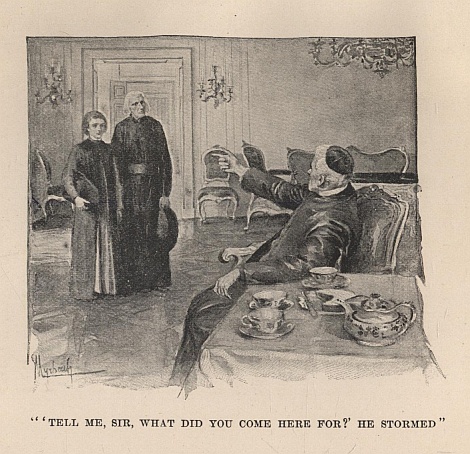
So we took our way in a coach to the Palace, and were ushered into the presence of the Cardinal with the usual ceremonies. He was a thin old man, with a long, dark face and a grumbling voice. We partook of chocolate and sugar biscuits, and made polite conversation until the object of our visit was broached; thereupon, a mighty storm began—that is, a storm from His Eminence, for we stood side by side in the middle of the great room, silent before the torrent of his wrath. After thundering hotly at Father Urbani, as if he, dear man, were to blame, he turned on me.
"What were you ever sent here to the College for? And since when has it been turned from a House of God into a training-school for every worthless cockatrice that would follow the drum? Tell me, sir, what did you come here for?" he stormed.
"'TELL ME, SIR, WHAT DID YOU COME HERE FOR?' HE STORMED"
"Indeed, your Eminence, I cannot tell," I answered, coolly.
"Cannot tell! No, and no one else, I dare say, will answer for it. What in the world do the bishops mean by sending such good-for-naughts here without finding out something about them?"
I was much tempted to say that my family was well known, but Father Urbani's hand was on my arm, and I knew I was to hold my tongue, which I did, although many things were said that, had any other man uttered, I would have held to be insulting.
At length, to our great relief, he made an end, and bidding Father Urbani get rid of me as soon as possible, he dismissed us. We bowed ourselves out, and I was free to enter the service for which I longed.
When we were at home again, Father Urbani said, "My dear Giovannini, now this is ended, I will say no more than I will see myself you are fittingly supplied with clothes and money, and if you desire first to return to Scotland, I will see you are sent thither."
But I told him I would rather join at once, for there was no one to dispute my resolution at home, as my only sister, Margaret, was with Lady Jane Drummond in France, and my father had promised my choice should be free when the time came.
"Well, then," he continued, "I say nothing of the rights of the quarrel the King of Naples has on his hands now, but if you will enter the Queen of Hungary's service, I will see you are strongly recommended to persons of the greatest interest, and a recommendation will mean advancement."
"Oh, Father," I said, "I could not do that! The Regiment Irlandia was my Uncle Scottos' regiment, and I could not join any other."
"You Scots are a famous people for hanging together!" he said, smiling; "and I suppose you wouldn't care if the regiment were fighting for the Grand Turk himself?" and he smiled again.
"No, Father," I said, seeing nothing to laugh at, "it could make no difference to me; I would be only a cadet."
"Well, well," he said, quietly, "such questions are perhaps as well left to older heads. Now to bed, and sleep if you can, for your days will be full until you leave."
True to his word, the Rector sent to me a tailor, by whom I was measured for two full suits of regimentals; a broker, with side-arms and equipment; and, to my great satisfaction, a periwig-maker, who took my size for my first wig, until my hair should grow long enough to be dressed in a queue.
At last all was ready, and I swaggered about in my finery, and bade farewell to my comrades, all of whom greatly envied me—even Angus, though he would not confess to it. However, he had the satisfaction of walking through the streets with me to pay our respects to Mr. O'Rourke, who had just completed his course, and was to take orders immediately.
He at once pretended great astonishment, and begged Angus to introduce him to "the General," and then broke into an old ranting Irish air:
"Wid your gold an' lace An' your warlike face In a terrible fright ye threw me— Giovanni, me dear, You looked so queer! Oh, Johnny, I hardly knew ye!"
And away he marched up and down the room to his doddering old song, and then drew up before me, making passes as if he were saluting, and bowed almost to his knees, bringing his hands up to his forehead and performed a low salute, which he informed Angus was only given to the Grand Turk on great occasions.
"Well, well," he said, at last, with a great sigh of relief, "my heart is easy now I see they wouldn't trust you with a sword; though I might set you up with the cook's skewer, if they won't do anything better for you!" And here, at last, he succeeded in angering me, for it was a point I was somewhat uncertain about, and only my delicacy had prevented my speaking of it to Father Urbani.
"'Tis lucky for you, Mr. O'Rourke, that I haven't it," I said, "or I would truss you so that the heathen you are going to feed would have nothing more to do than baste you!" For I supposed he would be off as a missionary like most of those from the Propaganda.
"I COULD NOT HELP STRUTTING AS WE PASSED THE FASHIONABLES"
"I don't know about the eating, Giovannini, my son, but you are quite right about the heathen, for I am going to follow the Drum like yourself, and if you ever come properly accredited to the Chaplain of the Company of St. James, in the Regiment Irlandia, you may have a surprise."
"Oh, Mr. O'Rourke!" I shouted, embracing him at the same time, "surely this isn't only another bit of your funning."
"Funning? 'Tis genuine brimstone and piety combined, that's what it is, and within a week after I take orders I'll be off. So 'tis only 'good-bye' till 'tis 'good-day' again."
The next morning, when I went to take leave of Father Urbani, I saw before him on the table a silver-mounted sword, at the sight of which my heart gave a great leap, for I could not doubt it was for me. He did not keep me in suspense, but handed it to me at once. "See what you think of that, Giovannini?"
I drew out the beautiful blade, found it balanced to a nicety, and could not forbear making a pass or two, even in his presence, at which he smiled and said, "Carry it bravely, little one, carry it bravely, and sometimes remember the old man who gave it to you will nightly pray that you may be kept in safety in the path of honour. Come, I will see you somewhat on your way," he added, and we passed out into the street together.
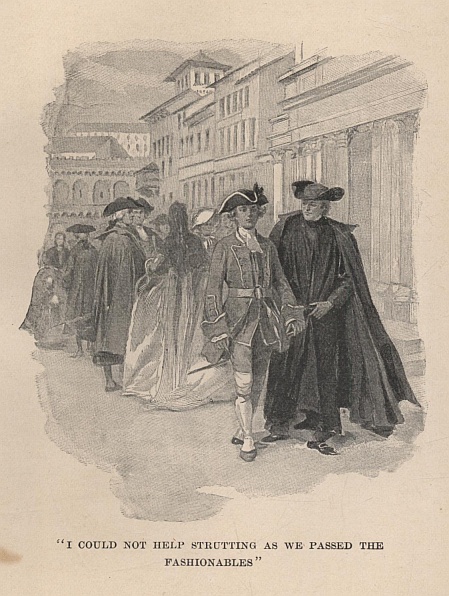
Conscious of my brave appearance, I could not help strutting as we passed the fashionables then abroad in the Piazza di Spagna, until I was recalled to a more fitting frame of mind by his gentle voice: "Here I must leave you, mio caro Giovannini. Surely, sometimes, in a quiet hour, you will turn your heart to me, lonely here within these walls, for I love you like a son, Giovannini, my little one. May God and all His saints have you in their holy keeping this day and forever," and he embraced me tenderly.
And so ended my life in the old Scots College in Rome.
III 1743-1744
Of the soldiering Father O'Rourke and I did in the Regiment Irlandia together; how we fared at the Battle of Velletri, and until the army divided under the walls of Rome, during which time I won more than one promotion.
"'There's a whirring noise across the night, The "Wild-Geese" are a-wing, Wide over seas they take their flight, Nor will they come with Spring. Blow high, blow low, come fair, come foul, No danger will they shirk, Till they doff their grey for the blue and the buff Of the Regiment of Burke!
"'All Spain and France and Italy Have echoed to our name! The burning suns of Africa Have set our arms aflame! But to-night we toast the morn that broke And wakened us to fame! The day we beat the Germans at Cremona!
"'Would you read our name on Honour's Roll? Look not for royal grant; It is written in Cassano, Alcoy, and Alicant, Saragossa, Barcelona— Wherever dangers lurk, You will find in the van the blue and the buff Of the Regiment of Burke!
"'All Spain and France and Italy Have echoed to our name! The burning suns of Africa Have set our arms aflame! But to-night we toast the morn that broke And wakened us to fame! The day we beat the Germans at Cremona!
"'Here's a health to every gentleman Who follows in our train! Here's a health to every lass who waits Till we return again! Here's confusion to the German horde, Until their knavish work Is stopped by the sight of the blue and the buff Of the Regiment of Burke!
"'All Spain and France and Italy Have echoed to our name! The burning suns of Africa Have set our arms aflame! But to-night we toast the morn that broke And wakened us to fame! The day we beat the Germans at Cremona!
"'THE DAY WE BEAT THE GERMANS AT CREMONA!'"
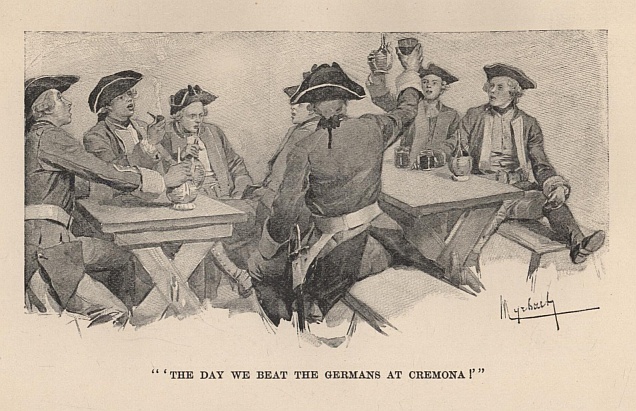
In the little inn at Narni, in company with six young gentlemen volunteers who had been enjoying a furlough in Rome, I sate and roared out the chorus as I picked up the words. To me they were glorious, and the air divine. At all events, the song was an improvement on many that went before and followed after.
I was prepared, in a measure, to meet with much looseness among military gentlemen, whose many vicissitudes and harassing calls on their temper and endurance may excuse a heat and vivacity of language that would not be fitting in an ordinary man. Indeed, my Uncle Scottos swore whenever his fancy pleased him. and no one ever thought the worse of him for that. But here were boys, none of them much older than myself, using oaths that fairly made my blood curdle, with all the assurance of a Field-Marshal at the least; and besides this, they did their best to make out they were practised in the blackest vices. Indeed, so ribald did they grow, that I felt it did not become me to sit quiet and listen to such wickedness.
"Gentlemen," I said, "my Uncle Scottos served in this regiment when it was part of the Irish Brigade, led by Colonel Walter Burke himself, and it was then held that no officer under the rank of Lieutenant had the privilege of swearing or using loose language; and I make bold to say it was a wise regulation, and one which I would like to see in force now."
These very fitting observations were greeted with a roar of laughter, at the end of which Mr. Fitzgerald, an ensign, said, with a mighty air of gravity: "Your Reverence is perfectly right; the same rule is still in force, and most strictly observed; but the truth is, that, like his Sacred Majesty, James III., our rightful positions are not fully recognized—de facto, as you Collegioners say, we are only Ensigns and Cadets, but de jure, we are Captains and Lieutenants in all the different degrees—just as Your Reverence is in the company of coarse, common soldiers, instead of hobnobbing with the heads of the Sacred College and other holy men." And his ribaldry was rewarded with a burst of laughter.
"Mr. Fitzgerald," I retorted, "you can spare your gibes on me. I neither understand nor like them. But if any of you think you can better me in a bout at single-stick, I'll shew you I can take a drubbing without grumbling from any of you who can give it me."
But Mr. Fitzgerald excused himself, as he had no skill except with the rapier; however, he was replaced by Mr. O'Reilly, who would have had no mean play had he been schooled by such a tutor as my Uncle Scottos. Then they challenged me to the small sword, thinking it my weak point, but I held my own as easily as at the other; and after this, if any one attempted to draw me on with "Your Reverence," I had only to answer "Single-stick" to turn the conversation. Let a lad but take advantage of his early opportunities, and he need not make a poor shewing in any company.
On our arrival at Faro, I was presented to His Excellency General MacDonnell, in command of the Irish troops in the Neapolitan service, which then consisted of the Regiments Hibernia and Irlandia, the latter including the remnant of "Burkes," in which I was entered as a cadet in the Company of St. James, under Colonel Donald MacDonnell, his brother Ranald being Captain en second.
The first injunction laid on me by the General was to dine every day at his table. This, of itself, was forwarding me at once into public notice, as he was constantly surrounded by Spanish noblemen and officers of note in the army, to whom he always introduced me as a young Scotch Highlander from the College in Rome, strongly recommended, come to acquire some knowledge of military affairs. Here I met his brother, Major-General MacDonnell, who was allowed to be the best foot officer and engineer in Spain, Sir Balthasar Nihel, our General of brigade, and many others.
Colonel MacDonnell most handsomely fulfilled his promise of fitting me for a soldier, for I was allowed to go out on active service whenever a company or battalion was given its orders, my duty being to report faithfully to the General every transaction that happened to the command I was in.
I made many and pleasant acquaintances, not only in our own troops, but also among the Neapolitans and Spaniards, who formed the bulk of our army, and was rapidly getting on with my education, a much easier task than any put to me at College.
Mr. O'Rourke, now Father O'Rourke, probably through the high favor he held in the Santi Apostoli, had joined us as Chaplain—although, I believe, such a course was unusual from the Propaganda—and was soon friends with every one from the General downwards. Though he had lost nothing of his old lively disposition, he was a different man from what I had ever seen him when he stood up in his robes before us at the Holy Office of the Mass.
No one who has not seen it performed in the open field, for men who, by their very calling, should have a more lively sense of the uncertainties of this life, can have any idea how grand it is in its simple surroundings. The altar is raised beneath an awning, and the service goes on before the kneeling men, without any of those distractions which meet one in a church; the Host is elevated to the roll of drums, the celebrant is half a soldier, and his acolytes cadets. Surely no more grateful service is ever offered to the God of Battles.
I shall not attempt to go into the detail of my experience in the army; it was that of a lad well introduced and handsomely befriended, and hundreds have gone through as much, and more too; but perhaps it would be hardly honest to pass over my first trial under fire.
In the Spring of '44 our army marched along the Adriatic, by way of Ancona and Loretto, to cover the Kingdom of Naples on that side. The Austrian vanguard came to an action with our rear before we reached Loretto, and pressed them hard. Father O'Rourke and I were marching side by side with O'Reilly, Fitzgerald, and some other young gentlemen near the Colonel.
"This strikes me much like a good imitation of running away, General McDonell of Scottos," said he, at which we only groaned, for the day was hot and we could not understand why the enemy should be allowed to annoy us in this fashion; indeed, we were too strongly impressed by the same thought to answer his challenge as it deserved.
But the answer soon came in an order for a reinforcement, and we all besieged the Colonel—who was good-nature itself and treated us like his own children—for permission to join. "Run off, then, the lot of you, and let the Germans see what your faces look like," he cried, laughing; and off we went, overjoyed at our good-fortune.
The required troops were halted and formed, and at once marched to the rear; the moment we saw the confusion and terror there and heard the groans of the wounded as they were roughly borne on with the hurrying mass, things took on a different look. What added to it was that, for some time, we had to stop and allow our people passage in a narrow way, and, by the balls that went whistling over our heads and the cheering of the enemy, we knew they were coming on with a rush.
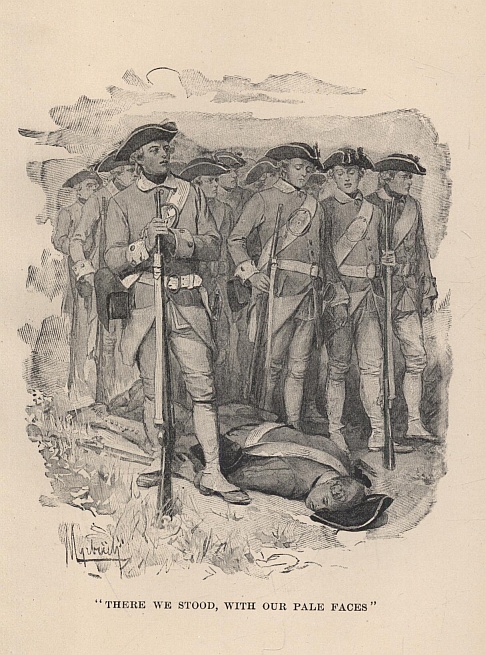
Suddenly a man near me gave a sickening kind of grunt and tumbled down in a heap, like a pile of empty clothes. My heart thumped as if it would burst through my ribs and my head swam so I could hardly see. O'Reilly, who was beside me, and, I suppose, moved by the same feeling as myself, put out his hand, which I grasped tightly, and there we stood with our pale faces, when, to our great relief, some old hand just behind us began to sing in a low voice, "The Day we Beat the Germans at Cremona"; then, at the same critical moment, came the sharp command, "Advance, quick!" and we were saved from a disgrace that would have been worse than death.
"THERE WE STOOD, WITH OUR PALE FACES"
Out we rushed in some kind of order, I suppose, but I do not remember anything but the great blue back of the grenadier in front of me, and how he worked his shoulders as he ran. Then came the word "Halt!" and almost as quickly "Fire!" My piece went off with the others, and when the smoke cleared I had my senses again about me and could see the enemy about one hundred paces ahead of us checked by our fire. We kept at it until dark came on and the enemy retired, whereon we rejoined our own army and encamped for the night.
That night in the General's tent after dinner he called me to him and asked, "Well, my lad, have you smelt powder to-day?"
"Yes, sir," I said, "and plentifully."
"What, sir," said he, "are you wounded?"
"No, please your Excellency," I answered, feeling somewhat ashamed I had not attained his full approbation in bringing back a whole skin.
"Sir," he said, sternly, "you will never smell powder until you are wounded. But in order to give you a better chance, and as a reward for not running away, you will be rated as Ensign to-morrow in the place of poor Jamieson, killed this afternoon."
So I won my first promotion for not being brave enough to take to my heels, where my heart was during the first part of the engagement at least; I never had the courage either to ask O'Reilly what his feelings had been when he held out his hand to me.
"Well, well," said Father O'Rourke, when I told him of my good-fortune, "Jeremiah was far-sighted when he prophesied 'the wild asses shall stand in the high places' (et onagri steterunt in rupibus). 'Tis Drum-Major they'll be making you next, and never a step for me, though I've the hardest and most dangerous work in the world trying to keep your heathen souls out of the clutch of a bigger enemy than Prince Lobkowitz himself. But 'tis a family party you are, anyway—here's a Major-General MacDonnell, and a Lieutenant-General MacDonnell, and a Colonel, and a Captain and a Lieutenant, and that poor little orphan, Angus, you left behind in Rome, and now they must needs make an Ensign of you. Faith, you're so plentiful hereabouts, I begin to believe the story that you had a boat of your own in the time of Noah."
"Indeed we had not, Father O'Rourke," I returned, indignantly, "that was the McLeans."
"Oh, well, McLeans or McDonells, 'tis all one. And Noah shewed his wisdom there, too, for had he let any more Highlanders into the Ark, they'd have been sailing it themselves inside of a month, for they've a rare scent for all the high places," he went on, with a roar of his Irish laughing. And I went off angry, but thinking how strange it was that so sensible a man in many things should find a pleasure in this childish way of jesting on any subject, and should so often choose me for his funning, who didn't relish it at all.
Colonel MacDonnell confirmed my rank as Ensign on the morrow, and for days we were hard at it marching across Italy to cover the northern frontier of Naples, next the Ecclesiastical States on the Mediterranean, where we got news that the Austrians were advancing in force under Prince Lobkowitz and the famous General Browne. They had an army of forty-five thousand men, Austrians, Hungarians, and Croats, while we were joined by thirty thousand Neapolitan troops, under King Carlo, so our forces were fairly equal. We took possession of the town of Velletri, within the Pope's dominions, the King making his headquarters in the Casa Ginetti, a handsome modern palace fronting on the principal square, while our army occupied the level country and the heights above. The Count di Gages was at the head of the Spanish, and the Duke of Castropignano of the Neapolitan troops, each taking command day about.
By some oversight the enemy were allowed to gain possession of the heights Monte Artemisio and Monte Spina, which occasioned great inconvenience to us, as by this means they commanded the high-road to Rome, and cut off our supply of water by the conduit which fed the great fountain in the principal square, so that we were obliged to search for water every evening at the cisterns and fountains about the country, or at the river, which ran in the great ravine between the two main armies, which lay about four miles asunder. To add to this, there was constant and severe enough fighting almost daily, but without any result proportionate.
About an hour before daybreak one morning, being on sentry, I was alarmed by the tramping of horses and the stir of men advancing towards my post. I challenged, and was answered by Lieutenant-General MacDonnell, whose voice I knew, and he knowing mine, called out:
"Is that you, McDonell?"
"Yes, your Excellency," I answered.
"Get yourself relieved then, and come with me."
While the relief was coming, I asked, "Where is your Excellency going?"
"To beat these rascals from their post," and nothing more was said until I got relieved and joined.
Off we went in the darkness, the General bidding me lay hold of his stirrup-leather; and as we went, he explained our object was to carry a battery of four eighteen-pounders nearest our camp. This we did with a rush, receiving only one discharge, and capturing near three hundred men, who had hardly time to strike a blow. Then, seeing that the battery could not be maintained for a moment, being completely exposed to the heights, he acted without waiting for orders, formed his force into three columns, and instantly led them against Monte Artemisio. Hot work we had of it for two hours, but at it we kept until we had cleared the heights of the enemy, whose force on Monte Spina, seeing our success, retreated to their camp, of which we had a full view, and which seemed to be in great confusion.
The General formed us up without hesitation. "Your work is only half done, my lads! Here's for another touch of Cremona!" and down the hill we swept on the enemy, shouting the song of the old regiment; but they never waited for us, deserting their camp and taking post in a wood hard by. It was a disappointment, but another was quick on its heels, for now who should ride up but an aide-de-camp with the most positive orders from the General-in-command to retreat. Then I heard a general officer swear for the first time!
However, there was nothing to be done; the camp was fired in as many places as possible, and we reclimbed Monte Artemisio and held it until relieved by the engineers under Major-General MacDonnell, who at once set about fortifying it with strong batteries, whereon we returned to camp, and the General to headquarters.
There was some talk, we afterwards heard, of his exceeding orders, which were to take the first battery only, and in a mixed army like ours it will be readily understood there was always a certain jealousy of any personal success; one would have thought it was an error to have beaten the enemy.
"How far would you have gone, General, had you not been recalled?" asked the young Duke of Alba, anxious to settle the matter.
"To the Devil, your Highness, if necessary:" the old soldier answered.
Thereat the King laughed heartily and said he believed him capable of it, and put an end to all further discussion by saying the General had acted under his orders, which was a very handsome way out of the difficulty, and highly approved of by our force when spread about.
We now settled down to continual skirmishing and manoeuvring and constant harassing of each other, with daily loss and daily distress on each side.
It was like living in a great city in this camp nearly four miles in length, resting its left on the town and its right on Monte Artemisio. Across on the other side of the valley lay our enemy, and if we suffered somewhat for lack of water, we knew they suffered still more from scarcity of provisions, as most of the prisoners we took were always eager for a meal; but our greatest suffering was from the incessant heat, for there we lay all the Summer months amid the dirt and other discomforts of a great crowd cut off from all water save for the most absolute needs. The peasants gave us of their stores readily enough, not because of their loyalty, but that any resistance to our foraging parties would have been useless, and have served only to aggravate their distress; so there was little opposition beyond outcries and black looks. The part of the peasant is a poor one in the time of war; but, after all, there must always be some to feed the soldiers, and if there were no peasants, doubtless we would have lived on some one else. I never would have fallen into this train of thought had it not been for Father O'Rourke, who gave himself much concern for them and their affairs, and went so far as to preach one Sunday that all men are equal in the sight of God, a holding I have never been able to make head or tail of, as it is clear against the common sense of any man who goes through the world with his eyes open.
In the beginning of August it was evident some great move was on foot by the enemy; there was constant marching and counter-marching, and we learnt from our spies that the sick, of whom there were many, had been moved to a great distance from the camp.
Our brigade in its encampment lay a little in rear of our left wing and faced the town. It was then the 10th of August, and I was to go on guard before daybreak on the outposts. The night was a sweltering one, rendering sleep wellnigh impossible; so, in company with a young fellow, come piping hot from Ireland to enter himself as a cadet in our regiment, I threw myself down fully dressed under an awning prepared for Divine Service on the morrow. For some cause unknown to me I was not called for guard at the proper time, but was awakened before daybreak by a couple of shots; then came half a dozen, next a couple of volleys, when, on starting up, I told my guest we certainly were attacked.
"Whatever shall I do?" he exclaimed; "I have no arms!"
"Never mind, fall into the ranks; if you are killed at the first discharge, you won't need any; if not, you will find as many as you want."
"But I have not yet been reviewed," he objected.
"No, and ten chances to one you never will be," I called back, as I rushed to order the générale sounded, which was soon repeated by all the drums in the army.
And then began such a confusion as I hope never to see again. Our men and officers turned out as they were, trying to slip into their clothes and find their arms. It was impossible to make out anything clearly, but we did our utmost to carry out the orders we heard screamed in the darkness.
From the sounds which came to us, it was evident the enemy were attempting to force our front, and so cut through our line. We had not half formed before we were nearly crushed by the rush of riderless horses of the two dragoon regiments in our rear, many of which broke away before the men could saddle them; and these were immediately followed by a regiment of Petits Walloons and a great body of cowardly Neapolitans who gave way before the enemy. In spite of it all we formed again, wheeled about, and faced the enemy, to find our army was cut in two, our left was on an impassable ravine, and General Browne with his successful troops in our front. There was nothing to do but retire towards the town, which we did, leaving a number of our officers and men on the field.
For my own share I was one of the last to give way, but when I turned my back I imagined the enemy all fired at me alone, and ran with all my might, feeling as though a weight were tied to each of my legs, till I out-distanced every one, when on looking back I saw the whole coming up. I halted, and every one as he came up did the same, and we soon formed a regular line. We were now joined by our senior officers, who restored order and resolved us to revenge our dead comrades and fight to the last. Our situation we found to be as bad as before. We wheeled to the right and endeavored to enter the town by the nearest gate, in order to defend ourselves by the help of an old Roman wall which surrounded the town; but the guard at the gate and those on the wall fired at us, mistaking us for the enemy in the uncertain light, and just then a column of Browne's men coming up gave us another fire.
To extricate ourselves from this very critical situation, we made another wheel to the left to recover our former ground, which with great loss we accomplished, only to find ourselves in a worse chance than before, for now a body of the enemy was between us and the ravine, by which means we were attacked on both flanks and in front.
The slaughter was terrible, and, being reduced to extremity, we offered to capitulate on honourable terms; at this there was a lull in the action and time to look about. We were so encumbered by our dead and wounded that a regular formation was almost impossible, but this we set about righting with all possible haste. Our Colonel sat straight and erect in the midst of us, in earnest talk with the French Major-General, who was in command. Lieutenant Butler was near me, and O'Reilly I saw attending to the removal of some of the wounded. The men, half-dressed, and many of them covered with blood, were resting as if the affair were entirely over, and already were talking and joking with each other in their usual way as if our lives did not hang on the answer to our terms. At length word was brought that our offer was refused, and we must surrender at discretion. Our chiefs whispered a moment, then Colonel MacDonnell rose to his full height in his stirrups and called in a voice deep with feeling, "Officers and gentlemen of the Company of St. James! They refuse us the only terms which honourable men can accept without disgrace. Officers, Gentlemen, All! I call on you to fight while a charge of powder and ball is left to living or to dead!" And the cheer we gave him carried our answer back to our ungenerous foe.
There was no shirking, as every man stepped firmly to his place; but matters grew worse from the beginning. Our French General was shot down, then Colonel MacDonnell, crying, "I'll open a way for you, my lads! Come on!" spurred his horse straight at the enemy, only to go down torn with bullets, while on every side our officers and men were falling fast.
So far I had not a scratch, but now a ball went through my thigh which prevented my standing. I crossed my firelock under my leg and shook it to see if the bone were whole, which, finding to be the case, I raised myself on one knee and continued firing. I received another shot, which threw me down, but I still made an attempt to support my surviving comrades until a third wound quite disabled me. Loss of blood, and no way to stop it, soon reduced my strength. I, however, gripped my sword, ready to run through the first who should insult me.
All our ammunition now being spent, and not a single cartridge to be found even among the dead, quarter was called by the few who remained alive. Many of the wounded were knocked on the head, and I did not escape; for, observing one approaching, I made ready to run him through, but seeing that five more were close to him, I dropped my sword, only to be saluted with "Hundsfott!" and a rattle of blows on my head, whereupon I fainted.
On coming to myself, I found I was lying with my clothes stripped off, weltering in my blood, twisting and turning with pain in the dust under a blistering sun, and no one alive near me to speak to.
The first who came up to me was a Croat, who, spying my gold-laced hat near by, clapped it on his head, and then had the impudence to ask me how I liked it. Not pleased with my answer, which was short, he turned me over on my face and, cutting off my queue with his sabre, marched away, saying he would remember me by it.
Shortly after this I was visited by another with cocked pistol in hand, who demanded my purse in very bad Italian.
"Where do you think I have hidden it?" I asked, angrily, for I hadn't on me what would have covered a sixpence. "If you can find it about me you can take it."
"Is that an answer for me, you ——," and here he called me a name, bad enough for a living man, but to the last degree insulting to one in my condition, and with this he pointed his pistol straight between my eyes.
I thought no one near, but the word "Quarter" was scarce spoken by me when I saw his pistol arm seized by a genteel young man, dressed only in his waistcoat, who cried, "You rascal, let the man die as he pleases; you see he has enough. Go and kill some one able to resist," and the fellow made off.
"Pray sir," said I to the young man, "what do you intend to make of this town if you take it!"
"Keep it if we can; if not, burn it."
"Then, sir, if you will have me borne to your camp, and my wounds dressed, I will reward you with fifty crowns."
Off he went, and in a few minutes came back with four stout German soldiers, to whom he said something in their language. They seized me by the arms and legs, but no sooner had they raised me from the ground than I fainted with the pain, and on recovering I found myself where I formerly was. The young man was still near, who told me shortly that I could not be removed.
"But, sir," said I, "if you set the town on fire I shall infallibly be burned here," for in our struggle we had been driven back on the walls.
"If I am alive," he returned, "I will prevent that; but I must attend to my duty, as the firing in the streets continues very hot," and with that he left me, and I saw no more of him.
I now observed a regiment of horse drawn up about half a gun-shot from where I lay. They faced the town, and if they advanced a few paces more I was afraid they would crush me under foot. But they faced to the rear, retired a little, and then faced the town again. This manoeuvring surprised me; I listened attentively and heard the cannon and platoons approach, and, raising my head on my hand, looked towards the gate nearest me, which was quite full of our men running out trailing their arms, to form a line between me and the horse; they were followed by another sortie of our people, who formed yet another line, but in this case between me and the town wall.
I looked upon myself then as certain of death, but used every precaution in my power to preserve what little life was left to me as long as possible. I seized two of my dead comrades, for they were thick around me, and with great difficulty dragged myself between them, so as to have some shelter from straggling balls.
I did not remain long in this danger, however, as the enemy, at the second fire from our people, left their ground and galloped out of sight.
I now began to suffer the torments of thirst in addition to my other pains, and called to every one who passed near me for a drink; but from the heat of the day, and the length of the action, their canteens and calabashes were all empty. At last I saw a grenadier of the Swiss guards, whose uniform was very much like ours, with a large calabash, and asked him if he had anything in it. "Yes, brother," he said, mistaking me, I suppose, for a Swiss.
I took a hearty draught of excellent wine and offered it back to him.
"No, no, brother," he said, "I am unhurt and you cannot help yourself," and thereupon he left me.
I was greatly refreshed, and on looking about me saw poor Lieutenant Butler, whom I had not before observed, lying near me on all fours. He was sadly wounded, and begged me in the name of God to let him have a drink. I drew myself a little nearer him, for he could not move, and handed him the calabash. He seized it eagerly and would have certainly finished it, had not I, observing from the horrid nature of his wound it was only a question of minutes till the end, pulled it from him, saying, "It is easy to see, my poor fellow, that your bread is baked. I cannot let you waste this when I may perish for the want of it." It is not that war makes men unfeeling, as many have urged, but in it they attain a judgment in the value of life not so readily acquired elsewhere.
It was now getting towards evening, and I must have fainted or slept somewhat, for the next I remember was feeling what I took to be rain falling, and, on opening my eyes, there was the big face of Father O'Rourke over me. He was crying like a child, and the first words I made out were: "Oh, Giovannini, darling! My poor boy! You're not dead—you're not dead, after all!"
"Who's beaten, Father?" I asked, as soon as I could speak.
"Faith, we're all beaten! First we were smashed into tatters, the King all but taken, and would have been had it not been for Sir Balthasar Nihel. We were beaten at every point of the compass, only we didn't know it! But now we've the town again, and sent General Browne off with a flea in his ear, and all the Croats and Hungarians, Pandours and Talpathians, hot foot after him. But oh, the poor souls that have gone to glory this night! Faith, promotion will be the order of the day now." And all this and much more he gave out, half crying, half laughing.
And there the good man sate, talking his nonsense to keep me up, holding me in his arms covered with his cassock, which he had stripped off when first he found me, in no little danger from the rascally camp-followers and the miserable peasants, who were prowling about ready to put a knife into any one who offered the least resistance. Indeed, the peasants killed, resistance or not; for each soldier dead, no matter what side, they looked on as one enemy the less.
"THERE THE GOOD MAN SATE, HOLDING ME IN HIS ARMS"
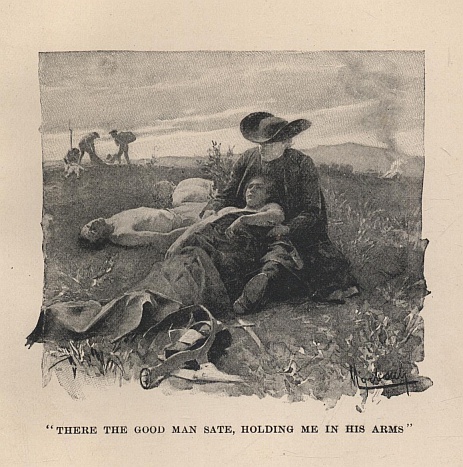
I was too weak to think of such things, but he told me afterwards his heart gave a Te Deum of rejoicing when he saw Lieutenant Miles MacDonnell, of the Regiment Hibernia, looking over the bodies for any chance of saving friends. He at once hailed him, and I was soon, lying on the leaf of a door on my way to the hospital.
Some idea may be gathered of the importance of this engagement when I say that there were near two hundred officers alone in the hospital, which was one of the largest convents in the town. As Father O'Rourke foretold, promotion was rapid and easy, and Captain Ranald MacDonnell was named as Colonel, commanding the regiment in the place of his brother, killed, as already related. He went through the hospital twice a day and never failed to visit me, inquiring particularly of my condition by order of his father, the General, and also brought me news of my own promotion as Lieutenant, with many kindly wishes for my speedy recovery—and I know no more grateful cataplasm for a mending wound than promotion.
It was wonderful how we all improved in spite of the heat, our crowded condition, and the scanty fare. My greatest suffering was from dreaming; for weeks I could not get the awful experiences of that day out of my poor head, and no sooner was I asleep than I was at some part of it again, only to be awakened with a scream and a start which often opened my wounds afresh and left me almost fainting with pain. My experience was only that of others, many of whom afterwards said they too dreaded the coming of sleep, which only increased their torments.
Many a story we had of the day, and gradually we gathered something like a fair idea of the whole. General Novati had carried out his attack on the town successfully, but had been prevented from seizing the person of the King through the obstinate defence of the Irish troops; indeed, we came in for no small share of compliments. Even General Browne, who cut our own detachment to pieces, said he was sorry for our loss, though he admired our gallant behaviour. This was the word brought by Mr. O'Reilly, who saved his life by a stratagem; for being down like the rest of us in our last stand, and fearing lest he should be trampled under foot by a squadron of horse just preparing to charge, he called out to the Germans, "Would you leave the Duke of Alba to perish?" and so was picked up and carried out of danger. When brought before General Browne and his staff, he confessed he was only Mr. O'Reilly, a Lieutenant in the Irish Brigade, and had borrowed the Duke's name when he thought it would do him most good. He was abandoned by the enemy in their retreat and carried in, and afterwards made his apologies to His Highness for the liberty he had taken, who graciously assured him he was glad it served so good an end.
The day had ended by a loss to the enemy of near three thousand men, and General Novati a prisoner, besides many other officers of high rank; our own loss was near as heavy, but, then, we were victorious, and the enemy foiled in every point he attempted.
Father O'Rourke was untiring in his care of us all. Indeed, for weeks he hardly seemed to have any rest, but whether he was up all night with some poor fellow whose time was short, or comforting another in pain, or letter-writing, or listening to complaints, he had always the same lively humour that brought many a laugh from the long rows of beds within hearing.
In about six weeks I was on crutches, but sadly incommoded by want of clothes, for I had not even a shirt I could call my own. "Faith, don't be so mighty put out on account of a few rags and tatters," was Father O'Rourke's comfort; "'tis a blessed state of innocence I found you in! Not even Adam in the Garden of Eden could have had less on him, or been less put out by it. You may thank Providence you are here in this blessed sunshine, instead of skiting about barelegged in your native land, where I'm told on good authority the men wear petticoats even in winter." But I was superior to his gibes a day or so later, for the General, hearing of my straits, most obligingly sent me a suit of clothes and half a dozen of shirts. And to add to his many kindnesses, in a letter he wrote to King James giving an account of the late battle, he mentioned my condition to His Majesty, setting forth my services in terms of such commendation that the King was pleased to order a pretty good sum of money for my immediate occasions.
Weary as I was of the hospital, I dreaded leaving it, as ordinary courtesy, let alone my heavy obligations, necessitated an immediate visit to the General, which I much dreaded, as I had not seen him since the day before the battle, when his son rode at our head, as gallant an officer as there was in the service. But when I stood before that fine old soldier there was only welcome in his look, and he said, jocosely:
"Are you still alive?"
"I hope your Excellency has sent no one to kill me," I answered, falling in with his humour.
"No, by gad! I thought you had enough. But I know what has brought you here to-day; you have come for a good meal after being starved in the hospital. But be careful, I have seen many who have been carried off by overeating in like case."
Dinner was served, and I sate down nearly opposite the General, who eyed me anxiously from time to time; at last he got up, took my knife and fork from me, and, ordering away what was before me, said, "You young devil, you'll kill yourself!" and his roughness meant more to me than soft words from any other man.
From this out I recovered rapidly, and soon was myself again and back in my Company with full rank as Lieutenant. There was no fighting now of any importance, and we wondered what the next move would be. But our spies and the deserters brought us in no news of value, and on the last day of September we lay down while our out-posts watched those of the enemy, their fires burning as usual across the valley; but in the morning we thought it strange we heard no drums and saw no movement, and then it dawned upon us that their whole army had withdrawn during the night, and now were in full retreat by way of Rome.
All the available force started in pursuit, with the hope of bringing them to an action at Torre Metia, about half-way between Albano and Rome, but they outmarched us. Both armies had engaged with His Holiness not to enter Rome, so the enemy passed under its walls, where, our advanced guard coming up with their rear, there was warm skirmishing until they crossed the Tiber at the Ponte Mole and encamped on the far side until the next morning, when they continued their retreat. Our army now divided, one division going forward under the Count di Gages to harass the enemy, while the remainder followed King Carlo back to Naples.
IV 1744-1746
How we met old friends and an older enemy in Rome with whom I was forced to subscribe to a Truce, having passed my word to the Duke of York; how it came that I resigned from the Company of St. James.
Through General MacDonnell's kindness I was allowed to spend a few days in Rome as being on his staff, and at my first freedom took my way to the street of the Quattro Fontane and my old College.
What a welcome I received! Good Father Urbani held me in his arms as if I bad been his own son, and would not hear of my sleeping outside the College, although 'twas a downright breach of their rules; and the old porter, of whom I once stood in such awe, waited up for me, no matter what the hour for returning might be, and nodded and winked knowingly, as if he too had once been young. Not that I would insinuate there was anything of levity in my conduct, for I have always had a too just regard for my position as a gentleman and an officer to indulge in anything unbecoming, more especially where I was so carefully observed.
Angus I found the same as ever, quiet and contented with his lot, as seemed most of the others, though I could see my appearance caused something of a ruffle among them. I seemed to have grown so many years older, and was surprised to find how small and almost mean many of the old surroundings looked; even the Fathers did not appear as formidable as before. All, that is, save dear old Father Urbani, of whom I never stood in awe, and who had only grown older and more frail; to him I told all that was in my heart, not even hiding my first fright from him, which I would not have then confessed to any other living man.
On the second day of our stay, the General and I took our way by the Corso and through to the Piazza Santi Apostoli to pay our respects to His Majesty King James. As we ascended the staircase I thought of the two poor awe-struck collegioners who in soutane and soprano had climbed the same stairs two years before, and the amazement that had filled their hearts when they saw and talked with Royalty for the first time. Now I was a man, though but sixteen, for I had carried a sword honourably in company with some of the bravest men in Italy, and had been personally presented to King Carlo as worthy of his gracious notice.
The General was in full dress, with his Spanish and Neapolitan orders, and I wore the full uniform of a Lieutenant of our brigade, which was genteel enough even for a presentation.
In the anteroom the General was welcomed on all hands, and I met many I knew, including Mr. Secretary Murray, Mr. Sheridan, and the Abbé Ramsay, and was much made of, though without flattery, save by those at whose hands I could fittingly receive it. What was my disgust, though, to see the white face of Creach again in the crowd; he, however, did not come near me, and, out of consideration for the General, I refrained from speaking of him, as it might lead to mention of my former meeting when with his son, the Colonel. I may say here that I never knew the result of the meeting between Creach and the Colonel, as the latter never saw fit to refer to it and I could not well question him.
The sight of the man was so distasteful that it fairly took away all the pleasure of my presentation, and even the gracious presence and words of His Majesty, and of the Duke of York, who accompanied him, did not altogether dissipate my uneasiness. In words as fitting as I could choose, I thanked His Majesty for his generous and unexpected succour, whereupon a smile passed over his grave, dark face, and he said, "But hold! are you not my little Highlander of the Santi Apostoli?"
"I am, please your Majesty," I answered, reddening at my childish adventure.
Then the King smiled again, and, much to my discomfiture, told the story which all seemed to find mighty amusing, save myself, who could see nothing therein but a very natural and exact distinction. In telling a story, however, a king has this advantage over others, in that all must laugh whether they find it to their liking or not.
I had hoped we would have seen the Prince of Wales as well, for in my heart he was the member of the Royal Family I most longed to see again, but we were informed he was engaged in a tour of Northern Italy.
When the King and the Duke withdrew, they signified to General MacDonnell that he was to follow, and when we bowed them out, and the doors closed upon them, conversation at once became general.
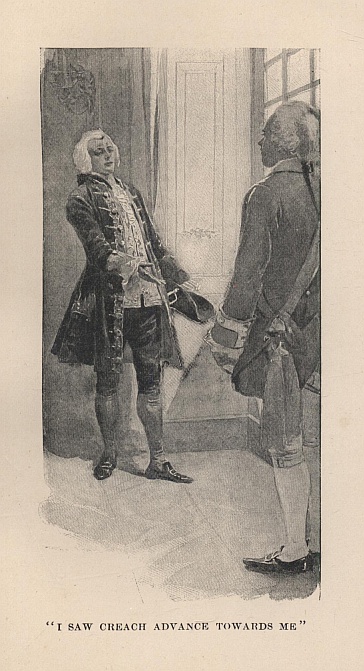
I withdrew to a window, for I was in no frame of mind for talk, when, to my astonishment, I saw Creach advance towards me, holding out his hand with an assured air. I drew myself up at once and looked him over slowly, seeing everything but the outstretched hand.
"This is a place for friendship and not for boyish quarrels, Mr. McDonell," he began. "I wish to congratulate you on your promotion.
"No place, Mr. Creach, can be for friendship between us, and as for congratulations, they are not only out of place but insulting from you," I said, quietly, and in a low voice, so no one might overhear.
"In the first place, my name is not Creach," he said, trying hard to keep his temper, "and in the second, you may find it not only foolish but even dangerous to try any of your airs with me. Remember, you can't always have a man at your back to fight your battles for you."
"I SAW CREACH ADVANCE TOWARDS ME"
"You clay-faced hound!" I said, "don't dare to take the name of the dead into your mouth, or I will strike you where you stand. What your object is in thus seeking me I do not know nor care, but as sure as the sun is above if you dare speak to me again I will forget the roof we stand under and treat you like the dog you are."
His face turned greyer than ever, and he stood hesitating a moment, but presently bowed ceremoniously, and moved off before my anger got the better of me.
I stood staring out of the window trying to recover myself, when who should come up but Father O'Rourke. "Well, well, my little Highlander, who has been ruffling your feathers?" said he.
"Look there! Father O'Rourke," I said, paying no attention to his nonsense; "do you see that man?"
"I'm not hard of hearing yet, my son, thank God! and you needn't make a sign-post of yourself. Do you mean the claret-coloured coat and the bag-wig?"
"Yes," I said, more quietly. "That is Creach!"
"The devil it is!" he said, and then he became confused, and glanced at me to see if I had observed his slip; but I have always held that an honest statement of opinion may excuse the expression. He was silent for a moment, looking hard at the man, and then went on in his old lively manner. "Well, Giovannini, we are not responsible for the company; they cannot be all lieutenants and priests. Let us wander about and get a mouthful of air." So, taking my arm, he led me off, nor would he speak on the subject until we were alone on the terrace. There he changed his tone, and said, shortly:
"Are you sure of the man?"
"As sure as if I had seen his ears."
"Faith! they were big enough to swear by," and to my impatience he began to laugh at the thought. "Do you remember how they stuck out? The handles of a jug would be flat beside them," and he laughed again. "Now I suppose you promptly insulted him?"
"Indeed I did not. I only told him he was a dog, and if he spoke to me again I would not answer for myself."
"Humph! I have frequently noticed a Highlander's conception of an insult is materially altered by the fact whether it proceeds from himself or from another; but I don't suppose you ever got as far in metaphysics as this. Now comes the question, what you intend to do? Remember the gentleman seems fairly well established here. Will you fight with him?"
"Fight with him? A thief? Indeed I will not! I will simply keep my word."
"You're a rare hand at that, and I'm not saying 'tis a bad habit. But here comes the General. To-morrow I'll be at the College about eleven," and so we parted.
The General was in great spirits. "Hark you, McDonell, something touching 'the North' is on foot. I'll not say more now, and this is in strict confidence, but you'll know what it means some day when I signify to you that you may apply for leave of absence. To-morrow, at four, you will attend again at the Palace; the Duke desires to see you. You will enter by the door you know of, and the word is 'Velletri'—but you know nothing," he added, with emphasis.
The next morning Father O'Rourke came as promised, and was introduced by me to the Rector with some little pride. Indeed, he was no mean figure of a man, this Chaplain of ours, with his broad shoulders and great head, that looked fitter for a soldier's tricorne than a priest's calotte.
After the usual compliments we fell to talking, Father O'Rourke as much at home as if he had known the Rector all his life, and it was easy to see the old man warmed to him as he told him of his work as chaplain in a marching regiment, though making light of it, as was his manner.
"Ah, Father," said the Rector, smiling, "I am afraid it is somewhat to you that the College owes the loss of this scholar; he would have been a credit to the schools some day."
"I doubt it, Most Reverend," answered Father O'Rourke, dryly, "as he is lacking in one of the senses."
"In what, pray?" asked the Rector, a little stirred. "I have never observed any lack; Sight, Sound, Taste, Touch, and Speech, he has them all."
"Your pardon, you have omitted Humour," returned Father O'Rourke, quietly; "and he has no more of that than a crocodile has of mathematics. A deplorable lack in a scholar, and useful any where—though for the banging of guns and the cracking of skulls there's less required than in almost any other profession"; and at this he burst into one of his foolish roars of laughter, much to my dislike, for I wished him to make a good figure before my protector. But, to my surprise, the Rector did not seem half as much put out as myself, and said, smiling:
"Well, well; this killing is a serious business in any case."
"But not so serious it could not be tempered by a little cheerfulness. 'Suaviter in modo' goes a long way towards making your enemy's end comfortable," ranted on Father O'Rourke, with much more that I have not the patience to put down. Indeed, I hold him wrong throughout, as I have quite as keen a sense of humour as is fitting for any gentleman in my position.
But to go on. When we were alone he listened quietly enough to my remonstrances to his late conduct, merely saying he understood that the Rector had not been born north of the Tweed, which was no answer whatever.
He then recurred to our matter of the day before, saying:
"I have been making some inquiries about this man Creach."
"Yes, and what do you find?"
"I find, Mr. McDonell, that if you are going to have the run of the Santi Apostoli you must number him amongst the Elect, for His Saintship is in high favour. He not only is there day in day out, but is a bosom friend of the Prince of Wales to boot."
"That I cannot credit," I returned. "His Highness could not be so mistaken."
"Faith, I'm not so sure of that," he returned, bitterly; "he has some sorry cattle about him, and, to say the least, he is easily pleased in the way of company."
"Father O'Rourke, it is not for the likes of you or me to discuss the doings of princes, and I'll thank you to say no more on the subject."
"Very well, Your Highness. I merely thought a word in season might save you from a like error, and that, coming from a descendant of kings, like myself, it would not give offence. But to leave that aside, you'll have to humble your stomach and swallow this Captain, claret-coat, chalk face, big ears, and all, or I will prophesy that you'll cut but a small figure with your betters."
This was as unpleasant a piece of news as I could well receive, and though I could not quarrel with it, I at least could resent the manner of its conveyance, so I turned upon my informant at once: "Perhaps this is an example of your 'suaviter in modo,' Father O'Rourke; if so, I'll be obliged if you'll put things in plain, sensible English, as between gentlemen."
"Oh, very well, Mr. John McDonell of Scottos—do you think it sounds better to say that his Royal Highness has not ordinary common taste in choosing his companions, and if you follow him, you must be hail-fellow-well-met with a blackguard like Creach, who happens just now to be in his favour?"
"'Pon my soul, Father O'Rourke, you are the most provoking man I ever met! If you wore a sword, I'd make you answer for this!" I roared, beside myself with anger.
"Oh, I can waggle a sword, if need be," he answered, very cool, "but I was thankful it wasn't a sword but a calabash of good chianti I had strapped on me the night I fell in with you after Velletri. There, there, Giovannini; 'tis nothing to make such a pother about, only you and I are too old friends to quarrel over such gentry as Mr. Creach."
"But it wasn't Mr. Creach, Father. I never would have lost my temper over him; I thought you were poking fun at me."
"Ah, Mr. Lieutenant, in humour, like in file-firing, a sense of direction is a great thing."
And so we made it all up again, and with Angus we had the chanti and fruit which the Rector had thoughtfully provided in my chamber.
At four o'clock I took my way to the secret entrance of the Santi Apostoli, found the familiar passage and a lackey awaiting me in the garden to conduct me to the Duke.
He was then about nineteen, though I did not think he appeared much my elder save in his manner, which was that of a Prince, though most lively and engaging. He soon opened the reason of the visit.
"Mr. McDonell," he said, "I am sure you are faithful and can be trusted."
"Your Royal Highness," I answered, "my people have been true to you and yours for generations, and it would ill become me to have any principles other than those we have always held. You can count on me to the very end."
"I was sure of it," he answered, smiling, holding out both his hands, which I grasped with emotion. "Now to business," and he civilly invited me to be seated in an embrasure of a window.
"My brother, the Prince of Wales, is travelling, it is true, but not in Italy; he left here secretly in January last, and since then has been in France, and at any day an expedition may be formed for Scotland, for we have the surest hope of the hearty co-operation of the French Court.
"Now I and His Majesty must have messengers at hand on whom we can absolutely rely; and my request to you is that you will not volunteer for service when the news comes, but will remain with your company here in Italy; we have positive assurances you will be permitted to leave at any moment we may signify. I know that I am asking you a hard service, but it is an important one, for there are but few men whom we can trust for such a mission.
"It is impossible to say when you may be needed, but your reward will be such when the time comes that others will envy your choice, and I and the King, my father, will ever remember the man who was ready to sacrifice the empty glory of the parade of war for the trust laid on him.
"You must keep yourself free of all entanglements, for your absolute freedom to move at once will be of the utmost importance to the Prince and to your country. Surely I may count on you for this?"
And I swore faithfulness from the bottom of my heart.
Then changing his tone, he began more lightly: "There is another small favour, a personal one, I would ask of you yet. There is a gentleman here in our court named Mr. Graeme—"
"Mr. Creach, Your Highness," I could not help interrupting.
"Mr. Graeme, I said," he returned, with something of hauteur. "You will be required to meet him, possibly to have business with him, and I desire as a personal favour to me," and he laid much stress on the words, "that you will lay aside all previous difficulties or misunderstandings between you until your engagement with me is at an end. Surely I am not asking too much in urging a favour at this beginning of your service," and I was so overcome with the graciousness of his manner that I promised, although sore against my will.
We then had a private audience with the King, who was pleased to recall the services of my grandfather, old Æneas of Scottos, and his brothers Glengarry, Lochgarry, and Barisdale, whom he knew personally in 1715, and flattered me by saying he congratulated the Duke of York on having a messenger of such approved fidelity; "for, Mr. McDonell, your General tells me he would trust you with his own honour."
"His Excellency has been like a father to me, Sire," I answered; and shortly afterwards our interview closed, the Duke paying me the honour of accompanying me to the door and insisted on shaking hands, nor would he admit of any ceremony at leave-taking.
The next morning some one knocked at my door, and, on opening it, there, to my surprise and disgust, I saw Creach, dressed in the most foppish manner. However, I dissembled my feelings, and to his greeting said, with civility:
"I wish you good-morning, Mr. Creach."
"By God! sir, if you repeat that name to me, I will run you through!" and he laid his hand to his sword.
I glanced quickly to see my own was within easy reach on the table, and then, "Mr. Creach," I said, "I promised His Royal Highness the Duke that I would not quarrel with you, and nothing will make me break my word, so don't go on pretending to find insults in my conversation, Mr. Creach, or it will become one-sided. I am a man of very few ideas, and one of them is that 'Mr. Creach'—no, 'Captain Creach'—was the name by which you were introduced to me, and so Creach you must remain till the end of the chapter, Mr. Creach."
But he had recovered himself with great address, and said, with an air of much openness:
"Mr. McDonell, what is the sense of keeping up this farce of quarrelling? We must meet, therefore let us do it with decency, as befits the cause to which our honour is pledged."
"Mr. Creach, if I were not a man moderate in all things, and were not my word pledged to the Duke, nothing in the world would prevent me throwing you down these stairs, and I could have no greater pleasure than to see you break your neck at the bottom; but since I am forced to treat you as a gentleman, kindly deliver yourself of your business and leave me to mine."
"I am doubly fortunate then, Mr. McDonell, first to the Duke and second to your high sense of honour. But I will not bandy compliments. His Highness bade me deliver this letter and his regrets that he will not see you again, as he hears General MacDonnell leaves for the army at Spoletto to-day."
"My humble duty to His Highness, sir," and I bowed to him mighty stiff, and he withdrew, leaving me very thankful that I had not been betrayed into any heat nor broken my word to the Duke.
On hurrying to the General's quarters I found the news was true, and that he had already sent for me; so, after short farewells, we rode through the Porta del Popolo and took the highway towards Spoletto.
I will not follow our campaign through the winter, except to say we were fairly successful and saw some brilliant service, particularly at La Bochetta and during the investment of Tortona.
During this winter I lost my best of friends, General MacDonnell, who died of a fever occasioned by the fatigue of our forced marching on Genoa; and a few days afterwards he was followed by his brother, the Major-General, of a fever also, resulting from the breaking out of an old wound he had received in the shoulder some fifteen years before.
All this time I had been anxiously expecting orders from the Duke, but the only word which came was a letter containing the disheartening tidings of the failure of the expedition under Marshal Saxe, and then we were all startled at the news of the Prince's embarkation in the Doutelle and the Elizabeth.
"'GENTLEMEN! GLASSES ALL!'"
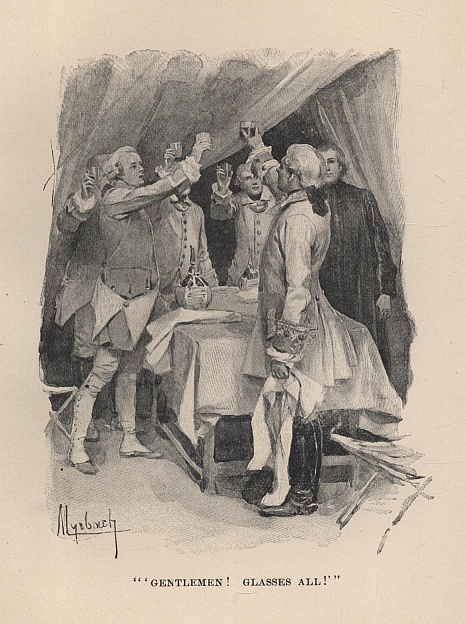
"It is simple madness," said Father O'Rourke, when the tidings were announced in the General's tent at dinner—indeed, one of the last occasions when he had us all at his table, as he loved.
"'Tis the kind of madness that heroes are made of," said the General, heartily. "Here, gentlemen! glasses all! Here's to Royal Charles, and may he never stop till he sleeps in St. James'!" and, warmed by his enthusiasm, he broke into the old Irish Jacobite song:
"'He's all my heart's treasure, my joy and my pleasure, So justly, my love, my heart follows thee; And I am resolved, in foul or fair weather, To seek out my Blackbird, wherever he be.'"
Such was the enthusiasm that we were all ready to volunteer, but as the General said, dryly enough, "What is to become of the Austrians if you all leave? You might as well desert to the enemy at once and have done with it."
While we awaited with impatience an answer to our application, word came to me from the Duke that I was on no account to apply for leave until such time as he sent me certain word himself. It was a bitter disappointment, but I was not alone, as the military authorities saw fit to refuse all applications until the matter was further advanced.
At last, in the month of January, letters came saying the Duke was about starting, that leave was granted me as well as certain others, with instructions to report to Mr. Sempil, the King's Agent at Paris, who would direct us further.
Conceiving my future duties called for freedom from immediate service, I sent in my formal resignation, and received from our Colonel, Ranald MacDonnell, a certificate testifying in flattering terms to the services I had performed, to my honour as a gentleman and my conduct as an officer while under his command in the Company of St. James:
"Nous, Colonel du Régiment d'Infanterie d'Irlande de St. Jacques, certifions que le Sieur Jean McDonell de Glengarry, sous-lieutenant au dit Régiment, s'est toujours comporté pendant tout le temps qu'il y a servi en Gentilhomme d'honneur, brave officier, et avec une conduite irréprochable à tout égard; en foy de quoy nous lui avons donné le présent. Fait à Plaisance le douzième janvier, mil sept cent quarante six. "MACDONNELL."
To my surprise I found the name of Father O'Rourke amongst those allowed to volunteer, and when we were alone I said, rallying him:
"I was not aware you were so strong a Jacobite, Father."
"Well, to tell the truth I am not, except in the way of sentiment; but sentiment, my dear Giovannini, as you are aware, will induce a sensible man to do more foolish things than any other power in the world. Still, I regard myself as in the path of duty, for I conceive there may be some Jacobites who will be none the worse for a little extra morality dispensed by even my unworthy hands."
I did not question him further, as I dreaded one of his usual rodomontades.
We left at once with the good wishes of all, took barge at Genoa as far as Antibes, and thence by post to Lyons, where we put up at the Hôtel du Parc.
Here we met a number of French officers, who brought news of the Battle of Falkirk, wherein Prince Charles had beaten the English cavalry and infantry off the field; and though, at the same time, we knew he had retreated from England, it did not serve to dash bur spirits, and we supped merrily together, drinking toast after toast to the success of the Cause.
All the old songs were sung lustily, and the French officers were much amused at our enthusiasm; but it was Father O'Rourke who carried off the honours of the evening by singing the following, to an air that was new to me:
Oh the water, the water, The dun and eerie water, Which long has parted loving hearts that wearied for their home! O'er the water, the water, The dark, dividing water, Our Bonnie Prince has come at last, at last—to claim his Own. He has come to hearts that waited, He has come to hearts that welcome, He has come though friends have wavered, with the foe upon his track. But what loyal heart will falter When our Bonnie Prince is standing With his banner blue above his head and his claymore at his back?
Then gather ye, Appin, Clanranald, Glengarry! Cross has gone round! Will a single man tarry When we march with our Prince against Geordie's Dutch carles? We are out for the King! We will conquer or swing! But the bonnie brown broadswords will klink and will kling From the Tweed to the Thames for our Bonnie Prince Charles!
Oh! the waiting, the waiting, The cruel night of waiting, When we brake the bread of sorrow and drank our bitter tears, It has broken at his coming Like the mist on Corryvechan, In the sunlight of his presence we have lost our midnight fears.
When the Prince unfurled his standard In the green vale of Glenfinnan, Beneath a sky as bright and blue, blown clear of storm and wrack, The Loyal chiefs came thronging To where their Prince was standing With his banner blue above his head and his claymore at his back.
Then gather ye, Appin, Clanranald, Glengarry! The Cross has gone round! Will a single man tarry When we march with our Prince against Geordie's Dutch carles? We are out for the King! We will conquer or swing! But the bonnie brown broadswords will klink and will kling From the Tweed to the Thames for our Bonnie Prince Charles!
Oh! the heather, the heather, Our modest hill-side heather, Hath donned her royal robe again to welcome back her Own. The roses bloom once more in hearts That hope deferred was wasting That will march with Bonnie Charlie, to halt only at his Throne! We have suffered, we have sorrowed, But our joy has come with morning, And all is shining gloriously that late was drear and black. Then up and out, ye gallant hearts, To where your Prince is standing, With his banner blue above his head and his claymore at his back!
Then gather ye, Appin, Clanranald, Glengarry! The Cross has gone round! Will a single man tarry When we march with our Prince against Geordie's Dutch carles? We are out for the King! We will conquer or swing! But the bonnie brown broadswords will klink and will kling From the Tweed to the Thames for our Bonnie Prince Charles!
When he ended we cheered and cheered, breaking our glasses, half crying, half laughing, until we made the room ring again; and the people in the square listening to us began to cheer in sympathy, and, unable to control myself, I jumped up, and, catching the big form of the priest to my bosom, fairly hugged him in my arms, "Oh, Father O'Rourke! How could you ever do it and you not a Highlander at all?" I cried, in my wonder.
"Faith, I could do the same for a Hottentot if I could only manage his irregular verbs," he shouted, struggling out of my embrace. "And now, gentlemen! If you don't stop this hullabaloo, you'll be arrested for disturbing the peace of this good town of Lyons, and if you don't stop cracking those bottles your heads will be as easy cracking for the English when it comes to hard knocks!" And off he went with a storm of cheers after him.
V 1746
How Father O'Rourke and I met with the Duke of York, who charged me with a secret mission towards Prince Charles; of our voyage to Scotland, and the dismal tidings that there met us.
The next morning Father O'Rourke's words came true, for there were many aching heads amongst us, of which my own was one, and the jolting of the Paris diligence did not in any way improve their condition nor their owners' tempers. It is surprising how mightily the hot enthusiasms of overnight will cool down by daylight—and here was an example. Last night there was not one of us but would have embarked to the Prince's support without a second thought of the chances, and not one would have admitted that the chances, if any, were aught but rose-coloured; but with the morning everything took on a different complexion, and the whole of our way to Paris was filled with nothing but the most dismal forebodings.
I addressed myself to Mr. Sempil, and found that the Duke would expect me in about a week at Boulogne; and in the mean time I did what I could to raise the spirits and determination of my companions.
At length we had a general consultation, and, much to my disgust, they one and all began to plan, not for our joining the Prince, but for offering the most excellent reasons why they should then and there return: "the Prince had retreated from England; the passage was dangerous on account of the English fleet; the French could not be relied upon for any material aid; and, lastly, Spring was approaching, and they would lose their chances of promotion in the ensuing campaign," and so on.
"In short, gentlemen," I said, out of patience at last, "you all came here prepared to sing the same song, and you do it to perfection. Your arguments do more credit to your heads than to your hearts. If the Prince were safe in London you would be the first to flock after him; but now, when he most needs your assistance, you are like a pack of old women inventing terrors to excuse your cowardice."
There were some of them who pretended to take exception to my words; but as I assured them I would be only too pleased to make any or all of them good, and the sooner the better, they did not go beyond their protest.
But if they found my words unpalatable, Father O'Rourke gave them something more difficult to digest.
"I object to the gentleman's manner of putting it myself," he began; "he is altogether too mealy-mouthed, which comes no doubt from his diet in boyhood. If he were only a blathering Irishman like the rest of you, he would be shouting Jacobite songs, and guzzling Jacobite toasts, and whispering Jacobite treasons, and never venture an inch of his precious carcass, until the moon turned into a Jacobite cheese and was ready to drop into his mouth. I'm ashamed of you all! Go back to your macaroni and polenta, and brag about Cremona and other battles you never fought, and see if you cannot breed some mongrel mixture that will make you ashamed of the way you have behaved this day. There! that's what I say to you; and if any of you don't like it, get down on your marrow-bones and thank Heaven that the rules of his Church prevent Father O'Rourke, late Chaplain of the Company of St. James, wearing a sword, or, by the Powers! you would go back like so many pinked bladders!"