Chapter V · LA ARAUCANA
Reading edition
Change of scene, Peru to Chile
Contest for governor of Chile
In La Araucana by Ercilla the theme is no longer the ancient Peruvian state, described by Cieza de León, Garcilaso de la Vega, and Sarmiento, with its autocratic rulers and submissive subjects, but the plains and forests of Chile and the Spaniards in conflict with a people who boasted they had never had a king and had never been subdued, a people sustained by primitive agriculture and proud of their rigid individualism. The time represented by the poem is the period following the death of Valdivia, who had taken possession of that region after the fruitless expedition of Almagro. Provision had been made that in case of Valdivia’s sudden death his authority should pass to Jerónimo de Alderete, but if Alderete had already died, Francisco de Aguirre and Francisco de Villagra in this order might claim the succession. At the time of Valdivia’s death Alderete was in Europe, Aguirre in Tucumán, where he had been the governor of the province for a year and a half, and Villagra was in Chile. In the absence of Alderete both Aguirre and Villagra were urged by their respective friends to assume the duties of the vacant office. The death of Alderete at Panama left Aguirre as the legitimate claimant, but Villagra’s presence in Chile gave him a practical advantage in the contest. This dispute and a natural desire to promote the interests of his family induced Andrés Hurtado de Mendoza, the viceroy of Peru, to set aside the pretensions of both Aguirre and Villagra, and to appoint his son, García Hurtado de Mendoza, to be the governor of Chile.
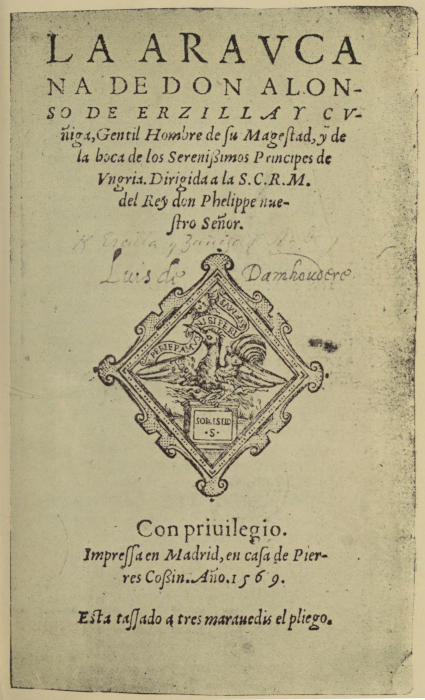
Title Page of the First Edition of “La Araucana”
Ercilla’s family
Alonso de Ercilla y Zúñiga was a member of the expedition sent by the viceroy to establish García de Mendoza in his office, and to carry on the war against the Araucanian Indians. He was born in Madrid on August 7, 1533. He was the youngest of the children of Dr. Fortún García de Ercilla and his wife Leonor de Zúñiga. His father was a famous jurisconsult, whose writings were read and commented upon in all the schools of Europe.[56]
Ercilla’s journeys
He became regent of Navarre and a member of the Council of Castille, and tutor of Prince Philip, who was later Philip II. He died at the age of forty in 1534, the year after the birth of the poet. It was a current tradition of the sixteenth century that the mother of Alonso de Ercilla was descended from the kings of Navarre. If this tradition represented a fact, there might be claimed for Don Alonso an aristocratic as well as an intellectual heritage. The seigniory of Bobadilla, which had belonged to his mother, was reunited to the crown, and the seignior became attached to the court of Charles V, where her young son was educated, subjected, doubtless, to the same system of instruction as that under which Prince Philip had grown up. It is probable that Alonso de Ercilla knew the Latin of Virgil and Lucian, but that his knowledge of Dante, Petrarch, and Ariosto was derived through translations. He entered the service of Philip in 1548, and accompanied that prince to Flanders on the occasion of Philip’s taking possession of the duchy of Brabant. The route of this journey was through Saragossa, Barcelona, Genoa, and Luxembourg, and the return was by the same way. A little later he went to Bohemia with his mother, who was in the suite of the Infanta María and her husband, the Archduke Maximilian. The young Ercilla undertook a third journey in 1554, accompanying Philip when that prince went to wed Mary Tudor, the Queen of England.
Alderete and Mendoza
While in England Ercilla learned that the Araucanians were in revolt, and that Hernández Girón was leading a rebellion against the legitimate government in Peru. The state into which affairs in Peru had fallen during the rebellion rendered the post of viceroy especially unattractive. Two persons to whom the king had offered it declined the honour. It was, however, accepted by Andrés Hurtado de Mendoza, Marqués de Cañete. Alderete, who had been in America, was in England with Philip’s escort. From him Ercilla got information that awakened his adventurous spirit, and he left Europe for America with the fleet that carried Alderete and Viceroy Mendoza. He arrived in Peru on July 6, 1556. Here he joined the expedition sent by the viceroy against the insurgent Araucanians. This expedition was commanded by the viceroy’s son, García Hurtado de Mendoza, a youth of twenty-one, who had been appointed governor of Chile.
On his arrival in Chile García de Mendoza arrested both Aguirre and Villagra and sent them to Lima. Thus freed from the embarrassing presence of the two rival claimants, he entered upon his campaign against the Araucanians, and on this campaign Ercilla acquired his first experience in warfare with the Indians. To describe the events of the war and his part in it was the primary purpose in writing La Araucana.
Ercilla in Chile
In Chile Ercilla found himself under conditions sharply in contrast with those of his life in Spain. A site had been selected for the town of Santiago, and plots had been assigned to soldier-colonists; but fourteen years after the arrival of Valdivia the Spanish occupation was represented only by a number of garrisoned posts confronting a region in possession of vigorous and hostile Indians. Ercilla had exchanged the circumstances of the artificial life of the Spanish court for warfare with a barbarous people in the presence of primitive nature. To a Spaniard of the sixteenth century an excursion beyond the limits of civilization, into the realm of savage life, was a stranger event than a similar experience would appear to a representative of these later generations. In the unfamiliar presence of primitive man and the primeval forest Ercilla was moved to set down his impressions of the life in which he had part, and of the nature that constituted his strange environment.
Ercilla condemned
Ercilla’s relation to the commander of the expedition had its unpleasant episodes. On the occasion of a dispute between him and Juan de Pineda, the supporters of each of the two parties drew their swords, when García de Mendoza interpreted the movement as the beginning of a mutiny, and condemned the two opponents to be beheaded. The activity of their friends, however, caused these ill-advised sentences to be commuted to imprisonment.[57] After his liberation from prison Ercilla continued his exploring expeditions and his participation in campaigns against the Araucanians, but he finally returned to Spain in 1562. Shortly after his arrival, having made a report to the king concerning his service in Chile, he went to Austria, where his mother held the position of a maid of honour at the imperial court. Returning from this journey in 1564, he remained a number of years in Madrid and published there the first part of La Araucana in 1569. The next year he married Doña María de Bazán, and in 1571 the king bestowed upon him the order of Santiago.
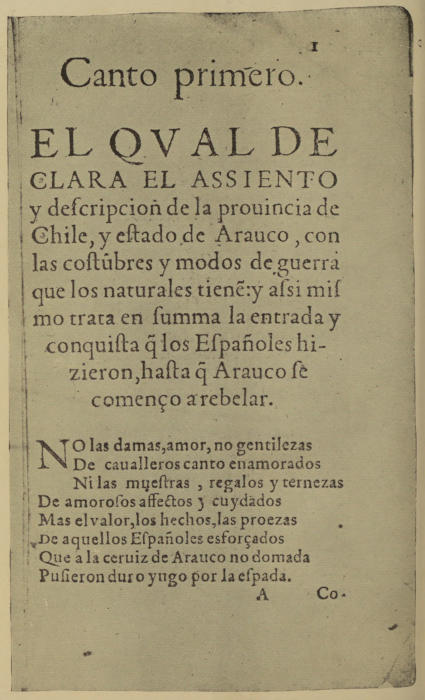
Page from the First Edition of “La Araucana”
Ercilla in Italy
Determined to seek further service, he went to Italy in 1574, to join the fleet, commanded by Don John of Austria, designed to proceed to the relief of Tunis, but before he arrived in Naples, Tunis had fallen into the hands of the Turks. At Rome he met one of his relatives, Juan de Zúñiga, then Spanish ambassador near the papal court. On a fourth journey to Austria he was graciously received by Emperor Maximilian and by the empress, María; also by his godfather, Rudolph, who had become king of Hungary. Ercilla returned to Spain in 1577. This was the last of his journeys into foreign countries. In 1578 he published at Madrid the second part of La Araucana.
The argument
The argument of the poem is stated in the first two octaves:
No las damas, amor, no gentilezas De caballeros canto enamorados; Ni las muestras, regalos, y ternezas De amorosos afectos y cuidados: Mas el valor, los hechos, las proezas De aquellos españoles esforzados, Que a la cerviz de Arauco, no domada, Pusieron duro yugo por la espada. Cosas diré también harto notables De gente que a ningún rey obedecen, Temerarias empresas memorables Que celebrarse con razón merecen; Raras industrias, términos loables Que más los españoles engrandecen; Pues no es el vencedor más estimado De aquello en que el vencido es reputado.[58]
Spain against Portugal
Soon after this publication the king sent Ercilla to Saragossa to confer there with the Duke of Brunswick and to persuade him to postpone his visit to Madrid. At the same time the question of the succession to the Portuguese crown seemed to portend war, and Ercilla looked forward to playing a conspicuous rôle in the projected campaign, and to celebrating once more in verse the glory of Spanish arms. But the opposition to Spain’s pretensions collapsed, and Portugal was annexed to Spain without exploits worthy of heroic song. The poet turned from literary work to religious devotion and prayer, and his tendency to melancholy was intensified in his last years by the loss of his brother, Juan, who was accompanying Philip II. to Portugal, and by the death of his only son, Diego. Somewhat of this attitude of mind finds expression in the last octave of his poem:
Y yo que tan sin rienda al mundo he dado El tiempo de mi vida más florido, Y siempre por camino despeñado Mis vanas esperanzas he seguido; Visto ya el poco fruto que he sacado, Y lo mucho que a Dios tengo ofendido, Conociendo mi error, de aquí adelante Será razón que llore y que no cante.[59]
The poet’s mental depression
This mental depression had also a cause in the withdrawal of the king’s favour as well as in the loss of relatives and friends and the fact that the poet faced old age without descendants.
In 1589 Ercilla published the third part of La Araucana. Some years later a new edition was issued, with two additional cantos, making the whole number thirty-seven.[60] He died in the city of Madrid on the 29th of November, 1594. The statement sometimes made that he died in extreme poverty does not appear to be supported by the fact that at the time of his death he had a household establishment consisting of twelve persons, to whom he bequeathed considerable sums, but with the statement that these sums were moderate, since all of these persons were expected to remain in the service of his widow, and derive advantage from her liberality. Among other bequests were five thousand ducats to his nieces and nephews, and ten thousand ducats as a contribution for the construction of a monastery, where his body and that of his widow might be buried.
The writing of the poem
The early cantos
Some part of La Araucana was written amid the scenes, and in connexion with the events, described. In his Prólogo Ercilla has stated that he wrote at hours stolen from the occupations of war in Chile, and sometimes on pieces of leather or of hides for want of paper, or on fragments of letters often only large enough to hold six lines; and it often required much effort and trouble to arrange these fragments in their proper order. This method of writing, as the author confesses, gave to his poem in some respects the quality of a journal in verse. This was especially true of those parts that were written during the campaign against the Araucanians, dealing with what he saw or with the events in which he participated; and these parts may be accepted as having the historical authority of a contemporary chronicle. This quality may be more particularly ascribed to the first fifteen cantos, the first published after the author’s return to Spain. And these cantos, during the seven years between the author’s arrival in Europe and their publication, underwent extensive modification and elaboration. It does not, however, appear probable that much if any of the second part was written in America, but that the author undertook it, “having promised to continue this history.” In the preface to the second part he affirms that he has continued it with no little difficulty and ennui, on account of the severity and monotony of the material, “since from the beginning to the end it contains only one and the same subject.”
The composition of La Araucana was interrupted many times by the author’s journeys and his diplomatic services. After Ercilla’s return to Spain the events of the Indian wars and the spirit of the contending parties gradually became indistinct in his mind. He departed from his original purpose “not to sing of love and the gallantry of enamoured knights,” and, under the influence of Italian models, introduced invented tales of romantic adventure, leaving the poem, in some sense, a mechanical mixture of historical narrative and romantic episodes.
Ercilla wanted a hero
The Araucanian war presented no leader on either side whose prominence entitled him to be treated as the prominent hero of the conflict. For this reason Ercilla is obliged to allow one figure after another to occupy the centre of the stage. Although his purpose was to glorify Spanish arms, the heroes who have appealed most strongly even to the inhabitants of Chile are the Araucanian chiefs. In the struggle for emancipation from Spain the Chileans were especially incited to action by the heroism of Caupolicán, Lautaro, Tucapel, Colocolo, and Galvarino. Parents named their children after these heroes, and the name of Lautaro was applied to the patriotic association of the early advocates of Spanish-American independence. Thus the inspiring figures in the narrative of the war are not the Spanish but the Indian leaders. It is quite possible that Ercilla’s resentment at the treatment he received at the hands of García de Mendoza prevented the commander’s figure from assuming greater importance in the poem.
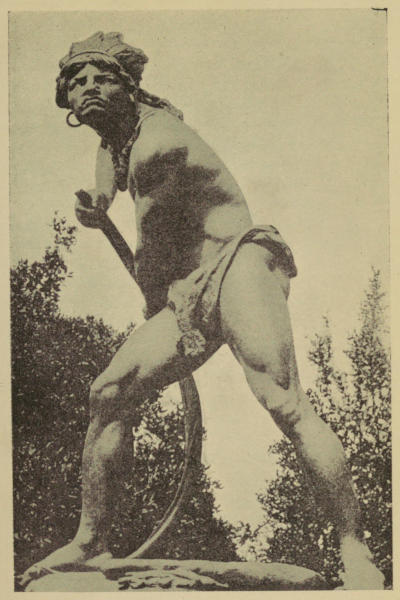
Statue of Caupolicán in Santiago de Chile
The magnified chiefs
Lautaro is described as a young man of medium height, solidly formed, with strong limbs and strong shoulders, and endowed with moral qualities not less advantageous than his physical qualities; audacious and unafraid, prompt to act, resourceful and heroic under critical circumstances; when the circumstances allowed him leisure, he knew how to prepare slowly and carefully for a difficult enterprise, to take as his soldiers even the most reckless and villainous of the Araucanians, to subject them to an iron discipline, and to inspire in them love and admiration for a chief who punished implacably with death the slightest infraction of his orders; yet in the story of the love that existed between him and the beautiful Guacolda the poet has revealed the gentler traits of his hero’s character.[61]
Caupolicán
In the list of Araucanian heroes an especially prominent place is accorded to Caupolicán, as typifying the strength and pride of his people, their contempt of pain and even of death. Ercilla gives the following description of him in the forty-seventh octave of the second canto:
Era este noble mozo de alto hecho, Varón de autoridad, grave y severo, Amigo de guardar todo derecho, Áspero y riguroso justiciero, De cuerpo grande y relevado pecho, Hábil, diestro, fortísimo y ligero, Sabio, astuto, sagaz, determinado, Y en casos de repente reportado.[62]
Tucapel
Tucapel is presented as a noisy and ferocious savage, always ready for any adventure, for a fight with the Spaniards or with the chiefs of his own race, unwilling to recognise any authority from any source, opposed to all arguments and to the traditions of his people; endowed with the physical qualities of a Hercules; turbulent, wilful, impious, and boastful of his ability to conquer the world single-handed. Recalling the heroic character of Milton’s Satan, the Araucanian heroes are presented by Ercilla in such a form as to excite admiration, although they appear as the determined enemies of Europeans and of European civilization.
Colocolo’s speech
But these great chiefs have become less widely known than the less noteworthy Colocolo, whom Voltaire celebrates in his Essay on Epic Poetry, by quoting the speech to the caciques and by comparing Ercilla’s Colocolo with Homer’s Nestor. Colocolo addresses the chiefs, or caciques, who are contending among themselves for pre-eminence and leadership, and he seeks for a solution of the contest that will preserve the moral equality of the chiefs:
“Caciques, del estado defensores, Codicia de mandar no me convida A pesarme de veros pretensores De cosa que a mi tanto era debida: Porque, según mi edad, ya véis, señores, Que estoy al otro mundo de partida; Mas el amor que siempre os he mostrado A bien aconsejaros me ha incitado. “¿Por qué cargos honrosos pretendemos Y ser en opinión grande tenidos, Pues que negar al mundo no podemos Haber sido sujetos y vencidos? Y en esto averiguarnos no queremos, Estando aún de españoles oprimidos: Mejor fuera esa furia ejecutalla Contra el fiero enemigo en la batalla. “¿Qué furor es el vuestro ¡oh Araucanos! Que a perdición os lleva sin sentillo? Contra vuestras entrañas tenéis manos, Y no contra el tirano en resistillo? ¿Teniendo tan a golpe a los cristianos Volvéis contra vosotros el cuchillo? Si gana de morir os ha movido, No sea en tan bajo estado y abatido. “Volved las armas y ánimo furioso A los pechos de aquellos que os han puesto En dura sujeción, con afrentoso Partido, a todo el mundo manifiesto; Lanzad de vos el yugo vergonzoso; Mostrad vuestro valor y fuerza en esto: No derrameis la sangre del Estado Que para redimirnos ha quedado. “No me pesa de ver la lozanía De vuestro corazón, antes me esfuerza; Mas temo que esta vuestra valentía Por mal gobierno el buen camino tuerza: Que, vuelta entre nosotros la porfía, Degolláis vuestra patria con su fuerza: Cortad, pues, si ha de ser desa manera Esta vieja garganta la primera: “Que esta flaca persona, atormentada De golpes de fortuna, no procura Sino el agudo filo de una espada, Pues no la acaba tanta desventura. Aquella vida es bien afortunada Que la temprana muerte la asegura; Pero, a nuestro bien público atendiendo, Quiero decir en esto lo que entiendo. “Pares sois en valor y fortaleza; El cielo os igualó en el nacimiento; De linaje, de estado y de riqueza Hizo a todos igual repartimiento; Y en singular por ánimo y grandeza Podéis tener del mundo el regimiento: Que este gracioso don, no agradecido, Nos ha al presente término traído. “En la virtud de vuestro brazo espero Que puede en breve tiempo remediarse, Mas ha de haber un capitán primero Que todos por él quieran gobernarse: Este será quien más un gran madero Sustentare en el hombro sin pararse; Y pues que sois iguales en la suerte, Procure cada cual de ser más fuerte.” Canto II., Oct. 28, et seq.[63]
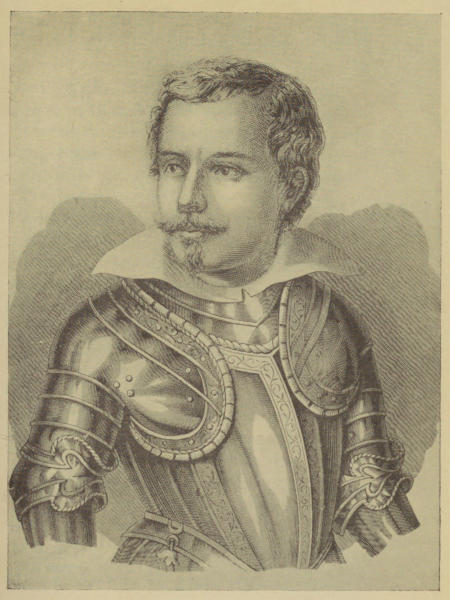
García Hurtado de Mendoza, 8th Viceroy of Peru 1590-1596
García de Mendoza
Ercilla on Ercilla
The prominent Spaniards are sketched less clearly than the Indians, appealing apparently less powerfully to the poet’s imagination. Yet the sketch of García de Mendoza, the youthful commander of the expedition, appears exaggerated when it is remembered that he was a youth of twenty-one and that some of his actions showed a wisdom not beyond his years. But among the characters that appear in the poem, not the least conspicuous is Ercilla himself. The references to his journeys and explorations throw an important side-light on the early history of Chile. These references, moreover, show him as a champion of the more admirable features of civilization. He opposes the useless cruelty of his compatriots; he is humane towards the vanquished; proud to repel the indignities offered by the commander; religious but not fanatical; a knight of the Middle Ages, animated by a certain pride in enduring the hardships and facing the dangers presented by a barbarous enemy in an unexplored region; a chivalrous hero, but too sober-minded to be drawn into quixotic enterprises.[64]
Ercilla’s limited knowledge of Indians
The poet’s philosophy
Ercilla presents the Araucanian heroes speaking to their countrymen as Spaniards might have spoken under similar circumstances. Evidently his knowledge of them was too superficial to enable him to set forth their psychological peculiarities, but he makes their individuality distinct by descriptions of their dress. His lack of intimate knowledge of the Indian mind may be indicated by the fact that apart from geographical terms he uses few words of a local origin or meaning, or that might not have been understood in Spain before the discovery of America. It is not merely descriptions of dress or of persons that certain critics have found admirable, but descriptions of events, of battles, as well. Considering this quality, however, there has existed a wide divergence of judgments, and the extreme unevenness of the poem suggests that some feature of it may be found to justify each view. The course of the narrative is here and there interrupted by the introduction of rhetorical speeches, and by reflections that seem to embody a philosophy or views of life, and these views indicate an uncheerful, if not a pessimistic, philosophy. In the fourth octave of the second canto he announces that “the most assured benefit of fortune is not to have ever had it”; and in the first octave of the twenty-sixth canto he finds that “the coming of one good after another is very doubtful, while one evil after another is always certain. The time of prosperity was never lasting, and the time of misery has never ceased.” This mournful note recurs frequently throughout the poem until the final lamentation of the last octave.
Barbarian innocence
But in certain passages there are anticipations of the doctrine that prevailed in France two hundred years later, the doctrine of the uncorrupted virtue of uncivilized society. This octave, the thirteenth of the thirty-sixth canto, is an indication:
La sincera bondad y la caricia De la sencilla gente de estas tierras Daban bien a entender que la codicia Aún no había penetrado aquellas sierras; Ni la maldad, el robo y la injusticia (Alimento ordinario de las guerras) Entrada en esta parte habían hallado Ni la ley natural inficionado.[65]
Orlando Furioso
The marked attention given to Orlando Furioso in Spain in the sixteenth century made inevitable its influence on Ercilla. This poem was twice translated into Spanish verse in the year 1549-1550, by Jerónimo de Urrea and Hernando de Alcocer, and later a prose translation was made by Vázquez de Contreras.
Seven editions of Urrea’s translation were issued before 1564, and Ariosto appears to have been a principal source of Ercilla’s inspiration, but the vigorous and positive spirit of the Spaniard was not able to acquire the Italian’s gifts of facility, grace, and fancy.[66]
Style of La Araucana
A view of Ercilla
A criticism of the style of La Araucana is hardly involved in the purpose of the present writing. Concerning this subject reliance must be placed on the judgment of Spanish critics, by whom one will find the excellences and defects of Ercilla’s verses sufficiently emphasized. There are stretches of dull and loose narration, but here and there are spirited verses, and octaves as fine as any found elsewhere in the Spanish language; but in this age of rapid movement, in these days of social impatience, three hundred and forty years after its publication, the reading of the poem is likely to be confined to persons who on account of their nationality or for other reasons have a special interest in the romantic history of the Spanish conquest in Chile. It is on its quality as history that stress must be laid. “Ercilla,” to quote a French critic, “n’était qu’un historien fourvoyé dans la poésie.... Il manquait surtout de sensibilité, de tendresse, pour mieux dire, et c’est selon nous, la grande cause de son infériorité. Il ne parait avoir ressenti vivement que l’ivresse brutale des combats. Il quitte la patrie sans un soupir, il la retrouve sans un transport. Il n’a fait parler ni l’amour paternel, ni l’amour filial. Les amants et les époux qu’il met en scène sont des raisonneurs froids, sententieux et subtils, et s’il leur échappe par hasard un cri passionné nous y percevons l’écho d’une plainte antique.”[67]
In his Retórica poética, Barros Arana affirms that Ercilla “describes with ardour” the combats and naturally and correctly the localities, sketches regularly the characters, and puts beautiful speeches into the mouth of his heroes, but his work lacks the plan and the necessary unity of an epic to such a degree that instead of a poem it appears as a poetical history of the war it celebrates.[68]
Popularity of the poem
But in spite of its shortcomings there are few books that have been oftener printed, and, like the other great modern historical poems, it has enjoyed a very noteworthy popularity. Even in recent times new and popular editions have appeared, and in the last half of the nineteenth century Alexandre Nicolas translated it into French prose, published at Paris in two volumes in 1869. It had already been translated into German by C. M. Winterling thirty-eight years earlier. An abridged translation into French, by Gilibert de Merlhiac, appeared in 1824. The metrical translation of parts of the poem into English, published in the translation of Molina’s Historia de Chile (Middletown, Conn., 1808) hardly merits comment. The most striking success of the poem was achieved in Chile, where the people, ignorant of all the favourable and unfavourable contentions of the critics, have regarded it as their Iliad, celebrating the beginning of their national life.
Hechos de Don García
Character of Figueroa’s book
Life of Figueroa
Ercilla’s apparent determination to belittle the achievements of the Governor of Chile called forth the Hechos de Don García Hurtado de Mendoza, el Marqués de Cañete, by Suárez de Figueroa, who, although not a Chilean, was induced to write on a Chilean topic. His work was an attempt to overtake and smother an advanced damaging report. Don García, when in command of the expedition against the Araucanians, as already suggested, condemned Ercilla to death, a sentence later modified under the protests of persons who comprehended its injustice. After this incident Don García did not find either his leadership or his character glorified in La Araucana. This was a source of regret not only to himself but also to his family. He died in obscurity, and after this event his relatives sought to rehabilitate his memory for posterity. They approached Dr. Cristóbal Suárez de Figueroa, proposing that he should undertake the task, should become the eulogist of a person on whom an unfavourable verdict had already been pronounced. He accepted the proposal, and of the seven books into which his work was divided the first three treat of Don García’s campaigns in Chile; the others deal with his government as viceroy of Peru, Mendaña’s expedition to the Solomon Islands, and the inglorious years of disgrace. In view of the judgments of history, Figueroa’s extravagant panegyric appears absurd. It may be said in favour of the book that it presents papers or documents given to the author by the Mendoza family, which furnish details of the viceroy’s life not otherwise known. But, on the other hand, it deals with a country which Figueroa had not visited, and with conditions of which he was almost entirely ignorant, thus making inevitable an abnormal perspective and false emphasis. The book is, however, written in “flowing and elegant language that is only rarely found in the historians of America; and in order to add interest to the work the author introduced rhetorical descriptions of a country he had not seen and of battles that were scarcely referred to in the documents.”[69]