GRANADA. (continued 2)
Stanley Rhoads Varnall translation
"Now that you have seen all the marvels of Moorish art and tropical vegetation there remains the suburb of the Albaicin to be seen before you can say that you know Granada. Prepare your mind for a new world, put your hand on your purse, and follow me."
So said Gongora to me on the last evening of my sojourn in Granada. A Republican journalist was with us, Melchiorre Almago by name, the director of the Idea, a congenial, affable young man, who to accompany us sacrificed his dinner and a leading article that he had been cogitating since morning.
We walked on until we came to the square of the Audiencia. There Gongora pointed out an alley winding up a hill, and said to me, "Here commences the Albaicin;" and Señor Melchiorre, touching a house with his cane, added, "Here commences the territory of the republic."
We turned up the alley, passed from it into another, and from that into a third, always ascending, without my seeing anything extraordinary, although I looked curiously in every direction. Narrow streets, squalid houses, old women dozing on the doorsteps, mothers carefully inspecting their children's heads, gaping dogs, crowing cocks, ragged boys running and shouting, and the other things that one always sees in the suburbs; but in those streets nothing more. But gradually, as we ascended, the appearance of the houses and the people began to change; the roofs became lower, the windows fewer, the doors smaller, and the people more ragged. In the middle of every street ran a little stream in a walled gutter, in the Moorish style; here and there over the doors and around the windows one saw the remains of arabesques and fragments of columns, and in the corners of the squares fountains and well-curbs of the time of the Moorish dominion. At every hundred steps it seemed as if we had gone back fifty years toward the age of the caliphs. My two companions touched me on the elbow from time to time, saying as they did so, "Look at that old woman!"—"Look at that little girl!"—"Look at that man!" and I looked, and asked, "Who are these people?" If I had unexpectedly found myself in that place, I should have believed on seeing those men and women that I was in an African village, so strange were the faces, the dress, the manner of moving, talking, and looking, at so short a distance from the centre of Granada—so different were they from the people that I had seen up to that time. At every turn I stopped to look in the face of my companions, and they answered, "That is nothing; we are now in the civilized part of the Albaicin; this is the Parisian quarter of the suburb; let us go on."
We went on, and the streets seemed like the bed of a torrent—paths hollowed out among the rocks, all banks and gullies, broken and stony—some so steep that a mule could not climb them, others so narrow that a man could scarcely pass; some blocked by women and children sitting on the ground, others grass-grown and deserted; and all so squalid, wild, and uncouth that the most wretched of our villages cannot give one an idea of them, because this is a poverty that bears the impress of another race and another continent. We turned into a labyrinth of streets, passing from time to time under a great Moorish arch or through a high square from which one commanded a view of the wide valleys, the snow-covered mountains, and a part of the lower city, until finally we arrived at a street rougher and narrower than any we had yet seen; and there we stopped to take breath.
"Here commences the real Albaicin," said the young archeologist. "Look at that house!"
I looked; it was a low, smoke-stained, ruinous house, with a door that seemed like the mouth of a cavern, before which one saw, under a mass of rags, a group, or rather a heap, of old women and little children, who upon our approach raised their eyes heavy with sleep, and with bony hands removed from the threshold some filth which impeded our passage.
"Let us enter," said my friend.
"Enter?" I demanded.
If they had told me that beyond those walls there was a facsimile of the famous Court of Miracles which Victor Hugo has described, I should not have doubted their word. No door has ever said more emphatically than that, "Stand back!" I cannot find a better comparison than the gaping mouth of a gigantic witch breathing out pestilential vapors. But I took courage and entered.
Oh, marvellous! It was the court of a Moorish house surrounded by graceful little columns surmounted by lovely arches, with those indescribable traceries of the Alhambra along the porticoes and around the mullioned windows, with the beams and ceiling carved and enamelled with little niches for vases of flowers and urns of perfume, with a pool in the middle, and all the traces and memorials of the delicate life of an opulent family. And in that house lived those wretched people!
We went out and entered other houses, in all of which I found some fragments of Moorish architecture and sculpture. From time to time Gongora would say to me, "This was a harem. Those were the baths of the women; up yonder was the chamber of a favorite;" and I fixed my eyes upon every bit of the arabesqued wall and upon all the little columns of the windows, as if to ask them for a revelation of their secrets—only a name or a magic word with which I might reconstruct in an instant the ruined edifice and summon the beautiful Arabians who had dwelt there. But, alas! amid the columns and under the arches of the windows there were only rags and wrinkled faces.
Among other houses, we entered one where we found a group of girls sewing under the shade of a tree in the courtyard, directed by an old woman. They were all working upon a great piece of cloth that seemed like a mat or a bed-spread, in black and gray stripes. I approached and asked one of the girls, "What is this?"
They all looked up and with a concerted movement spread the cloth open, so that I could see their work plainly. Almost before I had seen it I cried, "I will buy it."
They all began to laugh. It was the mantle of an Andalusian mountaineer, made to wear in the saddle, rectangular in form, with an opening in the middle to put one's head through, embroidered in bright-colored worsteds along the two shortest sides and around the opening. The design of the embroideries, which represented birds and fantastic flowers, green, blue, white, red, and yellow, all in a mass, was as crude as a pattern a child might make: the beauty of the work lay altogether in the harmony of the colors, which was truly marvellous. I cannot express the sensation produced by the sight of that mantle, except by saying that it laughed and filled one with its cheerfulness; and it seems to me impossible to imagine anything gayer, more festive, or more childishly and gracefully capricious. It was a thing to look upon in order to bring yourself out of a bad humor, or when you wish to write a pretty verse in a lady's album, or when you are expecting a person whom you wish to receive with your brightest smile.
"When will you finish these embroideries?" I asked one of the girls.
"Hoy mismo" (to-day), they all replied in chorus.
"And what is the mantle worth?"
"Cinco" (five), stammered one.
The old women pierced her with a glance which seemed to say, "Blockhead!" and answered hastily, "Six duros."
Six duros are thirty francs; it did not seem much to me, and I put my hand in my pocket.
Gongora cast a withering glance at me which seemed to say, "You simpleton!" and, drawing me back by the arm, said, "One moment: six duros is an exorbitant price."
The old woman shot him another glance which seemed to say, "Brigand!" and replied, "I cannot take less."
Gongora gave her another glance, which seemed to say, "Liar!" and said, "Come, now; you can take four duros; you would not ask more from the country-people."
The old woman insisted, and for a while we continued to exchange with our eyes the titles of simpleton, swindler, marplot, liar, pinch-penny, spend-thrift, until the mantle was sold to me for five duros, and I paid and left my address, and we went out blessed and commended to God by the old woman and followed a good way by the black eyes of the embroiderers.
We went on from street to street, among houses increasingly wretched and growing blacker and blacker, and more revolting rags and faces. But we never came to the end, and I asked my companions, "Will you have the goodness to tell me if Granada has any limits, and if so where they are? May one ask where we are going and how we shall return home?" But they simply laughed and went forward.
"Is there anything stranger than this to be seen?" I asked at a certain point.
"Stranger?" they both replied. "This second part of the suburb which you have seen still belongs to civilization: if not the Parisian, it is at least the Madrid, quarter of the Albaicin, and there is something else; let us go on."
We passed through a very small street containing some scantily-clothed women, who looked like people fallen from the moon; crossed a little square full of babies and pigs in friendly confusion; passed through two or three other alleys, now climbing, now descending, now in the midst of houses, now among piles of rubbish, now between trees and now among rocks, until we finally arrived at the solitary place on a hillside from which we saw in front the Generalife, to the right the Alhambra, and below a deep valley filled with a dense wood.
It was growing dark; no one was in sight and not a voice was heard.
"Is this the end of the suburb?" I asked.
My two companions laughed and said, "Look in that direction."
The Alhambra and the Valley of the Darro
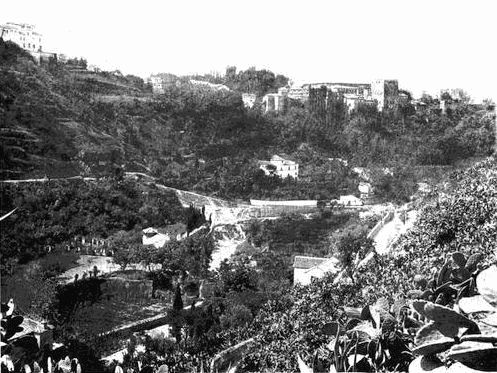
I turned and saw along the street that was lost in a distant grove an interminable row of houses. Of houses? Rather of dens dug in the earth, with a bit of wall in front, with holes for windows and crevices for doors, and wild plants of every sort on top and along the sides—veritable caves of beasts, in which by the glow of faint lights, scarcely visible, swarmed the gypsies by hundreds; a people multiplying in the bowels of the mountain, poorer, blacker, and more savage than any seen before; another city, unknown to the greater part of Granada, inaccessible to the police, closed to the census-officers, ignorant of every law and of all government, living one knows not how, how numerous no one knows, foreign to the city, to Spain, and to modern civilization, with a language and statutes and manners of their own—superstitious, false, thieving, beggarly, and fierce.
"Button up your coat and look out for your watch," said Gongora to me, "and let us go forward."
We had not taken a hundred steps when a half-naked boy, black as the walls of his hovel, ran out, gave a cry, and, making a sign to the other boys who followed him, dashed toward us; behind the boys came the women; behind the women the men, and then old men, old women, and more children; and in less time than it takes to tell it we were surrounded by a crowd. My two friends, recognized as Granadines, succeeded in saving themselves; I was left in the lurch. I can still see those horrid faces, still hear those voices, and still feel the pressure of those hands: gesticulating, shouting, saying a thousand things which I did not understand; dragging at my coat, my waistcoat, and my sleeves, they pressed upon me like a pack of famished people, breathed in my face, and cut off my very breath. They were, for the most part, half naked and emaciated—their garments falling in tatters, with unkempt hair, horrible to see; I seemed to be like Don Roderick in the midst of a crowd of the infected in that famous dream of the August night.
"What do these people want?" I asked myself. "Where have I been brought? How shall I get out of this?" I felt almost a sense of fear, and looked around uneasily. Little by little I began to understand.
"I have a sore on my shoulder," said one; "I cannot work; give me a penny."
"I have a broken leg," said another.
"I have a palsied arm."
"I have had a long sickness."
"Un cuarto, Señorito!"
"Un real, caballero!"
"Una peseta para todos!"
This last request was received with a general cry of approval: "Una peseta para todos!" (a peseta for us all).
With some little trepidation I drew out my purse; they all stood on tiptoe; the nearest poked their chins into it; those behind put their chins on the heads of those in front; the farthest stretched out their arms.
"One moment," I cried. "Who has the most authority among you all?"
They all replied with one voice, stretching out their arms toward the same person, "That one."
It was a terrible old hag, all nose and chin, with a great tuft of white hair standing straight above her head like a bunch of feathers, and a mouth which seemed like a letter-box, with little clothing save a chemise—black, shrivelled, and mummified; she approached me bowing and smiling, and held out her hands to take mine.
"What do you want?" I demanded, taking a step backward.
"Your fortune," they all cried.
"Tell my fortune, then," I replied, holding out my hand.
The old woman took my poor hand between her ten—I cannot say fingers, but shapeless bones—placed her sharp nose on it, raised her head, looked hard at me, pointed her finger toward me, and, swaying and pausing at every sentence as if she were reciting poetry, said to me in inspired accents, "Thou wert born upon a famous day.
"Upon a famous day also shalt thou die.
"Thou art the possessor of amazing riches."
Here she muttered I know not what about sweethearts and marriage and felicity, from which I understood that she supposed I was married, and then she continued: "On the day of thy marriage there was great feasting in thy house; there were many to give and take.
"And another woman wept.
"And when thou seest her the wings of thy heart open."
And so on in this strain, saying that I had sweethearts and friends and treasures and jewels in store for me every day of the year, in every country of the world. While the old woman was speaking they were all silent, as if they believed she had prophesied truly. She finally closed her prophecy with a formula of dismissal, and ended the formula by extending her arms and making a skip in a dancing attitude. I gave her the peseta, and the crowd broke into shouting, applause, and singing, making a thousand uncanny hops and gestures around me, saluting me with nudges and slaps of the hand on my back, as if I were an old friend, until finally, by dint of wriggling and striking now one and then another, I succeeded in opening a passage and rejoined my friends. But a new danger threatened us. The news of the arrival of a foreigner had spread, the tribes were in motion, the city of the gypsies was all in an uproar; from the neighboring houses and from the distant huts, from the top of the hill and the bottom of the valley, ran boys, women with babies about their necks, old men with canes, cripples, and professional imposters, septuagenarian prophetesses who wished to tell my fortune—an army of beggars coming upon us from every direction. It was night; there was no time for hesitation; we broke into a run toward the city like school-boys. Then a devilish cry broke out behind us, and the nimblest began to chase us. Thanks to Heaven! after a short race we found ourselves in safety—tired and breathless, and covered with dust, but safe.
"It was necessary to escape at any cost," said Señor Melchiorre with a laugh; "otherwise we should have gone home without our shirts."
"And take notice," added Gongora, "that we have seen only the door of Gypsy-town, the civilized part, not the Paris nor the Madrid, but at least the Granada, of the Albaicin. If we could only have gone on! if you could have seen the rest!"
"But how many thousand are there of those people?" I demanded.
"No one knows."
"How do they live?"
"No one can imagine."
"What authority do they recognize?"
"One only—los reyes (the kings), the heads of families or of houses, those who have the most money and years. They never go out of their city; they know nothing, they live in the dark as to all that happens beyond the circle of their hovels. Dynasties fall, governments change, armies clash, and it is a miracle if the news ever reaches their ears. Ask them if Isabella is still on the throne; they do not know. Ask them who Amadeus is; they have never heard his name. They are born and perish like flies, and they live as they lived centuries ago, multiplying without leaving their own boundaries, ignorant and unknown, seeing nothing all their lives beyond the valleys lying below their feet and the Alhambra towering above their heads."
We passed again through all the streets that we had traversed, now dark and deserted, and endless as it seemed to me; and, climbing and descending, turning and twisting, and turning again, we finally arrived at the square of the Audiencia in the middle of the city of Granada—in the civilized world. At the sight of the brightly-lighted cafés and shops I experienced a feeling of pleasure, as if I had just returned to city-life after a year's sojourn in an uninhabited wilderness.
On the evening of the next day I left for Valencia. I remember that a few moments before starting, as I was paying my hotel-bill, I observed to the proprietor that there was an overcharge for one candle, and playfully asked him, "Will you deduct it for me?" The proprietor seized his pen, and, deducting twenty centimes from the total charge, replied in a voice which he wished to appear emotional, "The devil! among Italians!"