Volume 4 — CHAPTER V AT CHIEVELEY AGAIN (continued 2)
Reading edition
While all this was going forward, from the balcony of the gaol a wondering crowd of Boer prisoners looked on agape. They could barely believe the evidence of their eyes: the town was free. Had their compatriots at last turned tail and bolted? They stared down on the vast interminable avenue of men and guns winding through what only the day before yesterday was a fiery concave—watched a continuous moving multitude, tattered and begrimed, saddle-brown and burly—and little by little began to fathom the meaning to themselves of this mighty display. The despised rooineks had, after all, not even been thrust into the sea: in fact, it appeared that the sea had cultivated a trick of casting up rooineks by the thousand, to be killed in scores only to come up in swarms!
By-and-by, when the military parade was over, the Mayor of the town, Mr. Farquhar, presented Sir George White with an address, in which the corporation and inhabitants expressed their appreciation of all that he had done for them in those dark days of durance. Flattering reference was also made to the services of General Hunter and Colonel Ward (A.A.G.). To these officers the General, in reply, alluded gratefully, eulogising the work done by the former, and describing the latter as the “best supply officer since Moses.” He then called attention to the stubborn patience of the civilians of Ladysmith, “who had borne themselves like good and true soldiers throughout a very trying time.” These remarks were followed by three hearty cheers for the civilians of Ladysmith. The Mayor expressed his pride in the manner the civilian population had comported itself, and the excellent feeling that had existed between both civil and military authorities. He then presented an illuminated address to Sir Redvers Buller, of which the following is the text:—
“We, the Mayor and members of the Town Council of the borough of Ladysmith, Natal, and as such representing the inhabitants of the said borough, beg most respectfully to welcome with great joy the arrival of yourself and your gallant soldiers at our township, and to express to you our most sincere and heartfelt appreciation of your noble and courageous efforts in the relief of this long-beleaguered borough. As members of the great British Empire, as loyal subjects of Her Most Gracious Majesty the Queen, and as colonists of Natal, we beg respectfully to tender you our most hearty thanks, realising as we do the magnitude and difficulty of the work you have accomplished. At the same time our sympathies are great for the heavy losses among your gallant troops that have occurred in your successful efforts to relieve us.”
The following telegrams were sent to Sir Redvers Buller and Sir George White by the Queen.
To Sir Redvers Buller:—
“Thank God for news you have telegraphed to me. Congratulate you and all under you with all my heart.
“V.R.I.”
To Sir George White:—
“Thank God that you and all those with you are safe after your long and trying siege, borne with such heroism. I congratulate you and all under you from the bottom of my heart. Trust you are all not very much exhausted.
“V.R.I.”
Reply from Sir George White to the Queen:—
“Your Majesty’s most gracious message has been received by me with deepest gratitude and with enthusiasm by the troops.
“Any hardships and privations are a hundred times compensated for by the sympathy and appreciation of our Queen, and your Majesty’s message will do more to restore both officers and men than anything else.
“General Sir George White, Ladysmith.”
The following telegram was received by the Queen from Sir Redvers Buller:—
“Troops much appreciate your Majesty’s kind telegram.
“Your Majesty cannot know how much your sympathy has helped to inspire them.
“General Buller.”
An additional telegram was sent by the Queen to Sir Redvers Buller on the 2nd inst.:—
“Pray express to the Naval Brigade my deep appreciation of the valuable services they have rendered with their guns.
“V.R.I.”
Later on a special Army Order was issued as follows:—
Gallantry of Irish Regiments in South Africa—Distinction to be Worn on St. Patrick’s Day.
Her Majesty the Queen is pleased to order that in future, upon St. Patrick’s Day, all ranks in her Majesty’s Irish regiments shall wear, as a distinction, a sprig of shamrock in their headdress, to commemorate the gallantry of her Irish soldiers during the recent battles in South Africa.
Soon after this came the transformation scene. Seventy-three waggon-loads of supplies, eleven of which contained hospital comforts, began to wind into the town. Major Morgan and Colonel Stanley, like fairy godmothers in the story-book, waved the wand of office, and promptly the machinery began to revolve, and manna in the form of nourishing food-stuffs poured into the famished regions. The Boers, too, in the precipitate retreat had left welcome loads of grass, herds, and ammunition—the ammunition of the besieged was well-nigh exhausted—besides individual necessaries which came in handy. But of course, the machinery of relief, well as it worked, could scarcely work fast enough to make an appreciable result, and save invalids who were sinking from the protracted trial. It was amazing how the sick-list swelled. Many who had come into the town jocund and jaunty, found themselves in a few hours clutched by the fell fever. It was enough but to breathe the tainted atmosphere to fall sick, and those who were seized at once discovered all the horror of helplessness in an area where provision for the comfort of the suffering was well-nigh exhausted. Looking back on the past from the new standpoint, the gaps became more than ever remarkable; for, despite incessant fighting, shot and shell were responsible for less lives than famine and fever.
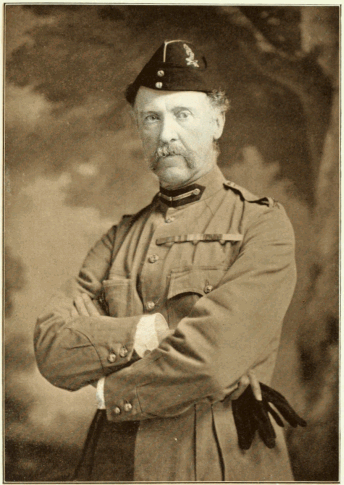
LIEUT.-GENERAL HON. N. G. LYTTELTON, C.B. Photo by Elliott & Fry, London.
Ladysmith at the commencement of the siege held some 13,496 fighting men and over 2000 civilians. Owing to sickness and hard fighting, the number had diminished to 10,164 men. There were about 2000 in hospital, but the death-rate practically increased only when, after January, food, nourishment of all kinds, and medical appliances grew scarce. At that time sickness of whatever kind assumed an ominous aspect; there was no chance of relief. It was impossible for languishing men to apply themselves to the soup made of old horse and mule, which was gladly devoured by those who had still the appetite without the means of appeasing it. From the 15th of January death stalked abroad uncombated; later he held carnival. Many died from wounds, very slight wounds, received on the 6th of January, from which they had not stamina to recover; the fevered and weakly dropped off from sheer starvation and famine; the gaunt talons needed scarcely to touch them, for they were exhausted, and some of them were glad to go. The deaths as a result of fighting were 24 officers and 235 men, while those attributed to sickness numbered six officers and 520 men, exclusive of white civilians.
The following special Army Order was issued:—
“The relief of Ladysmith unites two forces which have striven with conspicuous gallantry and splendid determination to maintain the honour of their Queen and country. The garrison of Ladysmith for four months held the position against every attack with complete success, and endured its privations with admirable fortitude. The relieving force had to make its way through unknown country, across unfordable rivers, and over almost inaccessible heights, in the face of a fully-prepared, well-armed, tenacious enemy. By the exhibition of the truest courage, which burns steadily besides flashing brilliantly, it accomplished its object and added a glorious page to our history. Sailors, soldiers, Colonials, and the home-bred have done this, united by one desire and inspired by one patriotism.
“The General Commanding congratulates both forces on their martial qualities, and thanks them for their determined efforts. He desires to offer his sincere sympathy to the relatives and friends of the good soldiers and gallant comrades who have fallen in the fight. Buller.”
Less formally and with more warmth the Chief addressed himself to his friends in England. He said:—
“We began fighting on the 14th February, and literally fought every day and nearly every night till the 27th. I am filled with admiration for the British soldiers; really, the manner in which they have worked, fought, and endured during the last fortnight has been something more than human. Broiled in a burning sun by day, drenched in rain by night, lying but 300 yards off an enemy who shoots you if you show as much as a finger; they could hardly eat or drink by day, and as they were usually attacked at night they got but little sleep; and through it all they were as cheery and willing as could be.”
Telegraphic wires and cables wore themselves out in repeating congratulation on the relief of Ladysmith. Veritably all the winds of heaven seemed to repeat them. From north, south, east, and west came the chorus of acclamation, a chorus most reviving to the magnificent multitude both inside and outside the place, who had been ready to offer up their heart’s blood on the altar of patriotism. Though the haunted and worn look could not die out of the faces of the sufferers in a moment, they had already begun to mend; though the shrunken and emaciated forms could not at once be relieved from the starvation and disease which had wasted them, there was over all a soothing glow of hope that acted magically, beatifically, as the mists of sunrise over a squalid landscape.
On the 9th of March Sir George White, looking much worn, he having suffered from Indian fever brought on by the malarious surroundings, left with his staff. The General addressed the Gordon Highlanders who formed the guard of honour, and in few and affecting words bade them farewell.