Volume 4 — CHAPTER I THE TURNING OF THE TIDE (continued 2)
Reading edition
“My horse had died with my last message to the 1st Brigade, and I trudged on over the level veldt partly on foot, partly on ammunition waggons, over the last five miles, crossed the Modder River with the four guns of P and G Batteries, and went to congratulate the General, who was sitting on the north bank, on his splendid achievement; for by this last forced march of nearly ten miles he had won half his way to Kimberley. Little incidents after the rout were full of the humour that hangs around everything grave. One of the staff plunged into the river and caught some geese, but some one else ate them; a pig ran the gauntlet through the camp—amidst roars of laughter, even from the serious General—of lances, bayonets, knives, sticks, boots, water-bottles, anything to hand, and at length was caught by a lucky trooper, who shared his feast that night with his friends. A waggon of fresh fruit was taken, sufficient to make thirsty men’s mouths water, but some thought the grapes were sour. Why the Boers retreated in such a hurry is difficult to understand, for the position and drift were very strong and easy to defend, especially against a spent foe; and, but for the quickness of the advance over the open veldt, which took the Boers completely by surprise, the division would have encountered a very nasty opposition.”
The Dutchmen were pursued with splendid animation by General Gordon’s jaded brigade, who succeeded, worn out as they were, in capturing some ambulance waggons and some Boer doctors; while General Broadwood’s brigade, also worn out, chased the Boers into the far distance till absolute exhaustion forced the abandonment of the pursuit. So at the drift the cavalry division enjoyed its terribly needed repose. They had gone through an appalling ordeal, but it had been wonderfully surmounted, and the command of river both at Klip Drift and Klip Kraal, some miles to the east, had been secured.
On the 14th the Boers still continued to buzz about after the fashion of mosquitoes—now advancing, now retiring, worrying and annoying, but never coming boldly to the attack.
They made strong efforts to fathom the movements and designs of the British, but without success. Colonel Gorringe, Chief of Lord Kitchener’s Staff, now arrived, and announced that Lord Kitchener and General Kelly-Kenny were advancing by night from Dekiel Drift, whereupon Captain Laycock, A.D.C., rode out and succeeded by midnight in conducting these officers safely to camp. In the small hours the Sixth Division, after a hard and really glorious march, which must be described anon, arrived. Thus his left flank being secured, General French was free to pursue his impetuous ride. This he did after handing over to the infantry the positions he had gained. While the cavalry division moved out, Kelly-Kenny’s division—as in the game of “general post”—quickly shifted to the vacant place, thus making any return of the fleeing Boers impossible.
The three cavalry brigades then drew up in columns of brigade masses, with the seven batteries of horse-artillery on their left, where the strongest attack from the laager near Kimberley was expected. How far the Boers were aware and prepared for the British move was uncertain, but it was decided that at all costs the cavalry would cut through them.
Operations began with the shelling and capture of two laagers on the north side of the river, and the way being thus cleared of the enemy, the division made its way to a point where it was met by the contingent from the Modder River. The force, now increased by Scots Greys, Household Cavalry, and two Lancer Regiments, numbered some 10,000 men, seven batteries of horse-artillery and three field-batteries.
Scarcely had the brigades proceeded before the Boers opened fire, and soon men and gunners fell, and horses riderless and pairs devoid of drivers were seen rushing madly over the plain. From a kopje on the right came the rattle and roar of musketry, which was replied to by the guns of the horse-artillery. There was no doubt now that a horde of Boers were hiding in front, and that the way forward was only to be gained by a desperate plunge. There was no hesitation. General Gordon and his gallant men were ordered to charge and clear the right front, and the thing was done. Away went the 9th and 12th Lancers, galloping for all they were worth, on and on like a flash of avenging lightning. At sight of the human avalanche the Boers, who had been “raining hell” from their trenches, suddenly threw up Mausers and hands; but it was too late, the whirlwind was upon them, and over a hundred Dutchmen bit the dust. Others ran helter-skelter, a whimpering and shouting rabble!
Now came the greatest sight that military men have witnessed for years—the rush of the legions across the great plain of Alexandersfontein. This vast area, about three to five miles square, is surrounded by menacing kopjes, which harboured Boers rendered desperate by surprise and consternation. Across the open the Lancer regiments and Scots Greys as advance guard, with the rest of the force deployed at ten yards’ intervals, rushed like a hurricane, a sirocco in the desert. Boers still showered down their lead, but the cavalry, heedless, thundered along, throwing up a volume of dust, while kopje after kopje was swept by the mounted infantry. The enemy was dispersed on every side.
Five long miles the race of the centaurs continued—centaurs galloping as if for dear life—Carabineers and Greys leading the main body, the 12th Lancers on the left, the Household Composite Regiment with the 9th Lancers on the right—a regal show, and one worth a lifetime to have witnessed.
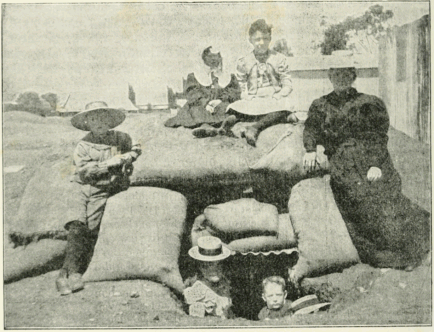
Typical Underground Dwelling at Kimberley.
At De Villiers the exhausted warriors watered their horses and strove to gather together the poor brutes for a final effort. Many were sun-stricken, others had simply used themselves up. The speed that was to outwit Cronje had to be paid for in horse-flesh. But, owing to that speed, much loss of human life was spared. Lieutenant Sweet Escott (16th Lancers) had fallen early in the day, but considering the fire of the enemy it was a marvel that only one officer had been killed. One man was also slain, and there were about thirty wounded.
Kopje held by the Boers.
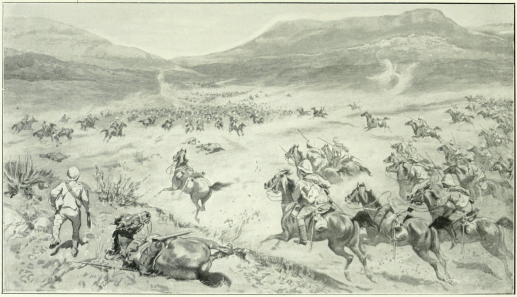
16th Lancers. 9th Lancers. Household Cavalry.
THE LAST STAND MADE BY THE BOERS BEFORE KIMBERLEY—CHARGE OF BRITISH CAVALRY IN THE ENGAGEMENT AT KLIP DRIFT.
Drawing by W. S. Small, from a Sketch by G. D. Giles, War Artist.
At two o’clock the troops were halted at the base of a small kopje, from the crown of which it was possible to descry the chimneys of Kimberley in the distance. It was as though they had sighted the Promised Land. Up went a mighty cheer from a thousand throats, ringing almost against the vault of the burnished heaven, and echoing far and wide among the threatening Boer-haunted kopjes! Kimberley was on the eve of relief. The trial, the trouble, the turmoil were over! The triumph was won! On went the Division, riding now with all their might, and at sight of them the enemy, hot-foot, commenced to gallop into space. Soon the Division was within sight of the suburbs, and their guns were addressing themselves to a Boer laager on the east of the town. The extra uproar struck fresh alarm in the people of Kimberley, who had been driven distraught by the Boer’s 100-pounders, and a message was flashed out, “The Boers are shelling the town.” Then came the answer—the glorious answer—“It is General French coming to the relief of Kimberley.” The news to the imprisoned multitude seemed incredible. They dreaded lest it might be a new wile of the Dutchman, and, to make assurance doubly sure, flashed out a fresh query. But by sunset the British troops had appeared: the whole force, battered, bronzed, but jubilant, was galloping into Beaconsfield.
STRATEGY VERSUS TACTICS
Some one has said that strategy is a permanent science whose principles are immutable, while tactics vary with the variations of weapons and modes of warfare. The first example of this permanent science was presented only when Lord Roberts came to South Africa, but so complete and skilful, and withal so subtle, was the initial demonstration, that its fruits within ten days of his arrival at the front were ready to drop to his hand. Looking back, the plan of Lord Roberts’ operations appears simple in the extreme, but at the time only masterly conception and accuracy of execution could have ensured success for so complicated a programme. To appreciate its subtlety and its neat execution, it becomes necessary to follow the other portions of the programme, beginning from the entry into the Free State of the enormous army that was massed on its borders by Monday the 12th. On that day three divisions of infantry, the 6th, 7th, and 9th, General French’s division, two brigades of mounted infantry under Colonels Hannay and Ridley respectively, the artillery under General Marshall, consisting of three brigade divisions of horse-artillery, two brigade divisions of field-artillery, one howitzer battery, and a Naval Contingent of four 4.7-inch and four 12-pounders, marched from Graspan and Honeynest Kloof through Ramdam. The total field force amounted to 23,000 infantry and 11,000 mounted men, with 98 guns, and a transport of over 700 waggons drawn by nearly 9000 mules and oxen. Later on the artillery was reinforced by the arrival of a battery of 6-inch howitzers, throwing 100-lb. shells, and three Vickers-Maxim quick-firers and the Brigade of Guards, which had remained opposite the Boer trenches at Majersfontein.
The following table serves to show roughly the disposition of the troops:—
FIELD-MARSHAL LORD ROBERTS’ FORCE
First Division.—(Lieutenant-General Lord Methuen).—1st (Pole-Carew’s) Brigade—3rd Grenadier Guards; 1st Coldstream Guards; 2nd Coldstream Guards; 1st Scots Guards. 9th (Douglas’s) Brigade—1st Northumberland Fusiliers; 1st Loyal North Lancashire (half); 2nd Northamptonshire; 2nd Yorkshire Light Infantry; 18th, 62nd, 75th Field Batteries.
Sixth Division.—(Lieutenant-General Kelly-Kenny).—12th Brigade—2nd Worcestershire, 1st Royal Irish, 2nd Bedfordshire, 2nd Wiltshire (half battalions). 13th Brigade (Knox’s)—2nd East Kent; 1st Oxfordshire Light Infantry; 1st West Riding; 2nd Gloucester; 76th, 81st, and 82nd Field Batteries; 38th Company Royal Engineers.
Seventh Division.—(Lieutenant-General Tucker).—14th Brigade—2nd Norfolk; 2nd Lincoln; 1st King’s Own Scottish Borderers; 2nd Hants. 15th Brigade—2nd Cheshire; 1st East Lancashire; 2nd South Wales Borderers; 2nd North Stafford; 83rd, 84th, and 85th Field Batteries; 9th Company Royal Engineers.
Ninth Division.—(Major-General Sir H. Colvile).—3rd (Highland) Brigade (MacDonald’s)—1st Argyll and Sutherland; 1st Highland Light Infantry; 2nd Seaforth Highlanders; 2nd Royal Highlanders (Black Watch). 18th Brigade—1st Essex; 1st Yorkshire; 1st Welsh; 2nd Royal Warwick.
Cavalry Division.—(Major-General (Local Lieutenant-General) French).—1st Brigade (Broadwood)—10th Hussars; 12th Lancers; Household Cavalry. 2nd Brigade (Porter)—6th Dragoon Guards; 6th Dragoons (two squadrons); 2nd Dragoons; New Zealanders; Australians. 3rd Brigade (Gordon)—9th Lancers; 16th Lancers; Horse Artillery; G, P, O, R, Q, T, U Batteries.
Troops with Lord Roberts.—Gordon Highlanders; 2nd Duke of Cornwall’s Light Infantry; 2nd Shropshire Light Infantry; Canadian Regiment; Roberts’ Horse; Kitchener’s Horse; City of London Imperial Volunteers (Mounted Infantry Company); 2nd, 38th, 39th, 44th, and 88th Field Batteries; A Battery R.H.A.; 37th and 65th Howitzer Batteries; three Naval 4.7-in. guns; part of Siege Train.
It will be seen by the above that General Colvile had been appointed to the command of the Ninth Division, while Colonel Pole-Carew was transferred from the command of the Ninth Brigade to that of the Guards Brigade, and was succeeded in the former post by Colonel Douglas, late Chief of the Staff to Lord Methuen.
Having viewed this force, it becomes somewhat interesting to note how smoothly wheel turned within wheel. The movement began by the concentration of General French’s division at Ramdam. On the morning of the 12th the infantry appeared, and General French moved on, crossed Dekiel’s Drift on Tuesday the 13th, and captured Klip Drift and Drieput Drift, on the Modder River. Following him closely on the 12th came the divisions of General Tucker and General Kelly-Kenny. The latter division was accompanied by Lord Kitchener and his staff. The negotiation of the first drift, which was almost impassable for transport, next occupied the ingenuity and tested the perseverance of the troops. The drifts, like the kopjes, are the almost unconquerable bogies of South Africa. They are the natural defences of the country, offering obstruction on every hand, and, however boldly you may storm the kopje, you must with infinite patience negotiate the drift. This is no small undertaking, for drifts, in a way, partake of the paradoxical character of individuals—the weaker the person, the more difficult is he to manage; the more insignificant the river, the greater the perverseness of the drift. It resolves itself in both cases into a question of narrowness. Small streams and small minds are banked up too high to allow moving room in their midst. The result of an attempt to advance is congestion of a painful kind. At this particular drift it was found impossible for the team of mules to lug the formidable waggon-loads up the north bank, and at last the feat had to be accomplished by adding relays of oxen to assist in the tremendous labour. Finally, by 4 A.M. the next morning the troops got across, General Tucker’s division marching to within some three miles of Jacobsdal, and hugging the river all the way, so as to run no risk of being without water. General Kelly-Kenny followed, marching from Waterval Drift to Wegdraai on the morning of the 14th, and proceeding thence at 5 P.M. on the same day to Klip Drift, which was reached in the middle of the night. The rapidity with which this rush on his heels was accomplished enabled General French, who had been awaiting the arrival of the infantry, to proceed on his flying swoop for the relief of Kimberley. This, as we know, was accomplished on Thursday the 15th of February. Meanwhile the wheels of the strategic machinery were going round. A small cavalry patrol had entered Jacobsdal, which town was found to be full of wounded, including many of our own invalids from Rensburg. On the way back the mounted infantry were attacked, and Colonel Henry was fired on by a party of Dutchmen who were concealed in the vicinity of the river, and so sudden was the attack that nine men were wounded. Colonel Henry, Major Hatchell, and ten men were missing. A battery of artillery shelled the environs of the place, and put to flight such Boers as were hanging about, whereupon the British remained masters of the situation. Thus it will be seen that while the Dutchmen were fleeing from Jacobsdal, from Alexandersfontein, and from the neighbourhood of Kimberley, for fear of being cut off, they had surrounding them Lord Methuen at Majersfontein, General Tucker at Jacobsdal, General Kelly-Kenny at the Klip and Rondeval Drifts, General French on the north, and General Colvile wheeling around, ready to suit his movements to any emergency. In this manner Cronje found the teeth of a trap preparing to close on him, and recognised that there was no alternative but to “make a bolt for it.”
Thus the first part of the programme was accomplished. Kimberley was automatically relieved; Cronje was on the run. But his running was no easy matter. Since Lord Roberts’ strategy had come into play, there was a prospect of a neck-and-neck race between the mobile Boer and the mobile Briton, and success depended on General French’s ability not only to rout but to head off the retreat of the Dutchman. That the British cavalry commander should outmatch him in celerity was a contingency which had not occurred to Cronje; that he should advance independently of the rail, and start off across the Riet to trek to the Modder, was described by one of his countrymen as distinctly “un-British.” Whether this epithet was used to denote admiration or contempt we cannot say. Certain it was that the wily persecutor of Mafeking and Kimberley thought that the secret of the art of trekking was confined to himself and his rabble, until he discovered, too late, that the equally wily French with his disciplined legions was ready to ride over him. On the 16th of February the astonished commandant, with a horde of 10,000 Boers, was scudding in full retreat towards Bloemfontein. On all sides were Boer laagers in a state of abandonment—stores, tents, food, Bibles, raiment—everything had been left by the amazed and panic-stricken Dutchmen. Dronfield, Saltpan, Scholtz Nek, and Spyfontein were now evacuated. Under cover of darkness the investing hordes had taken to their heels, leaving behind them even herds of cattle and ammunition, in their desire to gain a loophole of escape. But they soon found that, wherever they might go, there was the rumour of British opposition, an armed and avenging race advancing!
The fact was that the trekking of the Boer hordes had been adroitly discovered by Lord Kitchener, who, having detected an unusual haze of dust in the distance, at once gave orders for the mounted infantry not to follow French, but to pursue the enemy. Accordingly, to quote the Times correspondent, who was present:—
“The mounted infantry rode in pursuit across the plain, endeavouring to get to the north of the convoy, while General Knox’s Brigade was pushed along the north bank of the river, which makes a large bend to the north between Klip Drift and Klipkraal Drift, to strike the convoy on its southern flank. Cronje sent on his waggons to Drieputs Farm, at the north-eastern end of the bend, where they laagered at about eleven, and maintained a running fight with our troops all day. The skill with which the Boers conducted this rear-guard action extorted unqualified praise from all our officers. As the detachments on the extreme right of the Boer line were driven back by our mounted infantry, they rode round behind their centre and took up fresh positions on their left against the 81st Battery and Knox’s Brigade, which were advancing along the north bank of the river. At midday the Boers attempted to hold three low kopjes two miles north-east of Klip Drift, but were driven back to a stronger position at Drieputs.”
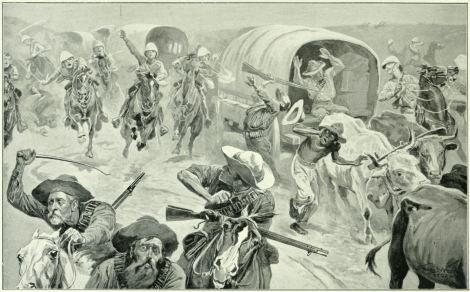
CAPTURE OF A BOER CONVOY BY GENERAL FRENCH’S TROOPS NEAR KIMBERLEY. Drawing by Stanley L. Wood, from a Sketch by an Officer.
Fighting went on throughout the day. At seven o’clock on the evening of the 16th it became almost possible to see the end; the artillery had commenced the vigorous shelling of the laager, and all the divisions moving on the great axis were now aware that Lord Roberts’ strategic plan was likely—how soon they knew not—to be crowned with success.
But we must here break off to eulogise the wonderful activity of Kelly-Kenny’s division, which acquitted itself so honourably. The march from Graspan to Brandvallei beyond Klip Drift, a distance 55¾ miles, was accomplished in five marching days. The Light Brigade on the eve of the battle of Talavera did sixty-two English miles in twenty-six hours, losing only seventeen stragglers by the way. They accomplished this feat by adopting the peculiar step invented by Sir John Moore, three paces walking alternating with three paces running, which enabled them, when tracks were suitable, to cover six miles an hour! No such evolutions as these were possible, owing to the torrid weather and the necessity to take precautions against exposure in the open veldt during midday. The temperature may be imagined when it is stated that in one day about sixty-six soldiers sun-stricken fell out of the ranks. On the morning of the 12th of February the infantry marched some nine and a half miles from Graspan to Ramdam, and from thence on the 13th moved to Waterval Drift. On the 14th they proceeded to Wegdraai, and on to Klip Drift, which was reached in the small hours of the 15th. Here, notwithstanding their fatigues, the 13th Brigade at once engaged with the enemy’s rearguard, and exhibited splendid fighting qualities, which in the circumstances were remarkable even for Englishmen. The West Riding, Gloucesters, Buffs, and Oxfords had a warm time during the whole of the 16th, as the enemy from kopjes beyond the river in the region of Klipkraal assailed them for nearly eight hours, assisted by a pom-pom which caused considerable loss. Though a furious sandstorm later on permitted the Boers under cover of night to get away, abandoning seventy-eight waggons, the next morning the invincible Sixth Division started in pursuit. Captain Trevor (1st East Kent Regiment), Lieutenant Shipway (2nd Gloucester Regiment), and Colonel M’Donnell, R.A., were wounded in the course of the engagement. Major Evelegh, Oxford Light Infantry, while proceeding to join his battalion in the Sixth Division with a small convoy and escort, was surrounded by a large party of Boers, and after a gallant defence was forced to surrender.
Fighting and marching without ceasing, the infantry went to Brandvallei and thence to Paardeberg, where they arrived at 9.30 P.M. on the 17th, in time to take a brief rest prior to the operations which have yet to be described, and in which they took such a prominent part. The marching, considering the tremendous heat and the difficulty of obtaining water, was a feat of which General Kelly-Kenny might justly have felt proud. Though plodding along incessantly through the heavy burning sand under a sun which baked and frizzled even through their uniforms, these men maintained patience and cheerfulness in a rare degree. The whole force was animated by complete faith in their commander, and moved unanimously like some magnificent piece of machinery, scarce taking time to eat or sleep in the zest of their persistent pursuit of the enemy. And they were not alone in their zealous performance of their share in the great scheme. The nicety and precision of the transport arrangements may be imagined when we remember that at one time four divisions were moving independently of their base, making marches across the arid waterless tracks, and carrying with them the necessaries of life for a healthy working multitude. A new regime had begun, and the mobility of our columns had grown equal to that of the Boers, while the railway had been relegated to a subordinate place in the strategical plan.
Colonel Graham, in his “Art of War,” declares that “to organise the means of transport for an army acting at a long distance from its principal magazines, in a country where it is entirely dependent on its own supplies, is a problem difficult of solution.” Now, the solution of this problem was due to the wonderful talent of Lord Kitchener, who was earning his right to be looked upon as the greatest military organiser of his generation. But his gigantic effort did not increase the popularity of the late Sirdar. He ran counter to too many private interests. The army is too intersected with grooves to be crossed without a few nasty jars, and it was scarcely possible for so young and successful a general and a peer—one possessed of almost criminal good luck and amazing moral as well as physical courage—to be looked upon by his contemporaries-in-arms with excessive approval. The secret of discord was given in a nutshell by Mr. Ralph of the Daily Mail. He wrote:—“His first conspicuous act when in South Africa was the withdrawal of the transport service from separated commands in order that it should be managed by the Army Service Corps. Thus it came about that every brigadier and colonel saw a certain amount of his power shifted to what he considered a subordinate branch of the service. A goodish degree of latitude in the enjoyment of comforts and extras, which had been made possible when these officers controlled the waggons, was also curtailed. The army wailed and gnashed its teeth, but I confess I always thought that reason and right were on Lord Kitchener’s side in this matter. Lord Kitchener’s plan was the only one by which an insufficient number of waggons and teams could be utilised for all that they were worth.”
The mobility of an army depends on the reduction of transport, and to the task of organising transport sufficient to ensure the mobility of 100,000 men the hero of Omdurman applied himself with his customary thoroughness. He conceived the gigantic ambition of doing away with all distinctions of transport, regimental, departmental, ammunition, or ambulance, and merging them in an immense whole, thus creating a single general corps, and it was doubtless to this conception and the able way that the scheme—with the assistance of Colonel Richardson—was carried out, that Lord Roberts owed the expedition of his march to Bloemfontein and the further success which resulted from his sure and swift rushes onward. Ordinarily speaking, in the army each unit is allowed its own transport. For instance, colonel, adjutant, and orderly-room are allotted by regulation a tent apiece. Every three officers share a tent, every fourteen men another. Staff-sergeants, batmen, and other details are proportionately provided for. Mounted officers are allowed 80 lbs. baggage, double the amount allowed for “smaller fry.” Without going into minute particulars, we may reckon that a brigade would move with 70 waggons and a division with about 180. To reduce the huge encumbrance of say some 2000 waggons, with their complement of oxen and drivers, was a stupendous labour, from which, with its consequences, this military Hercules did not shrink. Each unit was taken in hand, and its excrescences—regulation excrescences, we may call them—were cut down, peeled of all superfluities, much to the disgust of the staff officers and various other personages who stickle for their rights, and resent any innovation that threatens to dock off an iota of the creature comforts that belong to them by the divine right of red-tape and red-book regulations.
Not only were the rules of transport revised, but special hints tending to the development of the initiative of the private soldier were issued to the troops. Herewith is appended the notable document which may be said to have marked the beginning of the new era:—
Cape Town, February 5, 1900.
The following notes by the Field-Marshal Commanding-in-Chief are communicated for the guidance of all concerned.—By order,
Kitchener of Khartoum, Chief of Staff.
Notes for Guidance in South African Warfare
Cavalry
1. On reconnaissances or patrols not likely to be prolonged beyond one day, the cavalry soldier’s equipment should be lightened as much as possible, nothing being taken that can possibly be dispensed with.
2. It has been brought to my notice that our cavalry move too slowly when on reconnaissance duty, and that unnecessary long halts are made, the result being that the enemy, although starting after the cavalry, are able to get ahead of it. I could understand this if the country were close and difficult, but between the Modder and the Orange Rivers its general features are such as to admit of small parties of cavalry, accompanied by field-guns, being employed with impunity.
Artillery
3. If the enemy’s guns have, in some instances, the advantage of ours in range, we have the advantage of theirs in mobility, and we should make use of them by not remaining in position the precise distance of which from the enemy’s batteries has evidently been fixed beforehand. Moreover, it has been proved that the Boers’ fire is far less accurate at unknown distances. In taking up positions, compact battery formations should be avoided, the guns should be opened out, or it may be desirable to advance by sections or batteries. Similarly retirements should be carried out, at considerably increased intervals, by alternate batteries or sections, if necessary, and care should be taken to travel quickly through the dangerous zone of hostile artillery fire.
The following plan, frequently adopted by the Boers, has succeeded in deceiving our artillery on several occasions.
Suppose A to be a gun emplacement, the gun firing smokeless powder. Simultaneously with the discharge of the gun at A a powder flash of black powder will be exploded at B, a hill in rear, leading us to direct our projectile on B. Careful calculation with a watch, however, will defeat this plan.
Infantry
4. The present open formation renders it difficult for officers to exercise command over their men, except such as may be in their immediate vicinity. A remedy for this would appear to be a system of whistle calls, by which a company lying in extended order could obey orders as readily as if in quarter column. I invite suggestions for such a system of whistle calls as would be useful.
5. It is difficult to recognise officers as equipped at present, and it seems desirable they should wear a distinguishing mark of some kind, either on the collar at the back of the neck or on the back of the coat.
6. Soldiers, when under fire, do not take sufficient advantage of the sandy nature of the soil to construct cover for themselves. If such soil is scraped, even with a canteen tin, a certain amount of cover from rifle fire can be obtained in a short time.
7. The distribution of ammunition to the firing line is one of the most difficult problems of modern warfare. One solution, which has been suggested to me, is for a portion of the supports gradually to creep forward until a regular chain of men is established from the supports (where the ammunition carts should be) right up to the firing line. The ammunition could then be gradually worked up by hand till it reached the firing line, where it could be passed along as required. This would, no doubt, be a slow method of distributing ammunition, but it appears to be an improvement on the present method, which is almost impossible to carry out under fire.
8. Reports received suggest that the Boers are less likely to hold entrenchments on the plain with the same tenacity and courage as they display when defending kopjes, and it is stated that this applies especially to night-time, if they know that British infantry are within easy striking distance from them. How far this is true time only can show.
Roberts, Field-Marshal Commanding-in-Chief, South Africa.
To return, however, to the great advance. Much of the travelling was done by night, in order to save the oxen from the trying temperature of the day, though even during the night the heat was equal to that of an ordinary British midsummer. In addition to the painful toil of motion over the heavy, sandy, rugged leagues, there was the hourly danger of attack. Cronje had made known his need for reinforcements, and at the time, from the south, Andries Cronje was moving, and from the north, Commandants Snyman and Fournie, while from other quarters and in the direction of Ladysmith there was the belief that Boer hordes might be advancing. There was only one encounter with the Dutchmen, but it ended in a mishap that was a serious one, for the results were felt for days afterwards, and helped to try the heroism of the troops who engaged in the movement to the uttermost. A convoy of 180 waggons, one-quarter of the total transport, containing forage and provisions, was lost at Waterval Drift. An interesting picture of the terrible passage of the drift was given by a sapper who accompanied the convoy:—
“It was a pitiful sight to see the poor infantry fellows played out, some dropping with a slight sunstroke, and the cattle dropping dead in all directions. We moved sometimes by day and sometimes by night. Night-time was the best on account of the oxen working much better in the cool of night. Nothing occurred of note with us—but our fellows were fighting every day in front on their way to Kimberley—till we got to Riet River or Drift, which was a terrible pass in the river. Miles and miles of transport had to pass through a narrow passage across the drift, and it took a terrible time for one waggon to pass over, let alone the hundreds that had to pass. We were lucky to get across and encamp below a hill for the night. Next day they still continued to pass the drift, in fact they had been at it all night, and still hundreds of waggons to come on. The Boers evidently knew of this obstacle, and a party came up from the south and had vengeance on the column, as they couldn’t on the fighting line. It was a lucky thing for us we were clear, or else we might have found our baggage gone and ourselves put over the border (i.e. sent to Pretoria or shot). The Boers took up position in the hills and shelled the waggon convoy. The nigger drivers are terrible cowards, and all fled to the hills or kopjes near at hand, leaving the waggons and oxen to the mercy of the Boers. Some of the oxen we succeeded in driving back into our camp on the other side of the river. The good old New Zealanders (who have proved of great use and very daring in this campaign) rode over to where the nigger drivers were, and threatened to blow their brains out if they didn’t return to the waggons, which they did after the Boers had left off shelling for a bit, after doing a terrible lot of damage. Lord Bobs came up just as they were going to try and get some of the waggons away, and said ‘Let them go.’ Our loss proved to be over £100,000, which I am glad to say we recovered later. The Boers thought this convoy was lost purposely, and when we arrived here we found the whole of it except what had been sent to our prisoners at Pretoria.”
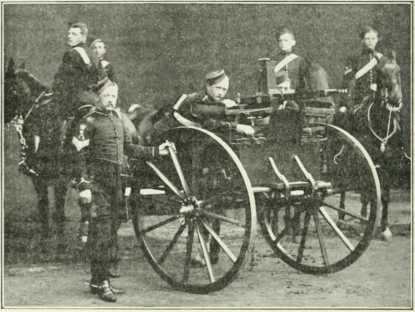
Troop of the 10th Hussars with Nordenfeldt Gun. Photo by H. Johnston, London.
The unpleasant adventures of E Squadron of Kitchener’s Light Horse, who were taken as prisoners to Pretoria, make a separate narrative of themselves, as they took place while the main body was moving on to the relief of Kimberley.
The squadron was attached to General French’s column, and took part in the engagement at Riet River. On its way to the relief of Kimberley, a halt was made at a farm a short distance from Modder River, and part of E squadron was detached to hold a well of water until the arrival of another column, expected in four hours, and then to advance along with them. The relieving column never arrived. Squadron E held the position for four days without food against a large force of Boers. They (E Squadron) occupied an old farmhouse. They loopholed the walls, and although continuously harassed by the Boer fire, they managed to maintain their position and the post they were placed in charge of. During that time they had to subsist on water only, and that brackish. Their horses were dying daily, as there was not a blade of grass on the veldt, and the stench was abominable. On the third day of the siege a poor goat that had wandered near the besieged was immediately captured and devoured. On the fourth day they commandeered one of the enemy’s horses, which they intended to slaughter, their own being too emaciated for that purpose. But the Boers, having been reinforced, gave them no time to do the butchering. On the evening of the fourth day a messenger bearing a letter from General de Wet arrived, demanding surrender within ten minutes. The Boer force consisted of 500 men and two 12-pounders. The officers consulted together, and decided, in view of the hopeless condition of their little garrison of fifty all told, worn out and starving and their horses dead, to accept the inevitable.
While all this was going on, and Cronje was making the discovery that he might be completely outflanked, and that the position of the Boer army at Spyfontein must become untenable, Lord Roberts was entering into Jacobsdal. The place was orderly and quiet. The three churches were full of patients, the town having been used mainly as an hospital. The invalids, for the most part, were sufferers from enteric, the result of too much Modder River. After a long and painful intimacy with the grilling veldt, the sight of houses and civilised dwellings struck gratefully on the eyes of the incoming troops. A store was hailed as a veritable godsend. Some one bought a tin of oatmeal, and walked off with it as one who had secured a prize; some one else gave a goodly price for a pot of pickles, and came away licking his lips like a modern Eliogabalus. The rejoicing was no mean emotion, for the unfortunate men, with the appetites of athletes, had been existing on lovers’ fare. One of the famished but cheery fellows wrote: “We marched into Jacobsdal, and as soon as we arrived we thronged the stores for provisions. I made the following purchases for three of us:—
s. d.
Three two-pound loaves at 1s. each 3 0
Three tins of condensed milk at 1s. each 3 0
Two tins of syrup at 1s. 3d. each 2 6
One small packet of cocoa 0 9
One tin of Quaker oats 1 3
One pound of sugar 0 6
11 0
Then we gorged ourselves to make up for three weeks’ semi-starvation. The most prominent building of Jacobsdal is the church, which stands in the centre of the town. The town itself lies in a hollow—Sleepy Hollow would be an apt title for the place just now. Most of the houses, including the church, are at present converted into hospitals, and the female population are acting as nurses. Most of them are in mourning for relatives lost during the campaign.” Later, the troops moved on and encamped at a farm which had also been used as an hospital. Sights pathetic were only too common—our own sick and wounded in various stages of suffering, and outside, to use a “Tommy’s” description, “some poor devils wrapped in sheets ready to be put to bed for the last time!”
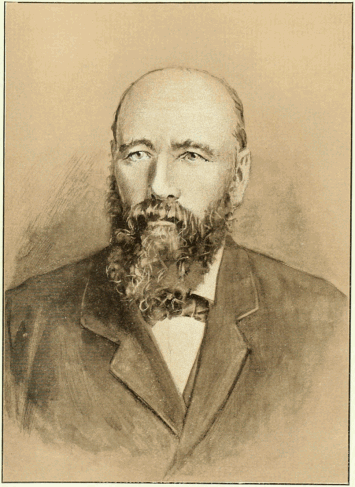
GENERAL CRONJE. From a Photo by M. Plumbe.
Lord Roberts visited the large German hospital, and expressed himself well pleased with the splendid cleanliness of the place and the general evidences of good management. Among the sufferers was found Colonel Henry, who had been taken prisoner on the 14th. Strangely enough, all the inhabitants of the place evinced satisfaction at the arrival of the British, particularly on making the discovery that it was not the habit of the British troops to loot and destroy, as they had been led by the Burghers to believe was the case. They were now made acquainted with the proclamation which Lord Roberts issued to the Burghers of the Orange Free State when his force invaded their territory. It was printed both in English and Dutch:—
“The British troops under my command having entered the Orange Free State, I feel it my duty to make known to all Burghers the cause of our coming, as well as to do all in my power to put an end to the devastation caused by this war, so that, should they continue the war, the inhabitants of the Orange Free State may not do so ignorantly, but with full knowledge of their responsibility before God for the lives lost in the campaign.
“Before the war began the British Government, which had always desired and cultivated peace and friendship with the people of the Orange Free State, gave a solemn assurance to President Steyn that, if the Orange Free State remained neutral, its territory would not be invaded, and its independence would be at all times fully respected by Her Majesty’s Government.
“In spite of that declaration, the Government of the Orange Free State was guilty of a wanton and unjustifiable invasion of British territory.
“The British Government believes that this act of aggression was not committed with the general approval and free will of a people with whom it has lived in complete amity for so many years. It believes that the responsibility rests wholly with the Government of the Orange Free State, acting, not in the interests of the country, but under mischievous influences from without. The British Government, therefore, wishes the people of the Orange Free State to understand that it bears them no ill-will, and, so far as is compatible with the successful conduct of the war and the re-establishment of peace in South Africa, it is anxious to preserve them from the evils brought upon them by the wrongful action of their Government.
“I therefore warn all Burghers to desist from any further hostility towards Her Majesty’s Government and the troops under my command, and I undertake that any of them who may so desist, and who are found staying in their homes and quietly pursuing their ordinary occupations, will not be made to suffer in their persons or property on account of their having taken up arms in obedience to the order of their Government. Those, however, who oppose the forces under my command, or furnish the enemy with supplies or information, will be dealt with according to the customs of war.
“Requisitions for food, forage, fuel, or shelter made on the authority of the officers in command of Her Majesty’s troops, must be at once complied with; but everything will be paid for on the spot, prices being regulated by the local market rates. If the inhabitants of any district refuse to comply with the demands made on them, the supplies will be taken by force, a full receipt being given.
“Should any inhabitant of the country consider that he or any member of his household has been unjustly treated by any officer, soldier, or civilian attached to the British army, he should submit his complaint, either personally or in writing, to my headquarters or to the headquarters of the nearest general officer. Should the complaint on inquiry be substantiated, redress will be given.
“Orders have been issued by me prohibiting soldiers from entering private houses or molesting the civil population on any pretext whatever, and every precaution has been taken against injury to property on the part of any person belonging to or connected with the army.
“Roberts, Field-Marshal, Commanding-in-Chief, South Africa.”
THE HERDING OF CRONJE
To return to General French. The cavalry division bivouacked outside the town of Kimberley, but their repose was limited. At 3 A.M. on the morning of the 16th they were up and doing. The enemy in the north was giving trouble. Some sharp fighting took place, during which Lieutenants Brassey (9th Lancers) and P. Bunbury were killed. This early activity was tough work for the already weary troops, who had been fifteen hours without a meal. Indeed, it was generally remarked that the relievers looked sorrier specimens of humanity than the relieved. The Colonial troops, the Queensland and New Zealand Contingents, and the New South Wales Lancers, considering all things, were wonderfully fit after having played a conspicuous part in the operations. These troops had joined General French’s column from the regions of the Orange and Modder Rivers. The New South Wales Lancers rode on the extreme right flank of the first brigade, and their ambulance corps, under Lieutenant Edwards, kept up with the column, and was complimented on being the first ambulance to cross the Modder River. Like the rest of the troops, they had taken their share of small rations, merely nominal rest, sun-scorching, and maddening thirst, and yet were full of zeal—“keen as mustard,” as some one said—to engage in the herding of Cronje and effect his capture. Worn out as they were, they had sprung to attention on a rumour brought in by a despatch-rider to the effect that Cronje had evacuated Majersfontein and was in full retreat.
At midnight on the 16th, no confirmation of this news had been received. The jaded troops, and still more jaded horses—mere skeletons in horse’s skins—were preparing for real repose, when all was changed! A telegram arrived from Lord Kitchener saying that Cronje, with 10,000 men, was in full retreat from Majersfontein, with all his waggons and equipment and four guns, along the north bank of the Modder River towards Bloemfontein; that he had already fought a rearguard action with him; and that if French, with all available horses and guns, could head him and prevent his crossing the river, the infantry from Klip Drift would press on and annihilate or take the whole force prisoners.
Here was a surprise! Pleasant yet unpleasant, for shattered men in the last stage of fatigue. But General French—whom some one has described as possessing the shape of a brick, with all the solid and excellent qualities of one—rose to the occasion. He was on the point of going to sleep, but there was no thought of rest now. Arrangements had to be made, horses weeded—out of a division of 5000 only one brigade was fit to move!—more borrowed from the Kimberley Light Horse, whose holiday-time had come, and other preparations hurriedly set on foot to ensure an immediate rush—a swoop that should be as swift and successful as it was startling!
One may imagine the midnight picture. The dark immensity of veldt—the dust-driven, sweltering veldt—and Cronje, miles ahead with his horde, the remnant of his convoy, his women and children, fleeing along the north bank of the Modder, harassed by the Sixth Division, threatened by the Seventh and Ninth, and yet longing to cross the river, to get safely to Koodoosrand Drift, where he hourly expected reinforcements would come to his succour. French, dead beat after glorious work accomplished, rising from the first hospitable pillow he had seen for days—springing suddenly to action, ordering, organising, deciding how to effect the great swoop on Koodoosrand Drift and head off the fugitive. There was no time for the buckling on of mental and moral armour; only the warrior at soul could have been ready for such a situation. But such an one was here. He gave swift orders. In three hours’ time General Broadwood and his brigade and three batteries of artillery—the only ones available out of seven—sallied forth towards the east, in the dusk of the morning. Their destination—Koodoosrand Drift—was some forty miles off, and once here Cronje’s last loophole of escape would be gone! The General and his staff followed at 4.15 A.M., riding at full speed, and catching up the brigade about fifteen miles off.
The whole nature of their errand and the proposed movement was a surprise, for this manœuvre had not entered into General French’s original calculations.
When the General had seen the Sixth Division safely at Klip Drift and secured his left flank, he proceeded on his rush to Kimberley. Of other movements save his own he was ignorant. Even as he and the troops were riding into the town, Cronje, who had discovered the futility of his position at Majersfontein and the danger of it, was trekking madly across the front of the Sixth Division. On the morning of the 16th Lord Kitchener, hearing that the Majersfontein laager and the Modder River camp were deserted, and seeing a cloud of dust in the distance, had guessed what was happening, and immediately altered his plans to meet the emergency. As we are aware, he instantly gave orders for the mounted infantry not to follow French, but to pursue and attack the Boer convoy, while he telegraphed later to French, with the results just described. General French grasped the position at a glance. He knew no time was to be lost, and soon Broadwood’s brigade, with horses that could barely move, was pushing on as fast as spurs could insist. The early morning dusk broke into the green and grey and gold of dawn; birds flew frightened hither and thither; foxes rushed to their holes; springbok and hares tempted the sportsmen, but never a glance to right or left was wasted. All eyes were strained to the east, to the momentous east, and the wooded banks of the distant river. Nearer and ever nearer they came—specks were seen on the horizon—men?—horses?—the enemy moving?—scudding away before he could be cornered? No—Yes? A moment of excitement, anguish—joy! The General had mounted a kopje, reconnoitred, and discovered the truth. It was Cronje’s force—the remnants of his convoy some 4000 yards off—the convoy streaming down into the drifts that lead to Petrusberg and thence to Bloemfontein! They must never reach that destination! Kitchener’s words—“Head him and prevent his crossing the river”—so simple in sound, so complex in execution, thrilled every heart. Quickly the guns were got into action—grandly—almost magically—the first shot plumped—bang! in front of the leading waggon just as the convoy was preparing to descend the drift! What a reveillé! Cronje, as we know, was rushing from the clutches of the Sixth Division at Drieputs. Breathless, he gathered himself together. Suddenly he found himself assailed by a new force—a new terror! He divined in a moment what had happened. It was French, the ubiquitous French—French redivivus, as it were—who was putting the finishing touch to the chapter of disaster. Poor Captain Boyle, in his letter to the Nineteenth Century, thus described the great Dutchman’s plight:—
“His only chance now was to sacrifice his guns and convoy, and cut his way across the river under the heavy fire of our guns. Immediately on the first shell bursting in the laager, about thirty Boers galloped out to seize a kopje on our right, afterwards called Roberts’ Hill; but the 10th Hussars in a neck-and-neck race had the legs of them, and seizing the hill in advance, beat them off with their carbine and Maxim fire. The Boers from their laager answered our shell fire for a short time with great accuracy from two or three guns. But these were quickly silenced, and shell after shell from Artillery Hill fell plump into the laager. Finally, our second battery was moved to a little distance from Roberts’ Hill and opened fire from the southern slope on to a kopje to which the Boers had retired. All that afternoon at intervals our guns poured shells into the laager, but no response came, and we spent our time watching the Boers, now 3000 yards away, entrenching themselves in the open and along the river-bank. Their waggons caught fire and the ammunition exploded, and as they realised their position more and more, so must their hearts have sunk. Anxiously must they have waited for the first sign of the infantry gathering round, as anxiously as we did in our turn watching from the high kopjes.
“The cavalry, worn out as they were and without food, had to hold the kopjes and water their horses in turn some five miles off. They got what grazing they could in the kopjes as they lay there, for no corn had come on from Kimberley, and neither men nor horses had had any food except the three days’ rations with which they originally started from Klip Drift the Thursday before, a good deal of which had been shaken off the saddles or lost in the long gallop up the plain to Kimberley. The General, the men, the horses, all alike had to live on what was found at Kamilfontein—a few mealies, a few onions, and the crumbs of biscuits in our pockets were all we had until some Free Staters’ sheep and cattle were rounded and killed. Had it not been for this plentiful supply of meat, the men must have fared very badly for the next three days. No transport came in until Monday night, and the horses had but 1½ lb. of corn in three days. The men were put on half rations of biscuits even after the transport arrived.
“Meanwhile, on Saturday afternoon about 5 P.M. Broadwood sent word to French that in the far distance he observed the dust rising, which he took for Kelly-Kenny’s division. French returned to Roberts’ Hill, and, until the sun set, anxiously awaited the arrival of the infantry—but they marched but slowly. From 6 P.M. till 7 P.M. we opened fire again from our batteries to show Lord Kitchener our exact positions.” The splendid work done by the Royal Horse Artillery was described by another eye-witness. He said: “I will give you an idea of what good gunners we have in the Artillery. General French said to one of the gunners, ‘See those three waggons over there? (a distance of about 3½ miles); see what you can do with them.’ The gunner fired three shell, and the waggons were no more.”
We must now watch the progress of the other portions of the force who were actively engaged in taking their share in the huge undertaking. Colonel Stephenson’s brigade, on the night of the 16th (while General French was learning the great news), had re-crossed the river at Klip Drift, and on the morning of the 17th (at the same hour as Broadwood’s brigade was moving from Kimberley) had marched to the south of the river with the same intention—that of heading off Cronje at Paardeberg and Koodoosrand Drift. Thus, with Broadwood’s brigade on one side, and Stephenson’s on the other, Cronje’s prospects of escape were scarcely worth a dime. The Times’ correspondent, talking of Colonel Stephenson’s troops on the morning of the fateful 17th, said:—
“They were joined about ten at Klipkraal Drift by Knox’s brigade, which marched along the northern bank. The mounted infantry, pushing on, reached Paardeberg Drift that evening, and encamped on rising ground close to the south bank. The infantry, leaving Klipkraal at six in the evening, made a night march for Paardeberg Drift, but, missing their way, slightly passed the Drift and bivouacked on some rising ground nearly two miles beyond, separated from the river by a smooth plain shelving gently down to it. The mistake was a fortunate one, as it brought the infantry almost opposite to the place where Cronje had determined to cross. Cronje had left Drieputs during the night after the battle, abandoning seventy-eight waggons, and pushed on along the north bank of the river during Saturday for Koodoosrand Drift. Soon after passing north of Paardeberg Drift he heard that French had already returned from Kimberley, and was holding a line of high kopjes running north-west from Koodoosrand Drift, and completely commanding the drift. Wheeling his waggons to the right across the plain, he laagered on the north bank of the river at Wolveskraal Farm. This was opposite to a drift of the same name, about half-way between Paardeberg and Koodoosrand Drifts, being about four miles in a straight line from each. Here he intended to cross on Sunday morning. But already, during the night, he became aware of the presence of the mounted infantry south of Paardeberg Drift, and decided that he could not get his convoy away without fighting. Probably Cronje did not realise that Kelly-Kenny’s infantry could have already marched up and occupied the rising ground not three thousand yards south of Wolveskraal Drift; still less could he know that General Colvile’s division (whose endurance had been extraordinary) was but a few miles behind, and was to reach Paardeberg Drift before daybreak. If Cronje had known this, there is little doubt that he would have promptly sacrificed all his transport and all his guns in order to get his men away and escape from the trap into which he was now caught. As it was, he sent a great part of his force to line the river-bed all the way down to Paardeberg Drift, in order to act as a rear-guard and check any attempt to interfere with his crossing Wolveskraal Drift at his leisure.”
Later on, the Ninth Division, with the Highland Brigade, who had made a forced march from Jacobsdal, arrived on the scene just in time to see the Boers sending up rockets to show their position to expected reinforcements. And there is little doubt that Cronje, unable to realise the expeditious advance of “lumbering Britons,” mistook General Colvile’s troops for the longed-for relief.
Among the missing from near Paardeberg were Lieutenants Romilly (Duke of Cornwall’s Light Infantry) and Metge (Welsh Regiment), and Captains Arnold and Vaughan of Kitchener’s Horse.
Here we have the position of affairs as they stood on the night of the 17th and on the morning of the 18th, when the trap so ingeniously set for Cronje commenced to close little by little—north, south, east, and west. Everywhere he turned the detestable rooineks menaced him, and he who so lately had eaten his breakfast to the tune of his 100-pounder gun, that belched ruin and mutilation over the whole region of Kimberley, was now constrained to breakfast to a new and disagreeable inversion of an identical melody!
THE BATTLE OF PAARDEBERG
On Sunday, the 18th of February, the most exciting action of the war took place. It was costly as it was momentous, for it served to decide the fate of the fleeing Dutchman. The scene of the drama was not unpicturesque. From the Paardeberg to the Koodoosrand Drift the Modder flowed along a deep hollow from thirty to a hundred yards in depth. To either side the forks of small dongas radiated, while the high banks were fringed with the feathery foliage of the mimosa and willow. Donga and tree stump afforded excellent cover for the slim adversary, sniper or scout. The river travelled from Koodoosrand Drift west-south-west, deviating southwards on either side of the Wolveskraal Drift. A vast expanse of veldt, some two thousand yards wide, shelved down towards the south bank of the river, fringed by higher ground; and this grassy plain extending eastwards joined a circle of kopjes now known as Kitchener’s Hill. On the opposite, the north bank of the river, was another similar plain, dotted with minor kopjes to within a thousand yards of the river, and beyond them was the higher hump of Paardeberg Hill.
The action began at dawn. Firing grew hotter and hotter with the growth of the morning, and soon pandemonium was let loose. While part of the mounted infantry was forcing the rearguard up the river another part was manœuvring on the right front and flank of the enemy. The Dutchmen meanwhile from King’s Kop turned on a quick-firing Hotchkiss gun, which swept the flat country from the kop to the southern bank of the river. The antagonists had both posted themselves on the north bank of the river—both banks of which were level, and this expanse afforded no cover for movements. Over this expanse the Ninth Brigade had to move, struggling through a zone of fire towards the concealed enemy.
Cronje by this time had realised that his position was critical—almost hopeless. Bringing his fine military qualities to bear on the situation, he decided to make the best of a bad job, and entrench himself with all the skill possible. He held about one square mile of the river-bed on either side of Wolveskraal Drift, and beyond that he knew were encircling kopjes, each one concealing its multitude of rooineks. On the east, slowly creeping up, were the menacing numbers of Tucker’s Division; on the west the vast crowds of the mounted infantry and the Sixth Division; on the south were field-guns little more than a mile off, threatening to shower destruction from Gun Hill, while on the north were Naval guns and howitzers. Indeed, everywhere was fate frowning, obdurate, vengeful. But the Dutchman retained his pluck and his wits. He even believed that with everything against him he might yet employ the same tactics which had nonplussed Lord Methuen at Modder River. He still retained a poor opinion of his adversary, and his delusion lent him confidence. He hurriedly built trenches, that in themselves were masterpieces of defensive art, and took up his headquarters in the centre, in a red brick house—a species of travellers’ hostelry, which may be found near all drifts in South Africa. Here at night Mrs. Cronje joined him. During the day she was placed in the women’s shelter at the east side of the area, which shelter was protected by waggons and trenches all along the bed of the river. Talking of these trenches, the correspondent of the Times declared that “the skill with which they were constructed as defences against both rifle and shell fire was worthy of the highest praise. All except those of the outer lines of pickets were made so narrow and deep that it seems as though they were in many cases entered from one end rather than the top, as any such ingress must even in a week’s time have considerably widened the neck of the excavation. At the top they were perhaps eighteen inches wide, at the bottom about three feet, and by crouching down the most complete protection was afforded from bursting shell.
“Every natural protection, such as the ramifications of the dongas which eat into the banks on both sides of the river, had been utilised, though the bombardment from both sides compelled them to abandon their first hasty breastworks cut into the actual top of the bank, which was here from about fifty to a hundred yards from the river itself, and thirty feet in height.
“For the first time here the ‘T’ trenches, of which much has been said during the present campaign, were used. They did not seem to present the least advantage over the ordinary shapes, except that in an exposed angle they may have provided additional protection against an enfilading fire.”
Cronje’s first object in entrenching himself in the bed of the river was to arrest the further advance of the mounted infantry, who had taken possession of the bed of the river west of his position. In this he was successful. Worn, harassed, and almost helpless, he determined to make a desperate stand, hoping against hope to gain time till some help from without should arrive. But this help never reached him. A grand enveloping movement commenced, and Cronje, brought to bay, found himself face to face with what proved to be his Sedan.
By this time he and his followers were snugly ensconced in bush and donga and scrub round the laager, and from the trees around they vigorously sniped and poured volleys at the advancing troops. In the advance to the attack the Highland Brigade was on the left, General Knox’s brigade in the centre and on the right, while General Smith Dorrien’s brigade, after crossing the river by Paardeberg Drift, moved along the north bank. The Highland Brigade had a terrific duty. The Boers, from their position in the bed of the river and on both sides of it, commanded the left of the Brigade, and as the kilted mass moved forward in the open poured upon them a deadly fire, which forced them to lie prone for the rest of the day. Here at noon, when bullets were humming their loudest, General Hector Macdonald was wounded. He had dismounted, and was directing the movements of the brigade, when overtaken by a shot which penetrated thigh and foot. Despite this unlucky accident and a tremendous spell of hard fighting, the brigade exhibited splendid pluck and tenacity. They were destitute of cover, but maintained their position with astonishing fortitude, and this after the long forced march they had made from Jacobsdal, and while enduring the tortures of maddening thirst, which could not be assuaged. A heavy thunderstorm mercifully overtook them in the course of the afternoon and raindrops large as gooseberries clattered down their relieving moisture on the parched and exhausted troops.
British Guns. Laager in Flames French's Cavalry 6th Division
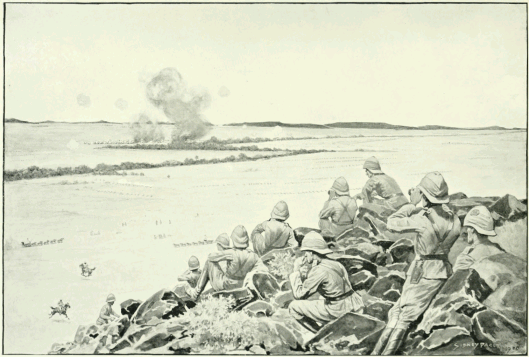
9th Division.
THE BATTLE OF PAARDEBERG. Drawing by Sidney Paget from a Sketch by W. B. Wollen, R.I.
On the north bank of the river was Cronje’s laager, an environment of waggons, carts, ammunition, and stores. While General Smith Dorrien’s force, among which were the Canadians, Gordons, and Shropshires, attempted to charge into the laager, they too were vigorously shelled by the enemy, who, undefeatable, held on valiantly to a kopje on the south bank of the river. Here they posted a Vickers-Maxim and other deadly weapons, and in a measure divided our force in two. The Seaforths and the Cornwall Regiment made a splendid charge with the bayonet, and drove the Boers from their cover round the drift, but in the glorious rush both the Colonel and Adjutant of the Cornwalls were stricken down. Ninety-six of the men were wounded, but they now held the north-west side of the enemy’s position.
Plan of the Boer Laagers and Trenches and the British Positions at Paardeberg. (By an Officer of the Royal Field Artillery.)
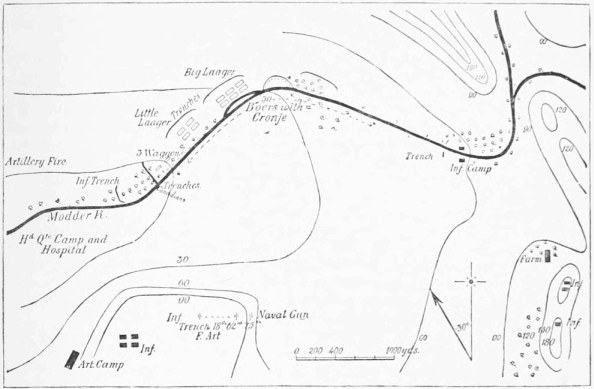
On the east the Sixth Division was hard at work tackling a horde of Boers, who made a last despairing lunge in order to burst through the entangling forces and push for the south bank of the river. The effort was stubborn as it was desperate, but they were defeated by the dash of the West Riding Regiment, who pressed forward with the bayonet and succeeded in seizing the drift. Many splendid fellows were wounded and slain in the collision. Meanwhile the artillery continued to direct their incessant thunder against the laager, pouring in a deluge of destruction from all quarters, and forcing the Dutchmen to shrink within the space, little more than a mile square, into which they had so hurriedly scrambled.
General Kelly-Kenny having possessed himself of both Klip Drift and Koodoosrand Drift, the Boers were now enclosed east and west. But here, crunched in a veritable death-trap, they fought tenaciously. Worn, harassed, and weakened by their hurried march, they yet held a stubborn front to our assaulting troops, and from the cramped region of their laager did as much damage as it was possible to do. The Canadians, who had behaved with conspicuous gallantry in the attack on the laager, lost nineteen killed and sixty-three wounded. A description of the fight as seen from their point of view was given by a private in the 1st Contingent:—
“We left Klip Drift on the Modder River at 6 P.M. Saturday, and marched all night until seven on Sunday morning, covering 23 miles. During the march we could hear the guns ahead. I was orderly man for Sunday, so, removing my pack, I went to the river for water. Just a little way up the river a brisk fire opened up. When I got back to our lines I found them issuing a ration of rum. I had mine, and it just braced me up.
“By this time the engagement was pretty brisk. Our brigade was ordered on the left of the river, which we crossed at a ford just in rear of the camp. The Shropshires crossed first, then followed the Canadians and Gordons. The water was up to our necks. Some went deeper and had to swim. We crossed in fours, holding on to each other, formed up in column and advanced a short distance, when we extended to seven paces in skirmishing order. C Company formed to support A Company.
“By this time the bullets were coming pretty thickly, and we had some very narrow squeaks. We reinforced A Company at 500 yards and opened fire. The Boer fire was heavy, and some of our boys had been hit, but we soon subdued the fire. Their position was in the river, and we were lying out in the open, no cover of any kind except a few anthills. We could see very little to fire at except the fire from their guns. Our line was in a crescent shape, the right on the river, and the left extended along about 500 yards. In the afternoon our troops were ordered to cease fire. As soon as we stopped they started sniping, which made us hug the ground.
“Shortly after joining the firing line Captain Arnold of A Company was struck. The Boers started a murderous fire on the stretcher-bearers who carried him away, a trick they did all day long. Towards evening the left was ordered to reinforce the right. It was a daring move, but we did it by running down in threes and fours. At dark all the forces retired, and quite a few men volunteered to search for the wounded. I was out all night until four the next morning, when I laid down played out. I never want to witness such terrible sights as I saw that night again. Whenever we showed ourselves in the moonlight the sharpshooters would fire at us. We were all up early next morning, but the Boers had retired farther up the river. So we collected our wounded and buried the dead. I was helping a hospital sergeant, and he sent two of us up the river to search for wounded. We found a few, and also came across a wounded Boer, whom we bandaged and took back to camp. We also came across a few dead. We questioned the Boer, and he said that they had retired during the night, carrying their wounded and throwing the dead into the river. After dinner, which we had about four, we went out on outpost duty. During the night there was quite a little firing going on. This morning we advanced towards the position again, and about ten o’clock retired for some breakfast and advanced again. Although under fire all day we did not fire, but the artillery certainly played Cain with them.”
Captain Arnold’s wound was mortal, but Lieutenant Mason, who was also shot, was not dangerously hurt.
A Colonial, writing from the front at Paardeberg, said that fighting “went on during the day until about five o’clock, when the Cornwalls arrived in support. The officer commanding this battalion seemed to think that too much time had already been spent in fighting the Boers, so ordered the charge. The result was fatal to the Cornwalls, as they had to retire. The Canadians, acting under the orders of the commanding officer of the Cornwalls as senior officer, also charged, and with a like result; but the Canadians, in place of retiring, simply lay down and remained. It was during this charge that most of the fatalities occurred. The unfortunate commanding officer of the Cornwalls was killed, and Captain Arnold and Lieutenant Mason of the Canadians wounded. The Brigadier subsequently expressed his regret that the charge took place, but at the same time warmly congratulated the Canadians on their behaviour, as did Lord Roberts also.”
Of gallantry and daring there was no end. From dawn till sunset raged a battle of appalling fierceness, of magnificent persistency. From drift to drift the hollows reverberated with the perpetual roll of musketry, the brawling of multifarious guns, the hoarse cheers of charging troops, the shouts of the unflinching enemy. Curling smoke burst in wreaths and garlands from the sides of the hills and rose against the purple of thunder-clouds; flaring tongues of vengeful flame danced and forked their reflections of heaven’s lightnings; spouts and torrents of water poured from the sky, mingling with the heroical blood of Britain’s best, that trickled in rivulets, north, south, east, and west of the scene, and traced far and wide the history of sacrifice on the now sacred ground. For all this, the position of the contending parties remained unchanged—Cronje defiant and enclosed, the British lion crouching, watching.
At dusk the scene was weirdly, terrifically picturesque. From the south and north sides of the river shells hurtled through the air, falling and exploding along the river-bed, now setting fire to a waggon, now a cart, and filling the gloom with lurid panoramas of flame and an awe-striking, ceaseless din. Once an ammunition waggon was struck. Then the blaze and crackling which followed, intermingling as they did with the roar of artillery and the rattle of rifles, made a fitting concert for Hades. And to the tune of this demoniacal intermezzo the cordon round the enemy was gradually closing, his last chances of escape were one by one being sealed, the last links in Lord Roberts’ strategical chain were being forged.
At night there was peace. The Modder might have been the placid purling Thames winding along between fringed and sloping banks to the bosom of the sea. But there was none to admire the pretty scene. All were worn out, and glad to drop to sleep where they had fought, while the bearer-parties—“body-snatchers,” as they were jocosely styled—picked their way in the darkness, doing their deeds of mercy with zealous, unflagging perseverance. During this time many deserters from the enemy came in. They had seen the hopelessness of their case, and had been urging, uselessly, the implacable Cronje to surrender.
The following is the list of those who were killed and wounded during the fight:—
Killed:—Mounted Infantry—Colonel Hannay.[1] 2nd Warwick—Lieutenant Hankay. Duke of Cornwall’s Light Infantry—Lieutenant-Colonel Aldworth,[2] Captain E. P. Wardlaw, Captain Newbury. Seaforth Highlanders—Second Lieutenant M’Clure. Argyll and Sutherland Highlanders—Lieutenant Courtenay. West Riding Regiment—Lieutenant Siordet. 1st Yorkshire—Second Lieutenant Neave. Oxford Light Infantry—Lieutenant Bright, Second Lieutenant Ball-Acton. Wounded:—Staff—Major-General Knox (13th Brigade), Major-General Hector MacDonald (3rd Brigade). Duke of Cornwall’s Light Infantry—Captain J. H. Maunder, Lieutenant H. W. Fife, Second Lieutenant J. W. C. Fife, Second Lieutenant R. M. Grigg. Seaforth Highlanders—Captain G. C. Fielden, Captain E. A. Cowans, Captain G. M. Lumsden, Lieutenant J. P. Grant, Second Lieutenant D. P. Monypenny (died of wounds), Second Lieutenant A. R. Moncrieff. 1st Gordon Highlanders—Second Lieutenant W. B. J. Nutford. Argyll and Sutherland Highlanders—Lieutenant C. N. Macdonald, Lieutenant G. Thorpe, Second Lieutenant G. A. Akers-Douglas, Second Lieutenant F. G. S. Cunningham. Black Watch—Lieutenant-Colonel A. M. Carthew-Yorkstoun, Major Hon. H. E. Maxwell, Major T. M. N. Berkeley, Captain J. G. H. Hamilton, Lieutenant J. G. Grieve (N.S.W. forces attached). West Riding Regiment—Captain F. J. de Gex, Captain H. D. E. Greenwood. 1st Yorkshire—Lieutenant-Colonel H. Bowles, Major Kirkpatrick, Lieutenant C. V. Edwards, Captain A. C. Buckle (South Stafford attached). Oxford Light Infantry—Major Day, Captain Watt, Lieutenant Hammich. East Kent Regiment—Captain Geddes. Shropshire Light Infantry—Captain Gubbins, Captain Smith, Lieutenant English, Second Lieutenant Kettlewell. Canadians—Captain H. M. Arnold (since died of wounds), Lieutenant J. C. Mason, Lieutenant Armstrong. R.A.M.C.—Captain J. E. C. Canter. Lieutenant G. H. Goddard. East Surrey—Captain A. H. S. Hart. 2nd Lincoln—Second Lieutenant Dockray Waterhouse. 1st Yorkshire—Second Lieutenant W. G. Turbet. 2nd Oxford Light Infantry—Captain Fanshawe, Lieutenant Stapleton. 2nd Bedford—Captain R. W. Waldy, Lieutenant Selous. 2nd Norfolk—Lieutenant Cramer-Roberts. 1st Welsh—Lieutenant-Colonel Banfield, Major Ball. 2nd East Kent—Captain Godfrey-Faussett, accidentally shot (died February 21). 1st West Riding—Captain Taylor, Captain Harris. Roberts’ Horse—Lieutenant A. Grant. Argyll and Sutherland—Captain N. Malcolm, D.S.O. 1st Gordon Highlanders—Lieutenant Ingilby. 1st Welsh Regiment—Major Harkness, Lieutenant F. A. Jones, Lieutenant Veal. Mounted Infantry—Lieutenant-Colonel Tudway (1st Essex). 1st Essex—Captain Milward, Second Lieutenant Thomson. Missing:—Captain Lennox, 81st Field Battery R.A.
The following table gives the distribution of the losses among officers:—
Killed. Wounded. Missing. Total.
Staff — 2 — 2
2nd Duke of Cornwall’s Light Infantry 3 4 — 7
2nd Seaforth Highlanders 1 6 — 7
1st Argyll and Sutherland Highlanders 1 4 — 5
1st West Riding Regiment 1 2 — 3
1st Yorkshire Regiment 1 4 — 5
1st Oxfordshire Light Infantry 2 3 — 5
2nd East Kent Regiment — 1 — 1
1st Gordon Highlanders — 1 — 1
2nd Royal Highlanders — 4 — 4
2nd Shropshire Light Infantry — 4 — 4
Royal Canadian Regiment — 2 — 2
Royal Army Medical Corps — 2 — 2
81st Battery R.A. — — 1 1
Total 9 39 1 49
The heaviness of this list and the evenness with which the casualties were shared bear witness to the dash and daring displayed by all the battalions engaged.
A good deal of comment subsequently took place regarding the methods adopted during this day’s warfare, and many were of opinion that the attempt to take the position by assault was unnecessarily wasteful of life. Considering the positions of the various regiments on the morning of the battle, it seemed as though the encircling of the enemy and forcing him to submission by a slow process of pressure would have served equally well to bring about the inevitable end. But again it has been urged that there was at the time no knowing how soon reinforcements might come to the assistance of Cronje, or what results might accrue from permitting the Boers—at the time breathless and weary—to gather themselves together for fresh resistance. Delay was evidently the one thing that Cronje was playing for, and Lord Kitchener, on his side, was averse from risks which might bring about the failure of the vital undertaking.
TRAPPED
The enemy had little rest. The small hours were spent in constructing entrenchments round the laager. All owned that their stubborn energy was admirable, but further active resistance on the part of Cronje was now beginning to be regarded by all—even his own people—as an act of suicide and murder. “It was magnificent, but it was not war,” as the Frenchman said. The Mounted Infantry and a battery of artillery next morning turned their attention to an offending kopje, whence the Boers could yet pour their equivalent for “cold water” on the British plans, and while circling round the position were accosted with a morning salutation from the rifles of the Federals on the summit of the hill. Fortunately the fusillade was launched with more vigour than accuracy, and there were no casualties. Pursuing their investigations, the troops discovered a good defensive position and seized it.
Early in the morning Cronje sent a white flag, demanding twenty-four hours’ armistice for the purpose of burying his dead. This most probably being part of a wary plot to gain time for reinforcements to come to the rescue, a reply was sent back from Lord Kitchener to the effect that it was impossible to grant the request, which must await the arrival of the Commander-in-Chief. Lord Roberts was then on his way from Jacobsdal, and when the matter was referred to him, he at once sent a message refusing to accede to the proposition. General Cronje’s reply, being roughly translated, implied that he wished to surrender, but when Lord Kitchener requested him to surrender in person, it was discovered that he had no notion of capitulation—unconditional surrender being the terms offered. Lord Roberts then ordered the resumption of the bombardment.
About midday came the rumour that French was at hand, and that he was taking his share of the great hemming-in movement, but the cavalry division was then nowhere in view. Lord Roberts arrived later, and addressed the troops, who welcomed him with cheers. Meanwhile the 18th, 62nd, and 75th field-batteries and the 65th (howitzer) battery surrounded the laager, and commenced an avalanche of destruction, the howitzers battering the river-bed with an enfilading fire, the fumes of lyddite rendering the surrounding air green with noxious vapour. Waggon after waggon of ammunition exploded with infernal uproar, shrapnel and lyddite danced diabolically over the river-bed and laager, yet there were no signs of surrender—not the flutter of a white flag in the direction where remained the obdurate man who, his last chance gone, refused to bow to the inevitable. Prisoners now and then, worn out and disgusted, came in, their rifles slung, and gave themselves up. In the laager were sixty women and girls, they said, and Cronje, “disconsolate and defiant, sat holding Mrs. Cronje’s hand and comforting her in the river-bed.” Meanwhile Broadwood’s brigade had appeared, exhausted and starving. The cavalry had come along the river-bank to Paardeberg in order to reach the forage and the convoy which was accompanying the infantry divisions from Klip Drift. Their state was lamentable, for it must be remembered that General Broadwood had galloped off during the night of the 16th almost provisionless. His brigade had borne the brunt of the fray, for General Gordon had only been able to follow later with some 120 horses out of his whole brigade. Colonel Porter’s brigade marched later still, owing to some accident with the telegraph. The work of relieving Kimberley and heading Cronje had cost the cavalry some 990 horses out of a total of 4800.
The loss of life, however, had not been excessive considering the strain and the engagements that had taken place between the 14th and 16th, but some goodly young officers were missing. Lieutenant Carbutt (R.H.A.), Lieutenant Brassey (9th Lancers), Lieutenant Hesketh (16th Lancers), and Lieutenant the Hon. M’Clintock Banbury (Scots Greys), were among the killed. Among the wounded were Captain Humfreys (Q Battery), Lieutenant Houston (P Battery), Lieut. Barnes (Q Battery), Captain Gordon and Lieut. Durand (9th Lancers), Captain Tuson (16th Lancers), Lieut. Fordyce and Second Lieut. Long (Scots Greys), Lieut. Johnson (Inniskilling Dragoons), Lieut. Gray (Roberts’ Horse). The fatigued remnant of the cavalry division now engaged in tackling the reinforcements that Cronje had so ardently expected.
In consequence of the huge circumference of the British circle, it was almost impossible to chronicle the innumerable small but brilliant actions which were continually taking place, and which in the excitement of the investment were almost overlooked. On the night of the 19th the Gloucesters performed a dashing though futile feat. In the afternoon they neared a kopje in which the Dutchmen were ensconced. They bided their time, and just as the shades of night began to fall rushed on the enemy with bayonets and drove them off with considerable loss. The positions taken were evacuated, however, during the night.
On the 20th the Boers before dawn were again hard at work increasing their entrenchments all round their laager, but their plucky labours were impeded by continual shells which were launched now and again to prevent the work from being carried to completion. Meanwhile from the east came the echo of artillery, a rumour of battle which proved that the untiring French was actively engaged in standing between the Boer reinforcements and Cronje, who still held out gallantly in the fond yet forlorn hope of their ultimate arrival. He was humanely offered many chances to give in, but since he stoutly refused them all, measures were taken by Lord Roberts to bring the fighting to a speedy conclusion.
But the doggedly valiant attitude of the enemy was not lost on his assailants. It had been impossible to withhold from Cronje a certain admiration for the masterful manœuvres which extricated him from his impossible position at Majersfontein, or for the stubborn resistance with which his force, outwitted, harassed by the mounted infantry, and fighting a skilful rearguard action, had succeeded in getting at least thirty-five miles to Koodoosrand Drift. It was now equally impossible to overlook the magnificent energy of the man, who, with his means of flight at an end, his 50,000 lbs. of ammunition sacrificed, his stores captured, his oxen exhausted to the death, with almost certain defeat staring him in the face, could turn and fight an action both ferocious and sanguinary. Moreover, by the sheer magnetism of his personality he forced his followers to show a bold front and maintain a desperate, almost fatuous, courage in the face of the most terrific shelling that the century has known.
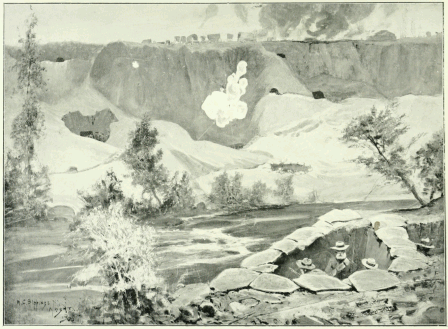
CRONJE’S STRONGHOLD ON THE MODDER RIVER. Drawing by H. C. Seppings Wright, from a Sketch by Frederic Villiers, War Artist.
Little by little the enclosing circle began to grow narrower. The infantry—the Cornwalls assisted by the Engineers—again set to work to push the enemy still farther back into the river, but otherwise little advance was made. The position was now sufficiently terrible for the enemy. Cronje’s trap was about a mile square, while commanding it in every direction were guns multifarious; bushes and banks and ravines were swept by cataracts of shrapnel, while volumes of greenish-yellow smoke from bursting lyddite curved and twisted around the river-bed, then carried their noxious vapour to the serene sapphire of the heavens. In the clear atmosphere the reiterations of Maxims filled up the pauses between the steady booming of artillery, while now and again the impotent despairing splutter of rifles from the enemy’s laager mingled with the stertorous rampage.
On the fourth day of Cronje’s resistance what might have been an unfortunate incident occurred. The Gloucester and Essex regiments by an accident had bivouacked on the north side of the river too close to the enemy’s laager. The result was that on the first gleam of daylight they were discovered by the Dutchmen, who treated them to a volley by way of reveillé. Luckily the firing was not at all up to the Boer mark and the regiments came off scot-free.
During the day General Smith Dorrien’s force on the north worked towards the doomed laager while General Knox’s brigade held the containing lines on the south side of the river. In the east General French was keeping an eye on a swarm of Boers who were hoping to come to the rescue of Cronje. These held a strong position on a kopje which seemed to be specially constructed by nature for defensive purposes. Still, when General Broadwood’s brigade and a battery of horse-artillery turned their attention to the summit and scoured it thoroughly, the Dutchmen helter-skelter fled. Unluckily for them, their precipitate action took them straight into the arms of General French, who having headed them towards the drift, now gave them so warm a reception that numbers bit the dust. Some escaped, but fifty were taken prisoners. Forage, provisions, and equipment were also seized, though the corpses of the slain were carried off, so that the tale of loss could not be told.
The capture of the kopje was an excellent move, as it was a useful position whence to watch for and intercept reinforcements that might be coming from Ladysmith or elsewhere to the succour of the doomed. A message was sent to the obdurate Commandant offering a safe conduct and a free pass anywhere for the women and children. Lord Roberts also proffered medical attendance and drugs. The offers were curtly rejected. Finding courteous overtures of no avail, the bombardment of the position was resumed, and the artillery continued to fire till dusk put an end to the operations. While the firing was taking place the mules of the 82nd Battery, while still hitched to the waggons, took it into their heads to stampede, causing a scene of the wildest confusion. The next day, however, all save one waggon were recovered.
During the night the Shropshire Regiment accomplished a fine feat. They pressed forward some two hundred yards, captured new ground, and there entrenched themselves. It was an excellent finale to four days’ incessant work under a withering fire, and by the 22nd they were fairly exhausted. They were then relieved by the Gordons. Here be it noticed that the Gordons were now incorporated with the Highland Brigade, which was thus composed of four kilted regiments. The Highland Light Infantry, who wear “trews,” had joined General Smith Dorrien’s force.
The exchange of positions between the Shropshires and Gordons was effected in a manner worthy of the slim Boer himself, and showed that the Britons had speedily taken practical lessons from their adversaries. The Shropshires having, as said, seized 200 yards of new ground, they were relieved the following morning by the Gordons. The Highlanders, snake-like, wormed themselves forward to the trenches on their stomachs, while the Shropshire men in like manner crawled over the bodies of the relieving force. An officer who witnessed the evolution said, “I have often heard of walking on an empty stomach, but I’m hanged if I’ve ever seen the feat accomplished so well and so literally.”
Another tremendous thunderstorm broke over the position, causing considerable discomfort to the troops, but still more to the unhappy creatures who, through the stout resistance of Cronje, were held to all the horrors of the trap into which he had fallen. We were now closing in on every side.
A grand attempt was made on the morning of the 23rd to bring help to the Dutchman. Commandant de Wet with a horde of some 1000 Boers, collected from the region of Ladysmith, appeared, and made a desperate effort to thrust himself through the British lines. Part of the force on its way towards its hoped-for destination was luckily accosted from a kopje occupied by the Scottish Borderers. The greeting, smart and accurate, was scarcely to the Dutchmen’s liking, and they made off in another direction, but still with the same result. From position to position they were hunted, and in sheer despair they made for an unoccupied kopje, where they hoped at last to make a stand. But they were disappointed. The lively Scottish Borderers were “one too many for them.” Seeing the Boers in act of seizing this point of vantage, the Borderers promptly hurled themselves in the coveted direction. There was an animated neck-and-neck race, and the Borderers, who won by a nose, promptly took possession of the hill and completely routed the Federals.
Finally the Boers found shelter in a kopje which was vis-à-vis to a like eminence held by the Yorkshires. A passage at arms followed, with the result that the fusillade of the enemy died a natural death. Then the Yorkshires, who had so strenuously brought about this result, were reinforced by the Buffs, lest some more of the Boer hosts from Ladysmith should put in an appearance. At this time the 75th and 62nd Batteries gave tongue from an adjacent farm, but their vociferous notes produced little effect upon the crown of the Boers’ stronghold.
So great was the silence that the Yorkshires moved on with a view to prodding the enemy in his lair, but, in the attempt, they were so furiously assailed by the shot of the enemy that they, in default of cover, were unable to proceed. Meanwhile the Buffs persevered, moving warily round the position till within 150 yards of the Dutchmen, who were eventually driven off. More than eighty—their horses having been shot—surrendered. On many of these were discovered explosive bullets, and it became evident that desperation was driving the Boers to disregard the rules of civilised warfare. Many of our wounded were found injured by these unholy missiles; and other tricks—barbarous tricks—were reported. On one occasion a Vickers-Maxim gun was directed at an ambulance, which at the time was fortunately unoccupied.
During the week our losses were fewer than on the opening day. Captain Dewar and Lieutenant Percival, 4th King’s Royal Rifles, and Lieutenant Angell, Welsh Regiment, were killed. Among the wounded were:—
2nd Gloucester—Lieutenant-Colonel R. F. Lindsell; 2nd Derbyshire—Lieutenant C. D. M. Harrington; 9th Lancers—Captain Campbell; P.R.H.A.—Lieutenant Houston; Royal Engineers—Captain Crookshank; 1st Lincoln—Second Lieutenant Wellesley; Argyll and Sutherland—Lieutenant and Adjutant Glasford; 1st East Kent Regiment (attached 2nd Battalion)—Lieutenant Hickman; 2nd Lincoln—Captain Gardner; King’s Own Scottish Borderers—Captain Pratt; East Kent—Captain Marriott; Yorkshire—Captain Pearson, Lieutenant Gunthorpe, 2nd Lieutenant Wardle.
Lieutenant Metge (1st Welsh Regiment) was missing.
Daily the enemy was squeezed into a smaller space. General Smith Dorrien had now pushed up the river-bed to within two hundred yards of Cronje’s entrenchments. The object lesson in perseverance, both on the part of Boers and British, was becoming almost awe-inspiring—the tension was veritably appalling. Soaked with rain to the very skin—the fevered skin that had been scorched, and toasted, and begrimed with dust—our men, grim and fierce, with the storm-winds piping the pipe of death about their ears, held their ground. Rations had been intermittent till the convoys began to come in, and, almost fasting, they had been acutely conscious of the foul, the nauseating atmosphere that now enveloped them like a loathely vaporous entanglement. The river had swollen and bore upon its turbid breast horrific revelations—thousands of rotting carcases and festering loads of poisonous wreckage, that rendered the act even of drawing breath almost a heroism. All along the great march endurance had been put to supreme test, for the track had been margined with the dead bodies of exhausted oxen and horses. These lay littered about, unburied, disembowelled, and in various stages of putrefaction. Everywhere vultures and flies and other loathsome parasites of the veldt hovered and sidled and crawled, glutting themselves at veritable orgies of destruction, and contesting their prizes with the winds. These, taking their fill, hastened to diffuse the remains of the grisly banquet far and wide. Thus the foul dust, wantonly distributed, blew in the throats and eyes and ears of gallant men, and contributed death more liberally, more pitifully, than even the bullets of the Boers!
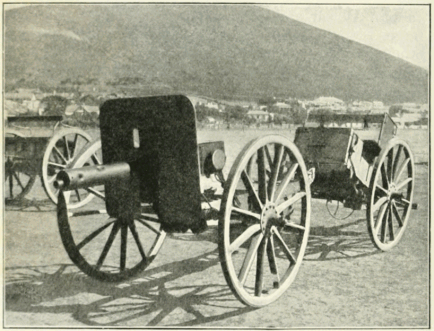
Guns Captured at Paardeberg. Photo by Alf. S. Hosking, Cape Town.
Plentiful rain had fallen, saturating humanity, and causing the heated ground to retract the fumes of a charnel-house. But in one way better times had come. There was fuller fare. Large convoys made a daily appearance, and the men were refreshed after their labours with the promise of plenty. Food of a substantial kind was indeed necessary, for it served to attune the stomach to the noxious vapours that hourly grew almost tangible. Cronje, though he knew it not, was sowing the seeds of a harvest of revenge! He was killing his thousands! For many days our troops had been enduring lenten fare; they had rung the changes on hardships, fatigues, and self-abnegations of all kinds. They had been battered on by storms. They had outstripped transport and supplies. They had kept the inner man appeased and working on quarter rations. They had marched like giants in ten-league boots, and meanwhile fed like fairies; yet withal had borne countenances cheery and noble, full of confidence and unquenchable pluck. But these splendid creatures were but mortal. The foul fiends of enteric and malaria were already sapping their buoyant constitutions, and marking them, one after another, with the deadly seal of possession.
Every day of the Dutchman’s resistance was therefore full of horror, full of anxiety. There were continual rumours that the Boer reinforcements were in view, that the Federals were massing for a desperate effort. Wearied and battered, the cavalry at Koodoosrand were perpetually speeding on wild-goose chases, in one of which both General French and Colonel Haig nearly lost their lives. A reconnaissance in force had been ordered. The drift, swollen by rains, was now a torrent, and in crossing the General and his A.D.C. were thrown by their restive horses into the river, whence they only emerged safe and sound in consequence of their being fine swimmers and pneumonia-proof Britons.
Cronje, finding that the reinforcements failed to reach him, decided on the night of the 26th to cut his way out and seize a kopje before dawn. But his intention was frustrated by the Mounted Infantry, who, in spite of the darkness, kept a watchful eye on the slippery enemy.
Quite early on the morning of the 27th of February, the anniversary of Majuba day, the splutter of musketry greeted the ears of the dozing camp. Some one was up and doing early. It was the Canadians. They were acting on the principle of the early bird that catches the morning worm. Supported by the Gordons, Cornwalls, and Shropshires, they were advancing, building a trench in the very teeth of the enemy, and at fifty yards’ range were saluting him with such deadly warmth as to render his position untenable. How this energetic and gallant movement, the wonder and admiration of all, was brought about was described by the correspondent of the Times. “It appeared that Brigadier-General MacDonald sent from his bed a note to Lord Roberts, reminding him that Tuesday was the anniversary of that disaster which, we all remembered, he had by example, order, and threat himself done his best to avert, even while the panic had been at its height; Sir Henry Colvile submitted a suggested attack backed by the same unanswerable plea. For a moment Lord Roberts demurred to the plan; it seemed likely to cost too heavily, but the insistance of Canada broke down his reluctance, and the men of the oldest colony were sent out in the small hours of Tuesday morning to redeem the blot on the name of the mother-country.