U.S. NAVAL WAR COLLEGE
Reading edition
Newport, Rhode Island
November 30, 1941
SOUND MILITARY DECISION was first published at the Naval War College in 1936. It included the essential features of THE ESTIMATE OF THE SITUATION which, since 1910, had been issued at intervals in a series of revised editions. The new material that was added in 1936 was intended to assist in enlarging the viewpoint and in broadening the basis of professional judgment.
Primarily intended for the purposes of the Naval War College, this work is the cumulative result of years of untiring and loyal effort on the part of the College staff and student body. Equally important have been the advice and assistance contributed by other officers of wide professional experience and attainment.
The objective has been a brief but inclusive treatment of the fundamentals of the military profession, i.e., the profession of arms. The emphasis, naturally, is on the exercise of mental effort in the solution of military problems, more especially in our Navy. An enormous literature has been consulted, and research has included all available and pertinent military writings. Care has also been taken to include, from civil sources, the findings of those authoritative works which deal with related matters and with the applicable underlying truths.
In a work of this type and scope, it is manifestly not possible to illustrate the abstract text by historical examples and analogies. These are complementary features of the War College resident and correspondence courses; provision for the necessary historical background is otherwise the concern of the individual student.
In this edition of SOUND MILITARY DECISION no radical changes have been made; the revision has been confined to rearrangement and amplification of the subject matter.
E.C. KALBFUS, Rear Admiral, U.S. Navy, President.
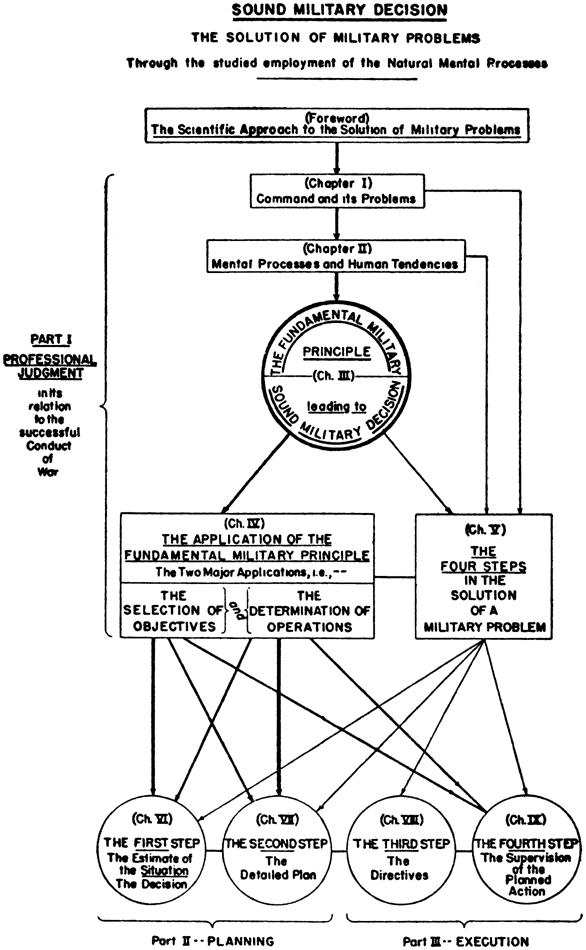
TABLE OF CONTENTS
(See Chart on page XXXX)
Page
FOREWORD 1
Science of War—Scientific Investigation—Fundamental Considerations—Art of War—Scientific Method—Leadership and Training—Sound Decision—Judgment—The Approach to the Solution of Military Problems—Fundamental Philosophy—Technique of Solution—Process of Education—Outline of the Discussion.
PART I. PROFESSIONAL JUDGMENT IN ITS RELATION TO THE SUCCESSFUL CONDUCT OF WAR.
I Command and its Problems 7
The Implementation of National Policy—The Primary Function of the Armed Forces—Military Strategy and Tactics—Command of the Armed Forces—Unity of Effort—The Chain of Command—Mutual Understanding—Indoctrination.
II Mental Processes and Human Tendencies 19
Natural Mental Processes—The Necessity for Logical Thought—Principles in their Relation to Logical Thought—Value and Limitations of Lists of Principles of War—Formulation and Use of Principles—Summary of Fundamental Considerations.
III Basic Principles Applicable to Military Problems (The Fundamental Military Principle) 29
Review of Conclusions—Procedure—Suitability, Feasibility, and Acceptability—Fundamental Principle for Attainment of an End—Interdependency of Factors—Special Nature of War—Factors in War—The Objective in War—Military Operations—Salient Features—The Fundamental Military Principle—Corollaries.
IV The Application of the Fundamental Military Principle (Objectives—Their Selection and Attainment) 43
The Basis for Solution of a Military Problem—The Major Components of a Military Problem—Essential Elements—Selection of Correct Military Objectives—Determination of Effective Military Operations—Physical Objectives—Relative Positions—Apportionment of Fighting Strength—Freedom of Action—Summary.
V The Four Steps in the Solution of a Military Problem 79
A Situation—The Incentive—The Assigned Objective—The Motivating Task—The Natural Mental Processes—The Approach to the Solution—The First Step—The Basic Problem—Tasks—The Mission—Survey of Factors of Fighting Strength—Courses of Action—Reflective Thinking—Naval Operations—Analysis and Selection of Courses of Action—The Decision—The Second Step—The Third Step—The Fourth Step—Sequence of Events in the Four Steps—The Use of a Form in the Solution of Problems—Conclusion.
*PART II. THE EXERCISE OF PROFESSIONAL JUDGMENT IN PLANNING.
VI The Selection of a Correct Objective (Including the Determination, in Proper Detail, of the Action Required for its Attainment) The First Step—The Solution of a Basic Problem (The Estimate of the Situation) 117
Process of solving a Problem—Sections of the Estimate Form—Establishment of the Basis for Solution of the Problem—Determination of Suitable, Feasible, and Acceptable Courses of Action—Examination into the Capabilities of the Enemy—Selection of the Best Course of Action—The Decision.
VII The Resolution of the Required Action into Detailed Operations (The Second Step—The Solution of Subsidiary Problems) 155
Assumptions—Alternative Plans—Application of the Essential Elements of a Favorable Military Operation—Testing for Suitability, Feasibility, and Acceptability— Formulation of Tasks—Organization of Task Groups— Application of the Fundamental Military Principle to the Determination of Objectives embodied in Tasks—Assembly of Measures for Freedom of Action—Preparation of Subsidiary Plans.
*PART III. THE EXERCISE OF PROFESSIONAL JUDGMENT IN THE EXECUTION OF THE PLAN
VIII The Inauguration of the Planned Action (The Third Step—The Formulation and Issue of Directives) 183
Scope of the Third Step—Military Plans and Military Directives—Essentials of Military Directives—Restatement of the Decision—Standard Forms for Plans and Directives—The Order Form—Types of Naval Directives.
IX The Supervision of the Planned Action (The Fourth Step) 197
Nature of the Discussion—Goal of Planning—Importance of Execution—The Incentive—Conditions in War—Recognition of New Problems—Nature of Readjustments Required—Importance of the Will of the Commander—Problems Involving Modification of the Basic Plan—Problems Challenging Integrity of Basic Plan—Further Procedure Applicable to such Problems of the Fourth Step—The Running Estimate of the Situation—Journal and Work Sheet—Special Remarks as to Entries—Summary.
*CONCLUSION 217
*APPENDIX
Outline Form of an Operation Plan 219
Tabular Form of the Estimate of the Situation 222
*INDEX 227
* Not included in the limited issue for use in Part I of the Correspondence Course.
FOREWORDToC
From the earliest days of recorded history, the facts associated with military operations of the past have been constantly studied. The result has been the accumulation of a mass of information from which conclusions have been drawn as to the causes of success and failure. Although scattered through countless volumes, and nowhere completely systematized and classified, this accepted body of knowledge constitutes the basis for the science of war.
Scientific investigation—that is, the collection, verification, and classification of facts—follows the recurrent procedure of successive analysis, hypothesis, theory, and test. The application of this process to the campaigns of history reveals fundamentals common to all, irrespective of whether the sphere of action has been land, sea, or air. In the ceaseless struggle for supremacy between the offense and the defense, great technological changes have taken place. The successful conduct of war, however, has always depended on effective operations for the creation or maintenance of favorable military situations, whose essential elements have remained unchanged throughout the years (see page 46).
These fundamental considerations (see page 28), whatever the detailed form of their presentation, are the basis for the successful conduct of war. The need of such a basis has been felt from very early times. It was not, however, until the early part of the Nineteenth Century that students of warfare appear to have recorded the view that the conduct of war is susceptible of reduction to scientific analysis, and that only through a reasoned theory can the true causes of success and failure be explained.
Such a scientific analysis of any subject has for its chief practical aim the improvement of the art, or practice, of that subject. Forming an important part of the science of war are those new developments in weapons and in other technological fields which, with the passage of time, have brought about great changes in methods of waging war. It is only through founding the art of war—the application of the science of war to actual military situations—on the fundamental truths discovered through the science of war, that changes in method, due to technological evolution, can be made most effective.
In preparing for war, the only practicable peacetime tests are usually restricted to those afforded by examples of the past, by problems such as chart (map) and board maneuvers, and by fleet and field exercises. While the military profession can afford to neglect none of them, such tests can never be conclusive. This fact, however, far from justifying resort to any other procedure, emphasizes the necessity for utilization of the scientific method in order to arrive at conclusions which are as exact as possible.
An exact result is, of course, the aim of all scientific research, but exactitude necessarily depends on the establishment of correct relationships among facts which have so far come to light. Consequently, there is great variation in the degree of accuracy which actually characterizes the several sciences. If it be maintained that only those studies which have resulted in exact conclusions may properly be regarded as sciences, then it can hardly be said that many sciences, now regarded as such, exist; for the findings of medicine, biology, chemistry, and even physics are continually being revised in the light of new data.
The science of war necessarily includes knowledge gained in other fields. In war, as in medicine or any other practical activity, the more inclusive and dependable the body of knowledge available as a basis for action, the more probable it is that the application of this knowledge, the art (page 1), will be effective.
Realization of these facts has led to renewed emphasis on the scientific approach to the solution of military problems. The fallacy of staking the future upon the possible availability of a military genius in time of need became clear when it was appreciated that more than one nation, hitherto victorious in arms, had been defeated and humiliated when genius no longer led its forces.
There followed in the military profession a conviction that, although extraordinary inherent capacity can be recognized and utilized when known to exist, it is safer and wiser to develop by training the highest average of ability in leadership than to trust to untrained "common sense" or to the possible advent of a genius. History has abundantly proved the folly of attempting, on any other basis, to cope with the unpredictable occurrence of genius in the hostile leadership. With the actual exercise of leadership in war restricted to the reality of war, there is emphasized the need of peacetime training—training of subordinates in efficient performance, and, more important, training of those who will be placed by the State in positions of responsibility and command.
Campaigns of the Twentieth Century reflect the intensity of mental training among the armed forces of the greater powers; the planning and conduct of war have acquired a precision, a swiftness, and a thoroughness before unknown. The study and analysis of past campaigns, the sifting of technical details from fundamental truths, and the shrewd combination of the theoretical and the practical form the basis of this training.
The proper solution of military problems requires the reaching of sound decision as to what is to be done. Upon the soundness of the decision depends, in great part, the effectiveness of the resulting action. Both are dependent on the possession of a high order of professional judgment, fortified by knowledge and founded on experience. Theoretical knowledge supplements experience, and is the best substitute in its absence. Judgment, the ability to understand the correct relationship between cause and effect, and to apply that knowledge under varying circumstances, is essential to good leadership. Professional judgment is inherently strengthened by mental exercise in the application of logical processes to the solution of military problems.
The approach, presented herein, to the solution of military problems is intended to assist the military profession in reaching sound decisions as to (1) the selection of its correct objectives, the ends toward which its action is to be directed under varying circumstances; (2) planning the detailed operations required; (3) transmitting the intent so clearly as to ensure inauguration of well-coordinated action; and (4) the effective supervision of such action.
The student of war will find in these pages a fundamental military philosophy whose roots go down to very ancient times. In the technique described for the solution of military problems, experienced officers will recognize a system with which they are already familiar. This system, constantly under study to improve its details, has been in use in our military Services for many years.
The foundation of this philosophy and of the system for its practical utilization rests on the concept of relative or proportional values. In the military environment, change, rather than stability, is especially to be expected, and the relationships existing among the essential elements of a military situation are, in fact, the significant values. Such values, themselves, vary with the viewpoint of the person concerned. Accordingly, because of the difference in objectives (defined above), what is strategy as viewed by a commander on a higher echelon may have more of a tactical aspect to those on a lower (page 10). Immediate objectives and ultimate objectives (page 54) can scarcely be understood in their true proportions unless the point of reference is clear. The point of view of the commander, as established by the position he occupies in the chain of command, is, therefore, to be taken into consideration in every phase of the solution of a problem,—in the determination of the appropriate effect desired (page 43), of relative fighting strength (page 35), and of courses of action and the detailed operations pertaining thereto (page 88).
On the basis of these facts, instantaneous and easy understanding of all the elements involved is not to be expected. Were such understanding possible, the expert conduct of war would be one of the easiest, instead of one of the most difficult, of human activities. It is only through a gradual assimilation of its fundamentals that the profession of arms is to be mastered. A process of true education is involved,—that of enlarging the viewpoint and broadening the basis of professional judgment (see page i),—and its essentials are the proper foundation for any system of self-improvement in the exercise of mental power. There is no easy road to the goal of military effort.
Part I, hereafter, discusses professional judgment in its basic relation to the successful conduct of war. This treatment examines the responsibilities of the armed forces, discusses the role of the commander, indicates the natural mental processes employed in the solution of military problems, formulates and explains the Fundamental Military Principle, and concludes with an outline of the procedure for its further application in Parts II and III.
Part II is concerned with the solution of the problems encountered during the planning stage.
Part III discusses the execution of the plan,—the directives and the supervision of the action,—but the treatment as to details is chiefly from the standpoint of the mental effort. During hostilities the vital issues which hinge on alert supervision create an accentuated demand for the intelligent exercise of professional judgment. Its possession to a highly developed degree and its exercise on a foundation of knowledge and experience, are prerequisite to attainment of the highest standards in the conduct of war.
The following pages are intended, therefore, to provide a fundamental basis upon which the commander, by thoughtful study and reflection, may develop his professional judgment to the end that its exercise result in sound military decision, essential alike to wise planning and to consistently effective action.