Front matter (continued 3)
Reading edition
"Well, meself'd say," says another, whose handsome eyes shone in the shadow of his soft felt hat, while his hands helped out his words with picturesque gesture, "the man I'd have a wish for to wote for him, is the man that'd rise out o' his bed in the night and give hay and oats to yer horse, and yerself fotever ye'd ax, when any one else'd leshen (listen) in their bed if ye were battherin' there till mornin'."
This argument referred to the well-known good nature of the Parnellite candidate, a general dealer and publican in a neighbouring village.
"Well, indeed, he's no scholar, I suppose," says a young fellow, still in reference to the Parnellite. "He has no learnin' nor way of spakin' no more than meself, but becripes! he's a fine sthrong man, and he'll be well able to fight and box in Parliament."
This was said in entire good faith, and was listened to with respect.
"Come on back the road!" bawls a supporter, beckoning authoritatively from the distance, "let yees come on now, the whole o' yee, the way we'd be before the car and it going up!"
The reason for this manoeuvre was presently apparent, on returning to the village street. As the candidate's car left the chapel the Parnellite crowd thronged the corner by which it must pass; a battery of threatening faces, waiting with unknown purpose; a gauntlet to run or to run away from. The car came slowly up the hill, preceded by a party of supporters; the candidate on one side, looking anxious the old priest on the other, bare-headed, and looking still more anxious, but waving his hand as if in greeting, while the interwoven yells became a thrilling mass of sound.
It was well for the candidate that his companion was one of the oldest and most popular of the Galway priests. That prestige had shielded the churchyard meeting from disturbance, and but for its influence now the future M.P. might have returned to England with an appearance not advantageous to the firm of which he was a member. A forest of clenched fists and sticks seemed to leap up towards him, the scream of hatred never took breath, and there was entreaty in the face of the priest as his wrinkled hands waved repressively above the tumult. There was a long moment of uncertainty, but in the next the car was through in safety, and was gone in the twinkling of an eye, the supporters running in its wake till the last waving gleam of the candidate's silk hat had been garnered.
It was then that things began to look, to an Irish eye, most promising and attractive. The supporters turned, formed into a solid body of perhaps forty men and boys, and marched with inimitable swagger straight back into the crowd, all together, in a kind of chant, shouting, "To hell with ——!" (the rival candidate) at the utmost strength of their lungs. The theme was a simple one, but magnificently vocalised, and was instantly replied to in the tu quoque manner by the opposite party. Sticks went up, the women rushed outwards for safety, looking, with their floating shawls, like a flock of frightened turkeys; and at this point the four constabulary men who represented that force made themselves felt. The dangerous moment yielded easily and unresentfully to these judicious hands, and the excitement sputtered out in a little bragging and hustling, without so much as a black eye to commemorate it. In half an hour the ducks were again waddling in line along the empty street, and a muffled hum proceeding from the shuttered public houses, told that the bonâ fide travellers had at length reached their journey's end. It was a lamentable falling off from the days of the fish kettles and the mulled port of Kilroy's Hotel.
The episode had expired in the way that might have been expected, and was at best an indeterminate, shapeless thing, full of unripe revolt that it was too childish to express. But that moment when the little flame first flickers in the gorse, feeling its naked way among the thorns and affluent blossom, has a wonder of birth in it that is forgotten when the blazing hillside jars the noonday, and the smoke rolls monotonously from strongholds of conflagration.
A RECORD OF HOLIDAY
Of summer holidays it may at least be contended that they involve two periods of undiluted enjoyment; the time of anticipation, and the calm—if sometimes chastened—season of retrospect.
I am glad; now that the mice are nesting in my trunks, and the spiders weaving fresh straps round my hold-all, that I have been to Switzerland, that the greasy Visitors' books of several West of Ireland hotels hold my name. Also, I remember how very cheerful it was to study a scarlet-hued Bradshaw, and to reflect that, with certain financial restrictions, the Continent of Europe lay smiling before me. (I remember also, that I lent that entertaining work to an American friend, and found the utmost difficulty in recovering it from him. It was only restored, indeed, on the morning of my departure, and my friend mentioned that he had sat up all night reading it, "Just to see how it ended," he said.)
Between, however, these seasons of satisfaction, there stretches the actual time of holiday, and as I reflect upon it, I am struck by the fact that its more salient features are misfortunes. From a literary point of view this has its advantages; the happy traveller has no history. If the converse is true it would need Gibbon or Macaulay to deal with our transit from the County Cork to that Alpine fastness for which we had trustingly, fearlessly labelled our luggage.
It began with fog in the Channel—the Irish Channel—solid, tangible fog, through which our bewildered steamer stumbled, uttering large, desolate cries of distress, stopping every now and then to bellow like a lost cow, sometimes, even, going astern, while muffled hootings told of another wanderer who had drawn nearer than was convenient.
"When I heard 'em giving the signal to go astern," said a sailor officer of high degree, next morning, as he gobbled a belated mouthful of breakfast, "I thought it was about time to get up and put on my clothes. Said nothing about it to m' wife, though!"
I wonder if he has realised yet why everyone smiled.
In London, rain; in Paris, blinding heat. Dizzily we staggered round the elder Salon, and through its innumerable small square rooms, with their lining of flagrant canvases; it was like exploring the brain-cells of a fever patient in delirium. One healing instant was ours, when at the public baths in the Boulevard Mont Parnasse, the waters of a "Bain Complet" closed over the exhausted person; but that, even, was speedily poisoned by the discovery that towels and soap, being extras, were not left in the Cabinet de Bain, and the bather, having with dripping hands explored the pocket for the needed coins, had then to tender them to the attendant through a difficult slit of doorway, receiving in exchange a small fragment of slightly scented marble and a gauze veil.
After that, the night journey to Geneva. Heat, sardine-like proximity of fellow travellers, two dauntless English ladies, who turned the long night into one unending and clanking tea-party; a nightmare interlude of douaniers, then, when a troubled sleep had at length been bestowed, Geneva; and all the horrors that attend the finish of a long train journey.
At breakfast, at our hotel, a survey of what we had hitherto endured in the pursuit of pleasure stung us to a brief revolt. This was a holiday, we told ourselves, why hurry? Fortified by a principle, theoretically unassailable, we strolled about Geneva. It was cold and very wet; still, in our newly realised leisure, we made a point of strolling. On our return to our hotel most of the staff were on the pavement, seemingly very much excited. A voiture, laden with our luggage, stood at the door. It appeared that our steamer left for Villeneuve in eight minutes. I imagine that the hotel staff's agitation arose from the fear that we should not have time to tip them all. This was, alas, unfounded.
The driver took us first to the wrong steamer. He then turned his machine too short, and locked the fore carriage. Then he shambled across the long bridge to the other steamboat quai, while we sat forward, like the coxswains of racing eights, in sweating agony, watching our boat getting up steam and preparing for instant departure.
We caught the boat by springing, like Spurius Lartius and Herminius, across the widening chasm between her deck and the shore, and therewith fell into a species of syncope. Mists shrouded the mountains; a chilled rain swept the lake. For our parts, slowly recovering, we kept the cabin, and swept the tea-table. It was almost our first moment of enjoyment.
The Alpine fastness, already alluded to, was not gained for a further couple of days, during which an awakening distaste for Switzerland slowly grew in us, though it did not thoroughly mature till mellowed by a mule ride up a mountain. Reticence in narration is a quality that I endeavour to cultivate. It becomes a necessity in treating of the village and its surrounding slums from and through which our start was made. Having, in a state nearing starvation, been offered the sole refreshment available, namely, concentrated essence of typhoid in the guise of glasses of milk, and having retained sufficient self-control to refuse them, we started on mule-back for the mountain. Traversing, as I have every reason to believe, the open main drain of the village, our animals proceeded to totter up a narrow and precipitous watercourse.
"La voie la plus directe," explained the mule-driver, lashing his ancient cattle in a general way, and without animosity.
The cloud that accompanied our wanderings, as in the case of the Israelites, did not fail of its usual office. Even through the crown of a Panama straw hat the rain attained to my skin. Thence it descended, enveloping me, as it were an inner garment. Twice my mule fell down. I could not reproach it. Indeed, nothing but the fact that one of its parents had been an ass explained its readiness to pick itself up and go on again. It had, however, an incentive, supplied in the rear by its proprietor; we had naught save the fetish of Holiday to goad us onward, and its potency was beginning to weaken.
One week of the mountain hotel was as much as we were able to endure. The usual "exceptional" weather prevailed. How familiar is the formula, and how entirely unworthy of credence!
"For seventeen years"—the Landlord calls heaven to witness—"it has never been so wet, or so cold, or so stormy at this time. If Monsieur or Madame, had come but three weeks ago—or would wait but three days longer——"
There was a time when the glamour of holiday might have induced belief, might even have beguiled a further endurance of the age-long table-d'hôte repasts, of the aggressive muscularity of the English schoolmaster, who, during the progress of the ménu from the watery soup to the acrid Alpine strawberry, faced us, boasting at large and in detail; of the German bride, who practised the piano for four hours daily (her head upon her bridegroom's shoulder, his faithful arm round her waist). These things, though unattractive in themselves, might once have been submitted to as elements of the theoretical holiday (in Switzerland), as mere inevitable crumples in the rose-leaf.
But, on this occasion—it is possibly one of the compensations of advancing years—we found ourselves endowed with a juster sense of proportion. The close of the eighth day saw us heading for home with a speed that almost amounted to rout. The mule-driver's maxim, "la voie la plus directe" seemed good common sense; we drew neither breath nor bridle, Geneva, Paris, London were but names in the night, till we found ourselves facing America from the front doorstep of a certain remote hostelry in the far west of Connaught.
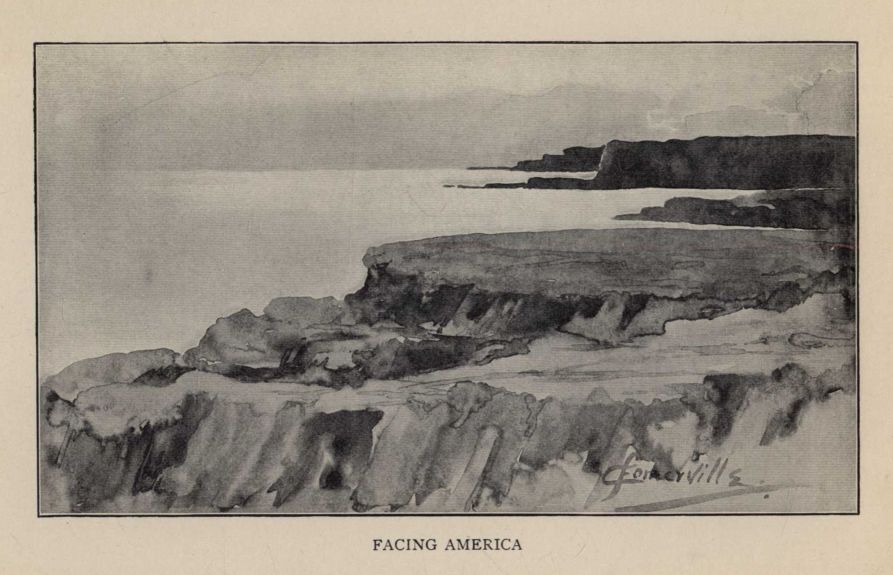
FACING AMERICA
Then, and not till then, did something of the largeness, the leisure, the absurdity, the unconventionality, that should enter into all true holiday, begin for us.
I have said hostelry, and undoubtedly the words "Seaview Hotel," in letters large and green, were inscribed upon its pink-washed walls, but without this clue I do not think the closest observer would be able to detect its walk in life. It had but one storey; a dark and narrow passage led from the entrance to the kitchen, and therein, at (as subsequent experience showed us) any time of the day or night, the entire establishment might be found, massed, talking as though they had not met for years, and were to separate in an hour.
Thus we, led by our carman, an habitué of the house, found them, and thus, with but brief intervals, they continued during the period we spent among them.
"What is it, Mike?" this to the car-driver from a very stout lady, whom we rightly assumed to be the proprietress. "Oh—the sitting-room," she exhibited a natural annoyance, having been interrupted in a pronouncement on, I gathered, the feeding of pigs. "Here! Mary Kate, show the sitting-room!" She re-addressed herself to her subject.
Mary Kate, a charming slattern with a profusion of fair hair, "showed" the sitting-room. It was small, but not unclean, and, in addition to the normal outfit of table and chairs, was remarkably equipped with a large double perambulator, whose use as a sideboard was sufficiently indicated by the fact that a cruet stand and a loaf of bread occupied one seat, while a piece of cold beef reclined on the other. The bedrooms, if I may quote a French guide-book's remarks upon the retreat of a hermit, "excited I know not what emotions of religious terror;" emotions that were not allayed by the suspicion, that deepened to certainty, that, in the absence of visitors, they were occupied by the staff.
"Hot wather? O cerr*tainly!" said Mary Kate, kindly. "Beg your pardon—" she crushed past me to the chimney-piece, and proceeded to grope behind photograph frames and a crowded multitude of glass and china, *objets d'art. "I left me hat pins—" here she giggled confidentially, while, so intimate was the arrangement of the objets d'art, that several of them fell off at the farther end of the chimney piece. "Ah! what matther! Sure they're all a little broke!" said Mary Kate, wedging them into their places again, and thrusting the recovered hat pins into her redundant locks. "Ye'll be wanting somethin' to eat now, I daresay," she went on, "I'll send granne'ma in to ye."
A brief interval ensued, during which we furtively examined the bedclothes, and indulged in disturbed conjecture as to the substance that stuffed the pillows. Their smell, though curious, offered no basis for theory.
There came a creeping sound without, and low down, a panel of the door was dealt a single blow.
I said "Come in!" not without a slight recurrence of religious terror.
A very little and ancient woman stood there, with the trade marks of soot and grease thick upon her. When she curtseyed she seemed to merge in the door mat, so small was she and so dingy.
There was reassurance in the discovery that she seemed as much in awe of us as we of her.
"How would I know what the likes o' ye would fancy?" she said, almost with despair, and went on to hope that our visit might prove an education into the ways of the aristocracy of which she had long stood in need, but she coupled the admission with a warning that she "was very owld and very dull."
It was a high responsibility, this position of exponents of an unknown type, and it is much to be regretted that we were forced to leave our venerable disciple under the impression that the upper classes usually cook their own food at hotels. It should here be said that this expedition had not been entered upon without a certain foreknowledge of what it was likely to involve, and amongst other precautions were provisions of a portable sort. These included sausages, and the sausages we confided to our old lady.
We sat in the parlour enjoying the appetite for dinner that is one of the bright features of a genuine holiday. After a delay of about half an hour, Mary Kate's head was thrust through a narrow opening of the door.
"Granne'ma says will the little puddings be split?"
Had the answer been Yes, and that it was usual to serve them with cream and sugar, I feel sure that grandmamma would have complied. As it was, after instructions to Mary Kate, of a lucidity unrivalled by Mrs. Beeton, the sausages appeared, pale, tepid, raw, in a pie-dish, just a-wash with luke-warm water.
The holiday appetite quailed at the sight, and the chef was summoned from the conversazione still raging in the kitchen. A single glance at the guests told her of failure, and, with a masterly grasp of the position, she hurried back to the kitchen and returned with the frying-pan.
"Keep it now yersels," she said. "Didn't I say to ye I was too owld?"
From that time the parlour grate led a sullied life, but—which may have consoled it—a thoroughly useful one. We re-cooked the sausages upon it; the perambulator yielded its increase, toast, grilled beef, sausages, who could reasonably ask for more?
We spent two days and two nights there; days of perfect weather, spent in exploring a coast as wild and beautiful as the heart of holiday maker could desire, nights strangely, almost desolately devoid of the entomological excursions and pursuits usual to village inns, and, in spite of the peculiarities of the pillows, sleep was not difficult. Or rather, in candour it should be said, was difficult only after the rising of the sun. For with the dawn, a vagrant population was astir in the village; a street Arab community of hens, dogs, geese and donkeys, incessant and clarion-toned in their addresses to morn and to each other; creatures who slept under carts and in stray corners; who treated life as a lounge, and regarded their owners as suzerains merely, to whom occasional allegiance was to be rendered, or a tributary egg or two laid in an inaccessible place.
On the whole, the donkeys are those of whom I can speak least temperately. They had, for want, possibly, of other employment, adopted the position of town-criers to the village, or perhaps were its prophets, perhaps its Cassandras, and they uplifted their testimony from sunrise till nightfall with a poignancy that rent the very skies. Standing one evening on one of the low hills that hemmed the village into its corner by the sea, I counted easily, and with half a glance, four of these enthusiasts, planted each on a commanding rock or mound, and sending his wild voice abroad over the valley. It was a sunny evening, after a day of sad and opalescent beauty, and the sea had brightened into blue and silver; the white-washed gables and a far white lighthouse were radiant with recovered cheerfulness, but the jackasses were as despairful and implacable as Jeremiah.
There was but one disaster during our brief sojourn at the Sea View Hotel. A few sausages and a tin of sardines remained, "spared," as Mary Kate said, from the first repast. These she proposed to store, for safety and coolness, in one of our bedrooms. The idea not being well received, she finally deposited them in the Post Office, which was attached to the hotel. But even this hiding place was not improbable enough to hoodwink that skilled tactician, the hotel cat, and he, in some dark hour of the night, found and feasted on them with, no doubt, all the ravishing joy of a new experience.
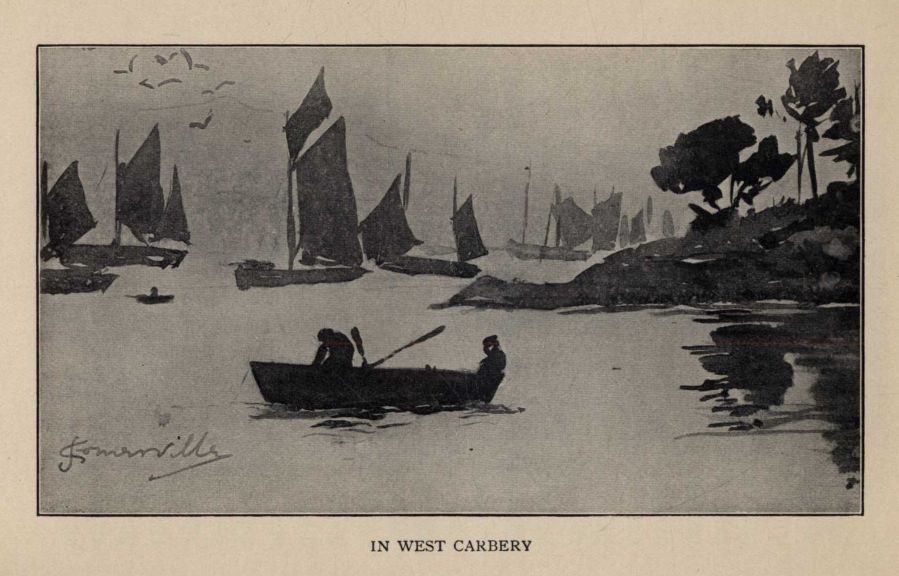
IN WEST CARBERY
We could not but sympathise with him. Thanks to the Sea View Hotel that subtle joy was also ours.
I began by saying that of the Summer holidays the times of anticipation and of retrospect were the times of truest pleasure. Yet I can remember long September days beside a sea of Mediterranean blue, the sea of Southern Ireland, when the perfect present asked nothing of either past or future. The long creek wound, blue-green as a peacock's breast, between deep woods. High places of rock and heather were there, where you could lie, "ringed with the azure world," and see the huge liners, yes, and hear them too, as they went throbbing and trampling along the sun's path westward.
Those who know this place of holiday are comparatively few, but there is at least one distinguished name of the company—Dean Swift, no less. A couple of hundred years or so ago, he spent a summer in West Carbery, (an ivy-covered ruin, known as Swift's Tower, testifies to the fact,) and he forthwith made a poem about it, a Latin poem, addressed to the Rocks of Carbery.
One gathers that it was of the nature of an encomium, though the points selected for description are not those that would tempt the effete holiday maker of to-day. Possibly it was the Dean's majestic eighteenth-century manner of thanking his host for "a very pleasant visit." I came upon it in the house of a descendant of that host, reverently quoted in a copy of Dr. Smith's history of the County Cork, dated 1749. Thanks to the sympathetic scholarship of a contemporary divine, the Revd. Dr. Donkin, who made a translation of it, I am able to give some quotations from it. Dr. Smith thinks that "the Dean's descriptions are as just as his numbers are beautiful." It is not for me to disagree with him. Let them—or some of them—dignify these unworthy pages.
"Lo! From the top of yonder cliff, that shrouds
Its airy head amidst the azure clouds,
Hangs the huge fragment, destitute of props,
Prone on the waves the rocky ruin drops.
* * * * *
Oft too with hideous yawn, the cavern wide
Presents an orifice on either side;
A dismal orifice, from sea to sea
Extended, pervious to the god of day.
* * * * *
High on the cliff their nests wild pigeons make,
And sea calves stable in the oozey lake ...
When o'er the craggy steep without controul,
Big with the blast, the raging billows roll, ...
The neighbouring race, tho' wont to brave the shocks
Of angry seas and run along the rocks,
Now pale with terror, while the ocean foams,
Fly far and wide, nor trust their native homes.
The goats, while pendant from the mountain top,
The wither'd herb improvident they crop,
Wash'd down the precipice with sudden sweep,
Leave their sweet lives beneath th' unfathomed deep."
I am sorry to say that in these degenerate times the improvident goat has lost his ancient skill and is no longer pendant, and the oozey lake and stabling sea calf (the latter possibly a lingering survivor of the Deluge) may no more be found. None the less, I can confidently commend the scenes of these catastrophes to the holiday maker of to-day.
Even now, when the sunshine of last September has faded to a memory, and that of next September is too far away to be even a hope, I can still feel the soft lift of the western wind, still hear the booming of the waves in the deep and riven heart of the cliff.
LOST, STOLEN, OR STRAYED
"I couldn't find your apron, Ma'am," said the "Why not," imported a month before, with bare feet and a forelock like a Shetland pony. She belonged to the drift-weed of the household, and would, perhaps, now be ranked as a "tweeny"; her class derived its title from its genial habit of replying "Why not?" to any given order, without considering or knowing whether such were its business. The "Why not" was at present flushed with long search, and with that sub-resentment and assumption of being suspected that all servants run up like a flag when valuables are missing.
"There isn't one in the house, but I'm afther axing about it. It must be it was waylaid."
It may scarcely be necessary to explain that she meant mislaid, but in her limited skill in English she had expressed the real trend of the things in the establishment. They were not, as a rule, lost, nor in the strict sense of the word were they stolen; they were waylaid, snatched from their own walk of life and applied to some pressing necessity of the moment. The apron might have been taken to clean a bicycle, or to stay the flow of spilt ink, or to bandage the foal's leg, and the "Why not" probably had been a party to its fate.
It is on record that in past ages a punt, used by the master for his own pleasure, was waylaid after it had been suitably laid up in the coach-house for the winter. When Spring came, and the time of the singing of birds and the painting of boats set in, the punt was not.
It was "gone this long time;" it was "as rotten as that the boards was falling out of it undher the people's feet." "You couldn't tell what thim women in the laundhry would catch hold of when they'd be short of fire, an' God knows a person's heart would be broke that'd have to be lookin' for sticks for them."
Having arrived at the fact that his boat had been burned, the Master yielded to the inevitable.
"Begad!" he said, regarding the culprits through his spectacles, "I believe you'd burn myself if I'd light!"
The march of education has merely added scope to the art of waylaying. We have in the West of Ireland "heavy showers and showers in between," as an old woman put it when describing a wet day. In the course of one of the in-betweens a party from the Big House took refuge in a wayside cabin, and although it is not desirable or polite to observe too curiously the environment in wayside cabins, a glimpse of a green morocco-bound volume on a shelf, between a salt-herring and a hair-brush was too much for the visitor's good breeding. Averting our eyes from the hair-brush we identified the volume as a copy of Byron's "Marino Faliero," which had long since disappeared from the drawing-room book-case in which it had been wont to stand in the decorous neglect which, I imagine, is not uncommonly its portion.
No one knew anything about the book. It had apparently flown like a storm-beaten bird to the cabin door, and, out of pure compassion, was given house room. From internal evidence it would seem to have inspired considerable interest in a family of the name of Sweeny, whose autographs profusely adorned its wide margins. Later on we heard that one, Patsey Sweeny, when dying, had asked for the solace of a book. The Big House had been applied to for something suitable. We shall never know what influenced the "Why not" in her selection of "Marino Faliero;" we shall never know anything in that, or in any similar matter, with any certainty, but we do not expect certainty in the West of Ireland. "Marino Faliero" returned to its fellows, importing a rich odour of tobacco and turf smoke, but otherwise, unfortunately, dumb to its adventures.
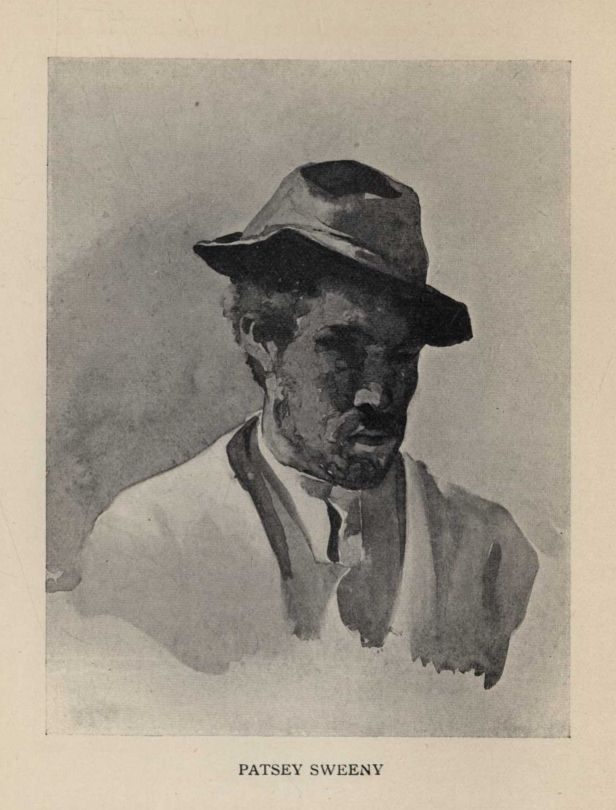
PATSEY SWEENY
Subsequently a daughter of the house of Sweeny showed much aptitude in the art of waylaying. A Confirmation was in prospect at the chapel, at which Miss Julia Sweeny, aged eleven, was to be presented as a candidate, the occasion requiring that she should be dressed in purest white from her oily curls to her nimble and naked feet. When the day of transformation arrived, the Young Ladies from the Big House turned out to view it, and as the candidate knelt in angelic decorum in the chapel, the youngest of the Young Ladies made the gratifying discovery that her new white canvas tennis shoes were on the feet of Miss Sweeny. On such a day it would have been a gross want of taste to have mentioned the matter, and that evening the tennis shoes re-appeared unostentatiously in their owner's room. No comment was made on either side, but with the sensitive perception of the clinical thermometer, the Sweeny family remained invisible for several weeks, after which Mrs. Sweeny arrived with a score of eggs as a present for the youngest Young Lady, and both sides felt that a disagreeable estrangement had been handsomely closed.
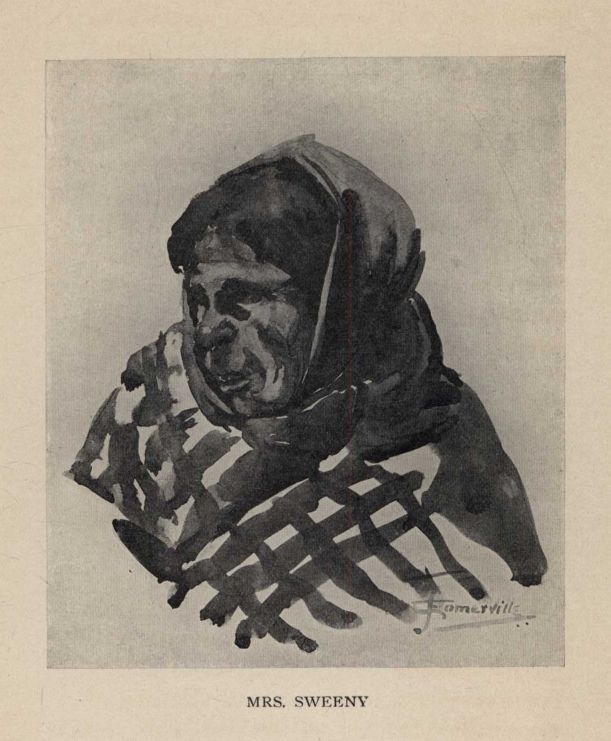
MRS. SWEENY
The adventures of the Gravy Spoon were of the simpler household variety, inexplicable, disconnected, yet following in a certain order a track familiar to all Irish householders. The gravy spoon was antique, slender of curve, and delicately ornamented along its graceful handle. Every servant connected with the spoon will now testify that the handle was cracked from the day it was made. One even asserts that "When ye'd strike it agin anything there'd be a roaring in it," which, of course, leaves no more to be said. That its prolonged absence from the table should have been unnoticed was well in the character of things: several months, in fact, passed before the lady of the house observed the cook skimming cream with a singular and dwarfish weapon, which proved to be the bowl and one inch of the handle of the gravy spoon. The explanation opened with the formula, "Sure that was broke always," followed almost inevitably by the statement that "it was broke when the young gentlemen was home." From the mouth of a third witness came the information that "Master Lionel broke it one day at luncheon helping curry." History was silent as to the composition of this remarkable curry. The cook entered no protest. Memory was not at any time her strongest point, judging at least from her own guileless confession on one of the many occasions when dinner was very late.
"Sure I mislaid the pudding, and there I was hunting the house for it, and where would it be afther all but in the oven!"
The search for the keys was, of course, a mere commonplace of every day. The storeroom was carefully locked up, and the bunch, an enormous and for the most part obsolete collection, was then taken severely upstairs and secreted. The next event was, usually, the departure beyond ken or call of the person who had secreted the keys, followed, at a greater or less interval, by the crisis when they became essential to the progress of things, by the opening scenes of the hunt, and its gradual broadening to full cry throughout the house. During this part of the comedy the servants, who were perfectly acquainted with every known hiding-place, remained coldly intent on their business, and the hunters deferred as long as possible the humiliating moment when their co-operation must be invited. When it came, the keys came with it.
To the lost and strayed the ashpit in the yard occasionally offered harbourage, where, among the hot turf ashes and evil smells, oblivion came quickly. Sometimes, when search ran high, as lately in the case of three errant postal orders, the ashpit was placed under martial law, and yielded strange spoils to its inquisitors. Instead of the postal orders came forth in the first instance a letter, dated 1805, from an historical personage, once Chief Justice of Ireland. The letter itself, in remarkably good preservation, described in choice and flowing English a fortnight spent in Bath, an experience in remarkable contrast to the ashpit. The second trophy was a cheque for eight pounds, recent and uncashed. The third was a tea cosy, of old gold and peacock blue satin, somewhat scorched by turf ashes, but new, and preserving in its quilted interior the label with which it emerged from its parent bazaar. There was other booty of an inconsiderable sort, but the postal orders were not found. The net result of the investigation was that every servant in the house hovered on the verge of giving warning, till the day when the postal orders arrived as stowaways in a letter from South Africa. The writer made no mention of their presence in the envelope, nor has he since been able to account for it, nor, to this hour, has any reasonable theory been brought forward to explain their wanderings.
Lest any hasty judgment should here be formed as to the conduct of Irish households, it is well to mention that other households, not Irish, have had experiences as remarkable.
A family of my acquaintance, blameless in domestic life and even notable in virtue, has established what must be, I think, a singular renown at Scotland Yard in the matter of lost valuables. During a stay of two nights under that hospitable roof, three several and severe disasters passed like winds through the establishment, causing much mental and physical stress, and a vast amount of cab hire.
The first was the loss of a diamond star, to recover which Scotland Yard, much concerned, put forth detectives and established a network of theories. It was subsequently found under the owner's bed. The second was less showy but more acute, a purse lost while shopping. Scotland Yard (not perhaps without a memory of the diamond star) was guarded, but still sympathetic. Several purses had been brought in; would the owner describe hers? The owner now asks us to believe that on being confronted with this question she found herself unable to remember what her purse was like. Then perhaps she could mention the sum of money it contained? Lamentable to relate, on this point also memory was a blank. After so flagrant a breakdown the ordinary individual would have ended the interview in the lockup, but the claimant of the purse, in addition to being young and lovely, was by no means ordinary. As a matter of fact she was invited to try again, and this time was enabled to say that she believed the purse had a hole in it. Further details of the interview were withheld, but we were given to understand that though the purse was not restored, the excellent relations with the officials remained unimpaired.
The third catastrophe was the loss of a dressing-bag, containing much of value, and forgotten, in the customary way, in a cab. This was a trifling matter; a mere occasion for a morning call at Scotland Yard, where the officials, with the special and protective smile reserved for this family, produced the bag. It was taken airily home in a hansom, its recovery was announced to an admiring luncheon table, and the peculiar success of the family with Scotland Yard was discussed.
"But where is the bag?"
And even with the words came the grey dawn of the discovery that the bag had once more been left in the hansom.
To follow the subsequent events would be an unkindness. It is enough to indicate that even Scotland Yard and its special smile were on this occasion of no avail.
To lose things by accident is, as we all know, calamitously easy, to lose them designedly is not only difficult but takes nerve and, at the right moment, want of principle.
There was once a red silk parasol, of the genus known to the trade as an en tout cas, which, literally translated, meant that in sunny weather it was cumbrous and heavy, and that during showers it wept tears of indelible maroon upon its possessor. It passed through an unloved youth into an abhorred middle age, with a crooked nose, a swelled handle, and a mottled complexion, unfit for society, yet not sufficiently decayed for a jumble sale. I and another went to Dublin for a week, and on starting found that the red umbrella had been put on the car by the servants, who held it in high esteem. We did not give it a thought; it would, of course, return upon the car to its lair in the back hall. As the train moved out into sunlight the red umbrella revealed itself, looming upon us through the netting where a careful porter had placed it. Not as yet recognising the hand of Fate, we lightly regarded it, and determining that it should be left in the train, straightway forgot its existence until an equally attentive porter placed it respectfully in our cab in Dublin. Had we kept our heads we should have offered it to him, murmuring something about having no change. Like most inspirations, this, unfortunately, did not occur to us till some five minutes later, but it suggested the idea of giving it to a housemaid, and on this understanding it accompanied us to our destination. During a week it disgraced our host's umbrella stand, and during that week we discovered that the housemaid, who, from the first, was quelling, was a Plymouth Sister, and would probably have regarded such a gift as an attempt to sap her religious convictions. When, on departure, it was deliberately forgotten, it was the Plymouth Sister who snatched it from the umbrella stand and breathlessly hurled it into our cab. It was obvious that to throw it out of the window in streets crowded with traffic would merely have involved a heavy fee to an inevitable rescuer; we reserved it for the window of the train, confidently, even enjoyably. Yet, such was its inveteracy, in the train the spell of forgetfulness again held us. The moments when it was remembered were precisely when the train stopped at stations, or the windows were blocked with fellow passengers, who would probably have pulled the communication cord to retrieve it. As we neared the long bridge of Athlone a final resolve was made. The network of big girders glided by, the broad Shannon glittered far below. The red umbrella shot like a spear through the girders and dropped out of sight. "So flashed and fell the brand Excalibur—"
The train crept into Athlone Station and there entered upon a prolonged wait among roomy and silent platforms. We exulted at leisure over the reel umbrella. A hurrying foot was distantly heard; doors opened and shut in rapid succession down the length of the train. We disinterred our tickets. The door of our carriage was opened and a heated boy put in his face.
"Did anny one here lose a red umbrella?"
It was the supreme moment in a duel with Destiny.
I replied to his question with a firm and simple negative.
CHILDREN OF THE CAPTIVITY
The road to Connemara lies white across the memory, white and very quiet. In that far west of Galway, the silence dwells pure upon the spacious country, away to where the Twelve Pins make a gallant line against the northern sky. It comes in the heathery wind, it borrows peace from the white cottage gables on the hill side, it is accented by the creeping approach of a turf cart, rocking behind its thin grey pony. Little else stirs, save the ducks that sail on a wayside pool to the push of their yellow propellers; away from the road, on a narrow oasis of arable soil, a couple of women are digging potatoes; their persistent voices are borne on the breeze that blows warm over the blossoming boglands and pink heather.
Scarcely to be analysed is that fragrance of Irish air; the pureness of bleak mountains is in it, the twang of turf smoke is in it, and there is something more, inseparable from Ireland's green and grey landscapes, wrought in with her bowed and patient cottages, her ragged walls, and eager rivers, and intelligible only to the spirit.
Over in England there are clustered cottages half buried in rich meadows, covered with roses to the edge of their mellow roof tiles, shaded by venerable and venerated trees, pleasant resting-places for the memory. From one of them comes forth a mild-faced elderly woman in a mushroom hat, the embodiment of respectability and hard work. If you talk to her you will be impressed by her sincerity, her reticence, her reverence for cleanliness, and further, as the conversation progresses, by her total lack of humour, and her conscientious recital of details not essential to the story. You will admire and like her, and she will bore you; so will her husband, with the serious face and sober blue eyes, and you will be ashamed of being bored.
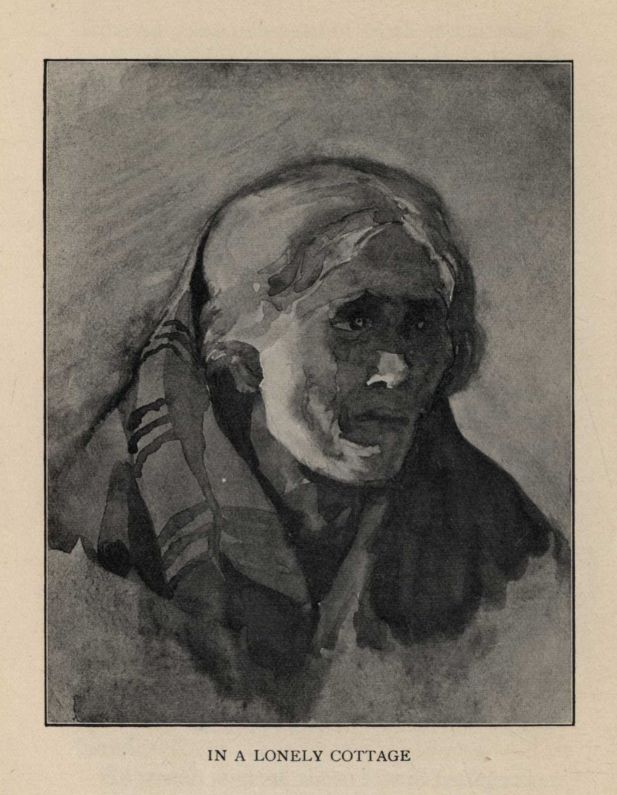
IN A LONELY COTTAGE
Approach one of these lonely cottages on a Connemara road, and you will find it crooked without quaintness, clumsy, dirty, distressful; yet there will come forth to you round the manure-heaps in front of the door a human being, probably barefooted, and better skilled in Irish than in English, who will converse with you in the true sense of the word, that is to say, with give and take, with intuition, and with easy and instant sense of humour. While you talk to her you can observe two elderly women in red petticoats and black cloaks advancing on the long road from Galway, carrying heavy baskets from the market: their eyes are quick, their faces clearly cut and foreign-looking. Were it in your power to listen to what they are saying, you would be entertained as you have seldom been, by highly seasoned gossip, narrative, both humorous and tragic, and wide and exhaustive criticism. A cart lumbers by, loaded with men and women, their teeth, one would say, loosened in their heads by the clattering and jolting, but their flow of ideas and language unshaken. The two women in the cloaks have arrived at a juncture at which they must stand still in the ecstasy of the story; the narrator shoots out a spike of a thumb, and digs her auditor in the chest to barb the point of the jest as it is delivered. The recipient swings backward from the waist with a yell of appreciation, they hitch their cloaks on their shoulders, and enter on the Committee stage of the affair as they move on again.
One might safely say that this bare and still country carries an amount of good talk, nimble, trenchant, and humorous, to the square mile, that the fat and comfortable plains of England could never rival. It has been so for centuries, and all the while the sons and daughters of Connemara have remained aloof and self-centred, hardly even aware of the marching life of England, least of all aware that Ireland holds the post of England's Court Jester. Others of their countrymen, more sophisticated, more astute, probably less agreeable, have not been slow to realise it. Perhaps they would have refused the Cap and Bells had they known the privilege entailed.
"As for our harps," said the Children of the Captivity, "we hanged them up upon the trees that are therein." That was when the songs of Zion were required of them in the strange land, and the strong Euphrates saw their tears. The sympathy of all the centuries has been theirs for that poignant hour; yet, as far as can be known, they were spared an extremer pang. It is nowhere recorded that the people of the strange land made any attempt to sing the songs of Zion to the Children of Israel.
When the Children of Erin hang up their harps in the Babylon of to-day, the last thing they wish to emulate is that passionate silence of the Israelites. They hang them up as those do who enter in and possess the land, and the songs of Zion have not faltered on their lips. A captive race they may be, but their national desire to "take the floor" has remained unshaken. They have discovered that an Irish brogue has a market value, and the songs of Zion have gone through many editions and held many audiences, since the days when Tom Moore exploited his country in London drawing-rooms. The moment of bitterness is when the English become fired with the notion of singing them for themselves.
Perhaps it comes about from English love of a theory, especially an hereditary theory, that has been handed down to them, well-thumbed by preceding generations. They have established a theory for the Irish, and particularly and confidently for Irish humour, and from owning the theory there is but a step to becoming proprietors also of the humour. Myself, when young, was nourished upon a work named "Near Home," and in the edition current at the time, I remember that the Irish were indulgently described as "a merry people, and fond of pigs." The hereditary theory could hardly have been better summarised. The average Englishman owns an Irish story or two, and is genially certain of his ability to tell it, with all necessary embellishment of accent and expression. As often as possible he tells it to an Irishman.
Elusive as running water is the brogue of the Irish peasant; hardly attained even by those who have known its tune from childhood. They, at least, know how it ought to be, and with this knowledge in their hearts, they have to sit in dreary submission while the stage Irishman convulses the English audience; they must smile, however galvanically, when friends, otherwise irreproachable, regale them with the Irish story in all its stale exuberance of Pat and the Pig, or expound for their benefit that epitome of vieux jeu, the Saxon conception of an Irish Bull.
As to Irish Bulls, it could be explained, were it of any avail, that they convey a finer shade of meaning than the downright English language will otherwise admit of.
"If ye were to be killed crossing a fence ye'd be all right!" said a looker-on to one whose horse had turned head over heels in the middle of a level pasture, "but if ye were killed on the flat o' the field ye'd never hold up your head again!"
Here was the effort of the true impressionist to create an effect regardless of the means.
"Jerry was a grand man. When he'd be idle itself he'd be busy!"
Had the author of this commendation merely said that Jerry's industry was unceasing, he would have been unassailable as to diction, but he would have left his audience cold. It is a melancholy fact that the English mind contrives to miss the artist's intention, and fastens unalterably on the obvious contradiction of terms.
As in converse, so, and with deeper disaster, is it in literature. There is scarcely a week in the life of the English comic papers that is guiltless of some heavy-handed caricature of Irish humour, daubed with false idiom and preposterous spelling, secure in its consciousness of being conventional. It is better to accuse a man of having broken a commandment than to tell him that his sense of humour appears to you defective, so, leaving that branch of the subject open, I will only mention that there are alive many excellent people who will never, on this side of the grave, be convinced that the Irish peasant does not say "indade" for "indeed," "belave" for "believe," or "swape" for "sweep." Inborn and ingrained knowledge of such points is essential; if, among many anomalies, a rule can be found, it seems to be that in an Irish brogue the diphthong "ea" changes to "a," as in "say" for "sea," while the double e remains untampered with; thus you might hear a person say "I was very wake last week."
Writers of fiction have done much that is painful in dealing with Irish people. Thackeray's Captain Costigan spoke like a stage edition of a Dublin car-driver, which is not what one would expect in a gentleman who, according to his own account, "bore his Majesty's Commission in the foighting Hundtherd and Third," and his introduction of Arthur Pendennis as "a person of refoined moind, emiable manners, and a sinsare lover of poethry" is not convincing or even very amusing. It is strange that the error of making Irish ladies and gentlemen talk like their servants should to this hour have a fascination for novelists. It is not so very long since that, in a magazine, I read of a high-born Irish Captain of Hussars, who, in a moment of emotion, exclaimed: "Howly Mither av Hiven!"
Dealing with present day writers is treading on delicate ground, and it is with diffidence that one arraigns one of the most enthralling of living story-tellers. Few of his works have been more popular than "Soldiers Three," yet to me and others of my country, it is the narratives of Private Mulvany that give least pleasure. "Gurl" for girl, "Thimber" for timber, and "Quane" for Queen, are conventions that have unfortunately proved irresistible; they are taken from a random page or two, and there is no page free of such.
But, after all, right or wrong, pronunciation and spelling are small things in the presentment of any dialect. The vitalising power is in the rhythm of the sentence, the turn of phrase, the knowledge of idiom, and of, beyond all, the attitude of mind. A laborious system of spelling exasperates the reader, jades the eye, and fails to convince the ear. If, in illustration, I again quote Mr. Kipling, it is because of the conspicuousness of his figure in literature; he can afford to occupy the position of target, indifferent alike to miss or bull's-eye.
Stripped of its curious and stifling superfluities of spelling, a sentence of Mulvaney's runs thus:
"Oh, boys, they were more lovely than the like of any loveliness in heaven; ay, their little bare feet were better than the white hands of a Lord's lady, and their mouths were like puckered roses, and their eyes were bigger and darker than the eyes of any living women I've seen."
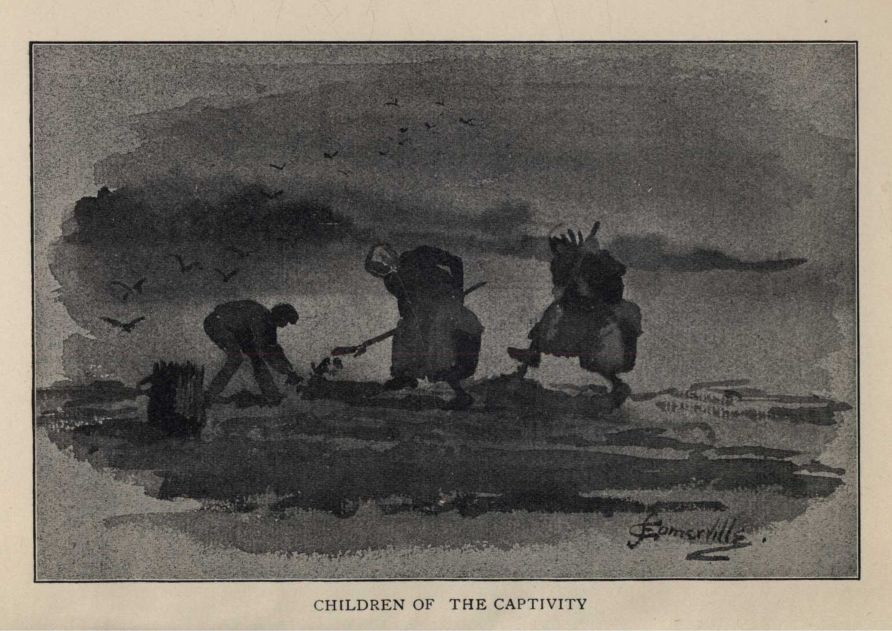
CHILDREN OF THE CAPTIVITY
With the exception of "the like" there is nothing in the wording of this panegyric that would even suggest it had been uttered by an Irishman. To stud the page with "ut" and "av" instead of "it" and "of" is of no avail. Irish people do not say these things; there is a sound that is a half-tone between the two, not to be captured by English voices, still less by English vowels. The shortcoming is, of course, trivial to those who do not suffer because of it, but want of perception of word and phrase and turn of thought means more than mere artistic failure, it means want of knowledge of the wayward and shrewd and sensitive minds that are at the back of the dialect.
The very wind that blows softly over brown acres of bog carries perfumes and sounds that England does not know: the women digging the potato-land are talking of things that England does not understand. The question that remains is whether England will ever understand.
SLIPPER'S A B C OF FOX-HUNTING
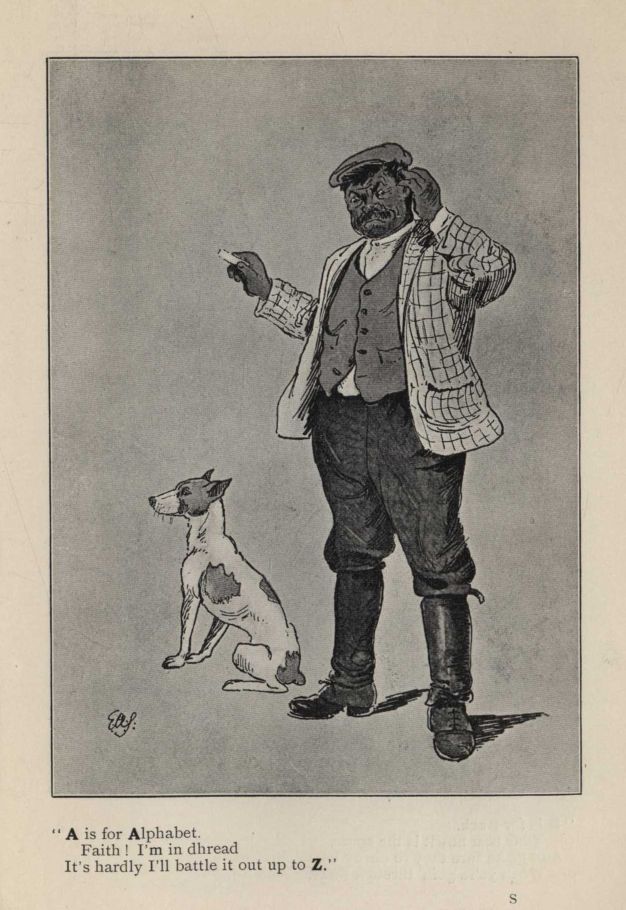
A is for Alphabet
"A is for Alphabet.
Faith! I'm in dhread
It's hardly I'll battle it out up to Z."
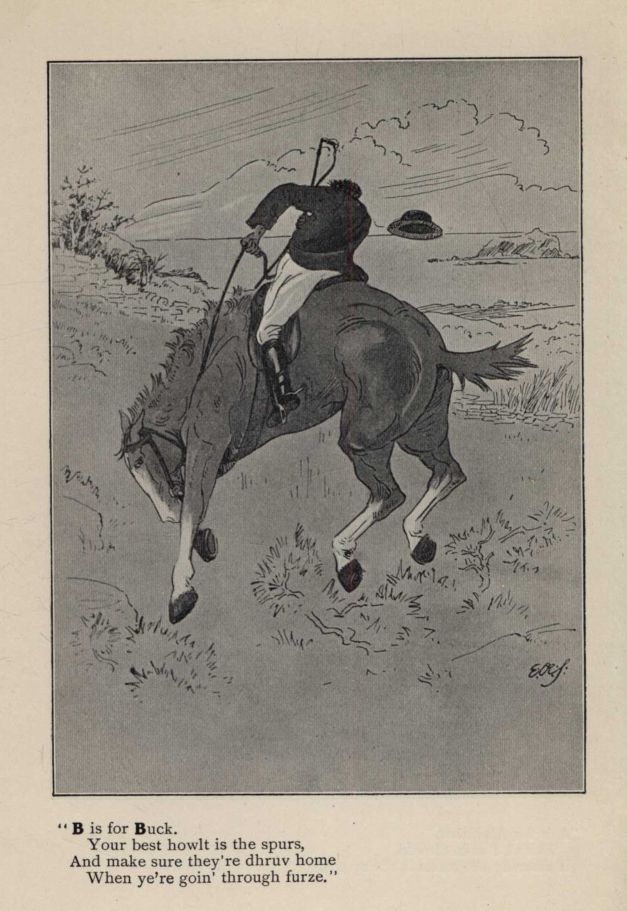
B is for Buck
"B is for Buck.
Your best howlt is the spurs,
And make sure they're dhruv home
When ye're goin' through furze."
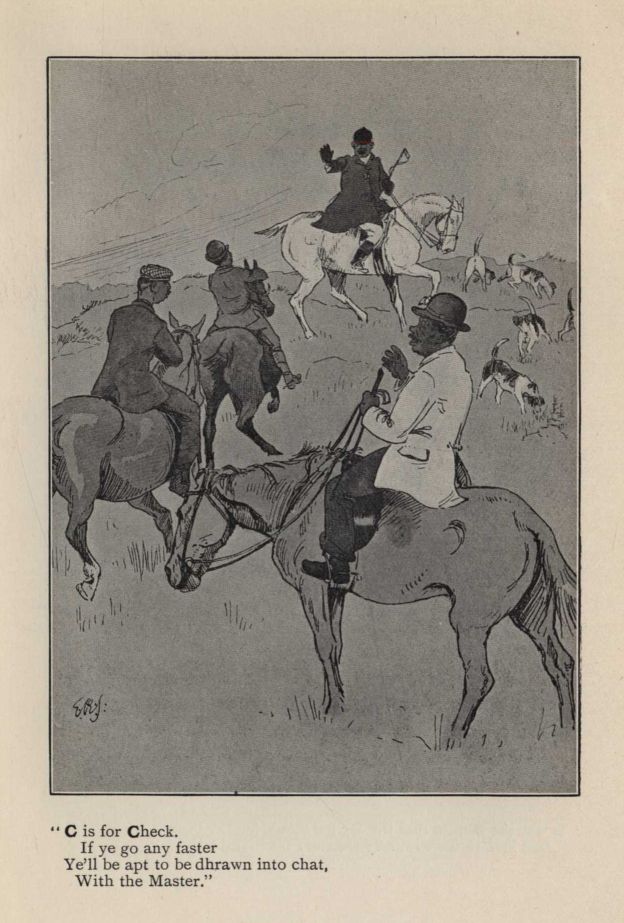
C is for Check
"C is for Check.
If ye go any faster
Ye'll be apt to be dhrawn into chat,
With the Master."
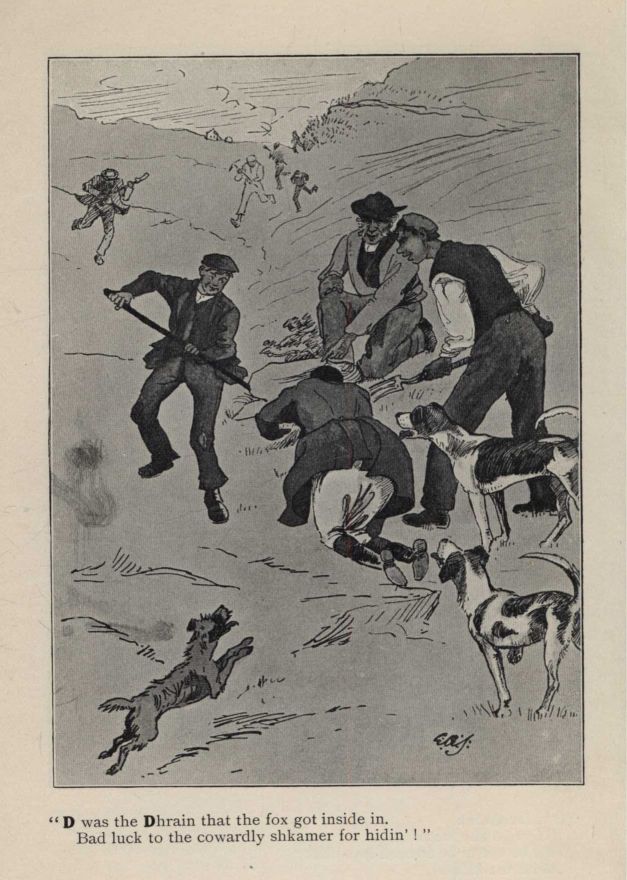
D was the Dhrain
"D was the Dhrain that the fox got inside in.
Bad luck to the cowardly shkamer for hidin'!"
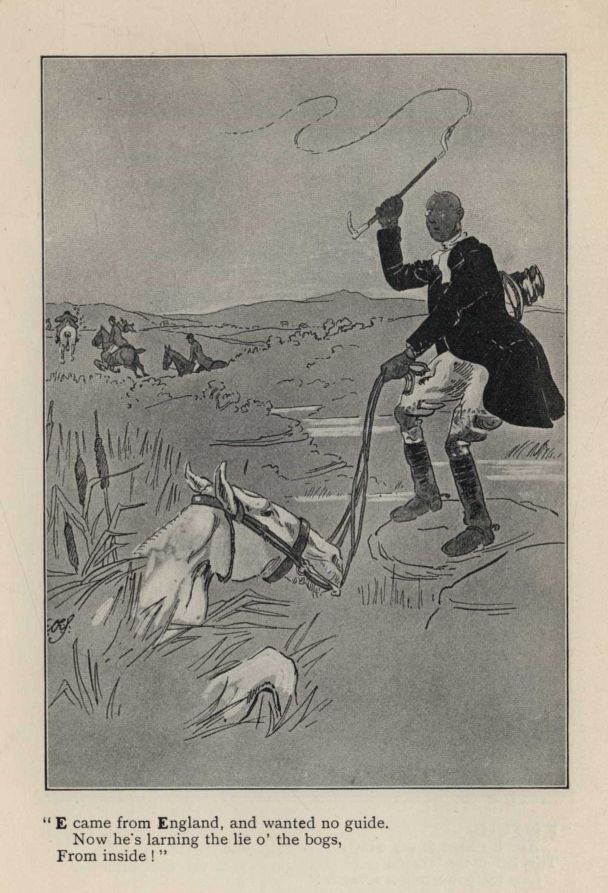
E came from England
"E came from England, and wanted no guide.
Now he's larning the lie o' the bogs,
From inside!"
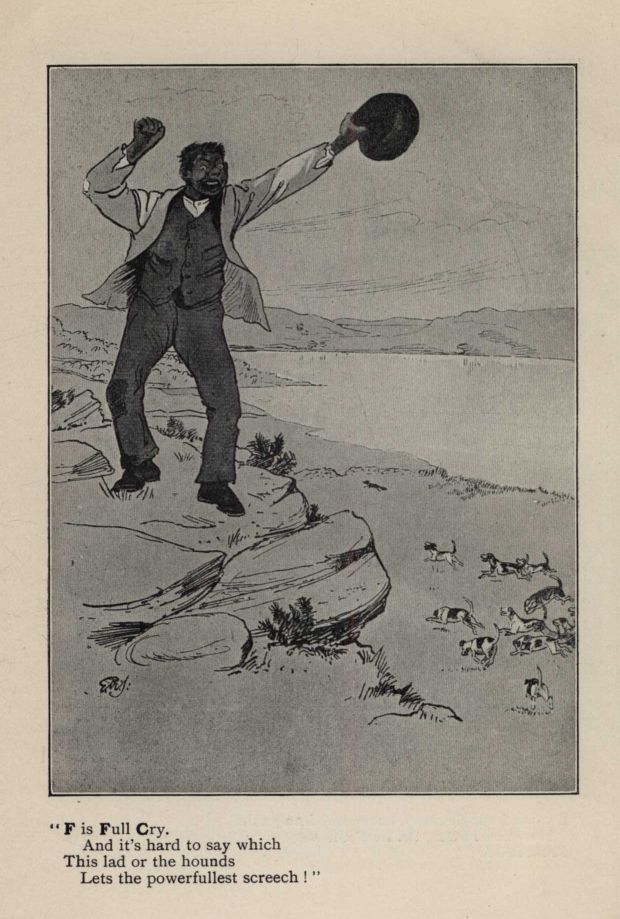
F is Full Cry
"F is Full Cry.
And it's hard to say which
This lad or the hounds
Lets the powerfullest screech!"
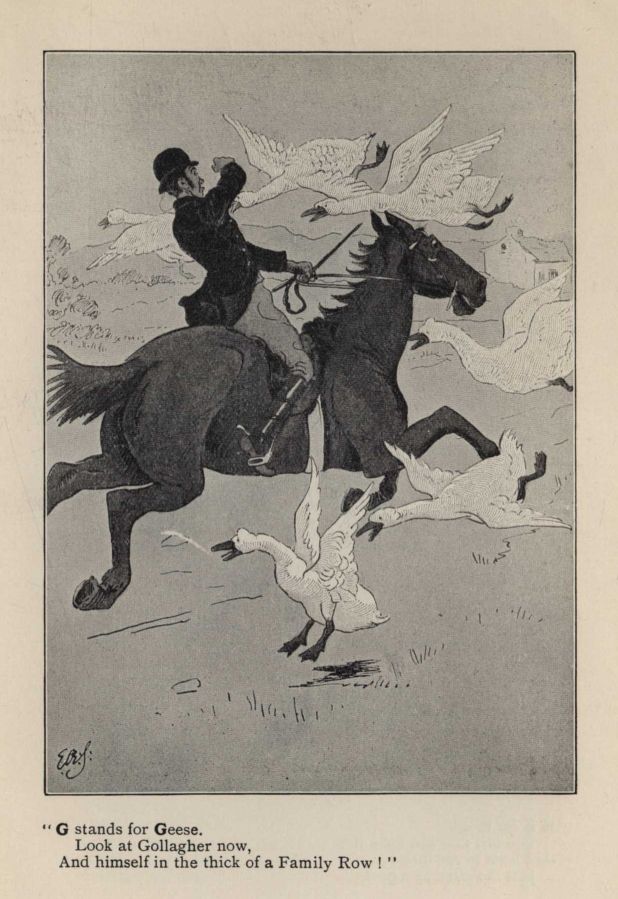
G stands for Geese
"G stands for Geese.
Look at Gollagher now,
And himself in the thick of a Family Row!"
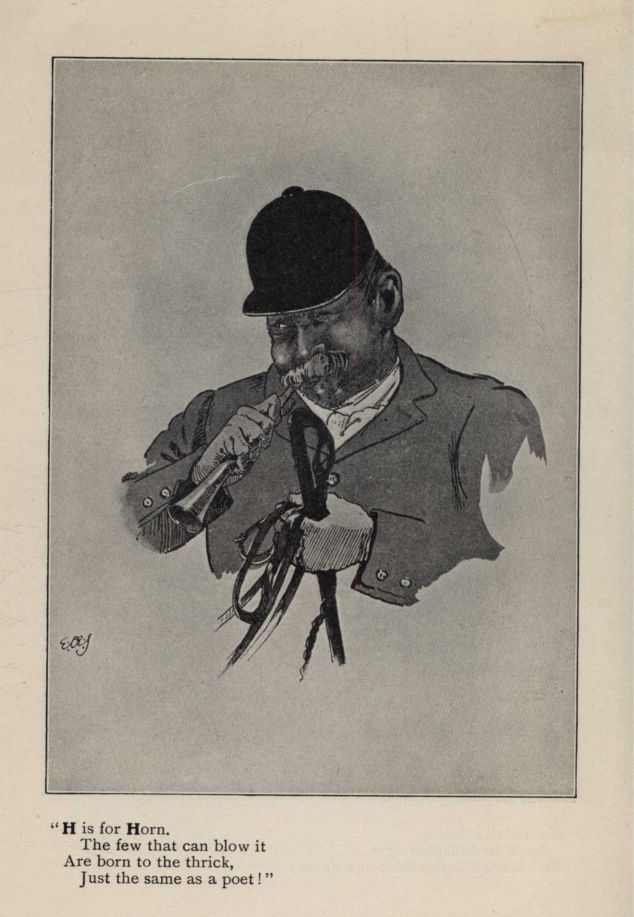
H is for Horn
"H is for Horn.
The few that can blow it
Are born to the thrick,
Just the same as a poet!"
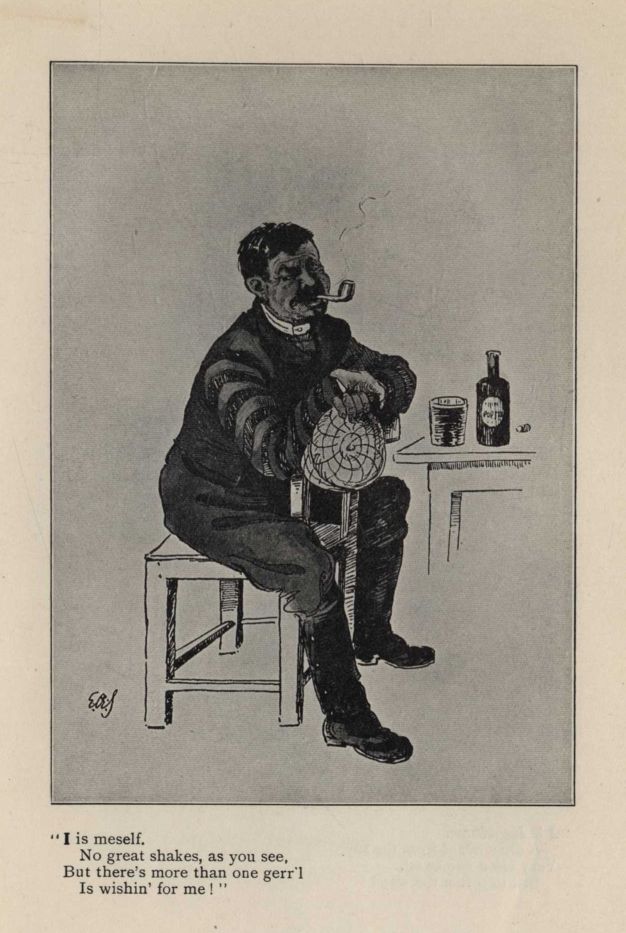
I is meself
"I is meself.
No great shakes, as you see,
But there's more than one gerr'l
Is wishin' for me!"
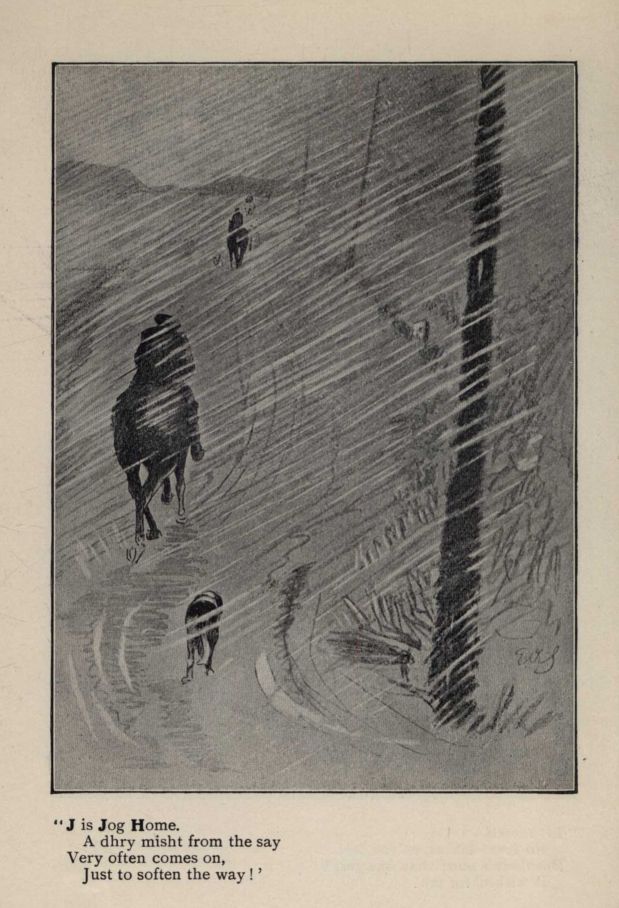
J is Jog Home
"J is Jog Home.
A dhry misht from the say
Very often comes on,
Just to soften the way!"
K is the Kick
"K is the Kick that killed Kinahane dead.
I'd be sorry to mention
The words that he said!"
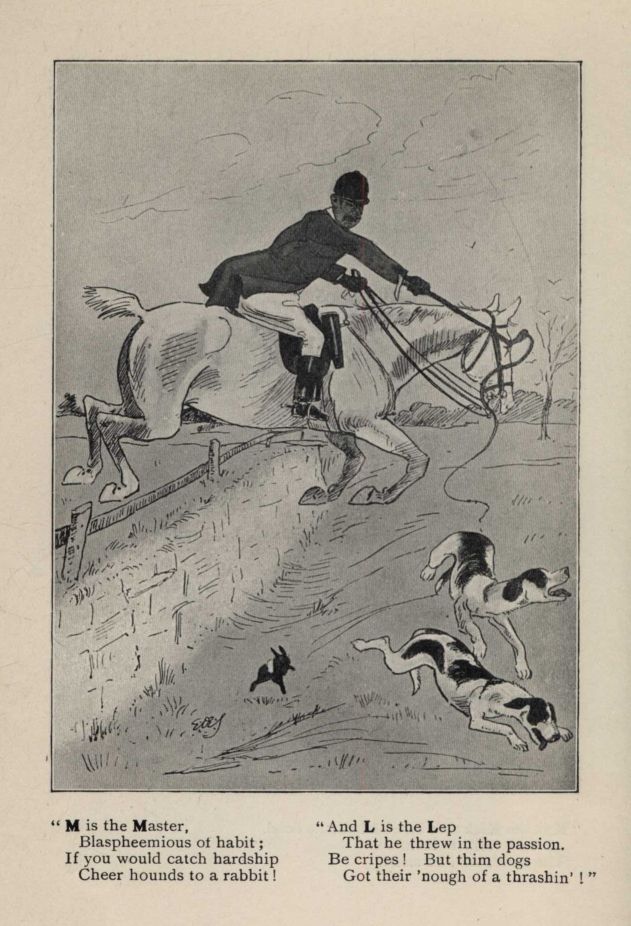
M is the Master
"M is the Master,
Blaspheemious of habit;
If you would catch hardship
Cheer hounds to a rabbit!
"And L is the Lep
That he threw in the passion.
Be cripes! But thim dogs
Got their 'nough of a thrashin'!"
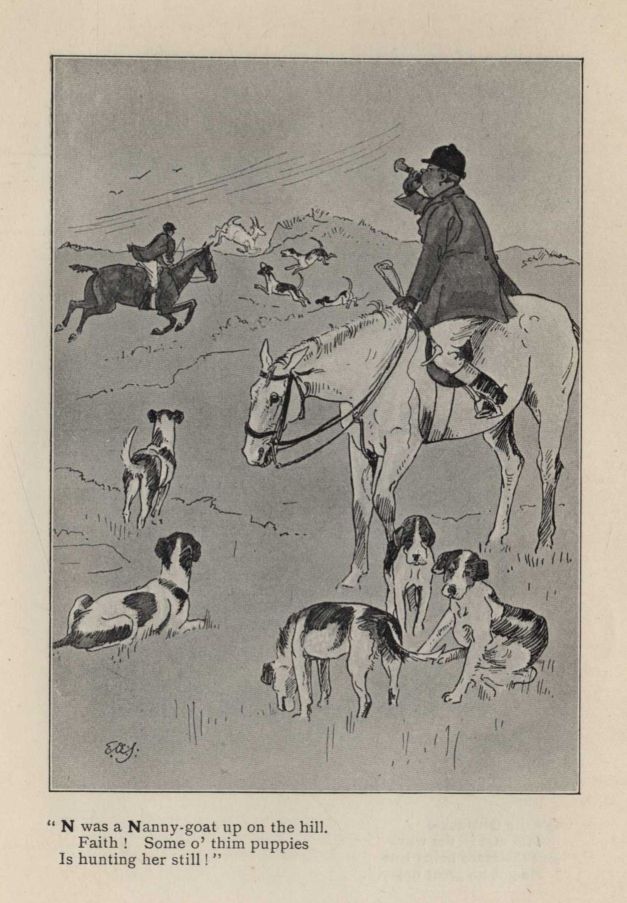
N was a Nanny-goat
"N was a Nanny-goat up on the hill.
Faith! Some o' thim puppies
Is hunting her still!"
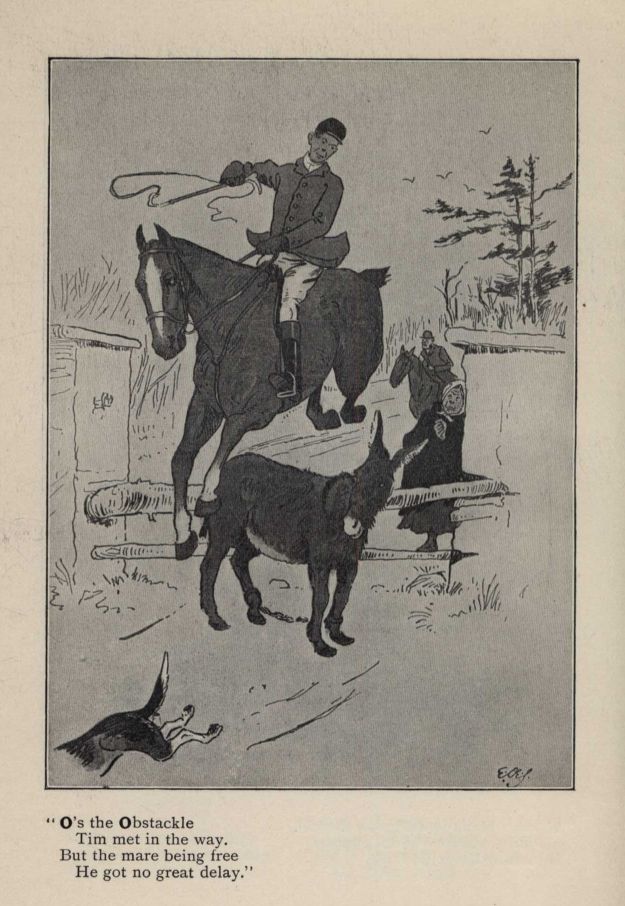
O's the Obstackle
"O's the Obstackle
Tim met in the way.
But the mare being free
He got no great delay."
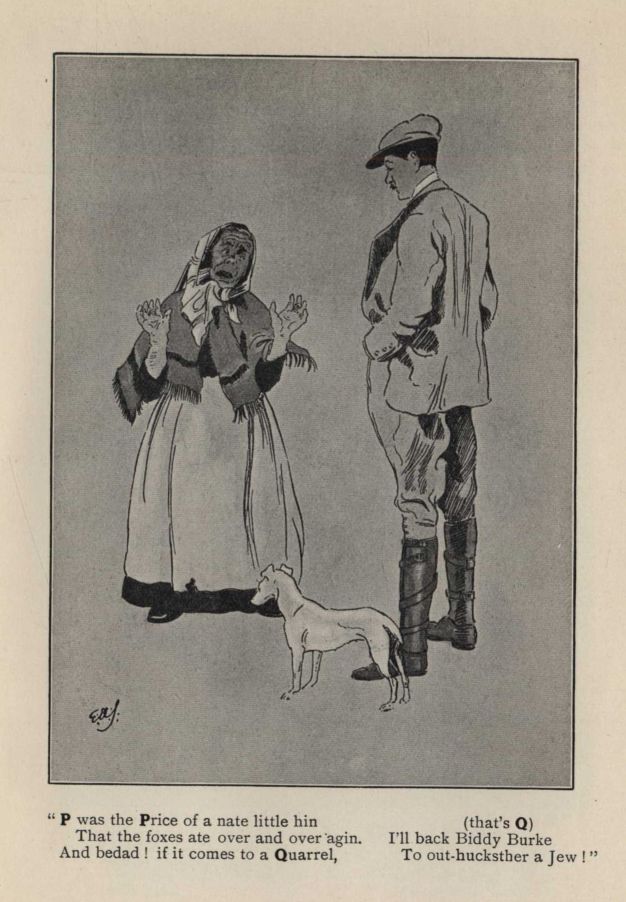
P was the Price
"P was the Price of a nate little bin
That the foxes ate over and over agin.
And bedad! if it comes to a Quarrel,
(that's Q)
I'll back Biddy Burke
To out-hucksther a Jew!
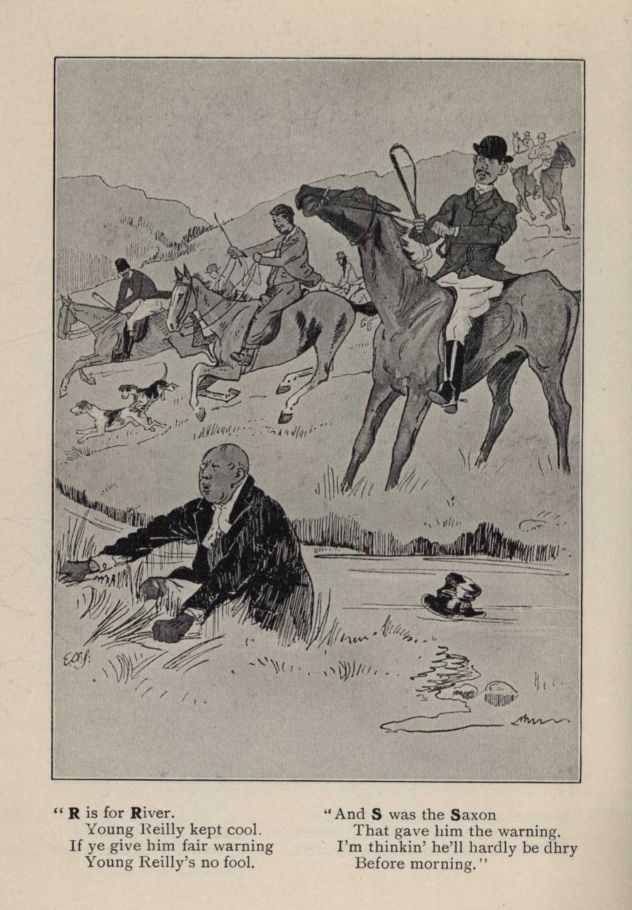
R is for River
"R is for River.
Young Reilly kept cool.
If ye give him fair warning
Young Reilly's no fool.
"And S was the Saxon
That gave him the warning.
I'm thinkin' he'll hardly be dhry
Before morning."
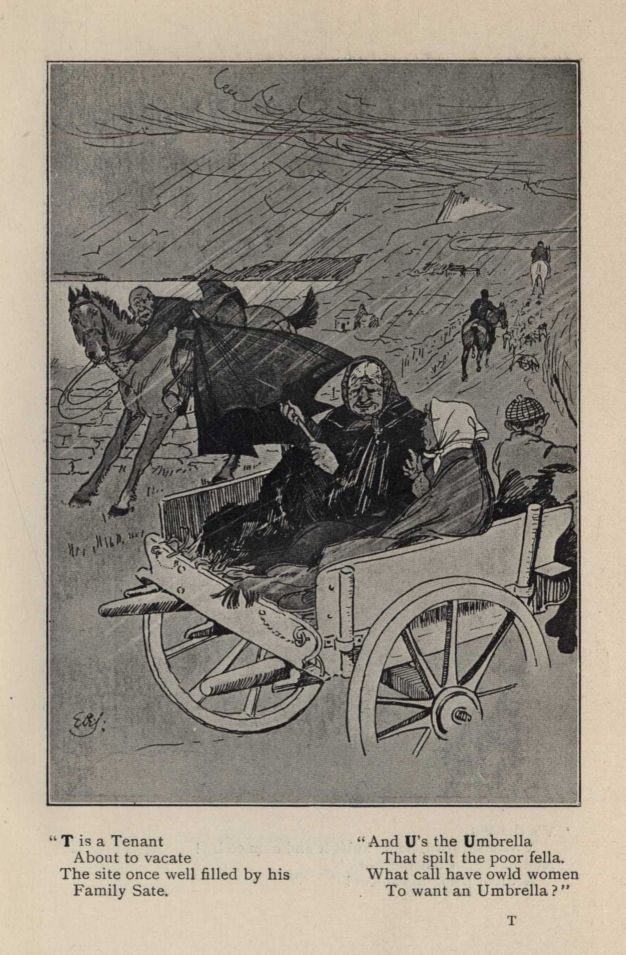
T is a Tenant
"T is a Tenant
About to vacate
The site once well filled by his
Family Sate.
"And U's the Umbrella
That spilt the poor fella.
What call have owld women
To want an Umbrella?"
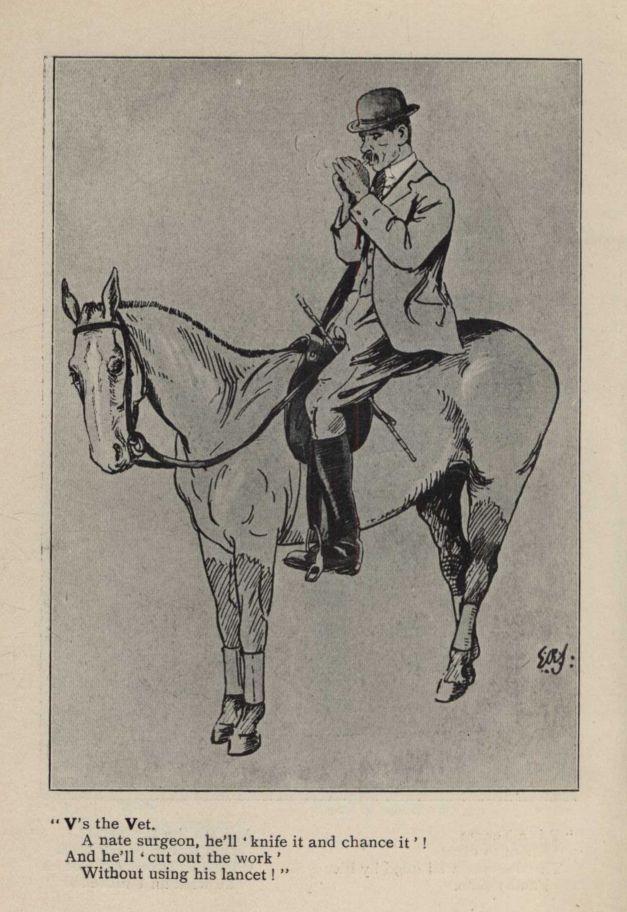
V's the Vet
"V's the Vet.
A nate surgeon, he'll 'knife it and chance it'!
And he'll 'cut out the work'
Without using his lancet!"
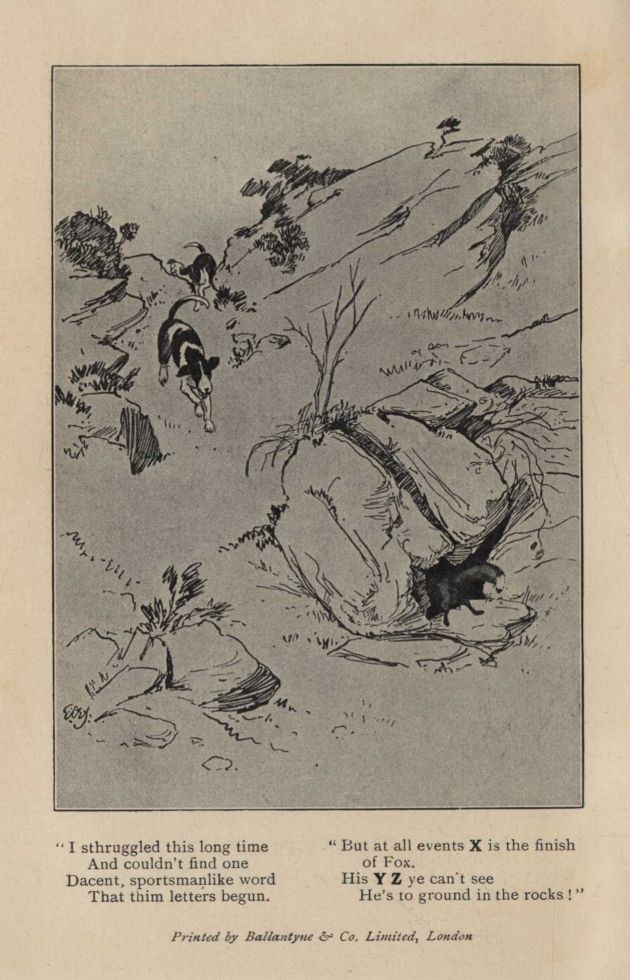
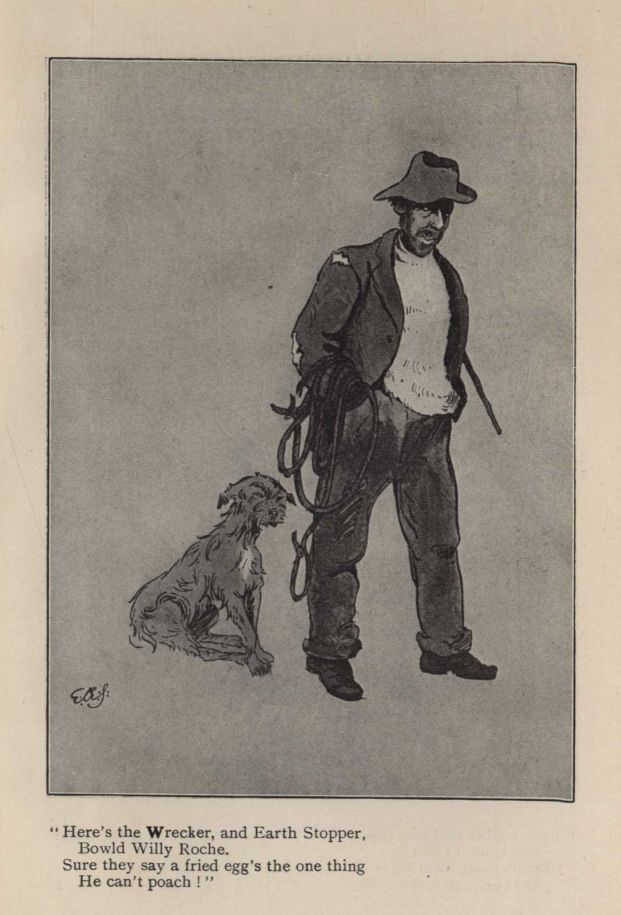
Here's the Wrecker
"Here's the Wrecker, and Earth Stopper,
Bowld Willy Roche.
Sure they say a fried egg's the one thing
He can't poach!"
X is the finish
"I sthruggled this long time
And couldn't find one
Dacent, sportsmanlike word
That thim letters begun.
"But at all events X is the finish of Fox.
His Y Z ye can't see
He's to ground in the rocks!"
Printed by Ballantyne & Co. Limited, London
* * * * * * * *
BY THE SAME AUTHORS
SOME EXPERIENCES OF AN IRISH R.M.
With 31 Illustrations by E. OE. SOMERVILLE. Crown 8vo, 6s.
ALL ON THE IRISH SHORE:
Irish Sketches. With 10 Illustrations by E. OE. SOMERVILLE. Crown 8vo, 6s.
THE REAL CHARLOTTE
Crown 8vo, 3s. 6d.
THE SILVER FOX
Crown 8vo, 3s. 6d.
AN IRISH COUSIN
Crown 8vo, 6s.
SLIPPER'S A B C OF FOX-HUNTING
By E. OE. SOMERVILLE, M.F.H. With Illustrations in Colour by the Author. 4to, boards, 10s. 6d. net.
LONGMANS, GREEN AND CO.