Front matter (continued 2)
Reading edition
"He has the 'fluenzy," says Tim.
"Is it bad with him?" says I.
"He's bad enough to-day," says he, "but yesterday he was clear dead altogether."
"It's a pity anything would ail him," says I.
The Major was a fine man, always, and his family was a fine family. Sure me father used to say that in owld times if ye went to the Big House ye'd get the smell o' roast beef when ye'd be no more than half way up the avenue, and there'd be dhrinkin' all day and knockin' all night, and if ye axed the change of a half-crown, it wasn't in it.
Faith, I said to John Daly, there wouldn't be any fun, nor no cursin' nor nothing, when the Major wouldn't be in it.
"Maybe I might please ye yet before the day's out," says he, lookin' at me ugly enough. "Time's up!" says he then, and with that he comminced to bugle, and away with himself and Tim and the dogs, out north for Dempsey's Gorse.
Well, you'd have to pity William Sheehan if ye seen him that time follyin' the hounds out the road from Kyleranny to Dempsey's Gorse. As soon as me bowld Shan Bui felt the horses throttin, and batthering, and belting the road afther him, he made all sorts of shapes and forms of himself, and as for William, if it wasn't for the almighty howlt he cot of the crupper of the owld saddle, he was a dead man.
"Blasht your sowl, William!" says owld Dan Donovan to him, "if you would save your bones," says he, "you will lead him out now for a mile till you're coming up to Dempsey's, and when ye have the hill agin him then's the time ye'll get satisfaction!"
Well, William had great courage the same day. He held his howlt on the little horse out to Dempsey's, and when we come to the gap into the southern field, below the house, Johnny Daly went away in up through the land. Well, at the third field west of where Dempsey had the turnips two years ago, there was about three foot of a stone wall before us. The yella pony jumped it very crabbed, but the minute he landed, and he havin' the fall o' the ground before him, he made a ball of himself, and he bet a lash on Dan Donovan's owld white mare that wasn't sayin' a word, only goin' from step to step over the wall, like a Christian, and with that he legged it away down the hill!
B'lieve me, William was promising God that time that if he come safe out of it he'd howld to the side-car and not ax to go huntin' agin! But indeed poor William had great courage all through, only for the wife.
"Whatever way it is," says I to Dan Donovan, and we wheeling round the brink o' the hill, "every horse that's in it will have his 'nough of grass ate before the dogs'll have them furze bushes rattled out, and, I'm tellin'ye, that'll quieten them."
"The divil a fox is there in it at all," says Dan.
"Well, now," says William, "there's a woman of the Sullivans' that has a little house beyond, is afther tellin' me a while ago himself and his pups has a nest in it some place. Last week she seen them walkin' in and out of it, like young pigs."
"Maybe she didn't tell ye what way her sons has them pairsecuted with greyhounds and bulldogs and all sorts!" says Dan.
Well, divil such screechin' ever ye heard as what the dogs comminced then down in the furze.
"That's Fiddler!" says Dan, "that's a great hound! Maybe it's a cat he have nooked in it!"
"Faith, well is he called Fiddler!" says I, "he roars most furious."
"Look over! Look over at Johnny Daly!" says William, "what bugling he have now! If it's a cat itself, what harm would it do them to ate her! It's little ateing there is in the like of her; them poor craytures of dogs does be starved with the hunger; and that's what has them yowling this way."
"Look at Johnny skelpin' round the bog!" says I, "mind ye, he's souple yet, and he as gross as a bullock, and a back on him as long as a double-ditch!"
"Whisht!" says Dan, "that's the Whip man screechin' to the dogs! They have a fox surely!"
"Ye lie!" says William, "that's Jeremi'h Drishcoll's screech, I seen him within in the furze. Hi cock! Jeremi'h! Bate him out of it boy!"
"Ah, that's a fine sober fox," says owld Dan, "he'll not lave his den for them. It's a pity now," says he, "that the Major wouldn't have a fox keeping in a stable, and on a holiday, or the like o' that, to put a halter on him and lead him out before the hounds. Begob, he'd give them a nice chase!"
With that all the lads on the hills around let a roar out o' them.
"Hulla! Hulla! Hulla!" says they. "Look at the cat! Look at he! Look at he! Down him! Land him!"
Every dog that was in it legged it to the roar.
Well, if ye seen Johnny Daly comin' down the hill that time ye'd think the fairies was afther him. He'd jump the house, he was that mad!
"Plase God he'll not come our way!" says I.
I declare to ye now, if you seen Jeremi'h Driscoll leppin' the furze bushes, and Johnny Daly afther him with the whip, ye'd as soon be lookin' at it as ateing your dinner. And as for Tim Hurley, you'd have to pity him, sthrivin' to go around every hound that was in it.
"The dogs have her ate! More power! They have the owld cat ate!" says Smartheen, that was sitting up on the wall behind us. "She was dam cute! I thought she'd besht them! The shkamer!"
'Twasn't long afther that till Tim Hurley had all the dogs gothered and counted, and 'tis he that got his own trouble with them! Them poor fellas of Whips catches great hardship. Johnny Daly faced away up the hill agin them, and the whole o' thim afther him.
"It's for Bludth he's making," says I, "and if that's to be the way, it's there ye'll see leppin!" says I. "Tighten yerself now Dan!" says I, "thim banks above in Bludth does be made up very crabby, and as for walls, it's not stones at all they has in them, but bog mould and slates!"
Well, for all, poor William Sheehan had great courage that day.
"Your sowl to the divil, Smartheen!" says he. "Knock a few o' thim stones, boy!"
With that he gives the yella pony a salamandher of a belt, and he coorsed him about three turns around the field the way he'd knock the wind out o' him, in regard of he being out on grass always, and when he thought he felt him jaded it's then he faced him in at the wall. But in spite of all he jumped it very sevare and very ugly. Them Shan Buies is very piggish that way.
Meself, I don't like them flippant leppers; I'd like a horse that will put his two forefeet into the butt o' the wall, and give ye time to say two Aves and a Father before he leps out.
"As for my mare," says I to Dan, the same time, "she boxed her knee a fortnight ago, and it's big with her yet, and faith she's avouring it always. And indeed that's a cross place in any case," says I. "God bless ye, Smartheen," says I, "throw down a couple more o' them stones!"
I'm tellin' ye Smartheen was a decent civil boy always.
We follied on the bohireens afther that, ye'd think 'twas a wedding with all that was in it! Throttin' and steppin' their horses, and the hounds and the ladies and gentlemen and all out before us.
"Faith," says I, "they'd get as nice a shweat this way as what they'd get in any quadhreel whatever in Dublin Castle," says I, "and as for jogglin' and jowltin'," says I, "any one'd be the better o' this in his health while he'll live," says I.
Indeed, all that was in it was teeming down with the heat before we were up into Bludth at all.
Comin' up out o' the bohireen there was a stick left across in the end of it, keepin' in calves; a middlin' heavy pole, and the two ends fasht. If it was in the Cork Park races ye wouldn't see as much fun as what we knocked out of it with young Tom Dennehy! Sure he was ridin' the Docthor's grey mare, an' he dhressed out, and grand yalla gaiters on him, and he in dhread of his life!
"Dennehy took great use out o' the bohireens all through!" says one of the lads "'tis time for him to throw a lep for us now!"
It's well the Docthor wasn't looking at them that time, and they weltin' the mare with switches and stones, and Dennehy howlding her back from the lep when she'd be gethered for it.—Begob! he fell heavy when the crayture jumped in the spite of him! And there's where the fun was!
Ye wouldn't blame him to be afraid if it wasn't for the dirty little boasting he has always. But indeed 'twould stun any one to hear the talk of the Dennehys.
"Mind yourself now, William," says Dan, afther the three of us had a place made out above on the hill for ourselves to stand aisy. "The hill tops is lakes afther the rain," says he, "though be Jingo!" says he, "that little horse went over the hill very knacky!"
"Look at Smartheen comin' down the bohireen over!" says I, "what have he in the bag? Ye'd say it was a side o' bacon with all the dogs that's snortin' afther it."
"Be dom!" says William, "but it's a fox! Look at Johnny Daly that has all his own dogs dhrove in under the wall. B'lieve me, them two has it settled out! We'll see sport now," says he, "afther Smartheen'll throw down the owld bag and give the fox a couple of kicks for to rise his heart for him!"
Well, what it was vexed Johnny Daly I dunno, but he was mad altogether! He lepped out the wall before him, and he as wicked with the passion as that he didn't roar, nor say a word, till he had Smartheen cot by the coat and the whip ruz to him to sthrike him! Ye wouldn't know what was the two o' thim sayin', but Smartheen thought to run, and 'twas then Johnny cot the bag secondly to take it from him. Every lad that was in it comminced to cheer and to bawl when they seen the two o' thim in howlts. I believe meself let a few screeches, but as for William, if it was his father that he seen took by the polis, an' he dhrunk, he wouldn't have more nature for him than what he showed to that boy.
"Hon-a-maun-dhiaoul! He'll have him dhragged off the horse!" says Dan.
"He will! He will!" says I, "he's dam stubborn!"
Maybe if it wasn't for the way Johnny crooked the owld horse with the spur, sthrivin' to squeeze the leg around him, he'd have held his howlt, but a Turk couldn't stand it with the hoist that owld Monaloo let out of him.
"He's down!" says Dan. "He's dead! 'Tis on his head he's fallen!"
"Ye're a liar!" says William, "it's on the fox he fell! The big mastheen of a tyrant!"
'Twasn't long then till the whole of us was gathered lookin' at Johnny, and he ravin' like a cat in the measles, and every bit that was on him desthroyed with the gutther, and says he to Smartheen, givin' a bitter big curse:
"It's all I wish," says he, "that ye were a football before me! Ye wouldn't last me three kicks!" says he.
'Twould dhrive a chill through your stomach to be leshnin' to the talk he had. And sure the fox was as flat as the palm o' yer hand within in the bag!
"Oh, fie, fie!" says Dan, "our fox is gone from us!"
Indeed, ye wouldn't like to be lookin' at the crayture. Johnny Daly's a very weighty man, and sure it's the last sthraw, as they say, put the hump on the camel. But in any case Smartheen battled it out well, and all that was in it was givin' him applauses.
Yerself knows Bludth, that there's as many hooks and pooks in it as that a person'd be moidthered before he'd have them gone around, let alone dogs, and horses.
"B'lieve me," says Dan, "'tis as good for them to give over; sure we're sick and tired waitin' on them. The fox that keeps this hill has a sthrong dungeon, and sorra fear of him to lave it for to be sporting for them. What a fool he is!"
"Yerrah shut yer mouth, Dan!" says I, "thim lads on the paikeen south is screechin' like as if they seen somethin'! What have ye over there?" says I, lettin' a roar.
"Yerrah, what are they sayin' at all?" says William, "it's like pigs talkin'! Sure I can't understand them no more than if I was a fool!"
With that the dogs comminced to gallop, and away with the whole of us. Well, William had great courage always.
"'Tis down the gully we should go, and we'll be before them whatever side they'll turn," says he.
"Musha, the divil go from ye!" says I, "maybe it's down the chimbly ye'd have us go! Sure a man itself couldn't stand in it, it's that steep!"
"No, nor ten men couldn't!" says Dan.
"If it was the ugliest place in life, ye'll be hard set to find a betther," says William.
Well, afther all, we went down in it, as well as another, and you may say there was scroogin' and scramblin', and thim that was afther us was bet down on us like a load o' hay, and thim that was before us cursin' black and blue for the way ourselves was squeezin' them.
"Faith! We're as throng as three in a bed!" says Dan, "the dogs could run away in their choice place and divil a one of us would know what side they went!"
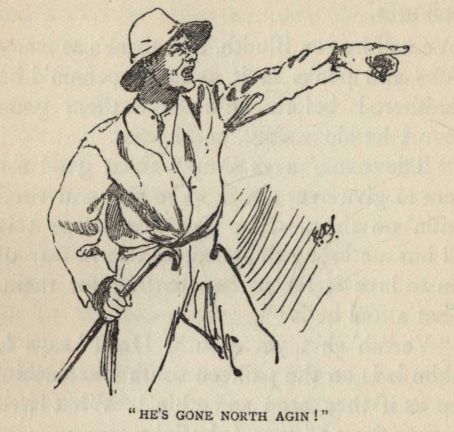
"He's gone north agin!" says a lad above on the hill, and every one that was in it turned about in the gully and up with them up it agin.
"HE'S GONE NORTH AGIN!"
"Maybe if it was himself was down in it he wouldn't have so much chat about goin' north!" says I, "and we twistin' in it like ye'd be dancin' a reel."
But as for William's little horse, if it was the roof of the chapel he was on he'd run in it like a bird, rocks or slates or any other thing, he wouldn't give a dang for them.
The sight'd lave your eyes if ye were lookin' at us afther that, comin' down out of Bludth, with slidin' and slippin', and buck leps and all sorts, and the dogs yowlin' away through the counthry from us. Great banks there was below in the fields. Every one o' them that we come into my mare would crouch like a hen before it, and she'd let a screech, and over with her, and wouldn't lave an iron on it. That was her routheen always, only when she soured by the dint of the Shan Bui, that was baulking with William out before her. When I'd have to dhrive her over before me she'd be waitin' on me the far side of the fence, ateing grass, till I'd come afther her. She is a grand mare indeed, and high ginthry does be jumpin' mad to buy her foals.
'Twasn't long till we come up to the dogs, where they were searchin' and snuffin' round the four corners of the field, and divil a smell could they get. We seen a lad then standing up on a rock, waving.
"He's gone wesht up the road!" says he.
"Did ye see him?" says Johnny Daly.
"Faith I did so!" says me lad, "and he was the most courageous thief of a fox ever ye seen!"
I went up to the lad.
"Where did ye get the two coats, ye're afther throwing behind the wall?" says I.
"'Tis aiqual to you where I got them," says me lad, "ax no questions and ye'll be told no lies!"
"Faith, there's no occasion," says I, "sure it's you is good-natured to be carryin' the two coats that was on my two sons this morning," says I, "and you bloated with running," says I.
Divil a word he said, but away with him.
"Thim two young lads o' mine will be apt to get a bating before night!" says I to meself, "and they're in the want of it!"
"Forrad! Forrad!" says Johnny to the dogs, that was whining most peevish round and about, and you'd think if he never had a nose on him he'd get the smell o' the paraffin oil, it was that parsevarin'.
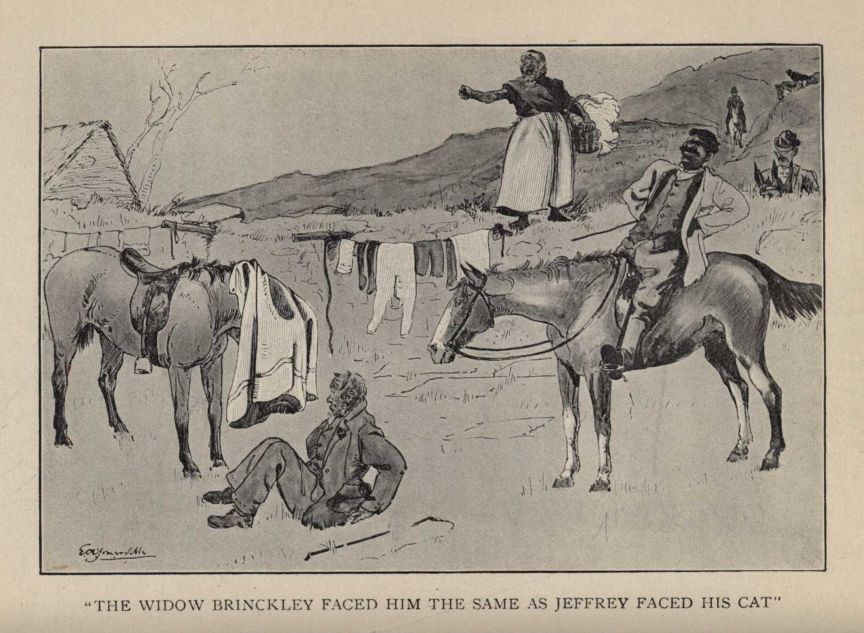
Two mile we legged it then, and the biggest walls in the counthry was in it, and God help them that had to be building them afther us! Comin' up Milleenavillen, William and a few more of us turned about round the butt o' the hill, for fear we'd be bet out entirely, and it wasn't long till we met with a great mountaineer of a big bank down in the widow Brinckley's land. Meself dhrew out back a couple o' fields, and knocked a few sticks that was in a gap, but me brave William didn't do but to let a roar to the Shan Bui, and to land him two clouts in the jaw comin' into the bank. The Shan Bui lepped up on to it, as loose as a hare, with the fright, but what'd be before him only posts that the widow Brinckley had dhrove in the far side o' the bank, and ropes on them, and clothes hangin' out on them. He put a hump on himself like a ferret when he seen them, but if all the polis in Ireland was below mindin' the clothes, he'd have to change his feet and lep out on to them, with the gallop he had on him, and he cot the two hind legs in the ropes, and himself and William and the clothes was threwn down in the field.
"He's dead!" says I. "'Twould kill him if he was a bull!"
"'Twould, or if he was an ass," says young Tom Dennehy, that was on the eastern side o' the fence.
Well afther all, not a bit in the world was on him, only a tooth he had was stirrin' always in his head afther it. But I'm tellin' ye, the widow Brinckley faced him the same as Jeffrey faced his cat, as they say, in regard of some sort of a petticoat the Shan Bui had dhraggin' afther him.
"THE WIDOW BRINCKLEY FACED HIM THE SAME AS JEFFREY FACED HIS CAT"
Out with the whole of us then from her into the road and left her afther us, and she dhrawing down saints and divils and the price o' the petticoat on us.
"It couldn't be," says I, "that it's into William's land the dogs is facin' now! Look at the line they're going beyond over the hill!"
"Begob, it is!" says Dan.
"If that be so it'd be betther for William to go under the sod!" says I.
Faith, I believe the divil was always busy with the Shan Bui! The very minute he got the smell o' the road under his feet, he comminced firin' and lashin', and when he had William loosened, it's then he legged it.
"He's diddled now entirely!" says I, "that horse won't stand or stay till he lands him within his own yard. The Lord look down in pity on William this day! Herself'll ate the face off him!"
Begob, the Shan Bui kept the one gallop always, the same as a thrain, and we battherin' the road afther him, and the dogs and all screechin' down the hill before us. Your heart'd rise if ye were listenin' to them!
"He'll run to the say with him!" says Dan, "the two o' them'll be cliffted!"
"Sorra fear of him!" says I, "what a fool he is! Look at him now, tightening himself comin' down to the gate!"
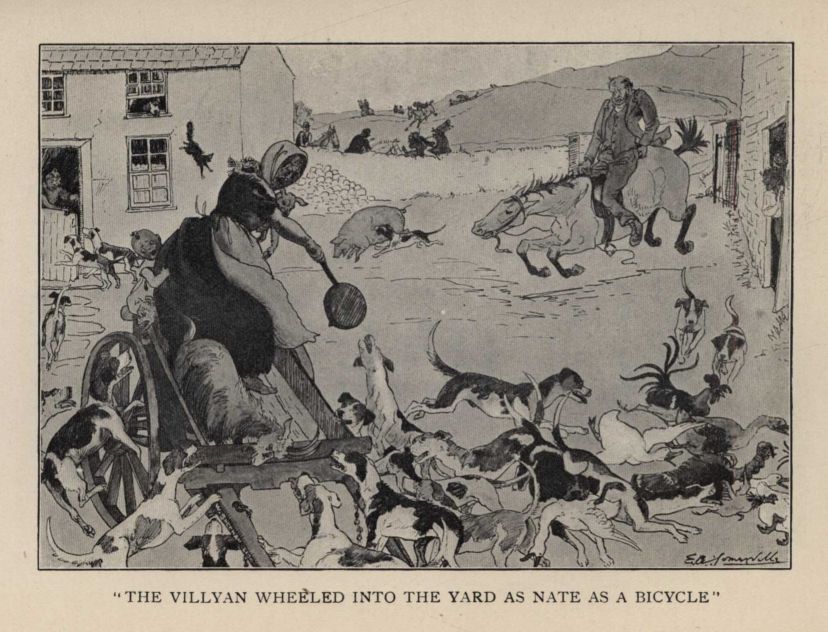
Begannies! The villyan wheeled into the yard as nate as a bicycle, and every hound in the pack was in it before him!
"THE VILLYAN WHEELED INTO THE YARD AS NATE AS A BICYCLE"
* * * * *
Twas the week afther, and I goin' to owld Dick Courtney's funeral (the Lord have mercy on him) and who would I meet only Anne Roche!
Well now I declare to ye, divil such an ateing ever I got from any woman! The dogs wouldn't pick me bones afther her! Sure she pitched all that was within and without to the Seventeen Divils.
And sure there was no blame on me at all, only she seen them two young whipsthers o' mine when they thrown the owld bag they had with the ferret's bed back into her hen-house, and they near dead with thralling it out through the counthry.
A half a gallon of paraffin they had soaked in it. If it was herself and not meself had one and eightpence lost by it she might be talkin'.
I'm told she gave William the Seven Shows of Cork on the head of it, but indeed poor William had great courage the same day.
ALSATIA
No doubt the fact that it was forbidden, or mainly forbidden, lent it a considerable charm. The prohibitory edict was a semi-obsolete Statute of—say—the reign of Edward VI. Authorities, when driven to their last trench, fell back on it, declaring that no respectable children were allowed in stable-yards, or ever had been. We never argued the point. At an early age we had learned the folly of hardening fluid prohibition into adamant by argument; but we did not cease from visiting the yard.
As I look back I see a procession advancing from the dimmest and most ancient places of memory, a procession as varied as that which in Maclise's picture slowly winds away from the Ark. Heading it are two figures who, in their prime, ranked equally as the over-lords of the stable-yard, Old Michael, and the copper-coloured turkey cock. When one has attained an altitude of some considerable number of inches over five feet, it is hard to estimate the terror that a robust turkey cock can inspire in a person, however charged with valiant intention, of little more than forty-eight inches over all. The copper-coloured turkey cock was subtle as he was vicious; he appreciated as well as any Boer General the moral effect of a surprise. To face him, to go forth with intent to battle, was possible, even enjoyable, but at this moment I can feel the panic, blinding and disintegrating, of being taken in the rear; I remember the sound of the striding claws on the gravel behind me, the rustle of the stiff wings; were I but four feet high, and still wore short socks, I am convinced that I would run as hard if similarly attacked.
Coincident with the time that the turkey cock held sway, one of us had somehow acquired a dog, a meek, female creature, always engaged either prospectively or retrospectively in family affairs, and loaded with a spirit broken by long beatings from the back-door. She was white, with very sore eyes and a long tail; one of her relatives professed to be a bull-terrier, a fact much dwelt on by her proprietor; but beyond the soreness of her eyes there was but little to substantiate it.
"Those village dogs had better look out," said the proprietor. "May-fly'll most likely kill them if she meets them."
She had come to us in May, and the name held for us the glamour of a hundred springs. Among the village dogs was one, contemptible beyond its fellows, known to us as Boiled Rice (a food specially abhorred by us, which her coat and complexion were supposed to resemble). Boiled Rice was generally on hand at or about the lodge gates, and one day Mayfly was formally led forth to slaughter her. Boiled Rice was a small and disgusting creature, very old, and nearly toothless, and without reputation as a fighter. None the less, when located by our scouts she did not refuse battle. On the contrary, she bustled up to May-fly, and, rising upon the shortest pair of hind legs ever put under any four-legged creature save a lizard, laid her paws upon her shoulders and yapped harshly in her face. Then, if ever, the blood of the bull terrier relation should have come into action; for some unfortunate reason that was the precise moment at which it ebbed. Our champion gave a squeak of resentful alarm, and, disengaging herself from the enemy, fled unpretentiously, unhesitatingly, without a hint of reprisal. For our parts we stoned and hunted Boiled Rice more mercilessly than ever after this overthrow. An unexpected aspect in the character of May-fly was that she, who fled from every living thing, remained unmoved by the ferocities of the copper turkey cock. At a word from us, and it was a word often spoken, she would take him by his scarlet and bulbous beard and gallop him off into remote places, from whence, long afterwards, he might be seen gloomily returning, a discredited and bedraggled despot. It was her sole achievement, and one greatly valued by us, but, unfortunately, it found no favour with the authorities, and one night she and the then puppy—she always had a puppy or so in her lair behind the potato house—were swept.
"SENDING HIS WILD VOICE ABROAD" "OLD MICHAEL"
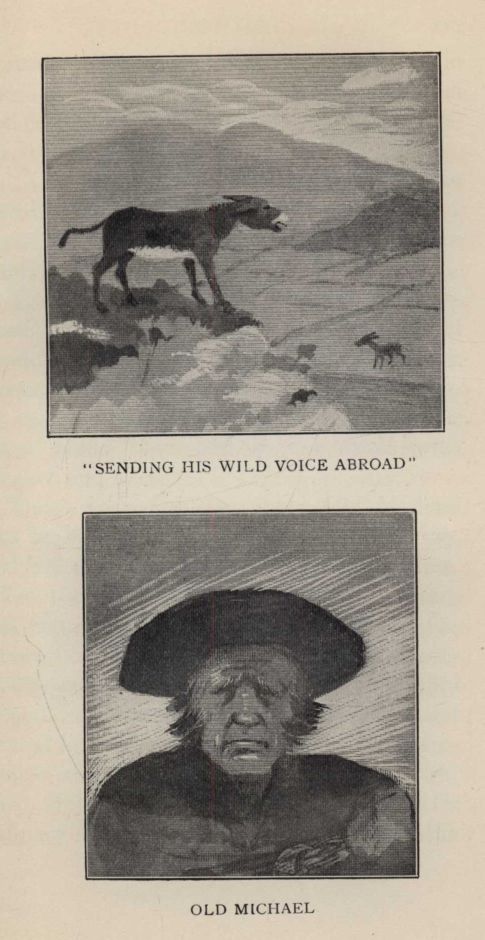
Neck and neck with the copper turkey cock came Old Michael, equal in malignity, but less active. He was nominally a stable helper, and was also a self-constituted spy in the service of the government—or rather of the governess—and a more implacable tale-bearer never truckled to authorities.
"The two o' them is round back o' the cow-house, Miss. It's now this minute I seen them climbing out over the garden gate!"
Thus we, prone on the slant of the cow-house roof, under the drooping laurel branches, with our pockets crammed with green, young apples, have listened, panting, to our betrayal. Any other man on the place would have lied in our cause with chapter and verse.
There was a tradition about Old Michael that he had once been bitten by a mad dog, and had thereupon, as a recognised antidote, killed the dog and eaten its liver. There was something luridly attractive about the transaction, and we often discussed the possibility as to whether the liver had thoroughly played its part, and whether it might not be that he suffered from slight chronic hydrophobia, and that, at any moment, he might turn snarling and foaming upon us. His ordinary manner lent itself to the fancy, his rages were so explosive, his yells at the horses under his charge so ungoverned, so screeching. One of these was a white pony that might have walked straight out of a fairy tale, in which he would have been exclusively employed as palfrey to the principal Princess. He had been bought through, or from, we never quite knew which, an old farmer, one Jer Sullivan, who lived at the head of a long and lonely Atlantic cove, and was as much fisherman as farmer, and more beggar than either. His main source of income was a petition in which was feelingly narrated the manner of death that befell his only horse.
"She was clifted one night by dogs hunting her, and drowned in the tide, and I have no one now to trust to, only the Lord."
Thus sorrowed the petition, Christmas by Christmas, getting a little browner as time went by, but no less insatiable. One windy Christmas Eve Jer Sullivan and the petition had appeared as usual, together with the horde of old women who, by long-established custom, received a dole on that day.
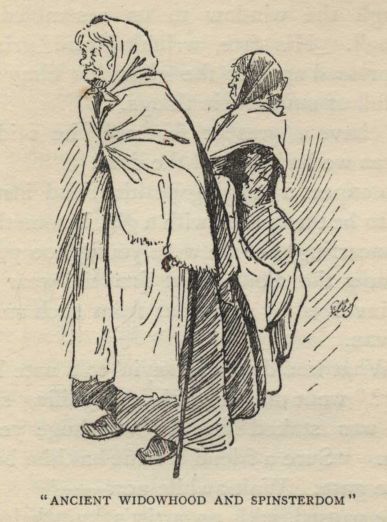
"ANCIENT WIDOWHOOD AND SPINSTERDOM"
In the twilight of the December morning they came by twos and threes, fluttering up the avenue, looking, with their long dark cloaks and thin red legs and feet, like the choughs that used to breed in the neighbouring cliffs. Upon the wet grass on the way round to the stable yard they squatted in a gabbling row, waiting for the coming forth of the master, and chaffing Jer Sullivan for having joined the ranks of ancient widowhood and spinsterdom, with the unquenchable spirit that lurks in the oldest and most forlorn Irish peasant woman. On this occasion, Jer, having exhausted his stock of repartee, planted himself on the hall-door steps.
"Is the granddada comin'?" he called through the window to us, assembled in the hall. His face, wrinkled and grizzly, was pressed against the glass, his filmy eye was full of unutterable things.
"I have a present for ye!" he said, as soon as we had opened the door.
To expect a begging petition, and instead of it to be threatened with a gift, is something disconcerting, but we were young, too young to know the mental and financial wear and tear involved by a present from such as Mr. Sullivan.
"What would you be sayin' to a nate little pony?" went on Jer, with a beguiling smile that was staked out by four huge yellow teeth. "Sure a friend o' mine has him below at the gate. Wait awhile now——"
He paused, with an artist's knowledge of effect, and strayed away down the avenue in the indefinite manner of beggar men.
The ceremonial of the gifts pursued its usual course. The Master moved down the row, a silence of expectation before him, a cackle of blessings behind him; as each received her dole she gathered her ragged plumage about her and flitted away, blessings still flowing from her as the steam-clouds trail out behind a train.
To us again, after breakfast, returned Jer Sullivan, and, incredible sight, he was leading a small pony. It was about thirteen hands high; in colour, dirty white, with a very wild eye, a figure like a toast rack, and a long tail.
"Sure your Honour knows the breed of him well. His dam was by the Kerry Diamond, the same as your Honour's coach-horses, the grandest horses in the globe of Ireland!"
Jer took a pull, and the Master eyed the pony in deep silence; the pony eyed us and snorted apprehensively.
"Sure the granddam of that one," resumed Jer, "was no loftier size than himself, an' she took a load out o' Banthry, an' a woman, an' three bonnives, an' two bundles o' spades, an' seven hours was all she took comin' to Tragumena Strand."
"What do you want for him?" said the Master. To say that our hearts leaped in us at this approach to business, is to put the thing very mildly. They rolled and rioted like porpoises in a summer sea, what time the Master, and Jer, and Jimmy Hosford, the coachman, who had joined the action irrepressibly, moved round and round in the slow orbits of the deal. The fiction that the pony was a present had been abandoned, the thing had narrowed to a duel between Jer Sullivan and Jimmy Hosford. The Master had made his offer—£5, I believe—and had strolled away.
"There isn't as much condition on him as'd bait a hook," said Jimmy Hosford.
"Oh, Jimmy!" we screamed as one man, "he's a lovely——"
"Ah, God help ye!" said Jimmy Hosford, washing his hands of a bargain in which he had to suffer such collaborators.
"My darlin' childhren," said Jer in a hoarse whisper to us, "don't mind for he bein' a small bit thin an' wake in himself; it's what ails him"—the whisper deepened and thickened—"he was ridden—by nights!" he paused awfully; "wouldn't I find him in the mornings bate out an' sweatin'; an' signs on it, the world wouldn't make him cross runnin' wather!"
"Who rode him?" said we, thrilling to the implied mystery.
Jer looked right and left over his shoulders.
"Those People!" said he.
A fairy-ridden pony! It needed but that touch of romance. The pony was bought. £5 and a weakling heifer calf were the terms finally agreed to. The explanation offered subsequently by Old Michael that it was the Tragumena boys that took the pony by nights for blagyarding, and to ride him in the tide, was dismissed with deserved contempt; the pony was called Fairy, and a better never bolted in a snaffle, or kicked its rider over its head when invited to jump a stream.
Those who have in any measure dipped below the surface of stable yard politics, can hardly fail to have become aware, even in a minor degree, of the subtle relations existing between the house dogs and the yard cats. That an understanding, almost amounting to a treaty, obtains, there can be no reasonable doubt. That the dogs are ashamed of it is certain; that the cats are not, is a fact bound up in the character of cats, who are never ashamed of anything. But yesterday, unsuspected and unseen, I viewed a typical instance of the strange and chilly truce that holds in the ashpit when the house dogs, the yard cats, the turkey cock, and, most implacably hated of all by all, the pensionnaire hound mother and her brood, feasted horribly and illicitly among cinders and refuse. The house dogs, furtively and hurriedly, with ears laid back, and guilty pauses in mid-bone; the hound mother grossly and jealously, something disposed to truculence; the turkey cock contemptibly, with sunken tail, and wattles of faded pink, prepared to skip four times his own length if the hound mother so much as looked at him.
Of the whole party the hound puppies and the cats alone showed to any advantage. The puppies, jovially unaware of the momentousness of each instant, sprawled and croaked over the woolly shin bone of a lamb; the cats were unalterably dignified, nibbling with deliberate daintiness the remains of a long-interred cod-fish. A millennial peace rested upon the scene.
It was possibly half an hour later, when those ineffable snobs, the house dogs, basking in the smiles of the aristocracy, had their attention drawn to the creeping grey form of the yard Tom, making fowling observations in the shrubbery. Like twin bolts from a thunder-cloud they sped on the chase; two highly connected white fox-terrier ladies, shrieking shrill threats at the intruding vermin. No wonder the yard Tom galloped. Yet the close observer could not but notice that as soon as the distance from the quarry had been reduced to some three or four feet, it remained fixed at that. In that nicely maintained interval was embodied one of the most immutable clauses of the treaty.
The treaty, however, and all connected with it, were of the most artificial and trifling to that child of nature, the hound mother. She, like her many predecessors, pretended to no higher sphere of operations than the stable yard.
"The care of my children and the surveillance of the ashpit," she seemed to say, "are all I demand."
But, like her predecessors, a more accomplished and wide ranging thief never jumped on to a kitchen table, or smirked hypocritically outside a hall door on the chance of making a dash upon the dining-room. It is not long since that history, for the twentieth time, repeated itself.
"The ham! the ham!" wailed from the dining-room the voice of the mistress. "Niobe has stolen the ham!"
The sequel was given by the laundry-woman, herself long versed in the ways of the stable yard, and of hound mothers.
"I was west in the field spreading the clothes, when I seen herself sthretched above on the hayrick. Divil blow the stir that was out of her! I knew by her she was at something! An' afther that I dunno why she wouldn't bursht with all the wather she dhrank! She has the divil's own inside!"
"IN SICKNESS AND IN HEALTH"
When I first heard these words I was not highly impressed by them, or by anything at the moment except the redness of the bridegroom's nose, and the surprising manner in which one of "the young ladies'" dresses had been coerced into fitting the bride. The solemnities of the service passed, in every sense, over my head, which was then not much higher than the table at which the priest stood; indeed, it was only by putting forth the fullest wriggling powers of childhood that I was able to gloat in comfort on the bride's blushes from a loophole between the turf-flavoured folds of her mother's Galway cloak and the repressive elbow of my elder brother. Why the ceremony should have taken place in the vestry I cannot say, beyond that it was a custom in the little Roman Catholic Chapel of which I write; just as it was in those friendly days a custom with us to go to the marriages of the tenants, and to take our share of the blessing and the sprinkled holy water.
The accustomed gold, silver, and copper were laid on the book by the bridegroom, the portentous words were spoken, with the melancholy Galway accent adding its emphasis to them, and at the next interval the priest opened the window behind him.
"Run down to Mick Leonard's for a coal," he said in Irish to some one outside, and then proceeded with a most sound and simple exordium to the newly married pair.
In a few minutes there appeared in the open window a hand holding a live coal of turf in a bent stick. I can see it yet, the pale fire in the white ash of the sod, thrust between us and the blue sky, and the priest's hand put out to take it, but I cannot remember now what was its mission, whether to light a candle or incense.
After this came a sprinkling with holy water with something that nearly resembled a hearth-brush. A drop fell into my open mouth as I stood gaping with the detestable curiosity of my age, and its peculiar, slightly brackish flavour is always the impression that comes first when I recall that day. There was a long business of hand shakings and huggings, and the wedding party squeezed itself out of the narrow vestry doorway, with hearts fully attuned to the afternoon's entertainment.
At the gate some shaggy horses were tied up, and having clambered on to one of these, much as a man would climb a tree, the bridegroom hauled his bride up behind him, and started for home at a lumbering gallop. Shouting and whooping, the other men got on their horses and pursued, and the whole clattering, bumping cavalcade passed out of sight, leaving us transfixed in admiration of the traditional "dragging home" of the bride. For me the only remaining recollections of the day are of a surfeit in the bedroom of the bride's mother, where in gluttonous solitude I partook of hot soda-bread, half a glass of luscious port, and a boiled egg; while the less honoured guests in the kitchen outside harangued and sang songs, and drank the wine of the country in its integrity. My wedding garment was, I recollect, a Holland "waggoner," loosely girt by a shiny black belt with a brass serpent buckle. At no subsequent wedding breakfast have I been as enjoyably dressed, and, as a natural consequence, at none have I eaten as much.
As my first distinct glimpse into matrimony it stands far back and detached; after it, in the Bayeux tapestry of childhood, horses, dogs, and baffled governesses moved on in untiring confusion, for periods of unmeasured time, before the subject again presented itself.
There lives in my memory a Sunday morning in spring, when the little beech leaves were poised like pale green moths among the bare branches, and the northerly showers whipped the lambs into shelter. The servants had gone in a body to early mass, leaving the preparations for breakfast in the hands of Tom Cashen, a trusted friend and counsellor, whose ordinary business it was to attend to the affairs of the yard and its pigs.
There was soda-bread to be watched in the oven, there were saucepans and kettles resolved upon untimely boiling, there was porridge to be stirred, and there was also Tom Cashen's dog, a hungry, furtive thing, capable at any moment of clearing the table of all that was upon it. The moment came, as it comes to those who wait with complete attentiveness, and Tom Cashen's dog did not let it slip. It was during the retributions of justice that the bread burned in the oven, the coffee boiled over on the range, and the porridge adhered massively to the bottom of the saucepan.
"I'd sooner be digging the clay from morning till night," said Tom Cashen, after a long and prayerful imprecation, "than to be at this kind of work. There isn't a man in the world without getting married but he's sure to die quare, and no wonder, from the work that's within!"
Translated into our inferior English this aphorism sets forth the opinion that a bachelor who has to do his own household work is bound to end his days in a lunatic asylum. This view of matrimony had not before been heard by me, and it seemed to be wholly reasonable. For one thing, the men in the yard were always right in our eyes, and always full of just complaints against the kitchen; in any case, the Work that was Within—the arduous triflings with saucepans and sweeping-brushes—was certainly contemptible as compared with the realities and the fascinations of the stable and the hay-cart. The point of view of Mrs. Tom Cashen was not touched upon; I think I realised that she was not likely to have one.
She was described at the time of her marriage as "fine and fair and freckled, and a great warrant to fatten turkeys," and she walked two miles every day, with a basket on her back, to carry Tom Cashen's dinner to him—potatoes and boiled eggs, kept hot in a clean towel. Later on the dinner was carried by two barefooted little boys; from thenceforward, during many years, there was always a barefooted little boy or two to carry it, whereat the heart of Tom Cashen was glad, and so, in a modified degree, was the heart of Mrs. Tom Cashen, combating hourly, in a swarming cabin, with the Work that was Within.
Some time afterwards, when a spare son or two had betaken themselves, weeping direfully, to America, it fell to my lot to sit by the fire in the Cashen household, and to read aloud a letter from one of them, for the enlightenment of his parents, who were not skilled in the finer arts. It was a most affectionate letter, inquiring in turn for all members of the family, and it enclosed an order for two pounds. It concluded as follows:
"I think, my dear father, I will not see you again, because you are very old and you will soon die, but when I come home I hope to have the pleasure of visiting your grave and crying my stomachful over it."
On receiving these cheering assurances the gratification of Tom Cashen was enormous; it was more to him, he said, than the two pounds itself, and, in his own words, he "had to cry a handful."
There came a day when the words of the letter recurred in their extremest force. Within sight of the Chapel, spoken of further back, stands a ruin, with the ground inside and outside of it choked with graves; mound and crooked headstone and battered slab, with the briar wreathing them, and the limestone rock thrusting its strong shoulder up between. In the last light of an October afternoon I found myself there, in a crowd that huddled and swayed round one intense point of interest—a shallow grave, dug with difficulty, where was laid in its deal coffin the quiet body left behind by the restless spirit of Tom Cashen, at the close of a companionship that had always been interesting and generally happy.
The parish priest was ill, and his substitute was late; the matter was proceeded with in a simplicity that was quite without self-consciousness or embarrassment. Tom Cashen's eldest son, grieved, as was well known, to his gentle heart's core, had in a newspaper earth that had been blessed (by whom I know not), and from the newspaper it was shaken by him upon the coffin. Holy water was poured into the grave from a soda-water bottle, and the bottle itself thrown in after it; then followed the shovelling in and stamping down, and the tender twilight falling in compassion on the scene.
The crowd became thin and dispersed, and as I walked away meditating on things that had passed and things that had endured during an absence of many years, a woman kneeling by a grave got heavily on to her feet and called me by my name. A middle-aged stranger in a frilled cap and blue cloak, with handsome eyes full of friendliness; that was the first impression. Then some wraith of old association began to flit about the worn features, and suddenly the bride of twenty-five years ago was there beneath the cap frill. Five minutes told the story: ill-health, an everlasting pain "out through the top of the head," sons and daughters in profusion, and baskets of turf carried on the back in boggy places. "Himself" was pointed out among the crowd. His nose glowed portentously above a rusty grey beard, and beneath a hat-brim of a bibulous tilt. The introduction was not pressed.
The sunny Shrove Tuesday in early March lived again as she spoke, the glare of sunshine upon the bare country brimming with imminent life, the scent of the furze, already muffling its spikes in bloom, the daffodils hanging their lamps in the shady places. How strangely, how bleakly different was the life history summarised in the melancholy October evening. Instead of the broad-backed horse, galloping on roads that were white in the sun and haze of the strong March day, with the large frieze-clad waist to meet her arms about, and the laughter and shouting of the pursuers coming to her ear, there would be a long and miry tramping in the darkness, behind her spouse, with talk of guano and geese and pigs' food, and a perfect foreknowledge of how he would complete, at the always convenient shebeen, the glorious fabric of intoxication, of which the foundation had been well and duly laid at the funeral.
The possessor of these materials for discontent was quite unaware of any of them. Her husband was as good as other people's, and seldom got drunk, except at funerals, weddings and fairs, or on the Holy days of the Church, and that was no more than was natural. Anything less would be cheerless, even uncanny. She introduced her daughter, "the second eldest, and she up to twenty years, and she having her passage paid to America with all she earned in the lace school." The young lady up to twenty years had her hair down her back, and wore a long coat with huge buttons, and a whole Harvest Festival in her hat, from which wisps of emerald grass drooped over the fierce fringe below it. To be very young, even childish, is the aim of her generation. The battle has been waged, even to weeping, by the ladies of the Big House, with a "tweeny" of seventeen, who, on every descent to the populous regions of the yard and kitchen, plucked the hairpins from her orange mane, and allowed it to flow forth in assertion of her infant charms. The previous generation, superior in this as in many other ways, grows old as unaffectedly as animals; it is a part of its deep and unstudied philosophy.
"I'm very old now, sure," said the matron of twenty-five years' standing, with a comfortable laugh, "I think I must be near forty-five years."
Had she said sixty it would not have seemed much above the mark, and she would have said it with equal composure. I looked the conventional incredulity, and realised that it was thrown away. She, in return, assured me that for my part she had often read of beauty in a book, but had never till now really seen it, that my face was made for the ruin of the world, and that she'd know me out of my father's family by the two eyes and the snout. All was accepted with fitting seriousness, and the piece of news that had been held back with difficulty during these ceremonial observances, was at length given the rein. Had I not heard of how her sister's daughter, down in Drohorna, had that morning brought three children into the world, daughters, unfortunately, but still a matter reflecting much lustre on the parish, and on that Providence that had singled it out from the Diocese for the honour.
The conversation abruptly closed, as the priest who was to have performed the Funeral Office scorched up on his bicycle, scarlet-faced, and half an hour late. As if the sight of him set the seal of the irrevocable upon what had been done, the widow of Tom Cashen broke into hoarse wailing; she was arduously consoled and taken away, and her husband was left behind in the solitude, he, who hated to be alone, and was afraid to pass the churchyard at night.
A discussion raged as to the opening of his strong box, the men who stamped down the earth on the grave using the action as an emphasis to their assertions. At length the churchyard emptied, the evening wind was raw, and in the gloom the white chapel on the hill stared with its gaunt windows, impervious to the life histories of its own making impossible as an accessory to sentiment.
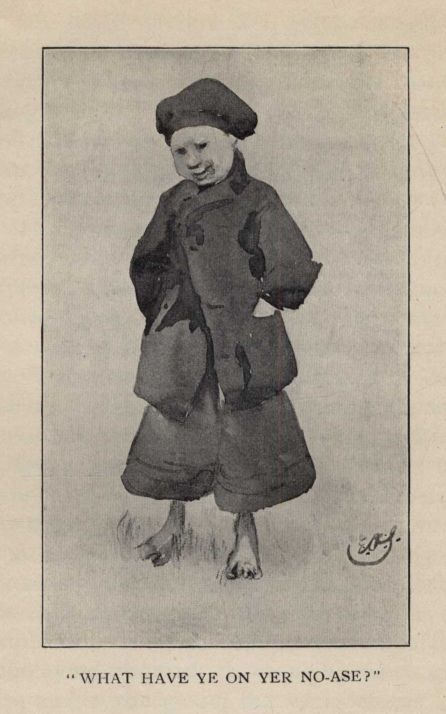
"WHAT HAVE YE ON YER NO-ASE?"
Obvious duty has seldom gone more suavely hand-in-hand with perfect enjoyment than in the attendance of the parish, practically en masse, at the levée held next day, and for many succeeding days, by the Triplets. A grey road runs north and south past their cabin door, level on the level face of the bog for a shelterless half-mile, and neither wake nor "Stations" could have commanded a more representative gathering than went and came upon it in those moist autumn afternoons. The gander who lorded it over the nibbled strip of grass in front of the cabin yard was worn down to amiability by a hundred assaults on new comers and an equal number of glorious returns to the applause of his family; the half-bred collie, coiled under a cart, closed his cunning eyes to aggressions that were beyond all barking; a five-year-old boy with tough tight curls of amber, and an appallingly dirty face, regarded me from the doorstep with brazen sang froid as I approached, and said in a loud and winding drawl: "What have ye on yer no-ase?" Praise is seldom perfected in the mouth of the babe and suckling. I removed my pince-nez, and passed with difficulty into a doorway filled with people, the blue smoke from the interior filling up the crevices. The father of the Triplets, a lanky young man, in the Sunday clothes in which he had just returned from making his application for the King's Bounty, was according an unchanging, helpless grin to the shafts of felicitation that beset him, the most barbed being screamed in Irish by the old women, to the rapture of the audience.
Behind this unequal strife the Triplets held their court, in a cradle by the fire, canopied with coarse flannel, and rocked unceasingly, one would say maddeningly, by a female relative with an expression of pomp befitting the show-woman. It suggested the bellringer who said, "We preached a very fine sermon to-day." The wicker walls rolled creakily. The rockers were uneven, so was the earthen floor beneath them, and each oscillation contained three separate jerks. In this bewildering world, composed of sallow blankets and an unceasing earthquake, the three brand new souls reposed as best they might; the show-woman's grimy hand parted their firmament of flannel, and revealed three minute faces of the pallor of lard, dome-like in forehead, with tiny and precisely similar features, wonderfully absorbed in sleep. The infant of a day old appeals unfailingly to the compassion, but its most impassioned adherent must admit that it is out of drawing. The light from the open door struck suddenly into the cradle, as some one clove a path through the assemblage; one of the absorbed faces worked in vexation, elderly, miserable vexation. Tears, too, angry and pitiful; the long slit of opening eyelid was full of them, the unseeing disc of dull blue within swam in them, the stately bald head turned to terra-cotta.
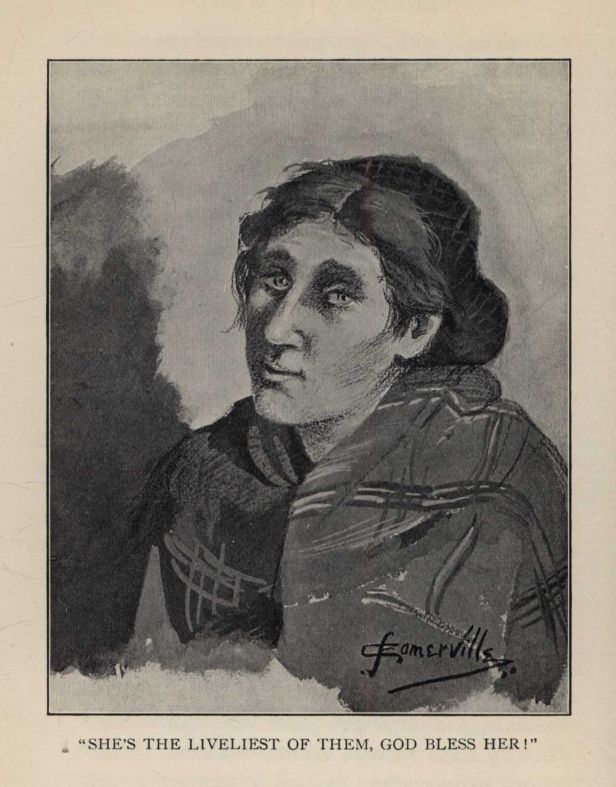
"SHE'S THE LIVELIEST OF THEM, GOD BLESS HER!"
"She's the liveliest of them, God bless her!" said the show-woman, in high admiration, "but as for the little one-een next the fire, she'll never do a day's good. 'Twasn't hardly making day this morning when I had a pot of water on the fire for her."
Being interpreted, this meant that the little one-een by the fire had in the cold autumn dawn retraced her way so far into the white trance of the unknown that all was made ready for washing and laying her out. She lay like a doll made of pale puckered wax, her sleeping lids had a lavender tone, and the shadows about her mouth were grey. Next morning the cocks had crowed but once when the pot of water simmered again over the turf fire, and the weak and lonely combat with death ended in defeat.
The life that she was not to share moved on about her in leisurely squalor; the smoke from the turf fire strayed languidly up the sooty wall, and blundered against the broad mouth of the chimney till the rafters were lost in the blue and settled obscurity. The walls were yellow with smoke; it was easy to imagine its flavour in the bowl of milk that stood on the dresser, ready for the invalid in the inner room. Obscure corners harboured obscure masses that might be family raiment, or beds, or old women; somewhere among them the jubilant cry of a hen proclaimed the feat of laying an egg, in muffled tones that suggested a lurking-place under a bed. Between the cradle and the fire sat an old man in a prehistoric tall hat, motionless in the stupor of his great age; at his feet a boy wrangled with a woolly puppy that rolled its eyes till the blue whites showed, in a delicious glance of humour, as it tugged at the red flannel shirt of its playmate.
"God save all here," said a voice, very dictatorially, at the door; a black-haired old woman shoved her way to the cradle, and parted the blankets with a professional air. She was a Wise Woman from the mountain, and foreknowing the moment when she would spit, for luck, in the faces of the helpless trio in the cradle, I jostled my way to the bedroom of their mother. It had an almost conventual calm. Moderate as was the light that struggled through a hermetically sealed window of eighteen inches by twelve, it was further baffled by an apron pinned across the panes; the air was heavy, reinforced only by the draughts and the smoke that entered hand-in-hand from the kitchen.
In one of two great beds the invalid lay in the twilight, with her hand pressed to her head. She was collected, well-bred, and concerned for the welfare of the visitor, and of all the visitor's relations, mentioned in due order of seniority. The glory of her position burned in two spots of excitement on her high cheek bones, but it could not eliminate her good manners. Her sister loudly recited the facts that she was using no food, only sups of milk and water, that as for puddings or any little rarities, if you ran down gold in a cup she wouldn't let it to her lips.
"There's nothing in the world wide I could fancy," said the sick girl, feebly, "unless it'd be the lick of a fish's tail."
The entry of the Wise Woman, with a stentorian benediction, here drove me forth like a bolted rabbit, and having skirted the evil-smelling morass in front of the house, I breathed the large air of the bogs with enthusiasm. The evening was speechless and oppressive; it held like a headache the question whether it is useful to be sorry for those who are not sorry for themselves, and, unrepining, grope out their lives in the dark house of ignorance; and whether discontent with one's lot is not the mother of good cooking and other excellent things.
A week afterwards an emissary brought to the Big House the intelligence that the mother of the Triplets had in the interval been at the point of death, and had been anointed, had an impression on her chest, and could give "no account of the pain she had in her side, only that it was like a person polishing a boot, and there to be lumps in the boot, and he having a brush in his hand." From out of these symptoms was distilled the fact that she had had pleurisy, acquired while walking barefoot in the yard to feed the calves. She entreated the gift of a pair of boots, and the emissary added, as a rider, the fact that the Colonel's boots would be just her fit. The Colonel was away, but the main body of his boots stood in battalions in his room. A pair of the dustiest was snatched, in a heat of philanthropy, and bestowed, and proved, we were given to understand, an invaluable adjunct to the feeding of the calves. It is worth mentioning that the Colonel, on his return next day, was by no means as gratified as had been hoped; they were, he said, the one and only pair of patent leather boots in which he could walk with comfort and credit in London, and the moving circumstance of Triplets had no power to allay his bitter and impotent wrath. His only tall hat had already been sold at a Jumble sale, and he did well to be angry. The cook, who had been sceptical throughout as to the necessity for the gift, tactfully reported that the Colonel's boots were too tight for That One, and brought from Second Mass the comfortable tidings that they had preyed on her feet.
The cook, always lenient, after the manner of her kind, to the Colonel and all his sex, was at that time much preoccupied with matrimonial affairs. It was soon afterwards that a strange young man in Sunday clothes appeared at intervals in the yard, and melted like a wraith into dark doorways in the kitchen passages. He was found eating trifle in the servants' hall, and in the evenings he fished on the lake. He was, we discovered, the cook's brother, arrived from Loughrea to investigate the position of the swain whom the cook wished to marry. On the fourth day he passed imperceptibly out of the establishment, and the cook fought loudly and venomously with all who crossed her path. It transpired that the brother had visited the home of the aspirant, and had found, she said, that it was a backwards place, and a narrow house, and he wouldn't let her go in it. She had twice at Mass seen the candidate for her hand, she informed us, lamentably, and he was a nice young man, foxy in the face, and she got a good account of him. That it was remarkable, or at all unpleasant, to marry a perfect stranger was a point quite outside her comprehension. She had never spoken to him, she admitted, but what signified, so long as she got a good account of him. It was afterwards discovered that the lover had been rejected because his family had been broom-makers, and that no self-respecting girl would look at him on that account. The point of social etiquette here touched remains still dark, but it was insuperable, and the cook eventually married the gentleman whose lofty calling it was to drive the butcher's cart.
The day before the marriage the battle was waged in the usual manner between the Loughrea brother and the bridegroom; greasy pound notes were slapped down on the table, the bride's savings were vaunted above the bridegroom's heifers and position as heir to his mother's bit of land, and with swaggering and bluff and whiskey drinking the bargain was concluded. Nothing could have been more frankly commercial; nothing, apparently, could have given more satisfaction. The cook departed, and lived in a cabin with a variety of her husband's relatives, who were by no means overjoyed at the circumstance; potatoes for dinner, and stewed tea morning, noon and night were her diet; the hens roosted above her bed, she weeded turnips and "spread" turf, she grew thin and pale, but never, so far as is known, did she repine, or regret the print dresses and the flesh-pots. The butcher's driver was "a quiet boy," better than most husbands; had it been the broom-maker, foxy in the face she would have made him an equally good wife. In a community where old maids are almost unknown, the only point worth considering was that she was married and had a "young son," and every man and woman in the country would have said that she was right. In traversing the point we should run our heads against a wall of primeval instinct.
Writers of novels, and readers of novels, had better shut their eyes to the fact, the inexorable fact, that such marriages are rushed into every day—loveless, sordid marriages, such as we are taught to hold in abhorrence, and that from them springs, like a flower from a dust heap, the unsullied, uneventful home-life of Western Ireland. It is romance that holds the two-edged sword, the sharp ecstasy and the severing scythe stroke, the expectancy and the disillusioning, the trance and the clearer vision.
It is even more than passive domestic toleration that blossoms in the cramped and dirty cabin life, affection grows with years, and where personal attraction never counted for much, the loss of it hurts nobody.
"Their hearts were within in each other," was said of an elderly couple, who, thirty years before, had been married in the priest's kitchen on the last night of Shraft; married as a happy thought, and by the merest chance. The lawful bride had taken her place by the bridegroom, but, changing her mind at the last possible moment, sprang from her knees, and declined the ceremony. As her betrothal was probably an affair of that afternoon it was not so dramatic an action as might be assumed, nor did it cause any hitch in the proceedings. The priest looked round the well-filled kitchen.
"Here, Mary Kate!" he said to his servant, "come on you, and marry the man! Sure you wouldn't let him go away, and he after walking five miles in the rain!"
Mary Kate knelt down by the bridegroom. We do not hear of remonstrance on her part, and thirty years afterwards, when their children were married or gone to America, it was said that this couple's "hearts were within in each other." It was said with perfect perception of the ways and the deeps of devotion; but the absence of it at their wedding was not worthy of remark, and in these things is the essence of the Irish nature, that keenly perceives sentiment, and contentedly ignores it.
"She isn't much, indeed," said a farmer of exceeding astuteness, when questioned about his matrimonial intentions, "but she's a nate little clerk." By this was delicately conveyed the fact that she could read and write, and that he could not. The marriage was highly successful.
Years afterwards a friend said to him in congratulation, "Well, James, I hear you married your daughter well."
"I did, sir, and I got him cheap." Then in a whisper, "He was divilish owld."
The computation by which the years of the bridegroom were set against the purchase money—in other words, the bride's dowry—must have been an intricate one, involving, one would say, the tables of insurance, and the best skill of the nate little clerk.
Congratulations, not unmixed with some genial surprise, were proffered to another parent on the marriage of his daughter, a person by no means in her first youth, and possessed of but one eye.
"Sure I had to give him ten pounds agin' the blind eye," explained the father of the bride, with unimpaired cordiality.
There is here no material, of the accepted sort, for a playwright; no unsatisfied yearnings and shattered ideals, nothing but remarkable common sense, and a profound awe for the Sacrament of Marriage. Marriage, humourous, commercial, and quite unlovely, is the first act; the second is mere preoccupation with an accomplished destiny; the last is usually twilight and much faithfulness. The dialogue is a masterpiece throughout, epigram, heart-piercing pathos, with humour, heavenly and inveterate, lubricating all. Perhaps the clue to success lies here, in the mutual possession of agreeability and the good nature that goes with the best agreeability; certain it is that with a command of repartee that makes fighting an artistic enjoyment, their conjugal battles are insignificant.
The two-fold heart of the race beats everywhere in the confusion; gross worldliness, and a matrimonial standard clear and unquestioned as the stars; Love the negligible quantity, and attachment the rule. It is for us, more singly bent on happiness, to aim at rapture and to foreknow disappointment.
HORTICULTURAL
I admit that I hesitate at the thought of pressing into the elect company of those who have discoursed upon gardens. From Lord Bacon down to the Poet Laureate, from the Poet Laureate up to that self-sufficing and yet voluble "Elizabeth," of whose German Garden all the craft have read, there seems no inch of garden sod that has been left unturned. I ask myself: Have I any original suggestions on, for example, The disbudding of 'Mums? (a term of horrid familiarity that I have seen applied to Chrysanthemums). Any high thoughts on Manures? Any special convictions in the matter of mulches?
My conscience, far from admitting ability to treat of these solemn things, reminds me that but little more than a year ago I should scarcely have been entrusted with the weeding of a gravel path, and hints at that Affair of the Coltsfoot. It is, in fact, the Coltsfoot Affair that decides me. I cannot be a guide or a sign-post, but I can be a scarecrow. I would say a moral scarecrow, though it may be conceded that the costume of the gardening amateur often lends itself to the more practical rôle.
I was not at all aware of being in the movement when I found myself snatching at my weekly copy of Gardening Illustrated in preference to the daily paper, and brooding heavily upon delphiniums when I might have been profiting by the sermon. It was only by degrees, as I went about the world, that I noted how quick and strong would beat the answering conversational pulse at the mention of a garden, at the sighing reference to the arrangement of a herbaceous border. It seemed that every second person I met was as much of a gardener as I was, in the matter of enthusiasm, and, as they might easily be, something more in the matter of practice. This discovery revolutionised society for me. It has doubtless done so for many another. The most penal afternoon visit may have its alleviations in a valuable hint on "the desire of the rose"—not for the star—but for the cleanings of the scullery drain; the most inveterate dowager may be found to be a man and a brother, profoundly versed in daffodils, full of lore about "Alpines." How astonishing it is to find oneself cheerfully, even ardently, assenting to what would once have been regarded as the hideous proposal to "Walk round the garden!" Such a walk has ceased to be a penance; it has become something, not quite a scouting expedition, not quite a (herbaceous) border-foray, not quite a "beggar's lay"; but it has something in it of the charms of all three. Which element preponderates depends on the character. There are moss-troopers born, who will twitch off a cutting, and filch a seed head, uncontrollably. There are heaven-endowed mendicants who will yearn and flatter the filling of a flower bed into a knotted pocket handkerchief. It is a useful principle to accept everything, regardless of the accident of the seasons. There are many other accidents of far higher importance to be considered—lapse of memory on the part of the giver, for instance, or repentance. In the amenities of gardeners, as in love, the advice to "Take me when I'm in the humour," is sound, and a cutting in the hand is well worth six in or on the bush, when the bush is another's.
I believe it is the gambling element that gives to gardening so potent a charm—that, and the seedmen's catalogues. One of my first adventures was in response to a singularly seductive advertisement—"Humulus Lupulus," it said, "The finest creeper in the world. Grows forty feet in a single night. Massive clusters of yellowish blossoms. Beautiful; Healthy." I have the constitutional misfortune to believe, unquestioning, the printed word. Even now I find it hard to discount the flights of fancy of that poetic idealist, the advertising nurseryman. I despatched eighteenpence by the next post; received by return an undemonstrative bundle of little roots, planted them prayerfully in a choice place, and then, as it happened, left home for a time. On my return to my garden I found the usual crop of catastrophes and compensations, but disregarding all alike I sped to the site of the Humulus Lupulus. There had been near the same spot a highly esteemed rose, "Climbing Captain Christie." The first thing that greeted me was the wan, indignant face of a Captain Christie, who, having climbed for all he was worth, was none the less overtaken, and was now gazing at me in strangled pallor from the depths of a thicket of common hops. The Poetic Idealist had triumphed.
I have never been able precisely to ascertain to what extent Bat Whoolley found me out in the Affair—already alluded to—of the Coltsfoot. Bat is my gardener, and I value his opinion highly, almost as highly as he does himself, though possibly with more limitations. Winter Heliotrope was what my neighbour called Coltsfoot. I felt there was something not quite sound in the lavish way she pressed it upon me. She said there was nothing like it for covering bare places, and that I might dig it up for myself and take all I wanted. That specious permission might have warned me; so also might the singular fact that my neighbour's shrubbery had for undergrowth naught save the curving leaves of the winter heliotrope. None the less, I planted out two or three colonies of it on the outskirts of the rock garden.
One morning, at the turn by the pine tree (one of my colonies had been unostentatiously planted in a bare place behind the pine tree), I met Bat. His face was redder than usual, and there was something very searching in his eye. Mine did not meet it.
"Look at that!" he said.
He held up a handful of long white roots, and brandished it, much as Jupiter is represented brandishing a handful of lightning. "Look at that dam-root"—he pronounced the words as one pronounces beet-root—"that some"—here a powerful variant on the usual definition of fool—"is after planting in your honour's consarns! See here! If ye left no more o' that in the ground than as much as ye couldn't see itself, it'd have the place ate up in one fortnight! I gave the morning to it, an' if I give the day itself it's hardly I'll have it all dug—Divil's cure to the—" (Here more variants in connection with the imposter.)
Something wavering in Bat's eye, even while the denunciation proceeded, made me conscious of the smirch of suspicion. I remained silent as the grave. Secretly I visited the other colonies, and found that one of them was already swinging an enveloping wing round the rearguard of the Iris Kaempferi, and that another had flung outposts into the heart of the helianthemums. At a bound I ranged myself with the opposition.
"Bat," I said, "the Dam-roots are in the garden!"
That night a fair-sized bundle of winter heliotrope was restored to my generous neighbour. Bat threw it over the wall.
I am slowly acquiring some insight into my gardener's likes and dislikes. He despises anything that he suspects of being a wild flower.
"'Sha! that's no good! That's one of the Heth family! The hills is rotten with it."
But on the other hand, he will lavish such a wealth of attention upon potatoes as would, if bestowed on the despised daughter of Heth, cause it to blossom like the rose. There are, in his opinion, but three flowers really worthy of cultivation. Red geraniums, blue lobelias, and yellow calceolarias. With these, had he his will, should all my garden be glorious. I never buy them; I never see them in their earlier stages, but suddenly, in the herbaceous border, the trio will appear, uttering a note of colour only comparable to the shriek of a macaw.
"Why then, there isn't a gentleman's garden in Ireland but thim have the sway in it!" Bat says, when he finds me brooding over a shattered ideal. "There was Mr. Massy's was the grand place! The garden steps big slobs of marble, and the gate lodges dashed and haberdashed, and the gardens fit to blind yer eye by the dint o' thim!"
What "haberdashed" may mean I cannot say, but "thim" meant the combination so dear to his heart that a stouter than mine would be needed to abolish it, even from a herbaceous border.
Sometimes, chiefly on Sunday afternoons, I am visited by compunction in the matter of the prohibited "calcies" and "lobaylias," for it is on Sundays that Bat is "at home" to three favoured enemies of his own profession. They move, very slowly, and, for the most part, silently, from bed to bed, like doctors making a clinical inspection at a hospital; at intervals they put a horny finger under a patient's chin and gravely study his complexion, or, wishing perhaps to show generosity to a rival, they pick off some malign bug or caterpillar, and squash it between an unhesitating finger and thumb. It is at such times that I feel how far my garden in its lack of that gorgeous trio lags behind that of any other gentleman in Ireland.
But my gardener has his alleviations. There was one bright day which, having begun with the funeral of a relative, culminated in a visit as prolonged as it was satiating from the chief mourner. King Solomon did not exploit his Temple more thoroughly for the discomfiture of the Queen of Sheba than did Bat his gardens for the Chief Mourner. The latter, a "mountainy man from back in the counthry," paced heavily round after Mr. Whoolly, his hands folded on the apex of his back under the voluminous skirts of his blue frieze coat, a stick hanging from them like a tail. The deep silence of his native hills was on him; he suffered his emotions without expression until the tour of the kitchen garden was made, its climax—fortunately stage-managed by Bat—being "a bed of greens." There is that in such a bed that, in such a nature, touches an even more vibrating chord than potatoes.
"And cabbages!" said the mountainy man, almost in a whisper.
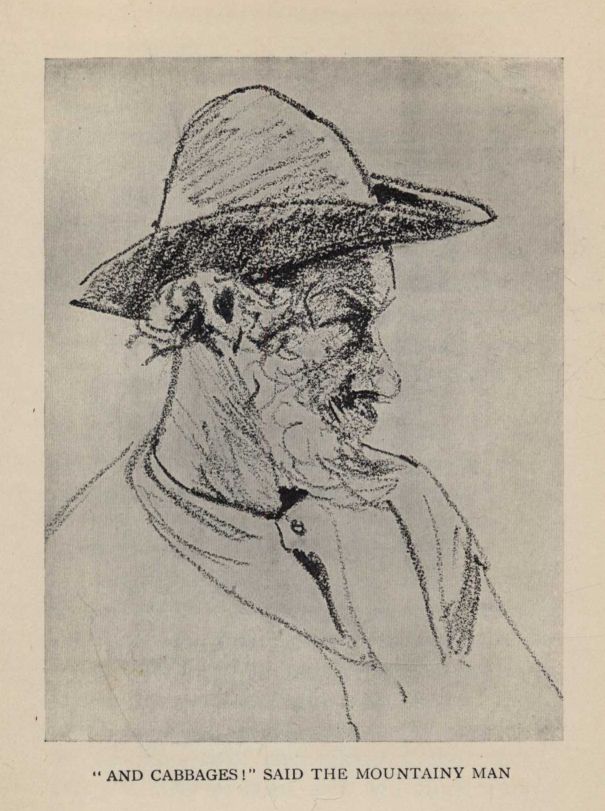
"AND CABBAGES!" SAID THE MOUNTAINY MAN
The Queen of Sheba herself was not a more gratifying audience. Mr. Whoolley seems to have observed the parallelism of the cases, and assuming that the visitor, in spite of the funeral, had no more spirit left in him, the couple adjourned to a convenient public house and were no more seen.
On the whole, I think I may say that I give Bat satisfaction. He is generous in judging rather by intention than achievement, and he sees the advantages of fostering a disposition to weed. Only once has he been tried too high, and that was when I planted out a bed with what he calls "pushoch-bui," a most pestilent weed whose English equivalent is, I fancy, charlock. To me he passed over the error in a very handsome manner, but I heard him the same afternoon say to the subordinate who was making good my misdoing:
"Is it that one! Sure he's no more good than a feather!"
Another act of folly of mine, however, carried with it more serious consequences. I was so far left to myself as to give permission to a Sunday School excursion of unknown dimensions to disport itself in my domains. Dates were discussed, and times arranged, and then a sponge of kindly oblivion wiped the affair from my mind. It was a couple of months afterwards—I was inspecting my wall fruit in the kitchen garden at eleven o'clock in the morning, and being eaten by midges in a way that foretold immediate rain, when there was a sound of thunderous driving on the avenue. Just then the rain began to fall, and almost at the same moment there arrived to me a rushing messenger from the house saying "there were ladies in the drawing-room."
I am a lone man, and there is no one to share with me the brunt of such a moment. I hurried in, and was confronted as I neared the hall door by four huge yellow brakes, full of children, and roofed with umbrellas. Two, already empty, were emulously pressing towards the yard, one taking a short cut across a strip of lawn, and two more were disgorging their burdens at large. I went into the drawing-room and found it lined with ladies in black. It was explained to me that on account of the rain the party, which comprised the Patrons, Teachers, and Pupils of four Sunday Schools, had "taken the liberty of coming to the house for shelter." Even as they spoke a strange murmuring sound arose from beneath my feet—the hum as of an angry hive. The house, like many old country houses in Ireland, stands upon a basement storey, and I realised that its cavernous recesses were being utilised as a receptacle for the Amalgamated Sunday Schools.
I cannot clearly recall the varied events of that day of nightmare. I remember finding, at one juncture, one of my subordinates stemming the rush of the Sunday Schools up the back-stairs with the kitchen table and an old driving whip. At another, my honoured presence was requested in a cave-like place, once a laundry, wherein a shocking meal was being partaken of. I noticed a teacher with a "cut" of cold salmon, wrapped in newspaper. She ate it with her fingers, quaffing raspberry vinegar the while. Kettles, capacious as the boiler of a man-of-war, steamed on the ancient fireplace; the air reeked of damp children and buns. Later on it cleared, and I led a company of female patrons forth to see the garden. Already the sward of the tennis ground looked like Epsom Downs on the day after the Derby, and an animated game of Hide-and-Seek was in progress among my young rhododendrons. I averted my eyes. In the flower garden the usual amusement of leaping the beds had taken place, with the usual results of chasm-like footprints in the centre of each. The first endurable incident of the day was the discovery that Bat had locked the kitchen garden gate, and that my strollings with the patronesses were perforce ended. But even as I was expressing my regrets (coupled, mentally, with a resolve to raise Mr. Whoolly's wages) there arose from within the walls cries of the most poignant, accompanied by roars comparable only to those of a wounded tiger. On the top of the wall, just above us there shot into view the face of a boy, a face scarlet with exertion, vociferous in lamentation. Quickly following it there appeared down the length of the wall other faces, equally agitated, while from within came a sound as of the heavy beating of carpets. Other sounds came also. Sounds of indignation too explicit to be printable. I blushed for the patronesses. None the less I endorsed every word of it as I realised that my best peach trees were being used as ladders by the Amalgamated Sunday Schools.
I think that was about the last act in the tragedy. Not long afterwards, in a yellow glow of late, repentant sunlight, the four brakes drove—with further cuttings of grassy corners—up to the hall door. The Sunday Schools were condensed into them, each child receiving an orange as it took its seat, and thin cheers arose in my honour. Simultaneously the brakes snowed forth orange peel upon the gravel; the procession swept out of sight, still cheering, still snowing orange peel.
For reasons darkly and inextricably mixed up with the Sunday School excursion, dinner that night was served at nine o'clock, and as I was aware that every servant in the house was in a separate and towering passion, I refrained from inquiry.
Yet, even through the indigestion following on this belated repast, I was upheld by the remembrance of Bat's face, as he glared at me through the bars of the kitchen garden gate, and said:
"Thanks be to God, I'm after breaking six pay-sticks on their backs!"
OUT OF HAND
Soldiers were there to keep the peace. The redcoats and the bayonets moved in a rigid line through the crowd that blocked the two streets of the town. They guarded a small body of voters that had come across Lough Corrib, and was making its way to the polling-booths, headed by a Galway landlord, on whose arm leaned an old man, decrepit, and unnerved by the storm of opposition through which they passed.
Another Galway landlord was ranging through groups of men who turned their backs on him, and hid behind each other, his tenants, personal friends all of them, who, for the first time on record, had voted in opposition to his wishes.
"Every one of them!" he said, while the atmosphere that surrounds suffering and strong emotion made itself felt, "all but two or three. They have all gone against me."
It was a memorable election, marking the new departure in Irish politics, and it broke the hearts and practically ended the lives of two at least of the Galway landlords. Till that time the landlords took their tenants to the poll en masse; thenceforward they were to advance under the banner of the Church.
The epoch that here found its close was memorable, too, in its way. It held, far back in it, the brave days when the Galway elections lasted for a month, and the actual voting for a week, days to which the pages of Lever bear witness. As that week of delightful warfare strove on the electors became more fastidious about their drinks, and would accept nothing less aristocratic than mulled port and claret. These restoratives were brewed in fish-kettles on the big fireplaces of the ballroom in Kilroy's hotel, an agreeable incident, not, we think, commemorated by Lever.
* * * * *
Twenty years afterwards a Galway village lay mute in the sunshine, drowsy with respectability, assertive of rectitude in every slant of its slate roofs. To view it thus from the waste altitudes of the moor above it, on a Sunday morning of July, with the call of a cock straining up through the silence, was to endue it with all the stillness and strictness of the day itself, even to credit it with a Presbyterian rigour of Sabbaticism that was at variance with the traditions of the County Galway. Down on its own level, and approaching it through the aisle of shade that lay between broken demesne walls and under the lofty embrace of demesne trees, the glare of its whitewash closed the vista blatantly, and with a self-righteousness that suppressed the romantic as a thing of libertine irrelevance. Therefore, to an eye accustomed, during many Sundays, to the recognition of the barren street, with its strings of ducks in moody reverie about the unremunerative gutters, and its dogs asleep outside the closed doors, it was startling beyond the merit of the occasion to be confronted with a staring crowd of people that filled the street loosely from end to end. Every face was turned towards the new-comer, till the whole slope of the hill was flushed with them; then it darkened, as the people realised that nothing worthy of further notice was occurring, and turned their heads again towards Galway.
The crowd was a representative one. Wizened old men in swallow-tailed coats and knee-breeches, degenerate youth in check suits and pot-hats, tanned women in deep-hooded cloaks, girls with shawls over their heads, freckled and ubiquitous children—all smelling heavily of turf smoke, some modernised with the master smell of hair-oil. The anti-Parnellite candidate was expected to arrive at any moment from Galway, to address those who had come to the village for Mass; and though the people had now been out of chapel for an hour there seemed to be no wish to disperse, or any sign of impatience. They even appeared to be enjoying themselves as thoroughly as was compatible with the fact that the public-houses had not yet been opened. Anything so fascinating as a little political excitement was worth waiting for, especially while Providence was liberal of fresh arrivals on outside cars, and invention failed not of the personal allusion wherewith to greet them; so that time passed healthfully, and expectation was no more than pleasantly ripe when outposts on the hill heralded at length the approach of the candidate.
A blended roar of execration and encouragement went out to meet him—a greeting sustained on every note of the human compass in a savagely inarticulate mass of discord. He seemed to cleave his way through it as he passed, his figure moving pompously along on its car above the shoulders of the people, in black coat and white waistcoat, while a deft hand manipulated a tall hat in recognition of every crumb of welcome. He passed on down a by-road towards the chapel, followed by a few dozen people, and by the booing and hooting of the rest of the assemblage. Clearly the materials for the meeting were elsewhere.
It was not far to the chapel, four hundred yards or thereabouts of dusty road, that lay hot and quiet between loose stone walls, dropping to a hollow and rising again to the low height where stood the unmistakable building that is the heart and fountain of parish politics, its plaster and whitewash veiled a little by the kindly churchyard trees, and the stone cross on its gable standing strong and keen under the melting sky.
On nearing the churchyard the candidate's voice was audible through the trees in fluent, opening sentences, each point duly weighted with a "Hee'rr, hee'rr!" as businesslike as the "Amen" of the parish clerk. His car was waiting outside in the shade, and the carman, who was perhaps a little blasé in the matter of speeches, was smoking an unemotional pipe beside it.
"Indeed, you may say the town of Galway is in a quare way," he said, putting his hand to a cheek that was just perceptibly more purple than the other. "Look at meself, the figure I am, that wasn't spakin' a word to a Christhian, good nor bad, and lasht night a fishwoman comes down to me in the sthreet this ways"—squaring his elbows and strutting—"'Hi for Lynch!' says she, hittin' me a puck in the jaw with her skib (basket). The Lord save us! 'tis hardly I ran from her before she had the town gethered afther her. Begob, the women's the most that'd frighten ye!"
At the churchyard gate a couple of long-tailed colts were tied up, saddle-horses evidently, but bare-backed, and bridled with a halter, their bodies bloated with summer grass out of all proportion to their long legs, and their countrified ears pricking occasionally at the cheers that did not by the blink of an eyelid affect the doze of the Galway car-horse. The company inside was a small one as compared with that in the street, and had in it a much larger proportion of women and old men, to which was perhaps due the superior calm of the proceedings. The churchyard was a spacious one, depressingly roomy indeed for the present occasion, for which any suburban back garden would have sufficed. Most of the audience had mounted on the tombstones, great slabs of limestone that formed the lids of the boxes placed over the more distinguished dead, blackish grey, and ringing under the hobnailed-boots like metal. The candidate stood on the highest tombstone, and all around him leaned and clung these strange groups of men and women, looking like the wooded islands in the lake close by; while between them the quiet background of the graveyard was visible, with its bent and musing trees, and array of low head-stones gazing blindly at the concourse.
The bald top of the candidate's head formed the focus-point of the gathering, giving back the sun's glare like glass as it swung and jerked with the flow of oratory, and beside it the immense shovel-hat of the old priest moved occasionally in accord, italicising for the benefit of the flock such phrases as seemed especially edifying. The curate was nowhere to be seen; rumour said that his political theories were not formed on those of his superior. A remembrance recurred of meeting, that morning, a severely contemplative young priest, walking alone and away from the village, with the green flicker of the leaves overhead playing strangely across the gloom of his sallow face.
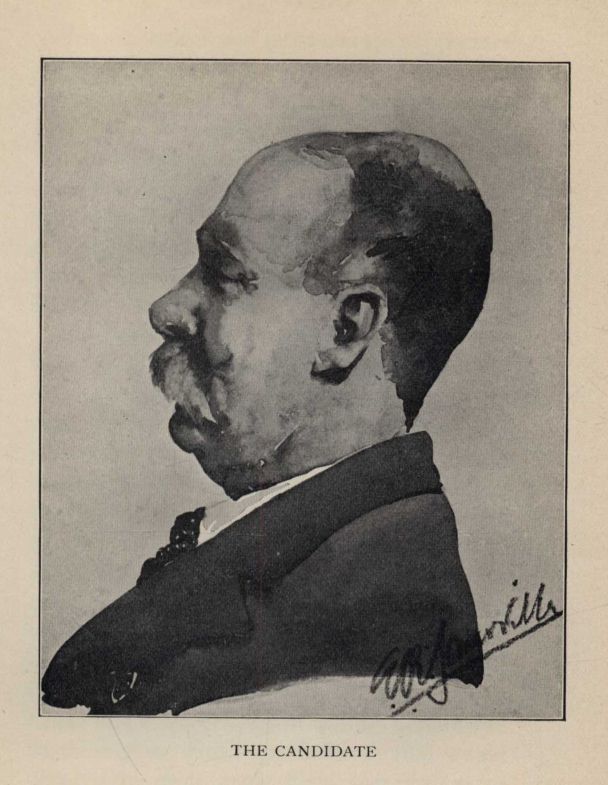
THE CANDIDATE
The candidate's speech seemed, indeed, to require a little driving home. It was, for the most part, an explanation to his constituents of the reasons that made it necessary for him to forego the happiness of acquainting himself with them in any intimate degree. He was, he said, in his temperately florid manner, closely connected with a large firm in England and, deplorable to relate, his income depended on his living in the bosom of the English firm. "Sure we know that—we know that!" yelled the half-dozen most chosen supporters, crushing precariously round the candidate on the edge of the tombstone platform, with their wild, combative faces pressing, all on fire, towards him. Perhaps he might yet be roused to say the right things about the rival candidate, the things that would wring forth a cheer in reply to those distant ones that came maddeningly at intervals from the crowd in the street.
But the speaker kept his eloquence well in hand, confining himself to such blind alleys of assertion as the remarkable success of his own career, his confidence that his constituents would re-elect him, and his desire to benefit them in some immeasurable way if they did so. A permissive cynicism curved the wrinkles on the faces of the old men who stood on the grassy graves behind him, with their hands under their coat-tails, and their grizzled chins sunk in their shirt-collars; they knew how they were going to vote, and their own powers (matured in the sale of many a heifer and rood of bog) of taking a part and sustaining it, with a perfectness that would deceive the elect, made them sceptical as to the ends of speech-making. The women were tittering and whispering under their shawls; but were certainly impressed by the candidate's Sunday attire, his well-kept grey moustache, and his affable way of saying "ladies and gentlemen" every now and then.
The speech ambled to its close, through a peroration of an uncertain conversational tone, assisted at critical points by one or other of the supporters, who would ungovernably supply the needed word out of the bursting fulness of his own repertoire. It was the sole outlet for their enthusiasm, except for the cheer that caught at the ravelled edge of the final sentence, as the candidate put on his hat and bowed himself from the tombstone.
"Be prayin' for the meetin', gerrls," said the old priest, leading the way to the vestry, with rusty skirts floating widely. The door closed on him and his protégé, the clumps on the tombstones fell apart, mingling in a laughing and talking stream towards the churchyard gate, and the prayers of the young ladies were apparently deferred to a more convenient season.
The chapel door stood open, showing the barren squareness of the interior; a zinc tub, half-full of Holy-water, stood in the porch, with the flags all round it wet from the splash of dipping hands; the altar gleamed gaudily at the further end; and a tall confession-box stood solitary in the seatless expanse of floor, fraught with the inseparable mystery and suggestiveness of its kind, and holding within its curtained rails the knowledge of what things are counted for unrighteousness in that twilight place, the conscience of the Western peasant. The air inside was warm, and still laden with the smell of frieze coats and stale turf smoke; but, except for this furnishing, the blankness was complete. Sunday and its Mass were over and done with for a week, and priest and congregation were striving factors in the carnal toils of election.
The people dispersed slowly, discussing the absorbing topic of the day, some in their native tongue, but for the most part in English, so pronounced as to be in the distance scarcely distinguishable from the liquid and guttural flow of Galway Irish.
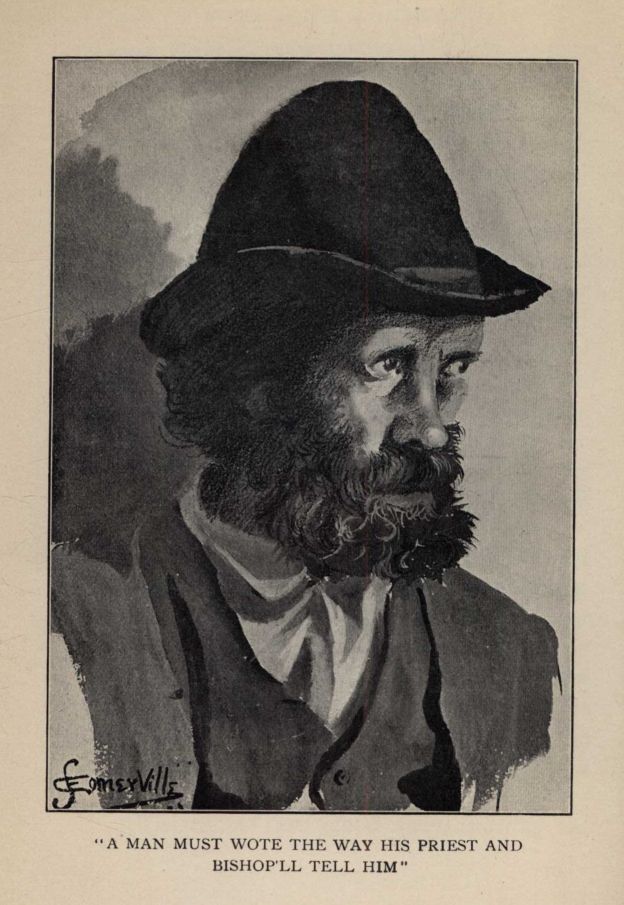
"A MAN MUST WOTE THE WAY HIS PRIEST AND BISHOP'LL TELL HIM"
"Sure, a man must wote the way his priest and bishop'll tell him," says a tall supporter, with the air of a person repeating a truism.