THE MEADOW LARK, OR OLD FIELD LARK.
Reading edition
(Sturnella magna.)
The meadow lark (fig. 11) is a common and well-known bird occurring from the Atlantic Coast to the Great Plains, where it gives way to a closely related subspecies, which extends thence westward to the Pacific. It winters from our southern border as far north as the District of Columbia, southern Illinois, and occasionally Iowa. Although it is a bird of the plains, finding its most congenial haunts in the prairies of the West, it does not disdain the meadows and mowing lands of New England. It nests on the ground and is so terrestrial in its habits that it seldom perches on trees, preferring a fence rail or a telegraph pole. When undisturbed, it may be seen walking about with a peculiar dainty step, stopping every few moments to look about and give its tail a nervous flirt or to sound a note or two of its clear whistle.
The meadow lark is almost wholly beneficial, although a few complaints have been made that it pulls sprouting grain, and one farmer claims that it eats clover seed. As a rule, however, it is looked upon with favor and is not disturbed.
In the 238 stomachs examined, animal food (practically all insects) constituted 73 per cent of the contents and vegetable matter 27 per cent. As would naturally be supposed, the insects were ground species, such as beetles, bugs, grasshoppers, and caterpillars, with a few flies, wasps, and spiders. A number of the stomachs were taken from birds that had been killed when the ground was covered with snow, but still they contained a large percentage of insects, showing the bird's skill in finding proper food under adverse circumstances.
Of the various insects eaten, crickets and grasshoppers are the most important, constituting 29 per cent of the entire year's food and 69 per cent of the food in August. It is scarcely necessary to enlarge upon this point, but it can readily be seen what an effect a number of these birds must have on a field of grass in the height of the grasshopper season. Of the 238 stomachs collected at all seasons of the year, 178, or more than two-thirds, contained remains of grasshoppers, and one was filled with fragments at 37 of those insects. This seems to show conclusively that grasshoppers are preferred and are eaten whenever they can be procured. The great number taken in August is especially noticeable. This is essentially the grasshopper month, i. e., the month when grasshoppers reach their maximum abundance; and the stomach examination has shown that a large number of birds resort to this diet in August, no matter what may be the food during the rest of the year.
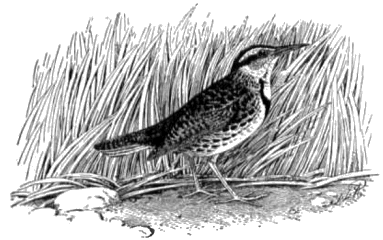
Fig. 11.—Meadow lark.
Next to grasshoppers, beetles make up the most important item of the meadow lark's food, amounting to nearly 21 per cent, of which about one-third are predaceous ground beetles. The others are all harmful species, and when it is considered that the bird feeds exclusively on the ground, it seems remarkable that so few useful ground beetles are eaten. Many of them have a disgusting odor, and possibly this may occasionally save them from destruction by birds, especially when other food is abundant. Caterpillars, too, form a very constant element, and in May constitute over 28 per cent of the whole food. May is the month when the dreaded cutworm begins its deadly career, and then the bird does some of its best work. Most of these caterpillars are ground feeders, and are overlooked by birds which habitually frequent trees; but the meadow lark finds them and devours them by thousands. The remainder of the insect food is made up of a few ants, wasps, and spiders, with a few bugs, including some cinch bugs.
The vegetable food consists of grain, weed, and other hard seeds. Grain in general amounts to 14, and weed and other seeds to 12 per cent. The grain, principally corn, is mostly eaten in winter and early spring, and must be therefore simply waste kernels; only a trifle is consumed in summer and autumn, when it is most plentiful. No trace of sprouting grain was discovered. Clover seed was found in only six stomachs, and but little in each. Seeds of weeds, principally ragweed, barn grass, and smartweed, are eaten from November to April, inclusive, but during the rest of the year are replaced by insects.
Briefly stated, more than half of the meadow lark's food consists of harmful insects; its vegetable food is composed either of noxious weeds or waste grain, and the remainder is made up of useful beetles or neutral insects and spiders. A strong point in the bird's favor is that, although naturally an insect eater, it is able to subsist on vegetable food, and consequently is not forced to migrate in cold weather any farther than is necessary to find ground free from snow. This explains why it remains for the most part in the United States during winter, and moves northward as soon as the snow disappears from its usual haunts.
There is one danger to which the meadow lark is exposed. As its flesh is highly esteemed the bird is often shot for the table, but it is entitled to all possible protection, and to slaughter it for game is the least profitable way to utilize this valuable species.