THE BOBOLINK, OR RICEBIRD.
Reading edition
(Dolichconyx oryzivorus)
The bobolink (fig. 9) is a common summer resident of the United States, north of about latitude 40°, and from New England westward to the Great Plains, wintering beyond our southern border. In New England there are few birds, if any, around which so much romance has clustered; in the South none on whose head so many maledictions have been heaped. The bobolink, entering the United States from the South at a time when the rice fields are freshly sown, pulls up the young plants and feeds upon the seed. Its stay, however, is not long, and it soon hastens northward, where it is welcomed as a herald of summer. During its sojourn in the Northern States it feeds mainly upon insects and small seeds of useless plants; but while rearing its young, insects constitute its chief food, and almost the exclusive diet of its brood. After the young are able to fly, the whole family gathers into a small flock and begins to live almost entirely upon vegetable food. This consists for the most part of weed seeds, since in the North these birds do not appear to molest grain to any great extent. They eat a few oats, but their stomachs do not reveal a great quantity of this or any other grain. As the season advances they gather into larger flocks and move southward, until by the end of August nearly all have left their breeding grounds. On their way they frequent the reedy marshes about the mouths of rivers and on the inland waters of the coast region, subsisting largely upon wild rice. After leaving the Northern States they are commonly known as reed birds, and having become very fat are treated as game.
They begin to arrive on the rice fields in the latter part of August, and during the next month make havoc in the ripening crop. It is unfortunate that the rice districts lie exactly in the track of their fall migration, since the abundant supply of food thus offered has undoubtedly served to attract them more and more, until most of the bobolinks bred in the North are concentrated with disastrous effect on the south east coast when the rice ripens in the fall, there was evidently a time when no such supply of food awaited the birds on their journey southward, and it seems probable that the introduction of rice culture in the South, combined with the clearing of the forests in the North, thus affording a larger available breeding area, has favored an increase in the numbers of this species. The food habits of the bobolink are not necessarily easily inimical to the interests of agriculture. It simply happens that the rice affords a supply of food more easily obtainable than did the wild plants which formerly occupied the same region. Were the rice fields at a distance from the line of migration, or north of the bobolinks' breeding ground, they would probably never be molested; but lying, as they do, directly in the path of migration, they form a recruiting ground, where the birds can rest and accumulate flesh and strength for the long sea flight which awaits them in their course to South America.
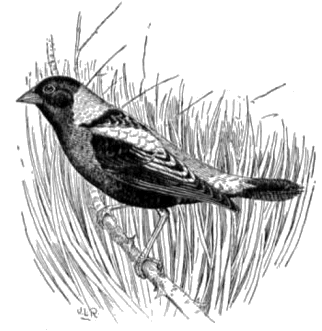
Fig. 9.—Bobolink.
The annual loss to rice growers on account of bobolinks has been estimated at $2,000,000. In the face of such losses it is evident that no mere poetical sentiment should stand in the way of applying any remedy which can be devised. It would be unsafe to assume that the insects which the birds consume during their residence in the North can compensate for such destruction. If these figures are any approximation to the truth, the ordinary farmer will not believe that the bobolink benefits, the Northern half of the country nearly as much as it damages the Southern half, and the thoughtful ornithologist will be inclined to agree with him. But even if the bird really does more harm than good, what is the remedy! For years the rice planters have been employing men and boys to shoot the birds and drive them away from the fields, but in spite of the millions slain every year their numbers do not decrease. In fact, a large part of the loss sustained is not in the grain which the birds actually eat, but in the outlay necessary to prevent them from taking it all. At present there seems to be no effective remedy short of complete extermination of the species, and this is evidently impracticable even were it desirable.