HISTORY OF THE SMUGGLERS. (continued 4)
Reading edition
Richard Havendon deposed that the 2nd November last, about seven at night, he heard somebody whistle at his door, and going out to see who was there, four men with crapes over their faces seized him, put a pistol to his breast, and said they wanted money; upon which he gave them eleven shillings and sixpence out of his pocket; but they said that would not do, and took him with them into the house; when they came in they called for candles, and one of them holding a pistol to his breast, stayed with him below stairs, while the rest went up, where they stayed a considerable time, and then came down stairs with what they had got; they then took him with them to the place where they had put their horses, and swore they would carry him away with them, unless he would tell them where the rest of his money was, for they were sure he had more than what they had got; but when they were got upon their horses, they bid him good night, and went away and left him. When he came back to his own house again, he found they had broke open two doors, two trunks and a box, and taken away the money and things mentioned in the indictment. Asked what he was doing when they whistled at his door, said he was churning.
Francis Doe, an accomplice in the said robbery, being sworn, deposed that he, John Mills, alias Smoker (who was convicted for the murder of Hawkins), and the two prisoners at the bar, agreed to go and rob the prosecutor’s house. That on the 2nd of November they all four, with their faces covered with crape, came to his house, and whistled at the door; that when the prosecutor came out, they seized him and demanded his money; that the prosecutor gave them eleven shillings and sixpence out of his pocket; that they then went into the house, and Lawrence Kemp, one of the prisoners, stood sentry over the prosecutor, whilst he, this witness, with Mills and Thomas Kemp, the other prisoners, went upstairs, forced open two doors, two trunks and a box, and took thereout several pieces of gold and silver, to the amount of five or six and thirty pounds, together with some rings, spoons and a watch. That when they came downstairs, they took the prosecutor with them to where their horses stood, and threatened they would carry him away with them unless he would discover where the rest of his money was, for they were sure he had more in the house. That upon his declaring he had no more, they let him go home, mounted their horses, and rode away. Upon shifting, that is, sharing the money, he had eight or nine pounds for his share. That Lawrence Kemp, one of the prisoners at the bar, was to sell the watch, rings, &c., and to divide the money between them, but he never did as he knew.
Jacob Pring deposed that he went down to Bristol to meet with and bring up John Mills, otherwise Smoker. That when he was there he met with the two prisoners at the bar, who agreed to come up with them. That on the road, talking together of their exploits, the two prisoners owned to him their robbing the farmer at Heathfield. That they said the old man was churning when they came to his house. That they craped their faces over, and took out of the house five or six and thirty pounds, besides a watch, rings, spoons, and a silver cup.
Being asked how they came to confess a robbery to him which must affect their lives, he said that he, the two Kemps, and Mills, alias Smoker, had agreed to go robbing on the highway, and to break open houses; that the prisoners bragged of this amongst other robberies they had committed.
Being asked by the court whether he had repented of the agreement he had so made, he said that he had no such intention, but that it was only a feint, and that he went down to Bristol on purpose to bring up Mills that he might be apprehended. That there meeting with the Kemps also, and hearing of this robbery at Heathfield, he resolved to do all in his power to allure them to his house, in order to get them and Mills apprehended.
The prisoners being called upon to make their defence, both said they knew nothing of the robbery; and the prisoner Thomas Kemp said that they never made any such confession to the evidence, Pring; that he, together with John Mills, alias Smoker, Francis Doe and Jockey Brown, were all the persons who robbed the farmer at Heathfield.
Being asked whether they had any witness to prove what they had asserted, or where they were when the robbery was committed, they said they had no witnesses, for that they had no “steady,” meaning no certain place of abode, for two years past; upon which the jury found them both Guilty. Death.
Robert Fuller was indicted for assaulting William Wittenden in an open field, near the King’s highway, putting him in fear of his life, and taking from the said William Wittenden seven shillings and sevenpence halfpenny, the 14th of November.
William Wittenden deposed that coming across a field near Worth, the prisoner at the bar, who was on horseback, stopped him and enquired the way to Worth; that this witness directed him; then the prisoner asked if he had any money; he answered, “No.” The prisoner replied, “D—n you, you have, and I will have it,” and then pulled out a pistol and put it to his breast; that then this witness pulled out a little bag, in which was seven shillings and sixpence in silver, and three halfpence, which the prisoner snatched from him, and then rode away.
Being asked by the court if he was sure the prisoner was the man that robbed him, answered he was very sure, and that he saw him ride by him the next day, in company with another man.
The prisoner in his defence said that the prosecutor declared, when he came to see him in the prison, that he did not know him; and to prove this called William Cooper, who, being sworn, deposed that the day before, the prisoner at the bar, with two other prisoners, were put into a room; that the prosecutor came in and said he knew nobody there.
The prosecutor being asked how many prisoners he saw in that room, said he saw but two, and that afterwards he went into another room, where all the prisoners were, and did not see anybody there that he knew, but, turning on his right hand, he saw the prisoner standing behind him, and he said, “That is the man that robbed me.”
Mr. Rackster deposed that he was in the room the first time the prosecutor saw the prisoners; that there were indeed three prisoners in the room, but that the prosecutor saw but two, which stood before him, for the prisoner at the bar stood behind him, which was the reason that he did not see him then.
The prisoner being asked if he had any witnesses to his innocence or character, answered that he had none; upon which the jury found him Guilty. Death.
Richard Savage was indicted for stealing out of the Lewes waggon twenty-two yards three-quarters of scarlet cloth, twenty-six yards of blue cloth, the property of Thomas Friend, of Lewes, and a box, in which were contained two silk gowns and two guineas, the property of a person unknown, on April 5th, 1748.
Mr. Friend deposed that he knew his servant put up the cloth, and ordered it to be carried to the waggon.
William Brown, servant to Mr. Friend, deposed that he delivered the cloth to the carrier’s man.
Matthew Comber, the carrier’s man, said he received the cloth from the last witness. That on the 5th of April last he was set to watch the waggon all night at Chailey; that two men came up to him about ten o’clock at night, enquiring what waggon it was; on his telling them, they took him away about two hundred yards from the waggon, where one of them kept him prisoner with a pistol at his breast; that then came up seven more men, who got off their horses, and left them at some distance from the waggon, with one man to take care of them. That the rest of the men went up to the waggon, and cut the cords, threw off some woolpacks, and then threw some boxes and other goods out of the waggon; that they broke open the boxes, took out the goods, loaded their horses, and went away.
Thomas Winter, otherwise the Coachman, an accomplice, deposed that on the 5th of April, he and Shoemaker Tom, with the prisoner at the bar and several others, met at Deval’s house at Bird’s Hole, and agreed to go out and rob a waggon that was loaded with wrecked goods; that about ten o’clock at night they came all together upon Chailey Common, where they took the carrier’s man prisoner, and one of them kept him so, while the rest went and rifled the waggon. That they broke open several boxes and parcels, and took away a large parcel of scarlet cloth, and another large parcel of blue cloth, and a box with two silk gowns and two guineas in it, with other goods. That after they had loaded their horses they rode away to Bird’s Hole, near Devil’s Ditch, where they shared the goods; that the prisoner at the bar was with them in the robbery, and had a share of the goods.
Thomas Dixon, otherwise Shoemaker Tom, another accomplice, deposed that he and Winter, and several others, met together at Deval’s house, at Bird’s Hole, and agreed to go and rob the waggon, as mentioned by the last evidence; that there they laid hold of the carrier’s man, took him some distance from the waggon, and set one of their number as a guard over him; that they then plundered the waggon, and took the cloth and other things mentioned in the indictment; that having loaded their horses, they made the best of their way to Bird’s Hole, and in a ditch near that place they divided the spoil.
Being asked by the court if the prisoner at the bar was with them at the time of their committing the robbery, said he believed he was, but was not sure; but that he was very sure that he was present at the time of sharing the goods, and that he had his share in the dividend; and that this witness sold his share to the last evidence, Thomas Winter.
The prisoner in his defence denied being any ways concerned in the robbery; but had no witnesses to call to contradict the facts as sworn by the witnesses for the prosecution. The jury brought him in Guilty of single felony. Transportation.
Mr. Friend, the prosecutor of Savage, laid the indictment for single felony, because he did not care to take life away; but the trial had not been over an hour, before he was informed by Winter and Shoemaker Tom that Savage had been concerned with them in many things, and that when Savage lived as a servant to Mr. Friend’s brother, to look after and manage a farm for him, that was fallen upon his hands by a tenant leaving it, that Savage used to entertain them all, which was a gang of about twelve or thirteen, where they used to come with their goods, and he found the horses in hay and corn, and them with victuals and drink; and they gave him tea and brandy for it, which he sold for his own use. He received sentence of transportation, but is ordered to be stopped in order to be tried next assizes for another fact.
Having now given an account of the trials of all the seven smugglers at East Grinstead, six of whom were executed for the several crimes of which they stood convicted, we shall now proceed to give an account of their behaviour and last dying words.
John Brown, alias Jockey Brown, about 33 years of age, was born of honest parents in the county of Sussex, who gave him a tolerable education, but he had followed smuggling for many years, and being apprehensive of being taken up for that crime, he absconded from his home and lurked about; and being acquainted with Winter, commonly called the Coachman, Shoemaker Tom, who was evidence against him at his trial, Fuller, and the two Kemps, his fellow sufferers, and many more smugglers, many of whom were outlawed, they all agreed to rob on the highway, and break open houses, in order to support themselves, being afraid to go a-smuggling; but they did that sometimes, when they could get anybody that they could trust to take the goods. He refused to make a general confession, but did not deny being concerned in robbing Mr. Walter on the highway near Bersted, for which he suffered.
He exclaimed against Mr. Wickens and his wife, who gave evidence against him at his trial, and said that he had never done them any harm.
He was taken up at first on suspicion of being a smuggler with Richard Mills, who was executed at Chichester, Richard Perrin, alias Payne, Thomas Kingsmill, alias the Staymaker, and William Fairall, alias the Shepherd, the three last now under condemnation in Newgate, for breaking open his Majesty’s warehouse at Poole; and being carried before Justice Hammond, in the Borough of Southwark, he committed them all five to the county gaol for Surrey, from whence he was removed by a Habeas Corpus to East Grinstead to take his trial.
He was not so very penitent as a person should be under his unhappy circumstances, but he frequently prayed to God to forgive him, and lamented most for the disgrace he had brought upon his family.
Lawrence Kemp and Thomas Kemp, two brothers, whose trials have been before related, refused to give an account of themselves, only that they were born near Hawkhurst, in Kent, and that they had been smugglers for many years and had committed many robberies, but said they never were concerned in any murder.
Thomas Kemp being asked if he was guilty of the indictment he was tried upon at the Old Bailey before he broke out of Newgate, he at first did not care to answer the question, but at last said he was.
They married two daughters of a farmer near Nettlebed, in Oxfordshire; but as the father of the unhappy young women lives in good reputation, and the women themselves having the character of very virtuous persons, we think it improper to mention any particulars concerning them, their own misfortunes being sufficient trouble to them.
As to Thomas Kemp, he broke out of Newgate soon after he was tried and acquitted at the Old Bailey, being charged with a large debt due to the crown; the circumstances attending his escape being somewhat more than common, we shall here insert them.
Thomas Potter and three other smugglers came into the press-yard of Newgate to see Thomas Kemp and William Grey, who was also one of the Hawkhurst gang, when they agreed at all hazards to assist in getting them out; and accordingly the time was fixed (Kemp having no irons, and Grey had his so managed as to let them fall off when he pleased), and Potter and the other three came to the press-yard door, and rung the bell for the turnkey to come and let them in; when he came and had unlocked the door, Potter immediately knocked him down with a horse pistol, and cut him terribly, when Kemp and Grey made their escape, and Potter and his companions got clear off without being discovered.
There were three other prisoners got out with them, but were taken directly, having irons on.
They were both very obstinate men, and could not be brought to think that smuggling was a crime, and when asked if they did not think robbing farmer Havendon, for which they were convicted, was a crime, they said they did, and begged pardon of him for it, but that if they had not been obliged to hide themselves from their home, for fear of being apprehended as smugglers, they should never have committed robberies.
Thomas Fuller, about thirty years of age, born in Kent, at first denied the robbery for which he was to suffer, and often said it was very hard to take away the life of a man on the single testimony of one person, who was to receive a reward for so doing; but the day before his execution he was brought to a confession of the fact, and acknowledged he did commit it in the manner it was sworn at his trial.
His wife attended him at his trial, and during his condemnation, for whose misfortunes he often declared himself sorry, and said he did not value death, but that he left her to the reproaches of a censorious world; but begged for God’s sake, that nobody would reflect on her or any of her family, for none of them were ever privy to his wicked actions.
He acknowledged he had been a smuggler many years, and was as deeply concerned as most of them; but that he was not concerned in breaking open the King’s warehouse at Poole, nor in the murders of Galley and Chater; but confessed he had been a very wicked sinner.
On Saturday, the 1st day of April last, they were all taken out of Horsham gaol and carried to the gallows, where they all seemed much more composed and devout than they had been before. None of them made any confessions, only desired all the spectators to take warning by their untimely end, particularly all young people.
After they had said their prayers some time, they were all tied up to the gallows and turned out of a cart, crying to the Lord to receive their souls.
We shall now give our readers, as we promised, an account of those four notorious smugglers, tried also at the assizes at Rochester, for the county of Kent, for divers robberies, and who were executed on Pickenden Heath, near Maidstone; whose method of robbing was going in the evening, disguised, and getting into houses, then binding all the family and robbing the same.
Stephen Diprose and James Bartlett were indicted, together with John Crumpton, not yet taken, for forcibly entering the dwelling-house of John Rich, of Linton, in the county of Kent, on the 31st of October last, putting him in fear of his life, and feloniously taking away £170l. in money, one small box and three gold rings.
The prosecutor deposed that about six o’clock in the evening on the 31st of October, somebody knocked at the door, and on his servant going to see who it was, four men rushed in, all disguised, with pistols and cutlasses in their hands. When they came in they demanded money, and asked him where his money was, upon which he desired they would be easy, and he would give them what he had. But they put one over him, and two of them went and rifled the house; and when they were gone he missed the money, &c., mentioned in the indictment.
Thomas Rogers, an accomplice in the fact, was next called, who deposed that he, the prisoners Stephen Diprose and James Bartlett, and John Crumpton, not yet taken, agreed to go and get some money upon the 31st October, and accordingly came to a resolution to go and rob Mr. Rich, of Linton. Accordingly they all set out, and when they came to Mr. Rich’s door, Diprose knocked, and the door was soon opened, on which they all rushed in with firearms and cutlasses in their hands, and seized Mr. Rich and all his family, most of whom they bound, but who they were in particular he could not tell; that those who were not bound had one to stand guard over them, and two of the gang, Crumpton and James Bartlett, rifled the house; and that he believed they took away all the things mentioned in the indictment.
Being asked what he meant by saying he believed they took away all the things mentioned in the indictment, said that they did not give him nor Diprose a share of anything more than two gold rings and about seventy pounds in money; but that since that time he had heard by Crumpton that they took more money and goods at Mr. Rich’s of Linton, which he and Bartlett had concealed.
Being asked if he was sure the prisoners at the bar were with him at the commencement of the fact, he said that they all agreed to go to Linton on purpose to rob Mr. Rich, imagining he had got a great deal of cash by him in his house.
Several of Mr. Rich’s servants were then produced, who deposed to the like effect of the thieves coming to their master’s house, and acting in the manner as was before related by the evidence Rogers; and some of them deposed further that the prisoners and Rogers were, they believed, three of the four men by their size and voices, that robbed Mr. Rich’s house, and bound most of his family. Here the proof for the prosecutor was ended.
The prisoners being called on to make their defence, had little or nothing to say, only denied the fact, and said that Thomas Rogers was a very wicked fellow, and that they knew nothing of him; and supposed he swore this to get himself at liberty, and for the sake of the reward that was to be paid on their conviction; but having no witnesses to prove the contrary of what Rogers had sworn, and nobody appearing to give them the character of honest men; and it likewise appearing by the testimony of credible witnesses, that they and Rogers and Crumpton, who stand indicted for the same, were all acquaintance, and frequently together, and reputed all smugglers, the jury, without going out of court, brought them both in Guilty. Death.
William Priggs and James Bartlett (the same Bartlett convicted on the last indictment), were indicted for forcibly entering the dwelling-house of John Wright, of Snave, in the county of Kent, and taking from thence two bags of money containing 31l. 7s. 6d.
This fact was proved upon the prisoners by the prosecutor and his servants, and Rogers an accomplice; the prosecutor deposing he knew the prisoners again, and was sure they were the men that robbed him of the two bags of money mentioned in the indictment; he further deposed that when they came into his house they had all pistols and cutlasses in their hands, and swore they came for money, and “D—n them,” money they would have; that they bound him and his family, and one stood sentry with a pistol cocked in his hand, while the others went upstairs and took the money: that it was Priggs that stood sentry, while Bartlett and Rogers went and took the money.
The prosecutor further deposed, that when they had got the two bags which contained 31l. 7s. 6d., they swore they would blow his brains out if he did not tell them where the rest of his money was, for they were sure that was not all; that they would destroy the family if they did not confess where there was more money; but upon his declaring he had no more in the house, and they making him swear it, they went away and, on going, said if they stirred for two hours, or attempted to call out, they would murder them, and to that end should stay just by to watch.
Thomas Rogers, the same witness as was against Bartlett and Diprose on the last indictment, deposed that he and the two prisoners went and committed the robbery at Mr. Wright’s house, at Snave, and bound Mr. Wright and his family, and took the two bags of money mentioned in the indictment; that they had crapes with them to put over their faces, but did not put them on at the committing this robbery.
Several other witnesses were produced, who confirmed what had been sworn by the prosecutor and Rogers the accomplice; and the prisoners having nothing to say or prove in contradiction to the evidence that had been given for the crown, only in general said they were innocent of the crime laid to their charge, the jury brought them both in Guilty. Death.
Thomas Potter was tried for stealing a horse; but as he so solemnly declared, and took the Sacrament just before his execution, that he knew nothing of the robbery, we shall omit the evidence, or the names of those concerned in the prosecution. The fact was sworn positively upon him, and he, not being able to prove the contrary, was found Guilty. Death.
While these men were under sentence of death, they were visited frequently by a reverend divine of the town of Maidstone, who endeavoured to bring them to a true and thorough repentance of all their past wicked lives and actions, being well assured that they had been smugglers many years, and that they had belonged to a gang, who committed many robberies, such as robbing houses in the same manner as the indictment had charged Diprose, Bartlett and Priggs; and also with having committed many robberies on the highway, besides other vile outrages, as well as smuggling.
They all behaved indifferently well under their unhappy circumstances, much better than those who had been smugglers generally did, and frequently prayed to God with great fervency, and were seemingly very sorry for their past misspent lives.
Thomas Potter, born at Hawkhurst, in Kent, twenty-eight years of age, declared he had been a very wicked sinner, and that he had been guilty of all manner of crimes except murder; which he declared he never was; though he confessed he did design to murder the turnkey of Newgate, when he went to get Grey and Kemp out of gaol; but that he was glad it happened no worse than it did, and that he often prayed the man might recover of the wounds he gave him; and that when he heard he was well again, he said it gave him great satisfaction.
He absolutely denied the fact for which he suffered, but acknowledged that he had committed crimes sufficient to have hanged him for many years past.
He refused to make any particular confession, but acknowledged that he had been a smuggler many years; and that he was well acquainted with the Kemps, Brown and Fuller: also with the Mills’s, as likewise with Winter the Coachman, and Shoemaker Tom, who were both admitted evidences against their companions at Horsham.
William Priggs was born at Seling, in the county of Kent, of very honest parents, who gave him a good education in a common way, was about thirty years of age, and had been a smuggler some years last past.
He acknowledged committing the fact for which he died, as was sworn against him on his trial, and begged pardon of the prosecutor for the great injury he had done him; as also of others he had in any ways injured in his life.
He solemnly declared that it was the evil gang he kept company with that persuaded him to commit the fact he died for, and said he never had been guilty of many robberies, though he had been a smuggler many years.
The day before his execution he declared himself truly penitent for all his wicked crimes he had been guilty of, and said he freely forgave his prosecutor, as he hoped for forgiveness from God.
He was asked if he knew of the robbery of the Rev. Mr. Wentworth, of Brenset, in the county of Kent, on the 19th day of December, when he declared he did not; but that he had heard that one Butler was concerned; and for anything more concerning that affair he did not know.
James Bartlett, aged forty-two years, was born of very honest parents at Aknidge, in the county of Kent, who gave him as much education as their circumstances would allow them.
He acknowledged the fact for which he died, but said as Priggs did, that it was evil company that he had associated himself with that drew him in to commit those wicked crimes.
He seemed very obstinate most of the time of his being under condemnation, and would not acknowledge himself guilty of any other robberies, but said he had been a smuggler many years, and did not see any great crime in that.
He was particularly pressed to state if he was not concerned in any murders, particularly that of Mr. Castle, the excise officer, who was shot on Silhurst Common by a gang of smugglers, when he, with several other officers, had seized some run goods; to which he would not give a positive answer, so that there were some grounds to think he was concerned.
He often said he had not the sin of murder to answer for; but one of his unhappy companions, and a fellow-sufferer, said he evaded the thing, by meaning that no person was ever murdered by his hands, but that Bartlett had been concerned where murder had been committed.
Stephen Diprose, born of honest parents, at High Halden, in the county of Kent, thirty-nine years of age, acknowledged himself guilty of the crime for which he was to suffer, and said he had been a wicked liver and a most notorious smuggler, having followed that employment for a great number of years; and that he never entertained a thought of smuggling being a crime till now, and that he was sincerely sorry for all his past iniquities.
He, as well as Priggs and Bartlett, laid the blame upon evil company, and said it was by the persuasion of some of his companions that he ever went a-robbing; but just before he went out of the gaol to execution he confessed it was pure necessity that obliged him to it, as it was the case of the rest of his companions who were afraid of being apprehended for smuggling; which if it so happened, they were all dead men.
He said that he verily believed that the reason why so many notorious villainies and murders had been committed by the smugglers was owing to their not being safe in appearing publicly.
On Thursday, the 30th of March, they were conveyed from Maidstone gaol to Pickenden Heath, the usual place of execution.
There were three more criminals executed with them, that were likewise convicted at the same assizes at Rochester, viz.:—Samuel Eling, who was born at Stanmore, in Middlesex, about thirty-five years of age, and John Davis, born near Hertford Town, aged twenty-two, as companions, for a robbery on the highway on Bexley Heath; and Richard Watson, born in Yorkshire, who would not tell his age, but supposed between thirty and forty, also for a robbery on the highway. These three criminals behaved themselves penitently at the gallows, as indeed they had done during the time of their lying under condemnation; and Eling and Davis declared to the last moment they were both innocent, and that they had never been guilty of any felonies or robberies; and forgave their prosecutor, as they expected forgiveness; and declared they died Protestants. Watson acknowledged his guilt; and said little more than that he forgave all his enemies, and died in charity with all men.
At the place of execution they all behaved penitently. Potter declared to the last moment he did not commit the robbery for which he died; and said he freely forgave his prosecutors, as he hoped for forgiveness for all his manifold sins, through his Redeemer Jesus Christ. Diprose said that his greatest consolation was, he never committed murder, or had been concerned at any time when murder had been committed. They none added anything to their former confessions, and having done praying and singing psalms, were turned off, crying to the Lord Jesus to receive their souls.
Having now finished the accounts of those smugglers, except Kingsmill, alias Staymaker, Fairall, alias Shepherd, Perrin, Glover and Lilliwhite, who were tried at the Old Bailey, for breaking open the King’s custom-house at Poole, we shall next proceed to give their trials, and conclude this work with a particular account of their lives, and the last dying words of Kingsmill, Fairall and Perrin, who were executed at Tyburn, the first two named now hanging in chains in Kent.
As to the life of Kingsmill, it will appear to be very remarkable; but for that of Fairall the like was never heard before, he being, even as he acknowledged himself, the most wicked smuggler living.
Thomas Kingsmill, alias Staymaker, William Fairall, alias Shepherd, Richard Perrin, alias Pain, alias Carpenter, Thomas Lilliwhite, and Richard Glover were indicted, and tried at the sessions-house in the Old Bailey, on Friday, the 4th of April, 1749, for being concerned with others, to the number of thirty persons, in breaking into the King’s custom-house at Poole, and stealing out of thence thirty-seven hundredweight of tea, value 500l. and upwards, on October 7th, 1747.
The prisoners being severally arraigned, and pleading not guilty, the counsel for the King opened the nature of the indictment. Then Mr. Bankes and Mr. Smythe, two of his Majesty’s counsel, spoke very particularly to the whole affair, shewing the enormity of the crime as being the most unheard-of act of villainy and impudence ever known, and proceeded to call the witnesses in support of the charge.
Captain William Johnson called and sworn: I have a deputation from the customs to seize prohibited goods. On the 22nd of September, 1747, I was stationed out of Stainham Bay, just by Poole. I was under the north shore and examined a cutter I suspected to be a smuggler. After quitting her I had a sight of the Three Brothers; I discovered her to the eastward, and after discovering her she put before the wind at N.N.W. I gave her chase with all the sail I could make; I chased her from before five in the afternoon till about eleven at night. After firing several shot at her, I brought her to. I went myself on board, and found she was loaded with tea, brandy and rum. The tea was in canvas, and oilskin bags over that, the usual packing for tea intended to be run; there was a delivery of it, forty-one hundredweight and three-quarters gross weight; there were thirty-nine casks, slung with ropes, in order to load upon horses, as smuggling brandy commonly is; there were seven persons in the cutter. I cannot say any of the prisoners at the bar were there. I carried these goods to the custom-house at Poole, and delivered them into the charge of the Collector of Customs there; the tea was deposited in the upper part of the warehouse; the brandy and rum were lodged in another part beneath.
William Milner, Esq., was next called and sworn: I am Collector of the Customs at Poole. On the 22nd or 23rd of September, Captain Johnson brought a vessel, whose name was given to me to be the Three Brothers. She had burthen two ton of tea, thirty-nine casks of brandy and rum, and a small bag of coffee. The tea was put in the upper part over the custom-house all together, except one small bag, which was damaged, which we put by the chimney. We made it secure; but it was taken away.
Q. Give us an account how it was taken away.
Milner. On the seventh of October, between two and three in the morning, I had advice brought me by one of the officers, that the custom-house was broken open; the staples were forced out of the posts; about five or six feet farther there was another door broken; at the door of my office the upper panel was broken in pieces, as if done with a hatchet, by which means they could more easily come at the lock, which was broken; and another door leading into the warehouse was also broken in pieces, so that there was a free passage made up to the tea warehouse, and the tea all carried off, except what was scattered over the floor, and one bag of about five or six pounds and the bag of coffee. They never attempted the brandy and rum.
Q. Did anybody ever come to claim the brandy and rum?
Milner. No, for it was condemned in the Exchequer.
Q. Was the tea in such sort of packages as the East India Company have?
Milner. No, sir, it was packed as is usual for run tea, and the brandy was in small casks all slung ready to fling over the horses.
The counsel for the crown having done examining Mr. Milner, proceeded to call several witnesses who were concerned in the fact; and in order that nothing but justice might be done, and the truth only appear against them, the witnesses were called in separately, so that Steel, who was the second, was not admitted into court till Race, who was the first examined, had gone through his evidence; and Fogden, who was the third and last examined, was likewise not suffered to go into Court till Steel had done.
John Race was called and sworn; who being asked if he knew the custom-house at Poole, answered, “I do know the custom-house at Poole.”
Q. Do you know any thing of its being broken open?
Race. It was broken open soon after Michaelmas. I do not know the day of the month. It was a year ago last October. There was tea taken out of it.
Court. Look at the prisoners. Do you know either of them?
Race. I know them all.
Court. Give us an account of what you know about it.
Race. I was not at the first meeting. The first time I was with them about it was in Charlton Forest, belonging to the Duke of Richmond: there was only Richard Perrin of the prisoners there then. We set our hands to a piece of paper to go and break open Poole custom-house, and take out the goods. It was Edmund Richards that set our names down; some of them met there Sunday, but I was not then with them; when we met on the Monday at Rowland’s Castle, the prisoners were all there, except Kingsmill and Fairall, and were all armed when they met, with blunderbusses, carbines and pistols; some lived thereabouts and some towards Chichester; so we met there to set out altogether. When we came to the Forest of Bere, joining to Horndean, the Hawkhurst gang met us, the prisoners Kingsmill and Fairall being with them, and they were seven in number, and brought with them, besides the horses they rode on, a little horse, which carried their arms; we went in company after we were joined, till we came to Lindhurst; there we lay all day on Tuesday, then all the prisoners were there; then we set out for Poole in the glimpse of the evening, and came to Poole about eleven at night.
Q. Were all the prisoners armed?
Race. To the best of my knowledge all the prisoners were armed both at Horndean in the Forest of Bere, and at Lindhurst; and when we came near the town of Poole, we sent two men to see if all things were clear for us to go to work, in breaking the warehouse, &c. The men were Thomas Willis and Thomas Stringer; Thomas Willis came to us and said “There is a large sloop laying up against the quay; she will plant her guns to the custom-house door, and tear us in pieces, so it cannot be done.” We were turning our horses to go back, when Kingsmill and Fairall and the rest of their countrymen said, “If you will not do it, we will go and do it ourselves.” This was the Hawkhurst gang. John and Richard Mills were with them; we call them the East-country people; they were fetched to help to break the custom-house. Some time after this, while we were consulting what we should do, Thomas Stringer returned and said the tide was low, and that the vessel could not bring her guns to bear to fire upon us. Then we all went forward to Poole. We rode down a little back lane on the left side the town, and came to the seaside. Just by this place we quitted our horses; Perrin and Lilliwhite stayed there to look after them.
Court. Why did you leave Perrin and Lilliwhite with the horses, more than anybody else?
Race. Because Perrin was troubled sometimes with the rheumatism, and not able to carry the goods so well as the rest; and Lilliwhite was a young man and had never been with us before.
Court. Well, go forward with your evidence.
Race. We went forward, and, going along, we met a lad, a fisherman; we kept him a prisoner. When we came to the custom-house, we broke open the door of the inside; and when we found where the tea was, we took it away. There was about thirty-seven hundredweight and three-quarters. We brought it to the horses, and slung it with the slings, and loaded our horses with it; the horses were two or three hundred yards off the custom-house. We sacked it in what we call horse-sacks to load.
Court. Were all the prisoners at the bar, or which of them, present at loading the horses?
Race. All the five prisoners were there, I am sure; and after we loaded all the horses, we went to a place called Fordingbridge; there we breakfasted and fed our horses. There were thirty-one horses, and thirty men of us; the odd horse was that for the East-countrymen to carry their arms upon.
The counsel for the King having done with this witness, those of the counsel for the prisoners got up; and as Mr. Crowle was for Perrin, Mr. Carew for Glover, and Mr. Spilltimber for Lilliwhite, the court advised them to ask such questions only as related to the prisoners they were retained for.
Cross-examined by Lilliwhite’s counsel.
Q. Did you see either of the prisoners assist in breaking the custom house?
Race. I saw Fairall and Kingsmill carry tea from the custom-house to the horses. When we came back to a place called Brooke, there we got a pair of steelyards and weighed the tea, and equally divided to each man his share; it made five bags a man, about twenty-seven pounds in a bag; the two men that held the horses, which were Lilliwhite and Perrin, had the same quantity.
Q. Were you all armed—are you sure?
Race. There were twenty of us all armed at Rowland’s Castle. Richard Perrin had a pair of pistols tied round his middle.
Q. Had Lilliwhite arms?
Race. Lilliwhite lay at my house on Sunday night, and another man with him; their horses were in my stable.
Q. Give me an answer to my question; are you sure that Lilliwhite had arms about him when you left him to hold the horses?
Race. I cannot tell; I cannot be quite certain.
Q. Was Lilliwhite ever with you before or since that time?
Race. No, never, as I know of; I never heard he was a smuggler.
Cross-examined by Glover’s counsel.
Q. Was Glover ever a reputed smuggler before, or did he ever act as such?
Race. No, not as I know of, neither before nor since. Richard Perrin was the merchant that went over to Guernsey to buy this cargo of brandy, rum and tea. I paid him part of the money as my share to go. He told me, after the goods were taken and put on board another vessel, that he had lost the tea by the Swift privateer, Captain Johnson.
Q. Hid you never hear that Glover was forced to go against his consent by Richards, his relation?
Race. No, I did not hear any such thing. Edmund Richards brought him, and I never knew him do anything but this time.
Cross-examined by Perrin’s counsel.
Q. Are you sure that Perrin was armed, particularly when he was with the horses?
Race. Yes, he was, and was armed all the way we went from the Forest of Bere, and at that place too.
Q. You say Perrin was troubled with the rheumatism; why would you take a man with you that could not help you to carry off the goods?
Race. I don’t know; I am sure he was with us, and had his share of tea when we divided it at Brooke.
William Steel was called, and appearing, was sworn.
William Steel. When I came home, I was told the goods were taken by Captain Johnson. The first time we met, I cannot say any of the prisoners were there. When we met in Charlton Forest at the Center-tree, I believe Richard Perrin was there; there were a great many of us there; this was some time in October; we met to conclude about getting this tea out of Poole custom-house. We came to some conclusion there; from thence we came to Rowland’s Castle on a Sunday in the afternoon; there were about twenty of us; I think Thomas Lilliwhite was there.
Q. Were there any of your company armed?
Steel. I cannot say there were any arms there on the Sunday. On the Monday, in the afternoon, some time before sunset, when we set out, every man was armed.
Q. How came they by their firearms?
Steel. They had them from their own houses, as far as I know. I do not remember one man without: some had pistols, some blunderbusses; all the Hawkhurst men had long arms slung round their shoulders, and Fairall, alias Shepherd, had a hanger. We went from Rowland’s Castle, and when we came to the Forest of Bere we were joined by the Hawkhurst gang; this was on a Monday night. The prisoners Kingsmill and Fairall were part of the Hawkhurst gang that joined us, and had with them a little horse which brought their arms and would follow a grey horse one of them rode on; there were about seven of them. We went from Dean to Lindhurst, and when we set out from thence to Poole we were all armed; we all looked at our firearms to see if they were primed.
Court. When you looked at your arms to see if they were primed at Dean, are you sure all the prisoners were there, or which of them?
Steel. They were all five there at that time, and we went together till we came near Poole, when Stringer and Willis went forward to see how the way stood; and when we came within about a mile of the town, Willis and Stringer[16] came and met us, and one of them said it was impossible to be done. We turned our horses again, and came to a little lane, and every man got off, and tied our horses up to a rail, which was put along a sort of a common. There were thirty-one horses; we left them under the care of Thomas Lilliwhite and Perrin; we every man went to the custom-house, and broke it open. I and another went to the quay, to see that nobody came to molest us. When I came back again the custom-house was broken open; they said it was done with iron bars. They were carrying the tea when the other man and I came to them.
Court. Who do you mean were carrying the tea?
Steel. All that went on purpose to break the custom-house open; I do not mean any in particular.
Court. Were any of the prisoners there?
Steel. Yes; Glover, Kingsmill and Fairall, Lilliwhite and Perrin being still with the horses. When we came we found the strings and tied it together, and carried it away to a gravelly place. There we fetched our horses to the place, and loaded them and carried it away. Then we went to a place called Fordingbridge, where we baited and refreshed ourselves. We loaded, and went for a place called Sandy Hill; but at a place called Brooke, before we came to this place, we got two pair of steelyards and weighed the tea, and it came to five bags a piece.
Q. Did you carry the tea to your horses, or did you bring the horses to the tea?
Steel. We carried the tea to a plain place convenient for loading. Then we brought the horses forward to be loaded.
Here Race was called again—he had said they carried the tea to the horses.
Q. to Race. Did you carry the tea to the horses?
Race. I had been employed at the custom-house to tie up the tea; and when I came, the horses were with the tea.
Cross-examined by Lilliwhite’s counsel.
Q. Did you ever know Lilliwhite before?
Steel. I have known him, and been acquainted with him four or five years.
Q. Who came there first, he or you?
Steel. He was there first.
Q. Was Lilliwhite ever a-smuggling with you before this time?
Steel. Not as I know of.
Q. Was he ever reputed a smuggler before this affair happened?
Steel. Not as I know of.
Q. Do you think when Lilliwhite went with you, that he knew what you were going about?
Steel. I think he did; we talked openly of it; but I cannot swear he did.
Q. Do not you know that Lilliwhite was asked only to take a ride with you, and that he did not know what you were going upon till you came to the Forest of Bere?
Steel. I cannot say any such thing; he joined us at Rowland’s Castle.
Q. You say the Hawkhurst gang joined you at the Forest of Bere, and had a little horse with them?
Steel. Yes.
Q. What arms were upon that little horse?
Steel. I think there were seven long muskets on him.
Q. Were the arms for you?
Steel. We had arms before that; they were brought for their own use.
Q. Had Lilliwhite any arms when holding the horses?
Steel. I cannot say that he had.
Q. Did you all put down your names on a piece of paper to go upon this affair?
Steel. Each man’s name was put down by Edmund Richards.
Q. Was Lilliwhite’s name put down?
Steel. I cannot say it was.
Cross-examined by Glover’s counsel.
Q. Was Glover ever concerned in smuggling before this?
Steel. No; I believe he never was before or since.
Q. Did you ever hear he went with reluctancy, and against his will?
Steel. As to that, I never heard he did; but I believe Richards forced him to it. This I know, Glover lived in Richards’ house, and I believe Richards was the occasion of his going with us.[17]
Q. Who was your commander?
Steel. There was nobody took the lead, one more than the other.
The counsel for the King then called Robert Fogden, who being come into court, was sworn.
Robert Fogden. I remember the time the tea was seized upon. I was at the consultation in Charlton Forest; there we concluded to go after the tea; there was a noted tree that stood in the forest, called the Center-tree. I do not know whether either of the prisoners were there. I was not at Rowland’s Castle; I was with others of the company, on a common just below, for we met at both places, and then met altogether at a place appointed in the Forest of Bere.
Q. Were any of the prisoners at the house you was at?
Fogden. No, not one. At the Forest of Bere there were, I believe, all the five prisoners. We met together at a lone place there; we stayed there till the Hawkhurst men came to us; then there were thirty of us in number. The prisoners Kingsmill and Fairall were with the Hawkhurst gang, and were part of that gang.
Q. Were you all armed?
Fogden. To the best of my knowledge we were all armed.
Q. For what purpose did you meet there?
Fogden. We were going to fetch away the tea that had been taken from us by Captain Johnson, and lodged in the custom-house at Poole.
Q. How did you take it?
Fogden. By force; went from thence to Lindhurst; we got there in the night, just as it was light. We stayed there till near night again; then in the night we went to Poole, and went to the backside of the town, and left our horses in a little lane. I never was at Poole before this or since; I believe we left our horses about a quarter of a mile out of town. We left them in care of two men, Perrin and Lilliwhite. Then we went and broke open the custom-house. I saw the door broken open with two iron bars.
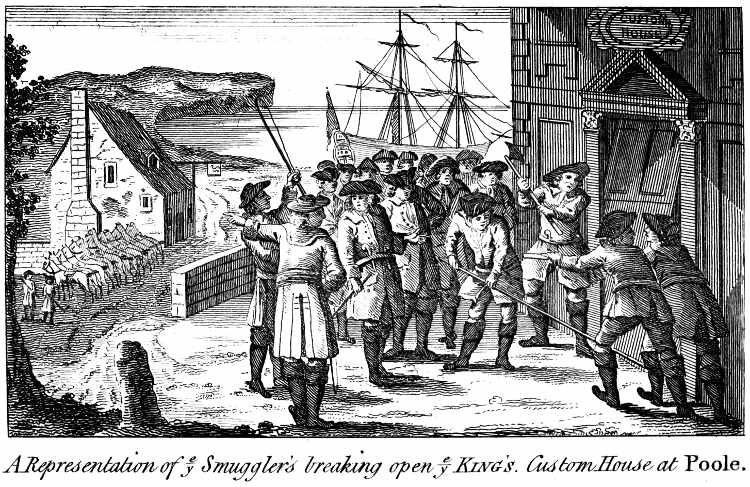
A Representation of ye Smuggler’s breaking open ye King’s Custom-house at Poole.
Q. Where did you get them?
Fogden. I cannot tell.
Q. Where did you find the tea lodged?
Fogden. It was in the top of the warehouse.
Q. Were any of the prisoners at the bar concerned in it?
Fogden. They were there, and did assist as the rest, except the two that held the horses. We brought the horses to a place near, and then carried the tea to them. It was a very narrow lane where we stopped first, and we brought the horses up to a more open place for loading.
Q. Did the prisoners at the bar help you load?
Fogden. Yes, all of them.
Q. Did you put an equal quantity on each horse?
Fogden. We distributed it as near as we could. There was our little horse that carried the arms had not so much as the other horses had on them. Every horse there was loaded with tea; from thence we went to a little town called Fordingbridge; at the next place we stopped, we weighed the tea with two pair of steelyards; for we thought it was not equal, some was scattered out of some of the bags. Then we divided it as equally as we could; they were quartern bags, each prisoner had five bags.
Q. When did you see Lilliwhite first?
Fogden. In the forest; I never saw him before.
Q. Was he there before or after you?
Fogden. I cannot tell.
Q. Did you hear any threats, if any should discover this affair what should be done to them?
Fogden. No, Sir.
Q. Had Lilliwhite arms when left with the horses?
Fogden. I believe he had not.
Q. Was Lilliwhite ever with you a-smuggling before?
Fogden. No, never as I know of.
Q. Was Glover ever with you a-smuggling before?
Fogden. No, never as I know of.
The counsel for the King resting their proof here, the prisoners were severally called upon to make their defence, when Kingsmill and Fairall said they had nothing to say, only that they knew nothing of the matter.
Perrin, having retained counsel for him, called the following persons to his character.
John Guy. I have known Perrin almost twenty years. He is a carpenter, and always bore a very good character among his neighbours. I never heard he neglected his business.
Q. Did you ever hear he was a smuggler?
Guy. I have known him these fifteen or sixteen years, and he always bore a very good character. I never heard in my life of his neglecting his business and going a-smuggling.
Q. Did you never hear he was a smuggler?
Guy. No, never, but by hearsay, as folks talk.
Richard Glover’s defence: I was forced into it by my brother-in-law, Edmund Richards, who threatened to shoot me if I would not go along with him.
William Tapling. I have known Richard Glover twenty years; I never heard before this unhappy affair that he was a smuggler; I believe he never was before. I know his brother-in-law Richards, and that Glover was about two months with him. Richards is a notorious wicked, swearing man, and reputed a great smuggler; I cannot help thinking he was the occasion of Glover’s acting in this.
Henry Hounsel. I have known Glover a child; he was a sober young lad; I never knew him otherwise, nor did I ever hear him swear an oath in my life.
Q. Did you never hear he was a smuggler?
Hounsel. Never before this. He lived with his father till the year 1744. His father dying, he followed his business till August, 1747. He went in the beginning of June to that wicked brother’s house, and was there about two months. He went after that to live servant with the Rev. Mr. Blagden. After that he got into Deptford yard, and there he continued ever since, till taken up, articled to a shipwright. This affair was at the time he was at his brother-in-law’s house.
John Grasswell. I have known Glover these twelve years and upwards; I believe he never was guilty of smuggling before this; his character is exceedingly good. I never knew him frequent bad company, or guilty of drinking or swearing an oath.
Woodruff Drinkwater. I have known Glover ever since he was born; I never heard he was reputed a smuggler either before or since, exclusive of this time; his temper is not formed for it at all, far from it; after his father died he was left joint executor with his mother (left in narrow circumstances); he often came to me on any little occasion for five or ten guineas; he always kept his word; after his mother married again, there was some difference in his family; he went into the country, and I was very sorry for him at his going to Richards’s house, and I cannot think he was voluntary in this rash action.
Mr. Edmonds. I have known Glover ever since the 9th of April last; he came to me and was entered into his Majesty’s yard at Deptford the day following; he bore a good character before, and during the time he has been with me he has behaved very well and sober; he obtained a good character of all that knew him; I have had as good an opinion of him as any man I know; he was with me till the day he was taken.
Mr. Dearing. I live in the parish where this young man was born. I go there for the summer season; I have known him about eighteen years; being informed of this bad thing, it made me come to London on purpose to say what I knew of him; we in the country had great reason to believe that bad man Richards had corrupted him; he was a well-behaved lad before this happened; his uncle came to me, and the young man came and begged of his uncle, that he would see out for some business for him, in some way or other, adding that he could not bear to live with Richards; I had just hired a servant, or I had taken him; just after this bad affair happened, and he was unfortunately drawn into it.
The Rev. Mr. Blagden. I live at Slindon, in Sussex. The prisoner Glover was my servant; I knew him and his family before; he behaved exceedingly well with me as any could, and if he were discharged from this I would readily take him again; he attended on religious service, public and private, constant; I never heard an ill word or an oath from his mouth, or anything vulgar.
Thomas Lilliwhite’s defence: I was down in the country, and a person desired me to take a ride with him; I agreed upon it, not knowing where they were going; I had no firearms, nor was any way concerned.
Fra. Wheeler. I have known Lilliwhite about six years; he always bore a very good character; was a worthy young fellow, and brought up in the farming under his father, who was a man in very good circumstances; he minded his father’s business very diligently; I have known him refuse going out upon parties of pleasure, because he has had business of his father’s to do; he married since this affair happened to a woman of fortune; I never heard him charged with any such crime as this before.
Sir Cecil Bishop. The prisoner married my housekeeper’s daughter; had not he been a man of good character, I should not have been consenting to the match, which I was; she brought him a good fortune; he is a deserving young man, and I cannot think he would be guilty of such a crime knowingly.
The evidence being all finished, Sir Thomas Abney summed up the whole in a very impartial manner; taking notice that in the case of Lilliwhite, if they thought the evidence that had been given against him was not quite full, as to his going voluntarily with them, and that he was not armed with firearms, they might acquit him.
The jury went out of court, and in about a quarter of an hour returned into court, and gave their verdict as follows, viz.:—
Thomas Kingsmill, William Fairall, and Richard Perrin, Guilty. Death.
Thomas Lilliwhite, Acquitted.
Richard Glover, Guilty, but recommended to mercy.
Thomas Lilliwhite was immediately discharged out of court as soon as he was acquitted; and the other four received sentence of death the same day, together with the other four criminals who had been tried and convicted of divers felonies and robberies.
While under sentence of death, they all four, viz., Kingsmill, Fairall, Perrin, and Glover, behaved much better than they had done before; and particularly Glover and Perrin were composed and resigned, and constantly prayed and sung psalms most of the night time; but Kingsmill and Fairall were not so penitent as Glover and Perrin.
As for Kingsmill and Fairhall, they were reckoned two of the most audacious wicked fellows amongst the smugglers; and indeed their behaviour while under condemnation, plainly shewed it.
The day they were brought to Newgate by Habeas Corpus, from the county gaol for Surrey, Fairall behaved very bold after declaring he did not value being hanged; and said, “Let’s have a pipe and some tobacco, and a bottle of wine, for as I am not to live long, I am determined to live well the short time I have to be in this world.” He also behaved very insolently at his trial; or more properly ignorantly, laughing all the time at the witnesses while they were giving their evidence; and when taken notice of by the court, and reprimanded for his bad behaviour, it had no effect on him, for he continued his idle impudent smiles, even when the jury brought him in Guilty.
At the time when he received sentence of death, when Mr. Recorder, who passed the same on him, and the rest of the criminals, said these words, “and the Lord have mercy on your souls,” he boldly replied, “If the Lord has not more mercy on our souls than the jury had on our bodies, I do not know what will become of them.”
On Thursday, the 20th of April, 1749, the report of these four criminals was made to his Majesty by Richard Adams, Esq., Recorder, when Kingsmill, Fairall, and Perrin were ordered for execution at Tyburn, on Wednesday, the 26th of the same month; and his Majesty was pleased to grant his most gracious pardon to Glover, several favourable circumstances appearing in his favour; and the court and jury having, after his trial, recommended him to his Majesty for mercy.
After the death warrant came down, Kingsmill and Fairall began to consider their unhappy circumstances more than they had done before, and always attending divine service at chapel, and prayed very devoutly, but retained their former behaviour of boldness and intrepidity, shewing no fear, and frequently saying they did not think they had been guilty of any crime in smuggling, or in breaking open Poole custom-house, as the property of the goods they went for was not Captain Johnson’s or anybody else’s, but of the persons who sent their money over to Guernsey for them.
Perrin, who was ordered only to be hanged and afterwards buried, and Kingsmill and Fairall being ordered to be hung in chains, Perrin was saying to them that he lamented their case: when Fairall replied smilingly, in the presence of many people, “We shall be hanging in the sweet air, when you are rotting in your grave.”
The evening before their execution, after they came down from chapel, their friends came to take leave of them; and Fairall smoked his pipe very heartily, and drank freely; but being ordered to go into his cell to be locked up, said, “Why in such a hurry, cannot you let me stay a little longer and drink with my friends; I shall not be able to drink with them to-morrow night.”
I shall next proceed to give the little account of these criminals as given by the ordinary of Newgate; and afterwards conclude this book with a relation of some of the most notorious actions committed by them, and which have been communicated by their confederates.
Thomas Kingsmill, alias Staymaker, aged 28, was born at Goodhurst, in Kent, a young fellow of enterprising spirit, and for some years past employed by the chiefs of the smugglers, the moneyed men or merchants, as they are usually amongst themselves called, in any dangerous exploits. As his character in general among his countrymen was that of a bold, resolute man, undaunted, and fit for the wicked purposes of smuggling, and never intimidated, in case of any suspicion of betraying their secrets, ready to oppose King’s officers in their duty, and being concerned in rescues of any sort or kind, so he wanted not business, but was made a companion for the greatest of them all, and was always at that service when wanted and called upon.
He would own nothing of himself, and was scarce to be persuaded that he had done anything amiss by following the bad practices of smuggling.
He acknowledged he was present at the breaking open of the custom-house, and that he had a share of the tea; and said what was sworn at the trial was all truth; but that they must be bad men to turn evidence to take away other people’s lives.
William Fairall, alias Shepherd, aged 25, was born at Horsendown Green, in Kent, bred to no business, but inured to smuggling from his infancy, and acquainted with most of the evil practices which have been used in those parts for some years past. In this behaviour he seemed equally as well qualified for the work as was Kingsmill, and it is generally believed that they were both concerned together in most of their undertakings. Fairall at his trial seemed to shew the utmost daringness and unconcern; even shewing tokens of threats to a witness, as he was giving his evidence to the court, and standing all the while in the bar with a smile or rather a sneer upon his countenance. He came also to the gang with Kingsmill to the Forest of Bere, and was one of the forwardest and most busy amongst the company. Yet he would not own any one thing against himself that he had done amiss, for which his life should be at stake. However, his own countrymen were glad when he was removed from among them, because he was known to be a desperate fellow, and no man could be safe who Fairall should once think had offended him.
Richard Perrin, alias Pain, alias Carpenter, aged 36, was born near Chichester, in Sussex; being bred a carpenter, was looked upon as a good workman, and had pretty business till the use of his right hand being in a great measure taken away by being subject to the rheumatism, he thought proper to leave that trade, and take to smuggling. He was esteemed a very honest man, and was therefore often entrusted by others to go over the water to buy goods, and for himself; he traded in that way for brandy and tea. And he was the man that went over for this very cargo of goods that was rescued from Poole Custom-house.
Having talked to the prisoners several times, each by himself, and also when they were altogether, neither of them all three would own anything; but said they knew best what they had done, and for what was amiss they would seek God’s forgiveness, and continued thus to declare to the last.
Having now given the ordinary of Newgate’s short account of these criminals, I shall proceed to give some account of such of their wicked actions as have come to our knowledge.
About two years since William Fairall was apprehended as a smuggler in Sussex, and being carried before James Butler, Esq., near Lewes, was ordered by that gentleman to be brought to London, in order to be tried for the same. They brought him quite safe to an inn in the Borough overnight, in order to carry him before Justice Hammond the next morning, but he found means to escape from the guards; and seeing a horse stand in Blackman Street, he got upon it and rode away, though in the presence of several people.
He made the best of his way into Sussex, to his gang, who were surprised at seeing him, knowing he was carried to London under a strong guard but three days before; but he soon informed them how he got away, and his lucky chance of stealing the horse.
They were no sooner met than he declared vengeance against Mr. Butler, and proposed many ways to be revenged. First to destroy all the deer in his park, and all his trees, which was readily agreed to; but Fairall, Kingsmill and John Mills, executed on Slindon Common, and many more of them, declared that would not satisfy them; and accordingly they proposed to set fire to his seat, one of the finest in the county of Sussex, and burn him in it; but this most wicked proposal was objected to by three of the gang, namely, Thomas Winter, alias the Coachman, one Stephens and one Slaughter, commonly called Captain Slaughter, who protested against setting the house on fire or killing the gentleman; and great disputes arose among them, and they parted at that time without putting any of their villainous proposals into execution; but Fairall, Kingsmill and some more of the gang were determined not to let their resentment drop, and accordingly they got each a brace of pistols, and determined to go and waylay him near his own park wall and shoot him. Accordingly they went into the neighbourhood, when they heard Mr. Butler was gone to Horsham, and that he was expected home that night, upon which they laid ready to execute their wicked design. But Mr. Butler, by some accident, happening not to come home that night, they were heard to say to each other, “D—n him, he will not come home to-night, let us be gone about our business”; and so they went away angry at their disappointment, swearing they would watch for a month together but they would have him.
This affair coming to Mr. Butler’s knowledge, care was taken to apprehend them if they came again, and they, being acquainted therewith, did not care to go a second time without a number; but no one would join except John Mills and Jackson, who was condemned at Chichester for the murders of Galley and Chater, as not caring to run into so much danger; and they not thinking themselves strong enough, being only four, the whole design was laid aside.
On their being disappointed in their revenge against Mr. Butler, they were all much chagrined, and Fairall said, “D—n him, an opportunity may happen some time,” that they might make an example of Mr. Butler, and all others that shall dare presume to obstruct them.
Thomas Winter, and several others of the smugglers, whose lives had been saved by turning evidence, said that Fairall and Kingsmill had been the occasion of carrying several officers of the customs and excise abroad from their families, for having been busy in detecting the smugglers, and seizing their contraband goods.
Fairall and Kingsmill were both concerned with the gang in Kent, viz., Diprose, Priggs and Bartlett, in all the robberies they committed; but as an account of those has been given before, we think it needless to make a repetition.
The morning of their execution they behaved very bold, shewing no signs of fear of death, and about nine o’clock, Fairall and Kingsmill were put into one cart, and Perrin in a mourning coach, and conveyed to Tyburn under a strong guard of soldiers, both horse and foot.
At the tree they joined in prayers very devoutly with the rest of the unhappy criminals who were executed with them, which being ended, and a psalm sung, they were turned off crying to the Lord to receive their souls.
The body of Perrin was delivered to his friends to be buried; and those of Fairall and Kingsmill were carried to a smith’s shop in Fetter-lane, near Holborn, where they were put into chains, and afterwards put into two wooden cases made on purpose, and conveyed by some of the guards and the sheriff’s officers for the county of Middlesex to Newcross turnpike in the county of Kent; where they were received by the officers to the sheriff of that county, who conveyed them to the places where they were ordered to be hung up, viz., Fairhall on Horsendown Green, and Kingsmill on Gowdhurstgore, at both which places they had lived.
Richard Glover, who had received his Majesty’s pardon, was discharged out of Newgate on Wednesday, the 3rd of May, 1749.
We can with pleasure inform our readers, that notorious wicked fellow, Edmund Richards (so often named in this work, as being concerned in the murder of Galley and Chater, and also in forcing Richard Glover to go with him and the rest of the gang to break open Poole custom-house) is taken, and in safe custody in Winchester gaol, so there is no doubt but he will meet with a just reward for all his cruel and enormous crimes, at the next assizes for the county of Sussex, to which county gaol he will be removed by Habeas Corpus.