HISTORY OF THE SMUGGLERS. (continued 3)
Reading edition
Being cross-examined at the request of Carter, whether he hindered him from going through the room,
Answered that both the prisoners did.
Joseph Southern, William Lamb, William Garrett and George Poate, proved the same as upon the former trial.
John Race, to the first part of his evidence relating to his transactions at the widow Payne’s, added, that the blood ran down from Galley’s head and face, on Jackson knocking him down; and that Jackson and Carter were not fuddled when he went away.
Being asked if he was certain the two prisoners were present at Rowland’s Castle at the consultation that was had to take the men Galley and Chater away and confine them, said, Yes, he was sure they were both present.
William Steel, to his former evidence, added, that whilst they were at the widow Payne’s, Jackson said, that if any of the gang went away from them, he would shoot them through the head, or through the body, or serve them as bad as the two men should be served. That he supposed Jackson meant by this, that he would murder any of their own company, or use any of them as ill as they did the officer and Chater, if they left them; that when the company left off whipping Galley with their thongs and lashes of their whips, as mentioned in the former trial, because the lashes of the whips reached this witness, they beat him with the butt-end of their whips, which were very heavy, and loaded with lead, till one of their whips was beat all to pieces. That the gravelly knap, where Galley was pushed off the horse, when he died, was in Conduit-lane, in Rogate parish; and Little Harry pushed him in the back, and shoved him down; and that Jackson and Carter, Little Sam, and Richards, were in company when he died; and that they laid his body upon a horse, and one man held him on one side, and another on the other side, and so they led the horse along. That Carter and Jackson went before to call Scardefield up, and when they came there, they laid Galley’s body down in the brewhouse, at Scardefield’s, and carried Chater into another room; that they drank every one a dram, and Jackson and Carter asked Scardefield if he knew any place to bury that man in, and he said “No.” But they said he must go with them; and they got a spade, and a candle and lantern, and they laid Galley on horseback again, and he (the witness), Carter, Little Sam and Scardefield, went back for about a mile, and he held the horse whilst Scardefield, Carter and Little Sam went to find the place to bury him in; and when they had found it, Carter and Sam came back to him, and left Scardefield to dig the grave. They went and buried him there, and returned back to Scardefield’s again; that Jackson told them that whilst they were burying Galley, he and Little Harry went to carry Chater to Old Mills’s; that they buried Galley two or three feet deep in the heart of a sand pit. The time at which they buried him was about three or four o’clock in the morning.
Being cross-examined, and asked by Carter, whether he (Carter) struck Galley; answered that they all struck him.
Being asked at the request of the prisoners’ Counsel, what was the consequence of that thrust which Little Harry gave Galley, when he fell the last time; answered that he thought by the fall Galley’s neck was broke, because as soon as he was down he gave himself a turn, and stretched out his hands and legs, and never stirred or spoke afterwards; that Galley was not falling till Little Harry gave him the push. Said that he did not know the parish of Rogate, or that the place where Galley died was within that parish, any otherwise than that he had been there since, and several people said it was the parish of Rogate.
Mr. Staniford, who was Counsel for the prisoners, moved, that the place where Galley died was not in the county of Sussex, and therefore the prisoners must be acquitted of this indictment; for that the present special commission, by which their lordships were trying the prisoners, was only to enquire into murders and felonies committed in the county of Sussex.
Whereupon the Counsel for the King replied that they would undertake to prove the place in the county of Sussex; and for that purpose William Steel was then asked whether the gravelly knap where Galley died was in the county of Southampton or in the county of Sussex; answered that he could not tell. That he had never heard, as he remembered, what county that place was in, but he was carried thither last Friday to see the place, and he shewed to some people then present the spot of ground where Galley fell off the horse and died, and he believed he should know one of the men that were with him.
John Aslett being called up, Steel said he was one of the men that was there.
Aslett was then sworn, and proved that he was with Steel and some dragoons on Friday last; that Steel pointed down to the ground with a stick, and said, “There the man died”; that he (the witness) took particular notice of that place, and is sure it was in the parish of Harting in Sussex; that he now lives at Harting, and was born and bred just by, and had lived there ever since he was a lad, and served the offices of surveyor and constable.
Steel, being cross-examined, was asked how he could remember the place so as to be sure of it; said he knew the place very well again by the little gravelly rising of the ground.
William Scardefield proved the same as in the former trial, with the following facts relating to the burial of Galley: that one of the gang asked him if he knew the place where they laid up some goods about a year-and-a-half ago, and he told them he did; upon which the man said, “You must go along with us,” but the witness told him his wife was ill, and he could not leave the house; and then Carter came in and asked for a lantern, and Edmund Richards told him he must go with them, to which he replied, if he must go, he must; that when he came down the hill a little way from his own house, he saw two companies, one on the right and the other on the left; that Carter, Steel, and a short man he did not know, went on to the place, and one of them came up after him, and he told him where it was; upon which they brought the horse up to a rough kind of a dell, and the short man fell a-digging, and it being a very cold night, he (the witness) took the spitter and dug to keep himself warm; there seemed to him to be a man upon the horse, and it fell into the pit like a dead man, and they covered it up; and he verily believed it to be the body of a man, but he did not help to put it in, and was about three or four yards from it; he never went nigh the ground afterwards, and did not see the body of a man upon the horse afterwards, or anywhere else; that the earth was thrown over the pit, and the short man did most of the work; and he did not enquire, or choose to ask any questions about it.
Edward Sones proved the finding the body of a dead man, in a fox earth, within three-quarters of a mile of Rake; there were boots upon the legs, and a glove upon one hand; that the body was much perished, and had a waistcoat and breeches on.
John Greentree produced a coat which he took up beyond Harting Pond in the public road, on the 15th of February last, and swore that there were some writings and a letter-case in the pocket, which he said he should know if he was to see them again.
Upon this a parchment was delivered into court by Justice Battine, and shewn to the witness, who said it was the same that he found in the coat pocket.
It was then read, and appeared to be a deputation under the commissioners of the customs, dated April, 1731, appointing Galley to be a tidesman in the port of Southampton.
William Galley, son of the deceased, looked at the coat which the witness produced, and proved it to be a coat his father had on the 14th of February, 1747–8, when he set out with Chater for Major Battine’s to carry a letter to the Major.
John Greentree was called again, and said that the coat was very bloody when he found it.
The King’s counsel submitted it here, upon which the prisoners being called upon to make their defence,
The prisoner Carter said he never intended to hurt the man, and never struck him, and only intended to carry him away to take care of him till they knew what became of Dimer; and that he had not any witnesses.
The prisoner Jackson said little or nothing, only that he did not kill the man, nor did he know who did.
The prisoners having neither of them any witnesses to produce, Mr. Justice Foster opened to the jury the substance of the indictment, as before set forth, and told them that where several people joined to do an act in itself unlawful, and death ensues from anything done in prosecution of that unlawful design, they will be all considered as principals in murder, if they were all present aiding or abetting therein; that it was not necessary that each of the prisoners at the bar should be guilty of every single abuse that was offered to the deceased in the long series of barbarities the witnesses of the crown had laid before them; if all or any of these abuses contributed to his death, and the prisoners at the bar were engaged in the several designs against him, and present aiding and abetting the others, they will be guilty within this indictment.
He summed up the evidence very largely, and applied it to the case of the prisoners; and then left it to the consideration of the gentlemen of the jury.
The jury, after some little consideration together, gave their verdict, that William Jackson and William Carter were both Guilty.
The counsel for the crown then moved for judgment; and all the seven prisoners being set to the bar, and severally asked what they had to say why judgment of death should not pass on them, Old Mills said he had nothing to say, only that he knew nothing of the murder of Chater.
Young Mills said he was not at Scardefield’s a quarter of an hour; and that it was by accident he called there, and that he knew nothing of the murder.
Hammond and Cobby said they were compelled to stay by Richards and Jackson, and that they would have made their escape, but could get no opportunity to do so.
Tapner said he did not cut Chater across the face, neither could he tell who did.
Jackson and Carter said that they had nothing more to say than what they had already said,
And none of the prisoners or their counsel having anything to offer in arrest of judgment, Mr. Justice Foster spoke to them as follows:—
“Benjamin Tapner, John Cobby, John Hammond, William Jackson, William Carter, Richard Mills the elder, and Richard Mills the younger, you have been convicted upon very full and satisfactory evidence of the murder of Daniel Chater; three of you as principals, and the rest as accessaries before the fact.
“And you, William Jackson and William Carter stand further convicted as principals in the murder of William Galley.
“Deliberate murder is most justly ranked amongst the highest crimes human nature is capable of; but those you have respectively been convicted of, have been attended with circumstances of very high and uncommon aggravation.
“The persons who have been the objects of your fury, were travelling on a very laudable design, the advancement of public justice. For this they were beset in their inn, tempted to drink to excess, and then laid asleep in an inner room, while a consultation was held in what manner to dispose of them: and in the end a resolution was taken to carry them to some distant place and to dispatch them by some means or other.
“In consequence of this resolution they were set on horseback, and exercised with various kinds of cruelty for many hours together, till one of them sunk under the hardships he suffered and died upon the road.
“The other was carried to a place of safe custody, there kept chained on a heap of turf, expecting his doom for three days. During this dreadful interval, a second consultation was held, and a resolution taken to dispatch him too; not a single man of thirteen who were present offering a word in his behalf.
“He was accordingly hurried to his death; and though he begged earnestly to live but one day longer, that small respite was denied him. I will not repeat every circumstance: but I cannot forbear putting you in mind of one. When the poor man was told he must die that very night, some of you advised him to say his prayers, and accordingly he did address himself to prayer.
“One would have hoped that this circumstance should have softened your hearts, and turned you from the evil purpose you were bent upon. Happy had it been for you, if you had then reflected, that God Almighty was witness to every thing that passed among you, and to all the intentions of your hearts!
“But while the man, under great distraction of thought, was recommending his soul to mercy, he was interrupted in his devotion by two of you in a manner I scarce know how to repeat.
“I hope your hearts have been long since softened to a proper degree of contrition for these things; and that you have already made a due preparation for the sentence I am now to pass upon you.
“If you have not, pray lose not one moment more. Let not company, or the habit of drinking, or the hopes of life divert you from it; for Christian charity obliges me to tell you that your time in this world will be very short.
“Nothing now remains but that I pass that sentence upon you which the Law of your Country, in conformity to the Law of God, and to the practice of all ages and nations, has already pronounced upon the crime you have been guilty of. This court doth therefore award that you, Benjamin Tapner, William Carter, John Hammond, John Cobby, Richard Mills the elder, Richard Mills the younger, and William Jackson, and each of you shall be conveyed from hence to the prison from whence you came, and from thence you shall be led to the place of execution, where you shall be severally hanged by the neck, until you shall be dead, and the Lord have mercy upon your souls.”
Having now completed the trials of these seven bloody criminals, I shall next give you the short Appendix which has been published by three of the clergymen who attended them after their conviction, and who have signed their names to the same, after which I shall give a much fuller account of their wicked lives and behaviour.
After sentence, the prisoners were carried back to Chichester gaol. The court were pleased to order them all for execution the very next day, and that the bodies of Jackson, Carter, Tapner, Cobby, and Hammond, the five principals, should be hung in chains. Accordingly, they were carried from the gaol, to a place called the Broyle, near Chichester; where, in the presence of a great number of spectators, on Thursday, the 19th day of January last, about two o’clock in the afternoon, all of them were executed, except Jackson, who died in jail, about four hours after sentence of death was pronounced upon him.
The heinousness of the crimes of such notorious offenders may possibly excite in the reader a desire to be informed of their respective behaviour whilst under sentence of death, and at the place of execution; to satisfy which is subjoined the following authentic account, under the hands of the several clergymen who attended them alternately in gaol, and together at the place of execution:—
“The first time I went to the malefactors under condemnation, being the evening after sentence was passed upon them, I prayed with them all; viz., Carter, Tapner, Cobby, Hammond, and the Mills’s (Jackson being dead just before I went to the gaol) but many persons being present, I had no opportunity of saying any thing material, and therefore told them I would visit them early the next morning, which I did accordingly.
“After prayers, I talked with them about their unhappy condition, and the heinous crimes that brought them into it. I asked them if they desired to receive the Sacrament; they all and each of them desired that I would administer it to them; accordingly I attended them again, about ten o’clock, for that purpose; and during the whole time of my performing that office, they all behaved with great decency and devotion, especially Carter and Tapner.
“Afterwards I put the following questions to them, and desired they would be sincere in their answers as dying men; first, whether they did not acknowledge the sentence that was passed upon them to be just, and what they highly deserved? Carter, the most sensible and penitent amongst them, first answered, Yes; as did afterwards Tapner, Cobby, and Hammond; but the two Mills’s did not.
“Secondly, I asked them whether they forgave everybody; they all and each answered they forgave all the world. Tapner then owned that Edmund Richards and another were the cause of his ruin, but yet forgave them.
“Carter laid his ruin to Jackson for drawing him from his honest employment.
“John Smyth,
“Curate of St. Pancras, in Chichester.”
“Both Carter and Tapner, a few hours before their execution, confessed to me that they with several others assembled together with a design to rescue Dimer out of Chichester gaol; that the only person amongst them who had arms was Edmund Richards; but that being disappointed by a number of persons who had promised to join them from the East, their scheme was frustrated and their purpose carried no further into execution; that one Stringer[9] was at the head of this confederacy, but not present with them at the time of their assembling together.
“Simon Hughes,
“Vicar of Donnington in Sussex.”
“Benjamin Tapner, of West Stoke, in Sussex, labourer, son of Henry Tapner, of Aldingbourne, Sussex, bricklayer, aged 27, before he was turned off, owned the justice of his sentence, and desired all young persons to take warning by his untimely end, and avoid bad company, which was his ruin. When in gaol, before he was brought out for execution, he said he did not remember he put the rope about Chater’s neck.
“William Carter, of Rowland’s Castle, thatcher, son of Wm. Carter, of East Meon in Hants, aged 39, at the place of execution and in gaol, confessed the justice of the sentence passed upon him, and acted more suitably to a person in such unhappy circumstances than any of them; he likewise at the gallows, cautioned every one against those courses that had brought him to so shameful an end.
“Tapner and Carter, when all the ropes were fixed, shook hands, but what or whether any words then passed between them, was not heard.
“Richard Mills the elder, of Trotton, in Sussex, colt-breaker, son of —— Mills of List, in Hants, labourer, aged 68, was unwilling to own himself guilty of the fact for which he died, and said he never saw Chater; but being asked whether he never heard him, as he was confined so long in the next room to that in which he generally sat, made no answer.
“Richard Mills the younger, of Stedham, colt-breaker, son of the aforesaid Richard Mills, aged 37, would willingly have been thought innocent; and it being put to him whether he made that speech about the council of war, &c., and whether he was not at the consultation, denied both; but in the latter Tapner confronted him, and said, ‘Yes, young Major, you was there;’ to which Mills replied, ‘Ay, for a quarter of an hour or so,’ or to that purpose. It so happened that his rope was first fixed to the gallows, and a considerable time was taken up in fixing the rest, which interim he might have much better employed than he did in gazing at the spectators, and then at the hangman (while tying the ropes of the other malefactors) till the cart was almost ready to drive away.
“John Cobby of Sidlesham, in Sussex, labourer, son of James Cobby of Birdham, in Sussex, carpenter, aged 30, appeared to be very dejected, and said but little in gaol, and little at the gallows.
“John Hammond of Bersted, in Sussex, labourer, son of John Hammond of the same place, labourer, aged 40, seemed likewise very much dejected, and had little to say for himself, excepting his pretending that the threats of Jackson, Carter and the rest, were the occasion of his being concerned in the murder.
“Cobby’s excuse was much the same.
“They all, except the two Mills’s, seemed sensible of the heinous nature of the crime for which they died, and behaved as became men in their unhappy condition, more particularly Carter; but the Mills’s, father and son, appeared hardened and unaffected, both in the gaol and at the gallows, especially the son, who seemed by his behaviour, even when his rope was fixed to the gallows, to be as little moved at what he was about to suffer, as the most unconcerned spectator. However, just before the cart drove away, he and his father seemed to offer up some prayers to God.
“R. Sandham,
“Vicar of Subdeanry in Chichester.
“John Smyth,
“Curate of St. Pancras.”
As Jackson died so soon after condemnation, no other account can be given of him, than he was of Aldsworth, near Rowland’s Castle, in Hampshire, labourer, aged about 50 years; and that being very ill all the time of his trial, as he had been for a considerable time before, was shocked at the sentence of death, and the apprehensions of being hung in chains, to such a degree as hastened and brought on his death before he could pay the forfeit of his life in that ignominy to which he was most deservedly doomed, and more particularly due to him as a ringleader in the most cruel and horrid barbarities and murders.
He professed the Romish religion some years before his death, and that he died a Roman Catholic may very reasonably be presumed from a printed paper that was found carefully sewed upon a linen purse in his waistcoat pocket immediately after his death, supposed to be a popish relique, and containing the following words, viz.:—
“Sancti tres Reges Gaspar, Melchior, Balthasar, Orate pro Nobis nunc et in Hora Mortis Nostræ. Ces Billets ont touche aux trois Testes de S. S. Roys a Cologne.
Ils sont pour Des Voyageurs, contre Les Malheurs de Chemins, Maux de Teste, Mal-cadaque, Fievres, Sorcellerie, toute sorte de Malefice, Morte subite.”
In English thus:
“Ye three Holy Kings, Gaspar, Melchior, Balthasar, Pray for us now, and in the hour of death. These papers have touched the three heads of the Holy Kings at Cologne.
They are to preserve travellers from accidents on the road, headaches, falling sickness, fevers, witchcraft, all kinds of mischief and sudden death.”
The body of William Carter was hung in chains in the Portsmouth road, near Rake, in Sussex; the body of Benjamin Tapner on Rook’s Hill, near Chichester; and the bodies of John Cobby and John Hammond upon the sea coast, near a place called Selsea Bill, in Sussex, where they were seen at a great distance, both east and west.
The bodies of the Mills’s, father and son, having neither friend or relation to take them away, were thrown into a hole, dug for that purpose, very near the gallows, into which was likewise thrown the body of Jackson. Just by is erected a stone having the following inscription, viz.:—
“Near this place was buried the body of William Jackson, a proscribed smuggler, who upon a special commission of Oyer and Terminer, held at Chichester, on the 16th day of January, 1748–9, was with William Carter, attainted for the murder of William Galley, a custom-house officer; and who likewise was, together with Benjamin Tapner, John Cobby, John Hammond, Richard Mills the elder, and Richard Mills, the younger, his son, attainted for the murder of Daniel Chater; but dying in a few hours after sentence of death was pronounced upon him, he thereby escaped the punishment which the heinousness of his complicated crimes deserved, and which was the next day most justly inflicted upon his accomplices.
“As a memorial to posterity, and a warning to this and succeeding generations,
“This stone is erected “A.D. 1749.”
Having now given an account of the behaviour of these seven bloody criminals, as occurred to the three clergymen who attended them after their receiving sentence of death, and who signed their names to the same; we shall now insert the account of their behaviour from the time of their being brought to Chichester gaol, to their execution, which account was taken by two persons who constantly attended on them, and is what occurred at the times the clergymen before-mentioned were not present; and are inserted to make this account complete.
The seven prisoners that were condemned, together with William Combleach the gardener, committed on suspicion of being concerned in the murder of Daniel Chater, were brought from Horsham gaol, in one waggon under a strong guard of soldiers, to Chichester, on Friday the 13th January, 1748–9.
Jackson being sick, was kept upstairs in a room by himself; and the other seven, William Combleach being with them, were put in a lower room, all ironed and stapled down, and well guarded; but behaved very bold and resolute, and not so decently as became people in their circumstances. They ate their breakfast, dinner and supper regularly, without any seeming concern, and talked and behaved freely to everybody that came to see them. Old Mills looking out of a window the day after they came there, which was market-day, young Mills said to Tapner, “D—n the old fellow, he will have a stare out.”
1. Richard Mills, sen., was formerly well respected by the gentlemen of the county; but having had for many years concerns with the smugglers, and a smuggler himself, and having prevailed on his sons to go a-smuggling likewise, he lost most of his business and character. He frequently said, that he was only sorry for his sons, for as to himself, he was under no trouble, for he was sure that he could not, according to the common course of nature, live above a year or two longer.
A few hours after sentence was passed upon him, a clergyman who lived near him, went to see him in the gaol, in order to discourse with him and bring him to a true sense of his deplorable condition; to which purpose he recommended him to make use of his few remaining moments in preparing for eternity. While the clergyman was thus seriously talking to him about the concerns of his soul, the old man interrupted him and said, “When do you think we shall be hanged?” The gentleman, after reproving him for the little concern he discovered about the more important affairs of another world, told him he believed his time was very short, and that he thought his execution would be ordered some time the next day, but could not exactly say at what hour. Mills replied, that as to the murder it gave him but little trouble, since he was not guilty of it; but as to the charge of smuggling, he owned he had been concerned in that trade for a great many years, and did not think there was any harm in it.
Being particularly asked, if he did not know that Chater was kept chained in his turf-house, he answered very indifferently, that he could not tell, he believed he did, but what was that to the murder? But being told that his maid, Ann Bridges, had declared upon oath, that he got up when Jackson and Little Harry[10] brought Chater to his house about three o’clock in the morning, and that he ordered her not to go into the turf-house, for there was a person there whom it was not proper she should see; he could not tell what to say, but stood seemingly dumbfounded; and an answer being pressed from him, he acknowledged that he did get up and let them in, and told Little Harry to carry him (Chater) into the turf-house, and chain him; and that he, as well as Little Harry, did look after him till the gang came and took him away the Wednesday night, but that he was no ways concerned in the murder; but at last he did acknowledge, that he did know they had agreed to carry Chater to the well by Lady Holt Park, and hang him, and throw him into it; and that Tapner took a cord for the purpose from his house.
Old Mills had been poor some time, and had left off smuggling, that is, going with the gangs to the seaside to fetch the goods, being sensible of the danger of going with others in a gang with firearms; but he got something by letting the smugglers bring anything to the house; and to blind the neighbours, he lived privately with his maid, Ann Bridges, and had, for upwards of a year, received alms from the parish, as he himself acknowledged.
2. Richard Mills, jun., had been concerned in smuggling for many years. He was a daring, obstinate, hardened fellow, and seemed capable of any mischief. He said to a gentleman, who went to see him, that he did not value death, but was not guilty of the murder of which he was accused, since he was not present when it was done; though if he had, he should not have thought it any crime to destroy such informing rogues. After his trial was over, two gentlemen going up to see him, they told him that his brother John,[11] who had been advertised in the Gazette as an accomplice in the murder of one Hawkins, and was likewise concerned in the murder of Mr. Chater, but not then taken, was seen following the judges over Hynd Heath, in their way to Chichester. “What,” said Mills, “there has been no robbery committed upon the highway lately, has there?” Upon which the person replied, “Not that I have heard of.” Mills made answer, “I suppose Jack must take to the highway, for he has no other way to live, till an opportunity offers of his getting to France, which I heartily wish he may do.” After their conviction on Tuesday night for the murder of Chater, he and the rest of them were remanded back to prison, and ordered to be brought down the next day, when Jackson and Carter were to be tried for the murder of Galley, and the whole to receive judgment, when Mills said, “What the d—l do they mean by that? Could not they do our whole business this night, without obliging us to come again and wear out our shoes? Well! if it must be so, the old man and I will go first, but I will give the old man the wall,” as he accordingly did.
3. John Cobby seemed a harmless, inoffensive creature, and being of an easy temper, it is supposed he was the more easily influenced to take on with the smugglers, though he declared he had not long been with them. He acknowledged that he was at the well when Chater was hung, and flung into it, and that he, as well as the rest, were all guilty of the crime for which they were condemned. He was very serious, and seemed very penitent; owned he was a great sinner; begged pardon of God for his offences, and hoped the world would forgive him the injuries he had done to anybody.
4. Benjamin Tapner was born of very honest parents, who gave him good schooling; and he always lived in good repute, till being persuaded by Jackson and some others to follow their wicked courses: which he had done for something more than two years. He behaved all the time under his confinement more decently than some of the others, and frequently prayed very devoutly. He was always very reserved if mention was made of the cruelties he exercised on Chater. A gentleman, who desires his name may not be mentioned, went to see him on Tuesday evening, just after his conviction, who, taking him to one corner of the room, asked him if there was anything in the report of his picking Chater’s eyes out, when he declared, as a dying man, he never made use of any weapon but his knife and whip; and that he might in the hurry pick one of his eyes out with the point of his knife, for he did not know what he did, the devil had got so strong hold of him. He said he had been in many engagements with the King’s officers, and been wounded three times; and hoped all young people would take warning by his untimely fate, and keep good company, for it was bad company had been his ruin.
5. William Carter behaved himself very serious, and said that Jackson had drawn him away from his honest employment to go a-smuggling, which was the cause of his ruin; and indeed his general character was very good except in that particular. He declared that these murders would never have happened, had not Mrs. Payne, at Rowland’s Castle, sent for him and Jackson, and in some measure exasperated them against Galley and Chater, as being informers. This Mrs. Payne and her two sons are in custody in Winchester Gaol, in order to take their trials at the ensuing assizes, when it is hoped they will meet their just reward.
6. John Hammond was a hardened, obdurate fellow, and very resolute, and always had great antipathy against the King’s officers and others concerned in suppressing smuggling; and often would let drop words out of his mouth, and that he did not think it any crime in killing an informer; but when he came to receive sentence he began to cry very much. He frequently lamented the case of his wife and four children, and said that was all that touched him; as for dying he did not mind it.
7. William Jackson died in his room about 7 o’clock the same night he received sentence of death. He had been one of the most notorious smugglers living in his time; and most of them, as well as Carter, gave him the worst of characters, and that he was even a thief among themselves; for when he knew that any of them had got any run goods, he would contrive to steal them away from them. He reflected on himself, after receiving sentence, for what he had said on his defence, that Tapner only was guilty; for he declared they were all concerned; and that when he had been concerned in the murder of Galley, he contrived to bring Cobby, Hammond, the three Mills’s, Stringer, Tapner, and the rest, to be concerned in the murder of Chater, lest they might, one day or other, run to the government, and make themselves an evidence, but by being guilty of murder, it would be an entire bar to them.
The afternoon preceding their execution, a person came to take measure of Jackson, Cobby, Hammond, Carter and Tapner, in order to make their irons in which they were to be hung in chains! which threw the prisoners into very great confusion, and they seemed under a greater concern than ever they had shewed before. But when old Mills and his son were told that they were exempted from that part of the punishment, they seemed to be mightily pleased at it, and contented to be hung only as common malefactors.
But it deserves particular notice, with respect to Jackson, that he was no sooner told that he was to be hung in chains, but he was seized with such horror and confusion, that he died in two hours afterwards; and though he was very ill before, yet it is believed that this hastened his end, and was the immediate cause of his death.
The foregoing accounts are a melancholy proof of the dreadful effects which are the fatal but too frequent consequences of the offence of smuggling—a crime which, however prejudicial to the kingdom in general, and to every fair trader in particular, perhaps may not, from an inattention to the many and monstrous mischiefs derived from it, have met with that general detestation and abhorrence it so highly deserves.
But a perusal of these sheets, shocking to every reader, cannot fail to alarm the nation, and open the eyes of all people, who must reflect with horror upon a set of dissolute and desperate wretches, united by a parity of inclinations and iniquities, formed into dangerous gangs and confederacies, that encouraged by numbers they might exercise cruelties and commit barbarities, which, abandoned as they were, they singly durst not attempt. Villains! not to be won by lenity, despising and rejecting proffered pardons, proceeding from crime to crime, till they arrived at the highest and, until now, unheard-of pitch of wickedness: who, not content with defrauding the King in his customs and revenues; not satisfied with violating the properties and possessions, pursued the lives of his subjects and servants, whose very blood could not satiate their malice—tortures were added to aggravate the pangs of death.
Before we take leave of these wretches, and begin upon the account of that most notorious villain and murderer, John Mills, and the rest, as promised, we think it will be very necessary to inform our readers of their several behaviours at the place of execution, not mentioned before in the account given by the three clergymen.
AT THE PLACE OF EXECUTION.
The prisoners were brought out of the gaol about two in the afternoon of Thursday, the 19th of January, 1748–9, being the day after receiving sentence, when a company of Foot Guards and a party of Dragoons were drawn out ready to receive them, and to conduct them to the place of execution, which was about a mile out of the town. The procession was solemn and slow; and when they came to the tree, they all, except the two Mills’s, behaved a little more serious than they had done before.
Carter said the sentence was just on them all, for they were all guilty, as charged in the indictments; and lamented the case of his wife and children, and said he hoped others would take warning by his untimely end.
The Mills’s, as I observed before, seemed no ways concerned; and the young one said he did not value to die, for he was prepared, though at the same time he appeared so very hardened and abandoned.
The halter that was used for the old man was very short, the gallows being high; so that he was obliged to stand a-tiptoe to give room for it to be tied up to the tree: the old fellow saying several times while this was doing, “Don’t hang me by inches.”
Tapner appeared very sensible of his crime, and prayed aloud, and seemed, as I hope he was, very sincere and devout. He declared that Jackson, Cobby and Stringer held three pistols to his head, and swore they would shoot him if he did not go and assist in the murder of Chater, the old shoemaker, who was going to make an information against their shepherd, Dimer, otherwise Diamond; that they also extorted three guineas from him by the same way of threats, to repay Jackson and Carter what they had been out of pocket on that account. He said they were all guilty of the crimes laid to their charge; and that one T—ff, well known in Chichester, and Stringer, John Mills[12] and Richards (all not taken) were as guilty as himself; and as they deserved the same punishment, he hoped they would all be taken, and served the same as he was just going to be. He acknowledged cutting Chater across the face, but did not care to repeat any of the cruelties he had exercised.
We are now come to the conclusion of the trials, and the behaviour of those who were executed at Chichester, and shall next proceed to those that were brought on at the assizes at East Grinstead, where two of the same gang were tried for murder, namely, Sheerman for that of Galley, and John Mills, called Smoker, for that of Hawkins, who was destroyed in as cruel and barbarous a manner as either Galley or Chater.
After which we shall give an account of the trials of the other smugglers, which were very remarkable for the most notorious crimes with which they are charged, such as murder, housebreaking, robberies on the highway, &c. But as Sheerman was tried for the crime for which several others had been already convicted, as has before been related, we think this trial will most properly follow those of his confederates, and with whom he had been concerned throughout the whole course of their villainies.
After which will follow the trial of John Mills, who not only had a hand in the murder of Chater, but likewise was a principal in that of poor Hawkins.
Henry Sheerman, otherwise Little Harry, was indicted for the inhuman murder of William Galley, which the said Sheerman, in company with several others, did perpetrate and accomplish on the said William Galley, by tying and fastening him on a horse, and then lashing, whipping and beating him with their whips, till the said Galley, no longer able to bear the cruel scourges, fell with his head under the horse’s belly, and his feet across the saddle; that being again set upright on the horse, the said prisoner, with the rest, again whipped, beat and bruised him, by the means of which he fell off the second time; and being set on another horse, the said prisoner, with the others, again beat and whipped him, till the said Galley was so terribly bruised and wounded that, being ready to fall off the horse, the prisoner gave him a push, and threw him to the ground, of which blows, wounds and bruises, and fall from the said horse, he died.
The counsel for the King upon this indictment were the same as were upon that against John Mills and John Reynolds, who after laying open and explaining to the court and jury the heinous nature of the offence and the pernicious consequences of smuggling, which generally brought on murder, robbery and other enormous crimes, they produced the following witnesses in support of the charge against the prisoner.
Mr. Shearer, collector of the customs at Southampton, deposed that he received a letter from the commissioners of the customs, informing him that one John Dimer was taken up on suspicion of being concerned with others in breaking open the custom-house at Poole and committed to Chichester gaol; that thereupon he sent one Chater with a letter to Justice Battine under the care of the deceased William Galley, the 14th day of February was twelvemonth, and hired a grey horse for him to ride on.
William Galley, son of the deceased William Galley, deposed that he very well remembered that some time in February was twelvemonth, his father set out on a journey to Justice Battine; that the night before he went he saw the letter and saw the direction upon it, which his father was carrying to the justice; that his father was dressed in a blue great coat, lined with blue, with brass buttons, a light brown close-bodied coat trimmed with blue, his waistcoat and breeches the same, and rode upon a grey horse, and that he never saw his father afterwards.
George Austen deposed that on the 14th of February was twelvemonth, being at the New Inn at Leigh, he saw the deceased William Galley and another person on horseback, and hearing them enquire the way to East Marden, and shewing a letter they had for Justice Battine, he said that he and his brother, Thomas Austin, and his brother-in-law, Robert Jenkes, were going part of that road and would shew them the way; that he went with them to a place called Rowland’s Castle, to a public-house kept by one widow Payne; that being there Galley and his companion called for rum. That the widow Payne enquired of him if he was acquainted with these men, or whether they belonged to his company. He told her they were going to Justice Battine’s; upon which she apprehended there was something in hand against the smugglers, several of whom came in soon afterwards.
John Race, otherwise Raise, an accomplice in the fact, deposed that on the 14th of February was twelvemonth, he was at Rowland’s Castle; that when he came in, he saw there Edmund Richards, William Steel, Carter, Jackson, Little Sam, Richard Kelly, Jackson’s wife, and the prisoner Henry Sheerman, together with Galley and Chater: that he saw Jackson take Chater to the door, and heard him ask him whether he knew anything of Dimer the shepherd, and Chater answering that he was obliged to appear against him, Galley came to them, to interrupt their talking, which Jackson resenting, struck him on the face with his fist. Being all come into the house again, Jackson related to the rest of them what Chater had said in relation to Dimer; upon which they consulted together what to do with Galley and Chater, and it was agreed by them all to carry them to a place of security, till they should have an opportunity of sending them to France; and that the prisoner was present at this consultation.
William Steel, another of the accomplices in the fact, deposed that on the 14th of February was twelvemonth he was sent for to the widow Payne’s; that when he came there he found Jackson, Little Sam, Kelly, Carter, Richards, Race and Little Harry; that he saw the two strangers there, Galley and Chater, who were drinking with the prisoner, and the rest of the smugglers; that Jackson took Chater out of the house, and was followed by Galley, who soon after returned with his face bloody, having, he said, been knocked down by Jackson. That Galley and Chater wanting to be gone, the prisoner, with the rest of the smugglers persuaded them to stay, and the company continued drinking till Galley and Chater were quite drunk, and were led into a little inner room to sleep; this was about four or five o’clock. That in the meanwhile this witness, with the rest of the smugglers, the prisoner being present, consulted what to do with Galley and Chater; and it was proposed to make away with them, and to that end, to throw them into the well in the horse pasture, about a quarter of a mile from Rowland’s Castle; but upon second thoughts that well was judged too near, and might occasion a discovery. That then it was agreed to allow threepence a week each, and to keep them in some private place till they saw what was the fate of Dimer; and as Dimer was used, in the same manner they agreed to use Galley and Chater. That about seven o’clock Carter and Jackson went into the little room, and having waked Galley and Chater, brought them out all bloody; and he believed that Jackson and Carter had kicked them with their spurs, which they had just before put on; that they then brought Galley and Chater out to the street door, and set them both upon the same horse, and tied their legs together under the horse’s belly. That then he (the witness) got upon a grey horse, and led that the deceased and Chater were upon; that they had not gone above 80 yards, before Jackson called out “Whip the dogs, cut them, slash them, d—n them”; and then the company fell to lashing and whipping them; while they rode about a mile to a place called Wood’s Ashes; that there they all alighted, and the prisoner, Little Harry, gave each of them a dram, but none to Galley and Chater; that mounting their horses again, they fell to beating and lashing the two men as violently as they had done before, till they came to Dean, which was about half a mile further; that then one of the company pulled out a pistol, and swore he would shoot them (Galley and Chater) through the head, if they made any noise while they were passing through the village; when they were got through Dean, they fell to whipping them again, till they came almost to Idsworth, when Galley and Chater fell again with their heads under the horse’s belly; upon which they parted them, and set up Galley behind him (this witness), and Chater behind Little Sam, and thus proceeded towards Lady Holt Park, about three miles further, whipping them all the way; but the lashes of their whips falling on this witness, he cried out and they left off whipping Galley; that being come to Lady Holt Park, Galley being faint and tired, got off, and Jackson and Carter took him by the arms and legs, and carried him to a well there, into which they said they would throw him; but some of the company interposing, they set him up behind this witness, but went on till they came down a hill, and Galley, not being able to ride any further, got down again; upon which they laid him upon the pommel of the saddle, across a horse before Richards, with his belly downwards, and in this manner carried him about a mile and a half; that then Richards, being tired of holding him, let him down by the side of the horse; that then they put him upon the grey horse which this witness rode upon, and this witness got off; they sat him up, his legs across the saddle, and his body lay over the mane, and Jackson held him on, and went on in this manner for about half a mile, Galley crying out grievously all the time, “Barbarous usage! barbarous usage! For God’s sake shoot me through the head or through the body;” he (the witness) imagined that Jackson was squeezing his privy parts. That they went on for two miles further, and coming to a dirty lane, Carter and Jackson rode forwards, and bade them stop at the swing gate till they returned. Being gone a little while, they came back again and said that the man of the house was ill and could not entertain them. It was then proposed to go to the house of one Scardefield at Rake, upon which the prisoner tied Galley with a cord, and got up on horseback behind him in order to hold him on; and coming to a gravelly knap in the road, Galley cried out, “I shall fall, I shall fall;” whereupon the prisoner then said, “D—n you, then fall,” and gave him a push, and Galley fell down, gave a spirt and never spoke afterwards; he (the witness) believed his neck was broken by the fall; that then they laid him across the horse again, and went to the Red Lion at Rake, kept by William Scardefield, whither they carried Chater all over blood. That Jackson and the prisoner went from Scardefield’s with Chater, to Old Mills’s, where he was left to the care of the prisoner, and in the meantime they buried Galley.
This witness was asked by the court whether the prisoner was present at the first consultation at the widow Payne’s, and continued in the same company to the death of Galley, and he answered: “Yes, he was with them all the time.”
Then William Scardefield was sworn, who deposed that the prisoner at the bar was with the rest of the smugglers at his house at Rake, when Galley was brought dead there, but went away with Chater, the other man who was all bloody.
The counsel for the King said they had a great many more witnesses, but they would rest the matter as it now was, and not give the court any further trouble.
The prisoner, being called upon to make his defence, said he had nobody to disprove the facts or speak to his character; and said he was sent for to Rowland’s Castle, though he did not know for what; that when he came there he was threatened by Jackson, Richards and others that were there, that they would shoot him through the head if he would not go with and assist them in what they were going about, and that it was not in his power to make his escape from them.
The jury brought him in guilty. Death.
Having now given the trial of Henry Sheerman, alias Little Harry, at East Grinstead, it will be necessary next to give an account of his life and behaviour under sentence of death, and at the place of execution, before we proceed to the trial of that notorious villain John Mills, alias Smoker, for the cruel murder of Richard Hawkins.
Henry Sheerman, alias Little Harry, about 32 years of age, was born and bred up at West Strutton, in the county of Sussex, to husbandry, whose parents were people of good character, though of but middling circumstances; and gave him as good an education at school as they could afford; but he said he never minded his learning—his mind run more upon other things, so that he made but very little progress, though he could read very well and write a little.
He said that Jackson was the cause of his ruin, and the considerable gains that were allowed to those who were as servants to the master smugglers, seduced him to leave his honest employment and take on with them.
He often declared that he never was concerned in any other murder than that of Galley, for which he suffered; but being asked if he was not guilty of the other indictment that was against him, as being an accessary to the murder of Chater before the fact was committed, he evaded answering the question in full, and said he left the company and Chater, and did not go to the well where he was hanged and flung down; but on being interrogated, and informed it was the same thing, his knowing their intention of murdering Chater, though he did not go quite to the place, he said he did not know that the company, when he parted from them, were going to hang him in the well at Lady Holt Park, and then fling his body down it to prevent a discovery. He was asked if old Major Mills knew that Chater was confined in his turf-house, and that they were going to murder him, because Old Mills partly denied it when he was executed on the Broyle near Chichester; he said that Old Mills was guilty of the whole affair laid to his charge, as being concerned in the murder of Chater; that Old Mills gave him the chain and horse-lock, to chain Chater to the beam, and went frequently to see he was safe during his confinement there, and often told Chater that he was a villain to turn informer, and he would see he should be hanged to prevent his informing any more; and he declared, that when they took Chater from Old Mills’s house, that Old Mills knew that they were going to hang him at the well by Lady Holt Park, and that the resolution and agreement of him, Old Mills, as well as the rest, was to fling his body down there, it being a dry well, to prevent a discovery, and that Old Mills himself said it was a very proper place, for as it was a dry well, it might lie there an age before anything could be discovered, and before that time it would be rotted quite away to nothing.
Before we proceed any further, we shall inform the reader what encouragement is given to seduce the young people from their honest employments to turn smugglers, which Little Harry declared.
The master smugglers contract for the goods either abroad, or with the master of a cutter that fetches them, for a quantity of teas (which they call dry goods) and brandies, and the master of the cutter fixes a time and place where he designs to land, and seldom or ever fails being pretty punctual as to the time, if the weather permits; as the master smugglers cannot fetch all the goods themselves, so they hire men whom they call their riders; and they allow each man half-a-guinea a journey, and bear all expenses of eating and drinking and horse, and allowance of a dollop of tea, which is forty pound weight, being the half of a bag, the profit of which dollop, even of the most ordinary sort, is worth more than a guinea, and some sorts 25s. and some more; and they always make one journey, sometimes two, and sometimes three in a week, which is indeed such a temptation that very few people in the country can withstand; and which has been the cause of so many turning smugglers.
He said it was very hard work in going down to the seaside to fetch the goods, and considering the hazard they run if taken, and of their own persons, as they are obliged to ride in the night only, and through the byeways, avoiding all the public roads as much as possible, people would not take on with them if it were not for the great profits that arise.
He said that all the smugglers, both masters and riders, drink drams to great excess, and generally keep themselves half drunk, which was the only thing that occasioned them to commit such outrages as they did sometimes; and he gave the following account of the murders of Galley and Chater:—
That on Sunday the 14th of last February was twelvemonth, he was sent for to the widow Payne’s, and informed that there were two men there who were going to make an information against John Dimer, that was in custody at Chichester, on suspicion of being concerned in breaking open the King’s warehouse at Poole, that, as he was one concerned in the said fact, he readily went to hear what he could, and when he came there, he found Jackson, Richards, Steel (the evidence), and some more of the gang concerned in breaking open the said warehouse; when Jackson said to him, “Harry, I have sent for you: here are two men have got a letter to Justice Battine, for him to take an information against Dimer;” and that they (the smugglers) resolved to have the letter from them; which he agreed to; and after they had made the men drunk, Carter and Jackson went into the room where the men were put to sleep, and took the letter, which they read, and found the contents amounted to all they suspected; that it was never proposed by any of them to hurt either Galley or Chater, but to keep them privately to prevent their giving the designed information, till the women, Carter’s and Jackson’s wives, proposed hanging them; and then it was talked of carrying them to the well just by, and to hang them and fling them down it, but it was not agreed to; neither did any of the men in his presence or hearing shew or intimate any inclination towards their so doing.
He said further, that they all drank pretty freely to make Galley and Chater drunk, and when they came to the resolution of carrying them both away, and concealing them till they knew what would be the fate of the shepherd Dimer, they were all more than half drunk; that he verily believed none of them had any design of murdering them while they were at Rowland’s Castle; but Jackson, who was the drunkest of the company, called out to whip them, which was soon after they set out from Mrs. Payne’s house, when Edmund Richards, who is not yet taken, began to lash them with his long whip; and then they all did the same except Steel, who was leading the horse the two men rode on.
He said that the design of tying their legs under the horse’s belly was for no other reason than to prevent their jumping off and running away, and making their escape, as it was night time; which, if either of them should do, they would be all inevitably ruined.
The liquor they had drank, and giving way to their passion, urged them on to the cruelties they exercised on Chater; but when they found Galley was dead, it sobered them all very much, and they were all in a great consternation and surprise, and could not tell what to do, when they concluded to bury the body of Galley, and to take care of Chater.
He lamented the unhappy case of Chater during the time of his being chained in Old Mills’s turf-house, but said, self-preservation obliged him to take care he did not get away, though he was all the time very uneasy, and said he declared his abhorrence to Tapner’s cutting Chater across the face and eyes, and of Cobby’s kicking him while he was saying the Lord’s Prayer, and that he came out of the turf-house into the dwelling-house upon that account, not being able to bear hearing the poor man’s expressions in begging for a few hours or minutes to make his peace with his Creator, at the same time the blood running all down his face. He said it was not Cobby alone that kicked Chater while he was at prayers, but also Richards and Stringer, who are both not yet taken.
Being asked why he did not give poor Galley and Chater a dram, as well as the smugglers, when they all got off their horses; he said he was going to do it, but Richards, Carter and Jackson, all swore they would blow his brains out if he did. He acknowledged going away with them from Old Mills’s in order to hang Chater according to agreement; but seeing Tapner whip the poor man so cruelly, Chater at the same time being all over blood and wounds, his heart relented, and that was the only reason why he did not go with them, and be present at his murder.
At his trial he behaved with reservedness, but no way audacious, as some of the others were; and after he had received his sentence, he began to bemoan his unhappy circumstances, and prayed very devoutly; and confessed that he had been a very wicked liver ever since he turned smuggler.
He said he never was concerned in many robberies, as numbers of the smugglers had been; and what gave him the most uneasiness was, the great scandal and vexation he had brought on his wife and family.
He was conveyed under a strong guard of soldiers from Horsham to Rake, near the place where Galley was buried, on the 20th day of March, 1749, and there executed, and afterwards hung in chains, as an example.
At the place of execution he behaved very penitent, and as became one in his unhappy circumstances, frequently saying that Jackson was the original person who was the cause of his ruin, and that he should not have gone to the widow Payne’s that unfortunate day that Mr. Galley and Mr. Chater were there, had he not been sent for. He declared that at the time he gave Galley the push off the horse, when Galley fell down and died, he had no thought that that fall would kill him just then; that he begged pardon of God and man, not only for that wicked action of his life, but for all others; and then was turned off, crying to the Lord Jesus Christ to receive his soul.
We shall now proceed to the trials of John Mills, alias Smoker, John Reynolds, the master of the Dog and Partridge on Slindon Common, where Richard Hawkins was inhumanly murdered; and then give an account of John Mills’s wicked life, and behaviour at his trial, and under sentence of death; and also of his confession, and last dying words at the place of execution.
John Mills, alias Smoker, together with Jeremiah Curtis, alias Butler, alias Pollard, and Richard Rowland, alias Robb (both not yet taken), was indicted for the murder of Richard Hawkins, in the parish of Slindon, in the county of Sussex, on the 28th day of January, 1748–9, in the 21st year of his Majesty’s reign, by violently assaulting, sticking, beating, whipping and kicking, him, the said Richard Hawkins, over the face, head, arms, belly, and private parts: of which wounds, bruises, kicks and stripes he instantly died. And John Reynolds was indicted for aiding, assisting, comforting and abetting the said John Mills, alias Smoker, and Jeremiah Curtis, alias Butler, alias Pollard, and Richard Rowland, alias Robb (both not yet taken), in the murder of the said Richard Hawkins.
The counsel for the King were Mr. Staples, Mr. Steele, recorder of Chichester, Mr. Burrel, Mr. Smythe (one of the king’s counsel, learned in the law, and member of Parliament for East Grinstead, in the county of Sussex), and Mr. Serjeant Wynn.
One of the counsel for the King having opened the indictment, Mr. Smythe observed to the court and jury that the practice of smuggling having prevailed all over the kingdom, particularly in that and the neighbouring counties, to so great a degree, and the persons concerned therein became so very audacious, that a great many murders were committed, and very barbarous ones too, upon such persons who should show the least inclination to prevent their pernicious practices. That the murder for which the present prisoners were indicted, was one of the most bloody and most cruel that ever was perpetrated in this, or any other civilized nation, except in two others that had happened in this county; that the prisoner Mills seemed to have the honour of committing the first, and setting the example of this species of most terrible murders, though some persons who committed the other murder had been first brought to justice. That many people were induced to think smuggling was no crime at all, or if it was one, but a very small one, it was but cheating the King, and that was no harm; not at all considering that it is a crime not only against the laws of the land, but against the law of God also, which commands all men to render to Cæsar the things that are Cæsar’s. That smuggling was robbing the nation of that revenue which is appointed for payment of the national debt; and that every act of smuggling was defrauding every one of his Majesty’s subjects that pay taxes, as they are obliged to make good all deficiencies. That when they shall hear the witnesses they will find that this evil practice was the original cause of this murder, and then he did not doubt but they would find the prisoners guilty.
Mr. Sergeant Wynn, after speaking of the nature of the crime, and that it was one of the consequential evils that attended smuggling, observed that most of the daring robberies that had been lately committed, were by these sort of men, who thought, or at least acted, as if they thought themselves above all law. That when they had called their witnesses, he did not doubt but they would give the jury such evidence as would induce them to believe the prisoners guilty, and consequently find them so.
Henry Murril deposed that some time in January last was twelvemonth, he was informed that some persons were at his house, enquiring after some tea they had lost, but could not tell who they were; that he went to young Cockrel’s, who keeps a public-house at Yapton; where he saw Jerry Curtis and two others, drinking. Curtis was very angry; said some rogues had stolen two bags of tea from him, and d—n him, he would find it out, and severely punish those concerned therein; for d—n him, he had whipt many a rogue, and washed his hands in their blood; that Curtis had offered this deponent five guineas to get the tea again, or find out who had got it; and then said that if money could not get it, he would come sword in hand, and find it out and take it away.
Being asked by the court if the prisoner Mills was one of them that were with Curtis, said he could not tell.
Henry Titcomb deposed that one day in January last was twelvemonth, Curtis and Mills came to Mr. Boniface’s barn, where he, the prisoner, and Richard Hawkins (the deceased) were at work; that Curtis called Hawkins out to speak with him; that he did not hear what passed between them, but that Hawkins went away with them; that a little while after, the same afternoon, he saw Hawkins riding behind Mills from Walberton towards Slindon, and never saw Hawkins the deceased afterwards.
John Saxby deposed that he was a servant to Cockrel the elder, of Walberton; that the day Hawkins (the deceased) was missing, Curtis, Mills, and Hawkins came to his master’s house and drank together; that at going away, Mills bid Hawkins get up behind him, which he at first refused, saying he would not, without making a sure bargain; that they bid him get up for they would satisfy him, which Hawkins did; and this deponent never saw the deceased afterwards.
Thomas Winter, alias the Coachman, an accomplice, deposed that one day the latter end of January was twelvemonth, he, with Jerry Curtis, alias Pollard, were at the prisoner Reynolds’s house, who kept the Dog and Partridge on Slindon Common; that Curtis presently went away from him, and promised to come to him again very soon, for he was to pay this witness some money he owed him; that this deponent stayed at the Dog and Partridge the rest of the day; that towards evening Richard Rowland, alias Robb, came to the house, asked for his master Curtis, and stayed with this deponent till night, when the prisoners Mills and Curtis came; that Curtis called for Robb, and said, “Robb, we have got a prisoner here”; then Hawkins got down from behind Mills, and all went in together, to a parlour in the prisoner Reynolds’s house; that they all, viz., Hawkins (the deceased), Curtis, Mills, Rowland, otherwise Robb, and this deponent, sat down together; that then they began to examine Hawkins about the two bags of tea, which he denied, saying he knew nothing of the matter; that Curtis said, “D—n you, you do know, and if you do not confess I shall whip you till you do, for, d—n you, I have whipped many a rogue, and washed my hands in his blood;” that the prisoner Reynolds came in when they were urging the deceased to confess, and said to the deceased, “Dick, you had better confess, it will be better for you”; his answer was, “I know nothing of it.” After Reynolds was gone, Mills and Robb were angry with the deceased; that Robb struck him in the face and made his nose bleed, and threatened to whip him to death; that Mills showed he was pleased with what Robb had done, and again threatened the deceased, who said, “If you whip me to death, I know nothing of it”; that then Mills and Robb made the deceased strip to his shirt, then they began to whip him over the face, arms and body, till they were out of breath, he all the while crying out that he was innocent, and begged them, for God’s sake, and Christ’s sake, to spare his life for the sake of his wife and child; that when they were out of breath, they pulled off their clothes to their shirts, and whipped him again till he fell down; when he was down they whipped him over the legs and belly, and upon the deceased kicking up his legs to save his belly, they saw his private parts; then they took aim thereat, and whipped him so that he roared out most grievously; that then they kicked him over the private parts and belly; they in the intervals asking after the tea; the deceased mentioned his father and brother, meaning the two Cockrels; that upon this Curtis and Mills took their horses, and said they would go and fetch them, and rode away, leaving the deceased with Robb and this deponent. That after they were gone, he and Robb placed the deceased in a chair by the fire, where he died.
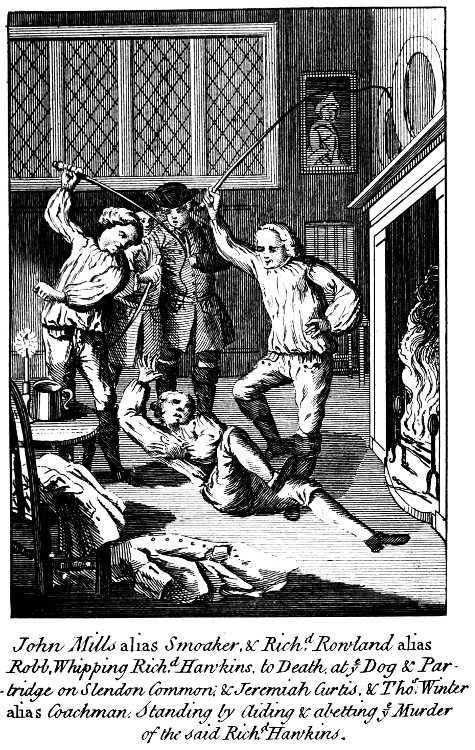
John Mills alias Smoker, & Richd. Rowland alias Robb, Whipping Richd. Hawkins, to Death, at ye Dog & Partridge on Slindon Common, & Jeremiah Curtis, & Thos. Winter alias Coachman, Standing by Aiding & abetting ye Murder of the said Richd. Hawkins.
Being asked by the court if the deceased was in good health when he came to the prisoner Reynolds’s house, and if he believed he died of the ill-usage he there met with, his answer was, “He was in good health when he came there, and was a stout man, and I am sure he died of the kicks and bruises he received from Mills and Robb.”
He further deposed that when they found he was dead Robb locked the door, put the key in his pocket, then they took their horses and rode towards Walberton to meet Curtis and Mills; that in the lane leading to Walberton he met them, with each a man behind him; that he desiring to speak with them, the men behind them got off and stood at a distance. That this deponent asked Curtis what they were going to do with these two men, who answered, “To confront them with Hawkins.” Then the deponent told him he was dead, and desired that no more mischief might be done, when Curtis replied, “By God, we will go through with it now.” That this deponent begged that the two men might be sent home, for there had been mischief enough done already; that then Curtis bid the two men go home, and said when they wanted them they would fetch them. That they rode all together to the prisoner Reynolds’s house, when Reynolds said to Curtis, “You have ruined me,” and Curtis replied he would make him amends. That then they consulted what to do with the body, when it was proposed to throw him into the well in Mr. Kemp’s park, and give out that they had carried him to France; that the prisoner Reynolds objected to it, as that was too near, and would soon be found. That they laid him on a horse and carried him to Parham Park, about twelve miles from Slindon Common, where they tied large stones to him in order to sink the body, and threw him into a pond belonging to Sir Cecil Bishop.
John Cockrel the younger deposed that the 28th day of January last was twelvemonth, about ten o’clock at night the prisoner Mills came to his house, called for some ale, ordered his horse into the stable; that while he was in the stable Curtis came in, and demanded two bags of tea, which he said his brother-in-law had confessed he had got; that this deponent denied his having them, upon which Curtis beat him with an oak stick till he was tired; that after this they took him with them to his father’s at Walberton, where they took his father and him with them, to carry them to Slindon, on Mills’s and Curtis’s horses, one behind each, and about a mile before they came to Slindon, they met two men on horseback, who called to them, and said they wanted to talk with them; that then they were ordered to get off from behind Curtis and Mills; that after the two men had talked with Curtis and Mills some time, Curtis bid them go home, and when they wanted them they would fetch them.
John Cockrel the elder, being sworn, confirmed the evidence as to being carried away, and afterwards let go.
Being asked by the court how long after his son-in-law (the deceased) was missing it was before he heard his body was found, said that in the April following he was sent for to Sir Cecil Bishop’s; that there he saw the deceased Richard Hawkins mangled in a most terrible manner, having a hole in his skull; that he knew him by the finger next the little finger of his right hand being bent down to his hand.
Matthew Smith deposed that one night in January last was twelvemonth, he was at the prisoner Reynolds’s house, the Dog and Partridge, on Slindon Common, and saw Curtis and Mills ride up to the door (Mills with a man behind him), and Curtis called out to Robb, and said, “We have got a prisoner”; and that then they all went in together into the back parlour.
Richard Seagrave, another witness, deposed that he lived at Sir Cecil Bishop’s in Parham Park, and saw the body of a man taken out of a pond there, very much mangled and bruised; and was likewise present when John Cockrel the elder came there and said he knew the body to be that of his son-in-law, Richard Hawkins.
Jacob Pring, another witness, deposed that being at Bristol, he there fell in company with the prisoner Mills; that they came together from thence to his house at Beckenham in Kent; that on the road he asked him whether he knew of the murder of Richard Hawkins of Yapton; that he told him “Yes,” and related to him the particular manner in which it was done, as follows: that in the beginning of January was twelvemonth, they had two bags of tea stolen from the place where they had concealed some stuff, and suspecting Hawkins and the Cockrels to have it, he and Jerry Curtis went and fetched Hawkins from a barn where he was at work, and carried him to Reynolds’s, on Slindon Common, where Robb and Winter, commonly called the Coachman, were before them; that he and Robb whipped Hawkins with their horse-whips till he owned that the Cockrels had their tea; that then he and Curtis went and fetched the Cockrels, and as they were bringing them behind them on the road, Robb and Winter met them and told them that the man was dead whom they had whipped; that they then sent the Cockrels home and went and took Hawkins’ dead body and carried it to Parham Park and threw it into Sir Cecil Bishop’s pond.
Here the counsel for the King rested it.
The prisoner being called upon to make his defence, denied the murder, and said he left the deceased Richard Hawkins alive and well with Robb and Winter, when he and Curtis went to fetch the Cockrels, and how Hawkins came by his death he could not tell. This was Mills’s defence.
The counsel for the prisoner Reynolds objected to the indictment, and said, though it might be extremely right with regard to the prisoner Mills, yet it was not so with regard to the prisoner Reynolds; for as Reynolds was indicted as a principal in the second degree, he should be concluded in the judgment as all principals are in murder. The court said this was a matter that might be offered in arrest of judgment, but not at that time.
The counsel, in his defence, said the prisoner Reynolds was no ways privy to or concerned in the said murder; that the persons who brought Hawkins to his house were in a room by themselves, and what they did there was without the privity or knowledge of the prisoner Reynolds, and that they should call witnesses to prove the same.
William Bullmar was called, who deposed that one day in January last was twelvemonth, he was at the prisoner Reynolds’ house with William Rowe in the kitchen; that he saw Curtis in the house, and heard there were other people with him in the new back parlour; that himself was there till twelve o’clock at night, and that the prisoner Reynolds was with him during all that time, excepting when he went to draw beer for his customers in the kitchen.
William Rowe deposed that he was at the prisoner Reynolds’s house at the same time as the before-mentioned witness, that he saw Curtis and Mills in the house, and heard there were other people with them in the back room; that he stayed till twelve o’clock at night, during which time the prisoner Reynolds was with him except when he was called to draw drink for company.
The judge, after he had summed up all the evidence exactly in the manner it had been sworn, observed to the jury, that with regard to the prisoner Mills, the facts were proved extremely clear, as he had called no witnesses to contradict the evidence for the King in any shape; that with respect to the prisoner Reynolds it did not appear that he was in the party that committed the murder, but that he was at home at peace in his own house, when this transaction happened; if therefore, they believed the witness called on his behalf, they must acquit him, and the jury, without going out, found Mills Guilty, and acquitted Reynolds.[13]
Mills’s behaviour was very unbecoming one under his circumstances; but before we proceed to say anything more of this criminal, we will give the particulars of his being apprehended. The 31st January last, a proclamation was issued for the apprehending several notorious smugglers that were concerned in the murder of Richard Hawkins, of Yapton, naming this John Mills as one of them, promising his Majesty’s pardon to anyone who should apprehend or give information of any of the offenders, although such informer was an outlawed smuggler, provided he was not concerned in any murder, or in breaking open his Majesty’s warehouse at Poole. Now William Pring, who was a witness against the said Mills and the two Kemps, knowing himself to be an outlawed smuggler, yet not concerned in murder, nor in breaking open the warehouse at Poole, resolves, if possible, to get his own pardon by taking some of those offenders. To this purpose he applied to a great man in power, informing him that he knew Mills, and that if he could be assured of his own pardon, he would endeavour to take him, for he was pretty certain to find him either at Bristol or Bath, where he knew he was gone to sell some run goods. Being assured of his pardon he set out accordingly, and at Bristol unexpectedly found the two Kemps with him, whom he likewise knew as being notorious smugglers. They then began to talk about their affairs. Mills was in a proclamation for two murders, that of Chater and that of Hawkins. Thomas Kemp was advertised for breaking out of Newgate, and Lawrence Kemp was outlawed by proclamation, and both the Kemps were concerned in robbing one farmer Havendon.
After talking over matters together, and observing that all their cases were very desperate, Pring, as a friend, offered his advice, by which he intended to inveigle them into the snare he had laid for them. He said, since they were all alike in such desperate circumstances without any hopes of mending their condition, he would have them go with him towards London, and to his house at Beckenham in Kent, and then consult together, to go and rob upon the highway, and break open houses in the same manner as Gregory’s gang used to do. Upon which they all agreed to come away together; and upon the road, amongst other talk, Mills owned that he was one of those who committed the murder of Hawkins, and both the Kemps confessed that they were concerned in robbing farmer Havendon, in the manner it was proved upon their trials.
When they were all come to his house at Beckenham, Pring then pretended that his horse being a very indifferent one, he would go to town and fetch his mare, which was a very good one, and would come back again with all convenient speed, and then they would set out together on their intended expeditions; for as their horses were very good, and his but a bad one, it might bring him into danger in case of a pursuit. Upon which he set out, and they agreed to stay at his house till his return; but instead of going to town, he rode away to Horsham, where he applied to Mr. Rackster, an officer in the excise there; who together with seven or eight more, all well armed, set out for Beckenham, in order to take them, where they arrived in the dead of night, and found Mills and the two Kemps just going to supper upon a fine breast of veal, and secured them. They bound the arms of the two Kemps, but Mills refusing to be bound in that manner, and being very refractory, they were forced to cut him with one of their hangers, before he would submit. They then brought them all three to the county gaol for Surrey, where they found Robert Fuller and Jockey Brown in custody for smuggling; and knowing that they had been guilty of many robberies on the highway in Sussex, they applied to the government for a Habeas Corpus, to carry them all five down to the assizes at East Grinstead, where, though they were each tried only upon one indictment, yet there was another indictment for murder, besides two for robbery against Mills, another for a robbery against Fuller, and two other indictments against the two Kemps, besides a number of other prosecutors, who were ready at East Grinstead to lay indictments against them, if there had been occasion.
John Mills, about 30 years of age, son of Richard Mills, of Trotton, lately executed at Chichester, was bred up to the business of a colt-breaker by his father. He said he had been a smuggler many years, and blamed Jeremiah Curtis, alias Pollard, who stands indicted for the same murder he was convicted of, and William Jackson, who was condemned at Chichester for the murders of Galley and Chater, as being the principal persons concerned in drawing him away from his honest employment.
Young Mills acknowledged himself a very wicked liver; but complained of the witnesses, that is, such of them as had been smugglers and turned evidences, and said that they had acted contrary to the solemn oaths and engagements they had made and sworn to among themselves, and therefore wished they might all come to the same end, and be hanged like him, and d—ned afterwards.
John Mills stood indicted for two murders, besides robberies, as is before mentioned; but it is remarkable that he committed both murders in twenty days; that of Hawkins, for which he was condemned, was perpetrated on the 28th of January; and the other, that he was not tried for, which was the murder of Daniel Chater, he committed the 17th of the following month.
It having been said, as soon as Mills was convicted, that the design of him and Curtis in fetching the two Cockrels, the father and brother-in-law of Hawkins, to the Dog and Partridge, was to serve them as they had done Hawkins; Mills being asked the question, at first seemed very sulky; but at last said, he believed that if Winter and Robb had not met them and told them that Hawkins was dead, they should have basted the Cockrels well, when they had got them there; so that in all probability their lives were preserved by Hawkins dying sooner than his murderers expected.
Jeremiah Curtis, alias Pollard, is at Gravelines in France, and has entered himself into the corps of the Irish brigades; but Richard Rowland, alias Robb, he imagined for very good reasons, was not out of the kingdom; and indeed he was seen and spoken to on East Grinstead Common, which is near that town, the latter end of the month of January last.
Being asked if he was upon Hind Heath on Saturday, the 14th of January last, when the judges were going over it to hold the assizes at Chichester on the special commission, to try his father and brother, and the rest of the smugglers then in custody, for the murders of William Galley and Daniel Chater; he said he was, and two others were with him, but would not tell their names; that they had no manner of design against the judges, or any body with them, neither did he or his companions know or think of the judges coming at that time, for they were upon other business; and that he and his said two companions committed three robberies that afternoon and evening, the nearest being upwards of twelve miles from Hind Heath; but he refused to name any particulars, declaring he thought he merited d—nation if he was to discover any thing, by means of which any of his companions might be apprehended and convicted.
At the place of execution[14] he behaved himself much more sedate than he had done before, during the small time he lay under condemnation, and prayed very devoutly; as he did indeed all the way from the gaol to the place of execution, to which he was conveyed under a strong guard of soldiers. He owned the fact of the murder of Richard Hawkins for which he suffered; but said when he went away with Curtis to fetch the two Cockrels, he did not think the man was so near his death.
He likewise acknowledged being present at the consultation at Scardefield’s, when it was agreed to murder Daniel Chater, the shoemaker, who was at that time confined in his father’s skilling or turf-house; and also that he was concerned with the two Kemps in going with crape over their faces, and robbing farmer Havendon, of Heathfield, in the county of Sussex.
He was pressed hard to make an ingenuous confession of all the crimes he had been guilty of, but he refused; and said he would inform them how far he was concerned in anything that was known to the world already, but nothing else.
Being then asked if he was with the gang when the King’s custom-house at Poole in Dorsetshire was broken open, he said he was, for it was too well known to deny it.
Just before he was turned off, he declared he was sorry for his ill-spent life, and desired all young people to take warning by his untimely end; and said that Richard Rowland, alias Robb, was only a servant to Curtis, and was ordered by Curtis to assist him in whipping poor Hawkins; for the cruelties of which and the murder of Chater, and all other wicked actions of his life, he hoped God would forgive him; declaring he died in peace with all mankind, and therefore hoped for forgiveness.
We will next proceed and give the trials in a concise manner, of Jockey Brown, the two Kemps, Fuller and Savage, all smugglers, and tried at the same assizes at East Grinstead, in Sussex, and then proceed and give an account of their wicked lives and conversation. And first we shall proceed on the trial of Jockey Brown.
John Brown, otherwise Jockey Brown, was indicted for assaulting and putting in fear John Walter, near Bersted, and robbing him of twelve guineas in gold and twelve pounds in silver, on the 12th of October, 1748.
John Walter deposed that riding along the road near Bersted, above seven o’clock at night, the 12th of October, he was stopped by four men; two of them laid hold of the horse’s bridle, and demanded his money, which he not delivering, the other two pulled him off his horse, one of them drew out a pistol, and the other aimed to strike at his head with a hanger, which he guarded with his stick; in the meanwhile one of the other two took a canvas bag with the money in it out of his pocket, and afterwards cut his horse’s bridle, and then they all rode off.
Thomas Dixon,[15] otherwise Shoemaker Tom, deposed that himself, the prisoner and two others, attacked the prosecutor in the road to Bersted, on the 12th of October, pulled him off his horse, and took from him a canvas bag, with upwards of twenty pounds of gold and silver in it. They afterwards rode about fourteen miles farther to a public house, where they shifted, meaning shared, the money among them all four.
Thomas Wickens deposed, that the night the prosecutor, Mr. Walter, was robbed, the last witness Dixon, the prisoner at the bar, and two others, came to his house about ten o’clock at night; that they called for a private room, where they stayed drinking till twelve o’clock at night; that they had often been at his house, sometimes two, and sometimes three of them together, but at this time they were all together.
Sarah Wickens, wife of the last witness, deposed that the night Mr. Walter was robbed, the prisoner at the bar, Thomas Dixon and two others, came to their house at ten o’clock at night; that they called for a pen and ink, and a private room; that she waited upon them, and saw them telling out money in four parcels: that there was a great deal of silver and some gold, but could not tell what was the quantity.
The prisoner in his defence, said that the witness Dixon was a drunken, idle, good-for-nothing fellow, and deserved no credit to be given to what he should swear. But as he could call no witness to disprove the facts or justify his character, and Dixon’s evidence being very circumstantially corroborated by Mr. and Mrs. Wickens, the jury found him Guilty. Death.
Lawrence Kemp and Thomas Kemp were indicted for forcibly entering the dwelling-house of Richard Havendon, of Heathfield, disguised, and armed with firearms and cutlasses, putting him in fear of his life, and taking from his person eleven shillings and sixpence, and afterwards, with violence, seizing and carrying away from his dwelling-house, thirty-five pounds in money, two silver spoons, three gold rings, a two-handled silver cup, and a silver watch in a tortoiseshell case, the 2nd of November, 1748.