Excavations at TUTTER'S NECK in James City County, Virginia, 1960-1961 (continued 2)
Reading edition
FIGURE 19
COARSE EARTHENWARES
1. Cream pan of Yorktown (?) earthenware.[170] The rim rolled; spout conjectural, based on others from the same group; base slightly rising; exterior of body above base displaying potting rings and knife work; body containing small quantities of quartz grit, pink-cored and yellow at the edges; exterior unglazed but orange-pink slipped, and the interior lead-glazed a ginger brown mottled with iron. T.N. 24.
2. Cream pan. The rim thickened, incurving and undercut; ware as of no. 1, but the internal glaze a darker brown; approximate diameter, 14 in. T.N. 18.
3. Cream pan. Similar to no. 1 but with spout (from which the above was copied), and the exterior slip somewhat more orange in color. T.N. 23.
4. Cream pan. With spout and rolled rim; the ware red-bodied, flecked with quartz grit and red ocher; exterior a deep red to black; internal glaze a dark greenish brown; approximate diameter, 14¾ in. T.N. 23.
5. Cream pan. The rim thickened, incurving, and undercut; body pale buff; exterior with pale-orange slip; internal glaze a lustrous purple, presumably somewhat overfired. Fragments with this colored glaze are among the many possible wasters from Yorktown. Diameter approximately 14 in. T.N. 23.
6. Cream pan. Unusual, shouldered rim sherd, perhaps intended to take a cover; red body with ginger-brown glaze; probably English. T.N. 4.
7. Storage jar, body fragments only. Decorated with medial grooves and applied trails pressed in piecrust style beneath the missing rim; the body gray-cored and red at the edges, coated with a light-brown glaze flecked here and there with pale green. Presumably English. T.N. 30.
8. Rim fragment from small cup or pot. Hard yellow body coated with a pale treacly glaze. Probably Staffordshire. T.N. 18.
9. Large cylindrical jar or bowl. The wall vertical, undercut above the slightly spread foot. Hard yellow body as above, coated with thick treacly and streaky brown glaze of a color much later often associated with Bennington. A rim sherd from the same deposit is slightly everted, but since the glaze is much lighter the piece may not belong to the same vessel. Base diameter approximately 10½ in. Probably Staffordshire. An example recently purchased by Colonial Williamsburg (fig. 9) is dated 1721. T.N. 30.
10. Storage jar. The rim everted and ridged internally, probably to seat a lid; gravel tempered, pale-pink earthenware; internal dark apple-green glaze.[171] West of England manufacture. T.N. 30.
GLASS BOTTLES
11. Wine bottle of early short-necked form. Olive-green metal; flat string-rim; the mouth everted over rim. About 1680-1700. T.N. 30.
12. Wine bottle with squat body, short and broad neck, and roughly applied string-rim; olive-green metal. The body type may normally be dated around 1700, but some examples are 10 or 15 years earlier.[172] T.N. 30.
13. Wine bottle of olive-green metal. Squatter than the above, but the neck somewhat taller and the shoulder less angular; probably little variation in date.[173] T.N. 30.
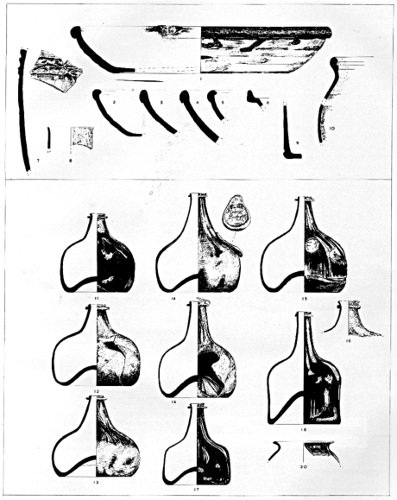
Figure 19.—Coarse earthenwares and glass bottles. One-fourth.
14. Wine bottle of squat form, olive-green metal. The neck taller than in no. 12 and the string-rim smaller and V-shaped.[174] Seal, on the shoulder, bears the legend "Richard Burbydge 1701." T.N. 30.
15. Wine bottle of squat form, olive-green metal. Somewhat bulbous and the shoulder weak, the string-rim broad and flat.[175] A slightly earlier form than no. 14. The bottle has a seal on its shoulder with the initials "F I" (Frederick Jones) stamped from a single matrix.[176] T.N. 30.
16. Wine bottle of somewhat unusual form. The metal thin olive green has turned black through decay which has almost entirely destroyed the metal. The body round-shouldered, and bulbous in the early manner; but the neck tall and the string-rim almost round-sectioned rather than V-shaped as one might expect of a bottle of this basic form. Were it not for the soft curve of the body and the shape of the string-rim this bottle might be attributed to the third decade of the 18th century. Note brass wire, still attached to neck, that held cork in place. T.N. 30.
17. Wine bottle of half-bottle size. The metal as in no. 16; shoulder angular; neck somewhat writhen with a broad and flat string-rim of 17th-century character. Without the last feature (and its context) this bottle might be thought to date as late as 1725. T.N. 30.
18. Wine bottle, olive-green metal. Short cylindrical body with conical basal kick, straight neck, and down-tooled string-rim. Dated examples occur in the late 1730's, but are more common in the following decade. T.N. 23.
19. Wine-bottle neck of olive-green metal in an advanced state of decay. Wide mouth with everted lip and large round-sectioned string-rim of unusual character. The angular shoulder suggests that the neck comes from a body comparable to that of no. 12. T.N. 31.
20. Pickle jar, everted-mouth fragments only. Olive-green metal in an advanced stage of decay, originally with square body in the manner of the more common case bottles.[177] T.N. 18.
FIGURE 20. MISCELLANEOUS SMALL FINDS
1. Harness ornament, plated brass. (See fig. 17, no. 12.) T.N. 17.
2. Harness fitting, brass. (See fig. 17, no. 13.) T.N. 15.
3. Brass button. Hollow cast; both back and front convex; the back with two molding holes on either side of the flat-sectioned brass loop, which spreads directly from the back without any intermediary shank. Such buttons were common in the second half of the 17th century and the first quarter of the 18th century.[178] Diameter, ¾ in. T.N. 23.
4. Brass curtain ring. The shape cast and then roughly filed flat on either side. This method of manufacture is typical of the 17th and 18th centuries. Diameter, 1 in. T.N. 24.
5. Ornamental brass band from shaft or hilt of uncertain form. The band has become flattened and folded, and the condition of the metal precludes regaining its original shape. However, the band is almost certainly a truncated cone, ornamented with a roughly cutout and scored foliate decoration at the narrow end and plated with a thin band of silver at the other end. Length, 1-3/16 in. T.N. 18.
6. Millefiori or chevron bead of yellow and black glass, almost certainly Venetian.[179] The bead is flattened on its pierced axis and has a diameter of 3/8 in. This example is probably of 17th-century date, but the technique can be traced back to Roman times. T.N. 30.
7. Chinese export porcelain-cup fragment. Decorated in underglaze blue, rough chevron ornament below the rim on the interior. Diameter approximately 3 in. T.N. 23.
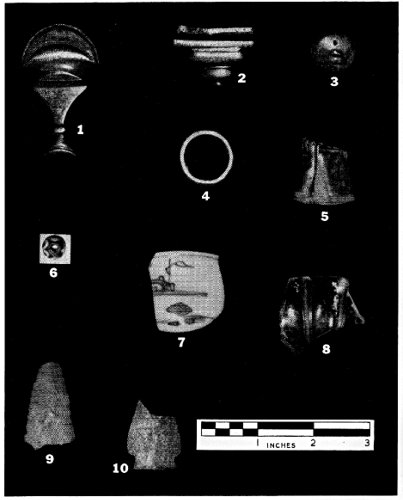
Figure 20.—Miscellaneous small finds.
8. Lower bowl fragment of lead-glass Romer ornamented with gadrooning or pillar molding. This is undoubtedly the finest glass fragment from the site; it would not have been out of place in the best English household.[180] About 1685. T.N. 30.
9. Indian projectile point of honey-colored quartzite. The edges slightly serrated, and the base slightly concave; the tip missing, but total length originally about 43 mm. Holland Type C.[181] T.N. 16.
10. Indian projectile point of red quartzite. Eared or corner-notched variety; original length approximately 45 mm. Holland Type O.[182] This is an unstratified item discovered on the bared clay surface on the promontory of Tutter's Neck overlooking the junction of Tutter's Neck and Kingsmill Creeks.
U.S. Government Printing Office: 1966
For sale by the Superintendent of Documents, U.S. Government Printing Office Washington, D.C., 20402—Price 70 cents
FOOTNOTES:
Contributions from The Museum of History and Technology: Paper 54
THE "POOR POTTER" OF YORKTOWN
C. Malcolm Watkins and Ivor Noël Hume
Part I: Documentary Record—C. Malcolm Watkins 75
THE CROWN AND COLONIAL MANUFACTURE 76
THE "POOR POTTER" AND HIS WARES 79
APPENDIXES 86
Part II: Pottery Evidence—Ivor Noël Hume 91
THE SALT-GLAZED STONEWARE 91
STONEWARE MANUFACTURING PROCESSES 102
THE EARTHENWARES 105
CONCLUSIONS 109
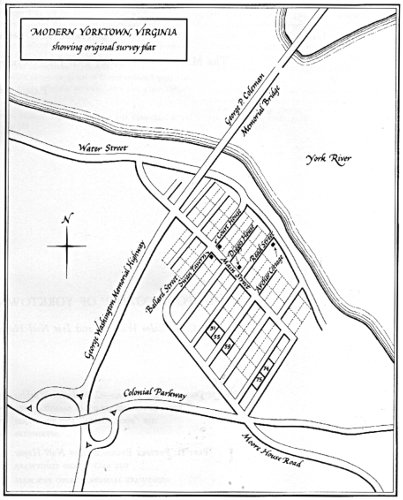
Figure 1.—Modern Yorktown, Virginia, showing original survey plat on which William Rogers' name appears on lots 51 and 55. Additional properties which he acquired are mentioned in his will as lots 59, 74, and 75.