SMALL TALK AT WREYLAND (continued 3)
Reading edition
There was a letter of mine on agriculture in the Times of 14 June 1920, and the editor of Justice thereupon sent me a leading-article in his paper of 17 June. I wrote a letter in reply, and he printed it in Justice of 1 July, and afterwards printed other letters from me in reply to things that other people wrote there. These people, of course, were socialists, and one of them was organizer of the Agricultural Workers’ Union. He lamented “the want of knowledge of agriculture in the Socialistic and Labour forces”; but his own facts and figures were very often wrong, and his reasoning was not exact. I shared his aspirations for Utopia; but he was going there across the clouds, and I was going along the land.
On an average the wheat crop in England is about a ton for every acre sown, or more than double the average for the United States or Canada. But wheat is not sown here except on land that suits it; and the average would soon go down, if wheat were sown on land that is less suitable. These people seemed to think that there would always be a ton an acre, however barren the land—or several tons an acre, if ‘Science’ were invoked. And they also seemed to think that wheat alone is ‘food,’ although our forefathers ate barley, oats and rye. These can be grown on land that is not good enough for wheat; and our island might perhaps grow food enough for the whole population—as these people said it should—but the population would have to be content with something less luxurious than wheaten bread.
They also put the claims of labour very high: unreasonably high, I thought. When a labourer comes to a farm, he finds fields fenced and drained and ready for cultivation, barns and stables, carts and ploughs and every needful implement, horses and food for the horses, and manures and seeds for the land. It is surely an abuse of language to talk of the crop as the produce of his labour. Suppose the crop fails utterly, as it sometimes will, from bad weather or other causes quite beyond control. As there is no crop, there is no produce of his labour; and (logically) he ought not to get anything at all. By accepting a fixed wage, he insures against that risk.
A maximum wage for agricultural labourers was fixed by the magistrates for Devon at Quarter Sessions, 13 April 1795. They were empowered to do this by the Acts of 5 Elizabeth and 1 James I, and “having made due enquiry of the wages of the labourers in husbandry in this county, and having had respect to the price of provisions and other articles necessary for the maintenance and support of such labourers at this time,” they made an order that “all manner of men labourers in husbandry shall take, with the meat and drink accustomed to be given in each district of the county respectively, the sum of fourteen pence per day and not above.” But piece-work was excepted—“all labourers in husbandry shall take by the great or task work as they shall agree.”
In his report to the Board of Agriculture in 1807 Vancouver says that agricultural wages had not changed in Devon since 1795. He puts the daily wage at 1s. 2d. and a quart of cider for the regular hands, and 1s. 4d. and the quart for casual hands, or 8s. a week instead of 7s., as they had none of the allowances the others had—ground for pig-keeping, and corn for bread-baking, and other things, at less than market price; and he mentions that the 7s. could be commuted into 3s. 6d. and maintenance: pages 361 to 363 and 446. And while a man was earning his 7s. on the land, his wife could be earning 3s. 6d. at her spinning wheel, and there might be other spinners in the family: pages 446 and 464. But he adds that this home industry was being destroyed by factories; so that whole families had now become dependent on their earnings on the land.
Agriculture was thus called upon to pay a wage that would support men’s wives and families, just when it could not pay enough to support unmarried men. The industrial North was a necessity, but it meant destruction for the agricultural South; and many people here expressed themselves as forcibly as Cobbett, Cottage Economy, section 232, “The lords of the loom, the crabbed-voiced, hard-favoured, hard-hearted, puffed-up, insolent, savage and bloody wretches of the North, assisted by a blind and greedy Government, have taken all the employment away from the agricultural women and children.”
Instead of fixing a maximum wage, as in Devon, the magistrates for Berks drew up a plan, 6 May 1795, ‘the Speenhamland plan,’ which was copied by other counties but never had the force of law. (The old Roman town of Spinæ was a mile or two from Newbury, and Quarter Sessions held at Newbury were nominally held at Spinæ, then known as Speenhamland.) The plan was drawn up clumsily. It allowed too little for the wage-earner and too much for his family: he had from 3s. to 5s. a week according to the cost of living as measured by the price of corn, but he also had 1s. 6d. to 2s. 6d. for his wife and each one of his children. Thus a man with a wife and seven children had twice as much as a man with a wife and two children, and five times as much as an unmarried man, though the cost of living would not be five times as much or even twice as much. That wrecked the plan: it meant paying one man a great deal more than another for getting through the same amount of work. Still, the old plan took account of facts, whereas the present notion is to fix a wage that is sufficient for an average family. This leaves big families short, and also takes money out of industry to pay unmarried men the cost of families they have not got.
In a letter to my father, 2 December 1849, my grandfather sends a message to a friend who had been talking of the good old times, and then describes the bad old times that he remembered here. “I have sold potatoes for 9d. per bag and hog sheep for 2s. 9d. a head. [A bag of potatoes is 160 lbs., and hogs are sheep between one and two years old.] Such was the distress among farmers then that labourers were put up to auction by the parish authorities, and hired for 6d. to 9d. per day.” Under the Speenhamland plan 6d. a day (3s. a week) was the minimum for a single man, and 9d. a day (4s. 6d. a week) was the minimum for a married man without a family. No doubt the 6d. or 9d. was quite as much as farmers could afford to pay when prices were so low; but men with families could not subsist on that. In their case (to use the modern terms) the economic wage was less than a subsistence wage; and the parish authorities paid them a subsistence wage and took the economic wage, the balance coming from the rates.
In agricultural districts the ratepayers were chiefly landowners, parsons with glebe and tithe, farmers, millers, and blacksmiths and others who made things for the farms; and thus the contribution from the rates came indirectly out of agriculture. It was, in fact, a general charge upon the industry, based on the employing classes’ means, but applied according to the labouring classes’ needs, so that no labourer was worse off for having a big family. No doubt it also was a subsidy to agriculture from ratepayers who were wholly unconnected with the land; but few such people could be found in country places. At the census in 1801 the parish of Lustleigh had a population of 246, and 236 of them were classed as agricultural.
Subsidies to any industry are open to abuse; but in a choice of evils this may be the lesser of the two. At present, if an economic wage is less than a subsistence wage, the industry slows down or stops, production is decreased or ceases, and hands are unemployed; and then these hands receive subsistence wages out of rates and taxes. But in a subsidy the public would only pay the difference between the economic and subsistence wages, all hands would be employed and production would go steadily on.
Since the passing of the Truck Act in 1831 payments in money have been replacing the old payments in kind. The old system was open to abuses; but I doubt if agricultural labourers have benefitted by the change, as there now are middlemen’s profits to be paid. Under the old system (as mentioned by Vancouver on pages 361, 363 of his report) farm-hands could buy their bread-corn from the farmer at fixed rates—two bushels a month of barley at 3s. a bushel, or a bushel of wheat at 6s.; and now they say the baker charges too much for their bread, whilst farmers say the miller pays too little for the wheat. So also with drink, the labourer did better with the cider he had helped to make, than with a small increase of wages for buying something else. He now buys tea or beer at prices that allow for profits and taxation, whereas his cider was taken at cost-price. No doubt, political economists would like to see all wages paid in cash, to save them trouble with statistics; but ‘real’ wages might be higher, if partly paid in produce of the farm.
A little while before the War I listened to a long dispute between two brothers, one a railway man at 30s. a week and the other a farm hand at 15s. The railway man maintained that he was worse off than his brother; he was paying 7s. a week for cramped accommodation in a town, whereas his brother had a cottage, free, and ground enough for growing vegetables and keeping poultry and a pig. And he went on comparing town and country prices, and town and country needs; and, on the whole, I think he proved his case. But there is an outcry against free cottages now, as a farm hand must vacate his cottage if he ceases working on the farm, the cottage being wanted for the man who takes his place. There is a great deal in a name. If these ‘tied cottages’ were called ‘official residences,’ less nonsense might be talked.
A slovenly housewife soon gives her cottage the aspect of a slum, and often gets it into such a mess that it can never be made quite nice again without almost rebuilding it; and at one time or another most of the old cottages have suffered in that way. Good housewives did their best, and scrubbed; but there was no such scrubbing here as I have seen in Holland. I stayed a night at Delft, 22 August 1872, at a hotel that looked out on a wide street with a canal running down the middle of it; and in the morning I watched the house opposite being cleaned up for the day. After all the windows had been cleaned inside and out, the front door was taken off its hinges and well scrubbed and then was carried over the canal and dipped in it.
After doing repairs, my grandfather notes, 29 October 1843, “Such is ever the case with house property: it is but a nominal income.” Matters have not improved since then; and I therefore try to build things that will never need repair. After viewing an addition that I was making at the Hall House, a village elder justly said, “There: ‘tbe everlastin’: and everlastin’: and everlastin’ after that.” It was a big granite staircase with granite walls laid in cement. I wish that former generations had used cement here: they used bad mortar with a core of rubble between the inside and outside stones—their walls were seldom less than three feet thick—and when the mortar has decayed, there is nothing to keep the outside stones from falling off and the rubble from going after them. When they were building ‘dry walls’ (that is, with neither mortar nor cement) they took more pains to get the stones to fit.
These ‘dry walls’ abound here. The countryside was strewn with granite boulders: when a piece was cleared to make a field, the boulders were broken up and used for walls enclosing it; and the walls were sometimes made immensely large, to use up the material. It is marvellous to see a skilled man building such a wall. The stones are of all shapes and sizes, from half a hundredweight to three or four, just as the rock or boulder happens to split up; and there may be many dozens of them lying about. He glances round and selects a stone, perhaps fifty feet away, and has it brought to him; and it fits in exactly with the stones he has just used, or only needs a single blow to knock off some protuberance. This all looks so easy that I have tried selecting stones myself; but they have never come right.
While I was having one of these walls built, I had a letter from a friend in London asking me if I could give a man a job: the man was strong enough for anything, but had been ill; and the doctor said he needed six weeks in the country, out of doors all day. I had him down for the six weeks, and set him to work at picking up the stones the skilled man wanted, and carrying them over to the wall. He happened to be a prizefighter, and he was still here at the time of Newton fair, and there happened to be a booth for boxing. He went in and boxed, and local men came in and boxed with him, not knowing who he was. They gained experience, and he brought home the stakes.—In his solicitude for my education, my father sent me to a prizefighter when I was twelve years old. I went twice a-week, but did not know enough to profit by his teaching—his gloves were always up against my eyes, and I saw nothing else. I did, however, learn a little of the language of the Ring.
A dozen years ago some people were talking to me here about the good old times, and their children meanwhile were giving the donkey and the dog some bits of bread. I said, “These are the good old times, and people will look back on them and say, in those days dogs and donkeys might eat wheaten bread.” I was looking ahead, a century or more, and never thought that in a few years time bread would be rationed out in England and made of other things than wheat. In what we call the good old times the labourer had no wheaten bread. In a letter of 3 December 1844 my grandfather remarks that wheat was then so cheap and oats so dear that wheat was being given to horses; and he calls wheat “food for Christians,” but then corrects himself, “when I say wheat is food for Christians, I do not mean to say the labourer is not a Christian,” although the labourer had only barley bread, not wheat.
Though wheat is so esteemed, a vast amount is wasted here in reaping and in threshing and with rats in ricks and barns. I have seen the ears gathered by hand in Turkey and in Spain, and with astonishing speed; and nothing is wasted then. And there is, I believe, an American machine which cuts the stalks so high that it reaps hardly anything below the ears; but I imagine that it does not get the ears off any of the shorter stalks.
After living in Long Island (New York) in 1817 and 1818, Cobbett says in his Cottage Economy, section 82, “Few people upon the face of the earth live better than the Long Islanders, yet nine families out of ten seldom eat wheaten bread. Rye is the flour that they principally make use of. Now, rye is seldom more than two-thirds the price of wheat, and barley is seldom more than half the price of wheat. Half rye and half wheat, taking out a little more of the offal, make very good bread. Half wheat, a quarter rye and a quarter barley, nay, one-third of each, make bread that I could be very well content to live upon all my lifetime.” Of course the Americans also had what they call ‘corn’ and we call ‘maize.’ We grow this for fodder, as it seldom ripens here; and we import the product as cornflour. Cobbett tried the American sort here, but found another sort near Calais—a dwarf plant—and tried this in 1827 and the following years; and in 1828 he reckoned that he had eleven thousand quartern loaves upon eleven acres, though three of the eleven had failed. These experiments of his were made at Kensington and Barnes; and in 1828 he says in Cobbett’s Corn, section 155, that he was paying his men three shillings a-week with board and lodging. They had porridge for breakfast: as much hot mutton as they could eat for dinner, and also apple-dumplings: bread and cheese, as much as they could eat, for supper: a pint of beer at dinner and another pint at supper. He lived on the same diet himself.
My grandfather had most of Cobbett’s agricultural books, and read them with respect, as Cobbett never recommended anything without trying it himself or having seen it tried. These books of his are shrewd and sensible, and may be right in what they say of that “degrading curse,” the “pernicious practice of drinking tea,” Cottage Economy, sections 23 to 33. “But is it in the power of any man, any good labourer who has attained the age of fifty, to look back upon the last thirty years of his life without cursing the day in which tea was introduced into England?” Parson Davy was preaching against tea-drinking here in 1803, and as early as 1748 Wesley was exhorting his followers to abhor tea as a deadly poison. (A prophet is without honour in his own chapels.) Cobbett likewise talks of “the corrosive, gnawing, and poisonous powers” of tea. “Tea has no useful strength in it: it contains nothing nutritious.... It is, in fact, a weaker kind of laudanum, which enlivens for the moment and deadens afterwards.”
The fault may not be in the tea itself, but in the way of making it and leaving it to ‘stand’ or ‘draw.’ A cynic said that tea was the salvation of the people here; it so damaged their digestions that they could not assimilate the food they ate; and this really was a mercy, as they over-ate themselves so much. Even in this house, I fear, tea was allowed to stand too long. I remember my grandmother being chaffed about a letter she had written, “Jane has drunk tea here. Poor soul, she has drained the cup of bitterness to the very dregs.”
In my early days here the cottagers all kept pigs; and the sties abutted on the cottages and drained into the lanes. There were sties on each side of the lane between Bowhouse and the Tallet; and as the lane is steep, the drainage made a stream downhill and joined the drainage from a sty at Souther Wreyland just outside the kitchen door. Then came a time when pig-sties were prohibited within a certain distance of a house; and the old granite pig-sties were utilized in other ways—that Souther Wreyland sty became a coal-cellar, and a double sty at Lower Wreyland has now become a sitting-room. But in War-time all restrictions were removed; and pig-sties could be set up close to dwellings, as before. Restrictions on building also were removed. Some years before the War I wanted to turn a barn into a house; but this was not allowed, although the barn had well-built granite walls—few houses have as good. And now a barn near here, not built so well as that, has just been turned into a house. If restrictions were necessary, they should not have been removed: if they were capricious, they should never have been made.
In those good old pig-sty days there were some powerful smells here, but they did not carry far, and the air was always fresh; and there were much worse smells in towns, with no fresh air to counteract them. A builder writes to my father about a house in London, 12 October 1862, “I beg to acquaint you that the works are going on, and on opening the ground I find a large cess-pool in the front area under the steps, a most improper situation for such a place.” That house was not built till 1820, and older houses usually were worse.
There were no sewers here, at Wreyland or at Lustleigh, until 1892, when a joint sewer was laid down for the sewage of both places. A joint water-supply was included in the scheme; but that part of the scheme fell through, and sewer-gas was thus laid on to every house that had no water of its own. This state of things continued for ten years, although there was no practical difficulty about the joint supply. The great Torquay reservoir is less than two miles off; and the engineers were ready to lay the water on, just as they had laid it on to other places between here and Torquay. But water-supply is in the jurisdiction of the Rural District Council; and the Council appointed Parochial Committees without experience of anything much bigger than a parish pump. The joint supply was rejected, as Wreyland is not in Lustleigh parish. A separate supply was found for Lustleigh; and when that failed, a further supply was found, as far off as the Torquay reservoir. Being in Bovey parish, Wreyland was supplied from a Bovey reservoir as far off on the other side; and this reservoir was a futile thing—intended as storage to supplement a small supply in drought, needless when a big supply was brought in from another source, and ineffective now, because the mains are nearly choked with rust. With their ineffective schemes and alterations and additions, these two rural parishes incurred a debt of about £24,000 for water-supply, besides about £8000 for sewage; and there are special-expenses rates for interest and sinking-fund, and water rates as well.
Moretonhampstead was provided with a sewer in 1905. The main part of the town is on a hill between two little valleys that converge into the valley of the Wrey; and a nine-inch sewer-pipe was carried down each valley to the junction of the two, and a nine-inch sewer-pipe from that point to the sewage-tanks some way further on, as if one nine-inch pipe would take the full contents of two of that same size. Moreton is a great place for thunderstorms—the conformation of the country brings the clouds that way—and the storm-water comes rushing down the sewer-pipes and drives the sewage along; and of course the sewer-pipes were always bursting where these torrents met. Instead of laying a larger pipe from the junction to the tanks (which would have been a costly thing) the District Council placed a sort of safety-valve above the junction; and now, whenever the pressure is sufficient, the sewage throws up a fountain there. I have gone to see the fountains at Versailles and Peterhof and other places celebrated for them, but I have never seen another fountain quite like this. And nobody need go out of his way to see it, as it splashes out on the high road from Moreton here.
In going from Moreton to Hurston, I pass a guide-post with an arm that says, ‘Chagford. 1½ miles.’ Taking that direction, I pass another guide-post (at Stiniel cross) less than a hundred yards away; and this has an arm that says, ‘Chagford. 2 miles.’ A foreigner noticed it and said, “Aha, you advance one hundred metres and you retreat one half-mile? How shall you arrive?” I said, of course, “We muddle through,” and he said “You are a wonderful people”; and he said it as if he meant it as a compliment, but I think he had some reservations in his mind.
There is a new guide-post at Lustleigh. Instead of getting a larch pole that might have cost about five shillings, the District Council got an iron post that cost five pounds; and on that post the sockets for the arms are at right-angles to each other. One arm is marked ‘Cleave,’ and points along the road there. The other is marked ‘Station,’ but (being at right-angles to the first) it points along the path to Wreyland, which path does not go anywhere near the Station. Hence, many objurgations from excursionists when they have missed the train. With a larch pole, the arm could be nailed on to point the proper way; but our Council would not be satisfied with anything that did not combine extravagance with inefficiency.
Inefficiency is said to be a sign of honesty in public bodies. When a public body is corrupt, the members take good care that everything is managed so efficiently that nobody would like to turn them out—they take no risks of losing a position that they find so profitable. On this hypothesis the Local Authorities in Devon cannot possibly be corrupt; and yet I sometimes feel a passing doubt when I see what schemes they sanction and what tenders they accept.
Corruption may be beneficial if it implies efficiency. The amount of money that is misappropriated will seldom be as much as would be muddled away by honest, inefficient men. We usually have some very able men in Devon, astute financiers whose abilities are thrown away in the routine of penal servitude on Dartmoor. We might entrust our Local Government affairs to them, not quite with a free hand, but with a reasonably laxity allowed in matters of finance.
Our present system of Local Government has the defects of bureaucracy without its merits. There are County Councils and District Councils and Parish Councils. These are elected by the ratepayers; and the people who are elected have not always got the necessary ability, and those who have the ability cannot always give the necessary time. The result is that the clerks and other officials have to do the Councils’ work, if it is going to be done at all; and they are not invariably the sort of men to whom such work would be entrusted. Under the bureaucratic system the Councils would be abolished and their work entrusted to officials of high standing, who would be qualified men; and they would do their best, as they would have full credit for successful work and be responsible if things went wrong. The officials have no such incentive now, as their acts are nominally the Councils’ acts, and they have neither credit nor blame.
With such administration it is not surprising that the rates in Bovey parish have risen to 8s. 10d. and 9s. 5d. in the £, or 18s. 3d. for the year—an inordinate sum for any rural parish. And no drastic reductions can be made now, as £1600 a year is required for interest and sinking-fund on loans, which will not be completely cleared till 1952. All the money that is squandered by the Councils is charged upon the rates; and nobody is ever punished for his blundering.
Take one case as a specimen of what is going on. A retaining-wall was being built, half a mile from here, under the direction of a District Council official. There was plenty of granite close at hand, but he was having stone of an inferior kind brought down there by steam lorries from a quarry nearly three miles off; and it came in lumps of insufficient size for a retaining wall. On seeing how the wall was being built, I wrote to say that it would certainly fall down, and the work had better be stopped, especially as there was scandalous waste of money in sending to a distance for inferior stone. But the work was carried on; and a few days after it was finished, the wall fell down exactly as I said it would. It was rebuilt in such a way that part of it will probably fall down again. The ratepayers are paying for the building of that wall and for its rebuilding, and the official goes scot free.
To take another case. Four years ago the District Council laid a water-main across some private property without complying with the forms prescribed by law; and as soon as it was laid, the owner told the Council to take it up, though it had cost about £240 to lay. He was within his rights; and he frightened the Council into an agreement to pay him a way-leave if he would allow it to remain, and to take it up if he gave six months’ notice. He has given notice and then withdrawn it on condition of the Council’s doing something for him which the Council was not really bound to do; and, so far as I can see, he may repeat the process as often as he likes. The ratepayers find the money for it all.
If a District Council needs a loan for carrying out large works, the plans and specifications and estimates have to be submitted to the Ministry of Health before the loan is sanctioned. In these matters the Ministry follows the practice of the old Local Government Board; and when a loan was needed for the Moreton sewage scheme, the Board sent down one of its inspectors. He held an inquiry at Moreton, and went over the ground; and he passed the plans and specifications containing the outrageous blunder I have mentioned. Hence the sewage fountain on the road.
In spite of all formalities, works are not always carried out according to the plans passed by the Ministry or Board. On the plans of the joint sewer here (Lustleigh and part of Bovey) there is a settling-tank for the sewage and an effluent to irrigate the fields below; but the tank has never been built, and raw sewage is run out upon the land. The tank appears upon the plans that were endorsed on the agreements with the landowners; and they can compel the Council to build it—at the ratepayers’ expense. The ratepayers imagined that the tank was there, and had been paid for from the loan the Board had sanctioned for carrying out the plans.
Amongst the works for giving Bovey more water (at a cost of upwards of £11,000) there are three horizontal shafts, or ‘adits,’ driven into Haytor down; and one of them is more than a quarter of a mile in length. The work was carried out in lavish style—these shafts remind me of the entrances to royal tombs that I have seen in Egypt. The water from the shafts must be quite pure; but water was also taken from an open stream that runs through Yarner wood, and may have dead rabbits and other unpleasant things in it; and this water goes into the same main without filtration. That being so, the shafts were hardly worth their cost. And although the water from them is so very pure, it is a little ‘sour’ (as moorland water often is) and therefore picks up lead in passing through lead pipes. As lead pipes have been laid, there is now a danger of lead-poisoning in Bovey, and so also in Lustleigh with its moorland water and lead pipes. And in both these places the lead pipes are in accordance with the plans and specifications passed by the Ministry of Health.
In the old days here, when drinking-water mostly came from wells, the population must have swallowed masses of unwholesome stuff. There is a well (now closed) in Lustleigh town-place just where the ground slopes downward from the churchyard to the Wrey. Here at Wreyland there is a well in front of the Hall House, now used for horses drinking at a trough, but formerly for all mankind. There were two pig-sties five yards from it and a third within ten yards; and it was on the lowest ground here, so that things would easily drain in. This house is higher up, but the well was on the lower side of it; and my grandfather had the present well sunk in 1839.
His well received great praise, as I am told. “Th’apothecary man come here and saith as he must anderize the well. And I saith, ‘Well, if you must, you must.’ And then he come again and saith, ‘I’ve anderized that well, and if you drink of that, you’ll live for ever.’” That was the substance of what he said, but not (I believe) the form in which he said it. People here are apt to put things in the form they would have used themselves. A lady of great dignity once noticed a donkey here, and remarked what a fine animal it was; and she was perturbed at hearing that the villagers were saying she had praised the animal in detail, ending up “and if there be one part of’n as I admire more than another, it be his rump.”
From time to time the County Council appoints a ‘rat-week’ for a general attack on rats. Rats have a good deal of sense: they abandon places where they are hunted down, and congregate in places where they are left alone. A rat-week frightens them away from these infested places; and in the following week there are more rats than can be managed in the places that were nearly free of them before. So a rat-week is rather a nuisance to anybody who has always kept rats down.
When there is an attack on any kind of creature, there is always an outcry that every kind of creature has its use, and we shall suffer for upsetting Nature’s plans; and one naturally gets impatient with the silly folk who have all cobwebs swept away, and then go grumbling that their rooms are full of flies. But rats are not indigenous here—England did very well without them until about 1350, like Australia without rabbits until about 1850. I am quite sure rats must be killed, and I get traps and poisons; but when it comes to killing one, my sympathies are with the rat, and I always have a secret hope that it will get away.
One winter afternoon I went up to my bedroom and found a rat there, sitting on the rug before the fire. It did not move when I came in, but looked at me appealingly. I understood, and it saw I understood; and we had as clear a conversation as if we had expressed ourselves in words. The rat said, “I must apologize for this unwarranted intrusion; but I am suffering from some distressing malady, and entertain a hope that it may be within your power to alleviate my sufferings.” I said, “I regret exceedingly that this should be entirely beyond my powers. I know too little of human maladies, and even less of the maladies of rodents; and were I to adopt the treatment usually prescribed for them, I fear your sufferings might be aggravated.” And the rat said, “You disappoint me grievously. But at least, I trust, you will not abuse the confidence I have reposed in you?” I said, “Nothing could be further from my thoughts,” and held the door politely open. The rat walked slowly out, stopped at the top of the stairs, and looked back at me with much more confidence, “But really isn’t there anything
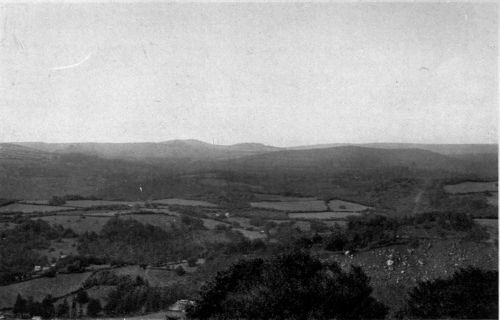
VIEW ACROSS WREY VALLEY
at all that you can do for me?” I said, “I’m awfully sorry, but I’m afraid there isn’t.” And the rat went slowly downstairs, out of doors, and away along the Pixey Garden.
The rat had come in through an open door; and this is the only way that a rat should be allowed to come into a house—the walls should be made rat-proof with cement. No doubt, rats climb up ivy and other creepers on the walls, and sometimes reach the thatch that way; but I have never known one come in at a window.
These rats, of course, are brown rats, the black rats being quite extinct now, although old men have told me they have seen some, years ago, both in London and down here. In his History of Devonshire, I. 129, ed. 1797, Polwhele quotes a man who was born in 1723 and said that, when he was a lad, there were only black rats until a ship called the Elizabeth was brought into Plymouth and broken up on the Devonshire side of the Plym; and this ship’s rats were brown.
We ought really to be grateful to the browns for killing off the blacks, as the blacks were much worse than the browns for carrying the Plague about. We have not heard much of the Plague in Western Europe since the brown rats arrived—the last great outbreak was in 1720 at Marseilles. The first outbreak in England began with the arrival of some ships at Weymouth in July or August 1348, and it very soon reached Devon and then spread over the whole country, killing more than half the population. So far as we know now, the Plague began in the Crimea. The black rats must have come down there in hordes, like the hordes of brown rats that were seen swimming across the Volga in 1727. It was brought by ships from the Crimea to Constantinople, and thence to Messina and Genoa; and a Genoese ship brought it to Marseilles about Christmas 1347. It spread all over France up to the Channel coast; but if it had come here that way, it would probably have reached Dover first, as Calais was then an English town with much traffic across the Straits: so I imagine that the ships at Weymouth had come up from the Mediterranean, and brought black rats with the pestiferous fleas.
That outbreak of the Plague reduced the population of these islands to half or perhaps a third of what it was before; and one may speculate about what might have happened, if the outbreak had been more severe and swept the population off without a remnant. In the absence of statistics one may estimate the death-rate from the number of new appointments to livings in the diocese of Exeter, as set down in bishop Grandisson’s register of Institutions. During February 1349 there were institutions to five parishes in the next valley to this: Chudleigh, Trusham, Ashton, Doddiscombsleigh, Dunsford. Those parishes are all on the left bank of the Teign; and there are no institutions to parishes on the right bank until June. If rats could swim the Volga, they could swim the Teign, but probably would not take the trouble if they were happy where they were; so I presume the river checked them, and they came up here another way. During March and April there were institutions to Lustleigh, Bovey, North Bovey, Manaton, Ilsington, Widdicombe: six parishes forming a solid block of sixty-four square miles. In the first six months of 1349 there were altogether 269 institutions, and 394 in the whole year. Even in 1348 there had been only 52, and the average number was 37 in the seven previous years, 1341 to 1347. There were not priests enough to fill up all the vacancies in 1349; and on 20 September bishop Grandisson obtained two Faculties from the Pope, one for ordaining a hundred young men who had not yet attained the age of twenty-three, and the other for ordaining fifty men who were born out of wedlock and therefore were ineligible without a Dispensation.
This kind of evidence needs more careful handling than Cardinal Gasquet has given it in his book on The Black Death of 1348 and 1349. Amongst other things he says there, page 102, “An examination of the institutions of the diocese, in relation to the time when the plague visited the various parts of it, appears to show that it commenced almost simultaneously in north and south. In North Devon it is found at both Northam and Alverdiscott on the 7th of November, at Fremington in the same district on the 8th, and at Barnstaple on December 23rd.... The early outbreak in the coast villages at the mouth of the estuary leading to Barnstaple points to the conclusion that the infection was brought by a ship passing up the Bristol Channel.” He assumes here that the Plague will be ‘found’ at a place on the very day on which a new incumbent has been instituted; and this assumption is quite unfounded unless he also assumes that the previous incumbent must have died of Plague there. But in two of these four places the previous incumbents could not possibly have died of Plague, as they had not died of anything at all: the register says distinctly that these vacancies were caused by resignation, not by death.
In a letter of 30 October 1348 bishop Grandisson cites a letter from the prior of Christchurch, Canterbury, written after the Archbishop’s death, and giving his instructions for processions and other rites to stay the Plague. According to the Prior’s letter (28 September) England was exhausted and impoverished by the War, “guerrarum discriminibus, que ipsius regni diviciarum substanciam exhaurunt et consumunt ... regnum Anglie desolatum extitit et afflictum.” That was the opinion of a man living at the time: yet there are books on history assuring us that England had never been so prosperous before, the country being then enriched with all the spoils of France.
In that letter of 30 October bishop Grandisson ordered solemn public processions in his diocese every Wednesday and Friday up to Christmas. He was living at Chudleigh Manor all the time, about six miles from here; so I imagine that there were processions all around. He also ordered masses, psalms and prayers. These were then the proper weapons for combatting the Plague: nobody smelled Rats. So also at Rhodes in October 1498 the Grand Master of the Knights ordered fasting and prayer, and the people all sang Alleluia. Columbus had brought a new disease from the New World, and it had just reached Rhodes; but these good people had not yet found out how it was propagated. The local poet, Emmanuel Georgillas, wrote a poem on it in medieval Greek, Thanaticon tês Rhodou. He says that the disease claimed victims from amongst them all, old men and matrons, boys and unwedded girls, the Knights themselves, and even the Archbishop. At last John Baptist triumphed over Charon—that is what the poet says—but the Grand Master of the Knights had not relied exclusively upon their patron saint: he had locked the ladies up.
Providence helps those who help themselves, and leaves whole generations to their fate unless they take the trouble to find out how diseases come and how they can be kept away. Plague is carried by rats’ fleas, just as typhus is carried by lice and malaria by mosquitos; the rats themselves are victims. Trichinosis is caused by pigs, and leprosy by fish; but the rats invade us of their own free will, and it is no fault of the pigs or fish that people sometimes eat them ‘cured,’ not cooked.
When the chieftains of the Delta of the Nile went to King Pianchi to tender their submission to him, about 750 B.C., he would not let them come inside the palace, as they were people who ate fish—see lines 149 to 151 of his inscription—and Jews were just as hard on people who ate pigs. Had the Jews abstained from eating fish, they might have been immune from leprosy, which is a worse disease than any they could have caught by eating pigs; and with proper cooking they might have eaten both. All those ancient prohibitions were too wide, like this modern prohibition of strong drink on the mere chance that it may make men drunk.
I doubt the Totem theory of abstinence from certain foods, and fancy somebody had noticed that certain diseases went with certain kinds of food, and had prohibited those foods accordingly. There have been men whose precepts we all follow without quite understanding why, and we say these men were “in advance of their generation” or “born before their time”; and yet the truth may be the other way—they were of their generation and their time, but mankind has deteriorated since.
Whenever I look at bees, I feel misgivings about the future of mankind. Think of the bees that invented the hexagonal cells, and the bees that go on building these cells and yet go buzzing against glass panes in one half of a window when the other half is open. The bees that could invent such cells, would surely have ability enough to find their way round glass. But bees are socialists; and socialism means that individuals of great ability will be kept down, and all ability will gradually be atrophied for want of use. I rather think that this is what has happened to the bees, and may be happening to mankind.
Collingwood ate rats. He said ships’ rats were very clean feeders, and he always had a dish of them at dinner when he was at sea; and I have heard that many officers fought shy of invitations to the Admiral’s table. No doubt his dish of rats was properly cooked; but rat may be as dangerous as pig, considered as diet, since rats are also liable to trichinosis. Amongst human beings the disease is very rare in England as compared with Germany: they eat a great deal of smoked ham there, and mere smoking does not kill trichinæ.
In former ages leprosy was common here. There was a hospital for lepers this side of Newton, founded by John Gilberd, 4 October 1538, “for the releff of powre lazar people wherof grete nomber with that diseas be now infectid in that partis to the grete daunger of infection of moche people to whom they use to resort and be conversant withal for lacke of convenyent hospitals in the county of Devon for them.” There were much older hospitals for lepers outside Exeter and Barnstaple and Tavistock and other towns; but these were more or less monastic, and had suffered from the dissolution of the monasteries. This hospital was then a quarter of a mile outside Newton Bushell; but the town has spread beyond it, and the old buildings have long since been replaced by alms-houses. Leprosy is quite extinct; but I fear that people hereabouts are careless in the cooking of cured food.
Leprosy would naturally be commoner before the Reformation, as so much fish was eaten during fasts; and the fasts themselves made people weaker and less able to resist disease. I agree with old folks here who say that fasts should be a time of feasting for the poor. “Rich folk have money to buy butcher’s meat in Lent as well as other times; and if they will not eat’n, they should give’n to they as cannot buy.” However, fasting was enjoined on rich and poor alike, and was deemed of more importance than almost anything else. Machiavelli was not easily shocked, but he drew the line at Sforza’s coming to Florence and eating meat in Lent, Istorie Fiorentine, VII, anno 1471, “cosa in quel tempo nella nostra città ancora non veduta.” I can myself remember how frightfully Prince Napoleon shocked the pious French by eating beef-steak on Good Friday.
Nobody thought of fasting here on any day except Good Friday; and fasting meant no more than eating hot-cross-buns in addition to the usual food. But whether it came as early as March 20 or as late as April 23, Good Friday was the great day for potato-planting. Whatever the season was, potatoes planted on Good Friday came up better than potatoes planted any other day—at least, that was the common belief here. There must have been a religious or superstitious base for this, and perhaps also for the custom of kicking a football round when the planting had been done. (In my early years a football was hardly ever seen here except on a Good Friday.) I have seen the sailors flogging Judas Iscariot on Good Fridays in Mediterranean ports, and I hear it may be seen on foreign ships in English ports. Judas Iscariot is there a dummy like Guy Fawkes and here, I think, he had become a football. But it is always hard to judge the meaning of such things. Some fifty years ago an acquaintance of mine, a midshipman, went up to Jerusalem with a lot of other midshipmen when the Mediterranean squadron was cruising off that coast; and they marched into Jerusalem singing a song (which then was popular) of Kafoosalum, ... the barber of Jerusalem, ... the daughter of the barber. And good Mahommedans were much impressed, thinking it was a holy song that these young angels sang so fervently.
There is now a service of Three Hours at Lustleigh on Good Friday. I inquired what authority there was for this, and was informed (officially) that it was a service licensed by the Bishop under the Shortened Services Act. That was quite good as a bit of cynicism or a joke, but rather past a joke if one remembers how that Act was passed through Parliament. Its promoters said that it was only to be used for shortening the old services, not for introducing anything new.
On the coronation of Queen Victoria there was a service in Exeter Cathedral and ‘rejoicings’ in the town; and my father’s diary finds fault—“the stupid dun of cannon, which even fired during the anthem, shaking the edifice and distracting everyone’s attention”—and so on for a couple of pages, finishing, “it seemed somewhat like a Good Friday: by no means a favourite day of mine.”
There is no desire here for more Good Fridays or Ash Wednesdays, but only for Shrove Tuesdays at all seasons of the year; and these Carnivals are not followed by Lenten fasts. Carnivals are superseding Fêtes and Galas, here called Feets and Gaylers; but knowing that a Swarry (or a Soirée) consisted of a leg of mutton, I should say that every Carnival or Feet or Gayler consists of a brass band ‘with the usual trimmings’ like the leg. It seems perverse of people to speak of fêtes as feets when they invariably speak of beans as banes, and even more perverse to want these foreign words at all. This coast is getting known as a Riviera, which they pronounce Riveerer as if it were a German word.
I have got a bill here for ‘mendin gardin oz’—hose—and I have seen a bill in Bedfordshire for ‘hoke’ and ‘hellum’ and ‘hash.’ With phonetic spelling there would be as many written languages as there are dialects now—water would be ‘warter’ in the Eastern counties, and ‘watter’ or ‘wetter’ here—but fonetic fanatics would take the cockney dialect and foist it on us all. On looking at an Elementary English Grammar, of which 350,000 have been sold, I found it said—“Take c out of the alphabet, and we could write, kat, sity, speshal, instead of cat, city, special, and in thus writing those words, we should be writing them according to their pronunciation.” No doubt, the cockney news-boys screech out ‘Extra Speshal’; but if we are to get pronunciation down from town, we might get it from the West End rather than the East.
Sometimes people make mistakes here about the origin of words—Reformatory is not Reform-a-Tory, as ardent Liberals said—and sometimes they make mistakes about the words themselves. During the War there was an entertainment for wounded soldiers at a house not far from here; and they came up in chars-à-banc with bagpipes playing all the way. I heard a small boy calling out, “Hearken to that music there,” and another one snubbing him, “Bain’t music, ‘tbe the magpies.” On first hearing of a Turkish bath, a girl assumed that it must be a turkeys’ bath. I picture an old turkey-cock jerking his head about and gobbling while he was screwing up his courage for a header into the cold plunge.
A cockney was greeted by a man down here with courteous inquiries about her health, “And how be you now? Be you all right?” The reply was, “No, half right, half left, like you”; and he told me that he had to do a bit of thinking afore he saw the sense of it. An old lady here surprised me just as much in town. She had not been there before, though well advanced in years; and I took her up in the Great Wheel at Earl’s Court to get a good look round. She told me afterwards, “I were a-thinkin’ all the time how Satan took our Lord up into an exceedin’ high place a-seein’ all the kingdoms of the world.”
I once heard a cockney expressing her contempt for everybody born elsewhere. She said with pride, “I was born and bred where I stand,” and she was standing in a gutter in a slum. Londoners do not often give themselves away like that: they usually are people of resource. I complained to an umbrella-maker that a new umbrella kept turning inside-out, and with a jerk I turned it inside out at once. He took the umbrella, jerked it the other way and said, “You see, sir, it comes back again quite easily.” I complained to a stationer that his envelopes did not stick. He replied with dignity, “No, sir, they do not: we use only the purest gum.”
On a spring morning I was coming out of Charing Cross station on my way back from Algeria with a very sun-burnt face, about the colour of a red geranium; and while my hansom was going slowly through the gates, I heard a loafer say, “Look, Bill, ee’s come into bloom early this year.” People are more courteous here. At a harvest supper there was a general desire to sing, “For he’s a jolly good fellow,” but also a general feeling that it would not be quite respectful: so they softened the familiar term and sang without restraint, “For he’s a jolly good gentleman.” And this version suits the tune so well that anyone would think the tune was written for it.—I am told that when I go to sleep, I snore. One afternoon I asked why the letters had not been brought in to me as soon as they arrived; and the answer was, “I was afraid I might disturb you, sir, I thought I heard you sleeping.”
There is a House of Mercy at Bovey, a Gothic Revival building designed by Woodyer about 1865. Its inmates come from every part of England, not especially from Devon; and they have been described to me as “Maidens as hath gotten babies without ever goin’ nigh a church,” in other words, unmarried mothers. But less courteous terms were used when laundry-work was started there. One old lady gave me her whole mind—not merely a bit of it—about “they paltry gentry as took their washin’ away from honest folk to give it to they hussies.” The practical mind thought it a waste of money to have such institutions: the inmates could be married off, at much less cost, by giving them dowers. And really there is just as much marrying for money among the poorer classes as among the rich, though the amount of money may be smaller and sometimes very small indeed.
Under a farmer’s will his farm went to his only son, but nearly all the stock was sold for paying the daughters’ legacies, as he had not reckoned on a fall in prices. The young man only got an unstocked farm and had no money for stocking it; but an aged relative of his made light of that. She said to me, “I tell’n he must marry one that hath some hornéd cattle,” and he chafed at such restriction of his choice. Another old lady, a relative of hers, was asking after a friend of mine who had been badly wounded in the War. I told her that he had quite recovered, and added that he had married his nurse: whereat she threw up her hands, exclaiming, “Oh, that War, it hath been a terrible thing for some of’n.”
There was an old saying here, “I would rather go to the funeral of a daughter than to her wedding of a doctor.” My grandfather quotes it in a letter of 30 November 1865 as if he quite agreed with it, and adds, “Strange, those doctors are always poor, and a miserable affair of it generally.” He did not much approve of marrying for love, or anything else, unless there were sufficient means. I remember that he thought the answer insufficient when somebody had cried out, “There she is, marrying him all in the depths of poverty,” and another person answered, “He hath blood.”
In his letters to my father on the death of relatives or friends, he enumerates all possible grounds of consolation. Thus, 30 June 1854, “Therefore on reflection I say we ought to be very thankful he was taken off as he was without pain or suffering.” He says this of a friend who had been staying with him a week before in full vigour of body and mind, and died just after leaving here from unsuspected weakness of the heart. In most cases he finds so many grounds for consolation that he comes very near saying it is really a good riddance. Thus, 18 September 1853, “On the whole, taking everything into consideration, I say there is nothing to grieve about, but all his friends ought to be thankful he is taken.” Again on 6 October 1853, “I should say a happy release for his mother,” and on 10 January 1855, “A happy release, I say, for himself and all about him,” and on 16 January 1855, “I say we ought all to be thankful he is taken before his sister, for what he would have done, had she been taken first, I cannot tell.”
This practical or utilitarian view was not uncommon here. He writes about a death at Lustleigh, 7 September 1845, “She died last evening. What will the old man do now. When his wife was very ill, I inquired for her. He said she was not likely to live, but then (he said) we can do without her. This is his son’s wife, a clever woman; and what they will do now, I am at a loss to say, for they have neither wife nor daughter, and of course must trust to a housekeeper.”
My grandmother generally saw things in another light. She writes to my father on 19 February 1845, “Report says we are to have Jane for a neighbour. It appears she has captivated Mr ***** and in due time, I suppose, will become his wife. It will be an excellent match for Jane. He is considered very wealthy and I believe a very nice man. He has called here several times and repeatedly requested your father to visit him: your father calls on no person, I am sorry to say.” Writing on 23 February, my grandfather just mentions the report and adds, “Depend on it, Jane will soon turn things upside down there.”
On another marriage he writes, 16 November 1851, “Your mother had a full and particular account of the wedding the day after.... I have often heard of throwing an old shoe after a new married couple to wish them good luck. I never knew it practised in Moreton but once, and then [the bride’s father] ran out in the street and threw an old shoe after the carriage. It did not carry luck with it, for that was an unfortunate marriage, so the story was he ought to have thrown more. To obviate all that, they threw shoes by the dozen: all the old shoes were looked up and thrown after and about the carriage like grape shot. Well, I hope they will be happy.”
As he thought all this worth mentioning, he might as well have gone to see it for himself, and also gone to see much else; but that was not his way. He writes on 9 June 1862, “This is Whitmonday, and the bells are ringing for two weddings that are solemnized today, so Lustleigh will be gay in addition to the usual holyday for the labourers and the children. I see nothing of it, but generally hear a squall of children and the hoarse voice of the men at the skittle playing. I give something to set the children a-running and something for the fiddler.” A younger man, of great ability, told my sister what he thought about it all, 11 October 1870, “He thought living in this remote part enough to rust the brains of any clever man, as you might pass a month without meeting anyone who could talk on any subject above pigs and cows.”
Flocks and herds, or pigs and cows, are not bad themes for talk, if anyone can handle themes judiciously and keep them in their place—flocks and herds are not like golf. But in reality they may be burdensome. My grandfather notes with pleasure, 13 December 1841, “My cows are regularly fed, three times a day, unlike farmer’s cows which catch what they can,” and then rather wearily, 10 August 1869, “My farm is a trouble and expense.” And the lesson is, never have a hobby that you cannot cast aside. You want no needless worries at a time when you have one foot in the grave and then get the gout in the other one.
In my father’s diary of his first visit to London he speaks of pictures at the Royal Academy and National Gallery and elsewhere, but the only artist whom he mentions by name is Benjamin West. This was in 1832, and West had died in 1820; he had been President of the Academy for nearly thirty years and was still in high repute. There are two wash drawings here signed, ‘B. West, 1785’ and ‘B. West, Windsor, 1788.’ The latter is one of his designs for the friezes at the Queen’s Lodge, built by George the Third and since destroyed. It is four feet long and seven inches high, with thirty-three figures personifying arts and sciences; the fine arts in the middle, the peaceful arts and sciences on one side and the warlike on the other. The earlier drawing is of Segestes giving his daughter to Germanicus as a hostage for Arminius. This was a favourite subject then, and West painted several pictures of it, the earliest in 1772.
West’s drawings are generally a great deal better than his paintings, and Galt gives the reason in his Life of West, II. 204.—In drawing and colouring he was one of the greatest artists of his age, but his powers of conception were far higher; “and it is this wonderful force of conception which renders his sketches so much more extraordinary than his finished pictures.” West is in oblivion now with most of the Academicians of his time, except the portrait painters. (There is a picture by one of those Academicians in Teign Grace church, a Madonna by James Barry, quite unnoticed now.) But repute depends on fashion, not on merit; and many artists of less merit are extolled.
Rustic critics judge things in a different way. Two large oil paintings here were praised—“There bain’t no other’n like’n in this parish, no, nor yet the next: look at their size and finish.” A portrait was praised also as a speaking likeness—“Why, any blind man could tell ‘twere he.” (Portraits, I may note, are known as photos here, even portraits of old ancestors; and ‘photos’ is coming to include all kinds of pictures, as ‘pictures’ now means movies.) I brought a very good Persian carpet down from London, and the criticism was—“Well, and if you’d got that old bit by you, I d’esay it were all so well as buyin’ a new’n.”
A friend of my mother’s writes to her from Brighton, 28 October 1841, “I have been twice to be charmed though not mesmerized by that delightful pet of yours Jullien and his helps (at the Town Hall) and a very grand affair they made of it. After beautiful Overtures, Waltzes and a capital set of Irish Quadrilles by Jullien, they gave us the Storming of St Jean d’Acre in perfection. The piece commenced with a slow movement of ‘God save the Queen,’ and after sundry descriptive morceaux the attack began and Jullien was in all his glory. Bombs, cannon, musquetry, bells tolling, shouts of victory, etc., and lots of blue lights, Roman Candles and last (though not least in effect) that beautiful rich crimson light that you saw last year.” And one of my great-aunts who liked all that, complained in later years that Wagner was so noisy.
Jullien brought Berlioz to England. My father was at the Opera, 25 June 1853, for the first night of Benvenuto Cellini, and was impressed by it, or rather by the final scene, the casting of the statue. And it might be more impressive now with better stage machinery for it—the furnace, the molten metal running down into the mould, and then the breaking of the mould revealing the great figure of Perseus still aglow with heat.—The real statue is said to be Cellini’s masterpiece; but I do not agree. I think myself that he surpassed it in the relief of Perseus and Andromeda on the pedestal below.
On first hearing Boito’s Mefistofele I recognized the chirruping of the angels as a familiar sound, but could not recollect where I had heard it. I had really heard it in expresses between Paris and Marseilles. Some of the P.L.M. carriages had wheels, or springs, or something, which gave forth just that sound when they were running fast; and it may be heard on some of the G.W.R. carriages, but with a different rhythm and pitch. A railwayman assures me that the English engines talk and (being foul-mouthed creatures) use unseemly words. Since learning this from him, I have distinctly heard an engine saying, “blów and blást it, fétch anóther,” when sent off up these gradients here with load enough for two; and then, quite cheerfully, “nów I’ve dóne it, nów I’ve dóne it,” when it has reached the top.
Writing from Teignmouth on 3 August 1854, my grandfather says, “There is nothing new here, but a ship of this place has just arrived literally gutted by the Greek pirates. She was laden with raisins. The crew were obliged to beg for their lives, they had but three biscuits left on coming to Falmouth. That must be put stop to somehow.” Greece was a nuisance then: the coast had been blockaded by the English fleet, and French and English troops were landed at the Piræus in May to stop the Greeks from siding with the Russians in the Crimean war. He writes on 2 April, “As war is declared, the papers will be interesting. I fancy people have been too sanguine.”
After the Coup d’état he writes from here, 7 December 1851, “Well, the President is taking very high ground, and no doubt he will make himself Emperor, if he can keep the Army on his side,” and further on 26 January, “What a scoundrel that President is.” But he went astray in saying that the President would not become Emperor “without a desperate struggle,” and still further astray on 12 October 1851 in generalizing from some undesirables whom he had seen, “America must now be made up of outcasts and rogues of all nations.”
In one of his letters—it looks just like the rest—he says on 17 December 1843, “I can scarcely tell if I am not writing plainer and more legibly than usual, as it is by candle, but I fancy so. I am writing with a metal pen. When at Moreton last, I bought some and am much pleased with them, for my sight is so bad that even with the assistance of glasses I cannot make a pen by candle light and very badly by daylight.” Twenty years after that, I was taught to make a pen (that is, to cut a quill into a point) as one of the things that every child must learn. Metal pens did not come into common use until after 1840, though introduced some years before, and many people still despised them. A friend of my father’s writes to him, 13 September 1856, “I hope you will be able to read my letter, but as I write with a steel pen, I am not quite certain of it.” Few people now could write so neatly with a quill; and his writing here is just as neat as ever.
Old letters and diaries can be trusted when they are recording facts; but they have never been revised, and may contain opinions which the writers would have modified on second thoughts. My father writes to my sister from Perugia, 17 September 1876, “This is the most curious and romantic place I ever saw: Laon is nothing to it.” Curious and romantic places generally had bad hotels, and Perugia had a good one; and I suspect this made him view the place benignantly and give it this excessive praise. He notes in his diary, 24 August 1874, “Elbe scenery rather fine, tho’ not equal to the Danube, Rhine or Moselle, but better than the Meuse or Loire.” He wrote this at Dresden, just after coming down the Elbe from Schandau; and I imagine he was thinking of the scenery there, forgetting other parts.
I have a letter of 14 February 1911 from Henry Montagu Butler, then Master of Trinity, but headmaster at Harrow at the time when I was there; and in this letter he says, “You and Arthur Evans are, I think, the chief antiquarians of our Harrow generation, Hastings Rashdall and Charles Gore our most learned and original theologians, Walter Sichel and George Russell our most fertile writers in general literature.” I do not know whether that was a considered opinion or only a passing thought: in either case I offer Sir Arthur my condolences on being mentioned in the same breath with me. As for the two theologians, here is something that Dean Rashdall lately wrote—“I am sure that on no subject but theology could Bishop Gore have been so blind to the requirement of ordinary fairness and straight dealing between man and man.” I suggested that he could have put it better in schoolboy diction with words like liar and sneak, but he informs me that he thinks those terms too strong.
It was rather a shock to me when a former fag of mine was made a Bishop—not Gore, of course—but you can never tell how fellows will turn out. Another fellow, in the same house, was sacked for getting drunk and disorderly in Harrow town. He succeeded to a Peerage and was a huge success as a Colonial Governor; and I believe his secret of success was giving the Colonials a finer Cognac, and more of it, than any Governor had given them before.
In his Harrow holidays down here my brother was telling one of my great-aunts such yarns that my sister wrote off to my father, 12 August 1862, “He teazes her dreadfully, and tells her the most extraordinary things about the Exhibition. When she asked him if all the boys dined together at school, he told her that half dined at the King’s Head and the other half at the Turk’s, and those that were not hungry could have a chop and bottle of stout in their rooms.” It was not so: at any rate, in my time.
He usually was very accurate, feeling that exaggeration spoiled a narrative of facts. Keep strictly to the facts, or launch out boldly into fiction. On the same principle he would not give a sixpence to relieve a case of destitution; but if the case was put before him and he was asked for twenty pounds, he might perhaps give the twenty, feeling that it might do good where sixpences were wasted. He did not often waste his money; but one evening on coming out of a theatre he meant to throw a sixpence to a man who found a hansom for us, and threw him a half-sovereign by mistake, and I heard the man say fervently, “Thank God, all the Gentlemen aren’t dead.”
With his prodigious memory my brother could have written books of this sort far better than I have written these; and I am sorry I did not oftener make sure of things by asking him. (He died five-and-twenty years ago.) As it is, I have left out things of which I am not sure; and some of these things were quite worth saying, if true; but I wished to keep as closely as I could to facts.
I once was telling a man a thing I thought would interest him; and he stopped me short—“I heard that from your brother, and shan’t forget it. I was out in Kensington Gardens with my wife, before we married, and he came up and told us that; and I didn’t want it then. I had just that moment proposed to her, and she had not had time to reply.” I hope I have not said anything here that has been heard before, like that.