SMALL TALK AT WREYLAND (continued 2)
Reading edition
The inscription and the leaflet both have the words ‘for ever,’ and these words are also on two patens that he had given to the church. They are “for the use of the Sacrament for ever”; and there is the same inscription on a chalice given by Edward Basill, who was Rector from 1660 to 1698. No doubt Davy copied Basill here, and hence applied ‘for ever’ to his later gift; and there is no question what ‘for ever’ meant—his gifts were to be kept.
The patens have not yet been sold, but the meadow has. The adjoining owner wanted it, and wanted it very badly, as he had erected a pair of semi-detached residences close up to the hedge. And it was sold him for £300, or £25 less than Davy gave for it a century ago. As a matter of business, the thing seemed indefensible; and as a matter of sentiment, it certainly was vile.
Sir Joshua Reynolds was born at Plympton, and in the zenith of his fame the Corporation made him Mayor. He acknowledged this by sending down his portrait, painted by himself, to be hung in the Town Hall. Finding it was worth a good round sum, the Corporation sold it.—Of course, Parson Davy was not as eminent a man as Sir Joshua, but he was the only man of any eminence who ever lived in Lustleigh, at any rate, the only one in the Dictionary of National Biography. It was at Lustleigh that he did the work on which his reputation rests—I have described it in my first Small Talk, pages 32 to 34—and for forty years, as curate for an absent pluralist, he was devoted to the interests of the place. It was as scandalous for Lustleigh to sell a gift of his as for Plympton to have sold Sir Joshua’s.
The strange thing is that Davy should have made a gift to Lustleigh, knowing what had happened to the gift of Robert Phipps. By his Will (2 October 1676) Phipps gave £40 to be bestowed in lands of inheritance, the rents and profits whereof were to be employed to buy linen cloth at Easter for such old men and women of the parish of Lustleigh as had none or little relief from the parish, the linen cloth to be dowlas of 10d. per yard or thereabouts, and each poor man or woman to have three yards. The linen was distributed until 1802, and then the trust-fund disappeared, and has not been heard of since. It had not been invested in land; and this may have been the reason why Davy chose to give a piece of land in his own lifetime rather than bequeath a sum of money by Will.
He could have given the school a larger income by putting his £325 into the Three per Cents. at the price they stood at then. As he did not do that, he would hardly have approved of selling the land and putting the proceeds into Funding Loan, though this will give a larger income than the rent in recent years. The present rent is not the only thing to be considered in trusts that are in perpetuity. Harrow accepted a fixed annual sum in lieu of the rent of land that then was farms and now is part of London.
At the Parish Meeting there was an overwhelming majority against the sale—only five people voting for it—and nearly the same majority for a resolution calling on the trustees to resign. But the sale was carried through by a majority of the trustees in spite of every protest. Three of the trustees in the majority were people who had only lately come to live in Lustleigh, and the most active of them was a new arrival who soon went away. Things have changed since Parson Davy’s time. He was here for forty years himself: the living of Lustleigh was held by two Rectors for ninety-six years, 1791 to 1887; and the living of Bovey was held by two Vicars for a hundred years, 1735 to 1835. In the present century there have already been four Rectors of Lustleigh, and the vacancies have not been caused by death.
These people who come and go, will never take the same amount of interest in a place as those who spend the best part of their lives there; and they may even take delight in doing some lasting damage to a place that has not quite appreciated them. That is a kindly view to take. Unkind people called the sale a job; and nobody believed the talk of getting more money for school prizes—Lustleigh is some miles from Buncombe. If more money was wanted for the prizes, there were plenty of people who would have subscribed the few pounds’ difference between the rent of the meadow and the interest on the Funding Loan.
The new-comers at Lustleigh always call the old school-house ‘the old vestry’ for some reason that I cannot comprehend—vestry-meetings were held in one of the rooms there, but the building was always called the school. What they call ‘the new vestry’ is an excrescence from the church: it is in the angle between the chancel and south transept, spoiling the exterior of the church, and making the interior dark by blocking windows up. It contains the organ; and organs are not always worth the space they take and the disfigurement they cause. The south transept of Exeter Cathedral is disfigured by a row of 32-foot pipes, standing by themselves; and this bit of hideousness only gives a dozen extra notes. I do not think the extra notes are worth the sacrifice.
Churches suffer badly from additions and improvements and injudicious gifts, and Lustleigh church has suffered very badly in that way—there is always something being done. A pavement of coloured marbles has just been laid down in the chancel there, to replace a pavement of encaustic tiles that was laid down sixty years ago in place of the old pavement of rough granite slabs. The tiles were an Albert Memorial, and had the monogram of V. and A.; but they were very slippery, and it looked undignified for any cleric to sit down unexpectedly upon the chancel floor. The marble pavement is a gift, and people consider it unmannerly to look a gift-horse in the mouth, even if the beast is not worth stabling. Nevertheless, there is a way of saying courteously that your stable is unworthy of such a noble steed, and the steed might find some better stabling in another place.
When a building has a character of its own, you ought not merely to abstain from putting in things that are out of character with it: you ought to put in things that will bring its character out. Siena cathedral is a gorgeous building, and it has the finest pavement in the world; and the pavement makes the building look more gorgeous still. You can tell exactly how much the building is indebted to the pavement, as the pavement is covered over with boarding (to protect it) during a great part of the year, and then the building looks comparatively poor. If the Siena pavement could be laid in Lustleigh church, it would not give splendour to the church: it would only make you discontented with the roughness of the pillars and arches and the effigies of the old knights who held the place six centuries ago. The old pavement of rough granite slabs was far more suited to the rugged grandeur of the church.
There may, of course, be additions to a church which are so splendid in themselves that the church itself sinks into insignificance beside them: such, for example, as Maximilian’s tomb with its attendant statues in the church at Innsbruck. Had there been anything of that kind here, few people would have cared what happened to the church itself. But the additions here have only been the ordinary things in marble, brass, mosaic, painting, coloured glass; and they have made this rugged moorland church look quite suburban.
There are two great monuments in Bovey church, one to Nicholas Eveleigh, who died in 1620, and the other to Elizæus Hele, who died in 1635. Elizæus was better known as Pious-Uses Hele, having given his estates away for pious uses—amongst other things, Blue Maids’ Hospital at Exeter had £50 a-year from Bovey mill. He married Eveleigh’s widow; and she erected these monuments to her two husbands, though both of them were buried elsewhere. There is a recumbent figure of each husband, and in Hele’s case there are also kneeling figures of the wife and a former wife and a young son who had died. Over the recumbent figure there is a rounded arch with columns, architrave, etc., as if it were a gateway; and in the earlier monument the style is pure Italian of a hundred years before, whereas the later monument is what is called Jacobean, with the Italian style debased by Flemish and German methods. The change is curious: after the Italian of 1620, one would expect the Palladian of Inigo Jones in 1635 rather than this belated Jacobean.
They stand on the north and south sides of the chancel, almost touching the east end; and on the east wall between them there was mahogany panelling with columns and festoons carved in the style of Grinling Gibbons. The panelling just suited the monuments and enhanced their merits; but there came a time when it was the ambition of the clergy to make their chancels look like show-rooms in church-furnishers’ shops; and then the panelling was taken down and thrown into a barn. The present Vicar has brought it back, and put it at the west end of the church; and I hope that it will some day go back to the east end, and oust the rubbish that is there.
He has also brought back the royal-arms that were thrown out at the same time, and has put them in the arch below the tower. These royal-arms are a grand piece of wood-carving, set up at the Restoration together with the arms of archbishop Laud and bishop Hall of Exeter, with suitable inscriptions about “that wicked and bloody Parliment.” They stood on the screen, with the royal shield just where the rood had been, and the Lion and the Unicorn in the places of the Blessed Virgin and Saint John.
The rood-loft has been reconstructed (but without a rood) and I do not think it has improved the church. However small a church may be, the rood-loft must be large enough for people to pass along it to the rood, and may thus be very much too large to suit the church. And this new rood-loft looks too large, though Bovey church is not so very small. Most churches, I suspect, looked all the better for the compromise of 10 October 1561, which took away their rood-lofts and left them their screens.
By this compromise the rood-loft is to be “so altered that the upper part of the same, with the soller, be quite taken down unto the upper parts of the vaults and beam running in length over the said vaults ... putting some convenient crest upon the said beam.” If the rood-loft has already been removed and “there remain a comely partition betwixt the chancel and the church,” no alteration is to be attempted; but “where no partition is standing,” a partition must be built.
In this district the screens usually are woodwork, elaborately carved: very few are stone. The beam is eight or ten feet from the ground, and is supported by uprights three or four feet apart; and between the uprights there is solid panelling to a height of about three feet, and then open tracery for the rest of the height, making a sort of Gothic window with its arched head touching the beam and springing from the uprights two or three feet below. At the springing of these arched window-heads there were segments of arches, springing out on each side of the screen, and combining with the window-heads to form a kind of vaulting underneath the soller, or rood-loft floor. The rood-loft was approached by a staircase in the thickness of the wall or in a little turret outside, with entrance and exit both inside the church; and where the rood-loft has been taken down, the exit leads out on to the little pinnacles of the ‘crest’ of the beam; and then the effect is comic, as no one but a rope-dancer could ever walk along them. It is so in Lustleigh church and in many others. On the Lustleigh screen there are carvings of pomegranates—the badge of Aragon—and possibly the screen dates from the time of Catherine of Aragon or her daughter. But the pomegranates have their sides cut open to show the grains inside, and thus look very like bunches of grapes with leaves enclosing them. In early Christian art palm-trees grew into candlesticks with candles in them, the leaves becoming the flame; and I rather suspect a similar transformation here.
Many rood-lofts were taken down by Henry VIII and Edward VI, but several were put up again by Mary, and some were never taken down at all. Opinion was divided; and this compromise of Elizabeth’s (which covered many other points) was “for the avoiding of much strife and contention that have heretofore arisen among the Queen’s subjects in divers parts of the realm.” In this part of England the strife and contention had taken the form of open rebellion in 1549; and the rebels came to Bovey. In answer to some interrogatories, 4 January 1602, Richard Clannaborough of Lustleigh, yeoman, “of the age of fowerscore and ten yeares or there aboutes,” said he had known Bovey mill “ever synce the Commotion in the tyme of the raigne of the late Kinge Edward the Sixth.”
This rebellion, usually called the Commotion, began on Whitmonday, 10 June, the new prayer-book having come into use on Whit-sunday; and it went on until 6 August, when the King’s men defeated the rebels on Clyst Heath and raised the siege of Exeter. The siege had lasted for five weeks, and seemed likely to end in a capitulation, as supplies were running short and many of the citizens were in favour of the rebels. These rebels carried the Host with them on a wagon—as at the Battle of the Standard in 1138—and these were some of their demands. ‘Wee wil have al the general councels and holy decrees of our forefathers observed kept and performed; and whosoever shal again-say them, we hold them as hereticks.’ ‘We wil have the Bible and al books of Scripture in English to be called in again.’ ‘We wil not receive the new service, because it is but like a Christmas game; but we wil have our old service of Mattins, Mass, Evensong and Procession in Latine, as it was before. And so we the Cornish men, whereof certain of us understand no English, utterly refuse this new English.’
Those rebels (or their leaders) showed great sense in their demands for Latin prayers and books. They wanted something sonorous to which they could give a general assent, and saw that if it were in English they would soon be squabbling over details. And people have been squabbling over details ever since.
Mesopotamia is notoriously a blessed word, but in some cases a mistranslation. Parapotamia is less sonorous, but sometimes more exact—the country on the west side of the Euphrates, not the east side. But people do not care much where such places were, provided that the names sound well. One day some foreigners were here; and somebody heard me talking to them, and then went telling everybody else, “Strangers come here from all parts to visit’n, and to each one of’n he speaketh in their own tongues, Parthians and Medes and Elamites and all the rest of’n.”
In some places in the south of Italy they still read the Gospels in Greek on certain festivals; and I once heard this reading, but cannot now remember where. I do not think the congregation understood a word of it, but they mostly put on the expression of connoisseurs when sampling a rare wine. In ancient times there was a ritual of that sort at Pæstum—Athenæos quotes an account of it (XIV. 31) from one of the lost works of Aristoxenos of Tarentum about 300 B.C. The descendants of the old Greek settlers had become ‘barbarians,’ that is to say, they had adopted the manners and customs and the language of their neighbours there; but once a year they had a day of lamentation on which they spoke Greek words in memory of the past. I have seen something like that in Jerusalem, at the Place of Wailing at the foot of the great wall. Jews go there to wail and pray; and I was told that many of them did not know the meaning of the Hebrew words they used.
Whether it is understandable or not, the English of the Bible is very fine indeed; but not, I think, so perfect as people generally say. It is difficult to judge, as it has now become a standard, like the English of Shakespeare’s plays. Ben Jonson thought that some of Shakespeare’s lines might be improved; and he was a good judge. People now think the weakest lines superb; and they admire the Bible also without discrimination.
There is no virtue in using a language that is ‘understanded of the people,’ if it is used for saying things that will be misinterpreted. In modern English ‘virgin’ means ‘virgo intacta,’ but that is not the meaning of ‘almah’ in the Hebrew of Isaiah, VII. 14. Every schoolboy knows (to his cost) that ‘deum’ is accusative, not vocative; and Te Deum is mistranslated—the older part may be heretical or even pagan. There are hundreds and thousands of these mistranslations and misinterpretations and statements that are unintelligible without long explanation. Readers very often fail to see the meaning of it all, and sometimes will not face the meaning when it is quite clear.
No doubt, Scripture is taught in every school; but there are many ways of teaching it. Lustleigh has a County Council school, and the Scripture teaching is regulated by a County Council syllabus. The syllabus says what things the children are to read, and what they are to learn by heart; and when people grumble at the Education Rate, I remind them that every well-taught child in Devon can say the names of the Ten Plagues of Egypt as glibly as a parrot. And then, of course, they feel that they are getting value for their money.
Old folk used to search the Scriptures very diligently here, and picked up words and phrases that they used in most embarrassing ways. One old lady told me in sorrow and in wrath, “The Parson, he come here, and I spoke Scripture to’n. And ‘good mornin’,’ he saith, ‘good mornin’,’ and up he were and away over they steps ’fore I could say another word.” I found that she had used some words the Parson had to read in church but did not wish to hear elsewhere.
I have two volumes here of Miracles and Lives of Saints, with coloured plates; and two small children who came to stay with me, used to call them the Funny Books, as the pictures in them were so funny. By the time these children came again, they had just learned to read; but I forgot this when I let them have the Funny Books again, and presently a little voice read out, “Now a certain nun became with child, and....” I stopped the reading, but could not stop the questions that they asked.
A small boy of my acquaintance had duly learned to say his prayers and was having a course of Scripture stories, but went on strike when he was told of the creation of Eve. He said that it was mean of God to put Adam to sleep and then take a rib away; and to show God what he thought of it, he would stop off saying his prayers. The strike lasted for six weeks.
The creation of Eve is sculptured in relief on the Campanile at Florence and on the Façade of Orvieto Cathedral; and in these reliefs (and also in some others) the sculptors have kept closely to their text, ‘God created Man in his own image.’ Adam and the Creator are exactly alike, even in the growth of the beard and the arrangement of the hair—the same model served for both. Anthropomorphism is an artifice that must be used, and I think those sculptors used it more effectively than Michaelangelo. In his frescoes in the Sistine Chapel he makes Adam a young man of twenty and the Creator an old man of seventy, not the least like Adam, and neither human nor divine. There is a picture by Pesellino in the National Gallery (No. 727) portraying the three Persons of the Trinity. An old lady told me, forty years ago, that she took one of her maids there soon after this picture had arrived: the maid stared at the First Person for some considerable time, and then said, “Lor’, mum, d’you think it’s like?”
In King’s College Chapel at Cambridge the central figure in the great east window, usually mistaken for God Almighty, is really Pontius Pilate; and I am always pleased to see him on his judgement-seat up there—it is some compensation for the ignorant abuse that is poured out on him from pulpits. In the case before the Court the Prisoner had pleaded guilty—‘thou sayest’—to the charge of claiming to be a King: the Prosecution would not allow the charge to be withdrawn; and the Judge was bound to pass the sentence which the Law prescribed.
I fancy Pilate may have misinterpreted a phrase. Julius Cæsar had been canonized as ‘divus,’ and Augustus therefore styled himself ‘divi filius,’ and afterwards was also canonized as ‘divus.’ But while ‘divi filius’ and ‘dei filius’ were quite distinct in Latin, they were both translated into Greek as ‘theou uios.’ (There is no question of misreadings here: the phrase is in inscriptions and on coins.) Saint Paul says that the Gentiles thought his doctrines ‘foolishness,’ and Pilate might think it ‘foolishness’ for anyone to claim to be a son of God; but it would be a serious matter for anyone to claim to be a son of the late Emperor, especially if he also claimed to be a King.
The ancient portraits of Christ are of two different types, the oldest portraits making him a beardless youth, and more recent portraits making him a bearded man. The very old portraits agree with the tradition (Luke, II. 2) that the Nativity was at the time of the census by Quirinius. That was at the end of 6 or beginning of 7 A.D., and the Crucifixion may have been as early as the spring of 27 A.D., as Pilate was in office then: in which case there obviously could not be any genuine portraits of Christ above the age of twenty. The more recent portraits agree with the traditions that make Christ over thirty at the Crucifixion. But in these portraits it is another kind of face, not the same face in maturer years; and the youthful face is usually much pleasanter, betokening a Deity who would delight in turning water into wine.
I should account for the two heads by saying that the bearded head was originally meant for John the Baptist, and mistaken afterwards for Christ. At any rate, John has a bearded head like this in those early representations of the Baptism where Christ is portrayed as a beardless youth. But the bearded head is universally accepted now, and it has been idealized. The greatest of these imaginary portraits is Leonardo da Vinci’s in his fresco of the Last Supper—at any rate it was so when I first saw it (1869) and for some years after that, but when I saw it last (1913) the whole fresco had been washed over with some preservative, and it did not seem the same. Perhaps Leonardo had read more into the Gospels than is really there: one might think that Christ was saying sorrowfully, those were the best disciples he could get, and what a gang they were—if one of them did not betray him, another one would. There is the gesture of the hands, and the face is full of disappointment and disdain.
There is a stained-glass window in the Guildhall at Plymouth depicting the inauguration of the building by the Prince of Wales in 1874; and this is the only window I have seen in which a chimney-pot hat is represented in stained glass. The hat has come out well—the stained glass gives it all the lustre of hot-ironing. Designers of commemorative windows might brighten up their works by putting in a few such hats; and artistically this chimney-pot is every bit as good as the rectangular haloes of a thousand years before. Charlemagne had a rectangular halo in a mosaic in the Lateran: Theodora and Pope Paschal still have rectangular haloes in the mosaics in saint Praxed’s church at Rome; and the Prince of Wales would have had a rectangular halo, had he been living then.
Saints and angels had round haloes, but other people had to be content with square or oblong haloes while they were alive. I do not know why this was so, or what a halo really was—whether it was a thing like a rainbow which always faces you, or whether it was a flat and rigid thing which you saw obliquely when the wearer turned aside: the Old Masters have depicted it both ways. For want of higher authority I draw my own conclusions from such things as Toto Maidalchini says: namely, that saint Cassian, being puzzled, scratched his head, and thereby put his halo all awry; or that saints Pancras and Sebastian went bathing in one of the rivers of Paradise, and then sat upon the river bank while their haloes were drying in the sun.
The rectangular halo is very useful for determining dates: it shows that the fresco or mosaic was executed in the lifetime of the personage who has the halo. But mosaics often need repairing—the little glass cubes get loose and come away—and after centuries of small repairs there may not be much of the original left, even if it has not all been taken down at various times in order to repair the wall behind it. When I was in Rome in 1876 the mosaics in the apse of the Lateran were lying on the floor. One of the Canons explained to me that they were just taking down the apse and rebuilding it a little further back, as the choir did not give them space enough for ceremonial. (I thought the Canons might have been content with what had satisfied the greatest Popes; and I tried to tell him so.) When the apse had been rebuilt, the mosaics were put back in it: a creditable bit of Nineteenth Century work, but still described as Thirteenth in the guides.
One day in 1874 I was on the tower of the Pleissenburg at Leipzig looking at the battlefield—it is a wide view, extending to Luetzen and the battlefield of 1632. There was an old man up there who had been in the great battle (1813) and I asked him whereabouts the windmill was, from which Napoleon watched it. He pointed out the windmill, and added with a grin, “Windmill burned down: man build another: man say it same.”—When the Campanile at Venice was being built up again, the brickwork ‘sweated’ and gave the red a curious tinge of white; and in the evenings in the glare of the Piazza I could have sworn it was the ghost of the old Campanile that I had seen there forty years before. That was in 1909; but when I saw it in 1913, I felt that the old Campanile had come to life again.
If buildings are burnt out or tumble down, there is no remedy but reconstruction. But people are too fond of reconstructing buildings that are still intact, and making them ‘as good as new.’ If they want to know what a building looked like when it was new, they can surely build a copy of it somewhere else, and go and look at that: instead of putting a new front on the north transept of Westminster Abbey, they might have stuck it on a building like Truro Cathedral which is completely new. And the new front is not even a true copy of the original front—amongst other things, it has eleven little arches where there could never have been more than eight. When I go to see a historic building, I want to see it as it really was, not as a modern architect may think it should have been; and when I find a Thirteenth Century design just finished in fresh stone, I feel the work is out of date or I am out of date myself—instead of a black coat and chimney-pot, I ought to be in gold brocade with crimson tights and a feather in my cap.
Judged by its architecture Truro Cathedral would be about two centuries earlier than the old church which is built into it, and it really is about four centuries later. The church may pass for an addition to an older building, when the new stonework has lost its glare. No doubt, in Burgos Cathedral the triforium is of an earlier style than the arches underneath it, though they were built at the same time; but Gothic was not indigenous in Spain, and Burgos was designed by German architects in an eclectic way. I do not think that this absurdity exists elsewhere, except as a result of alterations: at Furness Abbey, I feel sure, the arches in the transepts originally were round (like those in the triforium up above them) and were converted into pointed arches afterwards. The walls were weakened by these alterations, and that was why the central tower fell; at least, I think so.
The round archways in the cloisters show how splendid Furness Abbey would have been with its original design. But the old church-builders never knew when to stop: they ran after all the latest fashions in design, and in fact were out (as we should say) to beat the record. Their flying-buttresses were towers of force: at least, a verger told me that a bishop said so. But their biggest efforts often failed—Amiens Cathedral looks all right when you see it from the triforium, but you generally see it from the floor, and then it looks too high. And there were many problems that they never solved at all: for instance, they built naves like tunnels and just walled them up at the west end, whereas a nave requires a narthex or an apse or some such thing to terminate it.
Gothic is never at its best except in ruins—Chartres does not equal Tintern—and I have felt this even here. Lower Wreyland is an ordinary bit of cottage architecture; but there was no roof on the north end of it for several weeks in 1901, and then it looked quite grand with a granite gable standing out against the sky, and moonlight streaming through the empty windows. One’s appreciation of a building will always be affected by the atmosphere in which one may have seen it. In going up the Nile in 1882 my boat stuck in the mud close by Kom Ombo on a brilliant moonlight night; and I thought the temple there as beautiful a thing as I had ever seen, but changed my mind on seeing it by daylight as I came down stream. So also at Granada, I was once in the Alhambra on a rainy day, 22 September 1877, and could hardly believe it was the building that looked so like a fairy palace when I had seen it in the scorching sun. And with some pictures also, such as Tintoretto’s Bacchus and Ariadne in the Doge’s Palace or Michaelangelo’s Last Judgement in the Sistine Chapel, there is no life or beauty in them unless the sun is strong enough to bring the colouring out.
We have not sun enough in England to justify the use of Classic architecture or Palladian. These styles demand the glare of Greece and Italy; and sometimes that is not enough—in bleak places, such as Phigaleia or Segesta, I have found the old Greek temples too austere without their ancient colouring. However, these styles are now established here; and the only consolation is that they are all reduced to rule, so that ambitious architects do not come to grief with them as badly as with Gothic.
One of the worst faults of English architects is that when they have a building of great width, they put a portico or some such ‘feature’ in the centre and another at each end, and thus destroy the broad effect of width without creating an effect of height. The old Museum at Berlin was more imposing with its eighteen columns in a single line than the British Museum with its forty-four in different lines projecting at the centre and the ends; and with a colonnade the whole width of Trafalgar Square, the National Gallery might not have been unworthy of its site. At the Imperial Institute there is a tower in the middle and a tower near each end. The towers would be commendable, if they stood out alone; but the main building detracts from their effect of height, and they detract from its effect of breadth: and this is waste. Yet a tower does not impair the effect, if it divides a long front into two unequal parts, like the Rath-haus tower at Leipzig, built in 1556. I cannot understand why this is so, but observation has convinced me that it is a fact.
Architecture is not to be picked up from books: you have to go to see the buildings for yourself. There are books condemning the corners of the Valmarana Palace at Vicenza, and these certainly look feeble in Palladio’s design. The design just shows the building by itself; but really it is in a street, with lower buildings on each side of it. The corners carry your eyes down to these, and are exactly right.
In contrast with the Valmarana, the Casa del Diavolo has a most uncompromising corner, as if Palladio meant the building to look higher than it really is, and dwarf all its surroundings. Apparently, it was to have six columns along the front with five narrow windows squeezed in between them, but it has only three columns and two windows: the rest was never built. They are gigantic columns on high pedestals; and these vertical lines do as much for the effect of height here as the horizontal lines of the Basilica for its effect of breadth. There is also a house at Exeter (84, Queen Street) which I always call the Casa del Diavolo, with no aspersions on the occupier or the owner, but just because it is a little like that building at Vicenza. It has only four columns, though wide enough for five or six: its windows are too wide, and the columns have no pedestals; and thus it misses most of the effect of the real thing.
In ‘this sweete towne,’ as Evelyn describes Vicenza, ‘full of gentlemen and splendid palaces,’ the Teatro Olimpico was completed from Palladio’s designs in 1584 and was inaugurated with a play of Sophocles. (I have often wondered what Shakespeare would have made of it, had he been present there.) The scenery is solid architecture, built according to perspective so that you may think that you are looking down long streets. But when a man goes down the street, you see him growing bigger and bigger in proportion to the houses on each side of him; and all illusion is dispelled. I feel the actors should be life-size marionettes that could be dwarfed down by deflation when they make their exits at the back. This scenery that does not shift, has never been a real success; nor has the auditorium. Palladio was copying Vitruvius, and made it pseudo-Roman; and a modern audience looks as foolish there as in the Bradfield theatre, which is pseudo-Greek.
In these theatres and in those that really are antique, a great effect might be attained with audience as well as actors in antique costume. If the modern audience does not care to dress in Greek or Roman style, there might at least be labels. I have seen people going to rehearsals of a Pageant in plain clothes with cards pinned on them—courtier, soldier, buccaneer, etc.; and the audience might have cards as well—archon, quæstor, trierarch, etc. Imagination might then do the rest, though costumes would be better. But such costumes are usually a compromise of what the ancients really wore and what can now be worn. I remember a lady going to a ball in fancy dress as Cæsar’s Wife; and a newspaper described her dress as safety-pins and gauze, but chiefly safety-pins. However, safety-pins are quite a good defence against snap-shots. There is ‘halation’ from the metal of the pins, so that the photograph is blurred and looks as if they were continuous, like pieces of chain-mail.
Not long ago a Lustleigh boy was going to be a Roman Senator in some theatricals in town, and he wrote home to his mother to send him the materials for making up a Toga. Not knowing what a Toga was, she sent him the materials for making up a Toque—an inadequate costume for Roman Senators, even at the Lupercalia.
There are childrens’ recitations at Christmas time in Rome in the church of Ara Coeli. A platform is erected in the nave; and every afternoon there is a crowd of children, and they go up, one by one, and recite their pieces with as much assurance as if they were accustomed to addressing public meetings every day. When listening to them, I have thought of May Day here and the overpowering shyness of the boys who have to make the little speech at the crowning of the Queen. I cannot remember more than one boy here who spoke as well as any of the children there; and he was so full of his speech that he put the crown on upside down, enveloping her eyes and nose in flowers that were intended to stand up above the rest. However, older people may do worse. Archbishop Temple was an octogenarian, and yet he all but put King Edward’s crown on with the hinder part in front.
The southern races have a greater gift of oratory than is customary here, and they seem to pass from childhood into manhood at a very much earlier age. John XII was only eighteen when he was elected Pope in 956, and four-and-twenty when he crowned Otho as Emperor; and at two-and-twenty he confirmed Saint Dunstan in the see of Canterbury and made him Papal Legate here, with what results we know. No doubt, a young man might become a Pope by influence or simony, but never an Heresiarch except on his own merits; and some of the great heretics were very young. Clement of Alexandria says in his Stromateis, III. 428, that Epiphanes the son of Carpocrates was only seventeen when he died: yet he had imperilled Christianity by his doctrine of Free Love. This young scamp of an Heresiarch was a contemporary of Antinoos; and it is one of the puzzles of ancient history why Christians or Pagans ever took such people seriously. But we must look at the paintings in the Catacombs rather than the writings of the Fathers, if we would understand the blithe life of the early Christians when Erôs was Patriarch of Antioch and Anterôs was Pope.
Leo X went into residence at Rome in 1492, being then a Cardinal and aged sixteen; and he had a letter from his father, Lorenzo de’ Medici, telling him how to behave there and above all things (una regola sopra l’altre) to get up early in the morning and set to work upon the business of the day. According to Domenichi, Facetie, p. 129, ed. 1581, Ugolino Martelli asked Lorenzo why he did not get up early himself, whereupon Lorenzo asked him what he did when he got up, and then told him that it was not worth while getting up to do such trivial things. That was an answer to Ugolino, but not an answer to the question that he asked, as Lorenzo certainly had weighty things to do; but it acknowledges that early rising is merely a means to an end, not an end in itself, as some fanatics say. In his Duty and Advantages of Early Rising John Wesley says that (by the grace of God) he rose at four and had done so for sixty years, but he also says that he could not subsist with less than six hours and a half of sleep: so he must have gone to bed by half past nine. He does not show that it is any better to be awake at four or five in the morning than at ten or eleven at night; and in winter it certainly is worse, as vitality is at its lowest in the hours before dawn.
Wesley took the sleep he needed, six hours and a half; but many saintly men have given themselves so little time for sleep that they can never have been healthily awake, unless they got some sleep at unappointed times. Bonaventura says of Francis of Assisi that his prayers were sometimes mingled with indescribable groans, ‘gemitibus inenarrabilibus.’ That is in the Legenda Sancta, ‘the life of a saint, written by a saint, to be read in the spirit of a saint’; but the Devil has sometimes tempted me to think that those indescribable groans were snores.
My uncle, Cecil King, strayed into a Wesleyan chapel between Charlestown and Holmbush on 17 April 1843, and this is his account of it. “I found them singing, and took the opportunity of entering an empty seat. Soon after, the congregation turned round to pray, and I followed their example. There were no lights in the chapel, so that one could scarcely discern anything. They had not commenced the prayer when a woman gave a deep groan. I turned round, thinking she might be ill, and just then a man cried out ‘Lord have mercy upon us.’ I could not tell what was the matter, and began to look about me in astonishment, but I now heard the prayer beginning, and was preparing to pay attention, when cries of ‘Praised be the Lord,’ ‘Blessed be the name of the Lord,’ arose in wild confusion. ‘Amens’ and other exclamations assailed my ears each moment, and presently I could hear one raising his voice above all others to let them know that he was praying. ’Twas a scene too ridiculous for one accustomed to the meekness of the Church.” He was sixteen then—he died when he was twenty—and he was on a walking tour in Cornwall with a friend of his, Tom Oliver. They both kept careful journals of the tour, and Oliver’s was printed afterwards. It gives the opening of the hymn they heard, “We most of us can pray aloud, | we all of us can groan, | but God can tell,” etc.
They had a letter of introduction from one of my great-uncles to Mr Joseph Treffry, and found him at home in the old palace at Fowey. He was then a man of sixty. He showed them round, but rather chilled them. “A man inhabiting perhaps not more than one room or two in that magnificent building, the locks of whose doors grated with rust.... A man who seems to care for nobody, whose only happiness consists in spending money.” But his money was well spent. He built the breakwater at Par harbour entirely at his own expense, and likewise the great Treffry viaduct, which was near completion then. He made mines pay, got railroads built, and brought prosperity to everything he touched—he was doing as much for that part of Cornwall as King Smith was doing for the Scillies; and, like him, he was autocratic. I remember an old man in the islands quoting the Song of Solomon in speaking to me of their former King, “He was terrible as an army with banners.”
People say that there was too much luxury in England in the years before the War, but I doubt if there was much. I could only see people doing small things in an ostentatious way, whereas real luxury consists in doing big things as a matter of course. It was real luxury, I think, to keep the sea out with a breakwater, and bridge a great big valley with a granite viaduct, and then go on with other schemes, as Treffry did: also, perhaps, to build an arch of polished jasper thirty feet high, eleven feet wide and eight feet thick. But he was not a Nero with a Golden House, and he built his jasper archway into medieval walls at Fowey.
Nero made much the same mistake, not with the Golden House itself, but with his landscape-gardening there: it took up too much space right in the heart of Rome, and the site was quite unsuitable. He might have done his gardening so much better in the Alban hills, or better still at Capri, where Tiberius had already done so much. Look round that island from its highest point, and then look down from the Palatine on to the slopes below: it makes you feel that Nero was a fool to take to gardening there.
I have seen a ribald pamphlet accusing Mrs Grundy of the gravest improprieties. Tiberius was the Mrs Grundy of his generation—she might have written his message to the Senate in 22 A.D. with its condemnation of men and women dressing so much alike, ‘promiscas viris et feminis vestes.’ It is in Tacitus, Annales, III. 53; and in Suetonius, Tiberius, 35, there are instances enough of his severity to ladies who were not respectable. The fast set paid him out by inventing tales about him. No such tales were current till he tried to pull these people up; and the tales were only about his life at Capri. He was respectable at Rome and Rhodes and every other place; and nobody could really know what happened at Capri, as the public was shut out.
Tiberius must have gone to heaven, as Dante met him there, Paradiso, VI. 86; and if people won’t take Dante’s word for it, I may refer them to a former Vicar of Widdicombe, the Rev. John Rendle. He was a Wrangler in 1781 and got a Fellowship, and was Vicar of Widdicombe from 1790 till his death in 1815; and in 1814 he produced a History of Tiberius, the first Defender of the true Faith. The book shows perfect mastery of the evidence, and an adroitness in destructive criticism that might have made his fortune at the Bar. And his contention is that all those tales about Tiberius were invented out of spite: not, however, because he was a Mrs Grundy, but because he was at heart a Christian.
If he was a Christian, he must have been a very early Christian; and by all accounts the early Christians were very much pleasanter people than some of their successors. But, whether he was a Christian or not, he certainly was one of the three men who made Christianity possible. Augustus and he kept the world at peace during the whole period of Gospel history; and Christ looked to Cæsar—that is, Tiberius—to manage all the rough work of the world, and let people in Judæa have peace and quietness and no responsibilities. Herod was the other of those three great men. People make a fuss about his massacring some Innocents: they forget that there might not have been any Bethlehem or any Innocents there to massacre, if he had not governed the country so successfully during his long reign.
Whitewashing goes on apace. Dean Milman whitewashed Savonarola in 1855, and in 1905 Baron Corvo whitewashed the entire Borgia family; and in due season all the villains of history will be arrayed in shining white. Meanwhile it is hard on those whose turn is yet to come, as they are suffering by comparison now. Dreyfus has been whitewashed, and Bazaine has not: yet he was the worse treated of the two—a packed tribunal, with charges framed in such a way that the accused could not put in his real defence.
Whitewash is an admirable thing, but people always lay it on too thick; and Rendle not only makes Tiberius ‘a believer in the divinity of Jesus Christ’ but makes him ‘the nursing father of the infant Catholic Church.’ Tacitus calls Christianity an ‘exitiabilis superstitio,’ and says that it arose in the reign of Tiberius, was kept down for a time, and then broke out again, Annales, XV. 44; and he also says that a ‘gravissimum exitium’ was brought in very artfully by Tiberius himself, was kept down for a time, and then broke out again, Annales, I. 73. Rendle argues that this ‘exitium’ must have been the ‘exitiabilis superstitio’ of Christianity, and not Espionage, as the context would lead one to suppose. Having satisfied himself of this by a careful examination of Tacitus and other good authorities, he goes on to admit inferior authorities without any examination at all, if only they concur in this. And thus he admits Tertullian, Apologeticus, 5, which says that Tiberius sent a Message to the Senate, recommending Christianity; and although the Senate rejected it, Tiberius did not change his mind, but used his powers to protect the Christians.
According to Rendle, Tiberius sent this message to the Senate in the fourteenth year of his reign, whereas the Gospel of Luke says that Christ was not baptized until the fifteenth. Of course, the fifteenth is impossible if Christ was born before the death of Herod and was then in his thirtieth year, for this (as Athanasius saw) is the real meaning of the phrase ‘about thirty years old, beginning,’ which is translated so ridiculously in the Authorised version and so evasively in the Revised. But instead of saying that ‘fifteenth’ is a slip of the pen or something of the sort, Rendle takes the view that Luke is using ‘fifteenth’ in a Lucasian or Pickwickian sense for ‘tenth.’ It is a pity we have no more of this chronology. The book announces “a similar Volume by the same Author—a Chronological Arrangement of all the Events recorded in the New Testament.” But he died the year after, and the new book never came out.
He was contemporary at Widdicombe with Parson Davy here; but Davy was the older man, and had finished printing his great work before Rendle brought out his. It is curious that these lonely parishes had parsons then with so much industry and learning; but a book like Davy’s System of Divinity was a thing that might have been expected from a country parsonage, whereas the History of Tiberius was not, especially in such a place as Widdicombe.
Although it is within a walk of here, I seldom go there for the Fair. Last time I went, a dozen years ago, I found a poor show of sheep, nothing else for sale except some gingerbread, and very few people there. When the Cloches de Corneville came out, my brother thought that there must be some very fine bells at Corneville, to give rise to the tale; and he made inquiries, as he was in Normandy soon afterwards. People were telling him that he would only find some church bells of the usual kind there, ‘comme dans toutes les paroisses,’ and then a man struck in, ‘Aha, monsieur, c’est une pièce de théâtre.’ I think of that when people ask me questions about Widdicombe Fair, and I tell them that it is a comic song.
The song about Widdicombe Fair is probably an adaptation of a Somerset song, ‘Midsummer Fair,’ and there are several versions. The theme is briefly this:—Mr Pearse was not going to the Fair himself, and lent his old grey mare to some neighbours who were going, namely, Messrs Brewer, Stewer, Gurney, Davy, Whiddon, Hawk, Cobley and others. (Excepting Whiddon these are not Devonshire names.) As the mare did not return, he went up to the top of a hill to look round, and caught sight of her from there. She was then making her will, and died soon afterwards. Her ghost may be seen on the moor on stormy nights, looking ghastly white and rattling her bones. One may assume that she died from being ridden too hard, but the song does not distinctly say so.
Widdicombe is a very big parish of over ten thousand acres, but small in comparison with Lydford, which has over fifty thousand and is about the biggest parish in England. Two places in Lydford parish were transferred to Widdicombe by Bishop Bronescombe, 20 August 1260, on the ground that they were much too far away from Lydford church, namely, eight miles when the weather was good, and fifteen miles when it was bad, ‘tempestatibus exortis.’ In bad weather the people could not get across the moor, and had to go a long way round. These two places, Babbeneye and Pushylle, are now Babeny and Pizwell; and they are about eleven miles and twelve miles from Lydford church in a straight line on the Ordnance Map. Hurston is two miles and a half from Chagford church in a straight line, but people always call it two mile there and three mile back. The difference is in the hill.
The old waywardens used to fetch stone from a stream a long way off, to mend a piece of road near Hurston. Then an enlightened man appeared, and asked them why they fetched it from a distance when there was plenty close at hand; and they could not tell him why—they could only say that, time out of mind, it always had been fetched from there. So the enlightened man prevailed: some granite was blasted out close by, and the road was properly macadamized; and in twelve months’ time the road had disappeared. There was a peat bog underneath; and the sharp granite chips cut through the peat, whereas the river stones had rested on it, being smooth and round. I do not know the date, and cannot fix the place precisely, but have always understood that it was on a road from Chagford to Tavistock that is marked on Donn’s and Bowen’s maps and even on Cary’s as late as 1826, but now stops short near Metheral.
The older maps are much more chatty than the new. In the valley of the Bovey at the foot of Lustleigh Cleave, Donn’s map remarks, “This River has a subterraneous Passage.” That is where the stream goes underneath the rocks at Horsham Steps. In the next valley there is “Becky Fall, a Cataract” both on Donn’s map and on Cary’s. But the Fall has ceased to be a Cataract since the best part of the stream was turned away to
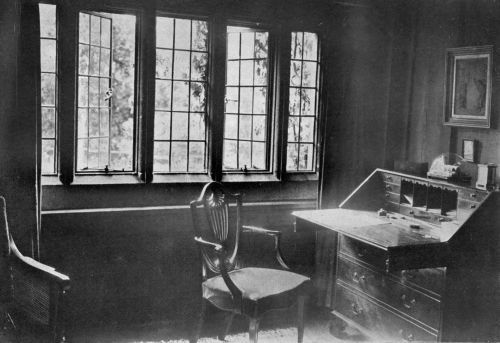
THE AUTHOR’S DESK
make a leat. The water used to pitch on a great rock and spread out over the front of that, whereas it now goes down behind this rock, except in heavy storms or floods, and there is little to be seen.
The new maps mark the hills as Tors, not Torrs. In examining old documents I have hardly ever seen the word written with a single r unless there was a mark above the r̃ to show that it was double: and I have never seen it with a single r when there was final e—invariably Torre, not Tore. Everybody now writes ‘Haytor Rocks,’ but it is a pleonasm, as ‘tor’ means ‘rock.’ The older people said ‘Arter Rocks,’ and I fancy they meant ‘Arthur Rocks.’ There is the legend of King Arthur’s encounter with the Devil there, and he gave his name to other high places, such as Arthur’s Seat at Edinburgh.
There is, of course, an etymology for Arthur’s Seat, showing that it has nothing to do with Arthur. There is also an etymology for Man-o’-War Rocks, showing that they have nothing to do with men-of-war. That group of rocks is on the north side of the Scillies—three rocks about 600 feet long and about 150 high—and from some points of view it looks uncommonly like a big three-masted ship with all sails set. The chances are against its having a Celtic name that could be corrupted into anything so suitable as Man-o’-War.
In dealing with the names of places, people are too fond of thinking that the etymology must be Celtic, if it is not Latin or Anglo-Saxon. Many of these names may go back to the times before the Celts arrived, and there was a population here whose language was probably akin to Basque. Of course, wild etymologists are not to be restrained by such considerations. One of them has gone to ancient Egyptian to get an etymology for Haytor, Reflections on names and places in Devonshire, p. 12, ed. 1845, “H’tor in the Phonetic Egyptian meant a house.” But this sort of thing is not confined to Devon. There is an exclamation ‘O popoi’ in Greek, answering to ‘Oh my’ in English. According to Lauth, Homer und Aegypten, p. 43, it is an invocation of Pepi, a king who reigned in Dynasty VI and built a Pyramid at Sakkarah.
Many places owe their present names to blunders. The Hebrides owe theirs to a misreading in Solinus, ‘hebrides’ for ‘hebudes’: they have no r in Pliny or in Mela or in Ptolemy. There is a bay called Morikambê in Ptolemy, geographia, II. 3. 2, on the western side of Britain; and on the strength of this the name of Morecambe was given to a place in Lancashire, although the place is only in the latitude of York, whereas Ptolemy puts Morikambê a whole degree further north. Until 1842, or thereabouts, the present Morecambe was called Poulton, or strictly Poulton-le-Sands to distinguish it from Poulton-le-Fylde, which is the present Poulton.
Teign Grace takes its second name from the Grace family, its owners six centuries ago; but people tell me that it really is Teignrace and takes its name from a race in the river Teign a little way below. There was no race there till 1863, when this branch line was begun. The railway blocked a wide curve in the river, and gave it the sharp twist that makes the race.
Kingswear is King’s Wear, yet I have heard it called King Swear; and I have also heard Kingskerswell called Kings Curse Well. (It is the part of Kerswell that was kept by the Crown, and Abbotskerswell is the part that was given to Torre Abbey.) But, apart from the pronunciation, the spelling may be misleading in such names as Kerswell, Ogwell, Loddiswell, etc. A well may often be the nucleus of a settlement in arid regions, but not in regions that are full of springs and streams; and in many of these Devonshire names the ‘well’ must stand for ‘vill,’ the ancient term for ‘village.’ As a matter of fact, the termination is spelled with an i in twenty-two cases out of twenty-seven in the Exeter manuscript of Domesday.
Domesday has nearly a hundred entries of places in Devon with names that end in ‘ford,’ but only two with names that end in ‘bridge.’ These are Tanebrige and Talebrige in the Exchequer manuscript, but the Exeter manuscript has Taignebrige and Talebrua; so the second name seems dubious. (The first, of course, in Teignbridge.) These terminations give a notion of the roads then, and sometimes also of the streams. A mile from here there is a place called Elsford, where there is not any ford nor anything to be forded. It is an old place, mentioned in Domesday as Eilauesford and at that time (twenty years after the Conquest) still in the possession of a Saxon thane. It stands on the edge of the table-land between the valleys of the Wrey and the Teign; and if there ever was a ford there, there must have been a little river running off the table-land and down into the Wrey along a gully in the hill-side, where there is hardly a trickle now.
There is a place called Yeo close by the Wrey, a Twinyeo at the confluence of the Wrey and Bovey, and another at the confluence of the Bovey and Teign; and both Twinyeos are Mesopotamias, being in between the streams. Yeo here means ‘stream’ or ‘water,’ as in Yeoford. But a yeoman is not a waterman—he is a land man; and there, I think, the ‘yeo’ is to be linked with ‘gau’ in German, not with ‘eau’ in French. There are traces of an Anglo-Saxon word like ‘gau’ for ‘place’ or ‘land’; and the g would easily become a y, as in ‘year’ and ‘day’ for ‘gear’ and ‘dæg.’
The old printers used a y to represent an obsolete th which was nearly of that shape, and people followed them in writing it, especially with ‘ye’ for ‘the.’ Parson Davy always did so; and his spirit, being summoned to a séance, discredited the medium by pronouncing ‘the’ as ‘ye’—a thing that no one did. We still use a z as an abbreviation in ‘viz’ for ‘videlicet.’ They use it in Dutch catalogues of bulbs, and one hears gardeners talking of Narcissus Poetz or Poetaz instead of Poetarum. But it may be better to pronounce the z than misinterpret it, like the people who made Barum and Sarum out of Bz and Sz, the abbreviated forms of Barnstaple and Salisbury. The z was also used in ‘lez’ for ‘legitur,’ a very useful term for anyone who had to put things down in Latin, and did not know the Latin names for them. Thus, on the Court Roll of Lydford Manor, 21 September 1586, “Humfridus Pitford queritur de Johanne Thorne et Maria uxore eius de placito transgressionis super casum. Attachiantur per quinque lez callacowe et hulland bandes tres lez handkerchefs et unum lez wollen wastecott. Et quia predicti,” etc.
Among the manuscripts at the House of Lords there are some returns that have not been used sufficiently in books on local history. In May 1641 a Protestation against all Popery, etc., was taken by the Lords and Commons, and in August it was circulated in the country. At the beginning of the following year returns were required from every parish, giving the names of those who had taken the Protestation; and many of these returns are at the House of Lords. I obtained copies of the returns for this parish and seven adjoining parishes, made an index to the names, and had my index printed in 1913 for private circulation. The return for Moreton parish does not say if anyone refused to take the Protestation, but the returns for the other seven parishes say that nobody refused: so these returns give a complete list of all the male inhabitants over eighteen years of age, that being the limit of age for taking the Protestation.
There were 411 in Moreton, 53 in Lustleigh, 150 in Hennock, 345 in Bovey, 139 in North Bovey, 77 in Manaton, 179 in Ilsington and 255 in Widdicombe. None of these people had more than one Christian name, and many had the same surname. In Widdicombe there were five-and-twenty men called Hamlin or Hamlyn, and six of them were Richard, four were Thomas and three were John. In Moreton there were twenty men called Bowdon, and four of them were John, three were William and three were George. They could easily have been distinguished by saying where they lived; but in only three cases was this done. In Hennock one of the two John Potters is ‘of Kelly,’ and one of the five John Wreafords is ‘of Nepton’; and in North Bovey one of the three John Nosworthies is ‘de Kindon.’
On the Court Rolls of Wreyland Manor one John Wills is distinguished from another as ‘of Eastawray’ in 1710 and ‘de Eastawray’ in 1714. In 1718 Jane Clampitt of Yeo is called Jane Yeo; and, going a long way back, a man is twice called John atte Yeo and three times called John Yeo at the same sitting of the Court, 30 April 1438. In course of time the ‘atte’ or ‘de’ dropped out, and a man was known by the name of the place where he was living, or the place whence he had come. That explains why these returns have so many surnames that are names of places not far off, or corruptions of such names. The surname Bunckum (in Bovey) is a corruption of Boncombe or Buncombe, the parent hamlet of that home of eloquence, Bunkum, in North Carolina.
Among the Christian names there is Hanniball in Ilsington and Bovey, and Methusalem in Moreton; but most of them are commonplace. Out of these 1609 men 342 are John—that is, roughly, two men out of every nine—while 173 are William, 152 are Richard and 147 are Thomas; so that half the total number had one of these four names. It must have been confusing; and, having only one name each, they could not be distinguished by combinations of initials, as is usual now when people have two Christian names or more. Second names were not quite unknown then—there was Henry Frederick Thynne, a Royalist in the Civil War—but the new fashion had not yet extended to these rustic parishes.
These returns do not support the view that parents had a habit of naming children after the patron saint of the parish. The patron saint is Andrew at Moreton, and Pancras at Widdicombe; but Moreton has only twelve Andrews, whereas Widdicombe has eighteen Andrews and only one Pancras. Pancras is a pleasant name that parents might use oftener: it drops so nicely into Panny, like Pontius into Ponty. But parents are strange folk. Pontius is equivalent to Quintus, and I urged a friend of mine to call his fifth son Pontius; but he went and chose a less historic name. A great-great-uncle of mine gave one of his sons the name of Ghibelline, which is historic but not often given at the font. I imagine he was feeling very anti-Guelph just then.
A child named Flood was christened Noah; and in after years his house was known to everyone in Bovey as the Ark. Quite recently a Wreyland child was christened Cesca. I asked the mother where she got the name, and she said she got it off the washing. She took in washing, and one of her families had a daughter named Francesca, who was usually called ‘Cesca and had her linen marked that way. And really you cannot object to Cesca unless you also object to Betty and other shortened names.
The Protestation of 1642 was soon followed by the Civil War, and at Christmas 1645 there was a Royalist force at Bovey and a Parliamentary force at Tiverton. Fairfax marched from Tiverton to Moreton, while Cromwell marched from Tiverton to Bovey by another road, and surprised and beat the Royalists there, 9 January. They lost 12 men killed and 60 taken prisoners besides about 350 horses. “It was almost supper time with them when our men entered the town, most of them at that instant were playing at cards, but our souldiers took up the stakes for many of their principal officers, who (being together in one room) threw their stakes of mony out at the window, which whilst our souldiers were scrambling for, they escaped out at a back-door over the river, and saved their best stakes.” That is what Sprigge says in his Anglia Rediviva or England’s Recovery, published in 1647. The story has been doubted, as it is told of other places; but it probably is true of Bovey. Sprigge was chaplain to Fairfax during this campaign, and thus could get at facts; and the story is also in a letter to Edmund Prideaux, M.P., written on 11 January, and printed and published on 15 January by order of the House of Commons, that is, within a week of the event. The letter says that the money thrown out of window was about £10 of silver.
Next day, 10 January, “the weather still extream bitter cold,” the forces at Moreton and Bovey “had a rendezvouz near Bovey,” and went on to Ashburton, whither the Royalists had retired. That is what Sprigge says; but one wonders why the rendezvous should be ‘near’ Bovey and not at Bovey itself, Bovey being on the road to Ashburton. It would not be between Moreton and Bovey, as there is no cross-road between, and one force or the other would have to go back the way it came. If it was the other side of Bovey, the Moreton force would merely follow the Bovey force along the road, and join it later on instead of joining it at Bovey. In that weather, “much snow upon the ground,” the open country would be barred: so I imagine that Fairfax and his troops came down the valley by the usual road to Bovey, passing through the end of Wreyland Manor at Kelly.
Wreyland never was disturbed. One sitting of the Manor Court is in the first year of Edward V and the next in the first year of Richard III: another is in the second year of Richard III and the next in the first year of Henry VII. The business of the Court goes quietly on, regardless of the murders in the Tower or the carnage upon Bosworth Field. John Merdon is amerced a penny under Richard III because he has not yet repaired his buildings that are tumbling down, and he is again amerced a penny under Henry VII because he has not yet repaired, etc.
However, Bosworth Field had its effect at Wreycombe, three miles further up the valley, the Manor of Wreycombe being restored to Robert Cary, son and heir of Sir William Cary, who had forfeited it on attainder for high treason twenty years before, 1 July 1465. He had quitted England to join Queen Margaret in waging war on Edward IV, and he was killed at the battle of Tewkesbury in 1471. The same thing had happened to Wreycombe once before. Sir John Cary was one of the judges who were attainted of high treason for declaring the Commission of Regency to be unlawful, and he forfeited his property, 1 August 1387. He died in 1395, and next year Wreycombe and other lands were granted to his widow. She was one of the Holways of Holway, and this was Holway property that she had brought to him on marriage.
Wreyland was once the property of John de Moelis; and he died in 1337, leaving two daughters and no son. Muriel was fifteen and Isabella was thirteen or more; and they became wards of the King, as their father held his lands ‘in chief,’ that is to say, at first hand from the King. The two girls married at once—not bad matches, but without the King’s consent; and then there was the usual fuss. On partition of their father’s lands, Wreyland was part of Muriel’s share; but there was a Fine of 200 marks to pay for marrying without the King’s consent. It was paid on 27 August 1337, and the King passed on the money to his son, Edward the Black Prince, who was then a boy of seven.
Things happened here in Wreyland Manor which seem trivial now that we have only the bare facts, as set down on the record of the Manor Court; but in real life the facts may have aroused such animosities that they would seem momentous then.—John More and Thomas Sachet have been cutting down trees on the Lustleigh side of the Wrey, thereby choking the stream so that it is overflowing on the Wreyland side and doing damage here. Henry atte Slade has been catching pheasants and partridges inside the Manor bounds. (Slade is just outside.) Ralf Golde’s pigs have been eating Ralf Wilcokes’ apples from the Feast of saint Christina unto the Feast of the Nativity of the blessed Mary. (From 24 July to 8 September.) Thomas Wollecote’s pig has been eating Thomas Ollesbrome’s apples, and Ollesbrome has killed the pig, though Wollecote has offered him twenty bushels of apples as compensation. In this case two issues were set down for trial: the offer of the apples, and the killing of the pig. Wollecote failed on the first issue, and did not proceed on the second—it may be that Ollesbrome had brought the pig into Court, as his defence was that he had not killed it.
That was the Fifteenth Century, and the Twentieth is not unlike it. In this present Century there were two men living in Lustleigh parish who have now gone away—men of assured position and independent means. One man lived in a valley, and the other on a hill-side just above; and one man had a garden, and the other had a dog. When the dog got busy with bones, it went off to the garden and carried out its burials and exhumations there. At least, that is what the owner of the garden said, and what the owner of the dog denied; and the contention was so sharp between them that one of them summoned the other before the magistrates at Newton to be bound over to keep the peace.
In a humbler state of life there were two old ladies who kept chicken; and whenever one of them fed her chicken, her neighbour’s chicken came over in a mass and scrambled for the food. It was a thing that chicken would naturally do; but she felt certain that her neighbour egged them on. One day she seemed to be in heavenly happiness, and she explained to me, “I be a-thinkin’ of that woman there, when I shall see her in the torments.” I asked where she was going to see that, and she answered with asperity, “Where be I a-goin’? Why, Abram’s bosom, o’ course.” Her thoughts were on the parable of Lazarus and Dives. People of her generation did not consider eternal life worth having without eternal punishment for everybody they disliked.
In country places little things seem big, as there is nothing big to dwarf them. I have seen a man throw down his work and come rushing across the valley, uttering imprecations all the way—as someone said of him, “could hear’n comin’ up a-buzzin’ like an aireyplain”—and it was only because he saw a trespasser, not a murder or a fire or anything else commensurate. In big towns they have newspapers coming out in fresh editions all day long, and placards of the news, and boys to shout it out; and they cannot quite ignore the ‘mysteries’ and ‘allegations’ and the ‘startling revelations.’ These may be trumpery enough and quite untrue, but at all events they do not set good neighbours quarrelling.
About the time of the Armistice I was going out to Hurston one morning, and overtook a rural postman on the way. He told me that the Crown Prince had been killed; and when I said I doubted it, he said he had seen it in two newspapers, and that was good enough for him. And he announced the news at every farm-house on his round. Ten days afterwards I went out there again, and overtook him as before. I mentioned the Crown Prince, but that bit of news had passed out of his mind, and he had other news (of course, quite true) which he was taking round with him that day. News of this sort does no harm. In such places there are people who have time to think, and they can see that news is not invariably true. An old man said to me, “They tell and tell, and I don’t hearken to no word of it, only what my son says as he’s see’d hisself, and he says the Bulgarians has landed at Ostend.” I suggested Kustendje, but he stuck firmly to Ostend.
On the morning of the Armistice I went down to Bovey; and the first things I saw were two flags flying at half-mast. I felt uneasy till I got there and learned the reason why. It was a very long while since the flags had been up higher than half-mast, and now they wouldn’t go any higher until the gear was eased; and somebody would be going up to see to that a little later on. In the streets I found the children waving every flag that they could get, German or Austrian as much as French or English; and later on I saw a great display of Russian flags at Lustleigh. On asking why, I found that someone had laid in a stock of Allied flags quite early in the War; but there had been a slump in Russians, and this was the unsold remnant of the stock.
Flags generally are ugly things, crude in colour and clumsy in design, and quite unsuitable for decorations. It is a glorious thing, especially in foreign ports, to see the White Ensign on a British man-of-war. The flag means something there; but it does not mean much anywhere else, and means nothing in mere decorations with national flags and signal flags all mixed together. Ships are dressed with flags because they have the flags on board, and nothing else so handy for display; but there is no sense in copying ships in towns, and hanging flags from what are called Venetian masts. In fact the celebrated masts at Venice look rather foolish now. They meant something when they carried the banners of the three Venetian states, Cyprus, Crete, and the Morea. Now they all three carry the Italian flag, and one would be enough for that. If it is flown on more than one, it might as well be flown on ten or twelve or twenty as on three.
Instead of putting up masts and flags in towns, people might take down the advertisements, just for a day, to celebrate some great event. That might make the streets look nice. But if they really must put something up, they might as least choose something that would be less dismal than a show of flags on a wet day. They might try wreaths and flowers in enamelled iron. I have seen daffodils like that, highly recommended for back gardens in large towns, where real plants will not grow. The leaves look green and fresh all through the year, and you bring the flowers out whenever you please, as the iron stalks are hollow and fit on to long pins between the leaves.
That kind of gardening tempts me. Such plants would never run wild or wither away or die, or do any of the other annoying things that real plants often do. I also find the automatic peacock very tempting. The real bird screeches, and gets up upon thatched roofs and digs itself in. But this is a stuffed bird with clock-work in it that puts its tail up for seven minutes every quarter-hour. No doubt, the topiary peacock is more restful to the eye; but it is slow of growth and needs much careful clipping.
If box and yew are clipped into the shape of kerb-stones and stone walls, such trees may just as well be clipped into the shape of domes and pyramids and other architectural things; but not, I think, into the shape of birds and beasts that might fly off or walk away. It is only a bad joke to make a plant look like an animal, and even good jokes pall when they take twenty years to make and go on for a century. I like these things in other people’s gardens where I see them only now and then, but do not want them in my own where I should see them every day.
In the Hall House garden I established two grass walks, crossing one another at right-angles, with hedges ten feet high and four feet thick made of clipped cypress and looking as solid as walls. I not only like the look of them, but find them very convenient—in one or other of those walks I can always be out of the sun or out of the wind, if either is too strong. The cypress is Cupressus Macrocarpa, which grows very quickly here; and if anybody wants to make a hedge of it, I should advise him to keep his hedge a little narrower at the top than at the base. With a very slight slope of the sides the rain runs down to the lowest twigs; but if the sides are bolt upright, the lowest twigs dry up and wither away, leaving an ugly hollow underneath.
A formal garden may be made to look as ugly as anything in Holland when the tulips are in bloom—five hundred tulips in a bed, all at the same distance from each other, and all of the same colour and size. Enamelled iron would be better than real flowers there, as it would give the full effect at which those gardeners aim. If formality demands entire beds of flowers of one kind, these might at least be flowers of varied colour and irregular growth. I use begonias for my box-edged beds here—double, single, frilled, all mixed together, scarlet, crimson, coral, salmon, orange, yellow, white—and (in my eyes) the beds have unity enough without too much formality. But all begonias are ungainly things; and ‘a blaze of colour’ generally means a mass of flowers that have few merits of their own. There are plenty of flowers worth growing for their grandeur or their grace; but people fill their gardens up with other sorts, just as they fill their houses with the books ‘without which no gentleman’s library would be complete.’ They merely grow these plants because most people grow them.
If there is to be a ‘formal’ garden, it should be next the house, as the house itself is all right-angles and straight lines that harmonize with walls of yew or cypress and kerb-stones of box. Conversely, the ‘wild’ garden should be far away; and the usual notion is that ‘landscape’ gardening covers the transition from the ‘formal’ to the ‘wild.’ I have a notion of my own that landscape gardening is like sitting between two stools. No doubt, a landscape painter may improve a landscape by omitting things that spoil the view or putting them in where they look right; and a landscape gardener can really cut things down or root them up and plant them somewhere else. He may thereby improve a garden that was naturally wild; but when he plans a ‘landscape’ garden, he usually gives it too much formality for nature and not enough for art.
In looking at landscapes by great painters, such as Claude Lorraine, you sometimes get an uncomfortable feeling of something being wrong, and then it dawns upon you that the hills and dales and rocks and streams defy the laws of Nature. In his Observations on Modern Gardening, which first came out in 1770, Whately treats real landscape in the same capricious way; and the question is, how far such licence is allowable. There is an engraving of Turner’s picture of the Temeraire, with some of the mistakes corrected. The sun is still setting in the east, but the tug’s mast is forward of the funnel, not abaft of it, and the Temeraire’s foremast looks taller than her mainmast, as it really would, seen from that point of view. But these corrections spoil the composition, with its series of ascending heights from the tug’s funnel to her mast and the foremast and the mainmast of the Temeraire. Turner understood ships very well, and knew what he was doing. But the Claudes and Whatelys did not understand geology, and blundered in an aimless way.
Whately declares that every ‘landskip’ is composed of ground, wood, water, rocks and buildings. In a garden “every species of architecture may be admitted, from the Grecian down to the Chinese”; but in a wider prospect there should be “no Grecian temples, no Turkish mosques, no Egyptian obelisks or pyramids,” though there may be “the semblance of an ancient British monument,” pp. 119, 120, ed. 1770. As for its construction, “the materials might be brick, or even timber plaistered over, if stone could not easily be procured: whatever they were, the fallacy would not be discernible.” It tempts me to construct a lath-and-plaster Stonehenge here.
On one point I agree with him, p. 159, “a chearful look-out from the windows is all that the proprietor desires: he is more sensible to the charms of the greater prospects, if he sees them only occasionally, and they do not become insipid by being familiar.” Nor is it prudent to rely too much upon a distant view. In a flat country you plant a belt of trees around your house and don’t care what your neighbours do: you are monarch of all you survey. But in a hilly country, such as this, you are at your neighbours’ mercy, unless you have a very large estate. Some neighbour may quite spoil your view by starting building or cutting timber or opening a mine a mile or two away. And you cannot plant him out. If you plant a tree to hide an eyesore, it hides it only from one point of view, and from other points it hides things you may wish to see.
Clipped hedges of yew and cypress look well almost anywhere, but best near dark green trees, cedar, pine, or fir. Evergreens are always better by themselves away from trees that shed their leaves, unless such trees are masked. I think the younger Pliny was right in growing ivy on his plane trees, and letting it run out along the branches and reach across from tree to tree, Epistolæ, V. 6. 32. He liked the dark green of the ivy with his bay trees and his clipped box bushes below, although he knew the ivy would ultimately kill the planes.
Planes were then the fashionable trees, as they gave the pleasantest shade. They were not introduced into Italy until about 400 B.C., and were not easily grown. The elder Pliny says that there were people who watered theirs with wine, Historia naturalis, XII. 4 (8). I never went as far as that with any tree, nor did my grandfather, although my grandmother always made a point of watering the myrtle with cold tea. No doubt, all plants have their appropriate food. I sometimes get the parings off the hoofs when a horse is being shod, and then I give my olive trees a feed.
I respect the elder Pliny as a man—his nephew has told us how his steady snoring could be heard amidst the thunders of Vesuvius, when everybody else was scared, Epistolæ, VI. 16. 13—but as an author he was not at his best. His nephew has described his ways: how he gave every moment of spare time to reading books or having books read to him, always making notes and extracts as he went along, Epistolæ, III. 5. But he did not always take things down correctly. Theophrastos says that the plane tree was rare (spanian) in Italy, Historia plantarum, IV. 5. 6, and Pliny has turned this into plane trees in Italy and Spain, Historia naturalis, XII. 3 (7). More than half of what he says of trees is copied out of Theophrastos, but he has interspersed it with his snippets out of other authors who were not always speaking of the same varieties. And thus he has created things that never have existed and could not possibly exist. At the end of an impossible tale, Gargantua, I. 6, Rabelais very justly says that after all he wasn’t as big a liar as Pliny, “et toutesfoys ie ne suis poinct menteur tant asseuré comme il a esté.”
The trees which shed their leaves are gorgeous with their autumn tints, and many kinds of them are graceful in the winter with bare boughs, especially just after snow. Writing at the window where I am writing now, my grandfather notes down, 3 January 1847, “Each flake takes up its position and there remains. I hope no wind will disturb it before I can go out and take a view of the country around: which I hope to do, even if it’s up to knees.” I feel that too; but bare boughs always remind me it is winter-time, and I might easily forget that dismal fact down here, if all the trees were green. If I were making a fresh start, I would surround myself with cedar and cypress, pine and fir, holly trees and bay trees, palm trees, yucca and New Zealand flax, Portugal laurel, arbutus, camellia, rhododendron, and other such trees and shrubs. The earliest kind of rhododendron (the Nobleanum) starts flowering here at Christmas. One of mine has nearly a hundred great red trusses of bloom now—January—and the red camellias are coming out. Sometimes on winter days the thermometer goes up to 90° in the sun; and there is seldom any great extremity of cold. My grandfather notes, 11 February 1855, “Thermometer at front door now 20°, such as I never remember seeing before.”
He noted thermometer, barometer, wind and weather, every day in books he kept for that, and every week he sent a copy to my father to compare with his own notes. But my father’s notes were very irregular, as he was often away, whereas my grandfather seldom stirred, at any rate in his later years (1840 to 1870) for which I have his notes. Also, my father met with difficulties that were unknown down here. Instead of the temperature on 11 September 1850 there is a note of “My thermometer stolen from the garden wall last night,” and no more temperatures for several days.
These notes, of course, were of no use except for forecasting in future years; and my grandfather at last perceived they were of very little use at all. He writes on 10 February 1860, “These phenomena used to indicate immediate storms, but really the weather has been such of late that all my old calculations and observations are gone to the winds, so now do not pretend to rely on any of them.”
Some of his prognostications had been lamentably wrong. He writes on 23 November 1851, “My mind tells me we shall have a deal of snow this winter,” and his record of the weather shows that there was practically none. As he says that his mind told him so, I suppose he was not consciously relying on his observations or his calculations here, though he could hardly have dismissed them from his mind. I think it came of the hereditary wisdom of old countryfolk. Their observations may be less exact, but there have been many generations of observers; and thus they form opinions that come true in nine years out of ten.
Mild winters often end with falls of snow in March or April—at any rate, it is so here—and this must be the basis of the saw, “A green Christmas, a white Easter.” My Grandfather quotes it on 28 December 1857 as “an old adage—I fear it may be too true.” On 12 January 1862 he writes, “How mild it is. Well, this verifies the saying of old that if the hawthorn and holly berries are plenty, be sure of a hard winter, but if none, a mild one; and there is scarcely a berry to be seen, even on our hollies which are generally so thick. When I was young these sayings were more general than now; and it is considered that the alwise Providence is mindful of the birds as well as man.”
The birds come down here from the bleaker country round the moor as soon as wintry weather sets in, and the ground below the hollies is red with berries that the birds have dropped. But this last winter (1922, 23) was so mild that no birds came, though berries were more abundant than ever was known before. In another such winter my grandfather writes, 25 January 1846, “I cannot find any of the old men I meet can ever recollect such a mild winter, so far. I have not yet seen a winter’s bird, not a fieldfare or starling or even a whindle [redwing] nor a covey of birds of any description: neither the linnet nor finch nor yellowhammer have congregated together as heretofore: they are all about singly as in summer. They do not appear to want the food of the barn’s door, the cornricks, or stable court, so far. Hope it is all for a wise purpose.”
Of course, there sometimes are hard winters here, as in 1907, 8 when almost all the birds were killed; and he writes, 14 May 1855, “Birds of all sorts are very scarce, the winter made great havoc of them: not a thrush to be heard nor a blackbird to be seen. I have not a robin in the garden.” But winters of that kind are rare.
With this climate and rich soil there is abundant produce from the land, but very little profit—on agricultural land of mine (apart from buildings) I have been paying close upon £3 an acre in rates and tithe and taxes. During the War the Food Controller found that milk could be produced for two pence a gallon less in the four Western counties than in the rest of England; so he imposed a duty of two pence a gallon on all milk sent out of these four counties, and thereby collected about £250,000. But the Law decided that the duty was illegal; and the money is being returned.
If milk can be produced so cheaply in the West, there ought to be more dairy-farming, and more land should be laid down to permanent pasture. But that is not a popular opinion now. Some acres will produce more food if they are ploughed than if they stay in grass, and perhaps the average acre will, but some acres certainly will not; and though the produce may be more per acre, it may be less per man employed. This is forgotten, and the cry is all for ploughing up. Experienced people will not go ploughing up their pasture; but power may be given someday to a Ministry or Board or Council, which has to lay down general rules and therefore takes the average case regardless of abnormal cases, such as the rich pastures here.
According to the Food Controller’s rules, milk could be produced much cheaper on one farm than on the next adjoining farm, if the county boundary happened to come between the two; and really there were places fifty or a hundred miles inside the boundary where it could not be produced as cheaply as at places just as far outside. No doubt, the line must be drawn somewhere, if there is to be a line at all; but such lines are merely nuisances when they do not represent the facts.