SMALL TALK AT WREYLAND (continued 3)
Reading edition
During the siege of Paris there was Aurora Borealis on the nights of 24 and 25 October 1870. I have never seen anything else so brilliant in the sky—the Krakatoa sunsets were nothing to it. A friend of mine was in Paris at the time, and his diary says:—“The colour was blood mixed with water.” People in London—myself among them—fancied that Paris was in flames, and that this was the reflexion in the sky. But, when the Communists did what the Germans did not do, there was no glare visible so far away.
Going from Calais to Paris on 15 August 1871, I noted in my diary that “the Prussians were still in possession of the station at Amiens”; and, returning on 11 September, “in passing St Denis, saw the Prussians packing their guns and ammunition on railway trucks, and preparing to evacuate the place.” The expresses were still made up with English carriages, as much of the French stock had been burnt.
Passing through Boulogne on 8 September 1873, I noted that “there were great rejoicings going on there on account of the payment of the Indemnity.” The final instalment had been paid on the 5th, and the army of occupation had begun its final move that morning, the 8th. It evacuated Verdun on the 13th, and crossed the frontier on the 16th. It had evacuated Nancy after the payment of the previous instalment on the 5th of August. And at Augsburg I noted in my diary, 12 August 1873:—“Drove to the Rath-haus, a fine old gabled building, internally in a state of great confusion, resulting from a banquet the night before to the Bavarians, who had just returned from the occupation of the French territory.”
From my diary, Nuremberg, 2 September 1874:—“The fourth anniversary of Sedan. The town in a state of utter excitement: every house with one or two banners (Bavarian or German), each several stories long, hung out from the upper windows, and wreaths of evergreens from all the rest; all the inhabitants either drinking beer or walking up and down the town without any particular object; bands of music marching about in a similar way. At ten I went to service at S. Sebald’s, which, large as it is, was crammed: quite three thousand people, I should think. Some chorales sounded very well when sung by so many: they were afterwards repeated by a band on the top of the tower, apparently for the crowd outside to sing to, but the crowd did not seem much taken with the idea, and merely listened to the band. Walked about looking at the decorations for a long time. The place could not have looked prettier, as the flags hid the houses, which are plain, and one could only see the roofs, the most picturesque part. Left Nuremberg at two, and got to Frankfort at eight: a very hot journey. All the stations were much decorated, and fireworks were going on at Frankfort. Drove through the Zeil to the Taunus station, and went by rail to Biebrich on the Rhine, arriving at half past eleven.”
I well remember that journey. I was going in the morning with my father, mother, brother and sister; but at the station we found that a bundle of umbrellas had been left at the hotel, and I was deputed to secure it and follow by a later train. And the guards and passengers were all very inquisitive as to how it came about that an English boy of sixteen should be travelling across Germany, all by himself, with no other luggage than a bundle of umbrellas.
From my diary, Freiburg, 2 September 1875:—“Great firing of cannon early in the morning to celebrate Sedan: the town pretty generally decorated with flags, but the inhabitants not so enthusiastic as the Nurembergers on the last anniversary.... Left Freiburg at half past twelve, and reached Strassburg at half past three.... The inhabitants either do not rejoice very greatly at Sedan, or do so very quietly.”
I was in Rome on 20 September 1876, which was the sixth anniversary of the taking of the city, and again on the same day in 1897. There was a parade of Garibaldians each time, and in 1876 it ended in some rioting. The citizens had done better with the Pope than they were doing with the King just then, and they had no kindly feelings for the people who had brought about the change.
Garibaldi had picked his men, and they looked firm and grim, giving one the notion that they would stick at nothing to attain their ends. As a rule, they did not look much like Italians; and in 1897 they made rather a display of their contempt for the little conscripts of the Italian infantry.
I saw Garibaldi several times in London; but the surroundings did not suit him, and he looked more slovenly than heroic with his dingy cloak and unkempt hair. He had a great ovation, when he made almost a triumphal entry into London on 11 April 1864. But he was in an open carriage, and the crowd was so very friendly and so anxious to shake hands with him, that at last they pulled the rumble off the carriage, together with the solemn footmen who were seated there. That happened in Pall Mall, and I did not actually see it.
I chanced to see another sort of entry into London on 24 March 1889. I was walking along the top of Trafalgar Square, and noticed an open carriage coming up from Charing Cross, followed by a shouting rabble. When it came abreast of me, I saw Rochefort and Boulanger sitting in it side by side, Rochefort with the air of a showman, and poor Boulanger holding a ridiculous bouquet and bowing to this mob. I think he wished himself back in his command, taking the salute.
Abdul-Aziz, the Sultan of Turkey, came to England in 1867, and was present at a review at Wimbledon on 20 July. He was riding along the ground with the Prince of Wales and the Staff, when suddenly a mass of well-dressed men broke through the barriers, and made a rush towards him. And then two squadrons of the Life Guards came down at a gallop, knocked over the leaders of the rush, and closed up round the Sultan. I was on the Grand Stand, and saw the whole thing admirably. The explanation was that the Sultan’s saddle-cloth was studded with diamonds, and the “swell-mob” thought that it could grab them. But it looked more like an attempt at assassination; and he must have taken it for that, judging by the way he managed his horse. However, he had nearly nine years more of absolute power before he was deposed and bled to death.
At one time or another I have seen a good many people of renown; but I have never seen anything more magnificent than the Emperor Frederick, when Crown Prince, seated on his horse and wearing the white dress of the Cuirassiers. He was grander even than the statue of Bartolomeo Colleoni.
I saw the Mahmal at Cairo on 11 February 1882. There was a vast crowd, and the Mahmal was received with a salute of sixteen guns, and the Khedive with a salute of twenty-one; but neither made so great a show as Arabi. On 2 February he had made himself Minister of War, and there was a notion that he would choose this occasion for making himself Khedive; but nothing happened then. I had passed through Tell el-Kebir on 4 February, and should have looked at it more closely, had I foreseen what would be happening there on 13 September. I sailed from Alexandria on 11 March, and never imagined then that there would be a massacre there on 11 June, and a bombardment on 11 July.
On the morning of the procession I saw the Mahmal saddled on its camel: after which the camel went out to meet the Mecca Caravan, and then marched into the city with the pilgrims, as though it had come all the way from Mecca. As a matter of fact, the Mahmal is nothing but a pair of panniers with a canopy above, such as women ride in when they make the pilgrimage, only more ornate. There is nothing whatever inside it. The story is that queen Sheger ad-Durr made the pilgrimage in very splendid panniers about the year 1250; and such panniers have been sent each year since then, though nobody has ever ridden in them. The procession was too straggling to be impressive as a whole, but some things in it were striking—particularly the Sheikh of the Camel. That holy man kept wagging his head from side to side, as if he wished to shake it off; and he was said to go on wagging it all the way from Cairo to Mecca and back.
I went to Siena to see the Palio in August 1898. It has not been vulgarized like the Carnivale, as it comes at a season when few people go to Italy.—In my opinion, people generally choose the wrong time of year for going there. To see Italy in all its glory, one must be there at the Vintage.
Strictly speaking, the Palio is the banner which forms the prize in a race of ten horses, representing ten of the seventeen wards into which the city is divided; seven of the wards being selected by rotation and three by lot. There are trial races on the 14th and 15th, and the race itself is on the 16th. It is run in honour of God and of the Blessed Virgin Mary, by statute of 17 June 1310; and the horses go to church before the race, and are blessed and sprinkled with holy water after certain prayers on their behalf.
The whole history of such festivals is given in Palio and Ponte by William Heywood, 1904. On looking into this, I found references to the Palio of 1898, and on plate 22 I found the top of my straw hat in the foreground of the picture. The hat is unmistakeable—built specially for me at Christys’ with wider brim and lower crown than was usual at that period.
Siena is still a mediæval city; and the race is run inside the city in a semicircular space enclosed by fine old buildings. But the race itself is not as interesting as the procession that precedes it. The city and its seventeen wards are represented by about 180 men, all in costumes of the Fifteenth Century, and the chief in splendid armour: the horses go with the members of the wards for which they run: the Palio is carried on a wagon in the middle; and the procession ends with the standard of the city on the mast of the Carroccio, the great wagon round which the struggle centred at that Battle of the Standard fought at Montaperto on 4 September 1260. I have seen as brilliant a sight with the bull-fighters entering the Plaza de Toros in procession—Madrid, 9 September 1877—but this was more impressive with its stately movement round that venerable place, the deep notes of the ancient drums and trumpets, and the great bell—the Campanone—roaring in its tower.
From my diary, Antwerp, 20 August 1872:—“Saw the Procession of the Giant from a house in the Rue de Chaperon. This procession takes place every third year on the last day of the Kermis: it commemorates the killing of a giant who held a castle on the banks of the Scheldt. First came an immense figure of a dolphin.... Then a basket-work figure of the Giantess, about twenty-five feet high: seated and holding in one hand a spear and in the other a shield with the city arms. Then the Giant, another figure of the same sort: in armour and carrying a club and sword.”
The procession was performed out of due season on 19 September 1843 for the benefit of Queen Victoria and Prince Albert; and they went afterwards to the studio of Gustaf Wappers, and commissioned him to paint a picture of it. The picture is in the King’s collection, and is engraved in Hall’s Royal Gallery of Art. It depicts three ladies at an open window, looking down on the procession as it passes through the Place de Meir, the Giant in the middle distance, and the Cathedral spire in the background. I have the preliminary sketch in oils; and this gives a second window, showing the palace in the Place de Meir, and the royal party on the balcony.
The three ladies in the picture were the painter’s wife and her sisters. They were the daughters of John Knight, a brother of my mother’s mother, and thus were cousins of mine. John Knight was paymaster of a battalion of the King’s German Legion from 1814 to 1816. He was with his battalion at the battle of Waterloo, and after the campaign he married the beautiful (and wealthy) daughter of the banker through whom he drew the pay at Brussels. The marriage brought him into contact with large financial interests on the Continent, and he settled at Antwerp as a banker; and there he made the acquaintance of Wappers. I remember Wappers very well. In his later years he lived in Paris, and I used to go to his house there. He had been a success as a painter, had been made a Baron, and so on; and was altogether very well contented with the world. He died in 1874.
Amongst other things by Wappers, I have a portrait in pencil of my great-aunt Mary Knight, signed and dated 1843, and a portrait in oils of Charley (a King Charles spaniel) signed and dated 1849 with inscription to “oncle Chᵗ Knight,” that is, his wife’s uncle, my great-uncle Christopher Knight, the owner of the dog.
The dog’s portrait hangs here next its master’s, a big three-quarter length in naval uniform with medal and clasps and the K.H. This portrait of him came to my mother after his decease, and was hung in the dining-room of our house in London. There happened to be a dinner-party soon after it arrived, and some of the guests were rather finding fault with it both as a work of art and as a likeness of the man, when unexpectedly a little voice proclaimed:—“I painted it.” It was the voice of Frederick Havill, a painter who had met with some success, but was a long way from achieving greatness. They had all forgotten who the painter was; and on finding they were face to face with him they discovered many merits in his work.
This old Captain Knight was on the Impregnable at the bombardment of Algiers, 27 August 1816, and next day he did a conscientious drawing of the ship, showing all the shot-holes in the hull and the damage to the rigging. I have it here, with two other water-colours that he did then. One of them shows the ships taking up their positions for the bombardment, the Queen Charlotte carrying Lord Exmouth’s flag as Admiral of the Blue: which flag, now nearly black, may still be seen in Christow church, about five miles from here. The other shows the bombardment in progress—clouds of smoke with the Impregnable and the Rear Admiral’s flag just showing through.
As works of art these water-colours are of little merit, but probably would please such critics as James on Turner’s Battle of Trafalgar, Naval History, vol. 3, p. 473, ed. 1902:—“The telegraphic message is going up, which was hoisted at about 11.40, the mizentopmast is falling, which went about 1.0, a strong light is reflected upon the Victory’s bow and sides from the burning Achille, which ship did not catch fire until 4.30 ... and the Redoutable is sinking under the bows of the Victory, although she did not sink until the night of the 22nd, and then under the stern of the Swiftsure.” He was on the Minotaur at the bombardment of Copenhagen, 5 September 1807, but made no drawings then.
Instead of drawing what they saw—which might be interesting now—people used to occupy themselves with copies; and I have inherited many portfolios of these uninteresting things. But there are copies after Prout by my mother’s sister, Emma King; and, on comparing one of these with its original, I found wonderfully little difference. Many of Prout’s best water-colours went into the collection of the late Martin Swindells of Bollington; and he lent them to my aunt to copy, while she was staying at a house near there. It must have been between 1850 and 1858, but I do not know exactly when. There are a dozen of them framed and hung here.
I once did a water-colour that I thought worth framing; but friends said such unkind things about it, that I took it down and put it in a drawer. It was meant for the apse of a cathedral—no cathedral in particular, though I suspect I had Toledo in my mind. Looking at it thirty years afterwards, I fancied that it was not such a failure after all—unquestionably, some parts of it were excellent: so I took it out again, and hung it up. And then the friends explained to me:—“The picture’s just as bad as ever, only your eyesight has got worse.” I took it down once more.
In a letter of Edward Knight, my great-grandfather—I have seen the letter, but have not got it here—he speaks of meeting the Prince Regent at a dinner at Brighton, “and H.R.H. was pleased to say that Eliza was an uncommon pretty girl.” Eliza was my grandmother; and she must have been uncommonly pretty, if she was really like a miniature of her by William Wood that I have here. I have drawings by Stroehling of her brother Joseph Knight and of her husband H. T. King—my maternal grandfather—and Joseph had fine features then, though in old age (when I remember him) his nose suggested port. I have been told that he was one of the three best-looking men in London in his time, and that Byron was one of the other two, but I cannot remember who the third was. I have also been told that there were letters to him from Byron, and they fell into the hands of one of my great-aunts; and she destroyed them as “things that no right-minded person would desire to read.”
In my library there are many volumes that belonged to these great-aunts; and they are just the books that all “right-minded” persons would desire to read. There are three editions of Pascal’s Pensées and none of his Provinciales; and there are five Tassos to one Dante, and that one has nothing but the Paradiso.
The last of these great-uncles and great-aunts lived on till 1886. I remember several of them in my earliest years, especially at Cheltenham; and, when I first read Cranford some years after that, I felt that I had met the characters before. Cheltenham was perhaps more opulent, but the people were the same. They were full of genuine kindness, but incredibly slow and ceremonious, always giving precedence to the wife of my great-uncle Joseph, because she was the daughter of a Peer. I can hardly imagine people of that type except in shaded drawing-rooms with china bowls of rose-leaves; yet some of them had figured in less tranquil scenes.
As a lieutenant in the 15th Light Dragoons—now 15th Hussars—my great-uncle Edward Knight was in command of Sir John Moore’s escort at Corunna. He was close by, when Moore was hit, and he helped to bury him, 17 January 1809; and in after years he inveighed against the celebrated poem on the Burial. It was not like that, and “had no damned poetry in it.”
He went through the rest of the Peninsular War; and, as a major, he took over the command of the 11th Portuguese Dragoons at the battle of Vittoria, 21 June 1813. He received the gold medal and several foreign decorations, and retired with brevet of lieutenant-colonel. His brother Henry Knight went through the whole of the Peninsular War, 1808 to 1814, as paymaster of the 5th battalion of the King’s German Legion; and he was at the battle of Waterloo, 18 June 1815, as was his brother John Knight, then paymaster of the 2nd battalion. They were both in La Haye Sainte; and the position was shown me carefully, when I visited the battlefield, 13 August 1868. The buildings had been loopholed; and I was told that it was very unpleasant inside, when the enemy put their muskets through the loopholes and began to fire in.
John and Henry had the Waterloo medal, and Henry also had the Gwalior star, as he was at the battle of Punniar, 29 December 1843. He was then in the 9th Lancers, to which he was transferred in 1819. He was with his old battalion at the taking of Copenhagen, 7 September 1807; and curiously his brother Christopher Knight was there also, as a midshipman on the Minotaur.
These four great-uncles of mine saw a great deal of hard fighting without ever being wounded; but I find it recorded of Christopher at the bombardment of Algiers, 27 August 1816, that “the gallant officer had the misfortune to be severely contused.” When the old wooden ships were hit by heavy shot, great chunks of wood came flying off inside; and, if you were hit by one of these, you were not wounded but contused.
Edward had a son Godfrey Knight, a captain in the 64th—now Staffordshires—who was in the Indian Mutiny and Persian War. When he came to stay with us, his anecdotes outshone Aladdin and Sindbad in my youthful mind: the Jinn seemed tame beside the Gwalior Rebels as described by him. And he loomed up pretty large himself, when I saw him in his uniform with medals and clasps. He wore the long whiskers of that period with eye-glass and moustaches; and the eye-glass seemed to be a fixture, but in an action in the Mutiny, “unfawt’nately I dwopped my glass, and the demm’d Pandies nearly got me, haw!” He died at sea on his way out again, 24 August 1862. Troop-ships still took three months on the voyage, going by the Cape.
Amongst old letters here, I found one from a distant relative, Lucknow, 1 May 1857:—“The Bengal Army has been in a sad state lately owing to an idea that Government were issuing cartridges in the making up of which cows and pigs fat was used, the mere handling of which (to them) impurities would destroy their caste. From what I have heard from excellent authority there is no doubt of some objectionable material having been used, and it was shameful of the Government attempting to issue them. I was told by our Brigadier (but as a secret) that the propriety of doing so had been canvassed in Council, so whatever happens lies on their shoulders. I could hardly have believed any old Indians would have been so foolish. The matter is now dying away, and the men practising at the Enfield Rifle schools have ghee served out to them to grease the wads.” On 30 May the Mutiny reached Lucknow. His horse was shot under him that evening, and the Brigadier was killed not two yards off; but he came safely through the Siege.
There are many letters from my old nurse. After leaving us, she went into the service of a family in France. She writes to me from Sully, 25 January 1871:—“I must begin by telling you of our flight. I am writing in a very old castle on the borders of the Loire. The marquis, thinking we were in danger, sent us off here; there were three carriages, all the horses, and the pack of hounds. We had to pass thro’ a black forest at night, we were stopped from time to time by French guards; they looked terrifying on horseback with their long white cloaks. You may guess that we did not arrive at the end of our journey without sundry frights. We are with a friend of the family, and have been here more than two months, and no means of leaving.
“The castle is surrounded by water, two of the towers are in complete ruins, what is left of them is covered in ivy. The part we inhabit is in good condition, the rooms are very ancient, the walls and the ceilings are fresco, the dining-room is hung with tapestry, also the best bedrooms, the staircases are of stone, ropes passed thro’ iron rings in the walls supply the place of banisters, the walls are five feet thick; it will stand the cannon of the enemy, I have no fear in this good old place. The picture gallery is very interesting to visit, of course all family portraits, at the end of that is the old theatre; it is now converted into an ambulance for the wounded.
“We had been quiet a few days when the terrible battle of Bellegarde began not far from here, the poor wounded soldiers both French and Prussians were brought here in carts; the first two days they were about fifty and increased in number every day. It is well for your tender heart that you were not here, you could not have endured to witness their sufferings.
“Now for another scene we had General Bourbaki with his army encamped before the castle. How I wished you were here then. I looked out of my window, the moon was in its full, showing its bright light over the scene, the whole of the park was covered in tents, among the trees we could see the fires and the soldiers sitting around them in their different costumes; they had with them 150 cannons all arranged in order ready for an attack.
“The next morning was the worst of all; the Prussians were making for here on the other side of the Loire. The first thing the General thought of doing was cutting their march, so he ordered the bridge to be burnt. We watched the arrival of the enemy, and quite enjoyed their disappointment at finding themselves the wrong side of the river. They fired over here, I did not feel very brave that day. This last week they have been firing on the castle; there is no danger for us, the walls are thick enough to resist.”
She writes again, 6 February 1872:—“We have been staying a few days at the Château of Sully. I enjoyed the visit more this time, we could walk about without fear of the Prussians.... Maréchal de MacMahon with his son, a very nice boy, has been here for a few days shooting.” There is much praise of MacMahon in her letters: he is kind and good and brave and noble, and he comes round to the nursery and tells the children tales.
She left our house when I was old enough to do without a nurse; but other servants never left, unless they were going to be married. Ann came to us when she was sixteen, and stayed till she was sixty-three, when she retired on a pension. In another household her sister Betsy did the same. They were both past ninety, when they died; and so also were Mary and Martha, who were fellow-servants with Ann. I went to tea with Mary on her ninety-fifth birthday; and she sang “I’m ninety-five,” a song well known in earlier times.
In their later years they lived a good deal in the past. At some dinner-party at our house in London the soup was handed round as mock-turtle, whereas it was real-turtle, and Mary was proud of having made it. She never let the others hear the last of that. There was to be another party there, for which great preparations had been made. But, as Ann told me quite angrily, “on the very morning of the party, King William went and died, and the party had to be put off, and all the things were spoilt.” And she was very cross about it still.
There were illuminations for Queen Victoria’s wedding; and the house was decked with night-lights in little globes of coloured glass. Ann put them carefully away, and brought them out in 1887 for the Jubilee. There were illuminations for the wedding of the Prince of Wales; and I had a night out, 10 March 1863. At the top of Trafalgar Square a wheel of our brougham got locked into the wheels of another carriage; and it was impossible to lift them clear, owing to the pressure of the crowd. We stayed there for hours.
The illuminations in 1863 were things that people would not look at now. There were gas-pipes twisted into stars and monograms and crowns, with little holes punctured for the gas: there were some transparencies, mostly with oil lamps behind; and there were a few devices in cut glass. The crowd was feebler also. People say we are degenerate now, but I think it is the other way: some of the worst types seem to be extinct.
We moved into a new house in London on 23 June 1864, and I meant to celebrate the jubilee by moving out on 23 June 1914, but was not ready then, and did not finish my move till 23 November. Being newly built, the house had a hot-water cistern in the bath-room, fed automatically by the kitchen boiler more than forty feet below. That was a novelty in 1864; and, when people came to call, they went upstairs to look at it, and could not make it out. A gifted Fellow of King’s was quite disturbed about it till he thought of Heracleitos and the maxim Panta Rhei, and that enabled him to place our cistern in its true position in the Universe. Of course, these people knew that hot water was lighter than cold, and would go up while cold went down, yet were unable to follow the theory into practice. I have noticed the same thing several times, when going to Gibraltar by the P. & O. People on board have said the clock was being altered because we were going south. They knew theoretically what the reason was, but could not apply their knowledge.
A good many of the people here are of opinion that the Earth is flat; and I do not know of any simple and decisive way of proving it to be a globe. I failed miserably with Aristotle’s argument (De Cælo, ii. 14. 13) from the shape of the Earth’s shadow on the Moon in an eclipse. They very soon showed me that they could cast as round a shadow with a platter or a pail as with a ball of wool. And this, I imagine, was the reasoning of Anaximander and those others, who suggested that we might be living on the flat surface of a cylinder or disk.
There is the Horizon argument; but that is not for people living in a region of high hills, where no horizon can be seen. And the Circumnavigation argument is answered in this way:—In thick mists on the moor you think that you are going straight on, but you always go round in a circle till you come back to where you were before. The other arguments are too subtle to be grasped at all.
When people have come up for their first visit to London, I have seldom found them much impressed with the big public buildings. They have seen photographs, generally taken from some favourable point of view: so they know what to expect, and the reality is not always equal to their expectation. The buildings that impress them are the private houses at the West End. The houses may not be finer than they had expected; but it is the cumulative effect of street on street and square on square of large and wealthy houses, stretching out for miles in all directions.
A country cousin coming up to stay with me in London, I made out a list of sights that should be seen. Besides these sights, she saw a fire at a house close by. There were lots of engines and escapes, and I felt rather grateful to Providence for making this addition to my list; but I felt less grateful three nights afterwards, when Providence added a burglary, not at a neighbour’s house, but at my own.
In chatting with a small boy who was staying here, I was telling him about the fig tree, and showing him that on the outer parts the leaves had five lobes each, but further in (where they received less light) the leaves had only three lobes, and in the densest part they had only one. He listened very attentively, and then he went indoors, and said to everyone he met, “I know all about fig-leaves.”
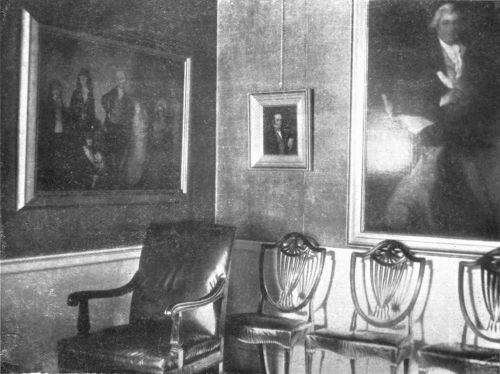
THE PICTURES WITH THE DOG (p. 36), IN THE LOWER PARLOUR (p. 50)
Writing to my father while my brother was on a visit here, 6 June 1852, my grandfather says:—“I was talking to him yesterday about his lessons. He asked if Papa used to learn his book well. I said he was a very good boy to learn, and did not think of play until he had learnt his lessons, which had a good effect on him now he was a man; and I hoped he would try to make even a better man than his Papa and to know more and to do more. It then dropped, and I did not expect to hear any more about it, but this morning he asked me if his Papa ever swallowed a fourpenny piece. I never dreamt of his motive for putting the question to me. I said No, then he said That is one thing I have done more than Papa.”
In their childhood my brother and sister and their friends were fond of acting plays of their own writing; and they had to study each other’s feelings, lest the parts should be refused. She writes to him, 13 October 1858:—“I have quite finished two scenes, but I must alter the third, as you were to be killed in your sleep, which I know you would not like: so you shall fight with the guards, and they shall kill you after a long struggle.” I have several of these plays in manuscript; and there is no end of killing. With a death-rate of 2 to 3 per scene, each actor could take several parts.
I took a little boy one afternoon to his first Pantomime at Drury Lane. We were sitting in the stalls, and the seats were rather low for him, so I folded up the overcoats for him to sit upon. This brought his head up level with the other people’s heads, and it also brought his right foot level with the calf of my left leg. When anything pleased him, he gave me a little kick to show that he was pleased; and he was pleased with almost everything. I went home very lame.
A generation later on, that little boy’s little children were staying with me here; and I felt rather flattered at hearing that I was mentioned in their prayers each night. But I felt less flattered afterwards, when I discovered that my name came in between the donkey’s and the cook’s. Those children used to get a lot of jam upon their fingers, when they were at tea. One afternoon I heard one of them telling the other, “Nurse says we mustn’t touch the banisters, because we’re sticky.” And then I heard them go upstairs on all fours, wiping it all off upon the carpet. At times they were exacting. I do not object to being a horse, or even a great grizzeley bear—I know what is expected of me then. But I do object to being a crocodile, if a crocodile is expected to lurk underneath a sofa, and snap at people’s legs.
There were some other children, who were friends of mine and also of a bishop, who was an old friend of their father. One day they told me, “Bishop’s coming to-morrow.” And thoughtlessly I said, “Give him my blessing, then.” Next time I saw them, they said in rather a puzzled way, “We gave the bishop your blessing, but he didn’t seem quite to like it.”
My acquaintance is not limited to children. There are not many lexicographers about; yet I number two of them among the friends who come down here to stay with me. One of them has dealt with Chinese, and the other with Egyptian hieroglyphics.
In my earlier years I heard a good deal of the Pre-Raphaelite movement, as embodied in William Holman Hunt. When he was painting his Eve of St Agnes in 1847, he wanted a couple of blood-hounds to complete the picture. Meeting a couple in the road, he tracked them to their lair, which was the house of John Blount Price, an old friend of my father’s and god-father to me. He lent his dogs, and thus began a friendship which lasted till his death in 1889.
My portrait was painted by Emily Holman Hunt in 1868. She was William’s sister, and had acquired all his mannerisms. My hair sticks out like wrought-iron railings round my head; and I have my old nurse’s authority for saying that I never wore such an ill-starched collar in my life.
There is also a water-colour of his here, which looks like the estuary of the Teign near Newton. I asked him if it was, 7 February 1909, and he told me that he remembered doing it while on a walking-tour in 1860, and it was somewhere between Falmouth and Exeter, but he was not certain where. He sketched the scene by moonlight, and put notes in pencil of the colouring of the various parts; but he did not rub the pencil out when he put the colours on, and now these notes show through the colouring. He said he knew they must come through in course of time. Unless they had, I should never have guessed what tint would be described as dusky pink.
On hearing people talk of the Pre-Raphaelite movement now, one wonders if they realize how thoroughly Post-Raphaelite the world was, when that movement started (1848) and for long years afterwards. Here is an extract from my diary, 22 August 1874, on my first visit to Dresden. I was only sixteen then, and have never been a judge of pictures, though they have always interested me; but I think it gives the point of view from which most people saw things at that time. “To the picture-gallery in the Zwinger, and at once went to the Sistine Madonna, which has a room to itself at one end of the building. After seeing many bad or indifferent copies of a picture, it is difficult to appreciate the original at once: it is certainly a most wonderful production, and, as a painting, far surpasses anything I have yet seen, but, as a composition, I do not like it so much as Titian’s Assumption or Murillo’s Immaculate Conception.” [I never understood the composition till I did what very few people take the trouble to do—went to Piacenza, 7 August 1898, and looked at the church of San Sisto, for which the Madonna was painted. On seeing the rectangular windows and their curtains, I understood the composition at once.] “Then went to Holbein’s Madonna, a Dutch lady in black velvet and frills: not very impressive after Raphael’s. The other principal pictures are Correggio’s La Notte, a wonderful composition of light and shade, Titian’s Tribute Money, Carlo Dolce’s Christ blessing the bread, and Battoni’s Magdalene.”
People care no more for Pompeo Battoni now than they cared for Botticelli then. The fashion is all the other way; and concessions must be made to fashion, even in a picture-gallery. And in most collections now the later works have been displaced by early works, almost always inferior in execution, and very often inferior in conception also. At the Uffizi the works of Botticelli now have a room apart; but for many years after I first went to Florence the Birth of Venus was hanging in the outside corridor, and did not even get a star in Baedeker.
In his essay on Botticelli, written in 1870, Walter Pater termed him “a secondary painter,” yet found so much in him to praise, that people hardly noticed this. And that was the beginning of the craze, at any rate in England. I knew Walter Pater, and always found him much more level-headed than people might imagine from his style of writing. And he had no illusions here. It is just the old story:—Wilkes never was a Wilkite.
All my earlier views of art were dislocated by the opening of the Grosvenor Gallery, 1 May 1877. By that time I had seen all the great galleries of Europe, except the Hermitage, and thus had material for forming an opinion, though the opinion may have been quite wrong. Anyway, I recognized there a style of art that certainly was great, and yet could not be classed with the Old Masters or the Modern Painters, or even as Eclectic. The style is hackneyed now; but in 1877 the Days of Creation was as great a surprise as Sartor Resartus in 1833 or Pickwick in 1836. Carlyle and Dickens were established long before my time, and were suffering then from imitation; and I could not see the reason why those books were praised so lavishly by the people who read them when they first came out. And now the younger generation cannot understand such praising of that picture and the others that were with it. This generation has grown up in a sort of “greenery-yallery” Grosvenor Gallery, and has never had to face the pea-greens and vermilions of the past.
Art has made strange moves since then. Personally, I am always glad of the impressions of a mind that is brighter than my own, but I do not want the impressions of a mind that is still duller; and I get impatient, when the dull mind goes with a clumsy hand, so that the artist cannot even give me such impressions as he has. When honest critics praise such work, I fear their minds are very dull indeed.
As an executor I was concerned in putting a memorial window into a country church. A relative wished for copies of the figures by Sir Joshua Reynolds in the west window of New College chapel at Oxford. There are only seven there, and this window needed nine. I thought the objection fatal; but the purveyor of stained glass replied “Oh no, not at all: we can design you two to match.” He did design them, and they matched his copies of the other seven, the copies being quite unlike the originals.
At the eastern end of Rochester cathedral there is a memorial to Dean Scott, with a gigantic Alpha and Omega on each side of the altar. As he was Dean Liddell’s partner in the great Greek lexicon, the double entendre is rather neat.
One sees trophies everywhere of captured flags and guns and other instruments of war; but the neatest trophies that I ever saw, were both at Petersburg. In the Preobrajensky cathedral there was a row of keys of captured cities, hanging up on pegs with little brass labels for the names. These came from conquests in the East; and in the Kazan cathedral there was a similar row of keys of captured cities in the West—Utrecht and Rheims amongst them.
The first time that I went over Rheims cathedral I noted in my diary:—“The exterior roof is a considerable height above the interior vaulting, and is supported by wood-work enough to burn down half-a-dozen cathedrals.” That was written on 30 March 1875, and it disturbed me in September 1914, when I heard that the Germans were bombarding Rheims, and the cathedral was on fire. The exterior roof was burnt and all this wood-work with it, but the vaulting stood the strain.
Writers on architecture do not always go to see the buildings they describe. Fergusson gives a plan, section and elevation of the church at Lodi on pages 50 to 52 of his History of Modern Architecture; and he describes the church as the earliest and best type of its class, and the only remarkable church now extant which was wholly by Bramante. On the strength of this I took the trouble to go to Lodi, 28 September 1899, in order to see the church. But it did not correspond to the designs in Fergusson. I found out afterwards that Bramante’s designs were never carried out, and the church was by Battagio.
I just missed seeing the celebrated crane upon Cologne cathedral. I went there first on 28 August 1868; and it was taken down about three months before that, after standing there on the stump of the spires for about 400 years, waiting for work to be resumed. I looked with admiration on the design for the spires, a fine old Fifteenth Century drawing—the architect sold his soul, and the Devil drew this in his blood. But the Devil had the best of it, as the spires have ruined the cathedral, being out of scale with all the rest.
Before the present Law Courts were begun, the rival designs were exhibited in sheds in Lincoln’s Inn Fields. I went to see them several times; and, speaking from memory, I should say that every one of the designs was better than what was built. But that was not the architect’s fault: he had to accept suggestions from all manner of people, each thinking only of one thing, and not considering the building as a whole. When the old Law Courts were pulled down, and the exposed side of Westminster Hall received its present screen and buttresses, a committee ruined the whole thing by forbidding the architect to carry up the little towers at the Palace Yard end—an integral part of his design. Once only, so far as I know, has such interference ended in success. Scott designed the Foreign Office block of buildings in the Gothic style; and his design may be seen in the Diploma Gallery of the Royal Academy. Palmerston could not stand Gothic, and Scott converted his Gothic to Palladian. Looking down Downing Street from the further side of Whitehall, one sees that he achieved what Linton and Turner only dreamt, when they painted their ideals of ancient Rome and Carthage.
The present Law Courts were not opened until 4 December 1882. That was six months after I was called to the Bar; and I have spoken in the old Chancery courts that have now been pulled down and forgotten—the two courts for the Vice Chancellors, that stood where there is now a lawn just inside the gateway leading into Lincoln’s Inn from Chancery Lane, and the court of the Master of the Rolls, on the other side of Chancery Lane on the site of the north-west corner of the present Record Office. I never spoke in the old Common Law courts at Westminster, but remember trials there long before I was a barrister.
I once spent a whole day there listening to the Tichborne case, and found it rather dull. But the Claimant was a sight: he was so corpulent that they cut a large semicircle out of the table to enable him to sit at it, and even then his waistcoat bulged out above the edge.
The trial in Pickwick seemed more possible then than now. I once heard Dickens read that chapter out. I am not certain of the date, but fully thirty years after he had written it; and he was no longer the same man. It fell rather flat. As a rule, authors should be read, not seen. I used to read Browning with interest and respect, if not with pleasure, until one afternoon I saw him running after an omnibus at the end of Piccadilly; and I could not stand his loftier poetry after seeing that.
Many years ago, during a Salisbury administration, I was in a train on the Great Northern, sitting with my back to the engine in one corner of a carriage, and at Hatfield a bishop got in, and sat with his back to the engine in the other corner. There was nobody else in the carriage, and he must have forgotten that I was there, as he started talking to himself. Apparently, he had been recommending some one for preferment, and now had qualms of conscience as to what he had been saying. “I said his preaching was admired by competent judges.” Pause. “Well, so it is. **** admires it, so does ****, and they’re competent judges. I didn’t say that I admired it.” Long pause. “I said he was a convinced Christian.” Pause. “Well, he is convinced. I didn’t say he wasn’t quarrelsome.” I thought it time to make my presence known.
Amongst the letters here I found one to my father from myself, Trinity College, Cambridge, 17 November 1877:—“I saw Darwin made a Doctor in the Senate House to-day. Huxley and Tyndall and the rest of them were there; and there were two stuffed monkeys—one with a musical-box inside it—suspended from the galleries by cords and dangled over Darwin’s head.”
The present Master of Trinity was headmaster at Harrow, while I was there. In his study one afternoon he was adjusting the accents on some of my Greek verses; and at last, pointing to a misplaced circumflex, he asked me how that could possibly go there. I answered him quite honestly that I didn’t know and didn’t care. It was rather a risky thing to say to a headmaster; but in the evening I received a parcel, and found it was Dean Stanley’s Life of Arnold—“C.T. from H.M.B. Harrow. Novʳ. 4. 1875.” I suppose my candour pleased him. I know he was quite snappish at my telling him that I put enclitics in for emphasis, when obviously I put them in to make my verses scan.
It was in my time at Harrow that Forty Years On was written and composed; and I helped to sing it at the concert on Founder’s Day, 10 October 1872, which was the first time it was sung in public. Forty years seemed a very long while then, and does not seem much now; and I see more meaning in “Shorter in wind, though in memory long, What shall it profit you that once you were strong.”
For many years I wasted time in trying to play the piano, until at last I saw that I should never play effectively, and then I gave it up. Curiously, my grandfather went through this process with the flute, though I never knew it till I found a letter of his just now:—2 April 1843, “I once had a great wish to learn the flute, and attended to it, and learnt all that was necessary, but could not make any advancement for want of an ear for it. I could play a tune by notes, but not give it that pleasing air that others could, for want of an ear. Therefore I considered it was time badly spent, and dropt it.” I think the fault was with the fingers more than with the ear. Had the ear been altogether bad, our bad playing might have pleased us.
My father had no ear at all for music, yet went to Oratorios, and slept comfortably through them all, except Haydn’s Creation with its disturbing bursts of sound. At the Opera he kept awake, as that was something more than music; and for some years he went pretty regularly—five-and-twenty times in the season of 1853, and so on. But he cared less for such things as the première of Berlioz’s Benvenuto Cellini on 25 June 1853, than for the spectacle on 19 April 1855, when Napoleon III and the Empress Eugénie came there with Queen Victoria. The best spectacle I ever saw, for opera and audience combined, was Glinka’s Life for the Czar at Moscow on the Czar’s name-day, 11 September 1889.
I went to the Opera for the first time on 25 May 1863. It was Meyerbeer’s Prophête; and I can still recall the scenery and dresses and acting, and make comparisons with later performances, though I cannot recall the singing at any performance vividly enough to compare it with the singing at another. I suppose my taste in operas has varied with the fashion, and also with my time of life. I was told some years ago, by one of our few living poets, that there was only one opera in the world, and that was Gluck’s Orfeo. I should say that others have also run, but otherwise I now agree with him.
A letter from my brother to my father—Wreyland, 30 June 1853—comes strangely from a boy of six. “My Dear Papa, I am very much displeased at your not answering my letter. there is a great fault in you about those things. and I hope you will answer this. two letters would be the sum but I would not trouble you to write two for one long one would be enough.... I know that you are quite an oprea [Opera] man. but you must not expect me to go to that Theatre for I do not like always to see things showy but I want something full of frolic such as the Merry Wives Of Windsor. that is what I want to see.” He knew Shakespeare too well. My grandfather writes to my father, 12 September 1854:—“He is always reading Shakespeare, and gets hold of all improper words: he made use of some to-day.”
The antics of some of the conductors used to amuse me as a boy. They waved their heads and arms, and swayed their bodies, as if they were intoxicated with the music. And then Maud Allan arose upon the stage, and did everything they would have done, were they not compelled to keep their seats. I was at one of her first performances in London; and there was no crowding or applause, such as was usual afterwards—in fact the audience did not quite know what to make of it.
She was not the earliest of these dancers—Isidora Duncan was before her—but she had the advantage of being highly trained as a musician before she took to dancing; and certainly her dancing made me understand much music that I never understood before. I had some correspondence with Dr Raymond Duncan—the brother of Isidora—about the music of the ancient Greeks. He claimed to speak with knowledge; but his logic was too easy for me—the Greeks did everything that was beautiful: this is beautiful: therefore the Greeks did it. I could not see how this would solve such problems as the structure of the tetrachords.
Some years before that time I wrote a little treatise On the Interpretation of Greek Music, and prepared to build an instrument of seventy strings. The ancients had seventy notes, having twenty-one notes to the octave, and a compass of three octaves and a third; but they never had so many strings. They tuned their strings to suit the mode or scale that they were going to use; but my object was to have the notes all there without this tuning.
I am a Pythagorean myself, and regard the Aristoxenians as silly folk who misinterpret Aristoxenus—and he merely walked slipshod in the footsteps of Pythagoras. Accordingly, I increased the mean tones (ab, cd, de, fg, ga) to major tones, and decreased the mean semitones (bc, ef) proportionately; and then I put a¹ and a² at about a quarter and a half of a mean tone above a, and b¹ and b² at rather less than an eighth and a quarter of a minor tone above b, and so on with the other notes. I worked out the vibrations for one complete tetrachord; and (omitting decimals) they were 243, 246, 249 for b, b¹, b², 256, 263, 271 for c, c¹, c², 288, 296, 304 for d, d¹, d², and 324 for e. And then I got Messrs Broadwood to make me a set of tuning-forks to test it—a troublesome piece of work, to which their Mr Hipkins gave a great deal of his valuable time and skill and knowledge. The error in the forks was negligible. The intervals were very curious, and unpleasant at first hearing; but, on getting used to them, I got impatient with the piano for having nothing but mean semitones.
As the piano and all keyed instruments have equal temperament now, they ought to have black keys and white alternately all through, and the music could be rewritten in a simpler form. It is ridiculous to keep to five black keys and seven white, instead of six of each, now we have dropped the system on which the seven and five were based.
I did not build my instrument of seventy strings, as I did not see how it could be kept in tune—a tuner would never get these subtle notes quite true, when his daily work was with the tempered scale. And there were practical difficulties about an instrument of seventy tuning-forks.
Somebody asked me what I meant to call the instrument, and I said Cacophone. That was before I grew accustomed to the intervals, and came to like them. But my answer reached some people’s ears in Paris; and I read in the Revue Critique, 27 July 1896, that I had invented a series of sounds “inexécutables par aucune voix humaine ou même féline,” in fact a “miaulement,” which “mérite complètement le nom de Cacophone, sous laquelle, dit-on, il l’a désignée.” Anyway, my cat-squall was antique, and their tempered scale was not; and I retorted with some vigour in that journal, 12 October 1896.
Various people had published transcripts of bits of ancient music, and had been applauded at the concerts where their transcripts were performed; and they did not like my saying that twenty notes in twenty-one were wrong, and the twenty-first was doubtful. Anyone can calculate the intervals between the notes by means of logarithms and the ratios given by Ptolemy and other ancient authors. These people told me volubly that this was only mathematics—“lascia le muse, e studia le matematiche.” They said that Aristoxenus must have used the tempered scale, as he assumes that six tones make an octave. Euclid, Sectio Canonis, prop. 9, proves with his usual precision that six tones are greater than an octave. Ptolemy, Harmonica, i. 9, says that the Aristoxenians should either have accepted what was proved, or set up something else to take its place; and he would hardly have said that, had they set up the tempered scale.
I have always felt that, if an opinion was worth publishing, it was worth defending; and that was why I defended my views about Greek music in the Revue Critique and elsewhere, and have also defended my views on many other things. Critics often change their tone, when put on their defence. There was a professor of theology at Jena, who was displeased with something that I wrote, and he pitched into me, Berliner Philologische Wochenschrift, 18 June 1898. I wrote an Entgegnung, which appeared there, 27 August 1898, with an Erwiderung from him. I remarked that “was er ein Wasserstrahl nennt, ist nicht anderes als der Heilige Geist,” corrected him on other points, and finished off with “in der That scheint er von der Litteratur der Sache ebensowenig zu wissen als von altchristlicher Kunst.” In his reply he was an injured innocent, although he had come down on me as if he were a Pope and Œcumenical Council all rolled up into one.
I had been writing about some portraits of Christ that can probably be dated at 258 A.D., or shortly after that; and I had used them in support of my opinion that Christ was only a little over twenty years of age at the date of the Crucifixion. I did not expect people to acquiesce in this without demur; but the theologians treated dates as dogmas. I cannot see the merit of believing that something happened in one way, if it happened in another way, or did not happen at all.
One evening, when some friends were staying with me, one of them was speaking of something he had seen in Egypt; and he said that he thought Brugsch’s system was the best, as a rough and ready way of getting at dates. You reckon three generations to a century; and, though this may not be true for a century or two, it comes pretty near the truth on an average of several centuries. Another man looked dubious; so I asked him what was wrong, and he explained. He was descended from William the Conqueror both on his father’s side and on his mother’s, but on one side it was twenty-seven generations, and on the other it was twenty-four; and he was just wondering whether he was a century older or younger than himself.
I wrote a book on Egyptian chronology and its application to the early history of Greece. The evidence required more careful sifting than it had received; and my point of view was that of Ovid, Amores, ii. 2. 57, 58—“viderit ipse licet, credet tamen ipse neganti, | damnabitque oculos, et sibi verba dabit.” I thought of quoting this upon the title-page, but found it rather long, and only gave a part. And then the Guardian reviewed the book, 9 September 1896, and said:—“The motto on the title-page, damnabitque oculos, is, perhaps, the oddest motto that ever graced a scientific treatise issued by a University Press.” Which made it plain that the Guardian had a reviewer who was less familiar with the Latin language than with modern swear-words.
In reviewing books myself, I have often been amazed at their inaccuracy. Youthful writers have to make mistakes for want of knowledge and experience, but I have found older writers making just as bad mistakes from indolence or carelessness.
There is a brilliant volume by Mahaffy on The Greek World under Roman Sway. It came out in 1890, and I reviewed it then. At page 391 I came on something quite incredible about the Proconsul of Asia reserving an exceptional privilege for the Christians. The author cited an inscription in support; so I looked this up, and found it was about the citizens of Chios. Of course, the Greek X is Ch; and I presume he made his note of this inscription in that form, and then took his Xians for Christians on the analogy of Xmas for Christmas.
One day Maspero was speaking to me rather strongly of a blunder that a friend of mine had made. I turned to a great work of his own, that was lying on the table, Les momies royales de Deir el-Bahari, and pointed to the hieroglyphic ka in one of the hieratic texts he had transcribed there. He looked at it for a minute, and then wrote down the hieroglyphic cha. He said that he pronounced cha as ka, and this must have led him into writing the wrong sign.
I found mistakes of quite another kind in the article on “Navis” in the third edition of Smith’s Dictionary of Greek and Roman Antiquities. The article was written by the present Provost of Eton; and, as he was headmaster at the time, he ought to have asked the boys to instruct him in the art of cribbing. He gives himself away by copying the misprints in the books from which he cribbed. On page 219 he cites Plato, Leges, iv. p. 507 instead of 707; and there is the same misprint in Cartault, Trière Athénienne, page 234. On page 223 he cites Polybius, xx. 85 instead of Diodorus, xx. 85; and there is the same mistake in Graser, De veterum re navali, page 53. On the same page he cites Diodorus, 1. 61; and Graser, page 52, has 50, 61 by mistake for 506, 61, which is the reference to the page and line in Hoeschel’s excerpts. On page 217 he prints a passage in Lucian, Navigium, 4, and says he took it from Josephus, Antiquitates, iv. 8. 37. He took the passage in Lucian from Breusing, Nautik der Alten, page 57, and took the reference to Josephus from another passage that Breusing prints on the same page.
Now and then I make mistakes myself. In my Ancient Ships, note 214, I quoted a passage from Procopius, and added, “Apparently the gonia is here the mast-head, as in Herodotus, viii. 122.” I should not have said that, if I had thought of Herodotus, i. 51; but I did not think of it until the book was out. However, it was only a single sentence in the middle of a very long note; and I hoped no harm was done. Some while afterwards I was at the Royal Academy, when the students were being lectured on Greek Sculpture. The lecturer was speaking of the trophy of the Æginetans, as described by Herodotus, viii. 122; and he told them that the grouping of the things was clear, if the gonia was a mast-head, as had lately been suggested.
There is no stopping a mistake after it has started. In the preface to my Ancient Ships I gave the history of a blunder that was made by Scheffer in 1654, and is now in four authoritative books of reference. In fact, when I am told that all authorities agree, I feel certain that one of them has blundered, and the rest have followed him without inquiry.
Guglielmotti has made a pleasant mistake, which these authorities are sure to copy some day: namely, that Alexander the Great was a distinguished German archæologist of the Nineteenth Century. Graser printed an account of his model of a war-ship of the time of Alexander the Great—“aus der Zeit Alexanders des Grossen.” Guglielmotti mentions it in his treatise Delle due Navi Romane, etc., and says, page 67:—“Non dai condottieri della nuova età, Bernardo Graser ed Alessandro de Grossen, egregi giovani, i quali hanno trattati, etc.”
Until I discovered it in Jal, Archéologie Navale, vol. ii, page 654, I never knew that “Sea Cheers” was an order given on English ships. Nor could I explain the ritual at All Saints’ Church in Margaret Street, until I got a hint from Baedeker, Londres, page 146:—“Cette église appartient à la secte des Puséystes.” This was in the edition of 1873. I got it while I was at Harrow, and found I was at “une des principales universités d’Angleterre,” page 245.
A foreigner once described to me a very interesting survival of our feudal institutions, which he had observed while travelling in a train. At one station they waited, and waited, until a man came running along, carrying a Caduceus, which he handed to the driver; and then at last the train went on. He took the Caduceus to be the symbol of some great lord’s permission to them to travel across his lands. And certainly the Staff did look rather like a Caduceus on some of the older lines that were worked upon that system.
My father used to tell me of a foreigner, who went into the refreshment-room at Swindon, had some soup, and was handed someone else’s change. On returning to the carriage, he extolled this English system, by which a passenger was entitled to a certain amount of refreshments, with a refund for the balance, if he did not take the whole amount.
In a Brighton train a foreigner asked me if he had to change at Clafam Junction. I said Clapham, and he corrected me:—“But in English ph is always f. I will show you in my book.” At the time of the railway race to Edinburgh, another foreigner told me that he found the trains very expressive.
Many years ago an old Belgian gentleman came down upon my father:—“I ask the butler for mutton-leg, and he say leg-of-mutton. Now you say mutton-chop. Why do you talk like that?” Some friends of mine from Paris asked me quite angrily:—“Why do you call Portland Place a Place? It is not a Place.” They had gone to the Langham under the impression that it looked out on something like the Vendôme or the Concorde. At an hotel in Switzerland my father was objecting to rooms without a view. The landlord said no others were vacant then, “but to-morrow I shall give you rooms where I shall make you see the Mont Blanc.” Faire voir, of course.
A learned German told me that Thomas Aquinas was one of the most genial men that ever lived. (By a genial man he meant a man of genius). Being in Berlin, I went to see an antiquarian friend, who was a surgeon by profession. I was then at work upon the sort of book that Germans call a Corpus; and he said he hoped to get much information from my corpse.
I have made much worse mistakes myself. On a hot summer day at Ferrara I went into a café to see if I could get an ice. Instead of asking the man if he had got Gelati, which are ices, I asked if he had got Geloni, which are chilblains. Arriving quite exhausted at an inn in the Tyrol, I said I wanted the Abendmahl at once. The word means Supper, just like Abendessen, but is now used only of the Sacrament.
In all probability I shall never again say Thank-you to a German; but I find that, if I do, I must say Donkey’s-hair. I fancied it was Danke-sehr, but am corrected by a girl from a superior sort of school near here.
A man built a bungalow not far from here, and chose to call it Chez-nous; but it is known as Chestnuts. Chars-à-banc are known as Cherubim. On venturing to hint that this was a mistake, I got a crushing reply:—“Why, us read of the Lord a-ridin’ on the wings of the Cherubim, and they folk be a-ridin’ on their seats.”
A quantity of plants arrived here while I was away, and among them were some Kalmias and Andromedas. On my
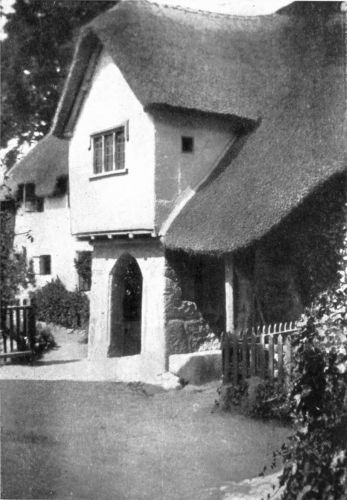
THE HALL HOUSE (p. 50)
return I asked where they had all been put; and I was told that some of them were in the greenhouse, others were in various parts of the garden, and the Camels and Dromedaries were out in the orchards.
An old gardener once gave me his opinion that a laundry was better than a garden, “as garments had not got such mazin’ names as plants.” And the maze grows more intricate, when Berberis Darwinii is Barbarous Darwin, and Nicotiana is Nicodemus, and Irises are Irish, and they English Irish be braver than they Spanish Irish.
There was an old lady here who always said:—“If there be a flower that I do like, it be a Pertunium.” It was neither a petunia nor a geranium; but I never found out exactly what it was. Botanists might adopt the name, when they want one for a novelty, for it is better than most of theirs. It may be convenient to give things Greek or Latin names, and it certainly sounds better to say Archæopteryx and Deinotherium than Old Bird and Awful Beast. But it is absurd to take the ancient name for one thing, and give it to another; yet that is what Linnæus and his followers have very often done.
Besides their botanical names, many things have trade names now. There is a plant here of the sort that is described at Kew as Rhododendrum Ponticum Cheiranthifolium. But, when I wanted to get another like it, I found the nurseryman did not know it by that name. He called it Jeremiah J. Colman.
Even in plain English there are pitfalls. At a hotel in Penzance I found the coffee-room quite full, when I came in to breakfast, and I asked the head-waiter if he couldn’t find me a place. He answered:—“Very sorry, sir, only whiting and soles to-day.”
One morning in London I was eating potted tunny-fish at breakfast, and I soon felt that it was having an effect on me. My brain was clearer than it has ever been before or since. I understood things that had always puzzled me; and nothing was obscure. In fact, for about two hours I was a Man of Genius; and then I dropped down to my usual level.
I made many inquiries about it afterwards, but without result until I came upon a man who had spent a couple of years at the Laboratory of Marine Zoology at Naples. He had himself felt odd after eating tunny-fish one day, and he knew of other cases. In his own case there was increased blood-pressure, especially in the brain, such as might arise from eating putrid meat. But he thought his fish was sound, and ascribed the effect to some unknown substance in a tunny.
This tempts me to suggest a problem. The ancient Greeks were the cleverest people ever known, and they were always eating pickled tunny. Were they quite so clever before they reached the Mediterranean, and got this particular food?—Common trout were put into some of the New Zealand streams, and they became great fish, quite unlike their ancestors. Did something of the same sort happen to the ancient Greeks, in intellect though not in body?
There is no denying the cleverness of the ancient Greeks; but I am sceptical about their beauty. They would never have talked so much of beauty, unless it had been rare. When people now-a-days go talking of the beauty of Greek Gods, they are thinking of the works of Pheidias and his successors. There is much charm in works of earlier date; but nobody can say quite honestly that the people in them are good-looking, much less that they are beautiful. Yet the nation cannot suddenly have changed its looks. I think it was that artists were getting more fastidious in their choice of models.
This notion struck me forcibly in the spring of 1888. I rode over a great part of Greece; and I did it comfortably, taking a dragoman and cook, with mules to carry the baggage, and muleteers to tend the mules. When my little cavalcade went through a village, the people all came out to have a look at it; and I had a look at them. Most of them were very plain indeed; but at every second or third village there would be one or two people who looked like ancient statues come to life. If I had brought home pictures of these people, and said nothing of the rest, I should have given quite a wrong impression of the modern Greeks.
We may have an equally wrong impression of the ancient Greeks. Zeuxis painted his Helen from five damsels whom he had chosen out of all the damsels in the city of Croton; and Anacreon suggests a similar plan for painting a Bathyllus. Pheidias modelled a statue from Pantarkes, and Praxiteles from Phryne. In the Hermes of Praxiteles the foot is copied from a model who used to go about on stony ground in sandals; yet Hermes was a god who travelled through the air. The statue represents an individual, not a type.
I went out from Orchomenos to see the Acidalian fountain, in which the Graces used to bathe. Instead of Graces bathing there, I found three old washerwomen scrubbing very dirty clothes, 13 April 1888. Washerwomen seem to have a fancy for such places. I have found them at Siloam, 17 March 1882, Fontebranda, 19 April 1892, and Vaucluse, 15 March 1891. They probably were there in Petrarch’s time, and Ezzelino’s also, and at an earlier time as well. I did not find them at Callichoros, where the women of Eleusis performed their mystic dance; but I found their washing spread out upon the beach to dry, 23 April 1880, and some of it puzzled me very much indeed—pieces of white material, less than a yard in width, but quite a dozen yards long.
These proved to be the petticoats of the Palikaris, old stalwarts of the War of Independence, who still wore the national costume—which really was Albanian, and not Greek at all. I found out afterwards how a Palikari put his petticoat on. He took one end, while another man held the other, and then he pirouetted towards the other man, winding the top edge round his waist.
Meanwhile my mother was observing other things, and in her diary I find:—“Some peasants at dinner at the little inn—one well dressed in Greek costume. They had a bowl of French beans, over which they poured a bottle of vinegar and sprinkled salt. Each man put in his fork, and helped himself to a mouthful, and then bit off a piece of raw onion and some black bread. They finished with honey on which they poured a bottle of oil, and ate the same way.” My father sometimes noted things like that. In his diary I find, Leukerbad, 27 August 1871:—“Sat by the cold spring in the broad walk towards the Ladders. Many came to drink it—with absinthe.”
My father and my mother were at the Certosa near Pavia on 21 August 1857. There were monks there then, and ladies were not admitted to the monastery or the aisles and choir of the church, but only to the nave. So my mother sat outside, while my father was seeing the interior. And then a bull came rushing along, with peasants in pursuit. She made a dash for the cloister gate; but the janitor was not going to have the place polluted by her presence: so he crossed himself, and slammed the door, leaving her to face the bull outside. Luckily the bull saw something else and turned aside, and she reached the church.
In 1891 I went to Kairouan, 27-29 March. There was no great difficulty in going then, and it is quite easy now; but until 1881 no Christians were allowed there. At the Mosques the people showed quite plainly that they did not want you there, and yet seemed pleased that you should see things, if you could appreciate their merits. But some French people came, who treated the whole thing as a show; and this displeased a very stalwart Dervish. So he went off, and rooted up a prickly-pear plant well covered with spikes, and then pranced in, whirling this huge thing round his head. And he personally conducted that party out of his Mosque and some way down the road.
Few people go to see the ruins of Utica, as the ruins are not worth seeing. But it struck me that some eminent writers had made a mess of the topography; and I went there, 24 March 1891, to see what I could make of it. And then I wrote a couple of articles in the Revue Archéologique, saying things about those writers. I apologised to the editor for my French of Stratford atte Bowe, but he said he thought it was the French of Billingsgatte.
I was sitting in the ruins of what clearly was the theatre: the lower parts were covered by a marsh; and presently a Chorus of Frogs came out, and gave me a lesson on Aristophanes. He makes his Chorus of Frogs say brekekekex koax koax; and I found that this should be taken as three syllables, answering to his oo-op-op and rhyp-pa-pai. The brekekekex stands for one long croak, not four; and the modern music of the play has got it wrong.
Just after this I was going down from Constantine to Biskra, and met the locusts coming up, 3 April 1891. There is a narrow gorge, not more than fifty yards in width, by which one passes from the Tell to the Sahara; and it was quite choked up with them from ground to sky. They seemed to be flying only eight or ten inches apart, and coming on interminably. They are pleasant-looking creatures, and would be as popular as grasshoppers, if only they would come in reasonable numbers. Coming in myriads, they have their uses too. Potted locust is not bad.
In 1882 I went by Austrian mail-steamer from Corfu to Trieste, 28 April to 1 May. She came from Alexandria, and was late in reaching Corfu; and it was midnight when I went on board. She was lying in the roadstead, and everything was silent then; but, as soon as she got out to sea and rolled, there were unexpected and alarming sounds. I discovered in the morning that she had a large consignment of wild beasts on board. They were confined in crates that looked very much too small and not nearly strong enough; but I was told that, if beasts were cooped up tight, they could not use their strength. An old lady remarked to me that she thought it very dangerous to have so many lions on board, and she took the precaution of locking her cabin door at night. I admit I had a pretty bad nightmare of an unknown animal, with a neck like a giraffe’s, standing on deck with his neck down the companion-ladder, the neck growing longer and longer till it nearly reached my cabin door.
I once spent a night on the summit of Mount Etna, 22-23 September 1883, and I have never seen anything more uncanny than the cone of that volcano, gleaming like metal in the moonlight, and sending up vast clouds of steam. It stands about 10,700 feet above Catania; and I made the ascent in about eleven hours from there, going by carriage to Nicolosi, and then by mule to the hut at the foot of the cone.—This hut was on the site of the new observatory.—The cone was troublesome, as my feet sank in at every step, and brought out puffs of sulphur: looking back, I could see all my footsteps smoking, and likewise those of my two guides. The crater was full of this sulphureous steam, and there was no view down into it, nor into the Valle del Bove, as the wind drove the steam down there. Apart from this, the view was clear. I saw the sun set from the summit of the cone, came down to the hut for shelter in the night, and saw the sun rise from the Torre del Filosofo, not far from the hut and nearly level with it.—The philosopher was Empedocles, but the tower is Roman, and may have been built for Hadrian, when he went up to see the sun rise.
There is not so wide a view from any of the summits in a chain of mountains like the Alps, nor do you seem to be at such a height as on this isolated mountain, although the height may really be much greater. The world seemed like a map spread out below me; and I saw the Shadow. As the sun rose, I began to see another great mountain standing in the middle of Sicily; and then the mountain faded, being only Etna’s shadow on the haze. It is the same thing as the Spectre of the Brocken. I have been up the Brocken also, 14 August 1874, but have not seen the Spectre.
After seeing the view from the Faulhorn at sunrise, 22 August 1849, my father noted in his diary:—“Looking at my three Swiss companions as they stood with myself on the apex of this mountain in the clear smooth snow, I could not help thinking of our being the only created beings who could be enjoying this magnificent spectacle.” He always had this sort of feeling that people ought to make more effort to see the wonders of the world.
This same feeling was expressed by a distinguished foreigner in rather an unexpected way. In 1900 a lady was saying in his presence that she did not mean to go to Paris for the Exhibition. He struck in:—“You can go, and you will not go? At the Last Day the Good God will say to you, ‘You did not go to the Paris Exhibition when-you-might-have-gone. You have not used the Talent that-I-gave-you. Go DOWN. Go DOWN.” It had not struck her in that light before.
In my younger days I took some trouble to see things. And it was worth the trouble, to see Moscow from the Sparrow hills, whence Napoleon saw it first, or Damascus from the heights of Salahîyeh, where Mohammed turned away, lest he should think no more of Paradise. Or, apart from history and association, to see things so beautiful as the Alhambra and the Generalife at Granada, and the deserted city of Mistra on the mountains overlooking Sparta.
When I first went to Athens, in the spring of 1880, the Acropolis still had its mediæval ramparts; and, as one stood on the Acropolis, they shut the modern city out of view, and one was there alone with the temples and the sky. These ramparts were demolished before I went there next, in the spring of 1882; and before I went again, in the spring of 1888, the whole of the Acropolis had been excavated and laid bare down to the solid rock. The results were of the highest interest; but the charm was gone. I felt that I had seen a dragon-fly hovering in the Attic air; and my dragon-fly was now a lifeless specimen, set out with pins upon a card.
I happened once to arrive at Athens in a sea-fog. The steamer had slowly hooted its way into the Piræus in the early morning; and I was driving up to Athens soon after sunrise. With the sun behind it, the Acropolis loomed up through the fog, as I came near; and this is the only time that I have seen it looking as I feel it ought to look. It seemed a vast and overwhelming mass; whereas in broad daylight it looks rather small, and quite puny, when one sees it from a distance. I have noticed that the Pyramids at Gizeh also look puny at a distance: yet the dome of St Peter’s looks its largest at fifteen or twenty miles from Rome. I cannot give a reason; but it is a fact.
Apart from that curious look upon its face, I have never found the Sphinx at Gizeh as impressive as the Sphingeion in Bœotia, the sphinx of Œdipus outside the gates of Thebes. This is merely a hill shaped like a sphinx; and there must have been another such hill at Gizeh, from which the Sphinx was formed. There is another within a walk of here; but it takes the shape only from a certain point of view—the western rock at Haytor, as one sees it on the road from Widdicombe. In a Dartmoor mist it looks stupendous, and surpasses the Sphingeion and the Sphinx.
There is another sight within a walk of here, also recalling Greece; and this is Grimspound. When I have visitors who have been in Greece, I take them over Hameldon, so as to come down on Grimspound from above. I give no hint beforehand, and just wait to hear what they will say. And they always say:—“Mycenæ.” The impression goes off, when one begins to think of details; but at first sight it is vivid.
Sometimes I take people up to Hittesleigh (or Hisley) Gate for the view of Lustleigh Cleave, and there await their comments. One man was an artist; and for a long while he was silent, and seemed to be drinking in the beauty of the scene. Then he pointed to some object in the middle distance, and remarked:—“I think I’d pick that out in Chinese White.” Another man who also painted, was silent also, and also seemed to drink it in; and he remarked:—“If I were going in for grouse, I’d put the butts round there.”
Looking on things less practically, one fancies that the scene is all unchanging and unchanged, and that its aspect was the same when our ancestors were living in hut-circles and building cromlechs and kistvaens. It needs an effort to carry back the mind to earlier ages, when there was a little volcano in this parish, and a bigger one about a mile this side of Newton; or to ages more remote, when this tract of igneous rock was first upheaved, and these lichen-covered boulders came rolling down the slopes red-hot. And there will come a time when only the granite will survive, the rest all vanishing like the land between our Land’s End and the Scilly Isles; and then Dartmoor will be a group of islands, and Wreyland one of the outlying reefs.