SMALL TALK AT WREYLAND (continued 2)
Reading edition
Like many other people of his time, my grandfather was certain that the climate had improved, and he thought he saw the cause. He writes to my father on 22 December 1850:—“I attribute the mildness of the winters and the warmth of the summers to the better state of cultivation of the land draining off the cold stagnant waters that lay about in all directions in my youthful days.” He writes on 23 November 1851:—“The old plan was to have the wheat up in grass at Christmas, as the farmers used to say ‘high enough to cover a crow,’ but they find now from the altered winters that to till in this month and the next is sufficiently early, and better crops.”
My grandfather tried farming here; and I gather from his accounts that he sank about £20 per acre in the first three years. That meant draining the ground, and getting it into good condition; and after that he made it pay, except in the years of the potato famine. He writes to my father on 8 March 1846:—“I should say a diligent clever man, farming his own estate, can make more money now than he could in war time [that is, before 1815] for the system of farming is quite changed, and the land is made to produce nearly double what it did then.”
His knowledge of farming was derived from books; and he did things that were not customary here, sometimes with failure, but often with success. Thus, he writes to my father, 2 April 1854:—“I tilled some barley yesterday.... It was another such March fifteen years ago, when I tilled this same field to barley. I then hired horses and gave it a good working; and the weather was so tempting that I tilled it in March to the amusement of my neighbours. The storms in April made it look blue, which amused them still further. But they all acknowledged they could not produce its equal to harvest.”
He writes on 25 April 1843:—“Folks are waiting to see what spade husbandry will produce. I tell them its not new to me, for I adopted it elsewhere some twelve or fourteen years ago, and was fully compensated for my trouble. But that will not do: they must see themselves. The field is turned up with the spade, all the spine put under, a foot deep; and I have taken out nearly stones enough to build a wall through the field. The cost in turning is 4d. [per rod] with a quart of cider to a shilling, so with cleaning and bringing it fit for the potato the cost is £4 per acre, about double the old system, which would leave all the stones, and the field not half worked.
“Our farmers are loth to believe that any other method but the old one is beneficial. They fancy all manure is in dung and the like. I tell them the quantity of carbon, etc., etc.... But all will not do: they must see to believe. I have tried 1 cwt. of nitrate of soda on an acre of grass, and it is astonishing the effect it has had.”
On 13 January 1851 he writes:—“I am trying an experiment, that is, I am fetching every day some of the refuse from the kilns at the Pottery. It is principally burnt clay. I have often looked at it on passing, and fancied it might turn to use—old Cobbett speaks well of burnt clay. My neighbours say they will try it also.”
In a letter of 11 February 1850 my grandfather suggests a sliding scale for agricultural rents, based on the average price of corn. He did not wish to fix a rent-charge once for all, as with the commutation of the tithe, but merely to provide for variations during the period of a lease. In practice the landlord makes remissions of rent in bad years; but I have not yet heard of a farmer giving his landlord a War-bonus on these good years.
The old copyhold system was better than the leasehold for agricultural land. Here in Wreyland manor a man took a tenement for the term of his life; and that included “his wife’s widowhood therein.” If he wished to give it up, there was always someone ready to take it on. The new tenant paid him for his life interest and his wife’s, and bought the reversion from the lord; and at the next sitting of the court the old tenant surrendered the tenement, and the new tenant was admitted in his stead. If he wished to keep the tenement in his family, he bought the reversion for his son. The tenants were answerable to the manor court, if they allowed their buildings to fall into decay, or let down the gates and hedges against their neighbour’s tenements. But in this manor the court could not take cognizance of bad cultivation, which so often accompanies security of tenure.
These copyhold tenements have developed into freeholds, and the manor has decayed. This is a district of small estates. In districts where estates are large, it is usually the other way. Manorial rights have grown, until at last the manor has unrestricted freehold, and the former copyholds are let as farms.
Estates here being small, the farms are small also; and they could not well be large in such a hilly country—haulage would be too costly, if a farm went over many ridges and coombes. Usually they are too small, and two or three might be thrown into one, one set of buildings serving for the whole, likewise one set of implements, and fewer horses—six horses have sufficed, where three farmers had each been keeping three. Even in districts where estates are large, and ground is flat, the farms are seldom large enough to give the best results. The ideal is the largest area that can possibly be worked from one homestead; and in some districts that may be very large indeed. No doubt, the latifundia were not a success; but that was due to slavery, not to size. Here in England our countryfolk would make a better stock as labourers on big estates than in starvation on small-holdings.
The labourer has certainly fared badly in the past. He grew the dear loaf, and never had a bite at it. But, when economists go writing of “the hungry ’forties,” they should remember that there were such things as trout and salmon, hares and rabbits, partridges and pheasants.
My grandfather writes to my father, 3 December 1844:—“I was told yesterday at Moreton that many travellers now give their horses a portion of wheat flour. Some are too scrupulous to do it: but the labourer would say Why give barley, as that is my food, and the Scotch and Irish may say Why give oats.” He writes a few days later, 15 December 1844:—“I had some conversation with the Lustleigh parson yesterday. He said we had no poor here, and the labourers were better off than where he came from.”—He had just left a living in Norfolk.—“There the wages were less, and they never tasted animal food from one year to another, but here they all managed to salt in a pig.”
He writes on 2 December 1849:—“Bad as times are, I have known them far worse under Protection.... Such was the distress among farmers then that labourers were put up to auction by the parish authorities, and hired for 6d. to 9d. per day.” And on 7 February 1850:—“There is no grumbling among the labourers, for now they have a cheap loaf, and are able to get a bit of meat to eat with it.... Besides under Free Trade they get salt, sugar, tea, coffee, etc., at a much lower rate than formerly, when their wages were but a half or a third.”
On 13 July 1851 he writes:—“I see a vast improvement in agriculture in this neighbourhood since Free Trade came in.... Protection did but foster indolence.” Fifty years later, when Protection was allied with Tariff Reform, an ardent Liberal said to me:—“No, ’t ain’t no tariffs and ’tection that they farmers need: ’t be nothin’ but lime and doong.” And certainly the land was starved.
My grandfather was converted to Free Trade somewhere about 1817 or 1818, but I do not know exactly when or how. He writes on 3 June 1843:—“I have been a Free Trader for more than five-and-twenty years.” And on 28 January 1844:—“I almost stood alone in Moreton as a Free Trader about five-and-twenty years ago.” As for the other party, he writes on 25 November 1849:—“Protection is substituted for Church & State and King & Constitution, and what they will have next I am at a loss to say.” He was a Liberal then; but the party went beyond his principles, and my brother writes from here, 4 July 1868:—“Grandpapa now calls himself a Conservative, and makes dire prophecies of the political future of England.”
Lord John Russell was the only politician whom he altogether trusted. There was some slight acquaintance; and Lord John gave my father a very nice desk upon his coming of age. My father used it always, and I have it still, not much the worse for wear, but somewhat damaged by burglars on one of their visits to our house in town.
Writing to my father on 25 January 1846, my grandfather says:—“Agricultural labourers are very scarce: most of the young and able bodied are gone on the railways.” Men got better pay as navvies than they had ever got in agriculture. Better pay meant better food; and the navvies developed into finer men than anyone had seen before—at least, old people always told me so. I fancy this displacement of labour had more effect on wages and employment than the change from Protection to Free Trade.
Writing on 8 March 1846, he says:—“I do not think many of the agriculturalists are prepared for the very great changes that the railways will make.” But those great changes never came, as the agriculturalists never grasped the situation. So long as transport was difficult, each district had to grow nearly everything that it required. When transport was made easy, each district should have grown what it grew best. Here in the South Hams there was quite the best cream in England, and about the best cider, and also excellent mutton. Had people kept to things like these, and laid down all their arable land to grass, they would have saved far more on agricultural buildings, implements and horses, than they would have spent in getting arable products from a distance. And they would hardly have felt the depression that began in 1878, as that scarcely touched these things.
Being short-sighted, they neglected their orchards, and grew careless of their cider-making, till Devonshire cider was outclassed by Hereford. And now they are ruining the cream by using separators. Of course, it is cream made in Devonshire, but it is not what was known as Devonshire cream. The stuff is not worth eating; but I suppose people will go on eating it as Devonshire cream, just as they go on drinking the wines of well-known growers, whose vineyards were exhausted years ago.
There is also a machine now to prepare wheat straw for thatching; and this bruises the reed, and renders it less durable than when it was prepared by hand. And now they never sow wheat early enough for the straw to gather strength. The result is that the thatch decays, and landlords and farmers both get tired of patching it, and put up slate or iron instead, thereby helping to destroy the market for one of their own products. I have known a field of wheat pay rent and rates and every outlay with the straw for thatching, and the grain was all clear profit.
Nobody who has lived under a thatched roof would willingly live under any other—the comfort is so great. The thatch keeps out the cold in winter, and keeps out the heat in summer. This house has about 4000 square feet of roof, and my other buildings in Wreyland have about 12,000 altogether; and the whole of this is thatched. Thatching costs about three pence a square foot, and lasts about five-and-twenty years; the period varying a little with the shape of the roof and its aspect, exposure, and so on. And really it is not inflammable. Just as paper will burn and books will not, so also straw will burn and thatch will not: at least, thatch will only burn quite slowly like a book. I have twice seen a fire stopped by cutting away a strip of thatch, and so making a gap that the fire could not cross; and the fire burnt so very slowly that there was ample time for this.
In insurance against fire a higher rate is charged on thatch than on the other kinds of roofing; and I presume the higher rate is needed, though possibly for other reasons than the nature of the roof. Writing to my father about a small estate that was for sale, my grandfather remarks quite placidly, 13 June 1864:—“The premises are all but new, for ***** took care to burn down the whole at different times—so all new and well built and slated. No office would continue the insurance for him, but being all slated it did not much require it.” I have heard the same thing said of other small estates.
There were many fires in Moreton about seventy or eighty years ago. In those times the insurance companies had fire-engines of their own, and people trusted to these engines. After a fire there, 11 September 1838, my father writes in his diary:—“The Moreton engine poured on the thatch in front of Mrs Heyward’s house, and kept the fire in the back premises. But, as the fire was extending towards the White Hart, which was insured in the ‘West of England,’ the engine (which belonged to that office) was removed there to endeavour to preserve the inn. As soon as the engine was removed, the fire came into the front of Mrs Heyward’s house, and extended on in Pound Street.... There ought to be two engines in the place; and, as the ‘Sun’ lost so much, perhaps they will send one there.” After another fire there, 12 September 1845, my grandfather writes to him:—“Many houses not insured: their owners dropt it at Ladyday last, when the advance took place on thatched houses.” This fire was a notable event. My father writes in his diary, Coblence, 21 September 1845:—“Read in the Galignani newspaper an account of the recent fire at Moreton, which has destroyed so much of the town.”
Cob walls are as good as a thatched roof for resisting heat and cold; and the houses that have both, are far the best to live in, when the temperature out-doors is either high or low. The cob is made of clay and gravel kneaded together with straw, and is put up in a mass, like concrete. It is very durable, if kept dry, but soon goes to pieces, if the wet gets into it, especially from above. The roof must therefore be kept quite watertight, and the outside of the walls may be protected by a coat of plaster or cement with rough-cast.
Good bricks are made on Bovey Heathfield at the other end of this parish. And nine inches of brickwork, laid in cement, is as strong as eighteen inches of cob, and looks the same, if covered with cement and rough-cast. But the eighteen inches of cob keeps a house much warmer than eighteen of brick.
In rough-casting the wall receives two coats of plaster or cement; and, before the second coat is dry, a mixture of fine gravel and hot lime is thrown hard at it with a trowel, and sticks on to the second coat. It was the custom here to rough-cast the south and west sides of a building, but not the north and east, as these are less exposed to wet.
Down here the building-stone is either granite or elvan; and rough-cast is desirable, as both sorts take damp, especially the granite. Moreover, if the walls are built of unsquared stone, the rain will sometimes find its way between the joints and down into the wall, wherever the bedding of the stones slopes downwards from the outside.
Some of the older buildings have squared stones from three to five feet long and two or three feet high. But generally these do not go beyond the first few courses, and then comes unsquared stone, and very often cob on top. In most of the old buildings here the walls are constructed with an inner and an outer face of unsquared stone and a core of mortar or cement. If the core decays, the stones get loose; and, if a stone falls out, others may
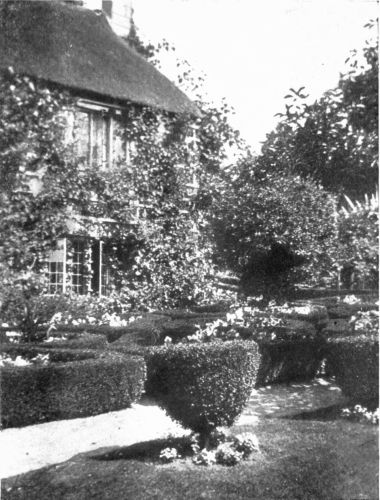
THE PIXEY GARDEN (pp. 35, 36)
go after it, the edges being unsquared, and then the whole structure may come tumbling down.
At the inn at Manaton I once heard a group of old inhabitants talking over various buildings that had fallen down, and quarrelling as to which of them had made the greatest noise in falling. Here at Wreyland the end wall of the Tallet—some 40 tons—fell out into the orchard in the twilight of a Sunday evening as people were on their way to church. “And Miss Mary *****, her were a-passin’ at the time; and, when her come in afterward, her said in all her born days her never beheld such a noise.”
People talk as though there was no jerry-building in the olden times. I believe the jerry-builder was as busy then as now, but his buildings have all tumbled down and been forgotten long ago. Only the best of the old buildings have lasted until now; and these are constantly in need of structural repair. I have overhauled a good many of these buildings; and by the time I have underpinned the walls, and grouted them, and done all the other necessary things, I always find I could have got a better result by taking them right down, and setting them up again on fresh foundations. And no one would have known the difference. At the lower end of Souther Wreyland there is a chimney-stack that looks as venerable as anything here. I built it new in 1906 from its foundation to its summit: there was nothing there before.
If one had merely to repair a building as an ancient monument, there would be comparatively little trouble. But there is serious trouble, when one wishes to retain the characteristics of a building, and yet meet modern needs with bath-rooms and the like. Bed-rooms used to open into one another, and you had to pass through other rooms to reach your own; but people now object to that. If the roof slopes down towards the outer walls, one cannot always get height enough for a passage without encroaching too much upon the rooms; and one does better then by putting in more staircases, each giving access to a group of rooms. This house has three main staircases, and no passages upstairs, except a short one that I built in 1899. Others have as many staircases, and passages as well; and people say that they are like the countryside—all lanes and hills.
In dealing with the Hall House, I decided not to sacrifice the Seventeenth Century work in order to restore the Fourteenth, though the restoration would have been of interest. There was originally a hall, with a screen across it, and a gallery projecting out beyond the screen on corbels. Subsequently the floor of the gallery was carried on across the hall, and the front of the gallery was carried up to the roof, thus making two rooms upstairs, and two down below, divided by the screen. These four rooms are useful, and the hall would have been very useless, as no courts are held for Wreyland manor now.
My great-great-grandfather Nelson Beveridge Gribble was lord of Wreyland manor, but always lived in this house—Yonder Wreyland—and never at the Hall House. I believe he held Court Baron and Court Leet and View of Frankpledge in the Lower Parlour here; and it must have been unpleasantly crowded, if the Homage and the Tithing came here in full force.
The last sitting of the court was held on 14 February 1871. I have printed the record of the sittings from 1437 to 1441, from 1479 to 1501, and from 1696 to 1727, Wreyland Documents, pp. 1-88, and have said there (pp. i-c) all I have to say about the history of this manor.
In 1898 I became a tenant of a manor in which admission is “by the verge.” The verge is a wooden staff or rod; and the steward of the manor holds one end, and the tenant holds the other, while they say the operative words. I thought the ceremony would be interesting, and might be picturesque; so I went myself, instead of doing it by deputy. The scene was a solicitor’s office of the most prosaic kind with type-writers and telephones. The steward was seated at an American desk; and, when I looked round for the verge, he said, “I haven’t got a stick, but this ’ll do.” And he took up a pencil (made in Austria) and held it out to me.
There was a pleasant old house at Becky Fall, burnt down on 18 April 1875, and rebuilt as one sees it now; and I have a full-length portrait of my great-great-great-grandfather, John Langworthy, sitting in the porch there. He has been described as “reading his bible, and looking as if he didn’t believe a word of it,” but it really is a law-book. The painter was Thomas Rennell. There are many pictures of his in Devonshire, mostly labelled Reynolds by mistake for Rennell. Sir Joshua and he were fellow-pupils in Hudson’s studio in London, but had not much in common afterwards.
Becky was a lonesome place till the new Manaton road was made, but now lies open to excursionists, and has lost something of its charm. While the old house remained, I coveted it more than this. It passed from John Langworthy to his daughter Honor, the wife of Nelson Beveridge Gribble, and then to their eldest son John Gribble, and to his eldest surviving son John Beveridge Gribble, who very soon got rid of it. He claimed Wreyland also as the heir, but found there was a settlement. He died here in this house on 18 August 1891, just ninety years after the death of his elder brother.
His father did not live here after he grew up, and this house was let to Captain Thomas Moore for several years. Moore was on the Genoa at the battle of Navarino, 20 October 1827, and ten days afterwards he died of wounds.
John Beveridge Gribble had an amateur knowledge of architecture, and also a little practical knowledge, picked up from a cousin who was an architect. A barn was being built upon some sloping ground near here; and, on seeing the foundations and the beginning of the walls, he told the builders that the whole thing would slip down, when they had reached a certain height. When they reached that height, it slipped down as he said; and they all marvelled at the prophecy. There were many false prophets here, when the railway was being made. They had never seen a skew-arch before, or even heard of such a thing; and they said these arches would come down as soon as the frames were taken out.
One of the old masons here would never condescend to use a plumb-line on his work. He said that he could tell if a wall was straight by just puttin’ his leg ag’in’n. Another said that he could do it with his eye. They, and others like them, are commemorated in the contour of the walls.
On many of the older houses round about here, one sees a board with the word “dairy” fixed up above a door or window. These boards are relics of the window-tax, as exemption could be claimed for the window of a dairy or a cheese-room, if “dairy” or “cheese-room” was painted up outside. There is a board with “dairy” at the back of this house. It seems to cover two windows now; but these are really the ends of one wide window. I had to block the centre up with walling, to support the bath-room that I built in 1904 above the former dairy.
Many of these houses also have windows that were stopped up, when the window-tax was heavy, and were not brought into use again, when it was abolished. I have opened up quite a dozen of them in my buildings. A window was not freed from the tax, unless it was stopped up with stone or brick or plaster; but usually the frame was left, and only needed glazing, when the stopping was removed.
The window-tax goes back to 1695, but many of these windows are of later date than that. The tax did not become oppressive until after 1784. In that year the tax on a house of ten windows was raised from 11s. 4d. to £1. 4s. 4d., to £1. 12s. 0d. in 1802, and to £2. 16s. 0d. in 1808. On a house of twenty windows it was raised from £1. 14s. 8d. to £4. 9s. 8d. in 1784, to £7. 10s. 0d. in 1802, and to £11. 4s. 6d. in 1808. And on a house of thirty windows from £3. 3s. 0d. to £7. 13s. 0d. in 1784, to £13. 0s. 0d. in 1802, and to £19. 12s. 6d. in 1808. It thus became worth while to block up windows; and this, I believe, was the period when most of these windows were blocked up. Window-tax had been imposed in place of hearth-money, the notion being that the number of the windows would indicate the value of the house. But it played havoc with the health of the community, as people were willing to live and sleep in rooms with neither light nor air, in order to escape the tax.
The same thing happened with ships. Dues were levied on tonnage; and formerly the tonnage of a ship was calculated from her length and breadth, the depth being reckoned as half the breadth, which was about the usual ratio when the rule was made. If the depth was more than half the breadth, the ship carried more cargo without any increase in the tonnage or the dues. And the result was that ships were built deeper and deeper, until the depth came to be about three-quarters of the breadth, and they became unsafe and foundered.
Then came the Act of 1854, which put tonnage on the basis of a ton for every hundred cubic feet of space inside the ship, excepting space required for engines, crew, coal, etc. But space was reckoned in a way that led to unforeseen results. If a screw-steamer of 3000 tons had an engine-space of 380 tons, or 38,000 cubic feet, she was allowed a further 285 tons as coal-space; but, if her engine-space was brought up to 400 tons, the allowance was 560 tons. And in powerful tugs the deductions often came to more than the total from which they were to be deducted. Their nett tonnage being registered as 0, these vessels had no dues to pay.
In going through old books that had been packed away here, I found the first edition of Lloyd’s Register of British and Foreign Shipping. It is dated in October 1834; and, including the supplement, it gives particulars of about 13,850 ships. On looking through them, I cannot find more than forty ships of above a thousand tons. The largest is of 1515 tons, the next of 1488 and the next of 1469; then come eleven of 1440 to 1403, eighteen of 1380 to 1311, three of 1286 to 1256, one of 1175, and four of 1068 to 1013. All forty are of the Port of London. Below the thousand tons, there is one of 993 and one of 987, then nine of 894 to 802, fifteen of 773 to 701, forty-three of 695 to 602, and a hundred and ten of 600 to 501. Thus (unless I have overlooked some) the ships of above 500 tons number 219 altogether, which is only about a sixty-third part of the total number on the Register.
In the Register for 1841, which I found here also, there are only eighteen ships of above a thousand tons. It gives only fifteen of the forty that were given in 1834: eight built of teak in the East Indies in 1798 to 1816, and seven built on the Thames in 1817 to 1827. And there are only three new ships of that tonnage, one of 1070, built at Amsterdam, and one of 1064 and one of 1267, both built in Canada.
In the 1834 edition the abbreviations Sr. and St. stand for schooner and schoot, not for steamer, as one might surmise; and the rules are framed for sailing-ships, with a few additional rules “for ships navigated by steam.” There are inquiries for the diameter of the paddle-wheels, and the length and breadth of the paddles, but no inquiries as to screws.
I can remember the Channel Fleet lying in Torbay with one of the old “seventy-fours” carrying the admiral’s flag. She was the Edgar, a wooden two-decker of 3094 tons, fitted with a funnel and a screw, but otherwise not unlike the ships of Nelson’s time. That was on 2 September 1864. One day in November 1916 I noticed an unusual number of steamers lying in Torbay, and found that they were sheltering from an enemy submarine outside. I felt that times had changed.
In the old letters and diaries here I find many words and phrases that have now gone out of use. The garden was ‘very rude,’ when it was untidy. A man was ‘thoughtful,’ when he was cunning, and ‘high-minded,’ when he was pretentious; and was a ‘patriot,’ when he was a profiteer. People were ‘confined,’ when they were kept indoors by any kind of illness; and some invalid old ladies had three or four ‘confinements’ every year. They all ‘used’ exercise, and did not take it; nor did they ever take tea. “We drank tea with Mrs ***** at Moreton, and Jane was on the carpet all the while: she has been to Exeter without a bonnet.” I do not know why people drag in scraps of French like ‘chaperon’ and ‘sur le tapis,’ nor why they follow Anglo-Indians in saying ‘pucka’ for ‘proper.’
Hearing a good deal of laughter in the lane, I inquired what was going on. And the answer was brought back:—“Please, zir, it be little Freddie ***** a-tryin’ to say swear-words, and he cannot form’n proper.”
I once said a swear-word here—at least, they thought I did. A bee was pestering me persistently one afternoon, while I was sitting in the garden; and at last in a moment of irritation I called it a coleopterous creature. Someone heard me, and afterwards I heard him telling someone else:—“He were a-swearin’ fine: called ’n bally-wopserous.”
A few years ago there was a child in the village, who was so absurdly like the Flora in the Primavera that we always called her the little Botticelli. But this disquieted her mother; and she sent up to say that she would like to know the meaning of that word.
Being of opinion that some fields near here would never yield enough to cover their rent, the farmer’s wife approached the landlord in this way:—“‘But, maister,’ saith I, ‘us cannot pluck feathers from a toad.’ And he saith, ‘so I’ve heard tell afore now, and I believe ’t be true’.” It is just the metaphor they use in France:—“Il est chargé d’argent comme un crapaud de plumes.” And when someone did a work of supererogation here, the comment was strangely like “le Bon Dieu rit énormément.”
Devonshire speech is not capricious, but has a syntax of its own. The classic phrase is ‘her told she.’ A pious person told me that ‘us didn’t love He, ’twas Him loved we.’ They never say ‘we are,’ but ‘us be’ or else ‘we am,’ contracted into ‘we’m.’ They say ‘I be’ as well as ‘I’m,’ but never ‘me’m’ or ‘me be,’ though invariably ‘me and Jarge be,’ or ‘me and Urn,’ or whatever the name is, and never ‘Ernest and I’ or ‘George and I.’ They say ‘to’ for ‘at’—‘her liveth to Moreton’—and formerly said ‘at’ for ‘to’—‘I be goin’ at Bovey’—but now it is the fashion to say ‘as far as’ Bovey.—A complete Grammar might be compiled.
Happily, the school has not taught them English that is truly up to date. They have not learned to say:—“The weather conditions being favourable, the psychological moment was indulged in.” They still say:—“As ’twere fine, us did’n.” And their pronunciation is unchanged: beetles are bittles, beans are banes, and Torquay is Tarkay.
Down here the Education Act of 1870 was not altogether a success. There had been a school in Lustleigh since 1825, maintained by a small endowment and the fees. Only the brightest children went there, and the others did not go to school at all. Had it gone on after 1870 as a higher-grade school, it might have done much service here; but the trustees shut it—by a breach of trust, so far as I can see. The bright children had to go to the board-school with the others who were not so bright; and their progress was retarded by these others, as the staff was never large enough to take them separately. As it is, I think more progress might be made, if the classes were only half the size, and the children were only half the time in school, some going in the morning and others in the afternoon.
In most of the parishes round here there are cottages too far away for young children to attend school in all weathers. As a rule, the able-bodied men have always got young children—families are long, and spread over many years. There is thus a difficulty in getting suitable tenants for these cottages; and many of them have been allowed to go to ruin, after being unoccupied for some long time. Families move down into villages, which now have many of the defects of a town, without its merits; and real country life is dying out—an unforeseen result of Education Acts.
Agriculture has suffered from a cause that seems equally remote—“farm-house lodgings.” People say that farms are let at so much per acre, but all farms have a house, and the house will often pay the rent; and, when the house does that, the farmer is less careful of his land. The profit is not only from the letting of the rooms, but from selling butter, eggs, fowls, etc., without the trouble and expense of going to market, and often (I am told) at more than market prices.
People crowd down here in summer, and will put up with any kind of lodging, as they mean to be out-doors all day. I have heard of rooms with “Wash in the Blood of the Lamb” in illuminated letters, where there should be a wash-stand. But this craze for rustic lodgings is comparatively new. My grandfather writes to my father, 16 January 1862:—“Tremlett they say will leave Lustleigh at Ladyday, and Hurston of Way has taken Harton and will leave Way, even Crideford (who used to let one room) will leave on Ladyday for Torquay: so no lodgers will come to Lustleigh. Perhaps when the railway comes, there may be accommodation.”
Like many other country places, Lustleigh started a flower-show, which soon became a show of vegetables and poultry, with fewer prizes for flowers than for such things as cream and honey, needlework and cookery. There were athletic sports as well, and kiss-in-the-ring and dancing on the grass to the strains of a brass band, the church bells ringing changes while the brass band played—a proper old Pandy Romy Un, as some one called it, meaning Pandemonium, I think. People came to it from a distance, as it was held on the bank-holiday in August, and they could spend their morning on the Cleave and finish off with this.
I missed the Lustleigh flower-show in 1900, having just gone up to town; but a friend wrote me this account of it next day:—“We went in about 2, when it opened, and found some disorder in the main tent, as it had partially blown down early.... Then there was a horrible noise, and a great gust of wind ripped the poultry tent almost in half. The whole thing began to collapse, men were rushing in and being pulled out by screaming females, some were tightening the ropes, which others immediately loosed, and presently a great loose flap of canvas overturned the stand of cages—a horrid mass of ducks and fowls screaming and quacking and flapping all over the crowd, pursued by their owners and upsetting everything. And just at this moment the big flower marquee—which was of course deserted—was caught by a tremendous puff of wind and torn right up and dropped on the tables inside. It wasn’t heavy enough to be dangerous, but I wish I could give you any idea of how funny it was to see ****, who was rather bossing the show, creep from under the canvas with an old lady, an infuriated fowl pecking at his knickerbockered calves. One of the nicest incidents was a little old lady in a velvet mantle and black curls, careering backwards over the ground, knocking people over as she clutched at the tail of a huge escaping and crowing cock with one hand, and with the other arm embraced a captured but still struggling and squawking goose. In about an hour after it was opened everything on the ground was swept quite flat. But excursion trains kept arriving, whose innocent passengers paid their sixpences—you couldn’t see the ruin from outside—and wondered why the crowd assembled at the gate laughed at them. However it was worth while to see the village boys fighting and scrambling under the fallen tent for the apples and potatoes.”
There is a May-day festival here, for which I am responsible. There used to be dancing round the May-pole at the flower-show and other festivals, but none upon May-day itself; and I put an end to that anomaly. The children at Lustleigh school—boys and girls—elect one of the girls as Queen, and her name is carved upon a rock on the hill behind this house. Then on May-day the Queen walks in procession under a canopy of flowers carried by four of the boys, her crown and sceptre being carried by two others; then come her maids of honour; and then all the other children of the school, most of them carrying flowers in garlands or on staves. The procession winds along through Lustleigh and through Wreyland, halting at certain places to sing the customary songs, and at last ascends the hill behind here. The Queen is enthroned upon a rock looking down upon the May-pole: the crown of flowers is placed upon her head, and the arum-lily sceptre in her hand: the maids of honour do their homage, laying their bouquets at her feet; and the four-and-twenty dancers perform their dance before her. Then comes the serious business of the day—the children’s tea. This year, 1917, there was a shortage of cereals; but I saved the situation with two hundred hard-boiled eggs.
There are two Friendly Societies here, Rationals and Rechabites; and for many years the Rationals had a church-parade upon Whit-sunday and a fête upon Whit-monday. In 1908 they decided not to have their fête that year: so the Rechabites announced a fête upon Whit-monday, and then the Rationals announced their fête as usual, fearing that their rivals would annex Whit-monday permanently. So there were two fêtes going on together in fields not far apart, and each had a big brass band.
This little dispute gave rise to an incredible display of hatred and malice between the two societies; and the Rector told the Rationals that he could not have a church-parade for them till they were reconciled. As that was out of the question, they had a church-parade without the Rector or the Church. They went round as usual in procession with their banner and regalia, collecting for the hospital, and halted in the town-place just outside the Church at time of evensong. And they sang psalms and hymns and spiritual songs with such support from their brass band, that the congregation could not hear a word the Rector said.
Before their fête the Rationals had a dinner, and I went. A man opposite me was saying that he had given more benefit to the Society than the Society had given to him, for he was now past fifty and had never drawn sick-pay yet. I was able to say that I was past fifty also, and had never yet been ill enough to stay in bed all day. But a man lower down the table must have thought that we were getting proud, for he remarked very audibly just then:—“There be a sort that do go sudden, when they do go.” A few years afterwards I was ill enough to stay in bed for many weeks, but I managed to get out of doors for May-day. I noticed a group of people talking together and glancing at me now and then, and presently one of them came over and explained:—“What us be sayin’, zir, be this: whatever shall us do for our May-day, when you be dead.”
They were ringing a knell at North Bovey one afternoon when I was out beyond there; and it sounded very weird, when the gusts of wind carried the wail of the bells across the hills. I met one of the Lustleigh ringers as I was coming back, and I asked him why they never did it there. He answered:—“But us do. Sometime. Not for all folk like, though. But us’ll ring’n for thee.”
When I was overhauling one of the old houses here, I made good some panelling that had been covered up with lath and plaster. After it was done, a man came over to tell me of some seasoned oak of extraordinary width, which I might buy. I saw that it would make fine panels, but my panelling was done. And then he said:—“Well, and if you didn’t use it for panellin’, it might serve some other purpose. Why, th’old Mr ***** and his wife both had their coffins made from that same tree.”
One of the old Wreyland houses looked out upon an orchard at the back; but the orchard was not let with the house, and at that time there was no back-door. Riding down the lane one day, the owner saw a piece of wood, as long as a fishing-rod, coming slowly out from one of the windows at the back, and going on until it reached an apple on a tree: it caught the apple in a sort of pocket at the end, and then went slowly back into the house again, taking the apple with it. To make quite sure, he waited till he saw this done a second time; and then he went round to the front, and told the father of the family what he thought about the sons, for obviously it was the boys who did it. The father said he would no longer be the tenant of a man who spoke to him like that: so he bought a piece of ground in Lustleigh, and built himself a house.
Another father of a family came to live in the old house; and a son of his took something of more value than an apple, and went off to America. After many years the son came back, and he was wanted by the police. They thought that he was hiding in his father’s house, and they got a warrant to search it. There is only one policeman here, and another one was sent for to assist, lest the man should slip out at the back, while our policeman came in at the front. Like all other things in little country places, the whole scheme was known to everybody here—even the train by which the other policeman would arrive; and a little crowd came round to see the sport, as if it were a bit of rabbitting. Strange to say, the man was not at home.
It was said that he was hiding in the cave in Loxter copse, and that food was carried up to him at night; but I do not know the truth of that. The copse is on the hill behind this house, and the cave is a hollow in a cleave of elvan rocks, low and narrow at the entrance, but more commodious inside, and branching into passages with practicable exits. It suits foxes very well, but would hardly suit a man who was not being hunted; though possibly I might get a tenant for it, if I gave the letting to a firm that let an urban house near here as ‘a romantic semi-detached villa,’ and another as ‘The Retreat,’ though it looked out on a garage and a stable, front and back.
Some eighty years ago a man put an explosive in a log in his woodhouse, and the log exploded on a neighbour’s hearth. The woodhouse was inviolate after that, but the neighbour’s injuries were serious; and my grandfather doubted if it was fair game. Taking things for personal use is not the same as taking things for pawn or sale; and I have known it done by men who otherwise were straight—except in horse-dealing and flower-shows and other such matters as have ethics of their own.
A man told me with righteous indignation that his neighbour had removed his landmarks in the night, and annexed a strip of his allotment, nearly three feet wide. I saw the neighbour afterwards, rubbing his hands with glee. He told me, “I’ve a-watched’n a-eggin’ they postes on, inch by inch and night by night, and now I’ve set’n back right where they was afore.” And a measurement proved that they were now in their right places.
Another man came to me about potato-ground or something of the sort; and on going away he said he would have come in earlier, only he had been sitting longer than he meant with a neighbour who was ill. It was a case of scarlet fever; and I said something about infection. But he said he did not hold with that. “What I want to know, be this:—The very first person as ever had the scarlet fever, who did he catch it from?”
In talking to a man who had been taken seriously ill, I asked him how the attack came on; and he told me how. “The pain took me that sudden round the middle, that I thought I’d parted right asunder. But it didn’t so happen to be.” There was nothing of the wasp about him to suggest the likelihood of such a severance.
An old man, who lived some way from here, was refusing his consent to a thing that could have been done equally well without his consent, though at much greater cost; and I went over to talk to him about it. He did not know me, and resented my intrusion; but presently he asked:—“Be you a son of Mr Torr as were a friend of Mr *****?” I said I was; and in a moment he was genial, slapped me on the back, and said:—“Why, one day they two pretty near drownded I.” He was going along a clam—a bridge formed of a single tree-trunk thrown across a stream—and they gave the trunk a twist, when he was half way over. The recollection of it put him into such good humour that he promised his consent.
I once told this to a friend, while I was going along a clam myself; and the notion struck him that he might perhaps give his children a claim upon my gratitude, if he just rolled me off.
There is little danger of drowning in these streams, as they generally are shallow. But accidents have happened. On the night of 27 December 1863 a man was going to Rudge from Wreyland by the clam across the Wrey; and he fell in, struck his head against a rock, and lay there stunned till he was drowned. His body was found next morning.
Just between Wreyland and Lustleigh the Wrey is very narrow; and I was able to rebuild the bridge there in the primæval way. The timber was decaying, and there were doubts about the liability for repair: so I assumed the office of Pontifex. I got blocks of granite nearly twelve feet long, and weighing nearly two tons each, and just placed them across the stream.
As the whole rainfall of the valley has to pass through the little gap between Wreyland and Lustleigh, there naturally are floods here after very heavy rains or thaws; and then it is not easy to go from one place to the other. Writing to my father on 26 December 1847 about a flood at that time, my grandfather recalls an incident in a much worse flood eight years before:—“Sally ***** could not come over the meadows, and went round Bishop’s Stone, and there found it equally bad: so her son-in-law Dick ***** took her to his back. But she being so heavy—double Dick’s weight—Dick was obliged to put her down in the middle of it.”
One afternoon a Church Lads’ Brigade came over from a seaside place to see the Cleave and other sights, and they had their tea in these meadows by the Wrey. The weather being warm, they all went for the stream, and bathed with a publicity that was hitherto unknown here, though not uncommon at the seaside. One of our oldest inhabitants was aghast at it, and said to me:—“Well, Mr Torr, if this be Wreyland, us might live in savage parts.”
Another day a Classic Dancer came over here to dance for me. She danced the Spring Song on the turf, with the tall cypress hedges as a background; and it really was a very pretty sight. But some of the spectators thought less about her dancing than her dress. And their verdict was:—“Her garments had not got no substance in them.”
Not long ago one of the old inhabitants was talking to me about the War; and this was how it struck him:—“It be a terrible thing, this war: proper terrible it be. I never knowed bacon such a price.” Another one looked at it from another point of view:—“What be the sense of their contendin’? Why, us in Lustleigh don’t wage war on they in Bovey, and wherefore should the nations fight?”
In talking to a very old inhabitant, I spoke of something out on Dartmoor, and he replied:—“Well, Dartymoor be a place I never were at.” I remarked that it was within a walk, and he replied:—“I never had no occasion to go there.”
Life is never very strenuous here. People always fancy there is time to spare—“the days be long.” That answers to the Spanish mañana—to-morrow—or the Arabic ba‘d bukra—the day after to-morrow—and is almost worthy of Theodore and Luke. In the Sayings of the Fathers Palladius relates that they were discontented with their dwelling, and in the winter they said they would move in the summer, and in the summer they said they would move in the winter; and they went on saying that for the space of fifty years; and they both died in that place.
There was a project for a railway here as soon as the main-line had reached Newton. My grandfather writes to my father on 25 April 1847:—“The surveyors have been from Newton to Okehampton, marking out a new line. They seem to be guided by the stream, and (if it takes place) they will go right up the meadows under here.... I cannot fancy it will take place, for people are a little cooled down, and not so mad for speculation. Had it been projected some little time ago, no doubt it would have taken.” The project came to nothing then, but some years afterwards it was revived; and he writes on 30 January 1861:—“I find there was a meeting at Moreton yesterday about this line of railway from Newton to Okehampton, and a meeting to-day at Newton, and at Okehampton on Saturday.”
The existing railway from Newton to Moreton was projected in 1858, and was carried out under the Moretonhampstead and South Devon Railway Act, 1862. My grandfather writes to my father, 8 February 1863:—“Mr Brassey has been down, and gone over the line marked out, but I cannot find what he thinks of it. He is staying at Torquay for the benefit of his health, and rides over some part of it every fine day. So I suppose something will be done, that is, if they can get the money, but people are not so forward with their money as heretofore for railroads.” Work was begun on 10 August 1863, but not near here till 9 November. In the autumn of 1864 surveys were made for an extension of the line from Moreton to Chagford; but nothing ever came of that. The line was opened to Moreton on 4 July 1866.
Financially the railway was a failure. There was a capital of £105,000 in shares and £35,000 in debentures, but the expenditure was £155,000. And the company was amalgamated with the South Devon company on 1 July 1872, the £105,000 in shares being exchanged for £52,500 in ordinary stock, and the £35,000 in debentures for £35,000 in debenture stock. And then the South Devon company was amalgamated with the Great Western company on 1 February 1876, each £100 of South Devon ordinary stock being exchanged for £65 of Great Western ordinary stock, and each £100 of South Devon debenture stock for £100 of Great Western 5% debenture stock. Thus £100 in
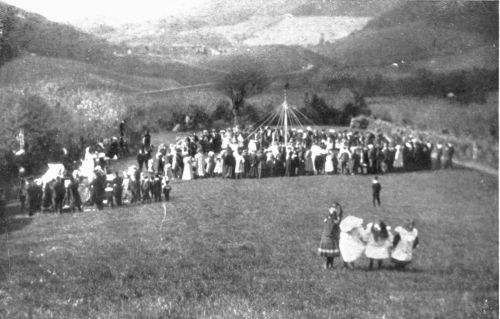
MAY DAY (p. 58)
shares came down to £32. 10s. 0d. in stock; but part of the loss was wiped out afterwards, when Great Western stocks went up, £32. 10s. 0d. of the ordinary stock selling for nearly £60, while £100 of the 5% debenture stock sold for nearly £200.
The navvies made things unpleasant here, while the line was building. My grandfather writes to my father on 17 November 1864:—“More than a hundred discharged on Monday, and a pretty row there was: drunk altogether, and fighting altogether, except one couple fought in the meadows for an hour and got badly served, I hear. The same night the villains stole all poor old *****’s fowls. He had them under lock and key, but they broke in and took the whole, young and old.... There is not a fowl or egg to be got hereabout.” Writing on 29 March 1865, he describes a visit from a drunken navvy the day before—“about as fine a built tall likely a fellow as you ever saw, and nicknamed the Bulldog.” He asked for meat and drink, and was sent empty away. “I learnt that he worked Saturday and Monday, and received 5s. 6d. for the two days, slept in a barn and spent all his earnings at the public-house.... Not long after I saw the policeman who belongs to the line—not the Lustleigh man—and he said, ‘If anything of the kind occurs again, send for me, and I will soon put all right.’ But he spends all his time on the line keeping the navvies in order; and before he can be got mischief may be done.” One of the dogs here had been poisoned by meat thrown her by a navvy, 22 September 1864. After that, he kept a revolver.
Now that the cuttings and embankments are all overgrown and covered with verdure, one can hardly realize how hideous it all looked, when they were raw and glaring. In that respect this was the worst piece of the line, as there are four cuttings here in less than a mile, and embankments almost all the way between them. But some of the viaducts and bridges are worthy of all praise. Just below here the line crosses and re-crosses the Wrey at a height of rather more than forty feet above the stream, first on a viaduct of two arches and then on a viaduct of three. And these are built of granite, and so well proportioned, that there would be many pictures of them, could they be transferred to Italy and attributed to Roman or Etruscan builders. A little further up there is a splendid archway, where the road goes underneath the line before ascending Caseleigh hill.
The line was intended to curve round the outer slope of Caseleigh hill instead of cutting through it; but the curve was condemned as dangerous on so steep a gradient. And the plans were altered, to the disadvantage of the scenery, and also of the shareholders, as the cuttings were very costly.
The old people here would often speak of London as though it stood upon a hill. And they could give a reason:—“Folk always tell of going up to London.” When the railway came, it was perplexing. This portion of the line ascends about 400 feet in about six miles, with gradients of as much as 1 in 40. Yet up trains went down, and down trains up.
Lustleigh station once had a signal-post, though it now has none. Seeing both arms lowered for trains to come both ways, I felt a little uneasy, there being only a single line. But the station-master said:—“Well, there isn’t an engine up at Moreton; and, if a truck did run away, it wouldn’t stop because the signal was against it.” Trucks do sometimes run away, but have never yet done serious damage.
This line was laid with the old broad-gauge rails on longitudinal sleepers, and was converted into narrow-gauge in 1892 by bringing the off-side rails and sleepers in towards the near-side. It has all been re-laid now with the usual narrow-gauge rails and transverse sleepers, excepting a few sidings.
On the broad-gauge there were eight seats in a compartment, first class, the narrow-gauge having only six. And in the Great Western carriages there was often a partition with a sliding door, making a sub-compartment on each side, each with two seats facing forward and two facing back. Passengers’ luggage used to be carried on the roofs of the carriages, being strapped down securely and covered with tarpaulins. But this was not peculiar to the broad-gauge. I remember it on narrow-gauge lines as well, especially the Great Northern.
Some of the old broad-gauge engines were worth seeing. On the Bristol & Exeter line there were engines that had a pair of driving-wheels nine feet in diameter, and four pairs of carrying-wheels set on two bogies fore and aft. These engines were taken over by the Great Western on the amalgamation of the companies; but the Great Western, I believe, had no engines of its own with driving-wheels of more than eight feet, except the Hurricane, whose driving-wheels were ten feet in diameter. I used to hear it said that Brunel had driven the Hurricane himself, and made her run a hundred miles an hour; and these Bristol & Exeter engines certainly ran more than eighty. It was one of these that came to grief at Long Ashton on 27 July 1876. She turned right over, and threw up her driving-wheels to such a height that they cleared the train, and came down upon the line behind it.
Engines were given names, just because stage-coaches had them. The most suggestive names—Crawley and Saint Blazey—are really names of places; and generally the choice of names is feeble. The managers of foreign lines have more imagination. I once met Lars Porsenna at Clusium—Chiusi—on the train for Rome.
A cousin of my father’s writes to him from Brighton, 28 April 1842:—“I was very glad to find from your note that you reached home safely, having escaped all the dangers of the railroad with its fearful tunnels. I think of returning [to London] by the good old stage coach, slow though it be: it is better to lose time than to run the risk of being crushed to pieces in those dark tunnels, where you have not even a chance of saving yourself by jumping out.”
There was an old gentleman near here, who was a reckless rider, and met with many accidents out hunting, yet could not bring himself to face the dangers of the railway. At last—in 1851, I think—he had to go to London on some urgent business, and then (to use his own words) he committed his soul to its Creator, and took a ticket by the train.
My grandfather did not travel in a train until 5 December 1846, and then he writes:—“I had not much inclination to go in it after reading of so many collisions and accidents, but now I think I could form a resolution to go anywhere in it; but I shall not do so, unless it is for special purposes.... I admit there is danger in all conveyances; but this, I think, with proper caution is by far the safest, and I shall in future (if ever I travel again) take about the middle carriage, for I see the hinder carriages are liable to be run into—therefore the danger is almost equal to that of the front, except the bursting of the engine.”
In a letter of 13 February 1852 he warns my father of another danger:—“I do hope you will leave the train at Exeter, when you come down, and not risk going on to Newton. The post is now arrived, near 3 o’clock: another landslip just as the mail train came up. This has been the fifth slip.” And really the dangers were considerable then. They were reduced, as years went on; but he never got quite reconciled to trains. When eighty years old and tired of life, he writes to my father, 8 June 1869:—“However glad I should be to receive my call, I would prefer home to a railway carriage.”
He writes on 27 April 1845 that Captain ***** has just returned from London. By some misunderstanding he was driven to the wrong station there, South Western not Great Western; and at that date the South Western ran only to Gosport and Southampton. It being dark, he did not notice this, and got into the train, and started off; and then “they told him he must take another train and cross over to the Great Western; but he said ‘the Devil take the train, I’ll have no more to do with it, but coach it.’ So he coached it all the way home, and did not arrive until Monday instead of Saturday.”
Until the rail reached Newton, letters came by coach to Chudleigh. Writing to my father on 25 June 1843, my grandfather says:—“Our post is altered. There is a horse-post direct from Chudley to Moreton: the bag is merely dropt at the office locked: he takes no letters on the road. Now in future we shall be obliged to send to Bovey with and for letters.” They had hitherto sent out to Kelly Cross upon the Moreton road; but Bovey was two miles further off. Several people here gave sixpence a week each to an old woman for bringing their letters out from Bovey and taking letters back; and he writes on 12 July 1845:—“The postwoman calls as regularly on Sunday mornings as on other mornings.” But on 15 February 1852 he writes:—“We have now a government appointed letter-carrier here: so the old woman, greatly to her discomfort, is out of a berth.... This man delivers free, and carries free.... He delivers from Bovey town on to Wooly, Knowle, here, and on to Lustleigh town, and so far as Rudge: all others, Parsonage, Kelly, etc., to fetch their letters from Lustleigh town.”
In the last years of coaching there were half-a-dozen daily services from London to Exeter and Plymouth, all serving different places on the way. Thus, one coach came down to Exeter by Shaftesbury and went on by Ashburton, while another came down by Dorchester and went on by Totnes. For coming here the best plan was to take a coach that passed through Chudleigh.
On 19 March 1841 my father started from Piccadilly in the Defiance coach at half past four, stopped at Andover for supper and at Ilminster for breakfast, and reached Exeter at half past ten. Allowing for stops, this meant travelling about ten miles an hour all the way, the distance being about 170 miles. He went on by coach to Chudleigh and drove from there, arriving here at half past one, twenty-one hours after leaving London. This was the last time that he came down all the way by road.
On 10 October 1842 he started from Paddington by the mail train at 8.55 p.m., reached Taunton at 2.55 a.m., and came on by the mail coach, stopping at Exeter from 6.15 to 7.0, and reaching Chudleigh at 8.0; and he was here soon after 9.0, “being only 12¼ hours from London to Wreyland.” Coming by the same train on 20 March 1845, he reached Exeter at 4.5 by rail instead of 6.15 by coach, and he was here soon after 7.0. On 8 August 1846 he came from Paddington to Exeter by the express train in only 4½ hours, 9.45 a.m. to 2.15 p.m. He came by rail as far as Teignmouth on 26 November 1846, and as far as Newton on 2 April 1847. But the line from Exeter to Newton did not much improve the journey, as it added twenty miles by rail, and saved only seven miles by road.
He notes on 7 October 1847:—“Went from Dawlish to Teignmouth by railway on the atmospheric plan, and to Newton by locomotive.” Brunel was the engineer of the line, and he had come round to the opinion that locomotives were wrong in principle—there was needless wear and tear and loss of power with engines dragging themselves along: the engine should be stationary, and the power transmitted. And he induced the company to build the line with stationary engines, which pumped the air out from a pipe between the metals, and thus drew the train along by suction. But the leakage was so great that the system was abandoned.
Coming down by the Defiance coach the fare from London to Exeter was £3 for a seat inside, and by some of the other coaches it was £3. 10s. 0d. When the railway had reached Taunton, the fare was £2. 18s. 0d. for first class on the train and inside on the coach. After it reached Exeter, the fare was £2. 4s. 6d., first class, and £2. 10s. 0d. by the express. It now is £1. 8s. 6d., first class by any train.
Writing to my father on 1 March 1840, my grandfather concludes:—“I have to request you do take an inside place in the coach. By no means go outside.” He had a notion that most people’s maladies could be traced to their travelling on the outside of a coach. He was himself a little deaf in one ear; and he always put this down to going across Salisbury Plain outside the coach on a freezing winter night.
In 1841 there was an innovation; and he writes to my father on 22 June:—“Moreton, they say, is all alive: there are three vehicles which they call Omnibusses. Wills goes from Exeter [through Moreton] to Plymouth, Waldron and Croot to Exeter and Newton.... All grades appear to go by this means, even the farmers go instead of horseback.”
My grandfather liked travelling in a leisurely way, “the time my own,” and had no patience with my father’s way of travelling about the world, “packing and unpacking, from steam carriage to steam vessel, all bustle and hurry,” as he puts it when writing him upon the subject on 19 August 1844. On going up the Rhine with him, he writes, 23 July 1855:—“Two days more on the journey would have avoided the unpleasant part of it.” But my father went his own way, and my mother kept to it after his decease. She went up the pyramids at Gizeh and Sakkarah, when she was sixty-three, and down a sulphur mine in Sicily, when she was sixty-six.
The foreign diligences were heavier and bigger than the English coaches, and did not travel so fast. On 9 October 1842 my father arrived at Boulogne by diligence from Paris, “having been only 21¾ hours on the journey—140 miles—whereas in 1839 I was 27 hours.” Going to Switzerland and Italy in September 1840, he went by steamer from London to Havre in 22 hours, and by diligence in 16 hours from Havre to Paris and 75 hours from Paris to Geneva. Then in 9 hours from Martigny to Brieg—“tolerably good travelling, altho’ for a coach that takes the mail the delays are shameful”—and in 11 hours across the Simplon from Brieg to Domodossola. This took me 10 hours in September 1899, which was the last time that I crossed the Alps by diligence. Since then I have been through the Simplon tunnel half-a-dozen times, going from Brieg to Domodossola in 50 minutes.
I crossed the Alps for the first time in August 1869, going by the Splügen. I was with my father, mother, brother and sister; and we engaged a Vetturino—a man who owned the carriage and horses that he drove. We came back by the St Gothard in a carriage with post-horses. In travelling with a Vetturino, one had to wait at various places, while his horses rested; but in posting one sometimes had to wait still longer for fresh horses. In September 1873 we came over the Arlberg in a carriage with post-horses—there is a railway-tunnel underneath it now—and one day we did only nineteen miles. When the postmaster was innkeeper as well, it was not his interest to speed the parting guest.
In driving across the Splügen, we started from Coire, and halted for the nights at Thusis, Chiavenna and Varenna. There was rail to Thusis, and on from Chiavenna, when I came that way again; and diligences went from Thusis to Chiavenna in about ten hours.
Posting across the St Gothard, we started from Como, stayed a night at Lugano and another at Airolo, and took the steamer at Fluelen for Lucerne. The tunnel had not been begun then. It was finished in 1882; and I came through it for the first time in October 1883, reaching Lucerne in about seven hours from Como.
Coming through by railway, one misses some of the excitements of the older style of travelling. When we went over in 1869, the diligence had been attacked by brigands the night before in the narrow gorge below Airolo. It was twilight when we reached the gorge; and suddenly we heard men galloping towards us. My sister made up her mind at once that they were brigands; but they turned out to be an escort coming down to see us through, and they rode on with us, their carbines in their hands.
We came from Basle to London in 1869 in six-and-twenty hours, and in 1913 I came in fourteen hours. There were neither dining-cars nor sleeping-cars in 1869, nor were there any corridor-carriages, but only the old style of carriage that jolted one abominably. Yet my father kept talking of the speed and comfort of the train, for he was thinking of the journey in the diligence. I got little sympathy from him, when I felt tired in a train; and I have little sympathy with people who complain of travelling now. In fact, I sometimes feel a little jealous of their seeing things so easily that I saw only with trouble and discomfort. They have railways and hotels all over Greece; and, when I went there first in 1880, there were no hotels except at Athens, and no railways except from Athens to Peiræus, a distance of about five miles.
But there was a pleasant way of travelling that is unknown to them. When I first went to Holland in 1872, we travelled along the canals in a Trekschuit, a light barge drawn by two or three horses, tandem, that went along the tow-path at a trot. The seats were put up high enough to clear the banks of the canal; and you saw the country comfortably, as you went gliding through. They have only motors now.
These barges were formerly in use in Belgium also; and I found these entries in one of the old diaries here:—“25 July 1833. Dunkirk. By barge to Bruges.... Changed barges at Furnes, the Belgian frontier.... Changed barges again at Nieuport.... 27 July 1833. Bruges. Embarked in a superb barge, called the Lion, and drawn by five horses. It had carried Napoleon.... Arrived at Ghent in the evening.”
A steamboat was nicer than a diligence; and that really was the reason why people were always going up the Rhine. It was much the easiest way of getting to Switzerland and Italy. Going by the Rhine in 1855, my father notes that it was the seventeenth time that he had gone that way, either up or down the stream. That time he had his father with him, and chafed a little at the leisurely movements of the previous generation. But he never wished for anything more rapid than the steamboat on the Rhine, whereas I have found it tedious, and gone up by the train.
Looking at old diaries, I see that the cost of travelling on the Continent has varied very little in the last seventy or eighty years. There has been a decrease in the cost of transit; but this is counterbalanced by an increase in the charge for bedrooms. It used to be absurdly low; but the rooms were often very poor and sparsely furnished even at the best hotels. The charge for meals at table d’hôte remains about the same.
My own experience of foreign tables d’hôte now goes back fifty years, having begun at Paris, 15 September 1867, with a table d’hôte of four hundred people at the Louvre Hotel—then in the old building on the other side of the street. So far as I can judge, the meals used generally to be better than they are, and they certainly were more abundant. The decline had begun before my time. After dining at the table d’hôte at Meurice’s, my father notes in his diary, 3 September 1863:—“Not so good a dinner as they used to give there five-and-twenty years ago.” At the table d’hôte at Blinzler’s at Godesberg, 25 August 1852, the courses were:—“1, soup; 2, roast beef and potatoes; 3, mutton cutlets and vegetables; 4, fish and sauces; 5, ducks and salads; 6, hare and stewed fruits; 7, roast veal and salads; 8, shell-fish and puddings; 9, fruits, sweetmeats and cheese.”
Innkeepers have changed their policy. They used to make their profit on the table d’hôte, and they find they can do better now with people dining à la carte. In those days it literally was table d’hôte, mine host sitting at the head of the table, and being helped first to make quite sure that everything was good. I saw this done at the Cloche at Dijon so recently as 9 August 1912; but it was a long while since I had seen this anywhere else.
The queerest table d’hôte I ever saw, was at the Singe d’Or at Tournai, 26 March 1875. That was Good Friday; and it was a first-rate fish-dinner, lasting close upon three hours. There were eighty people there, mostly from the town, as there were few travellers about, and we were the only English. The citizens went steadily through the fifteen courses, and drank dozens of champagne, and then went home with a good conscience, feeling they had carried out the precepts of the Church in having a meatless day.
In ordering wine at small hotels my father had a rule, which I have followed with success:—Always order the wine of the country. You will get the wine of the country in any event, whatever you may have ordered; and, if you order it under its own name, you may get it unadulterated.
In travelling in Italy in 1851, my father took a chimney-pot hat to wear in the large towns, and he writes home on 9 September that another must be brought down to meet him on his reaching London, as he had given this away on going to the mountains. “It had become such an incumbrance that I gave it away to-day to a poor old man at Ala: he had a crowd soon around to see him in his new covering, for which he was very grateful.” He no longer took a chimney-pot, when I began to go abroad with him—1867—but I have seen chimney-pots since then in most unlikely places. On 20 March 1882 I met an American near Jericho with chimney-pot and black frock-coat and everything to match: he said it was the best costume God ever made. On 28 December 1909 I met a Hindu on the cone of Mount Vesuvius; and he wore a chimney-pot and a very loud check suit.
Writing from Interlaken on 17 August 1849, my father says, “You would be amused at seeing what monkies the fashionable gentlemen do make of themselves in dress: perhaps one dressed like a mountaineer, or William Tell, will wear white kid gloves, or thin patent boots, or some other incongruity equally ridiculous.” People do things better now: even invalids are fully dressed for climbing.
Accidents in travelling were commoner then than now, and people took them more as matters of course. In an old diary here one page reads as follows, July 1850:—“17, Schaffhausen. 18, Zurich. 19, Lucerne. 20, do. 21, Escholzmatt. 22, Interlaken. 23, Lauterbrunnen, here I had the misfortune to fall over the Wengern Alp and break my leg, and was confined to my bed at this place 11 days, and then at Interlaken till Septr. 21. Expenses at hotels 730 francs, surgeon 330 do.—1060. 21, left Interlaken for Berne. 22, Berne. 23, Soleure. 24, Basle.” Writing to my father on 26 July “on my bed at Lauterbrunnen,” he takes it all quite calmly, just adding, “I shall have seen enough of snow and waterfalls.... How much more beautiful is the sweet vale of Lustleigh.”
Plenty of people went to Switzerland at the time when I first went—1869—far more than when my father went there thirty years before, but nothing like the crowds that go there now. They kept more to peaks and passes then; and they were always talking of Hannibal’s passage of the Alps. Junius was talked out: Tichborne and Dreyfus were yet to come; and Hannibal filled the gap. I used to hear them at home as well as there; and they all had their pet routes for Hannibal—Col d’Argentière, Mont Genèvre, Mont Cenis, Little Mont Cenis, Little St Bernard and Great St Bernard, and even Simplon and St Gothard. In 1871 I went looking for traces of the vinegar on the Great St Bernard. My father upheld the Cenis routes as the only passes from which you can look down upon the plains of Italy. I doubt if Hannibal did look down. I think he may have shown his men their line of march upon a map, just as Aristagoras used a map to show the Spartans their line of march 282 years earlier.
At that date (1869) people used still to go round Venice with Byrons, just as they go round with Ruskins now. It was Byron’s Venice that attracted them—the Venice of Marino Faliero and the Foscari, not the Venice of Carpaccio. As they could not conveniently Stand Upon The Bridge Of Sighs, they used to stand upon the Ponte della Paglia, and spout the famous lines at it from there. And they all went to see the Armenian Monastery, because it was a place where Byron stayed. Hardly anybody goes there now.
My father used always to take a Byron with him, when he went abroad, and he used to write things in the margin. Thus, his comment on The Castled Crag is “Drachenfels. 31 July 1839. Good description—very correct.” I believe it was the usual thing to annotate your Byron as if it were a guide-book.
From my father’s diary, Exeter, 23 October 1838:—“When did I dream that the Ada of Childe Harold would ever appear to me as an ordinary, unnoticed and unadorned woman. I am half vexed I should have seen her, and yet would not have it otherwise.... I recollect, when I first saw Brougham, and was standing opposite to him, I could not believe he was the extraordinary man I had been accustomed to hear so much about. But, now some years have passed away, my idea of him is very little lessened by his actual presence at that time. So may it turn out here. I hope it will: but, until it does, I shall read Byron with diminished satisfaction.”
After a tour in Italy, my father writes home from Ragatz in Switzerland, 16 September 1851:—“From Italy one dared not write about the Government, for the Austrians open the letters; but the Government is the most despotic tyranny I ever heard of: an Italian cannot get a passport, or leave the country; nor can any foreign paper reach him; nor is he allowed to talk politics.
“Venice was placarded whilst I was there with a Government proclamation, by way of warning to the people, that six persons had just been sentenced to the galleys (some for ten years, and one of the persons a lady) for daring to speak disrespectfully of the Government and the Emperor. The prisons are full of prisoners for talking politics: that by the Bridge of Sighs is crammed.
“An Englishman was sent out of Florence for saying he thought the Government was right in having sentinels in the theatres. The Chief of the Police told him that the Government tolerated no remarks upon its acts, approving them or otherwise.
“One of my American acquaintance, a physician, says that Hell, as an Institution, will wholly fail, if these tyrants don’t get their deserts in the Pit hereafter. When an Englishman said at Milan he had seen, among other relics at a church, what the priests asserted was the veritable brazen serpent of Moses in the wilderness, the Doctor asked if they showed at the same time the darkness that came over Israel. When he said No, the Doctor said they might safely have offered to, as it overshadowed the whole land in the shape of the Austrian despotism.
“Venice and Milan are both under martial law, and soldiers swarm in them; and at Verona they were preparing for a review of the whole army before the Emperor.... To induce the inhabitants to attend, there was to be a lottery, and tickets given to all who chose to come. But the Italians will not be coaxed. At a previous review, not a single Italian came upon the ground.”
Writing from Frankfort two days later, he says:—“Here I encountered those evil spirits again, the Austrian soldiers. They are chiefly Hungarians and Croats, and sent to keep the people of this ‘Free’ City of the Empire from rising again.” He had gone from Darmstadt to Freiburg by way of Radstadt on 7 August 1849, and noted in his diary then:—“Baden abounds with Prussian troops: they were just shooting some of the insurgent prisoners at Radstadt.” He wrote from Interlaken, 17 August 1849:—“I saw two Prussian officers at the Wengern Alp on leave of absence from Baden. They told me their troops had now 15,000 prisoners in Baden, and every Prussian among them they were shooting. I asked why, and they enquired if I could point out anything else they could do with them: as if it were a case of no alternative.”
Having to wait a little while at Brescia station on 23 August 1869, I went into a show that was going on just outside. There was such riotous applause that I felt sure it must be something good, and I found it was the visit of General von Haynau to the brewery of Messrs Barclay and Perkins. Their brewery was one of the sights of London that all foreigners went to see, and he went to see it. The men discovered who he was, and nearly murdered him. And the Brescians were wild with joy at seeing this in the show, remembering the old Hyæna’s brutality to them in 1849.
That afternoon, in going across the field of Solferino, I heard a curious story of the battle, 24 June 1859:—Nugent was a Field Marshal in the Austrian army. He was past eighty, and was merely a spectator, having no command; but he wore his uniform. He was watching the battle from an outlying point, and the French either saw him or heard that he was there. They argued that an officer of that rank would not be there, unless there was a force behind him; and for a time this held them back from attacking the Austrian left.
Ten years had removed all traces of the battle except the monuments and graves; but on going over the field of Gravelotte on 7 August 1875, just five years after the battle, 18 August 1870, I saw several patches of barren ground, and I was told that these marked the position of the ambulances, the surgeons having used things that afterwards sterilized the soil. And thereupon my father said that he saw patches of wheat of an unusual colour on the field of Waterloo five-and-twenty years after the battle, and he was told that these were places where horses had been killed in masses, when the cavalry charged the squares.
In a letter of 18 September 1851 my father says:—“I visited the scenes of Bonaparte’s early victories in Italy: Rivoli, Roveredo, etc.... All the towns on the Adige bear mementoes of him in the cannon balls yet sticking into the houses, the inhabitants never having taken the trouble to extract them.”
He notes in his diary, Liège, 30 July 1839:—“There was an old gentleman in the diligence with me, whom I discovered to have known Napoleon. He was returning from his house at Brussels to his country house, but lived in Paris for many years in Napoleon’s reign, and left on his abdication. He met him daily, and was Auditeur du Conseil d’État, at the meetings of which Napoleon generally presided. He said the likenesses of Napoleon were generally good, but it was impossible to give any idea by painting of the expression of his eyes—they were piercing, and he said ‘you could not look at him: his glance would read your very heart.’ He was pleasant when in good humour, but that was not always the case. He would always have an answer instantly on asking a question, and if a person did not know what he was asked, he must answer and say so without a moment’s delay.”
Napoleon was brought into Torbay on the Bellerophon in July 1815. There were strict orders from the Admiralty that nobody should come on board; but my grandfather managed it somehow, and there saw Napoleon walking up and down the deck. My grandfather was not impressed by Napoleon’s appearance, and used to tell me that “Boney was a poor-looking creature after all.” I imagine that “Boney” was not looking quite his best just then.
In a box here I found a portion of a human skull, and written on it “The skull of a Turk, one of those put to death at Joppa by that fellow Buonaparte.” That was when he shot the soldiers who had surrendered there, 10 March 1799. This relic was brought home by George Renner Hillier (born 1776, died 1865) who was then a lieutenant on the Alliance, and took part in the defence of Acre, 18 March to 21 May 1799. The box came to me as his executor’s executor; but I did not know what it contained. In another box I found a note of his that Buonaparte had sent a message to Jerusalem that he was coming there as soon as he had taken Acre, and the first French soldier that fell in the attack should be buried in the Holy Sepulchre.
After finding that skull, I had hopes of finding the keys of Flushing church, as my father told me that he had seen them at this Captain Hillier’s house; but I was disappointed. He acquired them in this way:—In the Walcheren expedition he was “appointed by Sir Richard Strachan to make the last signal on the island, with strict orders to secure the said signal at the top of the church in a manner it could not be hauled down by the enemy before the rear guard was embarked.” The written instructions were in this box:—“Blake, Flushing Roads, December 23rd 1809. As soon as the day breaks you are to show the two balls on the steeple of Flushing, being the signal for the rear guard to embark and the flotilla to withdraw, and you are to come off with the army.” He did not see how he could stop the enemy hauling the signal down as soon as they reached the church, but he thought he might delay them for some minutes, if he locked up all the doors, and brought the keys away with him.
During that war a good many French naval officers were sent to Dartmoor as prisoners; and the gravestones of some of them may be seen in Moreton churchyard, looking strangely out of place there with their French inscriptions. These officers were very popular down here; and I have been told that nobody, however poor, ever claimed the guinea reward that was offered for information of their going out of bounds.
In a letter to my father, 9 December 1839, my grandfather says:—“Your account of the French soldiers would not please a Frenchman.... I remember, when staying at Exeter, I saw a whole regiment of young fellows that had been taken prisoners: the eldest did not appear to exceed twenty-one: they were the most ugly and dirty set of fellows I ever saw, and very short: you could scarcely pick such a set from all our regiments.”
My father mentions in his diary, Nantes, 19 August 1847, that he had been talking to an old gentleman of over eighty, who had known Nantes since 1789. “In speaking of the horrible revolutionary scenes enacted at Nantes, he said that the most violent fanatics, who carried out the Butcheries and Noyades there,
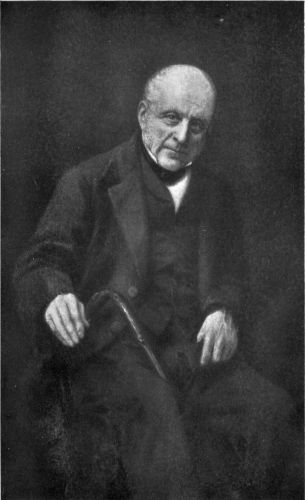
THE AUTHOR’S GRANDFATHER
were chiefly small tradesmen, and continued to live there unmolested after the Restoration as if nothing had happened, and some few were living yet.” Nantes impressed my father very much at that time:—“I have not seen a finer town. It is really finer than Brussels or Frankfort, and, as a whole, even finer than Paris.”
In his diary, Paris, 18 October 1839, my father writes:—“The streets here are worse, much worse, than in London, except just the Rivoli and one or two others, where there are arcades in front of the houses with flag stones. Not half or quarter of the other streets are flagged, and the common pavement is dreadfully uneven, besides not being level. Each side falling towards the centre makes the walking very disagreeable—and that centre generally running with mud or water affords the chance of every carriage that passes giving the foot travellers a splashing from head to foot. Besides, most of the streets are narrow, and many are filthy and muddy.
“It really is a disgrace to the Parisians, who boast so much of the Invalides, to have such a vile public road to it, and infamously lighted. Amongst the trees and all in the dark I had to grope my way towards the Seine, nearly up to my ancles in mud. At last I reached the bridge, and then for a contrast came into the Place de la Concorde, covered all over with flag pavement, and with brilliant gas lights at every two or three yards, and often two together. But it is either the height of splendour or the height of meanness and misery here.”
I saw Paris first in September 1867. It was then in all its glory, with the wide streets and stately buildings constructed in the previous fifteen years. The place was thronged with people of all nations, who had come to see the Exhibition; and there was huge prosperity all round. The soldiers looked magnificent, especially the Zouaves and the Imperial Guard—long-service men with medals; and few people imagined that the Prussians could stand up to them. Yet there were some signs of insecurity. The official tune was Partant pour la Syrie; and, if anyone even whistled the Marseillaise, the police were after him at once.
I saw Paris next in August and September 1871. And these are some of the things that I noted in my diary then:—In the Rue de Rivoli some blocks of houses had been blown up, others burnt, and all more or less damaged. Of the garden front of the Tuileries only the outer walls were left: the New Louvre had been a little damaged, and was being re-roofed: the fire had not reached the Louvre itself. At the Palais Royal, the palace itself had been burnt, but not the shops underneath. Neither the Bourse nor the Opera House was hurt. There was nothing left of the Hôtel de Ville except the outer walls and the chimneys with the statues on them; and these stood out well against the sky. Most of the neighbouring houses had been burnt. There were several shot holes through the Bastille Column. The remains of the Vendôme Column had already been removed, but the base was still there, a good deal broken on the side on which the pillar fell—and the man with the telescope was there as before. The arcade in the Rue de Castiglione was covered with bullet holes. In the Place de la Concorde the statue of Lille had been knocked to pieces by a shell, also one of the fountains—the further from the river—but the Luxor obelisk was safe. Out by the Auteuil Gate every house had been more or less damaged by shells, and a good many had been pulled down for fear of their collapsing. The stone fortifications were not much damaged, but the earthworks above them were covered with shell-holes. For 300 yards outside the fortifications the trees in the Bois de Boulogne had been cut down, but very few of the others had been damaged.
Paris has never recovered from that blow, and its slovenliness under the Republic contrasts badly with its smartness in the Second Empire. The damage was made good, but there has been little progress since; and meanwhile Vienna has become the finest town in Europe. Berlin has grown enormously; and the pleasant old town is lost amidst the dreariness of its extensions. It was after the events of 1870 that building started there, and started at Rome also in much the same style. But a style that does not matter in Berlin, is quite exasperating in such a place as Rome.