Part 1 — CHAPTER VIII. TRICKS WITH CARDS. (continued 2)
Reading edition
The Travelling Cards.—This is a pretty trick, and one that is always much commented upon by spectators who have seen it neatly performed. The performer has a couple of cards chosen, which he brings to the top of the pack; then, addressing the company, he refers to the notion that the sleeve of the coat is employed by conjurors for their concealment. He deprecates the attempt, made by many performers, to deny the immense aid afforded by this portion of the attire, especially for the effective concealment of eggs, pigeons, cannon-balls, and other articles equally easy of manipulation (this as sarcastically as he pleases), and says he will now proceed to demonstrate, conclusively, in what way the sleeve is employed. "So far from there being any difficulty, ladies and gentlemen, in concealing cards, in the sleeve, for instance, it is a very easy matter to cause them to travel up or down with great rapidity, and invisibly. My waistcoat, as you see, contains nothing." The performer cannot very well unbutton and open his waistcoat before the company, so, to show it is empty, he places his hand inside, and performs the action of emptying sufficiently vigorously to dislodge anything that might be there. He next palms a dozen or more cards from the top of the pack, and then, extending the left arm, ruffles the edges of the remaining cards. This act, he explains, has had the effect of sending a card up his sleeve, and he affects to watch its progress. A jerk of the arm is made, the contraction being caused, the performer says, by the passage, by the card, of the elbow. Plunging the right hand into the vest, the cards palmed are dropped there, one card only, taken from the bottom, being slowly extracted. A second card is made to pass in the same way, and another indifferent card extracted. The performer now asks the choosers of the two cards on the top at what numbers they shall pass up the sleeve. This feat is easy of accomplishment, as the cards are taken from the bottom until the proper number has been reached. When the cards in the vest have been exhausted, more can be palmed, and the operation continued until all the pack has been employed; but this finish is by no means necessary to the success of the trick, which may be considered concluded when the two selected cards have been withdrawn, although it is as well to continue passing cards until no more are left in the vest.
The Assembly.—In this trick, four cards are laid separately on the table, in a row, and upon each card three more are placed from the pack, making four heaps of four cards each. The company themselves select one of the four heaps, which is found to consist entirely of the four cards that were only just previously laid upon the table, apart from each other, the remaining three heaps consisting of four different cards each. To accomplish this, the performer commences operations by picking out of the pack four cards of any one denomination, say, the knaves. This is far better than having four different cards selected, as the trick is one of startling effect, and four picture cards are better for the purpose, apart from the fact that no one in the company is called upon for an effort of memory. The performer gives the four knaves to one of the company, and seizes an opportunity for palming three cards. He now allows the four knaves to be placed upon the top of the pack, which he holds in the left hand, supplementing secretly the three palmed cards. He then proceeds to deal off the four topmost cards, one by one, placing them in a row, divided by a few inches, saying, as he does so, "Here I place one knave, here a second, here a third, here a fourth." After he has placed the fourth card, which will naturally be the only one of the four that is really a knave, upon the table, he pauses for a moment or two, and then turning it over remarks, pensively, "Ah! the knave of diamonds," or whichever it may be. This is really to let the spectators see the only knave there is, in order to convey the impression that all the rest are knaves also, they being led to fancy the performer looks at the suit of it for the purposes of the trick. The remaining three knaves are now, of course, on the top of the pack, the three palmed cards and one knave having been removed from above them. It is open to the performer to place these three at once on the top of the fourth knave, and this is generally done, but I do not at all advise it. Invariably make a pass at this point, so as to bring the three knaves to the centre of the pack, keeping the place where they are well defined by a finger, or by a break in the pack. I then place the three cards now on the top upon one of the three ordinary cards, emphasising the fact that they come from the top. I then open the pack a little lower down, and taking three cards from there, place them upon another ordinary card. The middle of the pack, where the three knaves are, is now reached unsuspiciously enough, and they are, of course, placed upon the fourth knave. Three more ordinary cards, from still deeper down in the pack, are placed upon the remaining ordinary card, as much deliberation being paid to this last card as to any other, or the conjuror's manner may reveal that he has accomplished what he wanted, however unknown its precise nature may be. The selection of a heap then proceeds precisely as described in The Lady's Own Trick, first two, and then one being removed. The four knaves are then shown together in the supposed selected heap.
A second method depends upon the neat execution of the pass, and is to be commended because, each time three cards are placed upon one of the four lying upon the table, they are first shown to be ordinary mixed cards, and not knaves. Three cards are palmed, and placed upon top of the four knaves, as in the first method, and the three ordinary cards and one knave are placed in a row, as before. Three mixed cards are then taken from any part of the pack, their faces shown casually, and they are then put upon an ordinary card. This is gone through three times, the knave being left till the last. As if by mistake, the performer places the three cards, which he has shown to be mixed ones, upon the cards in his left hand, instead of upon the knave on the table. At this instant the three are passed to the bottom, the right thumb at once taking off the three knaves, as though they were the cards just placed there by mistake. On no account must the performer make any apology; he need merely say, "Oh! that's wrong; they must go here," and place the cards upon the knave. One must be perfect in making the pass before attempting this method; but it is very easy indeed to pass so few cards as three from top to bottom.
A third method is also accomplished by means of the pass, and is preferred by many conjurors. The four cards are shown, and, as they are being put upon the pack, the little finger is passed between the third and fourth, three cards thus being above it. The insertion of the little finger is in all cases greatly facilitated if the cards are spread a little, fanwise, at the moment of placing them on the pack. The three topmost cards (knaves) are immediately passed to the bottom, leaving one knave on the top, and the little finger kept between them and the rest of the pack. This card is then placed upon the table, its face being accidentally (?) shown to the spectators, and three others (ordinary cards) successively laid beside it. Three ordinary cards, always taken from the top, are then placed upon each of the ordinary ones lying singly upon the table, the audience seeing their faces each time, and then the pass is made, bringing the three knaves from the bottom back again to the top. These three cards are then placed upon the other knave, which brings about the desired state of affairs. As these three knaves cannot be shown to be ordinary cards, as was each preceding set of three cards, I here recommend the conjuror to make use of a little ruse of mine. It is to take off from the pack four, instead of three, cards, the three knaves thus having an ordinary card beneath them. Holding the edges even, so that only the lowest card can be seen, the performer says, "Now I once more take three cards, and"—here he turns them over, and, spreading them slightly, discovers four cards, so he continues, "Oh! I see, I have taken one card too many." He then removes the underneath card, and places the remaining three upon the knave. To show the faces of three out of four heaps of cards and not those of a fourth, causes suspicion to be thrown upon the latter. By adopting the ruse described, this is ostensibly done; at any rate, sufficiently so to satisfy the spectators, which is all that is desired.
A fourth method is bolder still, and calls for a masterly execution of the change. Matters progress precisely as in the second method, except that the three knaves are always slightly pushed off the top of the pack, ready to be exchanged at any moment. It is just as easy to change three cards as one by the method illustrated at Fig. 36. The fourth time is perhaps again the most favourable for the substitution, as the performer may cover the action of changing by handing the pack to be held. Holding the pack, with the knaves on the top, in the left hand, and the three ordinary cards in the right, he should turn round suddenly to someone on his extreme left, and somewhat behind him, when every opportunity will be afforded for executing the sleight. Or the act may be gone through by giving the last three cards to someone on the performer's left to place upon the remaining uncovered knave, when the same facility for an exchange will be afforded.
Yet a fifth method remains, which is a very fine one indeed, if the performer should happen to be an adept at changing. To attempt this method, he must be absolutely perfect in this sleight. The four knaves are first thrown down upon the table, faces upwards. One is then taken in the right hand, and three cards put upon it from the top of the pack, held in the left hand. That is what the performer appears to do, but, in reality, as he approaches the pack with the knave, the change is effected, the knave being thereby placed at the bottom of the pack. As he executes the change, the performer says, "I will now take three more cards from the pack," and, under cover of the quite natural action of bringing the knave into proximity to the pack, the change, if only adroitly executed, will pass unnoticed. The three cards required are drawn off by means of the right thumb, and the heap of four placed at a corner of the table. A second knave is similarly treated, followed by a third. Three knaves are now at the bottom of the pack. The performer may now either make the pass, bringing the three knaves to the top, and then place them upon the fourth, or else he may say that he will take three cards from the bottom of the pack, to show that it is immaterial to him from whence they come. As the feat of changing three times in succession is materially assisted by some freedom of movement, it is as well to place the four heaps at the corners of the table, wide apart, the performer being thereby compelled, in the eyes of the company, to move about a good deal. The one great feature connected with this method is, that the four knaves are shown faces upwards, until the very moment of their being placed in a heap. In each of the last three methods, the selection of the knave heap proceeds as described in the first method.
The five methods described give the conjuror his choice according to his greater facility with the pass, the palm, or the change; and he will also find that they are capable of far wider application, in connection with other card tricks.
Thought-reading.—Give the pack into the hands of a spectator, and allow one card to be secretly chosen. Replaced in the pack, it is passed to the top (or bottom), and a furtive glance taken at it, the palm being employed, if necessary. Let three cards be chosen in this manner, a fourth being forced, consequently previously known. The object of this diversion is in order that the last card selected may be placed in the pack by the chooser, and the cards immediately shuffled, which will distract attention from the fact that this was not done in the other cases, which, however, could be done after the performer had glanced at the card, if necessary, which it is not, as it draws out any trick too long to have the cards frequently shuffled. The performer must be careful to remember the cards, and by whom drawn. Taking the pack in his hand, he presents one end of it to a card drawer, explaining that he is about to give an exposition of thought-reading. Although there is no reason for failing, it is as well not to make this announcement any earlier, in case of anything going not quite rightly. The performer makes a great fuss about the necessity for looking full in the eyes of the person drawing the card, and pretends to arrive at the designation of the card by slow degrees, saying to himself, but audibly enough to be heard, for instance, "A red card—hearts—one, two, three, four, five, six, seven spots;" and then, loudly, "The seven of hearts." Every incidental occurrence in the behaviour of the persons whose thoughts are being read must be taken advantage of; a want of alacrity in obeying instructions, for example, tending to make the reading more difficult, the subject being even left for the time being, and returned to after other cards have been revealed. This trick has the advantage of bearing considerable repetition.
A second method is as follows: The performer holds the cards in one hand, and presents them to a spectator to cut, with the injunction that the underneath card of the cut shall be removed, looked at, and remembered. It is immaterial how many cards are thus chosen. As they are selected they are replaced in the pack by the person choosing, the performer turning his head away, if necessary, whilst this is being done; or they may be put back together, and the pack shuffled by the company. Simply by placing one end of the pack in the chooser's hand, whilst holding the other end himself, the performer is enabled to name the cards as before. This phase of the trick is accomplished by means of a "cut force." Glancing at the bottom card, the performer makes the pass, keeping the two packets apart by means of the little finger. The card which the performer has seen is now at the bottom of the upper half, and the pack is presented for cutting. As the four fingers are along one side of the pack, and the thumb along the other, the cut must be made lengthwise; and, as the little finger keeps the pack open at the back, it must be made there. The person cutting will notice nothing. Whilst the card is being examined, the performer glances at the fresh bottom card, and, when the upper half of the pack is returned to him, once more makes the pass, and presents the cards to another person to be cut. Four cards are quite sufficient for the effect; but, if the performer can remember others, he is quite at liberty to increase the number. The finish of the trick will depend upon the performer's ability to simulate the possession of thought-reading powers. If he has been showing any card tricks previously, with success, he may commence this one by saying, "I have an idea that many here fancy I have a method for forcing certain cards upon persons, such cards being previously known to me. Now, in order to render such a proceeding quite impossible, I will ask this gentleman to shuffle the cards thoroughly, so that I cannot know the position of any one of them, and then have the cards cut haphazard." This explains why the cut is used, and at once makes the trick appear stupendously difficult.
The "cut force" here described may be successfully employed for the purpose of reproducing cards that have been previously chosen, thought of, &c.; one of the company being made to cut the pack at the very spot where that card is situated, after shuffling, &c.
If the company appears still sceptical about the powers of mind claimed by the performer, he may give a final convincing proof. Placing the pack entirely in the hands of the company, he desires them to select two or three cards. These cards are gathered by a spectator, and given to another to hold, and afterwards placed by him in the pack. The performer then presents his hand to each chooser, and reads the cards as before. Unless the performer can execute the change with certainty, he must not attempt this method, or ruinous exposure may await him. About the first portion of the trick all is fair and above board, the company selecting the cards as they please. The performer, taking the pack in his left hand, then says, "Now, in order that I may not get a sight of the cards, will some gentleman kindly gather them in his hand?" Whilst this is being done, the performer must watch narrowly whose card is placed first, whose second, &c. Taking the three cards from the hand of the collector, the performer turns to a spectator on his left, requesting him to hold them between his hands. As he turns, he makes the change, the three chosen cards being left at the bottom, and three indifferent ones removed from the top, and given to be held. Great caution is necessary to keep the cards well covered by the upper hand, so that the performer shall not see them—his actual anxiety, of course, being lest any one else should do so. By this time he has glanced at the bottom card, and, making the single card slip pass, sees the next also, and the third soon afterwards. Affecting to see mistrust in the faces of the company, the performer says that perhaps it would, after all, be better to have the three cards in the pack. For this purpose the pack is handed to the person holding the three cards, who is directed to shuffle them with the rest. The trick then proceeds as before. If the change is properly executed, the effect of this trick is extraordinary, because the three cards have, apparently, always been in full view of everyone; and even if the performer had accidentally seen the face of the lowest one, the others have certainly never been visible to him.
A Game at Napoleon.—The performer forces five cards in succession, as quickly as he can, and remembering the whole five. Practice in the preceding trick will enable him to accomplish this, at first, rather difficult task, in public, it being simple enough to remember five cards when one has nothing else on hand at the same time. It is best to force all five cards on one person, who retains them. If forced upon different people, they must be afterwards collected in one hand. Giving the pack to another of the company, the performer asks for any five cards to be given him. This done, he tells the holder of the forced cards that he is about to play a game at "Napoleon" with him. For the sake of effect, he may allow one half of the company to see his hand, the other half looking over the hand of his opponent. In this way, universal interest is excited. Should the opponent have a poor hand, the performer may give him the choice of saying how many tricks he will declare. Should the opponent have at all good cards, however, then the performer must say, "I declare first." What he declares will, of course, depend upon the cards; but, in nearly every case, he can go "Napoleon," one condition of the trick being, as he will explain just before playing the hand, that the opponent must play the cards as called for by the performer, who, of course, must not make his antagonist revoke. With this proviso, it is wonderful how often it is possible, even with the least promising cards, to win all five tricks; the cases in which four only are possible being very rare. A couple of sample hands will be instructive.
First Hand.—The opponent's cards are:
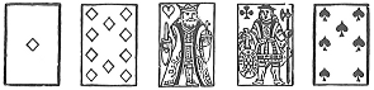
The performer's being:
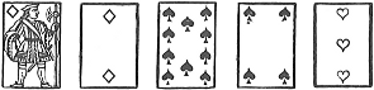
He declares "Napoleon," and the hand is played as follows:
1. Performer plays and calls for


2. Performer plays and calls for


3. Performer plays and calls for


4. Performer plays and calls for


5. Performer plays and calls for


Had the performer's highest diamond been less than the opponent's ten, then only four tricks would have been possible.
Second Hand.—The opponent's cards are:
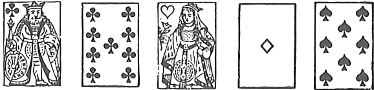
The performer's being:
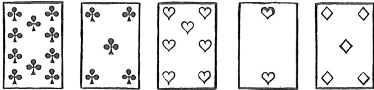
He declares "four," and the hand is played as follows:
1. Performer plays and calls for


2. Performer calls for and plays


3. Performer plays and calls for


4. Performer plays and calls for


5. Performer plays and calls for


Should the opponent, by any chance, hold an overwhelmingly superior hand, such as, for instance, five high cards of one or two suits, and the performer low cards of the same suit or suits, the latter must say, as soon as he realises the state of affairs, "Ah! I see, I haven't the ghost of a chance against you with this hand; have I?" at the same time throwing down his cards, faces upwards, and demanding a fresh hand. Of course, the astonishing part of the trick to the spectators is the fact of the performer being able to call the opponent's hand, card for card, and no one cavils at the absurdity of permitting him to do so utterly regardless of the general rules of the game.
The performer can, of course, make sure of winning the whole five tricks every time, if he prearranges to give a poor hand to his opponent; but a great deal of the fun lies in the fact of good cards falling to insignificant ones. If the performer arranges to have five fairly good cards, three of them of one suit, with a big one at their head, on the top of the pack, it may be as well, as, when he asks for five cards, they are sure to be given him from that position ninety-nine times in a hundred. Should the five cards drawn prove, by accident, the masters of them, then, of course, shuffle the pack before asking for a hand from it. Personally, I like as little prearrangement as possible about the trick.
The Lightning Change.—This is an effective trick of my own, and the outcome of practice at the single-handed pass shown at Figs. 31 and 32. The performer has several cards selected haphazard. How many is not material, but four or five will be sufficient. These he has placed in the pack in the ordinary way, and brought to the bottom; an extra card, not one of those chosen, being added last of all. The order in which the cards were replaced in the pack should be noted. The performer stands sideways to the audience, with the left arm extended, the pack being held in that hand perpendicularly, and not horizontally—the faces of the cards, and not the backs, visible. The thumb should lie well across the centre of the undermost card, and the performer should ascertain by feel that he has it in his grip before continuing the trick. The card that is exposed to view is the added one, and it conceals the first card gathered in of the chosen ones, which is naturally the undermost. The chooser of this card is requested to name it, when the performer informs the company that, if they watch closely enough, they will see the one card change into the other. Anyhow, if they are unable to see it, they will infallibly hear it. As this pass cannot be made noiselessly, the latter is a very necessary remark to make. The change is not effected with the hand held stationary—no pass ever is—a rapid movement, some six inches in extent, and somewhat circular, being made towards the body and back again. It is only a fraction of a second in duration, but by the time it is completed the pass must be accomplished. Each card is made to appear in turn, the performer taking care not to attempt the pass until he feels the card well gripped by the root of the thumb; otherwise, a fiasco may easily result. The pass may also be effected whilst turning the pack face downwards and back again very rapidly, but I do not find this method quite as good as the partially circular movement towards the body, the cards sometimes flying out of the fingers in a body, which is destructive to the success of the trick, and highly disconcerting to the performer. The feat is ostensibly exhibited as one of skill, and, when properly executed, invariably affords astonishment; for, although the company are apprised of the actual moment at which the cards change, and even hear the movement, they can see nothing of what takes place.
This concludes the series of card tricks, and also the first part, Drawing-room Conjuring. I have not pretended to describe—and, indeed, the feat would be quite impossible—every trick capable of being performed with the various articles mentioned. Every conjuror who is what is popularly, if somewhat bluntly, termed "worth his salt," will find out little dodges and variations in the course of practice and exhibition; and I would advise no one who discovers a method for arriving at any given result which comes to him easier than any described by me, to follow my instructions in preference to his own ideas. This advice more particularly applies to card tricks. Conjuring, it must be borne in mind, is not like cricket, or rowing, or shooting, or anything else; there is no legitimate means of arriving at anything through its medium. The wished-for result must be produced by fair means or by foul.
Many tricks included in the first portion may be successfully introduced on the stage. This is essentially the case with the more showy card tricks.