Volume 2 / Part 2 — ILLUSTRATIONS (continued 5)
Reading edition
I went to town at Pine Bluff. There I got to mixing concrete. I made pretty good at it, too. I stayed on for some years. Then I came to Hot Springs. My brother was along with me. We both worked and after work we built a house. It took us four years. But it was a good house. It has six rooms in it. It makes a good home. My brother had the deed. But his widow says I can stay on. The folks what lives in the rest of the house are good to me.
When I got to Hot Springs I worked mixing concrete. There was lots of sidewalks being made along about that time. Then I scatter dirt all around where the court house is now. Then I worked at both of the very biggest hotels. I washed. I washed cream pitchers—the little ones with corners that were hard to clean.
No, I ain't worked in three years. It hard to try to get along. Some states, they pays good pensions. I can't be here long—don't look like I can be here long. Seems as if they could take care of me for the few days I'm going to be on this earth. Seems like they could.
Interviewer: Mrs. Carol Graham Person interviewed: Millie Evans Age:
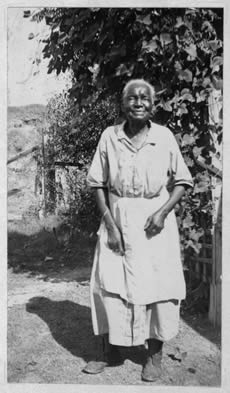
Yo' say yo' is in'rested in the lives of the slaves? Well, Miss, I is one of 'em. Was born in 1849 but I don' know jus' when. My birthday comes in fodder pullin' time cause my ma said she was pullin up till bout a hour 'fore I was born. Was born in North Carolina and was a young lady at the time of surrender.
I don' 'member ol' master's name; all I 'member is that we call 'em ol' master an ol' mistress. They had bout a hundred niggers and they was rich. Master always tended the men and mistress tended to us.
Ev'y mornin' bout fo' 'clock ol' master would ring de bell for us to git up by an yo could hear dat bell ringin all over de plantation. I can hear hit now. Hit would go ting-a-ling, ting-a-ling and I can see 'em now stirrin in Carolina. I git so lonesome when I thinks bout times we used to have. Twas better livin back yonder than now.
I stayed with my ma every night but my mistress raised me. My ma had to work hard so ev'y time ol' mistress thought we little black chilluns was hungry 'tween meals she would call us up to the house to eat. Sometime she would give us johnny cake an plenty of buttermilk to drink wid it. They had a long trough fo' us dat day would keep so clean. They would fill dis trough wid buttermilk and all us chillun would git roun' th' trough an drink wid our mouths an hol' our johnny cake wid our han's. I can jus' see myself drinkin' now. Hit was so good. There was so many black fo'ks to cook fuh that the cookin was done outdoors. Greens was cooked in a big black washpot jus' like yo' boils clothes in now. An' sometime they would crumble bread in the potlicker an give us spoons an we would stan' roun' the pot an' eat. When we et our regular meals the table was set under a chinaberry tree wid a oil cloth table cloth on when dey called us to th' table they would ring the bell. But we didn' eat out'n plates. We et out of gourds an had ho'made wood spoons. An' we had plenty t'eat. Whooo-eee! Jus' plenty t'eat. Ol' master's folks raised plenty o' meat an dey raise dey sugar, rice, peas, chickens, eggs, cows an' jus' ev'ything good t'eat.
Ev'y ev'nin' at three 'clock ol' mistress would call all us litsy bitsy chillun in an we would lay down on pallets an have to go to sleep. I can hear her now singin' to us piccaninnies:
"Hush-a-bye, bye-yo'-bye, mammy's piccaninnies Way beneath the silver shining moon Hush-a-bye, bye-yo'-bye, mammy's piccaninnies Daddy's little Carolina coons Now go to sleep yo' little piccaninnies."
When I got big 'nough I nursed my mistress's baby. When de baby go to sleep in de evenin' I woul' put hit in de cradle an' lay down by de cradle an go to sleep. I played a heap when I was little. We played Susannah Gal, jump rope, callin' cows, runnin', jumpin', skippin', an jus' ev'ythin' we could think of. When I got big 'nough to cook, I cooked den.
The kitchen of the big house was built way off f'om the house and we cooked on a great big ol' fi' place. We had swing pots an would swing 'em over the fire an cook an had a big ol' skillet wi' legs on hit. We call hit a ubben an cooked bread an cakes in it.
We had the bes' mistress an master in the worl' and they was Christian fo'ks an they taught us to be Christianlike too. Ev'y Sunday mornin' ol' master would have all us niggers to the house while he would sing an pray an read de Bible to us all. Ol' master taught us not to be bad; he taught us to be good; he tol' us to never steal nor to tell false tales an not to do anythin' that was bad. He said: Yo' will reap what yo' sow, that you sow it single an' reap double. I learnt that when I was a little chile an I ain't fo'got it yet. When I got grown I went de Baptist way. God called my pa to preach an ol' master let him preach in de kitchen an in the back yard under th' trees. On preachin' day ol' master took his whole family an all th' slaves to church wid him.
We had log school houses in them days an fo'ks learnt more than they does in the bricks t'day.
Down in the quarters ev'y black family had a one or two room log cabin. We didn' have no floors in them cabins. Nice dirt floors was de style then an we used sage brooms. Took a string an tied the sage together an had a nice broom out'n that. We would gather broom sage fo' our winter brooms jus' like we gathered our other winter stuff. We kep' our dirt floors swep' as clean an' white. An our bed was big an tall an had little beds to push under there. They was all little er nough to go under de other an in th' daytime we would push 'em all under the big one an make heaps of room. Our beds was stuffed wid hay an straw an shucks an b'lieve me chile they sho' slep' good.
When the boys would start to the quarters from th' fiel' they would get a turn of lider knots. I specks yo' knows 'em as pine knots. That was what we use' fo' light. When our fire went out we had no fire. Didn' know nothin' bout no matches. To start a fire we would take a skillet lid an a piece of cotton an a flint rock. Lay de cotton on th' skillet lid an' take a piece of iron an beat the flint rock till the fire would come. Sometime we would beat fo' thirty minutes before the fire would come an start the cotton then we woul' light our pine.
Up at th' big house we didn' use lider knots but used tallow candles for lights. We made the candles f'om tallow that we took f'om cows. We had moulds and would put string in there an leave the en' stickin' out to light an melt the tallow an pour it down aroun' th' string in the mould.
We use to play at night by moonlight and I can recollec' singin wid the fiddle. Oh, Lord, dat fiddle could almos' talk an I can hear it ringin now. Sometime we would dance in the moonlight too.
Ol' master raised lots of cotton and the women fo'ks carded an spun an wove cloth, then they dyed hit an made clothes. An we knit all the stockin's we wo'. They made their dye too, f'om diffe'nt kin's of bark an leaves an things. Dey would take the bark an boil it an strain it up an let it stan' a day then wet the 'terial in col' water an shake hit out an drop in the boilin' dye an let it set bout twenty minutes then take it out an hang it up an let it dry right out of that dye. Then rinse it in col' water an let it dry then it woul' be ready to make.
I'll tell yo' how to dye. A little beech bark dyes slate color set with copperas. Hickory bark and bay leaves dye yellow set with chamber lye; bamboo dyes turkey red, set color wid copperas. Pine straw dyes purple, set color with chamber lye. To dye cloth brown we would take de cloth an put it in the water where leather had been tanned an let it soak then set the color with apple vinegar. An we dyed blue wid indigo an set the color wid alum.
We wo' draws made out of termestic that come down longer than our dresses an we wo' seven petticoats in the winter wid sleeves in dem petticoats in the winter an the boys wo' big ol' long shirts. They didn' know nothin bout no britches till they was great big, jus' wen' roun' in dey shirttails. An we all wo' shoes cause my pa made shoes.
Master taught pa to make shoes an the way he done, they killed a cow an took the hide an tanned it. The way they tanned it was to take red oak bark and put in vats made somethin' like troughs that held water. Firs' he would put in a layer of leather an a layer of oak ashes an a layer of leather an a layer of oak ashes till he got it all in an cover with water. After that he let it soak till the hair come off the hide. Then he would take the hide out an it was ready for tannin'. Then the hide was put to soak in with the red oak bark. It stayed in the water till the hide turned tan then pa took the hide out of the red oak dye an it was a purty tan. It didn' have to soak long. Then he would get his pattern an cut an make tan shoes out'n the tanned hides. We called 'em brogans.
They planted indigo an it growed jus' like wheat. When it got ripe they gathered it an we would put it in a barrel an let it soak bout a week then we woul' take the indigo stems out an squeeze all the juice out of 'em an put the juice back in the barrel an let it stan' bout nother week, then we jus' stirred an stirred one whole day. We let it set three or four days then drained the water off an left the settlings and the settlings was blueing jus' like we have these days. We cut ours in little blocks an we dyed clothes wid it too.
We made vinegar out of apples. Took over ripe apples an ground 'em up an put 'em in a sack an let drip. Didn' add no water an when it got through drippin we let it sour an strained an let it stan for six months an had some of the bes vinegar ever made.
We had homemade tubs and didn' have no wash boa'ds. We had a block an battlin' stick. We put our clo'es in soak then took 'em out of soak an lay them on the block an take the battling stick an battle the dirt out of 'em. We mos'ly used rattan vines for clotheslines an they made the bes clo'es lines they was.
Ol' master raised big patches of tobaccy an when dey gather it they let it dry an then put it in lasses. After the lasses dripped off then they roll hit up an twisted it an let it dry in the sun 10 or 12 days. It sho' was ready for some and chewin an hit was sweet an stuck together so yo' could chew an spit an 'joy hit.
The way we got our perfume we took rose leaves, cape jasmines an sweet bazil an laid dem wid our clo'es an let 'em stay three or fo' days then we had good smellin' clo'es that would las' too.
When there was distressful news master would ring the bell. When the niggers in the fiel' would hear the bell everyone would lis'en an wonder what the trouble was. You'd see 'em stirrin' too. They would always ring the bell at twelve 'clock. Sometime then they would think it was some thin' serious an they would stan up straight but if they could see they shadow right under 'em they would know it was time for dinner.
The reason so many white folks was rich was they made money an didn' have nothin' to do but save it. They made money an raised ev'ything they used, an jus' didn' have no use fo' money. Didn' have no banks in them days an master buried his money.
The floo's in the big house was so pretty an white. We always kep' them scoured good. We didn' know what it was to use soap. We jus' took oak ashes out of the fi'place and sprinkled them on the floo' and scoured with a corn shuck mop. Then we would sweep the ashes off an rinse two times an let it dry. When it dried it was the cleanes' floo' they was. To make it white, clean sand was sprinkled on the floo' an we let it stay a couple of days then the floo' would be too clean to walk on. The way we dried the floo' was with a sack an a rag. We would get down on our knees an dry it so dry.
I 'member one night one of ol' master's girls was goin' to get married. That was after I was big 'nough to cook an we was sho' doin' some cookin. Some of the niggers on the place jus' natchally would steal so we cook a big cake of co'n-bread an iced it all pretty an put it out to cool an some of 'em stole it. This way old master found out who was doin the stealin cause it was such a joke on 'em they had to tell.
All ol' master's niggers was married by the white preacher but he had a neighbor who would marry his niggers hisself. He would say to the man: "Do yo' want this woman?" and to the girl, "Do yo' want this boy?" Then he would call the ol' mistress to fetch the broom an ol' master would hold one end an ol' mistress the other an tell the boy and girl to jump dis broom and he would say: "Dat's yo' wife." Dey called marryin' like that jumpin the broom.
Now chile I can't 'member everything I done in them days but we didn' have ter worry bout nothin. Ol' mistress was the one to worry. Twasn't then like it is now, no twasn't. We had such a good time an ev'ybody cried when the Yankees cried out: "Free." Tother niggers say dey had a hard time 'fo' dey was free but twas then like tis now. If you had a hard time we don it ourselves.
Ol' master didn' want to part with his niggers an the niggers didn' wan' to part with ol' master so they thought by comin to Arkansas they would have a chance to keep 'em. So they got on their way. We loaded up our wagons an put up our wagon sheet an we had plenty to eat an plenty of horse feed. We traveled bout 15 or 20 miles a day an would stop an camp at night. We would cook enough in the morning to las' all day. The cows was drove t'gether. Some was gentle an some was not an did dey have a time. I mean, dey had a time. While we was on our way ol' master died an three of the slaves died too. We buried the slaves there but we camped while ol' master was carried back to North Carolina. When ol' mistress come back we started on to Arkansas an reached here safe but when we got here we foun' freedom here too. Ol' mistress begged us to stay wid her an we stayed till she died then they took her back to Carolina. There wasn' nobody lef' but Miss Nancy an she soon married an lef' an I los' track of her an Mr. Tom.
El Dorado District FOLKLORE SUBJECTS Name of Interviewer: Pernella Anderson Subjects: Customs related to Slavery Time [HW: Ex Slave Story] Subject: Food—Particular foods typical and characteristic of certain localities and certain people (negroes) [Nov 6 1936] This information given by: Millie Evans (Negroes pronounce it Irvins) Place of Residence: By Missouri Pacific Track near MOP Shops Occupation: None Age: 87
[TR: Additional topic moved from subsequent page.] [TR: Personal information moved from bottom of interview.]
I wuz a young lady in the time of surrender. I am a slave chile. I am one of them. I had a gran' time in slavery time. I wuz born wid de white foks. I stayed wid mah muthah at night but mah mistress raised me. I nussed mah mutha's gran'chile. I churned and sot de table. When de baby go to sleep in de evenin' I put hit in de cradle. An' I'd lay down by the cradle and go to sleep. Every evenin' I'd go git lida knots. I played a lots. I wuz born 1849. We played Susanna Gals, and we just played jump rope. Jes' we gals did. We played calling' cows. Dey'd come to us and we run from um. My [TR: 'I' corrected to 'My'] mistess wuz a millionaire. I went to school a while. I can count only lit bit. One uz de girl made fun uz me. She kotch me nodding and we fit dare in de school house. Old log school house. Dey had two big rooms. Ah went to de ole fokes' church. Young un too. We'd cry if we didn't git ter go ter church wid ma and pa.
Our table was sot under a china berry tree and ooo-eee chile I can see hit now. We et on a loal (oil) table cloth. When dey called us to de table dey would ring a bell. We didn' eat out uz plates. We et outn gourds. We all et outn gourds. When I got big nuff ter cook I cooked den. We had plenty to eat. We raised who-eee plenty meat. We raised our sugar, rice, peas, chikens, eggs, cows. Who-eee chile we had plenty to eat. Our mistess had ovah a hunert (100) niggers. Ole moster nevah did whip none uv us niggers. He tended de men and mistess always tended to us. I wudden (wasn't) quite grown when I wuz married. We cooked out in de yard an' on fireplaces too in dose big ubbens (ovens). We cooked greens in a wash pot jes like you boil clothes, dats de way we cook greens. We cooked ash cakes too an we cooked persimmon braid (bread). An evah thing we had wuz good too. We made our churns in dem days. Made dem outn cypress.
Evahbody cried when dem yankees cried out: "Free." We cried too; we hated hit so bad. We had such a good time. I is gittin so ole I can't member so ever' thin' I done. Now chile ah cain't member evah' thin' I done but in dem days we didn' have ter worry 'bout nothin'. Ole mistress wuz de one ter worry. Twasn't den like hit is now. No Twasn't. Tother niggers say dey had er hard time foe dem Yankee cried "Free" but it waz den jes like hit is now if you had a hard time we done hit ourselves.
[HW: Negro food]
PERSIMMON PIE Make a crust like you would any other pie crust and take your persimmons and wash them. Let them be good and ripe. Get the seed out of them. Don't cook them. Mash them and put cinnamon and spice in and butter. Sugar to taste. Then roll your dough and put in custard pan, and then add the filling, then put a top crust on it, sprinkle a little sugar on top and bake.
PERSIMMON CORNBREAD Sift meal and add your ingredients then your persimmons that have been washed and the seeds taken out and mash them and put in and stir well together. Grease pan well and pour in and bake. Eat with fresh meat.
PERSIMMON BEER Gather your persimmons, wash and put in a keg, cover well with water and add about two cups of meal to it and let sour about three days. That makes a nice drink.
Boil persimmons just as you do prunes now day and they will answer for the same purpose.
ASH CAKE Two cups of meal and one teaspoon of salt and just enough hot water to make it stick together. Roll out in pones and wrap in a corn shuck or collard leaves or paper. Lay on hot ashes and cover with hot ashes and let cook about ten minutes.
CORNBREAD JOHNNY CAKE Two cups of meal, one half cup of flour about a teaspoon of soda, one cup of syrup, one-half teaspoon salt, beat well. Add teaspoon of lard. Pour in greased pan and bake.
[HW: Water or Milk added?]
(Old Mistress wud give us this corn bread johnny cake about four o'clock in de evening and give us plenty of buttermilk to drink wid it. Dey had a long trough. Dey kep' hit so clean fur us. Ev'ry evening about four dey would fill de trough full uv milk and wus abut 100 of us chilluns. We'd all get round de trough and drink wid our mouth and hold our johnny cake in our han's. I can jes see mahself drinkin now. It wus so good.)
BEEF DUMPLINS Take the brough (meaning broth) from boiled beef and season with salt, peper and add you dumplins jus as you would chicken dumplins.
Pick and wash beet tops just as you would turnip greens and cook with meat to season. Season to suit taste. This makes the best vegetable dish.
POTATO BISCUIT Two cups flour. Two teaspoons of baking powder, pinch of soda, teaspoon of salt, tablespoon of lard, two cups of cooked, well mashed sweet potatoes and milk to make a nice dough.
IRISH POTATO PIE Boil potatoes, set off and let cool, then mash well and add one cup sugar, two eggs, butter size of an egg, milk, spice to suit taste, bake in pie crust. Irish potatoes make a better pie than sweet potatoes.
Interviewer: Mary D. Hudgins Person Interviewed: Mose Evans Home: 451 Walnut Aged: 76
Radios from half a dozen houses blared out on the afternoon air. Ben[TR:?] Winslow was popular but ran a poor second to jazz bands in which moaning trombones predominated.
At one or two houses a knock or jangling bell had roused nobody. "They's all off at work," a neighbor usually volunteered. But in this block of comfortable cottages fronting on the paved section of Walnut evidently there were a goodly number of stay-at-homes. A mild prosperity seemed to pervade everything. The Walnut section is in the "old part of town". Some of the houses had evidently been built during the 90s; but they were well kept up and painted.
There was evidence here and there of former dependence on wells for water. One or two had been simply boarded over. One, a front yard affair had been ingeniously converted into a huge flower pot. The well had been filled in, its circular brick walls covered with a thick layer of cement. Into this, while still damp, had been pressed crystals. Even in January the vessel bore evidence of summer blooming.
"PREPARE TO MEET YOUR GOD" admonished the electrified box sign attatched to the front porch of one dwelling. Its border was of black wood. The sign itself was of white frosted glass. Letters of the slogan were in scarlet.
Next doer was another religious reminder. It was a modest pasteboard window card and announced Bible Study at 2: P.M. daily.
Three blocks up Walnut the pavement ends. Beyond that sidewalks too, listlessly peter out. A young, but enthusiastically growing ditch is beginning to separate path from street. Houses begin to take on a more dilapidated appearance. They lean uncertainly.
A colored woman stops to stare at the white one, plants herself directly in the stranger's path and demands, "Is you the investigator? No? Well who is you looking for? Oh, Mose, he's at his son's. Good thing I stopped you. Cause you would have gone too far. He's at his son's. His grandson just done had his tonsils out. He's over there."
The interviewer climbed the ladder-like steps leading to "his son's house". No Mose wasn't there. He had just left. Maybe he'd gone home. The de-tonsiled child proved to be a bright eyed, saddle-colored youngster of three, enormously interested in the stranger. He wore whip-cord jodphurs—protruding widely on either side of his plump thighs—and knee high leather riding boots. Plump and smiling, he looked for all the world like a kewpie provided with a kink ey crown and blistered to a rich chocolate by a friendly sun.
The child eyed the interviewer's pencil. Since, she was carrying a "spare" she offered it to him. He smiled and accepted with alacrity. Later when the interviewer had found Mose and brought him back to the house to be questioned, the grandson brought forth his long new pencil and showed it with heartfelt pride.
On up the street went the interviewer. Arrived at 451 she approached the house through a yard strewn, with wood chips and piled with cordwood. Nobody answered her knock. Two blocks back toward town she was stopped by the same woman who had accosted her before. "Did you find him?" "No," replied the interviewer. "Well he's somewhere on the street. He's a'carrying a cane. You just stop any man you see with a cane and ask him if he ain't Mose Evans." The advice was sound/ The first elderly man coming north was carrying a cane. He was Mose Evans.
"So you-all got together?" called the officious neighbor. "Mose, you ought of asked her—when you see her coming up the street if she wasn't looking for you." "Maybe," said Mose, "but then I didn't know, and I don't want to butt into other folks business" "Huh," snorted the woman, "spose I hadn't butted in. Where'd you be. You wouldn't have found her and she wouldn't have found you!" Both Mose and the interviewer wore forced to admit that she was right—but from Mose's disapproving expression he, like the interviewer, was sorry of it.
"No, ma'am. I ain't been here long. Just about two weeks. You want to talk to me. Let's go on up to my son's house. We'll stop there. I's tired. Seems like I get tired awful quick. Had to go down to the store to get some coal." (He was carrying a paper sack of about two gallon capacity. "Coal" was probably charcoal—much favored among wash women for use in a small bucket-furnace for heating "flat-irons".) My wife has to work awful hard to earn enough, to buy enough coal and wood.
Did I say I'd been here two weeks? I meant I has been here two years. I's lived all over. Came here from Woodruff county. Yes, ma'am. I can't work no more. My wife she gets 2-3 days washing a week. Then she gets some bundles to bring home and do. She got sick, same as me and her brothers come on down to bring her up here to look after. They provided for me too. They took good care of us. Then one of 'em got sick himself, and the other he lost out in a money way. So she's a washing.
Can't remember very much about the war. I was just a little thing when it was a'going on. Was hardly any size at all. I does remember standing in the door of my mother's house and watching the soldiers go by. Men dressed in blue they was. Wasn't afraid of them—didn't have sense enough to be, I guess. Looked sort of pretty to me, dressed all in blue that way. And they was riding fine horses. Made a big noise they did. They was a'riding by in a sort of sweeping gallop. I won't never forgot it.
Guess Confederates passed too. I was too small to know about them. They was all soldiers to me. Folks told me they was on their way to Vicksburg. I heard tell that there was lots of fighting down around Vicksburg.
I was born on a place which belonged to a man named Thad Shackleford. Don't remember him very well. They took me away from his place when I was little. But I never did hear my mother say anything against him. Awful fine man, she said, awful fine man. I had lots of half sisters—5 of 'em and 6 half brothers. There was just one full sister.
Farm? Not until I was 14. Just stayed around the house and nursed the children. Nursed lots of children. Took care of them and amused them. Played with them. But for four, five, maybe six years I helped my mother farm. Went out into the fields and worked.
Then I went to myself. Yes, ma'am, I share cropped. Share cropped up until about 1908. By that time I had got together a pretty good lot and bought stock and tools. Then I rented—rented thirds and fourths. I liked that way lots best. It's best if a body can get himself stocked up.
But let me tell you, ma'am. It's a lot easier to get behind than it is to catch up. Falling behind is easy. Catching up ain't so simple. I sort of lost my health and then I had to sell my stock. After that it was share-crop again. I share cropped right up until 1935. That's when we come here.
Yes, ma'am we moved around a lot. Longest what I worked for any man was 12 years. He was J.W. Hill, the best man I ever did see. Once I rented from a colored man, but he died. Was with him 6 years before another man came into possession. Rented from Cockerill 4 years and Doss 2 years, and Doyle 3 years. But now I's like an old shoe. I's worn out. Been a good, faithful servant, but I's wore out."
Interviewer: S.S. Taylor Person interviewed: Rachel Fairley 1600 Brown St. Little Rock, Ark. Age: 75 Occupation: General Housework [Jan 23 1938]
[HW: Mother Stole to Get Food]
"My mother said she had a hard time getting through. Had to steal half the time; had to put her head under the pot and pray for freedom. It was a large pot which she used to cook in on the yard. She would set it aside when she got through and put it down and put her head under it to pray.
"My father, when nine years old, was put on the speculator's block and sold at Charlottesville, North Carolina. My mother was sold on the same day. They sold her to a man named Paul Barringer, and refugeed her to a place near Sardis, Mississippi, to the cotton country. Before he was sold, my father belonged to the Greers in Charlottesville. I don't know who owned my mother. I never did hear her say how old she was when she was sold. They was auctioned off just like you would sell goods. One would holler one price and another would holler another, and the highest bid would get the slave.
"Mother did not go clear to Sardis but to a plantation ten miles from Sardis. This was before freedom. We stayed there till two years after freedom.
"I remember when my mother moved. I had never seen a wagon before. I was so uplifted, I had to walk a while and ride a while. We'd never seen a wagon nor a train neither. McKeever was the place where she moved from when she moved to Sardis.
"The first year she got free, she started sharecropping on the place. The next year she moved. That was the year she moved to Sardis itself. There she made sharecrops. That was the third year after freedom. That is what my father and mother called it, sharecropping. I don't know what their share was. But I guess it was half to them and half to him.
"I do general housework. I been doing that for eleven years. I never have any trouble. Whenever I want to I get off.
"The slaves used to live in one room log huts. They cooked out in the yard. I have seen them huts many a time. They had to cook out in the yard in the summertime. If they didn't, they'd burn up.
"My mother seen her master take off a big pot of money to bury. He didn't know he'd been seen. She didn't know where he went, but she seen the direction he took. Her master was Paul Barringer. That was on McKeever Creek near Sardis. It was near the end of the war. I never heard my mother say what became of the money, but I guess he got it back after everything was over.
"They had to work all the time. When they went to church on Sunday, they would tell them not to steal their master's things. How could they help but steal when they didn't have nothin'? You didn't eat if you didn't steal.
"My mother never would have been sold but the first bunch of slaves Barringer bought ran away from him and went back to the places where they come from. Lots of the old people wouldn't stay anywheres only at their homes. They would go back if they were sold away. It took a long time because they walked. When my mother and father were sold they had to walk. It took them six weeks,—from Charlottesville, North Carolina to Sardis, Mississippi.
"In Sardis my father was made the coachman, and mother was sent to the field. Master was mean and hard. Whipped them lots. Mother had to pick cotton all day every day and Sunday. When I first seen my father to remember him, he had on a big old coat which was given to him for special days. We called it a ham-beater. It had pieces that would make it set on you like a basque. He wore a high beaver hat too. That was his uniform. Whenever he drove, he had to dress up in it.
"My mother tickled me. She said she went out one day and kill a billygoat, but when she went to get it it was walking around just like the rest of them. My mother couldn't eat hogshead after freedom because they dried them and give them to them in slave time. You had to eat what you could git then.
"My mother said you jumped over a broomstick when you married.
"My father and mother were not exactly sold to Mississippi. My father was but my mother wasn't. When Paul Barringer lost all of his niggers, what he first had, his sister give him my mother and a whole lot more of them. I don't know how many he had, but he had a great many. My father went alone, but all my mother's people were taken—four sisters, and three brothers. They were all grown when I first seen them. I never seen my mother's father at all.
"There was a world of yellow people then. My mother said her sister had two yellow children; they were her master's. I know of plenty of light people who were living at that time.
"My mother had two light children that belonged to her sister. They were taken from her after freedom, and were made to cook and work for their sister and brother (white). All the orphans were taken and given back to the people what owned them when freedom came. My mother's sister was refugeed back to Charlottesville, North Carolina before the end of the war so that she wouldn't get free. After the war they were set free out there and never came back. The children were with my mother and they had to stay with their master until they were twenty years old. Then they would be free. They wouldn't give them any schooling at all. They were as white as the white children nearly but their mother was a colored woman. That made the difference.
"My mother said that the Ku Klux used to come through ridin' horses. I don't remember her saying what they wore.
"When the Yanks came through, they took everything. Made the niggers all leave. My mother said they just came in droves, riding horses, killing everything, even the babies.
"I was born in Sardis, Mississippi, Panolun (?) County, April 10, 1863."
Interviewer: Miss Irene Robertson Person interviewed: Pauline Fakes, Brinkley, Arkansas Age: 74
"My mama come from Virginia. Her owner was Moses Crawford. He had a bachelor son Prior Crawford. My papa's owner was Step Crawford. They was in Arkansas during the Civil War I know because I was born close to Cotton Plant. Papa's folks had lived in Tennessee but grandma and grandpa was raised in Indian Nation; they called it Alabama afterwards. She was a full blooded Creek and he was part Cherokee.
"Mama had twelve sisters and they was all sold. They took them to Texas. She never seen one of them again. Mama had scrofula and her owners let a woman take her North. She cured her. She wanted to keep her but they didn't let her. They kept her till freedom.
"The owners told them they was free. Stayed on a while. We never have got very fur off from where I was born. I had thirteen children of my own. Three living now.
"I know times was mighty hard when I was a child. Biscuits was big rarity as cake is now. I don't have much cake. Little cornbread and meat, molasses and proud to get that. We didn't have much clothes but we had plenty wood. We had wood to keep up the fire in the fireplace all night. They saw the back sticks in the woods and roll em up. In the coldest part of the winter they throw on a back log of green wood and pull the seats, had benches, didn't have chairs, way back in the middle of the room. It be snow and ice all over the ground. I got wood many a day. Yes, I plowed many a day. I done all kinds of field work, cook and wash and iron. Mid-wife is my talent. I been big and strong and work was the least of my worries.
"I can barely recollect seeing soldiers. They must have just got home from the war. The shiny buttons is about all I can recollect.
"I recollect the Ku Klux. They rode at night, some dressed in dark and some white clothes. They come through our house one time. I got under the cover. I was scared nearly to death.
"Near Cotton Plant there was a log cabin (Methodist?) church—Negro church two and one-half miles northeast direction. They had a Negro preacher. When they went to church they whooped and hollowed along the road. White people lived close to the road. The Ku Klux planned to break it up. They went down there and went in during their preaching, broke up and scattered their seats. One was killed. He may have acted 'smarty' or saucy or he may have been the leader."
Interviewer: Miss Irene Robertson Person interviewed: Mattie Fannen, Forrest City, Arkansas Age: 87
"My mother was named Silla Davis. She had four children. Her owners was Jep Davis and Tempy Davis. She died and he married her niece, Sally Davis. He had fifteen children by his first wife and five more by his second wife. Wasn't that a plenty children doe? Mama was a field hand. She ploughed in slavery right along. My father was named Bob Lee (Lea?). I never knowed much about him. His folks moved and took him off. Mother was sold but not on a stand. She belong to Bill Davis. He was Jep's brother. They said Bill Davis drunk up mother and all her children. He sold Aunt Serina to a man in Elberton, Georgia and all he had left then was grandma. He couldn't sell her. She was too old and Aunt Kizziah and Aunt Martha lived with her. Mother was born in Georgia. When a child was sold it nearly grieved the mothers and brothers and sisters to death. It was bad as deaths in the families. Jep Davis had forty or fifty niggers. He had six boys. They all had to go to war. They was in the Confederate army. Billy Davis was his daddy's young overseer. He had been raised up with some of the nigger boys then come over them. They wouldn't mind his orders. He tried to whoop them. They'd fight him back, choke him, throw him on the ground. Then the old man would whoop them. We all wanted 'em all to come home but Billy. Billy Davis got killed at war and never come home. His sisters was afraid some of the nigger boys raised up with him on the place would kill him and wanted Jep to make him stay at the house. Jep Davis was a good master and he was bad enough.
"I seen mama whooped. They tied some of them to trees and some they just whooped across their backs. It was 'cordin' to what they had done. Some of them would run off to the woods and stay a week or a month. The other niggers would feed them at night to keep them from starving.
"Jep Davis made a will after his first wife died and give out all his young niggers to his first set of children. His young wife cried till he destroyed it. She said, 'You kept the old ones here and me and my children won't have nothing.' I was willed to Miss Lizzie. They was fixing the wagon for me to go in. I wanted to go to Jefferson on the train. I told them so. I wanted to ride on the train. I never did get off. His young wife started crying. Miss Lizzie lived with her brother. They didn't want this young woman to have their father and he did. They kept a fuss up with her and all left. Then he divided the land.
"I nursed for his second wife, Miss Sally. I was five years or little older when I started nursing for his first wife. I nursed for a long time. I don't like children yet on that account. I got so many whoopings on their blame. I'd drap 'em, leave 'em, pinch 'em, quit walking 'em and rocking 'em. I got tired of 'em all the time.
"Me and Zack (white) was raised up together. He was one of the old set of children. The baby in that set. I'd set on the log across a branch and wait till Zack would break open a biscuit and sop it in ham gravy and bring it to me after he eat his breakfast. One morning the sun was so bright; he run down there crying, said his mama was dead. He never brought me no biscuit. He had just got up. I was five years old. I said I was glad. Emily was the cook and she come down there and kicked me off the log and made my nose bleed. I cried and run home. My mother picked me up in her arms, took me in her lap and asked me about it. I told her I was glad 'cause she kept that little cowhide and whooped me with it. They took me to the grave. She wanted to be buried in a pretty grave at the side of the house off a piece. She was buried there first. There was a big crowd. I kept running up towards the grave and they would pull me back by my dress tail. She was buried in a metal coffin. Susan was the oldest girl. She fainted. They took her to a carriage standing close. The whole family was buried there. Took back from places they lived to be buried in that graveyard. That was close to Nuna, Georgia.
"When the old man Jep Davis married again, Miss Sally must have me sleep in her room on a pallet so I could tend to the baby. The older girls would pick me and I would tell them what they talked about after they went to bed.
"When the War come on, the boys and Jep Davis dug a hole in the henhouse, put the guns in a box and buried them. They was there when the War ended. They had some jewelry. I don't know where they kept it. They sent all of the niggers fifteen miles on the river away from the Yankees. Not a one of us ever run off. Not a one ever went to the War or the Yankees. Jep Davis had been to get his mail on his horse. A Yankee come up at the gate walking and took it. He asked for the bridle and saddle but the Yankee laughed in his face. We never seen our horse no more. 'Babe' we called her. She was a pretty horse and so gentle we could ride her bare back.
"Jep Davis was religious. They had preaching at his church, the Baptist church at Nuna, for white folks in the morning and a white preacher preach for the niggers at the same church in the evening. He'd go to prayer meeting on Wednesday night and Thursday night he would come to the boys' house and read the Bible to his own niggers. We would sing and pray. He never cared how much we would sing and pray but he never better ketch 'em dancing. He'd whoop every one of 'em.
"I learned same of the ABC's in playing ball with the white children. We never had a book. I never went to school in my life. The boys not married but up grown lived in a house to their own selves. They got cooked fer up at Jep Davises house till they got a house built for them and give them a wife. Maybe they would see a woman on another plantation and claim her. Then the master had to talk that over.
Freedom
"Jep Davis had been to town. He got a notice to free his niggers. He had the farm bell rung. We all went out up to his house. He said, 'You are free. Go. If you can't get along come back and do like you been.' They left. Went hog wild. I was the last one to go. He said, 'Mattie, come back if you find you can't make it.' I had a hard time for a fact. I had a sister married in Atlanta. I went with them in 1866. I married to better my living. We quit. I met a man come to Arkansas and sent back for me when he got the money. I was in Atlanta thirty years. I was married in Arkansas in 1895. Been here ever since 'ceptin' visits back in Georgia. My husband was a good farmer and a good shoemaker. He left me six good rent houses and this house here when he died." (She has an income of forty dollars per month—rent on houses.) "He was a hard worker.
"I'd go to see my white folks after freedom. I loved 'em all.
"Jep Davis died out of the church. Him and Jack (Robertson, Robson, Robinson?) was deacons together in the Baptist church and their farms j'ined. Jack had two boys, John and Ed. Ed was killed by Hinton Right over his sister Mollie. Then she married Hinton Right. The quarrel started at La Grange but they had a duel during preaching on the church yard at the Baptist church at Nuna, Georgia. Jack was mean. He had a lot of Negroes and a big farm. He had two boys and four girls. Jennie died. Florence and Lula, old maids; John and Ed and Mollie.
"Jack caused Jep Davis to be put out of the church 'cause he said after freedom he didn't believe in slavery. He always thought they ought to be free but owned some to be like all the other folks and to have a living easy. He was afraid to own that, fear somebody kill him before freedom. When Jack was sick, Jep went to see him. He wouldn't let Jep come in to see him and he died.
"I worked in the field, washed and ironed. I never cooked but a little. In Atlanta when my first baby could stand in a cracker box I started cooking for a woman. She was upstairs. Had a small baby a few days old. I didn't have time to do the work and nurse and get my baby to sleep. It cried and fretted till I got dinner done. I took it and got it to sleep. She sent word for me to leave my baby at home, she wasn't going to have a nigger baby crying in her kitchen and messing it up. She was a Yankee woman. I left and I never cooked out no more.
"I never had no dealings with the Ku Klux. I was in Atlanta then. I heard my mother say they killed and beat up a lot of colored people in the country where she was. Seem like they was mad 'cause they was free.
"Times was hard after freedom. Times is hard now for some folks. Times running away with the white and black races both. They stop thinking. The thing what they call education done ruined this country. The folks quit work and living on education. I learned to work. My husband was a good shoemaker. We laid up all we could. I got seven houses renting around here. I gets about forty or forty-five dollars a month rent. It do very well, I reckon."
Interviewer: Samuel S. Taylor Person Interviewed: Robert Farmer 1612 Battery Street, Little Rock, Arkansas Age: 84
[HW: Tale of a "Nigger Ruler"]
"I was born in North Carolina. I can't tell when. Our names are in the Bible, and it was burnt up. My old master died and my young master was to go to the war, the Civil War, in the next draft. I remember that they said, 'If them others had shot right, I wouldn't have had to go.'
"He talked like they were standing up on a table or something shooting at the Yankees. Of course it wasn't that way. But he said that they didn't shoot right and that he would have to do it for them. They all came back, and none of them had shot right. One sick (he died after he got home); the other two come back all right.
"When my old master died, the son that drawed me stayed home for a little while. When he left he said about me, 'Don't let anybody whip him while I am gone. If they do, I'll bury them when I come back.' He was a good man and a good master.
Brutal Beating
"There were some that weren't so good. One of his brothers was a real bad man. They called him a nigger ruler. He used to go from place to place and handle niggers. He carried his cowhide with him when he went. My master said, 'A man is a damn fool to have a valuable slave and butcher him up.' He said, 'If they need a whipping, whip them, but don't beat them so they can't work.' He never whipped his slaves. No man ever hit me a lick but my father. No man. I ain't got no scar on me nowhere.
"My young master was named Wiley Grave Sharpe. He drawed me when my old master, Teed Sharpe, Sr., died. He's been dead a long time. Teed Sharpe, Jr., Gibb Sharpe, and Sam Sharpe were brothers to Wiley Grave Sharpe. Teed Sharpe, Jr. was the brutal one. He was the nigger ruler that did the beating up and the killing of Negroes.
"He beat my brother Peter once till Peter dropped dead. Wiley Graves who drawed me said, 'My brother shouldn't have done that.' But my brother didn't belong to Wiley and he couldn't do nothing about it. That was Teed, Jr.'s name. He got big money and was called a nigger ruler. Teed had said he was going to make Peter do as much work as my sister did. She was a young girl—but grown and stout and strong. In the olden time, you could see women stout and strong like that. They don't grow that way now. Peter couldn't keep up with her. He wasn't old enough nor strong enough then. He would be later, but he hadn't reached his growth and my sister had. Every time that Peter would fall behind my sister, Teed would take him out and buckle him down to a log with a leather strap and stand 'way back and then he would lay that long cowhide down, up and down his back. He would split it open with every stroke and the blood would run down. The last time he turned Peter loose, Peter went to my sister and asked her for a rag. She thought he just wanted to wipe the blood out of his face and eyes, but when she gave it to him, he fell down dead across the potato ridges.
Family
"Mary Farmer was my mother. William Farmer was my father. I never knowed any of my father's 'lations except one sister. She would come to see us sometimes.
"My father's master was Isaac Farmer. My mother didn't 'long to him. She 'longed to the Sharpes. Just what her master's name was I don't recollect. She lived five miles from my father. He went to see her every Thursday night. That was his regular night to go. He would go Saturday night; if he went any other time and the pateroles could catch him, they would whip him just the same as though he belonged to them. But they never did whip my father because they never could catch him. He was one of those who ran.
"My father and mother had ten children. I don't know whether any of them is living now or not besides myself.
How Freedom Came
"Freedom was a singsong every which way when I knowed anything. My father's master, Isaac Farmer, had a big farm and a whole world of land. He told the slaves all of them were free. He told his brother's slaves, 'After you have made this crop, bring your wives and children here because I am able to take care of them.' He had a smokehouse full of meat and other things. He told my father that after this crop is gathered, to fetch his wife and children to him (Isaac Farmer), because Sharpe might not be able to feed and shelter and take care of them all. So my father brought us to Isaac Farmer's farm.
"I never did anything but devilment the whole second year of freedom. I was large enough to take water in the field but I didn't have to do that. There were so many of them there that one could do what he pleased. The next year I worked because they had thinned out. The first year come during the surrender. They cared for Sharpe's crop. The next year they took Isaac Farmer's invitation and stayed with him. The third year many of them went other places, but my father and my mother and brothers and sisters stayed with Isaac Farmer for awhile.
"As time went on, I farmed with success myself.
"I stayed in North Carolina a long time. I had a wife and children in North Carolina. Later on, I went to Louisiana and stayed there one year and made one crop. Then I came here with my wife and children. I don't know how long I been here. We came up here when the high water was. That was the biggest high water they had. I worked on the levee and farmed. The first year we came here, we farmed. I lived out in the country then.
Occupation
"While I was able to work, I stayed on the farm. I had forty acres. But after my children left me and my wife died, I thought it would be better to sell out and pay my debts. Pay your honest debts and everything will be lovely. Now I manages to pay my rent by taking care of this yard and I get help from the government. I can't read and I can't write.
"I went down yonder to get help from the county. At last they taken me on and I got groceries three times. After that I couldn't get nothin' no more. They said my papers were made out incorrectly. I asked the worker to make it out correctly because I couldn't read and write. She said she wasn't supposed to do that but she would do it. She made it out for me. A short time later, the postman brought me a letter. I handed it to a lady to read for me, and she said, 'This is your old age check.' You don't know how much help that thing's been to me.
Ku Klux
"The Ku Klux never bothered me and they never bothered any of my people.
Opinions
"The young people pass by me and I don't know nothing about 'em. I know they are quite indifferent from what I was. When I come old enough to want a wife, I knowed what sort of wife I wanted. God blessed me and I happened to run up on the kind of woman I wanted. I made an engagement with her, and I didn't have a dollar. I was engaged to marry for three years before I married. I knowed it wouldn't do for me to marry her the way she was raised and I didn't have nothing. It looked curious for me to want that woman. I wanted her, and I had sense. I had sense enough to know how I must carry myself to get her. Now it looks like a young man wants all the women and ain't satisfied with nary one.
"My youngest son had a fine wife and was satisfied. He took up with what I call a whiskey head. He's been swapping horses ever since. That is the baby boy of mine. You know good and well a man couldn't get along that way.
"These young men will keep this one over here for a few days, and then that one over there for a few days. It shows like he wants them all.
Voting
"I have voted. I don't now. Since I lost out, I ain't voted.
Slave Houses
"You might say slave houses was nothing. Log houses, made out of logs and chinked up with sticks and mud in the cracks. Chimneys made with sticks and mud. Two rooms in our house. No windows, just cracks. All furniture was homemade. Take a two by four and bore a hole in it and put a cross piece in it and you had a bed.
"They made stools for chairs and made tables too. Food was kept in the smokehouse. For rations, they would give so much meat, so much molasses, and so much meal. No sugar and no coffee. They used to make tea out of sage, and out of sassafras, and that was the coffee.
Marriages
"I been married twice. The first time was out in North Carolina. The last time was in this city. I didn't stay with that last woman but four days. It took me just that long to find out who and who. She didn't want me; she wanted my money, and she thought I had more of it than I did. She got all I had though. I had just fifty dollars and she got that. I am going to get me a good woman, though, as soon as I can get divorced.
Memories of Work on Plantation
"My mother used to milk and I used to rope the calves and hold them so that they couldn't get to the cow. I had to keep the horses in the canebrake so they could eat. That was to keep the soldiers from getting a fine black horse the master had.
Soldiers
"But they got him just the same. The Yankees used to come in blue uniforms and come right on in without asking anything. They would take your horse and ask nothing. They would go into the smokehouse and take out shoulders, hams, and side meat, and they would take all the wine and brandy that was there.
Dances After Freedom
"Two sisters stayed in North Carolina in a two-room house in Wilson County. There was a big drove of us and we all went to town in the evening to get whiskey. There was one man who had a wife with us, but all the rest were single. We cut the pigeon wing, waltzed, and quadrilled. We danced all night until we burned up all the wood. Then we went down into the swamp and brought back each one as long a log as he could carry. We chopped this up and piled it in the room. Then we went on 'cross the swamp to another plantation and danced there.
"When we got through dancing, I looked at my feet and the bottom of them was plumb naked. I had just bought new boots, and had danced the bottoms clean out of them.
"I belong to the Primitive Baptist Church. I stay with Dr. Cope and clean up the back yard for my rent."
Interviewer: Mary D. Hudgins Person Interviewed: Mrs. Lou Fergusson Aged: 91 Home: With daughter Mrs. Peach Sinclair, Wade Street. [Jan 29 1938]
Zig-zaging across better than a mile of increasingly less thickly settled territory went the interviewer. The terrain was rolling—to put it mildly. During most of the walk her feet met the soft resistance of winter-packed earth. Sidewalks were the exception rather than the rule.
Wade Street, she had been told was "somewhere over in the Boulevard". Holding to a general direction she kept her course. "The Boulevard", known on the tax books of Hot Springs as Boulevard Addition, sprawls over a wide area. Houses vary in size and construction with startling frequency. Few of them are pretentious. Many appear well planned, are in excellent state of repair and front on yards, scrupulously neat, sometimes patterned with flower beds. Occasionally a building leans with age, roof caving and windows and doors yawning voids—long since abandoned by owners to wind and weather.
Up one hill, down another went the interviewer. Given a proper steer here and there by colored men and women—even children along the way, she finally found hereself in front of "that green house" belonging to Peach Sinclair.
Two colored women, middle aged, sat basking in the mild January sunlight on a back porch. "I beg your pardon," said the interviewer, approaching the step, "is this the home of Peach Sinclair, and will I find Mrs. Lou Fergusson here?"
"It sure is," the voice was cheerful. "My mother is in the house. Come around to the front," (the interviewer couldn't have reached the back steps, even if she had wanted to—the back yard was fenced from the front) "she's in the parlor."
Mrs. Lou turned out to be an incredibly black, unbelievably plump-cheeked, wide smiling "motherly" person. She seemed an Aunt Jemimah grown suddenly old, and even more mellow. "Mamma, this young lady's come to see you. She wants to talk to you and ask you some questions, about when—about before the war." (The situation is always delicate when an ex-slave is asked for details. Somehow both interviewer and interviewee avoid the ugly word whenever possible. The skillful interviewer can generally manage to pass it by completely, as well as any variant of the word negro. The informant is usually less squeamish. "Black folks," "colored folks", "black people", "Master's people", "us" are all encountered frequently.)
"Hant" was an intentional barbarism.
The old woman rocked and smiled. "Yes, ma'am. I'm her oldest, alive. She had 17 and 15 of them lived to grow up. But I'm about as old as she is, looks like. She never did have glasses—and today she can thread the finest needle. She can make as pretty a quilt as you'd hope to see. Makes fine stitches too. Seems like they made them stronger in her day." A nod of delighted approval from Mrs. Fergusson.
"I was born in Hempstead County, right here in this state. The town we were nearest was Columbus. I lived around there all of my life until I come here to be with my daughter. That was 15 years ago. Yes, I was born on a farm. From what I know, I'm over ninety. I was around 20 when the war ceaseted.
The man what owned us was named Ed Johnson. Yes, ma'am he had lots of folks. Was he good to us? Well, he was and he wasn't. He was good himself, wouldn't never have whipped us—but he had a mean wife. She'd dog him, and dog him until he'd tie us down and whip us for the least little thing. Then they put overseers over us. They was most generally mean. They'd run us out way fore day—even in the sleet—run us out to the field.
Was the life hard—well it was and it wasn't. No, ma'am, I didn't get much learning. Some folks wouldn't let their black folks learn at all. Then there was some which would let their children teach the colored children what they learned at school. We never learned very much.
You see, Master didn't live on the place. He lived bout as far as from here to town" (fully two miles) "The overseer looked after us mostly. No, ma'am I don't remember much about the war. You see, they was afraid that the fighting was going to get down there so they run us off to Texas. We settled down and made a crop there. How'd we get the land? Master rented it.
We made a crop down there and later we come back. No, ma'am we didn't stay with Mr. Johnson more than a month after there was peace. We come on in to Washington. No, ma'am, I never heard tell that Washington had been the Capitol of Arkansas for a while during the War. No, I never did hear that. Guess it was when we was in Texas. Then we folks didn't hear so much anyway.
We stayed in Washington most a year. Was I with my Mother? No, ma'am I was married—married before the war was thru. Married—does you know how we folks married in them days? Well the man asked your mother. Then you both asked your master. He built you a house. You moved in and there you was. You was married. I did some washing and cooking when I was in Washington. Then we moved onto a farm. I sort of liked Washington, but I was born on a farm and I sort of liked farm life.
We didn't move around very much—just two or three places. We raised cotton, corn, vegetables, peas, watermelons and lots of those sort of things. No ma'am, didn't nobody think of raising watermelons to ship way off like they does in Hempstead county now. Cotton was our cash crop. We rented thirds and fourths. Didn't move but three times. One place I stayed 15 years.
I been a widow 40 years. Yes, ma'am. I farmed myself, and my children helped me. Me and the owners got along well. Made good crops, me and the children. I managed to take good care of them. Made out to raise 15 out of the 17 to be grown. There's only 5 of them alive now.
Hard on a woman to run a farm by herself. Well now, I don't know. I made out. I raised my children and raised them healthy. I got along well with the farm owner. You might know when I was let to stay on one place for 15 years. You know I must have treated the land right and worked it fair.
Yes ma'am I remembers lots. Seems like women folks remembers better than men. I've got a good daughter. I'm still strong and can get about good. Guess the Lord has been good to me."
Interviewer: Miss Irene Robertson Person interviewed: Jennie Ferrell, West Memphis, Arkansas Age: 65
"I was born in Yellowbush County, Mississippi close to Grenada. Grandmother come from North Carolina. They wouldn't sell grandpa. He was owned by Laston. They never met again. She brought two boys with her. She was a Pernell. Her master brought her away and would have brought her husband but they wouldn't sell. She said durin' her forty years in slavery she never got a whoopin'. She was a field hand. After she come to Mississippi they was so good to her they called her free. She was a midwife. She doctored the rich white and colored. She rode horseback, she said, far and near. In Grenada after freedom she walked. They called her free her master was so good to her. I don't know how she learned to be a midwife. Her master was Henry Pernell. He owned a small place twelve miles from Grenada and another place in the Mississippi bottoms. My folks become renters after freedom. I don't know if they rented from him but I guess they did.
"The Ku Klux never bothered them that I ever heard them mention."
Interviewer: Pernella Anderson Person interviewed: Frank Fikes, El Dorado, Arkansas Age: About 88
"My name is Frank Fikes. I live between El Dorado and Strong and I am 79 years old if I make no mistake. I know my mama told me years ago that I was born in watermelon time. She said she ate the first watermelon that got ripe on the place that year and it made her sick. She thought she had the colic. Said she went and ate a piece of calamus root for the pain and after eating the root for the pain behold I was born. So if I live and nothing happens to me in watermelon time I will be eighty this year. I was a boy at surrender about the age of fourteen or fifteen.
"My work was very easy when I was a little slave. Something got wrong with my foot when I first started to walking and I was crippled. I could not get around like the other children, so my work was to nurse all of the time. Sometimes, as fast as I got one baby to sleep I would have to nurse another one to sleep. We belonged to Mars Colonel Williams and he had I guess a hundred families on his place and nearly every family had a baby, so I had a big job after all. The rest of the children carried water, pine, drove up cows and held the calves off and made fires at old mar's house.
"I had to keep a heap fire so the boys wouldn't have to beat fire out of rocks and iron. Old miss did the cooking while all of the slaves worked. The slaves stood around the long back porch and ate. They ate out of wooden bowls and wooden spoons. They ate greens and peas and bread. And old miss fed all of us children in a large trough. She fed us on what we called the licker from the greens and peas with bread mashed in it. We children did not use spoons. We picked the bread out with our fingers and got down on our all fours and sipped the licker with our mouth. We all had a very easy time we thought because we did not know any better then.
"I never went to church until after surrender. Neither did we go to school but the white children taught me to read and count.
"I recollect as well today as if it had been yesterday the soldiers passing our house going to Vicksburg to fight. The reason I recollect it so well they all was dressed in blue suits with pretty gold buttons down the front. They passed a whole day and we watched them all day.
"Old miss and mars was not mean to us at all until after surrender and we were freed. We did not have a hard time until after we were freed. They got mad at us because we was free and they let us go without a crumb of anything and without a penny and nothing but what we had on our backs. We wandered around and around for a long time. Then they hired us to work on halves and man, we had a hard time then and I've been having a hard time ever since.
"Before the War we lived in log cabins. There was a row of log cabins a quarter of a mile long. No windows and no floor. We had grass to sit on. Our beds was made of pine poles nailed to the wall and we slept on hay beds. My mama and other slaves pulled grass and let it dry to make the beds with. Our cover was made from our old worn out clothes.
"On Sunday evenings we played. We put on clean clothes once a week. In summer we bathed in the branch. We did not bathe at all in winter. I went in my shirt tail until I was eleven or twelve years old. Back in slavery time boys did not wear britches. They wore shirts and our hair was long. The slaves say if you cut a child's hair before he or she was ten or twelve years old they won't talk plain until they are that old."
Interviewer: Miss Irene Robertson Person interviewed: J.E. Filer, Marianna, Arkansas Age: 76
"I was born in Washington, Georgia. I come here in 1866. There was three stores in Marianna. My parents name Betsy and Bob Filer. My mother belong to Collins in Georgia. She come to this state with Colonel Woods. She worked in the field in Georgia and here too. Mama said they always had some work on hand. Work never played out. When it was cold and raining they would shuck corn to send to mill. The men would be under a shelter making boards or down at the blacksmith shop sharpening up the tools so they could work.
"Since we come to this state I've seen them make oak boards and pile them up in pens to dry out straight. I don't recollect that in Georgia. I was so little when we come here. I can recollect that but not much else. My brother was older. He might tell all about it."
[TR: Next section crossed out] Interviewer's Comment
I didn't get to see his brother. I went twice more but he was at work on a farm somewhere.
Interviewer: Samuel S. Taylor Subject: Ex-slavery [May 11 1938] Person Interviewed: Orleans Finger Negro (Apparently octoroon or quadroon) Address: 2804 West Fifteenth Street, Little Rock, Arkansas. Occupation: Formerly field hand and housekeeper Age: 79
[TR: Personal information moved from bottom of first page.] [TR: In text of interview, informant's name is given as Orleana.]
Birth, Family, and Master
"I was born in Mississippi in Tippa County not far from the edge of Tennessee. I wasn't raised in Arkansas, but all my children was raised here. I really don't know just where in Tippa county I was born. My mother's name was Ann Toler. Toler was my step father. My real father, I don't know. My mother never told me nothin' bout him and I don't know that; I can't tell what I don't know.
"My grandfather on my mother's side was Captain Ellis. That is the one come after me when I was small to carry me back to my folks. I didn't know him, and I said 'I don't want to go 'way with them strange Niggers'. He's dead now. They're all dead long ago. I have got children over fifty years old myself. I am the mother of nine children—three of them living. One of the living ones is Arthur Finger. He lives in St. Louis. I expected to hear from him today, but didn't. Cornelius Finger. (He is a brownskin boy, spare made), lives in Palestine, Arkansas, near Forrest City. Arthur is my baby boy. Elmira was my baby girl. She's the one you met. She's married and has children of her own.
"Captain Ellis' wife was named Minerva. She was my mother's mother. She's been dead years. I got children older than she was when she died. She died in Mississippi. I got a cousin named Molly Spight. She's dead. My mother's sister was named Emmaline; she is dead now too.
"My mother was colored. I don't know nothin' about my father, and my mother never taught me nothin' 'bout him.
"My step father and mother were both field hands. They worked in the field.
"I don't know just when I was born, but I am just sure that it was before the war. I remember hearing people talk about things in the war.
"My mother's master was named Whitely, I think, because she was named Whitley before she married.
"I have been married three times. The first man I married was 'Lijah Gibbs. The second time I married, I married Joe Finger. The third time I married Will Reese. He warn't no husband at all. They're all dead. Folks always called me Finger after my second husband died, because I didn't live with my third husband long.
House
"They had log houses. You would never see no brick chimney nor nothing of that kind. The logs were notched down and kinda kivered flat—no roof like now. They might have rafters on them, but the top was almost flat. Wouldn't be any steep like they is now. In them times they wouldn't have many rooms. Sometimes they would have two. They wouldn't have so many windows. Just old dirt chimneys. They'd take and dig a hole and stick sticks up in it. Then they'd make up the dirt and put water in it and pull grass and mix it in the dirt. They'd build a frame on the sticks and then put the mud on. The chimney couldn't catch fire till the house got old and the mud would fall off. When it got old and the mud got to fallin off, then they would be a fire. I've seen that since I been in Arkansas.
"Sometimes they would get big rocks and put them inside the fireplace to take the place of bricks. You could get rocks in the forest.
Furniture
"Used to have ropes and they would cord the bed stead. The cords would act in place of springs. When you move you would have a heap of trouble because all that would have to be undone and done up again. You have to take the cords out and them put it together again. The cords would be run through the sides of the bed and stuck in with pegs.
"They used to have spinning wheels and looms. They made clothes and they made the cloth for the clothes and they spun the thread they made the cloth our of. They'd card and spin the thread. There's lots of other things I can't remember.
War Memories
"The Yankess used to come in and have the people cook for them. They'd kill chickens and geese and things. The old people used to take their horses out and tie them out in the woods—hiding them out to keep the Yankees from getting them. The Yankees would ride up, take a good horse and leave the old worn-out one.
"There never was any fighting round where I lived. None of my folks was soldiers in the war.
Right After the War
"I don't remember just what my folks did right after the war. They were field hands and I guess they did that. My mother worked in the field that's all I know.
Life Since the War
"I have been in Arkansas a long time. I have been here ever since I left Mississippi. My first marriage was in Mississippi. The second and last ones was in Arkansas—Forrest City. My second husband had been dead since 1921. I don't know that I count Reese. We married in June and separated in September. He's dead now, and I don't hold nothin' against him.
"I am not able to work now. I do a little 'round the house and dig a little in the garden. I haven't worked in the field since way before 1921. I don't get no help at all from the Welfare. My daughter does what she can for me. I always have lived before I ever heard about the old age pension and I suppose God will take care of me yet somehow.
Cured by Prayer
"I'm puny and no'count. Aint able to do much. But I was crippled. I had a hurting in my leg and I couldn't walk without a stick. Finally, one day I went to go out and pick some turnips. I was visiting my son in Palestine. My leg hurt so bad that I talked to the Lord about it. And it seemed to me, he said 'Put down your stick.' I put it down and I aint used it since. I put it down right thar and I aint used it since. God is a momentary God. God knowed what I wanted and he said, 'Put down that sick,' and I aint been crippled since. It done me so much good. Looks like to me when I get to talking about the Lord, aint nobody a stranger to me.
"I know I been converted but that made me stronger. My son is a siner. He knowed about how I was crippled. He said you ought use your stick. He didn't know what to think about it. Young folks don't believe because they aint had no experience with prayer and they don't know what can happen.
"I done told you all I know. I don't want to tell you anything I don't know. If you don't know nothing, it is best to say you don't."
Everything which Orleana Finger states has the earmarks of being true. There are a great many things which she does not state which I believe that she could state if she wished. She evidently has a long list of things which she things should be unmentioned. She has two magic phrases with which she dismisses all subjects which she does not wich to discuss:
"I don't remember that."
"I better quit talking now before I start lying."
Interviewer: Miss Irene Robertson Person interviewed: Molly Finley, Honey Creek 3-1/2 miles from Mesa, Arkansas Age: Born 1865
"My master was Captain Baker Jones and his pa was John Jones. Miss Mariah was Baker Jones' wife. I believe the old man's wife was dead.
"My parents' name was Henry ("Clay") Harris and Harriett Harris. They had nine children. We lived close to the Post (Arkansas Post). Our nearest trading post was Pine Bluff. And the old man made trips to Memphis and had barrels sent out by ship. We lived around Hanniberry Creek. It was a pretty lake of water. Some folks called it Hanniberry Lake. We fished and waded and washed. We got our water out of two springs further up. I used to tote one bucket on my head and one in each hand. You never see that no more. Mama was a nurse and house woman and field woman if she was needed. I made fires around the pots and 'tended to mama's children.
"We lived on the Jones place years after freedom. I was born after freedom. We finally left. I cried and cried to let's go back. Only place ever seem like home to me yet. We went to the Cummings farm. They worked free labor then. Then we went to the hills. Then we seen hard times. We knowed we was free niggers pretty soon back in them poor hills.
"I was more educated than some white folks up in them hills. I went to school on the river. My teacher was a white man named Mr. Van Sang.
"Mama belong to the Garretts in Mississippi. She was sold when she was about four years old she tole me. There had been a death and old mistress bought her in. Master Garrett died. Then she give her to her daughter. She was her young mistress then. Old mistress didn't want her to bring her but she said she might well have her as any rest of the children. Mama never set eyes on none of her folks no more. Her father, she said, was light and part Enjun (Indian).
"John Prior owned papa in Kentucky. He sold him, brother and his mother to a nigger trader's gang. Captain Jones bought all three in Tennessee. He come brought them on to Arkansas. He was a field hand. He said they worked from daylight till after dark.
"They took their slaves to close to Houston, Texas to save them. Captain Jones said he didn't want the Yankees to scatter them and make soldiers of them. He brought them back on his place like he expected to do. Mama said they was out there three years. She had a baby three months old and the trip was hard on her and the baby but they stood it. I was her next baby after that. Freedom done been declared. Mama said they went in wagons and camped along the roadside at night.
"Before they left, the Yankees come. Old Master Jones treated them so nice, give them a big dinner, and opened up everything and offered some for them to take along that they didn't bother his stock nor meat. Then he had them (the slaves) set out with stock and supplies to Texas.
"Mama and papa said the Jones treated them pretty well. They wouldn't allow the overseers to beat up his slaves.
"The two Jones men put two barrels of money in a big iron chest. They said it weighed two hundred pounds. Four men took it out there in barrels and eight men lowered it. They took it to the family graveyard down past the orchard. They leveled it up like it was a grave. Yankees didn't get Jones money! Then he sent the slaves to Texas.
"Captain Jones had a home in Tennessee and one in Arkansas. Papa said he cleared out land along the river where there was panther, bears, and wild cats. They worked in huddles and the overseers had guns to shoot varmints. He said their breakfast and dinner was sent to the field, them that had wives had supper with their families once a day, on Sundays three times. The women left the fields to go fix supper and see after their cabins and children. They hauled their water in barrels and put it under the trees. They cooked washpots full of chicken and give them a big picnic dinner after they lay by crops and at Christmas. They had gourd banjos. Mama said they had good times.
"They had preaching one Sunday for white folks and one Sunday for black folks. They used the same preacher there but some colored preachers would come on the place at times and preach under the trees down at the quarters. They said the white preacher would say, 'You may get to the kitchen of heaven if you obey your master, if you don't steal, if you tell no stories, etc.'
"Captain Jones was a good doctor. If a doctor was had you know somebody was right low. They seldom had a doctor. Mama said her coat tail froze and her working. But they wore warm clothes next to their bodies.
"Captain Jones said, 'You all can go back on my place that want to go back and stay. You will have to learn to look after your own selves now but I will advise you and help you best I can. You will have to work hard as us have done b'fore. But I will pay you.' My folks was ready to 'board the wagons back to Jones' farm then. That is the way mama tole me it was at freedom! It was a long time I kept wondering what is freedom? I took to noticing what they said it was in slavery times and I caught on. I found out times had changed just b'fore I got into this world.
"Some things seem all right and some don't. Times seem good now but wait till dis winter. Folks will go cold and hungry again. Some folks good and some worse than in times b'fore."
Interviewer's Comment
Gets a pension check.
Interviewer: Miss Irene Robertson Person interviewed: Fanny Finney, Brinkley, Arkansas Age: 74 plus
"I was born in Marshall County, Mississippi. Born during slavery. I b'long to Master John Rook. He died during the Civil War. Miss Patsy Rook raised me. I put on her shoes, made up her bed, fetched her water and kindling wood.
"My parents named Catherine and Humphrey Rook. They had three children.
"When Master John Rook died they divided us. They give me to Rodie Briggs. John and Lizzie was Master John's other two children. He had three children too same as ma. My young master was a ball player. I'd hear them talk. Ma was a good house girl. They thought we'd all be like 'er. When I was three years old, I was the baby. They took ma and pa off keep the Yankees from stealing then. Miss Patsy took keer me. When ma and pa come home I didn't know them a tall. They say when they come back they went to Louziana, then 'bout close to Monticello in dis state, then last year they run 'em to Texas.
"Pa was jus' a farmer. Gran'ma lived down in the quarters and kept my sisters. I'd start to see 'em. Old gander run me. Sometimes the geese get me down and flog me wid their wings. One day I climbed up and peeped through a crack. I seen a lot of folks chopping cotton. It looked so easy. They was singing.
"Betsy done the milking. I'd sit or stand 'round till the butter come. She ax me which I wanted, milk or butter. I'd tell her. She put a little sugar on my buttered bread. It was so good I thought Sometimes she'd fill my cup up with fresh churned milk.
"I et in the kitchen; the white folks et in the dining-room. I slep' in granny's house, in granny's bed, in the back yard. Granny's name was 'Aunt' Hannah. She was real old and the boss cook on our place. She learnt all the girls on our place how to cook. Kept one or two helping her all the time. It was her part to make them wash their faces every morning soon as they started a fire and keep their hands clean all the time er cooking. Granny wore her white apron around her waist all time. Betty would make them help her milk. They had to wash the cows udder before they ever milked a drop. Miss Patsy learnt her black folks to be clean. Every one of them neat as a pin sure as you born.
"I was so little I couldn't think they got whoopings. I never heard of a woman on the place being whooped. They all had their work to do. Grandma cut out and made pants for all the men on the whole farm.
"Old man Rook raised near 'bout all his niggers. He bought whiskey by the barrel. On cold mornings they come by our shop to get their sacks. I heard them say they all got a drink of whiskey. His hands got to the field whooping and singing. The overseers handed it out to them. The women didn't get none as I knowed of.
"The paddyrollers run 'em in a heap but Master John Rook never let them whoop his colored folks.
"We lived six miles from Holly Springs on the big road to Memphis. Seem like every regiment of Yankee and rebel soldiers stopped at our house. They made a rake-off every time. They cleaned us out of something to eat. They took the watches and silverware. The Yankees rode up on our porch and one time one rode in the hall and in a room. Miss Patsy done run an' hid. I stood about. I had no sense. They done a lot every time they come. I watched see what all they would do. They burnt a lot of houses.
"A little white boy said, 'I tell you something if you give me a watermelon.' The black man give the boy a big watermelon. He had a big patch. The boy said, 'My papa coming take all your money away from you some night.' He fixed and sure 'nough he come dressed like a Ku Klux. He had some money but they didn't find it. One of the Ku Kluxes run off and left his spurs. The colored folks killed some and they run off and leave their horses. They come around and say they could drink three hundred fifteen buckets of water. They throw turpentine balls in the houses to make a light. They took a ball of cotton and dip it in turpentine, light it, throw it in a house to make a light so they could see who in there. A lot of black folks was killed and whooped. Their money was took from them.
"The third year after the War ma and pa come and got me. They made a crop for a third. That was our first year off of Rook's place. I love them Rook's girls so good right now. Wish I could see them or knowd where to write. I had to learn my folks. I played with my sisters all my life but I never had lived with them. When pa come for me they had my basket full of dresses and warm underclothes, clean and ironed. They sent ma some sweet potatoes and two big cakes. One of them was mine. Miss Patsy said, 'Let Fannie come back to see my girls.' I went back and visited. Granny lived in her house and cooked till she died. I had a place with granny at her house. We went back often and we helped them after freedom. They was good white folks as ever breathed. There was good folks and bad folks then and still is.