Volume 2 / Part 2 — ILLUSTRATIONS (continued 4)
Reading edition
Ku Klux Klan
"I don't remember much about the Ku Klux Klan. They never bothered me, and never bothered any one connected with me.
Powell Clayton
"I have stood at the bar and drank with Powell Clayton. He had been 'round here ever since we had. He was a very particular friend of my boss'—the bosses of my work after the war and freedom. They were all Yankees together. They would all meet at the office. That was while I was working my way through school and afterwards too. He was strictly a 'Negroes' Friend'. He was a straight out and out Yankee.
A Broken Thumb in a Political Fight
"I got this thumb broken beating a white man up. No, I'll tell the truth. He was beating me up and I thought he was going to kill me. It was when Benjamin Harrison had been elected President. I was in Sol Joe's saloon and I said, 'Hurrah for Harrison.' A white man standing at the bar there said to me, 'What do you mean, nigger, insulting the guests here?' And before I knew what he was going to do—bop!—he knocked me up on the side of the head and put me flat on the floor. He started to stamp me. My head was roaring, but I grabbed his legs and held them tight against me and then we was both on the floor fighting it out. I butted him in the face with my head and beat him in the face with my fists until he yelled for some one to come and stop me. There was plenty of white people 'round but none of them interfered. A great commotion set up and I slipped out the back door and went home during the excitement.
"When I went back to the saloon again after about a week or so, the fellow had left two dollars for me to drink up. Sol Joe told me that he showed the man he was wrong, that I was one of his best customers. To make Sol and me feel better, he left the two dollars. When I got there and found the money waiting for me, I just called everybody in the house up to the bar and treated it out.
"They claimed I had hit him with brass knucks, but when I showed them my hand—it was swollen double—and then showed them how the thumb was broken, they agreed on what caused the damage. That thumb never did set properly. You see, it's out of shape right now.
Domestic Life
"I met my wife going home. I was a train porter between here and Memphis. She was put in my care to see that she took her train all right out of Memphis, Tennessee, going on farther. I fell in love with her and commenced courting her right from there. She was so white in color that you couldn't tell she was colored by looking at her. After I married her, I was bringing her home, and three white men from another town got on the train and followed us, thinking she was white. Every once in a while they would come back and peep in the Negro coach. Sometimes they would come in and sit down and smoke and watch us. My sister notice it and called my attention to it. I went to the conductor and complained. He called their hand.
"It seems that they were just buying mileage from time to time and staying on the train to be able to get off where I got off. The conductor told them that if they went into Little Rock with the train there would be a delegation of white people there to meet them and that the reception wouldn't be a pleasant one, that I worked on the road, and that all the officials knew me and knew my wife, and that if I just sent a wire ahead they'd find themselves in deep. They got off the train at the next stop, but they gave me plenty of eye, and it looked like they didn't believe what had been told them.
"We were married only three and a half years when she died. Her name was Lillie Love Douglass before she married me. She was a perfect angel. White folks tried to say that she was white. We had two children. Both of them are dead. One died while giving birth to a child and the other died at the age of thirty-three.
"I married the second time. I met my second wife the same way I met the first. I was working on the railroad and she was traveling. I was a coach cleaner. We lived together three years and were separated over foolishness. She had long beautiful hair and an old friend of hers stopped by once and said that he ought to have a lock of her hair to braid into a watch chain. She said, 'I'll give you a lock.' I said, 'You and your hair both belong to me; how are you going to give it away without asking me.' She might have been joking, and I was not altogether serious. But it went on from there in to a deep quarrel. One day, I had been drinking heavily, and we had an argument over the matter. I don't remember what it was all about. Anyway, she called me a liar and I slapped her before I thought.
"For two or three weeks after that we stayed together just as though nothing had happened, except that she never had anything more to say to me. She would lie beside me at night but wouldn't say a word. One day I gave her a hundred dollars to buy some supplies for the store. She was a wonderful hat maker, and we had put up a store which she operated while I was out on the road working. When I came back that evening, the store was wide open and she was gone. She had slipped off and gone home from the station across the river. I didn't find that out till the next day. She hid during part of the night at the home of one of my friends. And another of my friends carried her across the river and put her on the train. I was out with a shotgun watching. I am glad I did not meet them. She is living in Chicago now, married to the man she wanted to give the lock of hair to and doing well the last I heard from her. She was a good woman, just marked with a high temper. There was no reason why we should not have lived together and gotten along well. We loved each other and were making money hand over fist when we separated.
Opinions
"The young people are too much for me. Women are awful now. The young ones are too wild for me. The old ones allow them too much freedom. They are not given proper instruction and training by their elders."
Interviewer's Comment
Dortch's grandfather on the father's side was a white man and either his master or someone closely connected with his master—his first master. His last master was the father of his half-sister, Cordelia, born before any of the other members of his family. These facts account largely for the good treatment accorded his mother and father in slave time and for the friendly attitude toward them subsequent to slavery.
Dortch's whole sister, Adrianna, is living next door to him, and is eighty-five years old going on eighty-six. She has a clearer memory than Dortch, and has also a clear vigorous mentality. She never went to school but uses excellent English and thinks straight. I have not made Dortch's interview any longer because I am spending the rest of this period on his sister's, and there was no need of taking some material which would be common to both and more clearly stated by her. I have already finished ten pages of her story.
Interviewer: Samuel S. Taylor Person interviewed: Fannie Dorum 423 W. Twenty-Fourth Street North Little Rock, Arkansas Age: 94
[TR: Some word pronunciation was marked in this interview. Letters surrounded by [] represent long vowels, and by () short vowels.]
[HW: Church Holds Old Age Contest]
"I was here in slavery time. Know the years I plowed. Ginned cotton in slavery time. My daddy was the ginner. His name was Hamp High. Stayed down in Lonoke County.
"I was here in slavery time. The third year of the surrender (1868), I married—married Burton Dorum.
"I was born in Franklin, North Carolina. My old master's name was Jack Green, Franklin County. He had five boys—Henry, John, James, Robert, and William Henry. And he had a daughter named Mary. My old mistress' name was Jennie Green. They all came from North Carolina and I think they are still there.
Work
"A slave better pick a hundred pounds of cotton in a day. You better pick a hundred. I couldn't pick a hundred. I never was much on picking cotton.
"I weeded corn, planted corn and cotton, cut up wheat, pulled fodder, and did all such work. I plowed before the War about two years. I used to have to take the horses and go hide when the soldiers would go through. I was about nineteen years old when Lee surrendered. That would make me somewheres about ninety-four years old. The boys figgered it all out when they had the old age contest 'round here. They added up the times I worked and put everything together.
Family
"I raised eight children. Have five living. And I reckon about forty children, grandchildren, great-grandchildren, and great-great-grandchildren. You see I have been here right smart time.
Schooling
"Colored folks didn't get no learning then. I never learned to read or write. Before I married, I learned to spell my name, but I had so much to do I have forgot how to do that.
How Freedom Came
"The Yankees were coming through the place. A great crowd of soldiers. The day the corps of Yankees were to go out, they all went up to the pike and it looked like a dark cloud. There were great big wagons loaded down with everything to eat. They took all the meat, all the whiskey, all the flour. That they didn't take, they give to the slaves or poured on the ground. They took the corn out of the crib.
"The next day, old master called us up to the stand around him. He told us we were all free and that if we would stay with him, he would pay us.
Whipping
"My old master never whipped me but once and never hit me much then. I said, 'Master, if you don't hit me no more, I'll tell you who's been stealing all your eggs.' He said, 'Will, you tell me, sure 'nough.' I said, 'Yes.' But I never done it.
Patrollers
"I heard about the pateroles catching the colored folks. They would catch them on the road as they were going places and whip them. The pateroles was white folks that was supposed to catch colored folks when they were out without a pass. Sometimes the colored folks would stretch ropes across the road and trip them up. You would hear them laughing about it when they got amongst themselves the next day.
House, Etc.
"I was born in a old log house—two rooms. One for the kitchen and one to sleep in. We had homemade furniture. Mighty few of them had bought furniture. Most of then made it themselves. If you had bought furniture, that was called fine. There was no rollers to any bed. Food was kept in the house. Wheat was kept under the bed because they had nowhere else to keep it. Planks were put around it. We children used to jump up and down in it.
Rations
"When the white folks got ready to give us milk, they poured it out in a tub and said, 'Come and git it.'
"They would kill hogs and the colored folks' meat would be put back of the white folks' meat in the smokehouse. They put the white folks' meat in the front and the colored folks' meat in the back. When you wanted something, you would go up to old master and say, 'My meat is out,' and they would give you some more out of the smokehouse.
"Brandy was kept in the storehouse too; but they didn't give that to the colored [TR: corrected from 'cullud'] folks—they didn't give any of it to them. My daddy used to make it and buy it from the white folks and slip and sell it to the colored folks. He didn't tell the white folks who he was gettin' it for.
"You didn't have a regular time to git rations. You didn't on my place. You got things any time you needed them. My master was a good man. My dad got anything he wanted because he was the ginner. When he was working and it came mealtime, he would go right by the white folks' house and git anything he wanted and eat it—brandy, meat, anything.
Slave Wages
"My daddy not only did the ginning on my place; he did the ginning for other folks. He did the ginning for an old rich man named Jack Green, who lived in Franklin County. Jack Green paid wages for my father's, Hampton High's, work and the money was turned over to his mistress. I don't know whether they paid him and he turned it over to his mistress, or whether they told him about it and paid his mistress. They trusted him and I know he did work for pay. On account of the money my father earned he was considered a valuable slave. That's why he could go and eat and drink anything he wanted to.
Life Since Slavery
"My husband married me in May. He went to his uncle and worked an shares for two or three years. Then my husband took a crop to himself. He bought a cow and hog and stayed there twenty-one years. Raised a great big orchard. All my children were born right there. White people owned the farm. Priestley Mangham and his wife were the white people. When we left that place, my children were all big enough to work. That was in North Carolina. The nearest town was College.
"When the white folks tried to take advantage of us and take our crops, then we left and came here. My husband is dead and has been dead over twenty years.
"My daughters do the best they can to help me along, but they're on relief themselves and can't do much for me.
Opinions
"The young people of today are in no good at all, except to eat. They are there on mealtime, but that is about all."
Interviewer's Comment
About three years ago, there was an old age contest in one of the colored churches of North Little Rock. Sister Hatchett was considered the oldest, Fannie Dorum next. Sarah Jane Patterson was among those considered in the nineties also. It is very probable that all of these three are ninety or more. Stories of Dorum and Patterson are already in, and interview with Hatchett will be completed soon.
This paper fails to record Fannie Dorum's accent with any approach to accuracy. She speaks fairly accurately and clearly and with a good deal of attention to grammaticalness. But she pronounces all "er" ending as "uh"; e.g., nigguh, cullud, fathuh, mothuh, m(o)stuh, daughtuhs.
There are a number of variations from correct pronunciation which I do not record because they do not constitute a variation from the normal pronunciation; e.g., "wuz" for "was", "(e)r" for "[e]r".
The slave pronunciation of "m(o)ster" is more nearly correct than the normal pronunciation of "m(a)" Frequent pronunciations are marse, marsa, m(o)ssa, m(o)stuh, and m(a)ssa.
Interviewer: Samuel S. Taylor Person interviewed: Silas Dothrum 1419 Pulaski Street, Little Rock, Arkansas Age: 82 or 83 Occupation: Field hand, general work [May 31 1939]
[HW: Don't Know Nothin']
"The white people that owned me are all dead. I am in this world by myself. Do you know anything that a man can put on his leg to keep the flies off it when it has sores on it? I had the city doctor here, but he didn't do me no good. I have to tie these rags around my foot to keep the flies off the sores.
"I worked with a white man nineteen years—put all that concrete down out there. He is still living. He helps me a little sometimes. If it weren't for him I couldn't live. The government allows me and my wife together eight dollars a month. I asked for more, but I couldn't get it. I get commodities too. They amount to about a dollar and a half a month. They don't give any flour or meat. Last month they gave some eggs and those were nice. What they give is a help to a man in my condition.
"I don't know where I was born and I don't know when. I know I am eighty-two or eighty-three years old. The white folks that raised me told me how old I was. I never saw my father and my mother in my life. I don't know nothin'. I'm Just on old green man. I don't know none of my kin people—father, mother, uncles, cousins, nothin'. When I found myself the white people had me.
"That was right down here in Arkansas here on old Dick Fletcher's farm. There was a big family of them Fletchers. They took me to Harriet Lindsay to raise. She is dead. She had a husband and he is dead. She had two or three daughters and they are dead.
Slave Houses
"I can remember what they used to live in. The slaves lived in old wooden houses. They ain't living in no houses now—one-half of them. They were log houses—two rooms. I have forgot what kind of floors—dirt, I guess. Food was kept in a smokehouse.
Relatives
"The whole family of Fletchers is dead. I think that there is a Jef Fletcher living in this town. I don't know just where but I met him sometime ago. He doesn't do nothing for me. Nobody gives me anything for myself but the man I used to work for—the concrete man. He's a man.
How Freedom Came
"All I remember is that they boxed us all up in covered wagons and carried us to Texas and kept us there till freedom came. Then they told us we were free and could go where wanted. But they kept me in bondage and a girl that used to be with them. We were bound to them that we would have to stay with them. They kept me just the same as under bondage. I wasn't allowed no kind of say-so.
"After Dick Fletcher died, his wife and his two children fetched us back—fetched us back in a covered wagon.
"I am a Arkansas man. Was raised here. I am very well known here, too. Some years after that she turned us loose. I can't remember just how many years it was, but it was a good many.
Right After the War
"After Mrs. Fletcher turned us loose, we worked with some families. I was working by the year. If I broke anything they took it out of my wages. If I broke a plow they would charge me for it. I was working for niggers. I can't remember how much they paid, but it wasn't anything when they got through taking out. I'm dogged if I know how much they were supposed to pay; it has been so long. But I know that if I broke anything—a tool or something—they charged me for it. I didn't have much at the end of the year. It would take me a lifetime to make anything if I had to do that.
Patrollers
"I have been out in the bushes when the pateroles would come up and gone into log houses and get niggers and whip their asses. They would surround all the niggers and make them go into the house where they could whip them as much as they wanted to. All that is been years and years ago. I never seen any niggers get away from them. I have heared of them getting away, but if they did I never knowed it.
Ku Klux Klan
"I heared of the Ku Klux, but they never bothered me. I never saw them do anything to anybody.
Recollections Relating to Parents
"I don't know who my parents were, but it seems like I heard them say my father was a white man, and I seen to remember that they said my mother was a dark woman.
Opinions
"The young people today ain't worth a shit. These young people going to school don't mean good to nobody. They dance all the night and all the time, and do everything else. That man across the street runs a whiskey house where they dance and do everything they're big enough to do. They ain't worth nothing."
Interviewer: Pernella M. Anderson Person interviewed: Sarah Douglas Route 2, Box 19-A, El Dorado, Arkansas Age: 82?
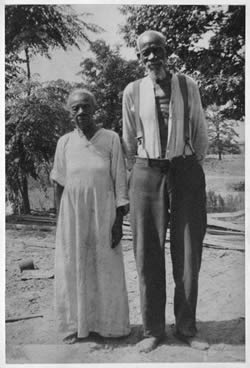
[TR: Original interview where photograph inserted notes photograph of "Sarah and Sam Douglas." The Library of Congress photo archive notes "'Tom' written in pencil above 'Sam' in title."]
"I was born in Alabama. I don't know when though. I did not find out when I was born because old miss never told me. My ma died when I was real small and my old miss raised me. I had a hard time of my life. I slept on the floor just like a cat—anywhere I laid down I slept. In winter I slept on rags. If I got sick old miss would give me plenty of medicine because she wanted me to stay well in order to work. My old master was name John Buffett and old misses name was Eddie Buffett. She would fix my bread and licker in a tin lid and shove it to me on the floor. I never ate at the table until I was twelve and that was after freedom.
"To whip me she put my head between the two fence rails and she taken the cow hide whip and beat me until I couldn't sit down for a week. Sometimes she tied our hands around a tree and tie our neck to the tree with our face to the tree and they would get behind us with that cow hide whip with a piece of lead tied to the end and lord have mercy! child, I shouted when I wasn't happy. All I could say was, 'Oh pray, mistress, pray.' That was our way to say Lord have mercy. The last whipping old miss give me she tied me to a tree and oh my Lord! old miss whipped me that day. That was the worse whipping I ever got in my life. I cried and bucked and hollered until I couldn't. I give up for dead and she wouldn't stop. I stop crying and said to her, 'Old miss, if I were you and you were me I wouldn't beat you this way.' That struck old miss's heart and she let me go and she did not have the heart to beat me any more.
"I did every kind of work when I was a little slave; split rails, sprouted, ditched, plowed, chopped, and picked and planted.
"I remember young master going to war and I remember hearing the first gun shoot but I did not see it. I saw the smoke though.
"I never went to school a day in my life. The white folks said we did not need to learn, if we needed to learn anything they could learn us with that cow hide whip.
"We went to the white folks' church, so we sit in the back on the floor. They allowed us to join their church whenever one got ready to join or felt that the Lord had forgiven them of their sins. We told our determination; this is what we said: 'I feel that the Lord have forgiven me for my sins. I have prayed and I feel that I am a better girl. I belong to master so and so and I am so old.' The white preacher would then ask our miss and master what they thought about it and if they could see any change. They would get up and say: 'I notice she don't steal and I notice she don't lie as much and I notice she works better.' Then they let us join. We served our mistress and master in slavery-time and not God.
"I recollect miss died just after the War. Old miss was very strict on us and after she died we was so glad we had a big dance in miss's kitchen and old miss came back and slapped one of the slaves and left the print of her hand on her face. That white hand never did go away and that place was forever haunted after that.
"Now I don't know how to tell you to get after my age but I was twelve years old two years after surrender."
Interviewer: Carol Graham Subject: Ex-slaves Information given by: Sarah Douglas, El Dorado, Arkansas
Mornin' honey. I thought you wuz comin' back tuh see me ergin las' summer an' I looked fuh you the longes' time. I'se plum proud tuh see you ergin. Dis other lady ain't de one that wuz wid you las' summer is she?
Now jes lis'en tuh that will yuh, she wants Aunt Sarah tuh tell huh some more 'bout slave'y times. John Bufford wuz mah marster's name. I wuz bo'n in Alabama an' brought to Louisiana by my marster's fambly. Aftuh de wah he freed us an' some of 'em mixed up in politics an' the white folks from the North fooled 'em into makin speeches fuh 'em, but dey soon learnt bettuh.
I ain't been well lately. The doctuh said I had slamatory rheumatis. I'm ol' now end don' have nobody tuh do nothin fuh me. My mistress wuz mammy in de ol' days.
Aftuh I got up fum mah rheumatism I went down tuh that church you sees, I give de lan' fuh hit, me and Tom did and I jes felt good and wanted tuh praise the Lord. I wuz so glad the sperit come once more, I got happy and I got up and went down tuh de fron' and said; "I want to shake hand wid ever' body in dis house. I wanna stroke yo hand." An' I stood down there at the front so happy an' duh yuh know one little chile and two women come down an' shook hands wid me, I jes didn't know whut tuh think. Yoh know when I wuz young and a body got happy evuh body did an' dey made a noise but not so now. An' tuh think dey couldn't turn praises.
You say yo' wants tuh talk tuh Tom? Well he's out dar in de back yard but he aint well and I specks he won't talk tuh but if you mus' come on. Tom here is a lady wants tuh talk tuh you. I'll go back an talk tuh de lady whuts waitin' in de car.
(The above written just as Sarah Douglas expressed it).
(Taken down word for word.)
(August 11, 1937.)
Interviewer: Pernella M. Anderson Person interviewed: Tom Douglas Route 2, Box 19-A, El Dorado, Arkansas Age: 91
"I was born in Marion, Louisiana September 15, 1847 at 8 o'clock in the morning. I was eighteen years of age at surrender. My master and missus was B.B. Thomas and Miss Susan Thomas. Old master had a gang of slaves and we all worked like we were putting out fire. Lord child, wasn't near like it is now. We went to bed early and got up early. There was a gang of plow hands, hoe hands, hands to clear new ground, a bunch of cooks, a washwoman. We worked too and didn't mind it. If we acted like we didn't want to work, our hands was crossed and tied and we was tied to a tree or bush and whipped until we bled. They had a whipping post that they tied us to to whip us.
"We was sold just like hogs and cows and stock is sold today. They built nigger pens like you see cow pens and hog pens. They drove niggers in there by the hundred and auctioned them off to the highest bidder. The white folks kept up with our age so when they got ready to sell us they could tell how old we were. They had a 'penetenture' for the white folks when they did wrong. When we done wrong we was tied to that whipping post and our hide busted open with that cow hide.
"We stayed out in the field in a log house and old master would allowance our week's rations out to us and Sunday morning we got one biscuit each. If our week's allowance give out before the week we did not get any more.
"Cooked on fireplaces, wasn't no stoves. We did not have to worry about our clothes. Old missus looked after everything. We wore brogan shoes and homespun clothes. There was a bunch of women that did the spinning and weaving just like these sewing room women are now. I was a shoe maker. I made all the shoes during the time we wasn't farming. We had to go nice and clean. If old missus caught us dirty our hide was busted. I got slavery time scars on my back now. You ought to see my back. Scars been on my back for seventy-five years.
"I never went to school a day in my life. I learned my ABC'S after I was nineteen years old. I went to night school, then to a teacher by the name of Nelse Otom. I was the first nigger to join the church on this side of the Mason and Dixie line. During slavery we all joined the white folk's church set in the back. After slavery in 1866 they met in conference and motioned to turn all of the black sheep out then. There was four or five they turned out here and four or five there, so we called our preacher and I was the first one to join. Old master asked our preacher what we paid him to preach to us. We told him old shoes and clothes. Old master says, 'Well, that's damn poor pay.' Our preacher says, 'And they got a damn poor preacher.'
"I did not know anything about war. Only I know it began in 1861, closed in 1865, and I know they fought at Vicksburg. That was two or three hundred miles from us but we could not keep our dishes upon the table whenever they shot a bomb. Those bombs would jar the house so hard and we could see the smoke that far.
"We was allowed to visit Saturday night and Sunday. If you had a wife you could go to see her Wednesday night and Saturday night and stay with her until Monday morning and if you were caught away any other time the patrollers would catch you. That is where the song come from, 'Run nigger run, don't the patarolls will catch you.' Sometimes a nigger would run off and the nigger dogs would track them. In slavery white folks put you together. Just tell you to go on and go to bed with her or him. You had to stay with them whether you wanted them or not.
"After freedom old master called all us slaves and told us we was free, opened a big gate and drove us all out. We didn't know what to do—not a penny, nowhere to go—so we went out there and set down. In about thirty minutes master came back and told us if we wanted to finish the crop for food and clothes we could, so we all went back and finished the crop and the next year they gave us half. So ever' since then we people been working for half.
"Here is one of my boy songs:
'Sadday night and Sunday too, A pretty girl on my mind As soon as Monday morning come The white folks get me gwi-ng.'"
[HW: Regrets End of Slavery] OLD SLAVE STORIES [TR: Sarah and Tom Douglas]
[TR: Aunt Sarah Douglas]— Ah wuz baptized de second year of surrender. Wuz twelve years ole at de time an my mistress spoke fuh me when ah j'ined de church. In them days when chillun j'ined de church some grown person had ter speak fuh em an tell if they thought they wuz converted or not. Now when chillun j'in de church if they is big enough ter talk they take em in widout grown fokes speaking fuh em a tall.
Slavery times wuz sho good times. We wuz fed an clothed an had nothin to worry about. Now poar ole niggers go hungry. Sho we wuz whipped in slavery times. Mah ole man has stripes on his back now wha he wuz whipped an ah wuz whipped too but hit hoped me up till now. Coase hit did. Hit keeps me fum goin aroun here tellin lies an stealin yo chickens.
Me an mah ole man is been married sixty-six years an have nevah had no chillun. Yo know little chillun is de sweetest thing in the worl'. Now if we had chillun we would have someone tuh take care of us in our ole days. Mah ole man, Tom, is 89 an I'se 82. Poar ole man. Ah does all ah kin fuh him but I'se ole too. These young niggers is gettin so uppity. They think they is better than we is. A Darkey jes don' love one another an stick t'gether like white fokes does. But ah is goin ter stick ter my ole man. He needs me. He is jes like a little helpless chile widout me ter look after him. Ah used to be mighty frisky an mighty proud when ah wuz young but ah wazn' as good then as ah is now. Ah likes ter go ter church. See that little white church over de hill? That is Douglas Chapel, a Baptist church. Me an mah ole man give de lan' fuh that church. We had plenty them days when Douglas was laid out (meaning Douglas Addition). But now poar ole niggers don' have enough ter eat all de time. None of them church members is missionary enough ter bring us somethin' ter eat. White fokes have good hearts but niggers is grudgeful. De bigges thing among white fokes is they do lie sometime an when they do they kin best a nigger all to pieces.
Niggers don' have as much 'ligion as they use ter. Ah went to a missionary meeting at one sister's house an she said ter me: "Sister Douglas, start us off wid a song" an ah started off with "Amazing Grace." Sang bout half of de first verse an noticed none of them j'ined in but ah kep' right on singin' an wuz gettin full of de sperit when that sister spoke up an said: "Sister Douglas, don' yo know that is done gone out of style?" an selected "Fly Away" an den all of them sisters j'ined in an sung "Fly away, fly away" an hit sounded jes like a dance chune.
Yas'm, that is our ole buggy standin aroun de corner of de house. We use ter ride in hit till hit got so rickety. An that ole horse is our fambly horse. Dolly Jane ah calls her. We've had her forty years an she gits sick sometime jes like ah does an ah thinks sho she is gone this time but she gits ovah hit jes like ah does when ah has a spell. We has lived in this house since 1900 but we is goin ovah on de utha side of de tracks soon wid the res of de niggers. Nobody lef on this side but white fokes now ceptin us. When de railroad come through down there ah had a cotton patch growin there an ah cried cause hit went through mah cotton patch an ruint part of hit. All we got out'n hit wuz damages.
No'm, mah ole man caint talk ter yo all terday; he is sick. Mebby ifn yo all come back he kin talk ter yo then.
(In the meantime we investigated Tom and Sarah Douglas and found that he has a bank account and at one time owned all the land that is now Douglas Addition. In a few days we went back and found Tom sitting on the porch.)
Uncle Tom Douglas—Yas'm, ah members de wah. Ah wuz fo'teen when de wah began an eighteen when hit closed. Mah marster wuz B.B. Thomas, Union Parish, Louisiana, near Marion, Louisiana. Ah saw de fust soldiers go an saw young marster go. When young marster come back at de close of de wah he brought back a big piece of mule meat ter show us niggers what he done have ter eat while he wuz in de army.
Ah nevah wuz sold but lots of marster's slaves wuz sold. They wuz sold jes like stock. Ah members one fambly. De man wuz a blacksmith, de woman a cook, an one of their chillun wuz waitin boy. They wuz put on de block an sold an a diffunt man bought each one an they went ter diffunt part of de country ter live on nevah did see one nother no moah. They wuz sole jes like cows an horses. No'm, ah didn't like slavery days. Ah'd rather be free an hungry.
(Tom is the only ex-slave who has told us that he had rather be free and we believe that is because he has a bank account and is independent.)
Yo say tell yo about hants. There is such a thing. Yes mam. Some fokes calls it fogyness but hit sho is true fuh me an Sarah has seed em haint we Sarah. Here young missy, what is yo doin wid that pencil?
(After we had put up our notebooks and pencils and assured them that we would not repeat it, they told us the following):
When me an Sarah lived out at de Moore place about three miles east on the main street road we seed plenty of haints. De graveyard wuz in sight of our house an we could see them sperits come up out de groun an they would go past de house down in a grove an we could see them there campin. We could see they campfires. We could hear their dishes rattling an their tincups an knives an forks. An hear em talkin. Den again they would be diggin with shovels. Sometimes in de graveyard we could see de sperits doin de things they did befo they died. Some would be plowing, some blacksmithing an each one doin what he had done while he wuz livin. When day wuz breakin they would go runnin crost our yard an git back in de graves. Yes'm, we seed em as long as we lived there. After we moved from ther somebody dug up some gold that wuz buried at de corner of de chimney. An hit is said that from that day hants have not been seen there.
Yes'm, there is no doubt erbout hit. They is such thin's as hants. Me an Sarah has both seed em but we aint seed any in a long time.
Interviewer: Mrs. Carol Graham Person interviewed: Tom & Sarah Douglas Resident: El Dorado, Arkansas Age: 90 and 83
NOTE:
This is a second interview with Uncle Tom and Aunt Sarah Douglas. The first was sent to your office in September 1936 from interview by Mrs. Mildred Thompson, El Dorado, Arkansas. Mrs. Thompson is not now with the Project. Mrs. Carol Graham made the second interview.
Tom Douglas—Ex-slave. I was a slave boy till I was eighteen. Was born in 1847, 'mancipated in '65. No, my master did not give me forty acres of land and a mule. When we was 'mancipated my master came took us outside the gate across the road and told us we was freed. "You are free to work for anybody you want to." We set there a while then we went whare ol' master was and he tol' us if we wanted to stay wid him and finish the crop he would provide our victuals and clothes. The next year we worked for him on the halves, and continued to do so for four or five years. 'F we didn' eat an' wear it up he would give us the balance in money an we of'en had as much as fifty dollars when the year was over.
My ol' master was S.B. [TR: in two previous interviews, B.B. Thomas] Thomas. The young master was Emmett Thomas. Mr. Emmett was his son. Dey was near Marion, Louisiana, then I worked fuh his brother-in-law 'Lias George. His wife was Susan George. I tell you the fact, these times is much bettuh than slave times. If I'm hungry an' naked, I'm free. I'm crazy 'bout liberty.
I've heard of the Ku Klux Klan but never did see none of 'em. Have seen where they is been but nevuh did see 'em.
We voted several years. Was considered citizens—voted an' all that sort of thing. I think if we pay taxes we ought to vote for payin' taxes makes us citizens don' it? I used to be a big politics man—lost all I had house, forty acres, a good well an' stock an' ever'thing. I was tol' one day that the Ku Kluxes was comin' to my house that night an' I got on my horse at sundown an left an aint nevuh been back. I was a big politics man then—lost all I had and quit politics. I'm ninety years old and fifteenth of next September. Looks like the old might get pensions if old has anything to do with it I ought to get a pension but us ol' folks that is gettin' long an has a place to stay an' somethin' to eat they say don' get none.
I come to El Dorado January 3, 1893. This place was in the woods then. I bought 120 acres from Mr. Dave Armstrong at five dollars per acre and in nine years I had it all paid for. It was after I got tired of workin' on the halves that I bought me a place.
Worked at a sawmill four years beginnin in 1897 or 98. Than I jobbed aroun' town three years doin' this an' that an' the other. Carried $25 with me when I moved to town and brought $28 back with me. Cleared $1 a year an' got tired of that.
Am livin' off my land. Have sol' some an' am sellin some now but times is hard and folks can't pay. I takes in from $18 to $25 per month.
The young folks is gone to destruction. Aint nothin' but destruction. You is young your self but you can tell times aint the same as they was ten years back. Young folks is goin' to destruction. Me, I'm goin' home. Goin' back 80 years an comin' up to day I is seen a mighty big change. Me, I'm goin' home. Don't know what you young folks going to see eighty years from now. Everybody is trying to get something for nothing.
We use to sing "Gimme this Old Time Religion, It's Good enough for me". An' we sung "I'm a Soldier of the Cross" an lots of others. We don' live right now, don' serve God. Pride, formality an love of money keeps folks from worshipping an' away from the ol' time religion. You know that ol' sayin: "Preacher in the pulpit preachin' mighty bold; All for your money an' none for your soul." Seems like its true now days.
You ask does I have stripes on my back from bein beat in slave'y times? No maam. I was always a good boy and smart boy raised in the same yard with the little white chillun. You says Sarah told you that las' year? Missy you mus' be mistaken. I was whipped once or twice but I needed it then or ol' master wouldn't a whipped me an he never did leave no stripes on me. My old master was good to all his niggers and I'm tellin you I was raised up with his chullun an him and old mistress was good to me. All we little black chillun et out of the boilin' pot an every Sunday mornin' we had hot biscuit and butter for breakfact. No maam my old master was always good to his niggers.
(Above is as exactly told by Tom Douglas with the exception that he used the word Marster, for master; wuz for was, tuh for to; ah for I and other quaint expressions—these were omitted because of instruction in Bulletin received August 7th, 1937.)
Taken down word for word. August 11, 1937.
Interviewer: Mrs. Bernice Bowden Person interviewed: Sebert Douglas 610 Catalpa Street, Pine Bluff, Arkansas Age: 82
"I was born in Lebanon, Kentucky. Gover Hood was my old master. His wife's name was Ann Hood.
"I 'member Morgan's Raid. I don't 'member what year it was but I 'member a right smart about it. Cumberland Gap was where they met.
"The Rebs and Yankees both come and took things from old master. I 'member three horses they taken well. Yankees had tents in the yard. They was right in the yard right in front of the Methodist church.
"My mother was Mrs. Hood's slave, and when she married she took my mother along and I was born on her place.
"I was the carriage boy in slave times. My father did the driving and I was the waitin' boy. I opened the gates.
"I 'member Billy Chandler and Lewis Rodman run off and j'ined the Yankees but they come back after the War was over.
"Paddyrollers was about the same as the Ku Klux. The Ku Klux would take the roof off the colored folks' houses and take their bedding and make 'em go back where they come from.
"We stayed right there with old master for two or three years, then we went to the country and farmed for ourselves.
"I went to school just long enough to read and write. I never seed no use for figgers till I married and went to farmin'.
"Since I been in Pine Bluff I done mill work. I was a sash and door man.
"I used to vote every election till Hoover, but I never held any office.
"The younger generation is bad medicine. Can't tell what's gwine come of 'em!"
Interviewer: Miss Irene Robertson Person interviewed: Henry Doyl, Brinkley, Arkansas Age: Will be 74 Feb. 2, 1938
"I was born in Hardeman County near Bolivar, Tennessee. My mother's moster was Bryant Cox and his wife was Miss Neely Cox. My mother was Dilly Cox. Two things I remembers tinctly that took place in my childhood: that was when my mother married George Doyl. I was raised by a stepfather. Miss Neely told my mother she was going to sell me and put me in her pocket. She told her that more'n one time. I recollect that.
"My oldest brother, one older en me, burned to death. My mother was a field hand. She was at work in the field. When she come to the house, the cabin burned up and the baby burned up too. That grieved her mighty bad and when Miss Neely tell her soon as I got big nough she was goner sell me mighty near break her heart.
"The first year after the surrender my father, Buck Rogers, left my mother in her bad condition. She said she followed him crying and begging him not to leave her to Montgomery Bridge, in Alabama. The last she seen him he was on Montgomery Bridge.
"They just expected freedom. My mother left her mistress and moved to the Doyl place. She didn't get nothing but her few clothes. I was born at the Doyl place. She worked for Moster Bob Doyl, a young man. They share cropped. We had a plenty I reckon of what we raised and a little money.
"I worked on Colonel Nuckles place when I got up grown. I worked on the Lunatic Asylum at Bolivar and loaded tires and ditched for the I.C. Railroad a long time.
"I don't recollect that the Ku Klux ever bothered us.
"My stepfather voted Republican ticket. I haven't voted for a good many years—not since Garfield or McKinley was our President.
"I come to Arkansas in 1887. I married in Arkansas. I heard that Arkansas was a rich country. My mother was dead. My stepfather had been out here. I come on the train, paid my own way. Come to Palestine the first night then on to Brinkley. I been close to Brinkley ever since.
"The old man died what learned me how to walk rice levies. I still work on the place. Everybody don't know how to walk levies. It will kill an old man. Your feet stay wet and cold all time. I do wear hip boots but my feet stay cold and damp. I got down with the rheumatism and jes' now got so I can walk.
"I got a wife and three living children. They all married and gone.
"Times is hard for old folks and changed so much. Children used to get jobs and take care of the granny folks and the old parents. They can't take care of themselves no more it look like. I don't know how to take the young generation. They are drifting along with the fast times.
"I applied but don't get no pension."
Interviewer: Miss Irene Robertson Person interviewed: Willie Doyld (male), Brinkley, Arkansas Age: 78 [-- -- 1938]
"I was born in Grenada, Mississippi. My parents belong to the same family of white folks. My moster was Jim Doyld. His wife was Mistress Karoline Doyld. Well as I recollect they had four childen. My parent's name was Hannah and William Doyld. I'm named for em. They was three of us childen. They belong to same family of white folks for a fact. I heard em say Moster Jim bought em offen the block at the same time. He got em at Galveston, Texas. He kept five families of slaves on his place well as I recollect.
"My pa was Moster Jim's ox driver. He drove five or six yokes at a time. He walk long side of em, wagons loaded up. He toted a long cowhide whoop. He toted it over his shoulder. When he'd crack it you could hear his whoop half a mile. Knowed he was comin' on up to the house. Them oxen would step long, peartin up when he crack his whoop over em. He'd be haulin' logs, wood, cotton, corn, taters, sorghum cane and stuff. He nearly always walked long side of em; sometimes he'd crawl upon the front wagon an' ride a piece.
"He was a very good moster I recken far as I knows. They go up there, get sompin' to eat. He give em a midlin' meat. He give us clothes. Folks wore heep of clothes then. They got whoopin's if they not do lack they tole em to do—plenty whoopin's! He kept ten dogs, they call bear dogs. They hunt fox, wolves, deer, bear, birds. Them dogs died wid black tongue. Every one of em died.
"We et at home mostly. We was lounced wid the rations but had a big plenty. We got the rations every Saturday mornin'. One fellow cut and weighed out the meat, sacked out the meal in pans what they take to git it in. Sometimes we et up at the house. Mama bring a big bucket milk and set it down, give us a tin cup. We eat it up lack pigs lappin' up slop. Mama cooked for old mistress. She bring us 'nough cooked up grub to last us two or three days at er time. Papa could cook when he be round the house too. I recollect all four my grandmas and grandpas. They come from Georgia. Moster Jim muster bought them too but I don't know if he got em all at the same time down at Galveston, Texas.
"Moster Jim show did drink liquor—whiskey. I recken he would. When he got drunk old missus have him on the bed an' she set by him till he sober up. Miss Karoline good as ever drawed a breath to colored and white.
"My grandma, mother's ma, was a light sorter woman. The balance of my kin was pure nigger.
"I kin for a fact recollect a right smart about the war. Papa went off to war wid Jack Hoskins. He was goin' to be his waitin' man. He stayed a good while fore he got home. Jack Hoskins got kilt fore he et breakfast one mornin'. That all I heard him say. I recken he helped bury him but I never heard em say.
"The plainest thing I recollect was a big drove of the Yankee soldiers—some ridin', some walkin'—come up to the moster's house. He was sorter old man. He was settin' in the gallery. He lived in a big log house. He was readin' the paper. He throwed back his head and was dead. Jes' scared to death. They said that was what the matter. In spite of that they come down there and ordered us up to the house. All the niggers scared to death not to go. There lay old Moster Jim stretched dead in his chair. They was backed up to the smoke house door and the horses makin' splinters of the door. It was three planks thick, crossed one another and bradded together wid iron nails. They throwed the stuff out an' say, 'Come an' git it. Take it to your houses.' They took it. It was ours and we didn't want it wasted. Soon as they gone they got mighty busy bringing it back. They built nother door an' put it up. Old Miss Karoline bout somewheres, scared purty near to death. They buried Moster Jim at Water Valley, Mississippi. Miss Karoline broke up and went back to Virginia. My grandma got her feather bed and died on it. Bout two years after that the Yankees sot fire to the house and burned it down. We all had good log houses down close together. They didn't bother us.
"I don't recollect the Ku Klux.
"Our folks never knowed when freedom come on. Some didn't believe they was free at all. They went on farmin' wid what left. What they made they got it. My folks purty nigh all died right there.
"I lives alone. I got two childern in Lulu, Mississippi. I had three childern. My wife come here wid me. She dead.
"I had forty acres land, two mules, wagon. It went for debts. White folks got it. I ain't made nuthin' since.
"I ain't no hand at votin' much. I railly never understood nuthin' bout the run of politics.
"I hates to say it but the young generation won't work if they can get by widout it. They take it, if they can, outen the old folks. I used to didn't ask folks no diffrunce. I worked right long.
"I gets commodities wid this old woman. I come here to build her fires and see after er. I don't git no check."
Interviewer: Miss Irene Robertson Person interviewed: Wade Dudley, Moro, Ark. Age: 73
"Bill Kidd and Miss Nancy Kidd owned my parents. I was born close to Okalona, Chickasha County, Mississippi, about the last year of the Civil War. Mr. Bill was Miss Nancy's boy. He was a nigger trader. They said the overseers treated em pretty rough. They made em work in nearly a run. When Miss Nancy was living they was rich but after she died he got down pretty low. He married. Course I knowd em. I been through his house. He had a fine house. My mother said she was born in Virginia. She belong to Addison and Duley. Her mother come wid her. They sold them but didn't sell her father so she never seed him no more. She walked or come in a ox wagon part of the way. She was with a drove. My father come from North Carolina. His father was free. My father weighed out rations. He was bright color. He worked round the house and then durin' the war he run a refugee wagon. The Yankees got men, mules, meat from Mr. Bill Kidd. My father he was hiding em and hiding the provisions from one place to another to keep the Yankees from starving em all to death. My mother had nine boys. They all belong to Mr. Miller. He died, his widow married Mr. Owen then Mr. Owen sold them to Mrs. Kidd. That was where they was freed. My parents stayed about Mrs. Kidd's till she died. They worked for a third some of the time, I don't know how long. When I was a boy size of that yonder biggest boy my folks was still thinking the government was going to give em something. I was ten years old when they left Mrs. Kidd's. They thought the government was going to give em 40 acres and a mule or some kind of a start. I don't know where they got the notion. My father voted down in Mississippi. I vote. I was working in the car shops in St. Louis in 1923. Me and my wife both voted then. I worked there two years. I come back to Arkansas where I could farm. The land was better here than in Mississippi. I walked part of the way and rode part of the way when I come here from Mississippi. I vote a Republican ticket. Bout all I owns is two little pigs and a few chickens. I did have a spring garden. We work in the field and make a little to eat and wear.
"I find the present times is hard for old folks. Some young folks is doing well I guess. They look like it. I made application twice for help but I ain't never got on. I don't know what to think bout the young folks. If they can get a living they have a good time. They don't worry bout the future. A little money don't buy nothin' much now. It seem like everything is to buy. Money is hard to get."
Interviewer: Miss Irene Robertson Person interviewed: Isabella Duke Little Rock, Arkansas (towards Benton) Visiting in Hazen Age: 62
[HW: Father Wore a Bonnet]
"My own dear mother was born at Faithville, Alabama. She belong to Sam Norse. His wife was Mistress Mai Jane. They moved to Little Rock years after my mother had come there. After seberal months they got trace of one another. I seed two of the Norse girls and a boy. Master Norse was a farmer in Alabama. Mother said he had plenty hands in slavery. She was a field hand. She had a tough time during slavery.
"Pa said he had a good time. 'Bout all he ever done was put on old mistress' shoes and pull her chair about for her to sit in. He built and chunked up the fires. Old mistress raised him and he had to wear a bonnet. He was real light. He said the worse whoopings he ever got was when he would be out riding stick horses with his bonnet on. The hands on the place would catch him and whoop him and say, 'Old mis' thinks he's white sure as de worl'.' The hands on the place sent him to the big house squalling many a time.
"After he got grown he could be took for a white man easy. He was part French. He talked Frenchy and acted Frenchy. Every one who knowd him in Little Rock called him Pa Frazier and called my mother Ma Frazier, but she was dark. Pa said he et out his mistress' plate more times than he didn't. She raised him about like her own boy.
"Mother had a hard time. Alex Norse bought my mother and a small brother from some people leaving her own dear mother when she was fifteen years old. Her mother kept the baby and the little boy took sick and died. But there had been an older boy sold to some folks near Norse's place before she was sold. The brother that was two years old died. There were other older children sold. My mother never saw her mother after she was sold. She heard from her mother in 1910. She was then one hundred and one years old and could thread her needles to piece quilts. Her baby boy six months old when mother was sold come to visit us. Mother wanted to go back to see her but never was able to get the money ready. Mother had good sight when she died in 1920. She was eighty-seven years old and didn't have to wear glasses to see. Mother's father was on another place. He was said to be part or all Indian.
"Mother said once a cloth peddler come through the country. Her older brother John lived on a place close to the Norse place. John told the peddler that ma took the piece of goods he missed. But John was the one got the goods mind out. The peddler reported it to Master Norse. He give my mother a terrible beating. After that it come out on John. He had stole the piece of cloth. John then took sick, lay sick a long time. Master Norse wouldn't let her go nigh John. She knowd when he died and the day he was to be buried. Master Norse wouldn't let her go nigh there, not even look like she wanted to cry.
"Mother married before freedom, jumped the broom she said. Then after freedom she married my father. My parents named Clara and George Frazier. She had twelve children. Pa was a cripple man. He was a soldier. He said he never was shot and never shot no one. He was on a horse and going this way (reeling from side to side dodging the shooting) all time. A horse throwed him and hurt his hip in the army. After that he limped. He drew a pension. I limps but I'm better as I got grown. I'm marked after him. One of my children I named after him what died was cripple like him. My little George died when he was ten. He was marked at birth after his grandpa. I had ten, jus' got five living children.
"My husband's father's father was in the Civil War. He didn't want to go out on battle-field, so in the camps he cut his eyeball with his fingernail so he could get to go to the horsepital. His eye went out. He hurt it too near the sight. He said he was sorry the rest of his life he done that. He got a pension too. He was blind and always was sorry for his disobedience. He said he was scared so bad he 'bout leave die then as go into the battlefield.
"In some ways times is better. People are no better. Children jus' growing up wild. Their education is of the head and not their heart and hands.
"I was raised around Little Rock is about right. I gets a pension. I'm sixty-two years old but I was down sick with nerve trouble several years. I'm better now. I've been gradually coming on up for over a year now.
"Mr. Ernest Harper of Little Rock takes out truckloads of black folks to work on his place in the country every day. They can get work that way if they can work."
Interviewer: Bernice Bowden Person interviewed: "Wash" Dukes 2217 E. Barraque Pine Bluff, Ark. Age: 83
"Yes'm, Wash Dukes is my name. My mother liked Washington so well, she named me General Washington Dukes, but I said my name was Wash Dukes. I'm the oldest one and I'm still here. Me? I was born in the state of Georgia, Howson County. Perry, Georgia was my closest place. I was born and raised on the Riggins place. I was born in 1855, you understand. The first day of March is my birthday. We had it on the Bible, four boys and four girls, and I was the oldest. House caught fire and burned up the Bible, but I always say I'm as old as a hoss.
"I can't see as good as I used to—gettin' too old, I reckon.
"Old master and mistis was good to us.
"My mother plowed just like a man. Had a little black mule named Mollie and wore these big old leggins come up to her knee.
"Old master was a long tall man with black hair.
"You know I was here cause I remember when Lincoln was elected president. He run against George Washington.
"I seen the Yankees but I never talked to em. I was scared of em. Had them muskets with a spear on the end. They give my uncle a hoss. When it thundered and lightninged that old hoss started to dance—thought twas a battle. And when he come to a fence, just jump right over with me on him. I say, 'Where you get that hoss?' and uncle say, 'Yankees give him to me.'
"I know one time they was a fellow come by there walkin'. I guess they shot his hoss. He had plenty money. I tried to get him to give me some but he wouldn't give me a bit.
"At Oglethorpe they had a place where they kep the prisoners. They was a little stream run through it and the Rebels pizened it and killed a lot of em.
"I was so crazy when I was young. I know one time mama sent me to town to get a dress pattern—ten yards. She say, 'Now, Wash, when you go across that bottom, you'll hear somethin' sounds like somebody dyin', but you just go on, it won't hurt you.' But I say, 'I won't hear it.' I went through there so fast and come back, mama say, 'You done been to town already?' I said, 'Yes, here's your dress pattern.' I went through there ninety to nothin'. I went so fast my heart hurt me.
"In slave times I remember if you wanted to go to another plantation you had to have a pass. Paddyrollers nearly got me one night. I was on a hoss. They was shootin' at me. I know the hoss was just stretched out and I was layin' right down on his neck.
"I stayed in Georgia till '74. I heared em say the cotton grow so big here in Arkansas you could sit on a limb and eat dinner. I know when I got here they was havin' that Brooks-Baxter war in Little Rock. I say, 'Press me into the war.' Man say, 'I ain't goin' press no boys.' I say, 'Give me a gun, I can kill em.' I wanted to fight.
"I tell you where I voted—colored folks don't vote now—it was when I was on the Davis place. I voted once or twice since I been up here. I called myself votin' Republican. I member since I been up here you know they had a colored man in the courthouse. When they had a grand jury they had em mixed, some colored and some white. I say now they ain't got no privilege. If they don't want em to vote ought not make em pay taxes.
"Up north they all sits together in the deppo but here in the south they got a 'tition between em.
"When I first went to farmin' I rented the land and the cotton was all mine, but now you work on the shares and don't have nothin'.
"If I keep a livin', I'm goin' away from here. I'm goin' up north. I won't go fore it gets warm though. I seen the snow knee deep in Cleveland, Ohio.
"I was workin' up north once. I had a pretty good job in Detroit doin' piece work, and doin' well, but I come back here cause my wife's mother was too old to move. If I had stayed I might have done well.
"I own this property but I'm bout to lose it on account o' taxes.
"I got grown boys and they ain't no more help to me than the spit out o' my mouth. None of em has ever give me a dime in their life. This younger generation is goin' to nothin'. They got a good education. I got a boy can write six different kinds a hands. Write enough to get in the pen. I got him pardoned and he's in Philadelphia now. Never sends me a dime.
"I never went to any school but night school a little. I was the oldest and it kep me knockin' around to help take care of the little ones.
"I preach sometimes. I'm not ordained—I'm a floor preacher, just stands in front of the altar."
Interviewer: Miss Irene Robertson Person interviewed: Lizzie Dunn, Clarendon, Arkansas Age: 88
"I was born close to Hernando, Mississippi. My parents was Cassie Gillahm and Ely Gillahm. My master was John Gillahm. I fell to John Gillahm and Tim bought me from him so I could be with my mother. I was a young baby. Bill Gillahm was our old master. He might had a big farm but I was raised on a small farm. White folks raised me. They put me to sewing young. I sewed with my fingers. I could sew mighty nice. My mistress had a machine she screwed on a table.
"All the Gillahms went to Louisiana in war time and left the women with youngest white master. They was trying to keep their slaves from scattering. They were so sure that the War would be lost.
"The Yankees camped close to us but didn't bother my white folks to hurt them. They et them out time and ag'in. I seen the Yankees every day. I seen the cannons and cavalry a mile long. The sound was like eternity had turned loose. Everything shook like earthquakes day and night. The light was bright and red and smoke terrible.
"Mother cooked and we et from our master's table.
"We was all scared when the War was on and glad it was over. Mama died at the close. Me and my sister sharecropped and made seven bales of cotton in one year.
"When freedom come on, our master and mistress told us. We all cried. Miss Mollie was next to our own mother. She raised us. We kept on their place.
"I cooked for Joe Campbell at Forrest City. He had one boy I help to raise. They think well of me."
Interviewer's Comment
Very light mulatto. Bed fast and had two rolls and a cup of coffee. Had been alone all day except when Home Aid girls bathed and cleaned her bed. She is paralyzed. She said she was hungry.
Interviewer: Mrs. Bernice Bowden Person interviewed: Nellie Dunne 3900 W. Sixth Avenue, Pine Bluff, Arkansas Age: 78
"Yes ma'am, I was slavery born but free raised. I was half as big as I is now. (She is not much over four feet tall—ed.) Born in Silver Creek, Mississippi. Yes ma'am. They give ever'body on the place their ages but mama said it wasn't no 'count and tore it up, so I don't know what year I was born.
"Cy Magby—mama was under his control. He would carry us over to the white folks' house every morning to see Miss Becky. When old master come after us, he'd say, 'What you gwine say?' and we'd say, 'One-two-three.' Then we'd go over to old Mis' and courtesy and say, 'Good morning, Miss Becky; good morning, Mars Albert; good morning, Mars Wardly.' They was just little old kids but we had to call 'em Mars.
"What I know I'm gwine tell you, but you ain't gwine ketch me in no tale.
"I 'member they was gwine put us to carryin' water for the hands next year, and that year we got free. My mother shouted, 'Now I ain't lyin' 'bout dat.' I sure 'member when they sot the people free. They was just ready to blow the folks out to the field. I 'member old Mose would blow the bugle and he could blow that bugle. If you wasn't in, you better get in. Yes ma'am! The day freedom come, I know Mose was just ready to blow the bugle when the Yankees begun to beat the drum down the road. They knowed it was all over then. That ain't no joke.
"I was a full grown woman then I come to Arkansas; I wasn't no baby.
"I went to school one month in my life. That was in Mississippi.
"My Joe" (her husband) "just lack one year bein' a graduate. He went up here to that Branch Normal. That boy had good learnin'. He could a learnt me but he was too high tempered. If I missed a word he would be so crabb'y. So one night I throwed the book across the room and said, 'You don't need try to learn me no more.'"
Interviewer: Samuel S. Taylor Person interviewed: William L. Dunwoody 2116 W. 24th Street, Little Rock, Arkansas Age: About 98
[HW: Remembers Jeff Davis]
"I was born in Charleston, South Carolina, in the year 1840.
"My father was killed in the Civil War when they taken South Carolina. His name was Charles Dunwoody. My mother's name was Mary Dunwoody. My father was a free man and my mother was a slave. When he courted and married her he took the name of Dunwoody.
Houses
"Ain't you seen a house built in the country when they were clearing up and wanted to put up somethin' for the men to live in while they were working? They'd cut down a tree. Then they'd line it—fasten a piece of twine to each end and whiten it and pull it up and let it fly down and mark the log. Then they'd score it with axes. Then the hewers would come along and hew the log. Sometimes they could hew it so straight you couldn't put a line on it and find any difference. Where they didn't take time with the logs, it would be where they were just putting up a little shack for the men to sleep in.
"Just like you box timber in the sawmill, the men would straighten out a log.
"To make the log house, you would saw your blocks, set em up, then you put the sills on the blocks, then you put the sleepers. When you get them in, lay the planks to walk on. Then they put on the first log. You notch it. To make the roof, you would keep on cutting the logs in half first one way and then the other until you got the blocks small enough for shingles. Then you would saw the shingles off. They had plenty of time.
Food
"The slaves ate just what the master ate. They ate the same on my master's place. All people didn't farm alike. Some just raised cotton and corn. Some raised peas, oats, rye, and a lot of different things. My old master raised corn, potatoes—Irish and sweet—, goober peas (peanuts), rye, and wheat, and I can't remember what else. That's in the eating line. He had hogs, goats, sheep, cows, chickens, turkeys, geese, ducks. That is all I can remember in the eating line. My old master's slaves et anything he raised.
"He would send three or four wagons down to the mill at a time. One of them would carry sacks; all the rest would carry wheat. You know flour seconds, shorts and brand come from the wheat. You get all that from the wheat. Buckwheat flour comes from a large grained wheat. The wagons came back loaded with flour, seconds, shorts and brand. The old man had six wheat barns to keep the wheat in.
"All the slaves ate together. They had a cook special for them. This cook would cook in a long house more than thirty feet long. Two or three women would work there and a man, just like the cooks would in a hotel now. All the working hands ate there and got whatever the cook gave them. It was one thing one time and another another. The cook gave the hands anything that was raised on the place. There was one woman in there cooking that was called 'Mammy' and she seed to all the chilen.
Feeding the Children
"After the old folks among the slaves had had their breakfast, the cook would blow a horn. That would be about nine o'clock or eight. All the children that were big enough would come to the cook shack. Some of them would bring small children that had been weaned but couldn't look after themselves. The cook would serve them whatever the old folks had for breakfast. They ate out of the same kind of dishes as the old folks.
"Between ten and eleven o'clock, the cook would blow the horn again and the children would come in from play. There would be a large bowl and a large spoon for each group of larger children. There would be enough children in each group to get around the bowl comfortably. One would take a spoon of what was in the bowl and then pass the spoon to his neighbor. His neighbor would take a spoonful and then pass the spoon on, and so on until everyone would have a spoonful. Then they would begin again, and so on until the bowl was empty. If they did not have enough then, the cook would put some more in the bowl. Most of the time, bread and milk was in the bowl; sometimes mush and milk.
"There was a small spoon and a small bowl for the smaller children in the group that the big children would use for them and pass around just like they passed around the big spoon.
"About two or three o'clock, the cook would blow the horn again. Time the children all got in there and et, it would be four or five o'clock. The old mammy would cut up greens real fine and cut up meat into little pieces and boil it with corn-meal dumplings. They'd call it pepper pot. Then she'd put some of the pepper pot into the bowls and we'd eat it. And it was good.
"After the large children had et, they would go back to see after the babies. If they were awake, the large children would put on their clothes and clean them up. Then where there was a woman who had two or three small children and didn't have one large enough to do this, they'd give her a large one from some other family to look after her children. If she had any relatives, they would use their children for her. If she didn't then they would use anybody's children.
"About eleven o'clock all the women who had little children that had not been weaned would come in to see after them and let them suck. When a woman had nursing children, she would nurse them before she went to work, again at around eleven o'clock and again when she came from work in the evening. She would come in long before sundown. In between times, the old mammy and the other children would look after them.
War Memories
"I saw Jeff Davis once. He was one-eyed. He had a glass eye. My old mistiss had three girls. They got into the buggy and went to see Jeff Davis when he come through Auburn, Alabama. We were living in Auburn then. I drove them. Jeff Davis came through first, and then the Confederate army, and then the Yankees. They didn't come on the same day but some days apart.
"The way I happened to see the Yanks was like this. I went to carry some clothes to my young master. He was a doctor, and was out where they were drilling the men. I laid down on the carpet in his tent and I heard music playing 'In Dixie Land I'll take my stand and live and die in Dixie.' I got up and come out and looked up ever which way but I couldn't see nothing. I went back again and laid down again in the tent, and I heard it again. I run out and looked all up and around again, and I still couldn't see nothin'. That time I looked and saw my young master talking to another officer—I can't remember his name. My young master said, 'What you looking for?'
"I said, 'I'm looking for them angels I hear playing. Don't you hear em playing Dixie?' The other officer said, 'Celas, you ought to whip that nigger.' I went back into the tent. My young master said, 'Whip him for what?' And he said, 'For telling that lie.' My young master said to him like this, 'He don't tell lies. He heard something somewhere.'
"Then they got through talking and he come on in and I seed him and beckoned to him. He came to me and I said, 'Lie down there.' He laid down and I laid down with him, and he heard it. Then he said, 'Look out there and tell him to come in.'
"I called the other officer and he come in. The doctor (that was my young master) said, 'Lie down there.' When he laid down by my young master, he heard it too. Then the doctor said to him, 'You said William was telling a damn lie.' He said, 'I beg your pardon, doctor.'
"My young master got up and said, 'Where is my spy glasses? Le'me have a look.' He went out and there was a mountain called the Blue Ridge Mountain. He looked but he didn't see nothin'. I went out and looked too. I said, 'Look down the line beside those two big trees,' and I handed the glasses back to him. He looked and then he hollered, 'My God, look yonder' and handed the spy glasses to the other officer. He looked too. Then the doctor said, 'What are we going to do?' He said, 'I am goin' to put pickets way out.' He told me to get to my mule. I got. He put one of his spurs on my foot and told me to go home and tell 'ma' the Yanks were coming. You know what 'ma' he was talking about? That was his wife's mother. We all called her 'mother.'
"I carried the note. When I got to Mrs. Dobbins' house, I yelled, 'The Yanks are coming—Yankees, Yankees, Yankees!' She had two boys. They runned out and said, 'What did you say?'
"I said, 'Yankees, Yankees!'
"They said, 'Hell, what could he see?'
"I come on then and got against Miss Yancy's. She had a son, a man named Henry Yancy. He had a sore leg. He asked me what I said. I told him that the Yanks were coming. He called for Henry, a boy that stayed with him, and had him saddle his horse. Then he got on it and rode up town. When he got up there, he was questioned bout how did he know it. Did he see them. He said he didn't see them, that Celas Neal saw them and the doctor's mother's boy brought the message. Then he taken off.
"Jeff Davis went on. The Confederates went on. They all went on. Then the Yanks passed through.
"The first fight they had there, they cleaned up the Sixty-Ninth Alabama troops. My young master had been helping drill them. He went on and overtook the others.
Right After the War
"I am not sure just what we did immediately after freedom. I don't know whether it was a year or whether it was a year and a half. I can just go by my mother. After freedom, we came from Auburn, Alabama to Opelika, Alabama, and she went to cooking at a hotel until she got money enough for what she wanted to do. When she got fixed, she moved then to Columbus, Georgia. She rented a place from Ned Burns, a policeman. When that place gave out, she went to washing and ironing. Sterling Love rented a house from the same man. He had four children and they were going to school and they took me too.
Schooling
"I fixed up and went to school with them. I didn't get no learning at all in slavery times.
How Freedom Came
"I don't know whether all the whites did it or not; but I know this—when they quit fighting, I know the white children called we little children and all the grown people who worked around the house and said, 'You all is jus' as free as we is. You ain't got no master and no mistiss,' and I don't know what they told them at the plantation.
Occupation
"Right after the War, my mother worked—washed—for an old white man. He took an interest in me and taught me. I did little things for him. When he died, I took up the teaching which he had been doing.
"At first I taught in Columbus, Georgia. By and by, a white man came along looking for laborers for this part of the country. He said money grew on bushes out here. He cleaned out the place. All the children and all the grown folks followed him. Two of my boys came to me and told me they were coming. We hoboed on freights and walked to Chattanooga, Tennessee. We stayed there awhile. Then a white man came along getting laborers. I never kept the year nor nothin'. He brought us to Lonoke County, and I got work on The Bood Bar Plantation. Squirrels, wild things, cotton and corn, plenty of it. So you see, the man told the truth when he said money grew on bushes.
"I taught and farmed all my life. Farming is the greatest occupation. It supports the teacher, the preacher, the lawyer, the doctor. None of them can live without it.
"I can't do much now since that lady knocked me down with her automobile and made me a cripple. I'd a been all right if so many of them young doctors hadn't experimented on me. Then I can't see good out of one eye. I can't do much now. I don't know why they won't give me a pension."
Interviewer's Comment
William Dunwoody had some of his dates and occurrences mixed up as would be natural for a man ninety-eight years old. But there was one respect in which he was sharper than anyone else interviewed.
At the close of the first day's interview when I arose to go he said to me, "Now you got what you want?" I told him yes and that I would be back for more the next day. Then he said, "Well, if you got what you want, there's one thing I want you to do for me before you go."
"Certainly, Brother Dunwoody," I said, "I'll be glad to do anything you want me to do. Just what can I do for you?"
"Well," he said, "I want you to read me what you been writin' there."
And I read it.
A little grandchild about four years old kept us company while he dictated to me. I furnished pennies for the child's candy and a nickel for the old man's tobacco.
The old man got a kick out of the dictation. After the first day, he became very cautious. He would say, "Now don't write this," and he wouldn't let me take it down the way he said it. Instead, he would make a long statement and then we would work out the gist of it together. He is not highly schooled, and he is not especially prepossessing in appearance; but he is a long way from decrepit—mentally.
He walks with a crutch and has a defect in the sight of one eye. He has good hearing and talks in a pleasant voice.
Interviewer: Miss Irene Robertson Person interviewed: Lucius Edwards Age: 72
Interviewer's Comment
I went to see Lucius Edwards, age seventy-two, twice. He has colitis. He wouldn't tell me anything. He said he was born in Shreveport, Louisiana and his father took him away so young he knew no mother; his aunt raised him. The first day he said he remembered all that about his parents' owners. The next day the nurse had him cleaned up and nice meals were sent in and still he wouldn't tell us anything. He told the nurse he had farmed and worked on the railroad all his life. He was up but wouldn't tell us anything. He told me, "I don't think I ever voted." We decided he might be afraid he'd twist his tales and we'd catch him some way.
Interviewer: Mary D. Hudgins Person Interviewed: John Elliott Age: 80 Home: South Border (property of brother's estate)
As told by: John Elliott
"No, ma'am. I ain't got no folks. They've all died out. My son, he may be alive. When I last heard from him, he was in Pine Bluff. But I wrote down lots of times and nobody can't find him. Brother said, that was before he died, that I could stay on in the place as long as I lived. His wife come to see me some years back and she said it was that way.
The comodity gives me milk, and a little beside. I'm expectin' to hear if I get the pension, Tuesday. No ma'am, I ain't worked in three years. Yes, ma'am, I was a slave. I was about 8 years old when they mustered 'em out the last time.
My daddy went along to take care of his young master. He died, and my daddy brought his horse and all his belongings home.
You see it was this way. My mother was a run-away slave. She was from, what's that big state off there—Virginia—yes, ma'am, that's it. There was a pretty good flock of them. They came into North Carolina—Wayne County was where John Elliott found them. They was in a pretty bad way. They didn't have no place to go and they didn't have nothing to eat. They didn't have nobody to own 'em. They didn't know what to do. My mother was about 13.
By some means or other they met up with a man named John Elliott. He was a teacher. He struck a bargain with them. He pitched in and he bought 200 acres of land. He built a big house for Miss Polly and Bunk and Margaret. Miss Polly was his sister. And he built cabins for the black folks.
And he says 'You stay here, and you take care of Miss Polly and the children. Now mind, you raise lots to eat. You take care of the place too. And if anybody bothers you you tell Miss Polly.' My Uncle Mose, he was the oldest. He was a blacksmith. Jacob was the carpenter. 'Now look here, Mose,' says Mister John, 'you raise plenty of hogs. Mind you give all the folks plenty of meat. Then you take the rest to Miss Polly and let her lock it in the smokehouse.' Miss Polly carried the key, but Mose was head man and had dominion over the smokehouse.
They didn't get money to any extreme. But whatever they wanted, Miss Polly would go along with them and they would buy it. They went to Goldsboro. That was the biggest town near us. The patrollers never bothered any of us. Once or twice they tried it. But Miss Polly wrote to Mr. John. He'd write it all down like it ought to be. Then they didn't bother us any more.
There was no speculation wid 'em like there was with other negro people. They never had to go to the hiring ground. Mr. John built a church for my mother and the other women who was running mates with her. And he built a school for the children. Some other colored children tried to come to the school too. They was welcome. But sometimes the white folks would tear up the books of the colored children from outside that tried to come.
Our folks stayed on and on. Mr. John was off teaching school most of the time. We stayed on and on. Pretty soon there was about 150-200, of us. Some of them was carpenters and some of them was this and some was that. Mr. John even put in a mill. A groundhog saw mill, it was. Some white men put it in. But it was the colored folks who run it. They all stayed right on on the farm. There wasn't any white folks about at all, except Miss Polly and Bunk and Margaret.
No, ma'am, after the war it didn't make much difference. We all stayed on. We worked the place. And when we got a chance, Mr. John let us hire out and keep the money. And if the folks wouldn't pay us, Mr. John would write the Federal and the Federal would see that we got our money for what we had worked. Mr. John was a mighty good man to us.
No ma'am. Nobody got discontented for a long time. Then some men come in and messed them up. Told us that we could make more money other places. And it was true too—if they had let us get the money. By that time Mr. John, had died. Bunk had died too, Miss Margaret had grown up and married. Her husband was managing the farm. He was good, but he wasn't like Mr. John. So lots of us moved away.
But about not making money. Take me. I raised 14-16 bales of cotton. The man who owned the land, I worked on halvers, sold it on the Liverpool market. But he wouldn't pay me but about 1/3 of what he collected on my half. And I says to him, 'You gets full price for your half, why can't I get full price for mine?' And he says, 'It's against the rules.' And I says, 'It ain't fair! And he says, 'It's the rules.' So after about six years I quit farming. You can't make no money that way. Yes—you make it, but you can't get it.