THE ORIGIN AND HISTORY OF SKI. By D. M. M. Crichton Somerville.
Reading edition
There are many people to whom the word “ski” must be an enigma, and everything connected with the pastime “ski-ing” as a sealed book. The object of the present treatise is, therefore, to solve the puzzle, open the pages of the closed volume, and thus throw light on a sport which, when once learnt, will be found more attractive, healthy, and invigorating than any other winter exercise, provided, of course, that it be not carried on (as often is the case) to excess, but is indulged in only by those who are sound of wind and limb.
For the sake of the uninitiated, it may be explained that ski (pronounced she) is a word of foreign origin, which, up to comparatively recent years, has been translated “snowshoe,” a term which conveys a wrong idea of the appliances in question, even supposing it might be more fitly given to the forerunners of the ski, viz., pattens formed of withes or wood, which are used in many parts at the present day, and of which the Indian or Canadian snowshoe is a modified type, and best known to British sportsmen.1 The ski, however, are of different construction, being formed of narrow boards, 7ft. and more in length, upturned at the toe to allow of their being shoved or slid over the snow, when attached to the feet of the wearer.
With the exception of snow skates (iron shod runners some 2ft. in length, for use on roadways and hard surfaces) they are the only kind of foot gear used for the purpose of gliding on snow, and possess many advantages over other snowshoes, not the least being their capability of being used for pleasure, as well as the necessary outdoor pursuits of daily life.
Until comparatively late years the employment of ski as contrivances for travelling on the snow was unknown to the majority of those inhabiting the more populated parts of the civilised globe, where communication can nearly always be kept open by rail, steamboat, or other means; notwithstanding that they are, and have been used from time immemorial during many months of the year by a large portion of the population of Northern and Central Asia, Russia, Scandinavia, and even the southern parts of Eastern Europe, where the winters are severe. Casual allusions to them in the writings of some few sporting authors did not suffice to bring the ski into other than mere passing notice; and they would probably have remained in obscurity but for the somewhat recent discovery that they could be employed for other purposes than those of mere locomotion, or keeping open communication in lands and districts where snows are deep, and highways lie buried or are unknown.
It may be of interest to mention here that, in remote parts of England, ski appear to have been employed so late even as the middle of the past century, their use being discontinued as communication with the outer world became easier. Thus, apart from information derived from other sources respecting finds of ski, or their remains in various parts, one gentleman, writing from Cumberland in February, 1904, states that, in the dales of Yorkshire and Durham, the sport is by no means new, and that forty years ago he went to his school on “skees,” which were made of beech wood, some 5ft. in length, with “nibs” about 3in., and that it was no uncommon practice in those days for the Weardale miners to go to and from their work on such snowshoes, it being a fine thing to see thirty or forty men gliding down the steep slopes from the mines at a speed equal to that of a railway train. The writer also adds that, amongst the youths, skee-jumping was a favourite pastime, and that he believes the practice was a very old one from the fact that he knew boys of his own age who had come into possession of “skees” once owned by their grand-fathers.2
To judge from the description given by the author of “Lorna Doone,” a form of ski was, probably, known in Devonshire some 300 years ago, where also sledges were employed throughout the entire year instead of wheeled vehicles for carting in farm products. In the story he relates how when, during the great frost of 1625, John Ridd was told that, in the Arctic regions, any man might get along with a “boat” on either foot to prevent his sinking in the snow—such “boats” being made very strong and light, of ribs with skin across them, 5ft. long by 1ft. wide, and turned up at each end, even as a canoe is—he built himself a pair of strong and light snowshoes, framed of ash, and ribbed of withy with half-tanned calf skin stretched across, and an inner sole to support his feet. “At first,” he says, “I could not walk at all, but floundered about most piteously, catching one shoe in the other, and both of them in the snowdrifts (just as a beginner would now), to the great amusement of the maidens who were come to look at me.”
From the above description such ski would have resembled those of the Chukchis in North-East Asia.
It is due, however, to the youth of Norway that ski-ing has of late years been reduced to a pleasure and an art; while the notice it has received abroad is owing mainly to the prominence given to it by accounts furnished to, and published in, English sporting and illustrated journals, and to allusions to it in the writings of various arctic explorers who have lately taken ski with them on their journeys as part of their travelling outfit.
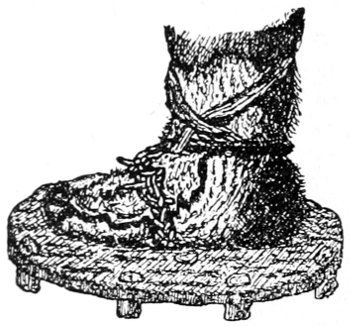
Fig. 1.—An early form of Snowshoe.
From a Sketch by Laurentius Urdahl.
In turning to the history of the ski, it will be found that their origin is as much lost in oblivion as that of the wheel; but it is not too much to assume that human beings who have been created to adapt themselves to their surroundings at all times, have, in lands far separated and entirely apart, invented somewhat similar appliances with which they could float, as it were, and proceed over depths of snow that would otherwise bury them, or cross tracts of treacherous ice which would give way under the tread of a human foot. In this connection one need not refer solely to inhabitants of wintry countries, for it will be found that the natives of other regions, who have to traverse yielding surfaces, such as the great mud flats of Hampshire and elsewhere, wear pattens on their feet, and are thus able to wander in safety over a substance too soft to bear them otherwise. Such pattens are almost identical with those employed elsewhere for travelling over snow, and consist of slabs of wood, some 16in. to 18in. long, by 12in. or so in width, which are attached to the feet by toe straps and thongs. In these pattens, no matter whether they be made of withes or solid wood, we undoubtedly find the earliest form of snowshoes or ski, a form which, however, exists to the present day, and is met with in the north-eastern and northern portions of Asia, Thibet, the Caucasus, Armenia, Scandinavia, Germany, Switzerland, and, in a modified form, in North America, the principle of construction there being identical, viz., a ring or framework of wood supporting a net work of withes or sinews. There are, however, various modifications of the original round pattern; some of the shoes, possibly to prevent straddling, are more or less elongated, the length being increased as the breadth is diminished, while some, thus shaped, have occasionally leather stretched between the frames to allow of their wearer gliding, instead of walking, over the snow, and thus become veritable ski; for while the original object of the snowshoe or patten and the ski are identical, viz., - to support a weight on yielding surfaces, the patten remains a shoe for walking purposes, while the ski becomes a blade on which to slide. From this explanation the difference between patten or snowshoe and ski is possibly made clear for the first time.
While, as previously mentioned, it is impossible to trace the origin of the ski, mention of snowshoes is made hundreds of years before the Christian era. Xenophon refers to their being worn (as in Scandinavia to the present day) by the horses of the Armenians to prevent their sinking in the deep snow. Historical mention, from a period before Christ, is also made of the mountaineers of the Caucasus attaching discs of leather (probably leather-covered wood), studded with nails, to their feet to enable them to move over the snows of the fells. The ancient accounts, however, all refer to the patten, but Norwegian traditions dating back some 1,600 years make mention of the ski. The Greek historian, Prokopius, as well as other writers, including King Alfred of England, from 550 A.D. to 1070 A.D., drew attention to the Lapps, who were called “Skrid Finner,”3 one saying they were the best of all men at ski-ing, and the fact of it being the Lapps who wore the ski, or who were the great exponents of ski-ing in those early times, would tend to confirm the theory of the ski themselves originating in Central Asia—those parts of the old world from which the Ugrians or Finns, Samoyeds, and other tribes of Mongols migrated northward and westward, till stopped by the waters of the Atlantic on the shores of the Scandinavian peninsula. There can be little doubt, however, that pattens were used for hundreds, if not thousands, of years before the thought of sliding over the snow, which led to the introduction of ski, entered the head of some inventive genius. The original ski were probably constructed by the Chukchis, or similar tribes, near the Behring Straits, or Sea of Okhotsk. They were formed, as already intimated, of elongated frames covered with leather, and were modified, subsequently, as migration increased, forests were met with, and wood was found to be a better and more durable material for the purpose required.
It will thus be seen that ski were extensively used in olden times by the Scandinavians as well as others. They also found their way from Norway to Iceland and Greenland. Of ski there are many types. The skridsko (sliding shoes), or ski of the Lapps, appear, if one is to judge from old illustrations from the sixteenth century (Figs. 2 and 3), to have been veritable shoes, the feet being placed in a hole made for the purpose at the heel of the ski. They are thus depicted as elongated (some 3ft. long) sabots. There is, however, no reason for assuming these sabot skis to have been the original form, for they were, at best, but a hybrid type of ingenious construction, possibly only used by the inhabitants of certain districts. The true Lapps’ ski, on the other hand, were comparatively short and broad, attached to the feet by toe straps and thongs, and covered with the skins of reindeer calves for the purpose of letting them glide easily without accumulating snow on the soles, of keeping the wood from splitting or fraying, and because, when thus covered, it was easier to ascend the slopes of the hills, the hairs which lay fore and aft, checking the tendency to slide backwards.
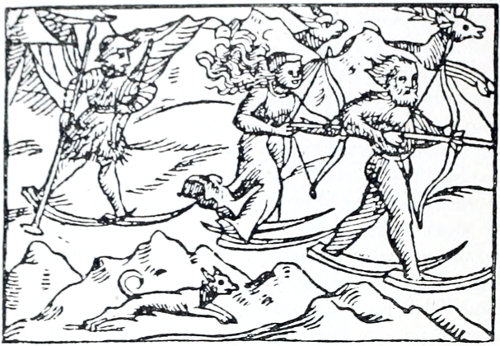
Fig. 2.—Skrid-Finner hunting (Olaus Magnus, ca. 1550).
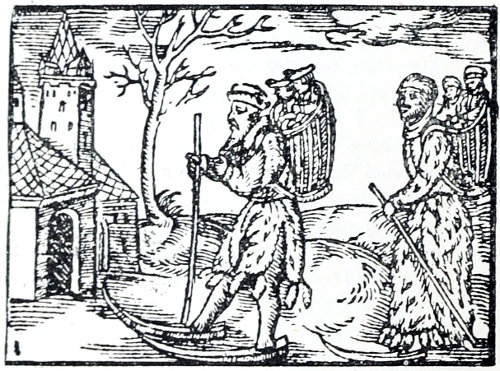
Fig. 3.—Skrid-Finner (Olaus Magnus, ca. 1550).
Such skin-clad ski were, and are still, employed by the Lapps, as well as by others in Scandinavia, Finland, and throughout Siberia; but several other types have, nevertheless, been used in Lapland for centuries. In Scandinavia and the North, these skin-covered appliances go by the name of “aandre,” “ondurr,” “andor,” to distinguish them from the plain ski. As, however, the advantages of the skin are not now generally considered sufficient to counterbalance the disadvantages, they are gradually disappearing.
There can be little doubt but that the greatest development of the ski has taken place in Europe, notably in Scandinavia, where they have been modified to suit the different requirements of the districts in which they are employed. Thus have the varied types hitherto been many, but may be divided generally into two groups, viz., the short and broad, or loose snow ski, and the long and narrow, or compact snow variety (“skare ski”), this latter pattern being represented by the Oesterdal and Swedish ski (originally one very long and one short ski, but now generally of equal length). These are the most suitable for open country, whether in the lowlands or mountains, and on level or undulating land are superior, so far as speed is concerned, to all others; but in broken country, or on mountains where obstacles such as trees, rocks, &c., are to be met with, the shorter or “loose snow” patterns, owing to their handiness, are invariably employed.
Almost every province, it may be said almost every district, throughout Scandinavia possessed its own type of ski. In Russia they have possibly been of a more homogeneous character than elsewhere, owing to the snow-clad portions of that empire consisting of vast plains which call for no variety of form. Of comparatively late years, however, there has been a tendency in Norway to adopt one sort for universal use, and a sub (lighter) variety for leaping purposes. It is a modified Telemarken (loose snow) type, eminently suited to every purpose, and is gradually superseding all other forms throughout Scandinavia.
Of accessories to the ski, the staff has invariably been recognised as a necessity (except in leaping competitions, when it becomes a source of the greatest danger) and should always form part of the outfit on all long excursions or journeys. It assists the skier both in aiding him when ascending, and as a brake when descending difficult slopes, or as a means of defence if attacked by animals. The Lapps use it, too, as an offensive weapon when attacking wolves, which they occasionally run down on their ski, and kill by a well-directed blow on the snout, or across that most vulnerable spot, the loins of the beast. The most effectual use of the staff can only be learnt by experience or teaching. The fastenings may be regarded as other important accessories, and but a few years ago, and in many parts even still consist solely of toe straps formed of withes or leather. These simple contrivances suited all the requirements of the expert peasants, and it is only of late years, when leaping was introduced, and the ski put to other and harder purposes than originally intended, that stronger and more secure bindings became necessary. Of these, there are many sorts, all good, but none perfect as yet. In some instances the latter may be a source of great danger owing to its being impossible, when peril faces one, or accidents occur, to remove the ski from the feet, and notably so when a man breaks through treacherous snow-covered ice, owing to the ski preventing him from regaining the surface. But while several fatal accidents have occurred in this manner, it is possible that others have been avoided by the greater command of the ski afforded to most people by secure fastenings.
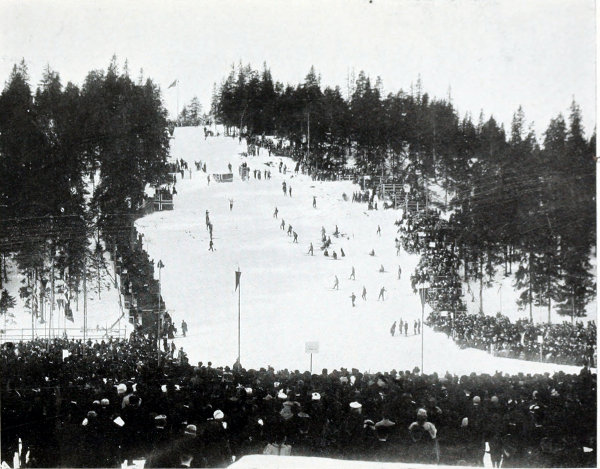
Holmenkollen.
Photo by Rude, Christiania.
Having now given an outline of the history and origin of the ski, it may be well to refer to the movement by which ski-ing has been brought into the prominent notice of sportsmen and admirers of winter pastimes. In the extensive and mountainous district of Telemarken, Norway, one in which ski were employed possibly more extensively than in any other, owing to its remoteness, and the wretched state of the few highways and byways to be found there, the peasants discovered that the ski might be used for pleasure as well as ordinary pursuits, and arranged meetings at which races were run, and the leaping powers of competitors tested on the slopes of selected hills. By degrees news of these trials of skill found its way to the towns and the populated districts in their neighbourhood, and some few citizens having found ski-ing to be a good, and to them attractive, exercise, determined to hold similar meetings at Christiania each winter. The accounts given of those meetings are very ludicrous, the hill being neither steep nor long, the competitors riding astride their poles down the track, and only jumping, if jumping it could be called, a few yards. The exhibitions did not “catch on,” and were discontinued for many years. The townsfolk knew too little about the sport to appreciate it, and the absurd, if not painful, appearance of the competitors was not encouraging to aspirants. Towards the end of the seventies, however, owing chiefly to the exertions of the Christiania Ski Club—a select institution with but few members—some Telemarken peasants4 were induced to visit the capital, and in the early part of 1879 a ski meeting was held on the slopes of the hill at Huseby, near Christiania, which was attended by a couple of the countrymen, who took part, together with other competitors, in the races and leaping that had been arranged. The Huseby slope was one which, only a few years previously, had been described as highly dangerous, and impossible to descend when the snow was fast and in good condition.
The leaping competition proved most highly interesting. though in some respects quite comical. Every man, except the Telemarkings, carried a long, stout staff, and on that, so they thought, their lives depended. Starting from the summit, riding their poles, as in former times, like witches on broom-sticks, checking the speed with frantic efforts, they slid downwards to the dreaded platform or “hop” from which they were supposed to leap, but over which they but trickled, as it were, and, landing softly beneath, finally reached the bottom somehow, thankful for their safe escape from the dreaded slide. But then came the Telemark boys, erect at starting, pliant, confident, without anything but a fir branch in their hands, swooping downwards with ever-increasing impetus until with a bound they were in the air, and 76ft. of space was cleared ere, with a resounding smack, their ski touched the slippery slope beneath, and they shot onwards to the plain, where suddenly they turned, stopped in a smother of snow dust, and faced the hill they had just descended! That was a sight worth seeing, and one never to be forgotten, even if in after years such performances have been, in a way, totally eclipsed.
This wonderful exhibition of the peasants’ skill naturally excited the greatest interest, and acted on the townsfolk like a charm. Their leaping was regarded as one of the wonders of the world, and in subsequent years people flocked to Christiania from far and wide to witness it. Then came the turn of the tide, the eyes of the city youths became opened—the eyes of those who, during the long winter days had, for want of better occupation, frequented billiard-rooms or ill-ventilated cafés, where the seeds of idleness and vice lay ready to strike root. By degrees such old haunts became forsaken, for the attractions of the newly-found sport proved greater than those of the bottle, and even if they failed to attract and reform the majority of men just at that period, they certainly had a most beneficial influence on many, and, as time advanced, on the younger generation, who were able to take to the pastime before bad customs could affect their ways. Like other things, especially before its novelty had worn off, ski-ing was, and often still is, carried to an excess, but that it is a healthy pastime is a fact beyond all doubt. To men it came as a boon and a blessing, and subsequently to women and girls, who, in the short winter days and close confinement to the house, suffered terribly from anæmia and all its attendant evils. At the time referred to the fair sex was debarred by public opinion from participating in masculine pursuits, and it is not so very long ago that pater and materfamilias looked askance at girls who donned the ski. That is all changed now, however, and ski-ing has produced of later years a race of robust men and healthy women, presenting the greatest possible contrast to those who lived “in the good old times,” unconscious of the benefits of exercise and fresh air, shut up in close and dingy rooms to escape from the dreaded cold and the touch of an icy blast.
For some years the peasants carried all before them, both in the racing and leaping competitions. They were steady on their legs, accustomed to the mountain slopes from their infancy, and could out-pace and out-distance all competitors. They did not, however, understand the art of training; the townsmen soon saw they could not get on without that, and ended at last in beating their teachers on all points, first in jumping, which they practised as an art, and, secondly, in racing given distances.
It may be well now to touch upon ski-ing proper, or the employment of ski for the purpose for which they were originally intended, viz., travelling over snow-clad land or ice. By means of these appliances people are enable to roam at will, enjoying the fresh, crispy air, the pretty landscape, and changing scenery, combined with the pleasant sensation of gliding, instead of tramping, over the surface of the country. The speed attained is certainly not very great, and is about the same in hilly as on level country, for in the former the time lost in ascending slopes is made up on the descent. In racing, the time made by the best men, travelling lightly clad, and under the best conditions of snow and weather, works out at about eight and a half miles an hour on a course of a little over nine miles, and nearly eight miles an hour on one of eighteen and a half miles. In racing, the longest distance ever run at a stretch was covered by a Lapp, who, at Jokkmokk, in Sweden, made a good 137 miles in 21 hours and 22 minutes, over comparatively level ground, thus at a rate of about six and a half miles an hour. Ordinary travellers, or soldiers on ski, would find five to five and a half miles an hour quite sufficient to tax their powers. In 1900, a detachment of the Norwegian Guards accomplished a march of 125 miles in seven and a half days, an average of some seventeen and a half miles a day, which must be looked upon as a very good performance, considering that they carried canvas wherewith to improvise tents, sleeping bags, and provisions, and moved up hill and down dale, once ascending to a height of 4,000ft. above the sea level. It will thus be seen that, in marching trim, soldiers on ski do not travel faster, or to any great extent faster, than infantry at other times, the only advantage of the ski being that, when the snow lies, they are able to move about, and get along in parts where men not provided with such appliances, or snowshoes, would be compelled to remain idle.
Attention may now be drawn to leaping, which was originally learned by the Norwegians on the slopes of their hills when inequalities of ground would, during a rapid descent, cause the wearer to bound through the air for some distance, possibly only a yard or two, but sufficient, anyway, to create a longing for a little more. This led the peasants to make an artificial rise on the face of a hill, and there meet to see who could leap farthest. In no other country was the leaping ever attempted, and it is primarily due to it that ski-ing caught on, and became so popular in Norway as to throw all other pleasures into the shade, and attain its present position as the national pastime of the people. To be understood ski-leaping must be seen. No photograph or description can ever give a proper idea of it. Many of those who now appear as the best leapers are men who devote their chief energies to this branch of the sport, and who attend all the meetings they possibly can. They might be called “pot hunters,” but this term can, fortunately, be hardly applied to them as yet, for the remuneration of a prize can scarcely repay the expenses they incur in loss of time, travelling, &c. They, in fact, perform for the love of the amusement, and, it may be said, nothing else except, possibly, renown. Ever since the peasants, in 1879, startled the country by their leaping powers, jumping has steadily improved, i.e., in length, and in the courage or daring of the leapers. But, while acknowledging this to some extent, it must be considered doubtful whether the modern wonderful accomplishments equal or surpass those of the Telemarken peasants, who, some twenty odd years ago, made bounds of 70ft. and upwards, with their ordinary country outfit of home-made ski, simply fastened with toe straps of twisted withes, whereas now men wear ski specially made for the purpose, strapped securely to their boots.
It may be of interest to conclude by giving a list of those who have made the longest leaps, and continued their course without a spill.
Records of leaps in which the men kept their feet after landing on the snow, so-called “standing leaps”:
Year. Name. Place. Length of Jump.
1879. Torjus Hemmestvedt Christiania 76 feet.
1893. Torjus Hemmestvedt Red Wing, U.S.A. 103 ”
1898. Sven Sollid Solberg, pr. Christiania 103½ ”
” Cato Aal
” Tollef Hemmestvedt (16 years old) Telemarken 99 ”
1899. Asbjörn Nielsen Solberg, pr. Christiania 107 ”
” Morten Hansen
1900. Olaf Tandberg Solberg, pr. Christiania 116½ ”
1902. Paul Nesjö (18 years old) Trondhjem 130 ”
” Nils Gjestvang Modum 134½ ”
From the above it will be seen that the longest leap recorded was one of 134½ft., truly a wonderful performance, and one that could only be accomplished on an exceedingly steep hill by most able performers.
In penning the above the writer trusts that he has thrown some light on the origin and history of ski, and the purpose to which they have been devoted of late years by the Norwegians, the founders of the sport of ski-ing.