Part 3 — ODDS AND ENDS. By E. C. Richardson.
Reading edition
ANTIDOTES TO “STICKING” AND AIDS TO CLIMBING.
In warm weather snow is apt to stick to the bottom of the ski (see page 22). It accumulates there in large watery clods, and renders progress very slow and laborious. Under such circumstances the advice commonly given is not to go out at all, and unless there is a prospect of better things, either in the shade or higher up, it is certainly best to stop at home. Nevertheless, the boundary line between sticking and not sticking is an extremely narrow one, and, moreover, one is not always sitting comfortably indoors when the trouble begins. It is therefore important to consider what is to be done to avoid or cure it.
Waxing the ski is the simplest plan, and proves effective in the great majority of cases. It is true that with waxed ski hill-climbing may become a matter of considerable difficulty, for the wax is apt to carry matters too far, and to make the surface unduly slippery. But anything is better than carrying all that dead weight of snow, and by using only a little wax under the foot (where the sticking chiefly occurs), by choosing an easy gradient, and by side stepping, &c., one can generally manage to get along somehow.
Various kinds of wax are sold for this purpose, and all are more or less efficacious. There is, however, a difficulty with the solid kinds in inducing them to “bite” when the ski are cold and wet, and the writer prefers the semi-liquid variety sold in tubes. A tube of wax, plus its attendant piece of rag, takes up very little room in the pocket or rucksack, and its weight is in no way commensurate with that of the lumps of snow which it is not infrequently its office to prevent.
Sealskin.—From time immemorial seal’s (or elk’s) skin has been attached to the bottom of the ski. The hairs, set towards the heel serve the double purpose of preventing the ski slipping backwards, and of keeping the surface free from sticky snow. Until quite recently it has been usual to fix the skin permanently; but whilst this works fairly well for certain purposes, it is open to many objections. The hair is a very serious impediment, both down-hill and on the level, for it not only reduces the speed, but, owing to its inherent “wobbliness,” it renders steering and balancing much more difficult. Then, again, the hair soon wears out, a day of hard snow being sufficient to quite spoil it; or it tears, or, being wet, the weather turns colder and it freezes solid. But perhaps the most serious objection of all is the nasty feeling of a skin-clad ski. There is a certain cleanness and crispness about the movement of the plain wood through the snow which one learns to love, and which one sorely misses. Besides which there is much art in getting up-hill to the best advantage on uncovered ski, and this keeps one’s mind busy, and greatly alleviates the labours of the climb; whereas with the skin any duffer can get along, and climbing becomes pure drudgery. It is, however, certain that, given a long and steep ascent where much zig-zagging is necessary, or even an only moderately steep slope and hard snow, one can with the skin arrive far more quickly and easily at the top than without it. It will, therefore, either when attached permanently or when detachable as about to be described, be found to be of great value for long and arduous mountain tours on steep Alpine ground. But even in the Alps, under all ordinary circumstances, where ski-running, and not the ascent of any particularly difficult summit, is the object in view, and where it is of no consequence whether one arrives an hour sooner or later, there is no sense in encumbering oneself with unnecessary gear and spoiling the pleasant “feel” of the bare ash.
On undulating ground, where one can usually go straight up and down hill (as in most parts of Norway), nobody nowadays dreams of using skin in any shape or form.
Detachable Sealskin is quite a recent invention, and is vastly preferable to the fixed article. For it can be used for a long climb, and removed when the summit is reached.
Thus a strip of the material mounted on webbing can be attached to the bottom of the ski by means of a loop over the point, a strap at the heel end, and a few transverse straps. But the plan is open to the objection that the skin is apt to slip about sideways, and that the fixing of it is troublesome, and takes time.
The latest method of fixing is that invented by Messrs. Sohm and Madlener, and is highly recommended by those who have tried it. But it involves boring two holes through each ski—an unpardonable sacrilege in the eyes of some people. Surely, however, if we are going to commit the outrage of using sealskin at all we may just as well be hanged for a sheep as for a lamb, and bore holes or do anything else which may assist us in our fell (joke!) design.
The detachable skin of Herren Sohm and Madlener is sewn on to stout webbing, and is only about half as long as the ski themselves. It is attached to the ski immediately in front of the foot, and reaches from there to the back end. The arrangements for fixing it are extremely ingenious, and permit of its being attached or removed with great rapidity. The photographs and drawings (p. 108) show exactly what they are.
A hole is bored in the ski just in front of the binding; and another about halfway between it and the heel end of the ski. Through each of these holes a bolt passes, the bottom of which is shaped like a flat sort of button. The bolt sticks up through the ski; and it is threaded and fitted with a wing-nut. (See Fig. a.) When not required the button is screwed by means of the wing-nut into a recess cut for its reception in the bottom of the ski.
The front part of the skin is buttoned to the front bolt, the middle part to the second bolt, whilst the heel end has a strap sewn on to it by means of which the whole is first stretched perfectly taut, and then secured by passing the strap round the heel of the ski, and fixing it to a catch on the top of the ski. The strap is fitted with eye-holes, and the catch is of the simple, but ingenious construction shown in Fig. b, and in the photos.
The front part of the skin, of course, requires protection. This is afforded by soldering two pieces of sheet brass together so as to form a sharp tent-shaped V.
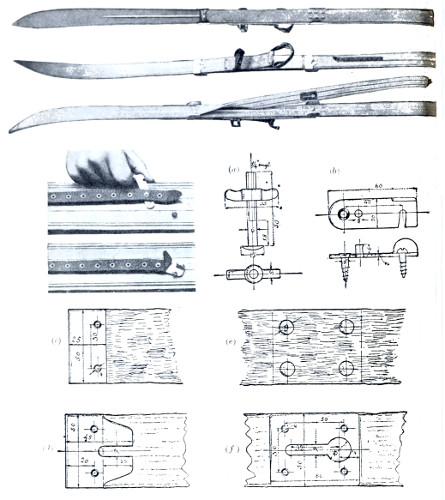
Fig. 34.—The Sohm-Madlener Detachable Sealskin.
(a) Bolt with button and wing-nut. Two are needed for each ski.
(b) Catch for securing strap leading from back end of skin. The photos showing catch half open and shut.
(c) Lower side of front edge of skin, showing sharp brass entrance.
(d) Upper side of front edge of skin, showing button-hole on brass entrance.
(e) Lower side of middle of skin, showing rivets for button-hole. There should be six rivets instead of only four, as shown.
(f) Upper side of middle of skin, showing button-hole.
The measurements, when not otherwise stated, are in millimètres.
The skin, mounted on its webbing, is placed between the jaws of the V which are then closed and secured by a couple of copper rivets. (See Figs. c and d.) The “button-holes” on the skin are not, of course, of the ordinary kind. The front one is shown in Fig. d. The second one in Fig. f.
The front “button-hole” is cut out of the upper part of the tent-shaped brass V as shown in Fig. d.
The second “button-hole” (Fig. f) allows the button to slide backwards and forwards in it so as to permit of the skin being pulled quite taut. This “button-hole” is made by simply cutting a hole and slot in another piece of sheet brass, and attaching it to the skin by means of rivets. (See Figs. e and f.) N.B.—Only four rivets are shown in this drawing, but probably it is better to make the slot a little longer and to add another rivet at each side.
In fitting this kind of detachable skin to a pair of ordinary ski, it is probably best to fill up the customary groove cut in the bottom of the ski. The ski will then be devoted exclusively to steep mountain work where it is in any case advantageous to dispense with the groove. (See page 33.) If, however, it is desired to retain the groove it will be advisable to make the button holes extra strong, or else to make them up so as to fit close against the wood.
It will be observed (as was mentioned above) that the skin only covers about half the under surface of the ski. To prevent snow sticking to the uncovered part in warm weather, a liberal coating of wax may be applied, or else (as Herr Sohm advises) the whole of the bottom of the ski may be painted with smooth and hard enamel. This gives a very fast surface for running on, and of course no slipping back need be feared when walking up-hill with the skin attached.
Climbing Irons.—Herr Sohm recommends the use of climbing irons invented by him in combination with his detachable skin. The object of the irons is to prevent slipping on very steep icy slopes. The writer has had no experience of these, and, as criticism without practical knowledge is seldom of much value, he prefers to leave the reader to try them or leave them alone, just as he pleases. This much may, however, be safely assumed that these appliances (like the skin itself) can only be of value to the skilled ski mountaineer desirous of making long and difficult excursions in the high Alps. They are (as Herr Sohm himself insists) quite unnecessary on ordinary ground, and are certainly not for the beginner.
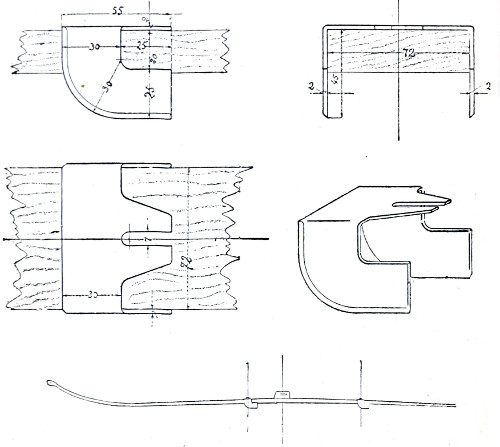
Fig. 35.—Sohm’s Climbing Irons.
The measurements are in millimètres. See also the photos, page 108.
The climbing irons are made of some strong metal unaffected by rust, and their shape and the method of fixing them in conjunction with the skin is shown clearly in the accompanying diagrams.
Tying a piece of rope to the bottom of the ski is resorted to by some in order to help them to get up-hill. The writer has, however, never found this to be of much use. It is true that if plenty of rope is used, and if it is properly fixed (no easy matter by the way), it largely obviates slipping back; but it also seriously hinders slipping forwards, and necessitates a lifting or heavy dragging of the ski at every step. Snow is very apt to stick to the rope, and of course no glissading with it is possible. The net loss seems therefore to be greater than the gain, though possibly there may be occasions when the reader may find something of the sort useful. The plan has at least the merit of cheapness.
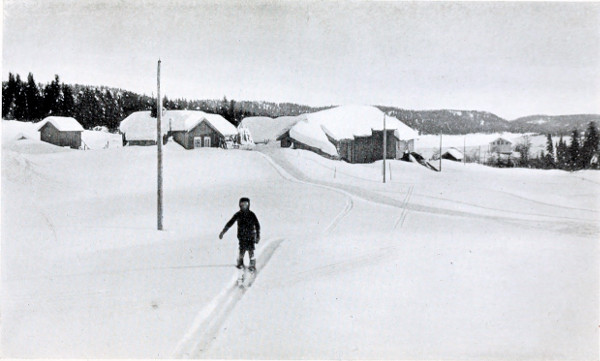
In Nordmarken, near Christiania.
Photo by H. Abel.
Dipping part of the ski into water is also recommended by some in order to help climbing, the idea being to form a lump of ice on the bottom, which may be removed when the summit is reached. But this, too, is open to much the same objections as the rope, and is scarcely worth while. If it is to be adopted, it is well to be provided with a metal paper-knife, or something of the kind, to scrape off the ice, and, incidentally, it may be here mentioned that some sort of scraping appliance will always be found useful; for cleaning one’s ski with the stick or an ordinary knife takes a long time, besides being apt to injure both the wood and the blade.
COMMON FAULTS AND FAILINGS
(Mostly dealt with already, but repeated here to impress the beginner).
I.—Kit.
(1) Too heavy clothes. Woolly clothes. Have light, wind-proof, smooth materials.
(2) Tight boots with thin soles. Have large strong boots which won’t pinch the toes, even with three pairs of socks on, and which won’t buckle in the middle of the sole.
(3) Ski brittle, of bad shape, or of great weight. Get some one who knows good ski to choose for you, or, if this is impossible, send to a good maker for his best.
(4) Too short gloves. Have long gloves to draw over the sleeves of your coat.
II.—Condition of the snow.
(1) Abusing the snow. The better the ski-runner the less he complains, and vice versâ. Notice how the good men manage.
(2) Continuing a tour when danger may be expected. Only greenhorns and fools do so. Turn back, and try another day.
(3) Waxing ski when snow is just binding. Best not. The slight clinging will help you up, and won’t interfere seriously with the run. Probably, too, it will be colder higher up.
III.—Technique.
(1) Short waddling steps on the level. Lean forward. Slide.
(2) Can’t get up hill. Raise front of ski and stamp. Don’t go too steeply. Go slowly, but keep at it.
(3) Rushing up in front of others when on tour. Don’t show off. Probably you are one of the worst of the party; in any case, you are only annoying the others.
(4) Side stepping, ski cross. Raise heel of lower ski. (See p. 60.)
(5) Can’t start down hill. Be quick about it, and then you can.
(6) Legs apart and feet level. Keep legs close together and one foot forward.
(7) Leaning back on stick. Practise without one.
(8) Falling inwards when making a down-hill curve. Lean forward! Throw the weight on to the lower ski.
(9) Telemark swing. Can’t get round. Raise heel of the back foot.
(10) Christiania swing. Ski runs off at a tangent. Hold ski together. Swing on both of them.
(11) Not learning to turn to both right and left. Don’t keep on practising that which you can already do.
(12) Dropping over a jump without sats, or recklessly hurling yourself over. Both forms of funking. Keep cool and think of your form.
(13) Jumping too late. Don’t go quite so fast, and begin to straighten up earlier.
(14) General stiffness. Don’t get into any fixed style of running. Keep on changing your ground and trying new things.
SKI-RUNNING ETIQUETTE.
Introductions are very informal on the snow.
You may ask anybody for advice, and be certain of receiving a polite answer, provided that you yourself are polite, and that your question is not idiotic.
If you contemplate joining a touring party, you should ask somebody who is going, and who has already made a tour with you, whether you are likely to be welcome. If he hesitates, don’t go. If he assents, go by all means, even though you may be doubtful whether you are up to the work in hand.
You should not instantly rush to the assistance of a lady who may have fallen. Do not let your gallantry get the better of your common sense.
In Norway ladies put on their own ski, and manage their own bindings, and it is not good manners to offer to assist them. Would that the custom extended to Switzerland!
However amusing your conversation may be, you should refrain from chattering during a long climb. Not everybody’s wind or everybody’s temper is perfect.
You will not add to your popularity on tour by continually accepting hospitality at the hands of others, especially if your water-bottle be small, and you carry no repairing outfit.
You should pay up punctually, and without demur, to the man who finances a touring party; it is at least ten to one that he is out of pocket, anyway.
It is a gross breach of manners to tread on the back of another man’s ski. You should at once apologise and fall back five yards.
You should not come plumping over a jump which others have been at some pains to construct, without first asking their leave, and it is always your solemn duty to repair as well as possible any damage you may occasion to the track.
Unless you are really a very good runner, it is better not to imitate too closely the Norwegian style of dress. People may be disappointed.
Always be polite in your dealings with foreigners, and you will seldom have cause to complain of their want of manners.
SOME USEFUL FIGURES.
1 inch = ·0254 metres 1 metre = 39·370 inches11
1 foot = ·3048 metres ″ = 3·280 feet
1 yard = ·9144 metres ″ = 1·0933 yards
1000 metres = 3280 feet 1 kilometre = 1093·3 yards
1000 feet = 304·8 metres 8 kilometres = 4·969 miles
″ = 5 miles, less 50 yards
France and Switzerland and Italy.
£4 = 100 francs 100 francs = 80 /-
4- = 5 francs 5 francs = 4/-
1/- = 1·25 francs 1 franc = -/9½ about
Norway, &c.
£1 = 18·2 kroner 1 krone = 1/1¼ about
Germany.
£1 = 20·4 marks 1 mark = -/11¾ about
Austria, &c.
£1= { 24 kronen 1 krone = -/10
{ 10·2 florins or gulden 1 florin or gulden = 1/11½
1 kilogramme = 2·2046 pounds avoirdupois. In trade 1 kilogramme is reckoned 10 per cent. more than 2lb. 11lb. = 5 kilogrammes.
Temperature falls about 1° Fahrenheit for every 300ft. rise or, say, 1° Cent. for every 200 metres.
THERMOMETER.
Comparison between Scales of Fahrenheit, Réaumur, and the Centigrade.
Cent. Fah’t. Rmr.
° ° °
100B. 212B. 80B.
99 210·2 79·2
98 208·4 78·4
97 206·6 77·6
96 204·8 76·8
95 203 76
94 201·2 75·2
93 199·4 74·4
92 197·6 73·6
91 195·8 72·8
90 194 72
89 192·2 71·2
88 190·4 70·4
87 188·6 69·6
86 186·8 68·8
85 185 68
84 183·2 67·2
83 181·4 66·4
82 179·6 65·6
81 177·8 64·8
80 176 64
79 174·2 63·2
78 172·4 62·4
77 170·6 61·6
76 168·8 60·8
75 167 60
74 165·2 59·2
73 163·4 58·4
72 161·6 57·6
71 159·8 56·8
70 158 56
69 156·2 55·2
68 154·4 54·4
67 152·6 53·6
66 150·8 52·8
65 149 52
64 147·2 51·2
63 145·4 50·4
62 143·6 49·6
61 141·8 48·8
60 140 48
59 138·2 47·2
58 136·4 46·4
57 134·6 45·6
56 132·8 44·8
55 131 44
54 129·2 43·2
53 127·4 42·4
52 125·6 41·6
51 123·8 40·8
50 122 40
49 120·2 39·2
48 118·4 38·4
47 116·8 37·6
46 114·8 36·8
45 113 36
44 111·2 35·2
43 109·4 34·4
42 107·6 33·6
41 105·8 32·8
40 104 32
39 102·2 31·2
38 100·4 30·4
37 98·6 29·6
36 96·8 28·8
35 95 28
34 93·2 27·2
33 91·4 26·4
32 89·6 25·6
31 87·8 24·8
30 86 24
29 84·2 23·2
28 82·4 22·4
27 80·6 21·6
26 78·8 20·8
25 77 20·0
24 75·2 19·2
23 73·4 18·4
22 71·6 17·6
21 69·8 16·8
20 68 16
19 66·2 15·2
18 64·4 14·4
17 62·6 13·6
16 60·8 12·8
15 59 12
14 57·2 11·2
13 55·4 10·4
12 53·6 9·6
11 51·8 8·8
10 50 8
9 48·2 7·2
8 46·4 6·4
7 44·6 5·6
6 42·8 4·8
5 41 4
4 39·2 3·2
3 37·4 2·4
2 35·6 1·6
1 33·8 0·8
Zero 32 Zero
1 30·2 0·8
2 28·4 1·6
3 26·6 2·4
4 24·8 3·2
5 23 4
6 21·2 4·8
7 19·4 5·6
8 17·6 6·4
9 15·8 7·2
10 14 8
11 12·2 8·8
12 10·4 9·6
13 8·6 10·4
14 6·8 11·2
15 5 12
16 3·2 12·8
17 1·4 13·6
18 — 14·4
19 2·2 15·2
20 4 16
21 5·8 16·8
22 7·6 17·6
23 9·4 18·4
24 11·2 19·2
25 13 20
26 14·8 20·8
27 16·6 21·6
28 18·4 22·4
29 20·2 23·2
30 22 24
31 23·8 24·8
32 25·6 25·6
33 27·4 26·4
34 29·2 27·2
35 31 28
36 32·8 28·8
37 24·6 29·6
38 36·4 29·6
39 38·2 31·2
40 40 32
41 41·8 32·8
42 43·6 33·6
43 45·4 34·4
44 47·2 35·2
45 49 36
46 50·8 36·8
47 52·6 37·6
48 54·4 38·4
49 56·2 39·2
Outfit FOR EVERY SPORT.
SKI from all the best makers in Norway, Germany, Austria, and Switzerland.
FASTENINGS of every description, including the “Alpine” and the “Ellefsen.”
CLOTHING of the best quality and design, ready made or to order.
BERCOLIN (in tubes), the best ski-wax, and other lubricants.
EVERYTHING required by ski-runners, mountaineers, tobogganers, skaters, and tourists.
E. DETHLEFFSEN & CO., BERNE, Christoffelgasse 7.
BERR & CO., VIENNA, Mariahilfer Str. 1c.
H. SGHWAIGER, MUNICH, Wein Str.(Rathaus).
Three Names. Three Countries. One Quality.