Chapter V
Reading edition
ΠΑΝΤΟΧΡΟΝΟΧΑΝΟΝ, or The Pedigree

NE of the most characteristic of Sir Thomas Urquhart's works is his ΠΑΝΤΟΧΡΟΝΟΧΑΝΟΝ: or, A Peculiar PROMPTUARY of TIME.[175] This contains a complete pedigree of the Urquhart family from the creation of the world down to the year A.D. 1652. Prefixed to it is a letter to the reader by "a well-wisher," whose initials are G. P., into whose hands the pedigree had fallen by mere chance, and who had thought himself bound in duty to the public to see it safely through the press. According to the statements of this disinterested philanthropist, the work in question was but one of a large number of papers of very great importance, forming part of the author's baggage, which he had to abandon after the battle of Worcester. It is the habit, we know, of impecunious and importunate wayfarers to carry about with them documents of interest to which they solicit attention; but why a man in Sir Thomas Urquhart's position should have gone on a campaign, encumbered by various unpublished works in manuscript, it is difficult to say. Perhaps the simplest explanation is that he was different from other people.
The soldiers of Cromwell, we were told, made but light of this portion of the enemy's baggage, after "the fatal blowe given to the Royal party at Worcester"; indeed, but for "a surpassing honest and civil officer of Colonel Pride's regiment," the pedigree of the Urquharts would have been used by "a file of musquettiers to afford smoak to their pipes of tobacco."[176]
The fame of Sir Thomas as an author and as a soldier moved G. P., as he tells us, to commit this treatise to the press. With considerable ingenuity he remarks that, though the author is now in prison as a Royalist, he understands that his position is by no means "so desperate as that he thereby will be much endangered." If any doubt up to this point existed as to who G. P. might be, it is set at rest by the terms in which he pleads for favourable conditions being granted to the prisoner. "It is humbly desired," he says, "and, as I believe, from the hearts of all that are acquainted with him, that the greatest State in the world stain not their glory by being the Atropos to cut the thred of that which Saturne's sithe hath not been able to mow in the progress of all former ages, especially in the person of him whose inward abilities are like to produce effects conducible to the State of as long continuance for the future."[177] Only Sir Thomas Urquhart himself had the secret of what we may call the "spacious" manner of self-eulogy, which by its very grandeur seems lifted up above all such petty feelings as pride or vanity.
The concluding passage in the address to the reader is also worth quoting, as it illustrates the magnanimous spirit in which the captive deprecates severity towards himself on the ground of the injury which would thereby redound to the State. "Considering," it says, "how formerly he hath been a Mæcenas to the scholar, a patron to the souldier, a favourer of the marchant, a protector of the artificer, and upholder of the yeoman, it were a thousand pities that by the austerity of a State, which dependeth in both its esse and bene esse upon the flourishing of these worthy professions, effects so advantagious thereto, should, by not conferring deserved courtesies on him, be extinguished in the very brood."[178]
In the True Pedigree and Lineal Descent of the Most Ancient and Honourable Family of the Urquharts in the House of Cromartie, we have a brief but surprisingly complete history of the family from the time of Adam[179] down to A.D. 1652. The line runs through the Sethite and not the Cainite branch of the human race, and, among the sons of Noah, it passes through Japhet. The story is told of a marginal note being found in the history of some ancient Highland family, to the effect that "about this time the Flood took place." Something like this is to be found in the document before us, for, under the date B.C. 2893, Sir Thomas adds to a mention of his ancestor Noah, a remark to the effect that "the Universal Deluge occurred in the six hundreth yeer compleat of his age."
The good fortune of his ancestors in their inheritances, marriages, and friendships is very remarkable. To one of them, Japhet, fell the inheritance of "all the regions of Europe"; Japhet's grandson Penuel was "a most intimate friend of Nimrod, the mighty hunter and builder of Babel"; while his great-grandson Tycheros was chosen by "Orpah, the daughter of Sabatius Saga, Prince of the Armenians, to be her husband, because of his gallantry and good success in the wars."[180]
The name Urquhart came into use at the comparatively late period of B.C. 2139, when the family had been in existence for over eighteen hundred years. It was first borne by Esormon. "He," we are told, "was soveraign Prince of Achaia. For his fortune in the wars, and affability in conversation, his subjects and familiars surnamed him ουροχαρτος, that is [to] say, fortunate well-beloved. After which time, his posterity ever since hath acknowledged him the father of all that carry the name of Urquhart.[181] He had for his arms, three banners, three ships, and three ladies, in a field d'or, with a picture of a young lady above the waste, holding in her right hand a brandished sword, and a branch of myrtle in the left, for crest; and for supporters, two Javanites, after the souldier-habit of Achaia, with this motto in the scroll of his coat-armour, ταυτα τα τρια αξιοθεατα; that is, These three are worthy to behold. Upon his wife Narfesia, who was soveraign of the Amazons, he begot Cratynter."[182]
The habits of the Urquharts to form alliances and friendships with persons afterwards famous in sacred and secular history is very marked. Thus, one of them, Phrenedon Urquhart, "was in the house of the Patriarch Abraham at the time of the destruction of Sodom and Gomorrha." At a later period, another, named Hypsegoras Urquhart, married a daughter of Herculus Lybius; while a descendant of theirs, Pamprosodos Urquhart, married Termuth, "who was that daughter of Pharaoh Amenophis which found Moses among the bulrushes, and brought him up as if he had been her own childe."
Another ancestor, Molin Urquhart (c. B.C. 1534), married Panthea, "the daughter of Deucalion and Pyrrha, of whom Ovid maketh mention in the first of his Metamorphoses." The genealogist goes on to say that "in that part of Africk which, after his name, is till this hour called Molinea, by cunning and valour together he killed in one morning three lions;[183] the heads whereof, when in a basket, presented to his lady Panthea, so terrified her, that (being quick with childe) for putting her right hand to her left side, with this sudden exclamation, O Hercules, what is this? the impression of three lions' heads was found upon the left side of the childe as soon as he was born." In consequence of this incident, the three banners, three ships, and three ladies in the Urquhart arms were exchanged for three lions' heads.
A century later, we find that Propetes Urquhart married Hypermnestra, "the choicest of Danaus' fifty daughters." This must have been some time after the little affair happened for which forty-nine of her sisters were condemned to draw water in sieves; for, as every schoolboy knows, the fifty daughters of Danaus were married to their cousins, the fifty sons of Ægyptus, and all of them, but one, at the bidding of their father, murdered their husbands on the evening of the marriage-day. Hypermnestra, however, had pity upon her cousin and husband, Lynceus, and spared him.[184] He must have died shortly after, probably from natural causes, as it is recorded in the work before us that she married Propetes Urquhart, and became the mother of Euplocamos Urquhart.
The thought of what the family to which Hypermnestra belonged were capable when their blood was up, must, one would think, have cast a slight shadow of apprehension upon the married life of Propetes Urquhart. A more cheerful tone must have pervaded that of his descendant Cainotomos Urquhart, for he, we are told, "took to wife Thymelica, the daughter of Bacchus, in recompense of his having accompanied him in the conquest of the Indies." Further interesting particulars, which are not elsewhere recorded, are related of this ancestor of Sir Thomas. On his return from the expedition in which he assisted Bacchus to conquer India, he "passed through the territories of Israel, where, being acquainted with Debora the Judge and Prophetess, he received from her a very rich jewel, which afterwards by one of his succession was presented to Pentasilea, that Queen of the Amazons that assisted the Trojans against Agamemnon."
Their son Rodrigo Urquhart (c. B.C. 1295) was, we are told, invited over by his kindred the Clanmolinespick,[185] the principal clan in Ireland, and "bore rule there with much applause and good success"—the one solitary instance of the kind, we suppose, which is to be found in the history of that "most distressful country." "From him," it is said, "is descended the Clanrurie,[186] of which name there were twenty-six rulers and kings of Ireland before the days of Ferguse the first, King of Scots in Scotland."
A slight degree of uncertainty hangs about the identity of the wife of Mellessen Urquhart (c. B.C. 1049). Her name was Nicolia, and before her marriage she "travelled from the remote Eastern countries to have experience of the wisdom of Solomon, and by many[187] is supposed to have been the Queen of Sheba." Her husband, however, must have considered that, though she loved wisdom, she had not acquired much of it, or, at any rate, of the kind which is needed for bringing up a young family; for the historian goes on to say that "Mellessen Urquhart nevertheless sent some of his children to Ireland and Britain, to be brought up with the best of his own father and mother's kindred."
Amongst other celebrated persons who had the honour of being enrolled amongst the ancestors of Sir Thomas Urquhart are Pothina, a niece of Lycurgus; Æquanima, the sister of Marcus Coriolanus; Diosa, the daughter of Alcibiades; and Tortolina, the daughter of King Arthur. It is observable that for a good many generations immediately preceding the author's time, the ladies who figure in the genealogy are of comparatively lowly birth—seldom, indeed, do they reach the rank of an earl's daughter. Either the supply of princesses was by this time somewhat exhausted, or the demands of the Urquharts were less exorbitant. The high-spirited character of the most remarkable scion of the family who drew up the genealogy forbids us to think that, with the lapse of time, they had suffered any diminution of courage. It rather seems as though the world had entered upon a less heroic stage. Perhaps, like Sir Thomas Browne in a later age, they had concluded that "it was too late to be ambitious, for the great mutations of the world were acted."
Sculptured Stone at Kinbeakie House
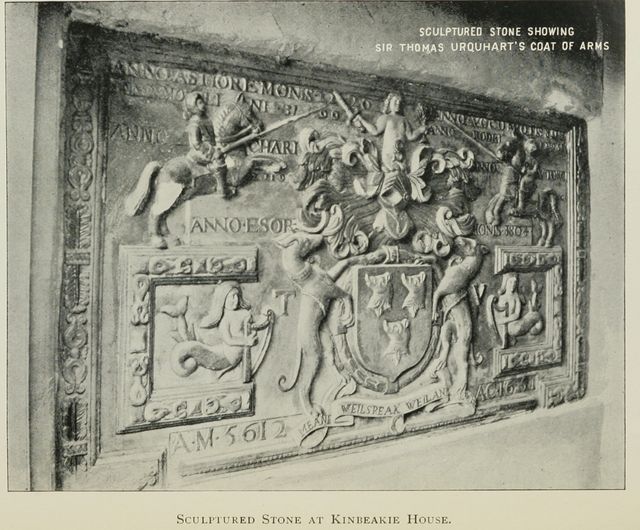
In the time of Vocompos (A.D. 775) a further change took place in the arms of the Urquharts, which gave them their final form. "Vocompos," we learn, "was the first in the world that had the bears' heads to his arms, being induced to exchange, by the instigation of King Solvatius, his arms of three lions' heads, for the three bears' heads, razed, because of the great exploit, in presence of the King, done by him and his two brothers, in killing, one morning, three wild bears, in the Caledonian forrest: the supporters were also changed into two greyhounds: the crest and impress remaining still the same as it was since the days of Astioremon."[188]
An alleged ancestor of our author, William de Monte Alto (Mouat),[189] took part in the patriotic resistance of Scotland against English oppression which is associated with the names of Bruce and Wallace, and the faint local traditions of that time partly corroborate Urquhart's statements. "This William," he says, "caried himself so lovingly towards King Robert, that when almost all Scotland was possest by King Edward's faction, and his lands at Cromartie altogether overrun by them, and his house garrisoned and victualed with three yeers provision of all necessaries for one hundred men, he by a stratagem gained the castle, and with the matter of fourty men, keept it out against the forces of Edward for the space of seven yeers and a half, during which time all his lands there were totally wasted, and his woods burnt; so that, having nothing then he could properly call his own but the mote-hill onely of Cromartie, which he fiercely maintained against the enemies, he was agnamed Gulielmus de Monte Alto. At last William Wallace came to his relief, but, as I conceive, it was the brother's son of the renowned William, who in a little den [or hollow] within two miles of Cromartie, till this hour called Wallace Den, killed six hundred of King Edward's unfortunate forces. Afterwards, raising the siege from about the mote-hill of Cromartie by the assistance of his namesake the other William, the shire of Cromarty was totally purged of the enemy."[190]
Tradition, according to Hugh Miller, is silent respecting the siege, but relates many details of the battle. The Scottish forces lay in ambuscade in the ravine or hollow which is still, or was until recently, called by Wallace's name, and attacked a large body of English troops on their way to join some of their countrymen, who were encamped on the peninsula of Easter Ross. The English were surprised and panic-struck, and left six hundred dead on the field of battle. The survivors were unacquainted with the country, and were under the impression that there was continuous land between them and their countrymen on the opposite shore. "They were only undeceived," we are told, "when, on climbing the southern Sutor, where it rises behind the town, they saw an arm of the sea more than a mile in width, and skirted by abrupt and dizzy precipices, opening before them. The spot is still pointed out where they made their final stand; and a few shapeless hillocks, that may still be seen among the trees, are said to have been raised above the bodies of those who fell; while the fugitives, for they were soon beaten from this position, were either driven over the neighbouring precipices, or perished amidst the waves of the Firth."[191]
Sir Thomas does not let us off easily. After subjecting our credulity to a severe strain by one kind of statement, he unexpectedly increases the tension by another. Thus he says that an ancestor in the fifteenth century, Thomas Urquhart, had by his wife Helen Abernethie, daughter of Lord Salton, five-and-twenty sons, who grew up to manhood, and eleven daughters, all of whom found husbands. It would only have been kind of him to have reduced these numbers a little. But on one point he has spared us: we are not asked to believe that there were others who died in infancy.
In a postscript Sir Thomas Urquhart explains that he has just given his readers a sketch of the history of his family, but hopes to furnish them with a complete narrative as soon as he obtains his release from his parole, and is at liberty to attend to this and to other matters of greater importance. The thought of the delightful book in store for mankind is so attractive to him that he cannot help dilating upon it. "In the great chronicle of the House of Urquhart," he continues, "the aforesaid Sir Thomas purposeth, by God's assistance, to make mention of the illustrious families from thence descended, which as yet are in esteem in the countries of Germany, Bohemia, Italy, France, Spain, England, Scotland, Ireland, and several other nations of a warmer climate, adjacent to that famous territory of Greece, the lovely mother of this most ancient and honourable stem."[192] He also intends not to omit the name of any family with which at any time the aforesaid house has contracted alliance.
The concluding paragraph is very amusing; for in it our author promises to give proof of the statements he has made, by quoting from the works of respectable chroniclers of past ages, though the degree of certainty which the reader may thereby expect to reach falls short of that given by Holy writ or the works of Euclid. "And finally," he says, "for confirmation of the truth in deriving of his extraction from the Ionian race of the Prince of Achaia, and in the deduction of all the considerable particulars of the whole story, [the author] is resolved to produce testimonies of Arabick, Greek, Latin, and other writers of such authentick approbation, that we may boldly from thence infer consequences of no less infallible verity then [than] any that is not grounded on faith by means of a Divine illumination, as is the story of the Bible, or on reason, by vertue of the unavoidable inference of a necessary concluding demonstration, as that of the Elements of Euclid; which being the greatest evidence that in any narration of that kinde is to be expected, the judicious reader is bid farewel, from whom the Author for the time most humbly takes his leave."[193]
It is needless to say that the scheme of filling out the sketch of the history of the Urquhart family was never carried out, if ever it had been seriously entertained by Sir Thomas; and we are left in ignorance of the names of the Arabic, Greek, Latin, and other authors on whose testimony our belief in the authenticity of the narrative was to have been firmly based. In the absence of this our judgment is left in suspense, unless, indeed, we conclude that, as the genealogy begins and ends with the names of actual persons,[194] the intermediate part is not likely to have been a mere fabrication. If the links are sound in the places where we can test them, it requires no very great exercise of credulity to believe that they are the same throughout.
Matthew Arnold on one occasion laid down the principle, that a book should either "edify the uninstructed," or "inform the instructed." Sir Thomas Urquhart's "ΠΑΝΤΟΧΡΟΝΟΧΑΝΟΝ" certainly justifies its existence according to this standard of judging literature; for if it does not serve to edify the uninstructed, it does inform the instructed, since the information it contains is not to be found in any other quarter.[195]
One's faith in the credibility of his narrative is, however, a little shaken by finding that in the second book of his favourite author, Rabelais, the genealogy of the giant Pantagruel is carried up to a period far beyond the Flood. It may be a mere coincidence, but it is one of those coincidences that make us very thoughtful.[196]
At the time when Sir Thomas Urquhart wrote, Scotland was supposed to have had a dynasty of kings and a connected political history dating far back before the birth of Christ. The impudent fictions of Hector Boece, whose history of Scotland was published in 1526, had been accepted by the public, and were regarded as genuine facts even by such literary personages as Erasmus and Paulus Jovius. Perhaps Sir Thomas thought that a credulity which had endured the considerable strain which Boece had put upon it might be trusted to bear a still greater weight. Indeed, he interwove the story of his family with that which was current as the genuine history of his native land.
According to the mythical history of Scotland, Gathelus, a Grecian prince, having quarrelled with his father Miol, took refuge in Egypt, and married Scota, a daughter of the Pharaoh who perished in the Red Sea. The young people came west and founded Portugal (i.e. Port of Gathelus), and then journeyed north to Scotland, bringing with them, as part of their baggage, the coronation-stone yet to be seen in Westminster Abbey. Their descendant Fergus, "the father of a hundred kings," was the founder of the Scottish monarchy. These shadowy persons appear again, "with the moonlight streaming through them," and play their parts in the genealogy of the Urquharts.
Some have thought that Sir Thomas believed devoutly in the genealogy himself, and was the dupe of his own imagination. One would be sorry to form so low an opinion of his mental endowments. If the book in question were not an elaborate joke, it can only have been intended to impose upon the English people by convincing them of the extraordinary dignity and grandeur of their captive. If this were indeed the case, he must have had an humbler opinion of the intellectual faculties possessed by the average Englishman than even the majority of his fellow-countrymen entertain.
A very amusing reference to this book of Sir Thomas Urquhart's is to be found in the Decisions of the Court of Session, under date of 23rd to 25th January, 1706.[197] In that year an action was brought by the Earl of Sutherland against the Earls of Crawford, Errol, and Marischal, to determine the question of precedency in the rolls of Parliament. The pursuer asserted that he was lineally descended from an Earl of Sutherland living in 1275, while his opponents' ancestors were not Earls till about 1399. The pursuer laid stress upon the fact that, in 1630, a formal inquiry into this matter had been held at Inverness, and that the decision had been in his favour. The persons who conducted the inquiry were, he said, of undoubted credit, and well versed in the particulars investigated, and "might have had good information from old men and writs, which in the course of time and through accidents had long disappeared." The advocate for the defenders replied that the "Chancellor of the Inquest" had been Sir Thomas Urquhart, who might have traced the pursuer's descent from Noah, as he had deduced his own genealogy from Adam, and that the decision arrived at was of no more value than "his fanciful derivation of his own pedigree. For the members of the Inquest seemed to have sworn rashly upon matters of greater antiquity than they could certainly know." "It is true," was the pursuer's reply, "the defender in his gaiety objects against Sir Thomas Urquhart as an ill genealogist; and it is owned that his derivation from Adam and Noah was fantastic enough, and indeed but lusus ingenii; but, after all, the defender's criticism will not hinder him to pass for a most knowing gentleman." The case was decided in favour of the Earl of Sutherland, so far as some of his contentions were concerned. But it is somewhat curious that his advocate overlooked the fact that the Sir Thomas Urquhart of 1630, who had been the "Chancellor of the Inquest," was not the author of the book containing the genealogy of the Urquharts, but that it was written by his son. It is quite possible, however, that it was a matter of notoriety that the elder Sir Thomas had been a believer in the long pedigree which his more famous son had, years after, elaborated and published.[198]