Mrs Molesworth (continued 4)
Reading edition
“I wish it were going to be still more different,” said Lady Mildred. “I wish I could help you all more effectually; but—”
“Dear Aunt Mildred, you couldn’t have helped us more effectually,” said Claudia, her eyes beaming. “We don’t want to be rich, even if you had a fortune to leave us, we couldn’t wish to be happier than we shall be when I am quite grown-up and able to begin my school, as mamma calls it. And we are all so strong and well, if it wasn’t for papa’s eyes.”
“Yes, that is a blessing,” Lady Mildred agreed: “the Meredons are a very sturdy race, much stronger than the Osberts. And that reminds me, I am sorry about that little Waldron boy; I cannot forget his poor little white face.”
“I hope he will get stronger soon,” said Claudia.
Lady Mildred said no more, and her niece saw little of her for the rest of that day, for there was another long interview with Mr Miller, and Claudia was sent out sight-seeing under the convoy of Lady Mildred’s maid.
It was some days later, Christmas Eve in fact, when the old lady said suddenly to her young companion:
“I see no help for it, Claudia; I must go to Cannes. It is absolutely necessary for me to see General Osbert without delay, and I cannot expect him to come here considering that his only remaining son is dying.”
“His only other son,” Claudia repeated. “Oh, Aunt Mildred, how very sad!”
“Yes; but this they have anticipated for some time. It was John Osbert’s death that was the great blow; and very probably the shock of it has made Frank worse. But it is very hard upon me too, though perhaps it seems selfish to say so; for I am too old to like starting off to the ends of the earth in this sudden fashion. For you I shall take care that it is no disadvantage. Once out of England I may not be in such a hurry to return. And you can have excellent lessons.”
“Oh, aunt, I do hope my being with you will not make it all more troublesome,” said Claudia. “Of course I shall like going better than anything. It is what mamma wished for me more than she could say. But, you know, if it would be easier for you it might be arranged for me to go to school, as mamma once thought of?”
“No,” said Lady Mildred decidedly; “I shall like having you with me. It will be an interest to me, and without it I should feel very lonely I shall not see much of the Osberts, poor people. It is really necessity that takes me there. I have never known much of them. I should like you to write home and tell them of our plans. I shall add a word or two to the letter.”
“And, Aunt Mildred,” said Claudia half-timidly, “may I answer Gervais’s letter? I should like to know if he is better: there is no fear of its leading to any intimacy that you might not like, as I may not be at Silverthorns again for a long time.”
“You can write if you like,” said Lady Mildred rather shortly. “I have nothing against the Waldrons. I dare say they are very well-brought-up young people. I only wish they did not live at that odious, gossiping Wortherham.”
Claudia looked up in surprise. She had hitherto been under the impression that of all the families in Wortherham, the Waldrons were her aunt’s chief aversion!
Chapter Fifteen.
Like a Fairy Tale.
“No,” said the doctor; “he’s not gaining ground as he should. Still there’s nothing really wrong. But I hardly know what to advise. What he really should have, as I’ve told you before, is a complete change. Can you not manage it? Not even to Devonshire or the Isle of Wight?”
Mrs Waldron shook her head sadly.
“I think even one of those would be about as impossible for us as the South of France or Italy,” she said. “But I will tell my husband what you say. Of course, in a case of life or death—”
“But it is not so bad as that; I have never said it was,” interrupted the doctor. “Don’t exaggerate it, my dear lady. If you can’t do as I say, you can’t, and we must do what we can, and hope the best. He will outgrow his present weakness I have no doubt. But he has come through so much that I was beginning to be rather proud of him, and this unfortunate back-cast is rather disappointing. I had set my heart on his growing up really strong and hearty, and I quite believe he might if he could get a thorough good start. That is the real state of the case.”
“Thank you! Yes, I think I quite understand,” replied Mrs Waldron. But she sighed as she spoke; and the doctor felt sorry for her, but he had to hurry away; and after all he came across people in worse plight than the Waldrons every day of the week, and he could not afford to spend much time or thought in sympathy.
The plight was bad enough, nevertheless, it seemed to Mrs Waldron, as she went back to the drawing-room where Jerry was lying covered with shawls and sheltered as well as could be from the draughts and insidious chills that it is so difficult entirely to defy in a small house, where one seems always running against a door or a window. The boy, to her eyes sharpened by anxiety, was doing worse than not gaining ground. He was, she began to believe, losing it. And some bitter enough tears rose to her eyes as she sat down to go on with the work at which Dr Lewis’s visit had interrupted her.
“Mamma,” said Jerry’s thin weak voice, “don’t you think Charlotte is really very pleased to have got the German prize?”
“Yes, my boy; I think she is. And she deserves to be so—she worked very hard indeed for it.”
“She would have been dreadfully disappointed not to get it,” said he again. “Though all the same,” he went on thinking to himself, “it is a little provoking to think that she would have got it any way, and that I went and caught this horrible cold for nothing. Only I would never have known how good Claudia was but for all that, and perhaps she would still have tried for the prize. I wish she would write to me again! I’m sure she would if she knew how tired I am of being ill, and of everything.”—“Mamma,” he went on again aloud, “doesn’t this winter seem dreadfully long, and it’s only a fortnight and four days past Christmas? Charlotte and the boys only began lessons again three days ago. I wish I could go back to school too, mamma. Oh, I do wish the summer would come. I think I shouldn’t care to live if it was to be always winter.”
His words startled his mother. She got up and came over to him.
“What makes you so gloomy, my old Jerry?” she said; “it isn’t like you.”
“I don’t mean to be naughty and impatient, mamma,” he said; “it’s just that I’m so tired—so tired of the cold, and the darkness, and the grimness,” and his eyes turned with almost a shudder from the window towards which they had glanced instinctively. He knew so well what the prospect outside must be; for it was raining heavily, one of Wortherham’s very ugliest days. “Oh, how I should like just to see and feel the sun, and the blue sky above! I feel as if I could drink the sunshine, mamma; I am so thirsty for it.”
Mrs Waldron sighed a little.
“It is as if he felt the want of it by instinct,” she said to herself. “There are places in the world where there is sunshine even at this season, my Jerry,” she said aloud. “I wish I could send you to one of them.”
Jerry’s eyes sparkled.
“Yes, wouldn’t it be lovely?” he exclaimed. “I wonder if it is to one of those places that they are going;” he added.
“Who?” asked his mother.
“The girl at Silverthorns—Miss Meredon, and old Lady Mildred. She said in her last letter, you know, mamma, that perhaps they were going to France. How nice it would be if we could all go! Sometimes one can’t help wishing to be rich, mamma.”
“Or at least not so poor,” his mother agreed with a rather wintry smile. “I can’t help wishing it when it is anything any of my darlings seem to want that I can’t give them, especially my poor old Jerry, who has had suffering enough in his life.”
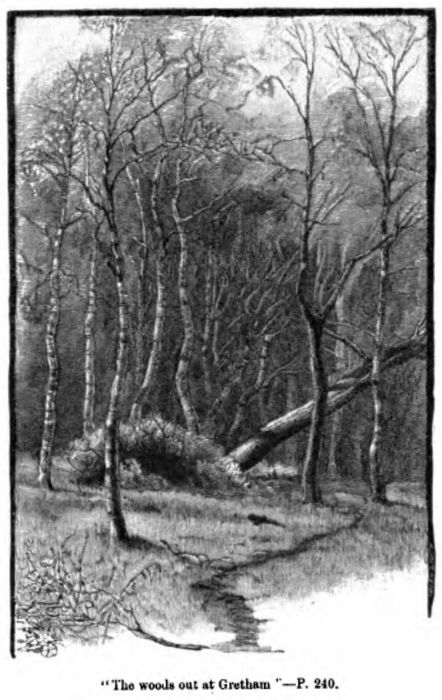
“Mamma, dear, sweet mamma, don’t speak like that,” said Jerry, softly stroking her cheek with his little thin hand. “I mustn’t grumble, I haven’t anything to grumble about, when I have you and Charlotte and papa and them all. And it isn’t grumbling to wish for the spring, is it? It is so nice even to think of the woods out at Gretham, with the primroses and violets all coming out. Oh, I do hope I shall be quite well by then, so that I can often walk out there on half-holidays!”
Mrs Waldron tried to answer cheerfully, but it was not easy. There was a cold misgiving at her heart, which she dared not, would not give words to. What would the sunshine or the spring-time, or primroses or violets, or anything sweet and lovely be to her, be to them all, without their quiet, patient little lame boy? How poorly do those understand a mother’s love who speak of one of several children as less precious than an only child! In a sense the intertwining bonds seem indeed but to make the whole affections stronger where a large circle is included by them.
Jerry seemed to have some notion of the thoughts in his mother’s mind.
“You are sure it would make me quite well to go to one of those warm places?” he said again, after a little pause.
“Dr Lewis thinks so,” said Mrs Waldron.
She had not meant to tell him so much, but she was feeling in a way, reckless.
“He must go abroad,” she said to herself. “He must and he shall. I will tell Edward so this evening, and at whatever cost and sacrifice it shall be done.”
And though the resolve seemed a wild one, though she had no faintest idea how it was to be carried out, her heart felt curiously lighter when she had made it.
Charlotte looked anxiously at Jerry when she came home from school that afternoon. He was lying asleep on his sofa, and her mother made a little sign not to disturb him as the girl opened the door.
“Is he no better to-day, mamma?” she whispered, as she sat down quietly beside her mother in the further corner of the room.
“Much as usual, I think,” Mrs Waldron replied, in the same tone. “Perhaps in himself he has been a little brighter. He was interested in what we were talking about.”
“Yes?” and Charlotte looked up inquiringly.
“Dr Lewis was here this morning. He examined Jerry thoroughly again, and still says the same thing. There is no actual disease, it is only weakness and want of tone that he speaks of. But those may be the beginning of anything! Charlotte, my dear, I have been feeling nearly desperate about Jerry.”
Then she went on to tell the girl all that the doctor had said—all that she had been thinking and resolving in her own mind.
She found full sympathy.
“Yes, mamma,” Charlotte agreed, “at all costs it must be done. But where should he go, and with whom, and how?”
“I don’t think it matters very specially where,” Mrs Waldron replied, “so long as it is a bright and sunny place. But how? Ah, I wish I knew! I am so ignorant of all those winter places—I don’t know which are the cheapest. I fancy they are all dear! Jerry has been writing to his friend, Miss Meredon, again. She wrote to him that she and her aunt are going abroad. I wish—I wonder if we could get any information from them.”
“Oh, no,” Charlotte interposed hastily; “don’t let us put ourselves under any more obligation to them. I don’t want to be horrid, mamma, but that girl seems to be always coming in my way. Even now that she has left school for a while, the next thing is we must hear of her going abroad for the winter like a princess, just when we’d give anything to be able to send Jerry.”
“Charlotte, my dear, you really are unreasonable,” said Mrs Waldron. “I thought you were grateful to this young girl, as we all are, for her kindness to Jerry. You told me yourself that you would never again say she was spoilt, or selfish, or any of the terrible things you had made up your mind she must be.”
“I know I did,” said Charlotte half penitently. “I did not mean to speak that way; but oh, mamma, it makes me wild to think about Jerry—he does look so white and thin?” She got up as she spoke, and went across the room on tip-toe, and stood for a moment looking down at the sleeping boy, her eyes filling with tears. “Mamma,” she said again as she returned to her mother, “we must manage it.”
But two or three days went by without any solution to the problem offering itself. Mr Waldron was exceedingly busy just at this time, and his wife shrank from saying much to him about what was constantly in her thoughts, till she had some at least possible plan to suggest. At last one night a sudden idea struck her.
“I will write to Mrs Knox,” she thought; “she may know of some place, some kind of pension, perhaps, or some doctor’s family, where Jerry would be well cared for, on pretty moderate terms. And once we hear of such a place we just must find the money somehow,”—and her mind ran over the few treasured pieces of silver plate in their possession,—“and Edward must take him there. Only will he not be terribly home-sick, alone among strangers?”
But Charlotte agreed that it seemed the only thing to do. The letter to Mrs Knox was written, and that evening after dinner Mr Waldron, his wife decided, must be told of all Dr Lewis had said. Dinner-time drew near, however, and instead of Mr Waldron there came a boy from his office with a note to say that he was not to be waited for; he had been detained unexpectedly, but would be home before long.
“How unlucky,” sighed Mrs Waldron. “I cannot send the letter without talking to your father, and he will come home so tired. Arthur,” for Arthur as well as Charlotte was in her confidence, “can you manage to keep Ted and Noble quiet in the school-room so that I can speak to your father uninterruptedly? Tell them he will be tired, and will like to be quiet.”
“All right, mother; I’ll see to it,” and a moment or two later certain ominous sounds from the school-room announced that Arthur was favouring his younger brothers with a specimen of certain strong measures he intended to resort to, should occasion arise, such as their “kicking up a row or making fools of themselves when mamma wanted to be quiet.”
He achieved his purpose, however. Mrs Waldron was alone, and the house was unusually silent when their father came in; he went straight to the drawing-room.
“You must be very tired, Edward,” said Mrs Waldron, starting up, “and hungry too. You have not had dinner.”
“Yes, thank you; I have had all I want,” he replied. “Tea then, or coffee?”
“In a little while, perhaps, but not just yet. I’m glad you are alone, Amy; I want to talk to you. How is Jerry to-day?”
“Much the same. I want to talk to you too—about Jerry—about what Dr Lewis has been saying,” Mrs Waldron began.
Her husband looked up sharply, and then she noticed that he was very pale, and as she mentioned the doctor’s name he started.
“Not anything worse? You are not trying to break anything dreadful to me, Amy,” he said hoarsely. “What a mockery it would all seem if it had come too late!” he added, as if speaking to himself, in a lower voice, though not so low as not to be heard by his wife. But she did not stop to ask the meaning of his words—she was too eager to set his anxiety at rest.
“Oh, no, no,” she said; “there is nothing new. It is only that Dr Lewis does so very earnestly advise—”
“His going abroad for some months,” interrupted Mr Waldron, his face clearing. “Yes, I know that. You spoke of it a little the other day; but I did not know till to-day that he urged it so very strongly.”
“Till to-day,” repeated Mrs Waldron, bewildered; “how did you hear it to-day? Has Dr Lewis been to see you?”
“No,” said her husband, with a rather peculiar smile, “it was not from him I heard it. Why did you not tell me how much he had said about it, Amy?”
“I have been going to do so all these last days,” she said; “but I waited to think over any feasible plan before saying more to you. I knew you were busy and worried. And even now I have but little to propose,” and she went on to tell of her letter to Mrs Knox, and her hopes of some advice or help in that quarter. Mr Waldron listened and again he smiled.
“I think I have a better plan than that to talk about,” he said. “You will scarcely believe me, Amy, when I tell you that I have this afternoon a letter from Lady Mildred Osbert offering to take charge of Jerry at Cannes for some weeks, or months—in fact for as long as it would be well for him to stay there.”
“From Lady Mildred!” Mrs Waldron ejaculated. “Edward! How ever did she know about his being ordered to go?”
“For that, and perhaps for the idea itself, we have to thank that young niece of hers, Charlotte’s schoolfellow. Jerry told us how kind the girl was to him, and in writing to her he must have said, quite innocently, of course, what Dr Lewis wished for him. They are leaving themselves for Cannes to-morrow; but Lady Mildred proposes that—that I should take Jerry to them next week.”
“You?” said Mrs Waldron, growing pale with suppressed anxiety and excitement. “Oh, Edward, you have more to tell me. What should she want to see you for, when she has always so completely ignored us as relations, unless there is some great change in some way.”
“Yes, Amy; there is a great change. That is what I wanted to tell you. The reason I did not come home earlier as usual to dinner was that I wanted to think it over quietly, to take it in as it were, before I tried to tell you about it. I have felt as if I were dreaming since I got the letters.”
“Letters?” half whispered Mrs Waldron; “were there more than one then? You said the one about Jerry was from Lady Mildred herself.”
“Yes; but it referred to another—a long and clear and most important letter from the London solicitors; it was in fact written by old Miller himself. I will show it you afterwards, but just now I want merely to tell you the drift of it all.”
“I think I can guess it,” said Mrs Waldron; “Lady Mildred has found out that she has been unfairly prejudiced against you, and she wants now to do something to help us. It will be a great boon, whatever it is—this offer for Jerry alone has lifted a terrible weight from my mind. But how has she changed so?”
“My dear Amy, don’t run on so fast. It is true that Lady Mildred has changed, but there is a great deal more to tell. You heard of Mr Osbert’s death, the General’s elder son? Well it appears that the second one, the only other—is dying. He has been in a hopeless state for years, but Lady Mildred did not know it. Mr Miller evidently thinks it was concealed purposely. She has had very little communication with the Osberts, and she has always thought of the sons as certain to succeed, as the General is an old man. But, do you see, Amy, as things are, there will be no Osbert to succeed?”
Mrs Waldron looked up bewilderedly.
“But it is all in Lady Mildred’s hands, is it not?” she said. “She can leave Silverthorns to her own family, can she not?”
“She can legally leave it to anybody, but she considers herself absolutely bound by her husband’s expressed wishes; and those were that it should never leave the family. Mr Miller says, that failing the Osberts, the Squire instructed Lady Mildred to look up all remoter connections; but till now, it does really seem very strange, she did not know, had no idea that we were the nearest. Mr Miller has been a good friend in the matter; he has, I suppose,” and here Mr Waldron laughed a little, “made inquiries about us and found all satisfactory. He has removed all Lady Mildred’s prejudices against me, and what I care for most, against my poor grandmother. And,”—Mr Waldron hesitated,—“Amy, it seems impossible, her intention therefore is now to make me the next proprietor of the old place.”
Mrs Waldron was silent for a moment.
“It seems too much,” he said again. “I don’t deserve it,” her husband went on.
This gave her power to speak.
“You not deserve it!” she exclaimed. “Oh, Edward, could a man deserve it more? How you have toiled, how you have kept up your spirits through all! If you said I didn’t deserve it—I have been often so faint-hearted and depressed. I don’t think—I don’t think we shall be spoilt by prosperity; we shall always know so well what a struggling life really is; it will be so delightful to help others. And oh, Edward! Arthur and Noble can go to college, and Ted into the army! That is to say if—will it make any difference at once?”
“Yes; Lady Mildred’s idea is that we should at once, at least very shortly, go to live on the estate, and that I should take charge of things. There is a very good house, at present occupied by one of the farmers, which can easily be made a capital house for us. It is so pretty, I remember it well; how delightful it will be to see you there, Amy! Lady Mildred, of course, will have the big house for her life, but she will be glad to feel free to come and go—the place has been growing a great charge to her. This is the rough sketch of her plan only. Of course there are numberless details to be arranged, and for these she wishes to see me. Then again, in case the General survives her he would have a right to some provision for his life, though it is very certain he would never wish now to be master of Silverthorns—he is quite broken down—and even had he inherited the place, he says he never would have come to live there. But Lady Mildred thinks it right to see him, and she wishes me to see him too. Miller says she is determined that none of the old prejudice against me shall be left; she is not a woman to do things by halves, once she has made up her mind. So, thanks to Miss Meredon, the idea of offering to take Jerry for a time fits in with my going to Cannes. And there we can talk all over.”
Mrs Waldron sat gazing into the fire.
“Edward,” she said, “I feel as if I were dreaming. Tell me—should we not let the poor children know this wonderful news at once?”
“Arthur and Charlotte, perhaps,—they deserve it,” he replied, getting up as he spoke to summon them.
And then again the whole had to be told.
Arthur’s pleasant face literally beamed with delight.
“Oh, papa!—oh, mother!” he exclaimed. “I can’t believe it. It is like a fairy tale. Why did you never tell us before that we were half Osberts?”
“I had meant to tell you before long,” said Mr Waldron; “but I had a horror of raising vague expectations. I knew too well what I had suffered from my false position as a child.”
“Yes,” said Arthur, thoughtfully; “I see.” And then, as a sudden idea struck him, “Fancy its coming after all through the female branch. Papa, the ghost will be laid.”
“Yes,” said Mr Waldron, smiling; “the ghost will be laid.”
“I bet you anything,”—Arthur went on—“I bet you anything, that the first thing old Jerry will say when he quite understands it, will be, ‘I’m so glad for the poor ghost.’”
“And if we never hear anything more of the ghost,” said Charlotte, speaking almost for the first time, “Jerry will be more than ever convinced that he did hear it. Papa,” she added with a little hesitation, “won’t Lady Mildred’s niece, Miss Meredon, be dreadfully disappointed when she knows all this? Perhaps she has heard all the talk about Lady Mildred’s intending to make her her heiress?”
“I hope not,” said Mr Waldron; “she has certainly hitherto shown a most friendly spirit to us. I should be grieved for our good fortune to cause disappointment to any one.”
“And then she must be so rich and grand already, I don’t suppose it would matter much to her,” said Charlotte.
“I don’t know about that: the Meredons are not a rich family by any means,” said Mr Waldron.
“I shall always love that girl,” said Mrs Waldron enthusiastically. “It is her doing about Jerry. Oh, Charlotte, darling! to think that all our poor little plans for sending him abroad are to be so delightfully replaced.”
“May I tell him, mamma?” said Charlotte eagerly; “to-morrow, not to-night, of course! I will take care not to startle him. But it would be so nice. And I will tell him how kind she has been—he is very fond of her,” she added with a slightly reluctant honesty.
“You must be fond of her too, my dear child,” said her father.
“I would like to be, at least I think so,” said Charlotte, and a vision rose before her of Claudia’s sweet, appealing face. “I have been horrid to her, I know,” she added to herself, “but she was rather queer at school.”
Chapter Sixteen.
Claudia’s Victory.
It seemed more like a dream than ever the next day.
“I can’t understand how I took it so quietly,” Charlotte thought to herself as she was dressing. “I suppose I was half stunned. I feel this morning as if I could just scream with delight. To think of Silverthorns coming to be our home—our own beautiful home. And how I have grumbled, and how jealous I have been of her. I don’t suppose she could ever quite understand—nobody who has never been poor themselves can. But, oh, I shall try to be kind and sympathising to others. It makes me feel as I used to when I was little, sometimes, when mamma saw I was cross and discontented, and instead of speaking sharply she would do some kind thing to make me feel happy. I wonder if God sometimes makes people good that way? For I know I haven’t deserved it, though dear papa, and mamma, and Arthur, and Jerry have. Oh, to think I may tell Jerry!”
The telling Jerry was more easily managed than she had anticipated. The boy’s instincts were sharpened by illness, and he had never forgotten the impression of his strange experiences at Silverthorns.
“I knew it, Charlotte,” he exclaimed, his blue eyes gleaming, “I knew it. When I was told that, about the ghost only coming to some of the family, and I remembered papa’s having heard it too, something seemed to tell me that we had to do with Silverthorns, and that more would come: I knew it, Charlotte. And she will be so pleased—Claudia, I mean.”
“You think she will be?” Charlotte said, rather surprised.
“Of course; I know she will be,” he said confidently; “you’ll see. And, of course, it will be ever so much nicer for her when she’s there, to have us living near. I’ll get to know her so well this winter, staying with them at that place. Oh, I say, I’m awfully glad to think of going there, and to know it won’t cost papa and mamma anything. I do so want to get well, Charlotte. I may say it now—I’ve really felt as if I never would lately, and almost as if I didn’t somehow much care.”
“Jerry!” Charlotte exclaimed.
“Yes; and that’s the queerest feeling of all. I suppose people have it when they’re really going to die, and that it’s a good thing. It must make it not so bad,” the boy went on.
“But you don’t feel that way now?” Charlotte asked anxiously.
“No, I feel quite different. It was partly, you know—” and Jerry hesitated—“the horrible feeling of being such a worry and such an expense to papa and mamma. I’ve thought often lately,” and the boy looked before him wistfully—“Charlotte,” he broke off, “isn’t it queer how things bring things to your mind? There’s a corner of one of the window-panes there that’s cracked; I see it every morning when I wake, and I always wonder when it will break away, and there’ll have to be a new pane. And then some proverb about cracked things lasting the longest comes into my mind, and I begin thinking perhaps I shall last an awfully long time, and then I worry about what a lot I shall cost them, and perhaps never be able to earn anything. And that’s what’s made me think sometimes lately that it would be better if I died.”
“But, Jerry,” Charlotte repeated; she spoke very quietly, for she was dreadfully afraid of beginning to cry; “you don’t need to feel that now. Now you can try to take advantage of all your chances for getting well without any worry to spoil it.”
“Yes; that’s what I’m so thankful for. Oh, I am so thankful!” he said fervently. “And, Charlotte,” he added very gravely, “there’s another thing I’m glad of, very glad of—the poor ghost will be able to rest now.”
Charlotte jumped up and clapped her hands. In her state of suppressed excitement one mood rapidly followed another, and it was better to laugh than to cry! But Jerry did not join in her merriment.
“Don’t, Charlotte,” he said, “I’m not joking. I’ve thought of him lately in the middle of the night when I couldn’t sleep, and I have felt so sorry for him. So sorry that if I had heard him again I would have spoken to him, I am sure. Can you fancy anything more terrible than to have to wander about,—never resting, with no home, and no power of doing any good, or undoing any harm,—for years and years and years? I think it’s quite as dreadful a punishment as any one could imagine, and I think, perhaps, if people believed in that kind of ghosts a little, it wouldn’t do them any harm.”
“But, supposing it’s true even,” said Charlotte, “the poor old thing’s at rest now.”
“Yes, I think so; I do hope he’ll be able to be at peace. For, after all, he has tried to tell how sorry he was, and to put things right,” said Jerry, with a sigh of relief.
He was weak and tired all that day, but it was scarcely, perhaps, to be wondered at. And the night following he slept soundly, and awoke refreshed; and when Dr Lewis saw him he expressed his conviction that the boy would be quite able to stand the journey in a week’s time. And it was with one anxiety the less on his overburdened professional shoulders that the good doctor left the Waldrons’ house that morning.
“It will save the boy, there is no doubt of it,” he said to himself. “And I know no one more deserving of good fortune than Waldron,” for Jerry’s father had thought it right to take his old friend to some extent into his confidence. “Dear me!—to think that he should be the next in the Silverthorns succession! I knew there was some connection, but I thought it a much more remote one.”
Surprises seemed to be the order of the day at Norfolk Terrace. Some day within the week, during which, preparations for Jerry’s journey went on busily, came a letter with a foreign post-mark, addressed to Charlotte. She started a little when she saw the writing.
“From Claudia Meredon,” she half whispered to herself; “she must be writing about Jerry, I suppose.”
But when she drew out the letter she saw that it was rather a long one. “The boys” were all about, and Charlotte knew that quiet was not to be expected in such circumstances. So she took the letter off to her own room to read in peace. The first few words surprised her.
“My dear Charlotte,” it began,—whereas hitherto Claudia’s one or two little notes had been formally addressed to “Dear Miss Waldron,”—“Aunt Mildred tells me I may call you by your first name as she says we must each think of the other as a sort of cousin now, so I hope you will not mind it. I have been longing to tell you how happy I was to hear all that has come to pass. It is, of course, very sad for General Osbert and his family, but they have never really seemed like relations to Aunt Mildred, and I do not think they have ever cared much about dear Silverthorns. It is delightful to think that it is going to be your father’s some day, and indeed it will seem like his almost at once, as Aunt Mildred is longing for him to take charge of things. I do so want to see you. I want to explain to you many things that I have never been able to tell. I know you must have thought me strange and unfriendly, and I want you to know how difficult it was. Aunt Mildred will not mind my telling you everything now. She wants us to be friends, and this brings me to what I want especially to write about.”
And then followed a proposal which made Charlotte’s face flush with pleasure, and her eyes beam.
“Oh, how delightful it would be,” she whispered. “Oh, will papa and mamma let me?”
And scarcely waiting to finish the letter she flew to her mother in such a state of breathless excitement that Mrs Waldron scarcely recognised her quiet self-contained little daughter.
“It is very, very kind,” she said, when she had read what Charlotte eagerly pointed out.
“And may I go? Do you think papa would let me?” she exclaimed. “Oh, mamma, I would work so hard at French and music. You see Claudia says I could join in her lessons.”
“We must wait till your father comes home,” said Mrs Waldron. “But I should like it for you very much indeed.”
Mr Waldron had had a letter too—from Lady Mildred herself. She wrote earnestly begging her newly acknowledged cousin to bring his daughter, as well as Jerry, for a two or three months’ visit to her at Cannes.
“I beg you not to let the expense be any difficulty,” she said. “There are long arrears due to you which I can, alas, only indirectly make up. And I am most anxious, peculiarly so, that my dear little niece, Claudia Meredon, should make friends with your children. She will be speaking of this plan in more detail in her letter to your daughter.”
So it was decided, and a few days later Mr Waldron, accompanied by his two children, started for Cannes.
Jerry bore the journey fairly well, but he was very exhausted before they got to its end, and his father was thankful that Charlotte was with them. Some little time of anxiety about him followed, and he required much care and nursing to bring him round, though the doctor assured them that there was no serious cause for alarm and much for congratulation that the move southwards had not been delayed.
“I doubt if he would have stood it a few weeks hence,” said he. “He was evidently losing instead of gaining strength every day in England. But you will see a great change in a little while.”
And in the mean time Jerry’s illness had one good effect. It drew the two girls together as nothing else could have done, and made the Waldrons feel more quickly and thoroughly at home with Lady Mildred than would otherwise have been the case. For her real kindness of heart came to the front at such times, and all her stiffness and “frighteningness” vanished.
One day—one lovely day, when it was difficult to believe it was only February, and that up there in the north in poor, grey old England, the rain and the fogs, or the snow, perhaps, were having it all their own way—a little group was enjoying the sunshine on one of the pleasant terrace walks above the sea. There was Jerry in an invalid-chair still, but looking as if he would soon be independent of anything of the kind, and beside him his two constant girl-attendants. Suddenly one of them started forward.
“Claudia,” she said, “I see papa; he is coming our way. Would you mind my running to meet him? I do so want to talk to him a little. He will so soon be going now, and I have scarcely seen him alone for so many days.”
“Of course,” Claudia replied. “Jerry and I will be perfectly happy. Don’t hurry, Charlotte.”
And in another minute Charlotte was beside her father, her two hands clasped on his arm.
“Well, my gipsy?” he said.
“Oh, papa, I have so much to say to you, and you are going so soon,” she replied.
“And I have been so busy since Jerry got better that my little girl is beginning to think I am forgetting her—is that your new trouble? Remember, I never agreed with you in the old days, when it seemed to you that if a good many ‘ifs’ were realised, there would be no such thing as a trouble left.”
“Papa,” said Charlotte reproachfully; “I’m not making troubles. I’m never going to do so—it would be too ungrateful. I suppose, as you say so, they must come some time or other, but just now, with Jerry better and all, it’s difficult to think of them. You haven’t any, have you, dear papa?”
“No, my dear; I have so much good to be grateful for, that, as you say, it is difficult to think of anything but sunshine. Everything is going on satisfactorily.”
“You have seen General Osbert again, papa, since the poor son’s death?” asked Charlotte; for the younger Mr Osbert had died a few days after the Waldrons arrived.
“Yes, poor old man; he and Lady Mildred are quite at one about everything, and of course I am only too glad to carry out her wishes. One thing I am glad of, and that is that I shall have plenty to do, Charlotte. I could not have endured a life of even comparative idleness.”
“Papa dear,” Charlotte went on, “it is most of all about Claudia I want to speak to you. I cannot tell you how I feel about her. Do you know, papa, I could not have been like her if our places had been reversed? Just think, she is really as happy for us as if we were her own family. I don’t believe it has once come into her mind, even the very least little bit, to wish any of it were coming to them.”
“She is a most sweet and noble girl,” said Mr Waldron.
“And, papa, to think of all she has told me—of how horribly I misunderstood her. To think how poor they are, and of her father’s blindness, and how they have struggled, and all that Claudia has done—not that she seems to think she has ever done anything. I sometimes can’t bear to think of the feelings I had,” and Charlotte’s honest eyes filled with tears.
“It was not altogether your fault,” said her father consolingly.
“Yes, papa; the horrid feelings were,” said Charlotte firmly. “But do you know it is Claudia’s happiness that makes me the most ashamed. She does not know—you said when you first understood about her, you remember, that it would hurt her for me to say too much about how I misjudged her?—she does not know half, and she thinks it was all because she dared not be frank and companionable at school. And she says she is so happy now that we are friends that it was the only thing wanting, and that she is the luckiest girl in the world. And after all, papa, the happiness she is so looking forward to, of working hard and earning, not many would think it a very delightful future, would they? Oh, papa, she is so good.”
“And so she is to be envied after all. Has she not ‘everything’ in the best sense, gipsy dear?”
“And we will always be her dearest friends, won’t we, papa? Afterwards—when—when Lady Mildred is dead, though I don’t like to speak of it, you will be rich enough to help them in many ways that they would not mind, won’t you, papa?”
Mr Waldron’s eyes looked very bright as he turned to Charlotte.
“I have been saying to Lady Mildred that nothing she can ask of me would give me greater pleasure than the being allowed now, or in the future, to be of use to the Meredons. Even were they less to be admired and respected than they are, it would be my place. And for Claudia herself, I am like you, Charlotte, I can’t say what I feel about her. I can only say I am most thankful for you to have such a friend.”
“I’m only dreadfully afraid, papa, that now I am learning to love her so, I shall not see much more of her. Lady Mildred is already talking of perhaps not returning to England all this year—of going to Germany in the summer, and back here again next winter. She says her mind is at peace about Silverthorns now, and that she means to have some holidays. And I mustn’t stay away from home very long, papa. Mamma could never manage the removal to Silverthorns, to the Old Lodge, I mean, without me,” she added importantly; “though I shall be dreadfully sorry to leave Claudia, and Lady Mildred too.”
“But think how very delightful it will be to be installed at the Old Lodge when they do come back, and to be able to give them a sort of welcome home.”
“And, papa, Claudia must always come to us for holidays even when she is settled at her own home, unless she is with Lady Mildred. And Jerry and I were planning we might ask one or two of the little ones to come with her each time, so that she wouldn’t feel she was leaving them all with her mother. Though Mrs Meredon isn’t quite so badly off as mamma, the next girl is past twelve, and our little girls are so tiny. But I think we must go on to Claudia and Jerry, papa. They want to see something of you, too, before you go. Oh, papa, how lovely it is here!”
And her eyes seemed as if they would never be tired of gazing at the perfection of sky and sea—at the blue glory one must leave our cold northern shores far behind ever to see.
“Yes,” said Mr Waldron, “it is very, very beautiful. But there are chilly and dull days here too, Charlotte. It is not always such sunshine and brilliance.”
“And even if it were, one would wish for home in a while,” the girl replied. “When the spring comes.”
“Yes—
”‘Oh, to be in England Now that April’s there,’” quoted her father. “Well, I hope we shall be all together there before April goes at any rate.”
And so saying they rejoined the others.
Charlotte’s misgivings that Lady Mildred would not return home for some length of time were realised. The old lady, who had not left England for many years, greatly enjoyed another taste of foreign travel, of which in her youth she had had much. Her mind was more at ease than it had been since her husband’s death as to the management of the property, and she also felt that she was conferring real and lasting benefits on Claudia. But some months before the two years during which her grand-niece was to be her charge, had expired, a sort of home-sickness came over them both.
“I think we won’t spend another Christmas away from England, Claudia,” she said rather suddenly one day. “I have a yearning to see Silverthorns again. And I know the Waldrons will never feel thoroughly at home till I am there myself. I must get to know Amy, and I want to see my pet Jerry again, and Charlotte too. And you will like to feel near your own people again, eh, my dear?”
“Yes, Aunt Mildred. It will be very nice, very nice,” said Claudia.
“Another Christmas if all’s well—if I’m still with you all, that’s to say,” pursued Lady Mildred, “we must have the house full. I must have you all over with me. But this year of course I must devote myself more particularly to Edward’s wife and children. And in that you will be a great help to me, you and Charlotte being already such friends.”
“She says—they say,” said Claudia laughing, “that I’m to spend all my holidays there—that’s to say when you don’t invite me. They are so very kind to me, really as if they were relations of my own. And some people in their place, Aunt Mildred, might not have been so cordial to me. I do think it’s delightful that your relations on the other side should be so nice. How beautifully things have turned out for us ever since that day you came down to Britton-Garnett! I do think I must have been born under a lucky star.”
And as she looked up with her sweet bright face and sunny eyes, Lady Mildred could not help agreeing with her.
“Yes, my dear, good child,” she said; “I think indeed some very beneficent fairy godmother must have been at your christening. You have some gifts you scarcely realise—the gift of bringing sunshine into other lives for one.”
“Auntie dear,” said Claudia, almost startled, for never was woman less demonstrative than Lady Mildred; “you are too good to me. I can do so little, and everybody is so kind to me. Auntie dear,” she went on timidly; “have I really brought a little sunshine to you?”
Lady Mildred smiled and stroked the girl’s soft hair as Claudia knelt down beside her; and though she did not speak, her niece was more than satisfied.
And no more was ever heard of the owls in the tower room at Silverthorns.
The End.
|
Chapter 1
| |
Chapter 2
| |
Chapter 3
| |
Chapter 4
| |
Chapter 5
| |
Chapter 6
| |
Chapter 7
| |
Chapter 8
| |
Chapter 9
| |
Chapter 10
| |
Chapter 11
| |
Chapter 12
| |
Chapter 13
| |
Chapter 14
| |
Chapter 15
| |
Chapter 16
|