Mrs Molesworth (continued 2)
Reading edition
“Some seem very nice indeed,” replied Miss Meredon. “The nicest looking of all, indeed she is rather a peculiarly pretty girl—I never saw any one quite like her, except—no, I don’t remember who it can be she reminds me of. She has quite dark brown hair, and a rather brown complexion, prettily brown, you know, and yet bright blue eyes. Her name is Charlotte Waldron.”
“Humph!” said Lady Mildred, “like her father.” She was not fond of Mr Waldron’s very “Osbert” characteristics, though she scarcely allowed even to herself that he had any traceable connection with the Silverthorns’ family.
“Oh, do you know them?” exclaimed Claudia, joyfully. “I felt sure when I saw her that you could not object—”
“Nonsense, Claudia,” Lady Mildred interrupted. “Her father is the Wortherham lawyer, or a Wortherham lawyer; no doubt there are plenty of them. And I should rather more object, if possible, to your making friends with this girl than with any others of the Wortherham misses. Mr Waldron has some little of the Silverthorns business, and I won’t have any gossiping about my affairs. You know the understanding on which you came to me?”
“Of course I do, dear aunt,” Claudia replied. “I wish you would not think because I say out to you whatever I feel that I have any idea of going against your wishes. I only meant that this girl looked so—it sounds rather vulgar to express it so, but it is the only way to say it—she looks so completely a lady that I thought you would probably not mind my knowing her a little better than the others. I fancy we shall be together in most of our lessons.”
“So much the worse,” thought Lady Mildred. “It is really very unlucky. I had no idea that Edward Waldron had a daughter old enough to be at school.”
But aloud, after a moment’s silence, she remarked with a slight touch of sarcasm in her tone,—
“So Miss Waldron also is a remarkably talented young person. She must be so if she is to rank with you, I suppose.”
“Aunt Mildred!” exclaimed Claudia. In her place most girls of her age, Charlotte Waldron certainly, would have burst into tears, or left the room in indignation, but this was fortunately not Claudia’s “way.” She forced back the momentary feeling of irritation, and answered brightly: “I know you are only teasing me, Aunt Mildred. You don’t really think me so dreadfully conceited?”
Even Lady Mildred could not help relaxing.
“You are very sweet-tempered, my dear, whatever else you are or are not, and it is the best of all gifts.” She sighed as she spoke.
“Now you will make me blush,” said Claudia merrily.
“And was this Miss Waldron very ‘kind,’ as you call it—very ‘empressée,’ and all the rest of it?” Lady Mildred asked.
“No-o,” answered Claudia, hesitating a little; “I can’t say that she was. Her manner is rather cold and reserved, but there is something very nice about her. I am sure she would be very nice if one knew her better. Perhaps she is shy. I think that gave me the feeling of wishing to be nice to her,” she added naïvely.
”‘Nice’ in the sense of being civil and courteous, of course you must be. I trust you are quite incapable of being otherwise. And it is the most ill-bred and vulgar idea to suppose that the right way of keeping people in their places is by being rude to them. That at once puts one beneath them. But, on the other hand, that is a very different thing from rushing into school-girl intimacies and bosom friendships, which I cannot have.”
“I know,” said Claudia, but though she sighed a little it was inaudibly. “Aunt Mildred,” she began again, half-timidly.
“Well?”
“Has the letter-bag gone? Can I possibly write to mamma to-night?”
“The post-bag has not gone, I believe,” said Lady Mildred. “No doubt you can write. I suppose you are in a fever to report the German master’s compliments—if you think it amiable and considerate to leave your old aunt alone when she has been alone all day, instead of making tea for her and sitting talking with her comfortably. But of course you very intellectual young ladies now-a-days think such small attentions to old people quite beneath you. You will prefer to write in your own room, I suppose—you have a fire. I will send you up some tea if you wish it. May I trouble you to ring the bell?” But as Claudia, without speaking, came forward to do so, Lady Mildred gave a little scream.
“Good gracious, child, you haven’t taken off your waterproof, and you have been standing beside me all this time with that soakingly wet cloak. If you are determined to kill yourself I object to your killing me too.”
“It is scarcely wet, aunt,” said Claudia, gently. “But I am very sorry all the same,” and she left the room as she spoke.
“Why do I constantly vex her?” she said to herself, despairingly. “I must be very stupid and clumsy. I do so want to please her, as papa and mamma said, not only because she is so good to us, but even more, because she is so lonely—poor Aunt Mildred. Of course my letter can wait till to-morrow. Oh, I know what I’ll do—I’ll be very quiet, and I’ll creep into the drawing-room behind Ball with the tea-tray, and Aunt Mildred will not know I’m there.”
And the smiles returned to Claudia’s face as she flew up-stairs and along the gallery to her room. Such a pretty, comfortable room as it was! A bright fire burned in the grate, her writing-table stood temptingly ready. Claudia would dearly have liked to have sat down there and then, to rejoice the home hearts with her good news. For they, as well as she, had been awaiting rather anxiously the results of her measuring her forces against those of her compeers. So much depended on the opinion of qualified and impartial judges as to her capacities; for, as her mother had said laughingly,—
“It may be the old story of our thinking our goose a swan, you know, dear.”
Yes, it would have been delightful to write off at once—a day sooner than they had been expecting to hear. But the very sight of her room confirmed the girl in not yielding to the temptation, for it recalled Lady Mildred’s constant though undemonstrative kindness.
“No doubt it was she who told the servants to keep the fire up for fear I should be cold,” she thought. “Dear me, how very good she is to me. How I wish mamma, and Lalage, and Alix, and all of them, for that matter, could see me here really like a little princess! But oh! how I wish I could send some of all this luxury to them—if I could but send dear mamma a fire in her room to-night! They won’t even be allowing themselves one in the drawing-room yet—they’ll all be sitting together in the study. Monday evening, poor papa’s holiday evening, as he calls it.”
All the time she was thus thinking she was taking off her things as fast as possible. In two minutes she was ready, her hair in order, the rebellious curls in their place, her collar, and all the little details of her dress fit to stand the scrutiny of even Lady Mildred’s sharp eyes; and as she flew down-stairs again, she met, as she had counted upon, the footman carrying in the tea-tray. The drawing-room was quite dark now, as far as light from outside was concerned, and Lady Mildred’s lamp left the corners in shadow. It was easy for Claudia to slip in unperceived, for her aunt was not expecting her, and did not even raise her eyes when the door opened, and the slight clatter that always accompanies cups and saucers announced the arrival of the tea.
“Tell Crossley to come in a few minutes to take Miss Meredon’s tea up-stairs,” said Lady Mildred, not knowing that the footman had already left the room, and that the movements she still heard were made by Claudia, safely ensconced behind the tray, and laughing quietly to herself. In another minute a voice close beside her made the old lady start.
“Aunt Mildred,” it said, “here is your tea.”
“Claudia!” she exclaimed. “I thought you were up-stairs in your room.”
“Selfishly writing my letter home! Oh, aunt! how could you think I would be so horrid! My letter will do very well to-morrow. I did not think it was so near tea-time when I thoughtlessly spoke of it. Do you think I don’t enjoy making tea for you?—almost the only thing I can do for you,” said the girl with a kind of affectionate reproach.
Lady Mildred was silent for a few moments. Then she said again, with a tone in her voice which was not often heard,—
“Claudia, you have the best of gifts—a sweet and sunny nature. Try to keep it, my dear.”
And Claudia felt rewarded.
She sat up in her own room that night for half-an-hour to write the home letter.
“Mamma would forgive my doing so for once,” she said to herself, “for I may not have time to-morrow. If I am really to do well at school I must work hard, and it will not be easy to do so, and yet to please Aunt Mildred. But I don’t mind how difficult it is—it will be worth it all to be able to help them at home without being separated. But oh, mamma, mamma! it is very hard to be away from you all!”
And Claudia leant her head on the table and burst into tears.
Chapter Six.
Claudia’s Home.
The Rectory at Britton-Garnett was one of those picturesque, tempting-looking, old cottage-like houses which, seen in summer by a passer-by, embowered in greenery and roses, remain in the memory as a sort of little earthly paradise. And its inhabitants, who loved it well in spite of its imperfections, would have accepted the verdict without much protest.
“It is a sweet little place,” Mrs Meredon would say, “and for rich people it might really be made almost perfect. But with these old houses, you see, there seems always something that wants doing or repairing. The roof is in a very bad state, and we are sometimes very much afraid that there is dry-rot in the old wainscoting.”
But the roof had to be patched up, and the incipient dry-rot had to be left to itself. Mr Meredon was far too poor to spend a shilling or even a sixpence that he could possibly help; and as the house was his own private property,—for what had been the Rectory was a very small house in the village, quite out of the question as the abode of a large family,—there was no one to appeal to for necessary repairs, as is usually the case. The Rectory proper was, in point of fact, large enough for the living, which was a very small one. Long ago now, when the Meredons first came there, shortly after their marriage, it had been with the idea that Britton-Garnett was but the stepping-stone to better things. But years had gone on without the better things coming, and now for some considerable time past the Rector had left off hoping that they ever would, or that he could be able conscientiously to accept them should they do so. For a terrible misfortune had come over him, literally to darken his life. He had grown almost totally blind.
It had been softened to some extent by a very slow and gradual approach. The sufferer himself, and his wife and elder children, had had time to prepare for it, and to make their account with it. There was even now a good hope that, with great care and prudence, the glimmering of sight that remained to him might be preserved; that the disease had, so to speak, done its worst. But adieu to all prospects of a more active career, of the wide-spread usefulness and distinction Mr Meredon had sometimes dreamt of, of “the better things,” in the practical sense even, that he had hoped for, when he and his light-hearted and talented but portionless young bride had, like so many thousands of others in fact and fiction, “so very imprudently married.” It was even harder in some ways than if the poor man had become completely blind, for then there would have been nothing more to fear, no use in precautions or care.
“Sometimes I could wish it had been so,” he once confessed to his wife. “I don’t know but that it would have been easier for you all.”
“Easier for you, perhaps, dear Basil,” said his wife. “But for us—oh no! Think what it would be for you not to know the children’s faces as they grow up, not to—”
“The loss would be mine in all that,” interrupted Mr Meredon.
“But, papa dear, it would be much more trouble for us if we had always to trot about with you, if you couldn’t go anywhere alone. We should have to get a little dog for you—or else I should have to leave off my lessons and my music and everything to go everywhere with you. No, you are a very selfish old man to wish to be quite blind,” said Claudia gaily. “I like you much better as you are.”
“I should not see how thin your mother’s face is growing. I can see that. The grey hairs—if they are coming—I can’t see as it is.”
“Nor can I—for the very good reason that there are none to see,” Claudia replied.
There were several children—all younger, considerably younger than Claudia, and the two next her were girls. So for the moment the family cares were not so heavy as in the future they would assuredly be, when the little boys’ schooling would have to be thought of, and college, or starting them in the world, beyond that again. Mr Meredon was the younger son of a large family. All that he could hope for had been done for him, and the seniors of his family were not rich men for their position.
“There is only Aunt Mildred,” he said more than once to his wife: “she is alone now, and she used to be fond of me.”
“Till you married,” said Mrs Meredon. “And—it is not exactly as if her money was Meredon money. She only has it for life, has she not?”
“Yes, only for her life; and she has, by her husband’s instructions, to keep up the place in such perfect order,—besides its being temporarily rather heavily burdened,—that she is really not very rich in ready money. General Osbert, the next owner, will be better off than she. Still, if she could see us, she might do something for the children. Anything would be something—even helping Claudia’s education.”
“That would be almost the best help she could give us,” said Mrs Meredon, eagerly. “Claudia is, I feel almost certain, unusually clever, and—you must not be vexed, Basil—an idea has struck me, her and me I should say, which would make things easier in the future. If Claudia could have the chance of some really first-rate teaching for a couple of years or so, she would then be eighteen, and she might turn her knowledge to account.”
“You mean by becoming a governess?” said Mr Meredon. “I doubt if Aunt Mildred would give any help towards such an end as that.”
“No, I don’t mean a governess in the ordinary way. But in the first place she could teach Lalage and Alix, and the boys too for some time to come. And besides that, I quite think she could have other pupils. Mrs Carteret has been speaking to me about her three girls—they are quite little still, you know, but in a year or two she will have to arrange something. Of course they are not the sort of people to send their girls to school; but, on the other hand, she is very averse to having a resident governess, as their house is already so full. She almost said to me that they would gladly pay as much as to a resident governess if they could meet with any lady in the neighbourhood who could undertake to give the children daily lessons. And Mr Fade, I rather fancy he would be delighted to join in any plan of the kind. He wants companionship for Sydney, and yet he would certainly never send her to school.”
“So we should have a select establishment for young ladies here,” said Mr Meredon, half amused, half incredulous. “I doubt if the Meredon prejudices would not be even more shocked by that than if Claudia became a governess.”
“I don’t think so; besides, we can’t afford to consider that. Our circumstances are very peculiar. We must do what we can for ourselves. And Claudia is a very exceptional girl.”
“Yes, I allow that. But would such a scheme not entail too much fatigue and work for her? She will be very young even at eighteen. And no teacher can teach everything.”
“No; but if it were arranged, Claudia and I are sure that both the Carterets and Mr Fade would join to have one or two masters once a week or so from Curwen. Claudia could superintend the preparation for them, and I, of course, would give what help I could if it were in this house. But most likely Mrs Carteret would wish the lessons to be there. There would be an advantage in that, for it would leave me more time for reading and writing with you.”
Mr Meredon was silent for a little.
“That would be a very great comfort,” he said at last, “and possibly even more. I can’t bear to take up your time just now, when you have all the teaching to do; but if you were freer I might perhaps go on with some of the work I had in hand when my eyes first got so bad. I could dictate to you,” and Mr Meredon looked up eagerly.
But the brighter expression soon faded.
“I am afraid,” he said, “we are reckoning on our chickens not only before they are hatched, but before we have got any eggs! In the first place, Mrs Carteret may not think Claudia fit for it. No man is a prophet in his own country—and you see they have known her since she was a baby.”
Mrs Meredon smiled.
“I will ask Mrs Carteret about it,” she said.
“And then the two years’ schooling for her. Where is that to come from?” he asked.
“Ah! that is the question. Well, Basil, I love our independence as much as you do, but with this prospect of steady and remunerative employment for her, I think we should swallow our false pride,—it surely would be false pride in such a case,—and ask Lady Mildred to help us. It would not be asking much, or burdening her for long.”
“I will think it over,” Mr Meredon replied, “and you perhaps had better sound Mrs Carteret, and, if you like, Mr Fade also.”
Perhaps Mrs Meredon had already done so. Be that as it may, the results were satisfactory. And a few days later the letter on which hung so many hopes was written by his wife to Mr Meredon’s dictation.
“And now,” she said wisely, “we have done what we could. Let us try in the mean time to put the matter off our minds.”
Their patience, however, was not so taxed as often happens in such cases. Nor was the answer what they had expected. How seldom, how strangely seldom are expectations realised! If ever in the long run things turn out as we have anticipated, the details of their fulfilment are so curiously unlike what we had pictured that we scarcely recognise them. Mrs Meredon and Claudia, the blind father too probably, had lain awake many an hour reading in imagination Lady Mildred’s reply. Would it be curt and cold, at once negativing all hopes, or condescendingly benevolent, or simply kind and kinswomanlike? The last, after so many years, and after too her expressed disapproval of her nephew’s marriage, was scarcely to be hoped for. It was none of all these, for in the shape of a letter her answer never came at all.
But one late August afternoon, about a month before the rainy Saturday when Charlotte and Gervais Waldron sat discussing the expected “new girl” at Miss Lloyd’s, the nameless heiress of Silverthorns, the old fly from Welby, the Britton-Garnett railway station, turned in at the Rectory gate and slowly crawled up the drive, already slushy with early autumn rains and want of rolling,—for carriage wheels were rare at the Meredons’—and in answer to the scared little maid’s information that “missus was at home,” a tall, upright old lady in deep mourning descended, and was ushered into the drawing-room. It was empty. She had time to look about her—to note the shabby furniture, the scrupulous care with which the carpet, faded though it was, was covered to protect it from the sun, the darned curtains looped up so as to show to the best advantage, the one real ornament of the room, a lovely nosegay of roses, freshly cut and fragrant, placed so as to make a bright spot where most wanted.
“Yes,” she decided, “there has been no exaggeration. They are very poor, but they are not degraded by it. They have kept up their self-respect.”
But she was scarcely prepared for the vision that met her eyes when, an instant later, the door opening made her turn round.
It was Claudia—Claudia in a little washed-out cotton frock, which might once have been blue, with snowy collar and cuffs, and a rosebud at her throat, her lovely hair fluttering over her forehead, her hazel eyes raised in half-perplexed inquiry,—Claudia, the most exquisite picture of girlhood that Lady Mildred’s gaze had ever rested on.
She half started forward to meet the child; but Claudia was absorbed in her commission, and did not notice it.
“Mamma is very sorry,” she began, “she—she has been busy writing for papa. She will be here in a moment. Can you kindly tell me your name—and is there anything I can say to mamma for you?”
“My dear, yes. Tell her not to hurry; I can wait. Tell her and your father that I am Aunt Mildred, and that I have come to spend the day with them if they will have me. And before you run away, can you not kiss your old aunt?”
“Of course, of course. I had no idea it was you, dear aunt,” said Claudia. “How strange of me not to guess, and we so often speak of you!”
“You knew that your mother, or perhaps I should say your father, wrote to me lately?” asked Lady Mildred.
“Yes,” said Claudia simply, “I knew all about it. And oh! I am so glad you have come. It is ever so much better than a letter.”
“She is lovely and good, I feel sure, and I should imagine clever, like her mother,” thought Lady Mildred. “What a pity it seems! But they are right—their idea is infinitely better than making a governess of such a girl, even if she were not a Meredon.”
And the result of that August day that Lady Mildred Osbert spent with her nephew and his family was, that a fortnight later Claudia Meredon was installed at Silverthorns.
Lady Mildred, when free from prejudice, could do things both kindly and sensibly, though nevertheless “in her own way.”
“I cannot do much for you,” she said to her nephew and his wife; “but I am heartily sorry for you,—I had no idea Basil’s eyes were so bad,—and what I can do I will. I am not so rich as is generally thought.”
“That I know,” Mr Meredon interrupted.
“Yes, I have always wished my own family to know it. As for the Osberts, time enough for them to know it when I am dead. It is no love for them that actuates me, but my determination to carry out my husband’s wishes. Thanks to this, the property will be all but unencumbered again when it leaves my hands. But this state of things cripples me. However, that is no one’s concern but my own. Of all things I hate gossip, so I keep my own counsel. Now as to Claudia—I should like, I tell you frankly, to get some personal gratification out of what I do. I have taken a great fancy to the child. Suppose you let me have her for the two years, instead of sending her away to school—I hate girls’ schools, by the way, even the best of them. But I have made inquiry, and I find that at Wortherham, near me, she could have excellent teaching. There is a sort of school there, a day school only, for some of the girls of the place, which is most highly spoken of—the principal of it, Miss Lloyd, is very capable herself, and has first-rate teachers to help her. If Claudia attended these classes she could live with me and cheer me up a little. I am very lonely. The two years may see the end of me—”
“Don’t say that, Aunt Mildred,” Mr Meredon interrupted; “it makes me feel as if I should have done something—written to you, or had some communication with you before. Has it been false pride?”
“Perhaps,” said Lady Mildred, bluntly. “I was not cordial about your marriage. You know it, my dear,” she added, turning to Mrs Meredon. “But it was no ill-feeling to you personally. And as things are—well, I see plainly that Basil could not have a better wife.”
“Thank you for saying so,” said Mrs Meredon simply.
“And let me say I think your plan for Claudia a delightful one.”
“But I have more to explain,” Lady Mildred went on. “I like doing things in my own way. If she comes to me it must not be in the guise of a poor relation. I won’t have all the old women in Wortherham,—dreadful radical place, that it is,—nor my county neighbours either, for that matter, gossiping about the poverty-stricken Meredons. Every one knows the Meredons are poor, but let us keep all details to ourselves. Claudia must not let any one at this school know anything about her motives for studying as hard as I am sure she will do; and she must not overdo it. She is well advanced already, you say?”
“I hope so,” said the mother. “But it is difficult to judge till one compares her with others. In French and German I am sure she will stand well.”
“Yes, I know she could not have had a better teacher than you.”
“I had unusual advantages myself certainly,” said Mrs Meredon, who had been many years in France and Germany.
Lady Mildred nodded her head without speaking. She had the greatest belief in her niece’s ability, and with good reason.
“Well, then,” she said, “we may consider it settled. I shall meet Claudia in London a week hence and see to a ‘trousseau’ for her, so give yourself no trouble on that head. You can explain to her all I have said. She will understand why I do not wish her to make friendships with any of the Wortherham girls whom she will be thrown with?”
“She will thoroughly understand that she is to follow your wishes in everything,” said Mrs Meredon. “But I must warn you that she is a very sociable child—the world seems to her a very much more delightful place than to most of us, for somehow she always manages to see the best side of people.”
“I hope she will see the best side of me then,” said Lady Mildred, rather grimly; “for I am a cantankerous old woman, and too old now to change. Claudia had better rub up her rose-coloured spectacles before she comes my way.”
And so, a fortnight later saw Lady Mildred’s grand-niece installed as the child of the house at Silverthorns, or, according to the local wiseacres who there, as everywhere, knew more of their neighbours’ affairs than the neighbours themselves, as “her ladyship’s adopted daughter, heiress to Silverthorns, and all the great accumulation of Osbert wealth.”
And certainly the girl’s sunny face and bright bearing gave some colour to Charlotte Waldron’s belief that Claudia Meredon was one of those favoured human beings “who have everything!”
Chapter Seven.
Misunderstood.
Claudia’s success in the German class was, as Charlotte had expected, but the first of her triumphs. She had natural abilities of the first order; she had been excellently and most carefully taught, with the close individual attention and sympathy which no teacher can give in such perfection as a parent, rare though the parents may be who are fitted to teach their own children! And joined to these advantages she had the most intense desire to learn, not merely from her innate love of knowledge, but from the even nobler motive of wishing to help her parents. So that it was not to be wondered at that by the end of the first week Miss Lloyd, who had been requested by Lady Mildred to let her know her opinion of her new pupil, sent to Silverthorns a most satisfactory report. For Miss Lloyd was honest to the backbone.
“Miss Meredon will make good progress, I have not the least doubt,” she wrote; “but it is only fair to say that the credit will be mostly due to her own application and to the teachers who have already so thoroughly taught her how to learn.”
Lady Mildred showed Claudia the letter.
“It will not make you vain,” she said, “for it is your mother it praises, not you. Miss Lloyd must be a straightforward sort of person; most schoolmistresses try to make out that their pupils know nothing when they go to them, and learn everything with them. Does she ever cross-question you as to who those teachers of yours were?”
“No,” said Claudia. “She asked me—or perhaps it was the French governess—if I had ever been abroad, and I said no, and then I think I said I had always been taught at home.”
“And the other pupils—do they seem inquisitive either?”
Claudia hesitated.
“I don’t think they are more so than any girls would be,” she said. “I—I don’t tell them anything, and of course they are accustomed to being very friendly and communicative with each other. I think they are all nice girls. The one I like the best—she and I do nearly all the same lessons—is Charlotte Waldron. At least I think I could like her if I knew her; but—”
“But what? You are not going to begin pestering me to let you make friends with her—her especially—I told you I don’t like her family,” said Lady Mildred irritably.
“Oh no, aunt, I was only going to say, I don’t know that she likes me,” said Claudia. “She is a very cold girl, except with some few whom she seems to know well.”
“Well, I hope you are cold to her in return,” replied her aunt, though as she glanced at the bright eager face beside her, it was difficult to associate it with the word.
“I try to do as you wish—as mamma explained,” said Claudia gently. “One thing I am sure of, Aunt Mildred, and that is that they all think me the very happiest girl in the world. And I almost think I am.”
She stooped to kiss Lady Mildred as she spoke, and then ran off.
She had not forgotten to bring her rose-coloured spectacles with her, that was certain. And it was well for her that it was so. There were difficulties in her present life that her mother had feared, but that Claudia herself in her innocence was as yet but very vaguely conscious of. She was scrupulously anxious to follow her aunt’s directions as to her behaviour to her companions, but to one so open-hearted and genial it was not easy to be only coldly courteous and always self-restrained. And the struggle gave her a curious sort of timidity and uncertainty of manner which was not perhaps without its charm, but made it difficult to understand her, even for those who cared to exercise any observation and discrimination.
“How do you like her, Charlotte? I do wish you would tell me?” asked Gueda Knox one day, about a month after Miss Meredon’s advent.
“I don’t want to speak about her; I hate gossip,” said Charlotte impatiently.
“I’m not asking you to gossip,” Gueda replied. “I really want to know. I think you might tell me; it can do no harm, as I am going away almost immediately,” for the Knox family, all excepting the vicar himself, were obliged to spend fully half the year in the south of France for Mrs Knox’s health.
“That’s just the worst of it,” Charlotte replied impatiently. “If you hadn’t been going away I would not have minded so much, but without you I shall be thrown more and more with her.”
“That of itself is a pretty plain answer to my question,” said Gueda composedly. “Of course it means you dislike her.”
“I have neither said nor implied that,” said Charlotte. “I suppose it is wrong to dislike any one whom you really don’t know any harm of,” she added.
“But one does so. Everybody in the world dislikes others without real reason. Don’t you remember Dr Fell?” said Gueda.
“No, it isn’t that,” said Charlotte. “I don’t dislike her without reason. If you weren’t going away, Gueda, I don’t know that I would tell you anything. I do dislike her, and my reason is that she is interfering with me in every way. Why did she come here at all? She is charming, and rich, and clever—why couldn’t she leave us all at peace? I am perfectly sick of her name—it is nothing but Miss Meredon this, Miss Meredon that, wherever you go. If you had heard Dr Lewis in the street yesterday, just raving about her.”
“And papa is nearly as bad,” said Gueda. “He saw her the other day when he called to see Miss Lloyd about the confirmation classes. I know how you must feel, Charlotte. Of course it is much the worst for you, because you have been so incontestably the head of us all till now. I can’t help feeling it for you, only—”
“Only what?”
“If it is a wrong feeling—if it is—don’t be angry, Charlotte—if it is jealousy,” said Gueda.
“I can’t help it. I’ve tried not to dislike her,” said Charlotte.
“Have you told your mother?—you say you tell her everything. That must be awfully nice. I dare scarcely tell mine anything now, she’s so ill,” said Gueda with a sigh.
“Poor Gueda,” said Charlotte with quiet sympathy. “Yes, I have talked about it to mamma; but she thinks it is best not to say much about it to any one. She says it impresses some kinds of wrong feelings more on our minds to talk about them. But how can I help it?—every moment it is something new. Did you bear this morning how mademoiselle went on about her French accent? And that duet that Mr Finlay will insist on our learning together! He said, Gueda, that I should take the bass because it was easier. Fancy that! he said it before her—Mr Finlay, who has always—”
She stopped.
“Yes, I know,” said Gueda. “It is very hard for you, Charlotte.”
“No one seems really to understand except Jerry, and now you,” said Charlotte. “I am afraid mamma is rather shocked at me. I suppose grown-up people don’t understand these feelings,” she added, little suspecting that the excess of her mother’s sympathy was what made her shrink from much expression of it, and she sighed deeply. “Why do some people have everything!” she went on, reverting to her old refrain. “It really does not seem fair. You know, Gueda, that it is a great deal because we are not rich that I want to get on very well. I may—don’t think me very conceited—but I may be able to write books when I am grown-up, or to do something of the kind.”
“But you are getting on well—as well as you could possibly wish.”
Charlotte shook her head.
“The teachers don’t all think so now” she replied, “and I am losing heart. Oh, Gueda, if I don’t get the German prize!”
“You must,” said Gueda. “I wish you could like her, Charlotte.”
“No, I don’t want to like her. I only wish she would go away—or still more, that she had never come. I don’t want to like her and she doesn’t want it either.”
Gueda looked rather perplexed.
“There’s something in that,” she said. “I don’t think it’s as much your fault as might seem at first. I can’t make her out. She seems good and nice altogether; but she must be selfish. She does seem so perfectly delighted when she is praised, and even put before you; and she does not really try to make friends with us. She might make you like her.”
Something was running in Gueda’s head about the best way of winning withheld liking or affection being to put oneself in the way of receiving a service from the one to be gained over. “If Miss Meredon cared to do it with Charlotte, she might. Charlotte is so generous: if she were appealed to by the girl to help her a little, she would respond at once, I know,” thought Gueda.
“No,” agreed Charlotte with some satisfaction, “she does not try. I don’t want her to, and I don’t try myself. All the same, I am glad she doesn’t.”
“Some of the girls say she is affected,” said Gueda.
“It doesn’t prevent them all from toadying her in a disgusting way,” said Charlotte, contemptuously.
“Not all of them,” said Gueda. “Some of them are nicer than that, and are too proud to make friends with a girl who never seems able to speak to any of us naturally. Some think her manners are very ‘distinguished,’ and what one must expect from Lady Mildred’s niece.”
“Vulgar snobs!” ejaculated Charlotte.
“What can you expect?” said Gueda. “Perhaps she is really more shy than anything else, and yet I hardly think so. Now and then she seems as if she was ready to burst out laughing, and as eager to chatter and talk nonsense as any of us. And sometimes she has a very curious look in her face, as if she were almost asking pardon of us all. And oh, Charlotte, how pretty she is!”
“You needn’t repeat that. I hear it about fifty times an hour. And she certainly does not look as if she were asking pardon of me every time she is put before me,” said Charlotte. “Now do let us talk of something else, Gueda. Don’t spoil the last few days before you go.”
And Claudia, in blissful ignorance of all the discussion she evoked, was just then writing home one of her happy, almost triumphant letters, telling of new laurels gained and satisfactory opinions everywhere. She spoke warmly of Lady Mildred’s kindness, and kept silence on her strangely trying temper, as well as on the difficulties she was growing more conscious of in her school-life.
“It would be wrong, distinctly wrong,” she said to herself, “to complain of Aunt Mildred. So there, I have no choice. But about school—I wonder if mamma could say anything to help me? No, I am afraid not. I must just not mind if I am disliked.”
So she told of nothing but of good. Still Mrs Meredon, being a remarkably clever and acute woman,—a woman too of somewhat more determined and less emotional calibre than Charlotte’s gentle, sympathising mother,—read between the lines of her daughter’s letter and saw some rocks ahead.
“She is determined to make the best of everything, and that is only right,” she said to herself. “But she is too one-sided in her way of looking at things just now. I must warn her.”
And this letter brought in return some counsel to Claudia, which she had afterwards even fuller reason to appreciate.
There happened one morning to be an unusually difficult exercise to do for the French teacher. It related to some of the rules of grammar which it was evident the pupils had not thoroughly taken in. “Mademoiselle” explained them again more fully and clearly, but at the end of her dissertation she looked round the circle of faces, with their varying expressions of intelligence, indifference, or bewilderment, and sighed.
“I don’t believe you understand yet, young ladies,” she said. “One or two of you may do so perhaps—Miss Meredon?”—and a smile from Claudia confirmed her hopefulness in that quarter,—“Miss Waldron?” but Charlotte’s face was resolutely bent upon her exercise-book. “She does not understand, and she is too proud to own it,” thought the governess, who, like some others of the teachers, was rather in awe of Charlotte. “Ah, well!—Miss Knox, you Fanny, and Isabel, I am almost sure—” she went on aloud.
“Oh, yes, indeed we understand quite well, even though we can’t quite say it,” said Isabel Lewis hastily. Anything to have done with the lesson and poor conscientious “mademoiselle,” who was so “tiresome” to-day. “You’ll see, mademoiselle, we shall do it all right when it comes up again in our exercises.”
“I am glad to hear it,” the French teacher replied in a peculiar tone. “You shall then give me the gratification you promise me without delay. For the next lesson you shall translate into French the following passage in English which I shall now dictate to you.”
And she proceeded to read aloud a passage of English especially composed to test the pupil’s comprehension of the knotty point.
Isabel made a grimace, but wrote it off readily enough. It was never her way to anticipate troubles. Who knew what might happen before the next lesson? She might discover some unanswerable reason for coaxing a holiday out of “papa”; she might have one of the convenient colds which were not much of a penance; the skies might fall! And she only laughed when her companions reproached her for having brought this extra piece of work upon them.
It was really a difficult exercise. It took all Claudia’s thorough knowledge of the rules to complete it correctly; and Charlotte, whose advantages of training in modern languages had been fewer, found herself in one or two details hopelessly baffled. But she kept this to herself; she did her best, and trusted there was not much wrong. Where was the use of speaking about it? There was no one who could help her. Mrs Waldron’s French was a long ago story; as to her companions, she was pretty sure that, with one exception, they were far more in the dark than herself. But it was new and painful to her to feel misgivings, and the very afternoon on which the exercises had to be given in she sat, her book open before her, trying to see what were her mistakes, and hoping to be able even then to correct them. She was so absorbed that she did not hear herself sigh, nor a light step approaching her in her corner.
“Miss Waldron,” said a voice she knew well, with an inflection of timidity which, till recently, happy, hearty Claudia’s tones had never known, “please forgive me for asking you if you are puzzled about that exercise. I found it very difficult, but ma—I was rather severely drilled in those rules, and I think I have got it right.”
“Indeed!” said Charlotte coldly.
“It is the last phrase that is so particularly worrying, is it not?—of course it is made to be so. Many French girls themselves would not know how to put it perfectly.”
Now it was this last phrase that to Charlotte had been a veritable ass’s bridge. And besides her ambition, she had the purer motive of a student’s real interest in thoroughly comprehending the working of the rule. As Claudia spoke she half unconsciously relaxed a little in her stiff, stand-off manner.
“Yes,” she said more frankly, “it is the last part that I cannot satisfy myself about.”
“Would you let me?—oh, please do,” said Claudia, her face flushing, her voice literally trembling with eagerness. “Might I just explain to you how I have said it to myself?” and without waiting for Charlotte’s half-hesitating reply, she ran on. In a few clear, terse sentences she put it before her listener, as all mademoiselle’s long explanations or the involved language of the grammar had failed to do. Charlotte forgot herself and her prejudices in real admiration and satisfaction.
“I see,” she exclaimed delightedly. “Miss Meredon, you have a real genius for teaching.”
“Do you really think so?” Claudia replied joyously. “And you are such a good judge. Oh, if you only—” but she checked herself sharply. “You do work so well and so hard, Miss Waldron.”
“Yes,” said Charlotte, with a slight return of the cold moodiness which Claudia had rarely seen behind, “I don’t spare myself. I care for nothing on earth so much as for getting on well with my lessons.”
There was an intensity in her tone which almost startled Claudia. At the same time it touched a sympathetic chord.
“Oh, do you really feel so?” she exclaimed impulsively. “I think I can understand it. You have probably some very great motive as well as love of learning. Are you perhaps looking forward to making some use of your education, of all you are learning, before long—to help your parents, perhaps?” Charlotte grew crimson.
“Do you mean to say, am I being educated to be a governess?” she said haughtily. “No, Miss Meredon, I am not I think before you make such remarks you might be at the trouble to understand whom you are talking to, though you seem to think yourself of a perfectly different world from every one about you. But even in our world there are such things as well-educated ladies who are not governesses, though the idea may be a new one to you.”
Claudia’s face grew pale with distress. She clasped her hands together, while her eyes filled with tears.
“Oh, dear, what have I done? How clumsy and rude I have been—just when I did so want to be the opposite,” for her poor little overture to Charlotte had been made in deference to a suggestion of her mother’s, that without infringing Lady Mildred’s rules, she might surely find some small opportunities of showing kindliness and sympathy to her companions. “I can only say I did not—oh, indeed I did not mean to offend you.”
“You have found us all sufficiently well-bred to ask you no questions, as you evidently wished to be considered a person apart; and I can’t therefore see that you, on your side, can expect any confidences,” Charlotte said icily.
“No, no, of course not,” said Claudia nervously. “But, Miss Waldron, you are forgetting—are you not going to correct that last paragraph?” for Charlotte was bundling up her books and preparing to stalk off with what she considered great dignity.
“Certainly not. I am not going to do anything so dishonourable as to correct my exercises by yours,” said Charlotte.
“Oh, it would not be that—you know it would not be that,” said Claudia sadly. “I know what is honourable and what is not so, though you will not allow that I am nice in any way, now that I have offended you. I only explained the rule to you as mademoiselle had already done. You have not seen my exercise—you don’t know what I have put.”
But it was in vain. And the result, as might have been expected, was that Claudia’s exercise was the only correct one, and that Charlotte received for the first time a sharp reprimand from the French teacher for inattention and indifference. And for the first time the praises that were lavished upon herself gave Claudia no pleasure, but instead, real pain and distress.
Chapter Eight.
The Old Legend.
“Jerry,” said Charlotte suddenly, a few days after Claudia’s unlucky attempt, “it’s no use. I’ve tried and I’ve tried to like that girl, at least to have no unkind feelings to her, and it’s no good. Gueda has gone now, and we—that girl and I—seem forced to be together in everything, and I just hate it.”
“But not her,” said Jerry; “it isn’t so bad if it’s only the—the thing, the way it’s come, that you hate, not the girl herself.”
“I don’t know. I’m afraid it’s much the same, and in a queer way I think I’d not mind so much if there were anything to hate about her, but there isn’t. Sometimes I could almost fancy myself liking her awfully, and that makes it worse.”
Charlotte stopped writing altogether and gazed out of the window on to the little deserted garden, looking blacker and drearier than ever in this grim December afternoon, with a sort of despair in her face.
“In spite of her being so horrid and impertinent to you the other day—asking if you were going to be a governess—you—papa’s daughter, and with four brothers to work for you, even supposing you hadn’t a father,” said Jerry wrathfully.
“But after all, perhaps, she didn’t mean it in any horrid, patronising way. I suppose very, very rich people really don’t understand, as papa said. Everybody that isn’t as rich as they seems all much about the same to them, I suppose.”
Jerry gave a sort of growl.
“Then very rich people must be very vulgar and ill-bred,” he said.
“I don’t know,” said Charlotte. “I try to say things to myself to make me feel nicer about her, but it seems no good. I don’t speak about it to mamma, because she told me it was better to fight down such feelings in my own heart, and I could see it really made her unhappy. She is so dreadfully sympathising, and so gentle herself. I’m afraid there’s something almost fierce in me that she can scarcely understand, Jerry. But there’s one thing that’s the worst of all. I think I could stand everything else if it wasn’t for the German prize. But if she gets that—oh, Jerry, it will break my heart. And next week Herr Märklestatter will be giving out the notes for the essay. You know the prize is for the essay.”
“Is she sure to try for it?”
“Oh, yes,” said Charlotte. “The other girls are already saying that it lies between her and me. I don’t know that she has heard or thought much about it—she doesn’t hear much of the talk that goes on, and I’m sure I listen to as little as I can: it can’t possibly matter to her as much as to me. It will be the first year I have not had it since Herr Märklestatter has taught us. Oh, Jerry, isn’t it hard?”
Jerry sat silent, as was his way when his feelings were deeply moved.
“It’s more than hard, it’s unbearable,” he said at last. “I don’t care how lovely she is, and all that,” he went on after a little pause, “she must be a horrid, stuck-up, selfish creature.”
“I don’t know,” said Charlotte, for the third time. “I don’t think I do think her so in the bottom of my heart, though sometimes it does seem like it. But independently of her interfering so with me, I don’t understand her; she never tells any of us a thing. We don’t know if she is an orphan, or if she has any one she cares for, or anything. And yet there is a look in her eyes—” and Charlotte’s own eyes took a softer expression, “a far-away look, almost sad;—though what can she have to be sad about?—she that has everything! I saw it one day when mamma was going to call for me, and I had to go half an hour sooner. I like awfully when mamma calls for me, you know, Jerry, and I suppose I looked pleased when I jumped up, and she was sitting beside me, and I was almost sure I heard her give a sort of little sob.”
“I thought you said her father and mother had died when she was a baby, and that she couldn’t remember them,” Jerry remarked.
“No; I only said very likely they had. It was at the beginning of our talking about it, when I was saying she had everything, and you tried to make out perhaps she wasn’t clever,—oh, my goodness, she not clever!—and that she was an orphan, and—and—I am sure there was another thing you said perhaps she had or hadn’t.”
“I know,” said Jerry: “it was that perhaps she had to sleep in the haunted room at Silverthorns. I just wish she had, and that the old ghost, the cruel old Osbert papa told us of, would appear to her and give her a jolly good fright, and teach her to feel for others a little.”
“She isn’t unfeeling in some ways,” said Charlotte. “One day one of the dogs at Silverthorns—it’s an old dog that belonged to Mr Osbert, and was always with him, and now it’s taken a great fancy to her, she says—well, it followed her, running after her pony-carriage all the way to school, and she never saw it till it panted up to the steps and lay there as if it was dying. She was in such a state—the tears running down her face. She ran in with it in her arms, and begged Miss Lloyd to let it stay; and when she went home again she had it packed up in a shawl beside her. Oh, she does look so nice when she drives off! The pony and everything are so perfect. But I must go on with my lessons.”
“So must I,” said Jerry; and for a few minutes there was silence.
Then Charlotte looked up again.
“Jerry,” she said, “I wish you hadn’t said that about the ghost at Silverthorns; it makes me shiver. Supposing, just supposing it did go to her, and that she was fearfully frightened, it would seem as if it was our fault somehow.”
“Rubbish!” said Jerry. “It wouldn’t be our fault; we’re not witches. Besides, it’s all nonsense.”
“I wonder if she has ever heard of it,” said Charlotte. “I wonder if there is any truth in it.”
And that evening, when all the family was together in the drawing-room, she spoke of it again to her father.
“Papa,” she said, “do you remember telling us of a haunted room at Silverthorns? Is it really true that there is one?”
“Perfectly true, as I told you, that there is a room which is said to be haunted,” replied her father. “But I personally can’t vouch for anything—at least for very little—beyond that.”
Five, nay six pairs of ears, for Mrs Waldron was nearly as eager on the subject as her children, pricked themselves up at this slight though incautious admission.
”‘Very little,’ you say, papa?” Charlotte exclaimed. “Oh, do tell us what the ‘very little’ is. Who told it you? Did you hear it at first hand, or how? and when? and from whom?”
Mr Waldron looked round him helplessly. He had spoken thoughtlessly, for even the wisest of us cannot be always on our guard. He had been half asleep, to tell the truth, when Charlotte first roused him by her question, for he had had a hard day’s work, and had driven some distance in the cold, and the arm-chair by the fire was very comfortable. He was wide awake now, however, and very much at a loss what to say. He had always, for reasons understood by his wife, avoided allusions to Silverthorns or the Osbert family; but of late, circumstances had seemed to force the place and its inhabitants upon the young Waldrons’ notice; and if he tried to back out of what he had said, it would probably only whet the interest and curiosity he deprecated. Better tell simply, and as it were unconsciously, what there was to tell.
“My dears, indeed there is nothing to interest you,” he said. “You know the legend—I told it to you the other day—that a long-ago Osbert had behaved very unjustly and cruelly, and that his spirit is supposed to be unable to rest on that account. Well—”
“But, papa,” said Arthur, “excuse me for interrupting you, but I was thinking over the story. I don’t see that it was so very wrong of him to wish the place to remain in the family—I mean to be owned by Osberts. It is the feeling everybody has.”
Mr Waldron smiled. It amused him to see the eldest son sentiment in Arthur, though he was heir to nothing.
“I quite agree with you,” he said. “But you forget—he was really cruel, for he left his poor daughter utterly penniless, in reality to gratify the spite he had always had against her. He carried his family pride a little too far, surely? Besides, he was a hard and unfeeling landlord.”
“Oh, yes,” said Arthur, “I forgot. Of course he might have looked after his daughter without letting the place go out of the family. And what did you say was the prophecy, papa?—that he should be punished by Silverthorns going in the female line after all, isn’t it? That has never come to pass yet—there have always been Osberts there?”
“Yes; the legend is, that the unhappy ghost shall never rest till the descendants of a daughter of the house own the place. It came near it once many years ago. The then squire had only a sister, and though the place had always been left in the male line, her grandson—her son was dead—would have succeeded, failing male Osberts, had not a cousin who had not been heard of for many years turned up. He was an old man, who had been most of his life in Australia, and he never came home to enjoy his inheritance. But he had two sons: one became the squire, and did very well for himself, by marrying Lady Mildred Meredon, for she is a clever and capable woman, and he would never have left things in as good order as he did but for her. The other son is now General Osbert.”
“But, papa,” said Charlotte, whose quick wits had taken in all he said, “if the place always goes to Osberts, it must be all nonsense about Lady Mildred’s intending to leave it to this Miss Meredon, as everybody will say.”
“I don’t know,” said her father. “There have been rumours that Lady Mildred is perfectly free to do as she likes with it, others that she is bound by some arrangement to leave it to the Osberts, and that in reality she only has it for her life. Either may be true. Mr Osbert and his brother were not very friendly, and General Osbert needed money. Perhaps he was satisfied with some help from his brother during his life. And the squire was much attached to his wife, and owed much to her. She may be able to leave it to her own people. But even if not, it doesn’t matter—General Osbert has sons,” he added, as if thinking aloud.
“Papa!” exclaimed Charlotte almost indignantly, “how can you say it doesn’t matter? I think it would be the most unfair, unnatural thing to leave an old, old place like that to people who have nothing to do with it.”
“What does it matter to us?” said Ted, with a yawn. “How can you excite yourself so about other people’s affairs, Charlotte?”
But Mr Waldron stroked Charlotte’s head as she sat near him.
“I think it is very unlikely,” he said. “Mr Osbert had plenty of family feeling.”
“What would the poor ghost do if it were so?” said Jerry, so seriously that they all laughed. “Just fancy his feelings! He’d lose all chance of ever resting in peace, poor thing—for if it once went away to another family, it could never go to the descendants of a woman Osbert. Lady Mildred isn’t an Osbert. No, you needn’t laugh—I’m very sorry for the ghost,” he persisted with real concern. “It makes me feel quite fidgety. I’d like to know about how it really is.”
“Perhaps Lady Mildred would ‘count’ as a woman Osbert,” said Noble. “It would seem fair, for the ghost would surely be punished enough by its going quite away from his family.”
“Nonsense, Noble,” said Jerry irritably. “Those relations of hers—that girl,” with an accent of bitter scorn, “is not even her descendant, supposing Lady Mildred did count.”
Charlotte glanced at him uneasily. It was so unlike Jerry to speak with such a tone of any one. And she knew whence came the prejudice he showed.
“We shall have to tell you not to excite yourself next, Jerry, my boy,” said his father. “I shall wish I had not told you anything about it.”
“But you haven’t, papa,” said Charlotte. “That’s to say, we have not heard a word about the ghost yet, I mean of what you ‘could personally vouch for.’ Do tell us.”
Mr Waldron glanced at his wife. “How am I to get out of it?” his eyes seemed to ask.
“Yes,” said Mrs Waldron calmly, chiming in with Charlotte; “do tell us.”
“I had heard this old story as a child,” he began. “You know I lived in this neighbourhood as a little boy, but I don’t think I ever told you that in the old days I have stayed at Silverthorns.”
“At Silverthorns itself!” repeated several voices. “No, indeed, papa, you never told us. How very funny it seems! Why didn’t you ever tell us?”
“It is more or less painful to me to recall that time,” Mr Waldron replied quietly. “They are all dead, all those I loved and cared for then. And it is so long ago now! But to go on with my story. I happened to be at Silverthorns one winter when the old squire was taken ill. I was there because my guardian who took charge of me was a very dear and old friend of his, and I was a quiet sort of child that did not give much trouble. I was left to run about the place as I liked, while the two old people were together. I slept in a little room in the oldest part of the house, which was the part the squire liked best, and he and his guests—unless there happened to be a great many in the house—inhabited it much more than the modern part. Do you remember, Charlotte and Jerry, noticing a sort of square tower at the end?”
“With a pointed window high up, and a pointed roof, almost like a kind of great pigeon-house? Oh, yes, I remember it,” said Charlotte.
“Well, that room, the room with that window, is the one that is said to be haunted. It is quite a small room. I believe the story is that the ghost frequents it because it was from that window that the unnatural father watched poor Bridget making her way down the avenue, when his cruelty had made her at last determine to leave him. I had heard something of the story, as I told you, but in the vaguest way. I knew nothing of the particulars; I could scarcely have understood them. I only knew that a long-ago Osbert, who was said to have been a cruel, bad man, was supposed to haunt the tower. But I had never heard that he came more at one time than another; I never knew that his spirit was supposed to be especially restless when any of the family were going to die; above all, when the place was going to change hands, I suppose. And I was not the least afraid of the tower—I often ran in and out of it in the daytime, though there was nothing particularly interesting in the little bare, deserted room. But one night, late evening rather,—I remember it so well, it had been a bitterly cold day, and the ground was covered with snow,—I was hanging about, rather at a loss what to do with myself, for my gr—guardian had been all day shut up with the squire, who was really very ill, when a sudden fancy seized me that I would like to go up to the tower room, as it is called, and look out on the moonlight glittering on the frost-covered trees of the avenue,—I have often, by the bye, had a fancy that the great thorns at the end of the drive seen in a frost must have given their name to the place,—for, like most children brought up alone, I was fanciful and dreamy. My own room, where a nice fire was blazing, was only one flight of steps lower than the tower room, but it looked out to the other side. I ran up-stairs and opened the tower room door—it was perfectly flooded with clear cold moonlight, except in one corner, away from the window, which struck me, as is always the case in moonlight shadows, as extraordinarily black and dark. But I did not mind, I had no thought of fear. I ran to the window and gazed out. It was as I expected—the trees were glistening like silver and diamonds, it seems to me that I have never seen anything so beautiful since. I remember saying to myself, ‘How I wish I could make some poetry about them to myself,’ when suddenly I was startled by the sound, or feeling—feeling as much as sound perhaps—of something moving in the dark corner, and before I had time to look round I heard distinctly three deep sighs or groans. Even had it been the daytime, and had there been nothing eerie about the place, the sound would have made me shiver—it seemed to tell of such profound, hopeless misery. Then in half a moment there rushed over me the remembrance of the story I had heard, and that I was here actually in the haunted room itself. I dashed through the doorway and down-stairs, and never stopped till I got to the servants’ regions; and then I was so near fainting and looked so wretched that my guardian had to be sent for, and all manner of soothing and comforting employed to bring me round. The whole thing might have been forgotten but for what followed. The poor old squire died that very night, and I think my guardian was glad he did not live till the next morning; for it brought the news of the reappearance of the Osbert cousins whom he had thought it his duty to try to trace, and so his sister’s grandson was cut out of his inheritance!”
“And the ghost had reason to be miserable then,” said Jerry. “Poor ghost.”
“Yes,” said Mr Waldron; “his hopes of his long penance ending must have been dashed to the ground.”
“Papa,” said Charlotte, in a rather awe-struck tone, “you speak as if you really believed it. Do you? Do you in the bottom of your heart believe it was the ghost?”
“No,” said Mr Waldron, smiling. “In the bottom of my heart I believe it was—” He stopped, and dropped his voice mysteriously.
“What?” exclaimed everybody.
“Owls!” said Mr Waldron in a thrilling whisper. Charlotte and Jerry, and one or two others, who afterwards denied it by the way, screamed.
“Oh, papa,” said Charlotte, “you did so frighten us.”
“Well, my dears, it shows how easily nerves can be worked up to be frightened at nothing. It was your own imaginations that frightened you.”
“Then do you mean,” said Noble, in rather a disappointed tone, “that there was nothing in it at all?”
Mr Waldron hesitated.
“I can’t say,” he replied. “I don’t know. I think it was a very curious coincidence that for the first time for long any colour should have been given to the old story, just when the squire died; and even more, just when the estates’ reverting to the female line was stopped. Of course this tells two ways—these circumstances following after made the incident impressive.”
“Yes,” said Noble; “I see.”
“But, papa,” said Charlotte, “didn’t you say that the poor grand—yes, grand-nephew, who so nearly had all, came off very badly? That needn’t have been—the squire might have left him something.”
“He meant to do so, but—it is a long story, and the legal details would only confuse you. The squire had left things, as was usual in the family, all to the male heir, and failing him, to the female line; indeed, there was not very much he could alienate from the property, and the new squire had debts when he came into it, though it is in a much better way now. But the old squire had never really anticipated that the Australian Osberts would turn up. There was room for a lawsuit about what he had meant for his sister and her grandson; and they could not fight it. So all went from them.”
“Did you know them—the sister and the boy?” asked Charlotte.
“Yes,” said Mr Waldron, and he sighed.
“If you had been grown-up then, couldn’t you have helped them now that you’re such a clever lawyer?” asked Jerry.
“Perhaps I might have been able to do something.”
“Only ‘perhaps’!” said Jerry reproachfully. “Papa, I think the law is horribly unjust. I hate it. I don’t want to be a lawyer. Fancy those poor things! And the poor, poor ghost.”
“Jerry’s got the ghost on the brain,” said Ted, teasingly.
“Mamma,” said Jerry plaintively, “do you hear Ted? Should he mock like that when papa’s been telling us the story seriously?”
“He’s only in fun; he didn’t mean to vex you, Jerry,” said Arthur, and Mrs Waldron looked at the boy somewhat anxiously. She did not like his half querulous tone. It reminded her of the time when he was suffering and feeble, and unable to bear ordinary nursery life. “Jerry can’t be well,” she said to herself; and she said it aloud to her husband when they were left alone.
“Do you think I should not have told that old story in his hearing?” he asked. “He is not usually nervous or excitable. I could not get out of telling it without seeming to make some mystery.”
“And you think it better not to tell them the whole?” asked his wife.
“I see no good purpose that it could serve,” he replied. “Not at present, at least, while they are young and impressionable. When they are older I have always intended that they should know, though it is most unlikely that it will ever affect us in any way.”
Chapter Nine.
The Tower Room.
If we knew more than is possible for us of what is passing at a distance, we should find so-called “coincidences” much more frequent then we have at present any idea of. That very evening when the family party in the Waldrons’ drawing-room was discussing the old legends of the Osberts, the conversation at Silverthorns between Lady Mildred and her niece had taken the same direction.
Claudia Meredon was not looking quite as bright and well as usual, and her aunt was becoming aware of it.
“You are so silent, child,” she said, half reproachfully, “and I like you to talk. It was one of your attractions to me at the first that you were not one of those stupid, half-bred, or not-at-all-bred girls who think good manners consist in staring at their elders, and never answering anything but ‘yes’ and ‘no’ and ‘if you please.’”
Claudia laughed.
“Then you don’t approve of—
”‘Hold up your head, turn out your toes, Speak when you’re spoken to, mend your clo’es,’
“Aunt Mildred?” she said.
“Yes, I do,” said the old lady, testily. “There’s a medium in all things. I detest impertinent little chatterboxes of children. But you’re not a child now, Claudia, and you have plenty of sense and knowledge in your head; you are quite able to talk very intelligently and agreeably if you choose. I only hope you are not going to turn into a book-worm. Are you working too hard?”
“No, aunt, I don’t think so,” said Claudia. “And you know how I enjoy my lessons. And the teaching at Miss Lloyd’s is really very interesting.”
But she gave a very little sigh as she spoke.
“Then what’s the matter with you? Are you ill? I hope you’re not home-sick. Or do any of those girls at Miss Lloyd’s annoy you in any way? You can’t deny that you’re not in your usual spirits.”
“No,” Claudia allowed, “I don’t feel quite as merry as usual; but I’m sure I’m not ill. And I’m not home-sick: if I were it would be too silly, when I know that what you are doing for me now is to make it possible for me to be a real help to them all at home. Perhaps, however, I am just a very little what people call home-sick. It isn’t the girls at school—I have very little to do with them.”
“All the better,” said Lady Mildred. “They cannot be much worth knowing.”
“Perhaps most of them are rather commonplace,” Claudia allowed. “There is only one—the one I told you of, Charlotte Waldron—who interests me at all particularly. But I don’t think I interest her, so though we do all the same lessons we scarcely ever speak to each other,” and again Claudia sighed a little.
“You are a goose,” said her aunt. “I believe you would like to make friends with the girl, and have her adoring you and gushing over you.”
Claudia could not help laughing a little. The idea of cold, proud Charlotte “gushing” over any one, over herself especially, struck her as curiously incongruous.
“She’s not at all that sort of girl, Aunt Mildred,” she said.
“So much the better,” repeated Lady Mildred again. “And whatever she is or is not,” she went on, “remember, Claudia, I gave you fair warning that I could have no school-girl friendships.”
“Of course, aunt, I know that quite well. Don’t think I am dreaming of such things. I really and truly don’t quite know why I don’t feel as bright as usual.”
It was as she said. She did not understand herself. Hitherto, though her life had been in some respects a hard and even anxious one,—for she had shared her parents’ cares and struggles, and the mode of living at the rectory had been of almost Spartan simplicity,—there had been no complications. Duties had been clear and straightforward, to Claudia’s genial and loving nature they had gone hand in hand with her greatest delight—that of serving and helping those about her. But now it was different: she felt herself misunderstood and disliked; she felt she was almost giving reason for this, and yet what could she do? The little kindnesses and overtures of good will which her mother had assured her she could find opportunity for without violating her aunt’s wishes had been rejected almost with scorn. She was beginning even faintly to suspect that her earnest and conscientious school-work, or rather the success with which it was crowned, was rousing against her feelings which she could not endure to suspect the existence of in the hearts of others. Yet here again what could she do? It must be right to do her best, to profit to the utmost by the opportunities her aunt’s goodness was giving her, even if it made her companions—though, to tell the truth, the word was in Claudia’s mind represented by Charlotte Waldron alone—dislike and almost hate her. Yet it was so painful, so new; and to have to face these problems for the first time, when for the first time she was alone and with no one to reprove or advise her, did seem hard. For it would have been impossible to express all her difficulties clearly in a letter, even had she not felt that it would be disloyal to her aunt, and cruel to the anxious hearts at home, to attempt to do so.
“No,” she repeated, as Lady Mildred did not at once speak, “I don’t quite know why I don’t feel as usual. Perhaps I am working a very little too hard. If it were summer I am sure I should be as merry as ever—it must be too lovely here in summer, Aunt Mildred.”
“But you get plenty of fresh air—it is a good drive into Wortherham and back every day?”
“Oh, yes, and I do so enjoy it. You don’t know how nice it is. I am so glad papa managed to teach me to drive quite as a child, though I never had anything like Kelpie to drive before. She is such a darling, Aunt Mildred.”
Claudia’s face lightened up with the thought of her pony’s perfections. Lady Mildred looked at her: she saw that when the momentary glow faded the girl seemed again pale and tired-looking.
“My dear, do you sleep well?” she said suddenly.
“Not very well, perhaps,” Claudia admitted.
“You’re not nervous—you don’t mind being alone?”
“Oh, no,” said Claudia; “I have always had a room alone since I was quite a little girl.”
“Yes; but at home, in a smaller house, where you all seem nearer together, it is different. You are quite sure you are not nervous here? Don’t be afraid of saying so if you are. No one has been telling you nonsense about this house being haunted, or anything of that kind?”
A light broke over Claudia’s face, which had been growing rather bewildered-looking.
“It is very kind of you to have thought of it, Aunt Mildred,” she said. “But indeed I am not the least nervous in that way. I have not slept well partly perhaps because I have been thinking so much about my lessons. I do so want to show them at home that I am doing well, and the examinations and all that will be coming on soon.”
“Don’t overdo it,” said Lady Mildred. “Your father and mother—and I, for that matter, if you care about me in that way—will be perfectly satisfied that you have done your best, without any prizes or things of that kind.”
“There is only one prize given at Christmas,” said Claudia, “and that is a German one that the master gives himself. I do dreadfully want to get it. Mamma is so anxious about my German.”
“Well, don’t overwork yourself, my dear. It would be very unlucky if you were to fall ill here—you that have always been so strong. It would reflect badly on me, or on Silverthorns, if you lost your rosy cheeks here. And to some of those girls, doubtless, prizes must seem matters of life or death—many of them probably are training for governesses.”
“Some perhaps may be,” said Claudia; “but I think many of them, particularly some of the least refined, are very rich. And I don’t think any of them can wish for this prize more than I do. Think what it would be to send it home! But, Aunt Mildred,” she went on in a different tone, “as you see I’m not nervous, I wish you would tell me more about the ghost.”
“I know very little about, the story, my dear,” Lady Mildred replied. “Mr Osbert, my husband, disliked its being spoken about, and I did not care to hear. There was some nonsense about the ghost being heard or seen at the time of the old squire’s death, which annoyed him. I fancy it was set about by some cousins who had no right to the place, but tried to claim something, and they wanted to make out that the ghost was on their side.”
“How very absurd, and how wrong!” said Claudia. “Yes; I know very little about it however. The ghost is supposed to be the spirit of a very ruffianly old Osbert, who cannot rest in peace.”
“He haunts the tower, doesn’t he?” said Claudia. “Old Peebles, the gardener, told me that, one day when I was asking him if there were owls’ nests up there. He said he ‘durstn’t take upon himself to disturb them, nor anything else about the tower, and he couldn’t say.’”
“Ah, yes, you see that explains it all. No doubt there have been owls there for generations, and if no one ever disturbs them they have it all their own way. We have never used those rooms much—the rooms in the lower part of the tower, I mean.”
“But they are dear old rooms. The one the servants call the chintz room might be made delightful. I should not be the least afraid to sleep there,” said Claudia.
“Well, if ever the house is more full of guests than it is likely to be in my time,” said Lady Mildred, who was particularly amiable to Claudia that evening, “you shall move there and try how you like it. We have often used it as a sort of bachelor’s room or odd spare room—it is easily put in order. And, by the bye, you would have no reason to fear the ghost, Claudia. He only appears to, or is heard by—I don’t know which—members of the Osbert family. They must have Osbert blood in them.”
“How disappointing!” Claudia replied. “I shouldn’t care so much for sleeping in the tower if that’s the case.”
“Well, go and sleep in your own bed now, and let me see you looking better to-morrow. It is getting late,” said her aunt.
Claudia kissed her and said good night, and went off. She felt brightened by the talk with Lady Mildred. It was not often that the old lady was so genial and sympathising.
“It was really very kind of her to think of my being perhaps frightened at night,” she said to herself. “Very few grown-up people think of such things. If it had been poor Alix now—I don’t believe Alix will ever be able to sleep in a room alone.”
She was up-stairs by this time on the large first floor landing, which at one side was separated from the oldest part of the house by a door and short passage. Claudia looked at the door.
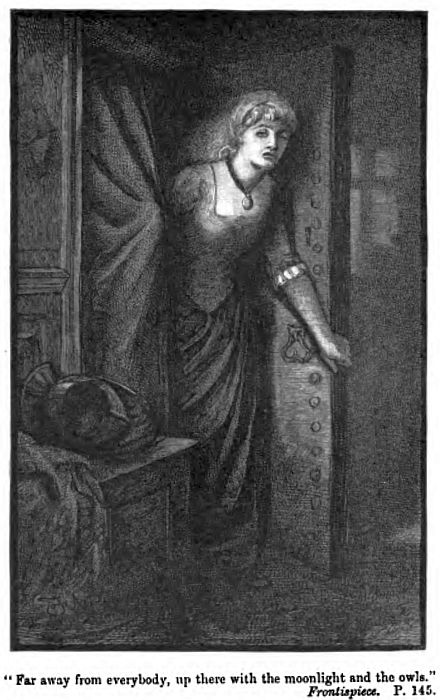
“I wonder now if I should be frightened if I slept in the tower,” she thought. “I hardly think so. Yet it must be queer and lonely up in that empty room. I wonder if it’s at all moonlight to-night. I’ve a great mind to run up just for a moment. I’ll leave this door open, so that if I am frightened I can rush down at once.”
And half laughing at her own temerity, Claudia opened the door, propping it ajar, for it was a spring one, by the aid of a chair on the wide landing, and running along the passage, began the ascent of the stairs. A few steps led to the chintz room, the door of which, imperfectly latched, was rattling somewhat uncannily, as if some one were trying to get out. But Claudia did not stop to close it—she hastened on, up the two flights, to the tower room itself. The staircase was dark save for some light from below, whence, too, came the sounds of the servants moving about and speaking in the distance, for on the ground floor of this wing were some of the offices in regular use. Claudia was not sorry to hear the murmurs—it seemed less “ghosty.” But as she opened the tower room door and entered, it banged to behind her—and then it seemed indeed as if she were far away from everybody, up there with the moonlight and the owls.
For moonlight there was, though of but a faint and fitful kind. There was frost about, though as yet no snow had fallen this winter, and the outside world looked grim and unadorned, as Claudia went to the window and gazed out. Except where here and there a ray of light fell on the evergreen trees in the avenue, all seemed black and lifeless.
“How dreary,” she thought with a little shudder. “I can’t help pitying the ghost if his rambles are restricted to this melancholy room. I wonder what he did that was so wicked,” and her eyes rested unconsciously on the drive, seen here and there in patches of light and dark through the trees, down which poor Bridget Osbert so many, many years ago had crept away, sobbing and broken-hearted. Claudia had never heard the story, Lady Mildred herself did not know it, but as the girl stood and gazed a strange sensation—not of fear, but of pity and sadness—came over her; and suddenly her thoughts reverted to the mention made by her aunt of the cousins who had been disappointed in their expectations, some of whom apparently had held the last communication on record with the Osbert ghost.
“Poor things,” she thought; “I feel sorry for them. Perhaps they had some rights, after all. It must be hard to part with an old place like this, or to give up hopes of having it if one has expected it. There is something strange in the thought of inhabiting the very spot where one’s ancestors have lived for hundreds of years. It must seem so full of them—permeated with their feelings and actions. If they had been bad people, I think it would seem rather dreadful. I wonder why I feel this so much to-night. Standing here, I could almost fancy I was an Osbert—and I feel certain some of them have been very unhappy. I do feel so sorry for I don’t know whom! If the ghost appeared I really think I should have courage to ask if I could do anything for him—poor ghost.”
But nothing appeared, no sound broke the perfect stillness, save a low rustling wail from the wind as it came round the corner. And the moonlight faded again, and Claudia turning from the window saw that the room was almost perfectly dark, and for the first time a slight feeling of fear came over her. She hurried to the door, and was glad to see as she opened it that the light from the large landing shone faintly up the stairs. And in another moment she had run down, and was smiling at her own trepidations in the cheerful security of her own room.
“I am not so very brave after all,” she said to herself.
And as might have been expected, her dreams that night were rather troubled. They seemed full of Charlotte Waldron and Herr Märklestatter, but the German teacher had the face of Charlotte’s father, whom Claudia had seen but once and for a moment only, the evening he came out to Silverthorns on business, and he seemed to be begging Claudia to do or not to do something. And just as she was consenting, and Mr Waldron was saying, “It is all for the poor ghost’s sake, you know,” she heard what she fancied in her dream to be a sudden cry of distress, and starting up in bed, found that the wind had got up, and was howling round the house, and that her door had blown open with a loud noise.
Still, though the next morning was dreary and stormy in the extreme, Claudia looked and felt better than for some time past.
“You don’t look as if ghosts or anything else had been troubling you,” said Lady Mildred; “but it is far too stormy for Kelpie this morning. You must have the brougham.”
And Claudia, while she thanked her, smiled to herself as she wondered what her aunt would have said to her visit to the tower room the night before.
Chapter Ten.
Jerry’s Appeal.
It was now very near Christmas, which promised this year to be what people are fond of calling “an old-fashioned” one. Snow had already fallen, though not to any great extent, though the weather-wise were prophesying that there was already more to come.
Charlotte Waldron was working harder at her lessons than she had ever yet done, and with a sort of feverish eagerness and absorption that was new to her. She tried to some extent to conceal her intense anxiety from her mother, perhaps because she felt instinctively that Mrs Waldron would have told her that she was allowing the spirit of ambition and emulation to carry her too far, especially if the whole of her motives had been confessed. She would not allow herself to acknowledge them; she would have been indignant with any one who had put them into words and faced her with their unloveliness. And as “none are so blind as those who won’t see,” she remained self-deceived, and in a sense self-satisfied.
Jerry, as usual, was her chief and indeed at this time her only confidant. And even to him she did not say very much, but what she did say startled and impressed the sensitive, sympathising nature of the boy far more than Charlotte had any idea of.
“Jerry,” she repeated more than once, “if I don’t get the German prize I shall go out of my mind. Oh, I don’t know what I shall do! I just can’t bear to think of it. It does not seem fair, does it, that I, who have been working steadily all these years, doing my best, my very best, should suddenly be set aside by a stranger, to whom the work is far easier than to me?—a girl who is far cleverer than I, who, for all I know—she never tells us anything—may have learnt her German in Germany and her French in France. That isn’t fair competition. If it had been Gueda now, or one of the girls who have learnt as I have done, with no greater advantages, I might have felt it in a way, but I should have known it was fair. And now it just isn’t.”
“No,” Jerry agreed, “it isn’t. But oh, Charlotte, it does make me so unhappy when you speak like that.”
“I’m very sorry,” said Charlotte penitently. “I’ll try not; but you see I’ve no one else to speak to. I told you I had left off talking to mamma about it all—and—there is just no one but you I can speak to.”
“No, don’t leave off speaking to me,” said Jerry; “I should know you were thinking of it all the same. Charlotte,” he went on after a little pause, “do you think the girl herself thinks it fair? You have said sometimes that you thought she was really a nice girl.”
“I can’t make her out,” Charlotte replied. “She seems nice, only she is dreadfully reserved. As for whether she thinks it fair or not, I don’t fancy she thinks about it in that way at all. I’m not sure that she really knows how clever she is. She does not seem conceited. But I suppose she wants very much to get the prize. The truth is, she should not be in the class or in any class; she should be by herself.”
“I wonder the teachers don’t see it,” said Jerry.
“Oh, they don’t care like that. They can’t make such particular distinctions. It’s only me it really matters to,” said Charlotte hopelessly. “I suppose everything’s unfair in this world. I don’t see how one is to help getting to have horrid feelings. What can it matter to her, so spoilt and rich and beautiful—what can one little school prize matter to her as it does to me?” and she groaned despairingly.
Jerry was silent for a few minutes; then he spoke again.
“Charlotte,” he said, “are you sure you won’t get it? It would be all the more of a triumph if you did win it over her.”
“But I know I can’t,” she said. “Of course I shall do my best; I should need to do that any way. Some of the girls are really very good German scholars. But she is more than good; she really writes it almost perfectly. Oh, no, I have no chance—the notes for the composition were given out last week. I have begun it, but I almost think I shall spill a bottle of ink over it, or let it catch fire accidentally at the last minute.”
“Oh, no, Charlotte, you won’t do that—promise me you won’t. Do, Charlotte!” Jerry entreated.
“Oh, well, I don’t suppose I shall. I should not like not to show Herr Märklestatter I had done my best. He used to be so kind to me; he is kind to me still. Only,” and again Charlotte sighed profoundly, “I really don’t know how I shall bear the disappointment and the mortification!”
Jerry did not sigh,—he was never very demonstrative,—but his face grew hard and stern, and he pressed his lips tightly together in a way that was usual with him when he was making up his mind to something.
For Jerry was making up his mind to something, and for the next few days he was silently thinking it over wondering how he was to carry it out.
The predicted snow fell but slightly. But the frost continued and increased. By the middle of December there was no talk among the boys on holiday afternoons but of skating. And one Tuesday evening, in the Waldrons’ school-room there was great excitement about an expedition to come off the following day, which was as usual a half-holiday.
“Can’t you come, Charlotte?” asked Arthur. For Charlotte, “one sister of her brothers,” was, as was natural, a great adept at skating, and even at less feminine recreations.
“I wish I could,” she said. “I’d give anything to go; but I can’t. It’s this extra work for the end of the term that I must get on with.”
It was the German composition. A glance at the expression of her face told it to Jerry.
“It’s out Gretham way, isn’t it?” he asked suddenly.
“Yes,” Arthur replied; “about half-a-mile past the first Silverthorns lodge.”
“I wish you’d take me, as Charlotte can’t go,” said Jerry.
The others looked at each other in surprise.
“You, Jerry!” they exclaimed. For the boy was of course debarred by his lameness from skating or any amusement of the kind, and he had often seemed to shrink from being a spectator of what he could not take part in, with a sensitiveness which his parents regretted.
“Yes, I. Why not?” he said. “Of course I would enjoy going more if Charlotte were to be there too, but I meant that I could have her seat in the dog-cart. I don’t take much room.”
“Are you to have the dog-cart?” asked Charlotte. “That is a piece of luck.”
“Yes; papa has to send Sam out that way with some message or papers or something, and he said we might get a lift. Of course we have to find our own way home, Jerry.”
“I know that. I can quite walk one way,” said the boy. “I needn’t stay long if I get too cold.”