ILLUSTRATIONS (continued 3)
Reading edition
"Did you?" says he, his eyes openin' wide. "Was it nice, riding in the freight car?"
"Never had so much fun out of a car ride since," says I. "But I was on the war path then. My outfit was a blank cartridge pistol, a scalpin' knife hooked from the kitchen, and a couple of nickel lib'ries that told all about Injun killin'. Don't lay out to slaughter any redskins, do you?"
He looks kind of weary, and shakes his head.
"Well, runnin' a trolley car has its good points, I s'pose," says I; "but I wouldn't tackle it for a year or so if I was you. You'd better give me your 'phone number, and I'll ring up the folks, so they won't be worryin' about you."
But say, this Gerald boy, alias Mr. Smith, don't fall for any smooth talk like that. He just sets his jaws hard and remarks, quiet like, "I guess I'd better be going."
"Where to?" says I.
"New Haven ought to be a good place to sell the machine," says he. "I can get a job there too."
At that I goes to pumpin' him some more, and he starts in to hand out the weirdest line of yarns I ever listened to. Maybe he wa'n't a very skilful liar, but he was a willin' one. Quick as I'd tangle him up on one story, he'd lie himself out and into another. He accounts for his not havin' any home in half a dozen different ways, sometimes killin' off his relations one by one, and then bunchin' 'em in a railroad wreck or an earthquake. But he sticks to Chicago as the place where he lived last, although the nearest he can get to the street number is by sayin' it was somewhere near Central Park.
"That happens to be in New York," says I.
"There are two in Chicago," says he.
"All right, Gerald," says I. "I give up. We'll let it go that you're playin' a lone hand; but before you start out again you'd better get a good night's rest here. What do you say?"
He didn't need much urgin'; so we runs the bubble around into the stable, and I tucks him and Togo away together in the spare bed.
"Who's the little lad?" says Dennis to me.
"For one thing," says I, "he's an honourary member of the Ananias Club. If I can dig up any more information between now and mornin', Dennis, I'll let you know."
First I calls up two or three village police stations along the line; but they hadn't had word of any stray kid.
"That's funny," thinks I. "If he'd lived down in Hester-st., there'd be four thousand cops huntin' him up by this time."
But it wa'n't my cue to do the frettin'; so I lets things rest as they are, only takin' a look at the kid before I turns in, to see that he was safe. And say, that one look gets me all broke up; for when I tiptoes in with the candle I finds that pink and white face of his all streaked up with cryin', and he has one arm around Togo, like he thought that terrier was all the friend he had left.
Gee! but that makes me feel mean! Why, if I'd known he was goin' to blubber himself to sleep that way, I'd hung around and cheered him up. He'd been so brash about this runaway business, though, that I never suspicioned he'd go to pieces the minute he was left alone. And they look different when they're asleep, don't they? I guess I must have put in the next two hours' wonderin' how it was that a nice, bright youngster like that should come to quit home. If he'd come from some tenement house, where it was a case of pop bein' on the island, and maw rushin' the can and usin' the poker on him, you wouldn't think anything of it. But here he has his bubble, and his high priced terrier, and things like that, and yet he does the skip. Well, there wa'n't any answer.
Not hearin' him stirrin' when I gets up in the mornin', I makes up my mind to let him snooze as long as he likes. So I has breakfast and goes out front with the mornin' papers. It got to be after nine o'clock, and I was just thinkin' of goin' up to see how he was gettin' on, when I sees a big green tourin' car come dashin' down into the park and turn into my front drive. There was a crowd in it; but, before I can get up, out flips a stunnin' lookin' bunch of dry goods, all veils and silk dust coat, and wants to know if I'm Shorty McCabe: which I says I am.
"Then you have my boy here, have you?" she shoots out. And, say, by the suspicious way she looks at me, you'd thought I'd been breakin' into some nursery. I'll admit she was a beaut, all right; but the hard look I gets from them big black eyes didn't win me for a cent.
"Maybe if I knew who you was, ma'am," says I, "we'd get along faster."
That don't soothe her a bit. She gives me one glare, and then whirls around and shouts to a couple of tough lookin' bruisers that was in the car.
"Quick!" she sings out. "Watch the rear and side doors. I'm sure he's here."
And the mugs pile out and proceed to plant themselves around the house.
"Sa-a-ay," says I, "this begins to look excitin'. Is it a raid, or what? Who are the husky boys?"
"Those men are in my employ," says she.
"Private sleut's?" says I.
"They are," says she, "and if you'll give up the boy without any trouble I will pay you just twice as much as you're getting to hide him. I'm going to have him, anyway."
"Well, well!" says I.
And say, maybe you can guess by that time I was feelin' like it was a warm day. If I'd had on a celluloid collar, it'd blown up. Inside of ten seconds, I've shucked my coat and am mixin' it with the plug that's guardin' the side door. The doin's was short and sweet. He's no sooner slumped down to feel what's happened to his jaw than No. 2 come up. He acts like he was ambitious to do damage, but the third punch leaves him on the grass. Then I takes each of 'em by the ear, leads 'em out to the road, and gives 'em a little leather farewell to help 'em get under way.
"Sorry to muss your hired help, ma'am," says I, comin' back to the front stoop; "but this is one place in the country where private detectives ain't wanted. And another thing, let's not have any more talk about me bein' paid. If there's anyone here belongin' to you, you can have him and welcome; but cut out the hold up business and the graft conversation. Now again, what's the name?"
She was so mad she was white around the lips; but she's one of the kind that knows when she's up against it, too. "I am Mrs. Rutgers Greene," says she.
"Oh, yes," says I. "From down on the point?"
"Mr. Greene lives at Orienta Point, I believe," says she.
Now that was plain enough, wa'n't it? You wouldn't think I'd need postin' on what they was sayin' at the clubs, after that. But these high life break-aways are so common you can't keep track of all of 'em, and she sprung it so offhand that I didn't more'n half tumble to what she meant.
"I suppose I may have Gerald now?" she goes on.
"Sure," says I. "I'll bring him down." And as I skips up the stairs I sings out, "Hey, Mr. Smith! Your maw's come for you!"
There was nothin' doin', though. I knocks on the door, and calls again. Next I goes in. And say, it wa'n't until I'd pawed over all the clothes, and looked under the bed and into the closet, that I could believe it. He must have got up at daylight, slipped down the back way in his stockin' feet, and skipped. The note on the wash stand clinches it. It was wrote kind of wobbly, and the spellin' was some streaked; but there wa'n't any mistakin' what he meant. He was sorry he had to tell so many whoppers, but he wa'n't ever goin' home any more, and he was much obliged for my tip about the freight car. Maybe my jaw didn't drop.
"Thick head!" says I, catchin' sight of myself in the bureau glass. "You would get humorous!"
When I goes back down stairs I find Mrs. Greene pacin' the porch. "Well?" says she.
I throws up my hands. "Skipped," says I.
"Do you mean to say he has gone?" she snaps.
"That's the size of it," says I.
"Then this is Rutgers's work. Oh, the beast!" and she begins stampin' her foot and bitin' her lips.
"That's where you're off," says I; "this is a case of——"
But just then another big bubble comes dashin' up, with four men in it, and the one that jumps out and joins us is the main stem of the fam'ly. I could see that by the way the lady turns her back on him. He's a clean cut, square jawed young feller, and by the narrow set of his eyes and the sandy colour of his hair you could guess he might be some obstinate when it came to an argument. But he begins calm enough.
"I'm Rutgers Greene," says he, "and at the police station they told me Gerald was here. I'll take charge of him, if you please."
"Have you brought a bunch of sleut's too?" says I.
He admits that he has.
"Then chase 'em off the grounds before I has another mental typhoon," says I. "Shoo 'em!"
"If they're not needed," says he, "and you object to——"
"I do," says I.
So he has his machine run out to the road again.
"Now," says I, "seein' as this is a family affair——"
"I beg pardon," puts in Greene; "but you hardly understand the situation. Mrs. Greene need not be consulted at all."
"I've as much right to Gerald as you have!" says she, her eyes snappin' like a trolley wheel on a wet night.
"We will allow the courts to decide that point," says he, real frosty.
"I don't want to butt in on any tender little domestic scene," says I; "but if I was you two I'd find the kid first. He's been gone since daylight."
"Gone!" says Greene. "Where?"
"There's no tellin' that," says I. "All I know is that when he left here he was headed for the railroad track, meanin' to jump a freight train and——"
"The railroad!" squeals Mrs. Greene. "Oh, he'll be killed! Oh, Gerald! Gerald!"
Greene don't say a word, but he turns the colour of a slice of Swiss cheese.
"Oh, what can we do?" says the lady, wringin' her hands.
"Any of them detectives of yours know the kid by sight?" says I.
They didn't. Neither did Greene's bunch. They was both fresh lots.
"Well," says I, "I'll own up that part of this is up to me, and I won't feel right until I've made a try to find him. I'm goin' to start now, and I don't know how long I'll be gone. From what I've seen I can guess that this cottage will be a little small for you two; but if you're anxious to hear the first returns, I'd advise you to stay right here. So long!"
And with that I grabs my hat and makes a dash out the back way, leavin' 'em standin' there back to back. I never tracked a runaway kid along a railroad, and I hadn't much notion of how to start; but I makes for the rock ballast just as though I had the plan all mapped out.
The first place I came across was a switch tower, and I hadn't chinned the operators three minutes before I gets on to the fact that an east bound freight usually passed there about six in the mornin', and generally stopped to drill on the siding just below. That was enough to send me down the track; but there wa'n't any traces of the kid.
"New Haven for me, then," says I, and by good luck I catches a local. Maybe that was a comfortable ride, watchin' out of the rear window for somethin' I was hopin' I wouldn't see! And when it was over I hunts up the yard master and finds the freight I was lookin' for was just about due.
"Expectin' a consignment?" says he.
"Yes," says I. "I'm a committee of one to receive a stray kid."
"Oh, that's it, eh?" says he. "We get 'em 'most every week. I'll see that you have a pass to overhaul the empties."
After I'd peeked into about a dozen box cars, and dug up nothin' more encouraging than a couple of boozy 'boes, I begun to think my calculations was all wrong. I was just slidin' another door shut when I notices a bundle of somethin' over in the far corner. I had half a mind not to climb in; for it didn't look like anything alive, but I takes a chance at it for luck, and the first thing I hears is a growl. The next minute I has Togo by the collar and the kid up on my arm. It was Gerald, all right, though he was that dirty and rumpled I hardly knew him.
He just groans and grabs hold of me like he was afraid I was goin' to get away. Why, the poor little cuss was so beat out and scared I couldn't get a word from him for half an hour. But after awhile I coaxed him to sit up on a stool and have a bite to eat, and when I've washed off some of the grime, and pulled out a few splinters from his hands, we gets a train back. First off I thought I'd 'phone Mr. and Mrs. Greene, but then I changes my mind. "Maybe it'll do 'em good to wait," thinks I.
We was half way back when Gerald looks up and says, "You won't take me home, will you?"
"What's the matter with home, kid?" says I.
"Well," says he, and I could see by the struggle he was havin' with his upper lip that it was comin' out hard, "mother says father isn't a nice man, and father says I mustn't believe what she says at all, and—and—I don't think I like either of them well enough to be their little boy any more. I don't like being stolen so often, either."
"Stolen!" says I.
"Yes," says he. "You see, when I'm with father, mother is always sending men to grab me up and take me off where she is. Then father sends men to get me back, and—and I don't believe I've got any real home any more. That's why I ran away. Wouldn't you?"
"Kid," says I, "I ain't got a word to say."
He was too tired and down in the mouth to do much conversing either. All he wants is to curl up with his head against my shoulder and go to sleep. After he wakes up from his nap he feels better, and when he finds we're goin' back to my place he gets quite chipper. All the way walkin' up from the station I tries to think of how it would be best to break the news to him about the grand household scrap that was due to be pulled off the minute we shows up. I couldn't do it, though, until we'd got clear to the house.
"Now, youngster," says I, "there's a little surprise on tap for you here, I guess. You walk up soft and peek through the door."
For a minute I thought maybe they'd cleared out, he was so still about it, so I steps up to rubber, too. And there's Mr. and Mrs. Rutgers Greene, sittin' on the sofa about as close as they could get, her weepin' damp streaks down his shirt front, and him pattin' her back hair gentle and lovin'.
"Turn off the sprayer!" says I. "Here's the kid!"
Well, we was all mixed up for the next few minutes. They hugs Gerald both to once, and then they hugs each other, and if I hadn't ducked just as I did I ain't sure what would have happened to me. When I comes back, half an hour later, all I needs is one glance to see that a lot of private sleut's and court lawyers is out of a job.
"Shorty," says Greene, givin' me the hearty grip, "I don't know how I'm ever goin' to——"
"Ah, lose it!" says I. "It was just by a fluke I got on the job, anyway. That's a great kid of yours, eh?"
Did I say anything about Primrose Park bein' a place where nothin' ever happened? Well, you can scratch that.
XI
WHEN ROSSITER CUT LOOSE
As a general thing I don't go much on looks, but I will say that I've seen handsomer specimens than Rossiter. He's got good height, and plenty of reach, with legs branchin' out just under his armpits—you know how them clothespin fellers are built—but when you finish out the combination with pop eyes and a couple of overhangin' front teeth— Well, what's the use? Rossy don't travel on his shape. He don't have to, with popper bossin' a couple of trunk lines.
When he first begun comin' to the Studio I sized him up for a soft boiled, and wondered how he could stray around town alone without havin' his shell cracked. Took me some time, too, before I fell to the fact that Rossy was wiser'n he looked; but at that he wa'n't no knowledge trust.
Just bein' good natured was Rossy's long suit. Course, he couldn't help grinnin'; his mouth is cut that way. There wa'n't any mistakin' the look in them wide set eyes of his, though. That was the real article, the genuine I'll-stand-for-anything kind. Say, you could spring any sort of a josh on Rossy, and he wouldn't squeal. He was one of your shy violets, too. Mostly he played a thinkin' part, and when he did talk, he didn't say much. After you got to know 'him real well, though, and was used to the way he looked, you couldn't help likin' Rossiter. I'd had both him and the old man as reg'lars for two or three months, and it's natural I was more or less chummy with them.
So when Rossy shows up here the other mornin' and shoves out his proposition to me, I don't think nothin' of it.
"Shorty," says he, kind of flushin' up, "I've got a favour to ask of you."
"You're welcome to use all I've got in the bank," says I.
"It isn't money," says he, growin' pinker.
"Oh!" says I, like I was a lot surprised. "Your usin' the touch preamble made me think it was. What's the go?"
"I—I can't tell you just now," says he; "but I'd like your assistance in a little affair, about eight o'clock this evening. Where can I find you?"
"Sounds mysterious," says I. "You ain't goin' up against any Canfield game; are you?"
"Oh, I assure——" he begins.
"That's enough," says I, and I names the particular spot I'll be decoratin' at that hour.
"You won't fail?" says he, anxious.
"Not unless an ambulance gets me," says I.
Well, I didn't go around battin' my head all the rest of the day, tryin' to think out what it was Rossiter had on the card. Somehow he ain't the kind you'd look for any hot stunts from. If I'd made a guess, maybe I'd said he wanted me to take him and a college chum down to a chop suey joint for an orgy on li-chee nuts an' weak tea.
So I wa'n't fidgetin' any that evenin', as I holds up the corner of 42nd-st., passin' the time of day with the Rounds, and watchin' the Harlem folks streak by to the roof gardens. Right on the tick a hansom fetches up at the curb, and I sees Rossiter givin' me the wig-wag to jump in.
"You're runnin' on sked," says I. "Where to now?"
"I think your Studio would be the best place," says he, "if you don't mind."
I said I didn't, and away we goes around the corner. As we does the turn I sees another cab make a wild dash to get in front, and, takin' a peek through the back window, I spots a second one followin'.
"Are we part of a procession?" says I, pointin' 'em out to him.
He only grins and looks kind of sheepish. "That's the regular thing nowadays," says he.
"What! Tin badgers?" says I.
He nods. "They made me rather nervous at first," he says; "but after I'd been shadowed for a week or so I got used to it, and lately I've got so I would feel lost without them. To-night, though, they're rather a nuisance. I thought you might help me to throw them off the track."
"But who set 'em on?" says I.
"Oh, it's father, I suppose," says he; not grouchy mind you, but kind of tired.
"Why, Rossy!" says I. "I didn't think you was the sort that called for P. D. reports."
"I'm not," says he. "That's just father's way, you know, when he suspects anything is going on that he hasn't been told about. He runs his business that way—has a big force looking into things all the time. And maybe some of them weren't busy; so he told them to look after me."
Well say! I've heard some tough things about the old man, but I never thought he'd carry a thing that far. Why, there ain't any more sportin' blood in Rossiter than you'd look for in a ribbon clerk. Outside of the little ladylike boxin' that he does with me, as a liver regulator, the most excitin' fad of his I ever heard of was collectin' picture postals.
Now, I generally fights shy of mixin' up in family affairs, but someway or other I just ached to take a hand in this. "Rossy," says I, "you're dead anxious to hand the lemon to them two sleut's; are you?"
He said he was.
"And your game's all on the straight after that, is it?" I says.
"'Pon my honour, it is," says he.
"Then count me in," says I. "I ain't never had any love for them sneak detectives, and here's where I gives 'em a whirl."
But say, they're a slippery bunch. They must have known just where we was headin', for by the time we lands on the sidewalk in front of the physical culture parlours, the man in the leadin' cab has jumped out and faded.
"He will be watching on the floor above," says Rossiter, "and the other one will stay below."
"That's the way they work it, eh?" says I. "Good! Come on in without lookin' around or lettin' 'em know you're on."
We goes up to the second floor and turns on the glim in the front office. Then I puts on a pair of gym. shoes, opens the door easy, and tiptoes down the stairs. He was just where I thought he'd be, coverin' up in the shade of the vestibule.
"Caught with the goods on!" says I, reachin' out and gettin' a good grip on his neck. "No you don't! No gun play in this!" and I gives his wrist a crack with my knuckles that puts his shootin' arm out of business.
"You're makin' a mistake," says he. "I'm a private detective."
"You're a third rate yegg," says I, "and you've been nipped tryin' to pinch a rubber door mat."
"Here's my badge," says he.
"Anybody can buy things like that at a hock shop," says I. "You come along up stairs till I see whether or no it's worth while ringin' up a cop."
He didn't want to visit, not a little bit, but I was behind, persuadin' him with my knee, and up he goes.
"Look at what the sneak thief business is comin' to," says I, standin' him under the bunch light where Rossiter could get a good look at him. He was a shifty eyed low brow that you wouldn't trust alone in a room with a hot quarter.
"My name is McGilty," says he.
"Even if it wa'n't, you could never prove an alibi with that face," says I.
"If this young gent'll 'phone to his father," he goes on, "he'll find that I'm all right."
"Don't you want us to call up Teddy at Oyster Bay? Or send for your old friend Bishop Potter? Ah, say, don't I look like I could buy fly paper without gettin' stuck? Sit down there and rest your face and hands."
With that I chucks him into a chair, grabs up a hunk of window cord that I has for the chest weights, and proceeds to do the bundle wrapping act on him. Course, he does a lot of talkin', tellin' of the things that'll happen to me if I don't let him go right off.
"I'll cheerfully pay all the expenses of a damage suit, or fines, Shorty," says Rossiter.
"Forget it!" says I. "There won't be anything of the sort. He's lettin' off a little hot air, that's all. Keep your eye on him while I goes after the other one."
I collared Number Two squattin' on the skylight stairs. For a minute or so he put up a nice little muss, but after I'd handed him a swift one on the jaw he forgot all about fightin' back.
"Attempted larceny of a tarred roof for yours," says I. "Come down till I give you the third degree."
He didn't have a word to say; just held onto his face and looked ugly. I tied him up same's I had the other and set 'em face to face, where they could see how pretty they looked. Then I led Rossiter down stairs.
"Now run along and enjoy yourself," says I. "That pair'll do no more sleut'in' for awhile. I'll keep 'em half an hour, anyway, before I throws 'em out in the street."
"I'm awfully obliged, Shorty," says he.
"Don't mention it," says I. "It's been a pleasure."'
That was no dream, either. Say, it did me most as much good as a trip to Coney, stringin' them trussed up keyhole gazers.
"Your names'll look nice in the paper," says I, "and when your cases come up at Special Sessions maybe your friends'll all have reserved seats. Sweet pair of pigeon toed junk collectors, you are!"
If they wa'n't sick of the trailin' business before I turned 'em loose, it wa'n't my fault. From the remarks they made as they went down the stairs I suspicioned they was some sore on me. But now and then I runs across folks that I'm kind of proud to have feel that way. Private detectives is in that class.
I was still on the grin, and thinkin' how real cute I'd been, when I hears heavy steps on the stairs, and in blows Rossiter's old man, short of breath and wall eyed.
"Where's he gone?" says he.
"Which one?" says I.
"Why, that fool boy of mine!" says the old man. "I've just had word that he was here less than an hour ago."
"You got a straight tip," says I.
"Well, where did he go from here?" says he.
"I'm a poor guesser," says I, "and he didn't leave any word; but if you was to ask my opinion, I'd say that most likely he was behavin' himself, wherever he was."
"Huh!" growls the old man. "That shows how little you know about him. He's off being married, probably to some yellow haired chorus girl; that's where he is!"
"What! Rossy?" says I.
Honest, I thought the old man must have gone batty; but when he tells me the whole yarn I begins to feel like I'd swallowed a foolish powder. Seems that Rossiter's mother had been noticin' symptoms in him for some time; but they hadn't nailed anything until that evenin', when the chump butler turns in a note that he shouldn't have let go of until next mornin'. It was from Rossiter, and says as how, by the time she reads that, he'll have gone and done it.
"But how do you figure out that he's picked a squab for his'n?" says I.
"Because they're the kind that would be most likely to trap a young chuckle head like Rossiter," says the old man. "It's what I've been afraid of for a long time. Who else would be likely to marry him? Come! you don't imagine I think he's an Apollo, just because he's my son, do you? And don't you suppose I've found out, in all these years, that he hasn't sense enough to pound sand? But I can't stay here. I've got to try and stop it, before it's too late. If you think you can be of any help, you can come along."
Well say, I didn't see how I'd fit into a hunt of that kind; and as for knowin' what to do, I hadn't a thought in my head just then; but seein' as how I'd butted in, it didn't seem no more'n right that I should stay with the game. So I tags along, and we climbs into the old man's electric cab.
"We'll go to Dr. Piecrust's first, and see if he's there," says he, "that being our church."
Well, he wa'n't. And they hadn't seen him at another minister's that the old man said Rossy knew.
"If she was an actorine," says I, "she'd be apt to steer him to the place where they has most of their splicin' done. Why not try there?"
"Good idea!" says he, and we lights out hot foot for the Little Church Around the Corner.
And say! Talk about your long shots! As we piles out what should I see but the carrotty topped night hawk that'd had Rossy and me for fares earlier in the evenin'.
"You're a winner," says I to the old man. "It's a case of waitin' at the church. Ten to one you'll find Rossiter inside."
It was a cinch. Rossy was the first one we saw as we got into the anteroom.
It wa'n't what you'd call a real affectionate meetin'. The old man steps up and eyes him for a minute, like a dyspeptic lookin' at a piece of overdone steak in a restaurant, and then he remarks: "What blasted nonsense is this, sir?"
"Why," says Rossy, shiftin' from one foot to the other, and grinnin' foolisher'n I ever saw him grin before—"why, I just thought I'd get married, that's all."
"That's all, eh?" says the old man, and you could have filed a saw with his voice. "Sort of a happy inspiration of the moment, was it?"
"Well," says Rossy, "not—not exactly that. I'd been thinking of it for some time, sir."
"The deuce you say!" says the old man.
"I—I didn't think you'd object," says Rossy.
"Wow!" says the old man. He'd been holdin' in a long spell, for him, but then he just boiled over. "See here, you young rascal!" says he. "What do you mean by talking that way to me? Didn't think I'd object! D'ye suppose I'm anxious to have all New York know that my son's been made a fool of? Think your mother and I are aching to have one of these bleached hair chorus girls in the family? Got her inside there, have you?"
"Yes, sir," says Rossy.
"Well, bring her out here!" says the old man. "I've got something to say to her."
"All right, sir," says Rossy. If there ever was a time for throwin' the hooks into a parent, it was then. But he's as good humoured and quiet about it as though he'd just been handed a piece of peach pie. "I'll bring her right out," says he.
When he comes in with the lady, the old man takes one look at her and almost loses his breath for good.
"Eunice May Ogden!" says he. "Why—why on earth didn't you say so before, Rossy?"
"Oh, hush!" says the lady. "Do be still! Can't you see that we're right in the middle of an elopement?"
Never saw Eunice May, did you? Well, that's what you miss by not travellin' around with the swells, same as me. I had seen her. And say, she's somethin' of a sight, too! She's a prize pumpkin, Eunice is. Maybe she's some less'n seven feet in her lisle threads, but she looks every inch of it; and when it comes to curves, she has Lillian Russell pared to a lamp post. She'd be a good enough looker if she wa'n't such a whale. As twins, she'd be a pair of beauts, but the way she stands, she's most too much of a good thing.
Pinckney says they call her the Ogden sinking fund among his crowd. I've heard 'em say that old man Ogden, who's a little, dried up runt of about five feet nothin', has never got over bein' surprised at the size Eunice has growed to. When she was about fourteen and weighed only a hundred and ninety odd, he and Mother Ogden figured a lot on marryin' Eunice into the House of Lords, like they did her sister, but they gave all that up when she topped the two hundred mark.
Standin' there with Rossiter, they loomed up like a dime museum couple; but they was lookin' happy, and gazin' at each other in that mushy way—you know how.
"Say," says Rossiter's old man, sizin' 'em up careful, "is it all true? Do you think as much of one another as all that?"
There wa'n't any need of their sayin' so; but Rossy speaks up prompt for the only time in his life. He told how they'd been spoons on each other for more'n a year, but hadn't dared let on because they was afraid of bein' kidded. It was the same way about gettin' married. Course, their bein' neighbours on the avenue, and all that, he must have known that the folks on either side wouldn't kick, but neither one of 'em had the nerve to stand for a big weddin', so they just made up their minds to slide off easy and have it all through before anyone had a chance to give 'em the jolly.
"But now that you've found it out," says Rossiter, "I suppose you'll want us to wait and——"
"Wait nothing!" says the old man, jammin' on his hat. "Don't you wait a minute on my account. Go ahead with your elopement. I'll clear out. I'll go up to the club and find Ogden, and when you have had the knot tied good and fast, you come home and receive a double barrelled blessing."
About that time the minister that they'd been waitin' for shows up, and before I knows it I've been rung in. Well, say, it was my first whack playin' back stop at a weddin', and perhaps I put up a punk performance; but inside of half an hour the job was done.
And of all the happy reunions I was ever lugged into, it was when Rossiter's folks and the Ogdens got together afterwards. They were so tickled to get them two freak left overs off their hands that they almost adopted me into both families, just for the little stunt I did in bilkin' them P. D.'s.
XII
TWO ROUNDS WITH SYLVIE
If it hadn't been for givin' Chester a show to make a gallery play, you wouldn't have caught me takin' a bite out of the quince, the way I did the other night. But say, when a young sport has spent the best part of a year learnin' swings and ducks and footwork, and when fancy boxin's about all the stunt he's got on his program, it's no more'n right he should give an exhibition, specially if that's what he aches to do. And Chester did have that kind of a longin'.
"Who are you plannin' to have in the audience, Chetty?" says I.
"Why," says he, "there'll be three or four of the fellows up, and maybe some of the crowd that mother's invited will drop in too."
"Miss Angelica likely to be in the bunch?" says I.
Chester pinks up at that and tries to make out he hadn't thought anything about Angelica's bein' there at all. But I'd heard a lot about this particular young lady, and when I sees the colour on Chester his plan was as clear as if the entries was posted on a board.
"All right, Chetty," says I; "have it any way you say. I'll be up early Saturday night."
So that's what I was doin' in the smoker on the five-nine, with my gym. suit and gaslight clothes in a kit bag up on the rack. Just as they shuts the gates and gives the word to pull out, in strolls the last man aboard and piles in alongside of me. I wouldn't have noticed him special if he hadn't squinted at the ticket I'd stuck in the seat back, and asked if I was goin' to get off at that station.
"I was thinkin' some of it when I paid my fare," says I.
"Ah!" says he, kind of gentle and blinkin' his eyes. "That is my station, too. Might I trouble you to remind me of the fact when we arrive?"
"Sure," says I; "I'll wake you up."
He gives me another blink, pulls a little readin' book out of his pocket, slumps down into the seat, and proceeds to act like he'd gone into a trance.
Say, I didn't need more'n one glimpse to size him up for a freak. The Angora haircut was tag enough—reg'lar Elbert Hubbard thatch he was wearin', all fluffy and wavy, and just clearin' his coat collar. That and the artist's necktie, not to mention the eye glasses with the tortoise shell rims, put him in the self advertisin' class without his sayin' a word.
Outside of the frills, he wa'n't a bad lookin' chap, and sizable enough for a 'longshoreman, only you could tell by the lily white hands and the long fingernails that him and toil never got within speakin' distance.
"Wonder what particular brand of mollycoddle he is?" thinks I.
Now there wa'n't any call for me to put him through the catechism, just because he was headed for the same town I was; but somehow I had an itch to take a rise out of him. So I leans over and gets a peek at the book.
"Readin' po'try, eh?" says I, swallowin' a grin.
"Beg pardon?" says he, kind of shakin' himself together. "Yes, this is poetry—Swinburne, you know," and he slumps down again as if he'd said all there was to say.
But when I starts out to be sociable you can't head me off that way. "Like it?" says I.
"Why, yes," says he, "very much, indeed. Don't you?"
He thought he had me corked there; but I comes right back at him. "Nix!" says I. "Swinny's stuff always hit me as bein' kind of punk."
"Really!" says he, liftin' his eyebrows. "Perhaps you have been unfortunate in your selections. Now take this, from the Anactoria——"
And say, I got what was comin' to me then. He tears off two or three yards of it, all about moonlight and stars and kissin' and lovin', and a lot of gush like that. Honest, it would give you an ache under your vest!
"There!" says he. "Isn't that beautiful imagery?"
"Maybe," says I. "Guess I never happened to light on that part before."
"But surely you are familiar with his Madonna Mia?" says he.
"That got past me too," says I.
"It's here," says he, speakin' up quick. "Wait. Ah, this is it!" and hanged if he don't give me another dose, with more love in it than you could get in a bushel of valentines, and about as much sense as if he'd been readin' the dictionary backwards. He does it well, though, just as if it all meant something; and me settin' there listenin' until I felt like I'd been doped.
"Say, I take it all back," says I when he lets up. "That Swinny chap maybe ain't quite up to Wallace Irwin; but he's got Ella Wheeler pushed through the ropes. I've got to see a friend in the baggage car, though, and if you'll let me climb out past I'll speak to the brakeman about puttin' you off where you belong."
"You're very kind," says he. "Regret you can't stay longer."
Was that a josh, or what? Anyway, I figures I'm gettin' off easy, for there was a lot more of that blamed book he might have pumped into me if I hadn't ducked.
"Never again!" says I to myself. "Next time I gets curious I'll keep my mouth shut."
I wa'n't takin' any chances of his holdin' me up on the station platform when we got off, either. I was the first man to swing from the steps, and I makes a bee line for the road leadin' out towards Chester's place, not stoppin' for a hack. Pretty soon who should come drivin' after me but Curlylocks. He still has his book open, though; so he gets by without spottin' me, and I draws a long breath.
By the time I'd hoofed over the two miles between the stations and where Chester lives I'd done a lot of breathin'. It was quite some of a place to get to, one of these new-model houses, that wears the plasterin' on the outside and has a roof made of fancy drain pipe. It's balanced right on the edge of the rocks, with the whole of Long Island sound for a back yard and more'n a dozen acres of private park between it and the road.
"Gee!" says I to Chester, "I should think this would be as lonesome as livin' in a lighthouse."
"Not with the mob that mother usually has around," says he.
If the attendance that night was a sample, I guess he was right; for the bunch that answers the dinner gong would have done credit to a summer hotel. Seems that Chester's old man had been a sour, unsociable old party in his day, keepin' the fam'ly shut up in a thirty-foot-front city house that was about as cheerful as a tomb, and havin' comp'ny to dinner reg'lar once a year.
But when he finally quit breathin', and the lawyers had pried the checkbook out of his grip, mother had sailed in to make up for lost time. It wasn't bridge and pink teas. She'd always had a hankerin' for minglin' with the high brows, and it was them she went gunnin' for,—anything from a college president down to lady novelists. Anybody that could paint a prize picture, or break into print in the thirty-five-cent magazines, or get his name up as havin' put the scoop net over a new germ, could win a week of first class board from her by just sendin' in his card.
But it was tough on Chester, havin' that kind of a gang around all the time, clutterin' up the front hall with their extension grips and droppin' polysyllables in the soup. Chetty's brow was a low cut. Maybe he had a full set of brains; but he hadn't ever had to work 'em overtime, and he didn't seem anxious to try. About all the heavy thinkin' he did was when he was orderin' lunch at the club. But he was a big, full blooded, good natured young feller, and with the exercise he got around to the Studio he kept in pretty good trim.
How he ever come to get stuck on a girl like Angelica, though, was more'n I could account for. She's one of these slim, big eyed, breathless, gushy sort of females; the kind that tends out on picture shows, and piano recitals, and Hindu lectures. Chester seems to have a bad case of it, though.
"Is she on hand to-night, Chetty?" says I.
He owns up that she was. "And say, Shorty," says he, "I want you to meet her. Come on, now. I've told her a lot about you."
"That bein' the case," says I, "here's where Angelica gets a treat," and we starts out to hunt for her, Chester's plan bein' to make me the excuse for the boxin' exhibit.
But Angelica didn't seem to be so easy to locate. First we strikes the music room, where a heavy weight gent lately come over from Warsaw is tearin' a thunder storm out of the southwest corner of the piano.
The room was full of folks; but nary sign of the girl with the eyes. Nor she wa'n't in the libr'y, where a four-eyed duck with a crop of rusty chin spinach was gassin' away about the sun spots, or something. Say, there was 'most any kind of brain stimulation you could name bein' handed out in diff'rent parts of that house; but Angelica wa'n't to any of 'em.
It was just by accident, as we was takin' a turn around one of the verandas facin' the water, that, we runs across a couple camped down in a corner seat under a big palm. The girl in pink radium silk was Angelica. And say, by moonlight she's a bunch' of honeysuckle! The other party was our old friend Curlylocks, and I has to grin at the easy way he has of pickin' out the best looker in sight and leadin' her off where she wouldn't have to listen to anybody but him. He has the po'try tap turned on full blast, and the girl is listenin' as pleased as if she had never heard anything better in her life.
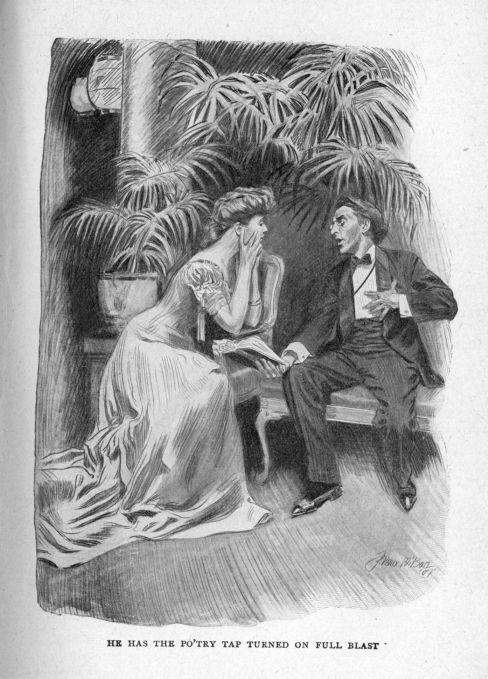
HE HAS THE PO'TRY TAP TURNED ON FULL BLAST
"Confound him!" says Chester under his breath. "He's here again, is he?"
"Looks like this part of the house was gettin' crowded, Chetty," says I. "Let's back out."
"Hanged if I do!" says he, and proceeds to do the butt in act about as gentle as a truck horse boltin' through a show window. "Oh, you're here, Angelica!" he growls out. "I've been hunting all over the shop for you."
"S-s-sh!" says Angelica, holding up one finger and him off with the other hand.
"Yes, I see," says Chester; "but——"
"Oh, please run away and don't bother!" says she. "That's a good boy, now Chester."
"Oh, darn!" says Chester.
That was the best he could do too, for they don't even wait to see us start. Angelica gives us a fine view of her back hair, and Mr. Curlylocks begins where he left off, and spiels away. It was a good deal the same kind of rot he had shoved at me on the train,—all about hearts and lovin' and so on,—only here he throws in business with the eyelashes, and seems to have pulled out the soft vocal stops.
Chester stands by for a minute, tryin' to look holes through 'em, and then he lets me lead him off.
"Now what do you think of that?" says he, makin' a face like he'd tasted something that had been too long in the can.
"Why," says I, "it's touchin', if true. Who's the home destroyer with the vaseline voice and the fuzzy nut?"
"He calls himself Sylvan Vickers," says Chester. "He's a poet—a sappy, slushy, milk and water poet. Writes stuff about birds and flowers and love, and goes around spouting it to women."
"Why," says I, "he peeled off a few strips for me, comin' up on the cars, and I though it was hot stuff."
"Honest, Shorty," says Chester, swallowin' the string as fast as I could unwind the ball, "you—you don't like that kind of guff, do you?"
"Oh, well," says I, "I don't wake up in the night and cry for it, and maybe I can worry along for the next century or so without hearin' any more; but he's sure found some one that does like it, eh?"
There's no sayin' but what Chester held himself in well; for if ever a man was entitled to a grouch, it was him. But he says mighty little, just walks off scowlin' and settin' his teeth hard. I knew what was good for that; so I hints that he round up his chappies and go down into the gym. to work it off.
Chetty's enthusiasm for mitt jugglin' has all petered out, though, and it's some time before I can make him see it my way. Then we has to find his crowd, that was scattered around in the different rooms, lonesome and tired; so it's late in the evenin' before we got under way.
Chester and me have had a round or so, and he'd just wore out one of his friends and was tryin' to tease somebody else to put 'em on, when I spots a rubber neck in the back of the hall.
"O-o-h, see who's here, Chetty!" says I, whisperin' over his shoulder.
It was our poet friend, that has had to give up Angelica to her maw. He's been strayin' around loose, and has wandered in through the gym. doors by luck. Now, Chester may not have any mighty intellect, but there's times when he can think as quick as the next one. He takes one glance at Curlylocks, and stiffens like a bird dog pointin' a partridge.
"Say," says he all excited, "do you suppose—could we get him to put them on?"
"Not if you showed you was so anxious as all that," says I.
"Then you ask him, Shorty," he whispers. "I'll give a hundred for just one round—two hundred."
"S-s-sh!" says I. "Take it easy."
Ever see an old lady tryin' to shoo a rooster into a fence corner, while the old man waited around the end of the woodshed with the axe? You know how gentle and easy the trick has to be worked? Well, that was me explainin' to Curlylocks how we was havin' a little exercise with the kid pillows,—oh, just a little harmless tappin' back and forth, so's we could sleep well afterwards,—and didn't he feel like tryin' it for a minute with Chester? Smooth! Some of that talk of mine would have greased an axle.
Sylvie, old boy, he blinks at me through his glasses, like a poll parrot sizin' up a firecracker that little Jimmy wants to hand him. He don't say anything, but he seems some interested. He reaches out for one of the mitts and pokes a finger into the paddin', lookin' it over as if it was some kind of a curiosity.
"Reg'lar swan's down cushions," says I.
"Like to have you try a round or so, Vickers," puts in Chester, as careless as he could. "Professor McCabe will show you how to put them on."
"Ah, really?" says Curlylocks. Then he has to step up and inspect Chester's frame up.
"That's the finish!" thinks I; for Chetty's a well built boy, good and bunchy around the shoulders, and when he peels down to a sleeveless jersey he looks 'most as wicked as Sharkey. But, just as we're expectin' Curlylocks to show how wise he was, he throws out a bluff that leaves us gaspin' for breath.
"Do you know," says he, "if I was in the mood for that sort of thing, I'd be charmed; but—er——"
"Oh, fudge!" says Chetty. "I expect you'd rather recite us some poetry?" And at that one of Chester's chums snickers right out. Sylvie flushes up like some one had slapped him on the wrist.
"Beg pardon," says he; "but I believe I will try it for a little while," and he holds out his paws for me to slip on the gloves.
"Better shed the parlour clothes," says I. "You're liable to get 'em dusty," which last tickles the audience a lot.
He didn't want to peel off even his Tuxedo; but jollies him into lettin' go of it, and partin' with his collar and white tie and eye glasses too. That was as far as he'd go, though.
Course, it was kind of a low down game to put up on anybody; but Curlylocks wa'n't outclassed any in height, nor much in weight; and, seein' as how he'd kind of laid himself open to something of the sort, I didn't feel as bad as I might. All the time, Chester was tryin' to keep the grin off his face, and his chums was most wearin' their elbows out nudgin' each other.
"Now," says I, when I've got Curlylocks ready for the slaughter, "what'll it be—two-minute rounds?"
"Quite satisfactory," says Sylvie; and Chetty nods.
"Then let 'er go!" says I, steppin' back.
One thing I've always coached Chester on, was openin' lively. It don't make any difference whether the mitts are hard or soft, whether it's a go to a finish or a private bout for fun, there's no sense in wastin' the first sixty seconds in stirrin' up the air. The thing to do is to bore in. And Chester didn't need any urgin'. He cuts loose with both bunches, landin' a right on the ribs and pokin' the left into the middle of Sylvie's map; so sudden that Mr. Poet heaves up a grunt way from his socks.
"Ah, string it out, Chetty," says I. "String it out, so's it'll last longer."
But he's like a hungry kid with a hokypoky sandwich,—he wants to take it all at one bite. And maybe if I'd been as much gone on Angelica as he was, and had been put on a siding for this moonlight po'try business, I'd been just as anxious. So he wades in again with as fine a set of half arm jolts as he has in stock.
By this time Sylvie has got his guard up proper, and is coverin' himself almost as good as if he knew how. He does it a little awkward; but somehow, Chetty couldn't seem to get through.
"Give him the cross hook!" sings out one of the boys.
Chester tries, but it didn't work. Then he springs another rush, and they goes around like a couple of pinwheels, with nothin' gettin' punished but the gloves.
"Time!" says I, and leads Sylvie over to a chair. He was puffin' some, but outside of that he was as good as new. "Good blockin', old man," says I. "You're doin' fine. Keep that up and you'll be all right."
"Think so?" says he, reachin' for the towel.
The second spasm starts off different. Curlylocks seems to be more awake than he was, and the first thing we knows he's fiddlin' for an openin' in the good old fashioned way.
"And there's where you lose out, son," thinks I.
I hadn't got through thinkin' before things begun happenin'. Sylvie seems to unlimber from the waist up, and his arms acted like he'd let out an extra link in 'em. Funny I hadn't noticed that reach of his before. For a second or so he only steps around Chester, shootin' out first one glove and then the other, and plantin' little love pats on different parts of him, as if he was locatin' the right spots.
Chetty don't like havin' his bumps felt of that way, and comes back with a left swing followed by an upper cut. They was both a little wild, and they didn't connect. That wa'n't the worst of it, though. Before he's through with that foolishness Sylvie turns them long arms of his into a rapid fire battery, and his mitts begin to touch up them spots he's picked out at the rate of about a hundred bull's eyes to the minute. It was bing—bing—bing—biff!—with Chetty's arms swingin' wide, and his block rockin', and his breath comin' short, and his knees gettin' as wabbly as a new boy speakin' a piece. Before I can call the round Curlylocks has put the steam into a jaw punch that sends Chester to the mat as hard as though he'd been dropped out of a window.
"Is—is it all over?" says Chetty when he comes to, a couple of minutes later.
"If you leave it to me," says I, "I should say it was; unless Mr. What's-his-name here wants to try that same bunch of tricks on me. How about it?"
"Much obliged, professor," says Curlylocks, givin' a last hitch to his white tie; "but I've seen you in the ring."
"Well," says I, "I've heard you recite po'try; so we're even. But say, you make a whole lot better showin' in my line than I would in yours, and if you ever need a backer in either, just call on me."
We shakes hands on that; and then Chetty comes to the front, man fashion, with his flipper out, too. That starts the reunion, and when I leaves 'em, about one A. M., the Scotch and ginger ale tide was runnin' out fast.
How about Angelica? Ah, say, next mornin' there shows up a younger, fresher, gushier one than she is, and inside of half an hour her and Curlylocks is close together on a bench, and he's got the little book out again. Angelica pines in the background for about three minutes before Chester comes around with the tourin' car, and the last I see of 'em they was snuggled up together in the back of the tonneau. So I guess Chetty don't need much sympathisin' with, even if he was passed a couple of lime drops.
XIII
GIVING BOMBAZOULA THE HOOK
Maybe I was tellin' you something about them two rockin' chair commodores from the yacht club, that I've got on my reg'lar list? They're some of Pinckney's crowd, you know, and that's just as good as sayin' they're more ornamental than useful. Anyway, that description's a close fit for Purdy.
First off I couldn't stand for Purdy at all. He's one of these natty, band box chappies, with straw coloured hair slicked down as smooth as if he'd just come up from a dive, and a costume that looks as if it might have been copied from a stained glass window. You've seen them symphonies in greys and browns, with everything matched up, from their shirt studs to their shoes buttons? Now, I don't mind a man's bein' a swell dresser—I've got a few hot vests myself—but this tryin' to be a Mr. Pastelle is runnin' the thing into the ground.
Purdy could stand all the improvin' the tailor could hand him, though. His eyes was popped just enough to give him a continual surprised look, and there was more or less of his face laid out in nose. Course, he wa'n't to blame for that; but just the same, when he gets to comin' to the Studio twice a week for glove work and the chest weights, I passes him over to Swifty Joe. Honest, I couldn't trust myself to hit around that nose proper. But Swifty uses him right. Them clothes of Purdy's had got Swifty goin', and he wouldn't have mussed him for a farm.
After I'd got used to seein' Purdy around, I didn't mind him so much myself. He seemed to be a well meanin', quiet, sisterly sort of a duck, one of the kind that fills in the corners at afternoon teas, and wears out three pairs of pumps every winter leadin' cotillions. You'll see his name figurin' in the society notes: how Mrs. Burgess Jones gave a dinner dance at Sherry's for the younger set, and the cotillion was led by Mr. Purdy Bligh. Say, how's that as a steady job for a grown man, eh?
But so long as I'm treated square by anyone, and they don't try to throw any lugs around where I am, I don't feel any call to let 'em in on my private thoughts. So Purdy and me gets along first rate; and the next thing I knows he's callin' me Shorty, and bein' as glad to see me when he comes in as if I was one of his old pals. How you goin' to dodge a thing of that kind? And then, 'fore I knows what's comin', I'm right in the middle of this Bombazoula business.
It wa'n't anything I butted into on purpose, now you can take that straight. It was this way: I was doin' my reg'lar afternoon stroll up the avenue, not payin' much attention to anything in particular, when a cab pulls up at the curb, and I looks around, to see Purdy leanin' over the apron and makin' motions at me with his cane.
"Hello!" says I. "Have they got you strapped in so you can't get out?"
"By Jove!" says he, "I never thought of jumping out, you know. Beg pardon, old man, for hailing you in that fashion, but——"
"Cut it!" says I. "I ain't so proud as all that. What's doin'?"
"It's rather a rummy go," says he; "but where can I buy some snakes?"
"That's rummy, all right," says I. "Have you tried sendin' him to an institute?"
"Sending who?" says he.
"Oh!" says I. "I figured this was a snake cure, throwin' a scare into somebody, that you was plannin'."
"Oh, dear, no," says Purdy. "They're for Valentine. He's fond of snakes, you know—can't get along without them. But they must be big ones—spotted, rings around them, and all that."
"Gee!" says I. "Vally's snake tastes must be educated 'way up! Guess you'll have to give in your order down at Lefty White's."
"And where is that?" says he.
"William street, near the bridge," says I. "Don't you know about Lefty's?"
Well, he didn't; hadn't ever been below the bridge on the East Side in his life; and wouldn't I please come along, if I could spare the time.
So I climbs in alongside Purdy and the cane, and off we goes down town, at the rate of a dollar 'n' a half an hour. I hadn't got out more'n two questions 'fore Purdy cuts loose with the story of his life.
"It's almost the same as asking me to choose my lot in the cemetery," says he, "this notion of Aunt Isabella's for sending me out to buy snakes."
"I thought it was Valentine they was for?" says I. "Where does he come in?"
That fetches us to Chapter One, which begins with Aunt Isabella. It seems that some time back, after she'd planted one hubby in Ohio and another in Greenwood, and had pinned 'em both down secure with cut granite slabs, aunty had let herself go for another try. This time she gets an Englishman. He couldn't have been very tough, to begin with, for he didn't last long. Neither did a brother of his; although you couldn't lay that up against Isabella, as brother in law got himself run over by a train. About all he left was a couple of fourteen-year-old youngsters stranded in a boarding school. That was Purdy and Valentine, and they was only half brothers at that, with nobody that they could look up to for anything more substantial than sympathy. So it was up to the step-aunt to do the rescue act.
Well, Isabella has accumulated all kinds of dough; but she figures out that the whole of one half brother was about all she wanted as a souvenir to take home from dear old England. She looks the two of 'em over for a day, tryin' to decide which to take, and then Purdy's 'lasses coloured hair wins out against Valentine's brick dust bangs. She finds a job for Vally, a place where he can almost earn a livin', gives him a nice new prayer book and her blessin', and cuts him adrift in the fog. Then she grabs Purdy by the hand and catches the next boat for New York.
From then on it's all to the downy for Purdy, barrin' the fact that the old girl's more or less tryin' to the nerves. She buys herself a double breasted house just off the avenue, gives Purdy the best there is goin', and encourages him to be as ladylike as he knows how.
And say, what would you expect? I'd hate to think of what I'd be now if I'd been brought up on a course of dancin' school, music lessons, and Fauntleroy suits. What else was there for Purdy to do but learn to drink tea with lemon in it, and lead cotillions? Aunt Isabella's been takin' on weight and losin' her hearin'. When she gets so that she can't eat chicken salad and ice cream at one A. M. without rememberin' it for three days, and she has to buy pearls to splice out her necklace, and have an extra wide chair put in her op'ra box, she begins to sour on the merry-merry life, scratches half the entries on her visitin' list, and joins old lady societies that meet once a month in the afternoon.
"Of course," says Purdy, "I had no objection to all that. It was natural. Only after she began to bring Anastasia around, and hint very plainly what she expected me to do, I began to get desperate."
"Stashy wa'n't exactly your idea of a pippin, eh?" says I.
That was what. Accordin' to Purdy's shorthand notes, Stashy was one of these square chinned females that ought to be doin' a weight liftin' act with some tent show. But she wa'n't. She had too much out at int'rest for that, and as she didn't go in for the light and frivolous she has to have something to keep her busy. So she starts out as a lady preventer. Gettin' up societies to prevent things was her fad. She splurges on 'em, from the kind that wants to put mufflers on steamboat whistles, to them that would like to button leggins on the statues of G. Wash. For all that, though, she thinks it's her duty to marry some man and train him, and between her and Aunt Isabella they'd picked out Purdy for the victim.
"While you'd gone and tagged some pink and white, mink lined Daisy May?" says I.
"I hadn't thought about getting married at all," says Purdy.
"Then you might's well quit squirmin'," says I. "If you've got two of that kind plannin' out your future, there ain't any hope."
Then we gets down to Valentine, the half brother that has been cut loose. Just as Purdy has given it to aunty straight that he'd rather drop out of two clubs and have his allowance cut in half, than tie up to any such tailor made article as Anastasia, and right in the middle of Aunt Isabella's gettin' purple faced and puffy eyed over it, along comes a lengthy letter from Valentine.
It ain't any hard luck wheeze, either. He's no hungry prod., Vally ain't. He's been doin' some tall climbin', all these years that Purdy's been collectin' pearl stick pins and gold cigarette cases, and changin' his clothes four times a day. Vally has jumped from one job to another, played things clear across the board and the ends against the middle, chased the pay envelope almost off the edge of the map, and finished somewhere on the east coast of Africa, where he bosses a couple of hundred coloured gentlemen in the original package, and makes easy money by bein' agent for a big firm of London iv'ry importers. He'd been makin' a trip to headquarters with a cargo, and was on his way back to the iv'ry fields, when the notion struck him to stop off in New York and say howdy to Aunt Isabella and Brother Purd.
"And she hasn't talked about anything but Valentine since," says Purdy.
"It's Vally's turn to be it; eh?" says I.
"You'd think so if you could hear them," says he. "Anastasia is just as enthusiastic."
"You ain't gettin' jealous, are you?" says I.
Purdy unreefs the sickliest kind of a grin you ever saw. "I was as pleased as anyone," says he, "until I found out the whole of Aunt Isabella's plan."
And say, it was a grand right and left that she'd framed up. Matin' Stashy up with Valentine instead of Purdy was only part. Her idea was to induce Vally to settle down with her, and ship Purdy off to look after the iv'ry job.
"Only fancy!" says Purdy. "It's a place called Bombazoula! Why, you can't even find it on the chart. I'd die if I had to live in such a dreadful place."
"Is it too late to get busy and hand out the hot air to Stashy?" says I. "Looks to me like it was either you for her, or Bombazoula for you."
"Don't!" says Purdy, and he shivers like I'd slipped an icicle down his back. Honest, he was takin' it so hard I didn't have the heart to rub it in.
"Maybe Valentine'll renig—who knows?" says I. "He may be so stuck on Africa that she can't call him off."
"Oh, Aunt Isabella has thought of that," says he. "She is so provoked with me that she will do everything to make him want to stay; and if I remember Valentine, he'll be willing. Besides, who would want to live in Africa when they could stop in New York? But I do think she might have sent some one else after those snakes."
"Oh, yes!" says I. "I'd clean forgot about them. Where do they figure in this?"
"Decoration," says Purdy. "In my old rooms too!"
Seems that Stashy and aunty had been reading up on Bombazoula, and they'd got it down fine. Then they turns to and lays themselves out to fix things up for Valentine so homelike and comfortable that, even if he was ever so homesick for the jungle, like he wrote he was, he wouldn't want to go any farther.
First they'd got a lot of big rubber trees and palms, and filled the rooms full of 'em, with the floors covered with stage grass, and half a dozen grey parrots to let loose. They'd even gone so far as to try to hire a couple of fake Zulus from a museum to come up and sing the moonrise song; so's Vally wouldn't be bothered about goin' to sleep night. The snakes twinin' around the rubber trees was to add the finishin' touch. Course, they wanted the harmless kind, that's had their stingers cut out; but snakes of some sort they'd just got to have, or else they knew it wouldn't seem like home to Valentine.
"Just as though I cared whether he is going to feel at home or not!" says Purdy, real pettish. "By, Jove, Shorty! I've half a mind not to do it. So there!"
"Gee!" says I. "I wouldn't have your temper for anything. Shall we signal the driver to do a pivot and head her north?"
"N-n-n-o," says Purdy, reluctant.
And right there I gets a seventh son view of Aunt Isabella crackin' the checkbook at Purdy, and givin' him the cold spine now and then by threatenin' to tear up the will. From that on I feels different towards him. He'd got to a point where it was either please Aunt Isabella, or get out and hustle; and how to get hold of real money except by shovin' pink slips at the payin' teller was part of his education that had been left out. He was up against it for fair.
"Say, Purdy," says I, "I don't want to interfere in any family matters; but since you've put it up to me, let me get this chunk of advice off my mind: Long's you've got to be nice to aunty or go on a snowball diet, I'd be nice and do it as cheerful as I could."
Purdy thinks that over for a minute or so. Then he raps his cane on the rubber mat, straightens up his shoulders, and says, "By Jove, I'll do it! I'll get the snakes!"
That wa'n't so easy, though, as I'd thought. Lefty White says he's sorry, but he runs a mighty small stock of snakes in winter. He's got a fine line of spring goods on the way, though, and if we'll just leave our order——
"Ah, say, Lefty!" says I. "You give me shootin' pains. Here I goes and cracks up your joint as a first class snakery and all you can show is a few angleworms in bottles and a prospectus of what you'll have next month."
"Stuffed ones wouldn't do, eh?" says he.
"Why not?" says I.
Purdy wa'n't sure, but he thought he'd take a chance on 'em; so we picked out three of the biggest and spottedest ones in the shop, and makes Lefty promise to get 'em up there early next forenoon, for Valentine was due to show up by dinner time next night.
On the way back we talks it over some more, and I tries to chirk Purdy up all I could; for every time he thinks of Bombazoula he has a shiverin' fit that nearly knocks him out.
"I could never stand it to go there," says he—"never!"
"Here, here!" says I. "That's no way to meet a thing like this. What you want to do is to chuck a bluff. Jump right into this reception business with both feet and let on you're tickled to death with the prospect. Aunty won't take half the satisfaction in shunting you off to the monkey woods if she thinks you want to go."
Beats all what a little encouragement will do for some folks. By the time Purdy drops me at the Studio he's feelin' a whole lot better, and is prepared to give Vally the long lost brother grip when he comes.
But I was sorry for Purdy just the same. I could see him, over there at Bombazoula, in a suit of lavender pajamas, tryin' to organise a cotillion with a lot of heavy weight brunettes, wearin' brass rings in their noses and not much else. And all next day I kept wonderin' if Aunt Isabella's scheme was really goin' to pan. So, when Purdy rushes in about four o'clock, and wants me to come up and take a look at the layout, I was just about ripe for goin' to see the show.
"But I hope we can shy aunty," says I. "Sometimes I get along with these old battle axes first rate, and then again I don't; and what little reputation you got left at home I don't want to queer."
"Oh, that will be all right," says Purdy. "She has heard of you from Pinckney, and she knows about how you helped me to get the snakes."
"Did they fit in?" says I.
"Come up and see," says Purdy.
And it was worth the trip, just to get a view of them rooms. Nobody but a batty old woman would have ever thought up so many jungle stunts for the second floor of a brownstone front.
"There!" says Purdy. "Isn't that tropical enough?"
I took a long look. "Well," says I, "I've never been farther south than Old Point, but I've seen such things pictured out before now, and if I'm any judge, this throws up a section of the cannibal belt to the life."
It did too. They had the dark shades pulled down, and the light was kind of dim; but you could see that the place was chock full of ferns and palms and such. The parrots was hoppin' around, and you could hear water runnin' somewheres, and they'd trained them spotted snakes around the rubber trees just as natural as if they'd crawled up there by themselves.
While we was lookin' Aunt Isabella comes puffin' up the stairs.
"Isn't it just charming, Mr. McCabe?" says she, holdin' a hand up behind one ear. "I can hardly wait for dear Valentine to come, I'm so anxious to see how pleased he'll be. He just dotes on jungle life. The dear boy! You must come up and take tea with him some afternoon. He's a very shy, diffident little chap; but——"
At that the door bell starts ringin' like the house was afire, and bang! bang! goes someone's fist on the outside panel. Course, we all chases down stairs to see what's broke loose; but before we gets to the front hall the butler has the door open, and in pushes a husky, red whiskered party, wearin' a cloth cap, a belted ulster with four checks to the square yard, and carryin' an extension leather bag about the size of a small trunk, with labels pasted all over it.
"It's a blawsted shyme, that's w'at it is!" says he—"me p'yin' 'alf a bob for a two shillin' drive. These cabbies of yours is a set of bloomink 'iw'ymen!"
"What name, sir?" says the butler.
"Nime!" roars the whiskered gent. "I'm Valentine, that's who I am! Tyke the luggage, you shiverin' pie face!"
"Oh, Valentine!" squeals Aunt Isabella, makin' a rush at him with her arms out.
"Sheer off, aunty!" says he. "Cut out the bally tommyrot and let me 'ave a wash. And sye, send some beggar for the brandy and soda. Where's me rooms?"
"I'll show you up, Valentine," chips in Purdy.
"'Ello! 'O's the little man?" says Vally. "Blow me if it ain't Purdy! Trot along up, Purdy lad, and show me the digs."
Say, he was a bird, Vally was. He talks like a Cockney, acts like a bounder, and looks 'em both.
Aunt Isabella has dropped on the hall seat, gaspin' for breath, the butler is leanin' against the wall with his mouth open; so I grabs the bag and starts up after the half brothers. Just by the peachblow tint of Vally's nose I got the idea that maybe the most entertainin' part of this whole program was billed to take place on the second floor.
"Here you are," says Purdy, swingin' open the door and shovin' him in. "Aunt Isabella has fixed things up homelike for you, you see."
"And here's your trunk," says I. "Make yourself to home," and I shuts him in to enjoy himself.
It took Valentine just about twenty seconds to size up the interior decorations; for Purdy'd turned on the incandescents so's to give him a good view, and that had stirred up the parrots some. What I was waitin' for was for him to discover the spotted snakes. I didn't think he could miss 'em, for they was mighty prominent. Nor he didn't. It wasn't only us heard it, but everyone else on the block.
"Wow!" says he. "'Elp! 'Elp! Lemme out! I'm bein' killed!"
That was Valentine, bellerin' enough to take the roof off, and clawin' around for the doorknob on the inside. He comes out as if he'd been shot through a chute, his eyes stickin' out like a couple of peeled onions, an' a grey parrot hangin' to one ear.
"What's the trouble?" says Purdy.
"Br-r-r!" says Valentine, like a clogged steam whistle. "Where's the nearest 'orspital? I'm a sick man! Br-r-r-r!"
With that he starts down the stairs, takin' three at a time, bolts through the front door, and makes a dash down the street, yellin' like a kid when a fire breaks out.
Purdy and me didn't have any time to watch how far he went, for Aunt Isabella had keeled over on the rug, the maid was havin' a fit in the parlour, and the butler was fannin' himself with the card tray. We had to use up all the alcohol and smellin' salts in the house before we could bring the bunch around. When aunty's so she can hold her head up and open her eyes, she looks about cautious, and whispers:
"Has—has he gone, Purdy, dear?"
Purdy says he has.
"Then," she says to me, "bolt that door, and never mention his name to me again."
Everything's lovely now. Purdy's back to the downy, and Bombazoula's wiped off the map for good.
And say! If you're lookin' for a set of jungle scenery and stuffed snakes, I know where you can get a job lot for the askin'.
XIV
A HUNCH FOR LANGDON
Say, the longer I knocks around and the more kinds I meet, the slower I am about sizin' folks up on a first view. I used to think there was only two classes, them that was my kind and them that wa'n't; but I've got over that. I don't try to grade 'em up any more; for they're built on so many different plans it would take a card index the size of a flat buildin' to keep 'em all on file. All I can make out is that there's some good points about the worst of 'em, and some of the best has their streak of yellow.
Anyway, I'm glad I ain't called on to write a tag for Langdon. First news I had of him was what I took for inside information, bein' as it was handed me by his maw. When I gets the note askin' me to call up in the 70's between five and six I don't know whether it's a bid to a tea fest or a bait for an auction. The stationery was real swell, though, and the writin' was this up and down kind that goes with the gilt crest. What I could puzzle out of the name, though, wa'n't familiar. But I follows up the invite and takes a chance.
So about five-thirty I'm standin' outside the glass doors pushin' the bell. A butler with boiled egg eyes looks me over real frosty from behind the lace curtains; but the minute I says I'm Shorty McCabe he takes off the tramp chain and says, "Yes, sir. This way, sir." I'm towed in over the Persian hall runner to the back parlour, where there's a lady and gent sittin' on opposite sides of the coal grate, with a tea tray between 'em.
"I'll be drinkin' that stuff yet, if I ain't careful," thinks I.
But I didn't even have to duck. The lady was so anxious to get to talkin' that she forgot to shove the cups at me, and the gent didn't act like it was his say. It was hard to tell, the way she has the lights fixed, whether she was twenty-five or fifty. Anyway, she hadn't got past the kittenish stage. Some of 'em never does. She don't overdo the thing, but just gushes natural; usin' her eyes, and eyebrows, and the end of her nose, and the tip of her chin when she spoke, as well as throwin' in a few shoulder lifts once in awhile.
"It's so good of you to come up, professor!" says she. "Isn't it, Pembroke?"
Pembroke—he's the gent on the other side of the tray—starts to say that it was, but she don't give him a chance. She blazes right ahead, tellin' how she's heard of me and my Studio through friends, and the minute she hears of it, she knows that nothing would suit Langdon better. "Langdon's my son, you know," says she.
"Honest?" says I.
"Te-he!" says she. "How sweet of you! Hardly anyone believes it at first, though. But he's a dear boy; isn't he, Pembroke?"
This was Pembroke's cue for fair. It's up to him to do the boost act. But all he produces is a double barrelled blink from behind the glasses. He's one of these chubby chaps, Pembroke is, especially around the belt. He has pink cheeks, and a nice white forehead that almost meets the back of his collar. But he knows when to let things slide with a blink.
"I guess some one's been givin' you the wrong steer," says I. "I ain't started any kindergarten class yet. The Y. M. C. A. does that sort of——"
"Oh, dear! but Langdon isn't a child, you know," says the lady. "He's a great big fellow, almost twenty-two. Yes, really. And I know you'll get to be awfully fond of him. Won't he, Pembroke?"
"We-e-e-ell——" says Pembroke.
"Oh, he's bound to," says she. "Of course, Langdon doesn't always make friends easily. He is so apt to be misunderstood. Why, they treated him perfectly horrid at prep. school, and even worse at college. A lot of the fellows, and, actually, some of the professors, were so rude to him that Langdon said he just wouldn't stay another day! I told him I didn't blame him a bit. So he came home. But it's awfully dull for a young man like Langdon here in New York, you know."
"Crippled, or blind or something, is he?" says I.
"Who, Langdon? Why, he's perfect—absolutely perfect!" says she.
"Oh, that accounts for it," says I, and Pembroke went through some motions with his cheeks like he was tryin' to blow soap bubbles up in the air.
Well, it seems that mother has been worryin' a lot over keepin' Langdon amused. Think of it, in a town like this!
"He detests business," says she, "and he doesn't care for theatres, or going to clubs, or reading, or society. But his poor dear father didn't care for any of those things either, except business. And Langdon hasn't any head for that. All he takes an interest in is his machine."
"Singer or Remington?" says I.
"Why, his auto, of course. He's perfectly devoted to that," says she; "but the police are so dreadfully particular. Oh, they make such lots of trouble for Langdon, and get him into such stupid scrapes. Don't they, Pembroke?"
Pembroke didn't blink at that. He nods twice.
"It just keeps me worried all the time," she goes on. "It isn't that I mind paying the absurd fines, of course; but—well, you can understand. No one knows what those horrid officers will do next, they're so unreasonable. Just think, that is the poor boy's only pleasure! So I thought that if we could only get Langdon interested in something of an athletic nature—he's a splendid boxer, you know—oh, splendid!"
"That's different," says I. "You might send him down a few times and——"
"Oh, but I want you to meet him first," says she, "and arouse his enthusiasm. He would never go if you didn't. I expect he will be in soon, and then— Why, that must be Langdon now!"
It might have been an axe brigade from the district attorney's office, or a hook and ladder company, by the sound. I didn't know whether he was comin' through the doors or bringin' 'em in with him. As I squints around I sees the egg eyed butler get shouldered into the hall rack; so I judges that Langdon must be in something of a hurry.
He gets over it, though, for he stamps into the middle of the room, plants his feet wide apart, throws his leather cap with the goggles on into a chair, and chucks one of them greasy bootleg gloves into the middle of the tea tray.
"Hello, maw!" he growls. "Hello, Fatty! You here again?"
Playful little cuss, Langdon was. He's about five feet nine, short necked, and broad across the chest. But he's got a nice face—for a masked ball—eyes the colour of purple writin' ink, hair of a lovely ripe tomato shade growin' down to a peak in front and standin' up stiff and bristly; a corrugated brow, like a washboard; and an undershot jaw, same's a bull terrier. Oh, yes, he was a dear boy, all right. In his leggin's and leather coat he looks too cute for any use.
"Who's this?" says he, gettin' sight of me sittin' sideways on the stuffed chair.
"Why, Langdon dear," says maw, "this is Professor McCabe. I was speaking to you of him, you know."
He looks me over as friendly as if I was some yegg man that had been hauled out of the coal cellar. "Huh!" says he. I've heard freight engines coughin' up a grade make a noise a good deal like that.
Say, as a rule I ain't anxious to take on new people, and it's gettin' so lately that we turn away two or three a week; but it didn't take me long to make up my mind that I could find time for a session with Langdon, if he wanted it.
"Your maw says you do a little boxin'?" says I, smooth and soothin'.
"What of it?" says he.
"Well," says I, "down to my Studio we juggle the kid pillows once in awhile ourselves, when we ain't doin' the wand drill, or playin' bean bag."
"Huh!" says he once more.
For a parlour conversationalist, Langdon was a frost, and he has manners that would turn a subway guard green. But maw jumps in with enough buttered talk for both, and pretty soon she tells me that Langdon's perfectly delighted and will be down next day.
"Me and Mr. Gallagher'll be on the spot," says I. "Good evenin', ma'am."
At that Pembroke jumps up, makes a quick break away, and trails along too, so we does a promenade together down West End-ave.
"Charming young fellow, eh?" says Pembroke.
"Sure!" says I. "But he hides it well."
"You think Langdon needs exercise?" says he.
"Never saw anyone that needed it much worse," says I.
"Just my notion," says he. "In fact I am so interested in seeing that Langdon gets it that I am quite willing to pay something extra for——"
"You don't have to," says I. "I'm almost willin' to do the payin' myself."
That pleases Pembroke so much he has to stop right in his tracks and shake hands. Funny, ain't it, how you can get to be such good friends with anyone so sudden? We walks thirty blocks, chinnin' like brothers, and when we stops on the corner of 42d I've got the whole story of maw and Langdon, with some of Pembroke's hist'ry thrown in.
It was just a plain case of mother bein' used as a doormat by her dear, darling boy. She was more or less broke in to it, for it seems that the late departed had been a good deal of a rough houser in his day, havin' been about as gentle in his ways as a 'Leventh-ave. bartender entertainin' the Gas House Gang. He hadn't much more'n quit the game, though, before Langdon got big enough to carry out the program, and he'd been at it ever since.
As near as I could figure, Pembroke was a boyhood friend of maw's. He'd missed his chance of bein' anything nearer, years ago, but was still anxious to try again. But it didn't look like there'd be any weddin' bells for him until Langdon either got his neck broke or was put away for life. Pemby wa'n't soured, though. He talked real nice about it. He said he could see how much maw thought of Langdon, and it showed what good stuff she was made of, her stickin' to the boy until he'd settled on something, or something had settled on him. Course, he thought it was about time she had a let up and was treated white for awhile.
Accordin' to the hints he dropped, I suspicions that Pembroke would have ranked her A-1 in the queen class, and I gathers that the size of her bank account don't cut any ice in this deal, him havin' more or less of a surplus himself. I guess he'd been a patient waiter; but he'd set his hopes hard on engagin' the bridal state room for a spring trip to Europe.
It all comes back, though, to what could be done with Langdon, and that was where the form sheet wa'n't any help. There's a million or so left in trust for him; but he don't get it until he's twenty-five. Meantime, it was a question of how you're goin' to handle a youngster that's inherited the instincts of a truck driver and the income of a bank president.
"It's a pity, too," says Pembroke. "He hasn't any vicious habits, he's rather bright, and if he could be started right he would make quite a man, even now. He needs to be caged up somewhere long enough to' have some of the bully knocked out of him. I'm hoping you can do a little along that line."
"Too big a contract," says I. "All I want is to make his ears buzz a little, just as a comeback for a few of them grunts he chucked at me."
And who do you suppose showed up at the Studio next forenoon? Him and maw; she smilin' all over and tickled to death to think she'd got him there; Langdon actin' like a bear with a sore ear.
"Maybe you hadn't better wait," says I to her.
"Oh, yes," says she. "I am going to stay and watch dear Langdon box, you know."
Well, unless I ruled her out flat, there was no way of changin' her mind; so I had to let her stay. And she saw Langdon box. Oh, yes! For an amateur, he puts up a fairly good exhibition, and as I didn't have the heart to throw the hook into him with her sittin' there lookin' so cheerful, about all I does is step around and block his swings and jabs. And say, with him carryin' his guard high, and leavin' the way to his meat safe open half the time, it was all I could do to hold myself back.
The only fun I gets is watchin' Swifty Joe's face out of the corner of my eye. He was pipin' us off from the start. First his mouth comes open a foot or so as he sees me let a chance slide, and when I misses more openin's he takes on a look like some one had fed him a ripe egg.
Langdon is havin' the time of his life. He can hit as hard as he likes, and he don't get hit back. Must have seemed real homelike to him. Anyway, soon's he dopes it out that there ain't any danger at all, he bores in like a snow plough, and between blockin' and duckin' I has my hands full.
Just how Langdon has it sized up I couldn't make out; but like as not I made somethin' of a hit with him. I put it down that way when he shows up one afternoon with his bubble, and offers to take me for a spin. It was so unexpected to find him tryin' to do somethin' agreeable that I don't feel like I ought to throw him down. So I pulls on a sweater and climbs in next to the steerin' wheel.