ILLUSTRATIONS (continued 2)
Reading edition
But if Pinckney was shy on time for letter readin' before, he had less of it now. The three of us put in the afternoon lookin' after that pair of kids, and we was all busy at that. Twice Miss Gerty started to break away and go for a train; but both times Pinckney sent me to call her back. Soon's she got on the scene everything was lovely.
Pinckney had picked out a suite of rooms at the Waldorf, and he thought as soon as he could get hold of a governess and a maid his troubles would be over. But it wa'n't so easy to pick up a pair of twin trainers. Three or four sets shows up; but when they starts to ask questions about who the twins belongs to, and who Pinckney was, and where Miss Gerty comes in, and what was I doin' there they gets a touch of pneumonia in the feet.
"I ain't casting any insinuations," says one; "but I never have been mixed up in a kidnapping case before, and I guess I won't begin now."
"The sassy thing!" says I, as she bangs the door.
Pinckney looks stunned; but Miss Gerty only laughs.
"Perhaps you'd better let me go out and find some one," says she. "And maybe I'll stay over for a day."
While she was gone Pinckney gets me to take a note up to his man, tellin' him to overhaul the mail and send all the London letters down. That took me less'n an hour, but when I gets back to the hotel I finds Pinckney with furrows in his brow, tryin' to make things right with the manager. He'd only left the twins locked up in the rooms for ten minutes or so, while he goes down for some cigarettes and the afternoon papers; but before he gets back they've rung up everything, from the hall maids to the fire department, run the bath tub over, and rigged the patent fire escapes out of the window.
"Was it you that was tellin' about not wantin' to miss any fun?" says I.
"Don't rub it in, Shorty," says he. "Did you get that blamed Tootle letter?"
He grabs it eager. "Now," says he, "we'll see who these youngsters are to be handed over to, and when."
The twins had got me harnessed up to a chair, and we was havin' an elegant time, when Pinckney gives a groan and hollers for me to come in and shut the door.
"Shorty," says he, "what do you think? There isn't anyone else. I've got to keep them."
Then he reads me the letter, which is from some English lawyers, sayin' that the late Mr. Anstruther, havin' no relations, has asked that his two children, Jack and Jill, should be sent over to his old and dear friend, Mr. Lionel Ogden Pinckney Bruce, with the request that he act as their guardian until they should come of age. The letter also says that there's a wad of money in the bank for expenses.
"And the deuce of it is, I can't refuse," says Pinckney. "Jack once did me a good turn that I can never forget."
"Well, this makes twice, then," says I. "But cheer up. For a bachelor, you're doin' well, ain't you? Now all you need is an account at the grocer's, and you're almost as good as a fam'ly man."
"But," says he, "I know nothing about bringing up children."
"Oh, you'll learn," says I. "You'll be manager of an orphan asylum yet."
It wa'n't until Miss Gerty shows up with a broad faced Swedish nurse that Pinckney gets his courage back. Gerty tells him he can take the night off, as she'll be on the job until mornin'; and Pinckney says the thoughts of goin' back to the club never seemed quite so good to him as then.
"So long," says I; "but don't forget that you're an uncle."
I has a picture of Pinckney takin' them twins by the hand, about the second day, and headin' for some boardin' school or private home. I couldn't help thinkin' about what a shame it was goin' to be too, for they sure was a cute pair of youngsters—too cute to be farmed out reckless.
Course, though, I couldn't see Pinckney doin' anything else. Even if he was married to one of them lady nectarines in the crowd he travels with, and had a kid of his own, I guess it would be a case of mama and papa havin' to be introduced to little Gwendolyn every once in awhile by the head of the nursery department.
Oh, I has a real good time for a few days, stewin' over them kids, and wonderin' how they and Pinckney was comin' on. And then yesterday I runs across the whole bunch, Miss Gerty and all, paradin' down the avenue bound for a candy shop, the whole four of 'em as smilin' as if they was startin' on a picnic.
"Chee, Pinckney!" says I, "you look like you was pleased with the amateur uncle business."
"Why not?" says he. "You ought to see how glad those youngsters are to see me when I come in. And we have great sport."
"Hotel people still friendly?" says I.
"Why," says he, "I believe there have been a few complaints. But we'll soon be out of that. I've leased a country house for the summer, you know."
"A house!" says I. "You with a house! Who'll run it?"
"S-s-s-sh!" says he, pullin' me one side and talkin' into my ear. "I'm going West to-night, to bring on her mother, and——"
"Oh, I see," says I. "You're goin' to offer Gerty the job?"
Pinckney gets a colour on his cheek bones at that. "She's a charming girl, Shorty," says he.
"She's nothin' less," says I; "and them twins are all right too. But say, Pinckney, I'll bet you never meet a steamer again without knowin' all about why you're there. Eh?"
VI
THE SOARING OF THE SAGAWAS
Well, I've been doin' a little more circulatin' among the fat-wads. It's gettin' to be a reg'lar fad with me. And say, I used to think they was a simple lot; but I don't know as they're much worse than some others that ain't got so good an excuse.
I was sittin' on my front porch, at Primrose Park, when in rolls that big bubble of Sadie's, with her behind the plate glass and rubber.
"But I thought you was figurin' in that big house party out to Breeze Acres," says I, "where they've got a duchess on exhibition?"
"It's the duchess I'm running away from," says Sadie.
"You ain't gettin' stage fright this late in the game, are you?" says I.
"Hardly," says she. "I'm bored, though. The duchess is a frost. She talks of nothing but her girls' charity school and her complexion baths. Thirty of us have been shut up with her for three days now, and we know her by heart. Pinckney asked me to drop around and see if I could find you. He says he's played billiards and poker until he's lost all the friends he ever had, and that if he doesn't get some exercise soon he'll die of indigestion. Will you let me take you over for the night?"
Well, I've monkeyed with them swell house parties before, and generally I've dug up trouble at 'em; but for the sake of Pinckney's health I said I'd take another chance; so in I climbs, and we goes zippin' off through the mud. Sadie hadn't told me more'n half the cat-scraps the women had pulled off durin' them rainy days before we was 'most there.
Just as we slowed up to turn into the private road that leads up to Breeze Acres, one of them dinky little one-lunger benzine buggies comes along, missin' forty explosions to the minute and coughin' itself to death on a grade you could hardly see. All of a sudden somethin' goes off. Bang! and the feller that was jugglin' the steerin' bar throws up both hands like he'd been shot with a ripe tomato.
"Caramba!" says he. "Likewise gadzooks!" as the antique quits movin' altogether.
I'd have known that lemon-coloured pair of lip whiskers anywhere. Leonidas Dodge has the only ones in captivity. I steps out of the show-case in time to see mister man lift off the front lid and shove his head into the works.
"Is the post mortem on?" says I.
"By the beard of the prophet!" says he, swingin' around, "Shorty McCabe!"
"Much obliged to meet you," says I, givin' him the grip. "The Electro-Polisho business must be boomin'," says I, "when you carry it around in a gasoline coach. But go on with your autopsy. Is it locomotor ataxia that ails the thing, or cirrhosis of the sparkin' plug?"
"It's nearer senile dementia," says he. "Gaze on that piece of mechanism, Shorty. There isn't another like it in the country."
"I can believe that," says I.
For an auto it was the punkiest ever. No two of the wheels was mates or the same size; the tires was bandaged like so many sore throats; the front dasher was wabbly; one of the side lamps was a tin stable lantern; and the seat was held on by a couple of cleats knocked off the end of a packing box.
"Looks like it had seen some first-aid repairin'," says I.
"Some!" says Leonidas. "Why, I've nailed this relic together at least twice a week for the last two months. I've used waggon bolts, nuts borrowed from wayside pumps, pieces of telephone wire, and horseshoe nails. Once I ran twenty miles with the sprocket chain tied up with twine. And yet they say that the age of miracles has passed! It would need a whole machine shop to get her going again," says he. "I'll await until my waggons come up, and then we'll get out the tow rope."
"Waggons!" says I. "You ain't travellin' with a retinue, are you?"
"That's the exact word for it," says he. And then Leonidas tells me about the Sagawa aggregation. Ever see one of these medicine shows? Well, that's what Leonidas had. He was sole proprietor and managing boss of the outfit.
"We carry eleven people, including drivers and canvas men," says he, "and we give a performance that the Proctor houses would charge seventy-five a head for. It's all for a dime, too—quarter for reserved—and our gentlemanly ushers offer the Sagawa for sale only between turns."
"You talk like a three-sheet poster," says I. "Where you headed for now?"
"We're making a hundred-mile jump up into the mill towns," says he, "and before we've worked up as far as Providence I expect we'll have to carry the receipts in kegs."
That was Leonidas, all over; seein' rainbows when other folks would be predictin' a Johnstown flood. Just about then, though, the bottom began to drop out of another cloud, so I lugged him over to the big bubble and put him inside.
"Sadie," says I, "I want you to know an old side pardner of mine. His name's Leonidas Dodge, or used to be, and there's nothing yellow about him but his hair."
And say, Sadie hadn't more'n heard about the Sagawa outfit than she begins to smile all over her face; so I guesses right off that she's got tangled up with some fool idea.
"It would be such a change from the duchess if we could get Mr. Dodge to stop over at Breeze Acres to-night and give his show," says Sadie.
"Madam," says Leonidas, "your wishes are my commands."
Sadie kept on grinnin' and plannin' out the program, while Leonidas passed out his high English as smooth as a demonstrator at a food show. Inside of ten minutes they has it all fixed. Then Sadie skips into the little gate cottage, where the timekeeper lives, and calls up Pinckney on the house 'phone. And say! what them two can't think of in the way of fool stunts no one else can.
By the time she'd got through, the Sagawa aggregation looms up on the road. There was two four-horse waggons. The front one had a tarpaulin top, and under cover was a bunch of the saddest lookin' actorines and specialty people you'd want to see. They didn't have life enough to look out when the driver pulled up. The second waggon carried the round top and poles.
"Your folks look as gay as a gang startin' off to do time on the island," says I.
"They're not as cheerful as they might be, that's a fact," says Leonidas.
It didn't take him long to put life into 'em, though. When he'd give off a few brisk orders they chirked up amazin'. They shed their rain coats for spangled jackets, hung out a lot of banners, and uncased a lot of pawnshop trombones and bass horns and such things. "All up for the grand street parade!" sings out Leonidas.
For an off-hand attempt, it wa'n't so slow. First comes Pinckney, ridin' a long-legged huntin' horse and keepin' the rain off his red coat with an umbrella. Then me and Sadie in her bubble, towin' the busted one-lunger behind. Leonidas was standin' up on the seat, wearin' his silk hat and handlin' a megaphone. Next came the band waggon, everybody armed with some kind of musical weapon, and tearin' the soul out of "The Merry Widow" waltz, in his own particular way. The pole waggon brings up the rear.
Pinckney must have spread the news well, for the whole crowd was out on the front veranda to see us go past. And say, when Leonidas sizes up the kind of folks that was givin' him the glad hand, he drops the imitation society talk that he likes to spout, and switches to straight Manhattanese.
"Well, well, well! Here we are!" he yells through the megaphone. "The only original Sagawa show on the road, remember! Come early, gents, and bring your lady friends. The doors of the big tent will open at eight o'clock—eight o'clock—and at eight-fifteen Mlle. Peroxide, the near queen of comedy, will cut loose on the coon songs."
"My word!" says the duchess, as she squints through her glasses at the aggregation.
But the rest of the guests was just ripe for something of the kind. Mrs. Curlew Brassett, who'd almost worried herself sick at seein' her party put on the blink by a shop-worn exhibit on the inside and rain on the out, told Pinckney he could have the medicine tent pitched in the middle of her Italian garden, if he wanted to. They didn't, though. They stuck up the round top on the lawn just in front of the stables, and they hadn't much more'n lit the gasolene flares before the folks begins to stroll out and hit up the ticket waggon.
"It's the first time I ever had the nerve to charge two dollars a throw for perches on the blue boards," says Leonidas; "but that friend of yours, Mr. Pinckney, wanted me to make it five."
Anyway, it was almost worth the money. Mlle. Peroxide, who did the high and lofty with a job lot of last year coon songs, owned a voice that would have had a Grand-st. banana huckster down and out; the monologue man was funny only when he didn't mean to be; and the black-face banjoist was the limit. Then there was a juggler, and Montana Kate, who wore buckskin leggins and did a fake rifle-shootin' act.
I tried to head Leonidas off from sendin' out his tent men, rigged up in red flannel coats, to sell bottled Sagawa; but he said Pinckney had told him to be sure and do it. They were birds, them "gentlemanly ushers."
"I'll bet I know where you picked up a lot of 'em," says I.
"Where?" says Leonidas.
"Off the benches in City Hall park," I says.
"All but one," says he, "and he had just graduated from Snake Hill. But you didn't take this for one of Frohman's road companies, did you?"
They unloaded the Sagawa, though. The audience wasn't missin' anything, and most everyone bought a bottle for a souvenir.
"It's the great Indian liver regulator and complexion beautifier," says Leonidas in his business talk. "It removes corns, takes the soreness out of stiff muscles, and restores the natural colour to grey hair. Also, ladies and gents, it can be used as a furniture polish, while a few drops in the bath is better than a week at Hot Springs."
He was right to home, Leonidas was, and it was a joy to see him. He'd got himself into a wrinkled dress suit, stuck an opera hat on the back of his head, and he jollied along that swell mob just as easy as if they'd been factory hands. And they all seemed glad they'd come. After it was over Pinckney says that it was too bad to keep such a good thing all to themselves, and he wants me to see if Leonidas wouldn't stay and give grand matinée performance next day.
"Tell him I'll guarantee him a full house," says Pinckney.
Course, Leonidas didn't need any coaxin'. "But I wish you'd find out if there isn't a butcher's shop handy," says he. "You see, we were up against it for a week or so, over in Jersey, and the rations ran kind of low. In fact, all we've had to live on for the last four days has been bean soup and pilot bread, and the artists are beginning to complain. Now that I've got a little real money, I'd like to buy a few pounds of steak. I reckon the aggregation would sleep better after a hot supper."
I lays the case before Pinckney and Sadie, and they goes straight for Mrs. Brassett. And say! before eleven-thirty they had that whole outfit lined up in the main dinin'-room before such a feed as most of 'em hadn't ever dreamed about. There was everything, from chilled olives to hot squab, with a pint of fizz at every plate.
Right after breakfast Pinckney began warmin' the telephone wires, callin' up everyone he knew within fifteen miles. And he sure did a good job. While he was at that I strolls out to the tent to have a little chin with Leonidas, and I discovers him up to the neck in trouble. He was backed up against the centre pole, and in front of him was the whole actorette push, all jawin' at once, and raisin' seven different kinds of ructions.
"Excuse me for buttin' in," says I; "but I thought maybe this might be a happy family."
"It ought to be, but it ain't," says Leonidas. "Just listen to 'em."
And say, what kind of bats do you think had got into their belfries? Seems they'd heard about the two-dollar-a-head crowd that was comin' to the matinée. That, and bein' waited on by a butler at dinner the night before, had gone to the vacant spot where their brains ought to be. They were tellin' Leonidas that if they were goin' to play to Broadway prices they were goin' to give Broadway acts.
Mlle. Peroxide allowed that she would cut out the rag time and put in a few choice selections from grand opera. Montana Kate hears that, and sheds the buckskin leggins. No rifle shootin' for her; not much! She had Ophelia's lines down pat, and she meant to give 'em or die in the attempt. The black-face banjoist says he can impersonate Sir Henry Irving to the life; and the juggler guy wants to show 'em how he can eat up the Toreador song.
"These folks want somethin' high-toned," says Mlle. Peroxide, "and this is the chance of a lifetime for me to fill the bill. I'd been doin' grand opera long ago if it hadn't been for the trust."
"They told me at the dramatic school in Dubuque that I ought to stick to Shakespeare," says Montana Kate, "and here's where I get my hooks in."
"You talk to 'em, Shorty," says Leonidas; "I'm hoarse."
"Not me," says I. "I did think you was a real gent, but I've changed my mind, Mr. Dodge. Anyone who'll tie the can to high-class talent the way you're tryin' to do is nothin' less'n a fiend in human form."
"There, now!" says the blondine.
Leonidas chucks the sponge. "You win," says he, "I'll let you all take a stab at anything you please, even if it comes to recitin' 'Ostler Joe'; but I'll be blanked if I shut down on selling Sagawa!"
Two minutes later they were turnin' trunks upside down diggin' out costumes to fit. As soon as they began to rehearse, Leonidas goes outside and sits down behind the tent, holdin' his face in his hands, like he had the toothache.
"It makes me ashamed of my kind," says he. "Why, they're rocky enough for a third-rate waggon show, and I supposed they knew it; but I'll be hanged if every last one of 'em don't think they've got Sothern or Julia Marlowe tied in a knot. Shorty, it's human nature glimpses like this that makes bein' an optimist hard work."
"They're a bug-house bunch; all actors are," says I. "You can't change 'em, though."
"I wish I wasn't responsible for this lot," says he.
He was feelin' worse than ever when the matinée opens. It had stopped rainin' early in the mornin', and all the cottagers for miles around had come over to see what new doin's Pinckney had hatched up. There was almost a capacity house when Leonidas steps out on the stage to announce the first turn. I knew he had more green money in his clothes that minute than he'd handled in a month before, but he acted as sheepish as if he was goin' to strike 'em for a loan.
"I wish to call the attention of the audience," says he, "to a few changes of program. Mlle. Peroxide, who is billed to sing coon songs, will render by her own request the jewel song from 'Faust,' and two solos from 'Lucia di Lammermoor.'"
And say, she did it! Anyways, them was what she aimed at. For awhile the crowd held its breath, tryin' to believe it was only a freight engine whistlin' for brakes, or somethin' like that. Then they began to grin. Next some one touched off a giggle, and after that they roared until they were wipin' away the tears.
Leonidas don't look quite so glum when he comes out to present the reformed banjoist as Sir Henry Irving. He'd got his cue, all right, and he hands out a game of talk about delayed genius comin' to the front that tickled the folks clear through. The guy never seemed to drop that he was bein' handed the lemon, and he done his worst.
I thought they'd used up all the laughs they had in 'em, but Montana Kate as Ophelia set 'em wild again. Maybe you've seen amateurs that was funny, but you never see anything to beat that combination. Amateurs are afraid to let themselves loose, but not that bunch. They were so sure of bein' the best that ever happened in their particular lines that they didn't even know the crowd was givin' 'em the ha-ha until they'd got through.
Anyway, as a rib tickler that show was all to the good. The folks nearly mobbed Pinckney, tellin' him what a case he was to think up such an exhibition, and he laid it all to Sadie and me.
Only the duchess didn't exactly seem to connect with the joke. She sat stolidly through the whole performance in a kind of a daze, and then afterwards she says: "It wasn't what I'd call really clever, you know; but, my word! the poor things tried hard enough."
Just before I starts for home I hunts up Leonidas. He was givin' orders to his boss canvasman when I found him, and feelin' the pulse of his one-lunger, that Mrs. Brassett's chauffeur had tinkered up.
"Well, Leonidas," says I, "are you goin' to put the Shakespeare-Sagawa combination on the ten-twenty-thirt circuit?"
"Not if I can prove an alibi," says he. "I've just paid a week's advance salary to that crowd of Melbas and Booths, and told 'em to go sign contracts with Frohman and Hammerstein. I may be running a medicine show, but I've got some professional pride left. Now I'm going back to New York and engage an educated pig and a troupe of trained dogs to fill out the season."
The last I saw of Montana Kate she was pacin' up and down the station platform, readin' a copy of "Romeo and Juliet." Ain't they the pippins, though?
VII
RINKEY AND THE PHONY LAMP
Say, for gettin' all the joy that's comin' to you, there's nothin' like bein' a mixer. The man who travels in one class all the time misses a lot. And I sure was mixin' it when I closes with Snick Butters and Sir Hunter Twiggle all in the same day.
Snick had first place on the card. He drifts into the Studio early in the forenoon, and when I sees the green patch over the left eye I knows what's comin'. He's shy of a lamp on that side, you know—uses the kind you buy at the store, when he's got it; and when he ain't got it, he wants money.
I s'pose if I was wise I'd scratched Snick off my list long ago; but knowin' him is one of the luxuries I've kept up. You know how it is with them old time friends you've kind of outgrown but hate to chuck in the discard, even when they work their touch as reg'lar as rent bills.
But Snick and me played on the same block when we was kids, and there was a time when I looked for Snick to be boostin' me, 'stead of me boostin' him. He's one of the near-smarts that you're always expectin' to make a record, but that never does. Bright lookin' boy, neat dresser, and all that, but never stickin' to one thing long enough to make good. You've seen 'em.
"Hello, Snick!" says I, as he levels the single barrel on me. "I see you've pulled down the shade again. What's happened to that memorial window of yours this time?"
"Same old thing," says he. "It's in at Simpson's for five, and a bookie's got the five."
"And now you want to negotiate a second mortgage, eh?" says I.
That was the case. He tells me his newest job is handlin' the josh horn on the front end of one of these Rube waggons, and just because the folks from Keokuk and Painted Post said that lookin' at the patch took their minds off seein' the skyscrapers, the boss told him he'd have to chuck it or get the run.
"He wouldn't come across with a five in advance, either," says Snick. "How's that for the granite heart?"
"It's like other tales of woe I've heard you tell," says I, "and generally they could be traced to your backin' three kings, or gettin' an inside tip on some beanery skate."
"That's right," says he, "but never again. I've quit the sportin' life for good. Just the same, if I don't show up on the waggon for the 'leven o'clock trip I'll be turned loose. If you don't believe it Shorty, I'll——"
"Ah, don't go callin' any notary publics," says I. "Here's the V to take up that ticket. But say, Snick; how many times do I have to buy out that eye before I get an equity in it?"
"It's yours now; honest, it is," says he. "If you say so, I'll write out a bill of sale."
"No," says I, "your word goes. Do you pass it?"
He said he did.
"Thanks," says I. "I always have thought that was a fine eye, and I'm proud to own it. So long, Snick."
There's one good thing about Snick Butters; after he's made his touch he knows enough to fade; don't hang around and rub it in, or give you a chance to wish you hadn't been so easy. It's touch and go with him, and before I'd got out the last of my remarks he was on his way.
It wa'n't more'n half josh, though, that I was givin' him about that phony pane of his. It was a work of art, one of the bright blue kind. As a general thing you can always spot a bought eye as far as you can see it, they're so set and stary. But Snick got his when he was young and, bein' a cute kid, he had learned how to use it so well that most folks never knew the difference. He could do about everything but see with it.
First off he'd trained it to keep pace with the other, movin' 'em together, like they was natural; but whenever he wanted to he could make the glass one stand still and let the other roam around. He always did that on Friday afternoons when he got up to speak pieces in the grammar school. And it was no trick at all for him to look wall eyed one minute, cross eyed the next, and then straighten 'em out with a jerk of his head. Maybe if it hadn't been for that eye of Snick's I'd have got further'n the eighth grade.
His star performance, though, was when he did a jugglin' act keepin' three potatoes in the air. He'd follow the murphies with his good eye and turn the other one on the audience, and if you didn't know how it was done, it would give you the creeps up and down the back, just watchin' him.
Say, you'd thought a feller with talent like that would have made a name for himself, wouldn't you? Tryin' to be a sport was where Snick fell down, though. He had the blood, all right, but no head. Why when we used to play marbles for keeps, Snick would never know when to quit. He'd shoot away until he'd lost his last alley, and then he'd pry out that glass eye of his and chuck it in the ring for another go. Many a time Snick's gone home wearin' a striped chiny or a pink stony in place of the store eye, and then his old lady would chase around lookin' for the kid that had won it off'm him. There's such a thing as bein' too good a loser; but you could never make Snick see it.
Well, I'd marked up five to the bad on my books, and then Swifty Joe and me had worked an hour with a couple of rockin' chair commodores from the New York Yacht Club, gettin' 'em in shape to answer Lipton's batch of spring challenges, when Pinckney blows in, towin' a tubby, red faced party in a frock coat and a silk lid.
"Shorty," says he, "I want you to know Sir Hunter Twiggle. Sir Hunter, this is the Professor McCabe you've heard about."
"If you heard it from Pinckney," says I, "don't believe more'n half of it." With that we swaps the grip, and he says he's glad to meet up with me.
But say, he hadn't been in the shop two minutes 'fore I was next to the fact that he was another who'd had to mate up his lamps with a specimen from the glass counter.
"They must be runnin' in pairs," thinks I. "This'd be a good time to draw to three of a kind."
Course, I didn't mention it, but I couldn't keep from watchin' how awkward he handled his'n, compared to the smooth way Snick could do it. I guess Pinckney must have spotted me comin' the steady gaze, for pretty soon he gets me one side and whispers, "Don't appear to notice it."
"All right," says I; "I'll look at his feet."
"No, no," says Pinckney, "just pretend you haven't discovered it. He's very sensitive on the subject—thinks no one knows, and so on."
"But it's as plain as a gold tooth," says I.
"I know," says Pinckney; "but humour him. He's the right sort."
Pinckney wa'n't far off, either. For a gent that acted as though he'd been born wearin' a high collar and a shiny hat, Sir Twiggle wasn't so worse. Barrin' the stiffenin', which didn't wear off at all, he was a decent kind of a haitch eater. Bein' dignified was something he couldn't help. You'd never guessed, to look at him, that he'd ever been mixed up in anything livelier'n layin' a church cornerstone, but it leaks out that he had been through all kinds of scraps in India, comes from the same stock as the old Marquis of Queensberry, and has followed the ring more or less himself.
"I had the doubtful honour," says he, bringin' both eyes into range on me, "of backing a certain Mr. Palmer, whom we sent over here several years ago after a belt."
"He got more'n one belt," says I.
"Quite so," says he, almost crackin' a smile; "one belt too many, I fancy."
Say, that was a real puncherino, eh? I ain't sure but what he got off more along the same line, for some of them British kind is hard to know unless you see 'em printed in the joke column. Anyway, we has quite a chin, and before he left we got real chummy.
He had a right to be feelin' gay, though; for he'd come over to marry a girl with more real estate deeds than you could pack in a trunk. Some kin of Pinckney's, this Miss Cornerlot was; a sort of faded flower that had hung too long on the stem. She'd run across Sir Hunter in London, him bein' a widower that was willin' to forget, and they'd made a go of it, nobody knew why. I judged that Pinckney was some relieved at the prospects of placin' a misfit. He'd laid out for a little dinner at the club, just to introduce Sir Hunter to his set and brace him up for bein' inspected by the girl's aunt and other relations at some swell doin's after.
I didn't pay much attention to their program at the time. It wa'n't any of my funeral who Pinckney married off his leftover second cousins to; and by evenin' I'd clean forgot all about Twiggle; when Pinckney 'phones he'd be obliged if I could step around to a Broadway hotel right off, as he's in trouble.
Pinckney meets me just inside the plate glass merry go round. "Something is the matter with Sir Hunter," says he, "and I can't find out from his fool man what it is."
"Before we gets any deeper let's clear the ground," says I. "When you left him, was he soused, or only damp around the edges?"
"Oh, it's not that at all," says Pinckney. "Sir Hunter is a gentleman—er, with a wonderful capacity."
"The Hippodrome tank's got that too," I says; "but there's enough fancy drinks mixed on Broadway every afternoon to run it over."
Sir Hunter has a set of rooms on the 'leventh floor. He wa'n't in sight, but we digs up Rinkey. By the looks, he'd just escaped from the chorus of a musical comedy, or else an Italian bakery. Near as I could make out he didn't have any proper clothes on at all, but was just done up in white buntin' that was wrapped and draped around him, like a parlour lamp on movin' day. The spots of him that you could see, around the back of his neck and the soles of his feet, was the colour of a twenty-cent maduro cigar. He was spread out on the rug with his heels toward us and his head on the sill of the door leadin' into the next room.
"Back up, Pinckney!" says I. "This must be a coloured prayer meetin' we're buttin' into."
"No, it's all right," says Pinckney. "That is Sir Hunter's man, Ringhi Singh."
"Sounds like a coon song," says I. "But he's no valet. He's a cook; can't you see by the cap?"
"That's a turban," says Pinckney. "Sir Hunter brought Ringhi from India, and he wears his native costume."
"Gee!" says I. "If that's his reg'lar get up, he's got Mark Twain's Phoebe Snow outfit beat a mile. But does Rinkey always rest on his face when he sits down?"
"It's that position which puzzles me," says Pinckney. "All I could get out of him was that Sahib Twiggle was in bed, and wouldn't see anyone."
"Oh, then the heathen is wise to United States talk, is he?" says I.
"He understands English, of course," says Pinckney, "but he declines to talk."
"That's easy fixed," says I, reachin' out and grabbin' Rinkey by the slack of his bloomers. "Maybe his conversation works is out of kink," and I up ends Rinkey into a chair.
"Be careful!" Pinckney sings out. "They're treachous chaps."
I had my eye peeled for cutlery, but he was the mildest choc'late cream you ever saw. He slumped there on the chair, shiverin' as if he had a chill comin' on, and rollin' his eyes like a cat in a fit. He was so scared he didn't know the day of the month from the time of night.
"Cheer up, Rinkey," says I, "and act sociable. Now tell the gentleman what's ailin' your boss."
It was like talkin' into a 'phone when the line's out of business. Rinkey goes on sendin' Morse wireless with his teeth, and never unloosens a word.
"Look here, Br'er Singh," says I, "you ain't gettin' any third degree—yet! Cut out the ague act and give Mr. Pinckney the straight talk. He's got a date here and wants to know why the gate is up."
More silence from Rinkey.
"Oh, well," says I, "I expect it ain't etiquette to jump the outside guard; but if we're goin' to get next to Sir Hunter, it looks like we had to announce ourselves. Here goes!"
I starts for the inside door; but I hadn't got my knuckles on the panel before Rinkey was givin' me the knee tackle and splutterin' all kinds of language.
"Hey!" says I. "Got the cork out, have you?"
With that Rinkey gets up and beckons us over into the far corner.
"The lord sahib," says he, rollin' his eyes at the bed room door—"the lord sahib desire that none should come near. He is in great anger."
"What's he grouchy about?" says I.
"The lord sahib," says he, "will destroy to death poor Ringhi Singh if he reveals."
"Destroy to death is good," says I; "but it don't sound convincin'. I think we're bein' strung."
Pinckney has the same idea, so I gets a good grip on Rinkey's neck.
"Come off!" says I. "As a liar you're too ambitious. You tell us what's the matter with your boss, or I'll do things to you that'll make bein' destroyed to death seem like fallin' on a feather bed!"
And it come, quick. "Yes, sahib," says he. "It is that there has been lost beyond finding the lord sahib's glorious eye."
"Sizzlin' sisters! Another pane gone!" says I. "This must be my eye retrievin' day, for sure."
But Pinckney takes it mighty serious. He says that the dinner at the club don't count for so much, but that the other affair can't be sidetracked so easy. It seems that the girl has lived through one throw down, when the feller skipped off to Europe just as the tie-up was to be posted, and it wouldn't do to give her a second scare of the same kind.
Rinkey was mighty reluctant about goin' into details, but we gets it out of him by degrees that the lord sahib has a habit, when he's locked up alone, of unscrewin' the fake lamp and puttin' it away in a box full of cotton battin'.
"Always in great secret," says Rinkey; "for the lord sahib would not disclose. But I have seen, which was an evil thing—oh, very evil! To-night it was done as before; but when it was time for the return, alas! the box was down side up on the floor and the glorious eye was not anywhere. Search! We look into everything, under all things. Then comes a great rage on the lord sahib, and I be sore from it in many places."
"That accounts for your restin' on your face, eh?" says I. "Well, Pinckney, what now?"
"Why," says he, "we've simply got to get a substitute eye. I'll wait here while you go out and buy another."
"Say, Pinckney," I says, "if you was goin' down Broadway at eight-thirty P. M., shoppin' for glass eyes, where'd you hit first? Would you try a china store, Or a gent's furnishin's place?"
"Don't they have them at drug stores?" says Pinckney.
"I never seen any glass eye counters in the ones I go to," says I. And then, right in the midst of our battin' our heads, I comes to.
"Oh, splash!" says I. "Pinckney, if anyone asks you, don't let on what a hickory head I am. Why, I've got a glass eye that Sir Hunter can have the loan of over night, just as well as not."'
"You!" says Pinckney, lookin' wild.
"Sure thing," says I. "It's a beaut, too. Can't a feller own a glass eye without wearin' it?"
"But where is it?" says Pinckney.
"It's with Snick Butters," says I. "He's usin' it, I expect. Fact is, it was built for Snick, but I hold a gilt edged first mortgage, and all I need to do to foreclose is say the word. Come on. Just as soon as we find Snick you can run back and fix up Sir Hunter as good as new."
"Do you think you can find him?" says Pinckney.
"We've got to find him," says I. "I'm gettin' interested in this game."
Snick was holdin' down a chair in the smokin' room at the Gilsey. He grins when he sees me, but when I puts it up to him about callin' in the loose lens for over night his jaw drops.
"Just my luck," says he. "Here I've got bill board seats for the Casino and was goin' to take the newsstand girl to the show as soon as she can get off."
"Sorry, Snick," says I, "but this is a desperate case. Won't she stand for the green curtain?"
"S-s-sh!" says he. "She don't know a thing about that. I'll have to call it off. Give me two minutes, will you?"
That was Snick, all over—losin' out just as easy as some folks wins. When he comes back, though, and I tells him what's doin', he says he'd like to know just where the lamp was goin', so he could be around after it in the mornin'.
"Sure," says I. "Bring it along up with you, then, there won't be any chance of our losin' it."
So all three of us goes back to the hotel. Pinckney wa'n't sayin' a word, actin' like he was kind of dazed, but watchin' Snick all the time. As we gets into the elevator, he pulls me by the sleeve and whispers:
"I say, Shorty, which one is it?"
"The south one," says I.
It wasn't till we got clear into Sir Hunter's reception room, under the light, that Pinckney heaves up something else.
"Oh, I say!" says he, starin' at Snick. "Beg pardon for mentioning it, but yours is a—er—you have blue eyes, haven't you, Mr. Butters?"
"That's right," says Snick.
"And Sir Hunter's are brown. It will never do," says he.
"Ah, what's the odds at night?" says I. "Maybe the girl's colour blind, anyway."
"No," says Pinckney, "Sir Hunter would never do it. Now, if you only knew of some one with a——"
"I don't," says I. "Snick's the only glass eyed friend I got on my repertoire. It's either his or none. You send Rinkey in to ask Twiggle if a blue one won't do on a pinch."
Mr. Rinkey didn't like the sound of that program a bit, and he goes to clawin' around my knees, beggin' me not to send him in to the lord sahib.
"G'wan!" says I, pushin' him off. "You make me feel as if I was bein' measured for a pair of leggin's. Skiddo!"
As I gives him a shove my finger catches in the white stuff he has around his head, and it begins to unwind. I'd peeled off about a yard, when out rolls somethin' shiny that Snick spots and made a grab for.
"Hello!" says he. "What's this?"
It was the stray brown, all right. That Kipling coon has had it stowed away all the time. Well say, there was lively doin's in that room for the next few minutes; me tryin' to get a strangle hold on Rinkey, and him doin' his best to jump through a window, chairs bein' knocked over, Snick hoppin' around tryin' to help, and Pinckney explainin' to Sir Hunter through the keyhole what it was all about.
When it was through we held a court of inquiry. And what do you guess? That smoked Chinaman had swiped it on purpose, thinkin' if he wore it on the back of his head he could see behind him. Wouldn't that grind you?
But it all comes out happy. Sir Hunter was a little late for dinner, but he shows up two eyed before the girl, makes a hit with her folks, and has engaged Snick to give him private lessons on how to make a fake optic behave like the real goods.
VIII
PINCKNEY AND THE TWINS
Say, when it comes to gettin' himself tangled up in ways that nobody ever thought of before, you can play Pinckney clear across the board. But I never knew him to send out such a hard breathin' hurry call as the one I got the other day. It come first thing in the mornin' too, just about the time Pinckney used to be tearin' off the second coupon from the slumber card. I hadn't more'n got inside the Studio door before Swifty Joe says:
"Pinckney's been tryin' to get you on the wire."
"Gee!" says I, "he's stayin' up late last night! Did he leave the number?"
He had, and it was a sixty-cent long distance call; so the first play I makes when I rings up is to reverse the charge.
"That you, Shorty?" says he. "Then for goodness' sake come up here on the next train! Will you?"
"House afire, bone in your throat, or what?" says I.
"It's those twins," says he.
"Bad as that?" says I. "Then I'll come."
Wa'n't I tellin' you about the pair of mated orphans that was shipped over to him unexpected; and how Miss Gertie, the Western blush rose that was on the steamer with 'em, helps him out? Well, the last I hears, Pinckney is gone on Miss Gertie and gettin' farther from sight every minute. He's planned it out to have the knot tied right away, hire a furnished cottage for the summer, and put in the honeymoon gettin' acquainted with the ready made family that they starts in with. Great scheme! Suits Pinckney right down to the ground, because it's different. He begins by accumulatin' a pair of twins, next he finds a girl and then he thinks about gettin' married. By the way he talked, I thought it was all settled; but hearin' this whoop for help I suspicioned there must be some hitch.
There wa'n't any carnation in his buttonhole when he meets me at the station; he hasn't shaved since the day before; and there's trouble tracks on his brow.
"Can't you stand married life better'n this?" says I.
"Married!" says he. "No such luck. I never expect to be married, Shorty; I'm not fit."
"Is this a decision that was handed you, or was it somethin' you found out for yourself?" says I.
"It's my own discovery," says he.
"Then there's hope," says I. "So the twins have been gettin' you worried, eh? Where's Miss Gertie?"
That gives Pinckney the hard luck cue, and while we jogs along towards his new place in the tub cart he tells me all about what's been happenin'. First off he owns up that he's queered his good start with Miss Gertie by bein' in such a rush to flash the solitaire spark on her. She ain't used to Pinckney's jumpy ways. They hadn't been acquainted much more'n a week, and he hadn't gone through any of the prelim's, when he ups and asks her what day it will be and whether she chooses church or parsonage. Course she shies at that, and the next thing Pinckney knows she's taken a train West, leavin' him with the twins on his hands, and a nice little note sayin' that while she appreciates the honour she's afraid he won't do.
"And you're left at the post?" says I.
"Yes," says he. "I couldn't take the twins and follow her, but I could telegraph. My first message read like this, 'What's the matter with me?' Here is her answer to that," and he digs up a yellow envelope from his inside pocket.
"Not domestic enough. G." It was short and crisp.
He couldn't give me his come back to that, for he said it covered three blanks; but it was meant to be an ironclad affidavit that he could be just as domestic as the next man, if he only had a chance.
"And then?" says I.
"Read it," says he, handin' over Exhibit Two.
"You have the chance now," it says. "Manage the twins for a month, and I will believe you."
And that was as far as he could get. Now, first and last, I guess there's been dozens of girls, not countin' all kinds of widows, that's had their lassoes out for Pinckney. He's been more or less interested in some; but when he really runs across one that's worth taggin' she does the sudden duck and runs him up against a game like this.
"And you're tryin' to make good, eh?" says I. "What's your program?"
For Pinckney, he hadn't done so worse. First he hunts up the only aunt he's got on his list. She's a wide, heavy weight old girl, that's lost or mislaid a couple of husbands, but hasn't ever had any kids of her own, and puts in her time goin' to Europe and comin' back. She was just havin' the trunks checked for Switzerland when Pinckney locates her and tells how glad he is to see her again. Didn't she want to change her plans and stay a month or so with him and the twins at some nice place up in Westchester? One glimpse of Jack and Jill with their comp'ny manners on wins her. Sure, she will!
So it's tip to Pinckney to hire a happy home for the summer, all found. Got any idea of how he tackles a job like that? Most folks would take a week off and do a lot of travelling sizin' up different joints. They'd want to know how many bath rooms, if there was malaria, and all about the plumbin', and what the neighbours was like. But livin' at the club don't put you wise to them tricks. Pinckney, he just rings up a real estate agent, gets him to read off a list, says, "I'll take No. 3," and it's all over. Next day they move out.
Was he stung? Well, not so bad as you'd think. Course, he's stuck about two prices for rent, and he signs a lease without readin' farther than the "Whereas"; but, barrin' a few things like haircloth furniture and rooms that have been shut up so long they smell like the subcellars in a brewery, he says the ranch wa'n't so bad. The outdoors was good, anyway. There was lots of it, acres and acres, with trees, and flower gardens, and walks, and fish ponds, and everything you could want for a pair of youngsters that needed room. I could see that myself.
"Say, Pinckney," says I, as we drives in through the grounds, "if you can't get along with Jack and Jill in a place of this kind you'd better give up. Why, all you got to do is to turn 'em loose."
"Wait!" says he. "You haven't heard it all."
"Let it come, then," says I.
"We will look at the house first," says he.
The kids wa'n't anywhere in sight; so we starts right in on the tour of inspection. It was a big, old, slate roofed baracks, with jigsaw work on the eaves, and a lot of dinky towers frescoed with lightnin' rods. There was furniture to match, mostly the marble topped, black walnut kind, that was real stylish back in the '70's.
In the hall we runs across Snivens. He was the butler; but you wouldn't guess it unless you was told. Kind of a cross between a horse doctor and a missionary, I should call him—one of these short legged, barrel podded gents, with a pair of white wind harps framin' up a putty coloured face that was ornamented with a set of the solemnest lookin' lamps you ever saw off a stuffed owl.
"Gee, Pinckney!" says I, "who unloaded that on you!"
"Snivens came with the place," says he.
"He looks it," says I. "I should think that face would sour milk. Don't he scare the twins?"
"Frighten Jack and Jill?" says Pinckney. "Not if he had horns and a tail! They seem to take him as a joke. But he does make all the rest of us feel creepy."
"Why don't you write him his release?" says I.
"Can't," says Pinckney. "He is one of the conditions in the contract—he and the urns."
"The urns?" says I.
"Yes," says Pinckney, sighin' deep. "We are coming to them now. There they are."
With that we steps into one of the front rooms, and he lines me up before a white marble mantel that is just as cheerful and tasty as some of them pieces in Greenwood Cemetery. On either end was what looks to be a bronze flower pot.
"To your right," says Pinckney, "is Grandfather; to your left, Aunt Sabina."
"What's the josh?" says I.
"Shorty," says he, heavin' up another sigh, "you are now in the presence of sacred dust. These urns contain the sad fragments of two great Van Rusters."
"Fragments is good," says I. "Couldn't find many to keep, could they? Did they go up with a powder mill, or fall into a stone crusher?"
"Cremated," says Pinckney.
Then I gets the whole story of the two old maids that Pinckney rented the place from. They were the last of the clan. In their day the Van Rusters had headed the Westchester battin' list, ownin' about half the county and gettin' their names in the paper reg'lar. But they'd been peterin' out for the last hundred years or so, and when it got down to the Misses Van Rusters, a pair of thin edged, old battle axes that had never wore anything but crape and jet bonnets, there wa'n't much left of the estate except the mortgages and the urns.
Rentin' the place furnished was the last card in the box, and Pinckney turns up as the willin' victim. When he comes to size up what he's drawn, and has read over the lease, he finds he's put his name to a lot he didn't dream about. Keepin' Snivens on the pay roll, promisin' not to disturb the urns, usin' the furniture careful, and havin' the grass cut in the private buryin' lot was only a few that he could think of off hand.
"You ain't a tenant, Pinckney," says I; "you're a philanthropist."
"I feel that way," says he. "At first, I didn't know which was worse, Snivens or the urns. But I know now—it is the urns. They are driving me to distraction."
"Ah, do a lap!" says I. "Course, I give in that there might be better parlour ornaments than potted ancestors, specially when they belong to someone else; but they don't come extra, do they? I thought it was the twins that was worryin' you?"
"That is where the urns come in," says he. "Here the youngsters are now. Step back in here and watch."
He pulls me into the next room, where we could see through the draperies. There's a whoop and a hurrah outside, the door bangs, and in tumbles the kids, with a nurse taggin' on behind. The youngsters makes a bee line for the mantelpiece and sings out:
"Hello, Grandfather! Hello, Aunt Sabina! Look what we brought this time!"
"Stop it! Stop it!" says the nurse, her eyes buggin' out.
"Boo! Fraid cat!" yells the twins, and nursy skips. Then they begins to unload the stuff they've lugged in, pilin' it up alongside the urns, singin' out like auctioneers, "There's some daisies for Aunt Sabina! And wild strawberries for Grandfather! And a mud turtle for aunty! And a bird's nest for Grandfather!" windin' up the performance by joinin' hands and goin' through a reg'lar war dance.
Pinckney explains how this was only a sample of what had been goin' on ever since they heard Snivens tellin' what was in the urns. They'd stood by, listenin' with their mouths and ears wide open, and then they'd asked questions until everyone was wore out tryin' to answer 'em. But the real woe came when the yarn got around among the servants and they begun leavin' faster'n Pinckney's Aunt Mary could send out new ones from town.
"Maybe the kids'll get tired of it in a few days," says I.
"Exactly what I thought," says Pinckney; "but they don't. It's the best game they can think of, and if I allow them they will stay in here by the hour, cutting up for the benefit of Grandfather and Aunt Sabina. It's morbid. It gets on one's nerves. My aunt says she can't stand it much longer, and if she goes I shall have to break up. If you're a friend of mine, Shorty, you'll think of some way to get those youngsters interested in something else."
"Why don't you buy 'em a pony cart?" says I.
"I've bought two," says he; "and games and candy, and parrots and mechanical toys enough to stock a store. Still they keep this thing up."
"And if you quit the domestic game, the kids have to go to some home, and you go back to the club?" says I.
"That's it," says he.
"And when Miss Gertie comes on, and finds you've renigged, it's all up between you and her, eh?" says I.
Pinckney groans.
"G'wan!" says I. "Go take a sleep."
With that I steps in and shows myself to the kids. They yells and makes a dash for me. Inside of two minutes I've been introduced to Grandfather and Aunt Sabina, made to do a duck before both jars, and am planted on the haircloth sofa with a kid holdin' either arm, while they puts me through the third degree. They want information.
"Did you ever see folks burned and put in jars?" says Jack.
"No," says I; "but I've seen pickled ones jugged. I hear you've got some ponies."
"Two," says Jill; "spotted ones. Would you want to be burned after you was a deader?"
"Better after than before," says I. "Where's the ponies now?"
"What do the ashes look like?" says Jack.
"Are there any clinkers?" says Jill.
Say, I was down and out in the first round. For every word I could get in about ponies they got in ten about them bloomin' jars, and when I leaves 'em they was organisin' a circus, with Grandfather and Aunt Sabina supposed to be occupyin' the reserved seats. Honest, it was enough to chill the spine of a morgue keeper. By good luck I runs across Snivens snoopin' through the hall.
"See here, you!" says I. "I want to talk to you."
"Beg pardon, sir," says he, backin' off, real stiff and dignified; "but——"
"Ah, chuck it!" says I, reachin' out and gettin' hold of his collar, playful like. "You've been listenin' at the door. Now what do you think of the way them kids is carryin' on in there?"
"It's outrageous, sir!" says he, puffin' up his cheeks, "It's scandalous! They're young imps, so they are, sir."
"Want to stop all that nonsense?" says I.
He says he does.
"Then," says I, "you take them jars down cellar and hide 'em in the coal bin."
He holds up both hands at that. "It can't be done, sir," says he. "They've been right there for twenty years without bein' so much as moved. They were very superior folks, sir, very superior."
"Couldn't you put 'em in the attic, then?" says I.
He couldn't. He says it's in the lease that the jars wa'n't to be touched.
"Snivens," says I, shovin' a twenty at him, "forget the lease."
Say, he looks at that yellowback as longin' as an East Side kid sizin' up a fruit cart. Then he gives a shiver and shakes his head. "Not for a thousand, sir," says he. "I wouldn't dare."
"You're an old billygoat, Snivens," says I.
And that's all the good I did with my little whirl at the game; but I tries to cheer Pinckney up by tellin' him the kids wa'n't doin' any harm.
"But they are," says Pinckney. "They're raising the very mischief with my plans. The maids are scared to death. They say the house is haunted. Four of them gave notice to-day. Aunt Mary is packing her trunks, and that means that I might as well give up. I'll inquire about a home to send them to this afternoon."
I guess it was about four o'clock, and I was tryin' to take a snooze in a hammock on the front porch, when I hears the twins makin' life miserable for the gard'ner that was fixin' the rose bushes.
"Lemme dig, Pat," says Jill.
"G'wan, ye young tarrier!" says Pat
"Can't I help some?" says Jack.
"Yes, if ye'll go off about a mile," says Pat.
"Why don't the roses grow any more?" asks Jill.
"It's needin' ashes on 'em they are," says Pat.
"Ashes!" says Jack.
"Ashes!" says Jill.
Then together, "Oh, we know where there's ashes—lots!"
"We'll fetch 'em!" says Jill, and with that I hears a scamperin' up the steps.
I was just gettin' up to chase after 'em, when I has another thought. "What's the use, anyway?" thinks I. "It's their last stunt." So I turns over and pretends to snooze.
When Pinckney shows up about six the twins has the pony carts out and is doin' a chariot race around the drive, as happy and innocent as a couple of pink angels. Then they eats their supper and goes to bed, with nary a mention of sayin' good-night to the jars, like they'd been in the habit of doin'. Next mornin' they gets up as frisky as colts and goes out to play wild Indians in the bushes. They was at it all the forenoon, and never a word about Grandfather and Aunt Sabina. Pinckney notices it, but he don't dare speak of it for fear he'll break the spell. About two he comes in with a telegram.
"Miss Gertie's coming on the four o'clock train," says he, lookin' wild.
"You don't act like you was much tickled," says I.
"She's sure to find out what a muss I've made of things," says he. "The moment she gets here I expect the twins will start up that confounded rigmarole about Grandfather and Aunt Sabina again. Oh, I can hear them doing it!"
I let it go at that. But while he's away at the station the kitchen talk breaks loose. The cook and two maids calls for Aunt Mary, tells her what they think of a place that has canned spooks in the parlour, and starts for the trolley. Aunt Mary gets her bonnet on and has her trunks lugged down on the front porch. That's the kind of a reception we has for Miss Gertrude and her mother when they show up.
"Anything particular the matter?" whispers Pinckney to me, as he hands the guests out of the carriage.
"Nothin' much," says I. "Me and Snivens and the twins is left. The others have gone or are goin'."
"What is the matter?" says Miss Gertie.
"Everything," says Pinckney. "I've made a flat failure. Shorty, you bring in the twins and we'll end this thing right now."
Well, I rounds up Jack and Jill, and after they've hugged Miss Gertie until her travelin' dress is fixed for a week at the cleaners', Pinckney leads us all into the front room. The urns was there on the mantel; but the kids don't even give 'em a look.
"Come on, you young rascals!" says he, as desperate as if he was pleadin' guilty to blowin' up a safe. "Tell Miss Gertrude about Grandfather and Aunt Sabina."
"Oh," says Jack, "they're out in the flower bed."
"We fed 'em to the rose bushes," says Jill.
"We didn't like to lose 'em," says Jack; "but Pat needed the ashes."
"It's straight goods," says I; "I was there."
And say, when Miss Gertrude hears the whole yarn about the urns, and the trouble they've made Pinckney, she stops laughin' and holds out one hand to him over Jill's shoulder.
"You poor boy!" says she. "Didn't you ever read Omar's—
"I sometimes think that never blows so red The rose, as where some buried Cæsar bled'?"
Say, who was this duck Omar? And what's that got to do with fertilisin' flower beds with the pulverised relations of your landladies? I give it up. All I know is that Pinckney's had them jars refilled with A-1 wood ashes, that Aunt Mary managed to 'phone up a new set of help before mornin', and that when I left Pinckney and Miss Gertie and the twins was' strollin' about, holdin' hands and lookin' to be havin' the time of their lives.
Domestic? Say, a clear Havana Punko, made in Connecticut, ain't in it with him.
IX
A LINE ON PEACOCK ALLEY
What's the use of travelin', when there's more fun stayin' home? Scenery? Say, the scenery that suits me best is the kind they keep lit up all night. There's a lot of it between 14th-st. and the park. Folks? Why, you stand on the corner of 42d and Broadway long enough and you won't miss seein' many of 'em. They most all get here sooner or later.
Now, look at what happens last evenin'. I was just leanin' up against the street door, real comfortable and satisfied after a good dinner, when Swifty Joe comes down from the Studio and says there's a party by the name of Merrity been callin' me up on the 'phone.
"Merrity?" says I. "That sounds kind of joyous and familiar. Didn't he give any letters for the front of it?"
"Nothin' but Hank," says Swifty.
"Oh, yes," says I, gettin' the clue. "What did Hank have to say?"
"Said he was a friend of yours, and if you didn't have nothin' better on the hook he'd like to see you around the Wisteria," says Swifty.
With that I lets loose a snicker. Honest, I couldn't help it.
"Ah, chee!" says Swifty. "Is it a string, or not? I might get a laugh out of this myself."
"Yes, and then again you mightn't," says I. "Maybe it'd bring on nothin' but a brain storm. You wait until I find out if it's safe to tell you."
With that I starts down towards 34th-st to see if it was really so about Hank Merrity; for the last glimpse I got of him he was out in Colorado, wearin' spurs and fringed buckskin pants, and lookin' to be as much of a fixture there as Pike's Peak.
It was while I was trainin' for one of my big matches, that I met up with Hank. We'd picked out Bedelia for a camp. You've heard of Bedelia? No? Then you ought to study the map. Anyway, if you'd been followin' the sportin' news reg'lar a few years back, you'd remember. There was a few days about that time when more press despatches was filed from Bedelia than from Washington. And the pictures that was sent east; "Shorty Ropin' Steers"—"Mr. McCabe Swingin' a Bronco by the Tail," and all such truck. You know the kind of stuff them newspaper artists strains their imaginations on.
Course, I was too busy to bother about what they did to me, and didn't care, anyway. But it was different with Hank. Oh, they got him too! You see, he had a ranch about four miles north of our camp, and one of my reg'lar forenoon stunts was to gallop up there, take a big swig of mountain spring water—better'n anything you can buy in bottles—chin a few minutes with Hank and the boys, and then dog trot it back.
That was how the boss of Merrity's ranch came to get his picture in the sportin' page alongside of a diagram of the four different ways I had of peelin' a boiled potato. Them was the times when I took my exercise with a sportin' editor hangin' to each elbow, and fellows with drawin' pads squattin' all over the place. Just for a josh I lugged one of the papers that had a picture of Hank up to the ranch, expectin' when he saw it, he'd want to buckle on his guns and start down after the gent that did it.
You couldn't have blamed him much if he had; for Hank's features wa'n't cut on what you might call classic lines. He looked more like a copy of an old master that had been done by a sign painter on the side of a barn. Not that he was so mortal homely, but his colour scheme was kind of surprisin'. His complexion was a shade or two lighter than a new saddle, except his neck, which was a flannel red, with lovely brown speckles on it; and his eyes was sort of buttermilk blue, with eyebrows that you had to guess at. His chief decoration though, was a lip whisker that was a marvel—one of these ginger coloured droopers that took root way down below his mouth corners and looked like it was there to stay.
But up on the ranch and down in Bedelia I never heard anyone pass remarks on Hank Merrity's looks. He wa'n't no bad man either, but as mild and gentle a beef raiser as you'd want to see. He seemed to be quite a star among the cow punchers, and after I'd got used to his peculiar style of beauty I kind of took to him, too.
The picture didn't r'ile him a bit. He sat there lookin' at it for a good five minutes without sayin' a word, them buttermilk eyes just starin', kind of blank and dazed. Then he looks up, as pleased as a kid, and says, "Wall, I'll be cussed! Mighty slick, ain't it?"
Next he hollers for Reney—that was Mrs. Merrity. She was a good sized, able bodied wild rose, Reney was; not such a bad looker, but a little shy on style. A calico wrapper with the sleeves rolled up, a lot of crinkly brown hair wavin' down her back, and an old pair of carpet slippers on her feet, was Reney's mornin' costume. I shouldn't wonder but what it did for afternoon and evenin' as well.
Mrs. Merrity was more tickled with the picture than Hank. She stared from the paper to him and back again, actin' like she thought Hank had done somethin' she ought to be proud of, but couldn't exactly place.
"Sho, Hank!" says she. "I wisht they'd waited until you'd put on your Sunday shirt and slicked up a little."
He was a real torrid proposition when he did slick up. I saw him do it once, a couple of nights before I broke trainin', when they was goin' to have a dance up to the ranch. His idea of makin' a swell toilet was to take a hunk of sheep tallow and grease his boots clear to the tops. Then he ducks his head into the horse trough and polishes the back of his neck with a bar of yellow soap. Next he dries himself off on a meal sack, uses half a bottle of scented hair oil on his Buffalo Bill thatch, pulls on a striped gingham shirt, ties a red silk handkerchief around his throat, and he's ready to receive comp'ny. I didn't see Mrs. Merrity after she got herself fixed for the ball; but Hank told me she was goin' to wear a shirt waist that she'd sent clear to Kansas City for.
Oh, we got real chummy before I left. He came down to see me off the day I started for Denver, and while we was waitin' for the train he told me the story of his life: How he'd been rustlin' for himself ever since he'd graduated from an orphan asylum in Illinois; the different things he'd worked at before he learned the cow business; and how, when he'd first met Reney slingin' crockery in a railroad restaurant, and married her on sight, they'd started out with a cash capital of one five-dollar bill and thirty-eight cents in change, to make their fortune. Then he told me how many steers and yearlings he owned, and how much grazin' land he'd got inside of wire.
"That's doin' middlin' well, ain't it?" says he.
Come to figure up, it was, and I told him I didn't see why he wa'n't in a fair way to find himself cuttin' into the grape some day.
"It all depends on the Jayhawker," says he. "I've got a third int'rest in that. Course, I ain't hollerin' a lot about it yet, for it ain't much more'n a hole in the ground; but if they ever strike the yellow there maybe we'll come on and take a look at New York."
"It's worth it," says I. "Hunt me up when you do."
"I shore will," says Hank. "Good luck!"
And the last I see of him he was standin' there in his buckskin pants, gawpin' at the steam cars.
Now, I ain't been spendin' my time ever since wonderin' what was happenin' to Hank. You know how it is. Maybe I've had him in mind two or three times. But when I gets that 'phone message I didn't have any trouble about callin' up my last view of him. So, when it come to buttin' into a swell Fifth-ave. hotel and askin' for Hank Merrity, I has a sudden spasm of bashfulness. It didn't last long.
"If Hank was good enough for me to chum with in Bedelia," says I, "he ought to have some standin' with me here. There wa'n't anything I could have asked that he wouldn't have done for me out there, and I guess if he needs some one to show him where Broadway is, and tell him to take his pants out of his boot tops, it's up to me to do it."
Just the same, when I gets up to the desk, I whispers it confidential to the clerk. If he'd come back with a hee-haw I wouldn't have said a word. I was expectin' somethin' of the kind. But never a chuckle. He don't even grin.
"Hank Merrity?" says he, shakin' his head. "We have a guest here, though, by the name of Henry Merrity—Mr. Henry Merrity."
"That's him," says I. "All the Henrys are Hanks when you get west of Omaha. Where'll I find him?"
I was hopin' he'd be up in his room, practisin' with' the electric light buttons, or bracin' himself for a ride down in the elevator; but there was no answer to the call on the house 'phone; so I has to wait while a boy goes out with my card on a silver tray, squeakin', "Mister Merrity! Mis-ter Merrity!" Five minutes later I was towed through the palms into the Turkish smokin' room, and the next thing I knew I was lined up in front of a perfect gent.
Say, if it hadn't been for them buttermilk eyes, you never could have made me believe it was him. Honest, them eyes was all there was left of the Hank Merrity I'd known in Bedelia. It wa'n't just the clothes, either, though he had 'em all on,—op'ra lid, four-button white vest, shiny shoes, and the rest,—it was what had happened to his face that was stunnin' me.
The lip drooper had been wiped out—not just shaved off, mind you, but scrubbed clean. The russet colour was gone, too. He was as pink and white and smooth as a roastin' pig that's been scraped and sandpapered for a window display in a meat shop. You've noticed that electric light complexion some of our Broadway rounders gets on? Well, Hank had it. Even the neck freckles had got the magic touch.
Course, he hadn't been turned into any he Venus, at that; but as he stood, costume and all, he looked as much a part of New York as the Flatiron Buildin'. And while I'm buggin' my eyes out and holdin' my mouth open, he grabs me by the hand and slaps me on the back.
"Why, hello, Shorty! I'm mighty glad to see you. Put 'er there!" says he.
"Gee!" says I. "Then it's true! Now I guess the thing for me to do is to own up to Maude Adams that I believe in fairies. Hank, who did it?"
"Did what?" says he.
"Why, made your face over and put on the Fifth-ave. gloss?" says I.
"Do I look it?" says he, grinnin'. "Would I pass?"
"Pass!" says I. "Hank, they could use you for a sign. Lookin' as you do now, you could go to any one night stand in the country and be handed the New York papers without sayin' a word. What I want to know, though, is how it happened?"
"Happen?" says he. "Shorty, such things don't come by accident. You buy 'em. You go through torture for 'em."
"Say, Hank," says I, "you don't mean to say you've been up against the skinologists?"
Well, he had. They'd kept his face in a steam box by the hour, scrubbed him with pumice stone, electrocuted his lip fringe, made him wear a sleepin' mask, and done everything but peel him alive.
"Look at that for a paw!" says he. "Ain't it lady-like?"
It was. Every fingernail showed the half moon, and the palm was as soft as a baby's.
"You must have been makin' a business of it," says I. "How long has this thing been goin' on?"
"Nearly four months," says Hank, heavin' a groan. "Part of that time I put in five hours a day; but I've got 'em scaled down to two now. It's been awful, Shorty, but it had to be done."
"How was that?" says I.
"On Reney's account," says he. "She's powerful peart at savvyin' things, Reney is. Why, when we struck town I was wearin' a leather trimmed hat and eatin' with my knife, just as polite as I knew how. We hadn't been here a day before she saw that something was wrong. 'Hank,' says she, 'this ain't where we belong. Let's go back.'—'What for?' says I.—'Shucks!' says she. 'Can't you see? These folks are different from us. Look at 'em!' Well, I did, and it made me mad. 'Reney,' says I,' I'll allow there is something wrong with us, but I reckon it ain't bone deep. There's such a thing as burnin' one brand over another, ain't there? Suppose we give it a whirl?' That's what we done too, and I'm beginnin' to suspicion we've made good."
"I guess you have, Hank," says I; "but ain't it expensive? You haven't gone broke to do it, have you?"
"Broke!" says he, smilin'. "Guess you ain't heard what they're takin' out of the Jayhawker these days. Why, I couldn't spend it all if I had four hands. But come on. Let's find Reney and go to a show, somewheres."
Course, seein' Hank had kind of prepared me for a change in Mrs. Merrity; so I braces myself for the shock and tries to forget the wrapper and carpet slippers. But you know the kind of birds that roost along Peacock Alley? There was a double row of 'em holdin' down the arm chairs on either side of the corridor, and lookin' like a livin' exhibit of spring millinery. I tried hard to imagine Reney in that bunch; but it was no go. The best I could do was throw up a picture of a squatty female in a Kansas City shirt waist. And then, all of a sudden, we fetches up alongside a fairy in radium silk and lace, with her hair waved to the minute, and carryin' enough sparks to light up the subway. She was the star of the collection, and I nearly loses my breath when Hank says:
"Reney, you remember Shorty McCabe, don't you?"
"Ah, rully!" says she liftin' up a pair of gold handled eye glasses and takin' a peek. "Chawmed to meet you again, Mr. McCabe."
"M-m-me too," says I. It was all the conversation I had ready to pass out.
Maybe I acted some foolish; but for the next few minutes I didn't do anything but stand there, sizin' her up and inspectin' the improvements. There hadn't been any half way business about her. If Hank was a good imitation, Mrs. Merrity was the real thing. She was it. I've often wondered where they all came from, them birds of Paradise that we see floatin' around such places; but now I've got a line on 'em. They ain't all raised in New York. It's pin spots on the map like Bedelia that keeps up the supply.
Reney hadn't stopped with takin' courses at the beauty doctors and goin' the limit on fancy clothes. She'd been plungin' on conversation lessons, voice culture, and all kind of parlour tricks. She'd been keepin' her eyes and ears open too, takin' her models from real life; and the finished product was somethin' you'd say had never been west of Broadway or east of Fourth-ave. As for her ever doin' such a thing as juggle crockery, it was almost a libel to think of it.
"Like it here in town, do you?" says I, firin' it at both of 'em.
"Like it!" says Hank. "See what it's costin' us. We got to like it."
She gives him a look that must have felt like an icicle slipped down his neck. "Certainly we enjoy New York," says she. "It's our home, don'cha know."
"Gosh!" says I. I didn't mean to let it slip out, but it got past me before I knew.
Mrs. Merrity only raises her eyebrows and smiles, as much as to say, "Oh, what can one expect?"
That numbs me so much I didn't have life enough to back out of goin' to the theatre with 'em, as Hank had planned. Course, we has a box, and it wasn't until she'd got herself placed well up in front and was lookin' the house over through the glasses that I gets a chance for a few remarks with Hank.
"Is she like that all the time now?" I whispers.
"You bet!" says he. "Don't she do it good?"
Say, there wa'n't any mistakin' how the act hit Hank. "You ought to see her with her op'ra rig on, though—tiara, and all that," says he.
"Go reg'lar?" says I.
"Tuesdays and Fridays," says he. "We leases the box for them nights."
That gets me curious to know how they puts in their time, so I has him give me an outline. It was something like this: Coffee and rolls at ten-thirty A. M.; hair dressers, manicures, and massage artists till twelve-thirty; drivin' in the brougham till two; an hour off for lunch; more drivin' and shoppin' till five; nap till six; then the maids and valets and so on to fix 'em up for dinner; theatre or op'ra till eleven; supper at some swell café; and the pillows about two A. M.
Then the curtain goes up for the second act, and I see Hank had got his eyes glued on the stage. As we'd come late, I hadn't got the hang of the piece before, but now I notices it's one of them gunless Wild West plays that's hit Broadway so hard. It was a breezy kind of a scene they showed up. To one side was an almost truly log cabin, with a tin wash basin hung on a nail just outside the front door and some real firewood stacked up under the window. Off up the middle was mountains piled up, one on top of the other, clear up into the flies.
The thing didn't strike me at first, until I hears Hank dig up a sigh that sounds as if it started from his shoes. Then I tumbles. This stage settin' was almost a dead ringer for his old ranch out north of Bedelia. In a minute in comes a bunch of stage cowboys. They was a lot cleaner lookin' than any I ever saw around Merrity's, and some of 'em was wearin' misfit whiskers; but barrin' a few little points like that they fitted into the picture well enough. Next we hears a whoop, and in bounces the leadin' lady, rigged out in beaded leggin's, knee length skirt, leather coat, and Shy Ann hat, with her red hair flyin' loose.
Say, I'm a good deal of a come-on when it comes to the ranch business, but I've seen enough to know that if any woman had showed up at Merrity's place in that costume the cow punchers would have blushed into their hats and took for the timber line. I looks at Hank, expectin' to see him wearin' a grin; but he wa'n't. He's 'most tarin' his eyes out, lookin' at them painted mountains and that four-piece log cabin. And would you believe it, Mrs. Merrity was doin' the same! I couldn't see that either of 'em moved durin' the whole act, or took their eyes off that scenery, and when the curtain goes down they just naturally reaches out and grips each other by the hand. For quite some time they didn't say a word. Then Reney breaks the spell.
"You noticed it, didn't you, Hank?" says she.
"Couldn't help it, Reney!" says he huskily.
"I expect the old place is looking awful nice, just about now," she goes on.
Hank was swallowin' hard just then, so all he could do was nod, and a big drop of brine leaks out of one of them buttermilk blue eyes. Reney saw it.
"Hank," says she, still grippin' his hand and talkin' throaty—"let's quit and go back!"
Say, maybe you never heard one of them flannel shirts call the cows home from the next county. A lot of folks who'd paid good money to listen to a weak imitation was treated to the genuine article.
"We-e-e-ough! Glory be!" yells Hank, jumpin' up and knockin' over a chair.
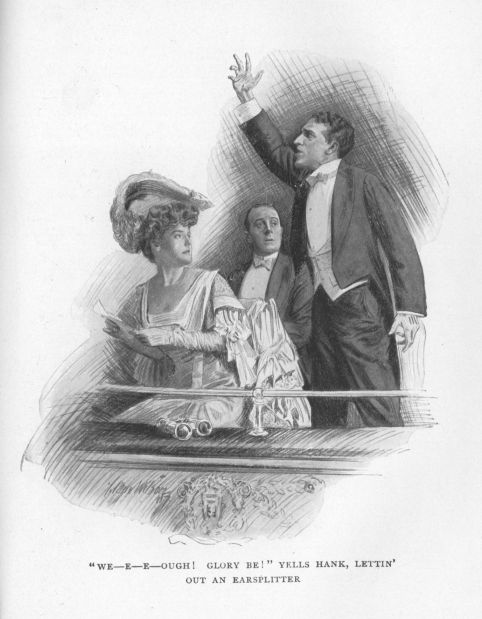
"WE—E—E—OUGH! GLORY BE!" YELLS HANK, LETTIN' OUT AN EARSPLITTER
It was an ear splitter, that was. Inside of a minute there was a special cop and four ushers makin' a rush for the back of our box.
"Here, here now!" says one. "You'll have to leave."
"Leave!" says Hank. "Why, gol durn you white faced tenderfeet, you couldn't hold us here another minute with rawhide ropes! Come on, Reney; maybe there's a night train!"
They didn't go quite so sudden as all that. Reney got him to wait until noon next day, so she could fire a few maids and send a bale or so of Paris gowns to the second hand shop; but they made me sit up till 'most mornin' with 'em, while they planned out the kind of a ranch de luxe they was goin' to build when they got back to Bedelia. As near as I could come to it, there was goin' to be four Chinese cooks always standin' ready to fry griddle cakes for any neighbours that might drop in, a dance hall with a floor of polished mahogany, and not a bath tub on the place. What they wanted was to get back among their old friends, put on their old clothes, and enjoy themselves in their own way for the rest of their lives.
X
SHORTY AND THE STRAY
Say, I don't know whether I'll ever get to be a reg'lar week-ender or not, but I've been makin' another stab at it. What's the use ownin' property in the country house belt if you don't use it now and then? So last Saturday, after I shuts up the Studio, I scoots out to my place in Primrose Park.
Well, I puts in the afternoon with Dennis Whaley, who's head gardener and farm superintendent, and everything else a three-acre plot will stand for. Then, about supper time, as I'm just settlin' myself on the front porch with my heels on the stoop rail, wonderin' how folks can manage to live all the time where nothin' ever happens, I hears a chug-chuggin', and up the drive rolls a cute little one-seater bubble, with nobody aboard but a Boston terrier and a boy.
"Chee!" thinks I, "they'll be givin' them gasolene carts to babies next. Wonder what fetches the kid in here?"
Maybe he was a big ten or a small twelve; anyway, he wa'n't more. He's one of these fine haired, light complected youngsters, that a few years ago would have had yellow Fauntleroy curls, and been rigged out in a lace collar and a black velvet suit, and had a nurse to lead him around by the hand. But the new crop of young Astergould Thickwads is bein' trained on different lines. This kid was a good sample. His tow coloured hair is just long enough to tousle nice, and he's bare headed at that. Then he's got on corduroy knickers, a khaki jacket, black leather leggin's, and gauntlet gloves, and he looks almost as healthy as if he was poor.
"Hello, youngster!" says I. "Did you lose the shuffer overboard?"
"Beg pardon," says he; "but I drive my own machine."
"Oh!" says I. "I might have known by the costume."
By this time he's standin' up with his hand to his ear, squintin' out through the trees to the main road, like he was listenin' for somethin'. In a second he hears one of them big six-cylinder cars go hummin' past, and it seems to be what he was waitin' for.
"Goin' to stop, are you?" says I.
"Thank you," says he, "I will stay a little while, if you don't mind," and he proceeds to shut off the gasolene and climb out. The dog follows him.
"Givin' some one the slip?" says I.
"Oh, no," says he real prompt. "I—I've been in a race, that's all."
"Ye-e-es?" says I. "Had a start, didn't you?"
"A little," says he.
With that he sits down on the steps, snuggles the terrier up alongside of him, and begins to look me and the place over careful, without sayin' any more. Course, that ain't the way boys usually act, unless they've got stage fright, and this one didn't seem at all shy. As near as I could guess, he was thinkin' hard, so I let him take his time. I figures out from his looks, and his showin' up in a runabout, that he's come from some of them big country places near by, and that when he gets ready he'll let out what he's after. Sure enough, pretty soon he opens up.
"Wouldn't you like to buy the machine, sir?" says he.
"Selling out, are you?" says I. "Well, what's your askin' price for a rig of that kind?"
He sizes me up for a minute, and then sends out a feeler. "Would five dollars be too much?"
"No," says I, "I shouldn't call that a squeeze, providin' you threw in the dog."
He looks real worried then, and hugs the terrier up closer than ever. "I couldn't sell Togo," says he. "You—you wouldn't want him too, would you?"
When I sees that it wouldn't take much more to get them big blue eyes of his to leakin', I puts him easy on the dog question. "But what's your idea of sellin' the bubble?" says I.
"Why," says he, "I won't need it any longer. I'm going to be a motorman on a trolley car."
"That's a real swell job," says I. "But how will the folks at home take it?"
"The folks at home?" says he, lookin' me straight in the eye. "Why, there aren't any. I haven't any home, you know."
Honest, the way he passed out that whopper was worth watchin'. It was done as cool and scientific as a real estate man takin' oath there wa'n't a mosquito in the whole county.
"Then you're just travelin' around loose, eh?" says I. "Where'd you strike from to-day?"
"Chicago," says he.
"Do tell!" says I. "That's quite a day's run. You must have left before breakfast."
"I had breakfast early," says he.
"Dinner in Buffalo?" says I.
"I didn't stop for dinner," says he.
"In that case—er—what's the name?" says I.
"Mister Smith," says he.
"Easy name to remember," says I.
"Ye-e-es. I'd rather you called me Gerald, though," says he.
"Good," says I. "Well, Gerald, seein' as you've made a long jump since breakfast, what do you say to grubbin' up a little with me, eh?"
That strikes him favourable, and as Mother Whaley is just bringin' in the platter, we goes inside and sits down, Togo and all. He sure didn't fall to like a half starved kid; but maybe that was because he was so busy lookin' at Mrs. Whaley. She ain't much on the French maid type, that's a fact. Her uniform is a checked apron over a faded red wrapper, and she has a way of puggin' her hair up in a little knob that makes her face look like one of the kind they cut out of a cocoanut.
Gerald eyes her for a while; then he leans over to me and whispers, "Is this the butler's night off?"
"Yes," says I. "He has seven a week. This is one of 'em."
After he's thought that over he grins. "I see," says he. "You means you haven't a butler? Why, I thought everyone did."
"There's a few of us struggles along without," says I. "We don't brag about it, though. But where do you keep your butler now, Mr. Gerald?"
That catches him with his guard down, and he begins to look mighty puzzled.
"Oh, come," says I, "you might's well own up. You've brought the runaway act right down to the minute, son; but barrin' the details, it's the same old game. I done the same when I was your age, only instead of runnin' off in a thousand-dollar bubble, I sneaked into an empty freight car."