"Pages from the Life of a Persian Cat" (continued 3)
Reading edition
There was a saucy rascal of a blackbird that used to run about on the lawn gathering food, quite close to the children. When Shireen, Tabby, and the rest were there the blackbird used to come even closer, in order that he might nod his head and scold the cats.
But Dick would cry “Eh? Eh? What d’ye say? What is it? You r-r-rascal!” and sometimes even fly down to offer him battle.
There was no song more sweet in the summer evenings however, than blackie’s.
The owl kept his song till midnight, and a very dreary one it was!
But strangely enough, some may think it, yet it is nevertheless most true, wild pigeons built their nests in the pine trees, close to the wall in which the owls had theirs. These pigeons knew, though gamekeepers don’t, that these owls lived on young rats and mice and not upon birds.
Squirrels used to run about the lawn with their long brown beautiful tails behind them, early in the morning; and they built in trees also.
Then there was a white-breasted weasel, that would often come quite close up to Lizzie and Tom, and stand on one end to look at what they were doing.
On this particular year, autumn lingered long on the hills and forests and fields all around the children’s beautiful home. It was, Uncle Ben said, a real Indian summer, so soft and warm and mellow, that neither he nor the Colonel ever cared to be much indoors.
“Well,” said Warlock, one afternoon out on the Colonel’s lawn, while Lizzie and Tom sat at some distance making a garland of gowans for the dogs’ necks, and the old sailor and soldier sat in their straw chairs, peacefully smoking and yarning—“Well, Shireen, although I have never been to sea myself, considering that the land and the lovely hills and woods are good enough for me, I dearly like to hear about it, so just heave round with your yarn, as Uncle Ben yonder says.”
“Yes, with pleasure,” said Shireen. “Let me see though, where did I leave off?”
“Why you left yourself sitting on the bulwark of the old Venom, catching flying fish.”
Oh, yes, so I did, Warlock. My memory is just getting a little fickle now, while yours is supple and green. Well, the voyage south was continued, slowly though, because we kept in towards the green-wooded coast, you know, in order to hunt for slave-ships. And several times Tom Brandy and I had to be blown out of the gun with a fuze before the men could load it. I always knew what was going to happen when this took place, and ran aft right speedily and got down below to my master’s bed; because do what I might, I could never reconcile myself to the noise of those terrible guns.
Master I could see, much to my joy, was getting better and stronger every day. But he often spoke to me about my mistress Beebee, and always said that he would, at all risks, prevent her from being sold to the Shah.
One day he went so far as to say, “Dear pussy Shireen, your mistress is much too good and too beautiful for a fellow like the Shah. Let him be content with the slaves he has. He is only a savage himself, at the best, and rather than he should have your sweet mistress, I will go back to Persia and carry her away.”
My life on board the Venom was now a most happy and pleasant one; but often and often, Warlock, I dreamt that I was back again in the land of the lion and the sun, in beautiful Persia, and that I was sitting as of old in the turret balcony, with my darling mistress. Then I would awake and find myself far away on the dark blue sea.
No, I should not say dark blue sea, because the Indian Ocean is more lovely far than turquoisine.
Tom Brandy and I would sit for hours on the bulwarks, which I used to call a fence, looking at the sea. The flying fish knew far better than to come on board the vessel during the day, but there always was something or other to be seen in the ocean. At times, especially on calm days, it would be a shoal of silvery whitebait. And such a shoal! Oh, Tabby, it would have made your mouth water to look upon it. We could see first far ahead of us, a dark patch upon the bright blue water, and when we came nearer, that part of the sea would be all a-quiver, as if it were raining hard there and nowhere else. But soon the shoal opened out in all its beauty of silvery life and loveliness. I’m not a post, only a Persian cat, else I could describe it better.
“Oh, rats!” cried Warlock, “never mind the poetry.”
Another sight we used to see would be a shoal of dolphins.
“Chasing the whitebait, I suppose?” This from Warlock.
“I didn’t say so, Warlock.”
But very prettily they used to come along on the top of the water. They would be so far away at first that they looked like tiny black ticks on the horizon, but soon they were near enough to us, and we saw that they were monsters. Oh, a hundred times as large as you, Warlock, or all of us put together. They came up head first, and went down head first, just skylarking and playing and skipping like lambs on the leas. And the water all around them was lashed into foam. Wasn’t I afraid, did you ask me, Vee-Vee? No, not a bit, because Tom told me they were as harmless as cows.
But, my children, there were creatures in that deep sea of turquoisine that were very far indeed from being harmless. These were the sharks.
There were always one or two down there that the doctor led. They used to know the doctor, and floated alongside the ship, while he threw down pieces of fat to them, and sometimes a ham bone.
The doctor said those tigers of the ocean used to swallow whatever was thrown overboard, even if it were only an empty medicine bottle.
Sometimes they looked very lovingly at the doctor, and this officer would tell me they were asking him to throw over a cat for them to swallow. They said they had never eaten cat, but felt sure that it must taste very nice indeed.
But little did we think that one day we would be in danger of our lives from those awful monsters.
Only it wasn’t by day, but by night, and a clear and beautiful night it was too, with the moon shining as brightly almost as it used to shine over the woods around my Persian home.
Tom and I had been sitting on the bulwarks as usual, expecting a flying fish to come on board. But they could see us too distinctly, so they kept away.
There was very little wind that night, just enough to fill the sails, and carry us along about five knots an hour.
It was a few minutes past midnight, and the watch had been changed, and stillness reigned everywhere. I think I must have fallen asleep and been dreaming, for I started in fright when one bell was struck loudly and clearly.
I started so that I missed my balance, and fell with a plash into the sea. Next moment Tom Brandy uttered a plaintive howl and dashed in after me. I am sure that the poor fellow had no idea of trying to save my life, he only wished to share my fate.
I heard a shout just after Tom came down. For a man in the watch, hearing the plash in the water, immediately concluded that someone had fallen in, and raised the alarm.
“Man overboard! Away, lifeboat’s crew!”
The shout was taken up and repeated fore and aft, down below and on deck as well.
Then something came rushing down into the sea from the stern of the ship, and fell into the water with a strange hollow ring.
The officer of the watch had let go the lifebuoy, but so quickly that he had forgotten to light it. His neglect to do so probably saved our lives.
The lifebuoy is made of two empty copper balls, with an arm of wood between. From this rises a short mast, on the top of which a beacon burns. Now had this been lit, Tom and I would have burned our paws when we scrambled up the little mast.
I never knew I could swim till then, but I can assure you, Warlock, it didn’t take Tom Brandy and I long to reach that lifebuoy, and there we clung till the boat came.
It was not long, perhaps, till the boat did arrive, but to me it seemed like a hundred years, for the sea all around us appeared to be alive with awful sharks. Tom told me afterwards my eyes must have multiplied their numbers, and that there were only just the doctor’s two tame ones.
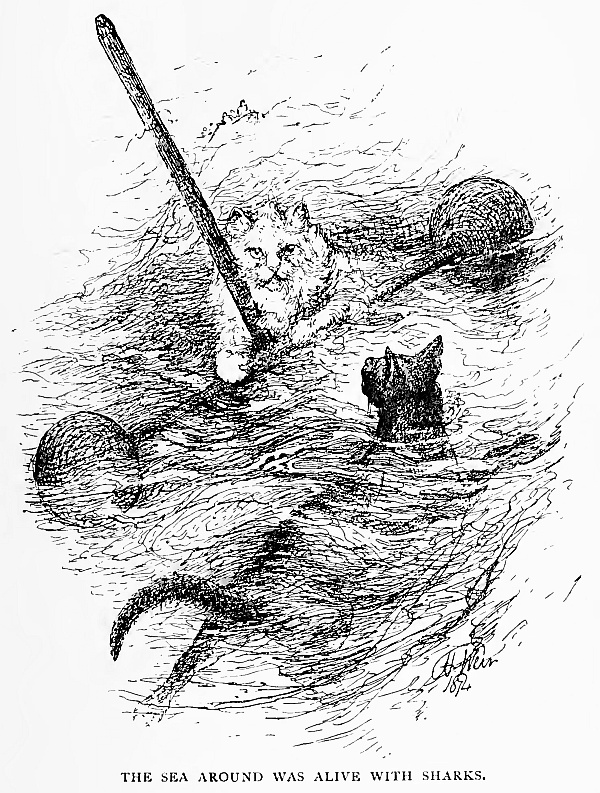
Well, Warlock, tame or not tame, they wanted to tear Tom and me to pieces, and were terribly disappointed when the men took us on board and the boat went rushing back to the Venom with us rescued pussies.
When the captain heard of what he called the gallant rescue, he ordered the mainbrace to be spliced, and so the men all had a glass of grog for saving our lives.
But next day the seaman who had struck the bell which so startled me, informed the boatswain that he was positive both cats did not fall off the bulwarks, but that I only had missed my hold and tumbled into the sea. He looked quickly towards the bows he said, and for a second or two saw Tom Brandy there safe enough. Then he heard his cry, and saw him deliberately spring into the sea after me.
The boatswain told all this to the men and also to the officers, and after that Tom became indeed a hero on board the ship. My master spoke of presenting him with a handsome collar of solid silver. The armourer said if my master Edgar would let him have the silver, he would very soon make it and engrave it also; he received a large silver spoon, and so heartily did he work, that in less than a week Tom was wearing his collar.
But, children, continued Shireen thoughtfully, although Tom Brandy looked somewhat dignified in his silver collar, it is rather a risky ornament for a pussy to wear. For a cat friend of mine in the country being presented with a lovely morocco leather collar by his own mistress, who thought a great deal of him, disappeared soon after in the most mysterious way. A whole week passed by and poor Clyde didn’t appear. Then one day a boy rang the door bell, and asked to see Clyde’s mistress. He thought he had found the missing cat he said.
“Where, my dear boy, where?” cried Mrs L—
“Up in a tree, far down in the wood, ma’am.”
“And why didn’t you bring him? I’ll go with you, and we must get him, and I will pay you well.”
“Can you climb trees?” she added.
“Like a squirrel,” he said boldly.
The tree was soon found, and up swarmed the boy.
“It is Clyde right enough!” he shouted down; “but she’s been and gone and hung herself.”
“Oh, poor pussy! Is she dead?”
By this time the lad was coming down the tree with pussy under his jacket.
“Never a dead is she, ma’am, but awfully thin.”
She was indeed thin, and a miserable time she must have spent. A branch of the tree had got caught in the collar, and there the poor cat was hung up by the neck, and but for the boy, who perhaps had been birds’-nesting, she would have been slowly starved to death.
That’s the worst of a dandy collar. But nothing ever happened to Tom Brandy on board the ship.
Well, in due course the Venom arrived safely in port, and was paid off. And I assure you, dear children, the day I parted from Tom Brandy I was very sorry indeed. But, you see, he wasn’t my master’s cat, and so couldn’t go with us.
Indeed Captain Beecroft had taken a real fancy for Tom, and being like many sailors, just a little superstitious, he thought that if he parted with pussy, all his good luck would go also, so he determined to stick to him.
Arrived on shore, we, that is my dear master and I, went to Yorkshire to live for a time with an aunt of his, about the only relative he had alive.
Mrs Clifford was an exceedingly nice old lady, and very fond of cats, as every nice old lady is, you know, Warlock. She took quite a fancy to me at once, and I had the run of the house and gardens, and a fine old-fashioned place it was. There were several other cats here and dogs too, but we lived like a happy family just as we all do here.
“Now, pussy Shireen,” said master to me one evening, “I don’t know what I shall do. I think more and more about your beautiful mistress that the Shah is going to claim, every day of my life; and I think, too, of the vow I made to protect her from the terrible fate that awaits her. But oh, pussy, I’m almost in a fix, for I must tell aunt about Beebee, and, very nice though she is, I do not know how she may take it; I am entirely dependent upon her, and what is more, I am her heir.”
“But tell her I must, Shireen, even if she cuts me off with a shilling. I still have my sword, you know, pussy.”
I rubbed my head against his hand, and sang loud and long.
He understood me, and took me up in his arms and kissed me on the head.
“Yes, Shireen,” he said, “I still have you, and we shall never part, I do assure you, unless I am slain in battle, and even then you will be by my side.”
Then he started to his feet.
“Come, Shireen,” he said bravely, “the more I think about it, the worse it will be. I will go and seek my aunt now in her own room, and tell her all about it.”
I trotted along the passage with him, and soon we came to Mrs Clifford’s door.
“Come in,” she cried. “Come in, Edgar,” for she knew it was his knock.
“Sit down, my child, by my chair.”
So Edgar took a low stool by her knee just as he used to do when a boy, and the kindly white-haired lady passed her hand through his hair.
“Just like old times, isn’t it, Edgar?”
“Yes, auntie; but I have come to speak to you about Shireen.”
“About your beautiful pussy?”
“Yes. Look, auntie.”
Edgar, as he spoke, took me up and exposed my gum.
“Do you see that brilliant red flashing little spot, aunt?”
“Yes, my dear boy. Let me get my glasses. Why, I declare, Edgar, it is a brilliant, a ruby, and though small, it looks like a priceless gem.”
“And so it is; and the person who had it put there is a still more priceless gem to me.”
“I don’t understand you, Edgar; you always were a strange child.”
“Well, shall I tell you the story of the ruby?”
Mrs Clifford folded her mittened hands in her lap, and looked, or tried to look resigned.
“I think,” she said, “I know what is coming. You have been out in Persia, and you have fallen in love with some designing minx of a Persian girl, and she gave you that Persian cat—and—and—and—” here the old lady began to tap with her foot against the footstool—“oh, that my brother’s boy should have fallen in love with a blackamoor!”
Edgar at this moment pulled out a case from his pocket, and opening it by means of touching a spring, held out before his auntie’s astonished gaze a charmingly executed miniature portrait of my sweet mistress.
“Is that a blackamoor, auntie?” he said.
“This lovely child! Is this—” she spoke no more for a time.
But my master knew he had gained a point, so he commenced to tell Beebee’s story and mine, from the very beginning to the end, and I assure you, children, when he finished, the tears were silently falling down the furrowed cheeks of the dear white-haired lady.
“Oh, the inhuman monster of a father of the dear girl?” she said, as if speaking to herself.
Then she turned to my master and held out her hand. “Dear boy,” she said, “I am your friend, and if ever Beebee comes to this country, I will try to be a friend and a mother to her.”
Then Edgar got up. He kissed the lady’s white hair, then walked straight away out of the room, struggling hard to restrain the tears that filled his eyes. They were tears of joy though.
Chapter Fourteen.
Zulina: a Homeless Waif and Stray.
Just a few weeks after this, and while reading a letter at breakfast, my master’s face flushed with joy.
There was nobody in the room but me, for the old lady did not come down to breakfast very early.
“Why, pussy Shireen, what do you think?” he cried.
Of course, I couldn’t tell what the matter might be.
“My regiment—the 78th Highlanders—has been ordered to Persia, to give the Persians a drubbing for insolence to our Government, and if I am well enough I must join forthwith. Hurrah! Of course I’m well enough.
“There will be many regiments there as well as ours, but oh, Shireen! won’t it be joyful, and you must come too, pussy. It may seem strange for the captain of a gallant regiment to have a cat as a pet, but what care I? Many a brave soldier has loved his pussy, so you come along with me, and I’ll chance it.
“Now,” he added, “I’ll just write a letter to the War Office, saying that I am well, and burning to join my regiment, then I’ll go down the hill and post it before auntie is up. That will settle it.”
Well, of course, children, Mrs Clifford was very sorry to lose her dear Edgar, as she called him, so soon again; but she was a brave old lady, and though she cried a little, she gave him a blessing and bade him go.
“Duty must be obeyed, Edgar,” she said, “even though hearts should break. Go, my boy, your country calls you.”
I don’t think, children, there was a much happier cat than pussy Shireen on the day my master left Waterloo Station for Portsmouth, to take passage for Bombay in a ship of war, especially when the brave soldier told me that this ship was to be commanded by Captain Beecroft himself. Indeed, hearing that we were going to India to join our regiment for service in Persia, Captain Beecroft had written to us, offering us a passage, and saying he would be very glad indeed to have master once more on board his vessel. And, he added, as master knew none of the officers in the wardroom, he would be happy to have him as a guest in his own apartments.
We had not gone straight to London, I may tell you, Warlock, from Yorkshire. We had a run over to Dublin first to see a friend, and on board the steamer I astonished everybody by my perfect coolness. I even ran right up the rigging into the foretop, and had a look around me, and the sailors all declared I was a ship’s cat born and bred.
Well, we had arrived at our hotel in the evening. I may tell you that it stood in one of the principal streets, and right in the middle of it, so that anyone going out by a back window and across the tiles, would have to go a long way round to get to the front door again.
Of course, Warlock, no human being would have dreamt of going out at a back window and along the tiles, and no dog either. But it is precisely what I did when master shut me in the room, and locked me in for safety till he should post a letter.
When he returned, behold! no Shireen was there, and he called me from the window in vain.
The truth is, I had never been to Ireland before, and wanted to see what the Irish cats were like; so I determined to spend a night on the tiles and go home with the milk in the morning.
I can’t say, however, that I thoroughly enjoyed myself. I found the Dublin cats a rather disreputable gang. They serenaded nervous old gentlemen, and had water and brushes and lumps of coal and the boot-jack thrown at them; they scratched up beds of choice flowers, and they broke into pigeon-lofts, and dove-cotes, and killed and ate the pigeons. Moreover, they boasted of all these exploits as if they had been the greatest fun in the world. So, on the whole, I was somewhat disgusted. However, it opened up a new phase of life before me, and so I gained some experience.
But, children, you must not suppose that I, a silken-coated Persian and a brave soldier’s cat, kept with this gang all night. I did not, but retired into a garden arbour early in the evening to have a quiet talk with a lady-cat who, it was evident from her voice and manners, had seen better days.
She was a very pretty half-bred Angora, or rather, I should say, she had been pretty once upon a time, but at present her face was thin and worn, her eyes looked world-weary, and her coat hung around her in mats and tatters.
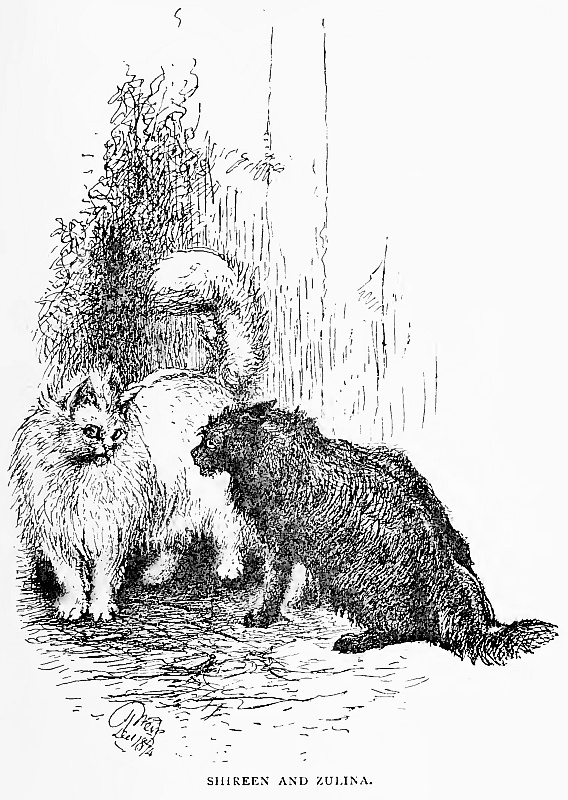
“And so,” she said, after we had settled down face to face, “and so you have been far travelled, and come all the way from across the seas?”
“Yes,” I answered, “and I am going all the way back again. The fact is, I have no real home, except where master is, and I do not care where that may be, whether on the lonesome moorland, amidst the city’s bustle, din, and strife, or far away upon the lone blue sea, I say, that if he be with me I am at home.”
“Ah!” sighed the poor waif in front of me. “I wish I had a kind master or mistress, if so you wouldn’t find me here to-night. Why, I haven’t even a name now, though they used to call me Zulina.”
“A pretty name,” I said; “but tell me, Zulina, how did so ladylike-looking and evidently amiable a pussy as you become a nomad and a wanderer?”
“Oh, don’t call me amiable,” she answered: “indeed, I am not. All my amiability, and ever, love, for the human race, has been crushed out of me. Well, once I had a home in the outskirts of this very city, and many home-ties too. It was a pretty house, with gardens all around it, and custom and long residence thereat had much endeared me to it. I knew every hole and corner of it. Knew every mouse-run, the cupboards, and the cosy nooks where I could have a quiet snooze when I needed such refreshment, and the places in which I could hide when hiding became an absolute necessity. I was acquainted with the manner of egress and ingress, so that I felt free and untrammelled, and I was familiar with every sound so that my rest was never disturbed by night, nor my nerves jarred by day.
“And out of doors too, Shireen, everything about the dear old place was familiar to me; the trees on which the sparrows perched, the field where I often found an egg, the meadow where the wild rabbits played, and the paths by which I could reach it in safety.
“But I was taken away from this home by a mistress who used to profess such love for me, and removed to a town more than twenty miles from Dublin. My new home too, was right in the centre of the town, and everything about it looked strange and foreign to me. But so long as I felt sure my mistress loved me, I did not care, so I began to learn the place by heart, as it were, and all the outs and ins of it.
“But lo! what was my astonishment to hear my mistress say one day:
“‘I don’t think we can put up with that cat now in this new house. I think we had better give a boy sixpence to drown it to-morrow morning.’
“That night I left the house, and the ungrateful mistress I had loved so well and dearly. I left the house, and the town too, and wandered on and on nearly all night, and at early dawn I was back again at my dear-loved home.
“I had forgotten there were strangers there now. And they treated me as a stray cat, and drummed me out when I dared to put my nose over the threshold.
“What could I do, Shireen? I could not endure the pangs of hunger, and though I hung about the garden of my old home for days, and made many a plaintive but useless appeal to the new-comers, I was forced at last to cast aside the mantle of virtue and become a thief. Yes, I even broke into the new people’s pigeon-loft and stole a bird. Then I took to this evil existence, and since then, alas! I have never been inside a human habitation except to steal.”
“Well, Zulina, it is very sad,” I said; “but I think you should try to reform even yet, and some kind lady might take pity on you.”
“No, no, no,” sighed Zulina, “I am but a homeless waif and stray, and my fate, I fear, will be to die in the street, or be torn to pieces by dogs.”
“I’m going to hope for better things for you, Zulina,” I insisted. “But good-bye. Yonder is the grey dawn stealing up into the sky, and I think I hear the milkman’s cry in a distant street. I must try to find my master’s hotel. Good-bye.”
It was a long distance round, but my instinct was unerring, and finally I found myself trotting up the correct street, and soon after sitting in the area doorway.
Down came the milkman with his rattling cans, and in a minute or two, Biddy, with her hair in papers, and looking very sleepy, opened the door.
While Biddy and the milkman were interchanging a few courtesies, I slipped quietly into the house and made my way as fast as I could upstairs to the second floor.
I soon spied my master’s boots, and mewed at the door.
It was opened in a moment, and in I popped, purring as loudly as I knew how to.
“Oh! pussy, pussy,” he cried, as he picked me up, “I thought I would never see you more, and I was quite disconsolate. You went out by the back and over the tiles, and now you’ve come in at the front; how did you find your way round?
“It is instinct, instinct, I suppose,” he added. “He who guides the great fur seals back through the stormy seas, through hundreds of miles of darkness and mist to their far northern islands in June, He guided you.
“‘Reason raise o’er instinct if we can, In this ’tis God directs, in that ’tis man.’”
Well, Warlock, we left Dublin, and at last found ourselves at Waterloo Station.
The train was in, and I was in also. I was in a basket, and I didn’t half like it.
I heard my master say to a railway porter, “Take charge of that basket for a few minutes, porter, till I go and buy some newspapers.”
Five minutes after this, when Edgar returned, he met that railway porter, and he was looking very disconsolate indeed.
His hands were bleeding, and he carried an empty basket.
“Oh! sir,” he cried, “your cat has gone. The basket was not securely fastened, and as soon as you left she wriggled out.”
“But why, man, didn’t you stick to her?” cried master.
“I tried to all I could, I do assure you, sir; but she bit me and tore my hands, then jumped down and disappeared in the crowd.”
“Well, come along and take my things out of the compartment where we put them, for I shan’t go by this train.”
“I’m so sorry, sir. But she’s only a cat, sir. You could get another.”
“Do as you’re told, porter, please,” said my master imperiously.
Without another word the porter followed him to the first-class compartment, and there they found me cosily snuggled up among the rugs!
(This incident occurred just as described, the dramatis personae being the author and his own far-travelled cat Muffie Two.)
Master was delighted, and gave the porter half-a-sovereign to heal his wounded dignity, and his still more wounded fingers.
My children, I travelled many and many a thousand miles with master after that both by sea and by land, but never again did he insult my amour propre by putting me in a creel.
At this moment Lizzie and Tom joined the group of old friends on the lawn. Tom threw himself down on the grass, and began to twine the garland of gowans he had been making around the neck of Vee-Vee, the Pomeranian dog.
Vee-Vee was Tom’s favourite, and never a night would the boy go to bed without him.
No, Vee-Vee did not sleep in the bed, but on a couch in the same cosy little room. He was exceedingly fond of the boy, a proof that love begets love, and of course the doggie would be always first awake in the morning, but he would not stir until Tommy did. As soon, however, as the little lad sighed, his first waking sigh, Vee-Vee jumped joyfully up on the bed, and his delight was simply wonderful.
How nice to be awakened thus by one who loves you, even if it be but a dog.
Vee-Vee was quite as rapturous in the welcome with which he used to greet Tommy’s home-coming, if he happened to be away all day.
During the lad’s absence the dog would refuse all food, and simply lie in the hall with eyes open and ears erect until he heard his little master’s voice or footstep; then he would spring up quite beside himself with joy, his bark having a kind of half hysterical ring in it, as if tears were hindering its clearer utterance.
Vee-Vee now seemed rejoiced to get the garland of gowans. It was a mark of favour on the part of Tommy that he acknowledged by licking his hands and cheek.
Meanwhile Lizzie had brought out a rug to place on the grass, that she might sit thereon, and so save herself from the damp.
As she was spreading it on the green sward something tumbled out.
That something was Chammy.
“Oh, Chammy, Chammy!” cried Lizzie delighted, “we thought you were dead. Where will you hide next?”
But Chammy gathered himself slowly up and crawled away, one leg at a time, to look for a fly.
Chapter Fifteen.
“When the Fur begins to Fly.”
Nobody had ever been heard to call Cracker a pretty dog or a bonnie dog. He was sturdy and strong, and nearly, if not quite, as large as a Collie. His legs were as straight as darts, and as strong as the sapling pine tree. Then his coat—ah! well, there is no way of describing that with pen and ink or in print either. It was rough though not shaggy, and every hair was as hard apparently as pin-wire.
In the matter of coats, in fact, Nature had, while dressing Cracker, adhered to the useful rather than the ornamental. He had apparently come in the afternoon for his coat, and nearly all the other dogs had been before him. Collie had been fitted with his flowing toga, the Poodle with his cords and tassels, the Yorkshire terrier with his doublet of silk, and many others with coats as soft and smooth as that of a carriage horse, and poor Cracker, the Airedale terrier, had almost been forgotten.
“Your coat, Cracker?” Nature had said. “Oh, certainly. I’m really afraid, however, that you have come rather late in the day to be dressed with anything like elegance.”
“Oh!” Cracker had put in, “I ain’t a bit particular. Anything’ll do for Cracker, so as it is thick enough to keep out a shower with a shake.”
So Nature had simply gathered up the sweepings of the shop, the cabbage and clippings, so to speak, and mixed them all up into a kind of shoddy, and dabbed Cracker all over with that, going in, however, for a few finishing touches of gold about the muzzle, the chest, and legs.
And good honest Cracker had given himself a shake, and said, “This’ll do famous,” then trotted off to do his duty and his work, which, to his credit be it said, every dog of this breed knows well how to get through.
Well, one sunshiny day, when the old friends, including even Chammy, who was lying in the limb of a dwarf holly, were assembled on Uncle Ben’s lawn, Ben himself and the Colonel blowing clouds in their straw chairs, and Lizzie lying with a book in Ben’s hammock, who should come through the gateway but towsy Cracker himself.
He was a brave dog this, and just as modest as brave, for the two good qualities always go hand-in-hand. So he advanced in a bashful, hesitating kind of way, as if he felt he ought to apologise for his presence on the lawn at all, but didn’t know exactly how to begin. He was smiling too, a very broad smile that seemed to extend halfway down both sides.
Vee-Vee and Warlock jumped up at once growling and barking, and ready to defend the family circle with their lives if there was any occasion, but seeing it was only Cracker, they ran to meet him, and give him a hearty welcome.
Then Cracker advanced, shaking his droll old stump of a tail, and Shireen herself arose and rubbed her back against his legs.
“No,” she said, “you certainly don’t intrude, Cracker, and we only wish you would come oftener than you do.”
“Well, seeing as that’s the case,” said Cracker, “I’ll make one this afternoon at your little garden party. But I’m not much used to refined society, I bet you. More at home in a stable than in a drawing-room; the riverside and moor or the forest is more in old Cracker’s way than fountain, lawn, and shrubbery. But, la! Shireen, whatever is that lying along that branch? It isn’t a big snail and it ain’t a large slug, sometimes grey and sometimes green. Well, of all the ugly—”
“It’s a friend of ours,” said Shireen, interrupting Cracker, “and, I assure you, Chammy won’t hurt anything or anybody except the flies and mealworms.”
“Well, well,” said Cracker, “wonders ’ll never cease, but if I had met a beast like that in the woods, I’d have bolted quick, you bet, and never turned tail till safe in my kennel again.”
“And now, Mother Shireen, let us have some more of your story,” said Vee-Vee.
“Ah! yes,” said Tabby; “but what a pity Cracker didn’t hear the first part.”
Well, said Shireen, we arrived at Portsmouth, I and my master as safe as anything, and after dinner proceeded on board.
The Hydra was the name of the war ship on which we were to sail for India’s distant shore. She was a fine craft of the kind human beings call a corvette. I was not long in perceiving that she carried many long black guns, but was glad to learn soon after my arrival, that as we were going to make a very quick passage out to Bombay, these awful guns would hardly ever be fired.
The Hydra was much larger than the old Venom, had fine open decks, and tall, raking masts, with a low, wide funnel of jet, up which went the crimson copper steampipe. Her decks were as white as ivory, and I could see my face in the polished woodwork, to say nothing of the brass that shone like gold.
I trotted along by my master’s side towards the quarter-deck.
Captain Beecroft in uniform, and looking young and happy, came forward with a smile to bid us welcome.
“So you haven’t parted with your beautiful cat?” said the captain, as we walked to the companion.
“No, Beecroft, nothing, I hope, will ever part me from her.”
“I wonder,” said Beecroft, “if she’ll remember her old pal, the hero, Tom Brandy.”
“What? Have you still got Tom?”
“Yes. It isn’t likely I’d sail without black Tom. That would be to throw away my luck, you know, and I’d never become an Admiral.”
“Ha, ha, ha!” laughed master; “but how superstitious sailors are!”
“And some soldiers too, ain’t they? ha, ha!”
Then both laughed, and Beecroft led the way to his quarters, a sentry at the door saluting as we passed by.
I declare to you, children, when I saw honest Tom Brandy lying there on a skin rug in front of the stove—for it was almost winter now, and very cold—you could have knocked me down with a sledge hammer.
I felt all over in a whirl with joy, and for a moment I didn’t know whether my top or my toes were uppermost.
Tom jumped up with a fond cry, and ran to meet me, and the two of us ran round and round the table in order to allay our feelings, like a pair of three-month-old kittens.
But we both settled down on the skin in a few minutes, and commenced singing a duet together, to the accompaniment of a coffee-urn that simmered above the stove.
“Just like old times, isn’t it, soldier?” said Beecroft, looking down at me and Tom.
“Just like old times, sailor,” said master.
Then the two shook hands once more.
And down they sat to talk and smoke.
The ship sailed in a day or two, heading away down channel on a beam wind. Tom told me it was a beam wind, else I wouldn’t have known, for it was just the same colour as any other wind. Tom also told me we were under close-reefed topsails and storm jib, and that if it came on to blow a bit more, we should be scudding under bare poles.
I said, “Oh, indeed!” But I didn’t know in the least what Tom meant.
You will observe, children, that Tom was dreadfully learned and nautical.
He was looking far more respectable and beautiful than when I saw him last. He had a new coat of jetty black, and there wasn’t a single burnt hole in it. He was rounder in the face, too, and more brilliant in eye.
When I remarked upon these improvements.
“Oh,” he said, “it is like this, Shireen, I have been living in the bosom of the Captain’s own family on shore, and on the fat of the land, as you might say.
“I’ve turned over a new leaf too,” he added, looking pensively at the blazing, caking coal, and swaying to and fro with the motion of the ship. “When I came on board the old Venom I wasn’t what you might have called strictly honest. I would have laid hands on a herring at any time; and I once tried to eat the cook’s canary, and was beautifully basted in consequence. But I’ve seen the error of my ways, and now that I am the Captain’s cat, I consider it is more honourable to beg than to steal. But my eyes, Shireen, how beautiful you’re looking! And to think I’ve got you back again. Won’t we have some jolly larks, and won’t we catch some flying fish. A few, eh? But mind you, Shireen, no going to sleep on the bulwarks and tumbling into the sea, this cruise.”
“Oh, it makes me shudder to think of that wild adventure, Tom,” I said.
“Yes, those sharks pretty nearly had us, hadn’t they, Shireen? If they hadn’t set to quarrelling among themselves as to which would have the white cat and which the black, they’d have eaten us both.”
“Heigho!” I sighed, and looked at Tom.
“Heigho!” sighed Tom, and looked at me.
Then we went on with the duet.
The weather soon grew so warm and balmy, and beautiful, that there was no longer any need for a fire in the stove, and the captain’s steward took away the skin, and put down a clean straw mat, and covered the sofa with coolest white and blue chintz, and the ports were carried open all day long, so that we could feel the breeze, and see the dark rippling ocean rushing past us, all bespangled with splashes of sunshine.
I was of course quite an old sailor, though I couldn’t speak nautical like Tom, and I enjoyed this cruise even more than the last.
So I ought to. Was not every day taking me nearer and nearer to my dear little mistress Beebee? And the shorter the time, the more I seemed to love her.
“Instead of going away from home,” said dear master to me one day in the cabin, “I seem to be going to my home, and going to happiness. Oh, I do hope, Shireen, that something will turn up for our good. The fortunes of war are so changeable, you know, Shireen, and we may see Beebee, may be able even to save her from her fate; but alas! we may not.”
We rounded the Cape in wild weather. The waves were mountains high, children; thunder roared and shook the ship, and lightning flash, quickly following flash, played around us, till all the ocean looked like a vast sea of fire. I was almost as much afraid of the thunder as I had been of the great guns on board the saucy Venom.
But soon we got out of this region of storms, and went north and away, the weather getting warmer day after day.
We were soon in the delightful regions of the flying fish; but I took great care not to fall asleep again on the bulwarks.
Everything looked the same in this great turquoisine sea; the bonitoes, the flying fish, the dancing, cooing dolphins, and even those terrible sly-eyed tigers of the sea—the sharks.
On and on and north and north we went. Sometimes we passed a green island, that seemed to hang in the air, rather than float on the ocean; and sometimes the surface of the water was patched here and there with glass-green or pearl-grey, and I knew, or rather Tom told me, that we were sailing over shoals, and at night extra look-outs had to be set, lest we should strike the coral rocks, and the ship break up, when we should all be drowned, and I should never see my mistress more.
It was what they call the cool season when we reached Bombay at last. But such a bustling, busy scene, never did I see before in all my life!
It was baggage and stores here, there, and everywhere, and soldiers all about, and boats skimming the water in every direction; and drums beating, bugles blowing, and great Highland bagpipes screaming, till I declare to you, children, it made me quite dizzy. The worst of it was, that for some days now I didn’t see so much of my master, though you may be sure I took good care to be at his side whenever I could.
I was sorry when the time came to part with Tom again, but we plighted our troth, and promised never to forget the happy cruise in the Hydra.
When it was all over and we were once more at sea, en route for the Persian Gulf, I gave a great sigh of relief. But I did feel a little lonely without Tom Brandy, and kept all the more closely to my master in consequence.
I was now to become a soldier’s cat in downright earnest, and know something about the horrors of war. Shireen paused for a moment. “Cracker,” she said, “do you like the story?”
“It’s a beauty,” said Cracker, “and I’ll like it still better when the fighting commences and the fur begins to fly.”
Chapter Sixteen.
The Fight was Hand to Hand and Horrible!
Well, Cracker, my dear friend, the fighting did begin in earnest, and soon too after we landed, though I’m sure I was very much puzzled indeed, and tried in vain to make out what it all meant.
How I wished that Tom had been there to help me, for I think Tom knew nearly everything worth knowing.
For the first time now I saw my master in full fighting array. He called his fine clothes his war-paint, and he drew a huge long knife out of a holder, and showed me how sharp it was, and said he was going to do and die in his country’s cause.
I wasn’t quite sure what doing and dying in a country’s cause was. But from the very commencement I knew that those soldier-men made a terrible din.
My master, in his gallant uniform and long sharp knife, belonged to the gay Highlanders, and they were the first sent on shore, and marched about in line and wheeled and tacked to the sound of the skirling bagpipes, with no other idea, I thought, than just to show off their fine clothes.
War, I began to think, must be very nice indeed.
Ah! but Cracker, the fur hadn’t begun to fly yet.
Well, master’s servant was a very tall fighting-man of the Highlanders, whom his comrades called Jock McNab.
“McNab,” said my master one day.
The red-faced, big pleasant man saluted.
“What’s your wull?” said Jock McNab.
“Shireen knows you well by this time.”
“Ah! ’deed she does,” said Jock, “and lo’es me too.”
“Well, Mac, we’ve both got to look after her. Do you think when we get into grips with the enemy, that Shireen would sit on top of your knapsack?”
“Weel,” said Jock, “if you’ll gie me leave, sir, I’ll soon drill her to that.”
So Jock took me in hand that very evening after we reached camp, and began to teach me what he called “knapsack drill.”
It was very simple. I was put on top of the knapsack and Jock fixed the bayonet on his gun and commenced plunging about up and down, and high and low, as if in front of the enemy. But I set my nails firmly into the knapsack and nothing could shake me off.
“That’ll do fine for a beginning,” said Jock.
There were British soldiers in the entrenched camp before Bushire, when we landed there, and marched to it, and right hearty welcome they made us.
The camp was in the middle of a vast plain, on which grew here and there some clumps of palm trees, and here and there a ruin stood. To our left was the blue sea, with the far-off shipping. Some distance in front of us was the walled town itself, built upon a long spit of land, and washed nearly all round by the sea. Far away behind the town were the lofty mountains, their snowy heads rising-high into the azure sky.
“Poetry again!” said Warlock.
“A spice of poesy,” said Shireen grandly, “sometimes adds attraction to a scene. Don’t you think so, Cracker?”
“Well, Shireen, to tell you the truth I can’t say I understand it like. My mother used to say to me ‘Cracker,’ she said, ‘in your journey through this vale of tears, always make a better use of your teeth than your tongue.’”
“Very good,” said Warlock. “Your mother must have been a brick, Cracker.”
“A brick, Warlock. What a funny idea! No, no, my mother was a Bingley terrier. But go on, Shireen, when did the fur begin to fly?”
Not yet a bit, Cracker. Well, at night, I found my way to master’s tent, and was glad to snuggle up in his arms, for though the days were warm the nights were bitterly cold.
Just before I fell asleep, Jock McNab came to the tent.
“I’m sayin’, sir,” he said.
“Yes, Mac, what is it?”
“Is Shireen wi’ you?”
“That she is. Thank you, McNab, for being so mindful.”
“That’s a’ richt then,” said Jock. “Good-nicht.”
And away the faithful fellow went.
Now although we were lying in camp here before Bushire, we weren’t going to attack this town. Indeed, the people seemed very glad to see us, and sold us all kinds of nice things. So our brave General Outram soon got ready to make a terrible attack upon an entrenched camp of the Persians, fifty miles distant, and we had to walk all the way.
What a beautiful sight it was, I thought, to see all those brave soldiers in lines and lines, outside the camp; horses, Highlanders, and even fighting sailors and artillerymen. Of course you won’t understand all I am saying, Cracker, but I am a soldier’s cat, you know, and cannot help feeling a little martial ardour when I think of that splendid campaign.
Well, off we marched at last, my master at the head of his company, and I, perched on Jock McNab’s knapsack, but keeping master in my eye all the time.
What a long weary, dreary march that was to Char Kota!
“Eh? Eh? What is it?” said the starling. “What d’ye say?”
“I said Char Kota, Dick, but I’m not going to use any hard names if I can help it, you may be sure.”
Well, continued Shireen, the village I mentioned is twenty-six miles from the shore, but after a long halt we fell in again, and it was ten o’clock at night before we got to the place where we were to rest till morning.
Oh, how tired and weary the poor fellows were, for all the afternoon a cruel high cold wind had been raising dust-clouds around us, and buffeting us till we could hardly get on!
During a great part of the march I trotted by my master’s side.
The night turned out bitterly cold, and as we lay on the ground the rain fell in torrents. The thunder roared and lightning flashed, till I thought surely we would be all drowned. As it was we were drenched to the skin.
Firing took place next morning, and I was a bit frightened; but Jock told me the men were only tiring off their pieces to make sure they were all right, after the heavy night of drenching rain.
The fight was to begin to-day, this very forenoon, for the enemy with all his guns was but five miles away, in his fortified camp at Brásjòon.
“The fur would soon fly,” said Cracker, beginning to get much interested.
“Ah! but, Cracker, the fur didn’t fly, for the enemy did.”
“They weren’t real terriers,” Cracker said, “you bet.”
No, and so they ran, and we took their camp, and their guns, and a lot of other things, and settled down for a bit, after destroying all the stores we didn’t want.
It was a cold, clear night, with the moon shining very brightly on the plain and camp, and on the great mountains rising in rocky terraces high into the starry sky, and not very far from us. We expected the great battle would be fought next day, at least the men said so, and I listened eagerly to all their conversation.
But the fur didn’t fly next day after all, and now we set out to walk back to Bushire, after doing the enemy’s camp all the damage we could. We started on the march towards the shore at eight o’clock, and marched on and on, singing and talking till midnight came.
Then, Cracker, the fun commenced, and the fur did begin to fly at last.
“Tell us! Tell us!” cried Cracker.
Oh, it is evident, Cracker, you are not a soldier’s dog, else you would know that no single person can see more than a very little bit of a battle, although he may be right in the midst of it. But if I didn’t see much I heard plenty.
It was sometime past midnight, and the moon was shining, though sand was blowing and getting into our eyes, when shouting and yelling, and awful firing was heard in the rear of our army. In less than half-an-hour the moonlight battle was raging its very fiercest. Horsemen were galloping here and there, yelling forth words of command, big guns roared out on the night air, bugles rang, and musketry roared, and fire flashed in every direction.
Of course, Cracker, being only a cat, I was terribly afraid, and sometimes I could not see my dear master at all for the smoke, only his flashing sword; but I often heard his brave voice high above the din of the battle, and this gave me courage and hope.
But my greatest trial came when the wild horsemen of the enemy came dashing on towards the Highlanders, and attempted to break their ranks.
Even at this terrible moment poor Jock McNab put up his hand and smoothed me.
“Hold on, pussy,” he said. “Dinna be feared. The tulzie will soon be ower when the grim-faced foreigners get a taste o’ Highland steel.”
And a terrible tulzie that was, Cracker, and I saw much blood, and flashing of fire and steel, and cries and groans and shrieks. Oh, it was awful!
Then the heat of the fight seemed to surge away from us, and Jock found time to put up his hand once more and say,—
“Are ye still there, Shireen? Bravo! pussy.”
The firing of the foe was much farther away now, and kept on thus all night long, till day at length broke pink and blue over the lovely snow-clad mountains.
Since the fierce raging of the battle, all throughout the cold hours of night, we had lain where we had stood, without fire or without covering, and showing never a light. But away in the West the pale moon began to sink at last in a cloudy haze, and at daylight nothing could be seen for the grey mists that covered hills and plain.
Master came round and I rose to meet him. He asked Jock McNab as he smoked and patted my head, whether I had shown any fear during the fight.
“Never a morsel, sir,” said Jock; “any more than yourself, sir.”
Master went back to his place smiling at Jock’s way of paying a compliment.
The firing of the enemy had by this time slackened, and it was greatly feared by our fine soldier lads that they had drawn off, and not waited “to get their licks,” as Jock phrased it.
Breakfast was now hastily served out, I sharing with master, who had come round and sat down beside Jock and me.
Then by degrees the morning mists gathered up and up, till they lay only like a grey cloud on the snow-clad mountain peaks, and we beheld the Persian army drawn up in battle array ready and waiting for us.
It was a grand sight, Cracker, for the sun now shone gaily down on their soldiers, in serried ranks of horse and foot.
They had not long to wait for us, children. But there was a lot of marching and counter-marching of regiments and brigades, that I could not understand, unless it was that our fellows were just showing off their fine clothes.
But the tulzie soon commenced, and as I stuck to my seat on brave Jock’s back, my ears were deafened with the yelling and shouting and rattling of musketry, and with the awful roar of the enemy’s dread artillery.
On we marched, or rushed, and soon the fight was almost hand to hand, and so horrible!
But the enemy could not stand the onslaught of our forces. They began to give way and retire, and soon the battle became a rout. The Persians left nearly a thousand dead on the field, and many more bodies lay in every conceivable position along the route they had taken towards the hills.
After our cavalry had chased them afar they returned, and the march was commenced back towards Bushire.
It was a long, cold, wet, and weary one, but we saw the sea at last, and never did soldiers stretch their tired limbs in camp, or make their tea with greater pleasure, than did our poor fellows when they found themselves once more in their entrenched position.
Some of our officers were buried next day, but I was so glad to think that neither my dear master, nor Jock, nor I, were among the wounded.
Jock McNab was loud in his praises of what he was kind enough to call my pluck and coolness in the presence of the foe.
“I wadna gie pussy for onything,” he said, “and I’m sure enough she brought us luck, for never a man fell near me, either dead or wounded.”
This was my first battle then, Cracker, but it wasn’t my last by any means.
As master said, the enemy was beaten, but being beaten doesn’t by any means signify that they were conquered.
We remained quiet enough in camp now for many long monotonous days, during which the enemy did not think of disturbing us.
More troops began to arrive from India. The ships lay out yonder at anchor, but a high tumbling sea rolled in upon the beach, and it was difficult indeed to communicate with the vessels, so that the poor horses in camp began to suffer from hunger, and our own rations were sometimes scant enough.
The north-west wind too, blew loud and fierce, and brought with it clouds of dust, and a fine sort of sand that nothing on earth could keep out of camp. The cold at night was still bitter, but we had tents now, and I was cosy enough in master’s arms.
They tell me that British soldiers and sailors are born grumblers. Well, I suppose there is some truth in this; but I must say, Cracker, our men never grumbled at the scantiness of their own rations, though they pitied the horses, but they did grumble a little because the time was passing on so monotonously, and there seemed no early chance of having another fight with the Persian foe.
In fact, Cracker, the foe was getting insolent. By night we now began to see his fires on the hills around, and, although he had not the courage to attack us, he fired upon our outposts.
My master, I knew, was getting impatient as well as his men.
“I want to get farther on up country, pussy,” he whispered to me one evening; “up nearer the bonnie woods and bills where your heart and mine dwell, Shireen, with your dear mistress Beebee.”
I purred and sang, and that seemed to give him heart.
But soon after this Britain’s great hero Havelock arrived, and we all hoped then for a speedy change, and we weren’t disappointed either, Cracker.
“More fur was going to fly, Shireen?”
Yes, dear Cracker, more fur was going to fly, for in a week or two we were embarked in a transport, and sailing up the Euphrates river to attack the Shah’s great army at Mohammerah.
This stronghold was said to be occupied by the very pink and pith of the Persian forces, in number about fifteen thousand in all.
Among the chief regiments behind the formidable earthworks were seven of the Shah’s best and bravest including his guards, and the very flower of his army. Some of these were commanded by a Prince of the blood royal, and somehow or other my master found out that Beebee’s father was there also.
When my dear master told me this his eyes were sparkling with joy.
“It is just possible, Shireen,” he said, “that Beebee herself may be there, if so—”
He did not finish the sentence, but I knew what he meant.
And now, said Shireen, here come the children, so my little story must end for a time. But you’ll come again, won’t you, Cracker?
“Oh, like a shot, Shireen,” said Cracker, “you bet.”
“Oh!” cried Tom, running up. “Come quick, Lizzie. Here is Cracker, the dog that saved Shireen’s life, and gave the butcher’s bull-terrier such a shaking. Poor doggie Cracker. Poor dear doggie, you won’t bite, will you?”
The towsy tyke looked up into the boy’s face and wagged his thick, short stump of a tail at a terrible rate, and there was so much kindness and affection in those brown eyes of his, that Tom at once bent down and threw his arms about his rough and grizzled neck.
Then Lizzie, who had been to fetch some milk, came and placed it down before Cracker.
Cracker really didn’t want it, but he drank it rather than anybody should think him ungrateful.
“Mind,” said Tom, “you must come to the Castle to-morrow afternoon. It is Shireen’s birthday, and we are going to give a party.”
Once more Cracker wagged his tail, then he went trotting away to the gate, gave one kindly look behind, and so disappeared.
Chapter Seventeen.
And Chammy never came again.
As the weather grew colder, Chammy hugged the fire more, so to speak, and was less and less inclined to run away.
Perhaps to talk of Chammy’s pedal progression as “running” is slightly to exaggerate. But, nevertheless, when Chammy made up his mind to go anywhere, whether it were on an expedition to the top of a curtain, or the extreme point of a poplar tree, he got there all the same. He would probably take a considerable time to make up his mind about it, however, and he would focus the spot he meant to reach with one eye for an hour or two to begin with. Probably, during this survey, his other eye would be wandering all round the room at Shireen, at Warlock, or at Lizzie and Tom. With one eye he was calculating the height of his ambition, as it were, with the other he was counting the chances there were against his ever reaching it at all. These chances had to be reckoned with, for first and foremost he had to descend from his perch or the branch in the ingle-nook. Having reached the floor, he would have to make for the wall of the room and creep along by the foot of the dado, perhaps changing colour once or twice so as to match the hue of the carpet, and thus do his best to escape observation. For Tabby might be there, and might sing out to Warlock:
“Oh, Warlock, here is Chammy just racing off as fast as lightning. Let us have some fun with him, and turn him over and over a few times.”
And they would do it too. And, although the cat and dog meant no harm, their attentions were somewhat disconcerting, to say the very least of it.
Or Lizzie and Tom might be on the floor and spy him, and Lizzie call to Tom, saying,—
“Oh, Tom, here is poor Chammy. I’m sure he is cold. Let us take him and nurse him by the fire a little.”
And Lizzie might roll him in a Shetland-wool shawl, and sit down before the blaze to warm him, shawl and all, being very much astonished, perhaps, when she opened the shawl to have a peep, to find no Chammy there at all.
“Oh, Tom! Tom!” she would say, looking half afraid, “I’m sure I had Chammy in my hands, and I’m sure I rolled him up; and now, why, he is clean gone!”
Or the cockatoo might see him, if Uncle Ben were there, and raise a terrible alarm, shrieking and crying, “Scray! Scray! Scray!” till all the prismatic crystals in the old-fashioned chandelier jingled to the sound.
Or the Colonel himself might find him.
“Oh, you’re on the hop, are you?” the Colonel would say. “Now you just come back to your perch by the ingle-nook.”
And he would lift him by the crest that was over his head and carry him back to the branch.
Chammy was a good-tempered kind of a chameleon at most times, though he could bite a little, and give a good pinch too if he saw any occasion; but there was nothing in the world made him more indignant than being lifted up by the crest.
It was a handy way of lifting him certainly, but Chammy used to get pea-green with anger when you did so, and his little nimble eyes would look directly back at you; or, I should rather say, one of them would, for very seldom indeed did he send them both to duty at the same time.
“Put me down at once, sir,” he would say, or seem to say, “this is an indignity I do not feel called upon tamely to submit to. You would not dare to lift a crocodile of the Nile thus. Yet I, too, belong to the ancient family of the Saurians, and I bid you beware.”
I have said that Chammy could bite. This is true; but if the weather were extra cold, he would stand any amount of teasing rather than be bothered turning his head or opening his mouth to pinch you. One of Chammy’s mottoes was “Perceverantia vincit” (Perseverance overcomes), and if his master put him back on his perch a hundred and fifty times after he, Chammy, had made up his mind to reach the top of that curtain, or get out at the window to climb a tree, he would watch his chance, bide his time, and begin all over again.
That is the sort of chameleon Chammy was.
The deliberation manifested in all the droll animal’s movements was something to watch and wonder at, and afforded no end of amusement to Lizzie and Tom. He never lifted more than one leg at a time. Not he. Four legs in four seconds. That was the speed of his pedal progression, and you didn’t need a stop-watch either to determine it. But he studied periodically on the march. He might be slow, but he was also wondrous sure, and when it came to the turn of say a left hind leg, to move it had to come to time, else Chammy would slightly turn his head and focus one goggle backwards, as much as to say:
“What’s the hitch along down there? Why on earth don’t you move instead of delaying the procession?”
When Chammy saw a fly that he had taken a fancy to, he would stalk cautiously along towards it, one leg at a time of course, and if the fly was fool enough to wait there long enough, why, it got caught and swallowed, that was all. If it didn’t, why Chammy evinced no great degree of disappointment, another fly would be sure to come. Everything comes to the chameleon who waits. So he would wait.
There was a deal to be done, mind you, before a fly could be caught, he must first judge the distance, being well acquainted with the length of his own tongue. Then the jaws began to open, which they did as slowly as the minute hand of a watch. After the jaws were opened and both goggles focussed, the tongue, which looked like a garden snail, went slowly straight out. Pop! Where is the fly? And where is the tongue? Well, the tongue went back like a bit of india-rubber, and evidently the fly was there too, for Chammy immediately began to move his jaws like a cow chewing the cud, only infinitely slower.
When flies were scarce, Lizzie or Tom fed Chammy with mealworms. They would take up one at a time with a pair of forceps and put it on Chammy’s plate.
Chammy’s plate, by the way, was the lid of a pill-box, and sometimes he would eat a dozen good big fat mealworms at one sitting, and perhaps refuse food for ten days or more after it. If presented with a mealworm when not hungry, Chammy would focus it with one eye for about a dozen seconds, then slowly turn his head away in the drollest manner possible.
“Excuse me,” he would seem to say, “but I couldn’t touch it. No good eating if you’re not hungry, is there? Take it away. Take it away.”
Chammy’s attitudes were droll in the extreme while on his tree-branch. Sometimes he would be quite perpendicular against a topmost twig, which he held for all the world as an old, old man holds his long staff, his chin resting on his two clasped hands. When he had warmed both his hands at the fire on a wintry day, he used to slowly turn round his back to the blaze to entice a little heat into his chilly old spine.
But Chammy got many a tumble, and sometimes he would stupidly catch his own tail to prevent himself from falling. So that if he had lived for hundreds of years, and he certainly gave one that impression, he had not gained a very great amount of wisdom in that time.
But he was wise enough to know that the flies were to be found mostly on the window panes, though for the life of him he never could discover why he couldn’t catch one when it was on the other side of the glass, he would have a shot at such a fly again and again, then turn pea-green with anger and disappointment, and crawl slowly away.
The Colonel was a very humane man, and when the frost became very hard, he placed a small but elegant oil-stove in a corner for the comfort of the chameleon. It had crimson glass in front, and as this glass got warm, Chammy used to stand up against it, the whole forming a very pretty picture.
Then Lizzie got a box and lined it with red flannel, and Chammy was put to bed in it every night. But the oil-stove had to be lit before he could be prevailed upon to stir of a morning. When Chammy felt certain, from his feelings, that the room was well-aired, then he gathered himself slowly up and took up a position on the edge of the box and in the front of the stove, and there he stood for hours, warming first one hand and then another.
Well, I have been writing about this queer pet all the time as if it had been a male. But the truth is, it turned out to be as Tommie said, a “her chameleon,” for lo! and behold it was discovered one morning that Chammy had laid some eggs. She put them all together in a heap in the corner and appeared to be employed all the time lifting and counting them and feeling them over. There were five altogether, about the size and shape of small beans, and pink in colour.
Chammy ate no food after this. She didn’t even seem to care to come any more to warm her toes at the stove. And, on going to take off the lid of her box one morning, Lizzie found poor Chammy immovable and colder than ever she had been before.
Then Lizzie sat down on the floor beside the red-lined box and burst into tears.
They made Chammy a grave near the sweet-scented syringa-tree, and when spring-time came, they planted it with forget-me-nots, and Chammy never came again.
Chapter Eighteen.
Shireen’s Birthday.—Stamboul’s Life and Career.
Shireen’s birthday party at the Castle was going to be a very grand affair, so Tommy and Lizzie would have told you, for they had made great preparations for celebrating the event.
Shireen had reached the advanced age of one-and-twenty, and yet there was but little sign that her strength was actually failing her. She did not care to move about quite so much as she had done many years before, and preferred, as we have seen, to take her little rambles about the village, and visit her many friends there.
She preferred, too, the lawn to the forest on a sunny summer’s afternoon, or a seat by the low fire among her old friends, when the wintry winds were roaring around the chimneys, and shaking doors and windows.
But to look at Shireen, with her lovely coat, her sweet face, her wee, short ears, and blue eyes, you would not have said she was more than seven.
“I wonder,” said Lizzie, on the morning of Shireen’s birthday, “if Mrs Cooper will come, and bring her lovely prize cat Stamboul?”
“Oh, yes, she is sure to come,” was the reply. “I’ve just had a letter.”
So away ran Lizzie and Tom to complete the arrangements for the afternoon and evening entertainment, for the great coup de théâtre was to consist of lighting up the grounds after dark with coloured lamps, and the flowerbeds and borders with fairy lights, and this duty devolved upon Lizzie and her little brother.
How anxiously they scanned the sky as they hung up their lamps and their Chinese lanterns, and how suspiciously they eyed the clouds, I need not tell you. But twenty times, at least, Tom ran to ask his uncle if he was quite sure it wouldn’t rain. So at last Uncle Clarkson told him that he was only a soldier, and not supposed to be able to read the signs or the sky, and that if they wanted true information, they must go to old Ben; they might as well bring him to luncheon. So, as soon as everything had been completed to the entire satisfaction of the children, off they set, and in a little more than an hour’s time, they re-appeared again, dragging Uncle Ben by his two hands on to the lawn.
Luncheon was laid in a tent erected specially for the purpose, and some time before they all sat down, a carriage rattled up the avenue, and Mrs Cooper herself alighted with her maid, who was carrying a mysterious-looking parcel, which was half basket, half bird’s cage, and really was the travelling-home of Stamboul, the prize cat.
Everyone waited anxiously to see Stamboul, and when presently he stalked forth, with his lovely red and white coat shining like satin and floating all over him, there was a general hum of admiration.
Stamboul did not take very much notice of anyone, he gave one glance at Shireen, then looked at the dogs. Satisfying himself, apparently, that they were harmless, he next turned his attention to the grass, walking gingerly over it, and shaking a fore-foot at every step, in case it might be damp.
Then he entered the tent and disposed of himself in a straw chair, that had a cushion to it.
Now, although the party congregated together to celebrate Shireen’s birthday was everything that could be desired, and though the feast was fit for a queen, and the lawn and grounds after dark looked like a scene from the “Arabian Nights,” still it is more with the cats and dogs we have to do than with Lizzie’s and Tom’s little human friends, or the older human beings who sat in the tent, talking and laughing very pleasantly indeed.
Shireen and her old friends occupied a beautifully lit up summer-house. Even Cracker and the chameleon, who at this time was alive, were here to-night; but Stamboul occupied the place of honour, which was a straw chair, and he accepted the dignity with the easy grace of a prince of the blood royal, and as if he quite merited the honour and dignity.
For some time he sat thoughtfully washing his beautiful face, and all kept silence around him, till he should be pleased to break the silence.
“Yes, Shireen,” he said at last, “I have been a prize cat now for many years, and, indeed, I believe I am entitled to dub myself a champion. Oh, no, Mr Warlock,” he continued, smiling, “I wasn’t always a prize cat; nor have I been all my life as beautiful and fully pelaged as I am now; indeed, I was once as plain and humble-looking as your friend Tabby there.”
Tabby winced and felt a little hurt. Certainly she did not lay claim to any great degree of beauty; still it seemed hard she should be thus singled out.
Even Chammy turned one eye down at her, and Dick cocked a black bead of an optic towards her. Only Warlock gave her face a kind of consolatory lick, as much as to say,—
“If you ain’t very pretty, Tabby, you are very good, and virtue is better, any day, than beauty.”
“Well, my friends,” continued Stamboul, “you may think it is very nice to be a first-prize cat, and to be made a great fuss with, and a great show of at exhibitions, and to be boasted about by your mistress, and crowed over by her friends; but I can tell you a show cat’s life has its dark side as well as its light, and this, I think, you will be ready enough to admit, when you have heard some of my adventures and experiences.”
Stamboul’s Life and Career.
“Ever see a cattery, Shireen? No, I dare say you never did; and of course, Tabby, you never did? Well, I will tell you of the cattery in which I was born, and there are many far less pleasant than that, I can assure you.
“I remember it well, though it is many years ago. I don’t say that I can actually recollect the day of my birth, but I mind the days of my kittenhood right well. And I can remember as if it were but yesterday, the morning I and my brothers and sisters were all bundled off to a show.”
“To be sold, I suppose?” said Shireen.
“Yes, my dear,” said Stamboul, “to be sold. But mind you, I don’t blame my old mistress in the least for this. She was at heart a lover of animals; and if she kept us in a cattery, and restricted us of our liberty to some extent, it was not altogether her fault.
“Mrs Rayne was a widow lady, and lived almost by herself in a pretty house in the country. She had neither kith nor kin belonging to her, as far as ever I could see. She had one faithful old man-servant and his wife, who lived in the house and attended on her in every way. But Mrs Rayne looked after the cattery herself. She fed us, and she gave us milk and water.”
“Thought cats never drank water?” said Cracker.
“A very great mistake, I assure you, sir,” said Stamboul. “A cat won’t thrive unless she has water, and that water must be soft, and clean, and sweet.”
“Well, Stamboul,” Cracker said, “a dog is never too old to learn.”
“But,” continued Stamboul, “I must tell you about the cattery. You see, there was a little cottage down in the grounds, nicely shaded with trees and all that, and with oceans of honeysuckle swelling all over the porch, and clustering round the windows. It was only a two-roomed cottage; but, nevertheless, Mrs Rayne conceived the notion of turning it into a cattery, for this amiable lady had an idea that if she did her best to improve the breed of cats in this country, she would be able to get for them a somewhat higher place or standing as members of society.
“She had commenced by keeping a few—three I think—for her own pleasure; but one by one they disappeared. They had been trapped, poisoned, or shot by the keepers, so she saw that if she were to do any good at all, she must protect her valuable cats, and at the same time keep their breed and species select and pure. So she had a look round the cottage one day, and was glad to find, to commence with, that it was not damp. Dampness in a cattery is likely to give rise, directly or indirectly, to many ailments incidental to cat-life.
“Then Mrs Rayne proceeded to furnish the cottage, after a fashion, plainly and well. This, I may tell you, Mr Cracker, was quite as much for her own sake as for the sake of the pussies. You see, she reasoned thus, and very rightly too, cats have become like clogs, domesticated, they have for countless ages given up their own wild life in the woods, and hills, and cairns, and elected to live with mankind, and share his joys and sorrows. In doing so, they give up, in a great measure, their freedom; they become the willing slaves of man, the playmates of his children, the gentle, soothing comforters to many a lonely human being, who has nothing before him in this world except the grave. Well, then, if pussy has done and does do all this, is it fair to keep her all her little life like a wild beast, shut up in a cage, or banished to barn or outhouse?
“No, and Mrs Rayne—although the cottage would be the home of the cats par excellence—would often visit it and spend many an hour therein, with her books or her knitting. She would even take her food there sometimes, for a cat never looks upon any place as an ideal home if a kettle never sings upon a hob by the fire, or a table is never spread for breakfast, or for tea.
“So, when completed, the cottage not only had a nice low fire, protected by a strong guard, to be put on when the fire was lit and no one in the room, but there were in it a table and stools, a couch, and a nice wicker easy-chair and footstool.
“There was a cupboard or two also, and there were brackets and flower-stands, and a mirror or two, and nick-nacks on the mantelpiece as well.
“In fact, this room—which was the winter end of the cottage—was so comfortable, that no one could have told it was a cattery. The other room was furnished as a summer-room, and needed no fireplace.
“There was in each a sanitary box of earth; but as the cats had at all times free access to the garden by means of a little swinging door at the bottom of the main door, this box was never used except for the convenience of young kittens.
“You will now observe, Tabby, that Mrs Rayne, in a manner, lived among her cats, so that she had their companionship and they had hers. Moreover, as a special treat, she used to take one of them into the house, frequently of a night, and whenever any cat was ailing she treated it as kindly and considerately as if it had been a baby.
“The cat’s garden itself deserves a word or two.
“You see, galvanised wire fencing is very cheap, as I dare say you, Cracker, being a farmer’s dog, know. Well, Mrs Rayne, first and foremost, laid out the pussies’ garden in front of and partly round the cottage. She laid down a bit of a lawn; she planned walks, and planted shrubs and flowers, for I can assure you, Cracker, we cats have an eye for colour and effect as well. Then she surrounded the whole with a high wire fence, covering in the top as well, so that birds might not come in to eat pussies’ food, and be eaten by the pussies in turn.
“The place was sheltered from the cast and north by a wooden fence, so on the whole, either in winter or in summer, a more comfortable cattery never existed to my knowledge, and I have seen a few.
“The garden was laid out then partly for effect, but partly, also, for utility and luxury. The lawn was a delightful place for the young cats to tumble and jump upon, when the spring and summer were in their prime, and the grass and weed-tops, that grew on this wildery of a lawn, helped to keep the cats in health.
“Then here and there, at different heights all round the wooden fence, and the wire fence also, were placed shelf-seats, about eighteen inches long, by one foot broad. On these the cats would lie and sun themselves, or they could take exercise all round, by leaping from one to the other.
“Among the flowers that grew around was Valerian, of which the cat is fond, and several other pretty flowers, that appealed to pussy’s sense of smell, and gratified her eye.
“There was a filter indoors, and large, clean dishes were placed on the floor for the drinking water, so that the furry inmates could help themselves whenever they pleased.”
“And a bit of brimstone in each dish, I suppose?” said Cracker. “A fine thing brimstone, you bet.”
“Fiddlesticks!” said Stamboul disdainfully. “Mr Cracker, I am afraid your notions are somewhat antiquated.”
“I don’t know what that be,” retorted Cracker. “I just speak as I’ve been taught.”
“True, true, my good fellow, and doubtless with the best intentions; but then, living in the country as you do, one is bound to believe a great many popular and foolish fallacies.”
“I own to it, I own to it, Stamboul,” said Cracker. “Now up north, where I comes from, a cat ain’t looked upon as much of a stunner I ’ssure you, Stamboul. They are just kept as a kind o’ live mousetraps.”
“Yes, I know,” said Stamboul; “and they are starved under the mistaken notion that this makes them catch mice.”
“So they be. And doesn’t it? I know if I were main hungry, and spotted a fine fat rabbit dashing past, I’d soon have he, you bet, and my dinner next, afore he were cold.”
“True, Cracker, but it is also a fact that the better a cat is fed, so long as he is not foolishly pampered and spoiled, the better a hunter he will make. You see, Cracker, to catch mice and rats, a cat has to have a deal of patience, and a world of cunning, and spend long nights of determined watching. To do this he must be in form. If he is half-starved, he is nervous, and tired, and weary; if he be hungry, then instead of watching by the cat’s run, he’ll be thinking more of the cupboard and the last square meal he had, and wondering when he will have another. Or, it is possible enough, instead of watching at all for master rat—and a well-bred cat won’t eat a rat after all—he will prefer to do his hunting in the nearest pigeon-loft or hen-house.”
“There is a deal in what you say,” said Shireen.
“Yes, I can see that,” Warlock put in.
“Well,” said Cracker, “I gives in to superior judgment.”
“And now,” continued Cracker, “is it true, Stamboul, that cats will suck a child’s breath? Mind, I’m not so far left to myself as to believe this, although there, maybe, is some hayseed in my hair.”
“A sillier notion,” said Stamboul, “was never heard, and this fallacy dates back to the days of witchcraft. Pah! out on such a ridiculous notion, it is really too absurd to argue about.”
“Well, Lady Shireen there, while telling her story, has proved in her own experience that it isn’t places so much that cats love as persons,” said Tabby.
“That is true, Tabby, if the persons are good to them; and I really think that people are beginning to think now, that cats are reasoning, thinking beings, with minds differing from their own only in degree.”
“If not interrupting you too much, Stamboul,” said Warlock, “I have just one word to say, having been a student of cat-life, especially of Mother Shireen there, and my own companion and field-ranger, honest Tabby here. Well, there is a saying, which is all too common among human beings I think, and that is the expression, ‘As cross as a cat.’ I’ve seen a cat cross, and I’ve felt her claws, too, but that was when she was either done out of her rights and starved, or put upon in some way or another.”
“Glad to hear you stick up for cats, Warlock,” said Stamboul.
“Oh, I just speak of cats as I find them. Now, for instance, who is it among human beings I wonder, that hasn’t noticed how fond a well-trained, well-kept cat is of children?
“Here is a bit master read in a book the other day (‘The Domestic Cat,’ by same author), and he told me that the writer had studied cats ever since he was the height of the parlour tongs.
“‘But,’ says the author, ‘the domestic cat is par excellence the playmate and friend of childhood. What is it, indeed, that pussy will not bear from the hands of its child-mistress? She may pull and lug pussy about any way she pleases, or walk up and down the garden-walk with it slung over her shoulder by the tail. If such treatment does hurt the poor cat, she takes good care not to show it. It is amusing enough sometimes to watch a little girl making a baby of her favourite pussy. They are wearied with gambolling together on the flowery lawn, and playing at hide-and-seek among the shrubbery, and pussy “must be tired,” says little Alice. Pussy enters into the joke at once, and seems positively dead beat; so the basket is brought, the little nightcap is put on, the shawl is carefully pinned around its shoulders, and this embryo mamma puts her feline baby to bed and bids it sleep. There are always two words, however, with pussy as regards the sleeping part of the contract, for little Alice never can get her baby to close more than one eye at a time. Pussy must see what is going on. Anon the baby “must be sick,” and pussy forthwith appears as if she couldn’t possibly survive another hour. Bread pills are manufactured, and forced down the poor cat’s throat, she barely resisting. Then lullabies, low and sweet, are sung to her, which pussy enjoys immensely, and presently, joining in the song herself, goes off to sleep in earnest.
“‘And Alice, pussy’s friend, although at times she may use the furry favourite rather roughly, is kind to her in the main. Doesn’t pussy get a share of Alice’s porridge every morning? Doesn’t she sup with Alice every night? And do you think, for one moment that Alice would go to bed without her of a night? Not she! And still this cat may be as savage as a tiger to strangers, and even to those in the house who do not treat her well. And let anyone else, except a child, attempt to lift this pussy by the tail, and see what he will see.’”
“And feel what he’ll feel,” said Cracker; “and serve him right, says I.”
“But I fear,” said Shireen, “this is somewhat of a digression. You were talking, Stamboul, of your pleasant and delightful cattery, the home of your kittenhood.”
“Yes. Well, I shall go on with my story.”
Chapter Nineteen.
In a Cat-Dealer’s Den.
“The cattery then,” continued Stamboul, “in which I was born, was really a very pleasant home, chiefly I think from the fact that dear old Mrs Rayne studied our ways and habits. She didn’t stint us in food either.”
“Gave you plenty of fish, I suppose?” said Cracker.
“Well,” said Stamboul, smiling, “I do not deny that cats do like a bit of fish; but, bless you, my dear Cracker, it is a mistake to think they don’t like flesh far better.”
“Mrs Rayne had no less than seven female or queen cats, and two beautiful Toms. One of these lived in the house constantly and was Mrs Rayne’s especial favourite. He was my dear father, but, alas! like many a beautiful cat, he got caught in a trap one day, and came home with a terribly lacerated leg. It got better for a time, but in his struggle no doubt, my father had hurt himself internally, for he became sickly after this, grew thin, and lost all appetite. Then his coat fell off in patches, and one day he was missing.
“Yes, he was found again, but dead. He had only gone down the garden, feeling, I suppose, that his end was near, and crept in under the dark shade of a bush to die.
“But the secret of Mrs Rayne’s success in rearing nice cats with wondrous coats, just like mine and yours, Shireen, was this—she fed her pussies with regularity and gave them plenty of variety of course. A little porridge and milk was our regular breakfast, but there was some variety as regards the dinner every day. Nor did she forget that cats like a little nicely-mashed greens now and then, and even a bit of tomato and any other raw fruit and vegetable, if it be but a potato paring.”
“Many cats many tastes, I suppose,” said Warlock.
“That’s it, Warlock, you speak like a book; but then you have enjoyed the not slight privilege of having had a cat as a companion, the cat being the superior animal.”
Cracker looked at Warlock and Warlock looked at Cracker, and I rather think their thoughts were very similar, only they said nothing. It wouldn’t have been polite.
“Well, my friends,” said Stamboul, “such was the home in which I was born and reared up to the age of two months. Then the show came round.
“Mrs Rayne said that we—the four kittens—were all very, very beautiful and fascinating, and that if her purse were only half as big as her heart she would not part with one of us. ‘However,’ she added, ‘those who buy you must pay your price, and having done so, they will value you all the more.’
“So mother and I were placed in a nice roomy box, not a wretched little reticule of a thing such as I have more than once travelled in to cat shows. The guard was warned to take precious care of us, and so he did.
“Mrs Rayne was at the station to meet us herself, and conveyed us in a cab all the way to the show.
“We were in good time, so that our dear mistress had an opportunity of arranging our pen for us before putting us in, and also to speak a bit of her mind to the manager and promoter.
“‘The pens are too small, Mr Silk,’ she said.