"Pages from the Life of a Persian Cat" (continued 2)
Reading edition
“Had what out?” said Vee-Vee.
“Why the game cock’s tail. He was in a field with his hens, and said something cheeky to us as we passed, and I went for him. He flew up into a tree, but Tab soon had him down out of that. Tab is simply a treat in a tree. Then I grabbed him by the tail, and, oh, didn’t the feathers fly just! You would have laughed. We left in rather a hurry, because old Farmer Dobbs went in to get his gun. We shan’t go Farmer Dobbs’ way again for a whole fortnight. But come, Shireen, tell us a little more of your story. You left yourself at Beebee’s beautiful palace in Persia.”
Yes, said Shireen, and soon after that ruby had been placed in my tooth, an event occurred that altered the whole course of my life, and of poor Beebee’s too.
I do not know how old Beebee was at this time, but I think she must have been about twelve, and she appeared to me to get more and more beautiful every day.
Now, never during all my lifetime had I seen Beebee’s father, and I was now over six months old; but one day great preparations were being made at the palace, slaves and servants were running about everywhere, and the lovely saloons were decorated with flowers, and hung round with many coloured lamps. I was not therefore surprised to be told by Beebee that her father was about to pay a visit to his home, previous to accompanying the Shah on a long journey to Europe, and over to England itself.
“Oh, how much I should like to go,” she sighed, “and if I did, you too, my sweet Shireen, should accompany me.”
Then one forenoon the father arrived in great state, with many camels and horses, and even accompanied by several elephants. With him came many other great men and dignitaries of the court, and they feasted for many days together. But all this time my poor little mistress was confined to her apartments.
One day—this was his only visit—Beebee’s father came to see her.
He was indeed a noble-looking man, and splendidly dressed in silken robes of many colours, and a cloak of camel’s hair, from under which peeped out a richly-jewelled sword-hilt. On his head was a gilded turban; on his feet were beautiful sandals.
Beebee ran to meet him, and stood before him with downcast eyes. She was prepared to rush into his arms and be embraced, but he only smiled and coldly took her hand.
Then he sank into an ottoman with graceful ease, whilst she remained standing by his side.
“My daughter grows taller, and she grows beautiful. She has a happy future before her. I have come to say farewell for a time. I have a long journey, and many long voyages before me. Beebee will see me when I return.”
Then she dropped on her knees before him, and clasping her hands as if in prayer, held them up towards him.
“My father,” she began.
He was frowning.
“My father is the most noble and handsome man in all the world. His sword is the sharpest sword in Persia. The arm that wields it is the strongest in all the wide dominions of the mighty Shah. If my father had enemies they would flee before him. But this is impossible, for all who see my father love him, and the Shah himself delights to bask in the sunshine of his smile.”
“My daughter speaks truly,” he said, relenting a little, “she speaks the white, pure truth; but what would she of me?”
“Oh, my father, you have but one little daughter, and she wants to love you dearly. She would be more in your presence. Beebee wants to see the world. Take her with you to Europe, to England. She would fain see England. She—”
“Bah!” he interrupted. “Who hath put such foolish notions in your head? Have you not an English teacher? She can tell you all you desire to know. My daughter knows not what she asks.”
“Oh, my father!”
“Silence, child! Silence! You are intended for the court of the Shah. The touch of unbelieving fingers, nay, even the glance of a foreigner’s eye would defile my daughter’s caste. No longer then would she be fit to stand before the king of kings, our great lord and master, the Shah.”
“Father, father, I will not be bride to the Shah!”
“What! This to me?”
He sprang up as he spoke, and I trembled lest he should strike my little mistress to the earth. He towered above her, as the poplar tree towers above the linden.
But he only strode to the arched and curtained doorway. He turned round as he went out, holding the drapery in his left hand.
“Adieu!” he said. “Adieu! My daughter must obey me, or—”
“Or what, father?”
Once more her hands were extended pleadingly, prayerfully towards him.
“She dies!”
The drapery fell. Beebee’s father had gone, and she had thrown herself on the ottoman cushions to weep.
I walked softly towards her, I sung to her; I licked her little white fingers. Then she ceased to weep.
“Oh, Shireen! Shireen!” she cried, “this is a bitter, bitter day to me. And I wanted to love father so. I could love him so. I have no mother. I—”
She threw herself down once more, and sobbed aloud.
I felt that I could have suffered anything to comfort and solace my beautiful mistress.
But what could I do?
I was only a cat.
Poor Beebee, she fell asleep there at last, and the red sunset clouds were in the sky before she awoke once more.
Chapter Eight.
Life in a Turret High.—Strange Adventure in the Forest.
Beebee’s father was gone, and peace and quiet reigned once more in the palace. But the poor child fell ill. Now the house or palace where Beebee lived was a somewhat lonesome one, and many, many miles from the town, though not a great way from the village. It stood on elevated ground, surrounded by splendid gardens, in which grew the rarest of tropical fruits and flowers. Away behind it was the everlasting forest, and behind that the snow-capped mountains, raising their jagged summits into the blue ethereal sky.
But from the turrets high, away to the west, glimpses of the sea could be had, and almost every evening Beebee and I went up to see the sunset. It was glorious, Beebee said, to look upon the ocean at any time, but to behold it lit up with the reflections of the gold and the crimson clouds, was like having a glimpse of Paradise.
A physician was now sent for from the distant town, and his words to Beebee were words of wisdom.
“It is not medicine I will give my fair young patient,” he said. “It is not medicine that she needs. It is the soul that is sick, not the body. But if the body is strengthened the soul will become calm. My patient grieves for an absent father, perhaps.”
Beebee sighed, and the tears stole into her eyes.
“She must seek for surcease of sorrow every day in the forest,” continued the physician. “Let her go with armed attendants, for wild beasts are many, deep in the dark woodland recesses.”
Then Beebee smiled through her tears.
“In the turret high,” she said, “one can catch glimpses of the ever-changing sea.”
“Yes, yes, my patient may go there often.”
“I would sleep there.”
“Good. My patient shall. So now adieu! I will come again.”
“You are wise and good,” said Beebee innocently. “I shall pray for you.”
“Ah! then,” he replied, “all good fortune will attend me. If one so young and guileless prays for poor me, the gods will not forget me. Adieu!”
“Adieu!”
Miss Morgan entered softly when the physician went away. She was Beebee’s English teacher. Beebee flew to meet her, and told her all the doctor had said.
“It is what he likewise told me,” said Miss Morgan, “and your studies are to be interrupted for a time. Your teacher of Sanscrit shall come no more for months. You will have a long holiday, and I am to read you books that will amuse instead of instructing you.”
“And I am to have a chamber in the turret?”
“Yes, dear, it is already being draped.”
“Oh! now indeed I begin to feel well and happy.”
And in the exuberance of her joy Beebee hung around Miss Morgan’s neck and danced up and down like a little child.
It was very pleasant up there in that turret, high above the swaying trees.
Although so high above everything the room was by no means a small one. Like those below, too, it was beautifully draped and tapestried, and the floor was of mosaics, crimson and blue and yellow, while the cushions that surrounded the walls were soft and delightful.
And all around the broad balcony the autumn roses clustered and clung, while the sweet odour of orange blossoms was wafted up from the gardens below. It was like new life to Beebee to dwell up in this turret high. There was so much to be seen that would never have been visible in the lower rooms.
The trees in themselves were a study, and that too, a very beautiful one. Probably no country in the world has more lovely woods than those of Persia. Here they were in all shapes; some on cliff tops, looking like noble pillared temples encanopied with dark masses of foliage; some like waves of the great rolling ocean itself; some like clouds of living green; while trees near at hand were seen to be hung and festooned with wild flowers, rich and rare, with which the sward itself was patched, and painted, and parterred. And every flower seemed to have a specially coloured moth or butterfly, or swift-winged dragon fly, that flew or floated or darted in the sunshine above it. And every bush seemed to contain a bird, the music of their voices as they answered each other in love songs, being, Beebee told me, ravishing to the ear, though I fear that I, being but a cat, and a young one, did not sufficiently appreciate the melody, and viewed the songsters themselves more from an epicurean and edible point of view than any other. Some of the birds were most lovely, and brighter in wing than the rainbow, that in more gloomy weather hung over the distant woodlands.
Strange as it may seem to you, Tabby, and to you, Mr Warlock, the birds around my Persian home were very tame indeed. The reason for this is not far to seek. They were neither hunted nor worried, and even the peasantry, in the mud villages, looked upon them as sacred, and their songs as God-gifts.
“God’s poets, hid in foliage green, Singing endless songs, themselves unseen; May we not dream God sends them there, Mellow angels of the air?”
No, they were not hunted and killed, nor were their nests robbed and rent in pieces by village rustics, and so they were tame, and seemed to love the people among whom they dwelt.
All night long the bulbuls sang, and at daybreak Beebee and I were awakened from our slumbers by the murmuring music of little bronze-winged pigeons that sat on our turret balcony. And at any hour of the day if Beebee went out upon the balcony and waved a dainty handkerchief towards the woods, birds of all kinds came flocking around her, sat on the balcony rail, alighted on her head, on her shapely white arms, and even fed from her open palm.
Yes, I confess that my instinct did at times whisper to me that I should seize upon one of these lovely birds and bear it away into some quiet corner and munch it and eat it, feathers and all.
But the very heinousness of such a crime used to make me shudder and draw further back into the turret chamber. Kill Beebee’s birds! How terrible! As dreadful as if Tabby yonder were to slay poor droll Dick, of whom we are each and all so fond.
But even birds of prey used to hover high above the turret at times, and wait until Beebee threw pieces of bread towards them. Then down they would swoop as swift as arrows, and the tit-bits had not time to reach the ground before they were seized and borne away to the woods.
The woods, and the birds, and the wild flowers, these alone would have rendered our turret life an ideal one. But there was the sky also, a never-ending, ever-changing source of delight to Beebee.
We were up here in the clouds almost, for so high was the turret that often we could see little fleecy cloudlets resting over the trees in the valley far beneath. The sunrises in the east, where mountain rose o’er mountain, and hills on hills, till they hid their snowy heads in the heavens, were indescribably grand and gorgeous. Long, long before the sun itself uprose, and while the shadows of night still rested in valleys and glens, those snow-covered peaks, all jagged and toothed, were lighted up with the most delicate shades of pink and crimson, with ethereal shadows of pearly blue. Downwards and downwards the light and colour would creep, till the forests seemed to swim in a purple haze; then bars and fleeces of cloud grew before our eyes from grey to bronze, and from bronze to lake and gold, and presently the sun’s red disc shimmered over the horizon and it was day; and the whole woods awakened at once into a burst of joyous bird-music and melody.
The sunsets used to be equally lovely.
Beebee would watch the sea all day long almost. It never was lacking in charm for her, whether grey under clouds of pearl, or bright blue under a cloudless sky, or dark with trailing thunderstorms, it was always the sea; and when a ship appeared, she would clap her tiny hands for very joy, and run to procure her lorgnettes, that she might even see the sailors as they walked to and fro across the decks, or leant listlessly over the bulwarks.
“Some day, some day,” she would cry, “some day, dear Shireen, you and I will be on the ocean, and then, oh! then, at last, I shall be free. I have been by its banks, Shireen, and have heard the music of its waters. But it has a secret, a secret that it tells only to those who brave its dangers.
“‘Wouldst thou, the helmsman answered, Learn the secrets of the sea? Only those who brave its dangers, Comprehend its mystery.’
“But,” she added, still quoting the American bard:—
“‘Ah! what pleasant visions haunt me As I gaze upon the sea! All the old romantic legends, All my dreams come back to me. “‘Sails of silk and ropes of sendal, Such as gleam in ancient lore; And the singing of the sailors, And the answers from the shore. “‘Till my soul is filled with longing For the secret of the sea; And the heart of that great ocean Sends a thrilling pulse through me.’”
Yet beautiful though the sunsets used to be they seemed ever to throw a shadow of melancholy over Beebee’s heart, and whether Miss Morgan was in the room or not, she would sit at the balcony casement in dreamy silence long after the glory of the clouds had left them, and the shades of night were falling over sea and land.
Then the stars would glimmer out, and their light appeared always to make her happy once more. The evening star was her especial favourite, not because it is the star of love, but because she called it and thought it her mother’s eye.
She would make her governess repeat to her, often over and over again, Longfellow’s beautiful lines to this star:—
“Just above yon sandy bar, As the day grows fainter and dimmer, Lonely and lovely a single star Lights the air with a dusty glimmer. “Into the ocean faint and far, Falls the trail of its golden splendour; And the gleam of that single star, Is ever refulgent, soft, and tender.”
Yes, I think Beebee loved that star better even than she loved the moon that in silver radiance used to shine softly, dreamily down on the woods and wilds.
My children, continued Shireen after a pause, I dwell longer on these pleasant scenes than perhaps I ought to; for, ah! me, this was the happiest part of my existence, and now that I am old and know I must soon sleep beneath the daisies, the thought of my ideal life then cheers my heart and banishes sadness far away.
But a change came. You must know then, Warlock, that Beebee did not neglect the advice the good physician had given her, and that every day she rode out into the woods and into the forests, always with a retinue of armed servants.
Why such a retinue, did you ask, Warlock? Well, I think there were two reasons. One was that the eunuch, who was Beebee’s special guardian, had received from her father strict injunctions never to let her beyond his ken; another was that the country some distance from the palace was infested by roving banditti, and that these robbers were sometimes in the pay of dissolute nobles, and would think but little of attacking a cavalcade, if they thought themselves strong enough to overpower it, and bearing away with them a young lady as prisoner.
But Beebee had not the slightest fear for herself. Her father was bold and brave to a fault. The daughter was brave without being bold. She bore but little good-will now, however, to that fierce-eyed black guardian of hers, and when out in the forest she was mischievous enough to give him many a fright. Beebee, you must know, was a great favourite with all her father’s retainers, and she used to bribe the chief groom sometimes to saddle for her a very fleet horse, and to let Jazr the black eunuch have but a sorry one. Then she would touch her horse with her spurs of gold when far away in the forest, and laughingly calling to Jazr to follow, soon out-distance all her pursuers.
She would hide from them, and then ride home another way, and it would be eventide before Jazr abandoned the search and came back disconsolate, to be told that Beebee had been home hours and hours before.
It was during one of these wild rides that Beebee had the strange adventure I am now going to describe to you.
I myself was with her that day, and so was Miss Morgan. This lady did not love Jazr a whit more than did Beebee.
Miss Morgan had an exceedingly fleet horse that day, but somehow Jazr’s nag had gone lame, and Beebee rode on ahead, quickly followed by Miss Morgan, and both were soon far beyond the fear of any pursuit.
Instead, however, of riding homewards to-day as usual, it pleased Beebee’s fancy to turn her horse’s head towards the hills.
The poor child seemed to exult in her newly-acquired freedom. Why should she be watched and guarded as if she were a prisoner and a thief? she asked Miss Morgan.
“Why indeed?” answered that lady.
“Daughters are not so treated in Merrie England, are they, dear teacher?”
“Oh, no, Beebee, my pupil. There they have much freedom, and are looked upon as in every way the equals of man!”
“How I long to see England,” said Beebee.
Then she bent down to me and patted my head.
“Some day, Shireen,” she said, “some day. Ah! I know my freedom will come! Perhaps my prince may come. In all pretty stories and fairy-tales a prince always comes.”
She laughed lightly as she spurred on her horse, Miss Morgan following close to her heels.
But little did Beebee know that her prince had already come, and that he was at the present moment in this very forest.
“Is it not time we returned?” said Miss Morgan, after they had ridden some distance farther. “The priest’s house in the wood that we passed nearly half-an-hour ago is the last in the forest. The mountains come soon now. Behold, Beebee, the pathway is already winding upwards. Farther on we may come upon the den of a wild beast, or even worse, the haunts of some evil men!”
Beebee was accustomed to be guided by her governess in everything, so she now reined up her steed, and both stopped short, and permitted the horses to help themselves to a few mouthfuls of the long tender grass that grew abundantly all around them.
The silence in this part of the dark wild forest was a silence that the heart could feel. Except for the occasional throbbing notes of a bulbul in the distance, no sound of any kind fell upon their ears for a time.
Suddenly, however, from an adjoining thicket came a sound that caused the hearts of both young ladies to beat faster as they listened breathlessly.
Twice or thrice it was repeated.
“What can it be, Miss Morgan?” said Beebee, turning a shade paler. “It sounds like someone moaning in pain or dying agony.”
“Nay, nay, dear pupil,” answered Miss Morgan, “we must not think that. It is in all probability but the mournful croodling of some wood pigeon. Hark, there it is again.”
Once more they listened.
There could be no mistake about it now, for not only was this moaning repeated, but after it a voice was heard calling feebly for help.
“Oh, sister,” cried Beebee, now thoroughly alarmed, “it is some poor wounded man. We cannot leave him. We must fly to his assistance!”
Without adding another word Beebee pushed the branches aside and urged on her steed towards the spot from which the sounds proceeded.
Miss Morgan followed close behind.
And soon they came to a kind of green grassy glade in the forest, which, from the trampled condition of the sward, gave evidence that a fearful struggle had taken place there but very recently.
One man lay face downwards on the ground, and it was easy to see he would never need help again.
But the other, evidently an Englishman, sat half up leaning on one elbow, his other hand pressed against his side, and blood trickling over his fingers.
Beebee quickly alighted from her horse and tied the bridle to a tree.
She was a Persian, it is true, but she had a woman’s heart, and here was a fellow-creature in pain and probably dying. She did not even notice that her veil had fallen down as she quickly rushed towards the stranger and knelt pityingly at his side.
Chapter Nine.
The Adventure in the Forest.
“You are wounded, poor stranger,” cried Beebee compassionately. “Are you much hurt?”
She spoke in English.
“I fear I am a little,” was the faint reply. “They have attacked and robbed me, and they have slain my faithful servant, and, indeed, they left me here for dead.”
“But pray,” he continued, “save yourselves, young ladies. The bandits may quickly come again.”
This was no time for false modesty. The poor fellow was bleeding to death. But Miss Morgan had that which no English man or woman should be without. She possessed a little skill in surgery.
So with her own handkerchief, and that of Beebee’s, she quickly staunched the bleeding, then commanded her patient to lie flat upon the grass in order to lessen the force of the circulation.
“And now,” said Beebee, “what are we to do? We cannot take this poor stranger to the palace. Jazr would kill him, and father would kill me.”
Here Beebee blushingly restored her veil to its place.
“But,” she continued, “we cannot leave him thus to perish here in the wilderness. I have it, dear governess. Ride back quickly, and at once, to the house of the priest, and cause him to send immediately his servants with a litter. At the priest’s house the stranger will be safe, and the good priest himself will be well rewarded.”
“But, Beebee, my dear pupil, will you not be afraid?”
“No, no, no,” cried Beebee, and at that moment I thought my little mistress looked all a queen. She spoke to Miss Morgan impatiently, almost imperiously.
“Go immediately,” she cried, “ride as hard as you safely can. Do not fear for me. I shall be safe until you return.”
Next minute Miss Morgan mounted her horse and quickly disappeared.
The stranger seemed slightly better now, that he was no longer losing blood, and would have tried to sit up in order to talk, but Beebee held up a warning finger.
“You must rest,” she said. “Miss Morgan would be displeased were you to sit up.”
He obeyed as if he had been a child.
Although pale and sickly-looking with the loss of blood, very handsome indeed was this stranger, dark brown hair cut short, a dark moustache, well-chiselled features, and beautiful eyes, quite as blue as mine, Warlock.
“You have saved my life,” he murmured. “May I ask whom I have to thank, and who is Miss Morgan?”
“I am the only daughter of an officer of the Shah,” said Beebee. “I have no mother. I may say I have no father. He—he is travelling now to Europe with our great king. Miss Morgan is the dearest friend I have on earth; an English lady who came to me as a companion, and to teach me your beautiful language.”
“You speak it well, Miss—”
“They simply call me Beebee.”
“May God bless and keep you, Beebee, for ever and ay. You have to-day saved my life, and I feel very grateful. A soldier should ever be ready to die. But if he is doomed to be slain he should fall in battle, with his back to the field and his feet to the foe, and not by the hand of wretched bandits, who stab men to death for a few handfuls of gold.”
“You are a soldier then? But you wear no uniform? You carry no arms?”
The wounded officer smiled feebly.
“I have been travelling for my health in your lovely country. It is not usual for British soldiers to wear uniforms or carry swords when not on duty.”
“And your name, brave soldier?”
“How know you I am brave?”
“You must be brave,” said Beebee innocently and naïvely, “because you are handsome, nay, even as beautiful as my father. Yes, you are brave, Mr—”
“My name is Edgar.”
“It is a strange name, but somewhat musical. Edgar, I shall often think of you. I may even dream of you, but I shall dream of you and think of you as you must appear in battle leading on your men to storm a breach. But now, talk no longer lest you faint with weakness.”
“One question more, lady. You are going to have me taken to the house of a priest. But where do you yourself dwell?”
“Oh, many miles from here.”
“But will you never come to see me? My wounds may take many weeks to heal.”
“I do not know.”
Beebee’s eyes were downcast now. She was petting and smoothing my head, Warlock.
“I shall die if you do not come sometimes to see me.”
“I shall send Miss Morgan, she is English.”
“I will die if you do not accompany her.”
“Then you must live. Oh, I would not have you die on any account. Now, be still. See, I have a little book of English poems. This is ‘The Lady of the Lake.’ I will read to you.”
Beebee sat herself innocently down on the grass close beside the wounded stranger, and in her sweet musical young voice commenced to read that romantic and spirited poem, while Edgar listened, his eyes on her face, or on the portion of it visible.
She read on and on and on, and the time flew quietly, quickly past.
Presently, however, her quick ears detected the sound of horses’ hoofs, soft though their footfall was upon the long greensward.
“They come,” she cried, rising, and just at that moment the boughs were dashed aside, and Miss Morgan entered the glade, speedily followed by four or five men bearing a litter. The priest himself was with them.
“Ah!” he said in French, “one poor fellow has had his coup de grace. He has gone, I trust, to a better world than this; but you, Monsieur—”
Me bent down and felt Edgar’s pulse, long and anxiously.
A finely-formed man was this French Catholic priest. Very tall, brown with the sun, and bearded.
“You will live,” he said. “You have youth and strength, and you shall have rest and quiet. All will combine to restore you.”
“Thank Heaven,” said Beebee.
She was bending down over me, and I noticed that she was weeping. I licked her hand, and she then took me up and embraced me.
Very gently indeed was the wounded stranger placed on that litter of soft green boughs and borne away, to the priest’s house.
This house was on the edge of the forest, built on a green brae-land at the head of a bushy dell or glen, adown which went a silver thread of a river winding in and winding out among its green banks, and forming many a rapid and cascade ere it finally disappeared and rolled on in its search for the sea.
Edgar was surprised at the comfort and even elegance of everything about the French Catholic priest’s house, and that evening, as the good man sat by his bedside, he took occasion to express his wonderment in as delicate language as he could command.
“You think it strange that I should dwell here almost alone. Ah! but, dear sir, I have a mission. I fill a niche. I think I even do good, and have taught souls to find Christ. The present Shah is tolerant of religions not his own, else would I soon be banished.
“You were surprised also, dear young sir,” he continued, “at the deftness with which I bound up your wound and dressed your bruises, but I was not always a priest. I was a surgeon. But I loved and I lost. Oh, it is a common story enough. Then I joined the priesthood and came here an exile, and almost a hermit, to cure souls and bodies. Yes, many seek my assistance, and I never refuse it. But, believe me, my dear sir, I can be just, as well as generous, and the scoundrels who attacked you and so basely murdered your servant shall not go unpunished. And now, my friend, go to sleep. You have nothing to do but get well.”
Edgar was in a burning fever next day nevertheless, and for nearly two weeks lay in bed hovering betwixt death and life.
When he recovered sufficiently to look about him, one beautiful afternoon, the evening sunshine stealing in through his window and falling on a bouquet of flowers beside him on the table, the first face he recognised was that of Miss Morgan.
She sat not far off, quietly embroidering a piece of work.
Seeing him awake and sensible, she approached his pillow smiling, and held something to his lips, which he swallowed without a murmur.
“How good you have been, dear Miss Morgan!” he murmured. “You have been near to me all the time. No, I have not been quite insensible. And Beebee, was she not here also?”
“She was. Sometimes. I myself have only come to see you now and then. We—we had a difficulty in getting away.”
“How good! How good! But the difficulty?”
“It is in the fact,” said Miss Morgan mournfully, “that my sweet young friend and pupil is sold to the Shah.”
“Sold to the Shah!” cried Edgar. “She, a mere child, so beautiful, so winning! Oh, Miss Morgan, I have dreamt of her every hour, and indeed—I—I—have got to love her. And she is gone. Oh, how horrible!”
“Nay, nay, you misunderstand me somewhat. Beebee has not gone. She is but promised to the Sultan or King. When she comes of age, or rather when she is two years older, then—she will be a slave indeed. Oh, I assure you, sir, it breaks my heart to lose her.”
At this moment the door quietly opened, and Beebee herself entered, followed by the priest-physician. She started slightly when she noticed that Edgar was now awake and sensible.
He held out his hand. It was a very thin and a very white one.
“I know all, Beebee,” he said. “I cannot thank you enough for your kindness, and you have come to me at great risk too. I understand what that risk has been, and I understand also Persian laws and Persian fathers. You have risked your honour and your life.”
“I could not help coming,” said Beebee innocently, “because I thought you would die. But now, we must part. We must never meet again. It is fate.”
“Must it, indeed, be so?” said Edgar gloomily.
“Indeed, I fear it must,” put in Miss Morgan.
“And I,” said Edgar. “I—am a soldier. I must try not to repine. But I cannot bear to think that we shall never meet again. I will pray that it may be otherwise, and that there may be happy days yet in store for you, Beebee—may I even say for us.”
He paused for a moment.
Beebee was silent, and weeping quietly as women-folks do, Warlock.
I had jumped up on the couch where poor Edgar lay, and was rubbing my head against his shoulder.
“This cat, Beebee,” continued Edgar, “is she very dear to you?”
“She is a friend. Poor Shireen! Sometimes when I am solitary and alone her affection and kindness is a great solace to me. But she is very young.”
She had drawn closer to the couch, and was patting my head.
“I think she loves me,” she added.
“I think,” said Edgar, touching her hand lightly, “this puss, Shireen, is a medium. Else how could you have read my thoughts?”
“Shireen is yours.”
“But I dare not deprive you of a friend so good and beautiful.”
“Nay, nay, do not speak thus. She will be a soldier’s cat.”
“On one condition only shall I accept the gift, Beebee.”
“And that condition?”
“That I may be permitted to bring her back to you at some future time. Within two years, Beebee?”
Once more he touched her hand.
“Two years,” she said, as if speaking to herself. “I will be dead ere then.”
“Nay, nay, nay,” he cried, almost fiercely, “for the wrong that your parents would do you must never be accomplished.”
“Speak no more, sir. Speak no more, Edgar.”
“Adieu, Edgar. Adieu, Shireen.”
“Adieu!”
Then they led her weeping away.
Did I ever see my sweet mistress again? Was that what you asked me, Warlock? Well, I will tell you another day. For see, my master is getting up to go. No, Vee-Vee, I do not want your convoy. Go home with master, and you, too, Dick and Warlock.
“Well, good afternoon, old friend,” said Colonel Clarkson, shaking hands with Uncle Ben. “You’ll come up to-morrow evening to the Castle, won’t you?”
“That will I. Ha, your old puss is off then.”
“Yes,” said the Colonel. “She has queer ways altogether. She is going now on a round of visits. I do wish she were not so old. We shall all miss poor Shireen when she dies. Good-day.”
Dick at once flew on to his master’s shoulder. Tabby cocked her tail and trotted along by his side, and the dogs followed.
It may seem strange to some readers that a starling should become so tame, but I wish the reader to remember that Dick is a study from the real life, and not a bird of the author’s imagination.
The road homewards was about two miles in all. During the walk Dick kept on his master’s shoulder until about half-way to the castle. They were then between two hedges, and just beyond was a field of turnips. Among these Dick knew right well he would find some of his favourite tit-bits, so without saying, by your leave, to his master, he flew off over the hedge.
Colonel Clarkson waited a reasonable time, but as Dick did not reappear, he bent down towards the Tabby cat and smoothed her.
“Go, find,” he said.
In a moment the cat was off through the hedge.
The Colonel listened with an amused smile on his face. He knew right well what would happen.
Then he heard Dick’s voice, and knew that pussy had found the truant.
“Eh? Eh? What is it?” These are his very words. “Tse, tse, tse! Sugar and snails! You r-r-rascal!”
Then back flew Dick to his master. Tabby herself appeared next minute, and the journey was resumed without further incident or adventure.
Meanwhile, where was Shireen?
When Shireen left Uncle Ben’s bungalow, she kept along inside the railing for some time. It was about the hour at which the butcher’s dog came out for his evening run, and Shireen knew right well he would be revenged on her if he possibly could, so she was determined not to give him the chance. But the coast was clear, and soon she was in the village. She trotted into the blacksmith’s shop, and he had a very kindly greeting for her, Shireen was very fond of spending half-an-hour with the blacksmith. Cats like pleasant people, and he was always laughing or singing, and often beating time to his song with the hammer on a red-hot horse-shoe, while the yellow sparks flew in all directions. Besides, there was always a nice fire here, and an air of comfort in the place—to Shireen’s way of thinking. She was a high-bred cat, it is true, and a cat of ancient lineage, as we know, but she was not at all aristocratic in the choice of her friends.
Shireen left the blacksmith at last, and went to see the sick child. It is strange, but true as well as strange, that cats never fail to sympathise with human beings in grief or suffering.
But little Tom Richards was better to-night, and sitting up in his chair by the fireside. He was delighted when Shireen came in, and made his mother place a saucer of milk down for her, and puss drank a little just to please the boy.
Then she permitted him to nurse her for quite a long time. Tom, child though he was, quite appreciated the value of this compliment; for although Shireen would permit a child to take her up, and even to pull her about and tease her, no grown-up person, with the exception of the Colonel and his wife, must dare to handle her.
But Shireen jumped down at last, and begged Tommy’s mother to open the door to her.
“Oh, don’t let pussy go yet!” pleaded the boy.
“I must, dear, I must,” said his mother, “else she may not come again.”
This was very true, for cats cannot bear restraint of any kind. If they are to be truly happy they must be allowed to go and come as they please.
Before going home Shireen had still another fireside to visit. And this was Emily’s.
A very humble hearth indeed; but poor Emily’s eyes sparkled with joy when Shireen came trotting in.
“Oh, Shireen dear, is it you?” she cried. “Oh, you beautiful good puss, and I haven’t seen you since Cracker nearly killed the butcher’s dog. Look, pussy, here is Cracker.”
Yes, there was Cracker, sure enough, and the dog and cat at once exchanged courtesies. Had you seen them lying together in front of the fire a few minutes after this, reader, you would never again have made use of that silly phrase—a cat and dog life. Cats and dogs, if brought up together, do agree. It is mankind that causes them to be enemies. A dog is far too noble an animal to touch a cat, unless he has been trained to look upon her as vermin.
“You see, I’m very busy to-night, Shireen,” said Emily. “Mending stockings for father. But baby is asleep, and so I have all the evening to myself, for I have already done my lessons.”
Poor Emily! her life was a somewhat hard one. Her mother had died but recently, and her father, who was only a labouring man, had been left all alone with Emily and her baby sister. All day long the child was taken care of by a neighbour, but as soon as school was dismissed Emily went for her, and then her work, indeed, began. Board Schools, as a rule, are a benefit to the nation, but there are cases when compulsory attendance falls heavy on children and parents too.
Emily’s father was sitting on the other side of the fire smoking his humble clay.
He bent down and stroked the cat.
“Ay, pussy,” he said, “Emily is very busy, and the Lord Himself knows what I should do without her. The Lord be thankit for a good kind daughter.”
So Shireen sat there nodding and singing by the fire, until she sang herself asleep. But when Emily arose at last, she asked to go, and her request was immediately granted.
“Good-night, pussy,” said Emily. “Mind to come again.”
And while pussy went trotting homewards through the darkness of a starless autumn night, Emily went in to prepare her father’s supper.
No, it is true, Emily was not a very good-looking girl, but she had a right kind heart of her own. And this is even better than beauty.
Chapter Ten.
We Sailed Away to the South.
Well, children, said Shireen, a few nights after, when she and her friends were once more all around the low and cheerful fire, the Colonel as usual in his place by the table, and Uncle Ben, cockatoo on shoulder, in an easy-chair. Well, children, here we are as cosy as cosy can be; and when I see you all beside me, and the fire blinking and burning so cheerily, I feel so happy all over that I can hardly express myself, even in song.
“But hear how the wind is howling to-night!” said Tabby, looking towards the window.
“Tse, tse, tse!” said Dick, as if much impressed.
Warlock simply sat on one end, looking thoughtfully into the fire. Wind or weather did not trouble Warlock much, he was as much at home among the heather on a wild winter’s day with the snow two feet deep, and clouds of ice-dust blowing, as he was among the wild flowers in dingle, dell, or forest, when summer was in its prime.
The truth is, Warlock was one of Scotland’s own dogs, and these you know, are as hardy as the hills.
It was concerning this same doggie, Warlock, that the author once wrote the following lines. They were in answer to a Highland friend, who enquired through the medium of a well-known journal, if he knew the Aberdeen terrier. The verses are truly descriptive of this brave breed of dog, whether they possess any other merit or not is very little matter.
Warlock. I ken the Terrier o’ the North, I ken the towsy tyke; Ye’ll search frae Tweed to Sussex shore, But never find his like. For pluck and pith, and jaws and teeth, And hair like heather cowes (stems); Wi’ body lang and low, and strang, At hame on cairns (heaps of stone and rubbish) and knowes. He’ll face a foumart (polecat), draw a brock (badger), Kill rats and whitterits (weasels) by the score; He’ll bang tod-lowrie (the fox) frae his hole, Or fight him at his door. He’ll range for days and ne’er be tired, O’er mountain, moor, or fell; Fair-play, I think, the dear wee chap Would fecht the deil himsel’. And yet beneath his rugged coat, A heart beats warm and true; He’ll help to herd the sheep and kye, And mind the lammies (young lambs) too. Then see him at the ingle side, Wi’ bairnies round him laughin’; Was ever dog sae pleased as he, Sae fond o’ fun and daffin? (Joking) But gie’s your han’, my Hielan man, In troth! we manna sever; Then here’s to Scotia’s best o’ dogs, Our towsy (rough and unkempt in coat) tyke for ever.
On this particular evening Warlock’s boots were somewhat muddy. Tabby’s had also been the same, though she had taken pains to clean them before coming to the fireside. The muddiness of their boots, however, only pointed to the fact that the two friends had enjoyed a rare day’s sport in the woods, or by the water’s side.
Well, said Shireen, as to the wind, I do not dislike hearing it, when I am indoors, nor hearing the rain rattling against the window panes either. I always think the fire burns brighter on a night like this. Besides, the howling and howthering of the storm carries my thoughts back to the golden days of my youth, and to the events of my life at sea.
Shireen paused for a moment with one snow-white paw raised thoughtfully in the air.
“Warlock,” she said, next minute, “what do you see in the fire?”
“Me?” said Warlock, rousing himself out of his reverie.
“Me, Shireen? Oh, I see a water-rat’s hole down under the banks of a dark brown stream, and I can see the water rats pop in and out. There, look, I see one now standing on end at the other side of the bank, rubbing the water out of his eyes with the back of his knuckles, the better to look over at me and Tabby.”
“What do you see, Mother Shireen?” said Vee-Vee.
I see a ship, my son, tossing hither and thither on the far-off Indian Ocean. I see the waves breaking in snowy spray, high, high against her jet-black sides. I see the racing waves curling their angry crests as they roll on towards the rugged horizon. I see dark storm clouds sweeping swift across the sky, with rifts of blue between, through which pours now and then a glint of sunshine.
“Mother Shireen, you were on that ship?” said Tabby, “tell us.”
Yes, Tabby, I was on that ship. And dear master too. Last evening I told you how my sweet little mistress Beebee, had given me away to the wounded officer before she bade him adieu.
I was vexed to lose her. I would, I thought, never, never see my old home again; never more lie on summer evenings on the turret balcony, watching with Beebee the sunlight and shade chasing each other across the dreamy woods, and the birds wheeling far beneath us in giddy flight. When Beebee had really gone, I scarce could believe that we were parted. I could not realise my loss at first. I went to the door and mewed, I jumped up into the window-sill, and examined the fastening of the jalousies.
“Shireen, come to me. Come, puss, come.”
I looked quickly around, and my eyes fell on the face of the soldier Edgar.
He looked wan and worn and old. Though but little more than six-and-twenty, and that is young for a man, he appeared to me in his grief and loneliness to be about sixty.
My heart went out to him at once. Oh, Tabby, I do believe that if human beings would only bear in mind, how sickness or helplessness in one of their race appeals to us poor cats, and how we love the feeble, the ill, and the old, as well as dear children, they would often be kinder to us. But this is a digression.
I jumped down from the window, and with a fond cry leapt up on the couch where soldier Edgar lay.
I was singing now.
I have often observed that the song of a cat seems to soothe a human being’s soul and calm his nerves, continued Shireen. Well, I had a duty to perform to this poor sick soldier, and I was determined to do it.
What is duty, did you ask, Warlock? Well, it is a word I have borrowed from the human race. It means the doing of that which you have been told off to do, and that it is your business to do. Strangely enough human beings usually want to be preached at before they can tackle their duty—if I may be excused for talking sailor fashion—while we cats and dogs, yes, and birds, Dick, feel impelled to duty by our own instincts only. But I had already become fond of soldier Edgar, because I knew my mistress liked him.
“Shireen,” he said, smoothing me but smiling, “you must not mourn too much for your mistress. She is not gone quite away, because she dwells here in my heart, Shireen. So we will often think of her together. I will love you for her sake, and you will love me for her sake. That is mutuality, pussy, so there! Now sit by me and sing, and I will sleep and awake calm and refreshed. I want to get better soon now, Shireen, because I intend coming back here again if possible, and take Beebee your mistress away. I want to save her from a fearful doom.”
I hardly know how the time passed after this for a month, during which time new master and I lived in the house of the priest.
But by this time master was strong and well again. Then came the day of parting.
The priest rode with us a very long way through the forest, and told us which way was the nearest to the city. Then we said—Farewell.
But the priest’s last words as he held Edgar’s hand were these: “If it be in my power to prevent it, my friend, depend upon it Beebee shall never enter the palace of the Shah!”
“May Heaven bless you,” said the soldier. He said no more. I do not think he could have done so had he tried, for tears seemed to rise and choke him.
Well, the next thing I distinctly remember, is being taken on board a man-o’-war ship from a boat that left the Apollo Bunder at Bombay.
I had one regret just then, for my thoughts reverted to Beebee in her turret chamber. I imagined her sitting there all alone with Miss Morgan, and gazing dreamily over the sea, the sea she so longed to float upon.
But once on board the ship I had little time to think very much, at first at all events. Everything was very new and very strange to me; and it would take me some time to get up to the ropes, you know, Warlock.
“Oh!” said Warlock, “we dogs don’t bother about ropes. When we come to a new home or house we just settle down there. All we want to know is where the door is.”
Ah! Warlock, yes, that I know is true. But think how different a dog’s life is from that of a poor cat. We cats have got to be wise, Warlock, and we’ve got to be wily, for though we have not got the brand of Cain upon our brows, still almost everybody who meets us wants to kill us.
It was on this very subject that only last Sunday I was conversing with the parson’s big tom-cat.
“I’m so much used to travelling now, Tom,” I said, “having had a spell of over twenty years of it, that I don’t mind where I go; but if I were not a travelling cat I should feel very much from home in a new house, not knowing the outs and ins of it, the upstairs and the down, and where to get food, where to watch for mice, and the drains to run into when the school children come past; or the trees to run up when the butcher’s dog comes round the corner.”
“Well, for many reasons,” said Tom in answer, “I like dogs well enough. But I wouldn’t like to be a dog, mind you, Shireen. Now look at me for example. I am the parson’s cat to be sure, and being a parson’s cat people might think I was under some restrictions. Not a bit of it, Shireen. I’m my own master.
“Now, look for example, at the Saint Bernard dog Dumpling—an honest contented great fellow he is—but bless you, Shireen, he isn’t free. But I am. Dumpling can’t do what he pleases—I can. I can go to bed when I like, rise when I like, and eat and drink when, where, and what I choose. Dumpling can’t. Really, Shireen, my old friend, I can forgive Dumpling for chasing me into the apple tree last Sunday, when I think of the dull life a dog leads, and how few are his joys compared to mine. Poor Dumpling needs the servants to wait upon him. He can’t walk a couple of miles by himself and be sure of finding his way back, or sure of not getting into a row, getting stolen, or some other accident equally ridiculous.
“The other day, Shireen, if you’ll take my word for it, Dumpling actually sat on the doorstep for two hours in the pouring, pitiless rain till his great shaggy coat was soaked to the skin, because, forsooth, he didn’t know how to get the door opened. Would a cat have done that? No, a cat would have walked politely up to the first kind-faced passenger that came along and asked him to be good enough to ring the bell, and the thing would have been done. Could Dumpling unlatch a door or catch a mouse? Not to save his life. Could he climb a tree and examine a sparrow’s nest? Not he. Could he find his way home over the tiles on a dark night? A pretty figure he would cut if he were only going to try. No, Shireen, dogs have their uses, but they’re not in the same standard with cats.”
Well, Warlock, mind these are Tom’s views and not mine: but as I was telling you all, I found myself safe on board the Venom at last, and that same afternoon we sailed away to the south.
Master being still somewhat of an invalid, the doctor had given him and me the use of his cabin, he himself sleeping at night inside a canvas screen on the main deck.
The Venom, I must tell you, wasn’t a very large ship, and she was engaged in what fighting human-sailors called the suppression of the slave trade. Not that I meant to trouble my head very much about any such nonsense, only in one way it appealed to us; it would make our passage down to the far-off Cape of Good Hope and so home to England a very much longer one.
“You see,” the captain said to my soldier Edgar on the quarter-deck the first day, “we are awfully glad to have you with us, but we can’t hurry even on your account.”
“I wouldn’t wish you to do so, Captain Beecroft. The long voyage will do me a wonderful deal of good; besides I don’t really long to be home. I’d rather be back in Persia again.”
The captain looked at him somewhat searchingly and smiled.
I was walking up and down with the pair of them, with my tail in the air and looking very contented and pleased, because the sun was shining so brightly, and the ocean, which I could catch peeps at through the port-holes, was as blue as lapis lazuli.
“I say,” said the captain, “did you lose your heart out there?”
“I did,” was the reply. “Oh, I am ten years older than Beebee, and perhaps more, and nothing may ever come of it. Put, sir, she saved my life.”
“Do you see this cat?” he continued, taking me up in his arms. “Well, this is Shireen. The girl who so bravely saved my life gave Shireen to me.”
“Wait a minute,” said Captain Beecroft. “Come into my cabin here. Now sit down and just tell me all the story.”
Edgar did so, and I think that from that moment these two men were fast friends.
My master also showed the captain the beautiful little ruby that was set in my tooth.
“A strange notion!” said the latter.
“It is not an uncommon one among eastern ladies,” said the soldier. “Anyhow,” he added, “I should always know Shireen again if I happened to lose her, and she returned even ten years after.”
Somehow, my children, those words, simple though they were, had an ominous ring in them, and I thought of them long, long after, in far less happy times.
Well, Warlock, after I had been a few days at sea, I determined to get up to the ropes. I must see everything there was to be seen, for as far as I had yet noticed, there was nothing to be very greatly afraid of.
But I resolved to make my first excursion round the ship by night.
So soon after sunset I went quietly upstairs, and immediately found myself under the stars on deck.
Chapter Eleven.
Ship’s Cat on Board the “Venom.”
As soon as I got on deck I began to glance eagerly about me.
The moon was shining very brightly, and the waves all the way to the horizon were stippled with light, while the bright stars were reflected and multiplied in the water like a myriad of diamonds.
There was a breeze blowing just then, so there was no need for the present to keep steam up, as a sailor calls it.
Steam is not nice on board ship, Warlock. There is a terrible noise, and everywhere the ship is shaken. You cannot help fancying you are inside a mill all the time, with such a multitude of wheels rattling round and round, that it quite bewilders one.
But to-night there was hardly a hush on deck, except now and then the trampling of the sailors’ feet, or a song borne aft from the forecastle.
I was not a ship’s cat yet, you know, Warlock, and so didn’t know the names of things. But I soon found a guide, or rather the guide found me. I was standing on the quarter-deck, as it is called, looking about me in a very uncertain kind of way, when I heard soft footsteps stealing up behind me, and, looking round, was rather startled to see standing there in the moonlight, which made him look double the size, an immense black Thomas cat, with yellow fiery eyes.
I was going to bolt down the stairs again at once, and ask my master to come and shoot him, but there was a sort of music in his voice which appealed to me the moment he spoke.
“Oh, you lovely, angelic pussy princess,” he said; “be not afraid, I pray you. Hurry not away, for if you leave the deck the moon will cease to shine, and the stars will lose their radiance.”
He advanced stealthily towards me as he spoke, singing aloud. But I sprang upon the skylight at once, raised my back and growled, as much probably in terror as in anger.
“Come but one step nearer,” I cried, “and I will leap into the foaming sea.”
“Dear princess,” he said, “I would rather lose my life. I would rather throw my body to the sharks than any ill should happen to a hair of your head.”
“See,” he continued, jumping on the top of a kind of wooden fence, which sailors call the bulwarks, that ran round, what I then called the lid (deck) of the ship. “See! speak the word, and I shall rid you for ever of my hateful presence!”
I was very much afraid then.
I did not want to see this Thomas cat drowned before my eyes, for although he was very black, I could not help noticing that he was comely.
“Oh,” I cried, “come down from off that fearful fence and I will forgive you, perhaps even take you into favour.”
Well, Warlock, strange though it may appear, in three minutes’ time this Thomas cat and I were as good friends as if we had known each other for years.
“You are very lovely,” he said. “Strange how extremes meet, for I have been told that I am quite ugly. Your coat is snow-white, mine is like the raven’s wing. Your fur is long and soft and silky, my hair is short and rough, and there are brown holes burned in it here and there, where sailors have dropped the ashes from their pipes. You are doubtless as spotless in character as you are in coat; but—well, Shireen, the cook has sometimes hinted to me that as far as my ethics are concerned I—I am not strictly honest. Sometimes the cook has hinted that to me by word of mouth, at other times, Shireen, with a wooden ladle.”
“But come,” he added, “let me show you round the ship.”
“May I ask your name,” I said; “you already know mine?”
“My name is Tom.”
“A very uncommon name, I daresay.”
“Well—yaas. But there are a few English cats of that name, as you may yet find out. My last name is Brandy. Tom Brandy, (Tom Brandy is a sketch from the life) there you have it all complete. Sounds nice, doesn’t it?”
“It does, indeed. Has it any meaning attached to it?”
“Well, then, it has. Brandy is a kind of fluid that some sailors swallow when they go on shore. They have often tried to make me take some, but I never would with my free will. It turns men into fiends, Shireen. For in a short time after they swallow it they appear to be excellent fellows, and they sing songs and shake hands, and vow to each other vows of undying love and affection. But soon after that they quarrel and fight most fiercely, and often take each other’s lives, as I have known them to do in the camps among the miners out in Australia, where I was born.”
“Oh, have you been in a real mine, Tom?”
“Yes, I first opened my eyes at the diggings.”
“Oh, how lovely! Was it at Golconda. I have heard Beebee, my mistress, read about Golconda in a book. And were there rubies and diamonds and amethysts all lying about, and gold and silver?”
“Not much of that, Shireen. My bed was a grimy old coat, belonging to one of the miners. My home was a wet and dark slimy hole, and the miners were not very romantic. They were as rough as rough could be. Any sailor you see here would look like a prince beside a miner. But though as rough as any of them, my master, a tall red man, with a long red beard, was kind-hearted, and for his sake I stayed in camp longer than I would otherwise have done.
“When I was old enough to catch my first rat the miners crowded round me, and said they would baptise me in aguardiente; that was the fiery stuff they were drinking, and so they did. Some of it got into my eyes and hurt them very much. That is how I was called Tom Brandy.
“Another day, when I was grown up, they forced some spoonfuls of brandy and water down my throat, and by-and-bye I seemed to get out of my mind. I walked round the camp and challenged every other he cat in the place, and fought almost as bad as a miner.
“I was always death on dogs, Shireen, but that night there wasn’t a dog anywhere about that I did not try to swallow alive, for I believed myself to be as big as an elephant. My master found me at last, and kindly took me home and laid me on his old coat in the corner, and I soon fell sound asleep, but, oh, Shireen, when I awoke next day my head and eyes were fit to burst with pain.
“Then, by-and-bye, there came a parson to our camp, and my master would walk miles to hear the preaching, and I always went with him. When there were many dogs about master used to lead me with a string, but he never chained me up in his house, as some miners did with their big cats. It is cruel to chain a dog even, but much more cruel to chain a cat.
“Well, master was what they call a rolling stone; one of the sort that don’t gather moss, you know. So he often changed camp. It took us two days and nights sometimes to get to the new camp, and I travelled all the way in an old gin case.
“Poor master!”
“Did he die?” said I.
“Well, it was like this. Often and often on lovely moonlit nights, Shireen, master and I would sit in the door of the hut where he lived out among the bush and scrub, and he would speak to me of his far-off home in England, and of his young wife and children that he was trying to dig gold for.
“‘It is that,’ he told me once, ‘which makes me so restless, Tom. I want to get money. I want to get home to them, pussy, and I’ll take you with me and we’ll be so happy.’
“And he would smooth my head and sing to me of the happy time that was coming when we should get home with wealth and riches.
“‘When the wild wintry wind Idly raves round our dwelling, And the roar of the linn On the night breeze is swelling; So merrily we’ll sing, As the storm rattles o’er us, Till the dear shieling (a cottage) ring With the light lilting chorus.’”
“But, ah! Shireen, that happy time never came, for one sad night, at the stores, a quarrel arose about something, and next moment the noise of pistol-shooting rang out high above the din of voices.
“There was a moment or two of intense stillness, and my master fell back into the arms of a friend.
“‘Oh, my dear wife and bairns!’ That was all master had breath to say before his death-blood rose and choked him.
“They told me I nearly went wild with grief, that I jumped upon his breast and cried and howled. Well, perhaps I did. I forget most of what happened. Only I know they buried him next day, and I sat on the grave for days, refusing to leave it. Then I wandered off to Melbourne. I thought if I could only get home and find master’s wife, and children, I might be a comfort to them. But this was impossible.
“Well, I stayed for some months in Melbourne, just a waif and a stray, you know, begging my bread from door to door. Then the Venom, the very ship we are now on, Shireen, lay in, and when walking one night near the docks, a sailor came singing along the street. He looked so good and so brown and so jolly that my heart went out to him at once, and I spoke to him.
“‘Hullo!’ he cried, ‘what a fine lump of a cat. Why, you are thin though, Tom.’”
“How did he know your name?” said I.
“Oh, just guessed it, I suppose.
“‘How thin you are!’ he says. ‘Well, on board you goes with me, and you shall be our ship’s cat, and if any man Jack bullies you, why they’ll have to fight Bill Bobstay.’ And that is how I came to be a ship’s cat, my lovely Shireen.”
“Nobody objected to your being on board, I suppose,” said I.
“Well, I don’t know, for you see, next day was Sunday, and seeing they were rigging up a church on the main deck, I went and sat down by the parson very demure-like, as I had sat beside poor master in the miners’ camp.
“Then, after church, the first lieutenant asked the men, who brought the cat on board. But of course nobody knew.
“‘Throw him overboard,’ cried the lieutenant.
“‘No, no,’ said the captain. ‘That will never do, Mr Jones. The poor cat is welcome to his bite and sup as long as he likes to stop with us, whoever brought him on board.’
“Then a man in the ranks saluted.
“‘Did you want to say anything?’ said Captain Beecroft.
“‘Well, sir,’ said the man, ‘I wouldn’t like any of my pals to be blamed for a-bringing of Tom from shore, ’cause I did, and you may flog me if you like.’
“‘No, no, my man, instead of flogging you I’ll forgive you. I like my men to be bold and outspoken just as you are.’
“And from that day to this, three long years, Shireen, I’ve been ship’s cat to the saucy Venom, and, what is more, I like it.
“Now, if you please, I’ll take you forward, and you can see the men’s quarters.”
“What are those three trees growing on the lid of the ship for, Tom?” I asked.
“Those are not trees, Shireen,” he answered; “those are what they call ship’s masts, and you must not say the lid of the ship, but the deck.”
“Thank you, Tom. And are those sheets hung up yonder to dry, Tom?”
“Oh, no, those are the ship’s sails. They carry the vessel along before the wind when the steam isn’t up. Look down into that hole, Shireen. Take care you don’t fall. Do you see all those clear glittering shafts and cranks and things? Well, those are the engines. Keep well away from them when they begin to move, else you might tumble in and be killed in a moment.”
“How strange and terrible!” I said.
Well, children, Tom took me everywhere all over the ship, and even introduced me to the men.
“My eyes, Bill,” said one man, “here’s a beauty. Did you ever see the like of her before? White’s the snow; long coat and eyes like a forget-me-not. Stand well back, Bill. Don’t smoke over her. She belongs to that soldier officer, and I’ll warrant he wouldn’t like a hole burned in that beautiful jacket she wears.”
But oh, children, for many weeks I thought ship-life was about the most awkward thing out, for when it isn’t blowing enough to send the vessel on through the water, then, you know, they start the mill and the rattling wheels, and your poor life is nearly shaken out of you, while the blacks keep falling all about, and if a lady has a white coat like mine, why—why it won’t bear thinking about. And if it does blow, Warlock, well, then it is too awkward for anything, and sometimes it was about all Tom Brandy could do to hang out, although his claws were sharper and stronger far than mine.
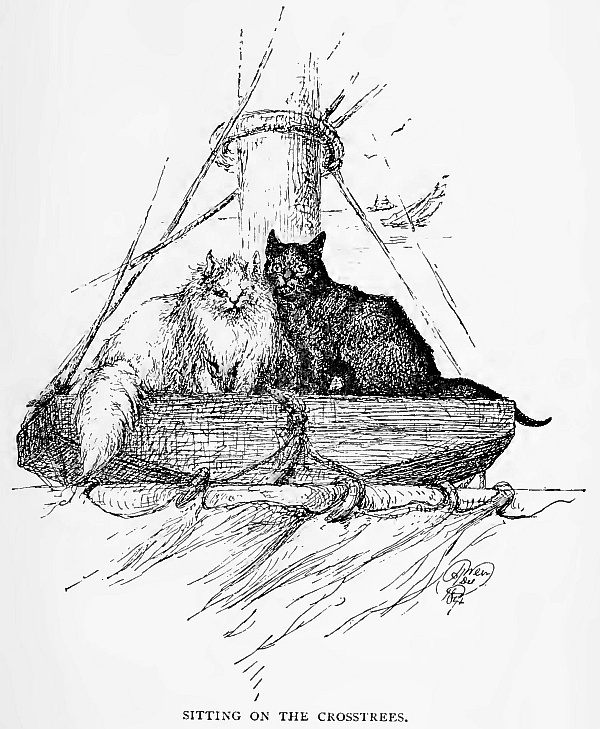
But long before we reached the city of Zanzibar I was, I think, quite as good a ship’s cat as Tom Brandy himself.
I’ll never forget, however, the first day Tom took me aloft.
We went as far as the maintop, and there we sat together talking for quite an hour.
“Hullo!” said Tom at last, “there goes eight bells and the bugle for dinner; come on, Shireen.”
Tom began to go down at once, but lo! when I looked over my heart grew faint and my head felt giddy, and I wouldn’t have ventured after Tom for anything.
“No, no, Tom,” I cried, “save yourself. Never mind me.”
“Why, there is no danger,” he answered. “Only you mustn’t try it head first as if you were coming out of a tree, but hand after hand, thus.”
And Tom soon disappeared.
I sat there till the shades of evening began to fall. Tom, however, hadn’t quite forgotten me, for he brought me up the breast of a chicken.
After I had partaken of it: “Will you try to come down now, Shireen?” he said.
“No, Tom,” I replied. “I shall end my days up here. I—”
I said no more. For at that moment a rough red face appeared over the top.
It was the honest sailor-man who had brought Tom Brandy on board, and he soon solved the difficulty by taking me down under his arm.
But I gained confidence after this, and was soon able to run up even to the top-gallant crosstrees, and come down again feet first, and hand after hand, just like Tom Brandy himself.
I’ll never forget the first day I heard the guns go off. Tom told me it was nothing. That we were merely chasing a slave-ship, and that the moment she lay to our brave sailors would board her, and very soon make an end of the Arabs.
Tom and I had crept into the largest gun that day, having found the tompion out. She was called a bow-chaser, whatever that may be, and she stood on a pivot away forward. The sun had been fearfully hot that forenoon, but Tom came aft to the quarter-deck, where I was lying panting, with my mouth open.
“Very hot, isn’t it?” said Tom.
“I feel roasting,” I replied.
“Well, follow me,” he said. “I know where it is dark and cool enough for anything. The tompion is out of the 56-pounder.”
“Whatever do you mean? What is a tompion, Tom? And what is a 56-pounder?”
“Come on and see, Shireen.”
Then we went to the gun.
“Follow your leader,” cried Tom, and in he crawled and soon was lost to view.
“But why, Tom?” I cried; “it must be dirty as well as dark. I’m afraid of soiling my coat.”
Tom looked out of the gun to laugh.
“Oh, Shireen!” he said, “the idea of a Royal Navy gun being dirty. I wonder what the gunner would say if you told him?”
So, half ashamed of myself, I jumped in. It was delightfully nice and cool, and so my companion and I fell sound asleep.
I was awakened before Tom by a voice. “Can’t load the bow-chaser, sir. Cats have both gone to sleep in it, and I can’t get ’em out.”
“Stick in a fuse,” cried the lieutenant, “and rouse them out.”
Immediately after there was a rang-bang let off behind us, and Tom and I were blown clean out of the gun.
We weren’t hurt, Warlock, for we both alighted on our feet; but, my blue eyes! I did get a scare.
Tom said that was nothing. He often went to sleep in the gun, and, as to being blown out with a fuse, it didn’t even singe one, and was quicker than walking.
But when the battle began in earnest, and the first gun went off, I bolted aft with my tail like a bottle-brush, and dived down below.
I tore in through the wardroom, and did not consider myself safe until I got into my master’s bed.
The battle didn’t last long. Tom told me it was only a small slaver. But she was captured, and towed astern, and Tom said there was some talk of hanging one or two of the Arabs, but I didn’t know anything about this. I was very pleased the fight was over.
Three slaves were brought on board. One was a little boy, with no more clothes on than a mermaid. And he was so black, children, that when he crawled up and put his arms round my neck, I quite expected to see a black ring round me next time I looked in the glass.
But the blackness didn’t come off.
Strangely enough, this poor little black child and I grew very great friends indeed.
I think that by this time, however, there wasn’t an officer or man in the ship, fore or aft, that didn’t love me very much.
Chapter Twelve.
Old Shipmates.
Tom and I, continued Shireen, weren’t the only pets on board the Venom. There was a monkey though, and a very large one he was. When he stood up he was as big as a second-class boy. The sailors had dressed him as a marine, and given him a wooden gun, and taught him to shake hands and salute. His name was Joe; but I’m sure he wasn’t happy, I often saw tears in his eyes, or thought I did. Perhaps he had been taken from his home, far away in the beautiful forests of Africa, and had left a wife and children behind him.
We had a mongoose too—a sly old grey creature that the men petted. But Tom never took to him, and used sometimes to whack him when nobody was looking.
We had a large chameleon just like Chammy,—and I wonder where Chammy is—our ship’s chameleon lived in an old coffee-pot that was turned down on its side like a kennel in the corner of the doctor’s cabin. He was chained to this just like a doggie, and used to catch little cockroaches and hammer-legged flies for himself all day.
In another part of the doctor’s cabin was a lizard four feet long, that looked terribly fierce and dangerous, he was also secured with a chain. In a hatbox, in the doctor’s cabin, lived a beautiful bronze-winged pigeon, who purred like a cat. Tom said he must be awfully good to eat, but he wouldn’t venture into the cabin for anything, owing to the dragon that was chained in the corner.
We had in the wardroom a grey parrot with a red tail that he was very proud of. And all the week through the parrot was allowed to go on deck if he liked, but not on Sundays, because once when he came to church in the middle of the service he set everybody laughing by calling the parson “Old Boots.”
The sailors now began to teach me tricks, and seeing that it pleased them very much, I tried to learn my lessons as quickly as possible.
On fine evenings then at smoking time, the men would call me forward, and a ring would be formed near to the winch and between the bows.
Jumping backwards and forwards over a stick, or over a man’s clasped hands, was nothing. Heigho! my dear children, this happened twenty years ago, although I remember it as if it were but yesterday. Well, I was supple and strong, and lithe of limb in those dear days, being little more than a kitten, and a man could hardly hold a stick so high that I couldn’t spring over it.
As soon as I was fairly well accomplished at this work, a piece of iron wire, bent in a half hoop, was used instead of the stick, and every night the sailor who was teaching me brought the two ends of the wire nearer and nearer, until at last it was a whole hoop and nothing else.
Next he covered the hoop half over with paper, leaving just a hole, but I was determined not to be beaten, and through I went.
One evening, to my surprise, the hoop was all covered with thin paper; nevertheless, when the man spoke kindly to me, and asked me to leap, through I went, and my education in leaping was supposed to be complete.
This man was afterwards called aft to the quarter-deck, and there, to the delight and amusement of the officers, and the envy of the mongoose, who couldn’t jump a bit, I went through the whole performance, and was applauded sky-high.
“Pussy,” said my master laughing, as he took me and fondled me in his arms, “I never knew before that you were a play actor.”
There were no rats on board the Venom, so Tom and I had an idle time of it. When Tom first came on board ship in Australia, there had been a large number of these nasty creatures in the vessel. They used to eat everything, and sometimes they got into the men’s hammocks for warmth, and slept with them all throughout the watch-in. Put Tom cleared the ship by degrees.
“That must have been fine fun,” said Warlock; “but it must have been dull times for Tom and you—no rats, no sport.”
“But,” added wise, wee Warlock, with a sigh, “it will be as bad in this country, Tabby, before long.”
“Yes,” said Tabby.
“What I would propose if I were in Parliament,” said Warlock, “would be this. We have a close season for birds, and even for seals, so we ought to have a close season for rats also.”
“Bravo! Bravo! tse, tse, tse!” cried Dick.
“Then if we had a close season for rats, though the farmers might grumble a bit, Tabby and I would have sport, and it is everybody for himself in this world. But, dear Mother Shireen, we are interrupting the easy flow of your narrative. Pray go on.”
Yes, Warlock, and I think if you wait for sport till a close season for rats becomes the law of the land, you’ll be pretty old and stiff before you get it. But on board the saucy Venom, although Tom and I scorned to catch cockroaches like the big ape and the mongoose, we had fine fun at night fishing.
“Fishing?” cried Tabby. “Why, whatever did you catch, Mother Shireen? Sharks?”
No, my dear, nor whales either, though a shark once nearly caught me. No, we caught flying fish, Tom and I.
“Tse, tse, tse!” from Dick.
I observe that Dick is much surprised. Perhaps he thinks I am becoming foolish in my old age. Not a bit of it, Dick. Tom taught me how to catch the flying fish, and I soon became a very apt pupil indeed. And easy work it was. You see, flying fish instead of being chased by dolphins, though they sometimes may be, or by sharks either, are generally out in shoals, looking for their own food, and they fly, Warlock, just for the fun of the thing.
“For sport like?” said Warlock.
Yes, Warlock, for sport.
Well, they always will fly to a light, and so all Tom and I had to do was to sit on the top of the bulwarks and look down. The starlight, flashing in our eyes, soon attracted the attention of the fish, and they jumped over our heads, and danced a jig on the deck behind us.
Then Tom and I went and had a very nice little supper, and there was always more than we could eat, so the men on watch had some too.
“Well, that is good,” said Tabby. “I’ve tried my hand at trout fishing, but I never heard of flying-fish catching like that before.”
“Trout fishing,” said Shireen, “is what I should call mere bottom fishing.”
“Yes, and you do go to the bottom too, with a plump.”
Shireen laughed.
“It may be all very well for short-haired Tabbies like you, my dear,” she remarked. “But, la! to get my jacket wet would entirely spoil it; besides, you know, I’m not so young as you. If I got wet I should be laid up with the rheumatics for a month to a dead certainty. Heigho! it might be a dead certainty too, though that, children, is only my little joke. But tell us Tabby, how you got on fishing.”
Tabby sat up for a moment, and Dick flew off her back, crying,—
“I say, I say, what is it? you r-r-rascal!”
“Well,” said Tabby, “it wasn’t with me that the catching of trout originated, nor with Warlock either. It happened thus. In a cottage near the forest, a year or two ago, there came an old maiden lady to live, who was very fond indeed of cats. She had three altogether, and she very wisely permitted them to roam about at the freedom of their own will. Two of her cats were ladies, the other was a fine red fellow, of the name of Joe.
“The gamekeepers said that Joe was a noted thief, and that he caught their birds and their leverets also, and that they would shoot him on sight. When the old lady heard this, she went straight to the keepers’ huts by the forest edge. Joe was trotting by her side, but as soon as they were within fifty yards of the cottages, Joe got up on his mistress’s shoulder. She was a strong old lady, and armed with a two-horse power umbrella in one hand, and a big book in the other.
“‘Do you see this cat?’ said Miss Simmonds to the head keeper.
“‘Can’t help seeing him, miss,’ he answered, ‘besides, we know him; he kills our birds and our leverets too, and we’ve seen him take a grilse out of the river!’
“‘Well, that is a pity; I just called to say that I was sorry, and that I will do my best to keep Joe at home, though this is difficult sometimes with a tom-cat, you know. But if he kills a bird or a leveret, you must let me know the amount of damage, and I’ll pay. But,’ she added, ‘you must not take the law into your own hands and shoot my cat.’
“‘Nonsense, miss!’ cried the keeper, pointing to a board on which was printed:
“Trespassers will be Prosecuted.”
“Dogs will be Shot.”
“‘That’s the way we serves dogs, miss, and it isn’t likely we’ll trouble about sparing a cat.’
“Then Miss Simmonds stuck her big umbrella ferule down in the turf, and took the big book from under her arm.
“‘Listen,’ she said. ‘Ahem! Corner versus Champneys. 2 Marsh, 584. A gamekeeper has no right to kill a dog for following game, even although the owner of the dog has received notice that trespassing dogs will be shot. In such a case as this, the shooter must pay the full price of the animal shot.’
“‘Didn’t know that before,’ said the keeper. ‘But, begging your pardon, miss, cats are not dogs.’
“‘The same law holds good, sir.’
“‘Cats can be trapped, miss.’
“‘Listen again,’ said Miss Simmonds. ‘Townsend versus Withan. In this case it was ruled that the defendant was answerable to the plaintiff for injuries sustained by his cat and dog in a trap, although he had no intention of injuring plaintiff, and meant only to catch foxes and vermin.’
“‘Poison, miss, is a quiet way of getting rid of cats. I’ll try that.’
“Once again, Miss Simmonds turned over the pages of her book, and proved to the satisfaction of even those surly keepers, that the putting down of poisoned flesh in a field laid the perpetrator under a penalty of 10 pounds.
“Well, although Miss Simmonds laid down the law to those men, she did not part from them in an unfriendly way, and something bright and yellow passed from her hand to that of the keeper.
“But in future Miss Simmonds restricted Joe’s liberty somewhat.
“Well, one day, Warlock and I were sitting by the burn (a small stream or rivulet is so called in Scotland) somewhat disconsolately, for we hadn’t had very much sport that day, only a few field mice and a mole, when I heard a cat mew softly within a few yards of me.
“I looked quickly round, and Warlock pricked up his ears, and prepared for instant combat.
“It was Joe.
“And very handsome he looked. I lost my heart to him at once.
“‘Shall I give him a fit?’ said Warlock.
“‘No, no,’ I cried hastily; ‘that is Joe.’
“‘I’m a little afraid of your dog, miss,’ said Joe. ‘Will he bite?’
“‘Oh, no, sir,’ I hastened to say.
“Then Joe advanced.
“All three soon got talking in quite a neighbourly kind of way, and the conversation naturally enough turned upon sport.
“‘We haven’t done much this forenoon,’ I said.
“‘Ah! then why don’t you catch trout?’
“Just at that moment fire seemed to flash from Joe’s yellow eyes. His nose was turned towards the stream; he was crouching low with his tail all a-quiver. Next minute he had left the bank and disappeared with a splash in the water.
“I was thunderstruck. So was Warlock. But Joe crept up the bank again almost directly, with a beautiful crimson-dotted yellow trout in his mouth.
“This he placed at my feet as a love-offering. Then he shook himself once or twice, and seemed quite pleased to see me enjoy the trout, the head and tail of which I gave to Warlock.
“‘Delightful, isn’t it?’ he said.
“‘Delicious!’ I replied.
“‘I’ve been a fisherman for over five years. You see, my late master had always been a disciple of Walton’s, and when only a kitten I used to sit and sing beside him, when packing his luncheon for the river’s side. I jumped up when he took down rod and basket, and would trot off with him all the way to the river. How eagerly I used to watch the skimming fly, and my master can make a lovely cast, and I couldn’t help being all of a tremble, and squaring my mouth, and emitting little screams of delight, when a fish rose to nibble; then when one was caught and thrown on the bank, nothing could prevent my jumping on it and killing it with blows of my paw. I did not put a tooth in it because master always fed me well, and I knew there was luncheon in the basket for me as well as for him.
“‘But I soon learned to catch fish myself, and now I not only spring on them as you saw me do just now, but where the stream is shallow, I fish as I have seen schoolboys do; for lying down on the bank I stretch my paw far in under it, and very often hand out a trout.’
“‘How clever!’ I said.
“‘It is wonderful!’ said Warlock.
“‘Well,’ said Joe, ‘you can do the same.’
“‘Can I?’ asked Warlock.
“‘No,’ said Joe smiling. ‘You’re only a dog, you know, but you can sit on a hillock, and watch and warn us if you see any fiend-boys coming along with catapults.’
“So, as Joe’s late master had been a disciple of Walton’s, I became a disciple of Joe’s. I think, Shireen, that I have proved a very apt pupil, though not quite as good yet as Joe. For Joe takes to the water like an Irish spaniel, and he told me that he often caught eels and also water rats.
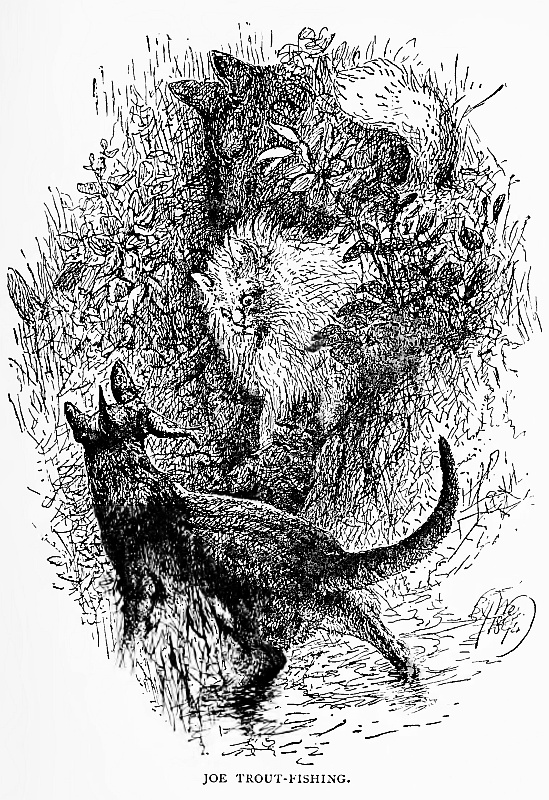
“My fishing lessons have been an advantage to me and to Warlock too, because previously I used to be rather afraid of the water, and more than once when Warlock and I were out hunting, and he swam over a stream, I had to go miles up or down till I found a bridge. But now I leap in just as Warlock does, and swim to the other side.”
Shireen got up and stretched herself now.
“I’ll go on with my story another night,” she said.
Then she jumped upon Colonel Clarkson’s knee.
“How fond that cat seems to be of you,” said Ben.
“Ah! yes, poor Shireen! She dearly loves both me and my wife. As for Lizzie and Tom, well, she adores them. But Tom here is such a good lad, and never pulls her about, for I have told him that pussy is very old, and, heigho! I daresay we’ll miss her some of these days.”
“But we can lift Tabby, can’t we, uncle?” said Lizzie.
“Well, I do think Tabby rather likes being teased just a very little, and I’m sure she would stand from you, Lizzie, treatment she would soon resent if Uncle Ben or I were going to resort to it.”
“Getting late,” said Uncle Ben, starting up. “But,” he added, “somehow when the wind roars as it does to-night, and takes my thoughts away back to the stormy ocean, I cannot help talking.”
“Won’t Cockie get wet?” said Mrs Clarkson. “Hadn’t you better leave him here to-night?”
“Bless your innocence, my dear Mrs Clarkson, the bird would break his heart.”
“Coakie wants to go home!” cried the cockatoo.
It will be observed that the bird called himself Coakie, not Cockie.
But Ben produced a big red handkerchief, and simply tied Cockie up as if he had been a bundle of collars going to the wash.
He placed the bundle under his arm, bade everybody good-night, then walked boldly forth into darkness and storm.
Chapter Thirteen.
“Away, Lifeboat’s Crew!”
The house where the Clarksons dwelt, with the two dear little orphans Lizzie and Tom, and to which Uncle Ben so often found his way, was a fine old place. It stood high on a great green brae, not far from the forest and sea, and had been at one time a real castle, for our friends only occupied the more modern portion of it. All the rest was in ruins, or nearly so.
It was within sound of the roar of a cataract, which could be heard ever and ay in drowsy monotony, except on stormy nights, when the wild wind, sweeping through the tall dark pine trees that grew on a beetling cliff top behind the ruin, quite drowned even the voice of the linn.
It was a rare old house and ruin for cats and children to play about; for there was not only quite a jungle of cover for birds of every sort, but the ivy itself that covered some of the sturdy grey walls gave berth and bield to more than one brown owl.
It was perhaps the noise made by the owls that gave rise to the notion, ripe enough among the peasantry, that the old Castle was haunted.
Lizzie and her brother both believed in this ghost. They made themselves believe, in fact, because it was romantic so to do.
There were fine old-fashioned walled-in gardens and lawns to play in besides, so that on the whole it was a kind of ideal place.
There was one peculiarity about the lawn that I should tell you of. The Colonel would not have it kept closely shaven, he loved to see the daisies growing thereon, and many a pink, crimson, or yellow nodding wild flower as well.
So all the summer long it was beautiful, and even in autumn too.
Lizzie and Tom were such gentle children, that none of the creatures of nature which visited the lawn, seemed to be one whit afraid of them. In fact, they—the children—were part and parcel of all that was beautiful in nature around them.
The mavises sang to them nearly all the year through, sometimes even in snow time. So did cock-robin, because he was always fed, even in summer. Lizzie and Tom knew where his nest was in a bank of wild roses, and robin appeared rather pleased than otherwise to have them come quietly round and take a peep at his yellow-throated gaping gorblings of youngsters.
“It takes me all my time,” cock-robin told Lizzie, “and all my wife’s time too, to feed them. Oh, they do eat and eat and eat to be sure. It is just stuff, stuff, stuff all day long; one beetle down the other come on, so that I haven’t time to sing a song to you. But wait till winter comes, and the youngsters are up and away, and won’t I just sing!”