Page 7 CONTENTS.
Reading edition
IRELAND.
Blarney Castle Lakes of Killarney Dublin (Instantaneous) Giant's Causeway
SCOTLAND.
Municipal Buildings, Glasgow Loch Lomond Forth Bridge Balmoral Castle Clamshell Cave, Island of Staffa Edinburgh (Instantaneous)
ENGLAND.
Liverpool (Instantaneous) Lime Street, Liverpool (Instantaneous) Manchester (Instantaneous) Warwick Castle, Warwick Shakespeare's House, Stratford-on-Avon Brighton Osborne House, Isle of Wight Hampton Court Palace, Hampton Court Greenwich Observatory, Greenwich
Windsor Castle.
Windsor Castle Green Drawing Room
London.
Midland Grand Hotel and St. Pancras Station The Strand (Instantaneous) Cheapside (Instantaneous) St. Paul's Cathedral The Bank of England (Instantaneous) Tower of London London Bridge (Instantaneous) Westminster Abbey Houses of Parliament Trafalgar Square Buckingham Palace Rotten Row (Instantaneous) Albert Memorial
BELGIUM.
Antwerp
Brussels.
Panoramic View of Brussels Palace of the King Bourse (Instantaneous) City Hall Cathedral of Ste. Gudule The Forbidden Book. Painting, Ooms
HOLLAND.
Scheveningen Amsterdam (Instantaneous) Windmill
NORWAY.
Christiansand Bergen Naerdfjord, Gudvnagen North Cape
RUSSIA.
Moscow Winter Palace, St. Petersburg
Page 8 GERMANY.
The Cathedral, Cologne Bingen Ehrenbreitstein Frankfort-on-the-Main Martin Luther's House, Frankfort-on-the-Main Ariadne on the Panther, Statuary, Dannecker University Building, Leipsic
Berlin.
Royal Palace Berlin, Unter den Linden Statue of Frederick the Great The Brandenburg Gate Monument of Victory
Potsdam.
The Historic Windmill
Dresden Gallery.
Madonna di San Sisto, Painting, Raphael Magdalene, Painting, Battoni
FRANCE.
Paris.
Bird's-eye View of Paris Place de la Concorde (Instantaneous) Madeleine (Instantaneous) Opera House (Instantaneous) Great Boulevards July Column Statue of the Republic Vendome Column Royal Palace Hotel de Ville Cathedral of Notre Dame Palace of Justice Arc of Triumph Dome des Invalides Tomb of Napoleon Eiffel Tower Pantheon Louvre Buildings
Louvre Gallery.
Venus de Milo, Statuary, Unknown Tomb of Phillippe Pot, Statuary, Renaissance Peacemaker of the Village, Painting, Greuze
Luxembourg Gallery.
The Last Veil, Statuary, Bouret Arrest in the Village, Painting, Salmson A Mother, Statuary, Lenoir Joan of Arc, Statuary, Chapu Paying the Reapers, Painting, Lhermitte Ignorance, Painting, Paton
Versailles.
Royal Palace Royal Carriage
Versailles Gallery.
Last Victims of the Reign of Terror, Painting, Muller Napoleon at Austerlitz, Painting, Vernet Napoleon, Painting, Gosse
Fontainebleau.
Royal Palace Throne Room Apartment of Tapestries Apartment of Mme. de Maintenon
SOUTHERN FRANCE.
Nice Monaco Page 9 Monte Carlo Gaming Hall, Monte Carlo
SPAIN.
Madrid Seville Bull Fight, Seville (Instantaneous) Toledo Gibraltar
PORTUGAL.
Lisbon
SWITZERLAND.
Kirchenfeld Bridge, Berne Clock Tower, Berne Peasant Woman Interlaken and the Jungfrau Grindelwald A Thousand Foot Chasm Brunig Pass Lucerne Rigi Rigi-Kulm Pilatus Simplon's Pass Zermatt and the Matterhorn Chamounix and Mont Blanc Engleberg St. Gotthard Railway Axenstrasse
AUSTRIA.
Vienna.
Panorama of Vienna Hotel Metropole Church of St. Stephen Theseus, Statuary, Canova Schönbrunn
TURKEY.
Constantinople.
Galata Bridge (Instantaneous) Mosque of St. Sophia Interior of the Mosque of St. Sophia Street Scene (Instantaneous) Mosque of Ahmed Turkish Lady Street Merchants Sultan's Harem
GREECE.
Acropolis, Athens Parthenon, Athens
ITALY.
Milan.
Grand Cathedral and Square Corso Venezia
Turin.
Exposition Buildings Duke Ferdinand of Genoa
Genoa.
General View of Genoa Statue of Columbus
Pisa.
Leaning Tower
Venice.
Palace of the Doges Grand Canal Cathedral of St. Mark Street Scene in Venice The Rialto (Instantaneous)
Page 10 Florence.
The Cathedral Vecchio Bridge Monk Loggia dei Lanzi Uffizi Buildings
Loggia Dei Lanzi.
Rape of Polyxena, Statuary, Fedi
Uffizi Gallery.
Wild Boar, Bronze The Grinder, Statuary, 16th Century
Rome.
Appian Way and Tomb of Cecilia Metella Pyramid of Cestius and St. Paul Gate Roman Forum Forum of Trajan Baths of Caracalla Colosseum Interior of Colosseum Pantheon Bridge of St. Angelo and Tomb of Hadrian St. Peter's and Vatican Interior of St. Peter's Romulus and Remus
Vatican Gallery.
Transfiguration, Painting, Raphael La Ballerina, Statuary, Canova Laocoonte, Statuary
Naples.
Toledo Street (Instantaneous)
Mount Vesuvius.
Crater
Pompeii.
Street of Tombs Civil Forum
Island of Capri.
General View and Landing
Island of Ischia.
Castello
EGYPT.
Alexandria.
Harbor Place of Mehemet Ali
Cairo.
Citadel Mosque of Mohammed 'Ali Street Scene Palace of Gezireh
On Camel-Back Pyramids of Gizeh Corner View of the Great Pyramid The Sphynx In Central Africa
Suez Canal.
Landing on Suez Canal (Instantaneous) Post Office, Suez
PALESTINE.
Yaffa or Jaffa
Jerusalem.
General View of Jerusalem Wailing Place of the Jews Street Scene
Garden of Gethsemane Bethlehem Dead Sea Nazareth Jacob's Well
SYRIA.
Beyrouth Page 11 Great Mosque, Damascus Ba'albek Mecca
INDIA.
Kalbadevie Road, Bombay Benares Tropical Scenery Heathen Temple Royal Observatory
CHINA.
Wong Tai Ken
SANDWICH ISLANDS.
Typical Scene
ALASKA.
Sitka Totem Poles
CANADA.
Parliament Buildings
UNITED STATES.
San Francisco.
Golden Gate Market Street, San Francisco
Yosemite Valley.
General View Glacier Point Mirror Lake Big Tree
Salt Lake City.
Great Mormon Temple
Yellowstone National Park.
Pulpit Terrace Obsidian Cliff Mammoth Paint Pots Old Faithful Geyser Yellowstone Lake and Hot Springs Yellowstone Falls Grand Cañon of the Yellowstone
Colorado.
Animas Cañon Grand Cañon of the Arkansas River Mountain of the Holy Cross Manitou and Pike's Peak Summit of Pike's Peak Gateway to the Garden of the Gods Cathedral Spires
Life in Oklahoma Indian Wigwam, Indian Territory State Street, Chicago, Ill. Niagara Falls, N. Y. Bunker Hill Monument, Boston, Mass.
New York.
Park Row Brooklyn Bridge Elevated Railroad Statue of Liberty
Philadelphia.
Chestnut Street Market Street
St. Augustine, Fla.
Fort San Marco Ponce de Leon
Washington, D. C.
The Capitol White House
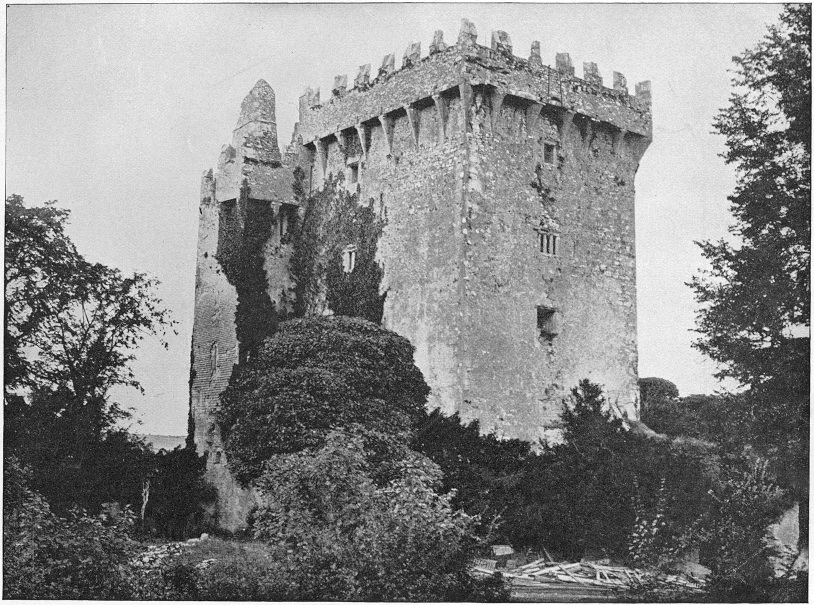
BLARNEY CASTLE, Ireland.—Here are observed the ruins of a famous old fortress, visited by thousands of tourists every year, on account of a tradition which has been attached for centuries to one of the stones used in building the castle. Its walls are 120 feet high and 18 feet thick; but it is principally noted for the "Blarney Stone," which is said to be endowed with the property of communicating to those who kiss its polished surface, the gift of gentle, insinuating speech. The triangular stone is 20 feet from the top, and contains this inscription: Cormack MacCarthy, "Fortis me fieri fecit A. D. 1446."
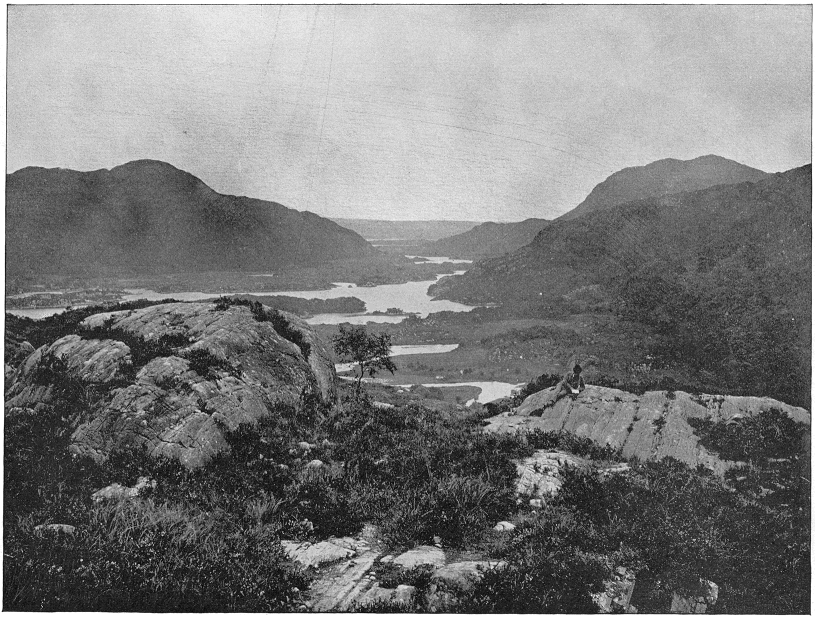
LAKES OF KILLARNEY, Ireland.—These are three connected lakes, near the centre of County Kerry. The largest contains thirty islands, and covers an area of fifteen square miles. The beautiful scenery along the lakes consists in the gracefulness of the mountain outlines and the rich and varied colorings of the wooded shores. Here the beholder falters, and his spirit is overawed as in a dream, while he contemplates the power and grandeur of the Creator. The lakes are visited by thousands of tourists annually. The above photograph gives a general view of them.
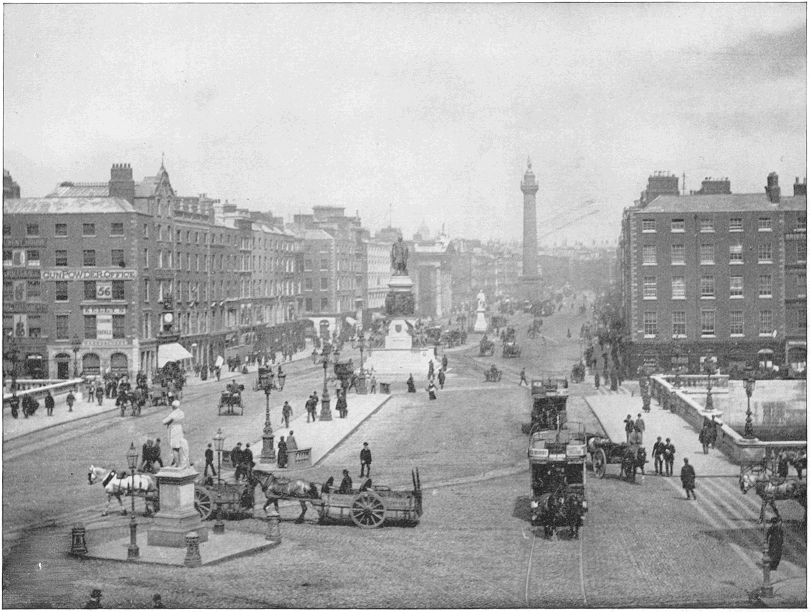
DUBLIN, Ireland.—Dublin, the capital and chief city of Ireland, is the centre of the political, ecclesiastical, educational, commercial, military and railroad enterprises of the kingdom. It is the residence of the Lord Lieutenant of Ireland, and it claims a high antiquity, having been in existence since the time of Ptolemy. In the ninth century it was taken by the Danes, who held sway for over two hundred years. In 1169 it was taken back by the English, and seven years later, its history began to be identified with that of Ireland. The city is divided into two parts by the Liffey, which is spanned by nine bridges. This photograph represents Sackville street, one of its principal thoroughfares.
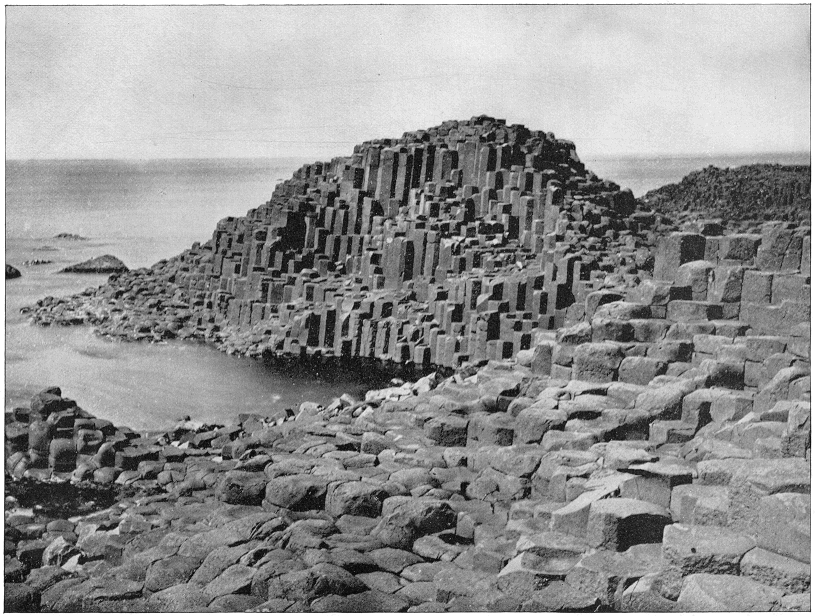
GIANT'S CAUSEWAY, Ireland.—The Giant's Causeway derives its name from a mythical legend, representing it to be the commencement of a road to be constructed by giants across the channel from Ireland to Scotland. It is a sort of pier or promontory of columnar basalt, projecting from the north coast of Antrim, Ireland, into the North Sea. It is divided by whin-dykes into the Little Causeway, the Middle or "Honeycomb Causeway" here represented, and the Grand Causeway. The pillars vary in diameter from 15 to 20 inches, and in height, from 10 to 20 feet. It is a most curious formation.
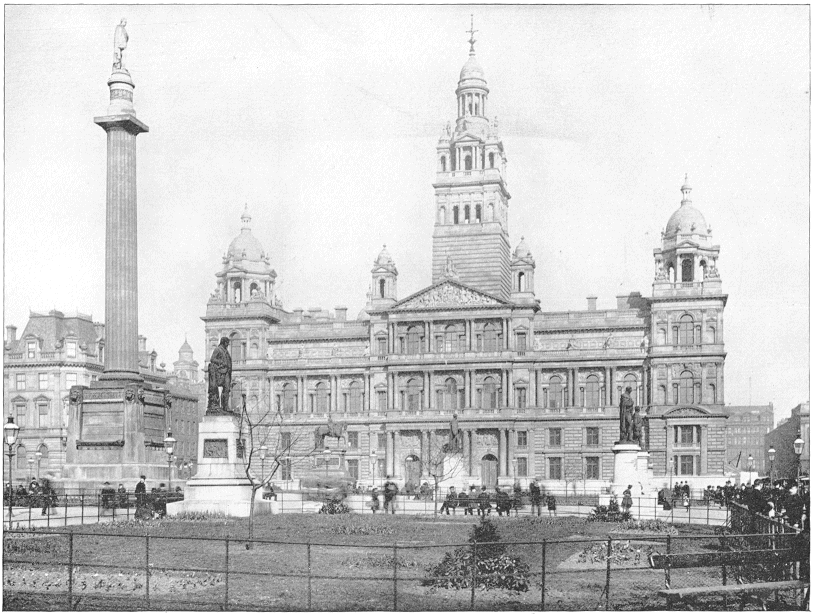
MUNICIPAL BUILDINGS, Glasgow, Scotland.—Glasgow is one of the best governed cities in Great Britain, and has a broad, bold and enlightened policy that conduces to the health, comfort and advancement of its citizens. This photograph represents its municipal buildings and a statue of Sir Walter Scott. The building is large and imposing, and of a mixed style of architecture. It was erected in 1860, at a cost of nearly half a million dollars, and has a tower 210 feet high. The Post Office, Bank of Scotland, Town Hall, Exchange and Revenue Buildings are close by.
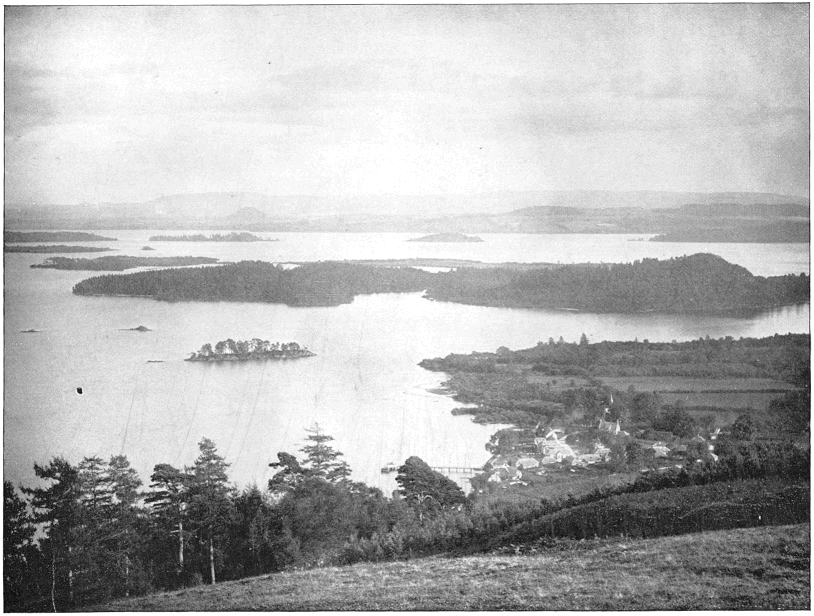
LOCH LOMOND, Scotland.—Here is presented the largest and, in many respects, the most beautiful of the Scottish Lakes; it is nearly twenty-five miles long, and from one to five miles wide. Its beauty is enhanced by the numerous wooded islands, among which the steamer threads its way. Some of the islands are of considerable size, and, by their craggy and wooded features, add greatly to the scenic beauty of the lake. Loch Lomond is unquestionably the pride of Scottish Lakes. It exceeds all others in extent and variety of scenery.
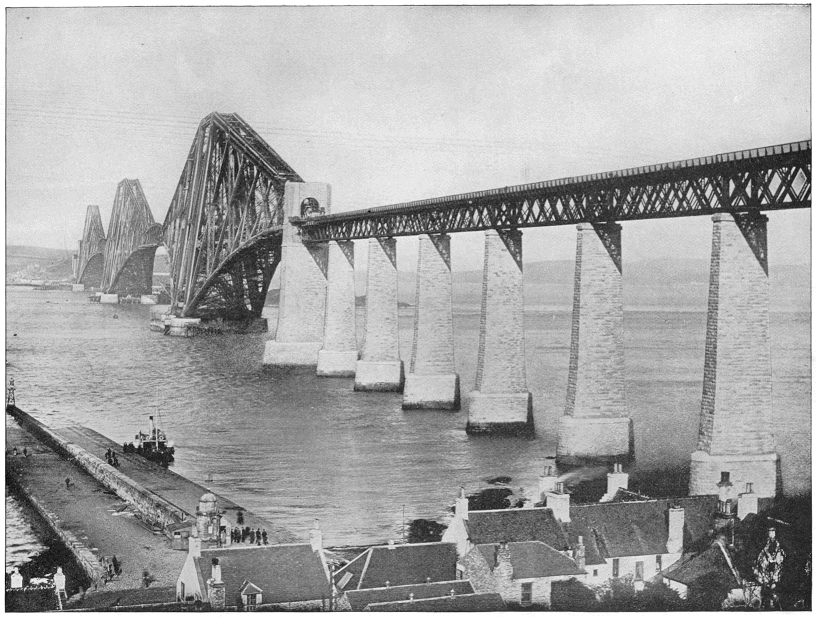
FORTH BRIDGE, Scotland.—This bridge, crossing the Firth of Forth, is pronounced the largest structure in the world, and is the most striking feat yet achieved in bridge-building. It is 8296 feet long, 354 feet high, and cost $12,500,000. It was begun in 1883, and completed in 1890. It is built on the cantilever and central girder system, the principle of which is that of "stable equilibrium," its own weight helping to balance it more firmly in position. Each of the main spans is 1700 feet long, and the deepest foundations are 88 feet. The weight of the metal in the bridge is 50,000 tons.
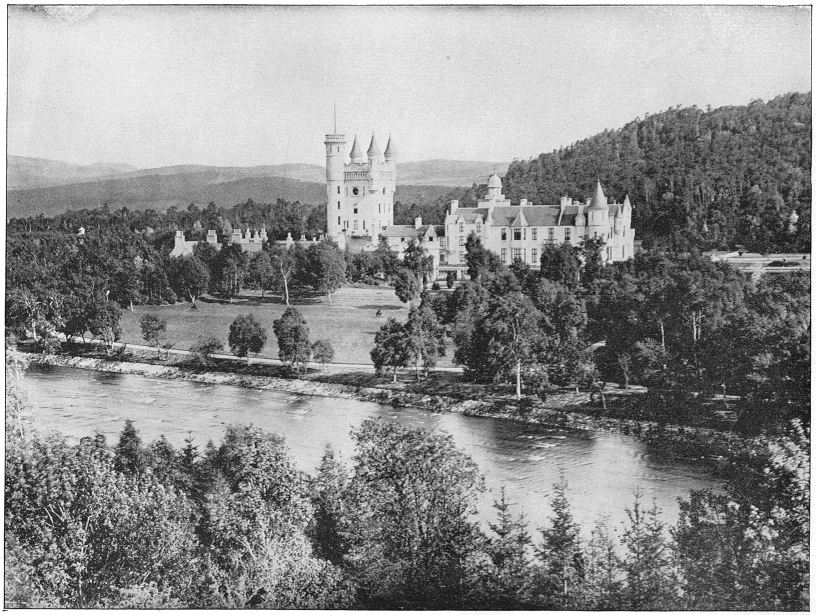
BALMORAL CASTLE, Scotland.—The above-named castle, the summer residence of Queen Victoria, is most beautifully and romantically situated in the Highlands of Scotland. The Queen has two other residences, one on the Isle of Wight, and the other at Windsor; but the Highland home is the most pleasant and attractive. The surrounding country is rich in deer, grouse and every other kind of game. The place is always guarded by soldiers, and no one is allowed to come near the castle, unless by special permission. The cairns which crown most of the hills, are memorials of friends of Her Majesty. The property covers forty thousand acres, three-fourths of which is a deer forest.
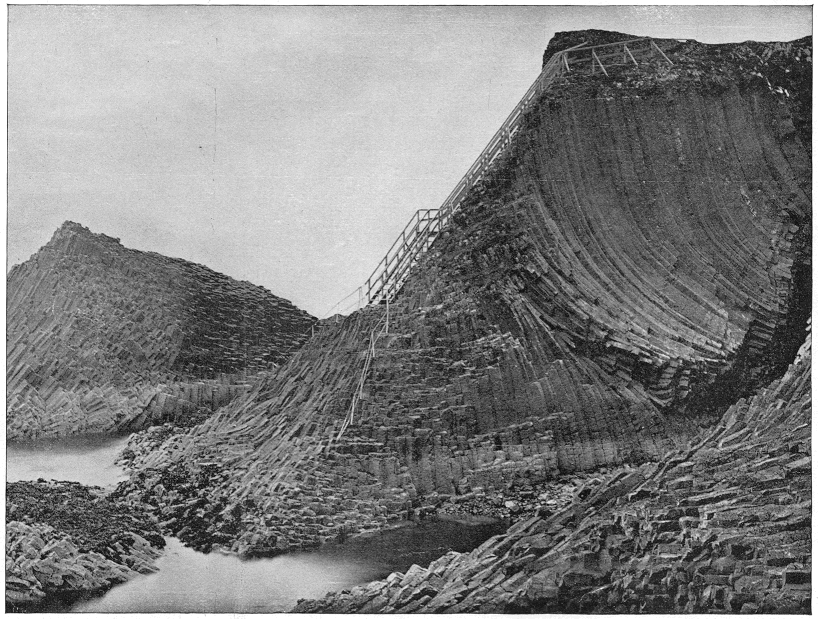
CLAMSHELL CAVE, Island of Staffa, Scotland.—The above cave is located on the Island of Staffa, in the Atlantic Ocean, not far from the mainland. It is one of those remarkable islands whose wonders have been known to the world for but little over a hundred years. The name of the island signifies columns or staves. At one time the coast was visited by violent volcanic actions, the effects of which may still be traced. Staffa is a little over a third of a mile in circumference, and presents a most interesting field of study for geologists.
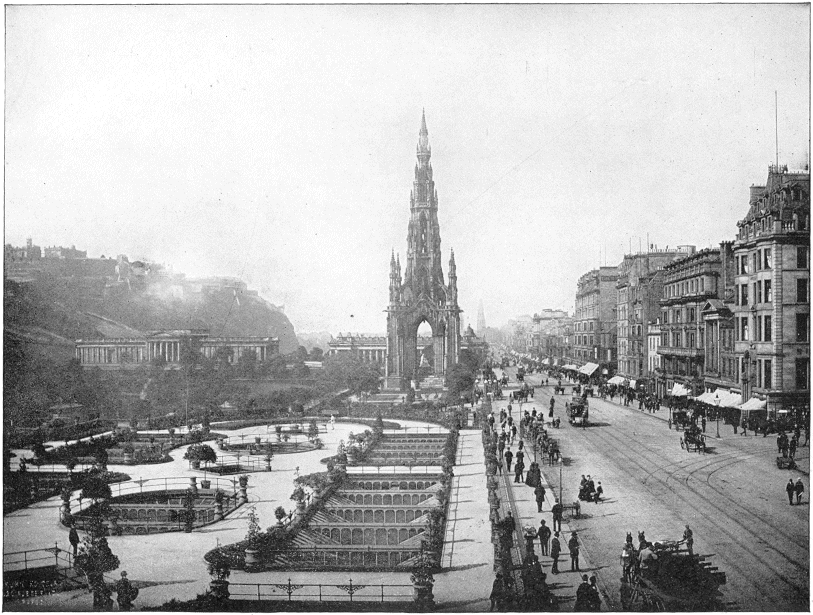
EDINBURGH, Scotland.—Edinburgh, the capital of Scotland, and one of the most romantically beautiful cities in Europe, is finely situated near the Firth of Forth. It is the seat of the administrative and judicial authorities of Scotland, and is renowned for its excellent university and schools. Its authentic history begins in 617, when King Edwin established a fortress on the Castle Rock. It consists of the picturesque Old Town, familiar to all readers of Walter Scott, and of the New Town, started in 1768. This photograph represents Princess Street, the principal thoroughfare of the New Town, Scott's Monument, and Castle Rock, the ancient seat of Scottish Kings.
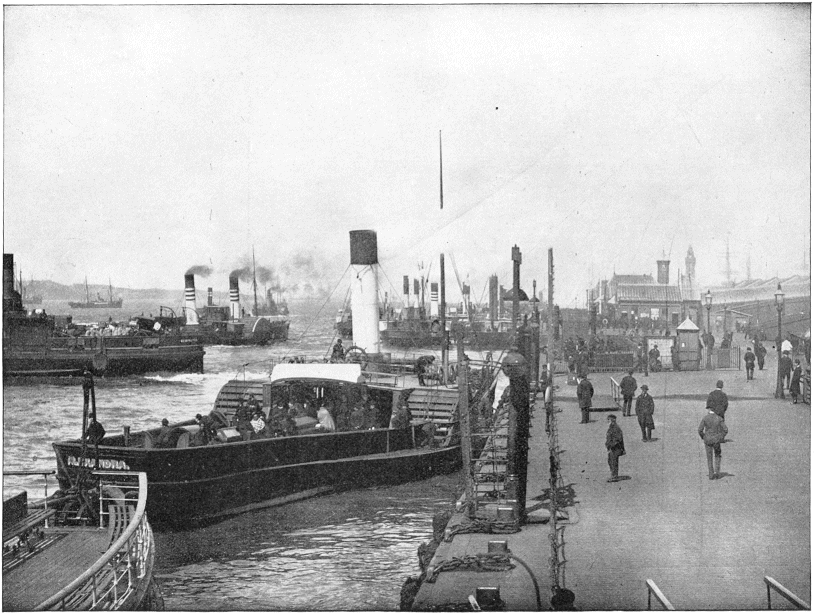
LIVERPOOL, England.—Liverpool, the second city and principal seaport of England, is situated on the right bank of the Mersey, three miles from the sea, and one hundred and eighty-five miles from London. The town was founded by King John in 1207, and its growth for several centuries was very slow. In 1840 regular steamboat communications were opened between it and New York, which, no doubt, established the modern pre-eminence of Liverpool. The importation of raw cotton from the United States forms the great staple of its commerce. The docks which flank the Mersey for a distance of seven miles, and give employment to thousands of workmen, are its most characteristic and interesting sights.
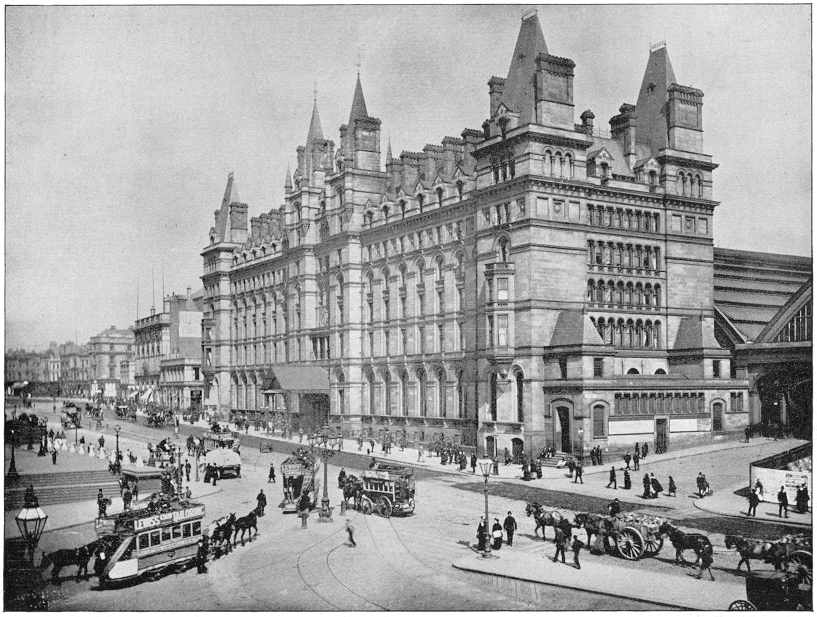
LIME STREET, Liverpool, England.—Situated on the north-east side of the River Mersey, near its mouth, stands the above city, extending for miles along its banks. Liverpool is noted for the magnificence of its docks, which are constructed on the most stupendous scale, and said to cover, including the dry docks, over two hundred acres, and fifteen miles of quays. Its principal avenue is Lime Street, represented by the above picture. The large building in the centre is the Terminal Hotel, of the London and Northwestern Railway, which starts from the rear of the building.
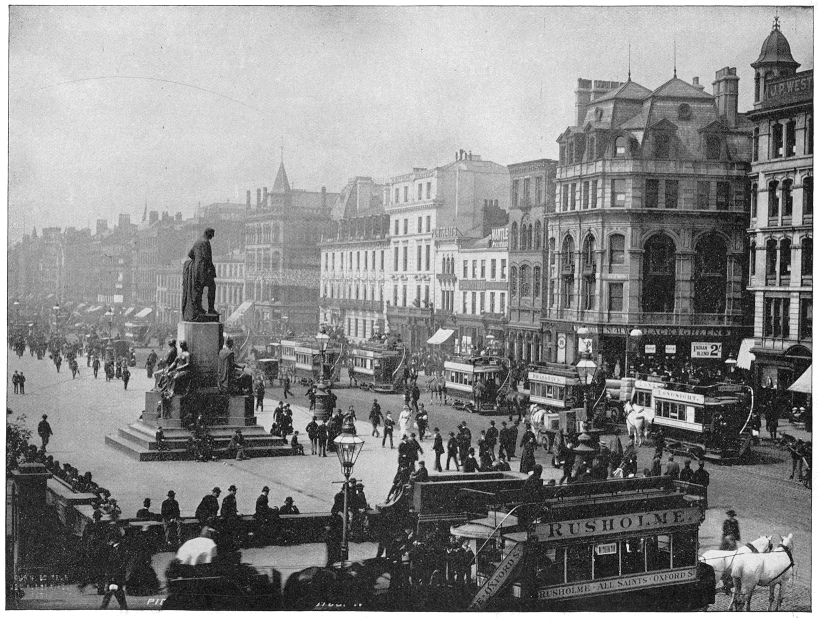
MANCHESTER, England.—Manchester is the chief industrial town of England, and the great metropolis of the manufacturers of cotton, silk, worsted, chemicals and machinery. Most of the streets of the older parts of the city are narrow, but those in the new parts are wide and attractive. The above picture represents Piccadilly Street, which is one of the principal thoroughfares. This avenue is bordered by magnificent shops, and always crowded with pedestrians, omnibuses and other vehicles. The statue in the centre is that of the Duke of Wellington. Piccadilly has a very animated appearance.
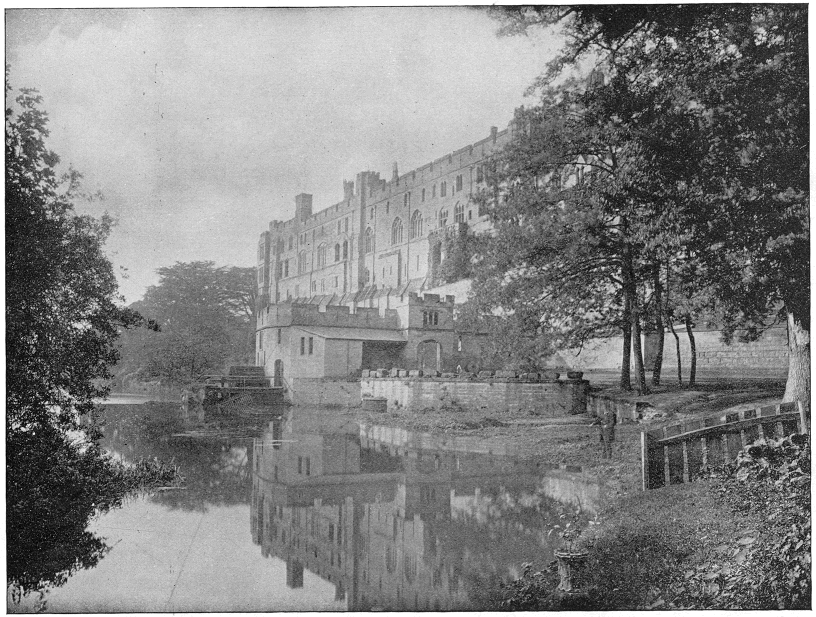
WARWICK CASTLE, Warwick, England.—Warwick, a quaint old town with 12,000 inhabitants, is situated on a hill rising from the River Avon, and is a place of great antiquity, having been originally a British settlement, and afterward occupied by the Romans. Legend goes back for its foundation to King Cymbeline, and the year one. On a commanding position, overlooking the Avon, stands Warwick Castle, the ancient and stately home of the Earl of Warwick. The Castle, which is one of the finest and most picturesque feudal residences in England, dates from Saxon times.
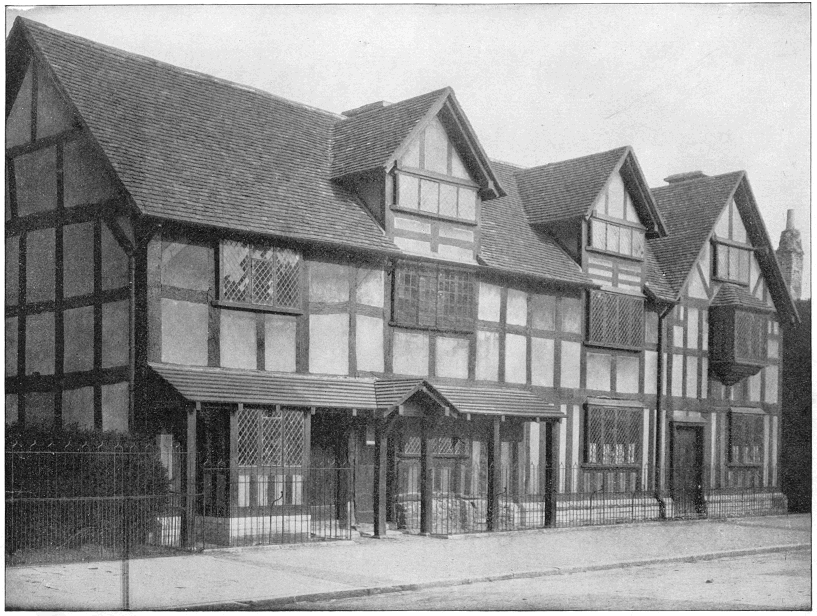
SHAKESPEARE'S HOUSE, Stratford-on-Avon, England.—Of all the ancient castles and monuments throughout England, the house of William Shakespeare at Stratford-on-Avon is perhaps the most interesting and popular. The chief literary glory of the world was born here, April 23, 1564, which gives his home an ancient and noted history. The house has undergone various vicissitudes since his time, but the framework remains substantially unaltered. The rooms to the right on the ground floor contain interesting collections of portraits, early editions of his productions, his school-desk and signet-ring. The garden back of the house contains a selection of the trees and flowers mentioned in his plays.
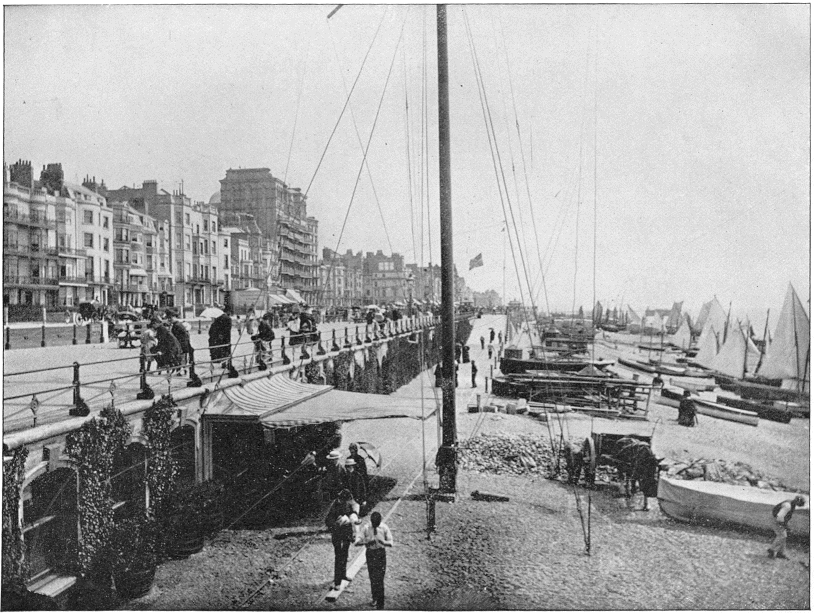
BRIGHTON, England.—This town, situated on the English Channel, forty-seven miles from London, extends three miles along the coast, and is fronted by a sea wall sixty feet in height, which forms a magnificent promenade. The town has elegant streets, squares and terraces, built in a style equal to the best in the metropolis. Its fisheries furnish large quantities of fish to the London market. In the time of George III., it was a mere fishing-village; but since his day, it has become the most fashionable watering-place in England.
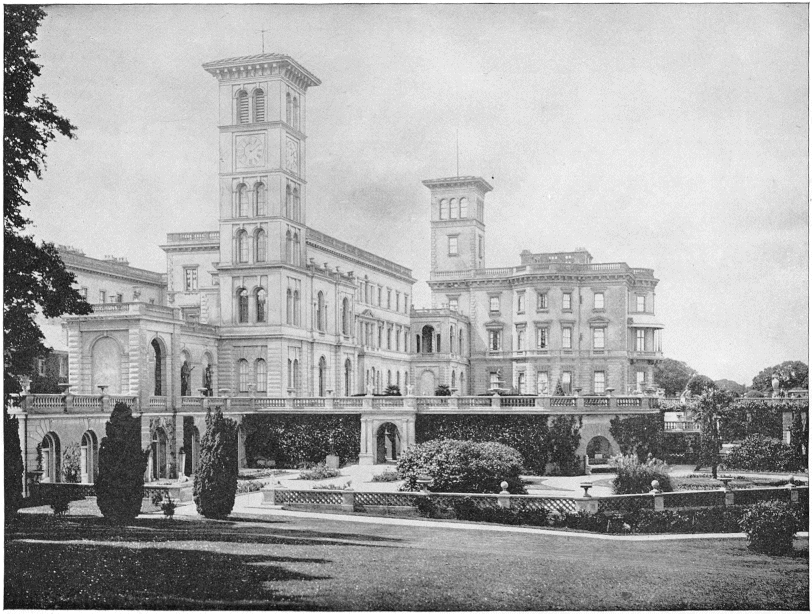
OSBORNE HOUSE, Isle of Wight, England.—This is the residence of the Queen of England; it was completed in 1845, and is located near Cowes. The latter town is on the north coast of the Isle of Wight, directly opposite to the mouth of Southampton Water. The port between them is the chief one of the island, and the headquarters of the Royal Yacht Squadron. Behind the harbor the houses rise picturesquely on gentle wooded slopes, and numerous villas adorn the vicinity. Magnificent residences and castles are located near by, of which the above picture is a fair representation.
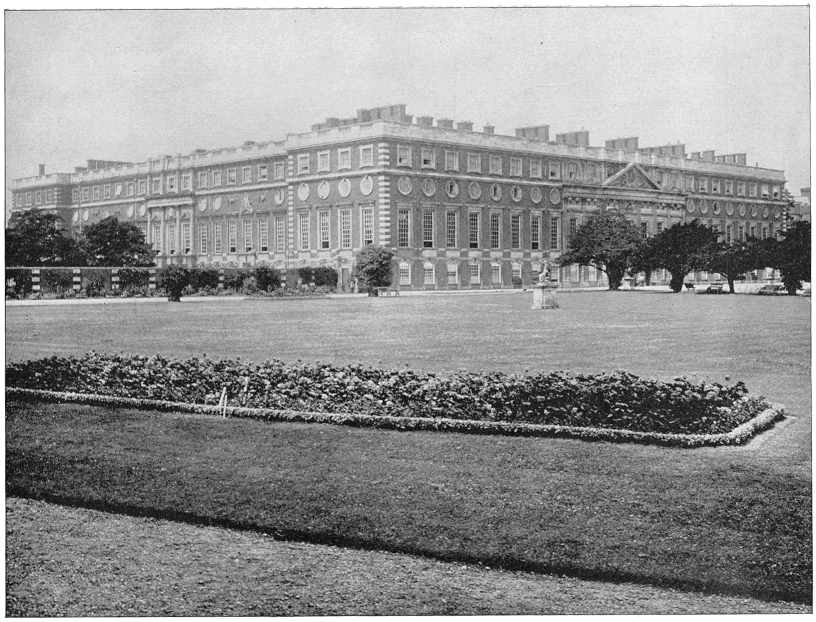
HAMPTON COURT PALACE, Hampton Court, England.—This palace was built by Cardinal Wolsey, the favorite of Henry VIII., and was afterwards presented to the King. It was subsequently occupied by Cromwell, the Stewarts, William III., and the first two monarchs of the House of Hanover. Since the time of George II., Hampton Court has ceased to be a royal residence, and is now inhabited by various pensioners of the Crown. The various rooms that were formerly occupied by the royalty, are now devoted to the use of an extensive picture-gallery.
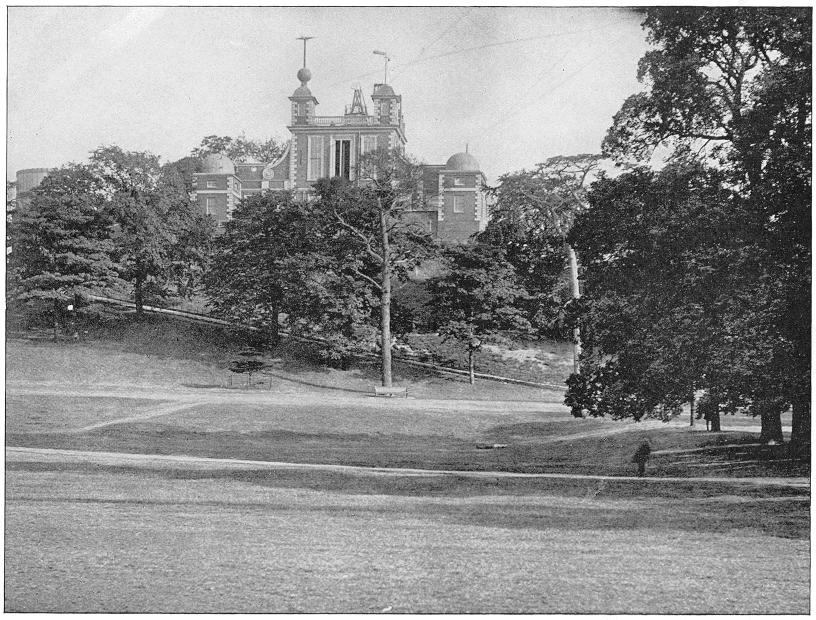
GREENWICH OBSERVATORY, Greenwich, England.—Greenwich Observatory is situated six miles from London Bridge, on a hill one hundred and eighty feet high, in the centre of Greenwich Park. It marks the meridian from which English astronomers make their calculations. The correct time for the whole of England is settled here every day at one o'clock P. M.; a large colored ball descends many feet, when the time is telegraphed to the most important towns throughout the country. A standard clock, with the hours numbered from one to twenty-four, and various standard measures of length are placed outside the entrance, pro bono publico.
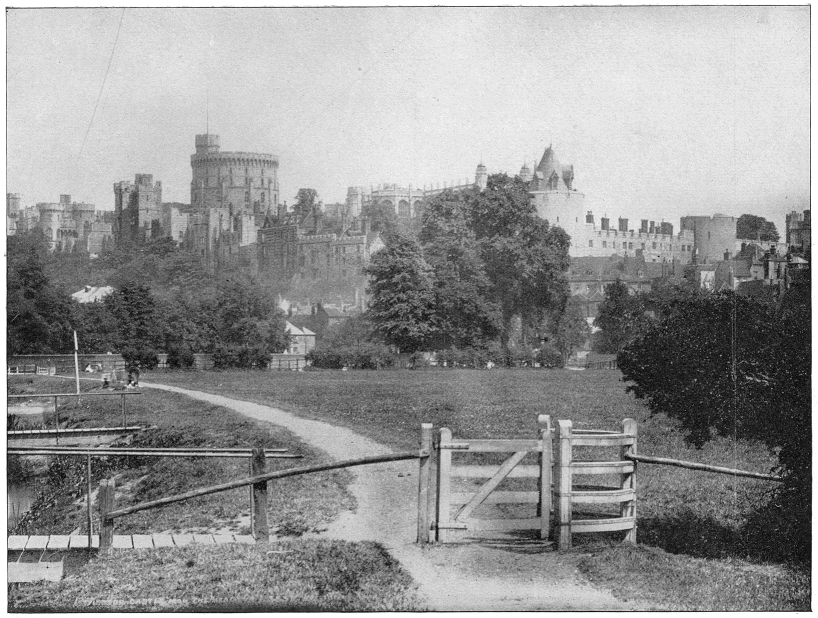
WINDSOR CASTLE, England.—This favorite seat of the sovereigns of Great Britain, twenty miles from London, at the town of Windsor, was frequently extended under succeeding monarchs, until finally, in the reign of Queen Victoria, when it was completed at a total cost of $4,500,000, it became one of the largest and most magnificent royal residences in the world. The Saxon kings resided on this spot long before the castle was founded by William the Conqueror. In its vaults are buried the sovereigns of England, including Henry VIII. and Charles I. The interior of the castle is richly and profusely decorated, and filled with pictures, statuary, bronze monuments and other works of art.
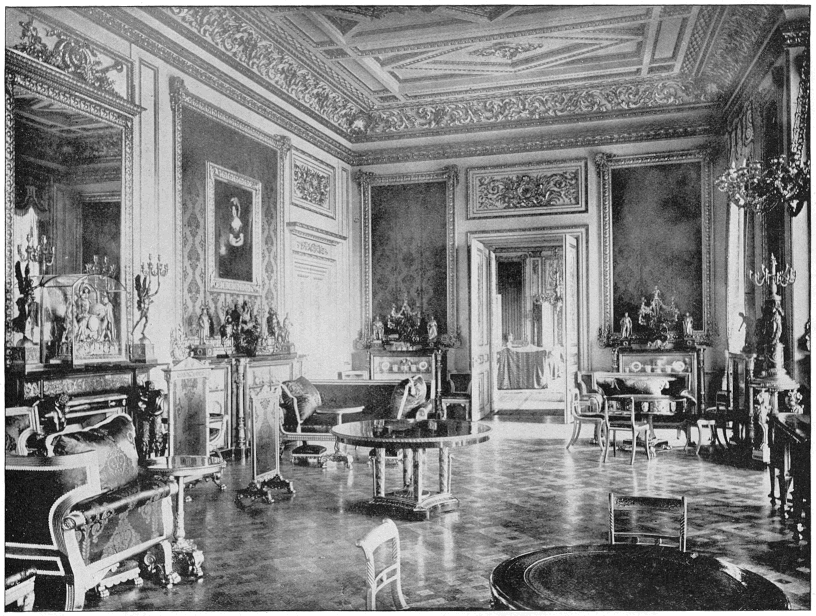
GREEN DRAWING-ROOM, Windsor Castle, England.—Windsor Castle, the residence of the Queen, is one of the largest and most magnificent royal residences in the world. The interior of the drawing-room, which is fitted up at an expense of many hundred thousand dollars, gives a person a fair conception of the elaborate and artistic display to be witnessed in numerous other apartments. The interior, beautified with colored marble, mosaics, sculpture, stained-glass, precious stones, and gilding in extraordinary profusion and richness, places it among the finest castles in all Europe.
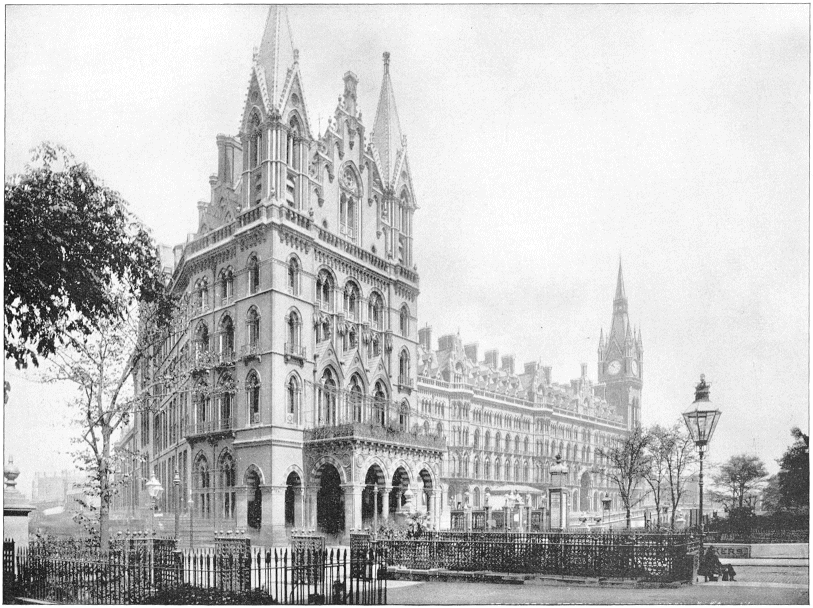
MIDLAND GRAND HOTEL AND ST. PANCRAS STATION, London, England.—The roof of this station is said to be the most extensive in the world, being seven hundred feet long, two hundred and forty feet span, and one hundred and fifty feet high. The hotel is the terminus of the railway by the same name, and is one of the largest in London. Travelers arriving at the metropolis of the world, by almost any of the large railway lines, can secure hotel accommodations at the end of their journey in the Railway Hotel.
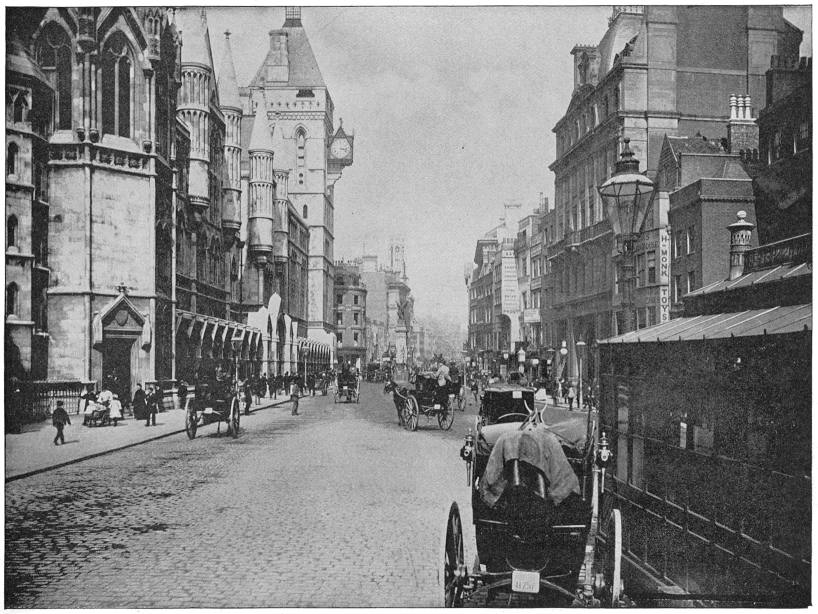
THE STRAND, London, England.—This street has been so named from its skirting the bank of the river, which is concealed here by the buildings. It is very broad, contains many handsome shops, and is the great artery of traffic between the city and the West End, and one of the busiest and most important thoroughfares in London. It was unpaved down to 1532. At that period many of the mansions of the nobility and hierarchy stood here, with gardens stretching down to the Thames. The buildings on the left are the new Law Courts.
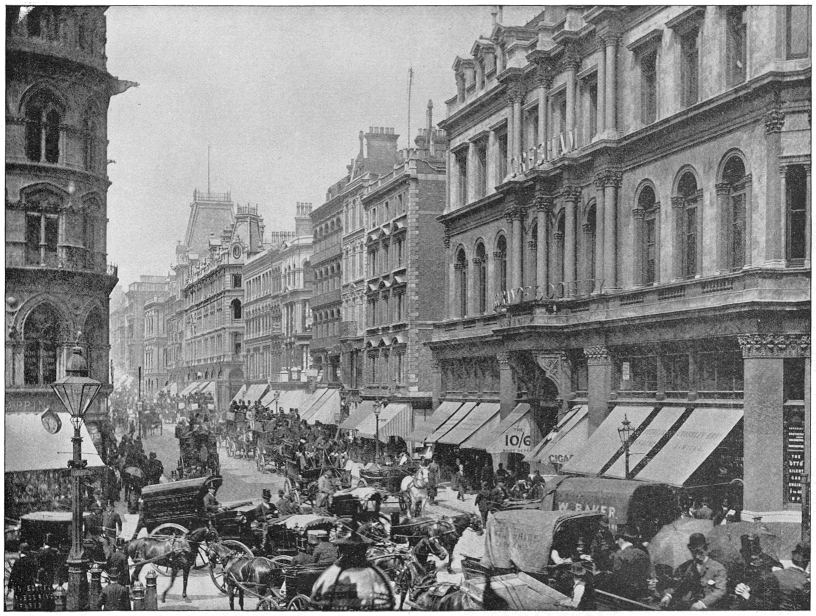
CHEAPSIDE, London, England.—This street is in the very heart of the "city" and is especially noted for its so-called "cheap shops," where is offered for sale every variety of articles, from a locomotive to a toothpick. The street is constantly so crowded with vehicles, that pedestrians are often delayed from fifteen to twenty minutes in crossing from one side to the other. It affords much pleasure to stroll along Cheapside and watch the crowds of pedestrians and vehicles pass up and down the avenue. The buildings lining Cheapside have an imposing appearance, and are of uniform architecture.
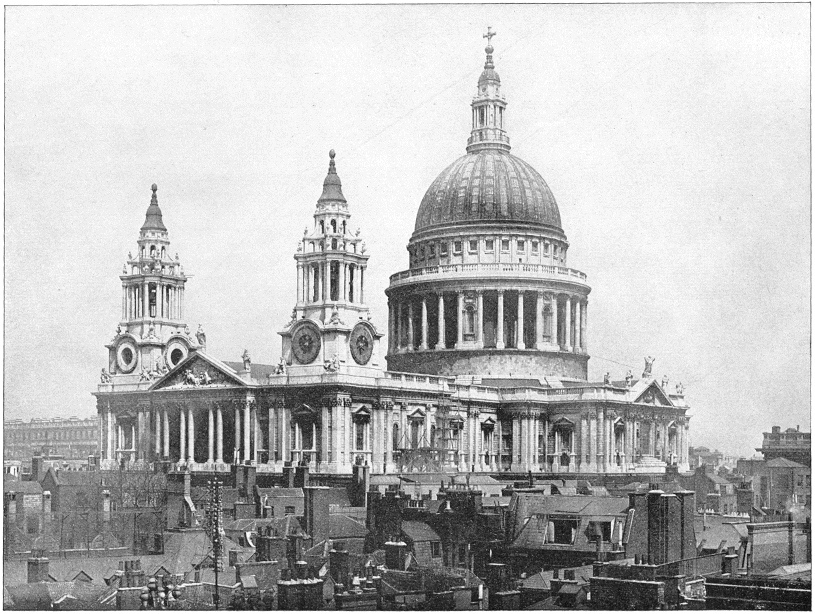
ST. PAUL'S CATHEDRAL, London, England.—Conspicuous, on a slight eminence in the very heart of London, stands the above-named cathedral, the most prominent building of the city. It is claimed that in Pagan times a temple of Diana occupied the site of St. Paul's. The present church was begun in 1675, opened for divine service in 1697, and completed in 1710. The bulk of its cost, amounting to nearly $4,000,000, was defrayed by a tax on coal. The church resembles St. Peter's at Rome, and is in the form of a Latin cross, five hundred feet long and one hundred and eighteen feet wide.
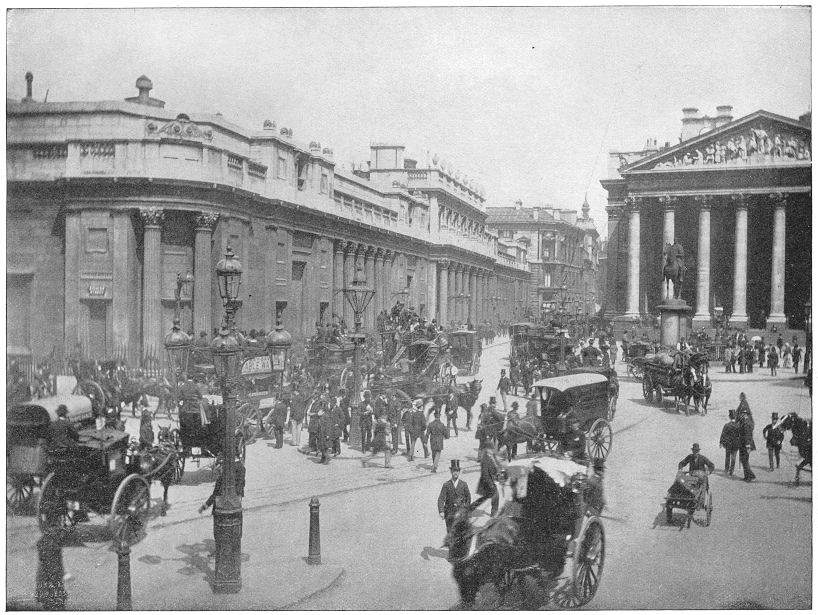
THE BANK OF ENGLAND, London, England.—This irregular, isolated, one-story building, covering an area of four acres, and located in the central part of London, is the largest and most powerful institution in the world. It is the only bank in London which has the power to issue paper money; its average daily business is over $10,000,000. It employs 900 people, and usually carries in its vaults from $75,000,000 to $100,000,000, while there are from 100 to 125,000,000 dollars of the bank's notes in circulation. On the right is the Stock Exchange, giving 1000 stock brokers daily employment.
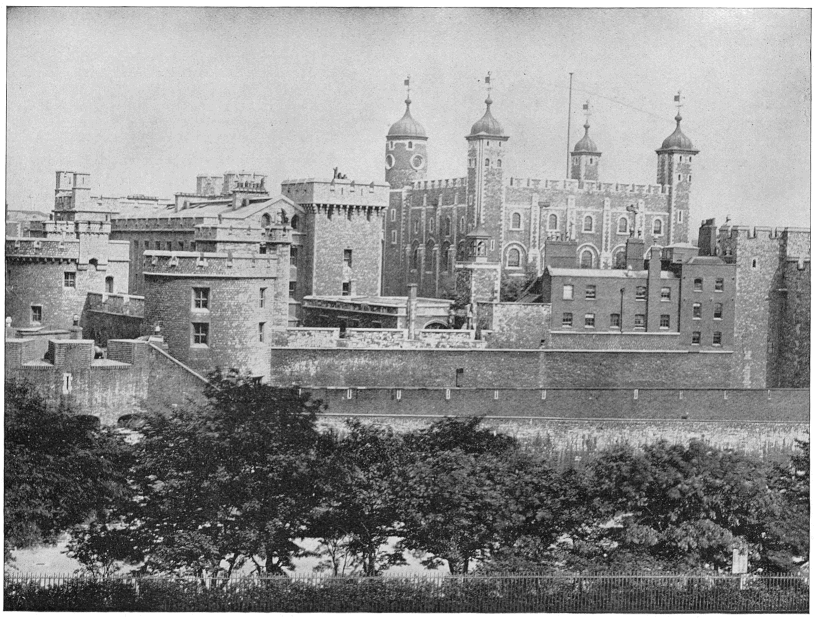
TOWER OF LONDON, London, England.—This celebrated fortress is located on the Thames in the eastern portion of London. Some of the most interesting events in the history of the Old World are clustered around these ancient relics. Some say the tower was commenced by Julius Cæsar, while most writers affirm that William the Conqueror commenced it in 1078. The tower-walls enclose about twelve acres, on the outside of which is a deep ditch or moat, formerly filled with water. The tower was for a time a residence for the Monarchs of England; afterwards a prison for State criminals.
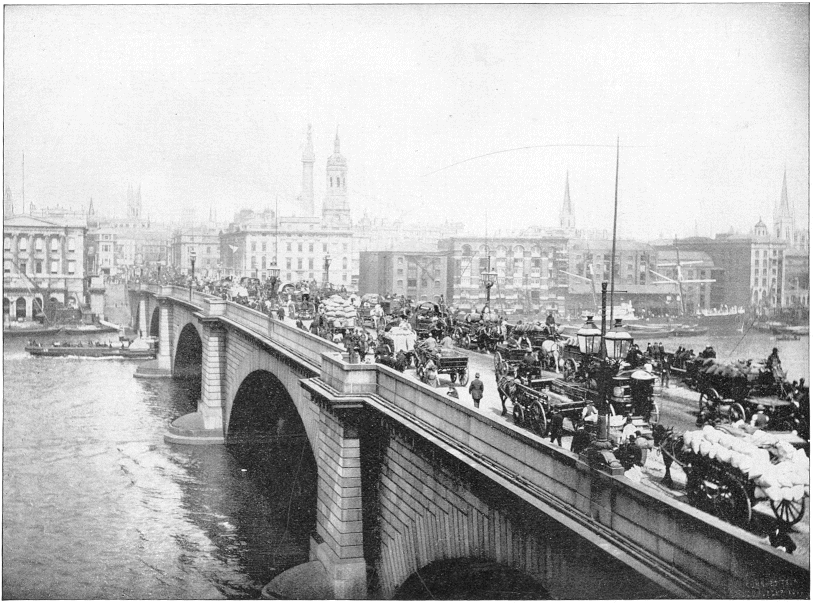
LONDON BRIDGE, London, England.—Centuries ago the Saxons and Romans erected various wooden bridges over the Thames, on the site of the present London Bridge; but they were all carried away by floods, or destroyed by fire. This bridge was begun in 1825 and completed in 1831 at a cost of $10,000,000. The bridge, 928 feet long and 54 feet wide, is borne by five granite arches, that in the centre having a span of 152 feet. The lamp-posts on the bridge are cast of the metal of French cannons captured in the Peninsular War. About 15,000 vehicles and 100,000 pedestrians cross the bridge daily.
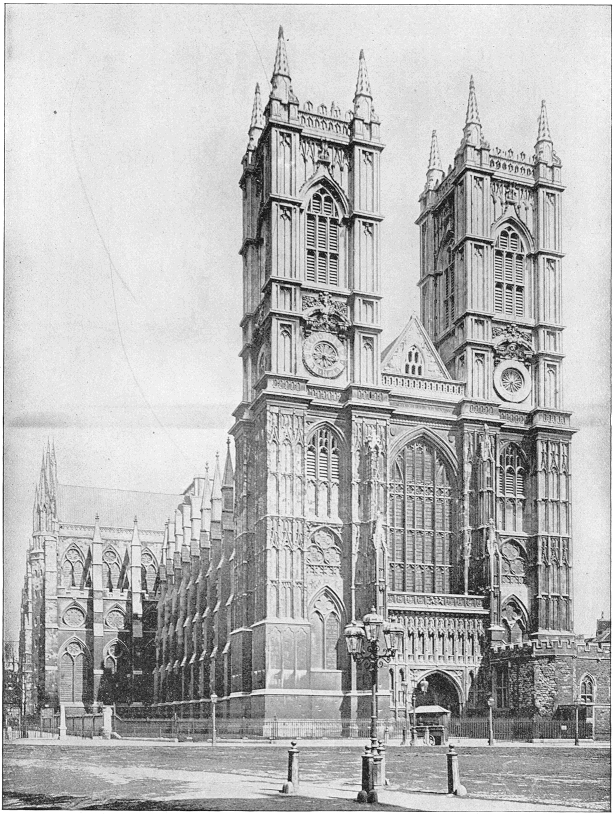
WESTMINSTER ABBEY, London, England.—The Abbey, built in the form of cross, four hundred feet long and two hundred feet wide, is of Gothic design, and was founded in 610 A. D.
"That antique pile, Where royal heads receive the sacred gold; It give them crowns, and does their ashes keep; There made like gods, like mortals there they sleep, Making the circle of their reign complete. These sons of Empire, where they rise, they set."
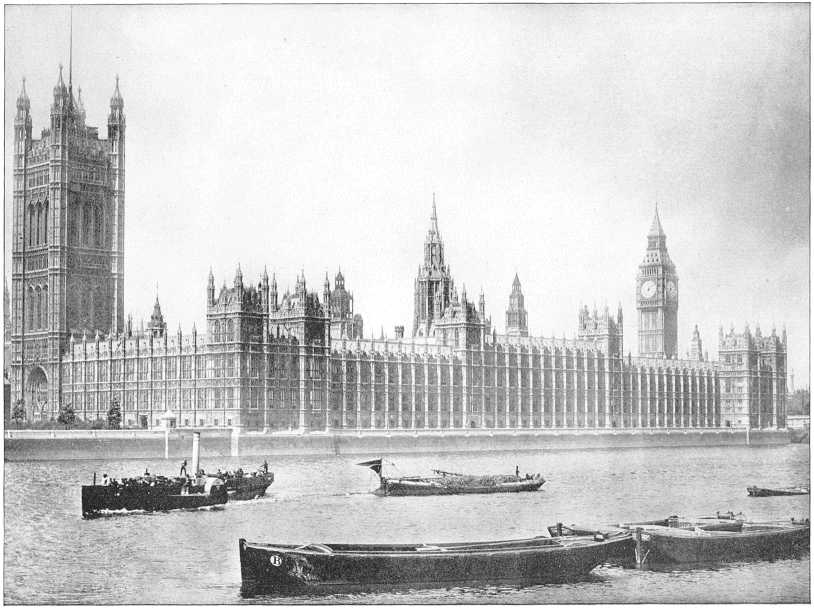
HOUSES OF PARLIAMENT, London, England.—These edifices form a single pile of buildings of the richest Gothic style. They cover over eight acres, contain one hundred stair-cases, eleven hundred apartments, and cost $15,000,000. They are perhaps the most costly national structure in the world. The Queen enters on the opening and prorogation of Parliament through the Victoria Tower, which is three hundred and forty feet high. The imposing river-front of the edifice is nine hundred and forty feet long, and adorned with statues of English monarchs, from William the Conqueror to Queen Victoria.
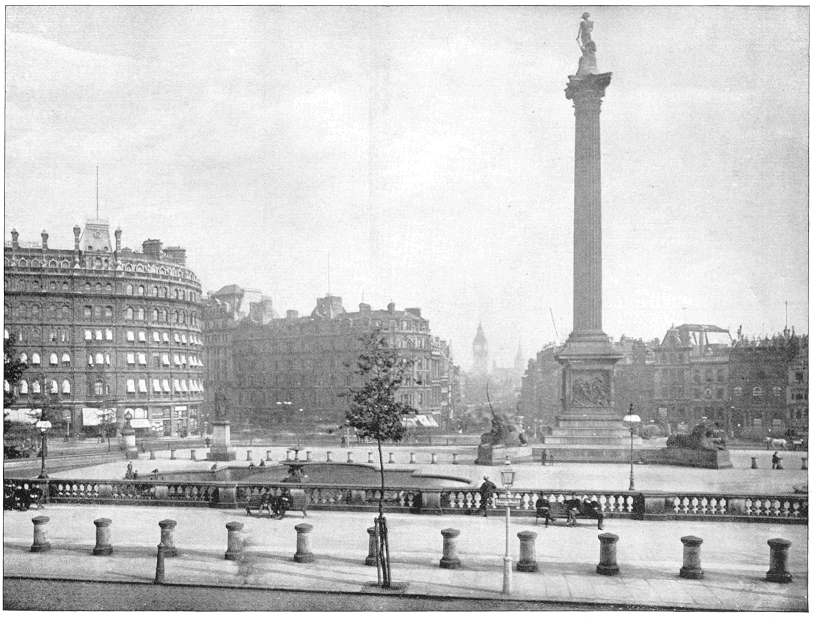
TRAFALGAR SQUARE, London, England.—Here is one of the finest open places in London. This great square, which is a centre of attraction, was dedicated to Lord Nelson, and commemorates his glorious death in the battle of Trafalgar, October 22, 1805, gained by the English fleet over the combined armaments of France and Spain. In the centre of the Square, rises to the memory of the great hero, a massive granite column, one hundred and fifty-four feet high, and crowned with a statue of Nelson. At the foot of the pedestal is inscribed his last command, "England expects every man will do his duty."
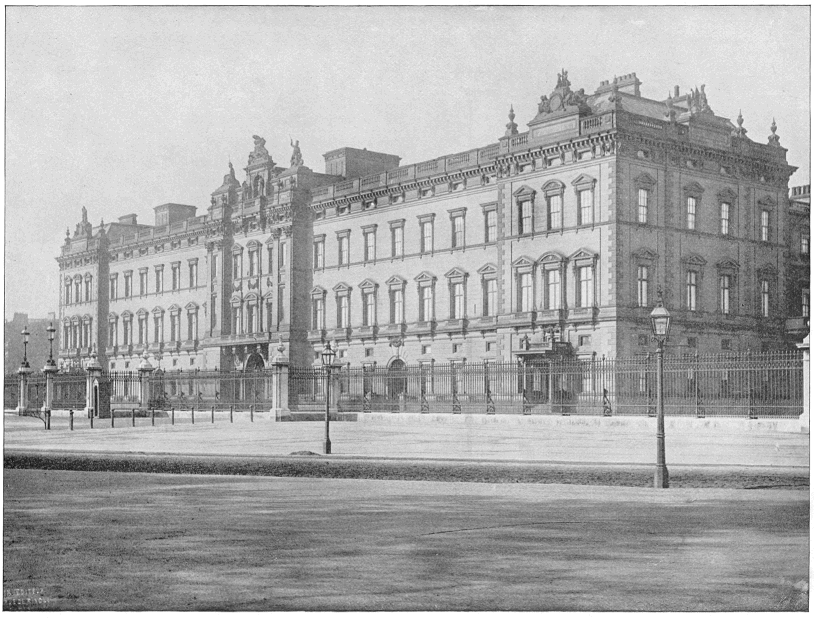
BUCKINGHAM PALACE, London, England.—The above palace, being now the Queen's residence and occupying the site of Buckingham House, was erected in 1703 by the Duke of Buckingham, and purchased by George III. His successor remodeled it in 1825, but it remained vacant until 1837, when it was occupied by Queen Victoria, whose residence it has since continued to be. The palace now forms a quadrangle, and is three hundred and sixty feet long. It contains a sculpture-gallery, a library, green drawing-room, throne-room, grand saloon, state ball-room, picture-gallery and private apartments.
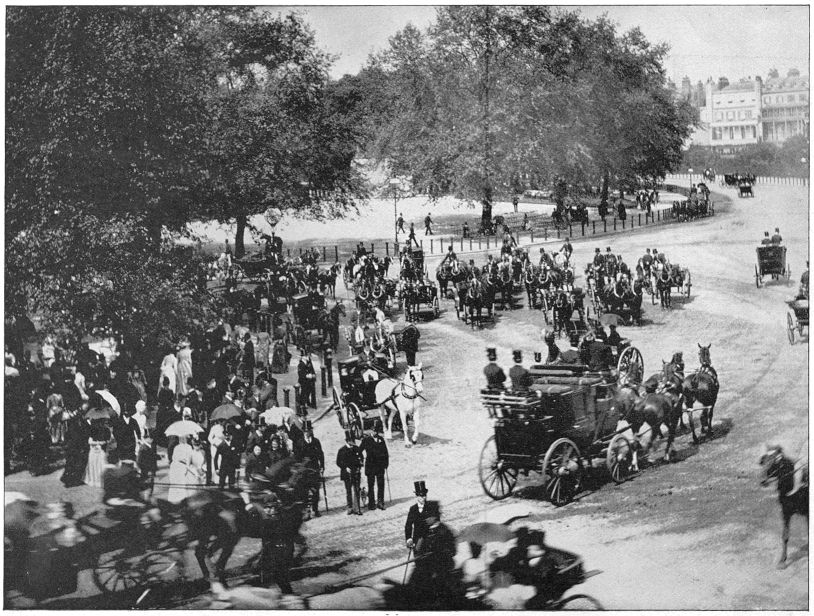
ROTTEN ROW, London, England.—Rotten Row is the finest portion of Hyde Park, irrespectively of the magnificent groups of trees and expanses of grass for which English parks stand pre-eminent. The Park is surrounded by a handsome and lofty iron railing, and provided with nine carriage entrances. In the spring and summer the fashionable world rides, drives or walks through the Row; and in the drives are seen unbroken files of elegant equipages and high-bred horses in handsome trappings moving continually, presided over by sleek coachmen and powdered lackeys, and occupied by some of the most beautiful and exquisitely dressed women in the world.
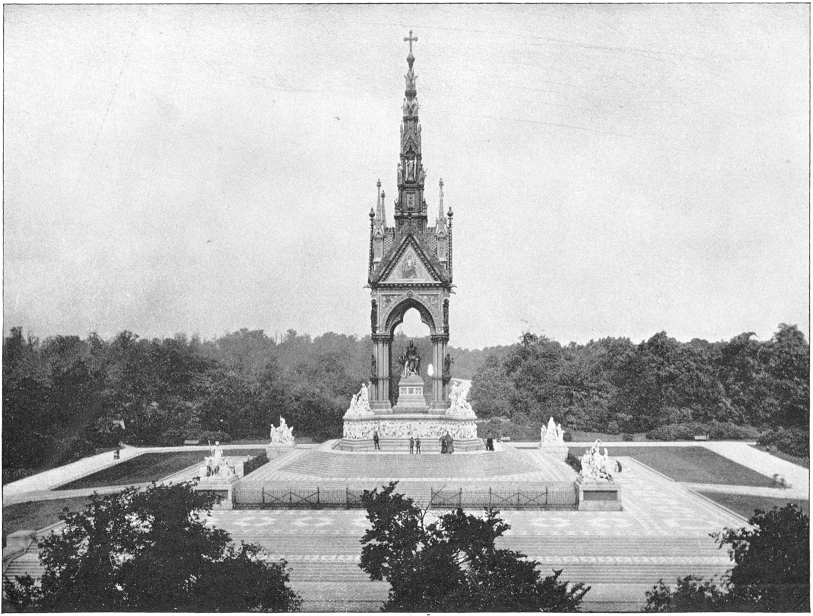
ALBERT MEMORIAL, London, England.—This magnificent monument to Albert, the late Prince Consort, was erected by the English nation at a cost of $600,000. On a spacious platform, to which granite steps ascend on each side, rises a basement adorned with reliefs in marble, representing artists of every period, poets. musicians, painters and sculptors. In the centre of the basement sits the colossal bronze-gilt figure of Prince Albert. The canopy terminates at the top in a Gothic spire, rising in three stages and surmounted by a cross. The monument is one hundred and seventy-five feet high, and gorgeously embellished with bronze and marble statues, gildings, colored stones and mosaic.
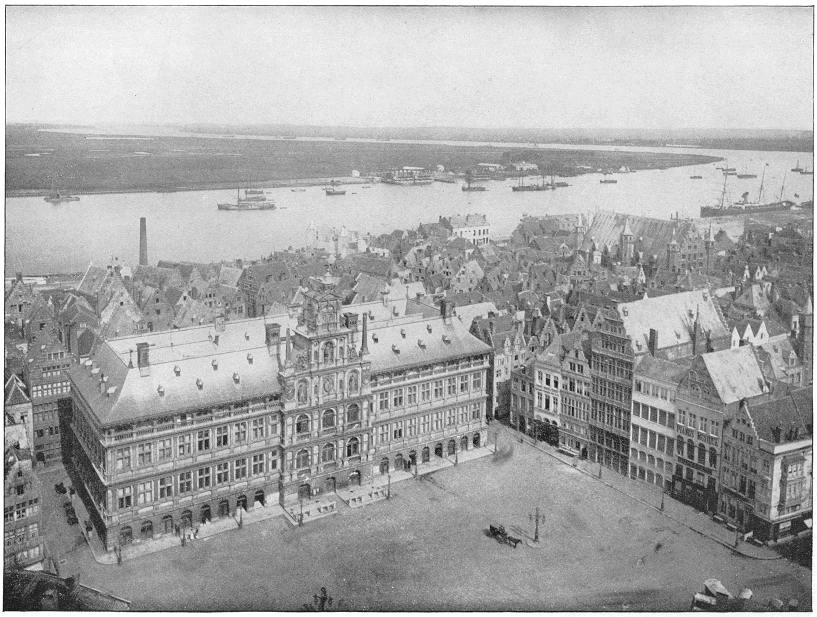
ANTWERP, Belgium.—Antwerp, the capital of a province of its own name, stands on the right bank of the Scheldt. It is strongly fortified; its walls and other defenses completely encompass the city on the land sides, having more than twelve miles of massive ramparts. The appearance of Antwerp is exceedingly picturesque, an effect produced by its numerous churches, convents, magnificent public buildings, its elaborate and extensive fortifications, the profusion of beautiful trees, and by the stately antique-looking houses which line its older thoroughfares. Of the docks, dock-yards and basins, constructed by Bonaparte at an expense of $10,000,000, the last only remains. Its harbor is one of the finest in the world.
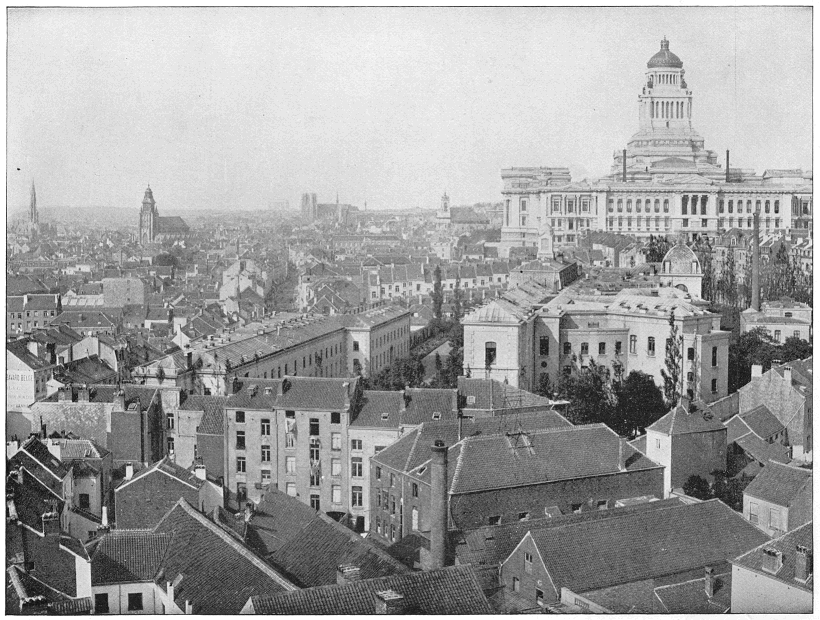
PANORAMIC VIEW OF BRUSSELS, Belgium.—Brussels, the capitol of Belgium and the residence of the royal family, is situated nearly in the centre of the Kingdom. The above picture presents a general view of the city, the tile roofs of the houses, with the Palace of Justice looming up in the background. This stately edifice, completed in 1883, was erected at an expense of over $10,000,000. This high tower of marble forcibly suggests the mighty structures of ancient Egypt or Assyria, and the vast amount of energy spent in their erection.
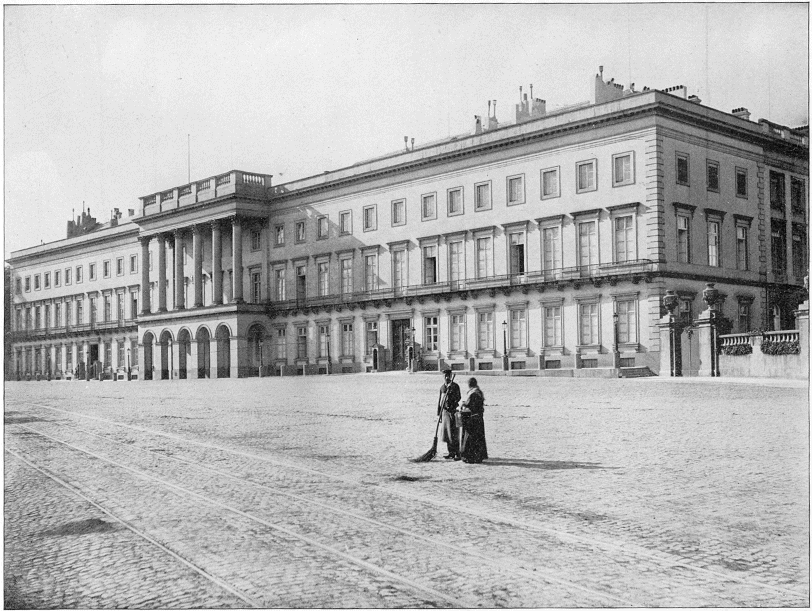
PALACE OF THE KING, Brussels, Belgium.—The above edifice originally consisted of two buildings, which were erected during the last century. These were connected by an intervening structure, and adorned in 1827 with a Corinthian colonnade. It is one of the principal and notable buildings of the City of Brussels. The interior contains a number of apartments handsomely fitted up, and a great variety of ancient and modern pictures. A flag hoisted on the palace announces the presence of the King.
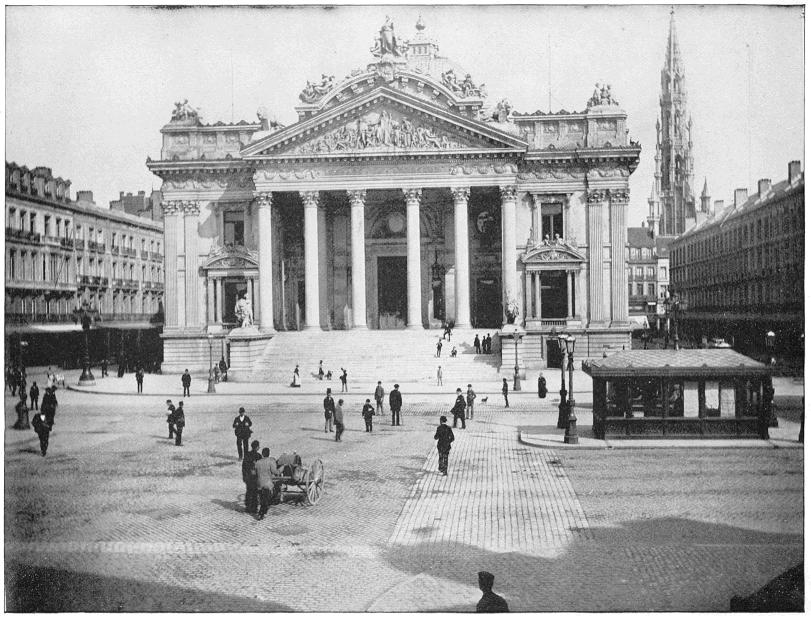
BOURSE, Brussels, Belgium.—In the central portion of the City of Brussels on the Boulevard Anspach, rises the Bourse or New Exchange, an imposing pile in Louis XIV. style. Its vast proportions and almost excessive richness of ornamentation combine to make the building worthy of being the commercial centre of an important metropolis; but it has been sadly disfigured by the application of a coat of paint, necessitated by the foible nature of the stone. The principal façade is embellished with a Corinthian colonnade, to which there is an ascent of twenty steps.
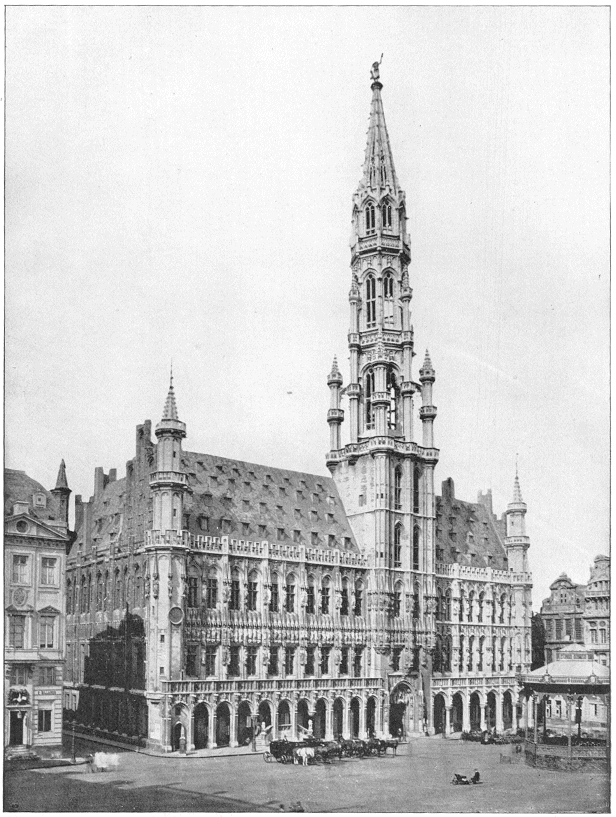
CITY HALL, Brussels, Belgium.—This is by far the most interesting edifice in the city, and one of the noblest and most beautiful buildings of the kind in Belgium. It is of irregular, quadrangular form, one hundred and ninety-eight feet in length, and one hundred and sixty-five feet in depth, and encloses a court. The principal façade is of Gothic style, and the graceful tower, which, however, for some unexplained reason does not rise from the centre of the structure, is three hundred and seventy feet in height. The entire building dates back to the fourteenth century, and is still occupied by municipal offices.
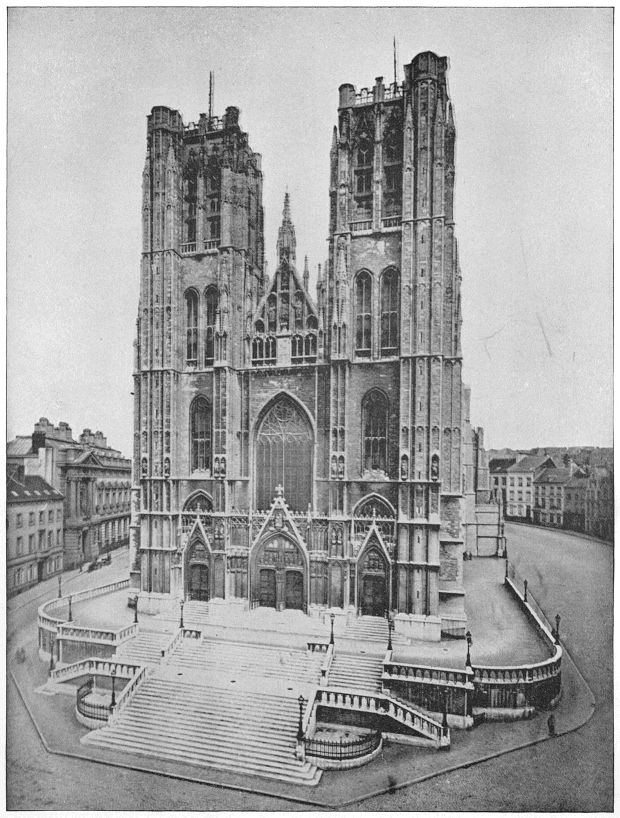
CATHEDRAL OF STE. GUDULE.—In the central part of the City of Brussels, overlooking its lower section, is the above edifice, one of the most imposing and most ancient Gothic churches in Belgium. It consists of a nave and aisle, having a retro-choir, and deep bays, resembling chapels. It was built in 1220, and has been in constant use for 670 years. While the elements of time are crumbling its outside surface, leaving an abundance of disintegrated matter at the base of its walls, its interior is adorned with fine paintings and kept in apparently good order.
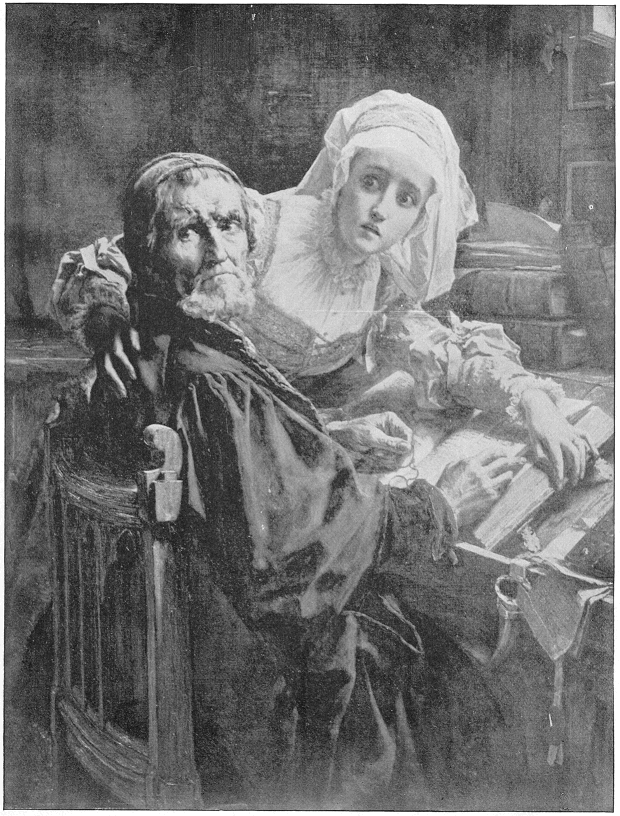
THE FORBIDDEN BOOK (By Ooms), Academy of Fine Arts, Brussels, Belgium—This striking painting by that celebrated artist, is a pleasing commingling of many colors, which, of course, are lost in the photograph. The picture represents a private library, the father and daughter eagerly devouring the contents of the Bible. Unexpected foot-steps are heard; hence the frightened look of both, for, in those days, reading the Bible was punished by death. The painting is a subject study for the earnest Bible-reader.
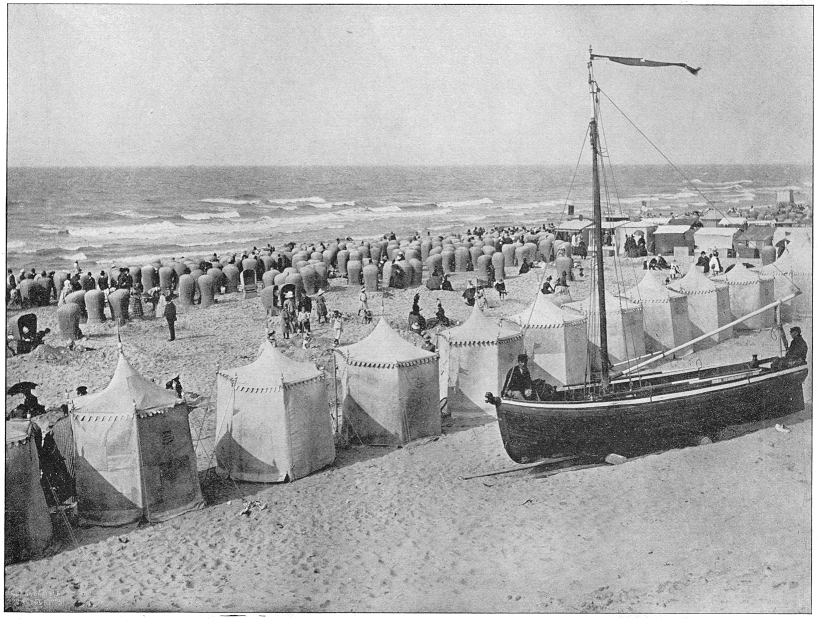
SCHEVENINGEN, Holland.—This famous and popular summer resort is annually visited by thousands of people. The sand is firm and smooth, and the place possesses a great advantage over other watering-places on the North Sea, having The Hague and woods in close proximity, the latter affording pleasant and shady walks. What appear like wooden posts driven in the sand in the above picture, are wicker-basket chairs, with roofs to keep off the sun. Scores of canvas tents line the shore, and thousands of people lie on the beach from early morning until late at night.
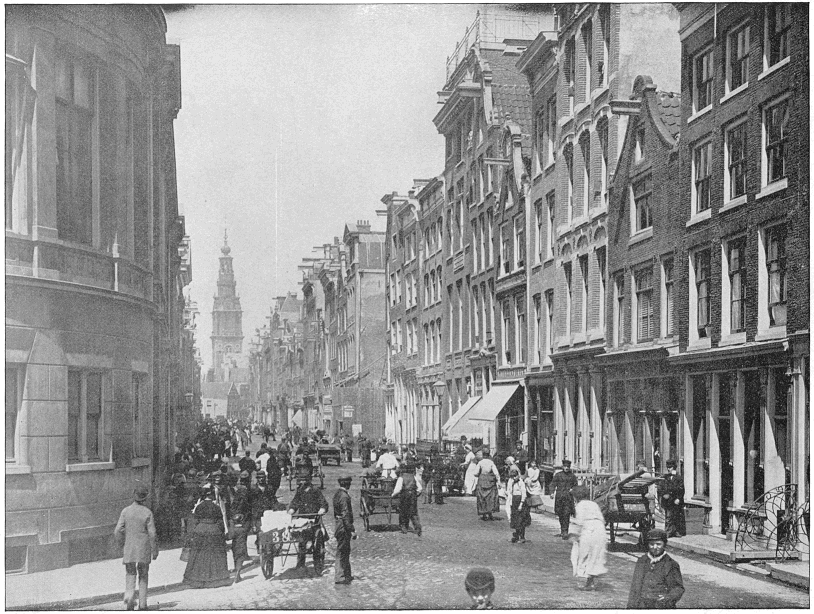
AMSTERDAM, Holland.—This is the largest and most important city in Holland, and constitutionally its capital. It stands on a soft, wet ground, under which, at a depth of fifty feet, is a bed of sand. Into this sand piles are driven, on which buildings are reared, a fact which gave rise to the jest of Erasmus of Rotterdam, that he knew a city whose inhabitants dwelt on tops of trees like rooks. The city is surrounded by grassy meadows. Amsterdam ranks much higher as a trading than as a manufacturing town. The photograph represents St. Antoine Street.
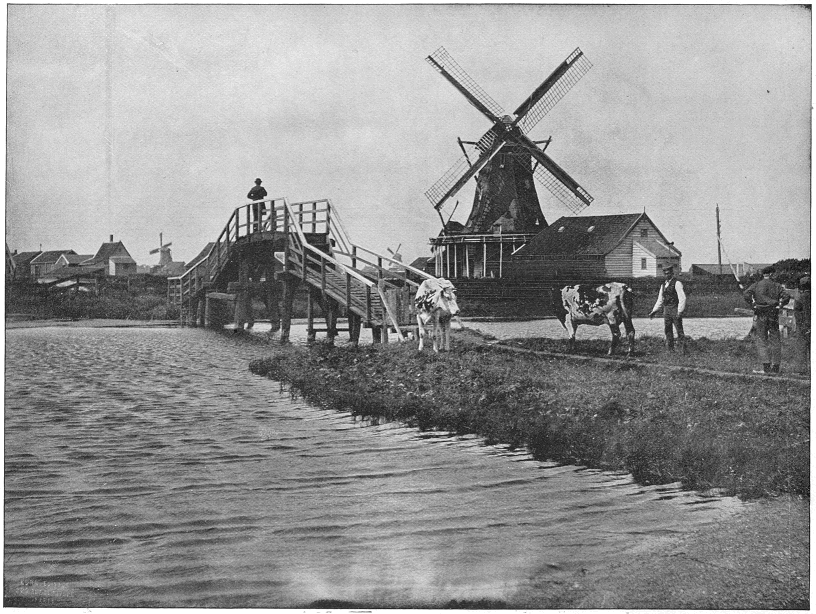
WIND-MILL, Holland.—Millions wonder that a country so situated as Holland can exist; and the stranger is almost unable to decide whether land or water predominates. Those broken and compressed coasts, those deep bays and great rivers, the lakes and canals crossing each other, all combine to give the idea of a country that may at any time disintegrate and disappear. In the thirteenth century the sea broke the dykes in northern Holland and formed the Zuyder Zee, destroying many villages and causing the death of eighty thousand people. To drain the lakes, and save the country from destructive inundations, the Hollanders press the air into their service, which is represented by the above wind-mill.
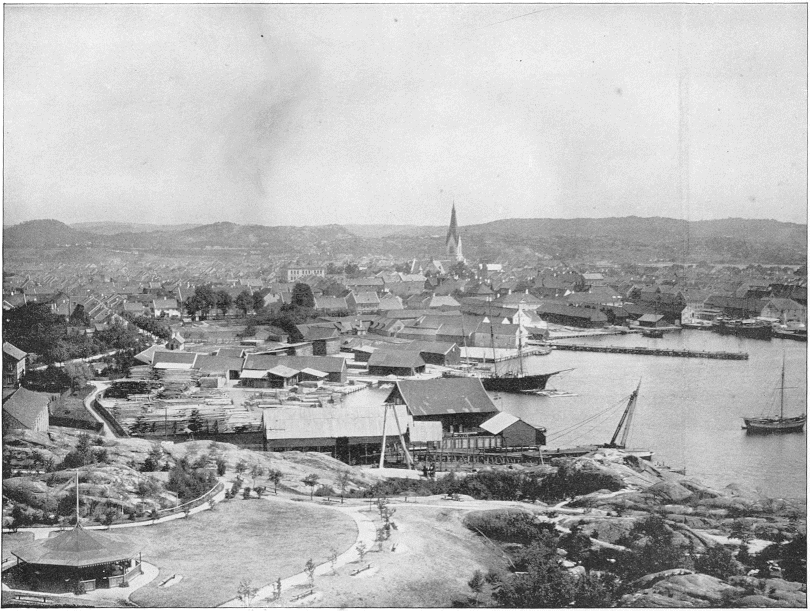
CHRISTIANSAND, Norway.—Christiansand is the largest town on the south coast of the Scandinavian peninsula, and the residence of one of the five Norwegian Bishops. It is beautifully situated at the mouth of the Otteraa, on the Christiansand Fjord. The town is named after Christian IV., by whom it was founded in 1641, and is regularly laid out with streets intersecting at right angles. It possesses an excellent harbor, at which all the coasting steamers of that country, and those from England, Germany and Denmark, arrive regularly.
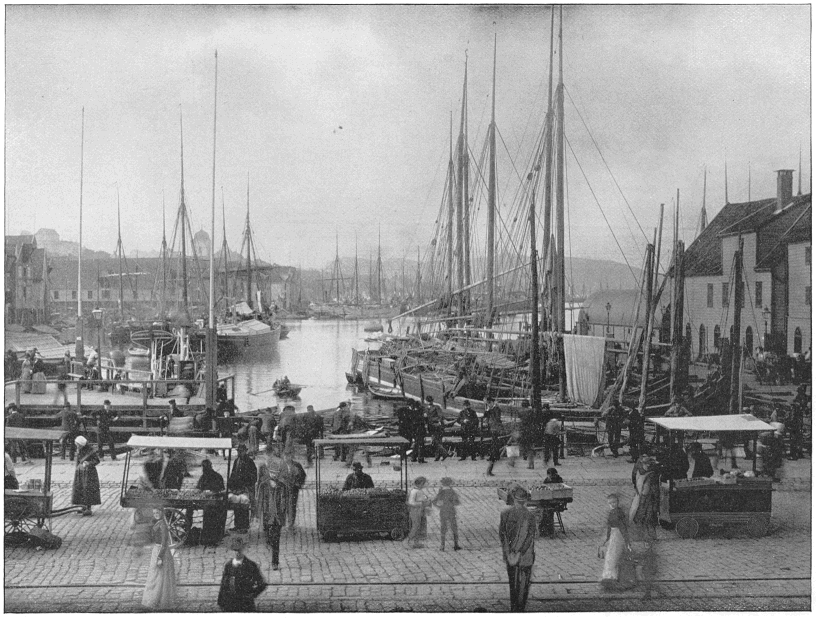
BERGEN, Norway.—Bergen is one of the oldest and most picturesque cities in Norway. The general aspect of the town is modern, though traces of its antiquity are not wanting. The older part adjoins the spacious harbor called Vaagen, and spreads over the rocky heights at the base of the Florfjeld and over the peninsula of Mordanes. Fish has always been the staple commodity of the city, and it is still the greatest fish market in Norway. The above picture represents the harbor, with vegetable-peddlers and their portable stalls in the foreground.
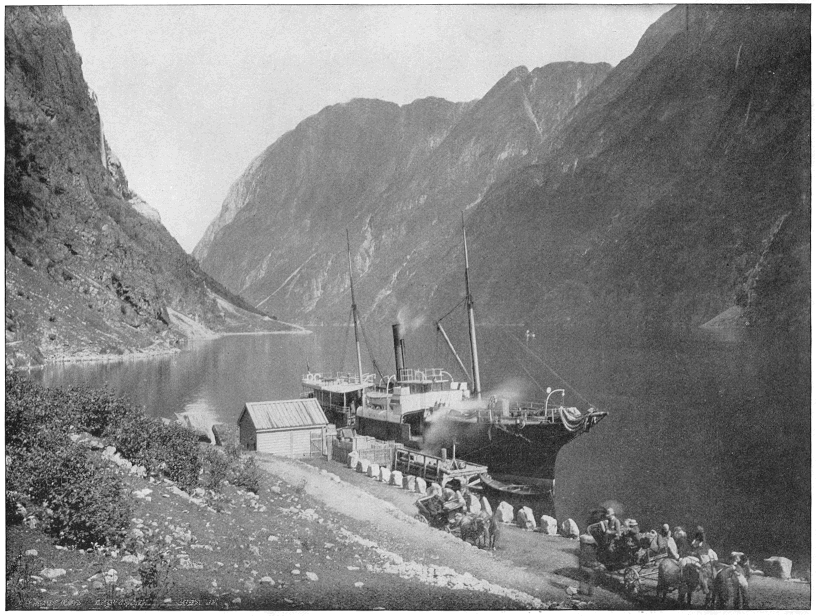
NIERDFJORD, GUDVNAGEN, Norway.—One of the grandest and most picturesque of the many Fjords on the broken coast of Norway, is represented here. Enormous waterfalls, formed by the melting snows and ice, are seen along the steep precipices of the high mountains on every side. The mountains on both sides of this inland sea, rise to the height of several thousand feet. The steamer in the foreground is one of the many that make weekly trips between Christiansand and Hammerfest, the latter being the most northern town in the world. During the summer season, these steamers are crowded with tourists to their utmost capacity. This fact evinces the grandeur of the place, and the interest it must afford to travellers.
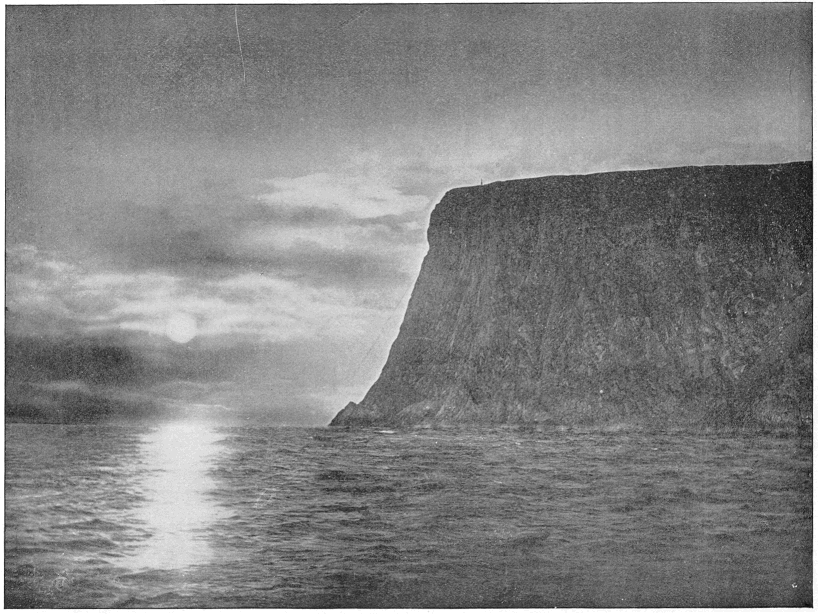
NORTH CAPE, Norway.—This cape (71° 10' N. Lat.), consisting of a dark gray slate-rock, furrowed with deep clefts, rising abruptly from the sea, is usually considered the most northern point of Europe; its height is about nine hundred and seventy feet. The northern sun, creeping at midnight (the time this photograph was taken) along the horizon, and the immeasurable ocean in apparent contact with the skies, form the grandest outlines and the most sublime pictures to the astonished beholder. Here, as in a dream, the many cares and anxieties of restless mortals seem to culminate.
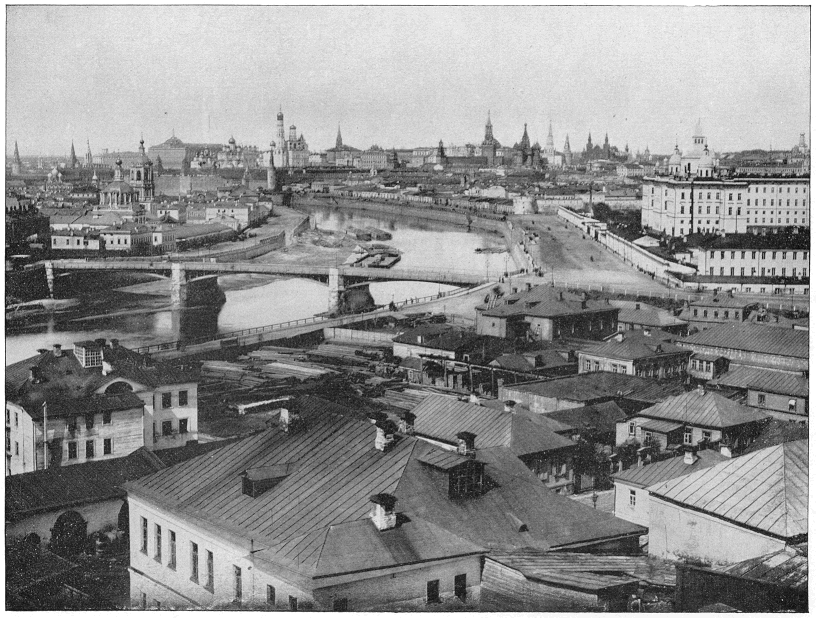
MOSCOW, Russia.—Moscow, which was at one time the capital of all Russia and home of the Czar, was founded nearly seven hundred and fifty years ago. The principal event in its history is the burning of it in 1812, for the purpose of dislodging the French from their winter quarters during the French and Russian war. The city is built with strange irregularities, having streets and numerous paltry lanes opening all at once into magnificent squares. It has a great number of churches and monasteries, and a university with 1000 students. This photograph represents the principal portion of the city and the river Moskva, on whose bank it is situated, with the Kremlin in the distance, piercing the air with its lofty spires.
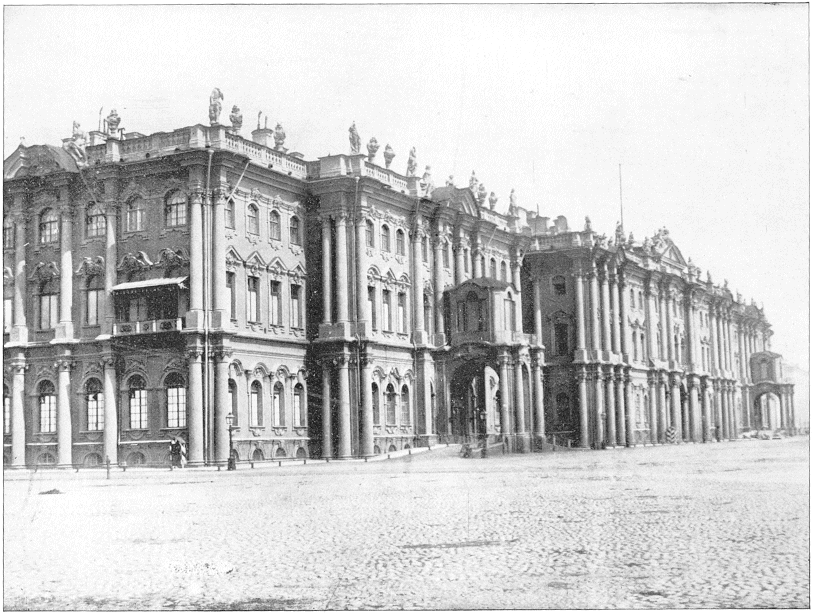
WINTER PALACE, St. Petersburg, Russia.—This magnificent palace is fronted with a large number of Corinthian columns, which give it a formidable yet beautiful appearance. On the top, along the front and sides, it is adorned by a number of statues representing various emblems and figures in Russian history. The most beautiful apartment of the edifice is the Salle Blanche, or white saloon, where the court fêtes are held. The room contains the crown jewels of Russia, and is decorated in pure white and gold. The effect is most dazzling.
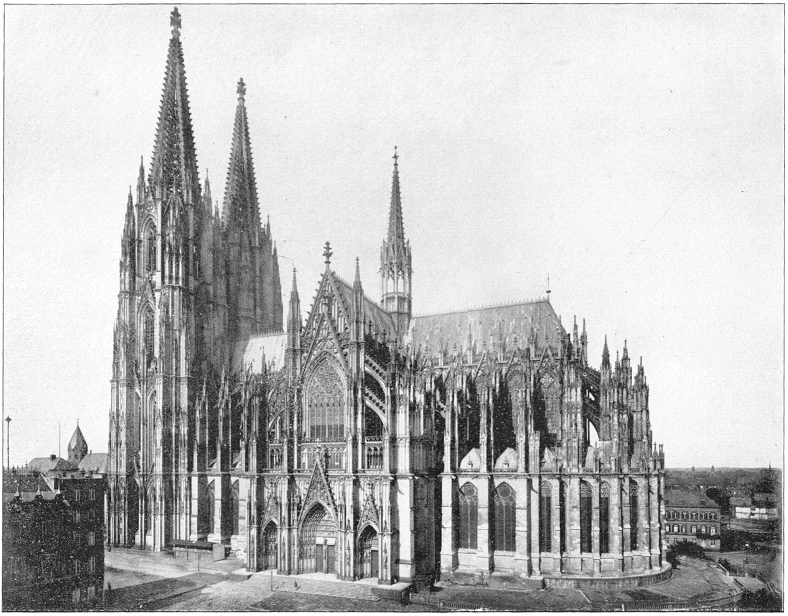
THE CATHEDRAL, Cologne, Germany.—This building justly excites the admiration of every beholder, and is probably the most magnificent Gothic edifice in the world. It stands on a slight eminence, sixty feet above the Rhine. As early as the ninth century, an Episcopal church occupied the site, but the inhabitants regarded it to be unworthy, as compared with the prosperity of the city, and consequently started a new one. The foundation-stone of the present structure was laid on August 14, 1248. On the 15th of October, 1880, the completion of the Cathedral was celebrated in the presence of William I.
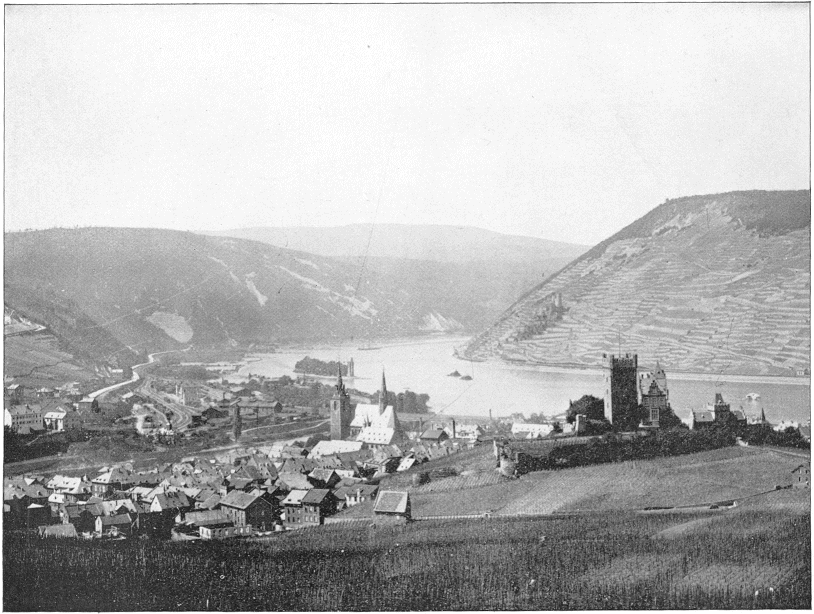
BINGEN, Germany.—Bingen, a Hessian town of Prussia, with a population of 7100, is situated at the confluence of the Nahe and Rhine rivers. The Romans erected a castle here in 70, when a battle was fought between them and the Gauls. Bingen carries on a large trade in wine, starch and leather. The town is in a beautiful and highly picturesque country, and is visited by thousands of tourists during the summer season. On an island in the Rhine is the Mansethum, or "Rat Tower," a structure erected in the thirteenth century. Bingen is celebrated in song, poetry, story and history.
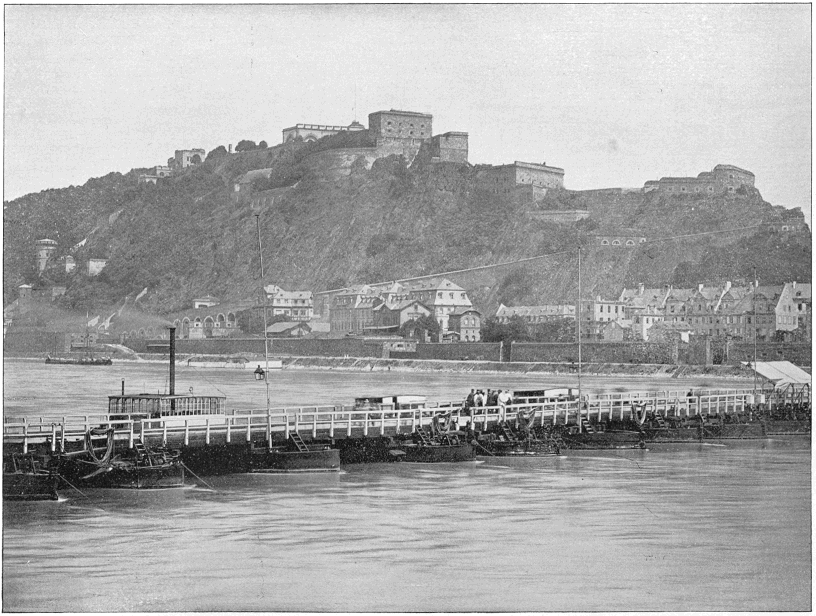
EHRENBREITSTEIN, Germany.—This small town, with five thousand three hundred inhabitants, prettily situated in a valley, is crowned with the fortresses of Ehrenbreitstein and Asterstein, which are connected with Coblenz by a bridge of boats, about four hundred yards in length. The majestic fortress of Ehrenbreitstein rises opposite the influx of the Moselle, and is situated on a precipitous rock, three hundred and eighty-five feet above the Rhine, inaccessible on three sides, and connected with the neighboring heights on the north side only. The view from the top is one of the finest on the Rhine. It embraces the fertile Rhine Valley from Stolzenfels to Andernach.
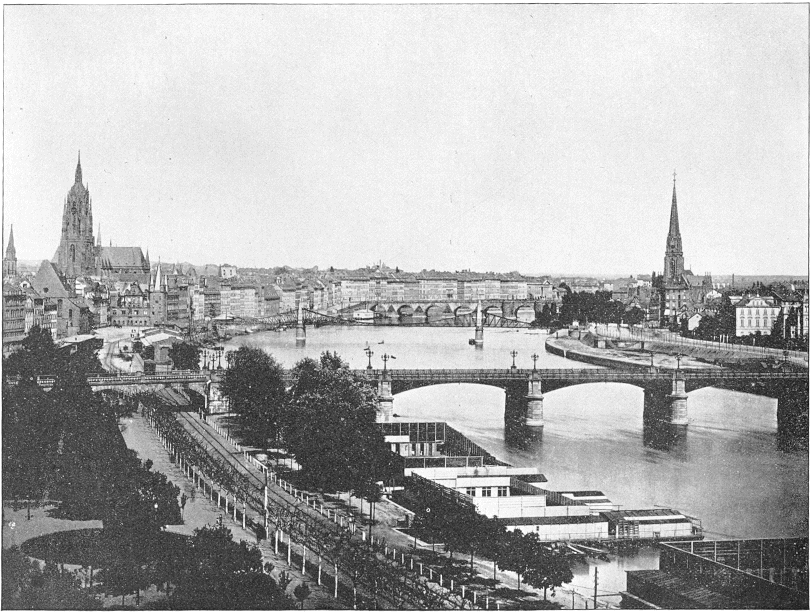
FRANKFORT-ON-THE-MAIN, Germany.—The above city, formerly one of the few independent towns of Germany, now belongs to Prussia. Old watch-towers in the vicinity indicate its ancient extent. The city lies on a spacious plain bounded by mountains, on the right bank of the navigable river Main. On the left bank lies Sachenhausen, a suburb connected with Frankfort by four stone bridges and one suspension bridge. In a commercial, and particularly a financial, point of view, Frankfort is one of the most important cities of Germany.
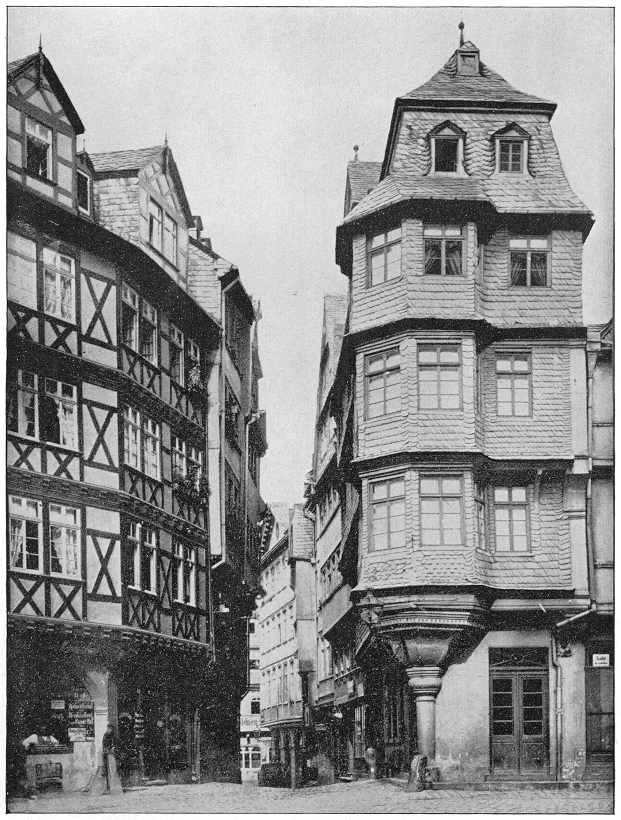
MARTIN LUTHER'S HOUSE, Frankfort-on-the-Main, Germany.—Here is a historic relic which justly excites the admiration of the beholder. This is where Martin Luther lived for a time after he had nailed to a church-door in Wittenberg the theses in which he contested the doctrine at the root of the detestable traffic carried on for the Pope by Tetzel and his accomplices. This brought to the front a man who had certainly many faults, but who amply made up for them by his force of intellect and the loftiness of his aims.
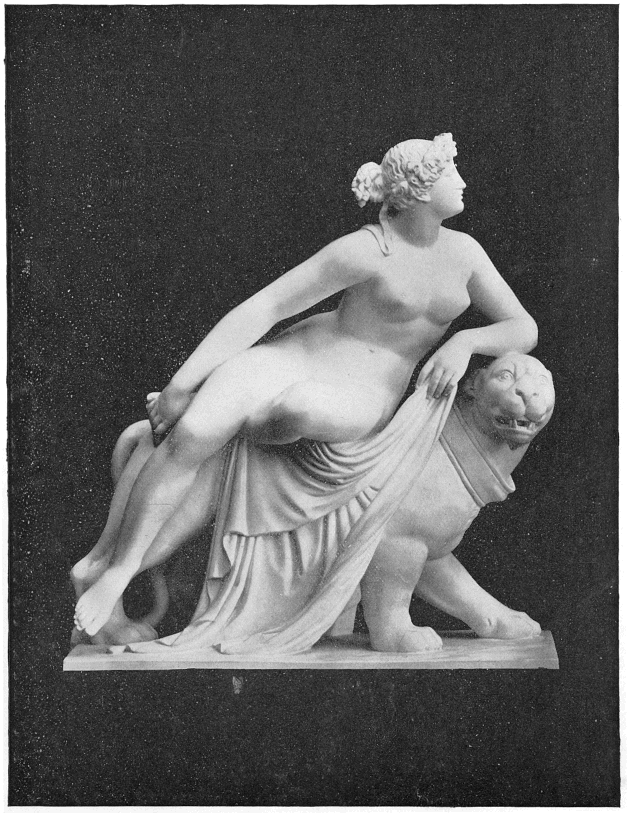
ARIADNE ON THE PANTHER, Bethmann's Museum, Frankfort-on-the-Main, Germany.—This exquisite piece of sculpture is the masterpiece of Dannecker, a sculptor of Stuttgart, who is likewise famous for his bust of Schiller. Of the many subjects sculptured by Dannecker, Ariadne, especially, has a peculiar charm of novelty, which has made it a European favorite in a reduced size. It is perhaps the contrast between the delicacy of the female human form and the subdued rude force of the panther she rides, that attracts the admiration.
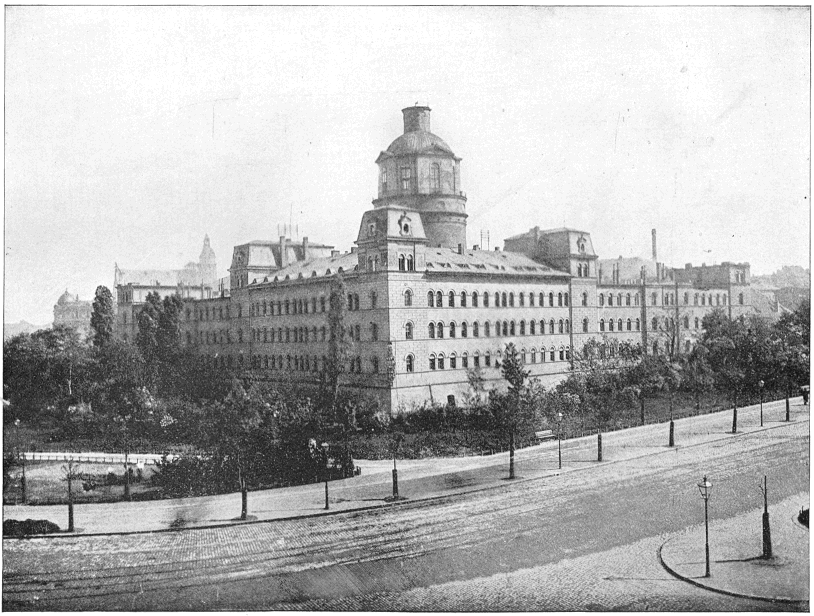
UNIVERSITY BUILDING, Leipsic, Germany.—Leipsic is one of the great commercial cities of Germany, the centre of the German book-trade, the seat of the supreme law-courts of the German Empire, and contains one of the most ancient and important universities in Europe. The interior of the city consists of lofty and closely built houses, dating chiefly from the seventeenth and eighteenth centuries, and is surrounded by five handsome suburbs, beyond which is a series of villages, almost adjacent to the town. The above picture represents one of the University buildings.
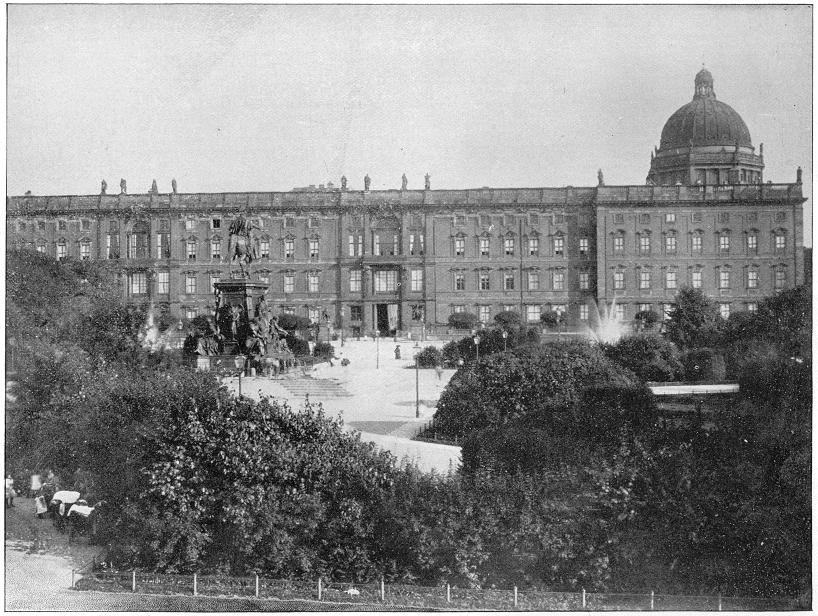
ROYAL PALACE, Berlin, Germany.—This palace, six hundred and fifty feet long, three hundred and eighty feet wide, and rectangular in form, rises in four stories to the height of one hundred feet, while the dome on the right is two hundred and thirty feet high. In the time of Frederick the Great, it served as a residence for all the members of the royal family, contained all the royal collections, and was the seat of several government officials. Now it is used for reception rooms, and a dwelling for royal officials. The exterior of the palace is massive and imposing; the interior is beautifully embellished.
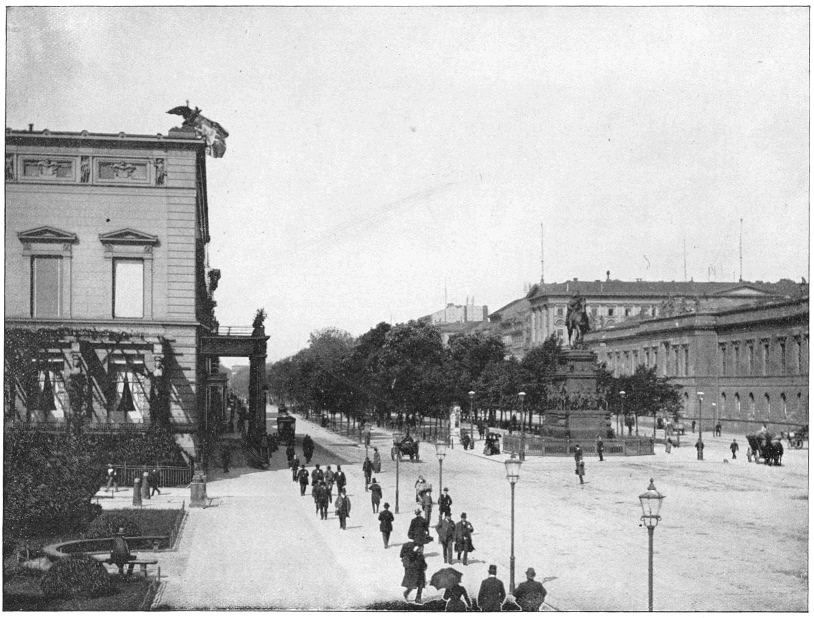
BERLIN, Germany.—Berlin, the capital of Prussia and the home of the emperor, with its large and beautiful buildings and its regularity of streets, ranks among the finest cities in Europe. The most noted street is that called "Unter den Linden," the city's pride, a broad and imposing thoroughfare, resembling the boulevards of Paris. It contains four rows of trees, ornamented at one end by the Brandenburg Gate, and at the other by the equestrian statue of Frederick the Great, well represented by this photograph. The palace of the king, different gardens, the aquarial museum and many other noted buildings border on "Unter den Linden," which is nearly a mile long, and thronged all day with pedestrians.
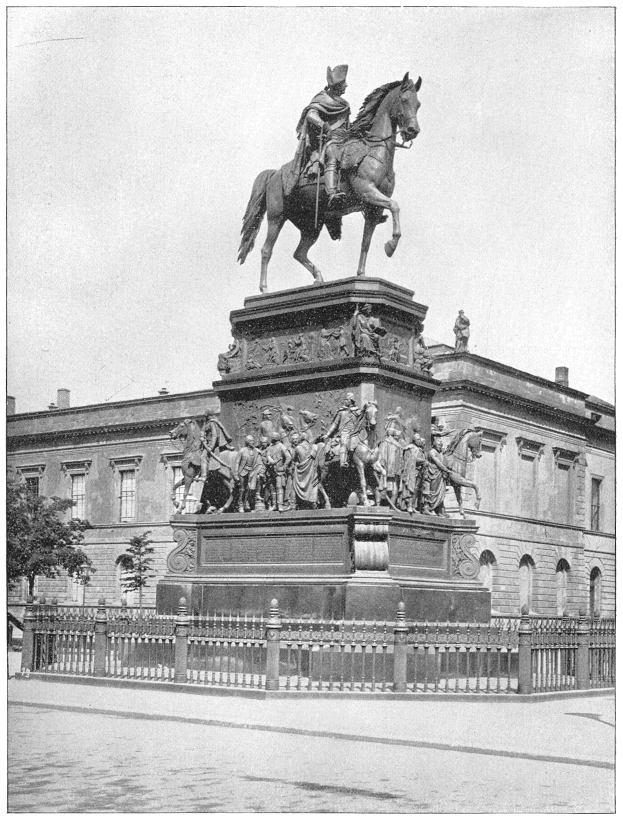
STATUE OF FREDERICK THE GREAT, Berlin, Germany.—This impressive and masterly work was erected in 1851 at one end of the "Linden," and is probably the grandest monument of its kind in Europe. The great King is represented on horse-back, with his coronation-robes and walking-stick. The pedestal is divided into four sections. The upper one contains allegorical figures and scenes in Frederick's life, with the figures Moderation, Justice, Wisdom and Strength at the corners; the second section contains figures of the King's officers, and the lower section, the names of other distinguished men.
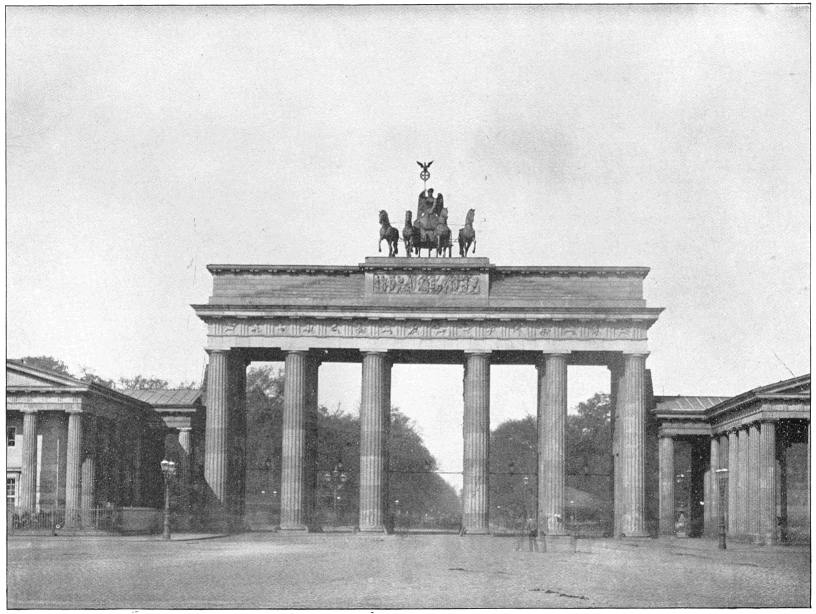
THE BRANDENBURG GATE, Berlin, Germany.—The Brandenburg Gate, forming the entrance to Berlin, from the Thiergarten, was erected in 1793 in imitation of the Propylæa at Athens. It is 85 feet high and 205 feet wide, and has five different passages, separated by massive Doric columns. It is at the one end of "Unter den Linden," and its middle passage is reserved for royal carriages only. The material is sandstone, and it is surmounted by a Quadriga of Victory from copper, taken to Paris by Napoleon in 1807, but restored in 1814. On the side are two wings resembling Grecian Temples, one of which is a pneumatic post-office and the other a guard-house. Both combine in their construction, strength, elegance and beauty.
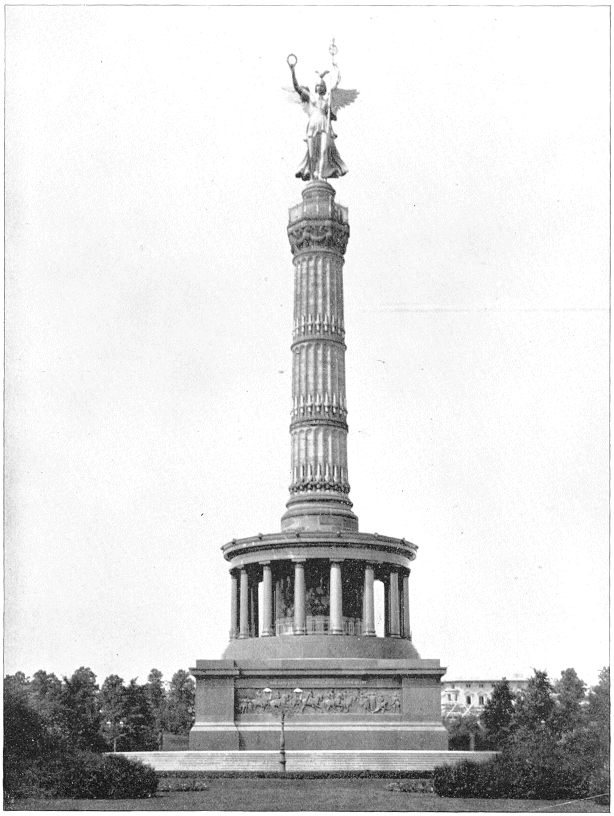
MONUMENT OF VICTORY, Berlin, Germany.—This monument, rising to a height of two hundred feet, stands on a circular terrace, approached by eight granite steps in the Thiergarten. It was dedicated on September 2, 1873, to commemorate the great victories of 1870 and 1871. The massive square pedestal is adorned with reliefs in bronze. Above, in the flutings of the column, which consists of yellow, grayish sandstone, are placed three rows of Danish, Austrian and French cannon, captured in the different battles fought with those nations.
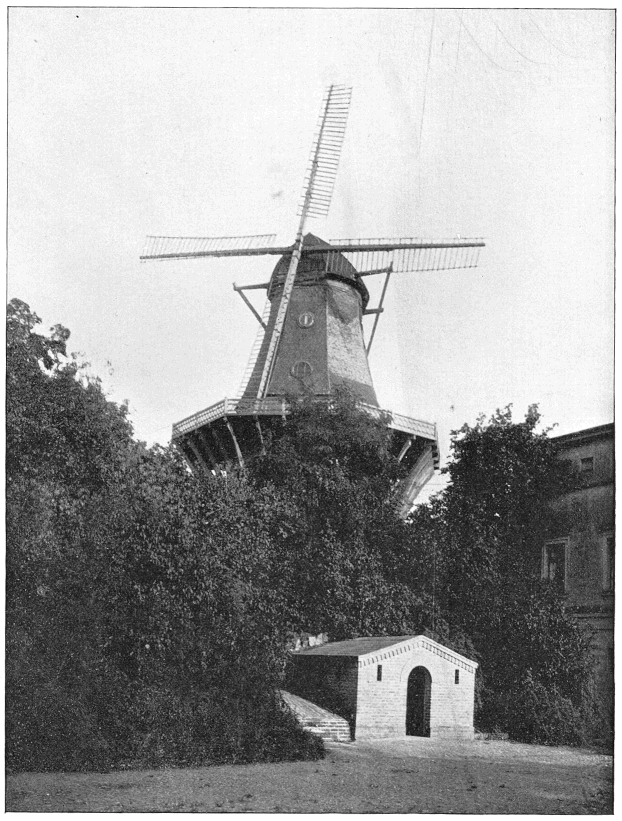
THE HISTORIC WINDMILL, Potsdam, Germany.—Potsdam is almost entirely surrounded by a fringe of royal palaces, parks and pleasure-grounds. Here is located the palace of Sanssouci. Adjacent to the palace is the famous windmill, now royal property, which its owner refused to sell to the King, meeting threatened violence by an appeal to the judges of its supreme court.
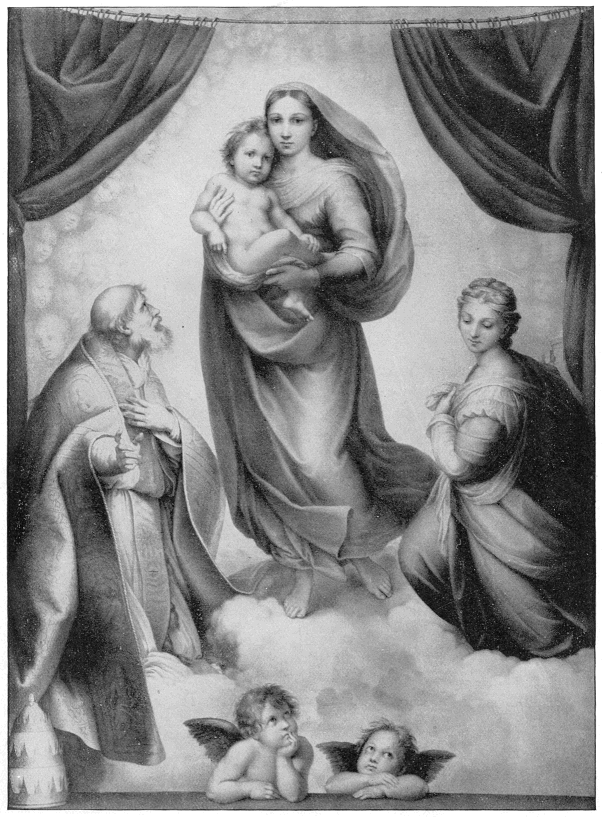
MADONNA DI SAN SISTO (by Raphael), Dresden Gallery, Dresden, Germany.—This masterpiece of Raphael, was photographed direct from the original painting, worth $400,000. It is an altar-piece, representing the Virgin and Child in clouds, with St. Sixtus on the right, St. Barbara on the left, and the cherubs beneath. A curtain has just been drawn back, and the Virgin issues, as it were, from the depth of Heaven, her large serene eyes seeming to embrace the whole world in their gaze. The most striking feature of the painting is the expression of naive innocence depicted on the faces of the cherubs.
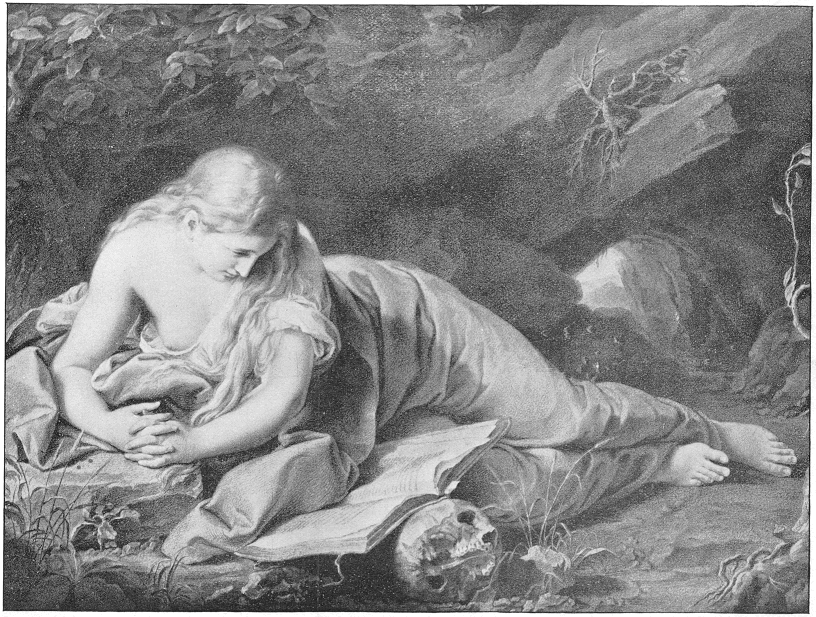
MAGDALENE (by Battoni), Dresden Gallery, Dresden, Germany.
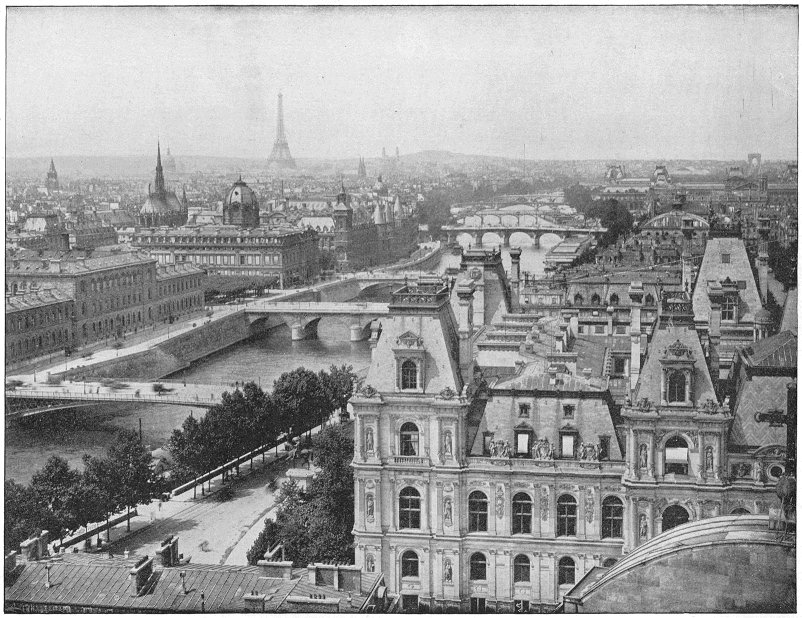
BIRD'S-EYE VIEW OF PARIS, France.—Paris, the largest city in the French Republic, and its capital, covers an area of thirty square miles, with a population of about 2,000,000. The river Seine, which flows through the centre of the city, is spanned by twenty-eight bridges, of which the seven principal are shown on this photograph. The city is noted for its fine parks, magnificent churches, colossal buildings, and wide boulevards, of which the Champs Elysees is the most famous. Paris is the centre of the political, artistic, scientific, commercial and industrial life of the nation.
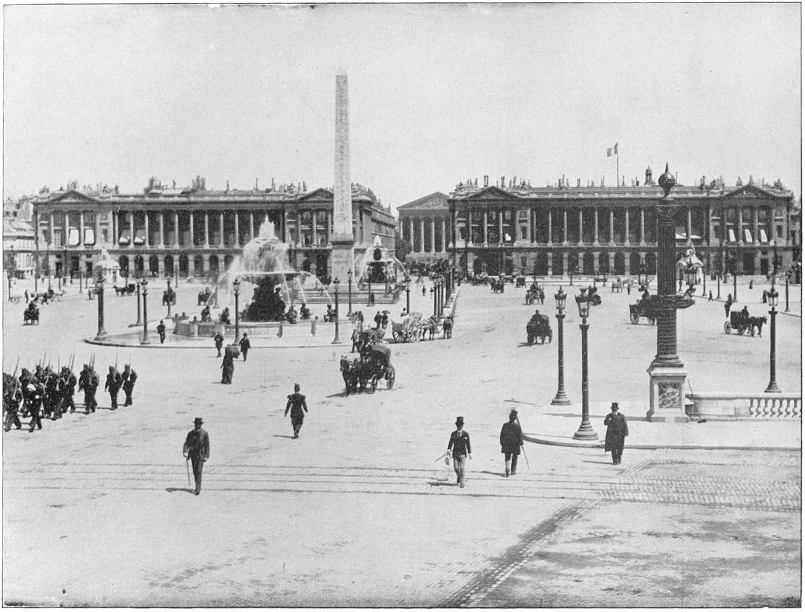
PLACE DE LA CONCORDE, Paris, France.—Place de la Concorde, one of the most beautiful and extensive public parks in Paris, being considered, by the best authorities, the finest in the world, is bounded by the Seine, Champs Elysees, Tuileries and Rue de Rivoli. Numerous historical associations are connected with the place. The guillotine did much bloody work here during 1793-4-5; upwards of 2800 people perished by it. Foreign troops frequently bivouacked on the square when Paris was in their power. The Obelisk of Luxor, a Monolith or single block of reddish granite 76 feet high, was presented to Louis Phillipi by Mohamed Ali and erected in the centre of the Place. It adds very much to the interest of the park.
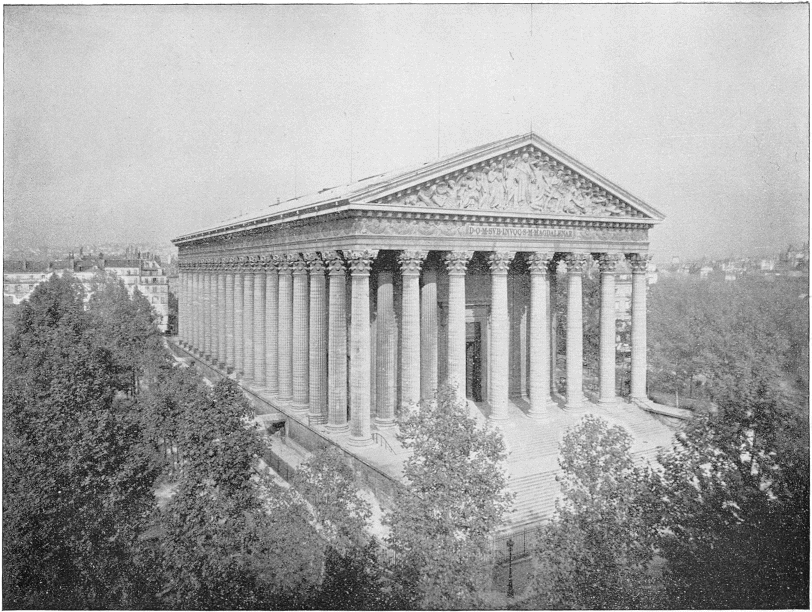
MADELEINE, PARIS, France.—The foundation of this church was laid by Louis XV. in 1764. The Revolution found the edifice unfinished, and Napoleon I. ordered the building to be completed as a "Temple of Glory." Louis XVIII., however, returned to the original intention of making it a church. The edifice was finally completed in 1842, and the amount of money expended was upwards of $2,500,000. It stands on a basement, surrounded by massive Corinthian columns. The building, which is destitute of windows, is constructed exclusively of stone, light being admitted through sky-lights in the roof.
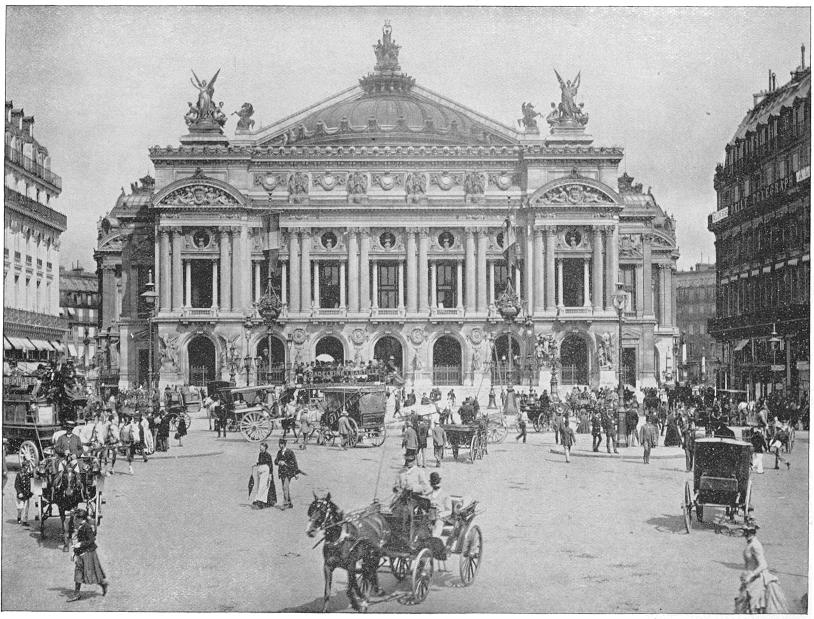
OPERA HOUSE, Paris, France.—This is a most sumptuous edifice, completed in 1874, and covering an area of nearly three acres. Nothing can surpass the magnificence of the materials with which it is decorated, and for which almost all Europe has made contributions. Sweden and Scotland yielded a supply of green and red granite; from Italy were brought the yellow and white marbles; from Finland, red porphyry; from Spain, "brocatello;" and from France, other marbles of various colors. The cost of the site was over $2,000,000, and that of the building nearly $8,000,000.
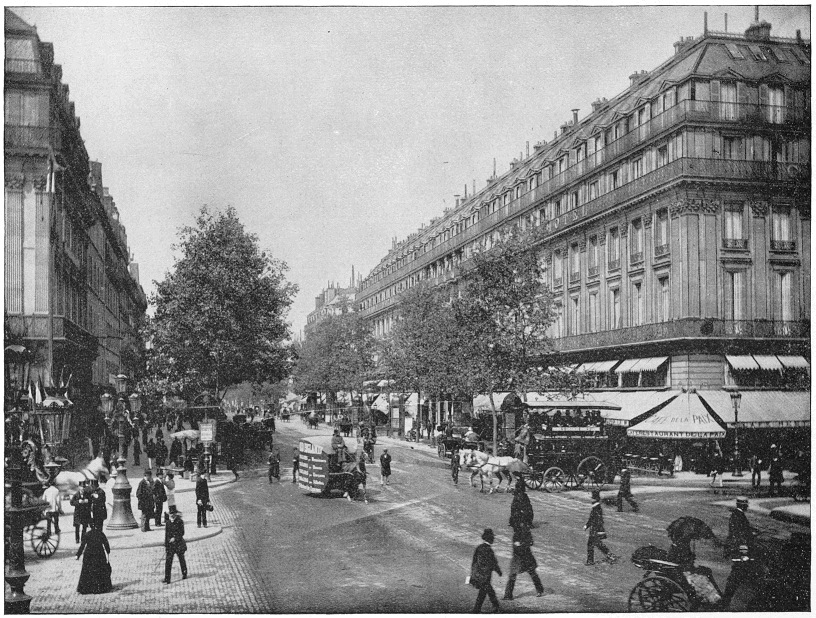
GREAT BOULEVARDS, Paris, France.—The splendid line of streets, known as the Great Boulevards, which extend on the north side of the Seine, from the Madeleine at one end, to the Bastile at the other, was originally the line of fortifications or bulwarks of the City of Paris. In 1670, the city having extended northward far beyond the fortifications, the moats were filled up, the walls destroyed and the above Boulevards formed. This photograph represents the Grand Hotel at the corner of the Place de l'Opera.
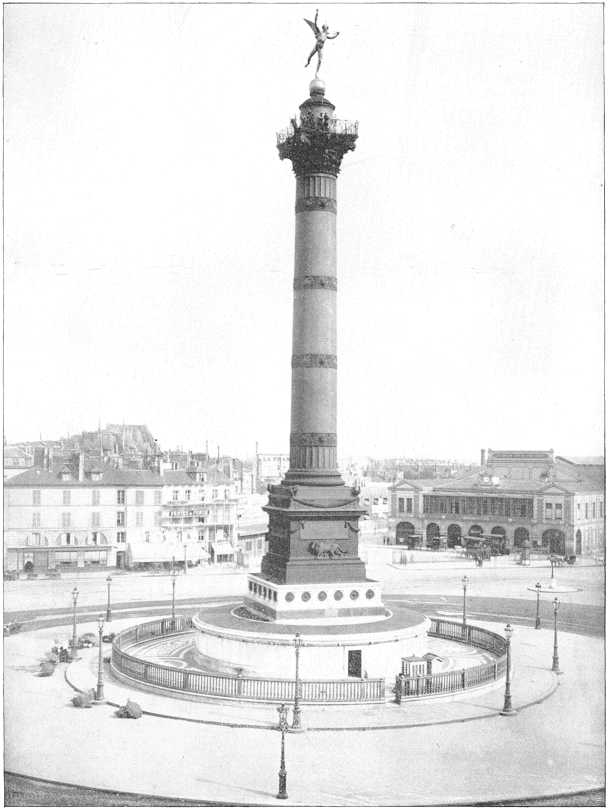
JULY COLUMN, Paris, France.—The above monument was erected after the Revolution of July, 1830, in honor of the heroes who fell on that occasion, and solemnly dedicated in 1840. The total height of the monument is one hundred and fifty-four feet, resting on a massive round sub-struction of white marble, originally intended for Napoleon's Elephant, which he had planned to erect in bronze on this spot; but his plans were never consummated. On the sub-struction rises a square basement, on each side of which are four bronze medallions, symbolical of Justice, the Constitution, Strength and Freedom.
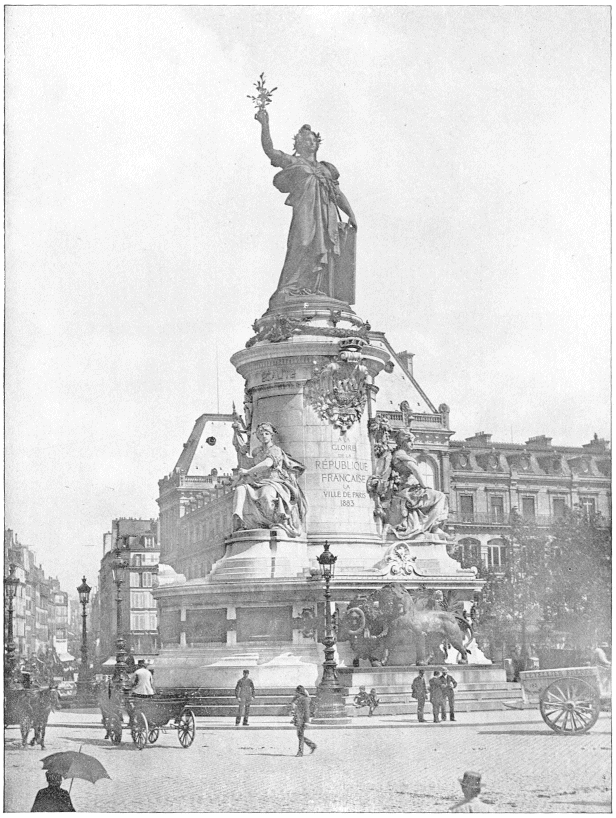
STATUE OF THE REPUBLIC, Paris, France.—This national statue is made of bronze, and was erected in 1883. The stone pedestal, fifty feet in height, is surrounded with seated bronze figures of Liberty, Equality and Fraternity. The statue, thirty-two feet high to the top of the olive branch, makes a striking and imposing appearance. In front is a brazen lion, with the urn of universal suffrage. On the stone pedestal are hewn the words, "To the Glory of the Republic of France, to the City of Paris, 1883." This statue was the model for the Statue of Liberty in New York Harbor.
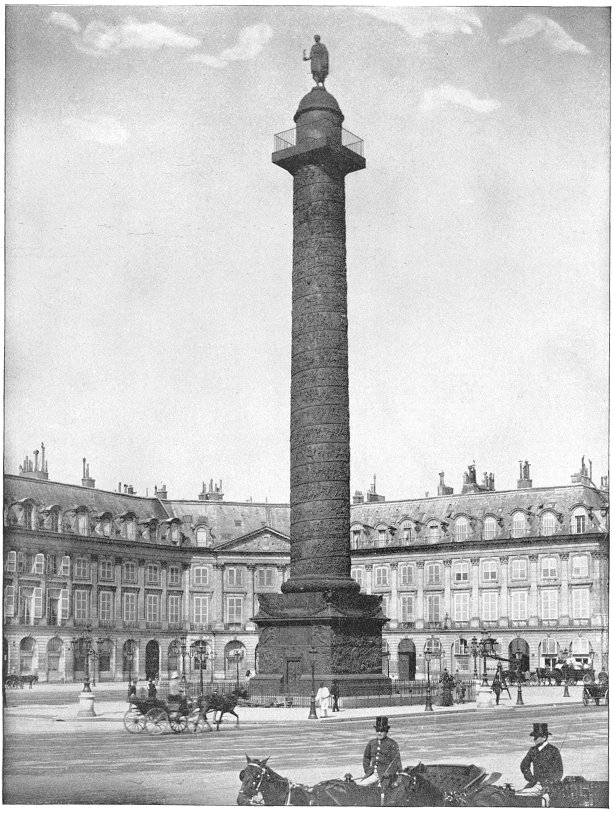
VENDOME COLUMN, Paris, France.—Here is an imitation of Trajan's column at Rome. It is one hundred and forty-two feet high, and thirteen feet in diameter, and was erected by the order of Napoleon I., from 1806 to 1810, to commemorate his victories in 1805, over the Russians and Austrians. The figures on the spiral column represent memorable scenes, from the breaking up of the camp at Boulogne, to the battle of Austerlitz. The metal of these figures was obtained by melting 1200 Russian and Austrian cannons. The top is a statue of Napoleon.
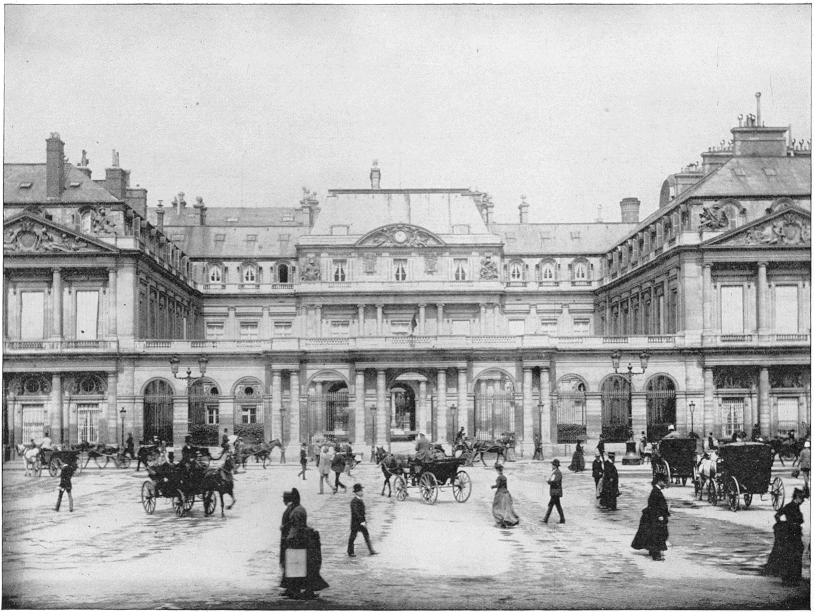
ROYAL PALACE, Paris, France.—The above palace, erected by Cardinal Richelieu in 1634, was occupied after his death by Anne of Austria, the widow of Louis XIII., with her sons Louis XIV., and Philip of Orleans, then in their minority. In 1815 the Orleans family regained possession of the Palais Royal; and it was occupied by Louis Philippe to 1830. Shortly before the outbreak of the revolution of July, he gave a sumptuous ball here in honor of Neapolitan notabilities then visiting Paris. In 1871, the Communists set the Palais Royal on fire, but it has since been carefully restored.
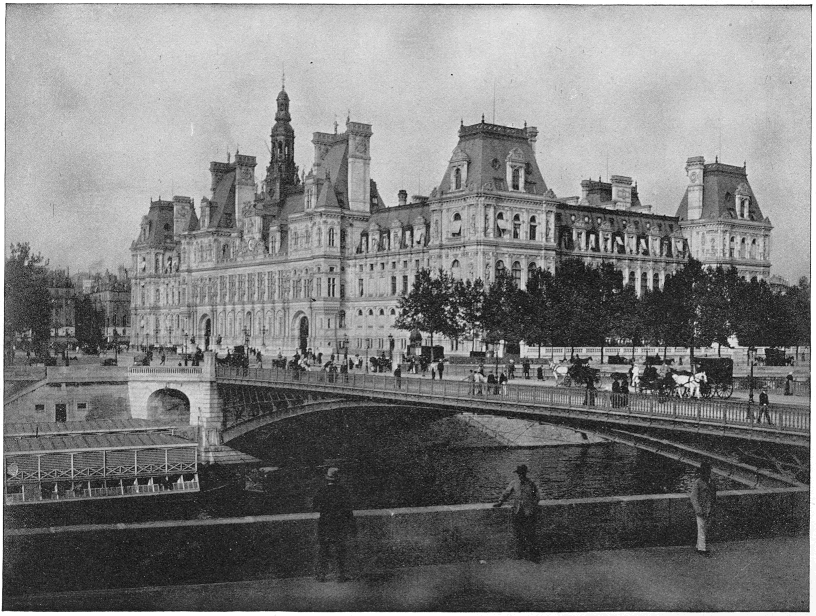
HOTEL DE VILLE, Paris, France.—The above edifice, in many respects one of the finest buildings in Paris, may be regarded as an enlarged reproduction of the original building, with richer ornamentation and more convenient arrangements. It has played a conspicuous part in the different revolutions, having been the usual rallying place of the Democratic party. Here was also celebrated the union of the July Monarchy with the Bourgeoisie, when Louis Philippe presented himself at one of the windows in August, 1830, and, in view of the populace, embraced Lafayette.
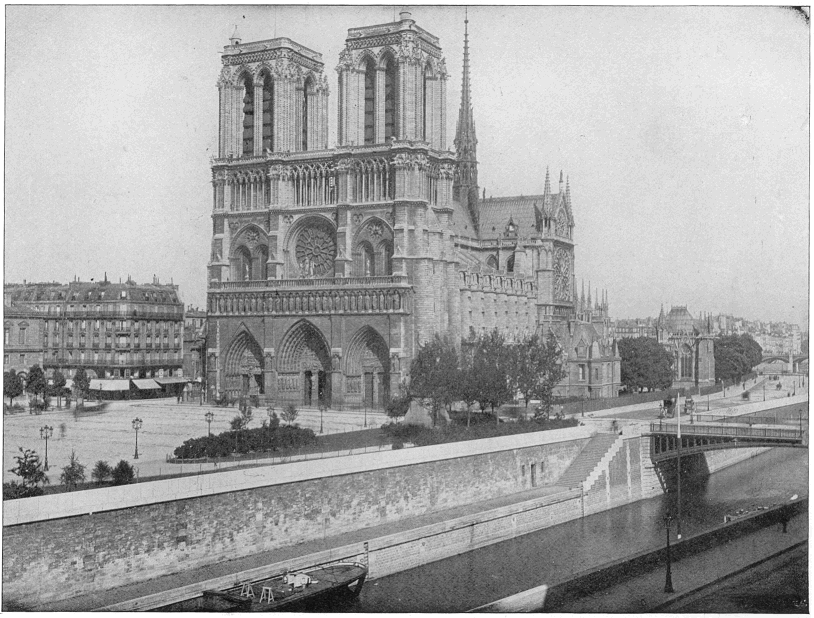
CATHEDRAL OF NOTRE DAME, Paris, France.—Founded in 1163, but not completed until the thirteenth century. Since then the building has been frequently altered. During the Revolution the Cathedral was sadly desecrated. The side chapels were devoted to orgies of various kinds. In 1802 it was again re-opened by Napoleon as a place of divine worship. During 1871 Notre Dame was desecrated by the Communists. The treasury was rifled, and the building used as a military depot. When the insurgents were compelled to retreat, they set fire to the church, but fortunately little damage was done.
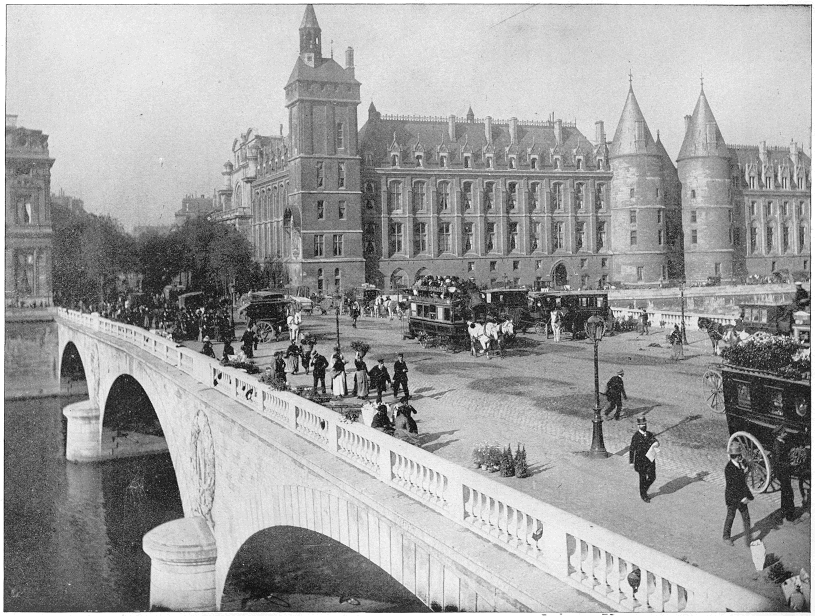
PALACE OF JUSTICE, Paris, France.—This palace, occupying the site of the ancient palace of the kings of France, was presented by Charles VIII., in 1431, to the Parliament or Supreme Court of Justice. The palace was so much injured by fire in 1618 and in 1776, that nothing of it now remains except the two round domes which are seen on the right of the picture. The bridge seen in connection with the avenue in the foreground, spans the Seine, having been built by Napoleon, while the avenue itself leads to the Exchange.
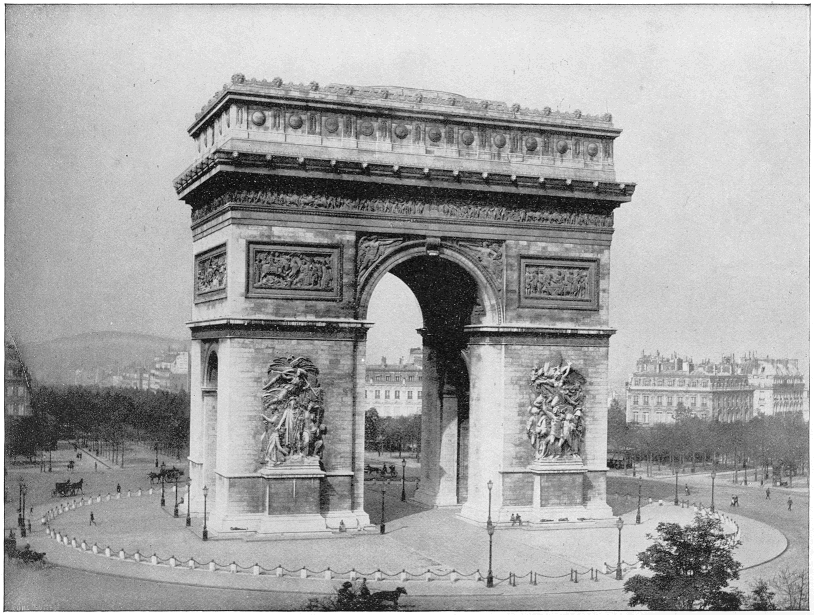
ARC OF TRIUMPH, Paris, France.—This is the finest triumphal arch in existence. It is situated at one end of the Champs Elysees, on an eminence, and can be seen from nearly every part of the city. Twelve magnificent avenues radiate from it, nearly all of them sloping upward to the arch. It was commenced by Napoleon I. in 1806, and completed by Louis Philippe in 1836, at a cost of $2,000,000.
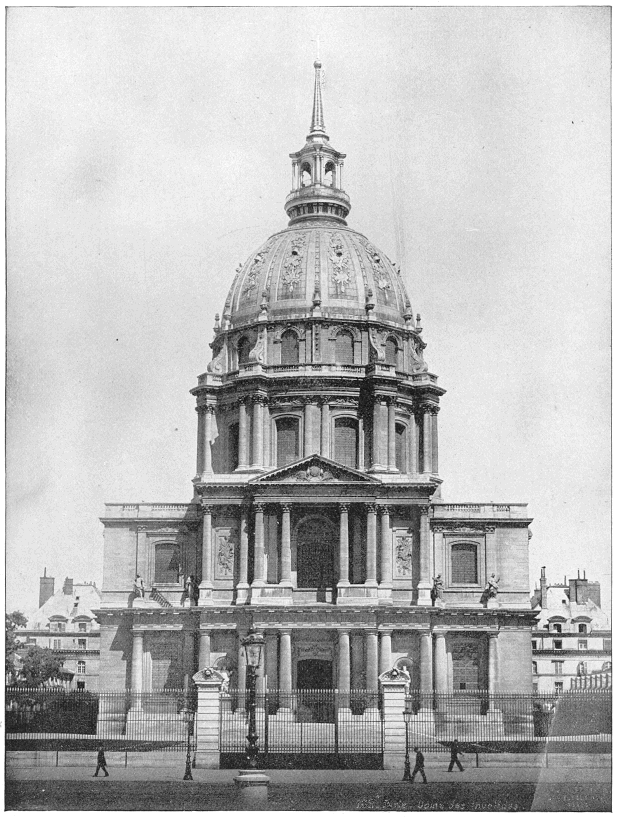
DOME DES INVALIDES, Paris, France.—The beautiful gilded dome, three hundred and forty feet high, which surmounts the church of the Invalides, and which can be seen at a great distance, is built on the north side of the Seine, and forms a part of the Hotel des Invalides. The Hotel des Invalides, founded in 1670 by Louis XIV., for aged veterans, covers an area of thirty-one acres. Immediately under the gilded dome, is a crypt below the floor, containing the tomb of Napoleon.
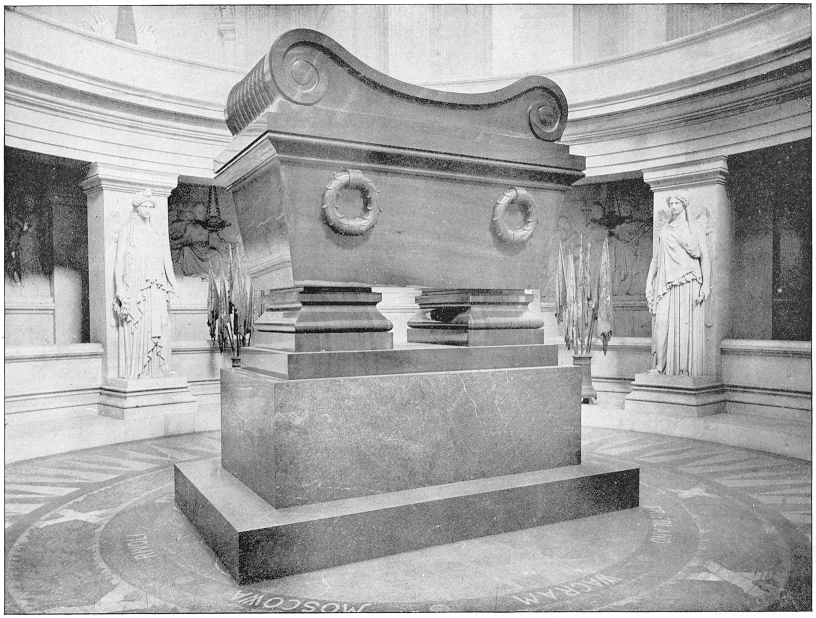
TOMB OF NAPOLEON, Paris, France.—This tomb is situated beneath the Dome des Invalides, in an open circular crypt, twenty feet in depth and thirty-six feet in diameter. The walls are of polished granite, adorned with ten marble reliefs. On the mosaic pavement rises the Sarcophagus, thirteen feet long, six and one-half feet wide, and fourteen and one-half feet high, a huge block of reddish-brown granite weighing sixty-seven tons, and costing $30,000. At the further end of the crypt appears Napoleon's last request: "I wish that my ashes rest on the banks of the Seine, in the midst of the French people, whom I loved so well." To these words, as well as to the tomb of the great leader, every Frenchman reverts with pride.
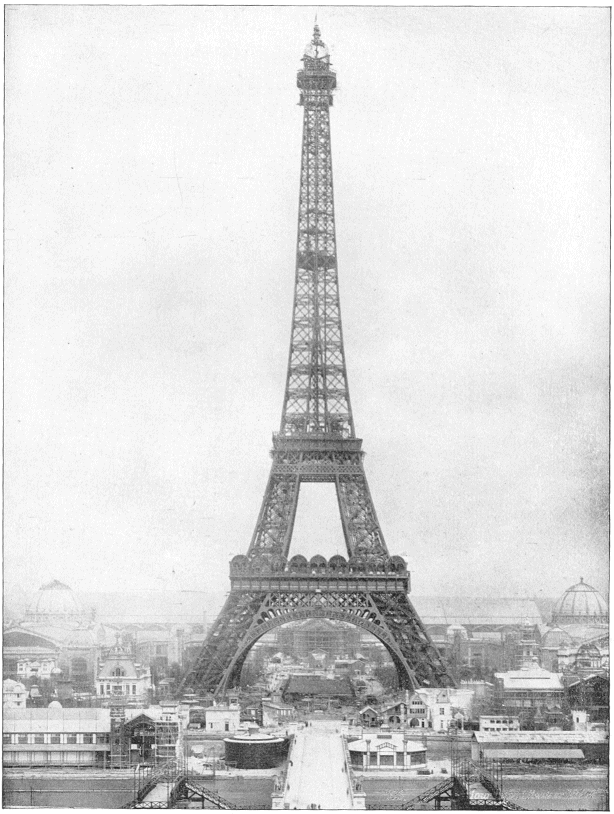
EIFFEL TOWER, Paris, France.—This enormous monument surpasses anything of the kind hitherto erected. From all parts of the city its graceful head may be seen, completely dwarfing into insignificance every public building and spire that Paris contains. It has three platforms. The first, of vast extent and comfortably arranged for many hundred visitors at a time, contains cafés and restaurants. The second is 376 feet from the ground, and the third, 863 feet. The total height of the Tower is 985 feet, being the loftiest monument in the world.
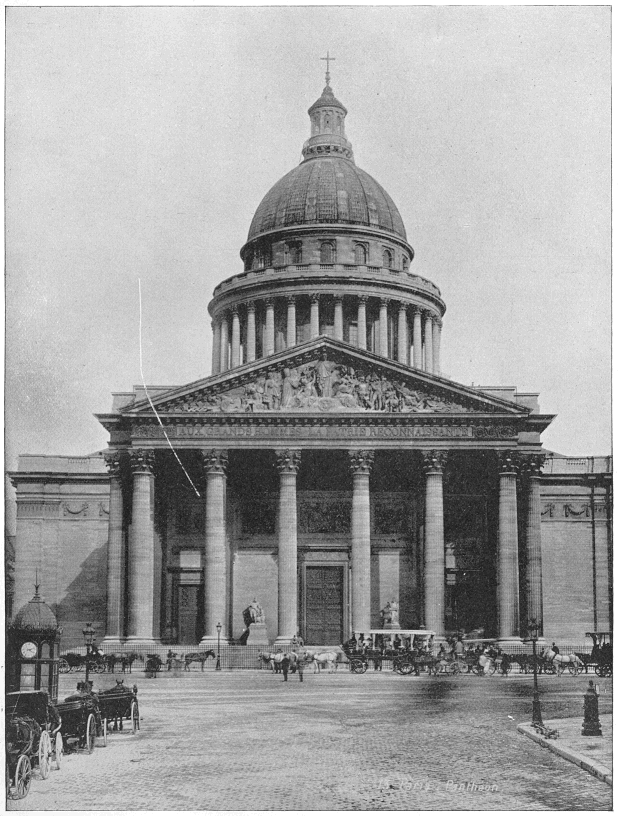
PANTHEON, Paris, France.—This structure standing on the highest ground in the City of Paris, occupies the site of the tomb of Ste. Genevieve, the patron saint of Paris. The present edifice was completed in 1790. The new church was dedicated to Ste. Genevieve, but in 1791 the Convention resolved to convert it into a kind of memorial temple, which they named the "Pantheon." In 1885 it was secularized for the obsequies of Victor Hugo. The edifice is of most imposing dimensions, in the form of a Greek cross. The building resembles the Pantheon in Rome.
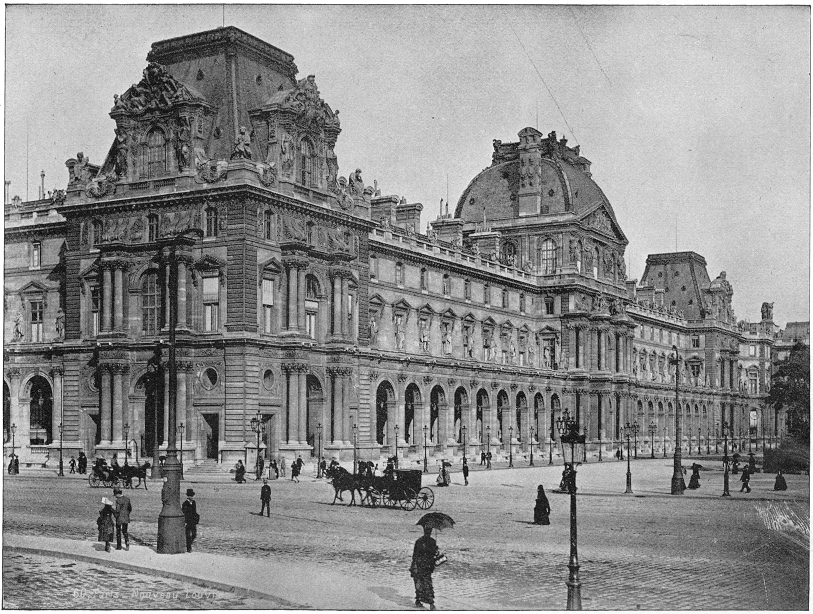
LOUVRE BUILDINGS, Paris, France.—Here are presented the most important public buildings in Paris, both architecturally and on account of the treasures of art they contain. The oldest part of the Louvre has been the scene of many historical events. It is divided into two different sections, the ground floor being devoted to an Egyptian museum. The other apartments contain the Asiatic museum, collections of ancient sculpture, collections of Renaissance sculpture, collections of modern sculpture, a picture gallery, a saloon of the ancient bronzes, and a collection of Greek and other antiquities.
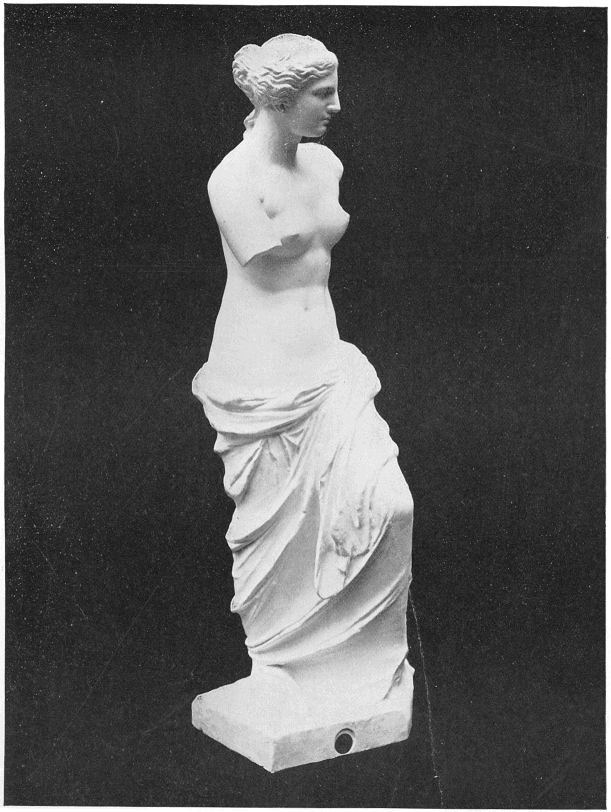
VENUS DE MILO, Louvre Gallery, Paris.—This statue of Aphrodite, which was found on the Island of Melos, now Milo, at the entrance to the Greek Archipelago, was sold to the French Government for 6000 francs, and is now not for sale for its weight in gold. It is exhibited in the Louvre and represents one of the most celebrated treasures of the Gallery. Aphrodite is here represented, not only as a beautiful woman, but as a goddess, as is seen by her powerful and majestic form and the noble expression of the head, indicating her independence of human needs and the placid self-competence of her divine character. It is one of the masterpieces which constitute the great marvel of antiquity.
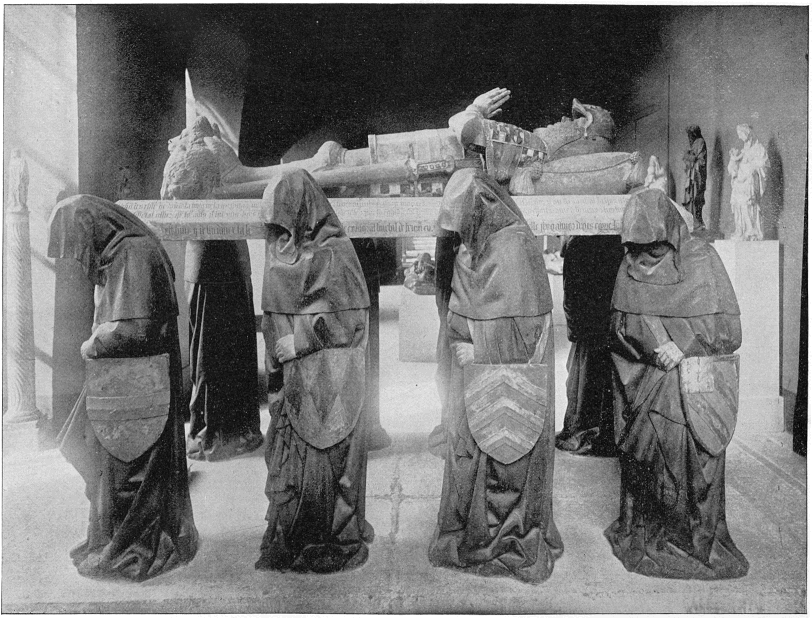
TOMB OF PHILLIPPE POT, Louvre Gallery, Paris, France.
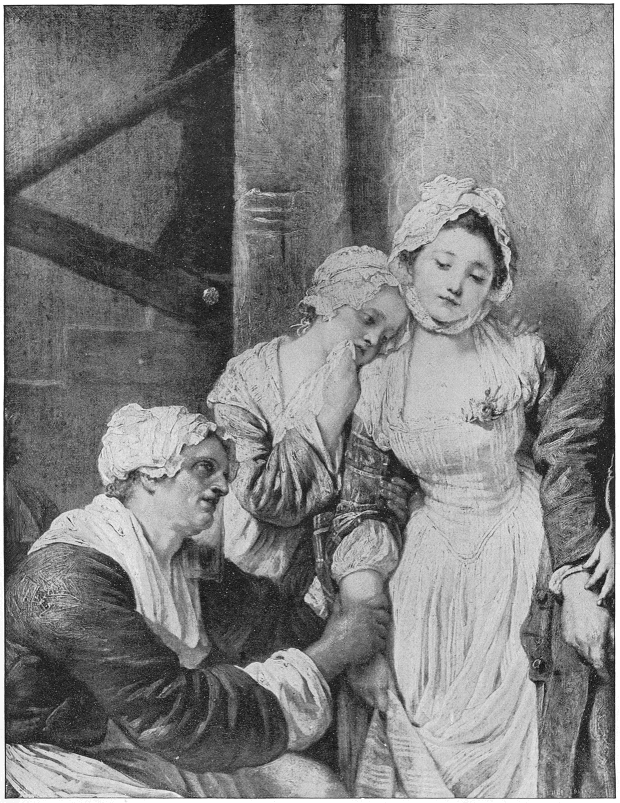
PEACEMAKER OF THE VILLAGE (by Greuze), Louvre Gallery, Paris, France.—This painting was executed by the renowned French artist when nearly at the zenith of his powers, and is only one of the many giant masterpieces by this celebrated painter. Greuze, when quite young, showed considerable talent, which was encouraged by a Lyonese artist. At the advice of the latter, he drifted to Paris and produced several Biblical subjects, followed by others of the same class. He left France for Italy, but returned soon after and produced the above painting in 1759-61, followed by others, with increasing success.
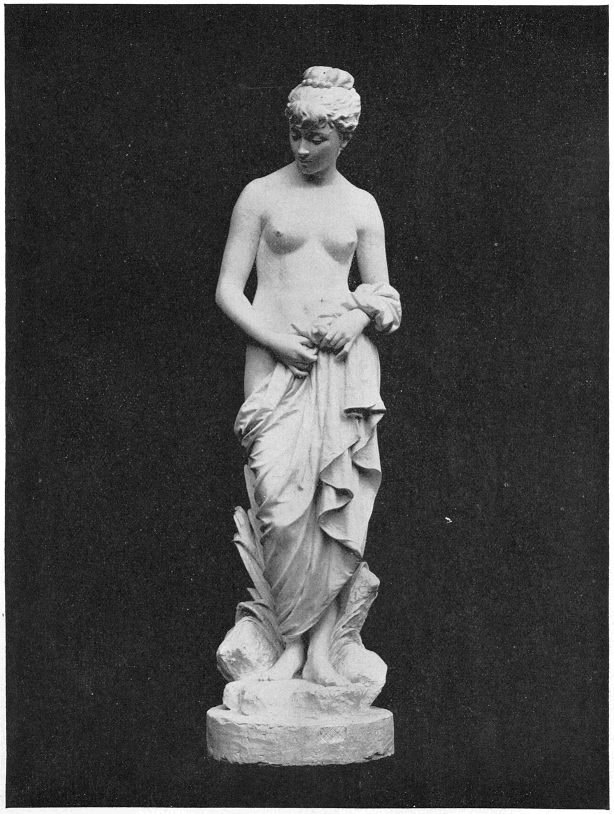
THE LAST VEIL (by Bouret), Luxembourg Gallery, Paris, France
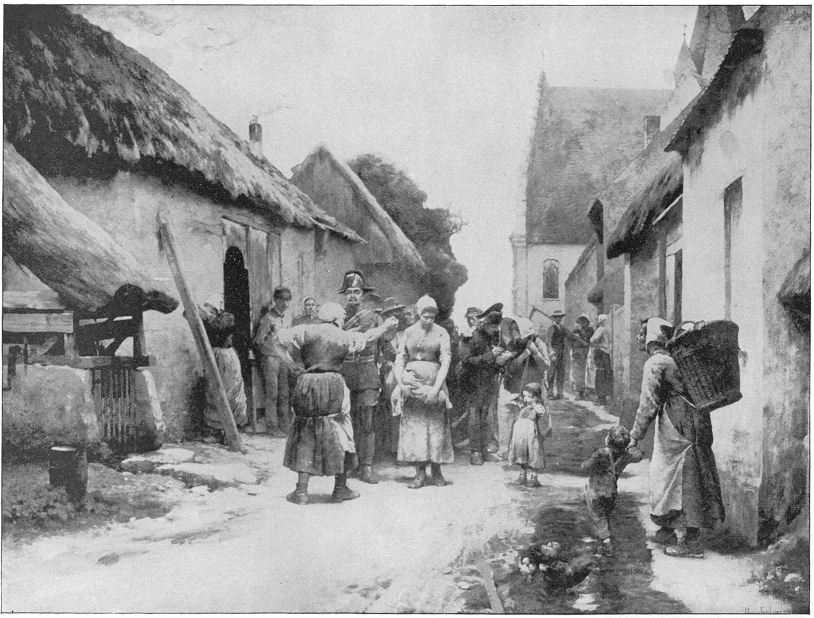
ARREST IN THE VILLAGE (by Salmson), Luxembourg Gallery, Paris, France.
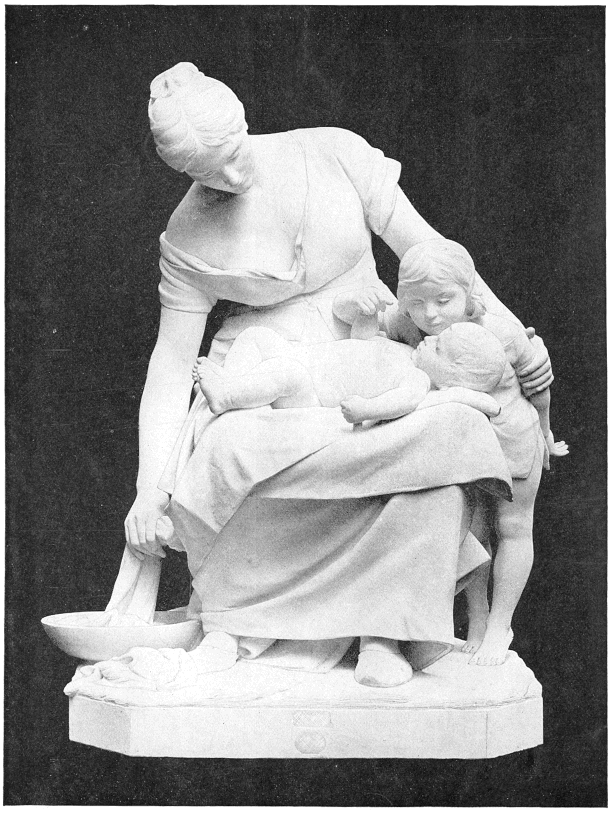
A MOTHER (By Lenoir), Luxembourg Gallery, Paris, France.
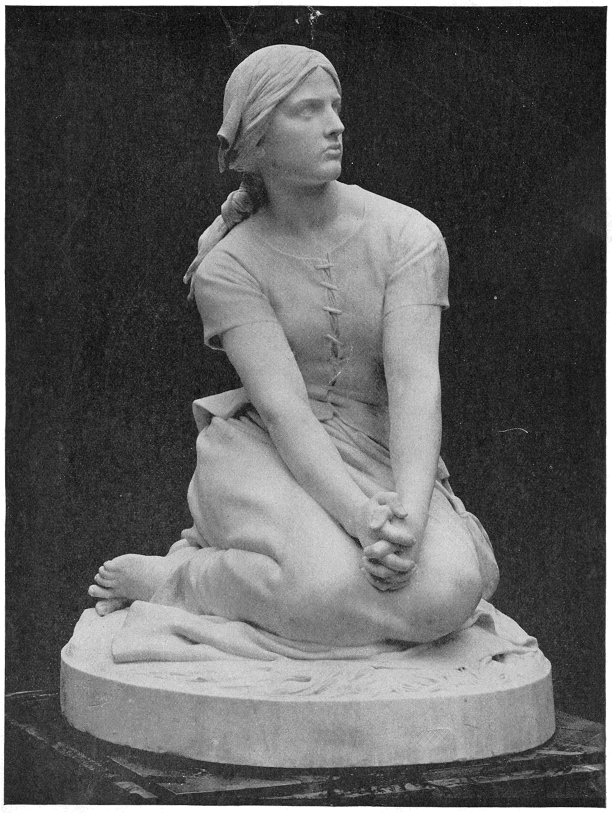
JOAN OF ARC (By Chapu), Luxembourg Gallery, Paris, France.—Known in France as Jeanne d'Arc, the maid of Orleans was born about 1411. In 1428, when Orleans, the key to the south of France, was infested by the English, she rode at the head of an army, clothed in a coat of mail, armed with an ancient sword, and carrying a white standard of her own design, embroidered with lilies, and having on the one side the image of God holding the world in His hand, on the other a representation of the annunciation. The siege of the town was broken, but she was often accused of being a heretic and sorcerer, and was burned at the stake May 30, 1431.
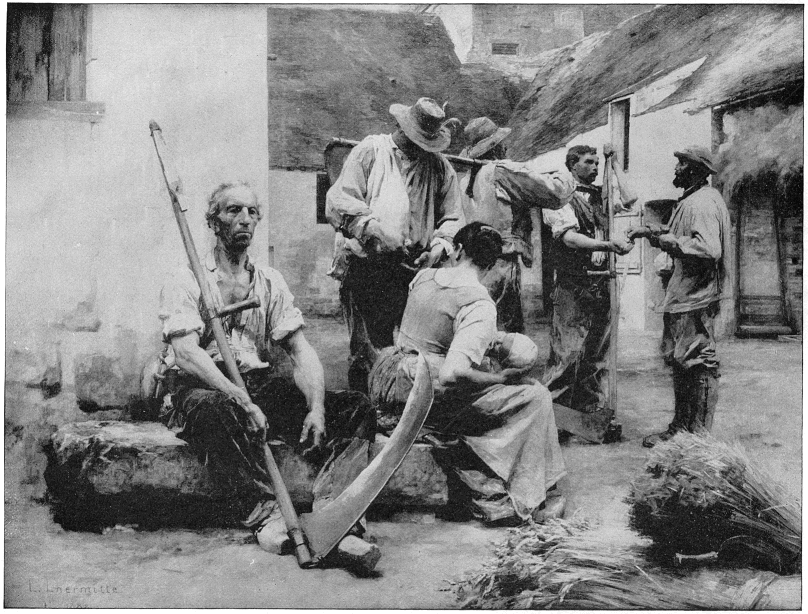
PAYING THE REAPERS (by Lhermitte), Luxembourg Gallery, Paris, France.—This famous painting, from which the photograph is a direct copy, represents a farm scene. The laborers have just finished their day's work. The man with the scythe, rolled-up sleeves and open shirt, is a genuine representation of an honest and industrious laborer. The expression on his face shows a tired look, but a spirit of contentment gently steals over his face, which nearly all true and honest country people possess after a day's hard labor.
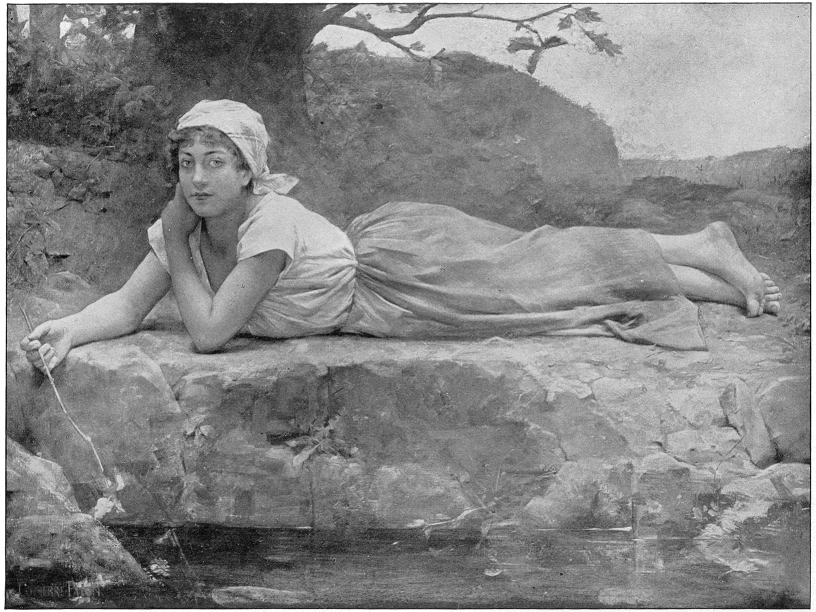
IGNORANCE (by J. Comerre Paton), Luxembourg Gallery, Paris, France.—This is one of the most celebrated paintings by this popular artist. The outlines of the girl are perfect. The graceful curves of the arms, the sweet expression of the face and the tender look of the eyes are all charmingly beautiful. The tiny cap, the loose garment, the uncovered feet, the bare arms, and the comfortable position of the girl, all add to her beauty. In the photograph the blended colors of the original painting are lost, yet the subject can be well studied from this copy.
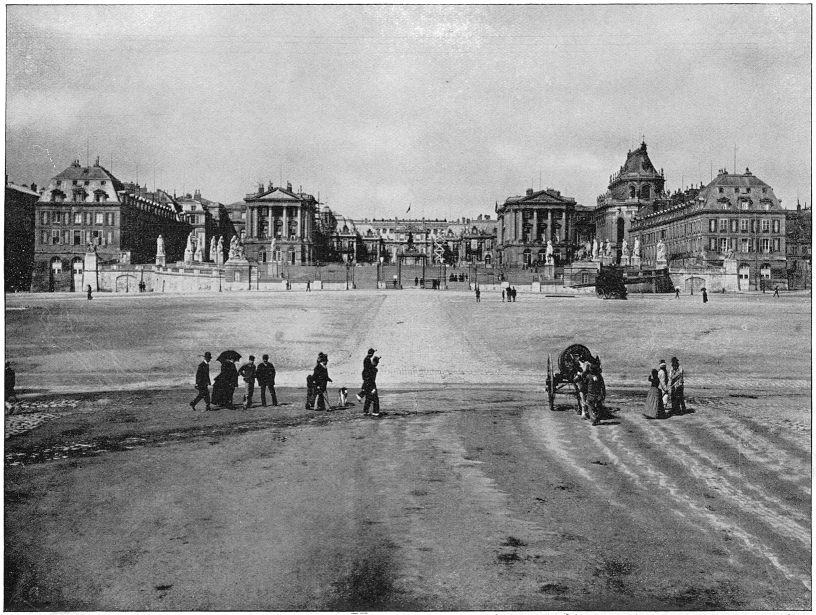
ROYAL PALACE, Versailles, France.—This palace presents a most imposing appearance; the principal façade is no less than one-fourth of a mile long. The building dates back, for the erection of its various parts, to several different periods, and was the royal residence of the various rulers of France. It has remained uninhabited since it was sacked by a Parisian mob, which included many thousand women. The various halls and rooms are now devoted to the use of most interesting picture galleries.
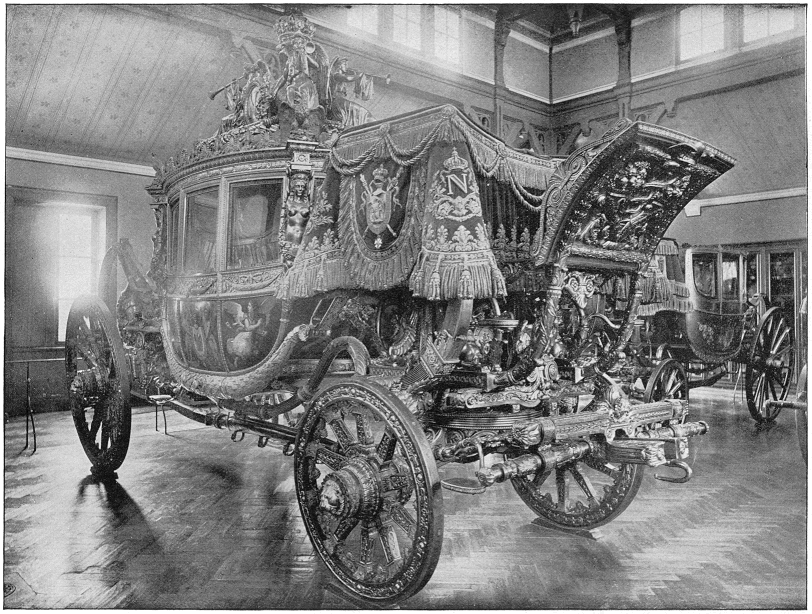
ROYAL CARRIAGE, Versailles, France.—In the Museum of Carriages at Versailles is a collection of royal vehicles from the time of the first Emperor to the baptism of the Prince Imperial in 1856, besides sledges of the time of Louis XIV., and sedan chairs. The royal carriage in the picture is that of Charles X., afterwards used by Napoleon on various occasions, the letter "N" being still seen on the drapery adorning the seat. The carriage is valued at $200,000, and considered one of the finest vehicles of its kind in the world.
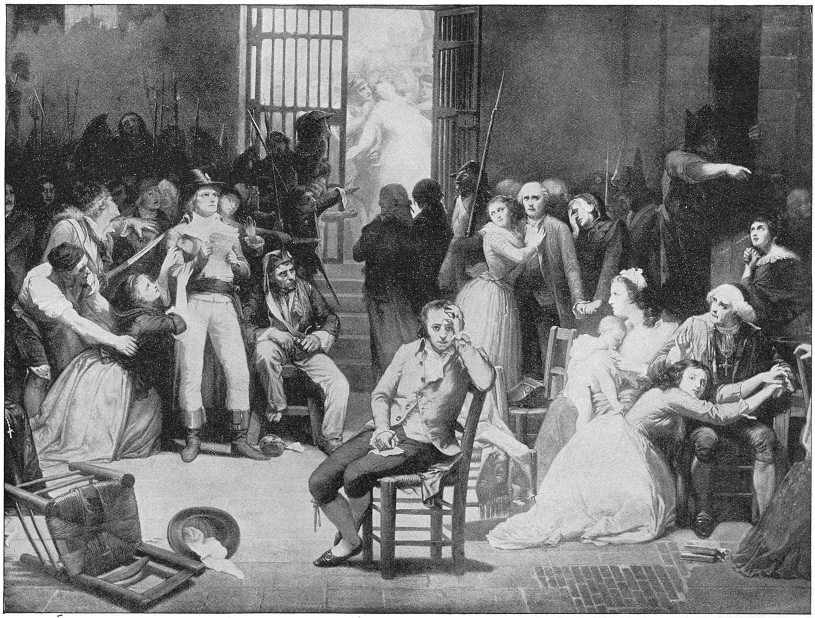
LAST VICTIMS OF THE REIGN OF TERROR (By Muller) Versailles Gallery, Versailles, France.—The French Revolution, more commonly termed the "Reign of Terror," is perhaps unparalleled in the history of civilized countries. Hundreds of citizens were guillotined, and when that process proved too slow, they were shot down by platoon-fire. The picture represents a prison scene crowded with "suspects." The officer to the right, with a list of condemned criminals, calls out the names of those to be put to death, each one fearing that his or her name will be next called to join the procession to the guillotine on the Place de la Concorde. The photograph presents a view of the last victims of that terrible war.
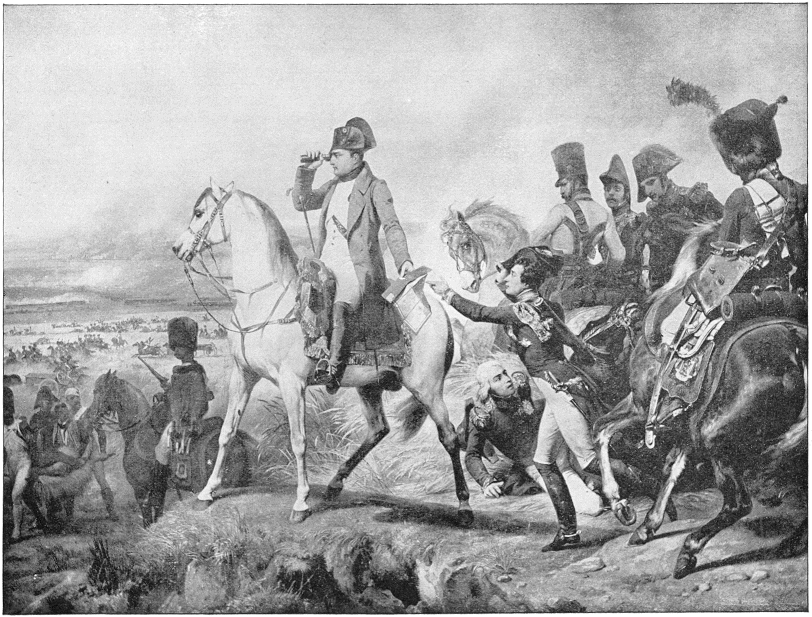
NAPOLEON AT AUSTERLITZ (By Vernet), Versailles Gallery, Versailles, France.—The conqueror here views the progress of the battle between the French troops, numbering 90,000 men, and the allied forces of fully 80,000. Napoleon, on his white horse, receives reports from his generals in the field, while with his field-glass he watches the advancing columns of both sides. This decisive battle was witnessed by three Emperors, those of France, Russia and Austria, and resulted in a glorious victory for Napoleon and the French. A treaty of peace followed between France and Austria; but it was of short duration, for the dangerous ambition of Napoleon could not fail to force all European nations into alliance.
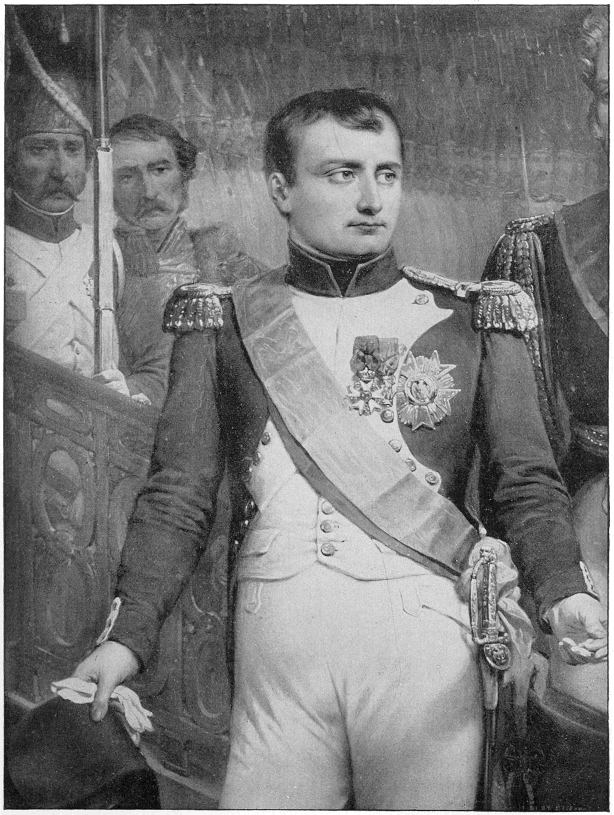
NAPOLEON (by Gosse), Versailles Gallery, Versailles, France.—The above represents the "Little Corporal" on July 7, 1807, at Tilsit, a commercial town of Eastern Prussia, ratifying the treaty with Russia and Prussia. Russia needed rest, and Napoleon was not sorry to pause. It was the highest point of the Emperor's renown. His hand was felt throughout all Europe; it seemed as if England alone were beyond his power.
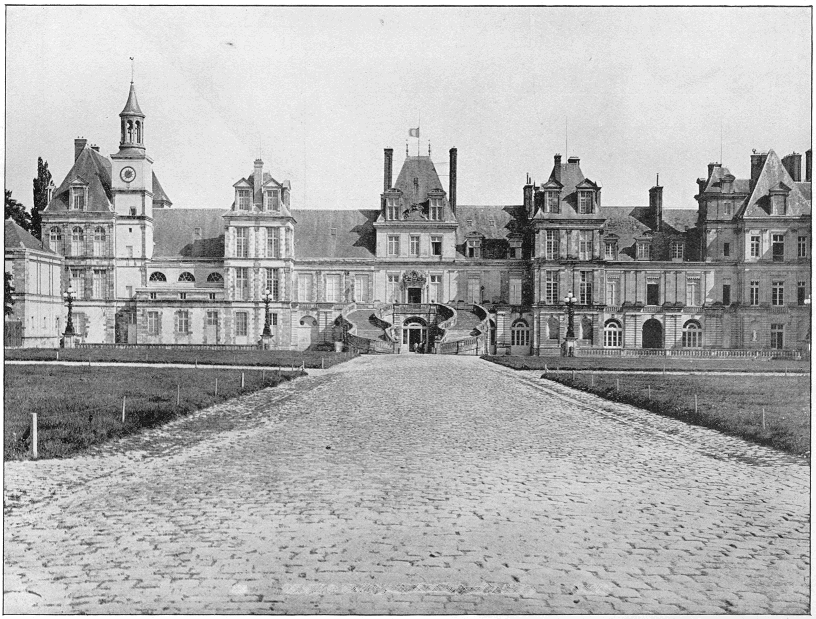
ROYAL PALACE, Fontainebleau, France.—This palace, situated on the south-west side of the town, is said to occupy the site of a former fortified chateau, founded in 1162. It was Francis I., however, who converted the mediæval fortress into a palace of almost unparalleled extent and magnificence. The exterior is less imposing than that of some other contemporaneous edifices, as the building, with the exception of several pavilions, is only two stories in height. It was a favorite residence of Napoleon.
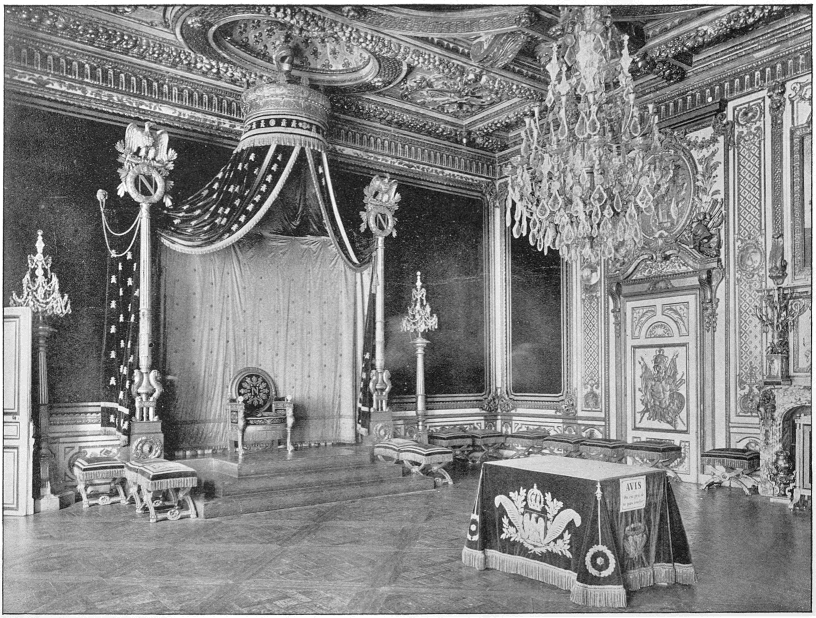
THRONE ROOM, Fontaineleau Palace, France.—This magnificent hall, with a ceiling in relief, containing a chandelier in rock-crystal, and wainscoated in the reign of Louis XIV., is perhaps the most sumptuous apartment of the palace. From here Napoleon almost ruled the world. The canopy of the throne rises by graceful folds to the rim of the high crown. The bees and the letter "N" on the chair, and on either side of the throne, are symbolic of Napoleon. It was in this same room where the Emperor declared his divorce from Josephine.
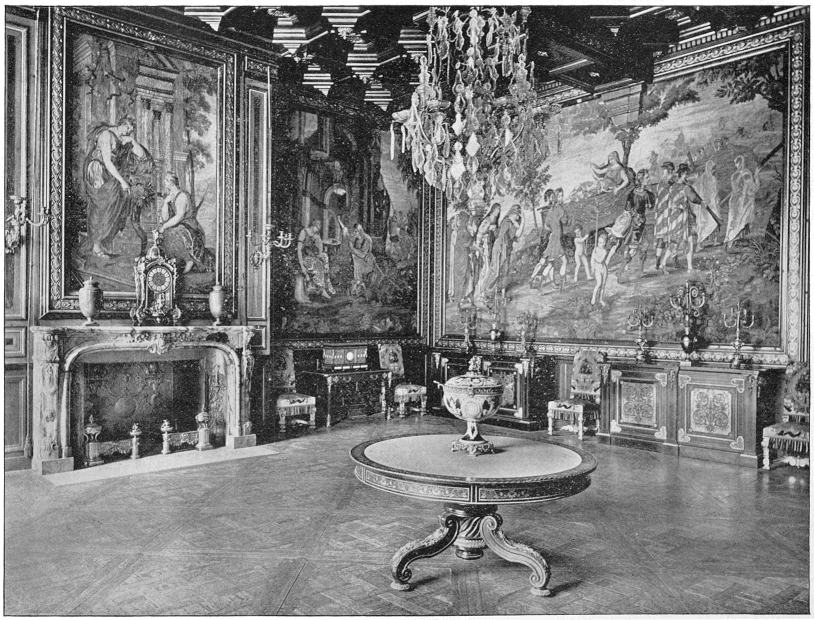
APARTMENT OF TAPESTRIES, Fontainebleau Palace, France.—This room is embellished with tapestry from Flanders, woven into the myth of Psyche. The ceiling is in relief, the old-fashioned mantel-piece dating back to the sixteenth century, while the vases and clock are the finest Sevres ware. The table in the centre is the same one on which Napoleon signed his abdication before taking his parting leave from his old Guard on the 20th of April, 1814, to go into exile at Elba. The floor of inlaid polished wood has been much worn by the feet of travelers passing through the palace daily.
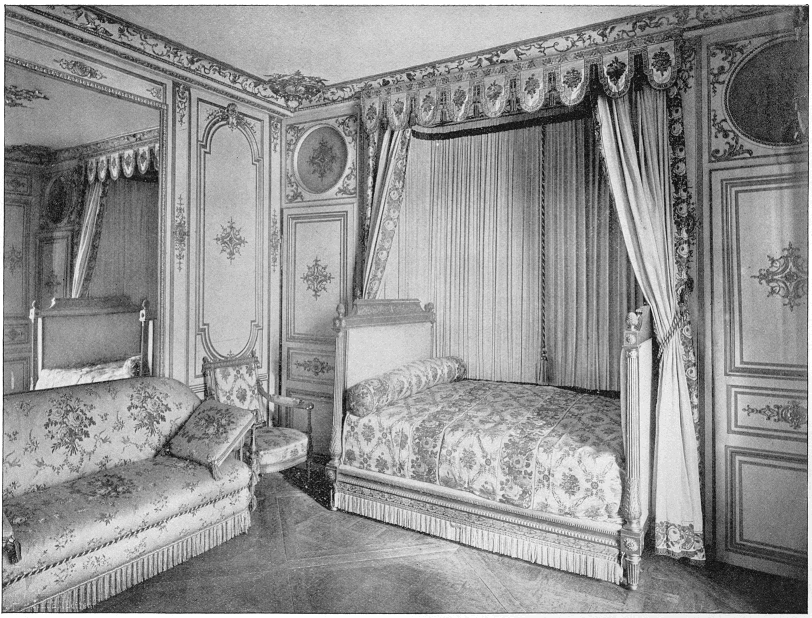
APARTMENT OF MME. DE MAINTENON, Fontainebleau Palace, France.—Madame de Maintenon was the second wife of Louis XIV., although no written proof of such a marriage is extant; but, that it took place, is nevertheless certain. As a wife, she was wholly admirable; she had to entertain a man that would not be amused, and was obliged to submit to a terribly strict court etiquette of absolute obedience to the King's inclinations. This she always did cheerfully, and never complained of weariness or illness. Her apartments still appear as they did when occupied by her.
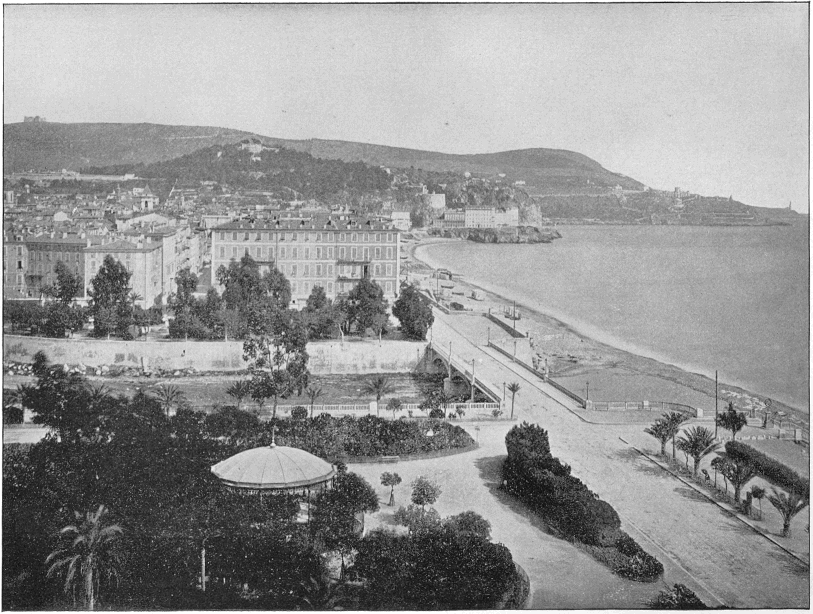
NICE, France.—Superbly situated on the shores of the Mediterranean is the City of Nice. In winter it is the rendezvous of invalids and others from all parts of Europe, who seek refuge here from the bleak and vigorous atmosphere of the North. The season begins with the races early in January, and closes with a great regatta at the beginning of April; but visitors abound from October until May. In summer the place is deserted.
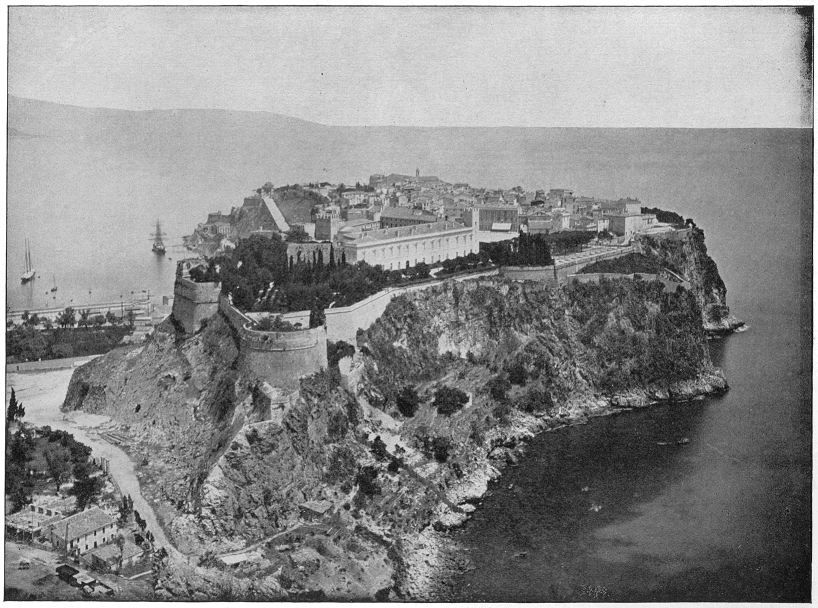
MONACO.—This principality of Europe, French in language, but Italian in tradition, is located in the southern part of France, on the Mediterranean Sea. Its area is six square miles, and consists principally of the town of Monaco and its suburbs, which stand on a high promontory. Monaco has a fine palace, a new cathedral, a college, a noted casino, where gambling is licensed to pay with its profits the state expenses; it has also manufactories of spirits, fine pottery, bricks, perfumery, and objects of myth. The principality is now virtually under French control.
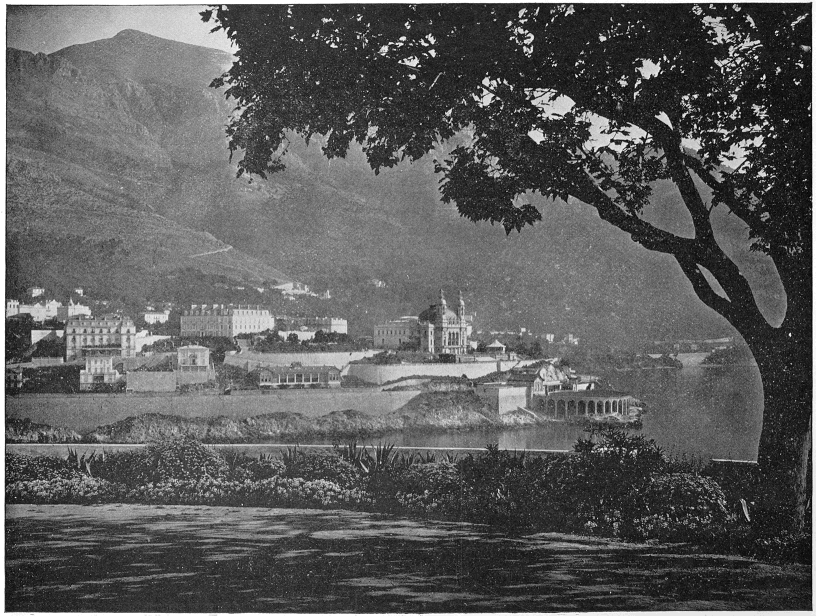
MONTE CARLO, France.—This place is a health-resort in winter and a sea-bathing place in summer; but the chief attraction to many is the "tapis vert" at the Casino. Monte Carlo belongs politically to the diminutive principality of Monaco; the former, as seen in the picture, is picturesquely situated on a small level at the foot of a high range of mountains, skirting the Mediterranean. The building to the left with turrets is the Casino. The population of the place is almost entirely transient.
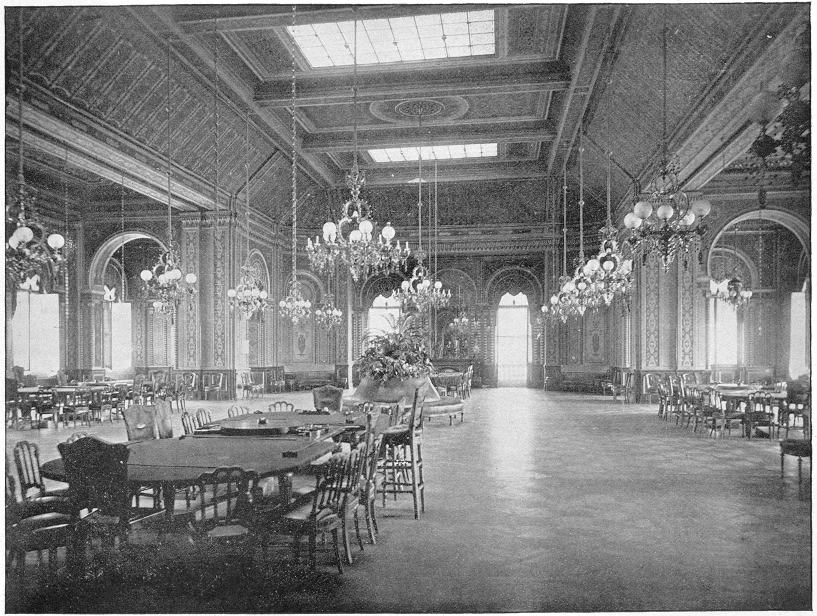
GAMING HALL, Monte Carlo, France.—Every portion of the interior of the Casino, of which the gaming-rooms are a part, is luxuriously fitted up. The ceilings are elaborately frescoed, while the walls and niches are adorned with works of art. Admission to the above room is obtained free upon presentation of a visiting card at the office. The games in progress from 11 A. M. until 11 P. M., are generally roulette, and patronized by men and women of all ages and from all countries. For the student of human nature, the gambling halls present an excellent opportunity to study mankind.
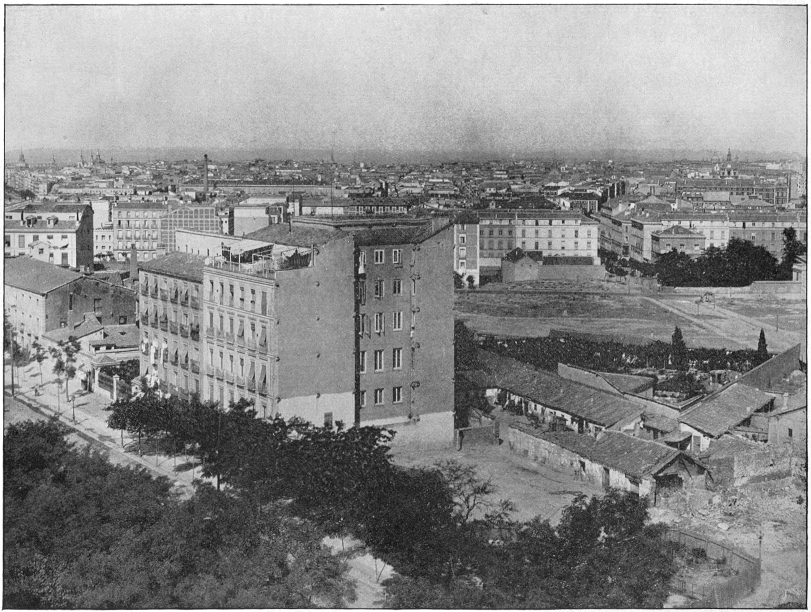
MADRID, Spain.-General view. This city is finely situated on a wide plain of the Guadalquivir. It contains an abundance of wealth and power, and is famous for its oranges and women. The city is very old, its history dating back as far as 600. It is noted for being the birthplace of many distinguished Spaniards. Magellan, the famous navigator, sailed from here in 1519, to discover Magellan Strait. The winter season is very mild and pleasant, and there is not a day in the whole year in which the sun does not shine.
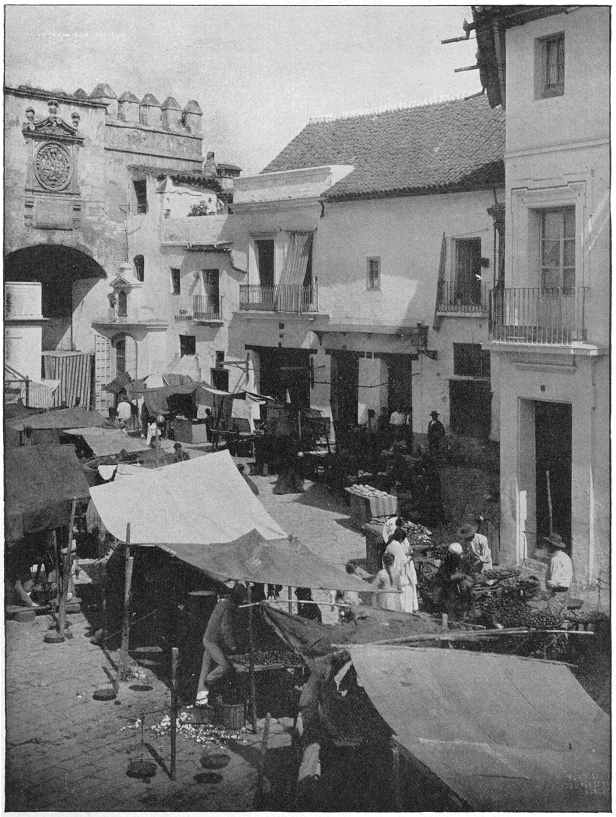
SEVILLE, Spain.—On the left bank of the Guadalquiver, in a level country as productive as a garden, stands the city of Seville. It is highly picturesque in its combination of buildings and with a river navigable to its very limits; it is astir with life and commerce. From the earliest time, this city has been the chief outlet for the wealth of Spain. In the poorer portions of the town, the open places are converted into market-stands, as seen above. Across the river, spanned by a bridge, is a Gypsy quarter of Triana.
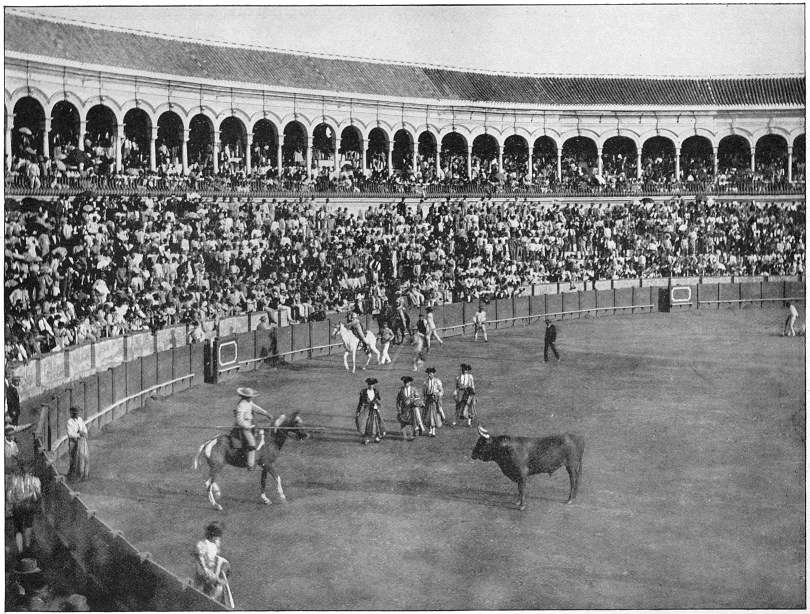
BULL FIGHT, Seville, Spain.—This photograph represents the great bull-ring of the city, with a capacity for eighteen thousand people and crowded with spectators to witness the great national amusement. A general holiday prevails on such occasions. Every one, rich and poor, possessing a grain of taste for bloody scenes and striking spectacles, can be found in the Amphitheatre on such occasions. The show generally lasts for several hours, during which several bulls, more horses, and not unfrequently, men are killed in the combat.
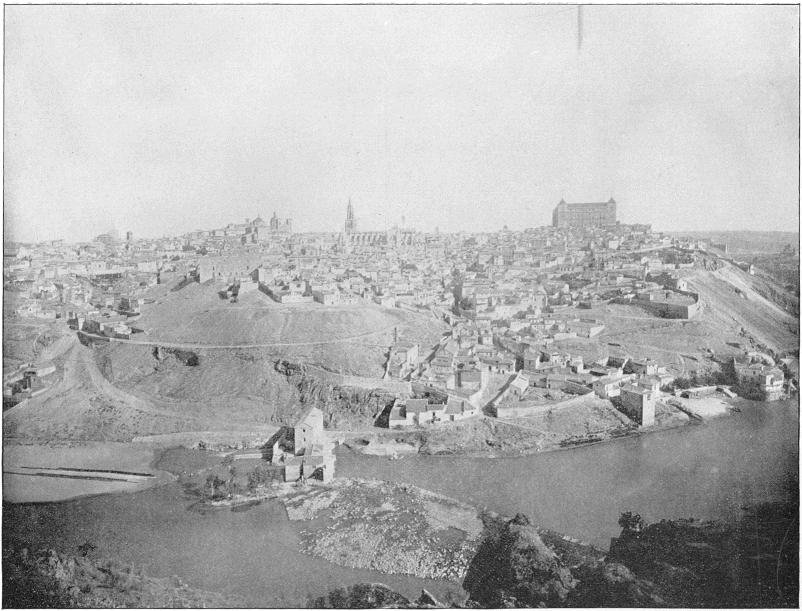
TOLEDO, Spain.—This city is situated on a rocky height, forty-one miles south-west of Madrid; its climate is very cold in winter and hot in summer. The Cathedral of Toledo, the metropolitan church of Spain, founded in 587, is four hundred feet in length, and two hundred and four feet in width, with a lofty tower and spire. Toledo has long been famous for its manufactories of sword-blades, and great skill is still shown in tempering the m. It was taken by the Goths in 467, and by the Moors in 714; it was retained by the latter until 1085, when it was permanently annexed to the crown of Castile.
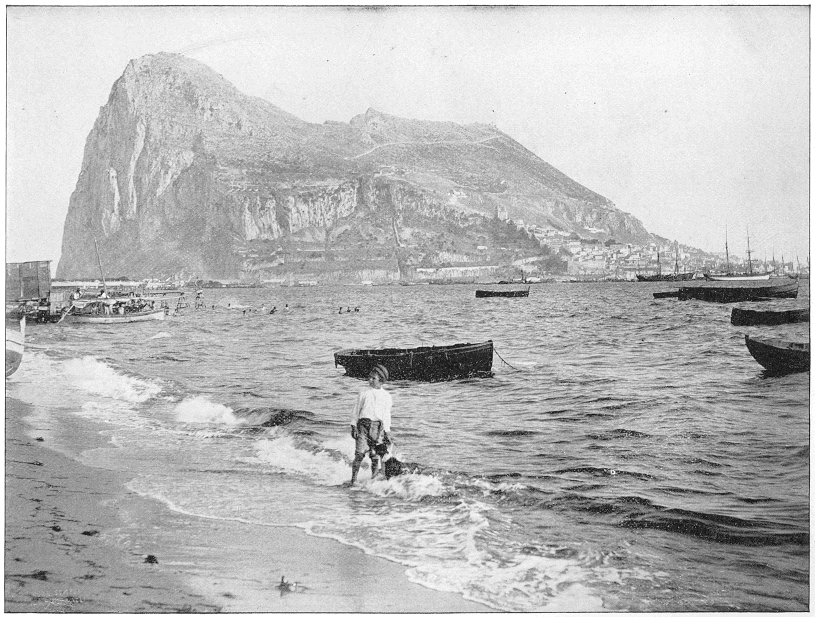
GIBRALTAR, Spain.—This remarkable fortress, which is a strongly fortified rock at the southern extremity of Spain, and forms the key to the Mediterranean, is connected with the continent by a low sandy isthmus, one and one-half miles long, and three-fourths of a mile wide. The highest point of the rock is about one thousand four hundred feet above the sea level. Vast sums of money and immense labor have been spent in fortifying this stronghold. The water for the supply of the town and garrison is collected during the rainy season, the roofs of the houses gathering all the falling rain.
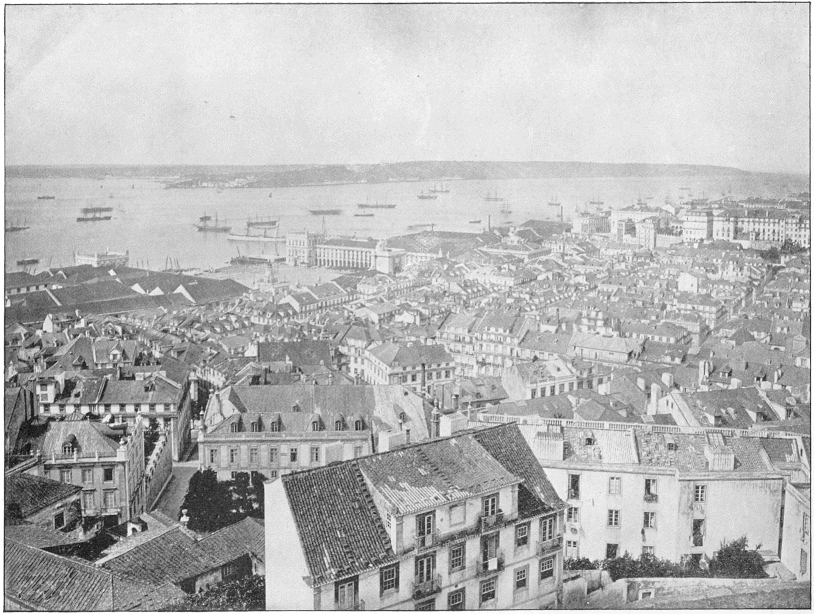
LISBON, Portugal.—This interesting city is situated on the Tagus, near the Atlantic Ocean. The length of the city is four miles, and its breadth about two miles. Lisbon is nobly situated for commerce, and has the finest harbor in the world. The earthquake of 1755, traces of which are still visible, destroyed a considerable portion of it, and killed about sixty thousand of its inhabitants. This photograph is a correct representation of the better portion of the city and harbor.
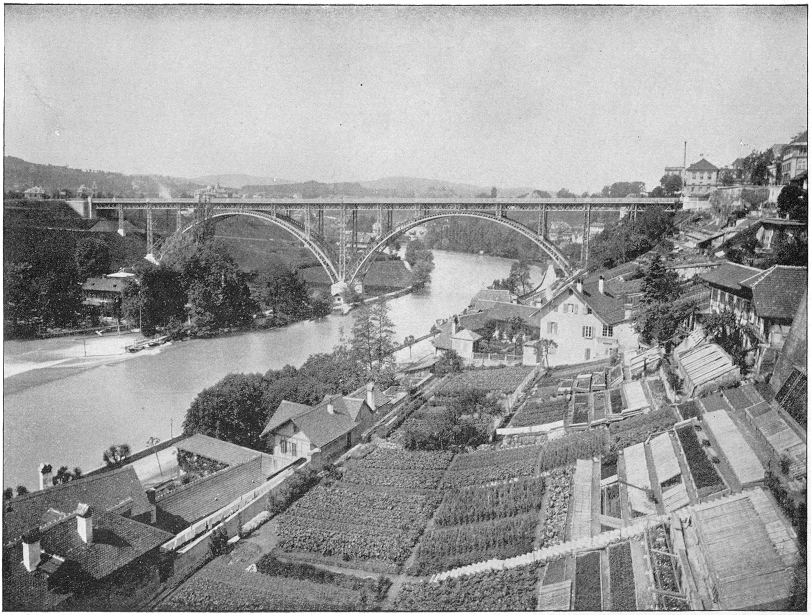
KIRCHENFELD BRIDGE, Berne, Switzerland.—The above structure is a huge iron bridge, seven hundred and fifty-one feet long, built in 1882-1883, across the river Aare, from the town proper to Helvetia Platz, where a new quarter of the town is being built by an English company. In the foreground are the terrace-like hot-houses and gardens of the peasants, who earn their livelihood by supplying the inhabitants of Berne with vegetables from their little farms. From the top of the bridge, in clear weather, the Bernese Alps can be seen better than from any other point in the Oberland.
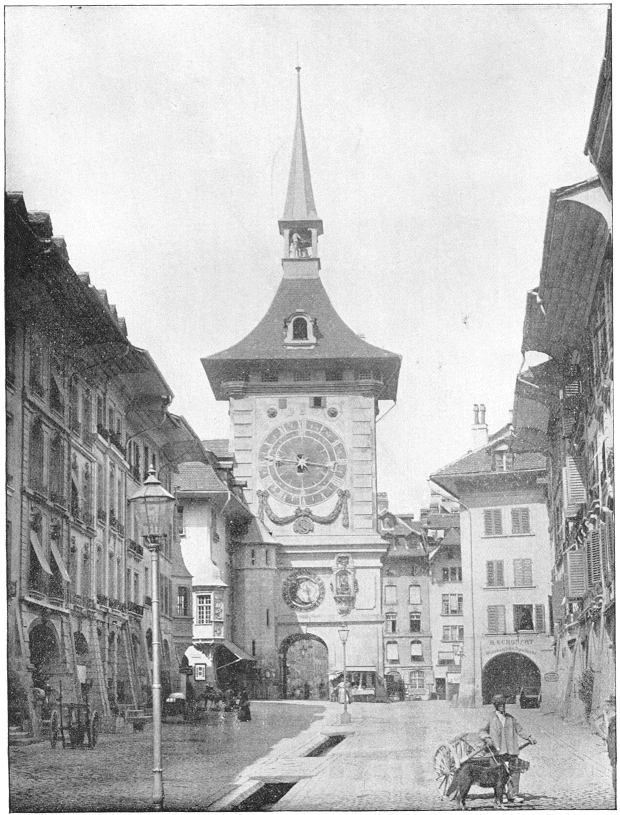
CLOCK TOWER, Berne, Switzerland.
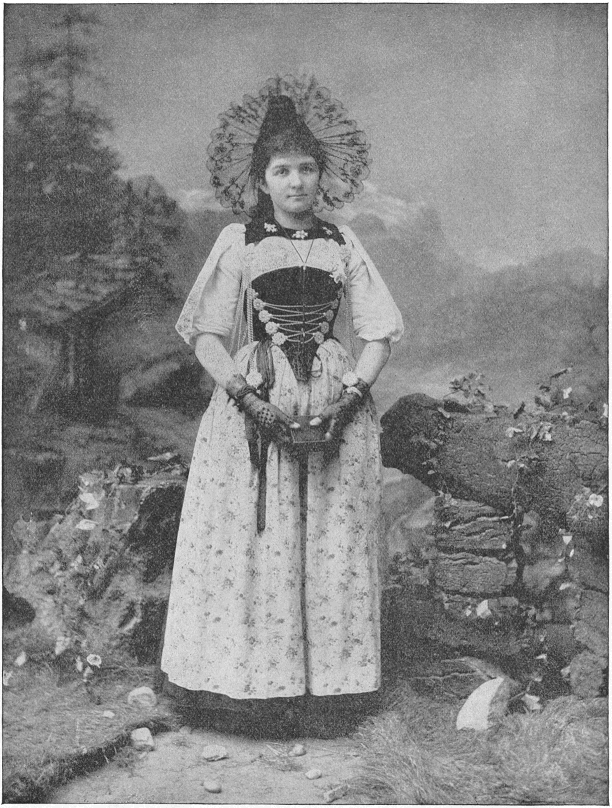
PEASANT WOMAN, Switzerland.—Here is a photograph of a Swiss girl on her way to church. She presents a true type of her sex, being well-developed, refined and accomplished. These peasants are fond of georgeous apparel, and on holidays and Sundays present a very pleasing spectacle. Their head-dress is particularly striking, consisting of a cap adorned with fine stiff lace, so arranged as to form a sort of fan at the back of the head. They all dress in similar costumes, which are both comfortable and attractive.
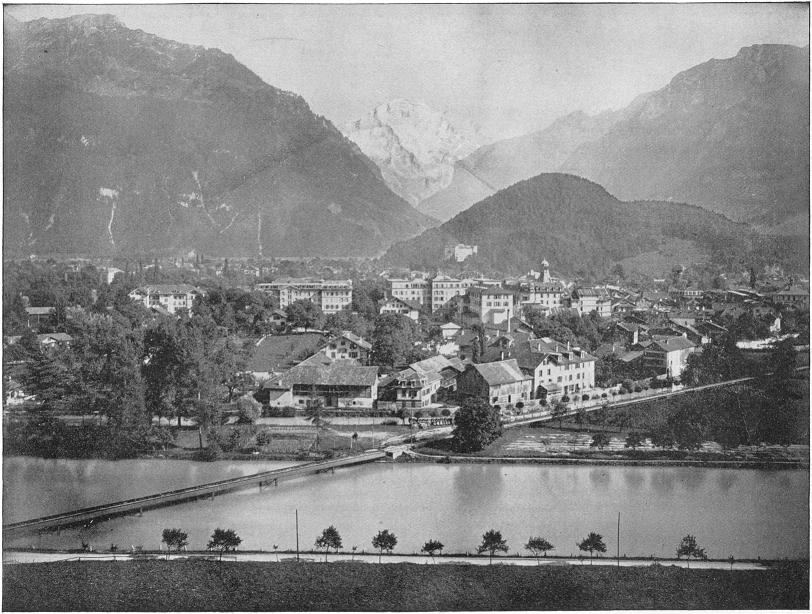
INTERLAKEN AND THE JUNGFRAU, Switzerland.—The low land between lakes Thun and Brienz, is called "Brodeli." These lakes once probably formed a single sheet of water, but were gradually separated by deposit carried from the mountain-sides. On this piece of land, "between the lakes," lies Interlaken. The town is a favorite summer resort and is noted for its mild and equal temperature. The above picture gives a general idea of the place, with the Jungfrau nine miles in the distance.
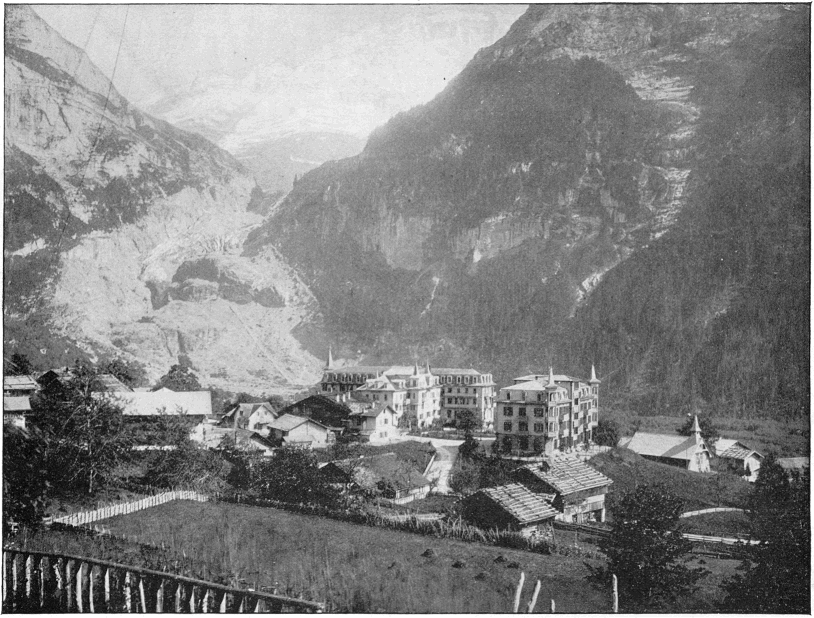
GRINDELWALD, Switzerland.—Grindelwald is a large village of widely-scattered houses, in the heart of the Alps and near the snow-fields. It is an excellent starting-point for mountain excursions, and also a favorite summer resort, the situation being sheltered and healthful. The place owes its reputation chiefly to its glaciers close by. Three gigantic mountains bound the valley. In years when ice is scarce, these glaciers serve as ice-quarries.
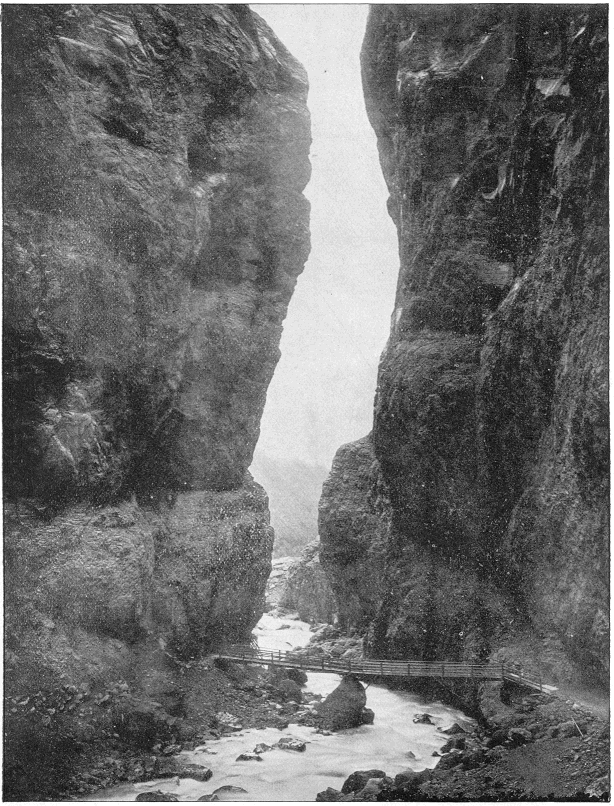
A THOUSAND FOOT CHASM, Grindelwald, Switzerland.—The above picture represents a chasm over a thousand feet in depth, with an almost perpendicular wall of rock rising on both sides. It has been cut down to its present level by the waters of the melting snows and ice on the mountain above, and strongly impresses the beholder with the power of the wheel of time. The stream in the foreground is only one of the many that rise into the dashing torrents within a hundred yards from their source in the Alpine country.
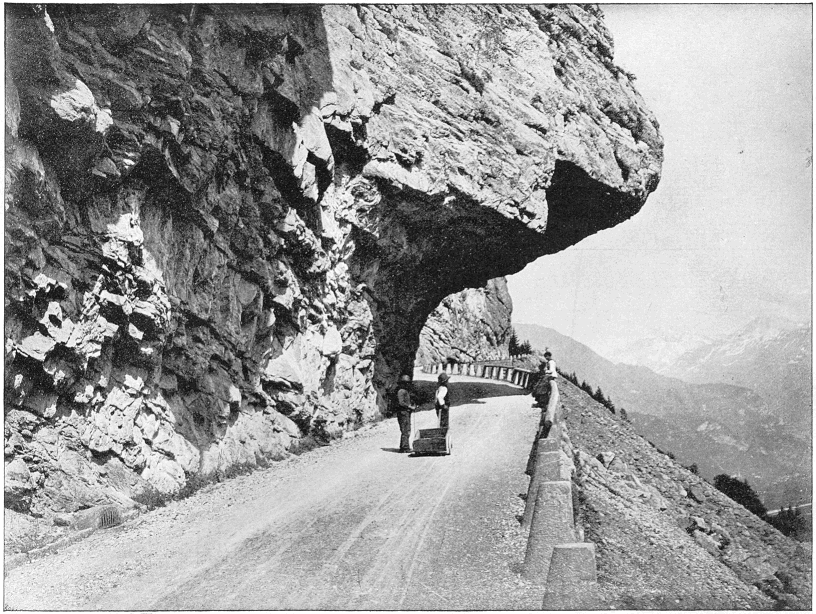
BRUNIG PASS, Switzerland.—There is, perhaps, no other country in the world that can boast of such expensive and magnificent public roads as Switzerland. This picture represents the over-hanging rock of the Brunig Pass, on the way from Lucerne to Interlaken. High up, along the mountain-side, the road winds its way, affording to the beholder a magnificent panorama of the distant snow-fields above, and the green valleys and placid lakes below.
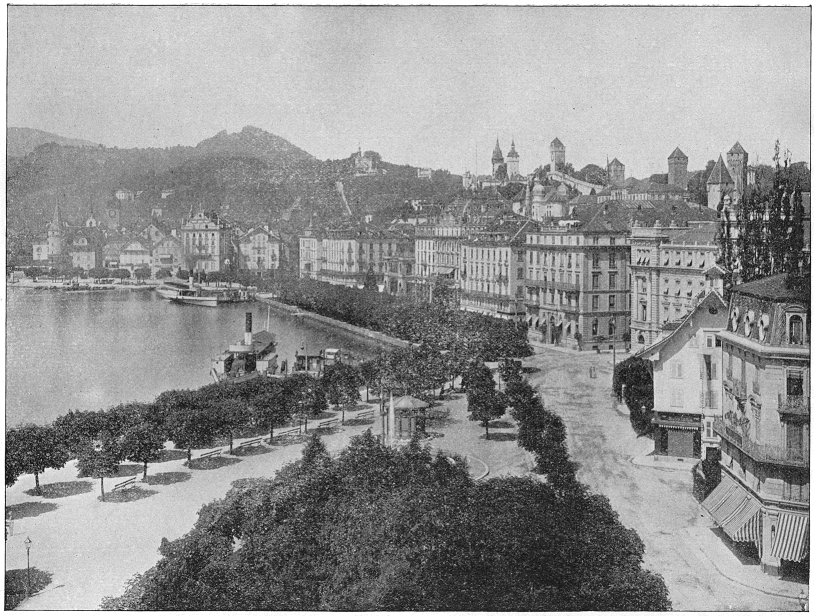
LUCERNE, Switzerland.—The above is the capital of the canton of Lucerne, and one of the three seats of the Swiss Diet on the Rense, located twenty-five miles from Zurich by rail. It is highly picturesque, enclosed by a wall and watch-towers. The principal edifices are a cathedral and other fine churches, several convents, a town hall, an arsenal with ancient armor, two hospitals, an orphan asylum, jail, theatre, and covered bridges adorned with ancient paintings. It is a very attractive summer resort, the above picture showing its principal promenade.
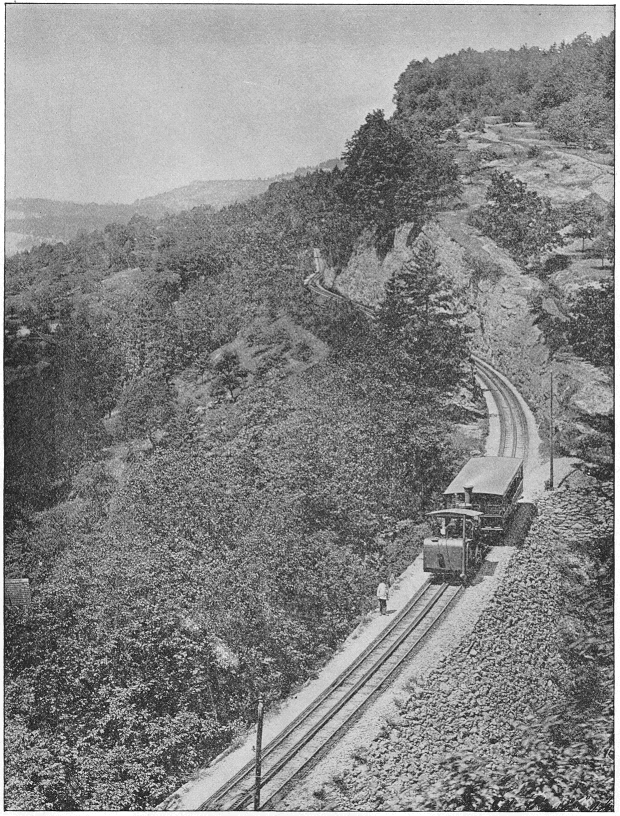
RIGI, Switzerland.—The Rigi is a group of mountains about twenty-five miles in circumference, lying between lakes Lucerne, Zug and Lowerz. The north side is precipitous, but the south side consists of broad terraces and gentle slopes, covered with fresh, green pastures, which support upwards of four thousand head of cattle; it is planted toward the base with fig, chestnut and almond trees. The photograph represents the Rigi inclined railway.
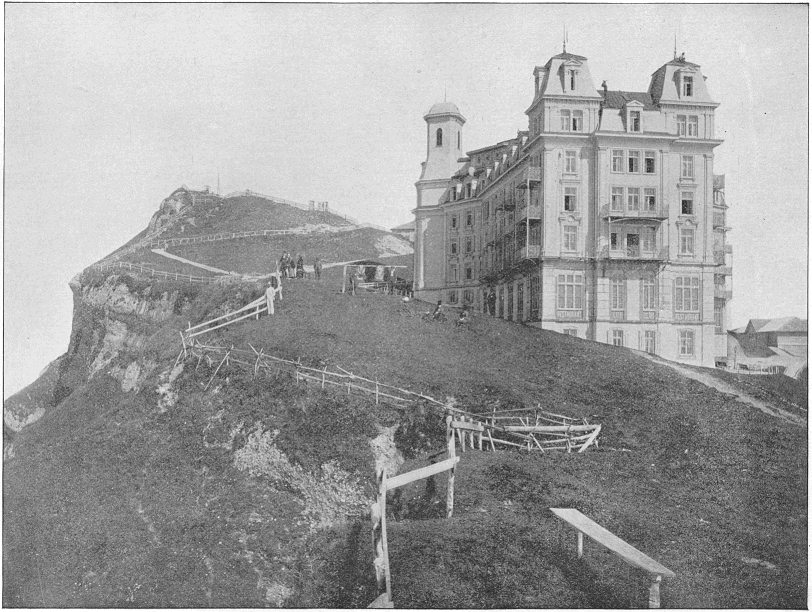
RIGI-KULM, Switzerland.—The summit of the Rigi, owing to its isolated position, commands an extensive view, three hundred miles in circumference, that is unsurpassed for beauty in Switzerland. In 1816 a very modest hotel was erected on the Kulm by private subscriptions, and in 1848 it was superseded by the oldest of the three houses on the Kulm. Since then the number of inns has been steadily increasing, and the Rigi is now one of the most popular Swiss resorts, and is visited by thousands of tourists yearly.
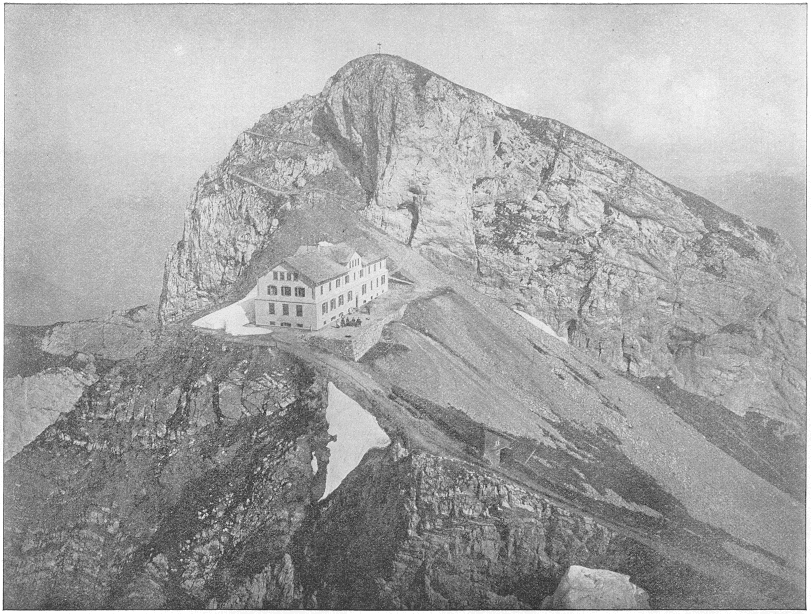
PILATUS, Switzerland.—This lofty mountain rises boldly in a rugged and imposing mass, almost isolated from the surrounding heights. Pilatus was formerly one of the best known Swiss mountains, but in later years it was supplanted by the Rigi. An inclined railway extends from the base to the summit, and is said to be one of the boldest undertakings of its kind ever carried through. Many legends are connected with Pilatus. One of the oldest is, that when Pontius Pilate was banished from Galilee he fled hither, and, in the bitterness of his remorse, drowned himself in the lake.
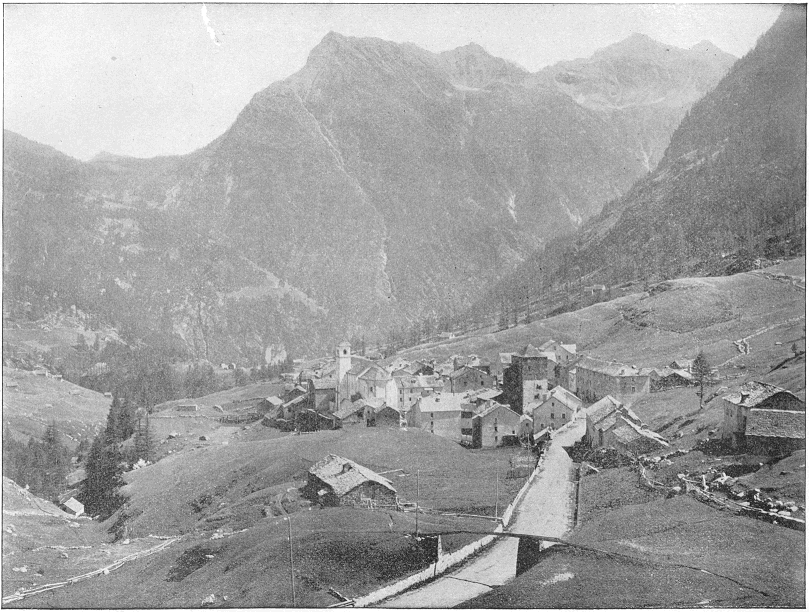
SIMPLON'S PASS, Switzerland.—This is the first Alpine route after Brenner, constructed by order of Napoleon I. A good walker may easily outstrip the "diligence" in ascending from either side, especially if he takes short cuts. At the highest point of the Simplon is a large building, with a lofty flight of stairs, founded by Napoleon, for the reception of travelers, and subject to the same rules as that of the Great St. Bernard. This famous mountain-road is seen in the foreground passing through the town of Simplon, a little village in the very heart of the Alps.
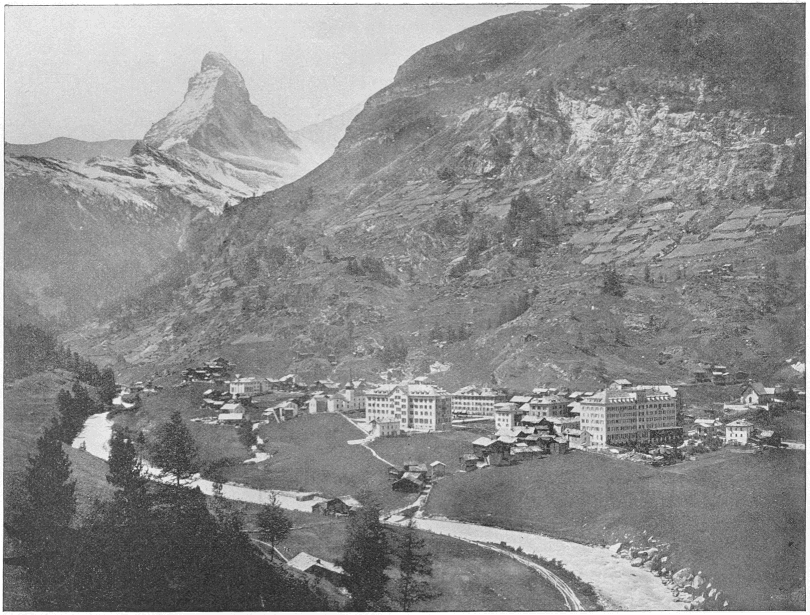
ZERMATT AND THE MATTERHORN, Switzerland.—The former lies in a green valley, with pine-clad slopes, while to the left rises the huge rock-pyramid of the Matterhorn. In no other locality is the traveler so completely admitted into the heart of the Alpine world as here. The Matterhorn was ascended for the first time on the 14th of July, 1865, but the ascent is now frequently made. The rock has been blasted at the most difficult points, and a rope attached to it, so that the most formidable difficulties have been removed; but even now the ascent is seldom made by any but proficient climbers.
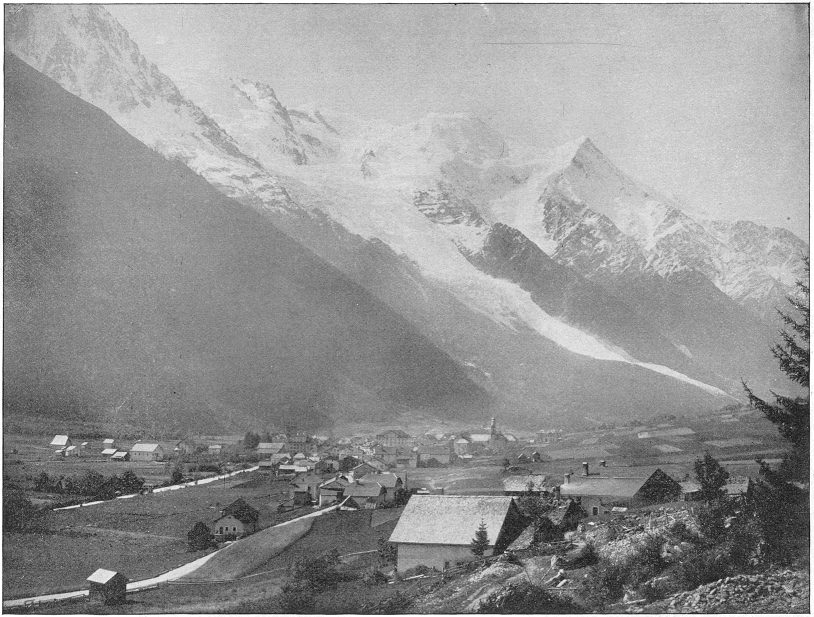
CHAMOUNIX AND MONT BLANC.—This Alpine valley is much frequented in summer, owing to its immediate proximity to Mont Blanc. It is inferior in picturesqueness to some other portions of Switzerland, but superior in grandeur of its glaciers, in which respect it has no rival but Zermatt. The picture shows the little village of Chamounix, with its few hotels and peasant homes in the valley below, and the perpetual ice and snow in the background, seemingly but a few minutes' walk away, yet requiring a good two hours' journey on mule-back. Apparent Alpine distances are very deceptive.
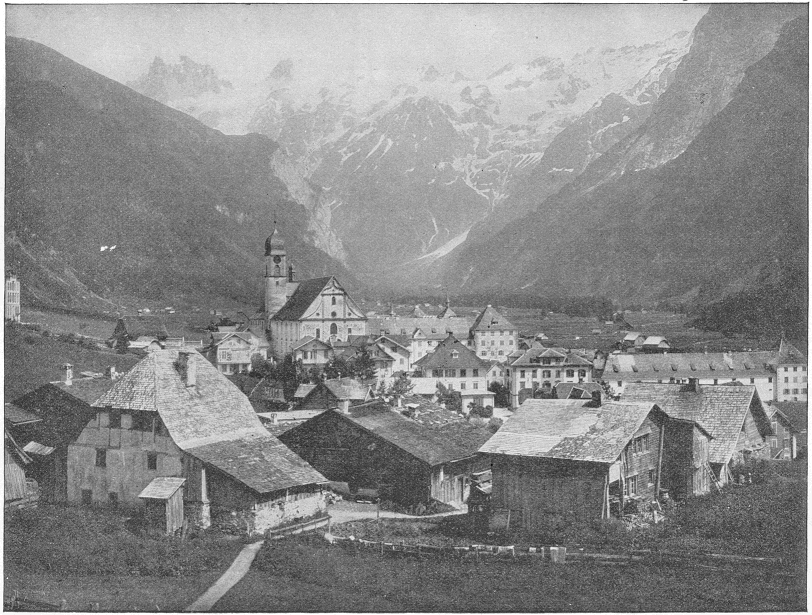
ENGLEBERG, Switzerland.—Engleberg is loftily and prettily situated in the great mountain region of the Alps, with a population of about two thousand inhabitants. The church which appears nearest the mountain, is quite ancient, but contains famous modern pictures. The snow-covered mountains, five miles in the distance, change the climate in summer, so that the tourist can wear an overcoat with comfort. The winters are very severe, and on account of the deep snows, the inhabitants are sometimes compelled to remain indoors for eight weeks. The houses and barns are generally under one roof.
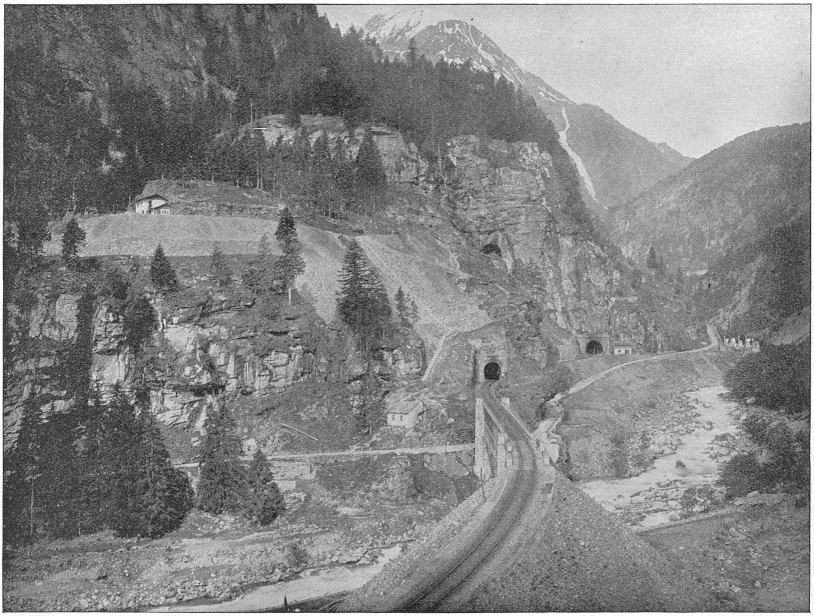
ST. GOTTHARD RAILWAY, Switzerland.—The railway here passes through beautiful landscapes, richly wooded with walnut and chestnut trees, on the left bank of the Ticino. Numerous Campaniles in the Italian style, crowning the hills, have a very picturesque effect. The peaks above are covered with snow. From the cliffs on every side, fall cascades. Huge masses of rock lie scattered about. Three tunnels of the railway are seen in the picture, the latter making a descent of three hundred feet by means of two loop-tunnels, one below the other, in cork-screw fashion.
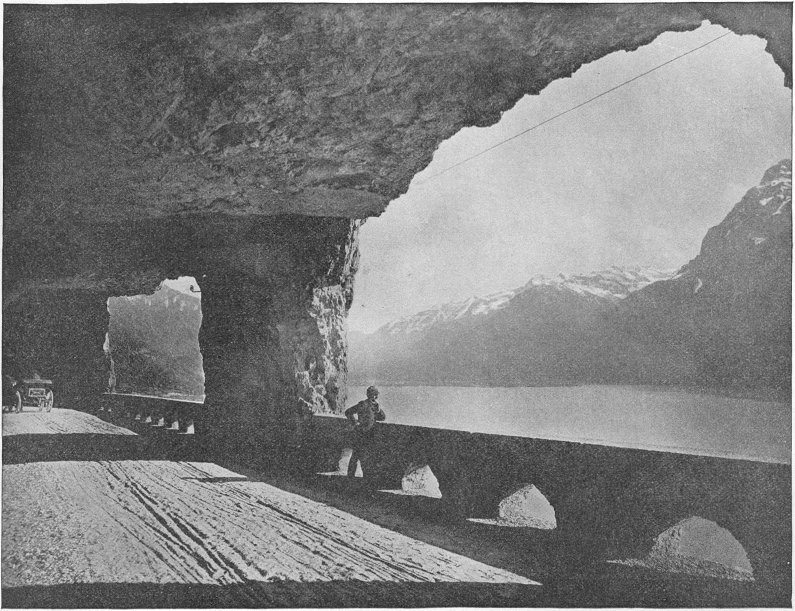
AXENSTRASSE, Switzerland.—This famous road extends nine miles along the Lake of Uri, from Brunnen to Fluelen, and is noted for the remarkable boldness displayed in its construction. It is to a great extent hewn out of solid rock, cut like a shelf into the side of the mountain, with occasional pillars to hold the thousands of tons of rock above, and a strong balustrade to guard travelers from tumbling over the abrupt precipice into the lake many feet below. It is the great highway leading from Switzerland to Italy, and is regarded as one of the most picturesque roads in the world.
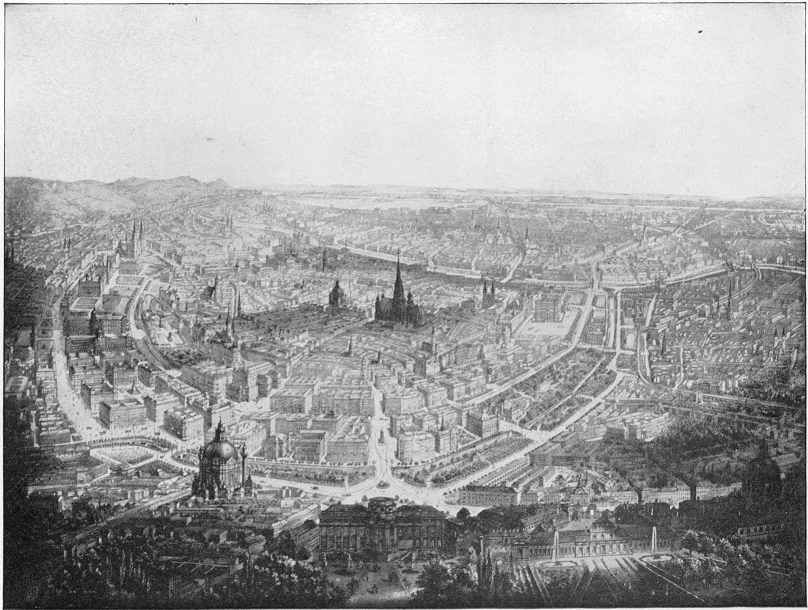
PANORAMA OF VIENNA, Austria—The capital of the Empire of Austria and residence of the Emperor, is situated in a plain surrounded by distant mountains, the Danube Canal flowing through a portion of the city. It was originally a Celtic settlement, dating back to 14 A. D. The streets of the present city are narrow, generally well-paved and enclosed by very lofty houses. A great number of old passages through the courts of houses, by means of which pedestrians may often make a short cut, are still seen. In the last quarter of a century, Vienna has acquired an importance as a seat of art.
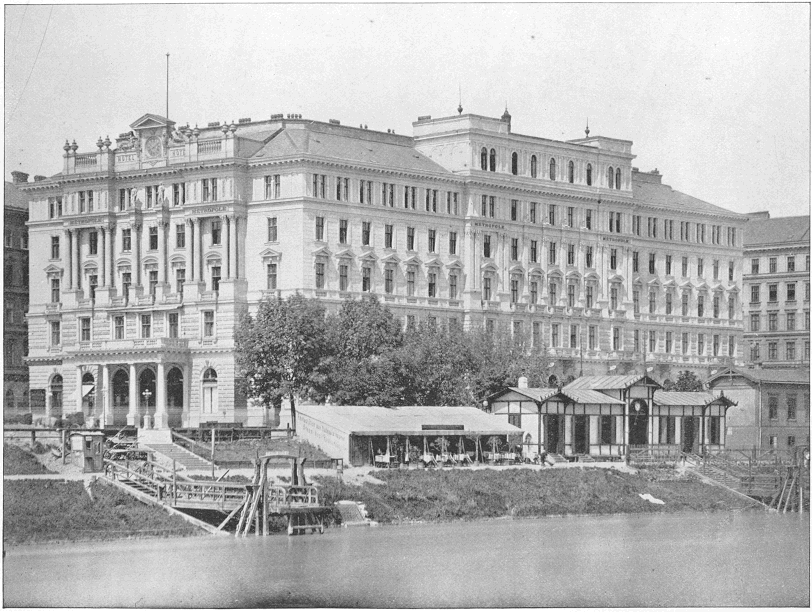
HOTEL METROPOLE, Vienna, Austria.—On a branch of the Danube, flowing through the heart of the City of Vienna, stands the Hotel Metropole, an enormous building, admirably adapted for travelers. The picture shows a prominent feature in the street architecture of Vienna; and the Metropole is only one of the many private and public buildings of colossal dimensions which have sprung up within the last few years. The interiors of all these structures are generally decorated throughout with painting and sculpture, which shows the perfection attained by the Vienese in the fine arts.
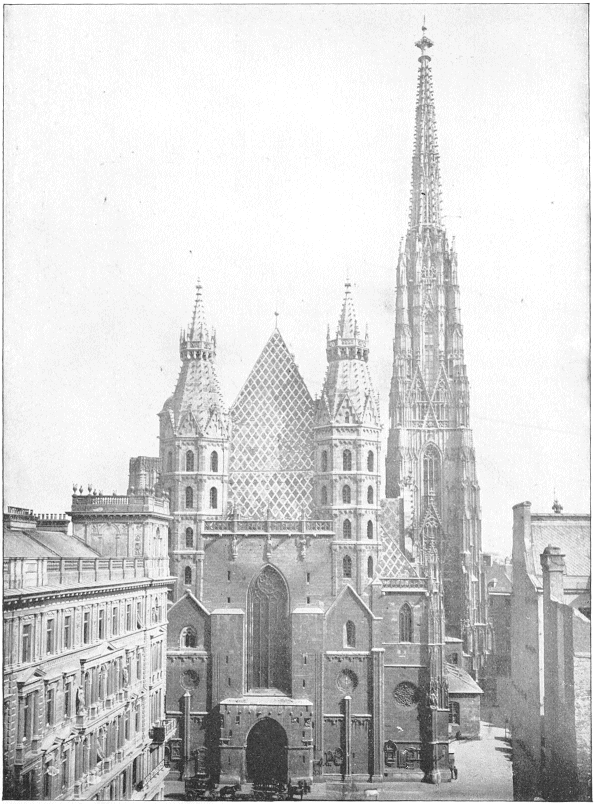
CHURCH OF ST. STEPHEN, Vienna, Austria.—This is the most important edifice in the Austrian capital, dating back in its construction to the thirteenth century. It is constructed of solid limestone, and built in the form of a Latin cross. Below the church are extensive catacombs, consisting of three vaults, filled with bones and skulls. Centuries ago, the sovereigns of Austria were buried in these vaults. The Tower, built between 1860 and 1864, affords an extensive view, embracing the river Danube and the battle-fields of Loban, Wagram and Essling.
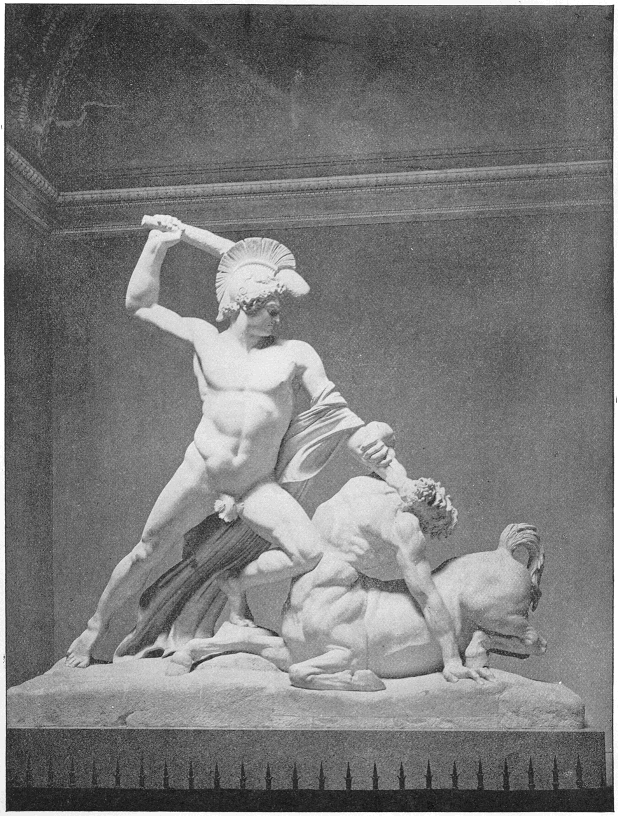
THESEUS (By Canoya), Volksgarten, Vienna, Austria.—In the centre of this pleasure ground stands the Temple of Theseus, containing Canova's fine marble group of the victory of Theseus over Centaur, originally destined by Napoleon I. for Milan. The figures are of heroic size. The victorious Theseus is represented as seated on the lifeless body of the monster, and the exhaustion that visibly pervades his whole frame, proves the terrible nature of the conflict in which he has been engaged.
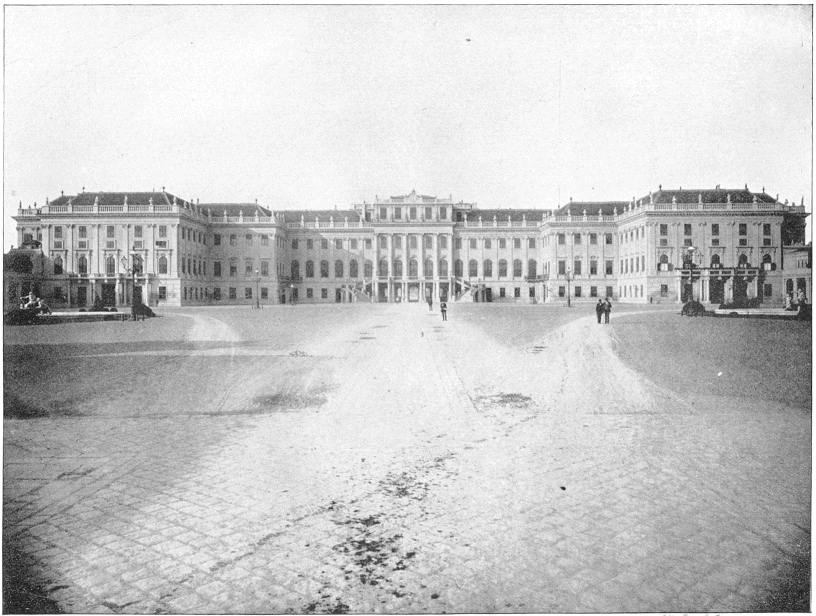
SCHONBRUNN, Austria.—This sumptuous edifice, the summer palace of the Austrian Emperor, was completed by Maria Theresa in 1775. The building has a most imposing appearance. The gardens in the rear are open to the public. To the left of the principal avenue are the Roman ruins, the Obelisk and the "Schöne Brunnen" (beautiful fountain), from which the palace derives its name. Statues, vases and other objects of taste of the period are scattered about the ground. Extensive parks are attached to the palace.
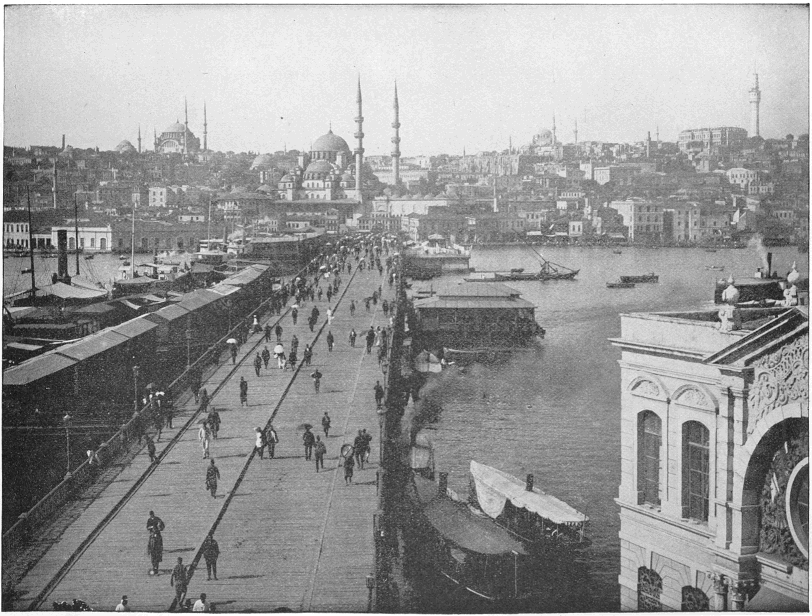
GALATA BRIDGE, Constantinople, Turkey.—Along the north shore of the Golden Horn spreads the quarter known as Galata, rising up to the crest of the hill, and including the massive tower that crowns it. Beyond and above Galata, Pera stretches forward along the ridge that runs parallel with the shore. These places are connected with Constantinople by two bridges crossing the Golden Horn. One of these bridges is represented in the above picture. Unlike those of most other countries, people do not keep on the sidewalks, but wander along in any portion of the street. The scene on the Bridge of Galata affords an interesting subject for study.
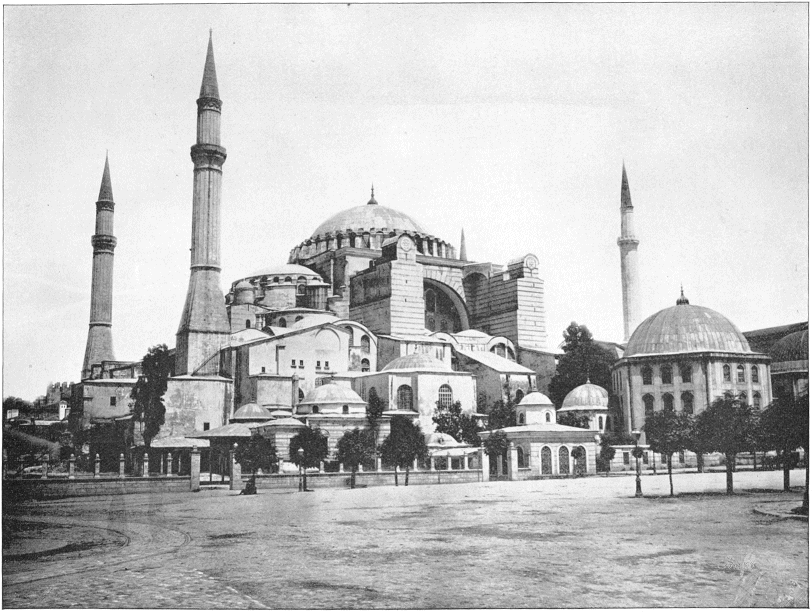
MOSQUE OF ST. SOPHIA, Constantinople, Turkey.—This is the finest and most important ecclesiastical building of the city. The first stone of the building was laid in 532. No fewer than ten thousand workmen are said to have been engaged under the direction of one hundred master builders, and when the work was completed, it had cost the imperial treasury $5,000,000. The dome rises to the height of one hundred and eighty feet, and is one hundred and seven feet in diameter. To render it as light as possible, it was constructed of pumice stone and Rhodian bricks. Not long after its completion, the dome was shaken by an earthquake, but was immediately restored.
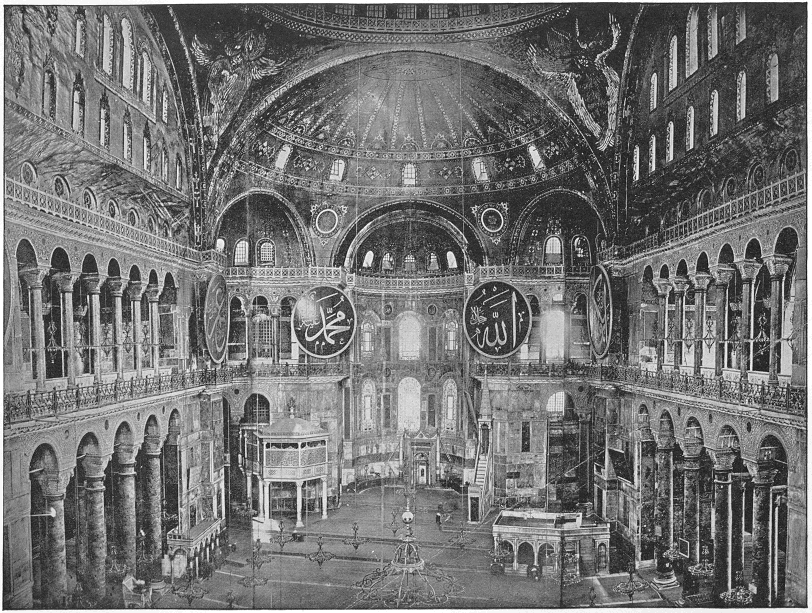
INTERIOR OF THE MOSQUE OF ST. SOPHIA, Constantinople, Turkey.—The whole interior of this noted structure is lined with costly marble. To add to its splendor, the temples of the ancient gods at Heliopolis and Ephesus, at Delos and Baalbec, at Athens and Cyzicus, were plundered of their columns. To secure the building from ravages of fire, no wood was employed in its construction except for the doors. The visitor cannot fail to be impressed by the bold span of the arches and the still bolder sweep of the dome, while his eye is at once bewildered and charmed by the rich, if not altogether harmonious, variety of decorations, from the many colored pillars down to the mosaics and inscriptions on the walls.
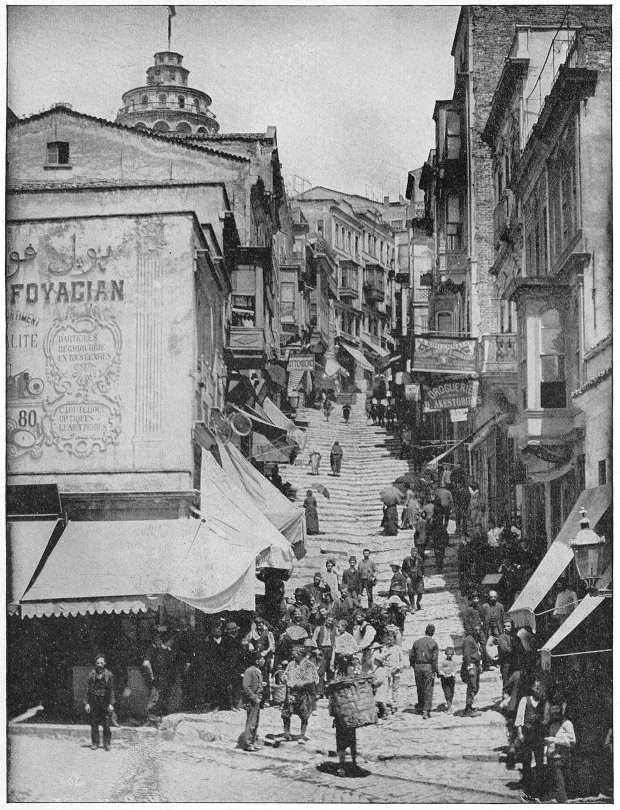
STREET SCENE, Constantinople, Turkey.—The American traveler upon entering this city is almost bewildered at the many novelties that confront him before he reaches his hotel. Nothing strikes him more forcibly than the awful silence that pervades so large a place. The only sound heard is an occasional cry of some vender, with a large wooden tray on his head, selling sweetmeats, sherbet, fruit or bread. Dogs at intervals disturb the pedestrian. Hundreds of them lie in the middle of the street, and only move when aroused by blows. At ten o'clock at night, the city is as silent as death.
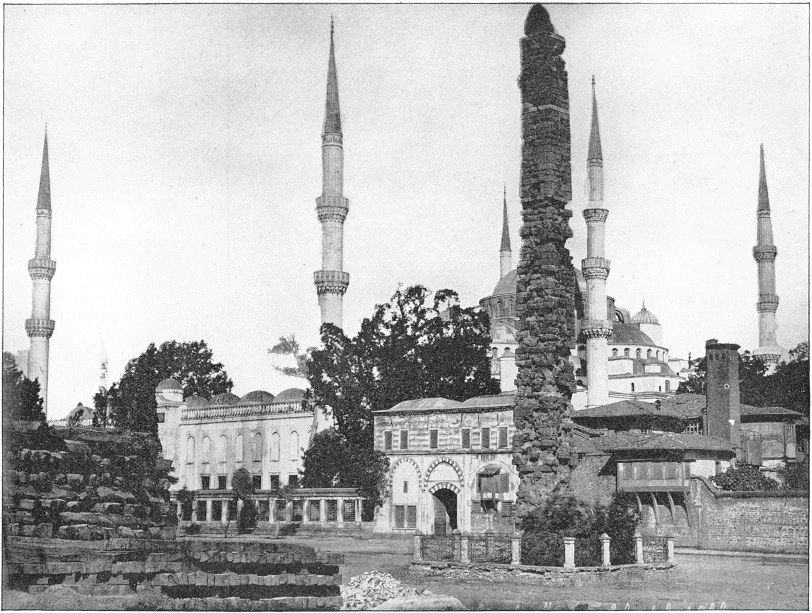
MOSQUE OF SULTAN AHMED, Constantinople, Turkey.—Of all the mosques in the Ottoman Empire, this is the principal one. It is not as richly decorated as St. Sophia, but it is the only one that possesses six minarets. It is located on a square called the Hippodrome, named after the spot that was in former years used for circus purposes. The exterior view gives it a magnificent appearance. The place is one of the chief objects of interest in the city. The crumbling monument in the foreground is a relic of antiquity.
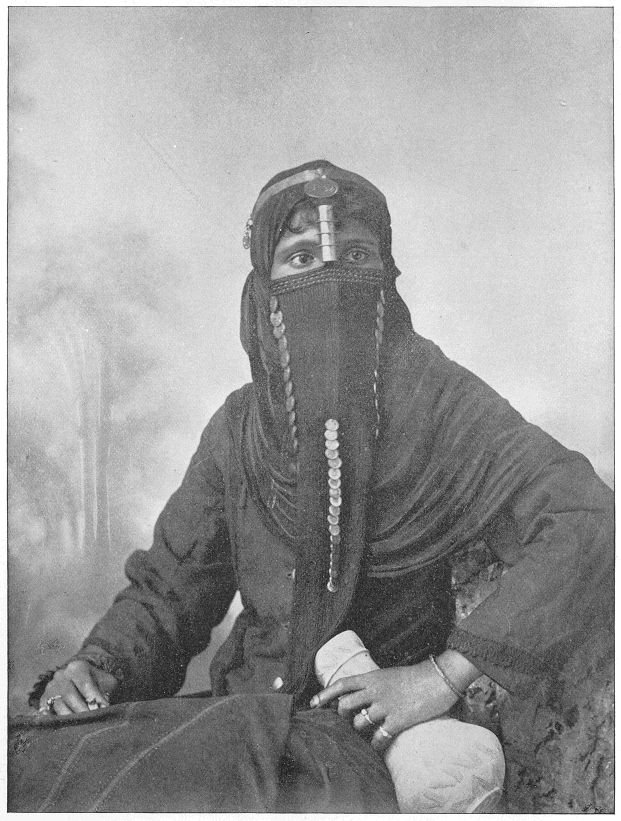
TURKISH LADY, Constantinople, Turkey.
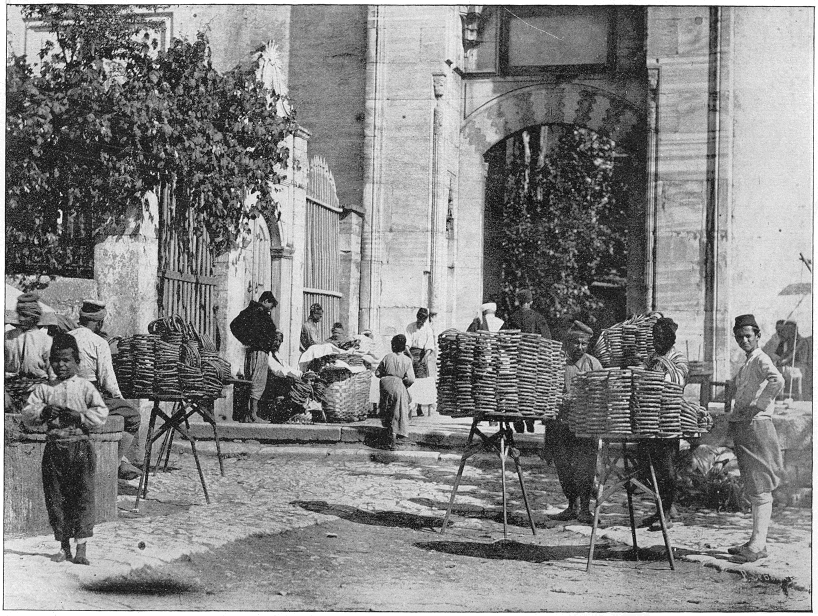
STREET MERCHANTS, Constantinople, Turkey.
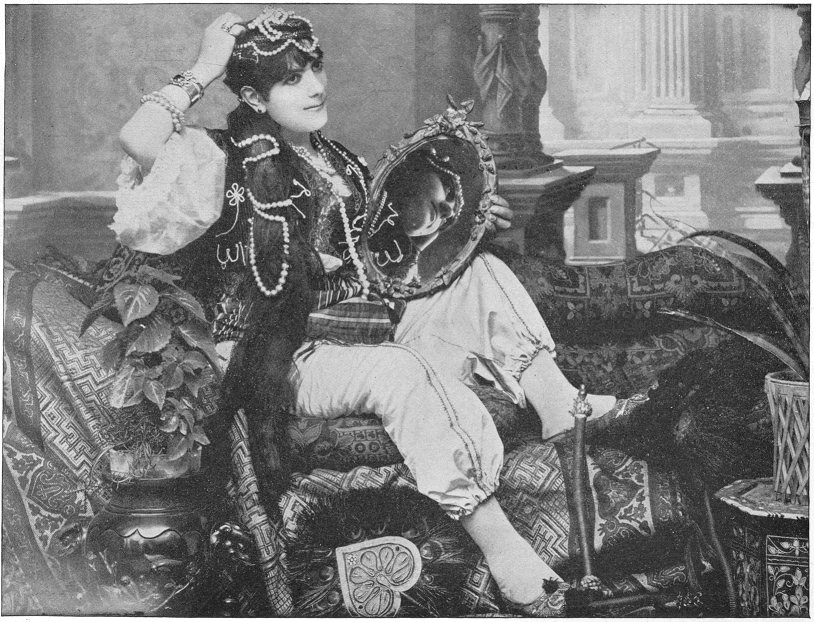
SULTAN'S HAREM, Constantinople, Turkey.—This photograph represents an odalisque, one of the beautiful inmates of the harem of the Sultan of Turkey. The photographer who took this picture found her most courteous and obliging, and able to converse fluently in English, French and German. Abdul Mezed, who ruled Turkey during the Crimean War, had 1200 wives and odalisques in his harem. When a Turkish Sultan wishes to show especial honor to a subject, he makes him a present of one of the cast-off wives. To refuse the gift would be to invite death. The harem is continually recruited by the gifts of those who wish to carry favor with the Sultan, and these comprise slaves of every nationality.
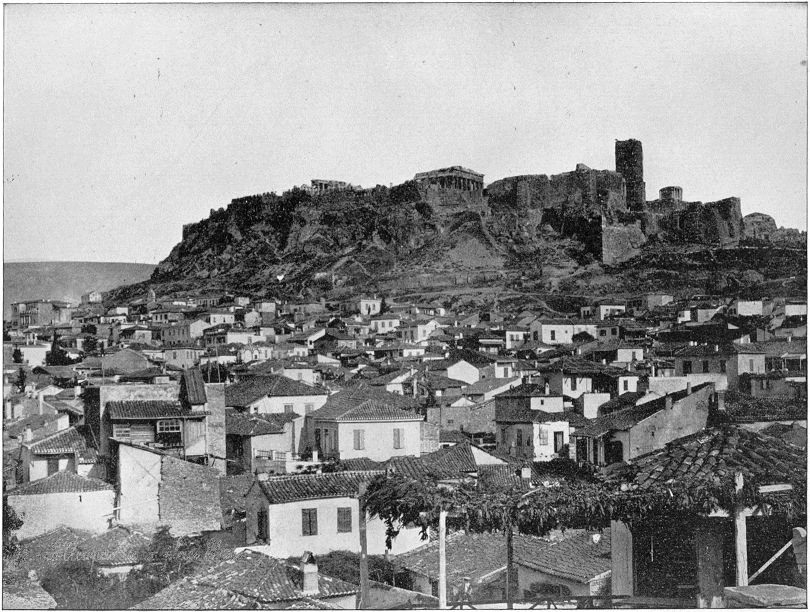
ACROPOLIS, Athens.—The natural centre of all the settlements in the Attic plain within the historical period was the Acropolis, a rocky plateau of crystalline limestone, rising precipitously to a height of two hundred feet. The semi-mythical Pelasgi, of whom but a few isolated traces have been found in Attica, are said to have leveled the top, increased the natural steepness of the rock on three sides, and fortified the only accessible part by nine gates. It was the earliest seat of the Athenian kings, who here sat in judgment and assembled their councils, as well as of the chief sanctuaries of the State.
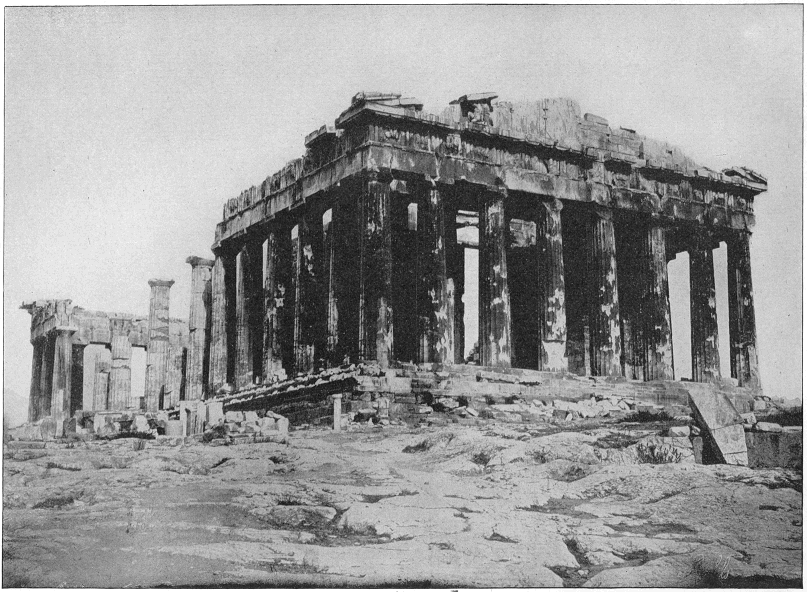
PARTHENON, Athens, Greece.—This structure is the most perfect monument of ancient art, and even in ruins presents an imposing and soul-stirring appearance, occupying the culminating point of the Acropolis. It was erected by Pericles and opened for public worship in 433 B.C. The crowning glory of the Parthenon was its magnificent sculpture, ascribed to Phidias, registering the highest level ever attained in plastic art. The Parthenon was used as a Christian Church in the fifth century. In 1460 it became the Turkish Mosque, and in 1670 the stately edifice was blown into ruins.
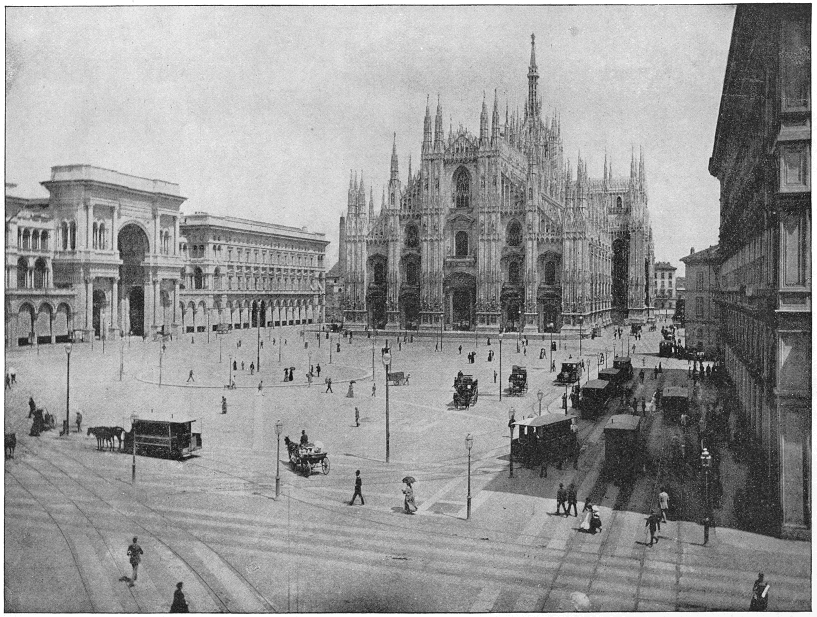
GRAND CATHEDRAL AND SQUARE, Milan, Italy.—This is the focus of the commercial and public life of the city, and is now enclosed by imposing edifices on every side. The celebrated Cathedral, the eighth wonder of the world, is next to St. Peter's in Rome, the largest church in Europe. It covers an area of fourteen thousand square yards, and holds about forty thousand people. The building is in cruciform shape, with double aisles and transept. The interior is supported by fifty-two pillars, each twelve feet in diameter. The floor consists of mosaic, in marble of different colors.
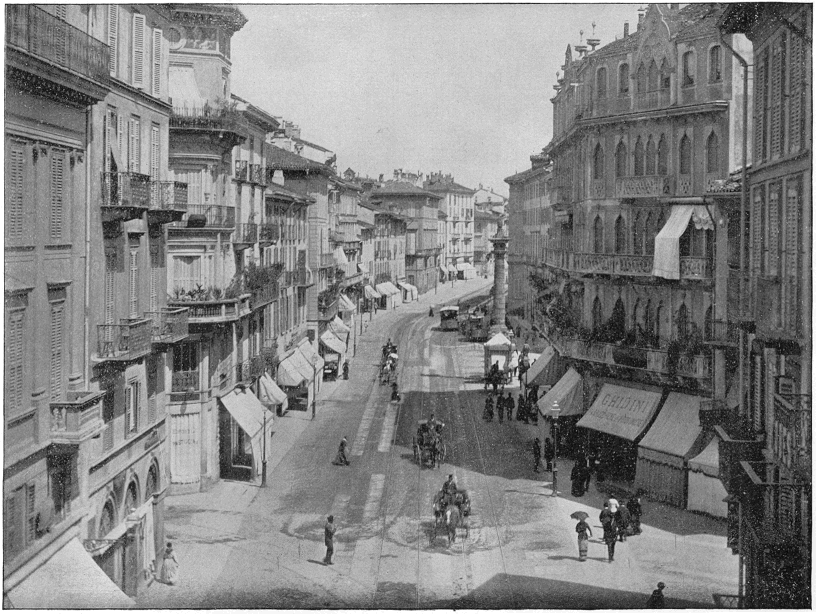
CORSO VENEZIA, Milan, Italy.—The principal shopping street of the city, and the favorite promenade of the Milanese is here represented. The buildings have a modern aspect, with little balconies at almost every window, which are often adorned with plants, flowers and creeping vines. The street, which is well paved, is wide, extending almost from house to house. The pavements are very narrow, consisting of only four smooth slabs of stone, laid side by side. The shop-windows are decorated in the most tempting style with the wares of the various merchants. The picture was secured in the early morning, giving the street a deserted look, which at all other times is crowded with people.
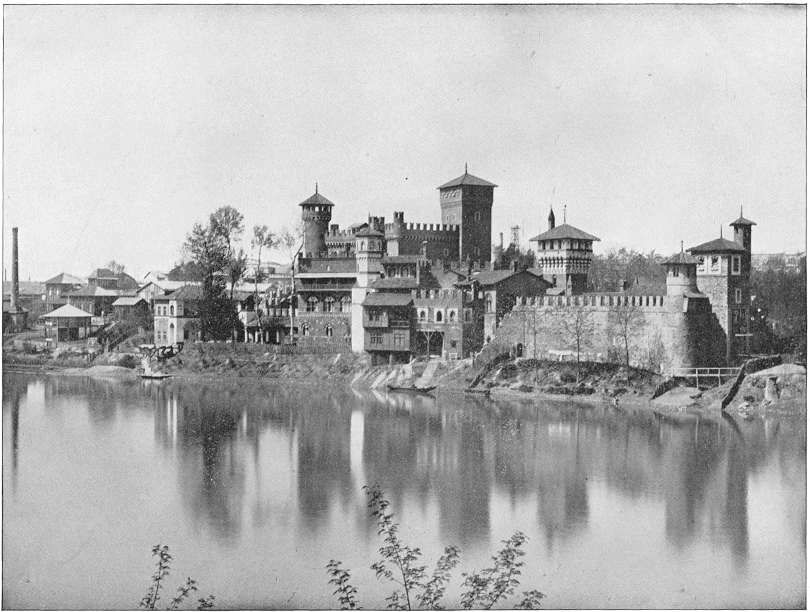
EXPOSITION BUILDINGS, Turin, Italy.—The city of Turin was the capital of the county of Piedmont in the Middle Ages, and in 1418 it became subject to the Dukes of Savoy, who frequently resided here. From 1859 to 1865 it was the capital of Italy, and the residence of the King. It lies on an extensive plain on the banks of the River Po. Turin was the chief centre of those national struggles which led to a unification of Italy. The removal of the seat of government to Florence seriously impaired the prosperity of the city for a time, but it long since recovered, and celebrated its commercial success in 1884 by the exhibition.
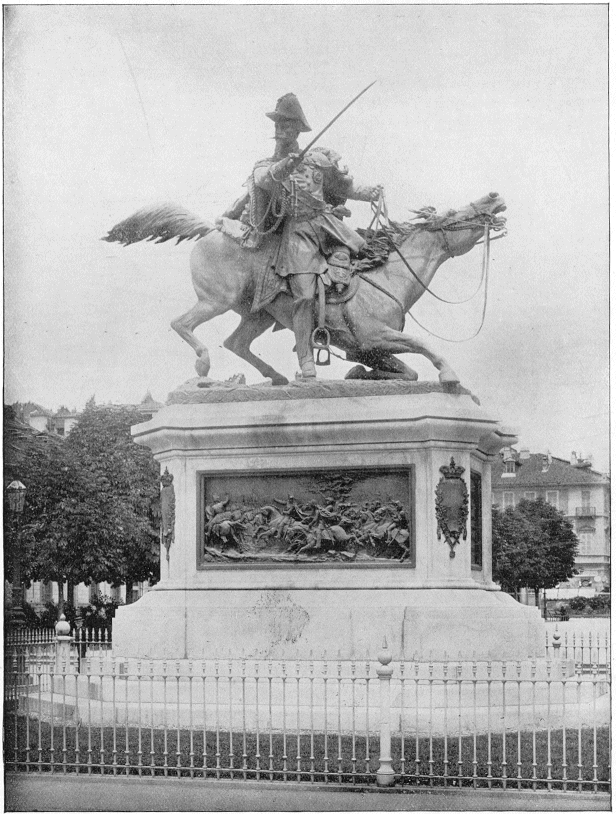
DUKE FERDINAND OF GENOA, Turin, Italy.—In the centre of the piazza Solferino stands the equestrian statue of Duke Ferdinand of Genoa, commanding-general at the battle of Novara. The statue was executed by Balzico, and is remarkable for the life-like expression of the wounded horse, with extended nostrils and gasping breath, sinking under the burden of his gallant rider. This piazza is one of the prettiest spots of Turin. Private residences face it on every side, with sloping lawns relieved by beds of flowers.
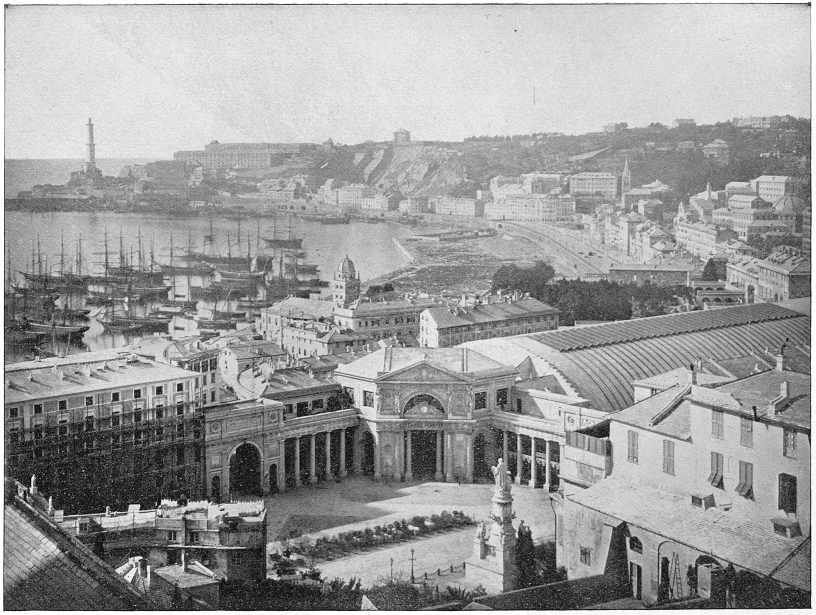
GENOA, Italy.—Genoa, with a population of about 200,000, is located in the northern portion of the Peninsula, and is the principal seaport of Italy. The city is in the form of a crescent, and its gradual ascent from the shore, renders its appearance beautiful and attractive. It is enclosed by a double line of fortifications, which places it among the leading fortified cities in Europe. A beautiful light-house on the west side, 300 feet in height, stands like a sentinel on the edge of the bay. In the older portions of the city, the streets are only ten feet wide and are lined with high buildings on both sides.
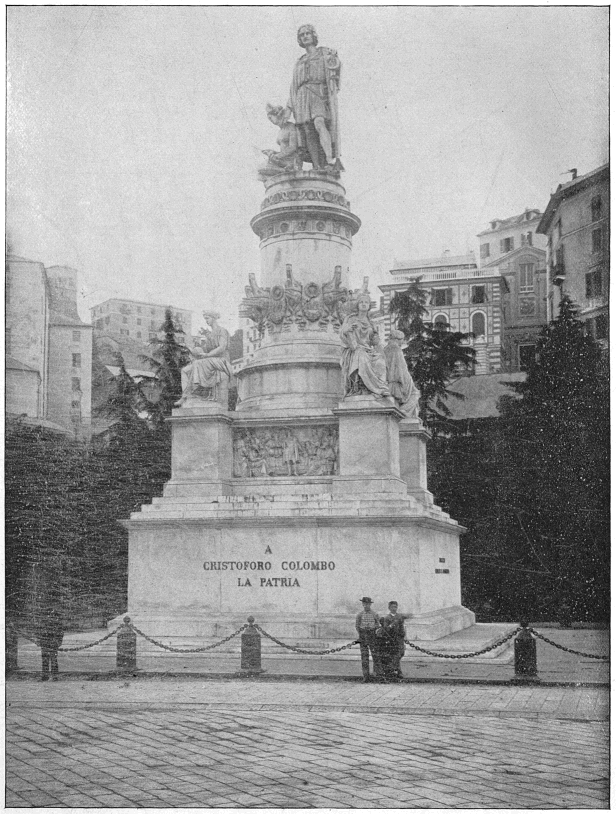
STATUE OF COLUMBUS, Genoa, Italy.—In the front of the principal railway station, rises the statue of Columbus, who was born at Genoa in 1435. The statue is in the centre of the spacious Piazza Acquaverde, embosomed in palm-trees. The pedestal is adorned with ships' prows. At the feet of the statue, which leans on an anchor, kneels the figure of America. The surrounding allegorical figures represent Religion, Science, Geography, Strength and Wisdom. Between these, are reliefs from the history of Columbus, with the inscription, "A Christoforo Colombo la Patria."
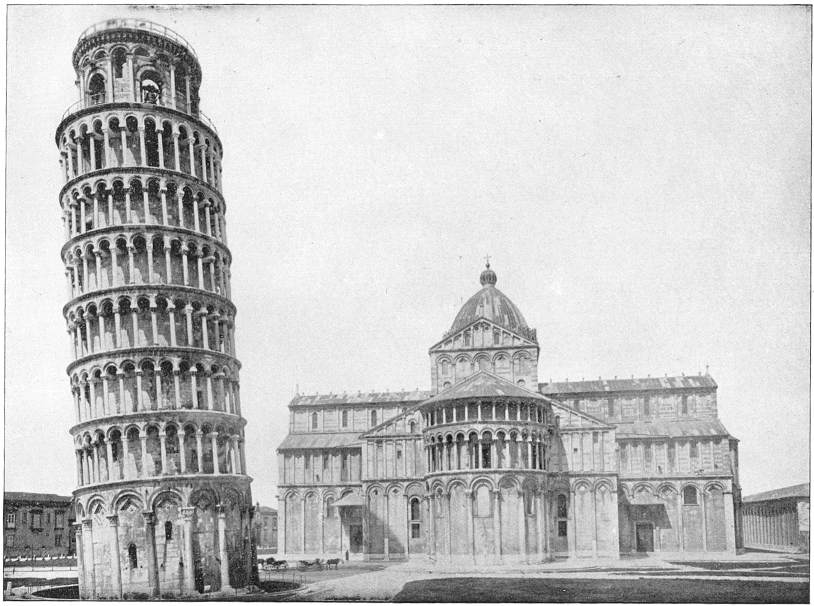
LEANING TOWER, Pisa, Italy.—Pisa is principally noted for its famous "Leaning Tower," begun in 1174, and built of white marble; it is 178 feet high, and fronted with 207 columns. It is 50 feet in diameter, and leans 13 feet from the perpendicular. The foundation being made insufficiently solid, it began to incline before it was one-third completed. The Cathedral on the right was begun in 1604, and consecrated in 1618 by Pope Gelasius; it contains the famous chandelier which Galileo saw swinging, and which led to his invention of the pendulum of the clock. The Baptistry, close by, is noted for its marvelous echo.
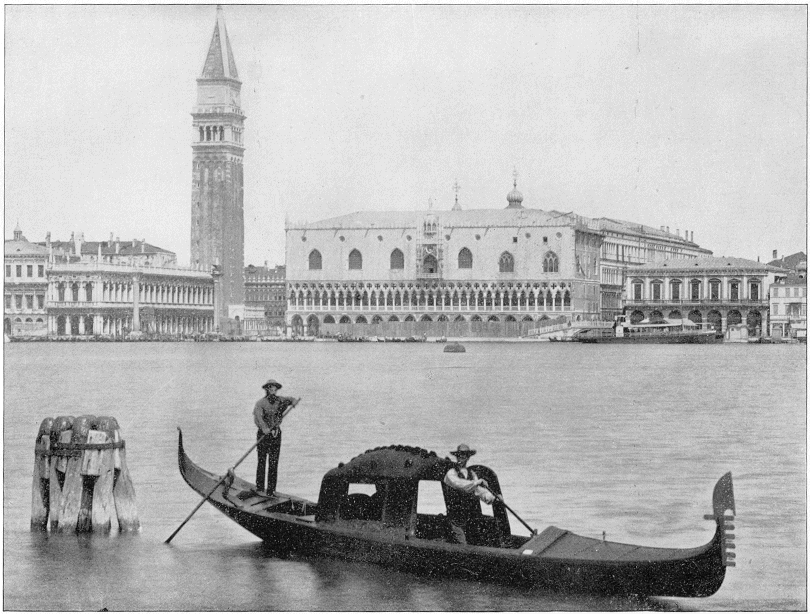
PALACE OF THE DOGES, Venice, Italy.—This magnificent edifice, founded in 800, and destroyed five times, has as often been re-erected in grander style. The palace is flanked with colonnades, forming two pointed arcades on the south and west. The upper portion of the building is constructed of red and white marble. The interior presents a noble specimen of Venetian art. Many famous masters are here represented, the subjects either portraying the glory of Venice, or being of a religious order. The Bridge of Sighs connects the palace with the prison adjoining, which contains a series of gloomy dungeons, a torture chamber and a place of execution for political criminals.
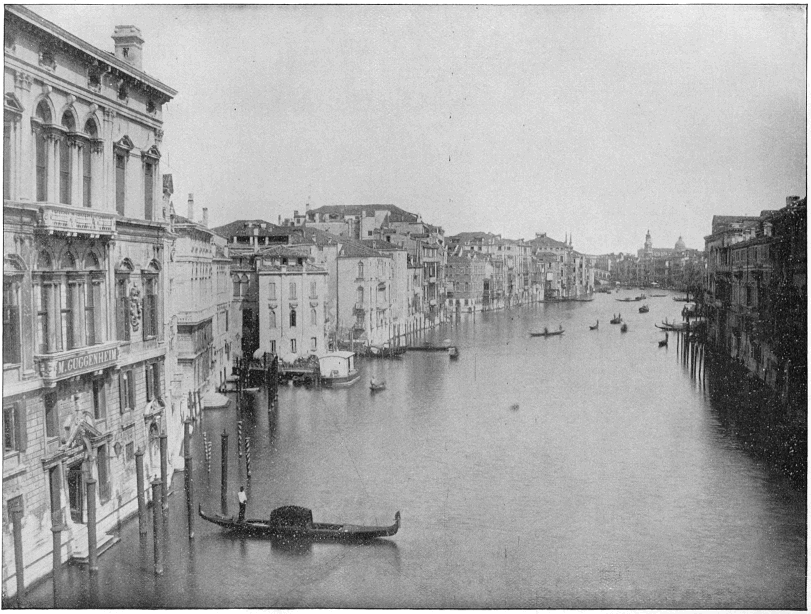
GRAND CANAL, Venice, Italy.—This canal, the main artery of the traffic of Venice, nearly two miles in length, and thirty-three to sixty-six yards in width, intersects the city from north-west to south-east, dividing it into two unequal parts. Steam-launches, hundreds of gondolas and other vessels are seen gliding in every direction. Handsome houses and magnificent palaces rise on the banks, for this is the street of the Nobili, the ancient aristocracy of Venice. A barge, with a military band, navigates the canal every Sunday evening. A trip on the canal is extremely interesting; the posts are painted with the heraldic colors of their proprietors.
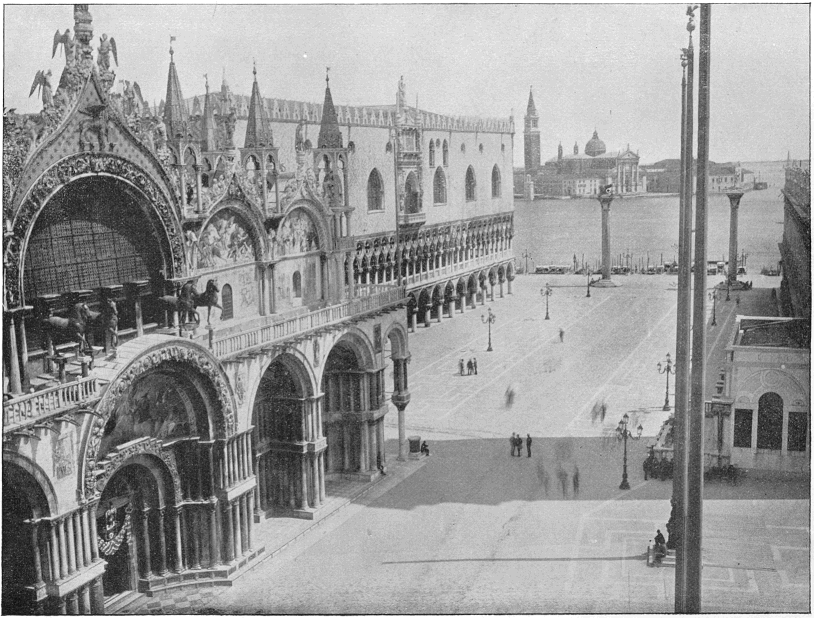
CATHEDRAL OF ST. MARK, Venice, Italy.—Facing the piazza of St. Mark, which is in the heart of Venice and the grand focus of attraction, rises the magnificent Cathedral of St. Mark, decorated with almost oriental splendor. The building dates back to the tenth and eleventh centuries, and portions of the materials used in its construction have been brought from almost every country in Europe. The ceiling of the interior is richly adorned with mosaics in the form of various noted paintings. Behind the High Altar repose the remains of St. Mark, while further back stand four spiral columns said to have belonged to the Temple of Solomon. The building to the right is the Ducal Palace.
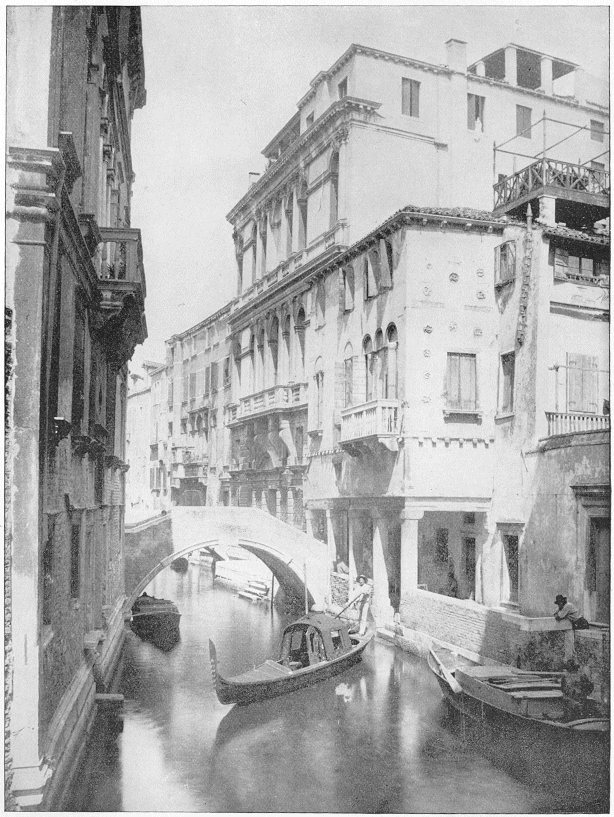
VENICE, Italy.—The capital of the Province of Venice, is situated on the lagoons, a long breast of lowlands in the Adriatic. For a time it was the first maritime and commercial power of the world, and one of the finest cities in Europe, but now it is nothing but a vast museum. The eighty islands on which Venice is built, are divided by wide and narrow canals, while small foot-paths wind throughout the city, occasionally crossing a canal, as is seen by the bridge in the above picture. Venice is popularly known as the "Queen of the Adriatic."
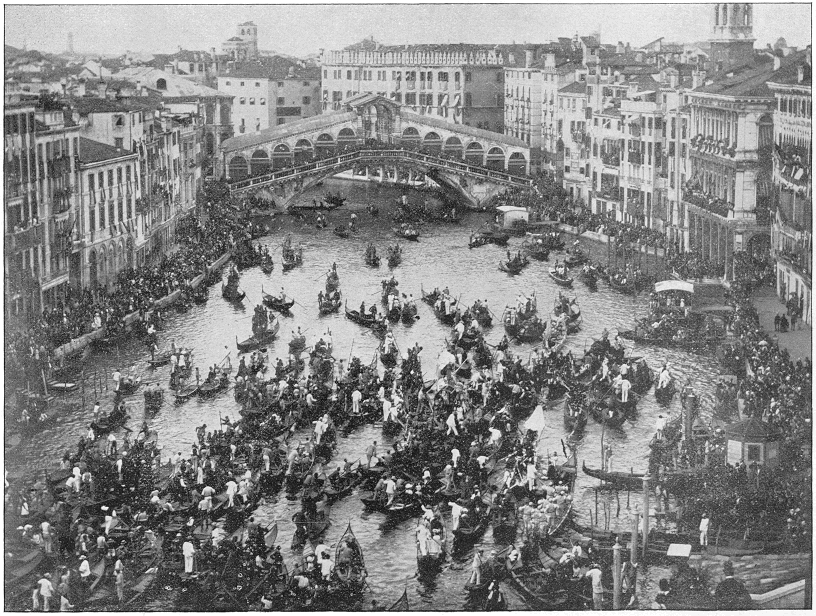
THE RIALTO, Venice, Italy.—This famous bridge, one hundred and fifty-eight feet long and forty-six feet wide, rests on twelve hundred posts. It was erected from 1588 to 1591. Its sides are lined with little shops, extending from a fish-market at one end, past jewelry-shops in the centre of the structure, down to a fruit-market at the other side. It always presents a busy appearance, and is considered a marvel of engineering skill, and one of the finest bridges in the world. The picture represents the annual parade on the Grand Canal, with the Rialto in the background, which is always the rallying centre on such occasions.
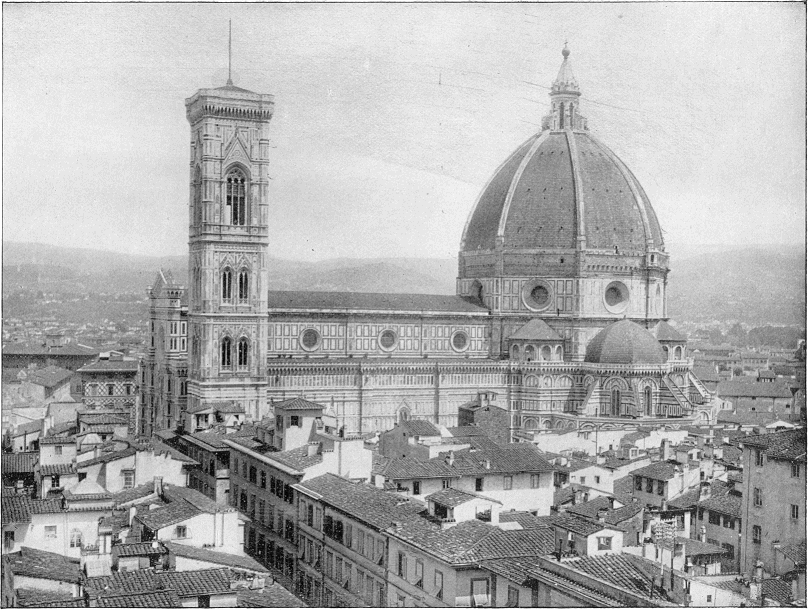
THE CATHEDRAL, Florence, Italy.—This stately edifice, erected from 1294 to 1462, on the site of the earlier church of St. Reparata, is a striking example of Italian architecture. The church was finally consecrated in 1436, but the lantern on the top of the dome was not completed until 1462. The building is one hundred and eighty-five and one-half yards long, and one hundred and fourteen yards wide; the dome is three hundred feet high. The bell-tower, a square structure adjoining the cathedral, two hundred and ninety-two feet in height, is regarded as one of the finest existing works of its kind. It consists of four stories of richly decorated and colored marbles.
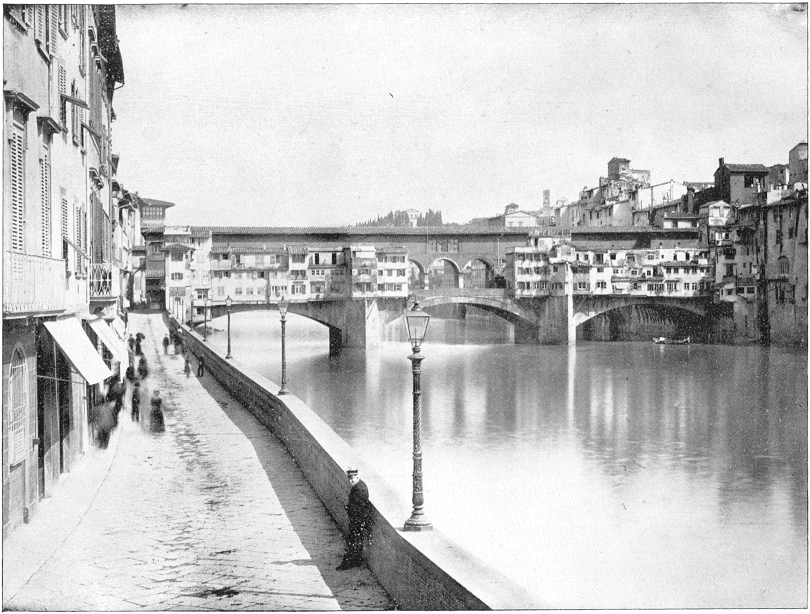
VECCHIO BRIDGE, Florence, Italy.—Florence is situated on both banks of the Arno, but by far the greatest part of the city lies on the right bank. The bridge in the picture dates back to the fourteenth century, and is flanked on both sides with shops which have belonged to gold-smiths ever since their erection. It forms one of the principal bridgeways between the city proper and that portion of Florence which stands on the south bank of the Arno, and has always been considered one of the greatest sights of the town.
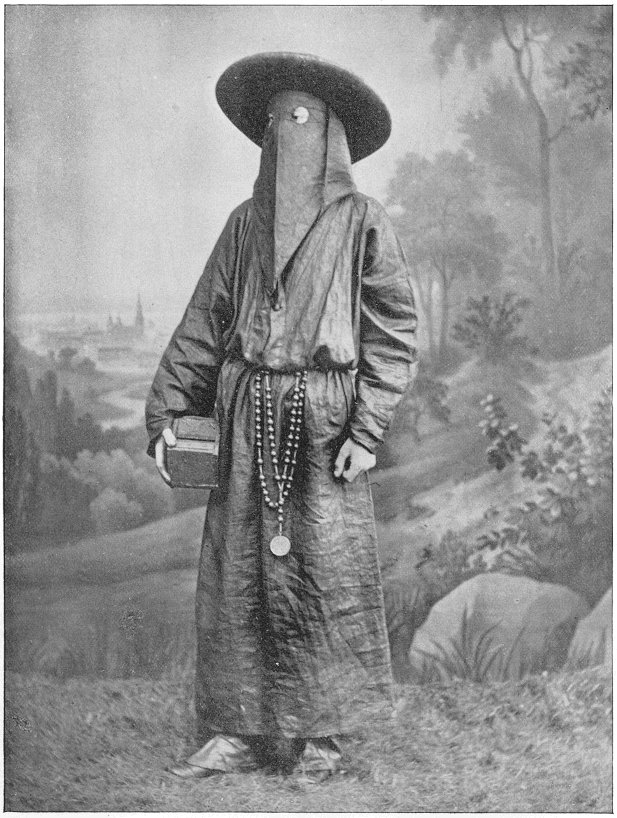
MONK, Italy.—Monasticism primarily meant the state of dwelling alone; and then, by an easy and natural transition, it came to denote a life of poverty, celibacy and divine obedience under fixed rules of discipline. The radical idea of the term, in all its varieties of age, creed and country, is the same, namely, retirement from society in search of some ideal life, which society cannot supply, but which is thought attainable by self-denial and withdrawal from the world. The picture represents an Italian monk in funeral attire.
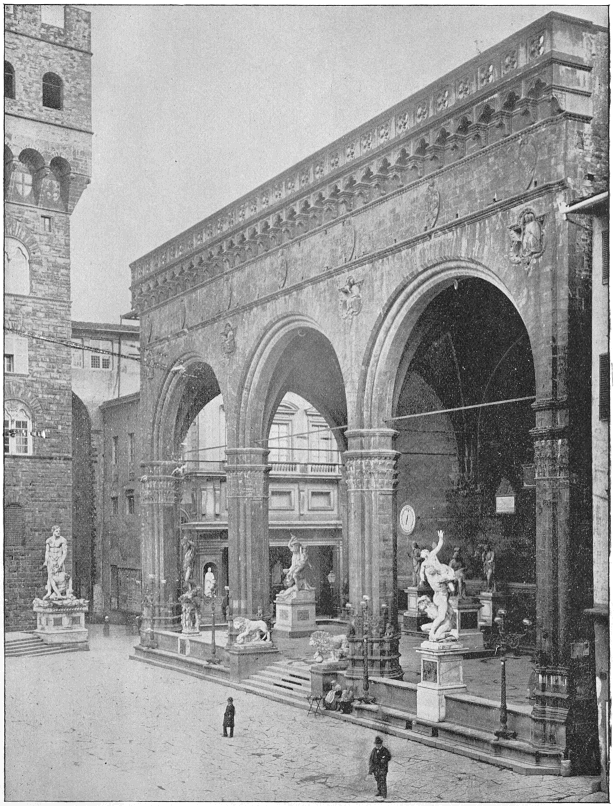
LOGGIA DEI LANZI, Florence, Italy.—This magnificent open-vaulted hall is one of the kind with which it was usual to provide both public and private patrons of Florence, in order that the inmate might enjoy the open air or participate in public demonstrations, without being obliged to descend to the street. The style of architecture shows a falling off from the Gothic, while the works of sculpture, representing Faith, Hope and Charity, Temperance and Fortitude, exhibit an incipient leaning toward Renaissance forms. Every afternoon the Loggia is crowded with the poorer people of Florence, who seek a cool spot in the open air.
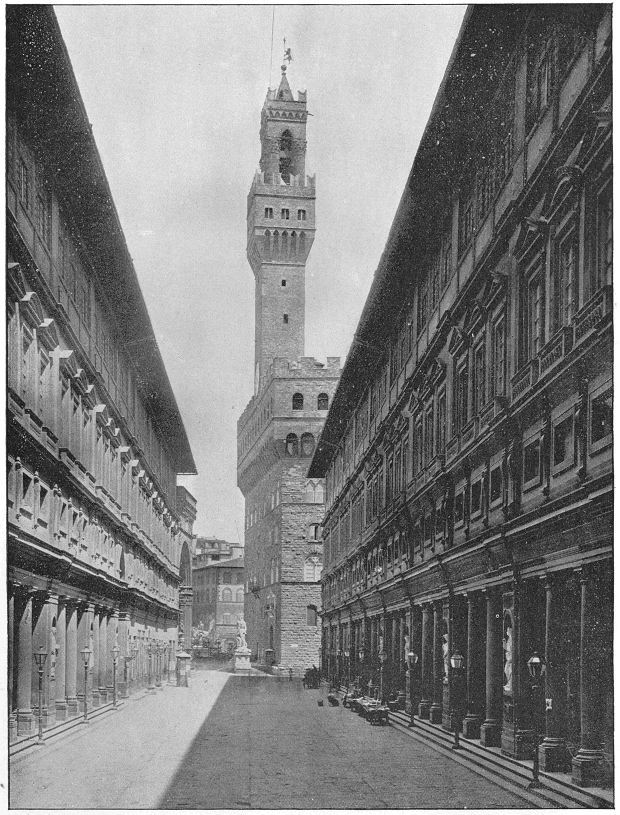
UFFIZI BUILDINGS, Florence, Italy.—This gallery originated with the Medici collections and was afterwards so improved with the numerous additions by the Lorraine Family, that it is now one of the best in the world, both for value and extent. The Portico of the Uffizi Gallery, seen on both sides of the open court, contains niches, which are adorned with marble statues of celebrated Tuscans. At the farthest end of the court, rises the Vecchio Palace, a castle-like building, with huge projecting battlements, being originally the seat of the Signora, and subsequently used as a casino.
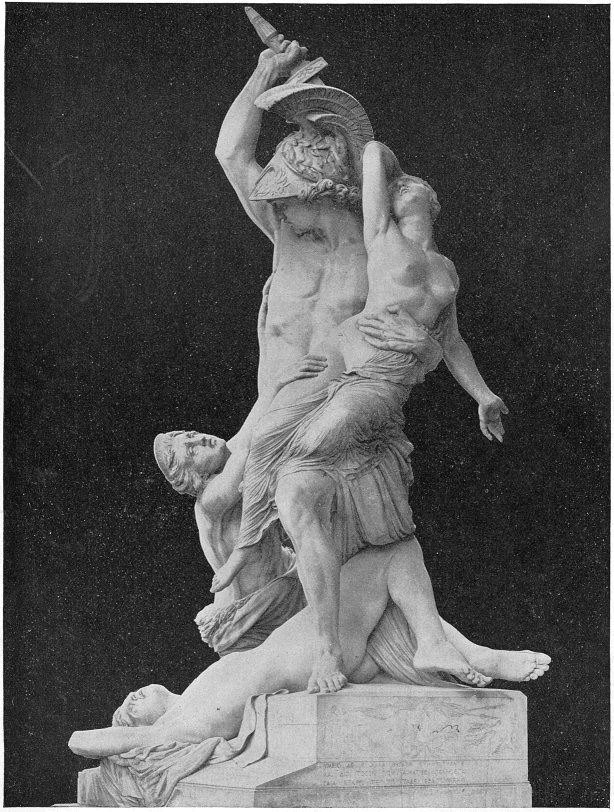
RAPE OF POLYXENA (By Fedi), Loggia dei Lanzi, Florence, Italy.—Polyxena, according to Greek legend, was the daughter of Priam, King of Troy. Having by her grace and beauty captivated Achilles, the Grecian hero, she was betrothed to him. But Achilles was slain by Paris, son of Priam; and after his death and the destruction of Troy, his manes appeared to the returning Greeks, and demanded of them the sacrifice of Polyxena. The Greeks consented, and Neoptolemus, the son of Achilles, sacrificed her on his father's grave. This work of art is of modern execution. It was placed in the Loggia in 1866.
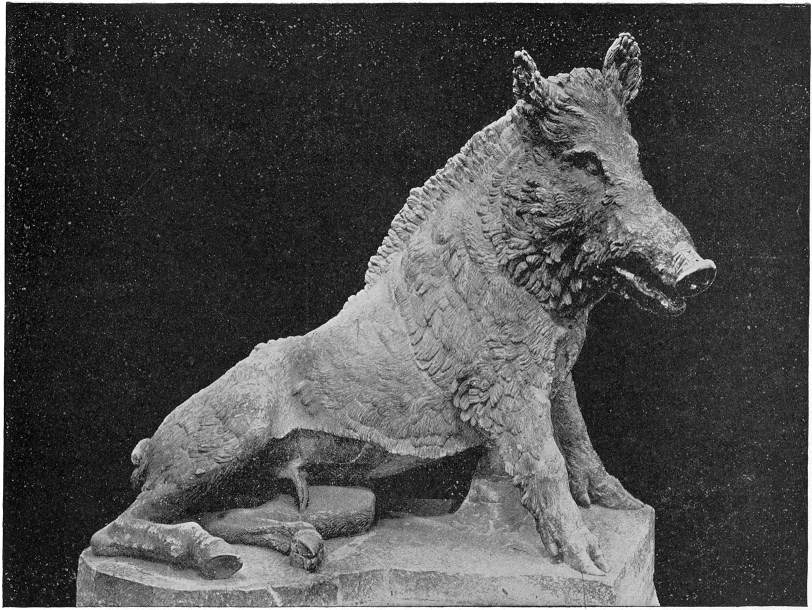
WILD BOAR, Uffizi Gallery, Florence, Italy.
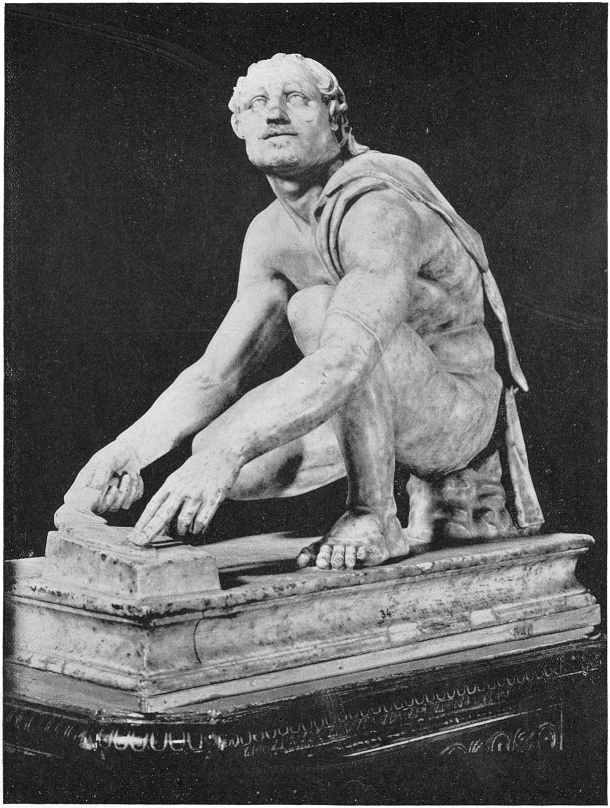
THE GRINDER, Uffizi Gallery, Florence, Italy.—This magnificent statue was found in Rome in the sixteenth century. It has never been exactly ascertained what it represents, but it is supposed to be a Scythian whetting his knife to flay Marsyas.