Page 7 CONTENTS. (continued 2)
Reading edition
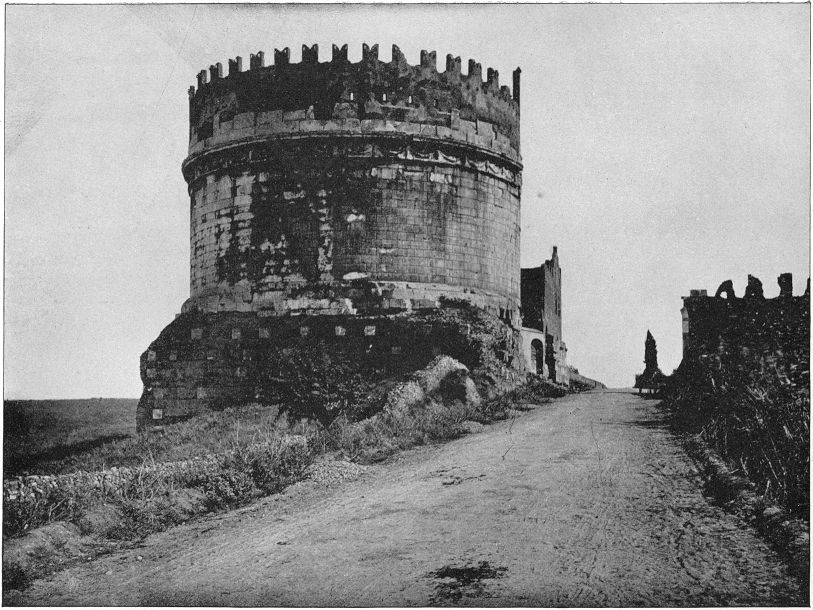
APPIAN WAY and TOMB OF CÆCILIA METELLA, Italy.—This military road, paved with stone blocks, and extending from Brindisi to Rome, was constructed by Appius Claudius Cæcus, 312 B.C. Even at the present time its proud ancient title is that of the "Queen of Roads," and it is remembered as being the way on which St. Paul came to Rome. The tomb of Cæcilia Metella, which forms an interesting and conspicuous object, is a circular structure sixty-five feet in diameter, erected in honor of the daughter of Metellus Creticus, wife of the younger Crassus, son of the triumvir.
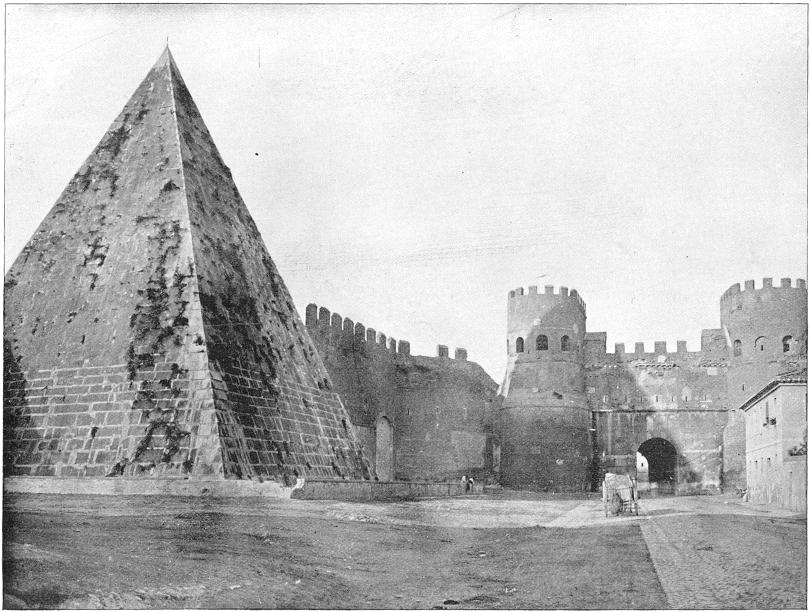
PYRAMID OF CESTIUS AND ST. PAUL GATE, Rome, Italy.—The pyramid enclosed by Aurelian within the city and wall is the tomb of Caius Cestius, who died in the year 12 B. C. The Egyptian pyramidical form was not unfrequently adopted by the Romans in their tombs. That of Cestius is built of brick and covered with marble blocks. Immediately to the right of the pyramid is the gate of St. Paul, leading on to the church of St. Paul beyond. Midway between the gate and church, legend says, St. Peter and St. Paul took leave of each other on their last journey.
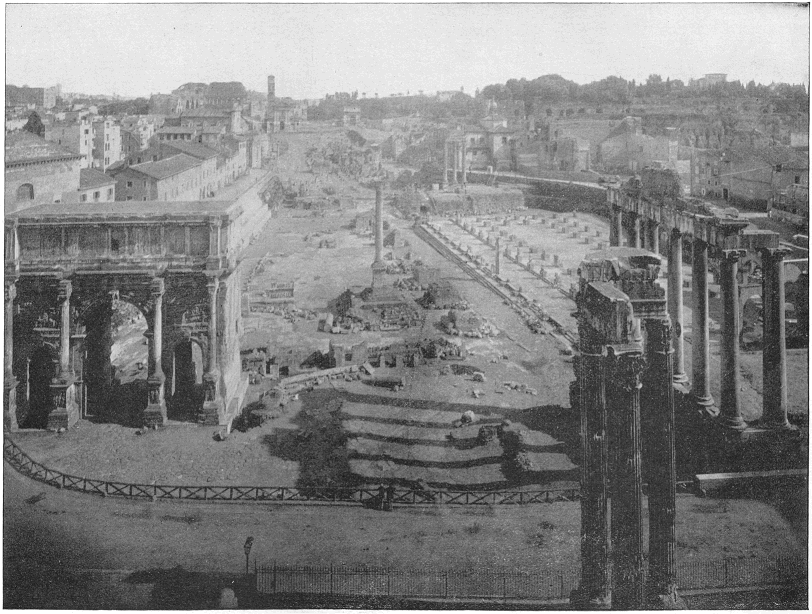
ROMAN FORUM, Rome, Italy.—After the Sabine tribes were amalgamated into a single state, they chose the Forum as its centre; and it was there that some of the most noted events in the history of the Roman Empire transpired. After the Samnite War, which resulted in the extension of Rome's supremacy over all Italy, the Forum became too small for its multifarious business; and therefore underwent many changes. After its destruction, during the Dark Ages, its remains were gradually buried beneath the rubbish and debris of some former centuries, but have recently been excavated.
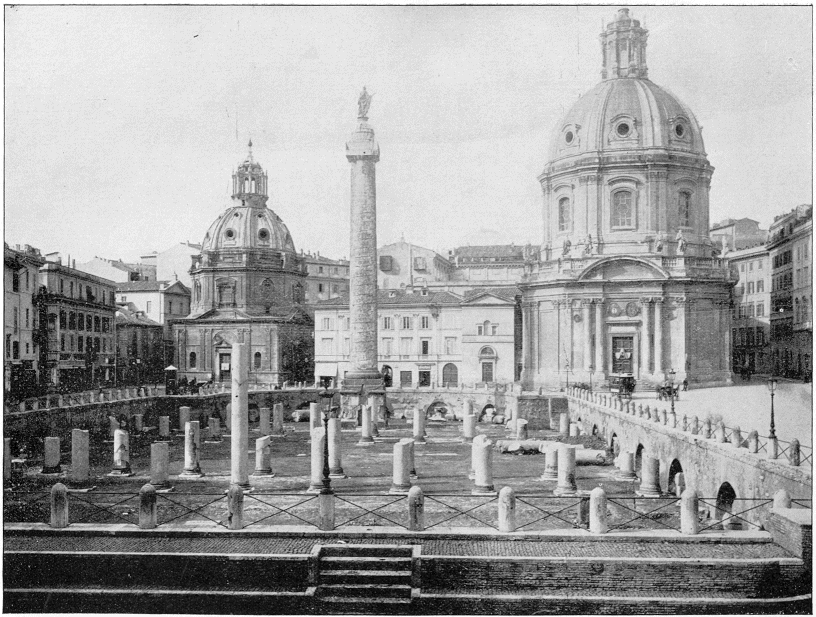
FORUM OF TRAJAN, Rome, Italy.—This forum, which adjoined that of Augustus, contained a collection of magnificent edifices, and is said to have been designed by Apollodorus of Damascus. Trajan's forum must have measured two hundred and twenty yards in width, and was probably of still greater length; it was considered the most magnificent in Rome. On the north side of the Basilica rises Trajan's Column, one hundred and forty-seven feet high, constructed entirely of marble. Around the column runs a spiral band, covered with admirable reliefs from Trajan's War with the Dacians. Beneath this monument Trajan was interred; on the summit stood his statue, now replaced by St Peter's.
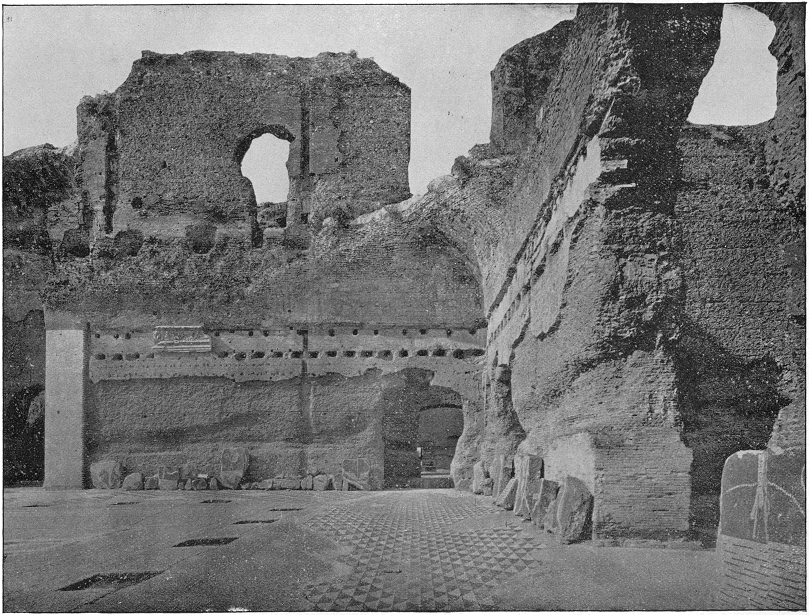
BATHS OF CARACALLA, Rome, Italy.—These ancient baths were begun in 212 by Caracalla, and completed by Alex. Severus, and they could accommodate 1600 bathers at one time. The magnificence of these baths was unparalleled; numerous statues, including the Farnese Bull, Hercules and Flora at Naples, have been found here; and the uncovered walls still bear testimony to the technical perfection of the structure. The establishment was quadrangular in form, and surrounded by a wall.
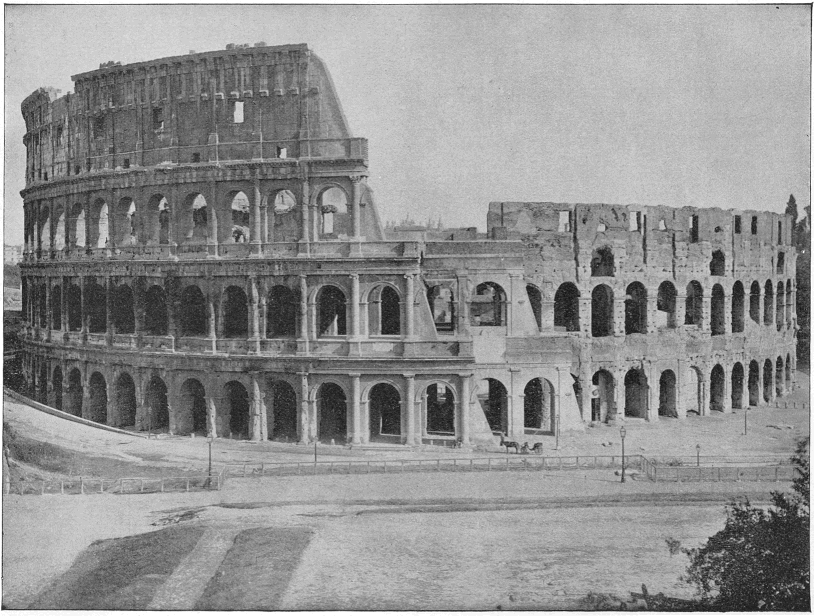
COLOSSEUM, Rome, Italy.—The Colosseum, originally called the Amphitheatrum Flavium and completed by Titus in 80 A.D., was the largest theatre and one of the most imposing structures in the world. It was inaugurated by 100 days' gladiatorial combats, in which 5000 wild animals were killed. It contained seats for 87,000 spectators. Only one-third of the gigantic structure now remains, yet the ruins are still stupendously impressive. The Colosseum has ever been a symbol of the greatness of Rome, and gave rise in the eighth century to a prophetic saying of the pilgrims: "While stands the Colosseum, Rome shall stand; when falls the Colosseum, Rome shall fall; and when Rome falls, with it shall fall the world!"
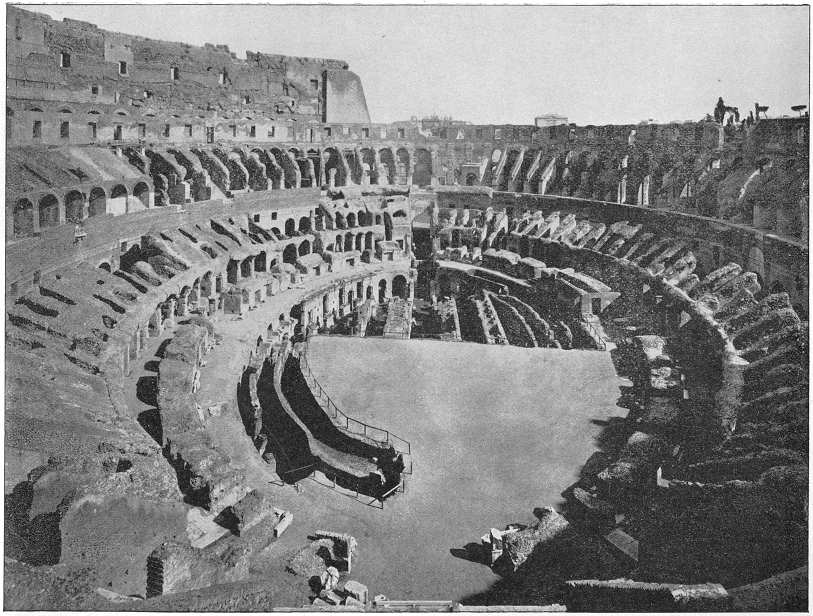
INTERIOR OF COLOSSEUM, Rome, Italy.—The arches of the first tier are marked by Roman numbers, as they formed so many entrances, through which, by means of internal stairways, the upper balconies were reached. The Arena had two openings enclosed by railings of bronze, through which the gladiators and wild beasts entered. Above was the Podium, a place intended for the Emperors and their families, for the magistrates, the senators, the priests and the vestals. Thousands of Christians in this place suffered martyrdom, by becoming the prey of wild beasts. The picture presents the imposing spectacle of the interior of this monument at the present day.
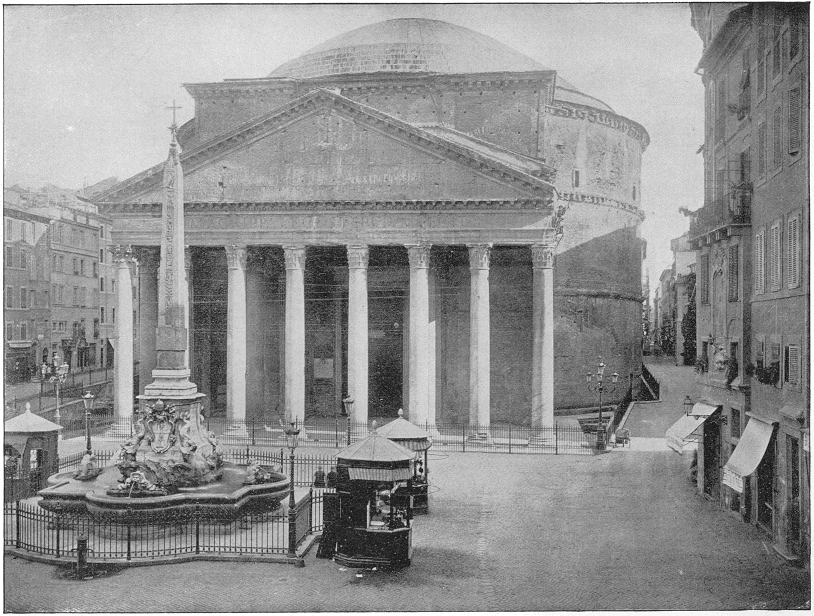
PANTHEON, Rome, Italy.—This is the only ancient edifice at Rome which is still in perfect preservation, as regards the walls and vaulting. The original statues and architectural decorations have long since been replaced by modern and inferior works, but the huge circular structure with its vast colonnade still presents a strikingly imposing appearance. The walls are twenty feet in thickness and were originally covered with marble and stucco. The height and diameter of the dome are each one hundred and forty feet. The opening of the dome at the top is thirty feet in diameter, and through this aperture the ancients supposed the gods to descend. The building is supposed to have been constructed in the first century B. C.
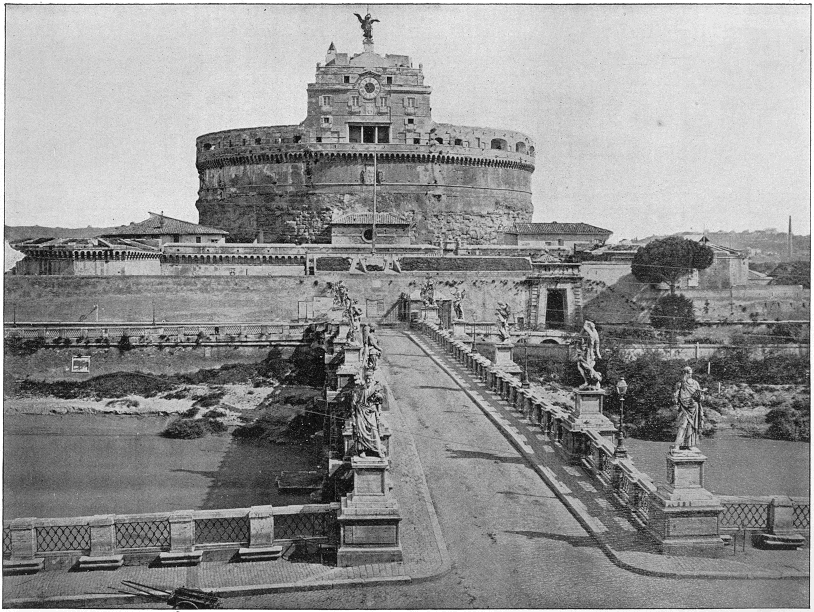
BRIDGE OF ST. ANGELO AND TOMB OF HADRIAN, Rome, Italy.—This bridge is of most ancient construction. It was built by Hadrian in 136 A. D., to connect his tomb with the city. Ten colossal angels, formerly much admired, and executed in 1688, testify to the low ebb of plastic art at that period. The tomb was built by Emperor Hadrian for himself and his successors. The massive circular tower stands on a square basement on the banks of the Tiber. The bronze statue of St. Michael, the Archangel, which is seen on the summit, gives the tower its present name, Castello S. Angelo.
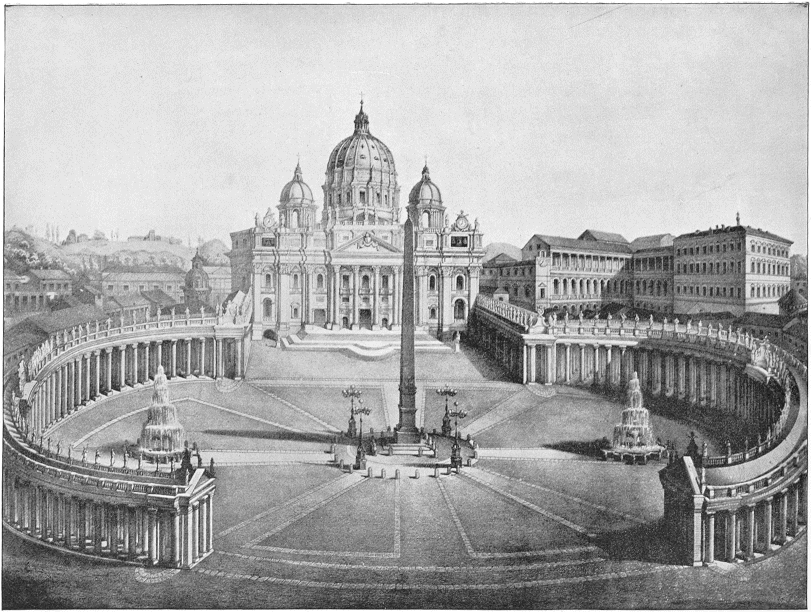
ST. PETER'S AND VATICAN, Rome, Italy.—St. Peter's is fronted by an elliptical piazza, enclosed by imposing colonnades, and is the largest and most beautiful Catholic Cathedral in the world; it was founded by Constantine and erected where St. Peter is said to have suffered martyrdom. Its erection and improvements cost over $50,000,000. The great Obelisk in the centre of the piazza, having no hieroglyphics, was brought from Heliopolis. The Vatican on the right is the Pope's residence, and is elegantly fitted up, being adorned with paintings and statues by the world's greatest masters.
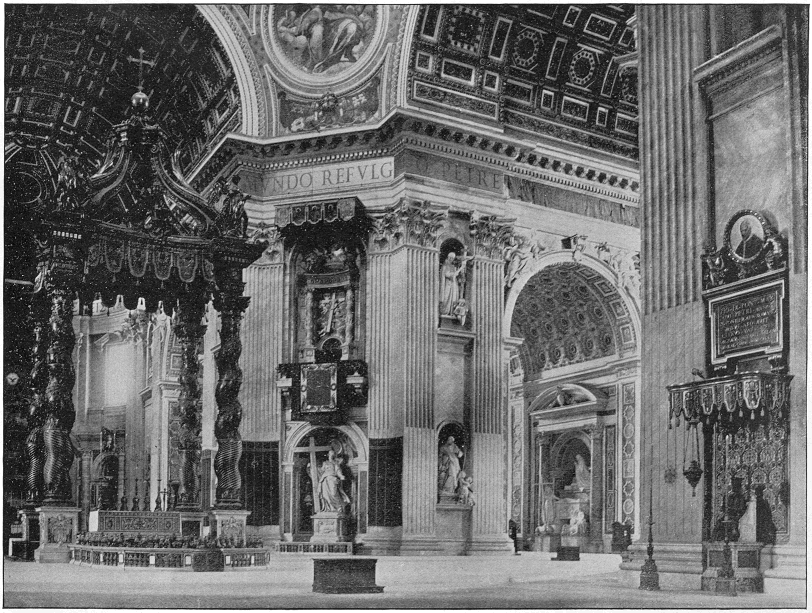
INTERIOR OF ST. PETER'S, Rome, Italy.—This most marvellous church in the world was built on the place where stood the temple of Jupiter Vaticanus. The first church here is said to have been built A. D., 90. It was a memorial chapel to St. Peter, and was, according to tradition, erected on the spot where the saint was buried. Constantine built a Basilica on the site. The present structure, the glory of Michael Angelo, was begun about 1503. The picture shows the high altar with the statue of St. Peter to the very right.
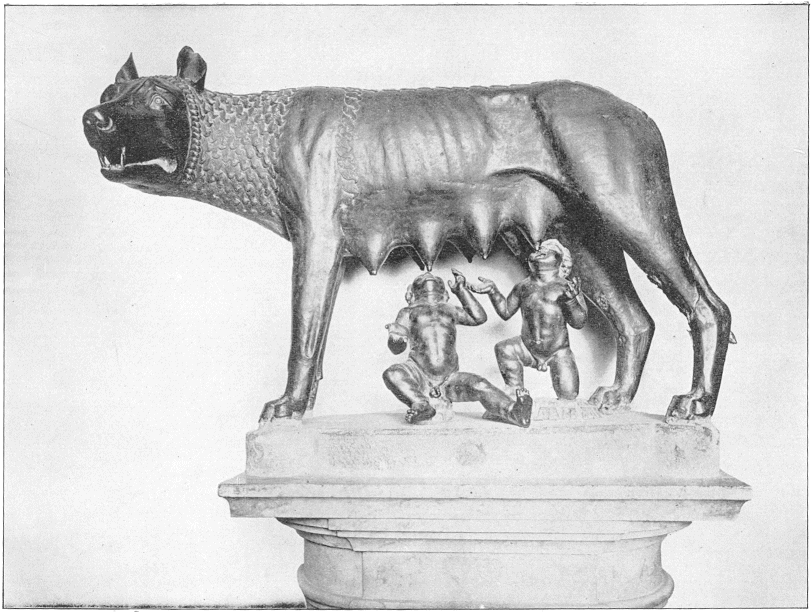
ROMULUS AND REMUS SUCKING THE WOLF, Capitol Museum, Rome, Italy.—Thus wrote Virgil ("AEN." VIII-630):
"By the wolf were laid the martial twins, Intrepid on her swelling dugs they hung; The foster dam lolled out her fawning tongue; She sucked secure; while bending back her head, She licked their tender limbs, and formed them as they fed."
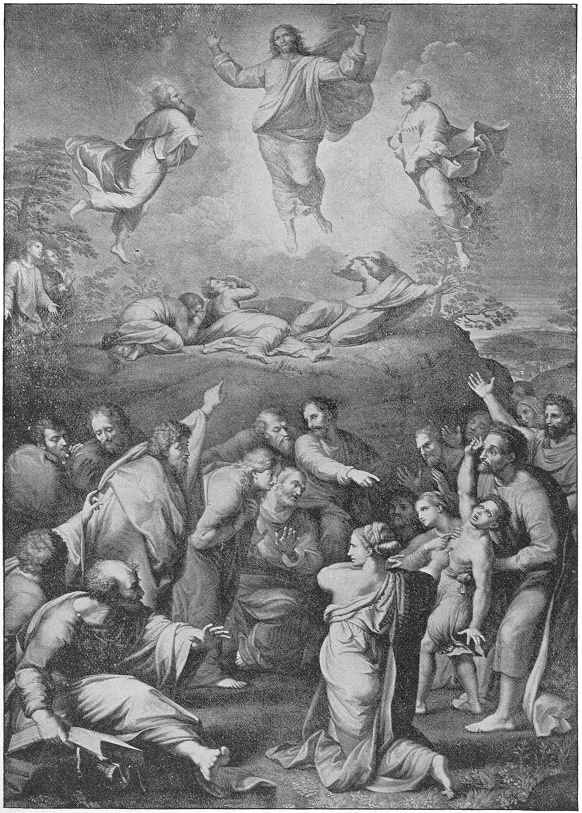
TRANSFIGURATION (By Raphael), Vatican Gallery, Rome, Italy.—The last great work and masterpiece of this celebrated artist, unfinished at his death and completed by Clement VIII., was preserved in St. Peter's until 1797. The upper part is by Raphael's own hand; Christ hovers between Moses and Elias; Peter, James and John are prostrate on the ground, and dazzled by the light. The figures to the left, in an attitude of adoration, are St. Lawrence and St. Stephen. The lower half, where the other disciples are requested to heal the possessed boy, was partly executed by Raphael's pupils.
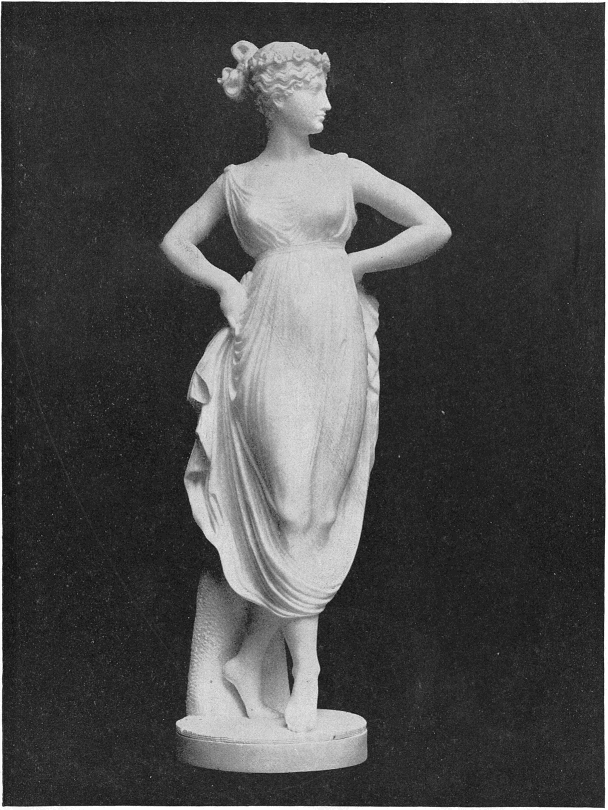
LA BALLERINA (By Canova), Rome, Italy.—Here is another of the masterpieces of this famous master-sculptor. It is hewn out of a solid block of marble, and comes under the head of "grace and elegance," one of the divisions of Canova's works. This subject is a most striking one. Like all his other subjects of grace, it is in all its details, an expression of attitude, delicacy of finish and elegance. The profile is charming, the twist of the hair natural, and the lines and curves of the arms perfect, while the drapery is next to real.
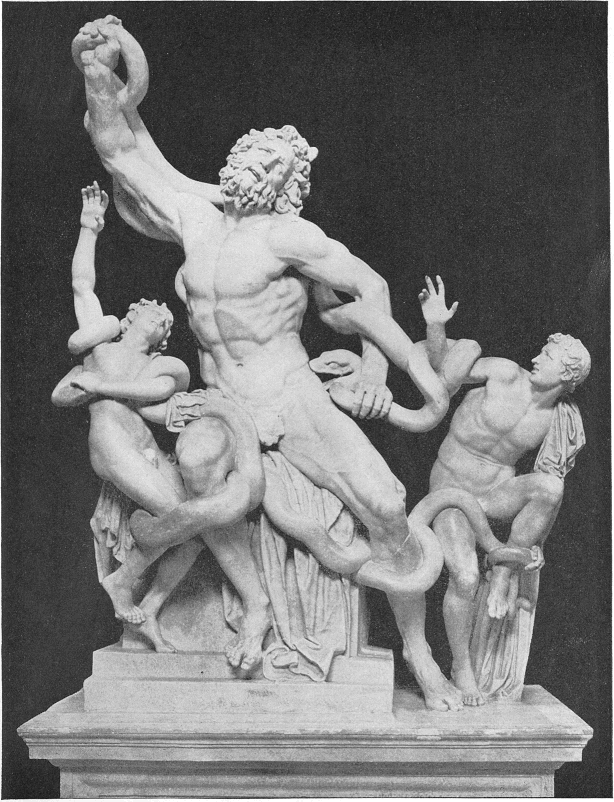
LAOCOONTE, Vatican Gallery, Rome, Italy.—This famous group represents Laocoon and his two sons, who were strangled by serpents at the command of Apollo. According to Pliny, it was executed by three Rhodians, and placed in the Palace of Titus. It was discovered under Julius II., in 1506, near Sette Sale, and was termed by Michael Angelo a "marvel of art." The work is admirably preserved, with the exception of the three uplifted arms, which have been incorrectly restored. The dramatic suspense of the moment, and the profoundly expressive attitude of the heads, denote the perfection of the Rhodian school of art.
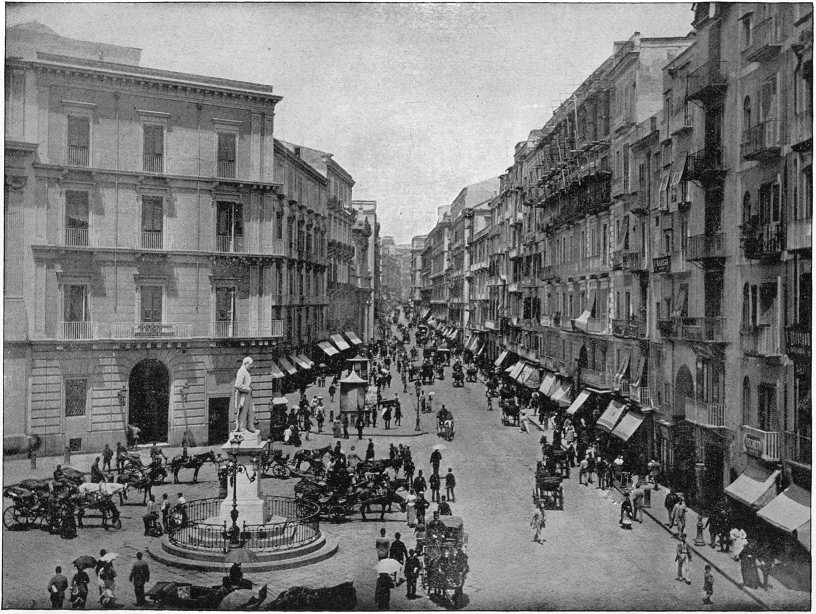
TOLEDO STREET, Naples, Italy.—This famous city is beautifully situated on the Bay of Naples, with Mount Vesuvius in the distance. Its charming position has given rise to the phrase "See Naples and die." It was founded by the Greeks, and here Virgil spent his time in study, his tomb being one of the points of interest for travelers. The city is still surrounded by a wall. It has often suffered from earthquakes and eruptions. The manufactures are numerous, of which macaroni and vermicelli are of first importance. The photograph represents Toledo Street, which intersects the city from south to north, and with its immense amount of well-conducted business, presents a very interesting sight.
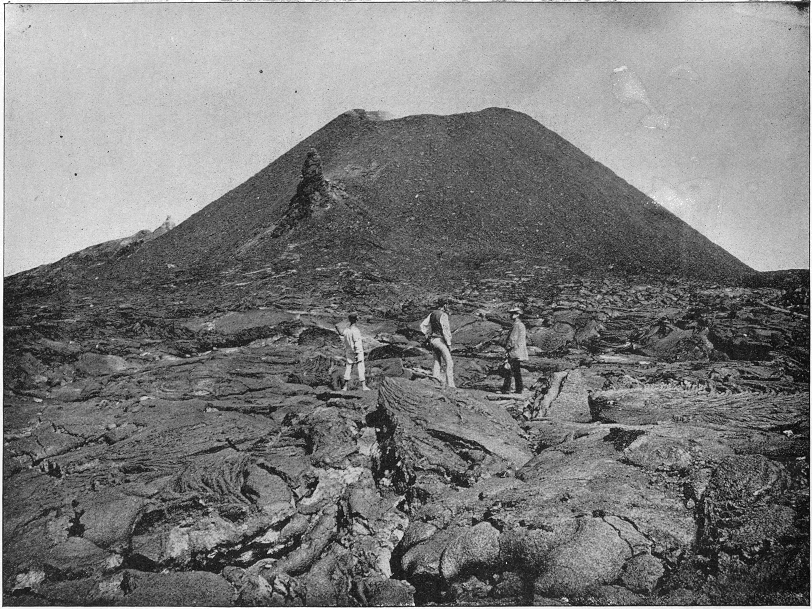
CRATER OF MOUNT VESUVIUS, Italy.—This volcano, with a crater of nearly a quarter of a mile in circumference, rises in lonely majesty from the Bay of Naples, and varies in height from 3900 to 4900 feet, according to the varied eruptions. Vesuvius in the time of Nero manifested itself by a fearful earthquake, damaging Herculaneum and Pompeii. An eruption occurred in 79 A.D. by which the two cities named, were lost to the world for seventeen centuries. Another most terrific eruption occurred in 1631, by which a stone weighing twenty-five tons was thrown a distance of fifteen miles, and streams of lava poured from the summit, destroying over three thousand people.
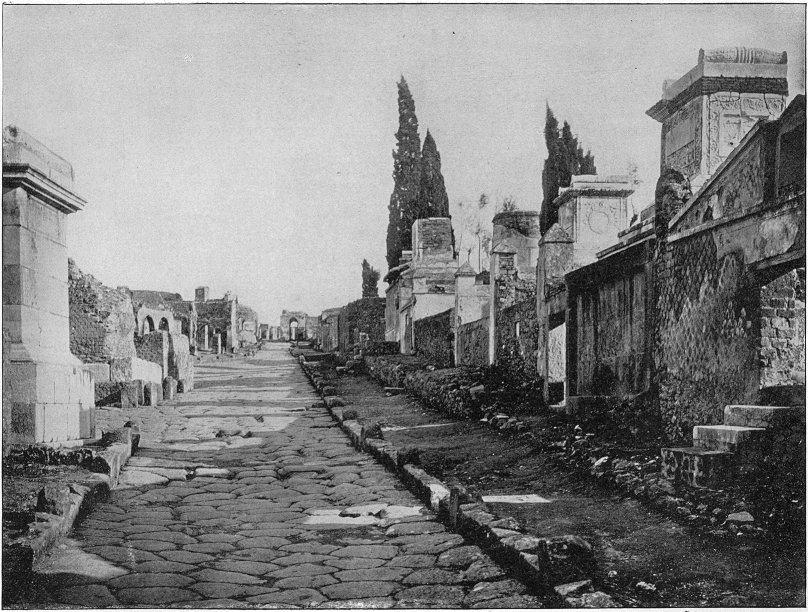
STREET OF TOMBS, Pompeii, Italy.—This photograph exhibits a suburb of Pompeii named Pagus Augustus Felix, in honor of Augustus; it lay outside the city walls. It consisted chiefly of one main street, which has been partly excavated. This is the so-called Street of Tombs. The ancient custom of burying the dead by the side of a high road is well known. It has been ascertained that rows of graves, similar to those discovered here, exist beyond other gates of Pompeii. The Street of Tombs is, in point of situation, the most beautiful part of the town.
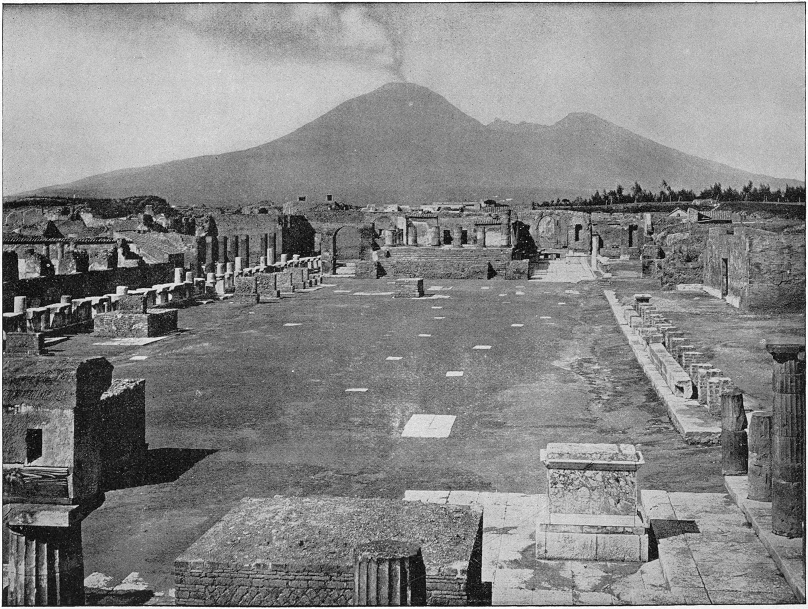
CIVIL FORUM, Pompeii, Italy.—The ancient market-place in the central part of Pompeii was destroyed by the eruption of Mount Vesuvius in 79 A. D. The Forum has been excavated during the present century, and found to be five hundred and fifteen feet long and one hundred and seven feet wide; it is surrounded by granite columns of the Doric order. From the discoveries made, it is supposed that the Forum was far from complete when the eruption occurred. The smoking mountain is still seen in the distance, while the ruins of the ancient market stand prominent in the foreground of this photograph. The Forum is a most interesting spot, and is familiar to all readers of "The Last Days of Pompeii."
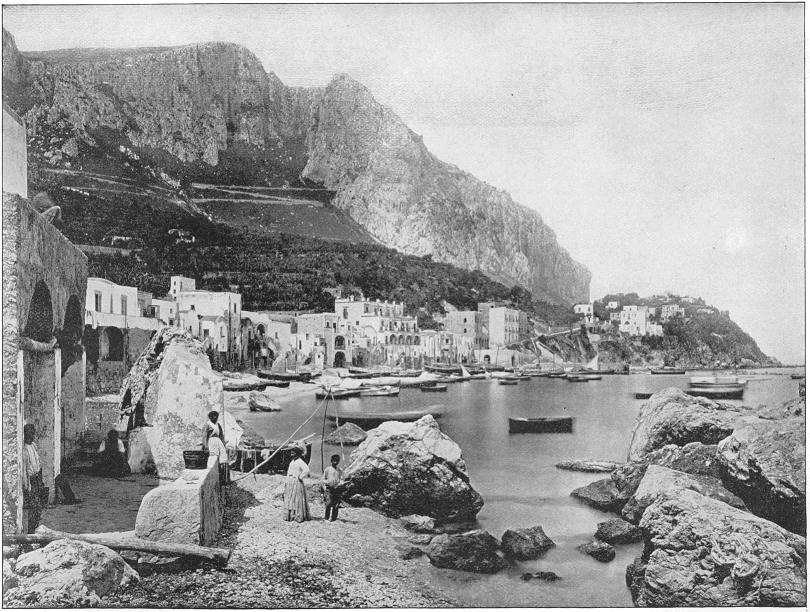
ISLAND OF CAPRI, Italy.—This is a small mountainous island of oblong form; its picturesque outline forms one of the most charming points in the view of the Bay of Naples. The highest point is the Monte Solarno, nineteen hundred and twenty feet above the level of the sea. The island, which contains five thousand inhabitants and the two small towns of Capri and Anacapri, yields fruit, oil and excellent red and white wines in abundance. The inhabitants receive their support mainly from strangers who visit the island yearly to the number of thirty thousand. The above picture shows the principal landing-place of Capri.
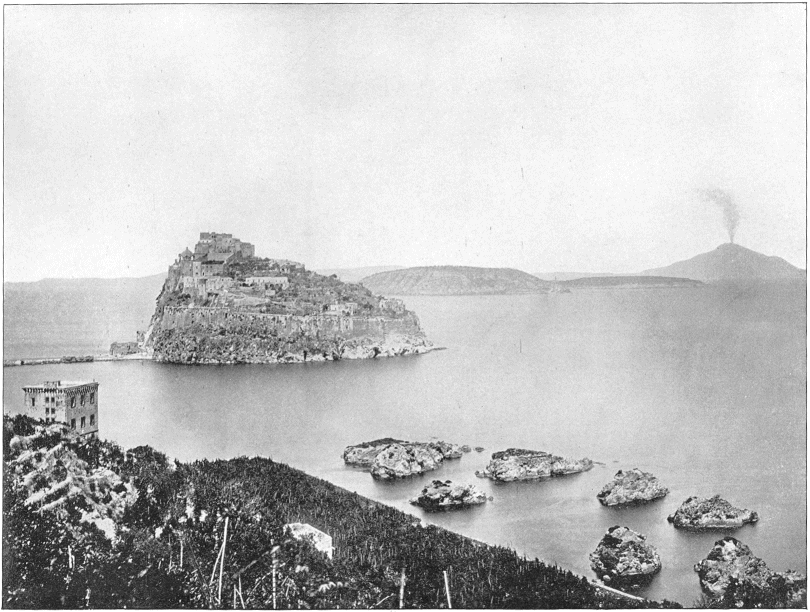
CASTELLO, Island of Ischia, Italy.—The climate of these charming islands is genial, the sky rarely overcast, the winters mild, the inhabitants bounteously supplied with the necessaries of life, and the sick with healing springs. Trees, shrubs and all kinds of plants thrive luxuriantly in this volcanic soil. Here and there are observed groves of young oaks and chestnuts. The inhabitants are distinguished by a peculiar costume, dialect and figure. Fashion is unknown; not one of the islands can boast of a horse or carriage. Castello, in the foreground, is a most curious volcanic formation.
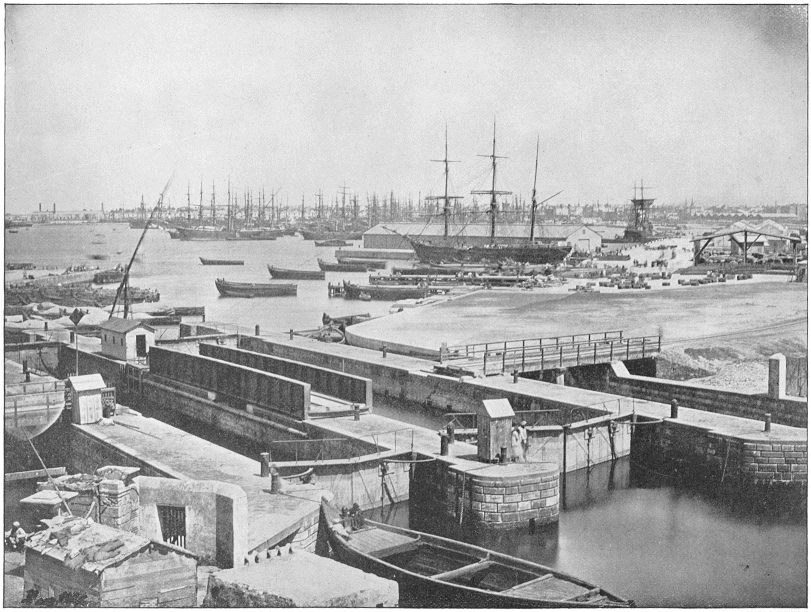
HARBOR, Alexandria, Egypt.—The perfectly flat coast of Egypt, and even Alexandria itself, are not visible to the steam-boat passenger until very shortly before the vessel enters the harbor. The latter consists of an outer breakwater, forming an obtuse angle nearly two miles in length. A second pier, nearly a mile in length, protects an inner harbor covering nearly five hundred acres of water, twenty-seven feet deep. No fewer than thirty thousand artificial blocks, weighing twenty tons each, and two million tons of natural blocks of stone were used in the construction of these magnificent harbor works.
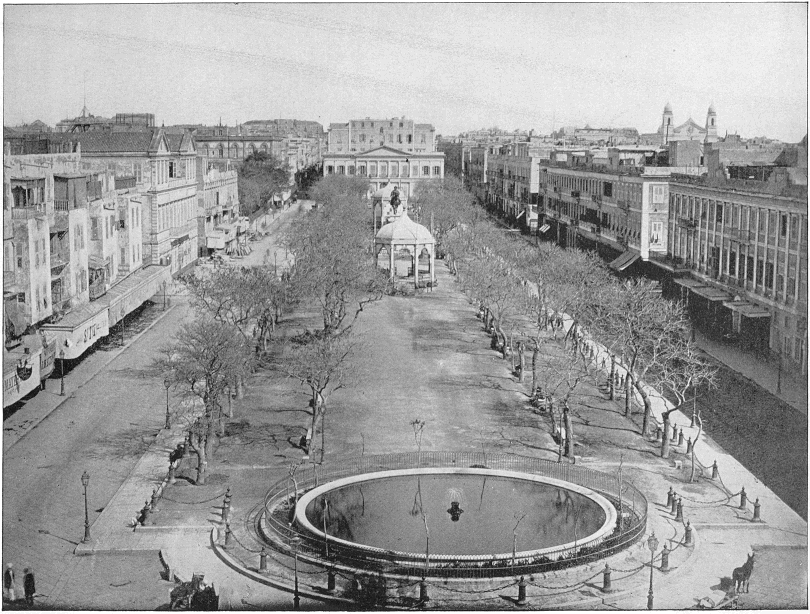
PLACE OF MEHEMET ALI, Alexandria, Egypt.—The site of this open square is embellished with trees and fountains. It became a scene of destruction during 1882. In the centre rises the equestrian statue of Mohammed' Ali, the founder of the reigning dynasty of Egypt. The Mohammedan religion forbids the pictorial or plastic representations of the human form. The erection of this monument was long opposed by the Ulama, or chief professor of divine and legal learning. The buildings on both sides are shops. That at the further end is the English church.
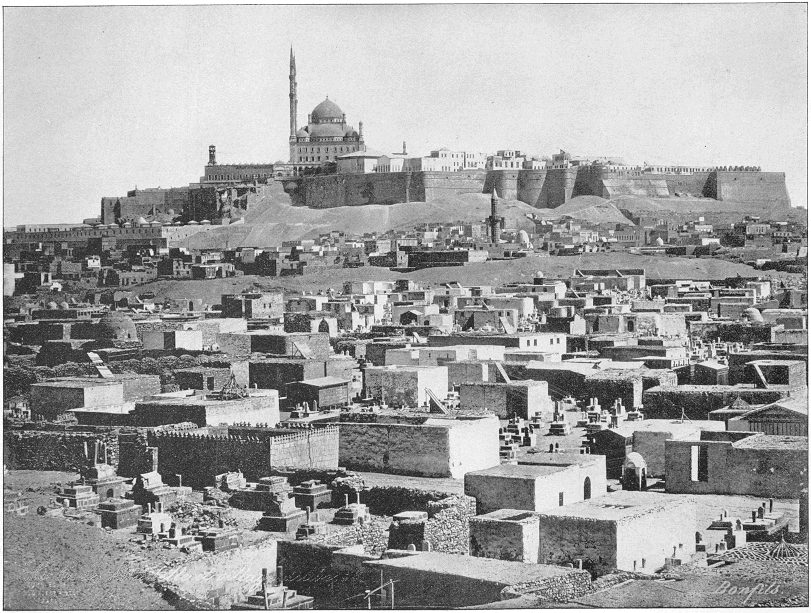
CITADEL, Cairo, Egypt.—This citadel affords a magnificent view of the city and surrounding country. It was erected in 1166, and built by stones taken from the small pyramids at Gizeh, the site having been selected, according to Arabian history, owing to the fact that meat could be kept here fresh twice as long as in any other part of Cairo. The fortress commands the city, yet its site is unfavorable, as a commanding height close by compelled its surrender during the wars of 1805.
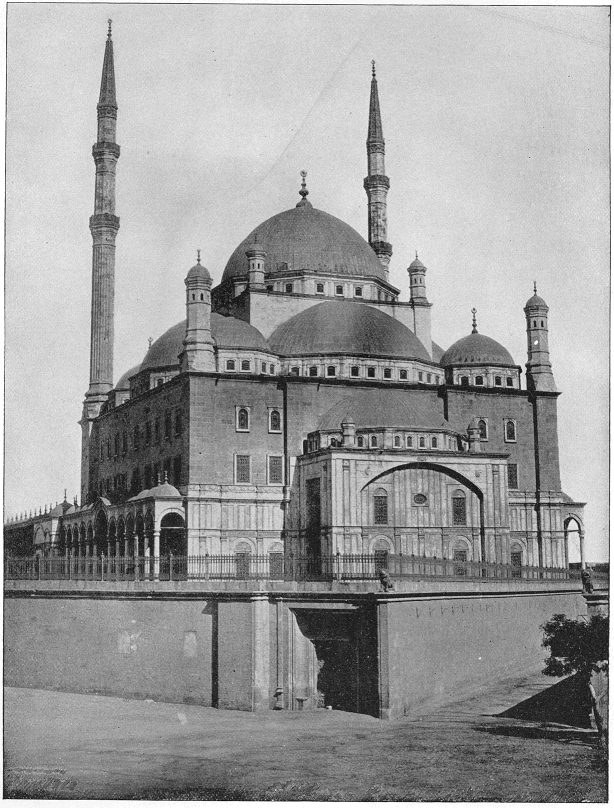
MOSQUE OF MOHAMMED' ALI, Cairo, Egypt.—The "Alabaster Mosque," whose lofty and graceful minarets are so conspicuous from the distance, form one of the landmarks of Cairo. In plan, it represents the Turkish mosques, built on the model of Hagia Sofla, at Constantinople. The execution of the design displays but little artistic taste, and the treatment of the material is somewhat unsatisfactory. The alabaster used for the incrustation of the masonry consists partly of blocks and partly of slabs. The beautiful yellow-tint stone soon fades when exposed to the sun.
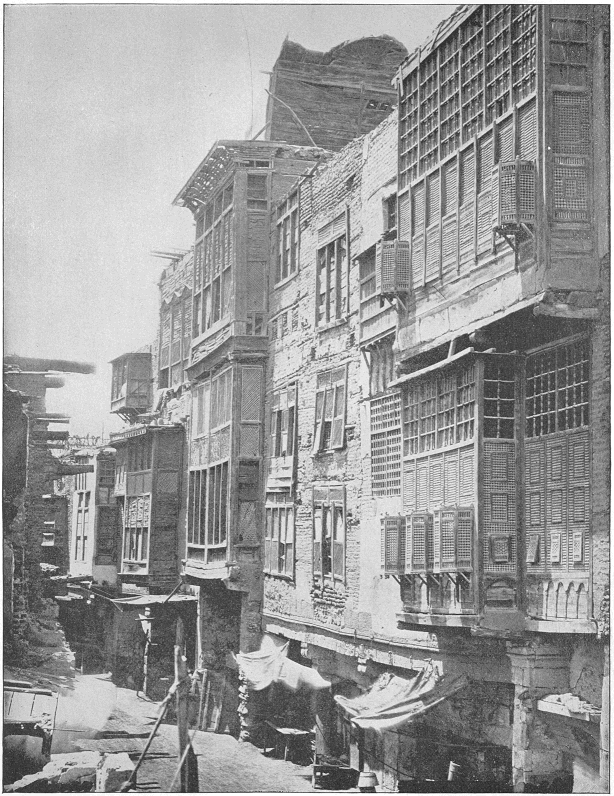
STREET SCENE, Cairo, Egypt.—Most of the streets in the old part of the town are unpaved, inaccessible to carriages, and often excessively dirty. They present an inexhaustible field of amusement and delight, admirably illustrating the whole world of oriental fiction. The lanes separating the rows of houses in the Arabian quarter are so narrow that the projecting balconies of harems, with their gratings, often nearly meet. Rickety, tumbling houses of every variety of oriental architecture strike the beholder at every turn, as is illustrated above.
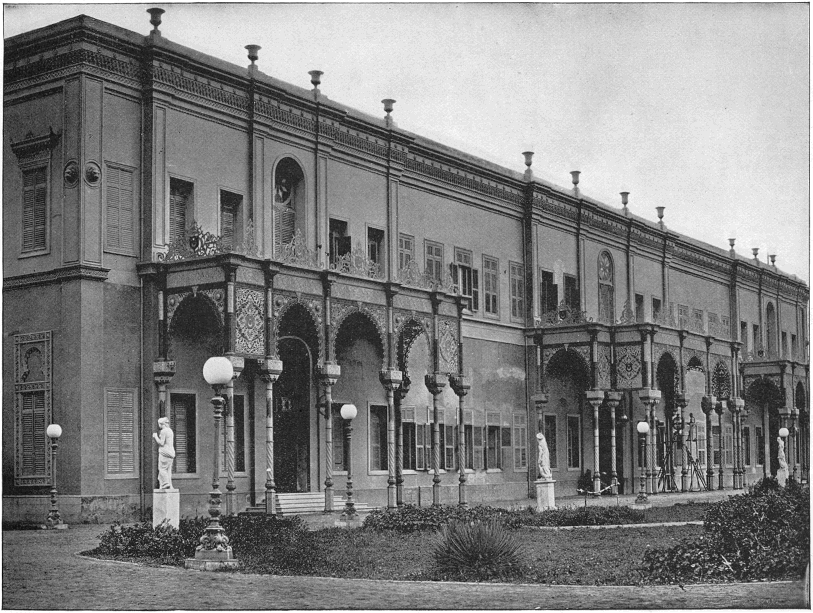
PALACE OF GEZIREH, Cairo, Egypt.—This palace is located on the Nile, at one end of a park by the same name. Its external appearance is simple. All the distinguished guests who were invited to attend the ceremony of the opening of the Suez Canal were entertained here. The building is State property and rarely occupied. The interior is furnished in the most sumptuous and elaborate manner. The onyx mantel-pieces, with mirrors, cost each $15,000. Portions of the palace are fitted up in suites of apartments for visitors, each consisting of bed-room, dressing-room and sitting-room.
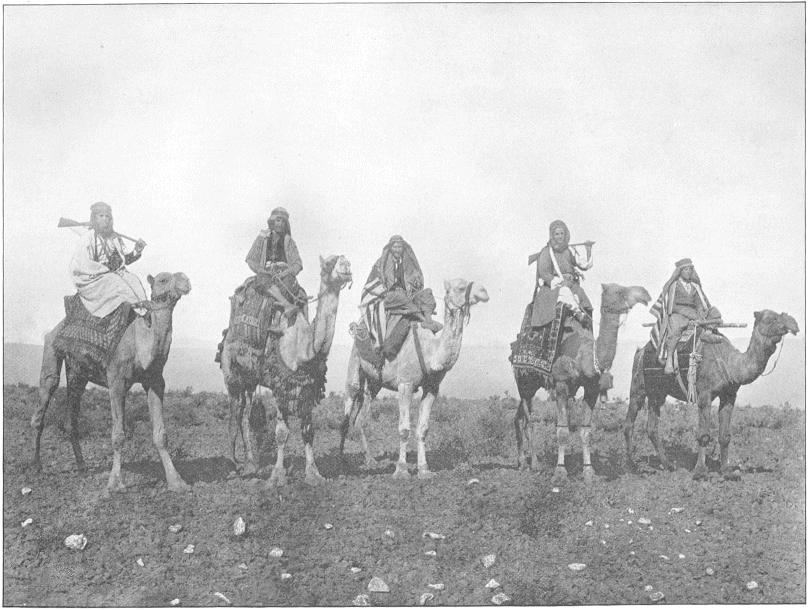
ON CAMEL-BACK, Egypt.—To people accustomed to all the comforts and luxuries of the world, who have never experienced desert tent-life, nor traveled through countries where there are no people to consult, it is hard to convey an idea of oriental camel-back traveling. The "ship of the desert" is a most faithful animal, and loved by his master as much as a child; but his back affords a very uncomfortable seat. The long backward and forward motion recalls to the rider the swells of the sea. The above picture is a perfect specimen of hundreds of such caravans during the traveling season.
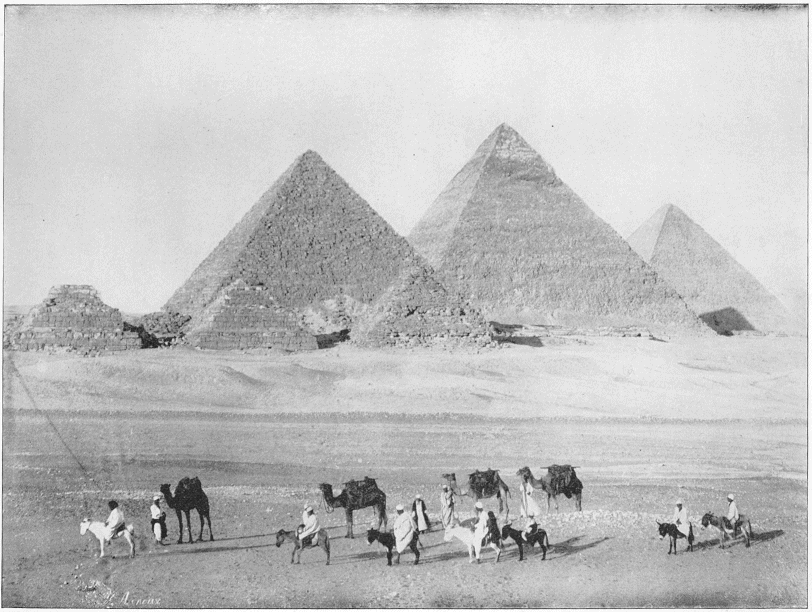
PYRAMIDS OF GIZEH, Egypt.—Here are represented the great Pyramids of Gizeh, occupying a plateau gradually ascending from east to west, parts of which are very precipitous at places. The three pyramids are so situated on this plateau as to face the four points of the compass, although the magnet shows a deviation toward the west. The Sphinx is situated close by. Numerous tombs, almost all in ruins, surround these pyramids, and extend over the plateau to the east. They are sometimes hewn in the form of grottoes in the external rocky slope.
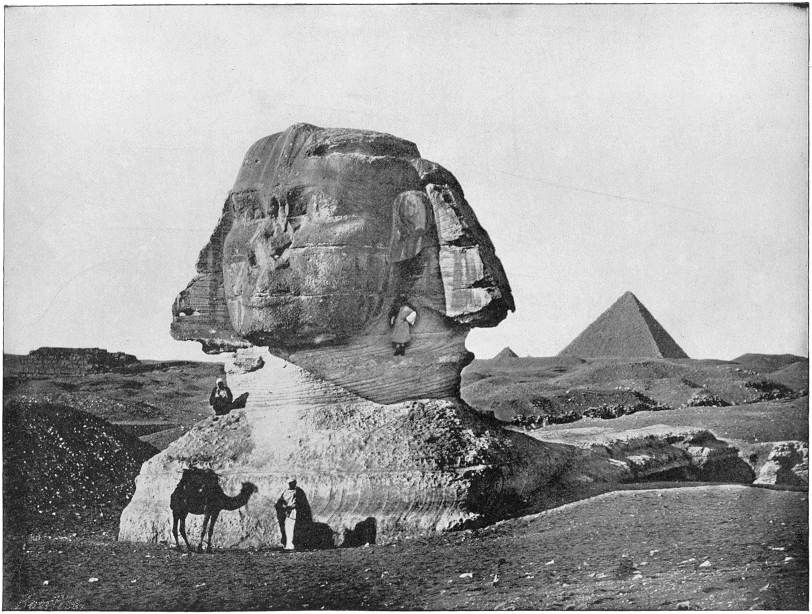
THE SPHYNX, EGYPT.—
"Since what unnumbered year, "No faithless slumber snatching,
Hast thou kept watch and ward, Still couched in silence brave,
And o'er the buried Land of Fear, Like some fierce hound long watching,
So grimly held thy guard?" Above her master's grave."
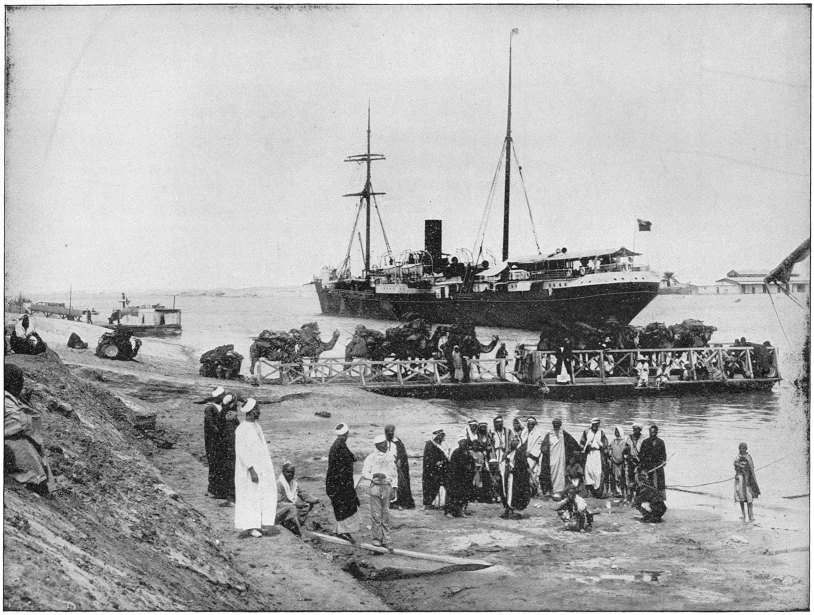
LANDING ON SUEZ CANAL, Egypt.—The Suez Canal, which connects the Red Sea with the Mediterranean, was completed in 1863. During the time of construction, which lasted five years, 25,000 men were employed, and 1600 camels to supply them with water. The cost of constructing the canal was $95,000,000, part of which was raised by shareholders, and the balance by the Khedive. This picture represents a landing stage and one of the English trading vessels sailing between England and India. A number of camels and Arabs are seen on a ferry-boat, ready to be taken across the Canal, the latter furnishing the great highway for all European vessels sailing to or from the Orient.
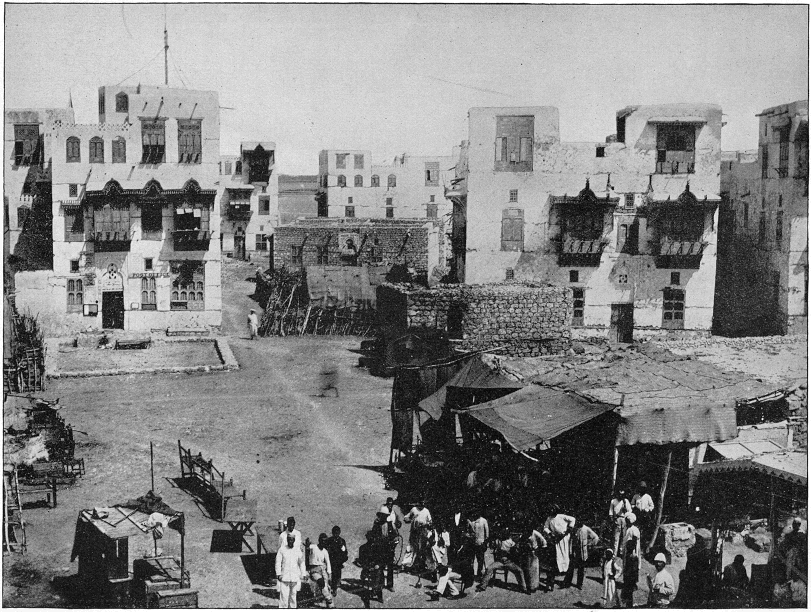
POST-OFFICE, Suez, Egypt.—The site of this town is naturally an absolute desert, and, until the water of the Nile was introduced by the fresh water canal in 1863, the water-supply of Suez was brought across the head of the gulf from the "wells of Moses," on the Arabian coast, or else carried on camels, after an hour's journey, from the fortified brackish of Bir Suweis. In spite of its favorable position for commerce, the place was quite small prior to the time of the canal, and even to-day the canal carries traffic past Suez rather than to it. The picture shows the post-office square.
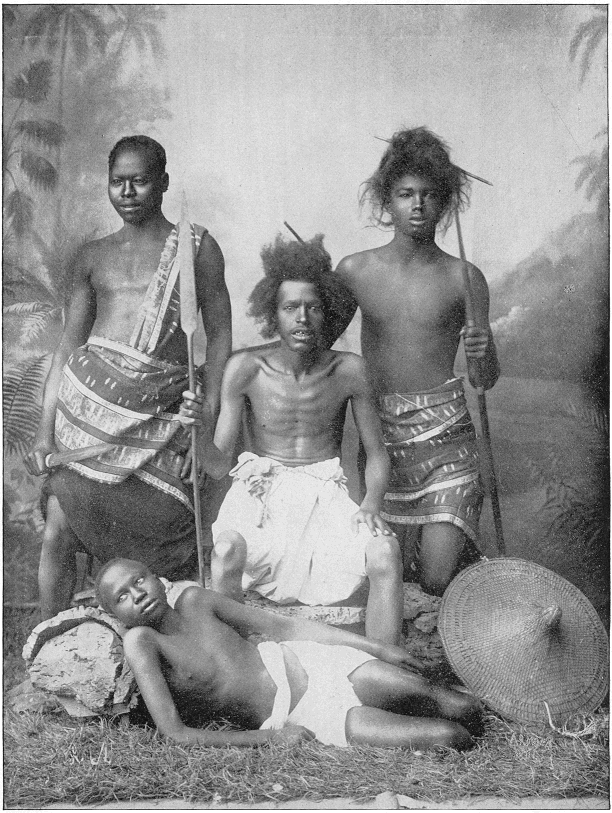
IN CENTRAL AFRICA.—No country in the world creates more interest among the civilized nations than does Africa. In the far interior, where African explorers have failed to find traces of the outer world, every variety of savage humanity exists. These uncivilized people, who know nothing of the progress of nations, live in tribes, preying upon each other's settlements, whenever opportunity presents itself. The above picture represents the typical natives of the Dark Continent.
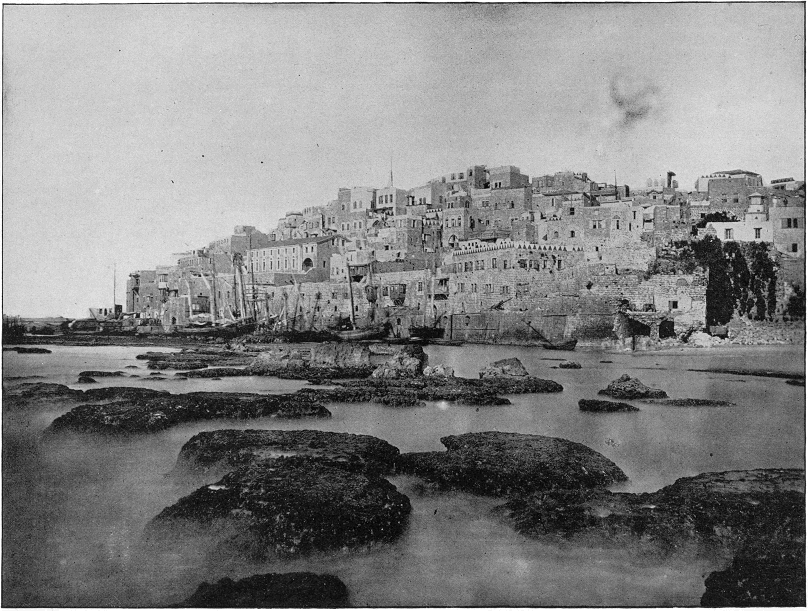
YAFFA OR JAFFA, Palestine.—Jaffa is a small town lying on the coast of the Mediterranean, at the foot of a rock one hundred and sixteen feet in height. This town is very ancient, and a road runs directly from it to Jerusalem. The houses are built of tuff-stone, and the streets are generally very narrow and dirty, and, after the slightest rain, exceedingly muddy. The town walls are falling to decay, and the interior of the town is uninteresting. Tradition points out the place as the one in which Napoleon is said to have caused plague-patients to be poisoned, and in which St. Peter once fished; but the authenticity of it seems to proceed from a confusion of ideas.
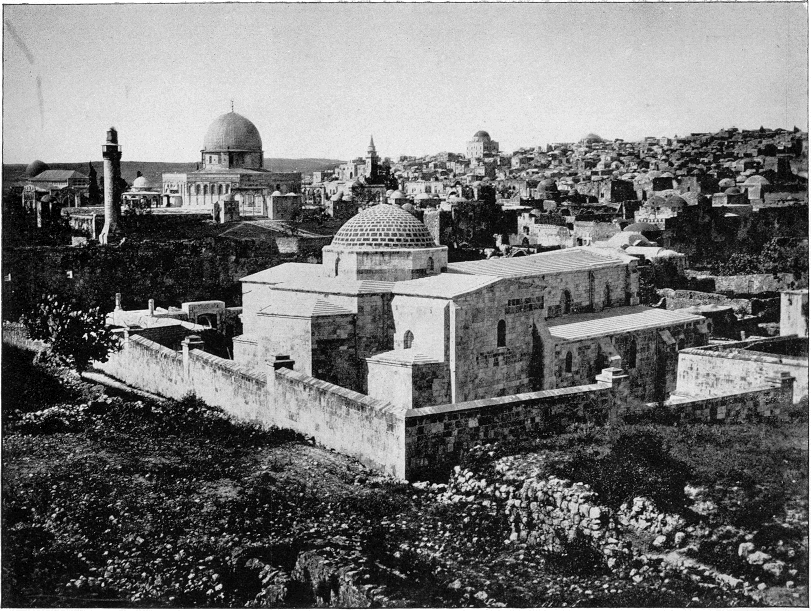
JERUSALEM, Palestine.—Here is a place of overwhelming interest, but at first sight sadly disappointing. Little is seen of the ancient City of Zion and Moriah, the far-famed capital of the Jewish Empire, in the narrow, crooked and ill-paved streets of the modern town. The combination of wild superstitions, with the merest formalism which is everywhere observed, and the fanaticism and jealous exclusiveness of the numerous religious communities of Jerusalem, form the chief modern characteristics of that memorable city which was once the fountain-head from which the knowledge of the true God was wont to be vouchsafed to mankind, and which has exercised the greatest influence on religious thought throughout the world.
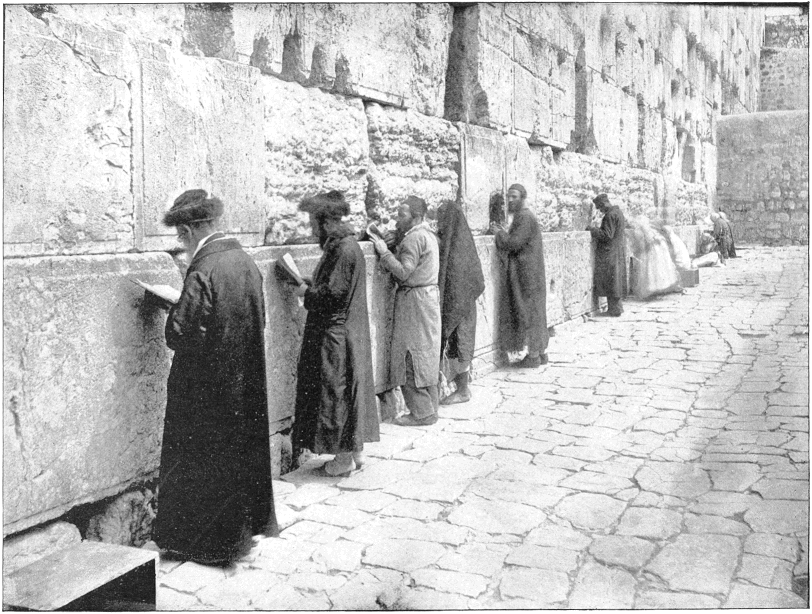
WAILING-PLACE OF THE JEWS, Jerusalem, Palestine.—Outside of the enclosure of Mosque El Aksa, at Jerusalem, is the noted wailing-place of the Jews. A large number of them, including old and young, male and female, gather here on Friday, kiss the stones and water them with their tears. They bewail the downfall of Jerusalem, and read from their well-worn Hebrew Bibles and prayer-books the Lamentations of Jeremiah. The following few words are an exact copy from their litany: "For the Palace that lies desolate, we sit in solitude and mourn." They present a curious spectacle.
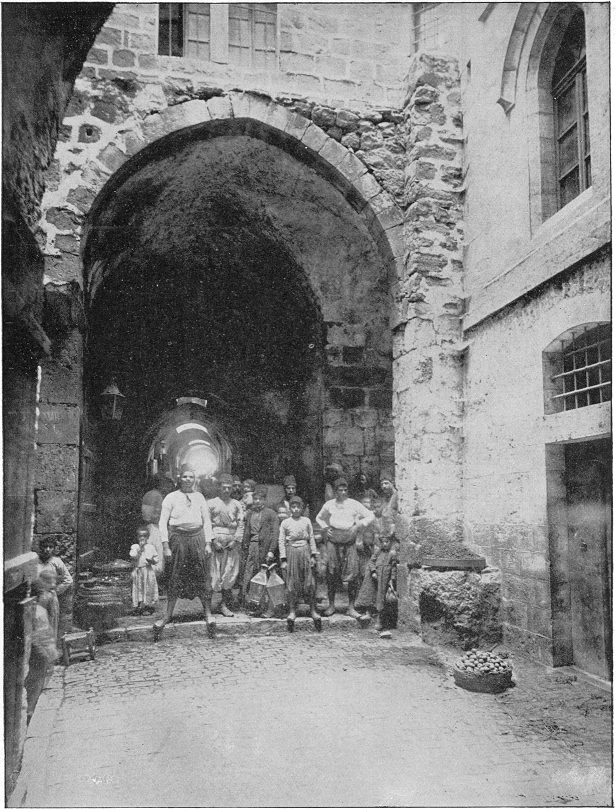
STREET SCENE, Jerusalem, Palestine.—The above photograph represents one of the fourteen stations of the "street of pain," over which Christ is said to have carried the cross on His way to Golgotha. The place where Christ was laid upon the cross, the house of Dives, the rich man, where Simon of Cyrene took the cross from Christ, the house against which Christ is said to have leaned, or near which He fell a second time, and the place where Christ is said to have addressed the women that accompanied Him, are all seen along this avenue.
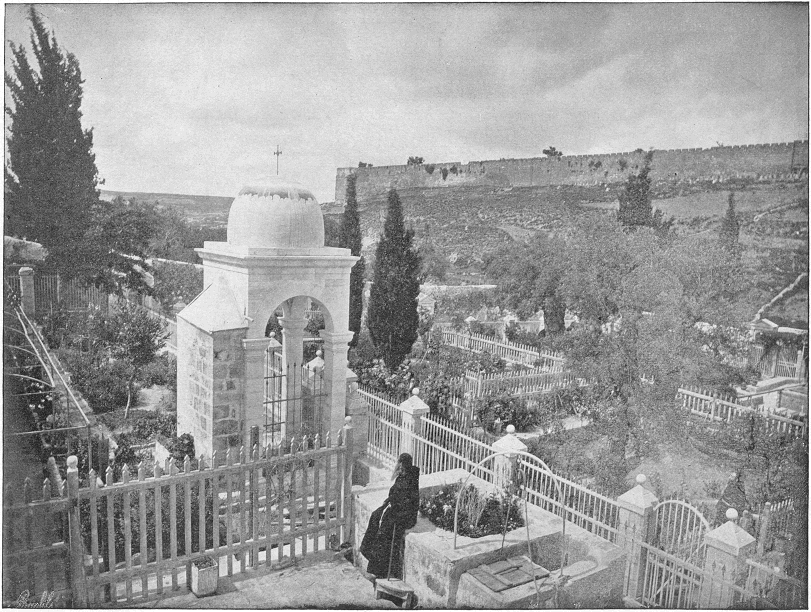
GARDEN OF GETHSEMANE, Palestine.—This holy place is situated at the foot of Mount Olivet across the Kedron, and noted as the scene of our Lord's agony. Jesus frequently came here, as did also His disciples. It is a small irregular spot surrounded by a high wall. This wall was built in 1847 by Franciscan monks, who claimed it necessary to keep from the garden, pilgrims who injured the olive trees. There are seven of these trees remaining in the Garden, whose trunks, nineteen feet in circumference, are cracked open with age, and claimed to date back to the time of our Saviour.
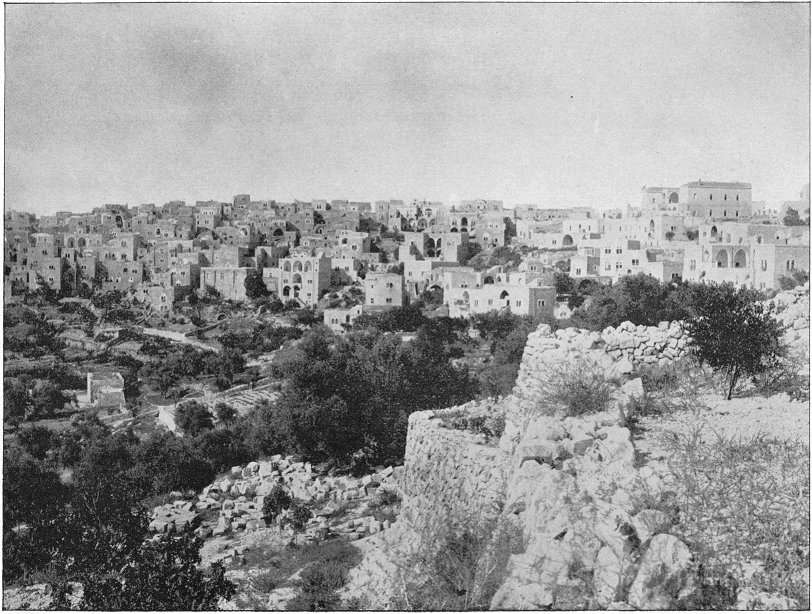
BETHLEHEM, Palestine.—"But thou, Bethlehem Ephratah, though thou be little among the thousands of Judah, yet out of thee shall He come forth unto Me that is to be ruler in Israel." In Hebrew the word signifies the "place of bread," or, more generally, "the place of food," and is possibly derived from the fact that the region about Bethlehem has from very remote antiquity presented a marked contrast to the surrounding "wilderness." We learn from the Bible that the inhabitants of Bethlehem possessed cornfields, vineyards and flocks of goats, and that they made cheese. The natural products of to-day in every respect confirm this record.
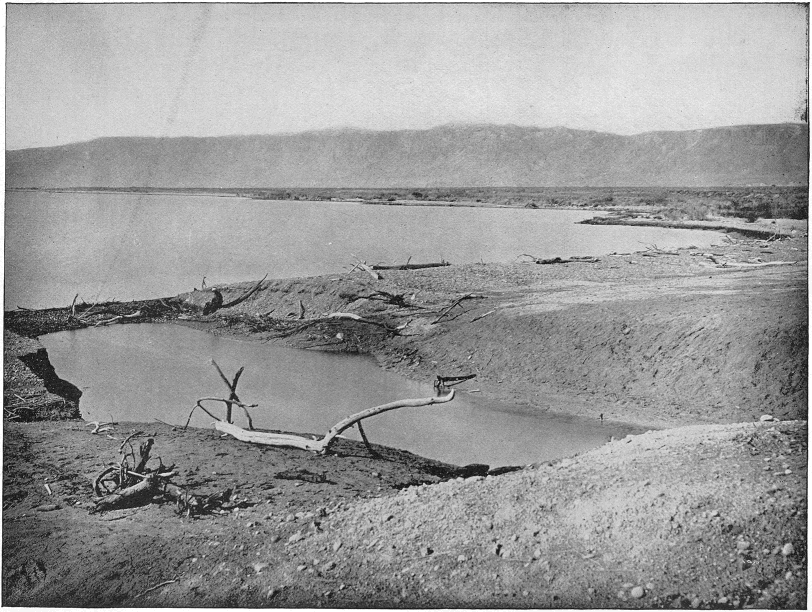
DEAD SEA, Palestine.—This sea, situated sixteen miles from Jerusalem and visible from the Mount of Olives, occupies that deep depression thirteen hundred feet below the Mediterranean, which extends from the mountains of Lebanon to the Gulf of Akabah, and is forty-six miles long and about ten miles wide. The River Jordan and smaller streams empty their waters into it, and it has no visible outlet. The water of the Dead Sea contains a large quantity of mineral substances, consisting of chlorides of sodium, calcium and magnesium, which give it a bitter taste, and render it smooth and oily.
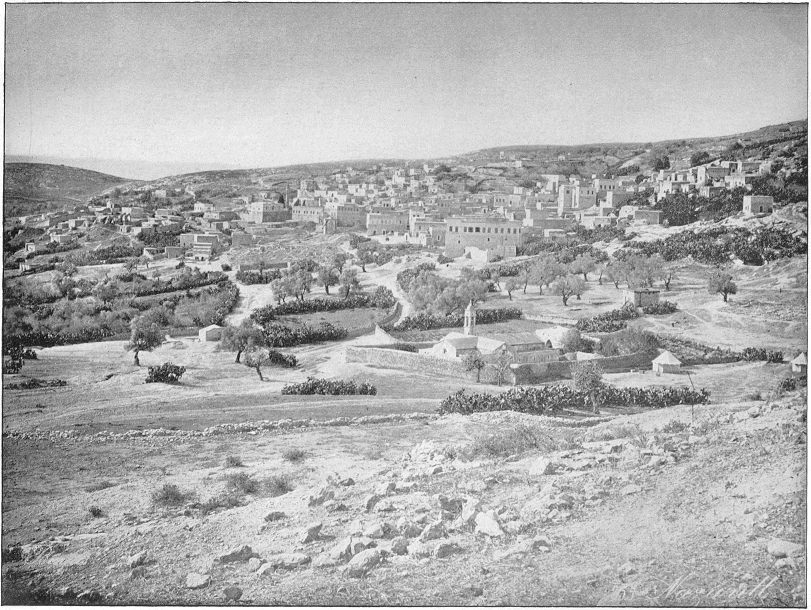
NAZARETH, Palestine.—This village, situated in Galilee about sixty-five miles from Jerusalem, is the place where Jesus grew up from infancy. From its highest elevation the most beautiful views of the Holy Land can be taken. The place must have been very small in the time of Christ, as the village is not named in the Old Testament. The population in those times was mainly Jewish, but it now has Greek, Latin and Moslem quarters and a Protestant mission. During the Middle Ages many Christians visited Nazareth, but when the Turks seized Palestine in 1517, they were again driven out.
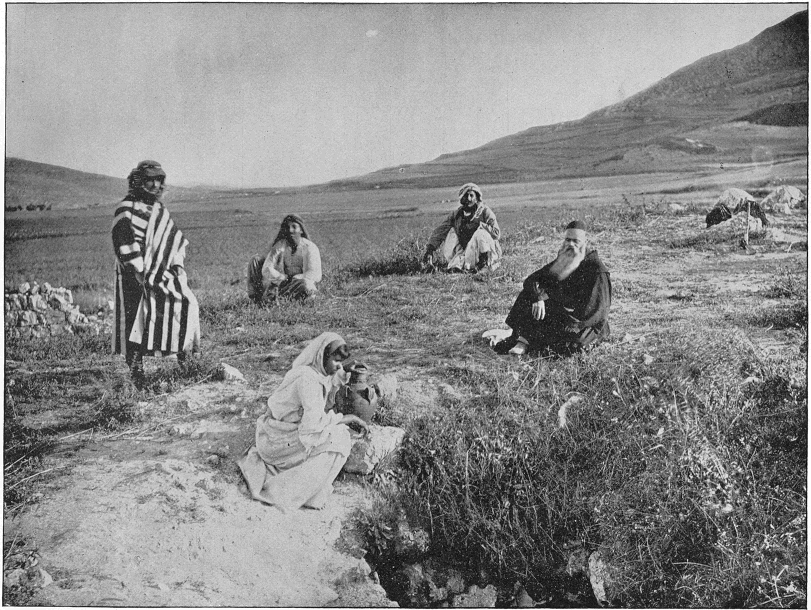
JACOB'S WELL, Palestine.—Jews, Christians and Muslims agree that this is the "Well of Jacob" of Scripture. (Gen. XXXIII., 19.) It is situated on the high road from Jerusalem to Galilee, according perfectly with the narrative of St. John IV., 5-30. In summer, it is often dry. It is seven and one-half feet in diameter and lined with masonry. If, as is probable, this well was the scene of Christ's conversation with the Samaritan woman, the tradition had already attached to it, that this was Jacob's Well, and around it was the field which he purchased, and where Joseph was afterwards buried. (Joshua XXIV., 32.)
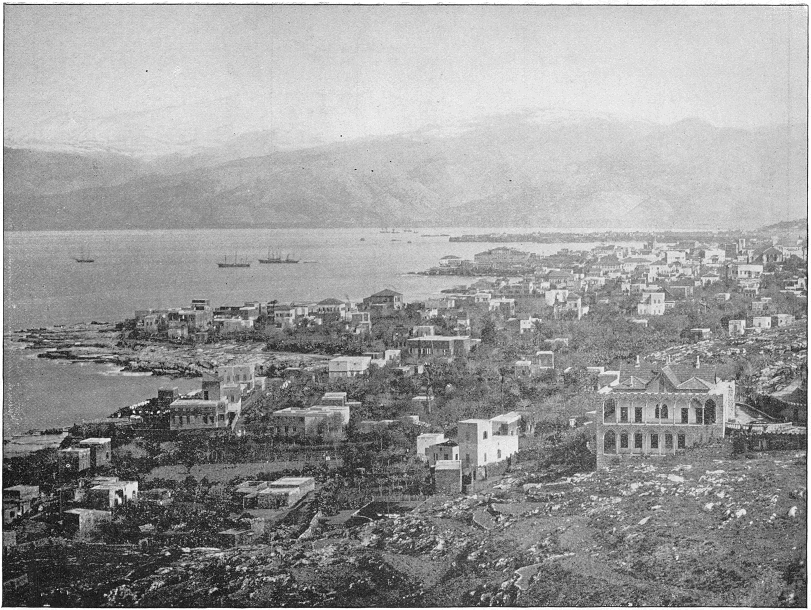
BEYROUTH, Syria.—The above city, located on the Mediterranean, is one of great antiquity. The city proper is an irregular square, open towards the sea, and surrounded on the land side by a substantial tower-flanked wall. The streets are wider than is usual in Syrian towns, and are paved with large stones. The houses, for the most part, are lofty and spacious. During the hot season the wealthier inhabitants move inland. The surrounding hills consist of reddish sand, interspersed with rock, and are covered with a light soil.
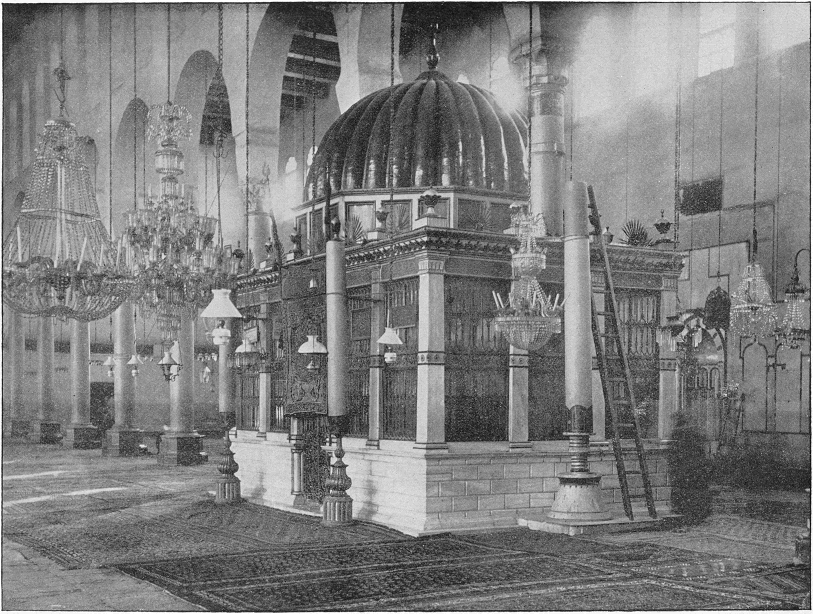
GREAT MOSQUE, Damascus, Syria.—It is possible that during the first century of the Christian era, a heathen temple stood on the site of the present mosque. The building was converted into a Christian church, and contained a casket in which the head of John the Baptist was shown. The Christian church was destroyed, and the present mosque erected. Antique columns were collected in towns of Syria, and used in the decoration. The pavement and lower walls are covered with rarest marbles. The ceiling, from which hang six hundred golden lamps, is of wood, inlaid with gold. The urn above the altar is said to still contain the remains of the head of John the Baptist.
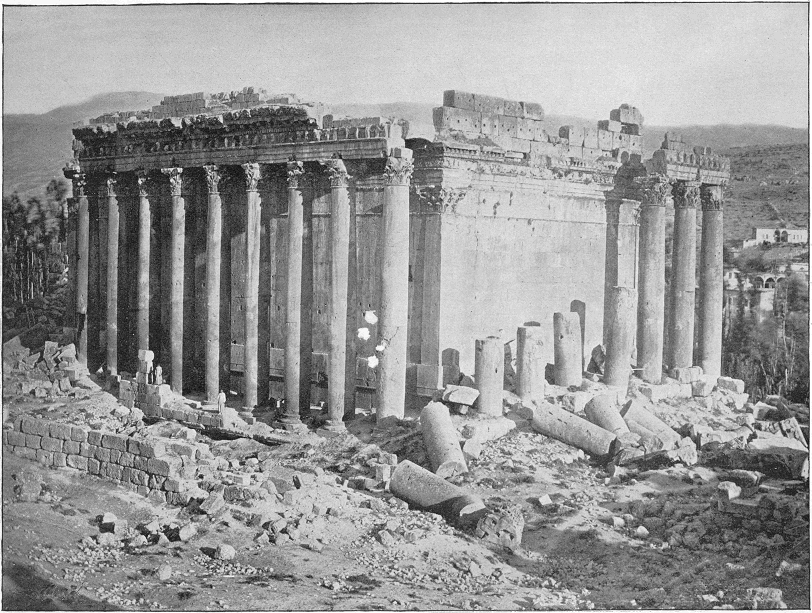
BAALBEC, Syria.—These magnificent ruins have excited the wonder and admiration of every beholder. In view of the fact that the Jewish style of architecture is mingled with that of the Doric and the Corinthian order, this building is supposed to have been the house that Solomon built for his Egyptian wife. It may be surpassed in classical taste by the Temple of Athens, and, in some respects, Rome may rival it. Even in magnitude the Nile exceeds it, but there is something about Baalbec that causes it to stand alone, and makes it peer of all. Its origin is not known, yet it passed through the Greek, Arab and Roman hands, and suffered assaults by the Crusades.
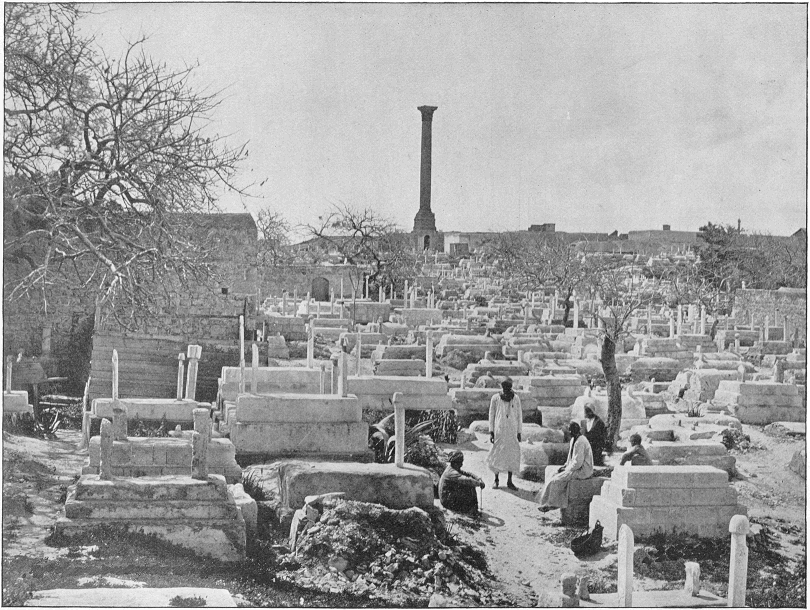
MECCA, Syria.—The pilgrimage to Mecca, which every Muslim is bound to undertake once in his life, is a most curious religious custom. In the neighborhood of Mecca the pilgrims undress, laying aside even their head-gear, and put on aprons and a piece of cloth over the left shoulder. They then perform the circuit of the Ka'ba, kiss the black stone, hear the sermon on Mount Arafat, near Mecca, pelt Satan with stones in the Valley of Mina, and conclude their pilgrimage with a great sacrificial feast. The picture shows the famous cemetery of Mecca, the bodies all buried above the ground.
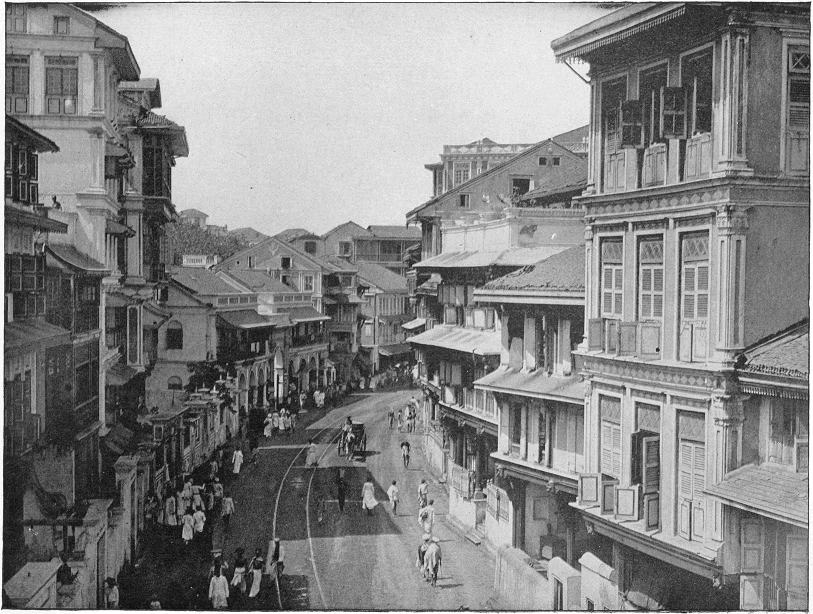
KALBADEVIE ROAD, Bombay, India.—The city of Bombay, under English rule, with a population of nearly a million inhabitants, is one or the most flourishing cities in India, on account of its nearness to the Suez Canal. The approach from the sea discloses one of the finest panoramas in the world, the only European analogy being the Bay of Naples. The town itself consists of well-built and usually handsome native bazaars, and of spacious streets devoted to European commerce, of which the above is one of the principal avenues.
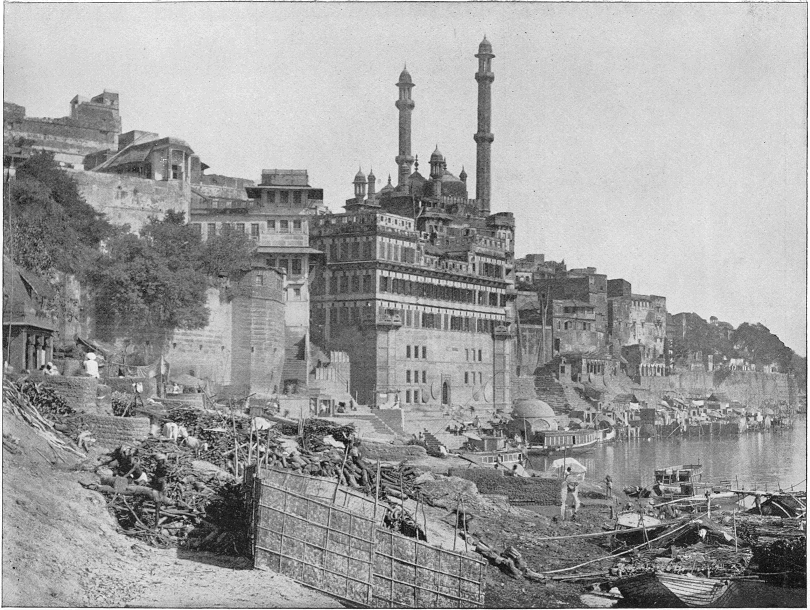
BENARES, India.—The city here represented is the religious centre of Hindooism, and one of the oldest cities on the globe. The bank of the Ganges is entirely lined with stone, and there are many very fine landing-places, built by pious devotees, and highly ornamented. The internal streets are so narrow and winding, that there is not room for a carriage to pass; and it is difficult to penetrate them even on horseback. The houses are built of Chanar stone, and are lofty, none being less than two, and many five and six, stories high.
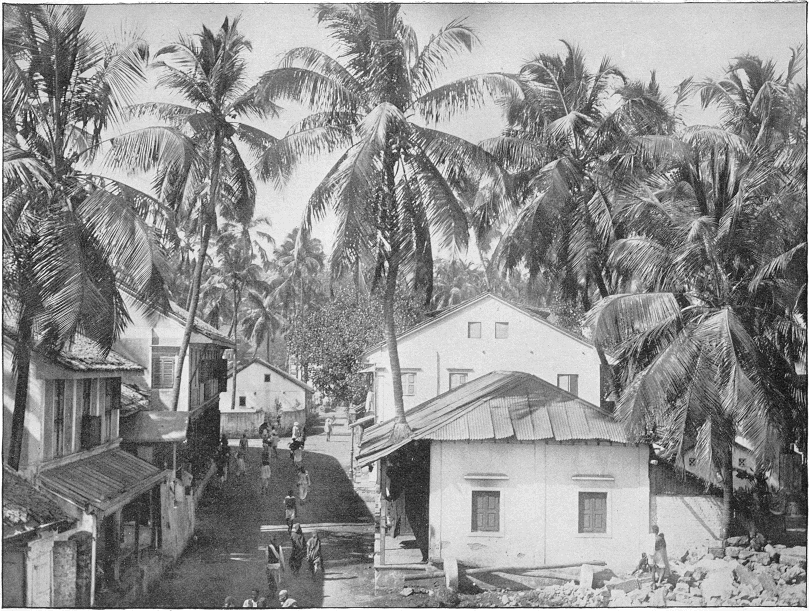
TROPICAL SCENERY, India.
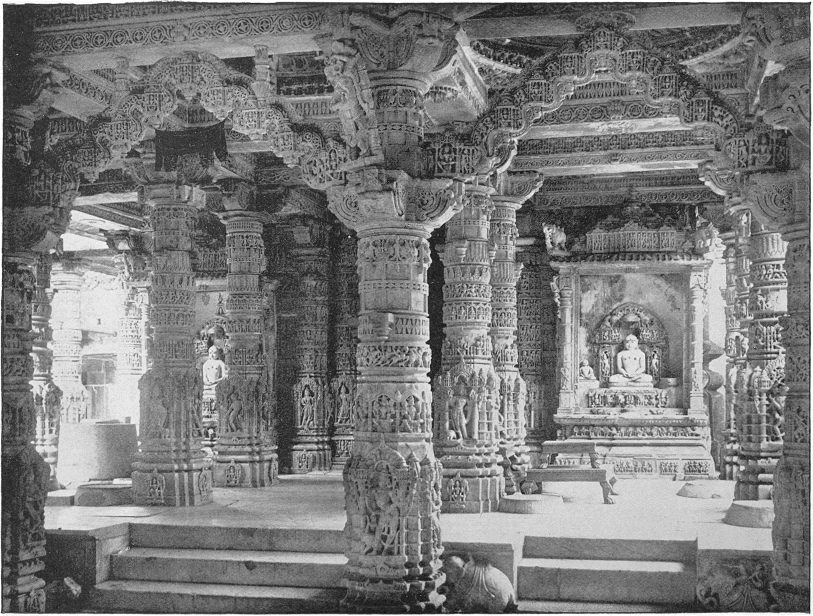
HEATHEN TEMPLE, India.
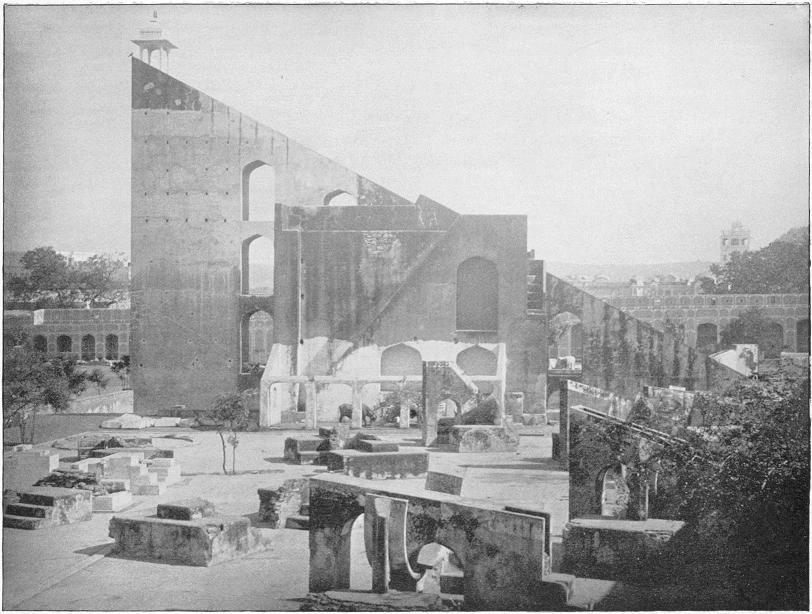
ROYAL OBSERVATORY, India.
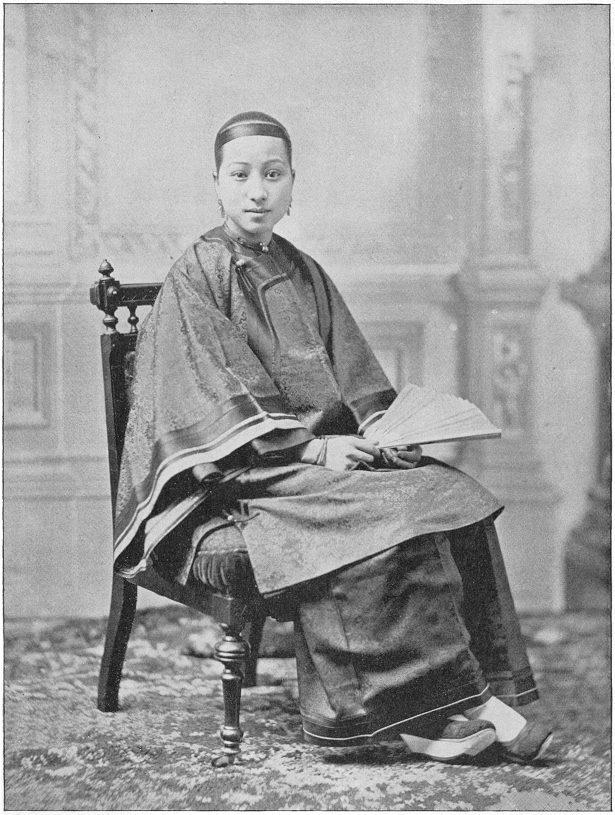
WONG TAI KEN, China.—The people of China are a thoroughly settled class of agriculturists and traders. They are partially Buddhist, and have a peculiar monosyllabic, uninflected language, with writing consisting of symbols, which represent words, not letters. The photograph represents one of the better class, dressed in a richly made costume after the fashion of her country. Her feet, like all of her race, are extremely small and encased in velvet sandals, with thick wooden shoes, which are peculiar to these people.
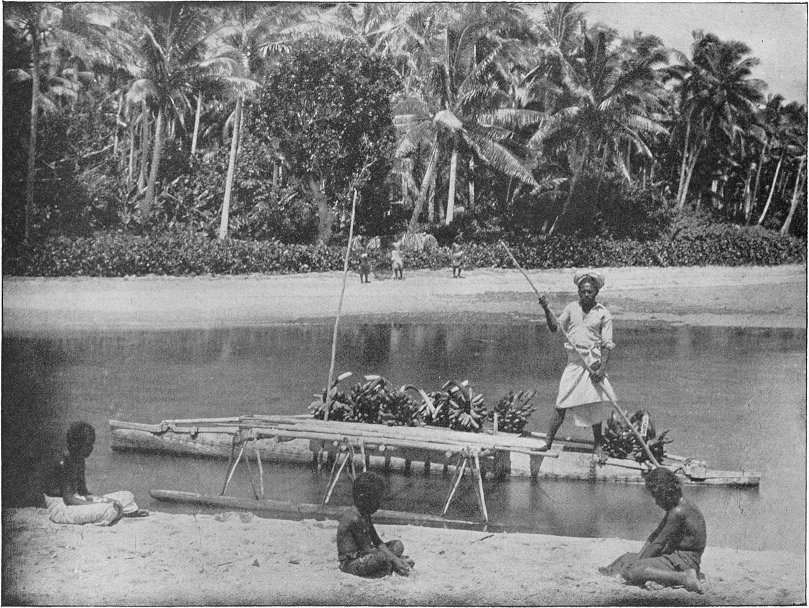
TYPICAL SCENE, Sandwich Islands.—The ravines and mountain-slopes on the windward side of the larger islands contain much forest growth, while the leeward uplands and plains are comparatively bare. Among the most remarkable forms of vegetation is a screw-pine and candle-nut tree, so named from the fact that the natives string together the kernels, which are very oily, and make candles. The natives derive their sustenance chiefly from pork and fish, both fresh and dried, and from the banana, sweet potato, yam, bread, fruit and cocoanut.
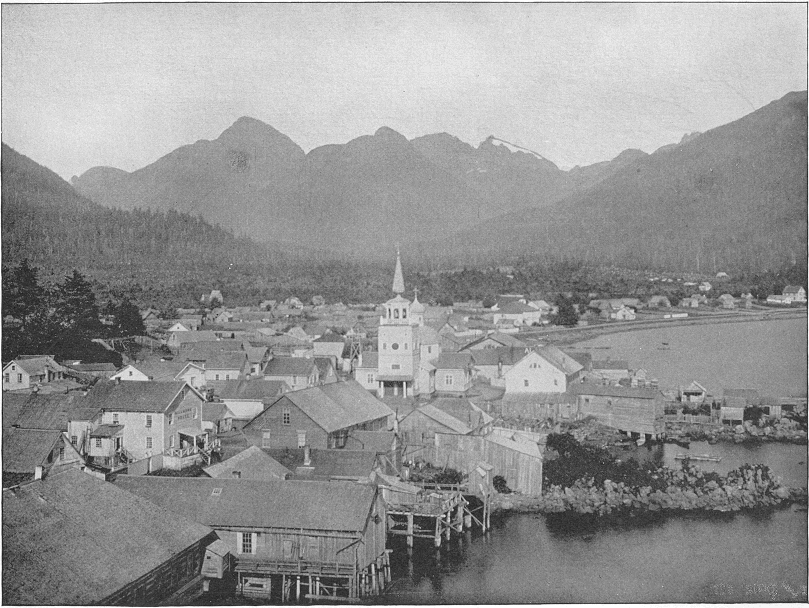
SITKA, Alaska.—Sitka, the capital of Alaska, is situated on the west coast of the Baranoff Island, which is one of the principal of the Alexander Islands. It is the second town in size, and has a custom house, a Greco-Russian church, a hospital, a half dozen stores, schools and several saw mills. Its principal business is fishing, and a number of steamers ply between this place and Portland, Oregon. The island is about seventy miles long and fifteen miles wide, and is densely timbered.
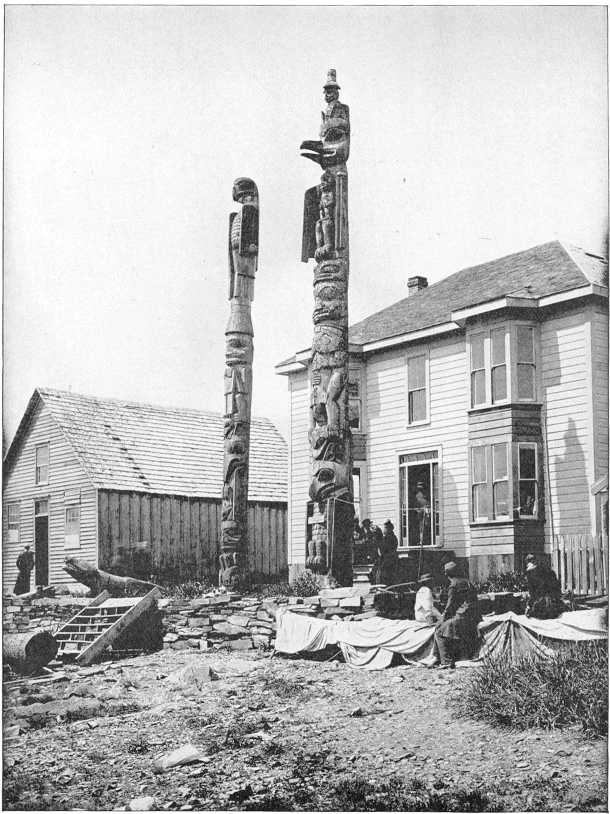
TOTEM POLES, Alaska.—A totem is a class of material objects which a savage regards with superstitious respect, believing that there exists between him and every member of the class an intimate and special relation. These poles, which rise to the height of 70 feet, are elaborately carved from top to bottom with a succession of figures, representing the wolf, frog, bear, eagle, whale and a variety of other animals. They are planted near Indian villages, but it is hoped church steeples will soon tower in their places and work a change in these strange people.
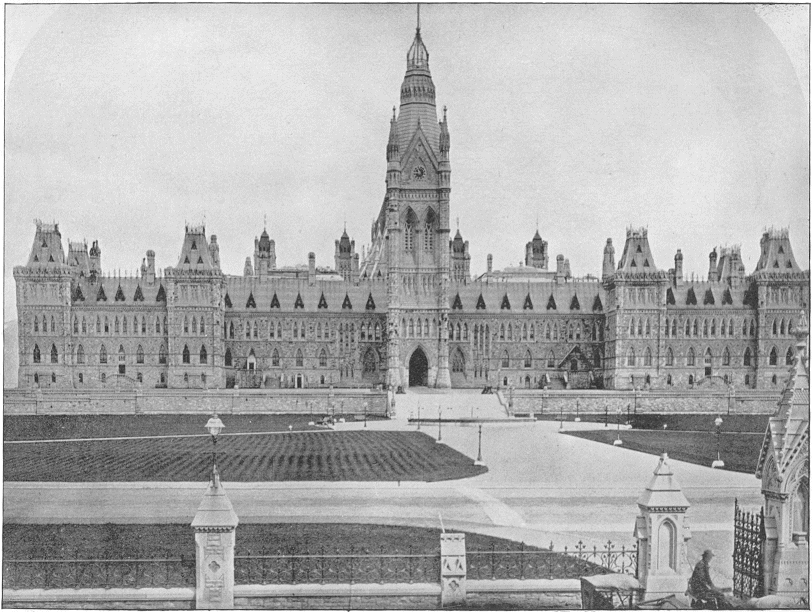
PARLIAMENT BUILDINGS, Ottawa, Canada.—The capital of the Dominion of Canada is situated on the Ottawa River, four hundred and fifty miles from New York, and one hundred and twenty-six miles from Montreal. It is one of the most flourishing cities in Ontario, on account of the great lumber products in the surrounding districts. The city was founded sixty-three years ago, its chief attraction being the Government Buildings, which stand on Barrack Hill, and are built mainly of light-colored sandstone. The style of architecture is that of Italian Gothic. The main building is five hundred feet long, covering nearly four acres, and involving a cost of $4,000,000 in its construction.
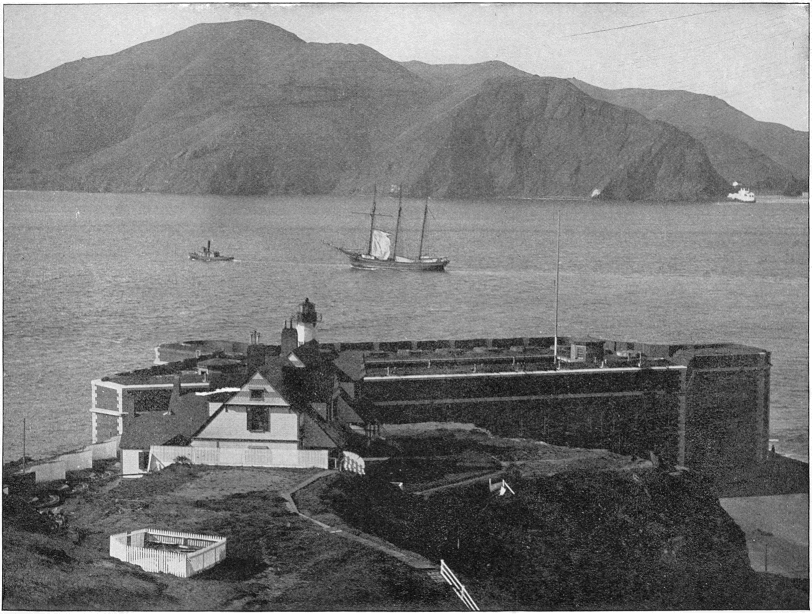
GOLDEN GATE, California.—This forms the entrance to San Francisco Bay, which is about seventy miles long and from ten to fifteen wide, and is narrowed into a channel only about one mile wide; here the waters escape in a current as the tide ebbs and flows to and from the ocean. As one approaches from the ocean towards the bay, the south side of the Golden Gate exhibits a shelving point of land which terminates in a long fortification called Fort Point. The portion of the strait between the light house on the north and the fort on the south, is termed "The Golden Gate," or "Chrysopylæ."
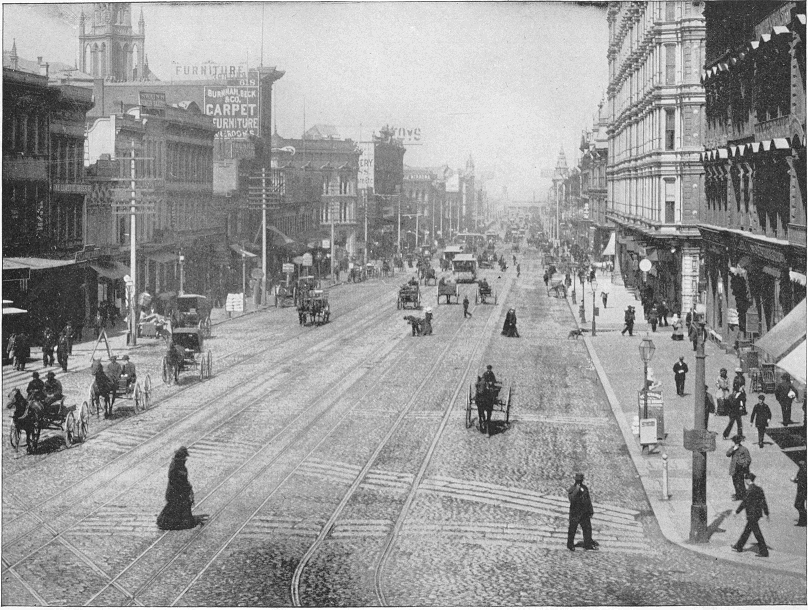
SAN FRANCISCO, California.—The city is the commercial metropolis of California, and is situated nearly six miles from the ocean on the west side of the magnificent bay from which it derives its name. It stands on a plain which inclines towards the bay, and has numerous hills behind it. The city is regularly laid out, the streets crossing each other at right angles. Market Street, which has four street-car tracks, two of which are cable lines, is the principal business street; it runs south-west from the bay, and divides the older from the newer portion of the city. The city was originally called Yerba Buena ("good herbs"), and was settled by the Spaniards about 1777, but was changed to San Francisco in 1847.
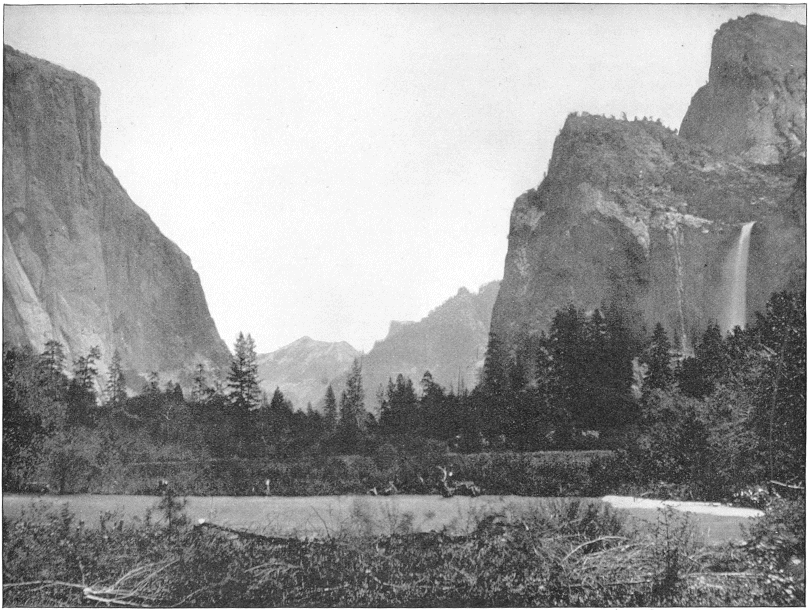
YOSEMITE VALLEY, California.—The Yosemite Valley is situated one hundred and fifty miles distant, in a direct line, a little to the southeast of San Francisco. It is six miles in length and from half a mile to a mile in width, and sunk from two thousand to three thousand feet in perpendicular depth below the general level of the surrounding country. The waterfalls in and about this valley are of great beauty and variety. The Nevada and Vernal Falls of the Merced River, which flows through the whole length of the valley, are wonderfully grand.
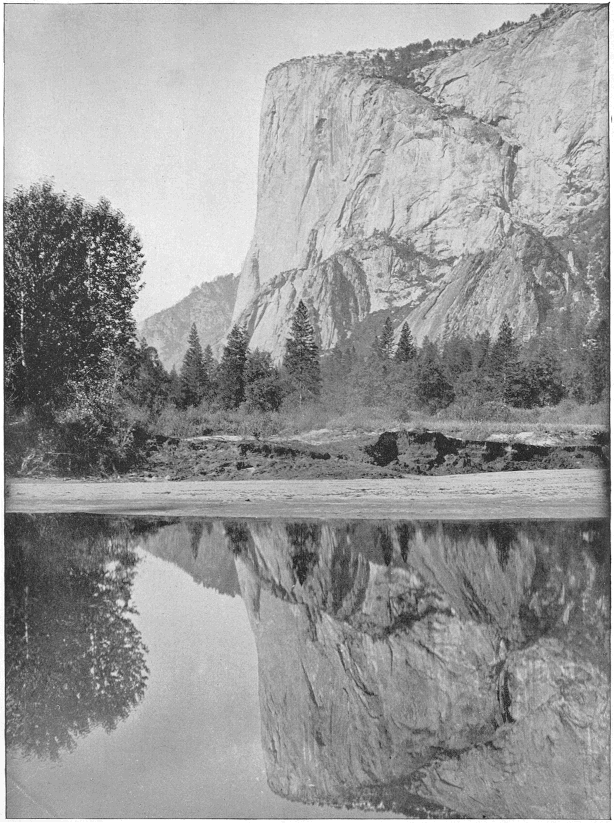
MIRROR LAKE, Yosemite Valley, California.—Up the canyon of the Tenaya is situated this beautiful little lake, called "Mirror Lake," which is an expansion of the Tenaya Fork. It is generally visited early in the morning, for the purpose of seeing the reflection of the overhanging rock, which is known as Mount Watkins. Mirror Lake is one of the principal points of interest of this marvelous depression of nature.
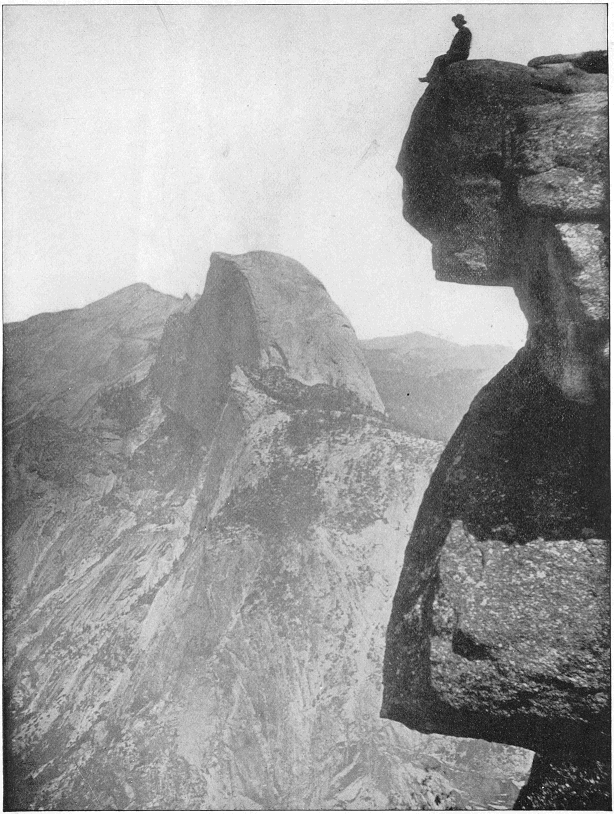
GLAZIER POINT, Yosemite Valley, California.—Glazier Point, one of the most remarkable and striking features of nature in the world, is composed of solid rock, thirty-two hundred feet in perpendicular height. It is reached by a trail from the floor of the valley, and the time generally consumed is from four to six hours. From this great point of interest, a general view of the whole valley can be obtained, and nothing is more soul-stirring to the beholder than to look at the great and marvelous wonders of nature abounding in the Yosemite Valley.
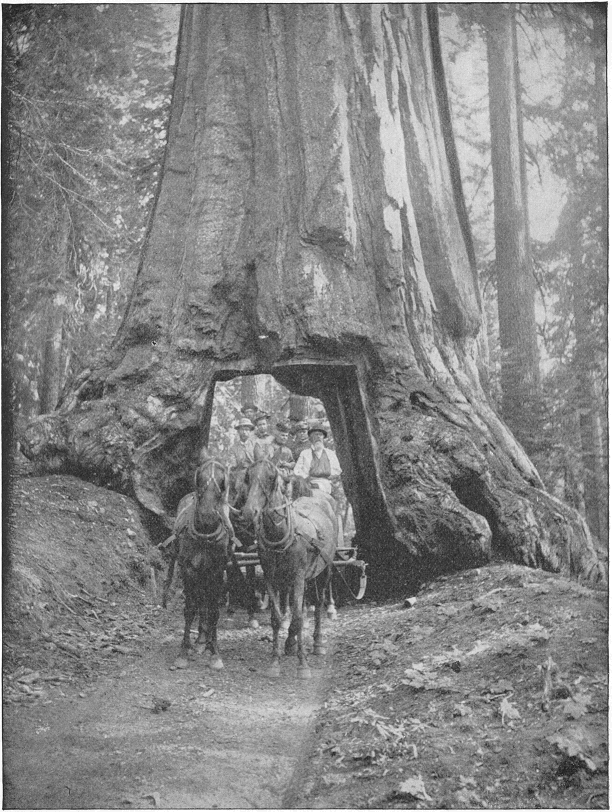
BIG TREE, California.—The big trees of California are known the world over and are specifically termed the sequoia gigantea, and abound only in California. They occur in groves or patches, which are scattered over limited areas. They grow to a great height, ranging from two hundred to three hundred feet, and attain a circumference from seventy-five to one hundred feet. The above is a photograph of one of the trees, showing the trunk, through which a four-horse stage coach passes. This tree measures twenty-five feet in diameter, and it stands in the Mariposa Grove.
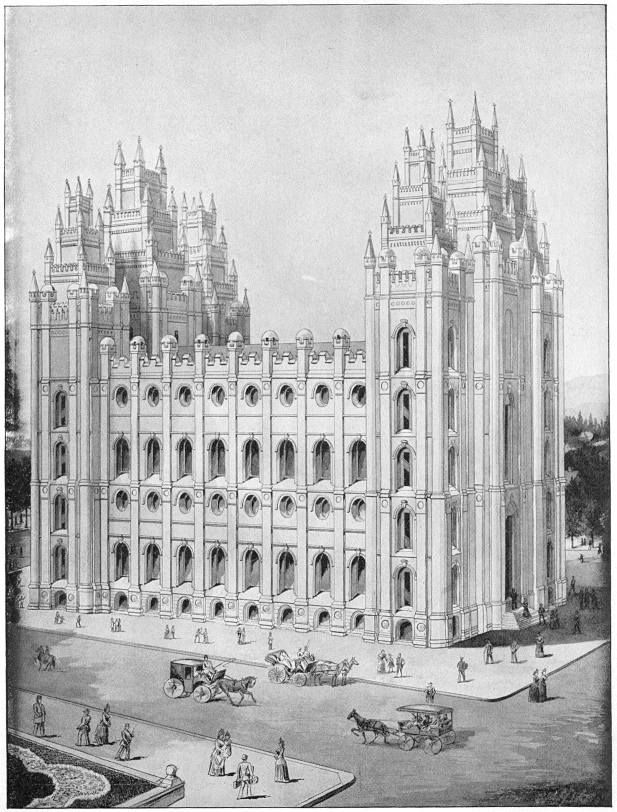
GREAT MORMON TEMPLE, Salt Lake City, Utah.—The Mormon religion was founded by Joseph Smith, at Manchester, New York, in 1830, and the same year was published "The Book of Mormon," in which Joseph Smith was declared to be God's "Prophet." He soon removed, with his followers, to Kirtland, Ohio, which was to be the seat of the New Jerusalem. Several years later the Mormon band emigrated to Missouri, and later to Salt Lake City, Utah. After the death of Smith, Brigham Young succeeded, until 1877, when he died and left a fortune of $2,000,000 to seventeen wives and fifty-six children. Here they prospered and started to build the great temple, which is not yet quite finished.
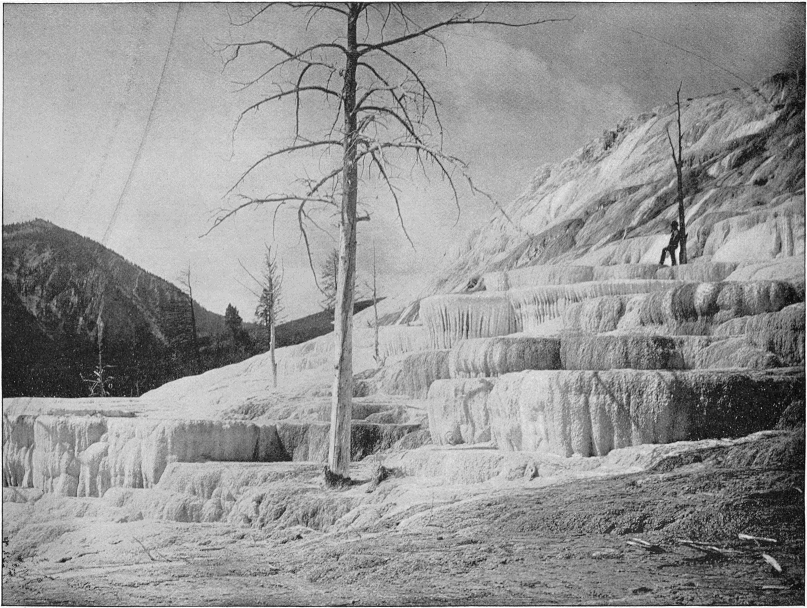
PULPIT TERRACE, Yellowstone National Park.-The Yellowstone Park has in the vicinity of the Mammoth Hot Springs many remarkable terrace-building springs, which are situated one thousand feet above the Gardiner River, into which they discharge their waters. The water finds its way to the surface through deep-lying cretaceous strata, and contains a great deposit of calcareous material. As the water flows out at the various elevations on the terraces through many vents, it forms corrugated layers of carbonate of lime, which is generally hard while wet, but becomes soft when dry. While these springs are active, vegetation dies in their vicinity; but when dry, grass and trees again grow on the crumbling calcareous deposit.
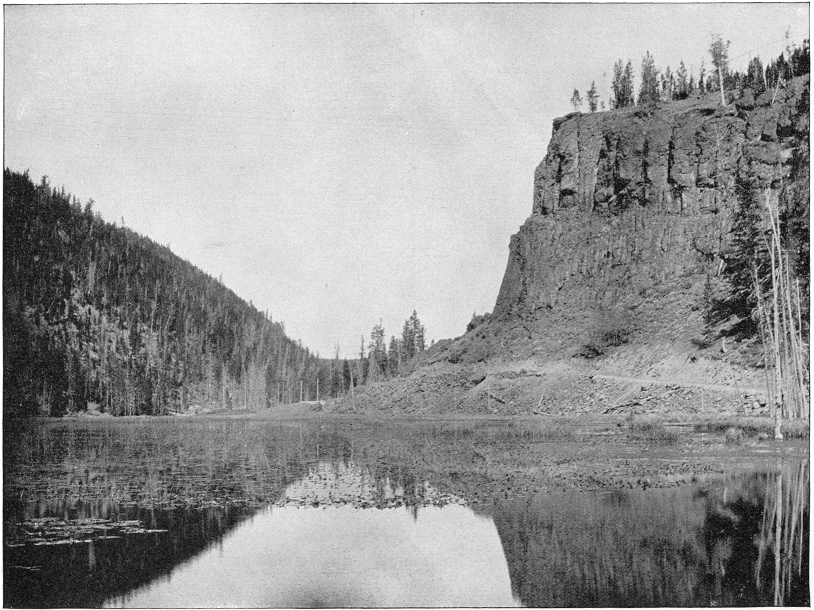
OBSIDIAN CLIFF, Yellowstone National Park.—This noted and volcanic glass mountain, situated in the Yellowstone Park, glistens like jet, is opaque and rises like basalt in almost vertical columns, from the shore of Beaver Lake. It is unequalled in the world, and is about two hundred feet high and one thousand feet in length, being variegated with streaks of red and yellow. When the carriage road was constructed over the side of the mountain along the lake, great fires were built upon the masses of Obsidian; and after they had been sufficiently expanded by the heat, cold water was thrown on them, which fractured the blocks into fragments that could be handled. Thus a glass carriage way was made one-quarter of a mile in length, which is without doubt the only piece of glass road in the world.
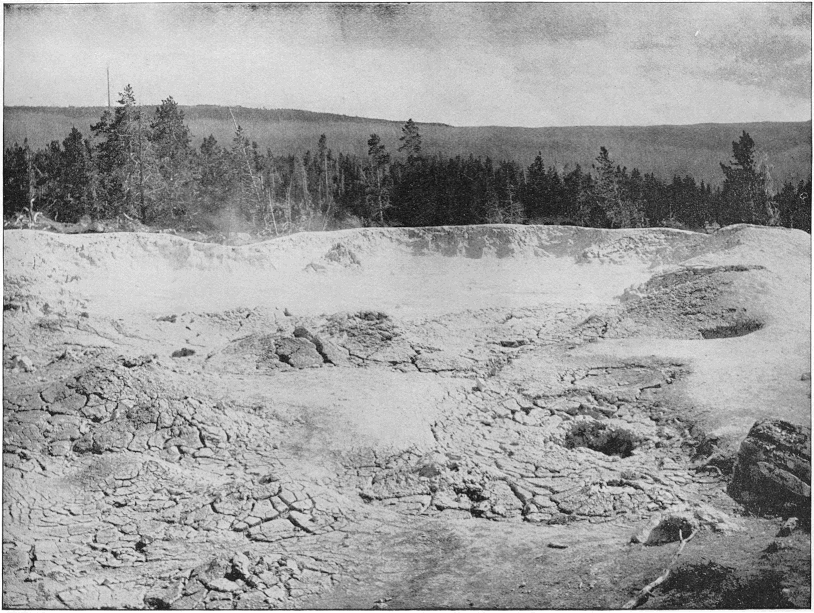
MAMMOTH PAINT POTS, Yellowstone National Park.—Among all the geysers and hot springs in Yellowstone Park, there is nothing more striking to behold than the Mammoth Paint Pots, which measure forty by sixty feet, with a mud rim on three sides from three to four feet in height. The whitish substance in this basin, which looks like paint, is in constant agitation, and resembles a vast bed of mortar with numerous points of ebullition. There is a constant bubbling up of this peculiar formation, which produces a sound similar to a hoarse whisper. Its contents have been reduced by the constant action to a mixed silicious clay, which in former years consisted of different colors, but is now active only in the white portion of its formation.
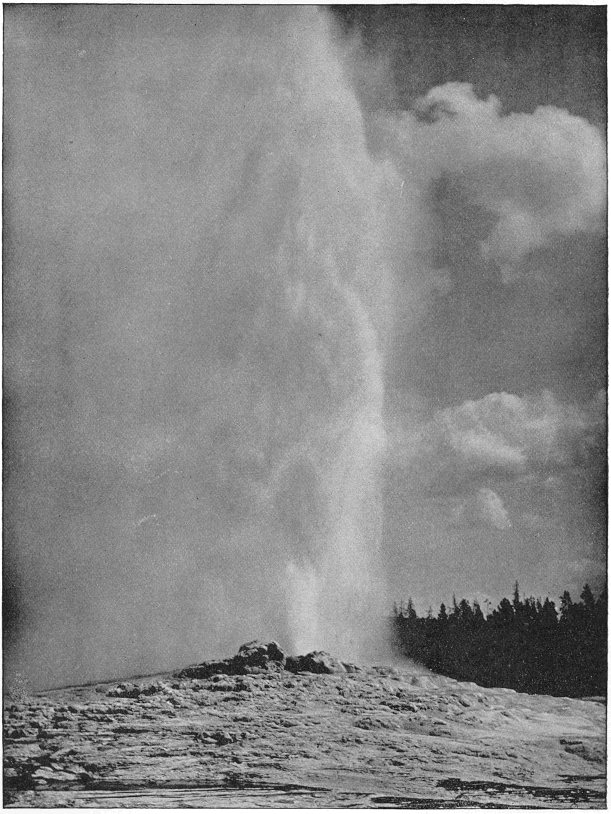
OLD FAITHFUL GEYSER, Yellowstone National Park.—Of all the geysers in the Yellowstone Park, this is one of the most interesting and noted on account of the great regularity of its eruptions, affording splendid opportunities for observation. It is located in the Upper Geyser Basin, and is situated on a mound of geyserite built by its own water. The eruptions begin with preliminary splashes, and continue for several minutes, becoming more powerful as they follow in rapid succession, when all at once the steam and water are thrown to a height of one hundred and fifty feet; this action occurs at intervals of every sixty-five minutes and lasts from four to five minutes.
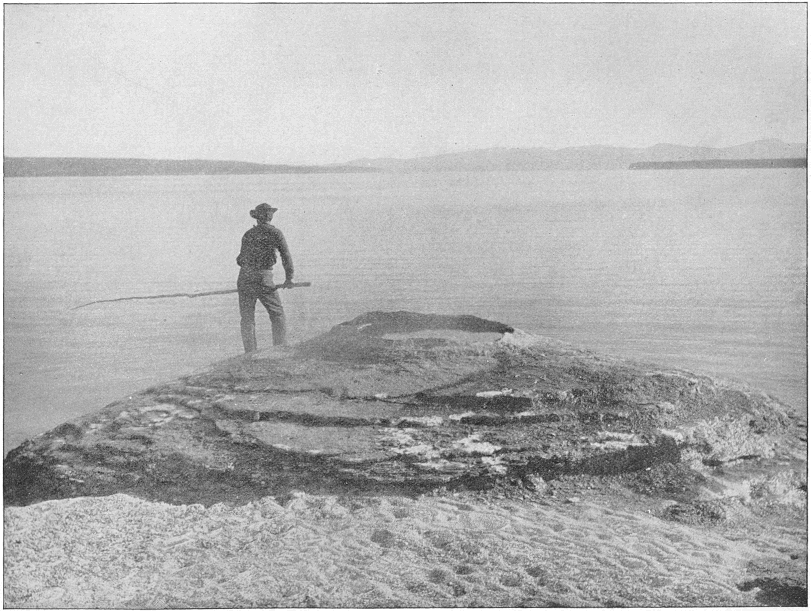
YELLOWSTONE LAKE AND HOT SPRINGS, Yellowstone National Park.—This large and beautiful sheet of water is nearly one-half mile higher than the summit of Mount Washington, N. H., and is surrounded by snow-capped mountains. It covers an area of one hundred and fifty square miles, and has a great depth. Trout are so plentiful that there is little pleasure afforded in capturing them. The lake is fed by numerous large tributaries and a score of smaller streams. A number of boiling springs, charged with sulphur, alum and alkali, dot its shores; and the fishermen can cook their trout by dropping them into the boiling springs without walking from the spot where they are caught.
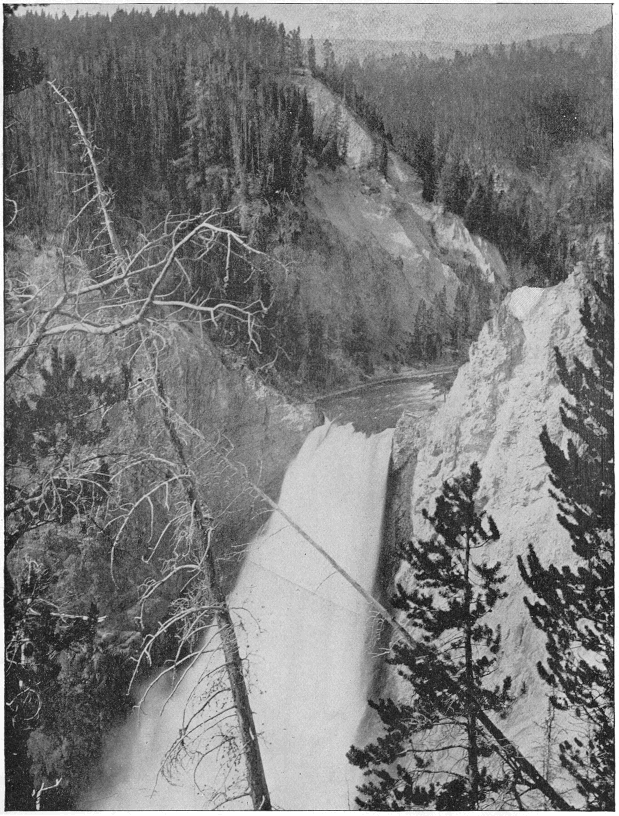
YELLOWSTONE FALLS, Yellowstone National Park.—After the water of the Yellowstone releases itself from the deep, symmetrical pool at the foot of the Upper Falls, the river turns to the left and flows through high bluffs for a short distance, until its sea-green water leaps from the top of the Great Falls, three hundred and sixty feet deep, into the profound, abysmal solitude of the Grand Canyon. This great mass of water breaks into fleecy columns and sheets of glistening foam as it descends; but it strikes the pool below with such a great concussion that it is forced upwards in fountains of spray and clouds of mist.
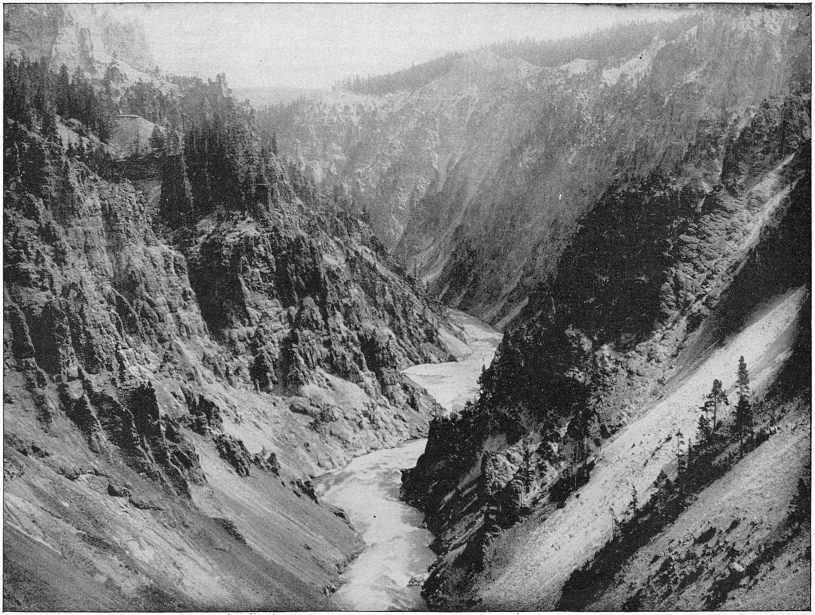
GRAND CAÑON OF THE YELLOWSTONE, Wyoming.—This wonderful gorge, whose scenic beauty is not equaled anywhere, has a scene of enchantment surpassing all expectations. From the Lower Falls it reveals the most varied groups of crags and rock ever beheld. It passes through a volcanic plateau, forming broken walls of barbaric richness of coloring that almost defies description. Red, purple and yellow predominate, and with the white foam of the rushing river through the bottom, and the dark green of the forest upon the plateau, form one of the grandest natural sights in earth.
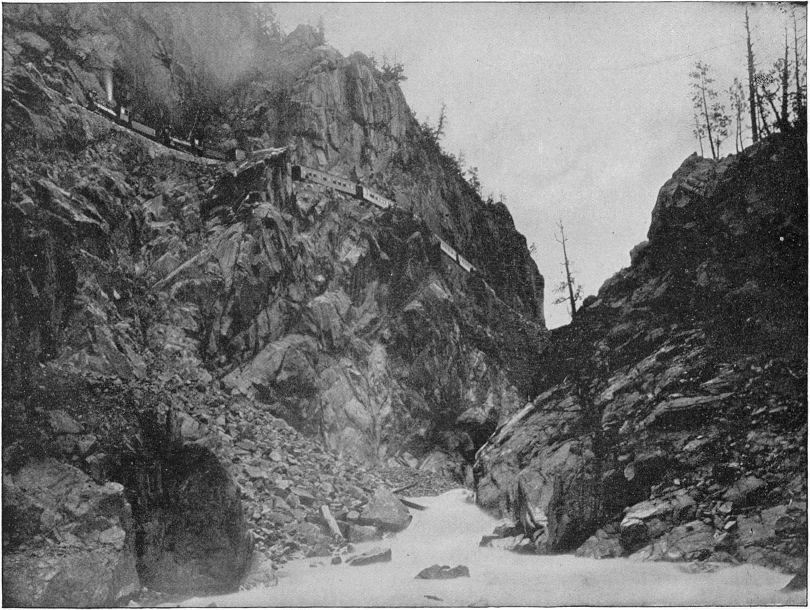
ANIMAS CANYON, Colorado.—This canyon is between Durango and Silverton, and the scenery through it is of surpassing grandeur and beauty. The railroad follows the course of the Animas River (to which the Spaniard gave the musical but melancholy title of "Rio de las Animas Perdidas," or River of Lost Souls) until the picturesque mining town of Silverton is reached. To the right is the silvery Animas River, which frets in its narrowing bed, and breaks into foam against the opposing boulders, beyond which rise the hills; to the left are mountains, increasing in rugged contour as the advance is made, and in the shadow of the rocks all is solitary, weird and awful; the startled traveler loses all apprehension in the wondrous beauty and grandeur of the scene.
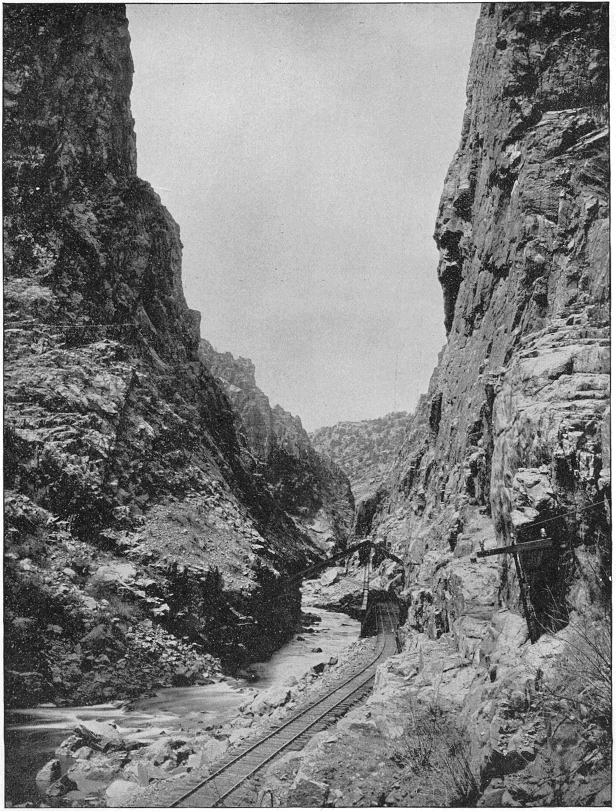
GRAND CANYON Of THE ARKANSAS RIVER, Colorado.—There are no words which can properly describe this great and magnificent canyon, the crowning attraction, the wonder of wonders, the marvel of marvels, in Colorado's scenery. This canyon is seven miles in length, and presents the grandest scenery in the world. This photograph represents the Royal Gorge, where the canyon is three hundred feet deep. As it is not sufficiently wide for railroad and river to pass through, the road is carried above the river, on a hanging bridge, which is shown in the picture.
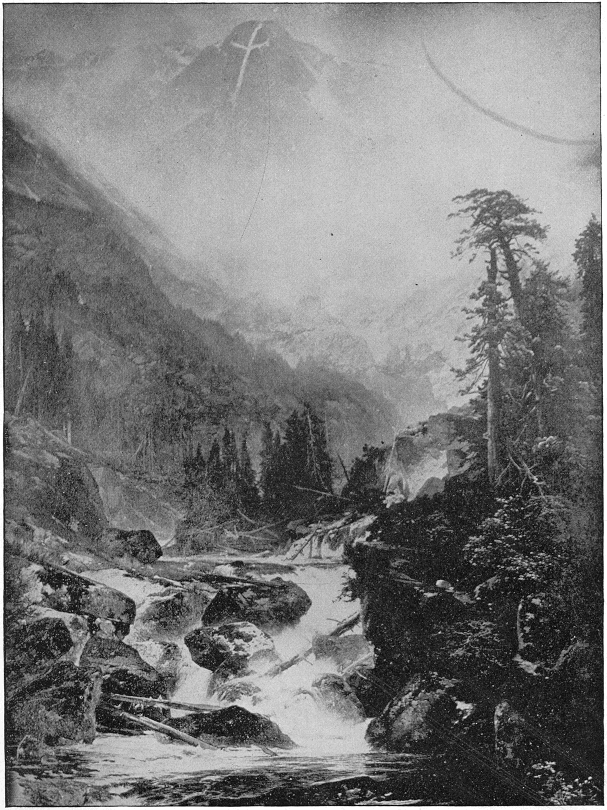
MOUNTAIN OF THE HOLY CROSS, Colorado.—This mountain is without doubt the most remarkable and the most noted of the Rockies, on account of the cross from which it received its name. Near the top is seen the cross, formed by deep crevices in its side, which are filled with perpetual snow and ice. The sight of wildwood, of tree-crowned slope, of rocky heights, of silvery cascades whose white threads of water are occasionally seen wearing away rifts in the rocks, renders the mountain one of the most enchanting of the many mountains in Colorado.
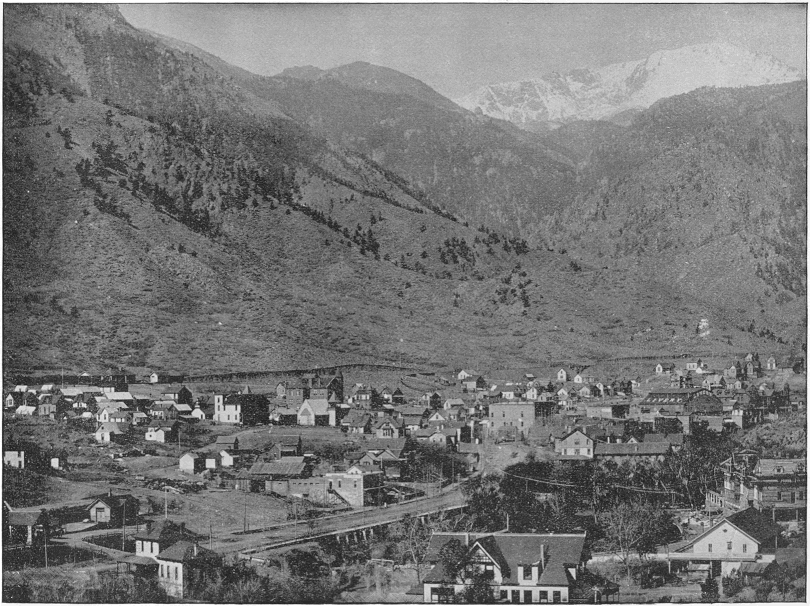
MANITOU AND PIKE'S PEAK, Colorado.—Manitou was known to white men long before Major Pike discovered the peak, and is noted for its famous soda springs, whose health-giving properties were familiar to the Indians from time immemorial. To this favored spot they made their pilgrimages, and in grateful recognition of the beneficent characteristics of the waters, they named the place in honor of the Great Spirit, and bestowed upon it the musical and significant title, Manitou. It is visited by thousands of tourists every season, and many make the ascent from here to the top of Pike's Peak, which is seen in the background.
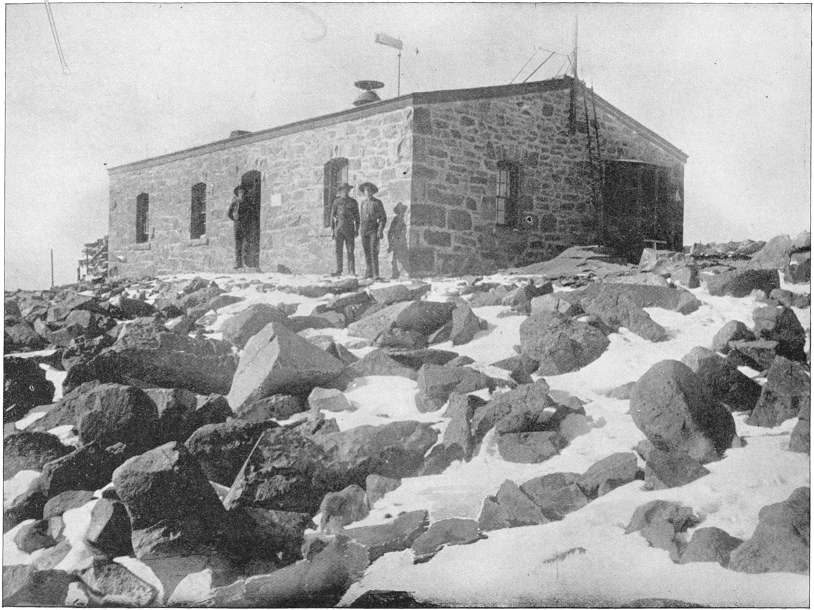
SUMMIT OF PIKE'S PEAK, Colorado.—In 1806 Major Zebulon Pike first described this wonderful snow-capped peak, which now bears his name, and which he called the "Great Snow Mountain." When the mountain first dawned on his view, he was one hundred miles east on the plains. This noted peak towers to the height of 14,147 feet, and its top is covered with perpetual snow. This photograph represents the U. S. Signal Station on its summit. The top is now reached by an incline railway from Manitou, and from it the traveler may behold one of the grandest sights in Colorado.
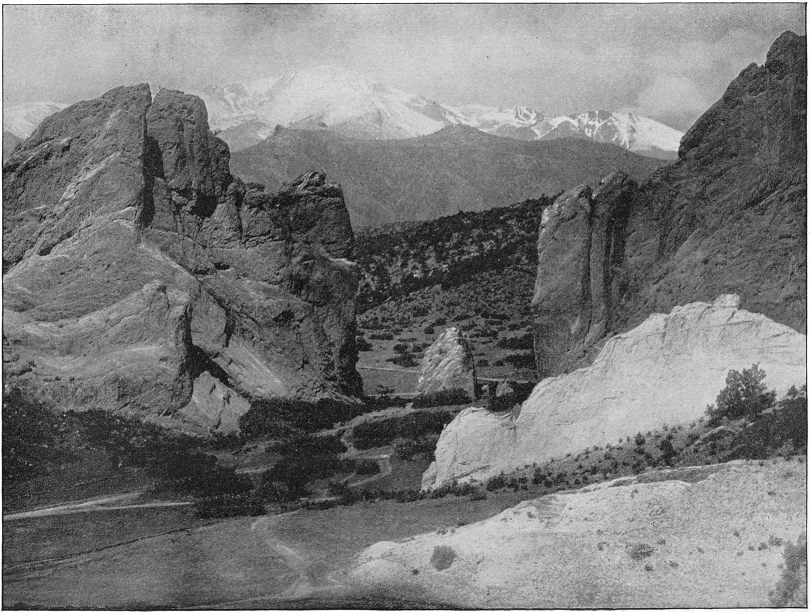
GATEWAY TO THE GARDEN OF THE GODS, Colorado.—Why this wonderful valley, which has not the appearance of a garden, was named the Garden of the Gods, no one knows; but, no doubt, by reason of its apt alliterations, the name has become so popular that it would be foolish to change it. There are many remains which show that Titanic forces have been at work here. It does not require a lively imagination to discover in the garden an endless variety of beings, such as the lion, the seal, the elephant, birds and reptiles of imitative forms. The most noted object is the Great Gateway.
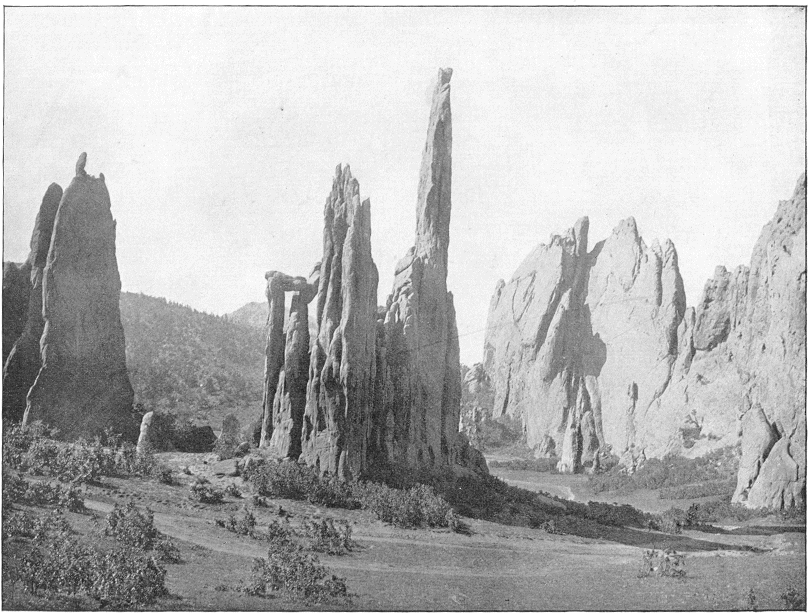
CATHEDRAL SPIRES, Colorado.—The stranger passing through Manitou should not fail to visit the Garden of the Gods, in which are located the Cathedral Spires, wonderful rock formations, standing upright, with pinnacles several hundred feet high. The wonderful region in which these spires are, in point of attraction, ranks with the sunny slopes of Italy, and the rugged grandeur of the Bernese Oberland. The scenery in this locality is so varied, so grand, and so impressive, that contemplative pauses must be made in order that the eye may grasp all the charming details of the view.
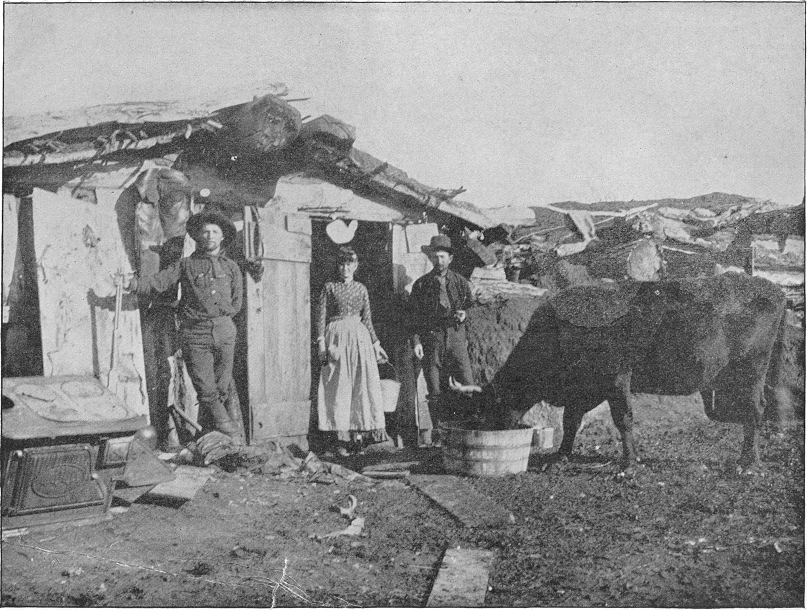
LIFE IN OKLAHOMA, Oklahoma Territory.—Oklahoma Territory is a beautiful stretch of country, abounding in vast and fertile plains. In the eastern part, the soil is particularly rich and well irrigated, making it almost as productive as a garden. The territory was formerly the special domain for all the Indian tribes, but this original race seems to be gradually becoming extinct. The above photograph represents a scene in Oklahoma County. This county is nearly in the centre of the territory, on the line of it railroad which has recently been opened. Owing to its admirable adaptability for agriculture, it is fast becoming populated. The picture suggests the most primitive rural simplicity.
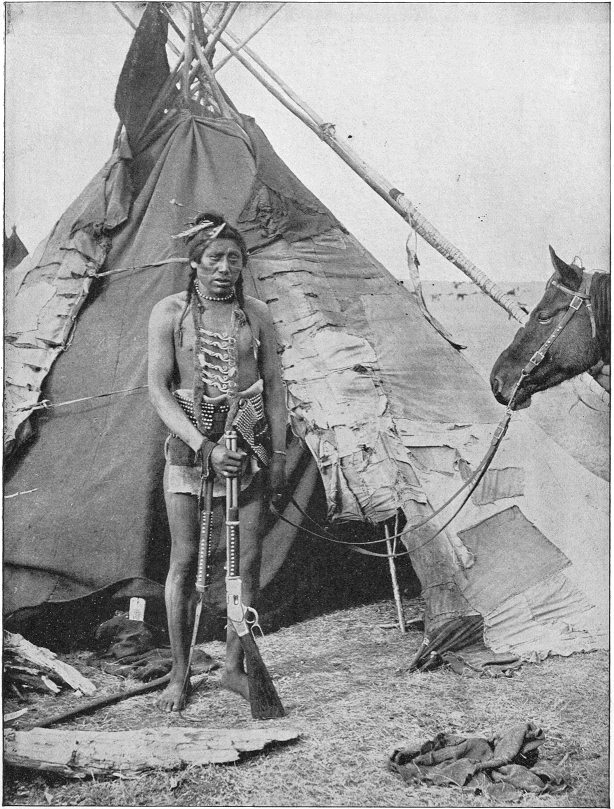
INDIAN WIGWAM, Indian Territory.—The red man, the original inhabitant of American soil, is represented here at his hut, with his gun and the reins of his horse in his hands. He has a universal belief in a Supreme Being, though his religious attributes are associated with various manifestations of natural phenomena. He believes in the immortality of the soul, but his conceptions of the future system of reward and punishment are confused. The American Indians are slowly diminishing in number on account of the progress of the white man. Their present population is about 255,000, and the greatest number are gathered upon their reservations in Indian Territory.
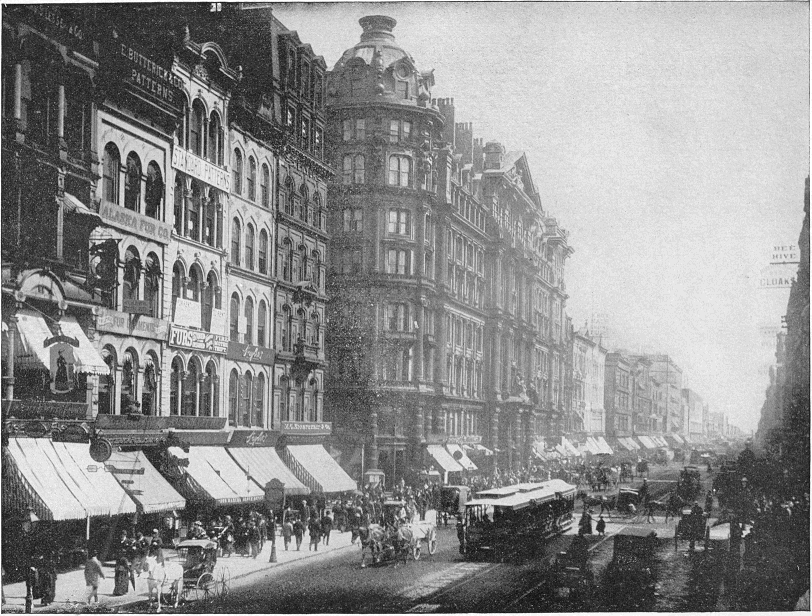
CHICAGO, Illinois.—This city, which is now the most important centre of commerce in the Northwestern States, is situated at the mouth of the Chicago River, on Lake Michigan. The first inhabitants known to have been in the locality were the Pollawatomie Indians, and the earliest Europeans were French fur traders, who visited the site in 1654. Fort Dearborn was built in 1804, when the first attempt was made to settle here; but the Indians destroyed and massacred most of the garrison in 1812. In 1816 the place was rebuilt and to-day stands as one of the leading cities of America. The above represents State Street, one of the principal thoroughfares, and the Palmer House, one of its leading hotels.
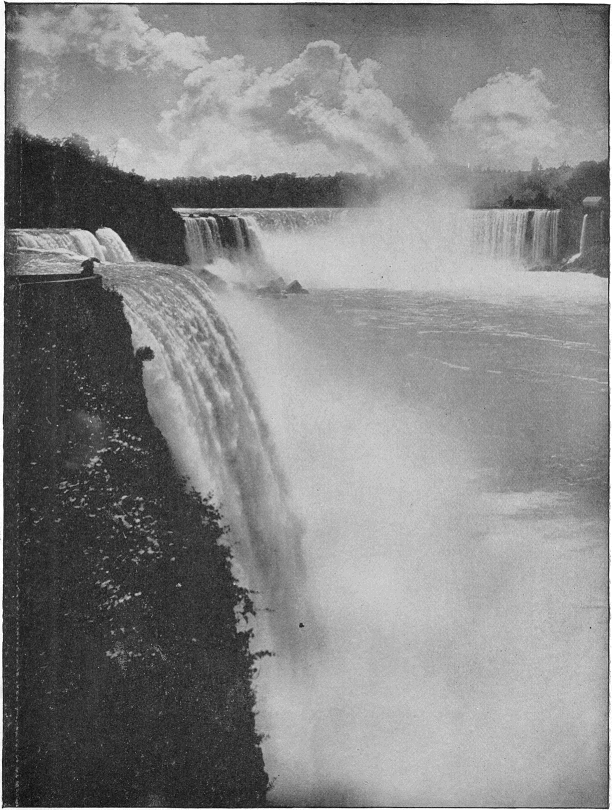
NIAGARA FALLS, New York.—The above falls constitute perhaps the most striking natural wonder in the world. Above the falls, the river is divided by Goat Island, forming the Horseshoe Falls, with a perpendicular descent of one hundred and fifty-eight feet. The height of the American Falls is one hundred and sixty-seven feet. Below the cataract, the river is very deep and narrow, varying from one hundred to three hundred yards, and flows between perpendicular rocks, two hundred and fifty feet high, into a gorge, which is crossed by several suspension bridges. These falls are world-famed, and are visited by thousands of tourists from different parts of the world.
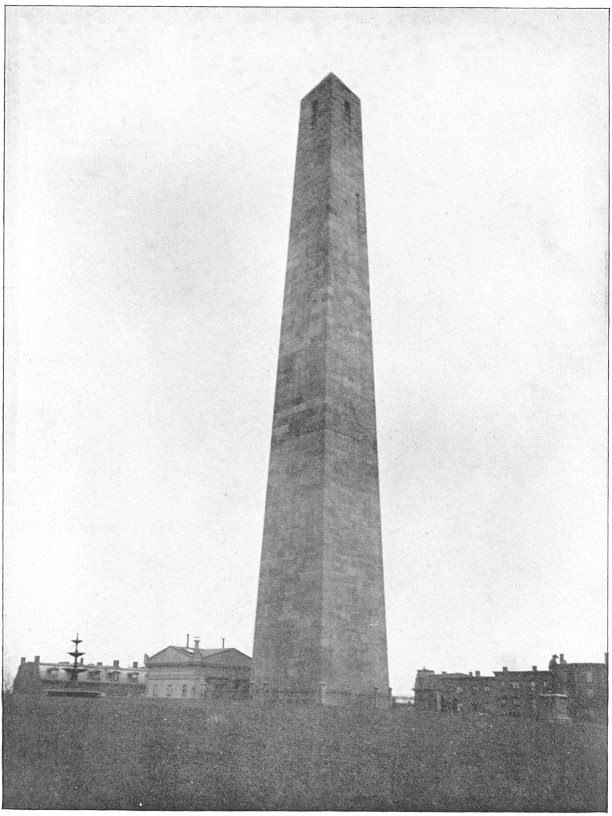
BUNKER HILL MONUMENT, Boston, Massachusetts.—On an elevation of one hundred and ten feet, in the town of Charlestown, one mile from Boston, towers the above-named monument to commemorate one of the most celebrated battles of the American Revolution, fought here on the 17th of June, 1775. The British remained master of the field after a long and bloody contest, but their victory was dearly bought. The monument, two hundred and twenty-one feet in height, stands in the centre of the ground, included within the redoubts on Breed's Hill.
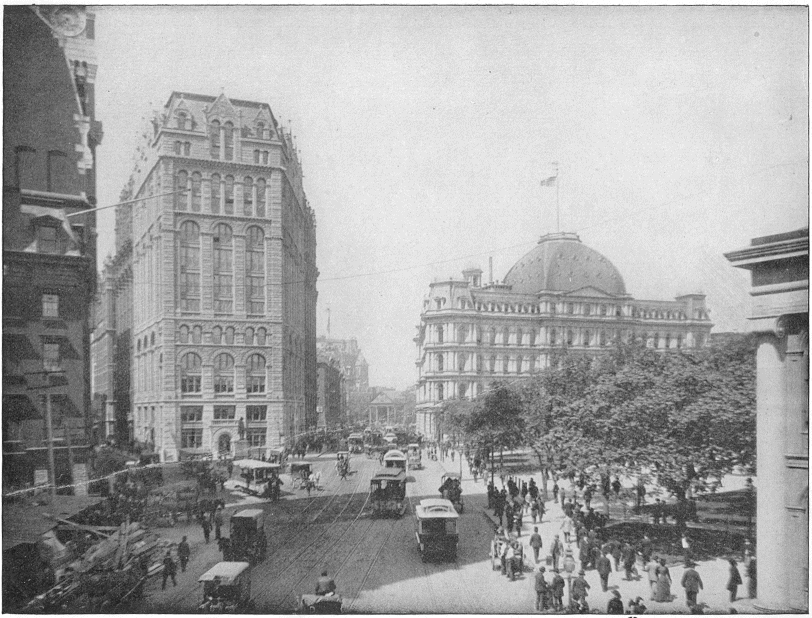
NEW YORK, N. Y.—The metropolis of the United States, is considered the headquarters of the stock and money market. It is here where the greater number of foreign vessels land and depart, and where the majority of immigrants first step upon our shores. The city is built on Manhattan Island, which is 13 miles long, and from 2 to 4 miles wide. This picture represents Park Row, and the New York Times' Building in the front, and the general Post-Office on the right, which is a large granite structure, and an ornament to the city. New York has a population of nearly two million people, composed of all nationalities. This city gives to the student of human nature an excellent opportunity to observe the life and habits of the different nations.
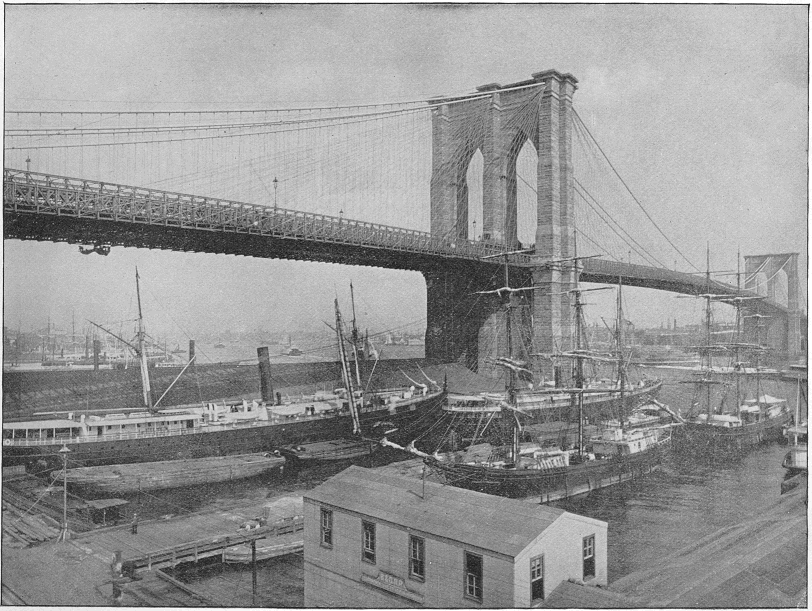
BROOKLYN BRIDGE, New York.—This bridge, connecting New York with Brooklyn, is by far the largest suspension bridge yet constructed. The work commenced in 1870, and opened for traffic on May 24, 1883. The central span, from tower to tower, measures fifteen hundred and ninety-five and one-half feet. In the centre is a foot-way, fifteen and one-half feet wide, and raised twelve feet above the other passages, affording an open view on both sides. There are tracks on each side for cable cars, worked by a stationary engine on the Brooklyn side, and on the outside are wagon-ways. The entire cost was $15,500,000.
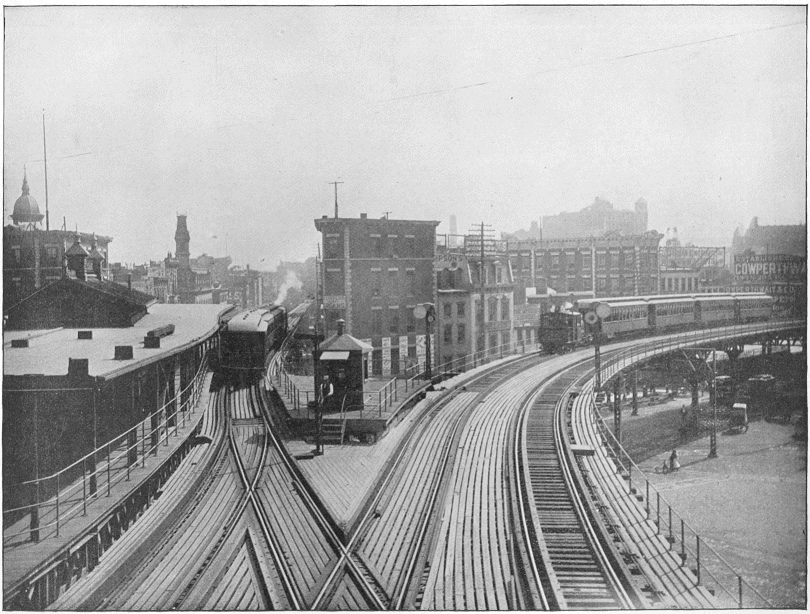
ELEVATED RAILROAD, New York, N. Y.—The steam cars, the street railway and the electric road are the three modern modes of transportation. The motive power of the elevated railroads of New York City is steam, and the quick facilities afforded exceed that of any other country. These elevated railroads are sufficiently high so as not to interfere with street traffic, stations are located every four or five blocks apart, there is little delay, and a passenger can ride from one end of the city to the other in a very short time. It is said that one million people ride daily on the elevated railroads of New York giving the company an income of $50,000 per day. The above photograph represents the railroad at Chatham Square, where it branches off into different directions.
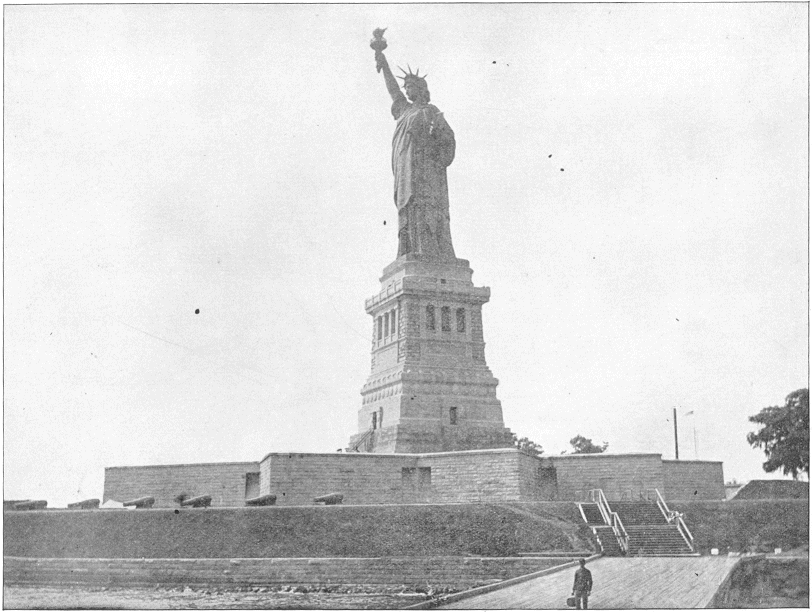
STATUE OF LIBERTY, New York Harbor, N. Y.—This magnificent monument, the work of Bartholdi, was presented by the French Government to the people of the United States as a token of sisterly love and respect, and as a means of still further cementing the good feelings of the two greatest republics on the globe. The statue stands on Bedloe's Island, in New York harbor. The torch of liberty, held in the right hand, is illuminated at night by a huge electric light. The pedestal on which the statue stands was built by voluntary contributions, solicited by the New York World.
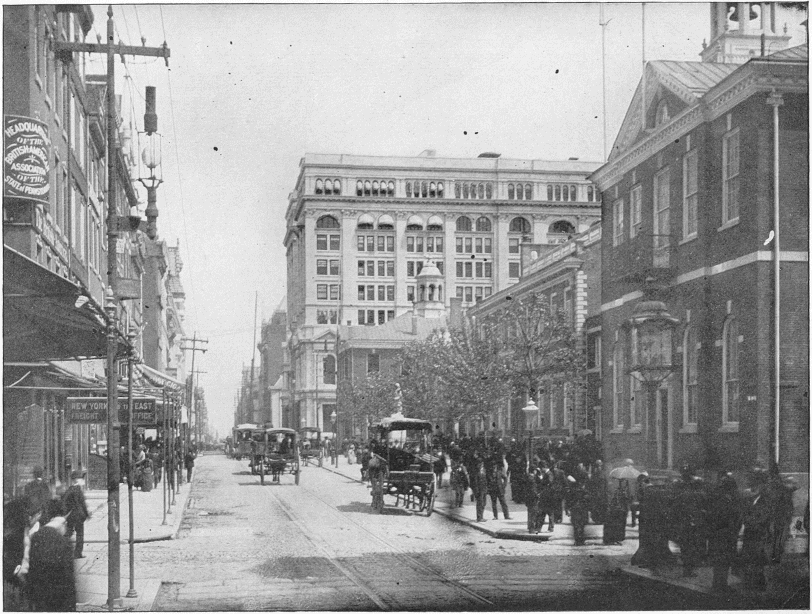
CHESTNUT STREET, Philadelphia, Pennsylvania.—Philadelphia, the third city of the United States and the metropolis of Pennsylvania, often called the City of Brotherly Love, was founded in 1682 by William Penn. This picture represents Chestnut Street, the principal retail business street and the avenue on which the leading banking institutions are located. The building on the right is Independence Hall, in which was declared the independence of the United States. The liberty bell is still preserved and found at the entrance of the building. The structure in the background is a banking house.
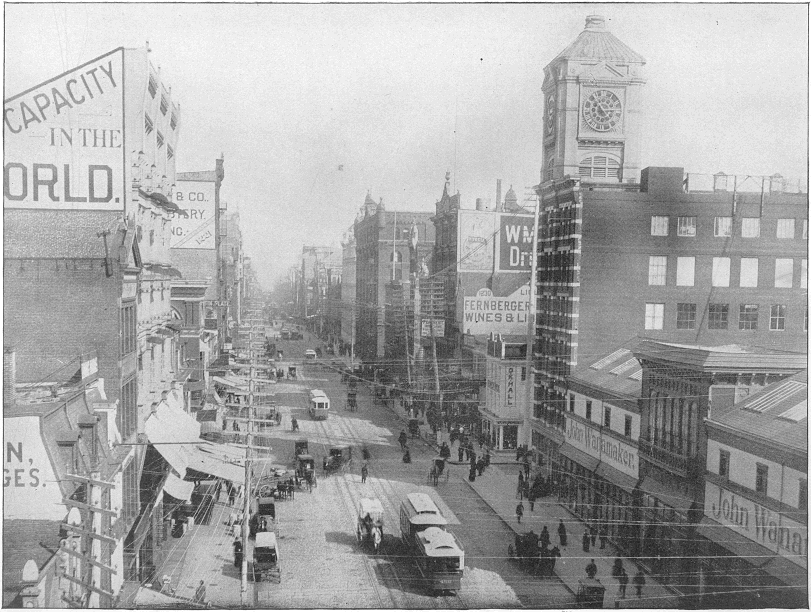
MARKET STREET, Philadelphia, Pennsylvania.—Perhaps no street in the world furnishes an avenue for so much business as does Market Street. The street from this point, which terminates at the Delaware River, making a total of fourteen squares, is full of wholesale houses. There are times during the day when it is packed with teams and pedestrians, presenting an interesting sight for a stranger. The building on the right-hand side is considered the largest store of its kind in the world. The cars on Market Street are run by cable, a system introduced a few years ago.
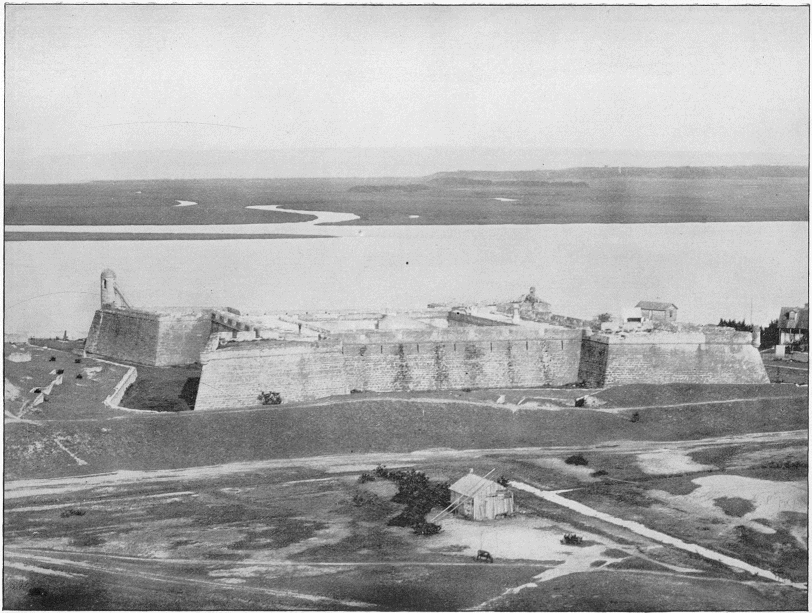
FORT SAN MARCO, St. Augustine, Florida, U. S. A.—St. Augustine, having the distinction of being the oldest city in the United States, was founded by Europeans and has recently become a popular winter watering-place. It is thirty-six miles from Jacksonville, and stands on a sandy peninsula. Along the sea-front, for nearly a mile, extends a granite-coped sea-wall; and, at its northern end, stands the Fort of San Marco, a well-preserved specimen of Spanish military architecture, built in 1756. The fort has a moat and outworks, and its walls are twenty-one feet high. It is in the form of a trapezium, and covers four acres.
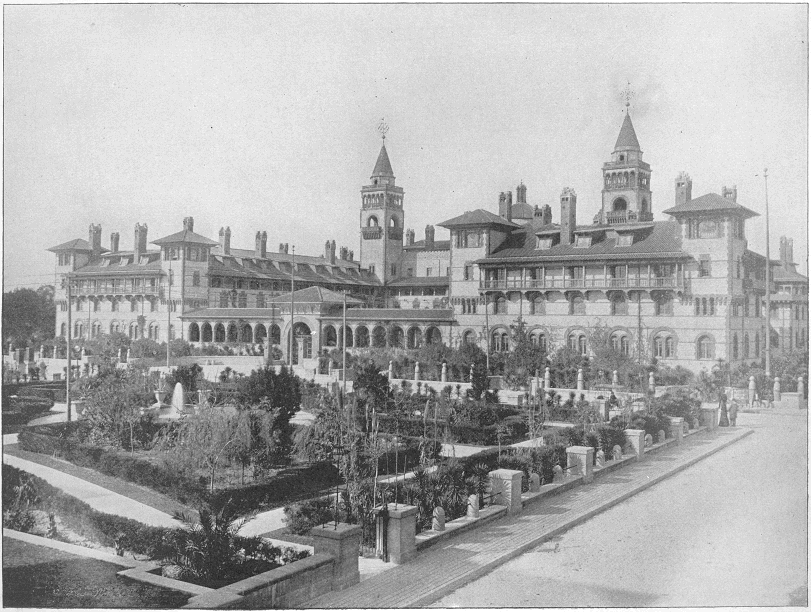
PONCE DE LEON, St. Augustine, Florida.
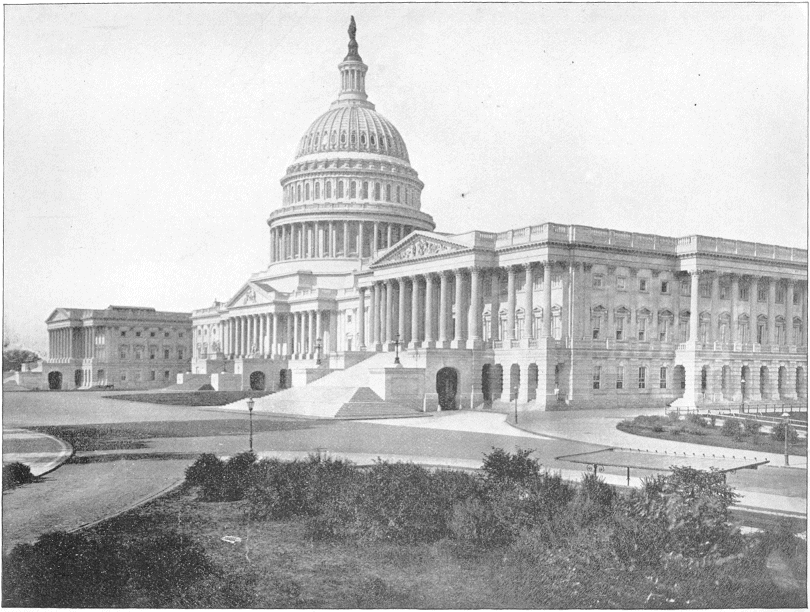
THE CAPITOL, Washington, D. C.
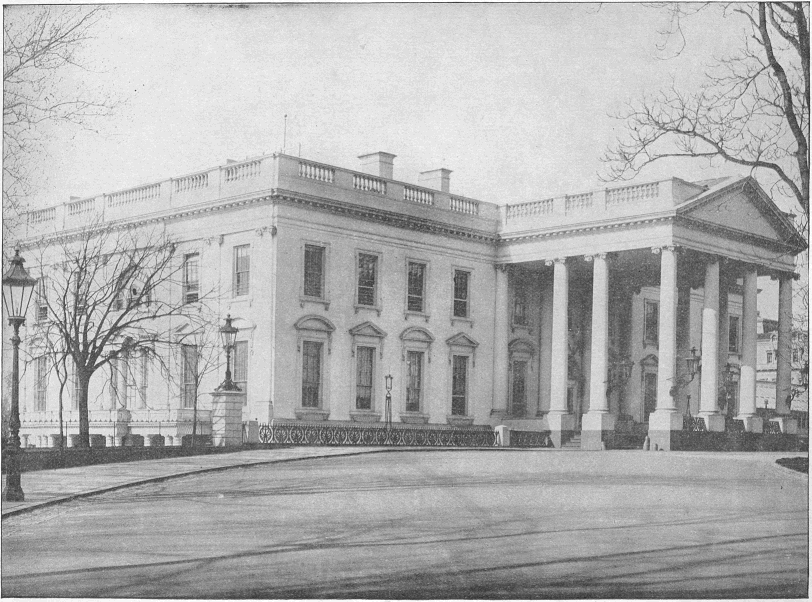
WHITE HOUSE, Washington, D. C.—The official residence of the President of the United States, is beautifully situated at the western extremity of Pennsylvania Avenue, about a mile and a half west of the Capitol. It is constructed of Freestone, painted white. Its dimensions are 170 feet front and 86 feet deep. The garden-front is very beautiful and admirably kept, the lawn sloping down to the Potomac River. In the square in front of the Mansion, stands the celebrated equestrian statue of General Jackson. Very close to the White House are located the State Treasury, and Navy and War departments.