The Masterpieces of George Sand, Amandine Lucille Aurore Dupin, Baroness Dudevant, NOW FOR THE FIRST TIME COMPLETELY TRANSLATED INTO ENGLISH SHE AND HE, AND LAVINIA BY G. BURNHAM IVES; WITH MEMOIR BY J. ALFRED BURGAN (continued 4)
George Burnham Ives translation
Laurent did not reply, but said to her:
"You are too proud, my dear! If you had burned all the leaves that offended you and left only your own image in the album, I should have understood, and I should have said: 'You do well;' but to withdraw and leave the others there, signifies that you will never dispute possession of me with any one."
"I disputed possession of you with debauchery," Thérèse replied; "I shall never do so much with any of those creatures."
"Well, that is pride, I say again; it is not love. Now, I disputed possession of you with Virtue, and I would do the same with any one of her monks."
"Why should you? Aren't you tired of loving the statue? is not the mummy in your heart?"
"Ah! you have a marvellous memory! Great God! what does a word amount to? Every one interprets it as he pleases. An innocent man may be hanged for a word. I see that I must be careful what I say with you; perhaps the most prudent way would be never to talk together."
"Mon Dieu! have we reached that point?" said Thérèse, bursting into tears.
They had reached that point. To no purpose did Laurent melt with her tears and beg her pardon for having caused them to flow: the trouble broke out afresh the next day.
"What do you suppose will become of me in this detestable city?" he said to her. "You want me to work; I have tried it and I can't do it. I was not born like you, with a little steel spring in my brain, so that I have only to press the button to set the will at work. I am a creator! Great or small, weak or powerful, a creator is a machine which obeys nobody and which God sets in motion, when it seems good to Him, with His breath or with the passing breeze. I am incapable of doing anything whatsoever when I am bored, or when I do not like my surroundings."
"How is it possible for an intellectual man to be bored," said Thérèse, "unless he is in a dungeon, deprived of light and air? Are there no beautiful things to see in this city which enchanted you so the first day, no interesting excursions to take in the neighborhood, no good book to consult, no intelligent people to talk with?"
"I have been buried in beautiful things up to my eyes; I don't like to drive alone; the best books irritate me when they tell me what I am not in the mood to believe. As for making acquaintances—I have letters of recommendation which you know very well that I can't use!"
"No, I don't know it; why not?"
"Because my friends in society naturally gave me letters to society people here; but society people don't live shut up within four walls, without ever thinking of amusing themselves; and as you are not in society, Thérèse, you can't go with me, so I should have to go alone!"
"Why not in the day-time, as I have to work all day in that old palace?"
"In the day-time, people make calls, and form plans for the evening. The evening is the time for amusement in all countries; don't you know that?"
"Very well, go out sometimes in the evening, since it must be so: go to balls and conversazioni. Don't gamble, that is all I ask."
"And that is just what I cannot promise. In society, one must devote one's self to play or to the ladies."
"So that all men in society either ruin themselves at play, or are involved in love-affairs?"
"Those who don't do one or the other are terribly bored in society, or bore other people terribly. I am not a salon conversationalist myself. I am not yet so hollow that I can procure a hearing without saying anything. Tell me, Thérèse, do you want me to take a plunge into society at our risk?"
"Not yet," said Thérèse; "be patient a little longer. Alas! I was not prepared to lose you so soon!"
The sorrowful accent and heart-broken glance irritated Laurent more than usual.
"You know," he said, "that you always bring me around to your wishes with the slightest complaint, and you abuse your power, my poor Thérèse. Don't you think you will be sorry for it some day, when you find me ill and exasperated?"
"I am sorry for it already, since I weary you," she replied. "So do what you choose!"
"Then you abandon me to my fate? Are you already weary of the struggle? Look you, my dear, it is you who no longer love me!"
"From the tone in which you say that, it seems to me that you wish that it should be so!"
He answered no, but, a moment later, his every word said yes. Thérèse was too serious, too proud, too modest. She was unwilling to descend with him from the heights of the empyrean. A hasty word seemed to her an insult, a trivial reminiscence incurred her censure. She was sober in everything, and had no comprehension of capricious appetites, of extravagant fancies. She was the better of the two, unquestionably, and if compliments were what she must have, he was ready with them; but was it a matter of compliments between them? Was not the important thing to devise some means of living together? Formerly, she was more cheerfully inclined, she had been coquettish with him, and she was no longer willing to be; now, she was like a sick bird on its perch, with feathers rumpled, head between its shoulders, and lifeless eye. Her pale, dismal face was enough to frighten one sometimes. In that huge, dark room, made depressing by the remains of former splendor, she produced the effect of a ghost upon him. At times, he was really afraid of her. Could she not fill that gloomy void with strange songs and joyous peals of laughter?
"Come; what shall we do to shake off this deathly chill that freezes one's shoulders? Sit down at the piano and play me a waltz. I will waltz all by myself. Do you know how to waltz? I'll wager that you don't. You don't know anything that isn't lugubrious!"
"Come," said Thérèse, rising, "let us leave this place at once, let come what may! You will go mad here. It may be worse elsewhere; but I will go through with my task to the end."
At that, Laurent lost his temper. So it was a task that she had imposed on herself? So she was simply performing a duty in cold blood? Perhaps she had taken a vow to the Virgin to consecrate her lover to her! All that she lacked now was to turn nun!
He took his hat with that air of supreme disdain and of a definitive rupture of relations which was natural to him. He went out without saying where he was going. It was ten o'clock at night. Thérèse passed the night in horrible distress of mind. He returned at daylight, and locked himself into his room, closing the doors noisily. She dared not show herself for fear of irritating him, and went softly to her own room. It was the first time that they had gone to sleep without a word of affection or pardon.
The next day, instead of returning to her work, she packed her boxes and made all her preparations for departure. He woke at three in the afternoon, and asked her laughingly what she was thinking about. He had recovered his senses, and made up his mind what to do. He had walked alone by the seashore during the night; he had reflected, and had become calm once more.
"That great, roaring, monotonous sea irritated me," he said, gaily. "First of all, I wrote some poetry. I compared myself to it. I was tempted to throw myself into its greenish bosom! Then it seemed to me tiresome and absurd on the part of the waves to be forever complaining because there are cliffs along the shore. If they are not strong enough to destroy them, let them hold their peace! Let them do like me, who do not propose to complain any more. See how charming I am this morning; I have determined to work, I shall remain here. I have shaved with great care. Kiss me, Thérèse, and let us not refer again to that idiotic last evening. Unpack these trunks and take them away quickly! don't let me see them again! They seem like a reproach, and I no longer deserve it."
There was a long interval between this off-hand way of making peace with himself and the time when an anxious glance from Thérèse was enough to make him bend both knees, and yet it was no more than three months.
Their thoughts were diverted by a surprise. Monsieur Palmer, who had arrived in Genoa that morning, came to ask them to dine with him. Laurent was enchanted by this diversion. Although he was always cold in his manners toward other men, he leaped on the American's neck, saying that he was sent by Heaven. Palmer was more surprised than flattered by this cordial welcome. A single glance at Thérèse had sufficed to show him that it was not the effusion of happiness. However, Laurent said nothing of his ennui, and Thérèse was surprised to hear him praise the city and the country. He even declared that the women were charming. How did he know them?
At eight o'clock, he called for his overcoat and went out. Palmer would have taken his leave at the same time.
"Why don't you stay a little longer with Thérèse?" said Laurent. "It will please her. We are altogether alone here. I am going out for an hour. Wait till I return before you have your tea."
At eleven, Laurent had not returned. Thérèse was very much depressed. She made vain efforts to conceal her despair. She was no longer anxious simply, she felt that she was lost. Palmer saw it all, and pretended to see nothing; he talked constantly to her to try to distract her thoughts; but, as Laurent did not come, and it was not proper to wait for him after midnight, he took his leave after pressing Thérèse's hand. Involuntarily he told her by that pressure that he was not deceived by her courage, and that he realized the extent of her disaster.
Laurent arrived at that moment, and saw Thérèse's emotion. He was no sooner alone with her, than he began to jest with her in a tone which affected not to descend to jealousy.
"Come," said she, "do not impose unnecessary pain upon me. Do you think that Palmer is paying court to me? Let us go, I have already suggested it."
"No, my dear, I am not so absurd as that. Now that you have somebody for company, and allow me to go out a little on my own account, everything is all right, and I feel just in the mood to work."
"God grant it!" said Thérèse. "I will do whatever you wish; but, if you rejoice because I have somebody to talk with, have the good taste not to refer to it as you did just now; for I cannot stand it."
"What the devil are you angry about now? what did I say that hurt you so, pray tell me? You are becoming far too sensitive and suspicious, my dear friend! What harm would be done if the excellent Palmer should fall in love with you?"
"It would be very wrong in you to leave me alone with him, if you think what you say."
"Ah! it would be wrong—to expose you to danger? You see that there is danger, according to your own story, and that I was not mistaken!"
"Very good! then let us pass our evenings together and receive no one. I am perfectly content. Is it a bargain?"
"You are very good, my dear Thérèse. Forgive me. I will stay with you, and we will see whomever you choose; that will be the best and pleasantest arrangement."
In truth, Laurent seemed to have come to his senses. He began a serious study in his studio, and invited Thérèse to come to see it. Several days passed without a storm. Palmer had not reappeared. But Laurent soon wearied of that regular life and went in search of him, reproaching him for his desertion of his friends. No sooner did he come to pass the evening with them than Laurent invented a pretext for going out, and remained away until midnight.
One week passed in this way, then another. Laurent gave Thérèse one evening out of three or four, and such an evening! she would have preferred solitude.
Where did he go? She never knew. He did not appear in society: the damp, cold weather precluded the idea that he went on the water for pleasure. However, he often said that he had been on a boat, and his clothes smelt of tar. He was learning to row, taking lessons of a fisherman in the harbor. He pretended that the fatigue calmed the excitement of his nerves, and put him in good condition for the next day's labor. Thérèse no longer dared to go to his studio. He seemed annoyed when she expressed a wish to see his work. He did not want her reflections when he was working out his own idea, nor did he wish to have her come there and say nothing, which would make him feel as if she were inclined to find fault. She was not to see his work until he deemed it worthy to be seen. Formerly, he never began anything without explaining his idea to her; now, he treated her like the public.
Two or three times he passed the whole night abroad. Thérèse did not become accustomed to the anxiety these prolonged absences caused her. She would have exasperated him by giving any sign that she noticed them; but, as may be imagined, she watched him and tried to learn the truth. It was impossible for her to follow him herself at night in a city full of sailors and adventurers of all nations. Not for anything in the world would she have stooped to have him followed by any one. She stole noiselessly into his room and looked at him as he lay asleep. He seemed utterly exhausted. Perhaps he had, in reality, undertaken a desperate struggle against himself, to deaden by physical exercise the excessive activity of his thought.
One night she noticed that his clothes were muddy and torn, as if he had actually been in a fight, or as if he had had a fall. Alarmed beyond measure, she approached him, and discovered blood on his pillow; he had a slight wound on the forehead. He was sleeping so soundly that she thought that she could, without rousing him, partly uncover his breast to see if there was any other wound; but he woke, and flew into a rage which was the coup de grâce to her. She tried to fly, but he detained her by force, put on a dressing-gown, locked the door, and then, striding excitedly up and down the room which was dimly lighted by a small night-lamp, he poured forth at last all the suffering that was heaped up in his heart.
"Enough of this," he said; "let us be frank with each other. We no longer love each other, we have never loved each other! We have deceived each other; you meant to take a lover; perhaps I was not the first nor the second, but no matter! you wanted a servant, a slave; you thought that my unhappy disposition, my debts, my ennui, my weariness of a life of debauchery, my illusions concerning true love, would put me at your mercy, and that I could never recover possession of myself. To carry such an enterprise to a successful issue, you needed to have a happier disposition yourself, and more patience, more flexibility, and, above all, more spirit! You have no spirit at all, Thérèse, be it said without offence. You are all of a piece, monotonous, pig-headed, and excessively vain of your pretended moderation, which is simply the philosophy of short-sighted people with limited faculties. As for myself, I am a madman, fickle, ungrateful, whatever you choose; but I am sincere, I am no selfish schemer; I give myself, heart and soul, without reservation: that is why I resume possession of myself in the same way. My moral liberty is a sacred thing, and I allow no one to seize it. I simply entrusted it, not gave it to you; it was for you to make a good use of it and to succeed in making me happy. Oh! do not try to say that you did not want me! I know all about these tricks of modesty and these evolutions of the female conscience. On the day that you yielded to me, I realized that you thought you had conquered me, and that all that feigned resistance, those tears of distress, and that constant pardoning of my temerity were simply the old commonplace way of throwing a line, and luring the poor fish, dazzled by the artificial fly, to nibble at the hook. I deceived you, Thérèse, by pretending to be deceived by that fly; it was my privilege. You wished adoration: I lavished it upon you without effort and without hypocrisy; you are beautiful, and I desired you! But a woman is only a woman, and the lowest of them all affords us as much pleasure as the greatest queen. You were simple enough not to know it, and now you must depend upon yourself. You must understand that monotony does not suit me, you must leave me to my instincts, which are not always sublime, but which I cannot destroy without destroying myself with them. Where is the harm, and why should we tear our hair? We have been partners, and we separate, that is the whole of it. There is no need of our hating and abusing each other just for that. Avenge yourself by granting the prayers of the excellent Palmer, who is languishing for love of you; I shall rejoice in his joy, and we three will continue to be the best friends in the world. You will recover your charms of other days, which you have lost, and the brilliancy of your lovely eyes, which are growing haggard and dull by dint of spying upon my acts. I shall become once more the jolly fellow that I used to be, and we will forget this nightmare that we are passing through together. Is it a bargain? You don't answer. Do you prefer hatred? Beware! I have never hated, but I can learn how; I learn quickly, you know! See, I clinched to-night with a drunken sailor twice as tall and strong as I; I thrashed him soundly, and received only a scratch. Beware lest I prove to be as strong mentally as physically on occasion, and lest, in a contest of hatred and vengeance, I crush the devil in person without leaving one of my hairs in his claws!"
Laurent, pale-faced and bitter, by turns ironical and frantic, with his hair in disorder, his shirt torn, and his forehead smeared with blood, was so ghastly to look at and to hear, that Thérèse felt all her love change into disgust. She was in such despair at that moment that it did not occur to her to be afraid. Silent and motionless in the chair in which she had seated herself, she allowed this torrent of blasphemous words to roll forth unchecked, and, saying to herself that that madman was quite capable of killing her, she awaited with frigid disdain and absolute indifference the climax of his frenzy.
He held his peace when he no longer had the strength to speak. Thereupon, she rose and left the room, without answering him by a single syllable, without casting a single glance at him.
VII
Laurent was not so contemptible as his words implied; he did not really believe a syllable of all the atrocious things he said to Thérèse during that horrible night. He believed them at the moment, or, rather, he spoke without heeding what he said. He remembered nothing of it after sleeping upon it, and if he had been reminded of it, would have denied every word.
But one fact was undeniably true, that he was weary, for the moment, of dignified love, and craved, with his whole heart, the degrading excitements of the past. It was his punishment for following the evil path he had chosen early in life,—a very harsh punishment, no doubt, of which we can readily imagine that he complained bitterly, since he had not sinned with premeditation, but had plunged laughingly into an abyss from which he supposed that he could easily escape when he chose. But love is regulated by a code which seems to rest, like all social codes, upon that terrible formula: No one is supposed to be ignorant of the law! So much the worse for those who are ignorant of it! Let the child go within reach of the claws of the panther, thinking to pat it: the panther will make no allowance for such ignorance; it will devour the child because it is not in its nature to spare him. And so with poison, with the lightning and with vice, blind agents of the fatal law which man must study, or take the consequences.
On the morrow of that explosion, naught remained in Laurent's memory save a vague idea that he had had a decisive explanation with Thérèse, and that she had seemed resigned.
"Perhaps everything is for the best," he thought, finding her as calm as when he had parted from her.
And yet he was terrified by her pallor.
"That is nothing," she said, tranquilly; "this cold tires me a good deal, but it is nothing more than a cold. It will have to run its course."
"Well, Thérèse," he said, "what is the present state of our relations? Have you reflected? It is for you to decide. Are we to part in anger, or remain on the footing of friendship as formerly?"
"I am not angry," she replied; "let us remain friends. Remain here, if you please. I propose to finish my work and return to France in about a fortnight."
"But should I not go and live in some other house for the next fortnight? aren't you afraid that people will talk?"
"Do whatever you think best. We have our own apartments here, entirely independent of each other; we use nothing but the salon in common; I have no use for it, and I give it up to you."
"No: on the other hand, I beg you to keep it. You will not hear me go out and come in; I will never put my foot inside it if you forbid me."
"I forbid you nothing," replied Thérèse, "unless it be to think for a single instant that your mistress can forgive you. As for your friend, she is superior to a certain order of disappointment. She hopes that she can still be useful to you, and you will always find her when you need any proof of friendship."
She offered him her hand, and went away to her work. Laurent did not understand her. Such perfect self-control was something which he could not comprehend, unfamiliar as he was with passive courage and silent resolution. He believed that she expected to resume her influence over him, and that she proposed to bring him back to love through friendship. He promised to yield to no attack of weakness, and, in order to be more certain of himself, he resolved to call some one to witness the fact of the rupture. He went to Palmer, confided to him the wretched story of his love, and added:
"If you love Thérèse, as I think you do, my dear friend, make Thérèse love you. I cannot be jealous of you, far from it. As I have made her unhappy enough, and as I am convinced that you will be exceedingly kind to her, you will relieve me of a subject of remorse which I am most anxious not to retain."
Laurent was surprised that Palmer made no reply.
"Do I offend you by speaking as I do?" he said. "Such is not my purpose. I entertain friendship and esteem for you, yes, and respect, if you choose. If you blame my conduct in this matter, tell me so; that will be preferable to this air of indifference or disdain."
"I am indifferent neither to Thérèse's sorrows nor to yours," replied Palmer. "But I spare you advice or reproaches which come too late. I believed that you were made for each other; I am persuaded, now, that the greatest, yes, the only happiness that you can confer upon each other is to part. As to my personal feelings for Thérèse, I do not admit your right to question me, and as for those sentiments which, in your judgment, I might succeed in arousing in her, you no longer have the right, after what you have said, to express such a supposition in my presence, much less in hers."
"That is true," rejoined Laurent, nonchalantly, "and I understand very well what it means. I see that I shall be in the way here now, and I think that I shall do as well to leave Genoa, in order not to embarrass any one."
He did, in fact, carry out his threat, after a very cold farewell to Thérèse, and went straight to Florence, with the intention of plunging into society or work, according to his caprice. It was exceedingly pleasant to him to say to himself:
"I will do whatever comes into my head, and there will be no one to suffer and be anxious about me. It is the worst of tortures, when a man is no more evilly disposed than I am, to have a victim constantly before one's eyes. Come, I am free at last, and the evil that I may do will fall on myself alone!"
Doubtless, Thérèse was wrong not to let him see the depth of the wound he had inflicted on her. She was too brave and too proud. Since she had undertaken the cure of a desperately diseased nature, she should not have recoiled from heroic remedies and painful operations. She should have made that frenzied heart bleed freely, have overwhelmed him with reproaches, and repaid insult with insult and stab with stab. If he had seen the suffering he had caused, perhaps Laurent would have done justice to himself. Perhaps shame and repentance would have saved his soul from the crime of murdering love in cold blood.
But, after three months of fruitless efforts, Thérèse was disheartened. Did she owe such absolute devotion to a man whom she had never desired to enslave, who had forced himself upon her despite her grief and her melancholy forebodings, who had clung to her steps like an abandoned child, and had cried to her: "Take me under your wing, protect me, or I shall die here by the roadside!"
And now that child cursed her for yielding to his outcries and his tears. He accused her of having taken advantage of his weakness to deprive him of the joys of liberty. He turned his back upon her, drawing a long breath, and exclaiming: "At last, at last!"
"Since he is incurable," she thought, "what is the use of making him suffer? Have I not proved that I could do nothing? Has he not told me, and, alas! almost proved it to me, that I was stifling his genius by seeking to cure his fever? When I thought that I had succeeded in disgusting him with dissipation, did I not discover that he was more greedy of it than ever? When I said to him: 'Go back into the world,' he dreaded my jealousy, and plunged into mysterious and degrading debauchery; he returned home drunk, with torn clothes, and blood on his face!"
On the day of Laurent's departure, Palmer asked Thérèse:
"Well, my friend, what do you propose to do? Shall I go after him?"
"No, certainly not!" she replied.
"Perhaps I could bring him back."
"I should be in despair if you did."
"Then you no longer love him?"
"No, not in the least."
There was a pause, after which Palmer continued in a thoughtful tone:
"Thérèse, I have some very important news for you. I hesitate, because I fear to cause you additional emotion, and you are hardly in condition——"
"I beg your pardon, my friend. I am horribly depressed, but I am absolutely calm, and prepared for anything."
"Very well, Thérèse; in that case, I will tell you that you are free: the Comte de —— is no more."
"I know it," replied Thérèse. "I have known it a week."
"And you haven't told Laurent?"
"No."
"Why not?"
"Because some sort of reaction would have taken place in him instantly. You know how anything unexpected upsets and excites him. One of two things would have happened: either he would have imagined that my purpose in informing him of the change in my position was to induce him to marry me, and the horror of being bound to me would have intensified his aversion, or he would have turned suddenly, of his own motion, to the idea of marriage, in one of those paroxysms of devotion which sometimes seize him and which last—just a quarter of an hour, to be succeeded by profound despair or frantic wrath. The unfortunate creature is guilty enough toward me; it was not necessary to offer fresh bait to his caprice, and an additional motive for him to perjure himself."
"Then you no longer esteem him?"
"I do not say that, my dear Palmer. I pity him, and do not accuse him. Perhaps some other woman will make him happy and good. I have been unable to do either. It is probably as much my fault as his. However that may be, it is proved to my satisfaction that we never should have loved each other, and that we should not make any further effort to do so."
"And now, Thérèse, will you not think of taking advantage of the liberty you have recovered?"
"What advantage can I take of it?"
"You can marry again, and become acquainted with the joys of a happy home."
"My dear Dick, I have loved twice in my life, and you see where I am now. It is not in my destiny to be happy. It is too late to seek what has thus far eluded me. I am thirty years old."
"It is just because you are thirty years old that you cannot do without love. You have undergone the enthusiasm of passion, and that is just the age at which women cannot escape it. It is because you have suffered, because you have been inadequately loved, that the inextinguishable thirst for happiness is bound to awake in you, and, it may be, to lead you from disappointment to disappointment, into deeper abysses than that from which you are now emerging."
"I trust not."
"Yes, of course, you trust not; but you are mistaken, Thérèse; everything is to be feared from your time of life, your overstrained sensitiveness and the deceitful tranquillity due to a moment of weariness and prostration. Love will seek you out, do not doubt it, and you will be pursued and beset the moment that you have recovered your liberty. Formerly, your isolation held in abeyance the hopes of those who surrounded you; but now that Laurent has lowered you in their esteem, all those who claimed to be your friends will seek to be your lovers. You will inspire violent passions, and some there will be sufficiently clever to persuade you. In a word——"
"In a word, Palmer, you consider me lost because I am unhappy! That is very cruel of you, and you make me feel very keenly how debased I am!"
Thérèse put her hands over her face, and wept bitterly.
Palmer let her weep on; seeing that tears would be beneficial to her, he had purposely provoked that outburst. When he saw that she was calmer, he knelt before her.
"Thérèse," he said, "I have caused you bitter pain, but you must give me credit for kindly intentions. I love you, Thérèse, I have always loved you, not with a blind passion, but with all the faith and all the devotion of which I am capable. I can see more plainly than ever that in your case a noble life has been ruined and shattered by the fault of others. You are, in truth, debased in the eyes of the world, but not in mine. On the contrary, your love for Laurent has proved to me that you are a woman, and I love you better so than armed at all points against every human frailty, as I once believed you to be. Listen to me, Thérèse. I am a philosopher; that is to say, I consult common-sense and tolerant ideas rather than the prejudices of society and the romantic subtleties of sentiment. Though you were to plunge into the most deplorable disorders, I should not cease to love you and esteem you, because you are one of those women who cannot be led astray except by the heart. But why should you fall into such a plight? It is perfectly clear to my mind, that if you should meet to-day a devoted, tranquil, and faithful heart, exempt from those mental maladies which sometimes make great artists and often bad husbands—a father, a brother, a friend, in a word, a husband, you would be forever secure against danger and misfortune in the future. Well, Thérèse, I venture to say that I am such a man. There is nothing brilliant about me to dazzle you, but I have a stout heart to love you. My confidence in you is absolute. As soon as you are happy, you will be grateful, and once grateful, you will be loyal and rehabilitated forever. Say yes, Thérèse; consent to marry me and consent at once, without alarm, without scruples, without false delicacy, without distrust of yourself. I give you my life, and ask nothing of you except to believe in me. I feel that I am strong enough not to suffer from the tears which another's ingratitude may still cause you to shed. I shall never reproach you with the past, and I undertake to make the future so pleasant and so secure that no storm will ever tear you from my bosom."
Palmer talked for a long while in this strain, with a heartfelt earnestness for which Thérèse was unprepared. She tried to repel his confidence; but this resistance was, in Palmer's eyes, a last remnant of mental disease which she must stamp out herself. She felt that Palmer spoke the truth, but she felt also that he proposed to assume a terrible task.
"No," she said, "I am not afraid of myself. I do not love Laurent, and I can never love him again; but what about society, your mother, your country, your social standing, the honor of your name? I am debased, as you have said; I am conscious of it. Ah! Palmer, do not urge me so! I am too dismayed by the thought of what you will have to defy for my sake!"
On the next day, and every day thereafter, Palmer pressed his suit vigorously. He gave Thérèse no time to breathe. He was alone with her from morning till night, and redoubled the force of his will to persuade her. Palmer was a man of heart and of impulse; we shall see later whether Thérèse was justified in hesitating. What disturbed her was the precipitation with which Palmer acted, and sought to force her to act by pledging herself to him by a promise.
"You are afraid of my reflections," she said; "therefore you have not so much confidence in me as you boast of having."
"I believe in your word," he replied. "Do I not prove that by asking you for it? But I am not obliged to believe that you love me, for you give me no answer on that point, and you are right. You do not know as yet what name to give to your friendly feeling. For my own part, I know that what I feel is love, and I am not one of those who hesitate to read their own hearts. Love with me is very logical. It fervently craves its object. Therefore it seeks to avoid the ill-fortune to which you may expose it by indulging in reflections or reveries, wherein, mentally diseased as you are, you may not distinguish your real interests."
Thérèse felt almost hurt when Palmer spoke of her interests. He seemed to her altogether too self-sacrificing, and she could not bear to have him think her capable of accepting so much from him without seeking to reciprocate. She suddenly felt ashamed of herself in that contest of generosity in which Palmer placed himself absolutely at her discretion, demanding only that she should accept his name, his fortune, his protection, and the affection of his whole life. He gave everything, and, as his only recompense, begged her to think of herself.
Thereupon, hope returned to Thérèse's heart. This man, whom she had always considered a practical, matter-of-fact mortal, and who still artlessly affected that character, revealed himself to her in so utterly unexpected a light, that her mind was vividly impressed, and as it were, revivified, in the midst of its death-agony. It was like a ray of sunlight bursting in upon darkness which she thought was destined to be everlasting. At the very moment when, rendered unjust by her despair, she was on the point of cursing love, he forced her to believe in love, and to look upon her misfortune as an accident for which Heaven was prepared to compensate her. Palmer, who was a handsome man of a cold and regular type of beauty, became more and more transfigured every moment in the astonished, uncertain, melting eyes of the woman he loved. His shyness, which imparted to his first advances a touch of roughness, gave place to effusive warmth, and, although he expressed himself less poetically than Laurent, he was none the less persuasive on that account.
Thérèse discovered genuine enthusiasm beneath that somewhat rough shell of obstinacy, and she could not refrain from smiling with emotion when she saw the vehemence with which he coolly pursued his project of saving her. She felt deeply touched, and allowed him to extort the promise he demanded.
Suddenly she received a letter in a handwriting that she did not recognize, it was so changed. Indeed, she had difficulty in deciphering the signature. She succeeded, however, with Palmer's help, in reading these words:
"I have played and lost; I had a mistress, she deceived me, and I killed her. I have taken poison. I am dying. Adieu, Thérèse.
"LAURENT."
"Let us go!" said Palmer.
"Ah! my friend, I do love you!" cried Thérèse, throwing her arms about his neck. "I realize now how well you deserve to be loved."
They started instantly. In one night they reached Livorno by water, and were at Florence that evening. They found Laurent at an inn, not dying, but suffering from an attack of brain fever of such violence that four men could hardly hold him. When he saw Thérèse, he recognized her and clung to her, crying that they intended to bury him alive. He held her so tightly that she fell to the floor, suffocated. Palmer had to carry her from the room in a swoon; but she came to herself in a moment; and, with a courage and perseverance bordering on the marvellous, she passed twenty days and nights at the bedside of that man whom she no longer loved. He recognized her only to heap the grossest insults upon her, and, as soon as she left him for an instant, he recalled her, saying that without her he should die.
Luckily, he had not killed any woman, nor taken any poison, nor, in all probability, lost his money at play, nor done anything of what he had written to Thérèse under the influence of delirium and disease. He never mentioned that letter, which she dared not mention to him; he was terrified enough by the derangement of his mind when he became conscious that it had been deranged. He had many other bad dreams while his fever lasted. Sometimes he imagined that Thérèse was administering poison to him, sometimes that Palmer was putting fetters on him. The most frequent and most agonizing of his hallucinations was one in which he saw Thérèse take a long gold pin from her hair and force it slowly into his skull. She had such a pin with which she kept her hair in place in the Italian fashion. She ceased to wear it, but he still saw and felt it.
As her presence seemed, as a general rule, to excite him, Thérèse usually stationed herself behind his bed, with the curtain between them; but, as soon as there was occasion to give him any medicine, he would lose his temper, and declare that he would take nothing from any hand but Thérèse's.
"She alone has the right to kill me," he would say; "I have injured her so deeply! She hates me, let her take her revenge! Don't I see her every moment, at the foot of my bed, in her new lover's arms? Come, Thérèse, come, I say; I am thirsty; pour out the poison for me."
Thérèse would, thereupon, pour out for him tranquillity and slumber. After several days of continued frantic excitement, which the doctors thought that he could not endure, and which they took note of as an abnormal fact, Laurent suddenly became calm and lay inert, prostrated, in a sort of stupor, but saved.
He was so weak that they had to feed him, without his knowledge, and in such infinitesimal quantities in order to relieve his stomach of all labor of digestion, that Thérèse felt that she ought not to leave him for an instant. Palmer tried to induce her to take some rest by giving her his word of honor to take her place by the invalid's side; but she refused, feeling that no human power was secure against the surprise of sleep, and that, since by a sort of miracle she was always on the alert when the time came to put the spoon to the patient's lips, and was never overcome by fatigue, God had entrusted to her, and to no other, the duty of saving that fragile existence.
And so it was, in truth, and she saved him.
If medical science, however enlightened it may be, proves inadequate in desperate cases, it is very often because it is impossible to carry out the treatment with absolute exactness. No one knows what disturbance a moment of craving or a moment of surfeit may cause in a life that is trembling in the balance; and the miracle lacking to save the dying man is often nothing more than placidity, persistence, and punctuality on the part of his nurses.
At last, Laurent awoke one morning as if from a lethargic sleep, seemed surprised to see Thérèse at his right and Palmer at his left, offered each of them a hand, and asked them where he was and how he came there.
They deceived him a long while as to the length and severity of his illness, for he was deeply distressed when he saw how weak and emaciated he was. The first time that he looked in the glass he was frightened by his own image. In the early days of his convalescence he asked for Thérèse. He was told that she was asleep. He was greatly surprised.
"So she has become a genuine Italian woman, has she," he said, "that she sleeps in the day-time?"
Thérèse slept twenty-four hours without a break. Nature reasserted itself as soon as anxiety vanished.
Little by little, Laurent learned how devoted she had been to him, and he detected on her face the traces of excessive fatigue following on the heels of excessive grief. As he was still too weak to give his mind to anything, Thérèse installed herself by his side, sometimes reading to him, sometimes playing cards with him to amuse him, sometimes taking him to drive. Palmer was always with them.
Laurent's strength returned with a rapidity as extraordinary as his constitution. His brain was not always perfectly clear, however. One day, he said angrily to Thérèse, when he happened to be alone with her:
"By the way, when does the excellent Palmer propose to do us the honor of going away?"
Thérèse saw that there was a gap in his memory, and did not reply. Whereupon he made an effort to control himself, and added:
"You consider me ungrateful, my love, to speak thus of a man who has been almost as devoted to me as you yourself have; but I am not vain enough or simple enough not to understand that his reason for shutting himself up for a month in the room of a very disagreeable invalid was to have an excuse for not leaving you. Come, Thérèse, will you swear that he did it solely on my account?"
Thérèse was offended by that point-blank question, and by his use of the second person singular, which she had believed to be discarded forever between them. She shook her head, and tried to change the subject. Laurent yielded with ill grace; but he returned to it the next day; and as Thérèse, seeing that he was strong enough to do without her, was preparing to go away, he said, with unfeigned surprise:
"Why, where are we going, Thérèse? Aren't we comfortable here?"
She was obliged to explain, for he insisted.
"My child," said Thérèse, "you are to remain here; the doctors say that you need another week or two of perfect quiet before you can travel at all without danger of a relapse. I am going back to France, as I have finished my work at Genoa, and I do not intend, at present, to visit other parts of Italy."
"Very good, Thérèse, you are free; but if you choose to return to France, I am at liberty to make the same choice. Can't you wait a week for me? I am sure that I shall need no more than that to be in condition to travel."
He was so sincere in his forgetfulness of the wrong he had done her, and he was so like a child at that moment, that Thérèse had to force back the tears that came to her eyes at the memory of that species of adoption, formerly so sweet, which she was forced to resign.
She began involuntarily to use the familiar form of address, and said to him, with the utmost gentleness and delicacy, that they must part for some time.
"Why part, in Heaven's name?" cried Laurent; "do we no longer love each other?"
"That would be impossible," she replied; "we shall always be friends; but we have mutually caused each other a great deal of suffering, and your health could not endure any more of it. We will wait until time enough has elapsed for everything to be forgotten."
"But I have forgotten!" cried Laurent, with an earnestness that was touching because it was so absolutely ingenuous. "I remember none of the wrong you did me! You were always an angel to me, and, being an angel, you cannot harbor resentment. You must forgive me for everything, and take me away with you, Thérèse! If you leave me here, I shall die of ennui!"
And as Thérèse displayed a firmness that he did not expect, he lost his temper and told her that she did very wrong to feign a severity to which her whole conduct gave the lie.
"I understand perfectly well what you want," he said. "You demand that I repent, and atone for my wrong-doing. Well, don't you see that I abhor the thought of it, and have I not expiated it sufficiently by going mad for eight or ten days? You desire tears and oaths as formerly? What is the use? you would not believe in them again. My future conduct is what is to be judged, and you see that I am not afraid of the future, since I cling to you. You see, my dear Thérèse, you are a child, too, and you know I often called you one when I saw you pretending to sulk. Do you think you can persuade me that you no longer love me, when you have just passed a whole month shut up here, and for twenty days and nights of that month did not go to bed and hardly left my room? Can't I see, from the dark rings about your lovely eyes, that you would have died at the task if it had been necessary? A woman doesn't do such things as that for a man she no longer loves!"
Thérèse dared not utter the fatal words. She hoped that Palmer would come and interrupt the tête-à-tête, and that she could avoid a scene that might result seriously for the convalescent. But it was impossible; he placed himself in front of the door to prevent her from going out, dropped at her feet, and grovelled there in despair.
"Great God!" she exclaimed, "is it possible that you think me cruel enough, capricious enough, to refuse to say a word that I could say to you? But I cannot say that one because it would not be the truth. Love is at an end between us."
Laurent rose in a passion. He could not understand that perhaps he had killed that love in which he had pretended not to believe.
"Is it Palmer?" he cried, smashing a tea-pot, from which he had mechanically poured himself a draught; "it is he, is it? Tell me, I insist upon it, I insist upon the truth! It will kill me, I know, but I don't choose to be deceived!"
"Deceived!" echoed Thérèse, taking his hands to prevent him from tearing them with his nails; "deceived! what sort of a word is that for you to use? Do I belong to you, pray? have we not been strangers to each other since the first night you passed away from home at Genoa, after telling me that I was your torment and your executioner? wasn't that four months ago and more? and do you think that length of time, without an indication of change on your part, was not enough to make me mistress of myself once more?"
And as she saw that Laurent, instead of being exasperated by her frankness, grew calmer, and listened with eager interest, she continued:
"If you do not understand the feeling that brought me to your sick-bed, and that has kept me beside you until to-day, to complete your cure by a mother's care, it is because you never understood my heart. This heart, Laurent," she said, putting her hand to her breast, "may be neither so proud nor so ardent as yours; but, as you yourself used often to say, it always remains in the same place. What it has loved it cannot cease to love; but, do not mistake my meaning, it is not love as you understand the word, it is not such love as you once aroused in me and as you are mad enough to expect again. Neither my passions nor my reason belong to you now. I have resumed possession of my body and my will; my confidence and my enthusiastic regard can never be restored to you. I am at liberty to bestow them upon whoever may deserve them, upon Palmer, if I choose, and you have no right to object, you who went to him one morning and said:
"'Pray go and console Thérèse; you will do me a favor.'"
"That is true! that is true!" cried Laurent, clasping his trembling hands; "I did say that! I had forgotten it, but I remember it now!"
"Do not forget it again," said Thérèse, who resumed a gentler tone when she saw that he was calmer, "and understand, my poor child, that love is too delicate a flower to rise again when one has trampled it under foot. Think no more of it in connection with me, seek it elsewhere, if this sad experience you have had of it opens your eyes and modifies your character. You will find it on the day that you are worthy of it. As for myself, I could no longer endure your caresses, I should be degraded by them; but my sisterly and motherly affection will remain yours in spite of yourself and in spite of everything. That is something different, it is pity; I do not conceal the fact, but I tell you frankly, so that you may think no more of winning again a love by which you as well as myself would be humiliated. If you wish that this friendship, which seems an insult to you now, should become agreeable to you, you have only to deserve it. Hitherto you have had no opportunity. Now the opportunity is at hand; make the most of it, part with me without weakness or bitterness. Show me the calm, sympathetic face of a man of heart, instead of this face of a child who weeps without knowing why."
"Let me weep, Thérèse," said Laurent, kneeling at her feet, "let me wash away my sin with my tears; let me kneel in adoration of this saintly compassion which has survived shattered love in your heart. It does not humiliate me, as you think; I feel that I shall become worthy of it. Do not ask me to be calm, you know well enough that I cannot be; but believe that I may possibly become good. Ah! Thérèse, I know you too late! Why did you not speak to me sooner as you have just spoken? Why did you overwhelm me with your kindness and devotion, sweet Sister of Charity who cannot restore my happiness? But you are right, Thérèse; I deserved what has happened to me, and you have made me understand it at last. The lesson will benefit me, I promise you, and if I am ever able to love another woman, I shall know how to love. So I shall owe everything to you, my sister, past and future alike!"
Laurent was still talking effusively when Palmer entered. Laurent threw himself on his neck, calling him his brother and his savior, and exclaimed, pointing to Thérèse:
"Ah! my friend! you remember what you said to me at the Hôtel Meurice the last time we met in Paris: 'If you are not sure that you will not make her suffer, blow out your brains to-night rather than return to her'?—I ought to have done it, but I did not! And now, look at her, she is more changed than I am, poor Thérèse! She was thrown down and trampled on, and yet she came and tore me from the clutches of death, when she might well have cursed me and abandoned me!"
Laurent's penitence was genuine; Palmer was deeply moved by it. As the artist worked himself up, he expressed himself with persuasive eloquence, and when Palmer was alone with Thérèse, he said to her:
"Do not think, my dear, that I suffered on account of your solicitude for him, I understood perfectly! You wished to cure his body and his heart. You have won the victory. Your poor child is saved! Now what do you propose to do?"
"Leave him forever," she replied, "or, at all events, not see him again for years to come. If he returns to France, I remain in Italy, and if he remains in Italy, I return to France. Have I not told you that was my resolution? It was because my mind was so thoroughly made up that I postponed the moment of parting. I knew that there must inevitably be an outbreak, and I did not wish to leave him while it lasted, if it should prove to be serious."
"Have you reflected seriously, Thérèse?" said Palmer, thoughtfully. "Are you quite sure of not weakening at the last moment?"
"I am perfectly sure."
"That man seems to me irresistible in grief. He would extort pity from the bowels of a stone, and yet, Thérèse, if you yield to him, you are lost, and he with you. If you still love him, reflect that you can save him only by leaving him!"
"I know it," replied Thérèse; "but why do you say that, my friend? Are you ill, too? Have you forgotten that my word is pledged to you?"
Palmer kissed her hand and smiled. Peace re-entered his soul.
On the next day, Laurent came and told them that he intended to go to Switzerland to complete his cure. The climate of Italy did not agree with him: that was the truth. The physicians advised him not to wait until the extremely hot weather.
It was definitely decided that they should part at Florence. Thérèse had no other plans than to go where Laurent did not go; but, when she saw how exhausted he was by the emotion of the preceding day, she had to promise him to pass another week at Florence, in order to prevent him from going away before he regained the necessary strength.
That week was, perhaps, the best in Laurent's whole life. Generous, trustful, cordial, and sincere, he had entered upon a frame of mind which he had never before known, even during the first week of his union with Thérèse. Affection had penetrated him, invaded him, vanquished him. He would not leave his two friends, but drove with them to the Cascines, at the hours when there was no crowd there, ate with them, took a childish delight in going to dine with them in the country, when Thérèse would take his arm and Palmer's alternately, tried his strength by fencing a little with the latter, accompanied them to the theatre, and made Dick the great tourist trace the itinerary of his trip to Switzerland. It was a very important question whether he should go by Milan or Genoa. He decided at last on the latter route, intending to go by Pisa and Lucca, thence along the shore, by land or water, according as he should feel stronger or weaker after the first few days of travelling.
The day appointed for his departure arrived. Laurent had made all his preparations with melancholy gaiety. Brimming over with jests concerning his costume, concerning his luggage, concerning the mongrel aspect he would present in a certain waterproof cloak, then a great novelty, which Palmer had compelled him to accept, and concerning the barbarous French of an Italian servant whom Palmer had selected for him, and who was the best fellow in the world; accepting gratefully and humbly all Thérèse's injunctions and attentions, he had tears in his eyes, while he laughed most heartily.
On the night preceding this last day, he had a slight attack of fever. He jested about it. The carriage in which he was to travel by slow stages, was at the door. It was a cool morning. Thérèse was anxious.
"Go with him as far as Spezzia," Palmer said to her. "That is where he is to take the boat, if he doesn't stand the carriage journey well. I will join you there the day after he has left. Some very urgent business will detain me here twenty-four hours."
Thérèse, surprised by this suggestion, refused to go with Laurent.
"I beg you to do it," said Palmer, with much earnestness; "it is impossible for me to go with you!"
"Very good, my dear, but it is not necessary for me to go with him."
"Yes, it is," he replied; "you must go."
Thérèse fancied that she understood: that Palmer deemed this final test necessary. She was surprised and disturbed.
"Will you give me your word of honor," she said, "that you really have important business here?"
"Yes," he replied, "I give you my word."
"Very well, then I will remain."
"No, you must go."
"I do not understand."
"I will explain later, my love. I believe in you as in God, as you see; have confidence in me. Go."
Thérèse hastily made up a small bundle which she tossed into the carriage; then she took her place beside Laurent, calling back to Palmer:
"I have your word of honor to join me in twenty-four hours."
VIII
Palmer, who was really obliged to remain in Florence and to send Thérèse away, felt a mortal pang as he watched her go. And yet the danger that he dreaded did not exist. The chain could not be rewelded. Laurent did not even think of trying to stir Thérèse's passions; but, feeling sure that he had not lost her heart, he resolved to recover her esteem. He resolved, do we say? No, he made no plan; he simply felt a natural longing to raise himself in the eyes of that woman who had grown so much greater in his mind. If he had appealed to her at that moment, she would have resisted him without difficulty; she would, perhaps, have despised him. He took pains not to do it, or, rather, he did not think of it. His instincts were too true to make such a mistake. In good faith, and with the utmost enthusiasm, he assumed the rôle of the man with the broken heart, of the chastised, humble child, so that, at the end of the journey, Thérèse wondered if he were not the victim of their fatal liaison.
During that three days' tête-à-tête, Thérèse was happy with Laurent. She saw a new era of exquisite sentiments opening before her, an unexplored road, for she had hitherto walked alone in it. She enjoyed keenly the pleasurable sensation of loving without remorse, without anxiety, and without a struggle, a pale-faced, feeble creature, who was no longer aught save a soul, so to speak, and whom she fancied she had found again beyond this life, in the paradise of pure spirits, as one dreams of finding one's self after death.
And then she had been deeply wounded and humiliated by him, stirred up and irritated against herself; that love, which she had accepted with so much courage and grandeur of soul, had left a stain, as a purely sensual liaison would have done. Then had come a moment when she had despised herself for allowing herself to be so grossly deceived. So she felt as if she were born again, and she became reconciled with the past when she saw growing upon the grave of that buried passion a flower of enthusiastic friendship lovelier than the passion had been even in its best days.
It was the 10th of May that they arrived at Spezzia, a small picturesque town, half-Genoese and half-Florentine, at the head of a bay as smooth and blue as the loveliest sky. The season for sea-bathing had not arrived. The country round about was an enchanted solitude, the weather cool and exquisite. At sight of that beautiful, calm water, Laurent, whom the carriage journey had fatigued somewhat, decided to go by sea. They inquired about means of transportation; a small steamboat went to Genoa twice a week. Thérèse was glad that it did not start that same evening. Her patient had twenty-four hours for rest. She bade him engage a cabin on the boat for the following day.
Laurent, although he still felt decidedly weak, had never been so well. He slept and ate like a child. The delicious languor of the first days of complete cure caused a blissful sort of confusion in his mind. The memory of his past life vanished like a bad dream. He felt and believed that he was radically changed forever. In this new life, he seemed not to have the faculty of suffering. He left Thérèse with a sort of triumphant joy amid his tears. This submission to the decrees of destiny was in his eyes a voluntary expiation for which she should give him due credit. He had not sought it, but he had accepted it at the moment when for the first time he realized the value of what he had hitherto failed to appreciate. He carried this craving for self-immolation so far as to tell her that she must love Palmer, that he was the best of friends and the greatest of philosophers. Then he cried abruptly:
"Don't say anything, Thérèse. Don't speak to me of him! I don't feel strong enough yet to hear you say that you love him. No, keep quiet! it would kill me! But be sure that I love him, too! What more can I say?"
Thérèse did not once mention Palmer's name; and when Laurent, less heroic, questioned her indirectly, she replied:
"Hush! I have a secret which I will tell you later, and which is not what you think. You could not guess it, so don't try."
They passed the last day rowing about the harbor of Spezzia. From time to time, they landed to pluck the lovely aromatic plants that grow in the sand even to the verge of the transparent, lazily plashing waves. Trees are rare along those lovely banks, from which mountains covered with flowering shrubs rise perpendicularly. As the heat was somewhat oppressive, they bade the boatman row toward a group of pines as soon as they spied it. They had brought their lunch, which they ate on the grass amid clumps of lavender and rosemary. The day passed like a dream; that is to say, it was brief as a moment, and yet it contained the sweetest emotions of two lives.
At last, the sun declined, and Laurent became melancholy. He saw in the distance the smoke of the Ferruccio, the steamer from Spezzia, which was getting up steam in readiness for sailing, and that black cloud passed over his mind. Thérèse saw that she must distract his thoughts to the very last, and she asked the boatman what more there was to see in the bay.
"There is Isola Palmaria," he replied, "and the portor marble-quarry. If you care to go there, you can take the steamer there. It has to pass the island to go out to sea, for it stops at Porto Venere to take passengers or freight. You will have time enough. I will answer for that."
The two friends bade him row them to Isola Palmaria.
It is a perpendicular block of marble on the side of the sea, with fertile fields sloping gently down to the shore on the side of the bay. There are a few houses half-way down the slope and two villas on the shore. The island is planted, a sort of natural fortification, at the mouth of the bay, the passage being very narrow between it and the small harbor once consecrated to Venus. Hence the name Porto Venere.
There is nothing about that repulsive village to justify its poetic name; but its situation on the naked rocks, lashed by angry waves,—for they are genuine waves from the sea that rush through the passage,—is as picturesque as possible. One could not imagine a more characteristic stage-setting for a nest of pirates. The houses, black and wretched, corroded by the salt air, stand one above another, immeasurably high, on the uneven rocks. Not a pane unbroken in the little windows, which seem like restless eyes watching for a victim on the horizon. Not a wall that is not stripped of its plaster, which hangs in great layers, like veils torn off by the storm. Not a straight line in all those buildings, which lean against one another and seem on the point of crumbling together. They reach to the very extremity of the promontory, where they come to an end in an old dilapidated fort and the steeple of a tiny church, standing like sentinels facing the immensity. Behind this picture, which stands in bold outline against the expanse of sea, rise towering cliffs of a livid tint, whose base, irised by reflections from the sea, seems to plunge into something as indefinite and impalpable as the color of the void.
From the marble-quarry on Isola Palmaria, across the narrow passage, Laurent and Thérèse looked upon that picturesque scene. The setting sun cast on the foreground of the picture a reddish light which blended in a single mass, homogeneous in appearance, cliffs, old walls, and ruins, so that everything, even the church, seemed hewn from the same block, while the great rocks in the background swam in a sea-green haze.
Laurent was deeply impressed with the spectacle, and, forgetting all else, contemplated it with the eye of a painter, wherein Thérèse saw, as in a mirror, all the flaming colors of the sky.
"Thank God!" she thought; "the artist is awake at last!"
In truth, since his illness, Laurent had not given a thought to his art.
As there was nothing of interest in the quarry, after they had looked at the great blocks of beautiful black marble, veined with golden yellow, Laurent proposed to ascend the slope and look out to sea from the highest point; and he went on through an almost impassable growth of pines, to a sort of fringe of lichens, where he seemed suddenly to be lost in space. The rock on which he stood overhung the sea, which had eaten into its base, and broke against it with a terrific noise. Laurent, who had no idea that side of the island was so steep, was seized with such a fit of giddiness that, but for Thérèse, who had followed him and forced him back upon the ground, he would have fallen into the sea.
At that moment, she saw that he was as terror-stricken and wild-eyed as on that night long before in the forest of ——.
"What is the matter?" she asked. "Is this another dream?"
"No! no!" he cried, rising, and clinging to her as if he thought that he had grasped an immovable rock of refuge; "this is no dream, it is reality! It is the sea, the horrible sea, which is to carry me off in a few moments! it is the image of the life to which I am returning! it is the impassable abyss that will soon be between us! it is that monotonous, untiring, hateful noise which I used to go to listen to at night in the roadstead of Genoa, and which roared blasphemies in my ears! it is that brutal ocean swell which I seemed to be trying to overcome in a boat, and which bore me resistlessly toward a deeper and more implacable abyss than that of the waves! Thérèse, Thérèse, do you know what you are doing when you toss me to that monster who is waiting yonder, his hideous jaws already open to devour your poor child?"
"Laurent," she said, shaking him by the arm, "Laurent, do you hear me?"
He seemed to wake in another world when he recognized Thérèse's voice; for when he appealed to her he thought that he was alone, and he turned with surprise when he saw that the tree to which he was clinging was nothing else than his friend's trembling, tired arm.
"Forgive me, forgive me," he said, "it is a last attack, it is nothing. Let us go!"
And he hurriedly descended the slope which he had ascended with her.
The Ferruccio was coming at full speed from Spezzia.
"Mon Dieu! there she is!" he said. "How fast she comes! if only she might sink before she gets here!"
"Laurent!" exclaimed Thérèse, sternly.
"Yes, yes, don't be afraid, my dear, I am perfectly calm. Don't you know that all I need now is a glance from you, to obey with joy? Call the boat! Come, it is all over! I am calm, I am content! Give me your hand, Thérèse. Remember, I have not asked you for a single kiss in these three days we have been together! I only ask you for this loyal hand. Do you remember the day you said to me: 'Never forget that before being your mistress, I was your friend!'—Well, it is as you wished: I am no longer anything to you, but I am yours forever!"
He jumped into the boat, thinking that Thérèse would remain on the island, and that the boat would return for her when he had been put aboard the Ferruccio; but she jumped in after him. She wanted to make sure, she said, that the servant who was to accompany Laurent, and who should have gone aboard with the luggage at Spezzia, had forgotten nothing that his master needed for the voyage.
So she took advantage of the brief stop the little steamer made at Porto Venere to go aboard with Laurent. Vicentino, the servant in question, awaited them. He was a trustworthy man, selected by Monsieur Palmer, it will be remembered. Thérèse took him aside.
"You have your master's purse, have you not?" she said. "I know that he told you to look after all the expenses of the trip. How much money did he give you?"
"Two hundred Florentine lire, signora; but I think that he has his wallet with him."
Thérèse had examined Laurent's pockets while he slept. She had found the wallet, and knew that it was almost empty. Laurent had spent a large amount in Florence; the expenses of his illness had been very considerable. He had placed the remainder of his little fortune in Palmer's hands, bidding him make up the accounts, and he had not glanced at them. In money matters, Laurent was a genuine child, who knew the value of nothing at all outside of France, not even the comparative value of the coins of the different Italian provinces. The amount he had handed to Vicentino seemed to him enough to last a long while, but it was not enough to reach the frontier for a man who had not the slightest idea of prudence.
Thérèse gave Vicentino all the money that she had in Italy, not even retaining what she herself would require for a few days; for, seeing that Laurent was coming toward her, she had no time to take one or two gold pieces from the roll which she slipped hurriedly into the servant's hand, saying:
"This is what he had in his pockets; he is very absent-minded, and prefers that you should take charge of it."
And she turned to the artist to exchange a last grasp of the hand. She deceived him this time without remorse. He had been distressed and irritated once before when she wished to pay his debts; now, she was no more than a mother to him, and she had the right to do as she was doing.
Laurent had seen nothing.
"One moment more, Thérèse!" he said in a voice choked by tears. "They will ring a bell to warn those who are not passengers to go ashore."
She put her arm through his, and went to inspect his cabin, which was comfortable enough for sleeping-quarters, but smelt disgustingly of fish. Thérèse felt for her smelling-bottle to leave with him; but she had lost it on the island.
"Why are you so anxious?" he said, touched by these attentions. "Give me a piece of the wild lavender we plucked together in the sand yonder."
Thérèse had placed the flowers in her corsage; to leave them with him was like leaving a pledge of love. There seemed to her something indelicate, or equivocal at least, in that idea, and her womanly instinct rebelled; but, as she leaned over the rail, she saw in one of the skiffs made fast to the gangway a child offering great bunches of violets for sale. She felt in her pockets, and was delighted to find there one last remaining coin, which she tossed to the little fellow, who in return tossed his finest bunch over the rail; she caught it handily, and spread the flowers about Laurent's cabin. He appreciated his friend's modesty, but he never knew that those violets were paid for with Thérèse's last and only sou.
A young man, whose travelling costume and aristocratic air were in striking contrast to those of the other passengers, who were mostly dealers in olive-oil, or small traders along the coast, passed Laurent, and, after glancing at him, said:
"Hallo! is it you?"
They shook hands with the absolute coldness of gesture and feature which is the stamp of young men of fashion. And yet he was one of those former companions in debauchery whom Laurent, speaking of them to Thérèse in his days of ennui, had called his best, his only friends. "People of my rank!" he would add; for he never lost his temper with Thérèse without reminding her that he was a gentleman.
But Laurent had mended his ways, and, instead of rejoicing at this meeting, he inwardly consigned to the devil this unwelcome witness of his last farewell to Thérèse. Monsieur de Vérac—such was his former friend's name—knew Thérèse, having been presented to her by Laurent at Paris; and, having respectfully saluted her, he observed that he was very fortunate to meet two travelling companions like Laurent and herself on the wretched little Ferruccio.
"But I am not one of you," she replied; "I remain here."
"Here? Where? At Porto Venere?"
"In Italy."
"Oho! then Fauvel is going to do some errands for you at Genoa, I suppose, and return to-morrow?"
"No!" said Laurent, vexed by this curiosity, which seemed to him ungentlemanly; "I am going to Switzerland, and Mademoiselle Jacques is not. Does that surprise you? Very good; then let me tell you that Mademoiselle Jacques is about to leave me, and that I am very much distressed. Do you understand?"
"No!" said Vérac, smiling; "but I am not obliged——"
"Yes, you are; you must understand what is a fact," retorted Laurent, with a vehemence that was slightly overbearing; "I have deserved what has happened to me, and I submit to it because Mademoiselle Jacques, regardless of the wrong I have done her, deigned to be a sister and a mother to me in a mortal illness which I have just gone through; so that I owe her as much gratitude as respect and affection."
Vérac was greatly surprised by what he heard. It was a story which resembled nothing in his experience. He walked discreetly away, after remarking to Thérèse that no noble action on her part would surprise him; but he watched the parting of the friends out of the corner of his eye. Thérèse, standing at the top of the gangway, crowded and jostled by the natives who embraced one another tumultuously and noisily at the clang of the warning-bell, bestowed a maternal kiss on Laurent's forehead. They both shed tears; then she went down into the skiff, and was rowed ashore to the shapeless, dirty staircase of flat stones which led to the hamlet of Porto Venere.
Laurent was amazed to see her go in that direction, instead of toward Spezzia.
"Ah!" he thought, weeping afresh, "of course, Palmer is waiting for her there!"
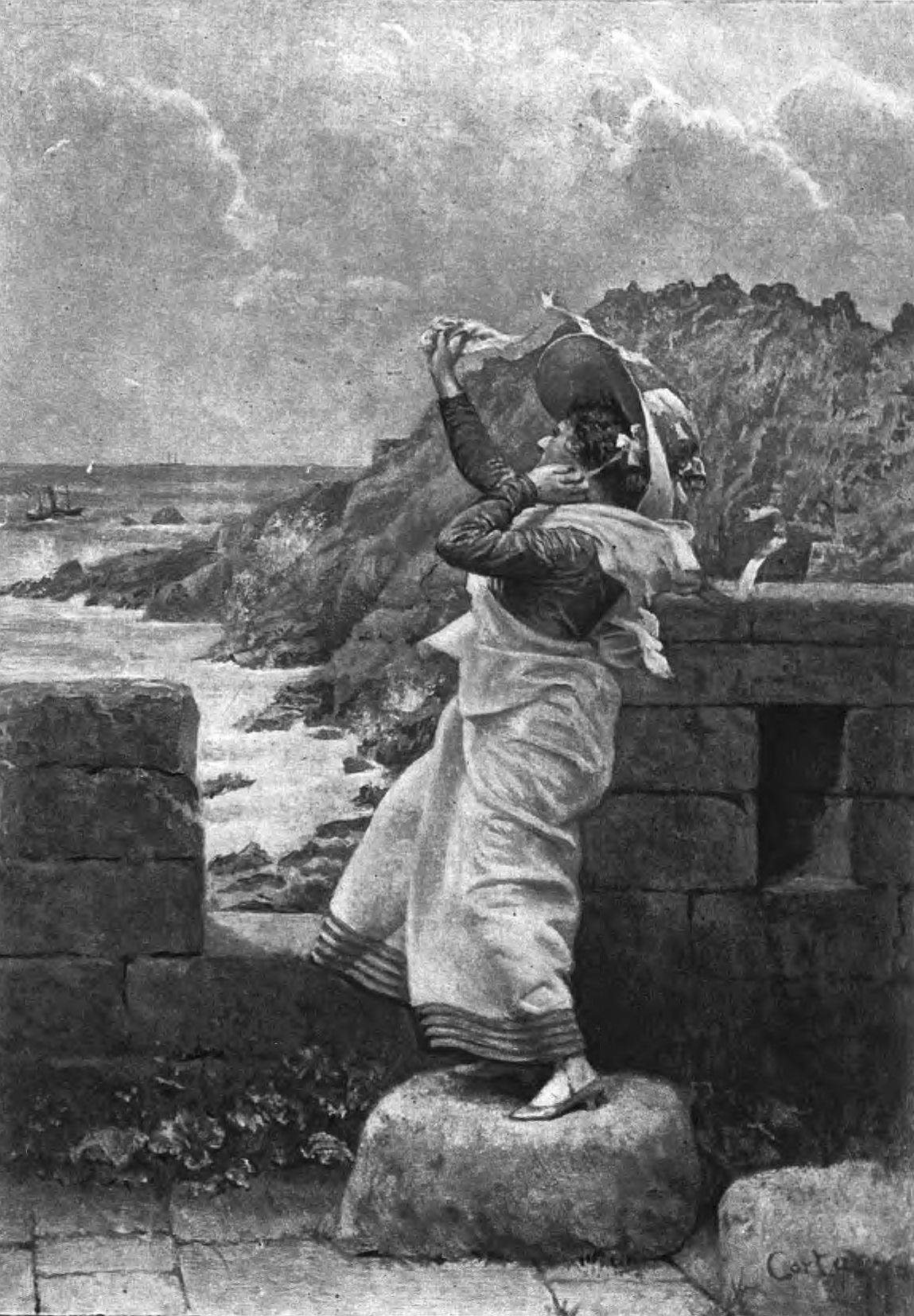
THE SEPARATION.
Laurent, as he cast his eyes for the last time upon that dismal cliff, saw, on the platform of the old ruined fort, a figure whose head and waving hair were still tinged with gold by the sun's declining rays; it was Thérèse's.
But, ten minutes later, as the Ferruccio, after steaming out to sea with some effort, turned to round the promontory, Laurent, as he cast his eyes for the last time upon that dismal cliff, saw, on the platform of the old ruined fort, a figure whose head and waving hair were still tinged with gold by the sun's declining rays; it was Thérèse's fair hair and her adored form. She was alone. Laurent held out his arms with intense emotion; then he clasped his hands in token of repentance, and his lips murmured two words which the breeze bore away:
"Forgive! forgive!"
Monsieur de Vérac gazed at him in speechless amazement; and Laurent, the most sensitive man on earth in the matter of ridicule, did not heed the glance of his former companion in debauchery. Indeed, he took a sort of pride in braving it at that moment.
When the shore had disappeared in the evening haze, Laurent found himself seated on a bench by Vérac's side.
"Come," said the latter, "tell me about this extraordinary experience! You have said too much to leave me in ignorance of the rest; all your friends in Paris—I might say all Paris, since you are a famous man—will ask me concerning the progress of your liaison with Mademoiselle Jacques, who is also too much in the public eye not to arouse curiosity. What shall I reply?"
"That you found me very downcast and shamefaced. That what I told you can be summed up in three words. Must I say them again?"
"Then you really abandoned her first? I like that better for your sake!"
"Yes, I understand; it is ridiculous to be betrayed, it is glorious to have taken the first step. That is the way I used to reason with you, that was our code; but I have changed my ideas altogether concerning all such matters since I have been in love. I betrayed her, I have been deserted, I am in despair: therefore our former theories had no common-sense. Find in the theory of life which we used to put in practice together an argument which will relieve me of my regret and my suffering, and I will say that you are right."
"I shall seek no arguments, my dear fellow; suffering is not to be argued with. I pity you because you are unhappy; but I am wondering if there is a woman in existence who deserves to be mourned so deeply, and if Mademoiselle Jacques would not have done better to forgive an act of infidelity, than to dismiss you in your present desperate state. For a mother, she seems to me a trifle stern and vindictive!"
"That is because you don't know how guilty and absurd I have been. An act of infidelity! she would have forgiven that, I am sure; but insults, reproaches!—and worse than that, Vérac! I said something to her that no self-respecting woman can ever forget: 'You bore me!'"
"Yes, that is a rough thing to say, especially when it is true. But suppose it was not true? suppose you simply said it in a moment of anger?"
"No! it was mental weariness. I had ceased to love her. Stay, it was worse than that: I was never able to love her when she was mine. Just remember that, Vérac; laugh if you please, but remember that for your own guidance. It is very possible that you will wake up some fine morning, sated with sham pleasures and violently in love with a virtuous woman. That may happen to you as it has happened to me, for I do not think that you are any more dissipated than I used to be. Well, when you have overcome that woman's resistance, probably the same thing will happen to you as to me: having acquired the deplorable habit of making love to women you despise, you will be doomed to fall back into those cravings for a barbarous sort of liberty of which dignified love has a horror. Thereupon, you will feel like a wild animal tamed by a child, and always ready to devour him in order to break its chain. And some day, when you have killed the helpless little keeper, you will fly all alone, roaring with joy and shaking your mane; but then—then the wild beasts of the desert will frighten you, and, because you have once learned to know the cage, you will care no more for liberty. However slight the bond, and however unwillingly your heart may have accepted it, it will regret it as soon as it is broken, and it will have a horror of solitude, yet be powerless to choose between love and libertinism. That is a form of suffering which you do not yet know. God grant that you may never know it! And meanwhile laugh and jeer as I used to do! That will not prevent your day from coming if debauchery has not already made a corpse of you!"
Monsieur de Vérac, smiling, allowed this torrent of words to flow, listening to it as to a well-executed cavatina at the Théâtre-Italien. Laurent was unquestionably sincere; but perhaps his auditor was justified in not attaching too great weight to his despair.
IX
When Thérèse finally lost sight of the Ferruccio, it was quite dark. She had dismissed the boat which she had hired in the morning at Spezzia, and paid for in advance. When the boatman rowed her ashore from the steamer, she had noticed that he was drunk; she was afraid to return to Spezzia alone with him, and, expecting to find some other boat on the shore, she had dismissed him.
But when she thought seriously about returning, she remembered that she was absolutely destitute. Nothing could be simpler, of course, than to go back to the Maltese Cross at Spezzia, where she and Laurent had passed the preceding night, to have the boatman paid at the office, and to await Palmer's arrival there; but the idea of being entirely destitute, and of being obliged to owe her breakfast the next day to Palmer, caused a feeling of repugnance, puerile, perhaps, but insurmountable, considering the existing relations between them. Furthermore, she was more than a little disturbed as to the real explanation of his conduct toward her. She had noticed the heart-rending sadness of his glance when she left Florence. She could not refrain from thinking that an obstacle to their marriage had suddenly arisen, and she saw in the projected union so many real drawbacks for Palmer, that she considered it her duty not to contend against the obstacle in whatever quarter it might arise. Thérèse adopted an altogether instinctive solution of the problem, which was to remain for the present at Porto Venere. In the small bundle which she had brought with her to guard against emergencies, she had enough clothes to pass four or five days anywhere. In the way of jewels, she had a gold watch and chain; these she could leave in pawn until she had received the pay for her work, which should have reached Genoa in the form of a banker's draft. She had directed Vicentino to call for her letters at Genoa and forward them to Spezzia.
She must pass the night somewhere, and the appearance of Porto Venere was not inviting. The tall houses along the narrow passage out to sea, which reach to the water's edge, are so nearly on a level with the top of the cliff in the rear, that in many places one must stoop in order to pass under the overhanging roofs which reach nearly to the middle of the street. That steep, narrow street, paved with rough cobble-stones, was crowded with children, hens, and large copper vessels placed at the angles formed by the roofs to catch the rain-water during the night. These vessels are the barometer of the locality: fresh water is so scarce there, that as soon as a cloud appears in the direction from which the wind is blowing, the housewives hasten to place all practicable receptacles in front of their doors, in order not to lose a drop of the blessing sent by Heaven.
As she passed before those yawning doorways, Thérèse caught a glimpse of one interior which seemed cleaner than the others and which exhaled a somewhat less acrid odor of oil. In the doorway was a poor woman whose pleasant and honest face inspired confidence; and the woman anticipated her by speaking to her in Italian or something approaching it. Thus she and Thérèse were able to understand each other. The goodwoman asked her pleasantly if she were looking for any one. She went in, looked about, and asked if she could hire a room for the night.
"Yes, to be sure, a better room than this, and you will be much quieter than at the inn, where you would hear the sailors singing all night long! But I am not an innkeeper, and if you don't want me to have quarrels on my hands, you will say publicly in the street to-morrow that you knew me before you came here."
"Very well," said Thérèse, "show me the room."
She was led up several steps and found herself in an enormous, miserable room, which commanded a panorama of vast extent on the bay and on the open sea; she took a liking to the room at first sight, for no special reason, unless it was that it seemed to her a sort of refuge against new bonds which she did not wish to be forced to accept. In that room she wrote on the following day to her mother:
"MY DEAREST LOVE:
"For twelve hours I have been at peace and in full possession of my free will for—I know not how many days or years. Everything is unsettled again in my mind, and you shall form your own opinion of the situation of affairs.
"That fatal love which alarmed you so is not renewed and never will be. You may set your mind at rest on that point. I came here with my patient, and put him aboard ship last night. If I have not saved his poor heart, and I hardly dare flatter myself that I have, I have made it better at all events, and through me it has enjoyed the sweet pleasure of friendship for a few moments. If I could have believed him, he was cured forever of his tempestuous outbreaks; but I could see plainly enough, from his contradictions and his relapses with respect to me, that the foundation of his nature is still unchanged, and the something still exists that I cannot define otherwise than as the love of that which is not.
"Alas! yes, that child would like to have for his mistress some one like the Venus de Milo, enlivened with the breath of my patron Sainte Thérèse, or perhaps it would be more accurate to say that the same woman should be Sappho to-day and Jeanne d'Arc to-morrow. It is most unfortunate for me that I ever believed that, after adorning me in his imagination with all the attributes of the Divinity, he would not open his eyes the next day! It must be that, without suspecting it, I am very vain, to have accepted the task of inspiring a cult! But, no, I was not, I give you my word! I did not think of myself; on the day when I allowed myself to be placed on that altar, I said to him: 'Since you absolutely insist upon adoring me instead of loving me, which I should much prefer, why, adore me, reserving the right to crush me to-morrow!'
"And he has crushed me! But of what can I complain? I anticipated it, and resigned myself to it beforehand.
"But I was weak, undignified, and wretched when that horrible moment came. My courage returned, however, and God permitted me to recover more quickly than I hoped.
"Now, I must speak to you of Palmer. You wish me to marry him, he wishes it, and I, too, did wish it! Do I wish it still? What shall I say, my beloved? I still am tortured by scruples and fears. Perhaps it is his fault. He could not or would not pass with me the last moments that I passed with Laurent; he left me alone with him three days, three days which I knew would be, and which actually were, without danger for me; but did he, Palmer, know it, and could he be sure of it? or—which would be much worse—did he say to himself that he must find out how far he could depend on me? There was on his part either a display of romantic unselfishness or an exaggerated discretion, which, in such a man, can come only from some worthy sentiment, but which has given me food for reflection none the less.
"I have written you what took place between us; it seemed to me that he had taken it upon himself as a sacred duty to rehabilitate me by marriage, after the affronts to which I had been subjected. I felt the enthusiasm of gratitude and the emotion that follows profound admiration. I said yes, I promised to be his wife, and to-day I feel that I love him as much as it is in my power to love.
"And yet to-day I hesitate, because it seems to me that he repents. Am I dreaming? I have no idea; but why could he not come here with me? When I learned of my poor Laurent's terrible illness, he did not wait for me to say: 'I am going to Florence;' but he said to me: 'Let us go!'—The twenty nights that I passed at Laurent's bedside, he passed in the next room, and he never said to me: 'You are killing yourself!' but simply: 'Take a little rest, so that you can go on with it.'—I have never detected the shadow of jealousy in him. It seemed that in his eyes I could never do too much to save the ungrateful boy whom we had both of us adopted, as it were. He knew, noble heart, that his confidence and generosity increased my love for him, and I was infinitely grateful to him for understanding it. In that way he raised me in my own eyes, and made me proud to belong to him.
"Very well; then why this whim or this obstacle at the last moment? An unforeseen obstacle? With the strong will that I know him to possess, I hardly believe in obstacles; it seems more probable that he wished to test me. That humiliates me, I confess. Alas! I have become horribly sensitive since I fell! Is it not natural? why did not he, who understands everything, understand that?
"Or, perhaps he has thought better of it, and has said to himself all that I said to him, from principle, in order to prevent his thinking of me; what would there be surprising in that? I had always known Palmer as a prudent and sensible man. When I discovered in him stores of enthusiasm and trust, I was greatly surprised. Might he not be one of those who take fire when they see others suffer, and who fall to loving the victims passionately? That is a natural instinct in those who are strong, it is the sublime pity of pure and happy hearts! There were moments when I said that to myself, in order to reconcile me with myself,—when I loved Laurent, for it was his suffering, before and above all else, that attached me to him!