The Masterpieces of George Sand, Amandine Lucille Aurore Dupin, Baroness Dudevant, NOW FOR THE FIRST TIME COMPLETELY TRANSLATED INTO ENGLISH SHE AND HE, AND LAVINIA BY G. BURNHAM IVES; WITH MEMOIR BY J. ALFRED BURGAN (continued 3)
George Burnham Ives translation
Finally he detested her for not divining his torments; he despised her for remaining faithful to that lover of hers, who could not be a man of more than ordinary talent, since she did not feel the need of talking about him; he would leave her, swearing that he would not go near her again for a long while, and he would have returned an hour later if he had had any hope that she would receive him.
Thérèse, who had caught a glimpse of his love for a moment, no longer suspected it, so well did he play his part. She was sincerely attached to the unhappy youth. Being an enthusiastic artist beneath her calm and thoughtful exterior, she had set up a sort of altar, she said, to what he might have been, and she still felt for him an indulgent pity, blended with genuine respect for genius diseased and gone astray. If she had been very certain of not arousing any evil desire, she would have fondled him like a son, and there were times when she checked herself as she was on the point of using the familiar form of address to him.
Was there a touch of love in that maternal sentiment? There surely was, unknown to Thérèse; but a truly chaste woman, who has lived longer by work than by passion, can keep from herself for a long while the secret of a love which she has resolved to fight against. Thérèse believed that she was certain of having no thought of her own satisfaction in that attachment of which she bore all the burden; as soon as it was evident that Laurent found tranquillity and contentment with her, she found tranquillity and contentment to give him. She was well aware that he was incapable of loving as she understood the word; so that she had been hurt and alarmed at the momentary caprice which he had confessed. That paroxysm past, she congratulated herself upon having found in a harmless fib a means of preventing its recurrence; and, as on all occasions, whenever he felt at all excited, Laurent hastened to proclaim the impassable barrier of ice of the Baltic Sea, she was no longer afraid, and accustomed herself to live amid flames without being burned.
All these sufferings and perils of the two friends were concealed and, as it were, incubated beneath a habitual satirical gaiety, which is the natural mood, the indelible seal, as it were, of French artists. It is a sort of second nature, for which the people of more northern countries blame us severely, and for which the serious English, above all, look down upon us. Yet it is that which constitutes the charm of refined liaisons, and often preserves us from many a mad or foolish step. To seek the absurd side of things is to discover the weak and illogical side. To laugh at the perils by which the heart is encompassed, is to practise defying them, like our soldiers, who go into fire laughing and singing. To make fun of a friend is often to save him from some weakness in which our pity would have led him to gratify himself. And, finally, to make fun of one's self is to rescue one's self from the foolish intoxication of overweening self-esteem. I have noticed that people who never jest are generally endowed with puerile and intolerable vanity.
Laurent's gaiety, like his talent, was dazzling with color and wit, and was the more natural because it was original. Thérèse had less wit than he, in the sense that she was naturally given to musing, and was an indolent talker; but what she needed was a playful spirit in others; then her own would gradually wake, and her quiet merriment was not without charm.
The result of this habitual good humor was that love, a subject upon which Thérèse never jested and did not like to have others jest in her presence, found no opportunity to slip in a word, to utter a note.
One fine morning, Monsieur Palmer's portrait was finished, and Thérèse handed to Laurent, in her friend's name, a snug little sum which the young man promised to put aside, to be used in case of illness or of some unforeseen and unavoidable expense.
Laurent had become intimate with Palmer while painting his portrait. He had found him what he was: upright, just, generous, intelligent, and well-informed. Palmer was a wealthy American of the middle class, whose patrimonial fortune was derived from trade. He had been in business himself and had travelled extensively in his younger days. At thirty, he had had the excellent sense to consider himself rich enough, and to determine to live for his own enjoyment. So he no longer travelled except for pleasure, and after he had seen, as he said, many curious things and extraordinary countries, he took delight in the sight of beautiful things and in studying countries which were really interesting by reason of their civilization.
Although he was not a very enlightened student of art, his judgment was reasonably reliable, and on all subjects his ideas were as healthy as his instincts. His French showed the effect of his timidity, to such a degree that it was almost unintelligible and absurdly incorrect at the beginning of a conversation; but when he felt at ease, one could see that he knew the language, and that all he lacked was longer practice or greater confidence to speak it very well.
Laurent had studied him with much curiosity and perturbation at the outset. When it was proved by affirmative evidence that he was not Mademoiselle Jacques's lover, he estimated his character more fairly, and conceived a sort of friendship for him which resembled, albeit at a long distance, his sentiment for Thérèse. Palmer was a tolerant philosopher, strict enough in his dealings with himself and very charitable to others. In his ideas, if not in his character, he resembled Thérèse, and he was almost always in accord with her on all points. Now and then Laurent still felt jealous of what he called, in musical parlance, their imperturbable unison; and, as it was simply an intellectual jealousy, he ventured to complain of it to Thérèse.
"Your definition amounts to nothing," she said. "Palmer is too placid and too perfect for me. I have a little more fire, and I sing a little louder than he does. Compared with him, I am the high note in the major third."
"In that case, I am only a false note," said Laurent.
"No," said Thérèse, "with you I am modified and go down the scale to form the minor third."
"Then with me you descend half a tone?"
"And I am half an interval nearer to you than to Palmer."
III
One day, at Palmer's request, Laurent went to the Hôtel Meurice, where the American lived, to see that the portrait was suitably framed and packed. The lid was nailed on in their presence, and Palmer himself wrote his mother's name and address thereon with a brush; then, as the porters carried the box away to dispatch it on its long journey, Palmer grasped the artist's hand, and said:
"I owe it to you that my dear mother is soon to have a very great pleasure, and I thank you again. Now will you allow me to talk with you a few moments? I have something to say to you."
They went into a salon where Laurent saw several trunks.
"I start to-morrow for Italy," said the American, offering him some excellent cigars and a taper, although he did not smoke himself; "and I do not choose to part with you without a few words touching a delicate matter, so delicate that, if you interrupt me, I shall not be able to find the proper French words for what I want to say."
"I swear that I will be as mute as the tomb," said Laurent, with a smile, surprised and considerably disturbed by this preamble.
"You love Mademoiselle Jacques," continued Palmer, "and I think that she loves you. Perhaps you are her lover; if you are not, I feel certain that you will be sooner or later. Ah! you promised not to speak! Say nothing, for I ask you nothing. I consider you worthy of the honor I attribute to you; but I am afraid that you are not well enough acquainted with Thérèse to know that, if your love is an honor to her, hers is no less an honor to you. I am afraid of that because of the questions you asked me about her, and of certain remarks that have been made about her before us two, by which I saw that you were more moved than I was. That proves that you know nothing about her; now I, who know the whole story, propose to tell you the whole story, so that your attachment to Mademoiselle Jacques may be founded on the esteem and respect which she deserves."
"Wait a moment, Palmer," cried Laurent, who was burning to hear what was coming, but was restrained by an honorable scruple. "Do you propose to tell me this with Mademoiselle Jacques's permission, or by her command?"
"Neither," replied Palmer. "Thérèse will never tell you the story of her life."
"Then say no more! I do not wish to know anything except what she wishes me to know."
"Good, very good!" rejoined Palmer, shaking his hand; "but suppose that what I have to tell you clears her from all suspicion?"
"Then why does she conceal it?"
"From consideration for others."
"Well, go on," said Laurent, unable to resist the temptation.
"I shall mention no names," said Palmer. "I will simply tell you that, in one of the large cities of France, there was once a rich banker who seduced a charming girl, his own daughter's governess. He had by her a female child who was born twenty-eight years ago on Saint Jacques's Day, was entered on the municipal register as born of unknown parents, and received no other family name than Jacques. Thérèse is that child.
"The governess received a sum of money from the banker, and, five years later, married one of his clerks, an honest fellow who had no suspicion of anything wrong, the whole affair having been kept very secret. The child was brought up in the country. Her father had taken charge of her. She was afterward placed in a convent, where she received a very fine education and was the object of much care and affection. Her mother saw her constantly during the first years; but after she was married, her husband became suspicious, and, resigning his position with the banker, took his wife to Belgium, where he went into business on his own account and made a fortune. The poor mother had to force back her tears and obey.
"That mother still lives a long way from her daughter; she has other children, and her conduct since her marriage has been beyond reproach; but she has never been happy. Her husband, who loves her dearly, keeps her almost under lock and key, and has never ceased to be jealous of her; which is in her eyes the merited penalty of her sin and her falsehood.
"It would seem that age should have brought confession on the one hand and forgiveness on the other. It would have been arranged so in a novel; but there is nothing less logical than real life, and that household is as disturbed as on the first day, the husband deep in love, uneasy and rough, the wife penitent, but silent and down-trodden.
"And so, under the difficult circumstances in which Thérèse was placed, she was deprived of the support, the assistance, the advice, and the consolation of her mother. But the mother loves her all the more dearly for being obliged to see her in secret, by stealth, when she succeeds in coming to Paris alone for two or three days, as has happened recently. But it is only within a few years that she has been able to devise pretexts of one sort or another, and obtain these occasional leaves of absence. Thérèse adores her mother, and will never make any admission that can possibly compromise her. That is why she will never endure a word of blame concerning the conduct of other women. You may well have thought that at such times she was indirectly claiming indulgence for herself. Nothing of the sort. Thérèse has nothing for which to seek forgiveness; but she has forgiven her mother everything; such is the story of their relations.
"I now have to tell you the story of the Comtesse de —— three stars. That is what you say in French, I believe, when you do not wish to call people by name. This countess, who bears neither her title nor her husband's name, is Thérèse again."
"So she is married? she is not a widow?"
"Patience! she is married, and she is not. You will see in a moment. Thérèse was fifteen years old when her father, the banker, became a widower and a free man; for his lawful children were all settled in life. He was an excellent man, and, despite the misstep of which I have told you and which I do not justify, it was impossible not to love him, he was so entertaining and generous. I was very intimate with him. He had told me in confidence the story of Thérèse's birth, and on several occasions he took me with him when he went to see her at the convent where she was. She was beautiful, intelligent, lovable, high-spirited. He would have been glad, I think, to have me make up my mind to ask her hand in marriage; but my heart was not free at that time; otherwise—— But I could not think of it.
"He then asked me some questions about a young Portuguese nobleman who was a frequent visitor at his house, who had very large interests in Havana, and who was very handsome. I had met this Portuguese in Paris, but I did not really know him, and I abstained from giving any opinion about him. He was very fascinating; but, for my part, I would never have placed any confidence in his face. He was the Comte de ——, to whom Thérèse was married a year later.
"I was obliged to go to Russia; when I returned, the banker had died of apoplexy, and Thérèse was married, married to that foreigner, that madman, I will not say that villain, because he was able to retain her love, even after she discovered his crime: that man already had a wife in the colonies when he had the incredible audacity to seek Thérèse's hand and to marry her.
"Do not ask me how Thérèse's father, a man of sense and experience, had allowed himself to be so deceived. I could but repeat to you what my own experience has taught me, to wit: that in this world, the things that happen are at least half of the time the direct opposite of what seemed likely to happen.
"In the later years of his life the banker had done divers other foolish things which would lead one to think that his reason was slightly clouded. He had left Thérèse a legacy instead of giving her a marriage-portion outright in his life-time. This legacy was of no effect as against the lawful heirs, and Thérèse, who adored her father, would not have applied to the courts even if there had been any chance of success. She was left penniless, therefore, just as she became a mother, and, at the same time, a frantic woman made a descent upon her, demanding her rights and threatening to make a scandal: it was her husband's first and only lawful wife.
"Thérèse had an extraordinary amount of courage: she pacified the unfortunate creature, and persuaded her not to apply to the courts; she induced the count to take back his wife and start for Havana with her. Because of Thérèse's birth and the secrecy with which her father had chosen to encompass the manifestations of his affection, her marriage had taken place secretly, abroad, and the young couple had lived abroad ever since. Indeed, their life had been most mysterious. The count, unquestionably afraid of being unmasked if he should reappear in the world, made Thérèse believe that he had a passion for living in solitude with her, and the trustful young wife, in love with her husband and naturally romantic, considered it altogether natural that her husband should travel with her under a false name, to avoid meeting people who were indifferent to him.
"Thus when Thérèse awoke to the horror of her situation, it was not impossible that everything might be shrouded in silence. She consulted a discreet lawyer, and, having acquired the certainty that her marriage was null and void, but that it required a judgment to quash it, if she wished ever to make use of her liberty, she instantly and irrevocably made up her mind to be neither free nor married, rather than besmirch her child's father with a degrading scandal and conviction. That made the child a bastard beyond recall; but it was better that he should have no name and should remain forever in ignorance of his birth, than that he should claim a tarnished name and bring dishonor upon his father.
"Thérèse still loved the wretch! she confessed as much to me, and he loved her with a diabolical passion. There were heart-rending struggles, indescribable scenes, in which Thérèse fought with an energy beyond her years, I will not say beyond her sex; a woman, when she is heroic, is not heroic by halves.
"At last, she carried the day; she kept her child, expelled the culprit from her arms, and saw him depart with her rival, who, although consumed by jealousy, was so far overcome by her magnanimity that she kissed her feet when they parted.
"Thérèse changed her abode and her name, passed as a widow, having resolved to be forgotten by the few people who had known her, and began to live for her child, with pitiful energy. The child was so dear to her, that she thought that she could find consolation with him; but this last joy was destined not to be of long duration.
"As the count was wealthy, and had no children by his first wife, Thérèse had been persuaded, at her rival's earnest entreaty, to accept a reasonable allowance, in order to enable her to give her son a suitable education; but the count had no sooner taken his wife back to Havana than he abandoned her again, made his escape, returned to Europe, and threw himself at Thérèse's feet, imploring her to fly with him and the child to the other side of the world.
"Thérèse was inexorable; she had reflected and prayed. Her heart had become strong, she no longer loved the count. On her son's account, she did not propose that such a man as the count should become the master of her life. She had lost the right to be happy, but not the right to respect herself; she repulsed him, without reproaches, but without weakness. The count threatened to leave her penniless; she replied that she was not afraid to work for a living.
"The wretched madman thereupon devised an execrable scheme, to place Thérèse at his mercy, or to be revenged for her resistance. He kidnapped the child and disappeared. Thérèse hurried after him; but he had taken his measures so carefully that she went astray and did not overtake him. It was at that crisis that I met her in England, dying of despair and fatigue at an inn, almost insane, and so changed by unhappiness that I hardly recognized her.
"I persuaded her to rest, and let me act for her. My investigations were lamentably successful. The count had returned to America. The child had died of fatigue on arriving there.
"When I was obliged to convey that horrible news to the unhappy creature, I was terrified myself at the calmness she displayed. At last, she wept, and I saw that she was saved. I was forced to leave her; she told me that she proposed to settle where she was. I was distressed by her destitution; she deceived me by telling me that her mother would not allow her to lack anything. I learned later that her poor mother would have been powerless to help her; she had not a centime at her disposal for which she had not to account. Moreover, she was entirely ignorant of all her daughter's misfortunes. Thérèse, who wrote to her in secret, had concealed them in order not to drive her to desperation.
"Thérèse lived on in England, giving lessons in French, drawing, and music, for she possessed talents which she had the courage to turn to account, that she might not have to accept compassion from any one.
"After a year, she returned to France, and settled in Paris, where she had never been, and where no one knew her. She was then but twenty years old; she was married at sixteen. She was no longer at all pretty, and it required eight years of repose and resignation to restore her health and her gentle gaiety of long ago.
"During all that time, I saw her only at rare intervals, for I am always travelling; but I always found her dignified and proud, working with invincible courage, and concealing her poverty behind miraculous neatness and cleanliness, never complaining of God, or of any mortal, refusing to talk of the past, sometimes caressing children by stealth and leaving them as soon as one looked at her, fearing, doubtless, that she might betray some emotion.
"I had not seen her for three years, when I came to ask you to paint my portrait, and I was trying to find her address, which I was on the point of asking you for when you mentioned her to me. Having arrived only the night before, I did not know that she had at last attained success, celebrity, and a comfortable income.
"It was only on finding her under such conditions, that it occurred to me that that heart, so long crushed, might live again, and suffer—or be happy. Try to make her happy, my dear Laurent, she has well earned it! And, if you are not sure that you will not make her suffer, blow out your brains to-night rather than return to her. That is all that I had to say to you."
"Stay," said Laurent, deeply moved; "this Comte de ——, is he still alive?"
"Unfortunately, yes. These men who drive other people to despair are always in good health and escape all dangers. They never hand in their resignations; why, this fellow recently had the presumption to send me a letter for Thérèse, which I handed to her in your presence, which she treated as it deserved."
Laurent had thought of marrying Thérèse as he listened to Monsieur Palmer's narrative. That narrative had produced a revolution in him. The monotonous tone, the pronounced accent, and a few curious grammatical lapses which we have not thought it worth our while to reproduce, had imparted to it, in his auditor's vivid imagination, an indefinable something as strange and terrible as Thérèse's destiny. That girl without kindred, that mother without children, that wife without a husband, was surely doomed to an exceptionally cruel fate! What depressing notions of love and life she must have retained! The sphinx reappeared before Laurent's dazzled eyes. Thérèse unveiled seemed to him more mysterious than ever; had she ever been consoled? could she be for a single instant?
He embraced Palmer effusively, swore to him that he loved Thérèse, and that, if he ever succeeded in winning her love, he would remember every hour of his life the hour that had just passed and the story he had just heard. Then, having promised not to betray his knowledge of Mademoiselle Jacques's history, he went home and wrote:
"THÉRÈSE:
"Do not believe a word of all I have been saying to you these last two months. Do not believe either what I said to you when you were afraid that I would fall in love with you. I am not amorous, it is not that; I love you madly. It is absurd, it is insane, it is wretched; but I, who thought that I never should or could say or write to a woman the words I love you! find them too cold and constrained to-day to express my feeling for you. I can live no longer with this secret which is choking me, and which you will not guess. I have tried a hundred times to leave you, to go to the end of the world, to forget you. In an hour I am at your door, and very often, at night, consumed with jealousy and almost frantic with rage against myself, I pray God to deliver me from my torment by summoning this unknown lover in whom I do not believe, and whom you invented to disgust me with the thought of you. Show me that man in your arms, or love me, Thérèse! Failing these alternatives, I can conceive but one other, and that is to kill myself and have done with it. This is cowardly, stupid, the commonplace threat worn threadbare by all despairing lovers; but is it my fault if there is a despair which makes all those who undergo it utter the same shriek, and am I mad because I happen to be a man like other men?
"Of what avail has been all that I have invented to protect myself from it, and to render my poor personality as harmless as it wished to be free?
"Have you anything to reproach me for in my dealings with you, Thérèse? Am I a conceited ass, a rake, I who prided myself upon making myself stupid so as to give you confidence in my friendship? But why do you wish that I should die without having loved, you who alone can teach me what love is, and who know it well? You have a treasure in your heart, and you smile as you sit beside a poor devil who is dying of hunger and thirst. You toss him a small coin from time to time; that means friendship in your eyes; it is not even pity, for you must know that the drop of water increases the thirst.
"And why do you not love me? You may have loved some one who was a worse man than I. I am not worth much, to be sure, but I love you, and is not that everything?
"You will not believe it; you will say again that I am mistaken, as you said before! No, you cannot say so, unless you lie to God and to yourself. You see that my torment gets the better of me, and that I am making an absurd declaration, I who dread nothing on earth so much as being laughed at by you!
"Thérèse, do not think me corrupt. You know very well that the bottom of my heart has never been sullied, and that from the abysses into which I have cast myself I have always, in spite of myself, raised my voice to Heaven. You know that with you I am as chaste as an infant, and you have not feared to take my head in your hands sometimes, as if you were about to kiss me on the forehead. And you would say: 'Bad head! you deserve to be broken.'—And yet, instead of crushing it like the head of a snake, you would try to make the pure and burning breath of your mind penetrate it. Ah! well, you have succeeded only too well; and, now that you have kindled the fire on the altar, you turn away and say to me: 'Place it in somebody's else care! Marry; love some sweet, devoted, lovely girl; have children, be ambitious for them, live a virtuous life, have a happy home—have everything, except me!'
"But, Thérèse, it is you whom I love passionately, not myself. Since I have known you, you have been striving to make me believe in happiness and to cultivate my taste for it. It is not your fault if I have not become as selfish as a spoiled child. But I am worthy of a better fate. I do not ask if your love would mean happiness to me. I simply know that it would be life, and that, good or bad, it is that life, or death, that I must have."
IV
Thérèse was deeply distressed by this letter. She was, as it were, struck by lightning. Her love bore so little resemblance to Laurent's, that she fancied that she did not love him with love, especially when she reread the expressions used by him. There was no delirium in Thérèse's heart, or, if there were, it had entered there, drop by drop, so slowly that she did not notice it, and believed that she was as thoroughly mistress of herself as on the first day. The word passion offended her.
"Passions! I?" she said to herself. "In Heaven's name, does he think that I don't know what passion is, and that I want any more of that poisoned draught? What have I done to him, I who have given him so much affection and thought, that he should propose to me, by way of thanks, despair, madness, and death?—After all," she thought, "it is not his fault, poor creature! He doesn't know what he wants, nor what he asks for. He seeks love like the philosopher's stone, in which one strives all the more earnestly to believe because he cannot grasp it. He thinks that I have it, and that I amuse myself by refusing to give it to him! There is always a touch of frenzy in whatever he thinks. How can I appease him, and turn him aside from a fancy that is rapidly making him unhappy?
"It is my fault; he has some right to say so. While trying to wean him from debauchery, I familiarized him too much with a virtuous attachment; but he is a man, and he deems our affection incomplete. Why did he deceive me? why did he make me believe that he was tranquil when he was with me? What shall I do to repair the idiocy of my inexperience? I have not been enough of a woman in the matter of presumption. I did not know that a woman, however lukewarm and weary of life she may be, can still disturb a man's brain. I ought to have believed that I was fascinating and dangerous, as he once told me, and to have guessed that he afterward contradicted himself on that point only to quiet my fears. So it is a misfortune, then,—for it certainly cannot be a sin,—not to have the instinct of coquetry?"
Thereupon, Thérèse, searching her memory, remembered that she had instinctively been reserved and distrustful to defend herself from the desires of other men who were not attractive to her; with Laurent she felt no such instinct, because she esteemed him in his friendship for her, because she could not believe that he would seek to deceive her, and also, it must be admitted, because she cared more for him than for any other. Alone in her studio, she paced the floor, oppressed by a painful sense of discomfort, sometimes glancing at the fatal letter which she had placed on a table as if she knew not what to do with it and could neither decide to read it again nor to destroy it, and sometimes looking at her unfinished work on the easel. She was working with enthusiasm and pleasure when they brought her that letter, that is to say, that doubt, that anxiety, that amazement, and that dread. It was like a mirage which caused all the spectres of her former miseries to reappear upon her unclouded, peaceful horizon. Every word written on that paper was like a hymn of death which she had heard in the past, a prophecy of fresh misfortunes to come.
She tried to recover her serenity by resuming her painting. That was her great remedy for all the petty ills of external life; but it was powerless that day; the terror which that passion aroused in her assailed her in the purest and most private sanctuary of her present life.
"Two pleasures disturbed or destroyed," she said to herself, throwing away her brush and taking up the letter: "work and friendship."
She passed the rest of the day without making up her mind to anything. But one point was perfectly clear in her mind, the determination to say no; but she proposed that it should be no in reality, and was not bent upon announcing her decision in hot haste, with the timorous abruptness of the woman who is afraid of succumbing unless she makes haste to barricade the door. How to say that no from which there should be no appeal, which should leave no hope behind, yet should not be like a red-hot iron on the sweet memory of friendship, was a hard and bitter problem for her to solve. That memory was her own love; when one has the body of a dearly loved one to bury, one cannot decide, without bitter sorrow, to place a white cloth over the face and bestow the body in the common grave. You would fain embalm it in a grave of its own, which you could look upon from time to time, praying for the soul of him whose dust it contains.
Darkness came upon her before she had hit upon any expedient for denying herself without inflicting too much pain. Catherine, seeing that she dined with little appetite, asked her anxiously if she were ill.
"No," she replied, "I have something on my mind."
"Ah! you work too hard," said the good old woman, "you do not think about taking care of yourself."
Thérèse raised her finger; it was a gesture with which Catherine was familiar, and which signified: "Don't speak of that."
The hour at which Thérèse received her few friends had, for some time past, been taken advantage of by Laurent only. Although the door stood open for whoever chose to come, he alone came, whether because the others were away from Paris—it was the season for going into the country or remaining there—or because they had detected in Thérèse a certain preoccupation, an involuntary and poorly concealed desire to talk exclusively with Monsieur de Fauvel.
Laurent usually arrived at eight, and Thérèse said to herself as she glanced at the clock:
"I did not answer his letter; he won't come to-day."
There was a horrible void in her heart as she added:
"He must never come again."
How was she to pass that endless evening, which she was accustomed to pass in conversation with her young friend, while she worked at some little sketch or some fancy-work, and he smoked his cigar, half-reclining lazily on the cushions of the couch? It occurred to her to escape the impending ennui by calling upon a friend in Faubourg Saint-Germain, with whom she sometimes went to the play; but her friend always retired early, and it would be too late when she arrived. It was such a long way, and the cabs moved so slowly! Then, too, she would have to dress, and Thérèse, who lived in slippers, like all artists who work with enthusiasm and cannot bear to be incommoded by their clothes, was very indolent in the matter of arraying herself in visiting costume. Suppose she should put on a veil and a shawl, send for a cab, and drive slowly through the deserted avenues of the Bois de Boulogne? Thérèse had sometimes taken such a drive with Laurent, when the evening heat was so stifling that they sought a breath of fresh air under the trees. Such excursions with anybody else would have compromised her seriously; but Laurent guarded religiously the secret of her confidence, and they both took delight in the unconventionality of those mysterious tête-à-têtes, which concealed no mystery. She remembered them as if they were already far away, and said to herself, sighing at the thought that they would never return:
"Those were happy times! They can never come again for him who suffers, or for me who am no longer in ignorance of it."
At nine o'clock, she at last attempted to answer Laurent's letter, but a peal of the bell made her heart beat fast. It was he! She rose to tell Catherine to say that she had gone out. Catherine returned: it was only a letter from him. Thérèse had an involuntary thrill of regret that it was not himself.
There were only these few words in the letter:
"Adieu, Thérèse! you do not love me, and I love you like a child!"
These two lines made Thérèse tremble from head to foot. The only passion that she had never striven to extinguish in her heart was maternal love. That wound, although apparently healed, was still bleeding like unsatisfied love.
"Like a child!" she repeated, crumpling the letter in her quivering hands. "He loves me like a child! Mon Dieu! what does he mean by that? does he know how he hurts me? Adieu! My boy had learned to say adieu! but he did not say it when they carried him away. I should have heard him! and I shall never hear him again!"
Thérèse was overexcited, and, as her emotion seized upon the most painful of pretexts for manifesting itself, she burst into tears.
"Did you call me?" said Catherine, entering the room. "Mon Dieu! what is the matter? You are weeping as you used to in the old days!"
"Nothing, nothing, leave me," replied Thérèse. "If any one comes to see me, say that I have gone to the theatre. I want to be alone. I am ill."
Catherine left the room, but went into the garden. She had seen Laurent creeping stealthily along the hedge.
"Do not sulk like this," she said. "I don't know why my mistress is crying; but it must be your fault, you make her unhappy. She doesn't want to see you. Go, ask her pardon!"
Catherine, despite all her respect for Thérèse and devotion to her, was satisfied that Laurent was her lover.
"She is weeping?" he cried. "Oh! mon Dieu! why is she weeping?"
And he rushed across the little garden and threw himself at Thérèse's feet, who was sobbing in the small salon, with her face in her hands.
Laurent would have been overjoyed to see her thus if he had been the rake that he sometimes sought to appear; but in reality he was wonderfully tender-hearted, and Thérèse possessed the secret power of arousing his real nature. The tears with which her face was bathed caused him genuine and profound grief. On his knees he implored her to forget his madness, and to restore him to reason by her gentleness and good sense.
"I wish only what you wish," he said, "and since you weep for our dead and gone friendship, I swear that I will bring it to life again rather than cause you fresh sorrow. But let us be frank with each other, my sweet, kind Thérèse, my dearest sister, for I no longer feel the strength to deceive you! do you summon the courage to accept my love as a deplorable discovery that you have made, and as a disease of which you propose to cure me by patience and pity. I will do my utmost in that direction, I swear to you! I will not ask you for so much as a kiss, and I think that will not cost me so much as you might fear, for I do not yet know whether my senses are involved in all this. No, really I do not think it. How could it be so, after the life I have led and am at liberty to lead still? What I feel is a thirst of the heart; why should it frighten you? Give me a little of your heart, and take all of mine. Consent to be loved by me, and do not tell me again that it is an insult to you, for what drives me to despair is to see that you despise me too much to permit me, even in a dream, to aspire to you. That lowers me so in my own eyes that it makes me long to kill the miserable devil who so offends your moral sense. Raise me, rather, from the slough into which I have fallen, and bid me expiate my evil life and become worthy of you. Yes, leave me a ray of hope! however faint it may be, it will make another man of me. You will see, you will see, Thérèse! The mere idea of striving to seem a better man to you gives me strength already; I can feel it! do not take it from me. What will become of me if you spurn me? I shall descend again all the steps I have climbed up since I have known you. All the fruit of our sacred friendship will be lost, so far as I am concerned. You will have tried to cure a sick man, and will have killed him instead! And then, too, will you yourself, who are so noble and so good, be content with your work? will you not reproach yourself for not having conducted it to a better end? Be to me a Sister of Charity, who does not confine herself to dressing the hurts of a wounded man, but who strives to reconcile his soul with Heaven. Come, Thérèse, do not withdraw your faithful hands from mine, do not turn away your face, so lovely in sorrow. I will not leave your feet until you have at least forgiven me for loving you, if you have not authorized me to love you!"
Thérèse could but accept this effusion as serious, for Laurent was perfectly honest. To hold him off with distrust would have been equivalent to an avowal of the too warm affection which she had for him; a woman who shows fear is already vanquished. So she assumed a brave face, and perhaps it was not mere affectation, for she believed that her strength was still equal to the task. Indeed, she was not ill-advised by her very weakness.
To break with him at that moment would have been to arouse terrible emotions which it was much better to appease, reserving the right to relax the bond gently, with skill and prudence. That might be a matter of some days. Laurent was so impressionable, and rushed so abruptly from one extreme to the other!
So they both calmed down, assisting each other to forget the storm, and even exerting themselves to laugh at it, in order to afford each other mutual encouragement touching the future; but, do what they would, their position was essentially changed, and their intimacy had taken a giant's stride. The fear of losing each other had brought them nearer together, and, while vowing that there had been no change in their friendship, there was in all their words and thoughts a sort of languor of the heart, a sort of rapturous fatigue, which was in effect the enfranchisement of love!
Catherine, when she brought the tea, put them completely at their ease by her artless, maternal solicitude.
"You would do much better," she said to Thérèse, "to eat the wing of a chicken instead of making a hole in your stomach with this tea!—Do you know," she said to Laurent, pointing at her mistress, "that she never touched her dinner?"
"Then let her sup at once!" cried Laurent. "Don't say no, Thérèse; you must do it! What in Heaven's name would become of me if you should be taken sick?"
And as Thérèse refused to eat, for she really was not hungry, he declared, at a sign from Catherine urging him to insist, that he was hungry himself; and that was quite true, for he had forgotten to dine. Thereupon Thérèse was delighted to give him some supper; and they ate together for the first time, which was no trivial occurrence in Thérèse's lonely and modest life. To eat together is one of the greatest promoters of intimacy. It is the satisfaction in common of a material necessity of existence, and if you seek a loftier meaning in it, it is a communion, as the word indicates.
Laurent, whose ideas naturally took a poetic turn, even in the midst of merriment, laughingly compared himself to the Prodigal Son, for whom Catherine made haste to kill the fatted calf. This fatted calf, which presented itself in the guise of a meagre chicken, naturally added to the gaiety of the two friends. It was so little for the young man's appetite to feed upon, that Thérèse was distressed. The quarter was sadly lacking in resources, and Laurent insisted that Catherine should not put herself out for him. In the depths of a closet they unearthed a huge jar of guava jelly. It was a present from Palmer, which Thérèse had forgotten to open, but which Laurent opened and attacked with great zest, talking meanwhile with the utmost warmth of the excellent Dick, of whom he had been foolish enough to be jealous, and whom he should love thenceforth with all his heart.
"You see, Thérèse," he said, "how unjust disappointment makes us! Believe me, children should be spoiled. Only those who are treated gently, turn out well. So give me plenty of guavas, now and always! Harshness is not simply a bitter gall, it is a deadly poison!"
When the tea arrived, Laurent discovered that he had devoured the chicken like a selfish glutton, and that Thérèse had eaten nothing at all. He rebuked himself for his heedlessness and confessed it; then he dismissed Catherine, and insisted upon making the tea himself and waiting on Thérèse. It was the first time in his life that he had ever waited on any one, and he found therein an exquisite enjoyment which he recognized with ingenuous surprise.
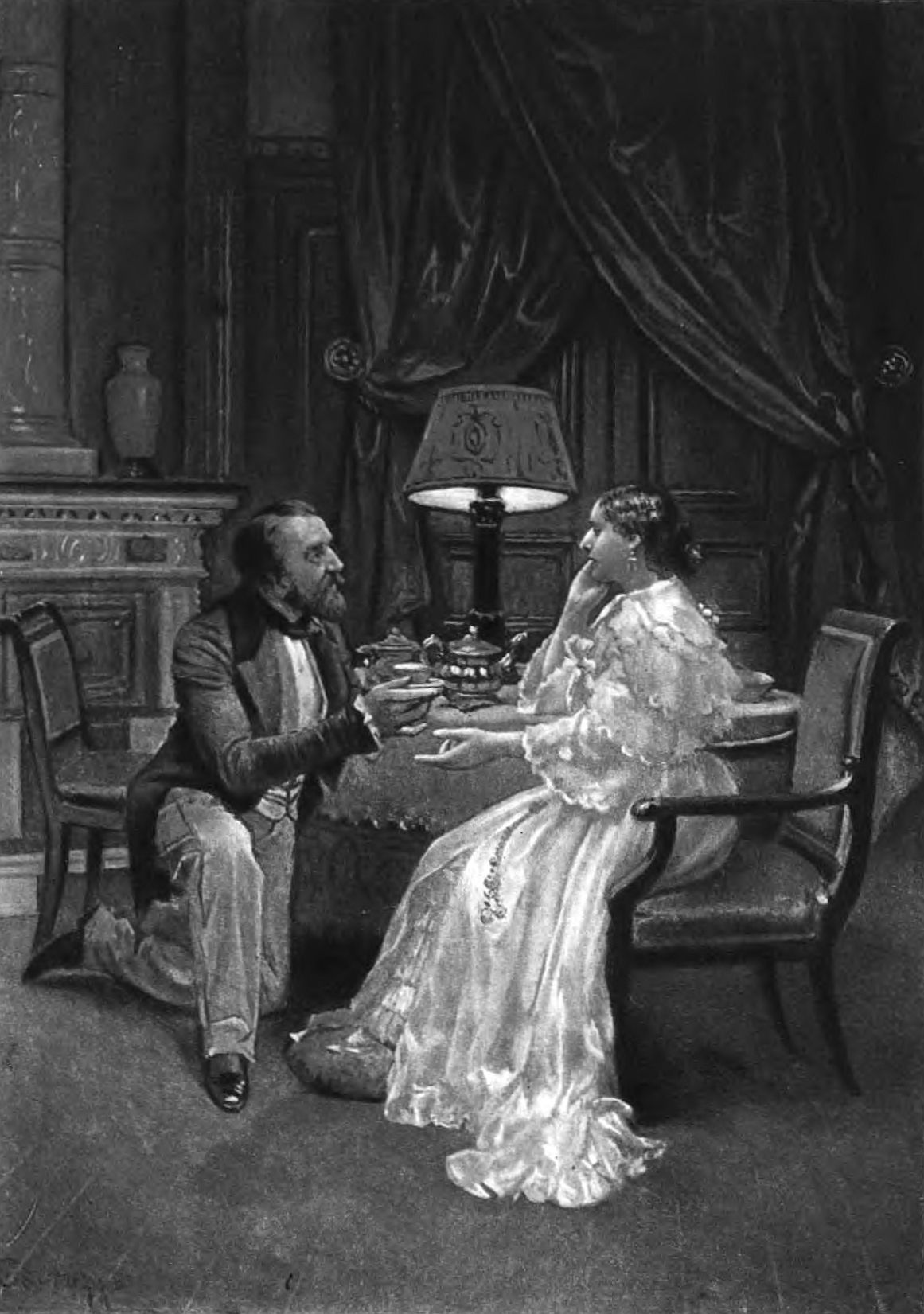
THEIR FIRST SUPPER.
"Now", said Laurent to Thérèse, as he knelt to offer her her cup, "I can understand how one can be a servant and enjoy his profession."
"Now," he said to Thérèse, as he knelt to offer her her cup, "I can understand how one can be a servant and enjoy his profession."
From certain people, even the most trivial attentions have an extraordinary value. There was in Laurent's manners, and even in his attitudes, a certain stiffness which he never laid aside, even with society women. He offered them attentions with the ceremonious coldness of the most rigid etiquette. With Thérèse, who did the honors of her little home like the excellent woman and good-humored artist that she was, he had always been cared for and coddled without having to reciprocate. He would have shown a lack of taste and of tact in assuming to act as the man of the house. Suddenly, as a result of those tears and mutual outpourings of the heart, he found himself, without in the least understanding how it happened, invested with rights which did not belong to him, but which he seized upon as if by inspiration, without opposition on the part of the surprised and deeply moved Thérèse. It seemed to him that he was under his own roof, and that he had won the privilege of looking after the mistress of the house, like a loving brother or an old friend. And Thérèse, without a thought of the danger of this taking possession, watched him with wide-open, wondering eyes, asking herself if she had not been radically mistaken hitherto in regarding that affectionate and devoted child as a reserved and gloomy man.
However, Thérèse reflected during the night; but, in the morning, Laurent, who, although he had no premeditated plan, did not propose to give her time to breathe,—for he had ceased to breathe himself,—sent her magnificent flowers, rare sweetmeats, and a note so loving, so gentle and respectful, that she could not fail to be touched by it. He said that he was the happiest of men, that he desired nothing more except her forgiveness, and that, as soon as he had obtained that, he should be the king of the world. He would accept any deprivation, any harsh decree, provided only that he was not forbidden to see and talk with his friend. That alone would be beyond his strength; all the rest was as nothing. He was well aware that Thérèse could have no love for him; which fact did not deter him from saying, ten lines lower down: "Is not our sanctified love indissoluble?"
And stating thus the pros and the con's, the false and the true, a hundred times a day, with a candor by which he was unquestionably deceived himself, encompassing Thérèse with delicate attentions, striving with all his heart to give her confidence in the chastity of their relations, and at every instant talking to her in a lofty strain of his adoration for her, seeking to divert her when she was disturbed in mind, to cheer her when she was sad, to melt her toward himself when she was stern, he led her insensibly to the point where she had no other will and no other existence than his.
Nothing is so perilous as those intimacies in which the parties have exchanged a promise not to attack each other, when neither of the two inspires a secret physical repulsion in the other. Artists, because of their independent life and the nature of their occupations, which oblige them often to depart from social conventions, are more exposed to these perils than they who live by rule and whose imaginations are less active. We should forgive them, therefore, for more sudden impressions and more feverish impulses. Public opinion realizes this duty, for it is generally more indulgent to those who go astray, perforce, in the tempest than those whose lives are passed in a flat calm. And then the world demands from artists the fire of inspiration, and that fire, which overflows for the enjoyment and enthusiasm of the public, must inevitably consume themselves in time. Then we pity them; and the honest bourgeois, returning to his family at night, after learning of their misfortunes and downfall, says to his excellent and gentle helpmeet:
"You remember that poor girl who sang so well? she is dead of a broken heart. And that famous poet who wrote such fine verses has killed himself. It's a great pity, wife. All those people end badly. We, the simple creatures, are the happy ones."
And the honest bourgeois is right.
Thérèse had lived a long while, however, if not as an honest bourgeois,—for one must have a family for that, and God had denied her a family,—at all events as a hard-working young woman, working from early morning, and not regaling herself with pleasure or sloth at the end of her day's work. She constantly aspired to the joys of a regular, domestic life; she loved order, and, far from displaying the childish contempt which certain artists lavished upon what they called, in those days, the grocer class, she bitterly regretted that she had not married in that safe and modest social circle where she would have found affection and security instead of talent and renown. But we do not choose our own destinies, for fools and ambitious mortals are not the only imprudent wights whom destiny overwhelms.
V
Thérèse had no weakness for Laurent in the ironical, libertine sense in which that word is commonly used in love. It was by an effort of her will that she said to him, after many nights of painful meditation:
"I wish what you wish, because we have reached the point where the sin still to be committed is the inevitable reparation of a succession of sins already committed. I have been culpable toward you, in not having had the selfish prudence to fly from you; it is better that I should be culpable toward myself by remaining your companion and your consolation, at the price of my peace of mind and my pride.—Listen," she added, grasping his hand with all the strength of which she was capable, "do not withdraw this hand, and, whatever happens, always retain enough honor and courage to remember that before being your mistress I was your friend. I said it to myself on the first day of your passion: we loved each other too well thus, not to love each other less well under other circumstances; but that happiness could not last for me, because you no longer share it, and pain has taken the upper hand in that liaison, in which for you pain and pleasure are mingled. I simply ask you, if you become weary of my love, as you become weary of my friendship, to remember that it is not an instant of frenzy that has driven me into your arms, but an impulse of my heart and a more loving and lasting sentiment than voluptuous intoxication. I am not superior to other women, and I do not assume the right to deem myself invulnerable; but I love you so ardently and so purely that I should never have transgressed with you, if you could have been saved by my strength. After I had believed that strength was beneficial to you, that it would teach you to discover your own strength and to purge yourself of an evil past, I found that you were convinced of the contrary, so convinced that to-day the contrary has actually happened: you are becoming bitter, and it seems that, if I resist, you are ready to hate me and to return to your life of debauchery, blaspheming even our poor friendship. And so I offer to God the sacrifice of my life for you. If I am destined to suffer because of your nature or your past, so be it. I shall be amply repaid if I rescue you from the suicide you were in a fair way to commit when I first knew you. If I do not succeed, I shall at least have made the trial, and God, who knows how sincere my devotion is, will pardon me if it is of no avail!"
In the early days of this union, Laurent's enthusiasm, gratitude, and faith were admirable to see. He rose superior to himself, he had outbursts of religious fervor, he blessed his dear mistress for having made known to him at last the true, chaste, and noble love of which he had dreamed so much, and of which he had thought that he was to be deprived forever by his own fault. She dipped him anew, he said, in the waters of his baptism, she wiped out even the memory of his evil days. It was adoration, worship, ecstatic contemplation.
Thérèse ingenuously believed in him. She abandoned herself to the joy of having caused all that happiness and restored all that grandeur of soul to one of God's elect. She forgot all her apprehensions, or smiled at them as meaningless dreams which she had mistaken for arguments. They laughed at them together; they reproached themselves for having misunderstood each other and for not having thrown themselves on each other's neck the very first day, they were so perfectly adapted to understand, appreciate, and cherish each other. There was no more talk of prudence, no more sermons. Thérèse had grown ten years younger. She was a child, more childish than Laurent himself; she devoted all her energies to the task of arranging his existence so that he would not feel the fold of a rose-leaf.
Poor Thérèse! Her intoxication did not last eight whole days.
Whence comes that terrible chastisement inflicted on those who have abused the forces of youth, a chastisement which consists in making them incapable of appreciating the joys of a harmonious and logical existence? Is the young man a very great criminal who, being launched in the world without a curb and with boundless aspirations, deems himself capable of exterminating all the phantoms that pass, of mastering all the pleasures that beckon to him? Is his sin anything else than ignorance, and could he have learned in his cradle that life should be a constant battle with one's self? There are some of these young men who are really to be pitied, and whom it is difficult to condemn, some who may have been without a guide, a careful mother, a judicious friend, a sincere first mistress. Vertigo has seized them at the outset; corruption has hurled itself upon them as upon its lawful prey, to make brutes of those who have more senses than heart, to make madmen of those who struggle, as Laurent did, between the mire of reality and the ideal of their dreams.
That is what Thérèse said to herself in order to keep on loving that suffering soul, and why she endured the outrages we are about to describe.
The seventh day of their happiness was irrevocably the last. That ill-fated figure was never absent from Thérèse's mind. Fortuitous circumstances combined to prolong that eternity of joy throughout a whole week; no one with whom she was intimate had come to see Thérèse, she had no work that was urgent; Laurent promised to set to work afresh as soon as he could resume possession of his studio, then in the hands of workmen who were making certain repairs. The heat in Paris was most oppressive; he proposed to Thérèse that they should pass forty-eight hours in the country, in the woods. It was the seventh day.
They set off by boat, and arrived at night-fall at a hotel. After dinner, they went out to ride in the forest in the lovely moonlight. They hired horses and a guide, who soon wearied them by his boastful loquacity. They had ridden about two leagues when they came to the foot of a cliff with which Laurent was familiar. He proposed to dismiss the horses and the guide, and to return on foot, even if it were a little late.
"I am sure," said Thérèse, "I don't know why we should not pass the whole night in the forest. There are no wolves or thieves here. Let us stay as long as you choose, and never go back, if you say so."
They were left alone; and thereupon a strange, almost impossible scene occurred, which we must describe just as it happened. They had climbed to the top of the cliff, and were sitting on the thick moss, which was burned and withered by the intense heat. Laurent was gazing at the magnificent spectacle of the sky, where the moon dimmed the brilliancy of the stars. Only two or three of the largest could be distinguished in the zenith. Laurent, lying on his back, gazed at them.
"I would like to know," he said, "the name of this one almost over my head; it seems to be looking at me."
"That is Vega," said Thérèse.
"So you know the names of all the stars, do you, my learned lady?"
"Of almost all. It isn't difficult, and in fifteen minutes you shall know as many as I do, if you choose."
"No, thanks; I much prefer not to know them; I prefer to give them names of my own."
"And you are right."
"I prefer to roam at random among those lines up yonder, and arrange combinations of groups according to my own ideas, rather than walk according to the whims of other people. After all, perhaps I am wrong, Thérèse! You prefer the beaten paths, don't you?"
"They are softer for tender feet. I haven't seven-league boots like you!"
"What sarcasm! you know very well that you are a stronger and better walker than I!"
"That is easily understood: it is because I have no wings to fly."
"See to it that you don't get hold of any and leave me behind! But let us not talk about parting: that word would make the heavens weep!"
"What! who has any idea of such a thing? Don't say that ghastly word again!"
"No, no! let's not think of it!" he cried, springing suddenly to his feet.
"What's the matter, and where are you going?" she said.
"I don't know," he replied. "Ah! by the way——There's an extraordinary echo here, and the last time I came here with little—you don't care to know her name, do you? I enjoyed listening to it here, while she sang on yonder little hillock, just opposite us."
Thérèse made no reply. He saw that this unseasonable evocation of one of his undesirable acquaintances was not a very delicate contribution to the joys of a romantic midnight expedition with the queen of his heart. Why had it come into his head? how was it that the name of some foolish virgin or other had come to his lips? He was mortified by his blunder; but, instead of ingenuously blaming himself for it and wooing oblivion by torrents of loving words which he was quite capable of pouring forth when passion inspired his heart, he determined to brazen it out, and asked Thérèse if she would sing for him.
"I could not do it," she replied, gently. "It is a long while since I have ridden, and it has made me a little oppressed."
"If it is only a little, make an effort, Thérèse; it will give me so much pleasure!"
Thérèse was too proud to be angry, she was only grieved. She turned her face away, and pretended to cough.
"Well, well," said he, laughingly, "you are only a poor weak woman! And then you don't believe in my echo, I can see that. I propose that you shall hear it. Stay here. I will climb up to the top of the hill. You are not afraid to remain alone for five minutes, I trust?"
"No," replied Thérèse, "I am not at all afraid."
To climb to the other height, he had to go down into the little ravine which separated it from that on which they were; but the ravine was deeper than it seemed. When Laurent, having gone down half-way, saw how far he still had to go, he stopped, reluctant to leave Thérèse alone so long, and called to her, asking if she had called him.
"No, indeed I did not!" she shouted, not wishing to thwart his caprice.
It is impossible to describe what took place in Laurent's brain; he took that indeed I did not for a rebuke, and continued to descend, but less quickly, and musing as he walked.
"I have wounded her," he said, "and now she is sulky, as in the days when we played at being brother and sister. Is she going to continue to have these moody fits, now that she is my mistress? But why did I wound her? I was wrong, certainly, but it was unintentional. It is impossible that some scrap of my past should not come to my mind now and then. Is it to be an insult to her and a mortification to me every time? What does my past matter to her, since she has accepted me as I am? And yet I was wrong! yes, I was wrong; but will she never happen to mention the wretch whom she loved and thought she had married? In spite of herself, Thérèse when she is with me will remember the days she lived without me, and shall I twist it into a crime?"
He instantly answered his own question:
"Oh! yes, it would be intolerable! So I have done very wrong, and I ought to have asked her pardon at once."
But he had already reached that stage of mental fatigue when the mind is sated with enthusiasm, and when the weak and shrinking creature that every one of us is, to a greater or less extent, feels that he must resume possession of himself.
"Must humble myself again, promise again, persuade again, shed tears again?" he said to himself. "Great God! can't she be happy and trustful for a single week? It's my fault, I agree, but it's hers still more for making so much out of so little, and spoiling this lovely poetic night which I had planned to pass with her in one of the loveliest spots on earth. I have been here before with rakes and wantons, it is true; but to what corner of the outskirts of Paris could I have taken her where I was not likely to run against some such unpleasant reminiscence? Surely they can hardly be said to enchant me, and it is almost cruel to reproach me with them."
As he replied thus in his heart to the reproaches with which Thérèse was probably upbraiding him in hers, he reached the bottom of the ravine, where he felt disturbed and fatigued as after a quarrel, and threw himself on the grass in a fit of annoyance and weariness. For seven whole days he had not belonged to himself; he was conscious of a longing to reconquer his liberty, and to fancy himself alone and unsubdued for a moment.
Thérèse, for her part, was heart-broken and terrified at the same time. Why had the word parting been suddenly hurled at her like a shrill cry amid that tranquil atmosphere that they were breathing together? what was the occasion of it? how had she provoked it? She tried in vain to determine. Laurent himself could not have explained it to her. All that had followed was grossly cruel, and how angry he must have been, that man of exquisite breeding, to have said it! But what was the cause of his anger? Had he a serpent within him that gnawed his heart and extorted from him wild and blasphemous words?
She had followed him with her eyes down the slope until he had entered the dark shadow of the ravine. Then she saw him no more, and was surprised at the time that elapsed before he appeared on the slope of the other hill. She was frightened at last—he might have fallen over some precipice. In vain did her eager glances question the grass-grown depths, bristling with huge, dark rocks. She rose, intending to call to him, when an indescribable cry of distress reached her ears, a hoarse, ghastly, desperate shriek, which made her hair stand on end.
She darted away like an arrow in the direction of the voice. If there had really been a precipice, she would have rushed over the edge without reflection; but there was only a steep incline, where she slipped several times on the moss and tore her dress on the bushes. Nothing stopped her; she reached Laurent's side, how, she knew not, and found him on his feet, with haggard eyes and trembling convulsively.
"Ah! here you are," he said, grasping her arm; "you did well to come! I should have died!"
And, like Don Juan after the reply of the statue, he added in a sharp, abrupt tone: "Let us go away from here!"
He led her to the road, walking at random, and unable to tell what had happened to him.
He became calmer at last, after ten or fifteen minutes, and sat down beside her in a clearing. They had no idea where they were; the ground was strewn with flat rocks which resembled tombs, and among them grew juniper-trees, which one might well have mistaken at night for cypresses.
"Mon Dieu!" said Laurent, suddenly, "are we in a cemetery? Why did you bring me here?"
"It is simply a tract of untilled land," she replied. "We passed through many similar ones this evening. If you don't like it, let's not stop here, but go back under the large trees."
"No, let us stay here," he rejoined. "Since chance or destiny brings these thoughts of death into my mind, I may as well face them and exhaust their horror. They have their charm, like everything else, have they not, Thérèse? Everything that moves the imagination powerfully, affords us enjoyment, more or less painful. When a head is to fall on the scaffold, the multitude goes to see, and it is altogether natural. We cannot live upon mild emotions alone; we need terrible emotions to make us realize the intensity of life."
He spoke thus, as if at random, for some moments. Thérèse dared not question him, and strove to divert his thoughts; she saw that he had had an attack of delirium. At last, he recovered sufficiently to desire and to be able to describe it to her.
He had had an hallucination. As he lay on the grass, in the ravine, his brain had become confused. He had heard the echo sing all by itself, and its song was an obscene refrain. Then, as he raised himself on his elbow to seek an explanation of the phenomenon, he had seen a man rush toward him over the grass, a pale-faced man, with torn garments, and his hair flying in the wind.
"I saw him so plainly," he said, "that I had time to say to myself that he was some belated citizen who had been surprised and pursued by robbers, and I even looked for my cane to go to his assistance, but my cane was lost in the grass, and the man was still running toward me. When he was close to me, I saw that he was drunk and that no one was chasing him. As he passed me, he cast a stupid, hideous glance at me, and made a fiendish grimace of hatred and contempt. Then I was afraid, and threw myself face downward on the ground, for that man—was myself!—Yes, it was my ghost, Thérèse. Don't be frightened, don't think me mad, it was a vision. I realized it when I found myself alone in the darkness. I could not have distinguished the features of any human face, I had seen that one only in my imagination; but how distinct, how ghastly, how horrible it was. It was myself twenty years older, with features wasted by debauchery or disease, wild eyes, a brutalized mouth, and, despite the total wiping out of my vitality, there was enough energy remaining in that phantom to insult and defy the creature that I am now. Thereupon, I said to myself: 'O my God! is that what I shall be in my mature years?' This evening, there came into my mind the memory of some miserable past experiences of mine, and I blurted them out involuntarily; is it because I still bear within me that old man from whom I believed that I was free? The spectre of debauchery will not release his victims, and even in Thérèse's arms he will mock at me and cry: 'It is too late!'
"Then I rose to go back to you, my poor Thérèse. I intended to ask your pardon for my vileness and to beg you to save me; but I don't know how many minutes or centuries I should have turned round and round, unable to take a step forward, if you had not come to me at last. I recognized you instantly, Thérèse; I was not afraid of you, and I felt that I was saved."
It was difficult to determine, when Laurent talked thus, whether he was telling of something that had really happened, or whether he had confused in his brain an allegory born of his bitter reflections and a vision which he had seen indistinctly in a sort of half-sleep. He swore, however, that he did not fall asleep on the grass, and that he had not once lost consciousness of the place where he was or of the passage of time; but even that was difficult to decide. Thérèse had lost sight of him, and to her the time had seemed mortally long.
She asked him if he were subject to these hallucinations.
"Yes," he said, "when I am drunk; but I have been drunk with love only, in the fortnight that you have been mine."
"The fortnight!" echoed Thérèse in amazement.
"No, less than that," he replied; "don't split hairs with me about dates; you see that I have not my wits as yet. Let us walk, that will fix me all right."
"But you need rest; we must think of returning to the hotel."
"Well, what are we doing?"
"We are not going in the right direction; our backs are turned to our starting-point."
"Do you want me to go back over that infernal rock?"
"No, but let us go to the right."
"That is just the wrong direction."
Thérèse insisted that she was not mistaken. Laurent refused to yield; he even lost his temper, and spoke in an irritated tone, as if that were a subject for quarrelling. Thérèse yielded at last, and followed where he chose to go. She was completely crushed by emotion and sadness. Laurent had spoken to her in a tone which she had never dreamed of assuming with Catherine, even when the old servant angered her. She forgave him because she felt that he was ill; but his state of painful excitement alarmed her so much the more.
Thanks to Laurent's obstinacy, they lost themselves in the forest, walked about four hours, and did not return to the hotel until daybreak. The walking in the fine, heavy sand of the forest is very fatiguing. Thérèse could hardly drag herself along, and Laurent, revivified by that violent exercise, did not think of slackening his pace out of regard for her. He walked ahead, constantly asserting that he had found the right path, asking her from time to time if she were tired, and never suspecting that, when she answered no, her purpose was to spare him any regret for having caused the misadventure.
The next day, Laurent had forgotten all about it; he had suffered a severe shock, however, from that strange attack, but it is a peculiarity of excessively nervous temperaments that they recover from such shocks as if by magic. Indeed, Thérèse had occasion to notice, that on the day following that lamentable experience it was she who was utterly exhausted, while he seemed to have acquired fresh strength.
She had not slept, expecting to find him suffering from some serious illness; but he took a bath, and felt quite disposed to repeat the excursion. He seemed to have forgotten how disastrous that nocturnal experience had been to the honeymoon! The melancholy impression soon wore away, so far as Thérèse was concerned. When they returned to Paris, she imagined that nothing had changed between them; but that same evening Laurent chose to draw a caricature of Thérèse and himself wandering through the forest by moonlight, he with his wild, distraught look, she with her torn gown and her fatigue-stricken body. Artists are so accustomed to make caricatures of one another, that Thérèse was amused by this one; but, although she, too, had plenty of facility and humor at the end of her pencil, she would not have caricatured Laurent for anything in the world; and when she saw him sketch from a comical standpoint that nocturnal scene which had so tortured her, she was deeply grieved. It seemed to her that there are certain sorrows of the heart which can never have a ridiculous side.
Laurent, instead of understanding her feeling, became still more satirical. He wrote under his own figure: Lost in the forest and in his mistress's heart; and under Thérèse's: Her heart is as sadly rent as her gown. The picture was entitled: Honeymoon in a Cemetery. Thérèse forced herself to smile; she praised the drawing, which, despite its buffoonery, revealed the hand of the master, and she made no reflection on the unfortunate choice of a subject. She made a mistake: she would have done better to demand at the outset that Laurent should not let his hilarity run about at random in long boots. She allowed him to tread on her toes because she was still afraid that he might be ill and might be seized with delirium in the midst of his dismal jesting.
Two or three other incidents of this nature having put her on her guard, she began to wonder whether the unexciting, regular life which she sought to give her friend was the regimen best adapted to that exceptional nature. She had said to him:
"Perhaps you will be bored sometimes; but ennui is a welcome rest from vertigo, and when your mental health has fully returned, you will be amused by trifles and will know what real cheerfulness is."
But matters turned out differently. Laurent did not admit his ennui, but it was impossible for him to endure it, and he vented it in strange and bitter caprices. He lived a life of constant ups and downs. Abrupt transitions from reverie to wild excitement, and from absolute indifference to noisy extravagance, became with him a normal condition, and he could not live without them. The happiness that he had found so delicious for a few days, began to irritate him like the sight of the sea during a flat calm.
"You are lucky," he said to Thérèse, "to wake every morning with your heart in the same place. You see, I lose mine while I am asleep. It is like the night-cap my nurse used to put on my head when I was a baby; sometimes she found it at my feet and sometimes on the floor."
Thérèse said to herself that it was impossible that serenity could come to that troubled soul all at once, and that it must become accustomed to it by degrees. To that end, he must not be prevented from returning sometimes to active life; but how could she arrange it so that activity would not be a blemish, a deadly blow dealt at their ideal? Thérèse could not be jealous of the mistresses Laurent had had previously; but she could not understand how she could kiss his brow on the morrow of a debauch. She must, therefore, since the work, which he had resumed with great ardor, excited him instead of calming him, seek with him a vent for that surplus energy. The natural vent would have been the enthusiasm of love; but that was an additional source of excitement, after which Laurent would fain have scaled the third heaven; lacking the strength for that, he turned his eyes in the direction of hell, and his brain, sometimes his very face, received a diabolical reflection therefrom.
Thérèse studied his tastes and his caprices, and was surprised to find them easy to satisfy. Laurent was greedy of diversion and of surprises; it was not necessary to take him among scenes of enchantment that could never exist in real life; it was enough to take him no matter where, and provide some amusement for him which he did not expect. If, instead of giving him a dinner at home, Thérèse informed him, putting on her hat the while, that they were to dine together at a restaurant, and if she suddenly asked him to take her to an entirely different sort of play from the one to which she had previously asked him to take her, he was overjoyed by that unexpected diversion and took the keenest pleasure in it; whereas, if they simply carried out a plan marked out beforehand, he was certain to feel an insurmountable distaste for it and a disposition to sneer at everything. So Thérèse treated him as a convalescent child, to whom one refuses nothing, and she chose to pay no heed to the resultant inconveniences to which she was subjected.
The first and most serious was the danger of compromising her reputation. She was commonly said to be, and known to be, virtuous. Everybody was not convinced that she had never had any other lover than Laurent; indeed, some person having reported that she had been seen in Italy years before with the Comte de ——, who had a wife in America, she was supposed to have been kept by the man whom she had actually married, and we have seen that Thérèse preferred to endure that blot upon her fame rather than engage in a scandalous contest with the miserable wretch whom she had loved; but every one was agreed in considering her a prudent and sensible woman.
"She keeps up appearances," people said; "there is never any rivalry or scandal about her; all her friends respect her and speak well of her. She is a clever woman, and seeks nothing more than to pass unnoticed; which fact adds to her merit."
When she was seen away from home, on Laurent's arm, people began to be surprised, and the blame was all the more severe because she had kept clear of it so long. Laurent's talent was highly esteemed by artists generally, but he had very few real friends among them. They took it ill of him that he played the gentleman with fashionable young men of another class, and, on the other hand, his friends in that other class could not understand his conversion and did not believe in it. So that Thérèse's fond and devoted love was regarded as a frenzied caprice. Would a chaste woman have chosen for her lover, in preference to all the serious men of her acquaintance, the only one who had led a dissolute life with all the vilest harlots in Paris? And, in the eyes of those who did not choose to condemn Thérèse, Laurent's violent passion seemed to be simply a successful piece of lechery, of which he was shrewd enough to shake himself clear when he was weary of it.
Thus on all sides Mademoiselle Jacques lost caste on account of the choice which she had made and which she seemed desirous to advertise.
Such, unquestionably, was not Thérèse's purpose; but with Laurent, although he had resolved to encompass her with respect, it was hardly possible to conceal her mode of life. He could not renounce the outside world, and she must either let him return thither alone to his destruction or go with him to preserve him from destruction. He was accustomed to see the crowd and to be seen by it. When he had lived in retirement a single day, he fancied that he had fallen into a cellar, and shouted lustily for gas and sunlight.
In addition to this loss of consideration, Thérèse was called upon to make another sacrifice: she was no longer sure of her footing pecuniarily. Hitherto she had earned enough money by her work to live comfortably, but only by observing strict regularity in her habits, by looking carefully after her expenses, and by working faithfully and regularly. Laurent's passion for the unexpected soon straitened her. She concealed her position from him, being unwilling to refuse to sacrifice to him that priceless time which constitutes the larger part of the artist's capital.
But all this was simply the frame of a much gloomier picture, over which Thérèse threw a veil so thick that no one suspected her unhappiness, and her friends, scandalized or distressed by her situation, held aloof from her, saying:
"She is intoxicated. Let us wait until she opens her eyes; that will come very soon."
It had already come. Thérèse acquired more and more thoroughly every day the sad certainty that Laurent no longer loved her, or loved her so little that there was no further hope of happiness, either for him or for her, in their union. It was in Italy that they both became absolutely certain of the fact, and we are now to describe their journey thither.
VI
Laurent had long wanted to see Italy; it had been his dream from childhood, and the unhoped-for sale of certain of his paintings made it possible at last for him to realize that dream. He offered to take Thérèse, proudly displaying his little fortune, and swearing by all he held dear that, if she would not go with him, he would abandon the trip. Thérèse knew well that he would not abandon it without regret and without bitterly reproaching her. So she exerted her utmost ingenuity to obtain some money herself. She succeeded by pledging her future work; and they set out late in the autumn.
Laurent had formed some very erroneous ideas concerning Italy, and expected to find spring in December as soon as he caught sight of the Mediterranean. He had to acknowledge his error, and to suffer from a very sharp attack of frosty weather on the trip from Marseille to Genoa. Genoa pleased him immensely, and as there were many pictures to see there, as it was the principal object of the journey so far as he was concerned, he readily agreed to stay there one or two months, and hired furnished apartments.
After a week, Laurent had seen everything, and Thérèse was just beginning to settle down to painting; for it should be said here that she was obliged to work. In order to obtain a few thousand-franc notes, she had made an agreement with a dealer in pictures to bring him copies of several unpublished portraits, which he proposed to have engraved. It was not an unpleasant task; the dealer, being a man of taste, had specified a number of portraits by Van Dyck, one at Genoa, one at Florence, etc. The copying of that master required a special gift, by virtue of which Thérèse had developed her own talent and earned a livelihood before she undertook to paint portraits on her own account; but she must needs begin by obtaining permission from the owners of those masterpieces; and, although she exerted herself to the utmost, a whole week passed before she was able to begin to copy the portrait at Genoa.
Laurent felt in nowise disposed to copy anything under heaven. His individuality was too pronounced and too fiery for that sort of work. He was benefited in other ways by the sight of great works. That was his right. And yet, many a great master, having so excellent an opportunity, would have been likely to take advantage of it. Laurent was not yet twenty-five years of age, and might still learn. That was Thérèse's opinion, who also saw an opportunity for him to increase his pecuniary resources. If he would have condescended to copy a Titian,—who was his favorite among the masters,—there was no doubt that the same dealer who had commissioned Thérèse would have bought it or found a purchaser for it. Laurent considered that an absurd idea. So long as he had money in his pocket, he could not conceive how one could descend from the lofty realms of art so far as to think of gain. He left Thérèse absorbed in contemplation of her model, joking her a little in anticipation on the Van Dyck she was going to paint, and trying to dishearten her with the terrible task she had the courage to undertake. Then he roamed about the city, sorely perplexed as to how he should employ the six weeks which Thérèse had asked for the completion of her work.
Certainly, she had no time to spare with the short, dark, December days, and facilities for working not to be compared with those of her own studio in Paris: a wretched light, an enormous room heated very slightly or not at all, and swarms of chattering tourists who, on the pretext of looking at her work, planted themselves in front of her, or annoyed her with their absurd or impertinent reflections. Ill with a severe cold, depressed, and, above all, alarmed by the traces of ennui which she spied in Laurent's eyes, she returned to their apartments at night to find him out of temper, or to wait for him until hunger drove him home. Two days did not pass without his reproaching her for having accepted a degrading task, and urging her to abandon it. Had not he money enough for both, and why should his mistress refuse to share it with him?
Thérèse held firm; she knew that money would not last in Laurent's hands, and that he very likely would not have enough to return home when he was tired of Italy. She begged him to let her work, and to work himself according to his own ideas, but as every artist can and should work when he has his future to build.
He agreed that she was right, and resolved to set to work. He unpacked his boxes, found a studio, and made several sketches; but, whether because of the change of air and of habits, or because of the too recent sight of so many chefs-d'œuvres which had moved him deeply and which he required time to digest, he was conscious of a temporary impotence, and fell into one of those fits of the blues which he could not throw off alone. It would have required some excitement coming from without, superb music descending from the ceiling, an Arabian steed coming through the key-hole, an unfamiliar literary masterpiece at his hand, or, still better, a naval engagement in the harbor of Genoa, an earthquake, or any other exciting event, pleasurable or terrible, which would take him out of himself, and under the spell of which he would feel lifted up and revivified.
Suddenly, amid his vague and confused aspirations, an evil idea sought him out in spite of himself.
"When I think," he reflected, "that formerly" (that was the way he referred to the time when he did not love Thérèse) "the slightest pleasure was enough to restore me to life! I have to-day many things of which I used to dream—money, that is to say, six months of leisure and liberty, Italy under my feet, the sea at my door, a mistress as loving as a mother, and at the same time a serious and intelligent friend; and all these are not enough to rekindle my energy! Whose fault is it? Not mine, surely. I was not spoiled, and formerly it did not require so much to divert me. When I think that the lightest wine used to go to my head as quickly as the most generous vintage; that any saucy minx, with a provoking glance and a problematical costume, was enough to raise my spirits and to persuade me that such a conquest made me like one of the heroes of the Regency! Did I need an ideal creature like Thérèse? How in the devil did I ever persuade myself that both moral and physical beauty were necessary to me in love? I used to be able to content myself with the least; therefore the most was certain to crush me, since better is the enemy of good. And then, too, is there such a thing as true beauty to the passions? The true is that which pleases. That with which one is sated is as if it had never been. And then there is the pleasure of changing, and therein, perhaps, lies the whole secret of life. To change is to renew one's self; to be able to change is to be free. Is the artist born to be a slave, and is it not slavery to remain faithful, or simply to pledge one's faith?"
Laurent allowed himself to be persuaded by these old sophistries, always new to minds that are adrift. He soon felt that he must express them to some one, and that some one was Thérèse. So much the worse for her, since Laurent saw no one else.
The evening conversation always began in about the same way:
"What a frightfully stupid place this is!"
One evening, he added:
"It must be a ghastly bore to be in a picture. I shouldn't like to be that model you are copying. That poor lovely countess in the black and gold dress, who has been hanging there two hundred years, must have damned herself in heaven—if her soft eyes didn't damn her here—to see her image buried in this dismal country."
"And yet," Thérèse replied, "she still has the privilege of beauty, the triumph which survives death and which the hand of a master perpetuates. Although she has crumbled to dust in her grave, she still has lovers; every day I see young men, utterly insensible to the merits of the painting, stand in ecstatic contemplation before that beauty which seems to breathe and smile with triumphant tranquillity."
"She resembles you, Thérèse, do you know it? She has a little of the sphinx, and I am not surprised at your admiration of her mysterious smile. They say that artists always create after their own nature; it was perfectly natural that you should select Van Dyck's portraits for your apprenticeship. He made women tall and slender and elegant and proud, like your figure."
"You have reached the stage of compliment! Stop there, for I know that mockery will come next."
"No, I am in no mood for jesting. You know well enough that I no longer jest. With you one must take everything seriously, and I follow the prescription. I simply have one depressing remark to make. It is that your dead and gone countess must be tired of being beautiful always in the same way.—An idea, Thérèse! a fantastic vision suggested by what you said just now. Listen."
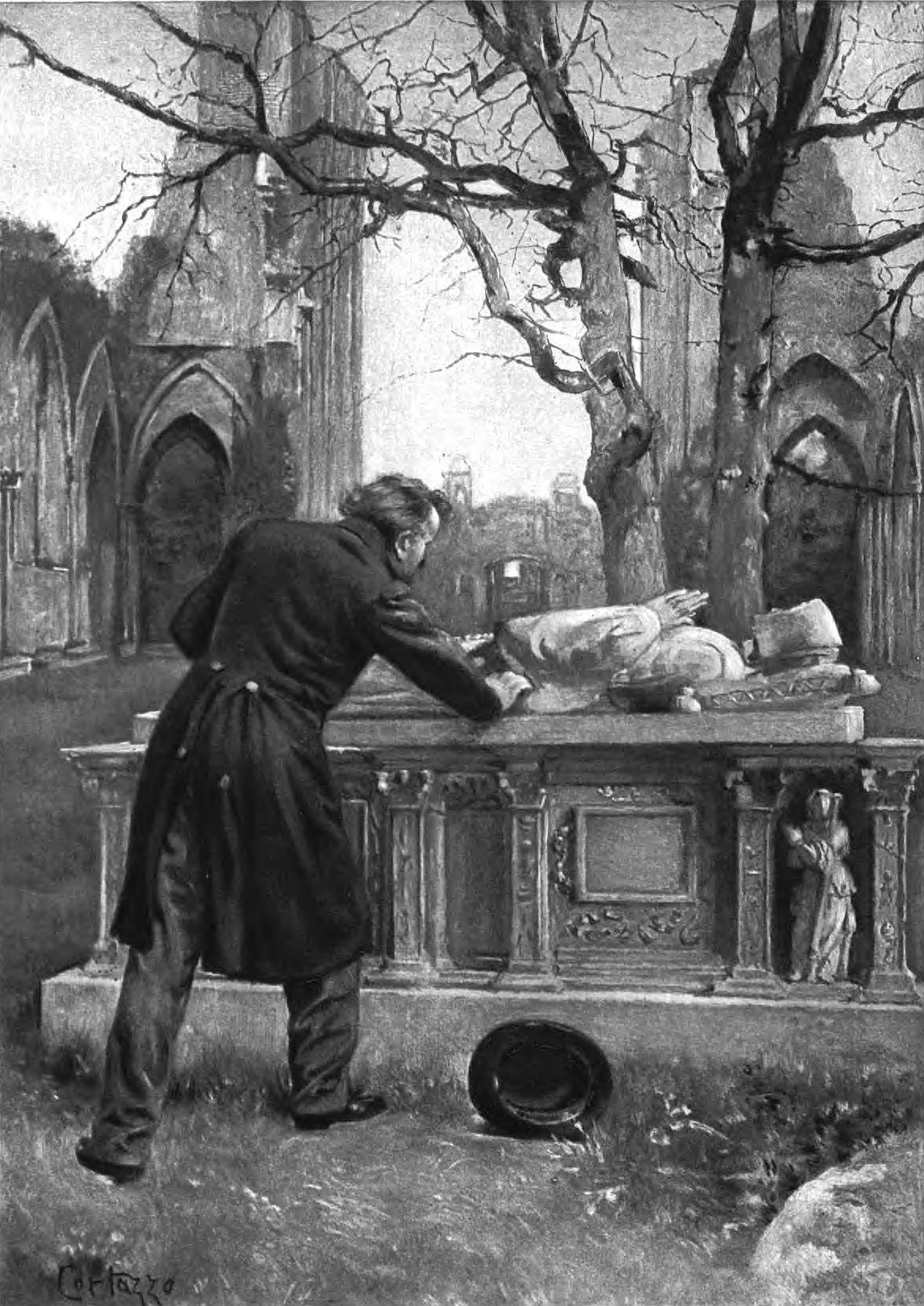
A FANTASTIC VISION.
"A young man, who presumably had some idea of sculpture, conceived a passion for a marble statue on a tomb. He went mad over it, and one day the poor devil raised the stone to see what was left of that lovely creature in the sarcophagus."
"A young man, who presumably had some idea of sculpture, conceived a passion for a marble statue on a tomb. He went mad over it, and one day the poor devil raised the stone to see what was left of that lovely creature in the sarcophagus. He found there—what he was certain to find there, the idiot!—a mummy! Thereupon, his reason returned, and he kissed the mummy, saying: 'I love you better so; at least, you are something that has lived, while I was enamored of a stone that has never been aware of its own existence.'"
"I don't understand," said Thérèse.
"Nor do I; but it may be that in love the statue is what one builds in his head, and the mummy what he takes into his heart."
Another day, he sketched Thérèse, in a pensive, melancholy attitude, in an album which she then looked through, finding there a dozen sketches of women whose insolent attitudes and shameless expressions made her blush. They were phantoms of the past which had passed through Laurent's memory, and had clung to those white pages, perhaps, in spite of him. Thérèse, without a word, tore out the leaf upon which she was given a place in that vile company, threw it into the fire, closed the album, and placed it on the table; then she sat down by the fire, put her foot on the andiron, and attempted to talk of something else.