Part 1 — HENRY VI PART I. (continued 2)
Reading edition
III, 5, 5.
This admirable passage forcibly illustrates the methods adopted by the actors in the art of acting in Elizabethan times. In our days this mode of producing stage effects is chiefly associated with the style of acting pursued by followers of the melodramatic school. If we examine carefully the substructure of Shakespeare’s tragic plays, we shall perforce arrive at the conclusion that melodrama enters largely into their composition.
Stript of their dialogue, the acts of these plays bear a striking resemblance to the lurid and blood curdling dramas nightly performed at our provincial theatres, and during the nineteenth century presented at the London theatres, principally those situated on the Surrey side of the Metropolis, and merely gaining the well-known sobriquet of the transpontine drama. These plays were interpreted by the actors in rather a boisterous manner by ranting and martial stalk, in reality tearing a passion to tatters, to very rags, tricks of the actors preserved by tradition from the very days of Shakespeare himself, who often alluded to and deprecated this inartistic and uncritical style of acting.
ROMEO AND JULIET
ACT. SCENE.
My dismal scene I needs must act alone.
IV, 3, 19.
MASQUERS.
Enter Romeo, Mercutio, Benvolio, with five or six other Masquers, Torchbearers and others.
WITHOUT-BOOK. PROLOGUE. PROMPTER. ENTRANCE.
Nor so without-book prologue faintly spoke After the prompter, for our entrance.
I, 4, 7.
The prompter was much in evidence in the early days of the theatre. The actor who spoke the prologue (not in the book of the play, but written by another hand at the command of the manager), no doubt, was much in need of that useful functionary.
MASK.
We mean well in going to this mask; But ’tis no wit to go.
I, 4, 48.
How long is’t now since last yourself and I Were in the mask? ’Tis since the nuptial of Incentio, Some five and twenty years, and then we mask’d.
I, 5, 35.
SCENE.
In fair Verona, where we lay our scene.
Chorus I, line 2.
CHORUS.
The first chorus is omitted in the First Folio. The second chorus at the end of the first act, or beginning of the second act, is included. Most critics would deny to Shakespeare both these compositions.
STAGE.
Is now the two hours’ traffic of the stage.
Chorus I, line 12.
The opening chorus of “Romeo and Juliet” contains the interesting information concerning the duration of an Elizabethan play. In those early days there were no long waits between the acts, no scenic effects to be staged, and but few properties required. Even allowing for the quick action without interruption, two hours is all too short for the proper representation of a Shakesperean play. There is evidence to prove that three hours was the limit. Ben Jonson, in the “Induction to Bartholomew Fair,” acted in 1614 at the Hope, refers to the space of two hours and a half, and somewhat more. Dekker, the prose writer and dramatist, mentions three hours: “Ye shall be glad to play three hours for twopence to the basest groundlings in London, whose breath is stronger than garlick and able to poison all the twelvepenny rooms.” The last phrase refers to the best places in the house.
Whetstone, as early as 1582, in his Civil Discourses, would allow three hours for a performance. If we bear in mind that a jig, which we should now call a farce, was performed after the regular piece and lasted at least half an hour, it must be conceded that three hours is none too many for the entire afternoon performance.
In winter the play commenced about two and lasted till dusk; in summer, three o’clock was the appointed hour. In a letter from Lord Hunsdon to the Lord Mayor in 1594, it is stated “that where heretofore they began not their plays till towards four o’clock, they will now begin at two and have done between four or five.” By this evidence about two hours and a half was the time required to act an Elizabethan play.
The quarto editions are not divided into scenes or acts. The text forming some of these plays was actually taken down from the actor’s lips, either by stenography or from memory, and if any interval had occurred it would have been recorded, which goes a long way to prove that the play was continuous throughout, otherwise three hours would be all too short to see the play through, especially a lengthy one like “Hamlet,” which has nearly four thousand lines. It is quite possible that a break of a few minutes may have taken place during certain scenes, but no stage directions exist sanctioning the usage.
TAMING OF THE SHREW
THE PRESENTERS ABOVE SPEAK.
The presenter in former times was one who took part in a play, an actor. The word is now obsolete. Even in Shakespeare’s day it is rarely met with. The Presenters in this scene were represented by Sly, the Page and the First Serving man, all being seated in the balcony above the stage.
ENTER A MESSENGER.
Your honour’s players hearing your amendment Are come to play a pleasant comedy: For so your doctors hold it very meet, Seeing too much sadness hath congealed your blood, And melancholy is the nurse of frenzy. Therefore they thought it good you hear a play And frame your mind to mirth and merriment, Which bars a thousand harms and lengthens life.
SLY.
Marry, I will let them play it. Is not a Christmas gambol or a tumbling trick?
PAGE.
No, my good lord; it is more pleasing stuff.
SLY.
What, household stuff?
PAGE.
It is a kind of history.
SLY.
Well, we’ll see it. Come, madam, wife, sit by my side. And let the world slip; we shall ne’er be younger.
COMEDY. PLAY. PLAYERS.
Your honour’s players hearing your amendment, Are come to play a pleasant comedy.
Ind. Sc. 2, 1, 136.
Therefore, they thought it good you hear a play.
Ind. Sc. 2, line 136.
Marry, I will let them play it. Is not a Christmas gambol or a tumbling trick?
Ind. Sc. II, line 140.
Every actor in the time of Elizabeth was forced to serve in some company of actors, who were under the protection of a nobleman, otherwise the poor actor was classed as a rogue and a vagabond, and liable to be sent to prison. “Your honour’s players” does not necessarily infer that they owed entire allegiance to their patron, but most likely they were prepared at all times to offer their services to their Lord protector. During the last two decades of the sixteenth century this patronage became merely formality, but owing to the strictures of the law this regulation was almost compulsory, so that in all England every play actor was under the patronage of some nobleman. As every one knows, Shakespeare belonged for many years to the servants of the Lord Chamberlain, and Edward Alleyn, the Founder of Dulwich College, and the greatest actor of his time, was a member of the Lord Admiral’s company. Even to-day there is a well known case of a gentleman owning his own orchestra a band of musicians, so that it is not at all unlikely that some wealthy or powerful nobleman retained a company of actors who only performed at his pleasure.
PART. PLAY.
My Lord, I warrant you we will play our part.
Ind. Sc. I, line 69.
PLAY’D. PLAY. PLAYERS.
There is a lord will hear you play to-night.
Ind. Sc. I, line 93.
For yet his honour never heard a play.
Ind. Sc. I, line 86.
They thought it good you hear a play And frame your mind to mirth.
Ind. Sc. II, line 139.
My lord, you nod; you do not mind the play.
I, 1, 2.
Players that offer service to your lordship.
Ind. Sc. 1, line 77.
PART. ENTER PLAYERS. PERFORMED.
LORD.
Now, fellows you are welcome.
PLAYERS.
We thank your honour.
LORD.
Do you intend to stay with me to-night?
PLAYERS.
So please your lordship to accept our duty.
LORD.
With all my heart. This fellow I remember Since once he played a farmer’s eldest son, ’Twas where you woo’d the gentlewoman so well: I have forgotten your name, but sure, that part Was aptly fitted and naturally performed.
PLAYERS.
I think ’twas Soto that your honour means.
LORD.
’Tis very true: thou did’st it excellent.
After having copied out the above passage, which was quite a bonne bouche for my theory, that Shakespeare on all occasions that offered themselves, introduced theatrical affairs into his plays, it came as rather a disappointment to find, on consulting the old drama of “The Taming of a Shrew,” the same scene slightly differently treated.
This old play was the one on which Shakespeare founded his own comedy of “The Taming of the Shrew.” The scene in which the players are introduced is called The Induction, and is founded on an episode in the life of Philip the Good, Duke of Burgundy, which is related in a Latin work by Heuterus, 1584, called De Rebus Burgundias. The story relates how the Duke, suddenly stumbling upon a drunken fellow lying in the road, has him conveyed to his palace, attires him like a lord, and when he wakes, the Duke and his followers keep the game up. The players present a comedy before him, and when he falls asleep he is again placed outside the ale house, and, on waking again, tells the host that he has had the grandest dream of his life, and if his wife vexes him he knows how to tame her. Strange to say, plays are mentioned in this Latin chronicle in which, to amuse the mock lord, the same incident is used in both English plays to entertain the so-called lord. I possess a late English book called Admirable Events. The fifth event relates the same adventures under the heading of “The Waking Man’s Dream.” It is believed that an early edition of this book was in circulation before Shakespeare’s time, but is now lost.
I have printed the players scene on account of its theatrical interest. It will be noted that the unusual word properties is used, also that the Duke is patron of a company of actors. The entire scene has an air of being taken straight from life. It was quite a common custom for actors to travel in the country or, as we should say, to go on tour. The company must have been a fairly large one, as several characters are introduced in the real play.
PLAYERS SCENE FROM THE OLD. PLAY.
MESSENGER.
And it please your honour your players be come, And do attend your honour’s pleasure here.
LORD.
The fittest time they could have chosen out; Bid one or two of them come hither straight, Now will I fit myself accordingly, For they shall play to him when he wakes.
(Enter two of the players with packs at their backs and a boy.)
Now, sirs, what store of plays have you?
SAN. (SANDER.)
Marry, my Lord, you may have a tragical or comodity or what you will.
THE OTHER.
A comedy, thou shouldst say: Souns, thou’lt shame us all.
LORD.
And what’s the name of your comedy?
SAN.
Marry, my lord, ’tis called “The Taming of a Shrew.” ’Tis a good lesson for us my lord that are married men.
LORD.
“The Taming of a Shrew,” that’s excellent sure, Go, see that you make ready straight, For you must play before a lord to-night. Say, you are his men and I your fellow, He’s something foolish, but whatso’er he says, See that you be not dashed out of countenance. Now, sirs, go you and make you ready, too, For you must play as soon as he doth wake.
SAN.
O brave, sirrah Tom, we must play before A foolish lord; come, let’s go make us ready: Go get a dishclout to make clean your shoes, And I’ll speak for the properties. My lord, we must Have a shoulder of mutton for a property, And a little vinegar to make our devil roar.
LORD.
Very well, sirrah, see that they want nothing.
LORD.
May it please you, your honour’s players be come to offer your honour a play.
SLY.
A play, Sim. O brave be they my players?
LORD.
Ay, my lord.
SLY.
Is there not a fool in the play?
LORD.
Yes, my lord.
SLY.
When will they play him?
LORD.
Even when it please your honour, they be ready.
BOY.
I’ll go bid them begin the play.
SLY.
Do, but look that you come again.
BOY.
I warrant you, my lord, I will not leave you.
SLY.
Come, Sim, where be the players? Sim, stand by me and we’ll flout the players out of their coats.
LORD.
I’ll call them, my lord. Ho, where are you there?
TEMPEST
PERFORM. CAST. ACT. PROLOGUE. DISCHARGE.
We all were sea-swallowed, though some cast again And by that destiny, to perform an act Whereof what’s past is prologue, what to come In yours and my discharge.
II, 1, 252.
ACTORS.
These our actors As I foretold you, were all spirits.
IV, 1, 148.
CAST.
We all were sea-swallowed though some cast again.
W. A. Wright would associate cast with its modern theatrical meaning, namely, of a company of actors to whom different parts of a play are assigned. The word in this sense was unknown in Shakespeare’s day; its earliest use as a theatrical term dates from 1631.
PLAYED. PART.
To have no screen between this part, he play’d, And him he played it for.
I, 2, 107.
REVELS.
Be cheerful, Sir, Our revels now are ended.
IV, 1, 148.
TIMON OF ATHENS
ACT.
Performance is ever the duller for his act.
V, 1, 26.
TITUS ANDRONICUS
I have read this disagreeable play very carefully, and can find therein no theatrical allusion of any kind.
Although included in the First Folio, and mentioned by Meres, Shakespeare’s contemporary, in a book published by him in 1598, a great many critics refuse to believe in the Shakesperean authorship. Many monographs have been written on the subject for and against. The weight of evidence is rather against the Shakesperean authorship. The plot is of a most blood-curdling nature, and many of the episodes are too terrible and nasty to be represented on the stage. There are many passages in the play which are truly poetical. It is to be hoped for Shakespeare’s reputation that he had no hand in this vile composition.
TROILUS AND CRESSIDA
ACTOR. PROLOGUE. ARGUMENT. PLAY.
And hither am I come A prologue armed, but not in confidence Of author’s pen or actor’s voice, but suited In like condition as our argument. To tell you fair beholders, that our play Leaps o’er the vaunt and firstlings of these broils, Beginning in the middle, starting thence away To what may be digested in a play.
Prologue, line 23.
HISS.
Some two months hence my will shall here be made. It should be now, but that my fear is this, Some galled goose of Winchester would hiss.
V, 10, 55.
PAGEANT.
Q.
Let my lady apprehend no fear; in all Cupid’s pageant there is represented no monster.
III, 2, 80.
From this passage it must be inferred that a Fear was a part played or impersonated in our old pageants or moralities. To this circumstance, Aspatia alludes in The Maid’s Tragedy, “And then a Fear,” “Do that Fear bravely wench.”
Let Patroclus make demands to me, You shall see the pageant of Ajax.
III, 3, 275.
PLAYER. SCAFFOLDAGE.
And like a strutting player, whose conceit Lies in his hamstring, and doth think it rich To hear the wooden dialogue and sound ’Twixt his stretched footing and the scaffoldage. Such to be pitied and o’er wrested seeming He acts thy greatness in.
Good all round acting in Shakespeare’s time was not the order of the day, as practised in ours. One or two stars, and the rest nowhere. Thus Shakespeare compares the strutting actor to the wooden boards on which he treads, making up in martial gait and heavy tread what he lacks in spiritual fire. The scaffoldage refers to the wooden platform on which plays were enacted. A hamstring is one of the tendons which form the sides of the ham or space at the back of the knee.
APPLAUSE.
From his deep chest laughs out a loud applause.
I, 11, 163.
PLAY.
Now play me Nestor.
I, 3, 165.
Now play him me Patroclus.
I, 3, 170.
SCENE.
In Troy there lies the scene.
Prologue, line 1.
TWELFTH NIGHT
STAGE. PLAYED.
FABIAN.
If this were played upon a stage now, I could condemn it as improbable fiction.
III, 4, 140.
This passage refers to the interview between Malvolio, Sir Toby, Maria and Fabian, after his appearance before the Countess in yellow stockings and the keep-smiling face. Shakespeare always strove to impress on his audience that his chief characters were impersonating events of everyday life; in order to heighten this belief, he frequently contrasts the real with the stage life or life of fiction.
VICE.
I am gone, sir, and Anon, sir, I’ll be with you again. In a trice, Like to the old Vice Your need to sustain; Who with dagger of lath In his rage and his wrath, Cries ha! ha! to the devil Like a mad lad, Pare his nails, dad. Adieu, goodman devil.
IV, 2, 134.
The Vice is a character chiefly to be met with in interludes, for the sake of comic relief, much in the same manner as in our melodramas of to-day comic characters are introduced, in order to render less oppressive the serious or tragic situations. This personality was dressed in a cap with ass’s ears, a long coat, and provided with a dagger of lath. One of his chief employments was to make sport with the devil by leaping on his back and belabouring him with his cardboard property till he made him roar. The devil, however, always carried him off in the end. His Satanic Majesty was supposed from choice to keep his nails always unpared, therefore to pare them was considered an affront.
In an interlude, “The Trial of Treasure,” he appeared in his customary stage apparel, with the addition of a pair of huge spectacles, no doubt to render him more ridiculous. The character seems to have been quite a popular one in mediæval times. The Vice appears in several plays of the sixteenth century, and is frequently mentioned by Elizabethan dramatists.
INTERLUDE.
I was one, sir, in this interlude, one Sir Topaz, sir, but that’s all one.
V, 1, 380.
The New English Dictionary describes an interlude as a dramatic representation of a light and humourous kind, such as was commonly introduced between the acts of the long mystery play or moralities, or exhibited as a part of an elaborate entertainment. This title was given to the first comedy written in English, “Our Comedie or Interlude which we intend to play is named ‘Ralph Royster Doyster in deede.’”
Sir A. Ward, the learned author of a history of English dramatic literature, writes: “It seems to have been applied to plays performed by professional actors from the time of Edward IV onwards. Its origin is doubtless to be found in the fact that such plays were occasionally performed in the interval of banquets and entertainments which, of course, would have been out of question in the case of religious plays proper.” Mr. E. K. Chambers, in his magnificent and scholarly work, The Mediæval Stage, would apply the meaning of the word Interlude to any kind of play, religious or otherwise, but instead of deriving the word from a “ludus” during the interval of something else, he would give it the meaning of a play carried on between (inter) two or more performers; in fact, a ludus in dialogue.
Ludus is the Latin for a play.
COMEDIAN.
Are you a comedian.
I, 5, 194.
This word, now in general use, was quite a novel introduction in Shakespeare’s time. The New English Dictionary quotes this passage as the first instance of the words being used in this sense. The date of this play is about 1601, which is proved from an entry in Manningham’s Diary, dated February 2nd, 1601; by our present reckoning this performance took place in 1602, as formerly the New Year began on the 25th of March.
“Feb. 2, 1601. At our feast we had a play called “Twelve Night,” or What you Will. Much like the “Comedy of Errors” or Menechmi in Plautus, but most like and near to that in Italian called Inganni.”
There is also a reference in the play to the map of the Indies. This map was issued in 1599, so between this date and the entry in the Diary 1601, this comedy must have been written.
ACT.
VIOLA.
My father had a mole upon his brow.
SEBASTIAN.
And so had mine.
VIOLA.
And died that day when Viola from her birth Had numbered thirteen years.
SEBASTIAN.
O, that record is lively in my soul, He finished indeed his mortal act That day that made my sister thirteen years.
V, 1, 249.
It shall become thee well to act my woes.
I, 4, 26.
MASQUE. REVELS.
SIR ANDREW.
I delight in masques and revels sometimes altogether.
I, 3, 121.
PART.
And all is semblative a woman’s part.
I, 4, 34.
WITHOUT BOOK.
An affectioned ass, that can state without book.
Without book was a technical theatrical term used by actors when they had got their part by heart. The phrase is now obsolete.
These pastimes were in great vogue when this play was written.
PLAY.
This fellow is wise enough to play the fool.
III, 1, 67.
That’s all one, our play is done And we’ll strive to please you every day.
V, 1, 416.
REVELS.
Shall we set about some revels?
I, 3, 145.
ZANY.
MALVOLIO.
I take these Wisemen that crow so at these set kind of fools, No better than the fool’s Zanies.
I, 5, 96.
The Italian Zanni or Zany is a contraction for Giovanni in the dialect of Bergamo, and is a nickname for a peasant of that place. The term Zany was generally applied in England to an inferior kind of fool imitating another or professional jester, corresponding in some degree to our own clown and pantaloon, the latter being the zany.
In connexion with the word Zany, it should be noted that Molière, the greatest dramatist after Shakespeare, usually introduced this character into his farces, under the name of Sgnarelle, which is a French rendering of the Italian word Zanarelle, the diminutive of Zanni. Molière himself generally acted this comic rôle.
TWO GENTLEMEN OF VERONA
ACTED. PAGEANTS. WOMAN’S PART. PLAY. PART. PLAY’D.
How tall was she? About my stature: for at Pentecost When all our pageants of delight were play’d, Our youth got me to play the woman’s part, And I was trimm’d in Madam Julia’s gown; Which served me as fit by all men’s judgment, As if the garment had been made for me; Therefore I know she is about my height, And at that time I made her weep a good, For I did play a lamentable part; Madam, ’twas Ariadne passioning For Theseus’ perjury and unjust flight: Which I so lively acted with my tears, That my poor mistress moved therewithal Wept bitterly, and would I might be dead If I in thought felt not her very sorrow.
IV, 4, 163.
The page who delivered this speech relates how he played the woman’s part. In Shakespeare’s time, and until half a century later, no woman appeared on the public stage. I have always held the opinion that it was on this account that so many of Shakespeare’s heroines were disguised as pages, thus enabling the boys who took their parts to be more natural. Most readers will call to mind Rosalind in “As you Like It” and Imogen in “Cymbeline,” but principally Viola in that delightful of all comedies “Twelfth Night.” Julia, one of the heroines in this play, also played the part of a page. The observant will notice that Madam Julia lent her gown to the impersonator of Ariadne, but in those days the costume of the period delineated was not regarded. By all accounts, all the characters were clothed in contemporary costumes. Even as late as the eighteenth century, David Garrick played Macbeth, dressed in a scarlet coat like a military officer, a waistcoat laced with silver, with a wig and breeches of the cut of the time. Macklin, a great actor of the eighteenth century, was the first to appear in a tartan and kilt about the year 1772.
MOTION. PUPPET.
O excellent motion! O exceeding puppet! Now will he interpret to her.
II, 1, 92.
A puppet was a figure dressed up like a doll and moved by strings by a person concealed behind a curtain, similar to our Punch and Judy and marionettes shows of to-day. The word was frequently used metaphorically by the early dramatists, when they wished to describe a person’s actions controlled by others, also applied contemptuously to a person as in the above passage. These puppet shows or motions, as they were termed, were exceedingly popular in Shakespeare’s time, and a special one is mentioned by Ben Jonson in Every Man Out of his Humour: “They say there’s a new Motion of the City of Nineveh with Jonas (not Maurice) and the whale to be seen at Fleet Bridge.” A Motion that was extremely popular was the history of the prodigal son, quoted by Shakespeare in a “Winter’s Tale.” “Then he compassed a motion of the Prodigal Son.” Biblical episodes often formed the subject of these shows.
Both puppet and motion, in their original sense, are now obsolete. “Now will he interpret her” refers to the dialogue spoken by the manipulation of the puppets
“The peeling accents of her voice, is like a fained treble on one’s voice that interprets to the puppets.”
THE WINTER’S TALE
ACT. AUDIENCE. ACTED.
The dignity of this act was worth the audience of Kings and princes, For by such was it acted.
V, 2, 86.
PART. PLAY. HISS.
Thy Mother plays and I Play too, but so disgraced a part whose issue Will hiss me to my grave.
I, 2, 188.
I see the play so lies That I must bear a part
IV, 4, 670.
PART. PERFORMED.
Good Paulina, Lead us from hence, where we may leisurely Each one demand and answer to his part Performed in this wide gap of time since first We were dissevered.
V, 3, 151.
MOTION.
Then he compassed a motion of the Prodigal son.
IV, 3, 103.
The puppet or motion showman exclaims in “Bartholomew Fair”: “O, the motions that I, Lanthorn Leatherhead, have given light to in my time.”
PLAY. SCENE.
My care to have you royally appointed as if The scene you play were mine.
IV, 4, 604.
SPECTATORS.
Though devised And played to take spectators.
III, 2, 38.
PASTORAL.
I play as I have seen them do In Whitsun pastorals.
IV, 4, 134.
The reference is to the several kinds of May games which were performed at this season of the year. They consisted of short dramatic pieces of French origin. The earliest known is that of the “Jeu de Robin et Marian,” which was played in 1392. M. Guy quotes it as folk going “desguiziez un Jeu qui l’endit Robin et Marian ainsi qu’il est accoutume de fere chacun an en les foiries de Penthecouste.” These pieces were a mixture of folk song and minstreling, which developed into a kind of primitive drama. The principal characters being represented by Shepherds and Shepherdesses, surrounded by woodland scenery. In Molière’s plays will be found two of these pastoral dramas, “Melicente,” comedie pastorale heroique; another was simply entitled, “Pastorale comique.”
THE LONDON Prodigall.
As it was plaide by the Kings Maiesties seruants.
By VVilliam Shakespeare,
LONDON.
Printed by T. C. for Nathaniel Butter, and are to be sold neere S. Austins gate, at the signe of the pyde Bull. 1605.
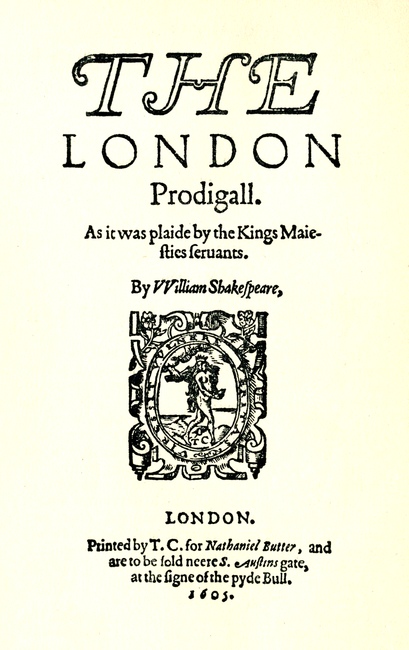
(Original Image)
Title page of an English Play.
ANDROMEDE TRAGEDIE
Representée auec les Machines sur le Theatre Royal de Bourbon.
A ROVEN, Chez LAVRENS MAVRRY, prés le Palais.
AVEC PRIVILEGE DV ROY. M. D C. LI.
Et se vendent A PARIS, Chez CHARLES DE SERCY, au Palais, dans la Salle Dauphine, à la bonne Foy Couronnée.
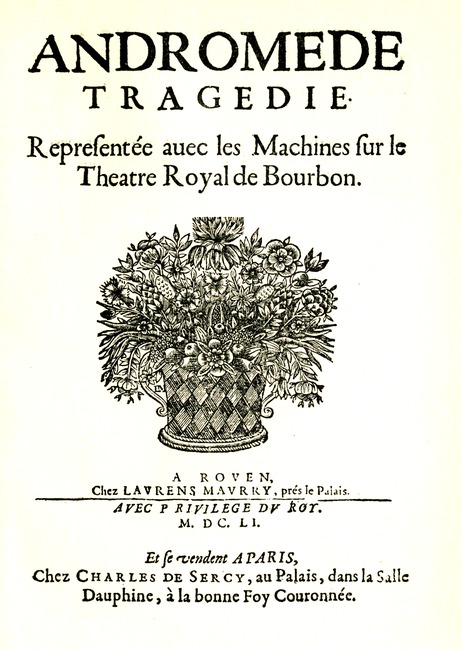
(Original Image)
Title page of a French Tragedy by Pierre Corneille, indicating at which Theatre the play was produced, showing a similarity with dramatic title pages of the seventeenth century.
I cannot close this book without mentioning the assistance rendered me respecting the illustrations. As in a previous volume, my friend, Mr. H. Franklin Waghorn, kindly holds himself responsible for the photographic work he has so ably executed. My friend, in order to help me, made many visits to the British Museum on my behalf. The authorities of that marvellous institution graciously permitted Mr. Waghorn to take photographs of any rare books which he desired for my work, for which permission I beg to offer my best thanks. Mr. Fleming, who made the blocks for the facsimiles, has executed his work beyond all praise.