Chapter III · THE THEATRES (continued 2)
Reading edition
An earlier play on the same subject that Shakespeare treated in “Twelfth Night” is generally supposed to have been presented on the stage. The roof of the hutch is surmounted by a flag, waving over the building, bearing for its sign a swan. With the exception of the stage, which was a movable one, the other parts of the stage buildings were permanent structures. The different sections of the house inscribed in the sketch are as follows: Over the topmost gallery is a sloping roof, which ran right round the theatre, inscribed on the right hand side facing the spectators with the word “tectum,” the Latin for roof. This part of the theatre was either tiled or thatched throughout. In one division of the lowermost gallery, in which were situated the best seats, a space therein, so described with the word “orchestra.” Professor Lawrence has written a very ingenious and learned dissertation on the meaning of this word, in which he proves conclusively that the place so marked was set apart for private boxes, called in the theatrical parlance of the day “The gentlemen’s rooms.”
The word orchestra, in this sense, has no connexion with the modern meaning of the word, or the ancient Greek definition, signifying a place reserved for dancing, also where the chorus accompanying a Greek play sang. The true meaning in the Shakesperean period denoted that part of the auditorium set aside for noblemen or those willing to pay a high price for their seats.
Cotgrave, in his English and French dictionary, published in 1611, defines orchestre as “the senators or noblemens’ places in a theatre, between the stage and the common seats.” The knowledge of this important fact in reconstructing intelligibly this part of an old theatre is a debt we owe to the ingenuity and learning of Professor Lawrence.
The word “sedilia” refers to the seats in the galleries, which proves that seating accommodation was provided in this part of the house, a fact which had been doubted for many years past.
The porticus was a colonnade or corridor running round the gallery furnished with columns supporting the galleries, and may have afforded standing room for spectators.
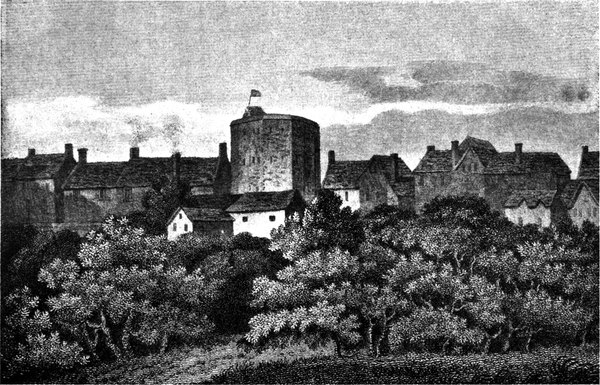
The Swan Theatre. From Visscher’s Map of London, 1616.
“Ingressus” refers to the steps leading to the galleries, being placed on both sides of the house. Other steps not shown in the sketch led to the second and third galleries. At this point were stationed the “gatherers,” who received the extra payment for entrance to these seats.
The structure behind the stage, inscribed “mimorum aedes,” is the tiring room for the actors making their exits and their entrances through the two doors placed one on each side. The word “proscænium” is the Latin word for stage, derived from the Greek word Skene, a booth or tent, in which the leader of the chorus in the early days of the Greek drama erected his dressing room. The same word scene, in our own days, bears many theatrical meanings almost identical with the word employed twenty-five hundred years ago, thus contradicting the belief of most people that we owe everything to the genius of the present generation.
The arena was the yard, in which stood the pit and gallery habitués of our day, the charge for this privilege being one penny.
I hope the reader will constantly refer to the drawing whilst reading this description, as it will materially help him in fully understanding the interior of an Elizabethan playhouse.
The Hope Theatre was modelled on the Swan. I here append the contract for the first-named theatre:
“The contractor, Katherens, is to take down the existing structure, and to build in its place another game house or plaie house fit for players to play in and for the game of bears and bulls. There is to be provided a tyre house and a frame to be carried or taken away and to stand upon tressels, sufficient to bear such a stage. It is agreed to build the same of such large compass, form, wideness and height as the playhouse called the Swan in the liberty of Paris Garden. And the said playhouse or game place to be made in all things and in such form and fashion as the said playhouse called the Swan, the scantling of the timbers, tiles and foundations as is aforesaid without fraud or covin.” The last word means conspiracy or collusion.
The separate items are:
1. Two staircases without and adjoining the playhouse of such largeness and height as the said playhouse called the Swan.
These stairs are not shown in the sketch; perhaps they were placed outside the building. It would be interesting to know the exact position.
2. “Heavens” over the stage to be borne and carried away without any posts or supporters to be fixed or set about the stage. Gutters of lead needful for carriage of water that shall fall about the same.
The “Heavens” in the Hope contract is different somewhat from the Swan, as the sketch plainly shows the columns supporting the “Heavens.”
3. Two boxes in the lowermost storey, fit and decent for gentlemen to sit in, and shall make the partition between the rooms as they are at the said playhouse called the Swan.
The boxes are marked “Orchestra” in the sketch.
4. Turned columns upon and over the stage.
5. Principals and forefront of the playhouse to be of oak; no fir to be used in the lowermost or under stones, except the upright posts or the back part of the said stones, all binding joists to be of oak.
6. To new tyle with English tyles all the upper roof of the said playhouse.
7. Also a louvre or storey over the said playhouse as it now is.
Several of the above particulars confirm the exactness of the drawing. It must not be forgotten that between the building of the Swan and that of the Hope nearly twenty years had intervened; in that time many improvements had taken place, but the essentials remain the same.
The Swan Theatre has little interest for students, the entertainments being chiefly devoted to bear-baiting, and other sports of a less exciting nature.
Francis Meres, the author of Palladis Tamia, published in 1598, refers to the Swan in the following passage: “As Antipater Sidonius was famous for extemporal verse in Greek.... And so is now our wittie Wilson, who, for learning and extemporal witte in this facultie, is without compare or compeere, as to his great and eternall commendations he manifested in his chalenge at the Swanne on the Banke-side.” A very interesting account of Shakespeare occurs in the same book: “As the soule of Euphorbus was thought to live in Pythagoras so the sweete wittie soule of Ovid lives in mellifluous and honeytongued Shakespeare, witness his Venus and Adonis, his Lucrece, his sugred sonnets among his private friends, etc.”
A few more references to the Swan are still extant. A certain Peter Bromville appeared at this theatre in 1600, performing acts of activity, he having exhibited the same before the Queen. Acts of activity correspond to those acrobatic feats often seen at our present day music halls.
Another extract is from Dekker’s play “Satiromastic,” 1602. Tucca: “Thou hast been at Paris Garden, hast not?” Horace: “Yes, Captain, I have played Zulziman there.” I have searched in vain to find the name of the play in which the part of Zulziman occurs. Ben Jonson acted the part of Zulziman.
The Swan was often alluded to as Paris Garden. Middleton’s play of “A Chaste Maid in Cheapside” was performed there. Another notice relates how a knight, witnessing the last new play at the Swan, lost his purse containing seven angels. An angel was a gold coin, valued at ten shillings. A man named Turner was thrust through the eye and killed here whilst contesting there for a prize.
During the last years of the Swan, only fencing matches and gladiatorial exhibitions were given. The last notice of this theatre appeared in a pamphlet entitled “Holland’s Leaguer,” by N. Goodman, published in 1632: “Three famous amphitheatres can be seen from the turret, one the continent of the world (i.e., the Globe), to which, half the year, a world of beauties and brave spirits resort. A building of excellent hope for players, wild beasts and gladiators and another, that the lady of the Leaguer in fortress could almost shake hands with, now fallen to decay and like a dying swan, hangs her head and sings her own dirge.” A dying swan evidently refers to this playhouse. It was a popular belief that a swan fluted a wild carol in her death.
Mr. Ordish attributes this pamphlet to Shakerley Marmion, who wrote a play called “Holland’s Leaguer.” Mr. Ordish has by a clerical error mixed the babies up.
Before taking leave of the fortunes of the Swan Theatre I wish to relate an interesting event which took place there in the year 1602, which incidently throws considerable light on how Elizabethan managers advertised their special shows on important occasions. The circumstances are described in a letter from John Chamberlain to Dudley Carleton in 1602.
“And now we are in mirth I must not forget to tell you of a cosening prank of one Venner, of Lincoln’s Inn, that gave out bills of a famous play on Saturday, was sevennight on the Bankside, to be acted only by certain gentlemen and gentlewomen of account. The price at coming was two shillings or eighteenpence at least, and when he had gotten most part of the money into his hands he would have shewed them a fair pair of heels, but he was not so nimble to get upon horseback, but that he was fain to forsake that course and betake himself to the water, where he was pursued and taken and brought before the Lord Chief Justice, who would make nothing of it but a jest and a merriment and bound him over on five pounds to appear at the sessions. In the meantime the common people, when they saw themselves deluded, revenged themselves upon the hangings, curtains, chairs, stone walls, and whatsoever came in their way, very outrageously and made great spoil, there was great store of good company and many noblemen.”
This event is referred to by Ben Jonson in his “Masque of Angurs, 1622.” Three of these gentlemen should have acted in that famous matter of “England’s Joy,” in 1603, but the date should be 1602. In a poetical effusion by Taylor, the Water Poet, he relates how one Fenner often confused with the real writer of “England’s Joy,” Venner, advertised himself as the author of this piece. This Fenner was the rival of Taylor as an extempore rhymester, and being challenged and the bills set up advertising the literary duel, Taylor prepared himself for the meeting. On the day appointed Fenner failed to come to the scratch, thereby causing Taylor to be branded as an impostor, which drew from him the following lines, published in his “A Cast over Water,” 1615:
“My defence against thy offence.”
“Thou bragst what fame thou gottst upon the stage, Indeed, thou set’st the people in a rage In playing ‘England’s Joy’ that every man Did judge it worse than that done at the Swan. To all your cost he will his wits employ To play the second part of ‘England’s Joy,’ And poor old Venner that plain-dealing man, Who acted ‘England’s Joy’ first at the Swan, Paid eight crowns for the writing of these things, Besides the covers and the silken strings.”
The original play-bill announcing this performance has the following title: ...
“The plot of the play called ‘England’s Joy,’ To be played at the Swan this 6 of March, 1602.”
This document being of such extreme interest, a photograph will be found on the opposite page. One can see by the smallness of the print that it was not intended for a poster, but to be distributed either amongst the assembled audience or delivered at the houses of the gentry or handed to passers-by in the street. The original of this broad sheet is preserved in the collection of the Society of Antiquaries. By the courtesy of the Secretary of the Society of Antiquaries I was accorded the privilege of inspecting this most interesting document, and further, allowed the favour of having the original photographed especially for this book. Although, as stated above, the print is too small for a poster, yet it is quite legible, almost the size of the type of this page.
THE PLOT OF THE PLAY, CALLED ENGLANDS JOY.
To be Playd at the Swan this 6. of Nouember. 1602.
FIRST, there is induct by shew and in Action; the ciuill warres of England from Edward the third, to the end of Queene Maries raigne, with the ouerthrow of Vsurpation.
2 Secondly then the entrance of Englands Ioy by the Coronation of our Soueraigne Lady Elizabeth, her Throne attended with peace, Plenty, and ciuill Pollicy: A sacred Prelate standing at her right hand, betokening the Serenity of the Gospell: At her left hand Iustice: And at her feete Warre, with a Scarlet Roabe of peace vpon his Armour: A wreath of Bayes about his temples, and a braunch of Palme in his hand.
3 Thirdly is dragd in three Furies, presenting Dissention, Famine, and Bloudshed, which are throwne downe into hell.
4 Fourthly is exprest vnder the person of a Tyrant, the enuy of Spayne, who to shew his cruelty causeth his Souldiers dragge in a beautifull Lady, whome they mangle and wound, tearing her garments and Iewels from off her: And so leaue her bloody, with her hayre about her shoulders, lying vpon the ground. To her come certaine Gentlemen, who seeing her pitious dispoylment, turne to the Throne of England, from whence one descendeth, taketh vp the Lady, wipeth her eyes, bindeth vp her woundes, giueth her treasure, and bringeth forth a band of Souldiers, who attend her forth: This Lady presenteth Belgia.
5 Fiftly, the Tyrant more enraged, taketh counsell, sends forth letters, priuie Spies, and secret vnderminers, taking their othes, and giuing them bagges of treasure. These signifie Lopus, and certaine Iesuites, who afterward, when the Tyrant lookes for an answere from them, are shewed to him in a glasse with halters about their neckes, which makes him mad with fury.
6 Sixtly, the Tyrant seeing all secret meanes to fayle him, intendeth open violence and inuasion by the hand of Warre, whereupon is set forth the battle at Sea in 88, with Englands victory.
7 Seuenthly, hee complotteth with the Irish rebelles, wherein is layd open the base ingratitude of Tyrone, the landing there of Don John de Aguila, and their dissipation by the wisdome and valour of the Lord Mountioy.
8 Eightly, a great triumph is made with fighting of twelue Gentlemen at Barriers, and sundrie rewards sent from the Throne of England, to all sortes of well deseruers.
9 Lastly, the Nine Worthyes, with seuerall Coronets, present themselues before the Throne, which are put backe by certaine in the habite of Angels, who set vpon the Ladies head, which represents her Maiestie, an Emperiall Crowne, garnished with the Sunne, Moone and Starres; And so with Musicke both with voyce and Instruments shee is taken vp into Heauen, when presently appeares, a Throne of blessed Soules, and beneath vnder the Stage set forth with strange fireworkes, diuers blacke and damned Soules, wonderfully discribed in their seuerall torments.
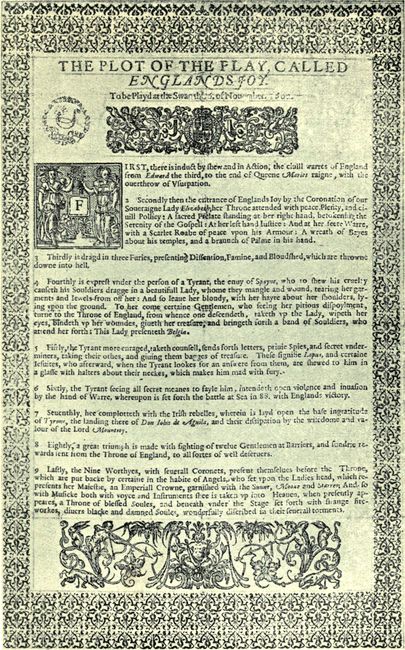
The plot of England’s Joy, specially photographed for this book, from the original, with kind permission of the Society of Antiquaries.
In the fifth paragraph of this most interesting programme of “England’s Joy” appears the name of Lopus, or more correctly Lopez. This name opens up a wide field of controversy, for the bearer was a Jew, and English historians aver that since the expulsion of that race in 1290, no Jew set foot on English soil until the time of Cromwell, over 350 years later than the first and only exodus. There can be no doubt that a certain number of Jews visited these shores, and a few settled here and made it their permanent home. This Lopez was a celebrated Jewish physician, and was honoured by being elected house surgeon to St. Bartholomew’s Hospital; afterwards he became physician to Queen Elizabeth. After many years’ residence in this country he was arrested on suspicion of being implicated In a plot to poison the Queen; he was duly tried, convicted and sentenced to be hanged, which sentence a few months later was carried out at Tyburn. According to Camden, the learned antiquarian, Lopez’s last words on the scaffold were that he loved the Queen as much as he did Jesus Christ, which naturally leads one to the assumption that he must have been a converted Jew and have forsaken the faith of his fathers, or else Camden may have invented this dying confession in order to show that some Jews believed in the Christian religion.
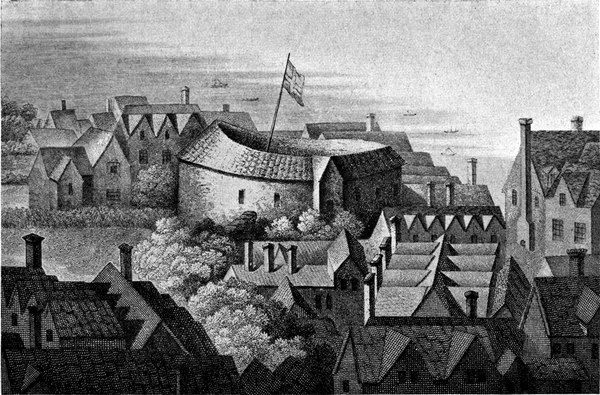
Either the Rose Theatre or the First Globe Theatre.
When the Swan Theatre was sold it realized the sum of £1,873. A view of the exterior of the theatre is depicted in Visscher’s Map of London, 1616. The old theatre is marked on the Map of the Manor, dated 1627.
This sketch of the interior of the Swan Theatre, dated circa 1596, important as it is, must not be taken too literally; many discrepancies can be detected when compared with our knowledge of the contemporary stage. Especially noticeable is the bareness of the stage, and lack of all signs of any suggestion of a curtain, which, judging by directions in old plays, was a most important feature. Also be it remembered that the Swan playhouse was not typically a playgoers’ theatre, being devoted chiefly to feats of activity and other pastimes.
THE GLOBE THEATRE
The last theatre built on the Bankside was the most famous of all, namely, the Globe. On the stage of this theatre the greatest of the Shakesperean plays were first acted; here Shakespeare followed the actor’s calling, covering a period of ten years.
The site of such a famous spot might well kindle the imagination of every Englishman who takes a pride in the welfare of his country. Instead of which, what do we find? Truthfully speaking, not one Englishman in a thousand could indicate in what part of the Metropolis the Globe Theatre stood, and many could be found totally ignorant of the existence in early days of that theatre. Strange to relate, the fascinating study of old London does not appeal to modern Englishmen.
What would be the opinion of the greatest creator of the grandest literature the world has known if he could behold the vast majority of present day citizens, the labouring class of Britons, being sweated half-naked in factories for the benefit of a body of shareholders who look upon them as fuel for their machines? Such is England of to-day! and those men who accept such conditions deserve nothing but contempt. The better class idolize sport, cultivating physical strength at the expense of the mind; all the brains this sporting class possess seem hidden in their hands or feet; naturally brought up under these conditions they despise the beauties of the mind, and become slaves of their sensuous feelings, which would even make a Chinaman look down upon them with contempt. The only way to eradicate these vicious symptoms is by teaching the younger generation that money-making is not the fountain of happiness, and that hours of freedom are necessary for the enjoyment of life and the worship of both toil and wealth are fit only to be followed by despised nations.
If these rules are dutifully followed, Englishmen would be themselves again, and not a crowd of unworthy people whose only topic of conversation consists of sport, money, and amusement.
Judging from the dastardly act of razing Crosby Hall to the ground, little care they for the beautiful and sacred memorials of the past, otherwise such acts of vandalism would scarcely be permitted. Our City Authorities, filled with wine, beer, and turtle soup, allow these Philistines for the greed of gold to desecrate and demolish every ancient building, and are equally blamable in permitting these scandals of impiety to be carried out by the demons of improvement.
Some disgusting brewery, or evil-smelling warehouse or factory, are the buildings generally erected on these famous sites. No doubt the idiot guardians of the City regard these unsightly buildings as vast improvements.
Such being the spirit of the times, there is little reason for wonder that not even the sites of many ancient important places of interest can be accurately delineated. Unfortunately this indictment applies in some measure when we search for the site of the Globe Theatre. The original plot of ground occupied by the theatre can only be conjecturally restored, and then the deepest research and careful reading of old documents must be diligently studied, besides which the poring over old maps is most essential for the true discovery of the exact sites.
An extremely illuminating article on the site of the first Globe Theatre was contributed to the transactions of the London and Middlesex Archæological Society in 1912 by Mr. George Hubbard, Vice-President of the Royal Institute of British Architects. This pamphlet was first read at the Bishopsgate Institute in February of the same year. This learned dissertation was the result of a vehement discussion following the fixing of a bronze tablet on the outside wall of Messrs. Barclay and Perkins’ Brewery, situated on the south of Park Street, formerly Maid Lane. The dispute arises over which side of the road the original Globe Theatre occupied, either on the north or the south side of Maid Lane, the modern Park Street. After a careful perusal of Mr. Hubbard’s article, every sensible reader will strongly endorse the author’s views and give his vote without demur for the north side.
Mr. William Martin, in a little special pleading, maintains in a most able and interesting paper which appeared in the Surrey Archæological Collections, vol. xxiii, that the site must be sought on the south side, without, in my judgment, convincing anyone. Before Mr. Hubbard entered the field of controversy, Mr. Martin’s article had already been published.
When the Burbages dismantled their playhouse in Shoreditch, they removed the materials of the building, which chiefly consisted of wood, over the water, and there on the Bankside erected a new theatre. The Times printed four articles from the pen of Mr. Wallace, Professor of English Literature in an American university, on matters of great interest in connexion with the Globe Theatre. The document in question relates of a family dispute, which was eventually brought into Court. During the Shakesperean era, and later, the Law Courts were appealed to for the settlement of disputes of the flimsiest character, demonstrating the litigious nature of the citizens in Elizabeth’s reign. To these quarrels and the survival of legal documents are due the knowledge which we now possess of early theatrical history. The plaintiff in this case was Thomasina Osteler, the widow of a well-known actor and sharer in the Globe and Blackfriars playhouses, the defendant being the John Hemmings, ever remembered as one of the joint editors of the First Folio of Shakespeare’s Works.
The defendant was the father of the plaintiff, Thomasina, who claimed certain shares in the Globe Theatre. Her attorney, in maintaining her claim, cited certain leases from legal documents, and, fortunately for us, he drew up a plan of the ground occupied by the Globe Theatre. The following account, stripped of all legal verbiage, reads as follows; “All that parcel of land enclosed and made into four separate garden plots, late in the tenure of and occupation of Thomas Burt and Istrand Morris, dyers, and of Latantius Roper, salter, citizen of London, containing in length from east to west 200 feet of assize lying and adjoining upon a way or lane then on one side, and abutting on a piece of land called “The Park,” upon the north, and upon a garden in the occupation of one John Cornish towards the west, and on another garden plot in the occupation of one John Knowles towards the east, with all the houses, buildings, etc. And also that parcel of land just recently enclosed and made into three several garden plots, whereof two of the same were in the occupation of one John Roberts, carpenter, and another in the occupation of Thomas Ditcher, citizen and merchant tailor, of London, containing in length from east to west 156 feet of assize, lying and adjoining upon a garden plot in the occupation of William Sellers towards the east, and upon another garden plot in the occupation of John Burgram, saddler, towards the west, and upon a lane there called Maiden Lane, towards the south, with all the houses, buildings, etc. Upon which same premises or upon some part thereof existed a certain playhouse fit for the showing or acting of comedies and tragedies.”
This account was diametrically at variance with the accepted conclusions respecting the site of the theatre, which all previous writers had placed due south of Maid Lane. The newly-discovered document mentions the north side of the theatre as being bounded by the Park and the south side by Maid Lane. The stumbling block in the new theory was the placing of the theatre north of the lane bounded by the Park; the only Park known was Winchester Park, consisting of about sixty acres, which lay south of Maid Lane. For the solution of this difficult problem we must thank Mr. Hubbard, who has pointed out that the northern boundary named “The Park” had no connexion with the well-known Winchester Park, but refers to a strip of land called “The Park” abutting on the shore of the Bankside. Professor Wallace notes that: “What the Park was is not certain, possibly an inn or a little garden, for this district boasted several such little plots variously named. In any case, this so-called ‘Park’ was in no way connected with the great Winchester Park.”
Further proof is shown in an entry in one of the token books, which is preserved at Southwark Cathedral, dated 1598, in which occurs the following memorandum: “From the Park.” The collector of the rents for Nicholas Brend, the owner of the property on which the playhouse stood, makes several similar entries in the “Token Books,” all dealing with property in the neighbourhood.
In another of these Sacrament Token Books is a further entry: “Globe Alleye Brend Rents, 1612.” “Globe Alleye Brende’s Rents nowe Bodley’s” is an entry for the year 1613.
Mr. Hubbard thus comments on these entries: “The name Globe Alley is first inscribed in a marginal note under the heading of Brand’s Rents, on page 61 of the Token Book for the Clerk Liberty for the year 1619. This alley was not apparently known as Globe Alley until that year.” This statement is not quite accurate, as Globe Alley is already recorded in the year 1612. This alley lay north of Maid Lane, easily identified in the old maps of London; although unnamed, the outline of this thoroughfare is clearly discernible in the map of Ralph Aggas, and also in that of Braun and Hogenberg, engraved by Hofnagel. Both these views were issued in 1572, from their similarity, one engraver must have copied the other. In Norden’s Map of London, published in 1593, this way or lane can be distinctly traced. In Rocque’s Map, dated 1745, a Globe Alley is marked on a London map for the first time. This alley is there shown on the south side of Maid Lane, this insertion causing all the trouble and confusion. The writers of the annals of the early London theatres blindly concluding that this alley marked the entrance to the old Globe Theatre; it does nothing of the kind. What most likely occurred is that when the second Globe Theatre was demolished the original Globe Alley of the Token Books was also destroyed. In later years a new Alley of the same name appears, perhaps in commemoration of the Globe Theatre, whose exact site was quite forgotten.
Mr. Martin adopts the fanciful view that the draftsman had before him a rough sketch, in which the top edge of the plan lay towards the south and Maid Lane towards the north, thus agreeing with Mr. Martin’s own conclusions.
The exact spot where the Globe stood should be sought for between Red Lion Wharf and Southwark Wharf, both wharves being marked in the Ordnance Survey. The early Globe Alley will be found facing Clink Street, on a plot of ground now called Ironworks Yard, situated on Bankside, which in former times led to the famous Globe Theatre.
The maps of Aggas and Hofnagel depict two amphitheatres, one marked “The Bolle bayting” and the other further east, “The Bear bayting.” On turning to Norden’s map we find that the “Bear bayting” has vanished and the old “Bolle bayting” sport is now marked the Beare house. Now let us cast a glance at Visscher’s beautiful engraved view of London, 1616; there we notice in the foreground two distinct amphitheatres, the one towards the west marked the Bear Garden, the other The Globe. From the position of these two structures, no one, after carefully reading the above details, can mistake the position of the Globe which stands in Visscher’s view on the site of the original Bear House, so named in the old maps, the site corresponding with the vacant space in Norden’s map, and now definitely named the Globe.
The importance of locating the exact site of the most celebrated theatre in the world has led me into a somewhat lengthy discussion on the subject. There now remains for the Shakespeare Reading Society the duty of removing their handsome plaque to the opposite side of the road without further delay.
The Globe theatre was opened in the spring of 1599 with a probable production of “Henry V.” “Within this wooden O” is mentioned in the prologue. The Globe was round in form, and built chiefly of wood. Another reference in the same play clearly proves that “Henry V” was acted sometime in the year 1599.
“But now behold In the quick forge and working house of thought How London doth pour forth her citizens! The Mayor and all his brethren in best sort Like the senators of the antique Rome. With the plebians swarming at their heels, Go forth and fetch their conquering Caesar in, As by a lower, but by loving likelihood, Were now the general of our gracious empress, As in good time he may from Ireland come, Bringing rebellion broached on his sword, How many would the peaceful city quit To welcome him!”
This passage commemorates a very exciting contemporary event. The Earl of Essex, the Queen’s favourite, was despatched to Ireland, in command of a large force with the object of subduing the rebel Earl of Tyrone. Essex set out in March, 1599, not returning until September of the same year. When these lines were written, Essex was the idol of the people. The Irish expeditionary force under his command was a complete failure, and the Earl suffered greatly in reputation, and in no sense returned as a conquering hero.
Professor Lawrence affirms that there does not exist any authentic view of either the exterior or the interior of the first Globe Theatre. Professor Baker, of Harvard University, maintains that the circular building in the foreground of Hondius’s map of London, dated 1610, is intended for the Globe. Halliwell-Phillipps, a great authority on all Shakesperean matters, identifies this theatre with the first Globe. Fleay, on the contrary, argues that the Rose is the theatre depicted. Professor Lawrence further states that no reliance can be placed on the evidence of old maps. They were based for the most part on surveys made many years previously, and published in later years without careful alterations in details, and in them the Bankside theatres are seldom correctly located. This building must either indicate the Rose or the Globe; nothing is known after 1606 of the Rose, which may have fallen into desuetude whereas the Globe was at the zenith of its reputation.
Critically examined, the evidence favours the Globe, and in my opinion may fairly be declared as the theatre indicated. The structure marked the Globe, in Visscher’s view, is the second Globe Theatre, built after the disastrous fire of 1613, the new theatre being erected on the site of the old one.
This view so well known by frequent reproductions, is by most people regarded as the original theatre. In a map, dated 1657, a copy of the original being in my possession, four theatres are shown—namely, The Swan, The Hope, The Rose, and The Globe. The Hope and Globe occupy the spaces formerly marked in Aggas and Hofnagel maps as “The Bolle Bayting and The Bear Bayting.” The Rose is misplaced in the 1657 map, being too far north of the Hope and the Globe, the proper position should be marked south-east of the Hope and south-west of the Globe. Considering the historical importance of the Globe Theatre, how much cause for regret exists that such scanty records remain of this time-honoured building.
In spite of these limitations, diligent research by patient and skilful scholars have greatly increased the knowledge necessary for a complete understanding of this theatre.
The building was circular or octagonal in shape, and was open to the sky. The roof running round the topmost gallery was thatched; a large aperture in this part of the building admitted the light. The drawing of the interior of the Swan, a most important Elizabethan document, gives a fairly representative view of an early Shakesperean theatre, and it is more than likely that the interior of the Globe presented a like appearance. An extra volume would be required in formulating the conditions under which a Shakesperean play was produced, and then three-fourths of the treatise would be mere conjecture.
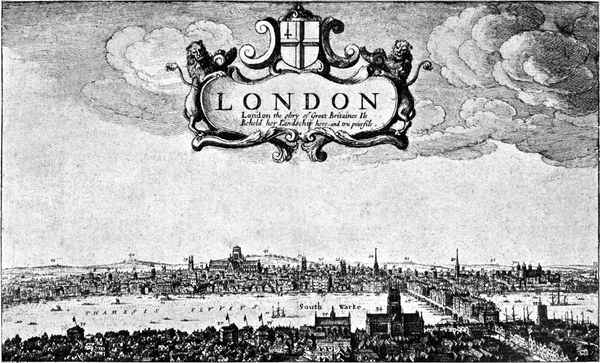
Frontispiece to James Howell’s Londinopolis, 1657, showing the position of four London theatres, circa 1600. From left to right are the Swan, the Hope, the Rose, and the Globe. This engraving is taken from an original copy in the possession of the Author.
We know for certain that the management was under a company of actors, who occupied the theatre during the whole period until destroyed by fire; this company was known under different names at various periods, but chiefly as The Lord Chamberlain’s Servants. Contemporary documents prove that Shakespeare was a member of this company, besides being an important shareholder. How he disposed of his investments is nowhere mentioned: they may have been sold on retiring from the stage in 1609; his will is silent respecting these shares, a sure sign that he had already parted with them.
For a period of fourteen years thousands of Londoners, drawn from all classes of society, enjoyed the dramatic production offered by the company playing at the Globe on the Bankside, yet we search in vain for any detailed notice of even one performance. What must we think of the critics and scribblers who had a giant in their midst and knew him not; long notices of bull and bear fights abound, but the first performance of “Hamlet” found no chronicler; perhaps on that day a big fight in the bear pit was advertised, which was considered a greater attraction. Even in our days a sensational and exciting performance would rather engage the attention of the critics of the daily papers than, in their eyes, the lesser attraction of a Shakesperean performance even if acted by celebrated players.
For instance, Miss Lily Elsie, in a new musical comedy of the vulgarest type, would appear of greater importance from a press point of view than Forbes Robertson in the character of Hamlet.
The only evidence we obtain of plays being acted at this theatre is from entries made in the books of the Stationers’ Register: “A book called the Revenge of Hamlet, Prince of Denmarke, as it was lately acted by the Lord Chamberlain’s servants.” The name of the Lord Chamberlain indicating where the play was produced. Similar evidence is likewise derived from the title pages of the early quartos issued during the lifetime of the poet. In the whole range of Elizabethan literature not a single page can be discovered criticising those wonderful scenes enacted almost daily before their eyes at the Globe or in previous years at other theatres, before that building was erected, although a vast amount of printed matter, more than the present generation can conceive, was constantly being issued from the press.
London alone possessed nearly a thousand publishers, booksellers and printers, and the number of books on all subjects was enormous. The great part of this large output has been thoroughly ransacked with the object of discovering Shakesperean references, unfortunately with rather meagre results. The general public of the day reads nothing of this mass of literature, with the exception of Shakespeare’s works, although many of the books are really worth perusal. Even Plutarch’s Lives, the most popular book of the last three centuries, is entirely neglected.
The lengthy description which is given in relating the history of the Swan Theatre applies in a more or less degree to all the other Shakesperean theatres, and now the mournful duty remains of chronicling the total destruction of the first Globe Theatre by fire.
This great catastrophe befell it on St. Peter’s Day, June 29th, 1613. Oh, what a conflagration! In the space of two hours the building was a heap of smouldering ruins, no doubt containing many of the previous manuscripts of Shakespeare’s plays; this statement is quite gratuitous. Shakespeare may have preserved his original MSS. at Stratford, or they may have been destroyed, after the prompter’s copy had been transcribed from the original, as being of no further use. We know the Bodleian Library parted with their First Folio when the third appeared, as being in the eyes of the then librarian of no account when a later edition appeared.
When the fire broke out a performance was taking place of a play called “Henry VIII, or All is True.” Whether this was Shakespeare’s play of “Henry VIII” is a debatable point. The secondary title, “All is True,” is never associated with Shakespeare’s “Henry VIII.” The higher criticism rejects this play of “Henry VIII” as not forming part of the Shakesperean canon, although included in the First Folio. Wolsey’s farewell speech is such a favourite of mine that I am willing in ascribing the whole play as Shakespeare’s.
This theatre possessed only two doors, one in front being the entrance door and the other situated at the rear of the building. This back entrance was used by the actors, and also for those provided with seats in the balcony, or were accommodated with seats in the Lords’ rooms. The reason for so few entrances can be explained by the peculiar manner in which payment was made by the gatherers of the theatre. A most interesting reference to the Globe will be found in the journal of Prince Lewis of Wirtemberg, representative of the United Foreign Princes to France and England in 1610, written by his secretary, Wurmsser. The original MS. is in the British Museum (Lundi 30. S. Eminence alla au Globe, lieu ordinaire ou l’on joue les comedies) in a manuscript volume, written by Dr. Forman a few months before his death in 1611, and now preserved among the Ashmolean MSS. in the Bodleian Library. This interesting manuscript was exhibited in the Bodleian Library at an exhibition of rare Shakesperean books in connexion with the tercentenary of the poet’s death. I purposely visited Oxford with the object of examining this wonderful collection. Dr. Madun, the learned librarian, expressly pointed out to me this interesting volume.
“In ‘Richard II’ at the glob 1611 the 30th of April. In the Winterstale at the glob 1611 the 15th of Maye. Of Cimbal in ‘King of England.’ In ‘Macbeth’ at the Glob 1610 the 20 of April.”
Appended are notes about the different plays. By comparing the notes of “Richard II” the play cannot be one Shakespeare wrote.
Extracts concerning the burning of the Globe Theatre:
“London, this last day of June, 1613. No longer since than yesterday while Burbage his companie were acting at the Globe the play of Hen 8. And there shooting of certayne chambers in way of triumph, the fire catch’d, and fastened upon the thatch of the house and there burned so furiously as it consumed the whole house and all in less than two hours, the people having enough to save themselves.”
Letter from Thomas Lakins to Sir Thos. Pickering.
“Now to let matters of state sleep, I will entertain you at the present with what hath happened this week at the Bankside. The King’s players had a new play called ‘All is True,’ representing some principal pieces of the reign of Henry the 8th which was set forth with many extraordinary circumstances of Pomp and Majesty, even to the matting of the stage, the Knights of the Order, with their George and Garter, the Guards with their embroidered coats and the like sufficient in truth within a while to make Greatness very familiar if not ridiculous. Now King Henry, making a masque at the Cardinall’s Wolsey’s house, and certain canons being shot off at his entry, some of the Paper or other stuff wherewith some of them were stopped, did light on the Thatch, where being thought at first but an idle smoak, and their eyes more attentive to the show, it kindled inwardly and ran round like a train, consuming within less than an hour the whole House to the very ground. This was the Fatal period of that virtuous Fabrique, where yet nothing did perish but Wood and straw and a few forsaken cloakes. Only one man had his breeches set on fire, that would perhaps have broyled him if he had not by the benefit of provident witt put it out with bottle ale.”
Letter from Sir Henry Wotten to his nephew, Sir Edward Bain, reprinted in Relique Wottonae, 1635.
“All you that please to understand Come, listen to my story, To see Death with his rakering brand, Mongst such an auditorye, Regarding neither Cardinal’s might, Nor yet the rugged face of Henry the eighth.”
A sonnet upon the pitiful Burning of the Globe playhouse in London. Anonymous about 1613.
“If I should have set down the several terms and damages done this year by fire, in the very many and sundry places of this Kingdom, it would contain many a sheet of paper, as is evident by the incessante collections throughout the Churches of this realm for such as have been spoyled by fire. Also upon S. Peter’s day last, the playhouse or Theatre called the Globe, upon the Bankside neare London, by negligent discharging of a peal of ordinance close to the south side, the Thatch thereof took fire and the wind sudainly disperst the Flame round about and in a very short space the whole building was quite consumed and no man hurt, the house being filled with people to behold the play, viz., of Henry the 8. And the next spring it was new builded in a far finer manner than before.”
The Annals or General Chronicle of England, begun first by Master John Stow and afterwards continued and augmented with matters foreign and domestique, ancient and modern, unto the end of the present year, 1614, by Edmund Howe, Gentleman, London.
Howe evidently made a slip when he wrote ‘upon S. Peter’s Day last,’ that date would refer to the year 1614. Howe admits that he continued the chronicle up to the end of that year, 1614. The fire took place in 1613.
“But the burning of the Globe or Playhouse on the Bankside on S. Peter’s Day cannot escape you which fell out by a peal of chambers that I know not upon what occasion, were to be used in the play, the tampin or stopple of one of them lighting in the thatch that covered the house, burned it to the ground in less than two hours with a dwelling house adjoining, and it was a great marvel and fair grace of God that the people had little harm having but two narrow doors to get out at.”
John Chamberlain wrote to Sir Ralph Winwood on July 8th, 1613.
Sir Henry Wotten’s letter, previously quoted supplies us with the use of the chambers which so puzzled John Chamberlain. This letter acquaints us with the important fact that only two narrow doors admitted the spectators at the theatre.
“Well-fare the Wise-man yet on the Bankside My friends the Waterman. They could provide Against thy furie, which to serve their needs They made a vulcan of a sheafe of Reedes Whom they durst handle in their holyday coates And safely trust to dresse, not burn their boats But O these Reeds’ they mere disdaine of them Made thee beget that cruell stratagem Which some are pleased to stile but thy madde pranck Against the Globe, the Glory of the Bancke Which though it were the Fort of the whole Parish, Flank’d with a Ditch and forced out of a Marish, I saw with two poorchambers taken in And razed ere thought could urge this might have been. See the World’s Ruins! nothing but the piles Left, and wit senate cover it with tiles.”
Ben Jonson, in his “Execration upon Vulcan,” published among his Miscellaneous Poems in a book called Underwoods, wrote a short poem commemorating the fire.
“As gold is better when in fire tried, So is the Bankside Globe that late was burned, For where before it had a thatched hide Now to a stately Theatre ’tis turned.”
In the Prologue to the “Doubtful Heir,” a play by Shirley.
The day following the fire, two ballads in the event were entered at Stationers’ Hall; one was entitled “The Sodayne Burninge of the Globe on the Bankside in the Play tyme of St. Peter’s Day last, 1613.” The other was called “A doleful ballad of the generall overthrowe of the famous theatre on the Bankside called the Globe, etc.,” by William Parrat. Both these ballads have perished, but one of them may be identified, in a manuscript volume of poems in the library of Sir Mathew Wilson Mart. One stanza runs as follows:
“Some lost their hattes and some their swords, Then out runne Burbage, too; The Reprobates, though drunck on Monday, Prayed for the foule-Foole and Henry Condye. Ther with swolne eyes, like druncken Fleminges, Distressed stood old struttering Heminges.”
Both Heminge and Condell were the editors of the famous First Folio.
An interesting reference to the burning of the Globe Theatre will be found in a quaint volume entitled, “A Concordancy of Yeares, containing a new easie and most exact Computation of Time according to the English Account. Also the use of the English and Roman Kalendar, with briefe Notes, Rules and Tables as well, Mathematical and legal, as vulgar for each private man’s occasion. Newly composed, digested and augmented.”
“Nicholas Okes for Thomas Adams, 1615. By Arthur Hopten, Gentleman.”
This first edition is not in the British Museum, but a copy of the second edition, dated 1616, will be found in that institution. At the end of the volume is a calendar, or what we should term a diary, of chief events of the year. The calendar commences from 1066 until the date of publication. In the British Museum copy of the second edition the events are jumbled together without mentioning the date, but in the first edition, which by good chance I happened to see at Sotheby’s auction rooms, most of the events are dated thus: Middleton’s Waterworks finished 1611; the House of Correction, Clerkenwell, opened 1615. In the year 1613 three events are chronicled: Death of Prince Henry, the marriage of Princess Elizabeth to the Palatine, and the play-house on fire, which last event happened on June 29th, 1613. I did not have time to consult the diary carefully, but I think in all other years only one event is given to each year.
In 1644 Sir Mathew Brand, the son of Nicholas Brand, the original owner of the ground on which both the first and second Globe Theatres were built, pulled down the building and erected tenements, which in course of time were likewise demolished, giving place to a dwelling-house; on the latter being cleared away, warehouses were erected which are standing at the present day.
The sign of the first Globe Theatre was a figure of Atlas supporting the Globe, bearing underneath an inscription: “Totus mundus agit histrionem.” A rendering into English occurs in Jacques’ soliloquy in “As You Like It”: “All the world’s a stage.”
THE FORTUNE
The opening of the Globe Theatre in the spring of 1599 proved from the outset a most successful venture, seriously curtailing the profits of its near rival, the Rose; this latter theatre gradually discontinued the legitimate drama, diverting its energies in an entirely different channel.
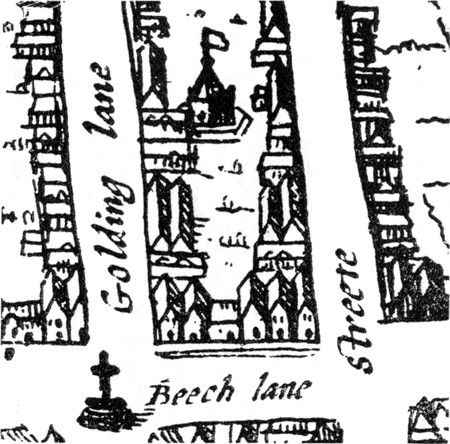
The First Fortune Theatre. Built in 1600. Situated midway between Golden Lane and Whitecross Street.
Henslowe, the proprietor of this neglected playhouse, was a man of varied resources, combined with unbounded capital, two great advantages in speculative undertakings. Foreseeing that the opposition would eventually overwhelm him, a swift plan of action was devised which enabled him in continuing uninterruptedly his theatrical prosperity. Without hesitating, he formulated a scheme of erecting a new theatre on the north side of the Thames. The building was far removed from the keen competition, such as was in vogue at the Globe, of the Lord Chamberlain’s servants. The Fortune Theatre, for such was the name of Henslowe’s latest enterprise, was situated in a district northwest of the heart of the City.
The Roaring Girle,
OR Moll Cut-Purse.
As it hath lately beene Acted on the Fortune-stage by the Prince his Players.
Written by T. Middleton and T. Dekkar.
Printed at London for Thomas Archer, and are to be sold at his shop in Popes head-pallace, neere the Royall Exchange. 1611.
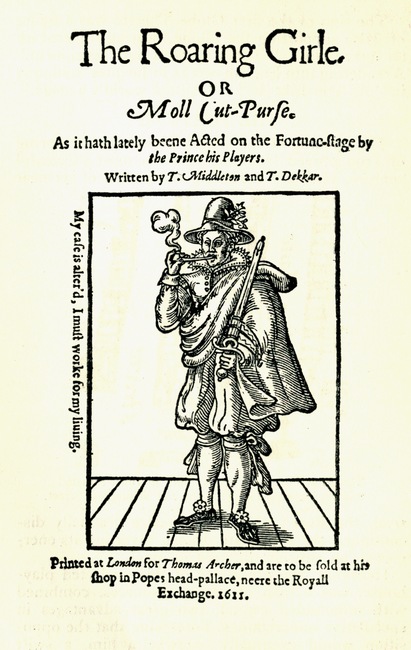
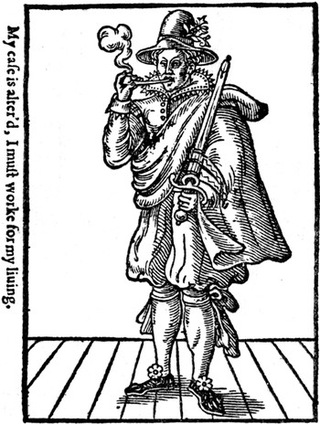
My case is alter’d, I must worke for my liuing.
(Original Image)
In searching for the exact site, the enquirer must walk straight down Aldersgate Street until he strikes the Barbican, then follow the Barbican until Beech Street is reached; at each end of this thoroughfare two streets branch off, both leading to Old Street; midway between these two streets, named respectively Golden Lane and Whitecross Street, stood the Fortune Theatre. A distant reminder of the past will be noticed by a street called Playhouse Yard, a turning off Golden Lane. Why this place should be termed a yard is rather puzzling, as outwardly it bears the monotonous look of an ordinary London street, which most readers will agree is far from picturesque.
Professor Lawrence, in his exhaustive list of the early London theatres, can find no view of this theatre; on the other hand, Professor Baker gives an illustration of this theatre, taken from Ryther’s Map of London, dated 1604. “In the district I have described is to be seen a building from the top of which a flag is flying; on the churches marked in the map a cross is seen.” This distinction is decidedly in favour of Professor Baker’s theory.
In the last month of the year 1600 the Fortune was opened to the public, meeting with bitter opposition from the City Authorities and the Puritanical section of the people. Notwithstanding all those obstacles, coupled with innumerable complaints, Henslowe and Allen, his son-in-law, steadily proceeded with their undertaking, being eventually rewarded for all the anxiety and persecution by the complete success of their new venture.
The documentary evidence in proof of the opposition they encountered has been preserved in a letter addressed by the Earl of Nottingham, the Lord Admiral: “To all and every of her Majesty’s Justices and other Ministers and Offices in the County of Middlesex requiring them to suffer his servant Edward Alleyn to proceed unmolested in the founding of his new playhouse near Redcross Street.” This letter does not seem to have produced the desired effect; thereupon, Allen caused a petition to be drawn up by the most influential inhabitants of Finsbury, in whose Lordship lay the site of the Fortune, beseeching the Lords of the Privy Council that the erection of the new house might be allowed to proceed, on the grounds that the site was conveniently chosen, so as to cause no annoyance, and that the projectors had promised a weekly allowance to the poor of the parish. Twenty-seven names were attached to this petition, which was engrossed on the first week in April, 1600.
On the 8th of April a warrant was issued on behalf of the Privy Council, and signed by the Earl of Nottingham, Lord Hunsdon, the Lord Chamberlain, and Robert Cecil, to the following effect: “To the Justices of Peace and the County of Middlesex, especially of St. Giles, without Cripplegate.” The document refers to the petition of the inhabitants, and adds that Allen’s choice of a site in Golden Lane is recommended by some of the Justices themselves.
Another item mentioned is that of an old theatre to be pulled down; this would lead one in inferring that when the new theatre was licensed that either the Rose or the Curtain would be demolished, and presumably promises were given to that effect. However, the said theatres continued their career for many years after these interdicts. Even after the warrant from the Privy Council certain parties were still clamouring for the reduction of the number of playhouses, as is evident by a letter from the Privy Council addressed to the Lord Mayor for the restraint of the immoderate use and company of playhouses and players.
In reading the Privy Council’s Bill of Complaint, one would conclude that the Lords of the Council played a double part, one in urging the restriction of the playhouses and actors, the other in protecting the same. The latter proceeds to state: “That there shall be about the City two houses and no more allowed to serve for the use of the common stage plays. And forasmuch as their Lordships have been informed by Edmund Tylney, esquire, her Majesty’s servant and Master of the Revels, that the house now in hand to be built by the said Edward Alleyn is not intended to increase the number of playhouses but to be instead of another, namely, the Curtain, which is either to be ruined and plucked down, or to be put to some other good use, as also that the situation thereof is meet and convenient for that purpose, it is likewise ordered that the said house of Alleyn shall be allowed to be one of the two houses, and namely for the house to be allowed in Middlesex for the company of players belonging to the Lord Admiral, so as the house called the Curtain be as it is pretended, either ruined or applied to some other good use, and for the other house allowed to be on the Surrey side, whereas their Lordships are pleased to permit to the company of players that shall play there to make their own choice which they will have of divers houses, that are there, choosing one of them and no more, and the said company of players being the servants of the Lord Chamberlain and that are to play these have made choice of the house called the Globe, it is ordered that the said house and none other shall be allowed there. And speedily it is forbidden that any stage plays shall be played as sometimes they have been in any common inn for public assembly in or near about the City. Further, it is ordered that the two several companies of players assigned unto the two houses allowed may play each of them in their several houses twice a week and no oftener, and specially they shall refrain to play on the Sabbath day upon pain of imprisonment and further penalty, and that they shall forbear altogether in the time of Lent and likewise at such times as of extraordinary sickness or infection of disease shall appear to be in or about the City.”
This document sums up the position of theatrical matters in the last year of the sixteenth century, and, frankly speaking, the outlook was not a particularly rosy one.
However, this order of the Council was quite a dead letter and need not have been written. Theatrical managers took no notice of these commands, and the threatened theatres remained undisturbed.
There must have been some reason why this order was disobeyed; many critics contend that the Lord Admiral and the Lord Chamberlain were desirous of creating a monopoly for their servants, others with more show of reason point out that the Privy Council tried to sugar over the feelings of the City Authorities by writing polite letters, but when the fatal moment arrived they refused the permission granted in the correspondence. Perhaps the Queen took a greater share in these transactions than is generally supposed by the historians of the theatre, protecting in her own person the poor player.
All these points are merely surmises; further documents may enable us to discover the true solution of this interesting enigma. Fortunately the contract for the building of this theatre is still in existence. The extreme importance attaching to this document warrants its transcription in full, respecting the chief items. The contract was made out on the 8th day of January, 1599, between Philip Henslowe and Edward Allen on one part and Peter Short, citizen and carpenter, of London, on the other, for the building and setting up a new House and stage for a playhouse in and upon a certain plot of ground near Goldinge Lane, in the parish of St. Giles, without Cripplegate. “The frame of the house to be set up square, and to continue 80 feet of lawful assize every way square, without and 55 feet of like assize square every way within, with a good, sure and strong foundation of piles, brick, lime and sand both without and within, to be wrought one foot of assize at the least above ground, and the said frame to contain three stories in height, the first a lower storey to contain twelve foot of lawful assize in height, the second storey eleven foot of lawful assize in height, and the third or upper storey nine foot. All which storeys shall contain twelve foot and a half of lawful assize in breadth throughout, besides a jutty forwards in either of the two upper storeys of ten inches, with four convenient divisions for gentlemen’s rooms and other sufficient and convenient divisions for twopenny rooms, with necessary seats to be placed and set as well in these rooms as throughout all the rest of the galleries, and with such like stairs, conveyances and divisions without and within, as are made and contrived in and to the late erected play house on the Bank, in the said parish of Saint Saviour’s, called the Globe, with a stage and tiring house to be made, erected and set up within the said frame, with a shadow or cover over the said stage, which stage shall be placed and set, as also the staircases of the said frame in such sort as is prefigured, in a plot thereon drawn, and which stage shall contain in length forty and three foot of lawful assize, and in breadth to extend to the middle of the yard of the said house, the same stage to be paled in below with good strong and sufficient new oaken boards, and likewise the lower storey of the said frame withinside, and the same lower storey to be also laid over and fenced with strong iron piles. And the said stage to be in all other proportions contrived and fashioned like unto the stage of the said Playhouse called the Globe, with convenient windows and lights glazed to the said tiring house. And the said frame, stage and staircases to be with tile, and to have sufficient gutter of lead, to carry and convey the water from the covering of the said stage to fall backwards, and also the said frame and the staircases thereof to be sufficiently enclosed without with lath, lime and hair. And the gentlemen’s rooms and twopenny rooms to be ceiled with lath, lime and hair, and all the floors of the said galleries, storeys and stage to be boarded with good and sufficient new deal boards of the whole thickness where need shall be. And the said house and other things before mentioned to be made and done, to be in all other contrivitions, conveyances, fashions, thing and things effected, finished and done according to the manner and fashion of the said house called the Globe, saving only that all the principle and main posts of the said frame and stage forward shall be square and wrought pilaster wise with carved proportions called Satyres, to be placed and set on the top of every of the same posts, and saving also that the said Peter Short shall not be charged with any manner of painting in or about the said frame house and stage or any part thereof nor rendering the walls within nor ceiling any more other rooms than the gentlemen’s rooms, twopenny rooms and stage before mentioned. That the said Philip Henslowe and Edward Allen will well and truly pay to the said Peter Short the full sum of four hundred and forty pounds (£440) of lawful money of England.”
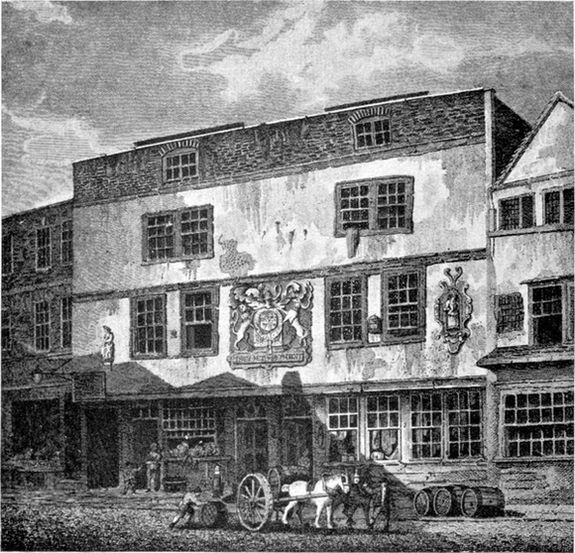
The second Fortune Theatre, 1621.
This contract is noteworthy as affording the means in some measure of reconstructing the Globe, also corroborating the evidence of the Swan sketch, especially with regard to the auditorium, which corresponds in most particulars with the plans formulated in the Fortune indenture. During Henslowe’s lifetime—he died in 1616—the only company of players which appeared at the Fortune were those of the Lord Admiral, which in former days had their headquarters at the Rose. The last entry in Henslowe’s Diary is a note detailing the accounts received from the Fortune in 1608, beginning at the Christmas holidays.
For many years past the Diary had ceased chronicling the name of the plays acted day by day, as we find in the Rose accounts, consequently nothing is known of the repertoire of this theatre. The Admiral’s men continued acting at this house until its total destruction by fire in 1621. Allen notifies this event in his diary. “This night at 12 of the clock the Fortune was burnt.”
On the death of his father-in-law, Allen took control of all his property, either by bequest or in right of his wife. The estate included the Fortune Theatre. Henslowe’s will was at first disputed by his nephew, John Henslowe; this action must have failed, as Allen became the sole possessor of his father-in-law’s property.
SWEINAM,
THE
Woman-hater, ARRAIGNED BY WOMEN.
A new Comedie,
Acted at the Red Bull, by the late Queenes Seruants.
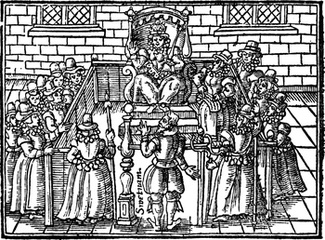
LONDON, Printed for Richard Meighen, and are to be sold at his Shops at Saint Clements Church, ouer-against Essex House, and at Westminster Hall. 1620.
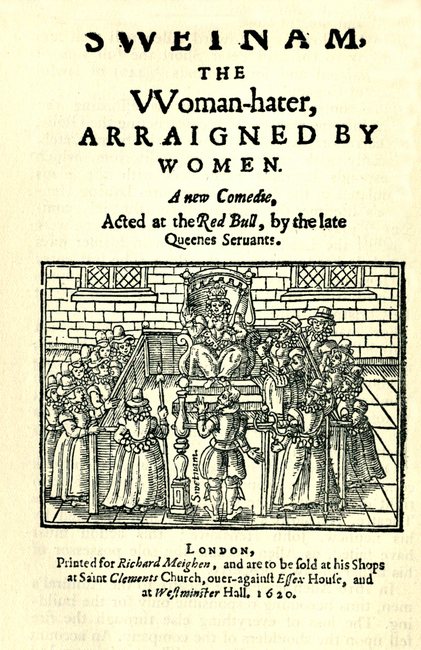
(Original Image)
In 1616 Allen leased the theatre to the Admiral’s men, thus becoming responsible only for the building. The loss of everything else through the fire fell upon the shoulders of the company. An account of the burning of the Fortune Theatre is recorded under the date of December 15th, 1621, in a letter written by John Chamberlain to Sir Dudley Carleton. “On Sunday night there was a great fire at the Fortune, in Golden Lane, the fayrest playhouse in this town. It was quite burnt downe in two hours and all their apparell and playbooks lost, whereby the poor companions are quite undone.”
A new Fortune arose three years later on the site of the old one, namely in 1624. An improvement in the building was effected by constructing the house of brick. Allen possessed shares in the new theatre, otherwise he had no interest or responsibility in the undertaking.
During the Civil War the theatre was dismantled, and the playhouse ceased for evermore its connexion with the drama. In 1682, Church Services were held there, and finally it became many years later a fully established brewery. The shape of the interior of the second Fortune is a matter of controversy, well known experts disagreeing on this point. The exterior is illustrated in Wilkinson’s Londonia, and shows a square-shaped building.
The house took its name from the image of a Goddess which stood in front of the theatre, but whether it was a sculptured sign or a painting must remain undecided.
THE RED BULL THEATRE
The next theatre on our list is the Red Bull, until lately unanimously assigned to the year 1609. Professor Lawrence, in his second series of Elizabethan studies, would antedate this reckoning by nearly a decade; unfortunately no reference is given for this early date. After spending many fruitless hours in search of fresh discoveries, I inserted a note in Notes and Queries, receiving by return one private communication, and a few answers through the journal itself. Although my note was perfectly clear, the information was what was already known, and dealt chiefly with the later fortunes of the Red Bull.
Professor Baker, even as late as 1907, dates the opening of the theatre after 1608. The observant reader will readily perceive that the history of the early English stage is in a state of chaos. Scholars such as Mr. Greg, Mr. Chambers, Sir Sidney Lee, and Prof. Lawrence, who are especially endowed with thorough knowledge of the subject, should for the benefit of posterity undertake the colossal task of re-writing the history of the stage during the Shakesperean period. Mr. Fleay’s chronicle history of the stage is much too fragmentary, from the theatrical point of view, for the guidance either of the general student or readers interested in the subject.
In my opinion all Collier’s works must be entirely discarded as this dishonest littérateur forged documents, notes, and even whole books, in order to substantiate his theories. Certainly he possessed great knowledge of the matter, and may well be termed the pioneer in scientific research, but his criminal methods require that the student must verify all his statements, therefore if the reader is wise, all this author’s works should be rejected on account of the difficulty of distinguishing the true from the false.
The site of the Red Bull is situated near the Clerkenwell Road end of St. John Street, formerly called St. John Street Road. On the left hand side, going towards the Angel, Islington, is Hayward’s Place; close by is Woodbridge Street, on this space stood the Red Bull. Previous to the year 1609 nothing is heard of this theatre in the annals of the stage. Recently documents have come to light proving its earlier existence, and, as stated above, Professor Lawrence would place the date as early as 1600. A well-known print of this theatre, of which I possess the original copy, is generally styled “The inside of the Red Bull Theatre.” This engraving first appeared in a book called Kirkman’s Wits or Sport upon Sport, published in two parts, a second edition being reissued in one volume in 1673, with the engraving as frontispiece, the original print does not bear any inscription; this is found only on the modern reproduction issued in 1809. The print was sold separately which may possibly account for the fanciful description. One glance at the drawing will convince the student that the print can in no way be associated with the old Red Bull Theatre. The Red Bull was a public theatre, being open to the sky, with a thatched roof, performances being given only in the daytime. Now the print plainly indicates by the inclusion of chandeliers hanging from the roof, as well as a row of rabbit-eared footlights along the front, that if a contemporary theatre is represented a private one is intended.
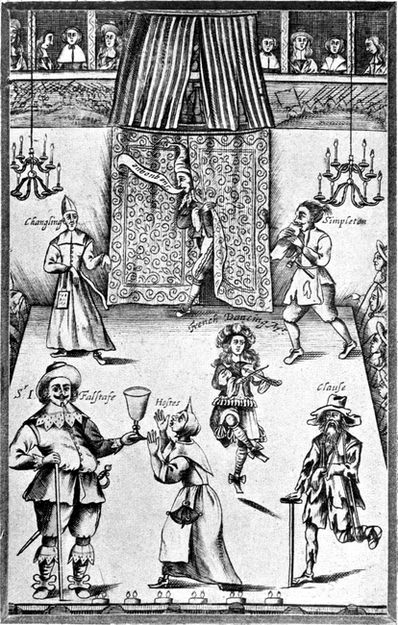
Reproduced from an original engraving in the possession of the Author. Erroneously inscribed as the interior of the Red Bull Theatre. Now generally identified as the inside of a theatre during the Commonwealth.
The massing of spectators on either side of the stage is evidence that the drawing is an imaginary one, made up partly from an early Elizabethan stage, combined with the Restoration Stage of Charles II.
Possibly it may represent a real stage of the latter period, but cannot under any circumstances resemble the old Red Bull Playhouse during any time of its existence. Seven characters are represented on the stage, illustrating a few of the plays that could be acted by a strolling company. The principal motive of Kirkman’s book is “for those players who intend to wander or go a strolling; this very Book and a few ordinary properties are enough to set them up and get money in any Town in England.”
1. Sir J. Falstafe and Hostes represent characters of that name in Shakespeare’s “Henry IV.”
2. The figure emerging from behind the curtain is Green, the actor, who took the part of Bubble, the City Gallant, whose answer to every complaint is “Tu quoque,” the play on this account being re-christened “Tu quoque.” The play was published in 1614, and is still extant. There is evidence that the drama was acted at the Red Bull in the year 1611.
3. Clause is one of the chief characters in the “Lame Commonwealth,” taken from “The Beggar’s Bush,” a tragic-comedy, by John Fletcher, circa 1615. The scene is laid somewhere in Flanders, but the play is named after a well-known tree, called “The Beggar’s Bush,” between Huntingdon and Coxton. The play was first printed in 1647. On looking up an old theatrical dictionary, dated 1792, this play is ascribed to Beaumont and Fletcher, and is written “The Beggar’s Bush.”
4. “French Dancing Mr.,” a droll taken from the Duke of Newcastle’s play called “Variety,” printed in 1647. The dictionary adds that this play was acted with very great applause at the Black Fryars.
5. “Simpleton” seems to be an independent farce, in which one, Robert Cox, an actor, made a great hit and caused roars of laughter from the unsophisticated audience by eating a huge slice of bread and butter, and complaining that a man cannot be left undisturbed to eat a little bit for his afternoon luncheon.
6. The “Changling” is a character in Middleton’s tragedy of that name. Antonio, who pretends idiocy in order that he may gain access to the wife of a mad doctor. This play was acted before the Court at Whitehall in 1624.
The history of this theatre still awaits an historian.
Its most enthusiastic supporters were the rougher elements of the population, who then, as now, chiefly delighted in lurid melodrama of a very pronounced type. The Chancery proceedings, in 1617, elicit the fact that certain members of the Red Bull company were sued for money owed; further proceedings state that they were unable to satisfy the claim—certain evidence that their finances were anything but prosperous.
This theatre cannot claim any Shakesperean associations, although enjoying a longer lease of life than any other playhouse of that period, being last named as a theatre as late as the year 1663. Pepys, the celebrated Diarist, visited the Red Bull in 1661. Mr. Barton Baker, in his history of the London stage, suggests that the Red Bull Theatre was originally an inn-yard, theatrical performances taking place there; he also casually mentions an accident caused by the collapse of the auditorium. By the word auditorium I presume he means the galleries that surrounded the yard on three sides. Mr. Baker does not give any references for these statements, or give further details of the event.
An interesting notice of this theatre, which existed during the early days of the Commonwealth, will be found in Randolphe’s “Muses’ Looking Glass.”
THE GLOBE.
Wherein, quoth he, reigns a whole world of vice, Had been consumed, the Phœnix burnt to ashes, The Fortune whipped for a blind—Blackfriars, He wonders how it escaped demolishing In the time of Reformation; lastly he wished The Bull might cross the Thames to the Bear-gardens And there be soundly baited.
Edward Allen, the Elizabethan actor, also mentions this theatre in a manuscript note preserved at Dulwich College: “Went to the Red Bull and received for the Younger Brother (a play) but £3 6s. 4d.”
In 1629 a company of French comedians acted here for one day only. After being deserted by the actors, the Red Bull offered various entertainments to the public. There is extant a bill which was formerly in possession of Mr. Eliot Hodgson, advertising a fencing match at the Red Bull on Whit Monday, 30th May, 1664. This is surmounted by a large woodcut of the Royal Arms, and is printed on a sheet of coarse paper, measuring 5⅚ inches by 7½ inches. No authentic view of either the interior or the exterior is in existence.
Above the illustration of the Red Bull Theatre check will be found a facsimile of an admission to the Roman Coliseum, built A.D. 72. This rare specimen is perfectly genuine, and was purchased by me many years ago at the Buxton Forman sale. It is an interesting souvenir of ancient theatrical times; the numerals, VII, on the reverse refer to one of the sections of the vast building, and may have been a complimentary ticket before the tax on deadheads came into vogue.
When the building was finally demolished is likewise uncertain. An interesting metal check ticket, giving admittance to the Upper Gallery of the Red Bull, is extant, the date of which is between the Restoration and the closing of the Red Bull as a theatre, namely, 1660–1663. The obverse has the head of a bull, within a wreath, tied in a knot with ribbons; a double ring encircles the entire figure. The reverse has simply the words Upper Gallery one above the other, a star is over the second P in upper, and another under the second L of Gallery; the whole is within a double lined circle.
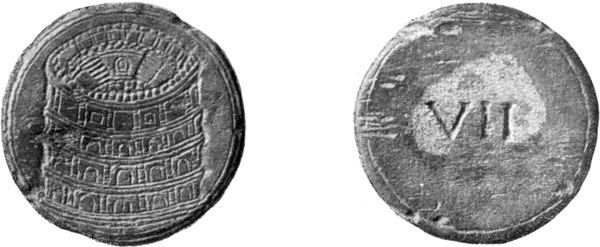
Facsimile of an admission ticket to the Roman Coliseum. Circa A.D. 90. Reproduced from a genuine ivory ticket in the possession of the Author.

Ticket of Admission to the Red Bull Theatre.
The writer of an article on Shakespeare, in which an illustration appears, considers this check as a souvenir of the Globe; this ascription may be due to a clerical error. Most writers on Shakesperean matters, unless they are expert students, are seldom accurate in their statements; they are too apt in seeking information from paragraphs culled from ancient encyclopædias, a very unsafe medium for sound knowledge. Almost every sentence requires patient research; in some instances a dozen or more books must be consulted in verifying quite an ordinary statement, and very few writers possess the necessary patience for such monotonous work. For suchlike people I would recommend novel writing—a much easier task, and which can be pursued without interruption.
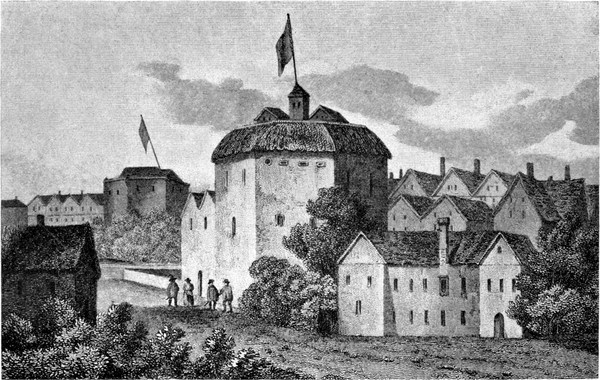
The large theatre in the foreground is the Second Globe Theatre, 1614. The small one is the Hope.
THE HOPE THEATRE
The last theatre set up on the Bankside, and also the last public theatre opened during Shakespeare’s lifetime, was the Hope, built in the year 1614, two years before his death. This reconstructed building had originally served as an amphi-theatre for bull baiting, being marked on the maps of both Aggas and Hofnagel in 1572, also in Norden’s map of 1593.
Twenty years after Aggas’ map appeared, the bull-baiting house had been converted into a bear-baiting establishment; the old bear-baiting house seen in these maps was, in 1599, occupied by the famous Globe Theatre. The playhouse marked in Norden’s map is the Rose, then the sole theatre on the Bankside.
The cause of the Bear-house being turned into a theatre was due to the Globe Theatre being burnt to the ground in the previous year 1613. Cunning old Henslowe, seizing an opportunity of taking advantage of this catastrophe, converted his rival’s misfortune to his own profit. The contract for demolishing the old Bear Garden is still in existence, setting forth that an arena for the exhibition of bear-baiting, likewise a stage suitable for play acting, was to be erected. Under these conditions the stage was a movable one, thereby permitting the performance of either entertainments.
The contract states that it was to be built like the Swan, a theatre erected nearly twenty years previously, a proof that few alterations or improvements were made in theatrical structures during this long period.
Most people interested in theatrical matters are aware that customs appertaining to the theatre are handed down from generation to generation, and innovations in stage tradition are seldom, if ever, introduced, even in such an improving age as our own.
This theatre is without any Shakesperean association, and the only stage play, so far as is known, publicly acted there is Ben Jonson’s “Bartholomew Fair,” in 1614. This play contains several theatrical allusions, one of which is defining the spectators of the pit as “the understanding gentlemen of the ground.” Shakespeare names the same audience as the “groundlings” in Hamlet’s speech to the players. For several days in the week the Hope was given over to bear-baiting and other sports. There is an account of one Fenner, who challenged Taylor, the Water Poet, to a combat of wits. On the day appointed, Fenner failed to put in an appearance, thereby causing the great enmity of Taylor, who wrote some rather poignant and sarcastic verses in memory of the event. Fenner replied by a mock epitaph:
“O! ’twas that foolish scurvie play At Hope that took his sense away.”
Taylor replied:
“Thou writest a hotch potch of some forty lines About my play at Hope and my designs.”
On the rebuilding of the Globe, the Hope stood little chance against such a powerful rival; in fact, this building was never seriously regarded as a theatre. When the new Globe was entirely rebuilt the Hope gradually resumed its former occupation as a bear-baiting house, which in reality had never been discarded.
As a bear-baiting garden, a reference is found in Swetnam’s Arraignment of Women, 1617: “If you mean to see the bear-baiting of women then trudge to this bear garden apace, and get in betimes and view every room where thou may best sit for thy pleasure.”
The further history of the Hope after 1616 is quite unconnected with the drama. It flourished for many years. After Shakespeare’s death, Cunningham, in his Handbook of London, says that the best account of its last days is narrated in Howe’s MS., a continuation of Stow’s Survey; this must be by some other hand than Howe’s, as he died in 1631. “The Hope, on the bankside in Southwark, commonly called the Beare Garden, a playhouse for stage players on Mondays, Wednesdays, Fridays, and Saturdays, and for the baiting of the Beares on Tuesdays and Thursdays, the stage being made to take up and down when they please.”
It was built in the year 1610, and was pulled down to make tenements, by Thomas Walker, petticoat maker, in Cannon Street, on Tuesday, the 25th of March, 1656.
Seven of Mr. Godfrie’s Bears, by command of Thomas Pride, then High Sheriff of Surrey, were then shot to death on Saturday, the 9th of February, 1655, by a company of soldiers. A few years later, after the Restoration, the Bear Garden, was renamed, and continued giving exhibitions until 1691. In an advertisement, dated 1682, the Hope is still styled by its old name. This paragraph, which appeared in the Loyal Protestant, must refer to some new building, or perhaps the old name was still in use.
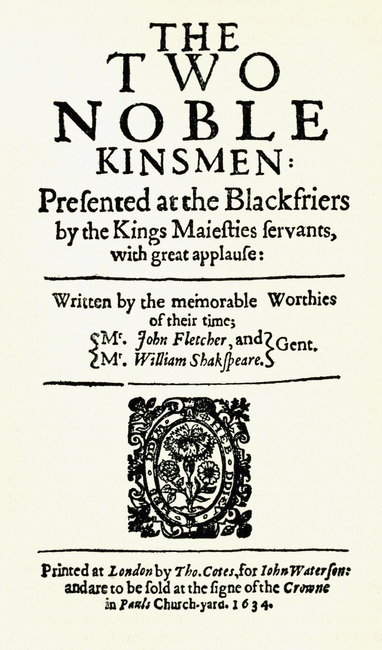
THE TWO NOBLE KINSMEN:
Presented at the Blackfriers by the Kings Maiesties servants, with great applause:
Written by the memorable Worthies of their time;
{ Mr. John Fletcher, and } Gent.
Mr. William Shakspeare.

Printed at London by Tho. Coses, for Iohn Waterson: and are to be sold at the signe of the Crowne in Pauls Church-yard. 1634.
(Original Image)
The last we hear of this new Hope is in 1691, when an advertisement states there is now made at the Bear Garden glass house, on the Bankside, crown window glass, and may be had of all glaziers in London. Howe is in error in stating that the Hope was built in 1610; this theatre was built soon after the Globe fire in 1614. In Visscher’s map of London, 1616, is an excellent view of this theatre, named the Bear Garden. Another view is seen in Hollar’s view of London, the last differs slightly from Visscher’s in shape. During an interval of thirty-three years a few alterations may have been introduced.
An interesting souvenir of the bear-baiting house is preserved amongst the Dulwich papers. This relic takes the form of a modern playbill, with the exception that the text is written instead of printed. The advertisement is written in a large round hand, and may have been the original placard placed in front of the building: “To-morrow being Thursdaie, shall be seen at the Bear garden on Bankside a great mach plaid by the gamsters of Essex, who hath chalenged all comers whatsoever to play V dogges at the single beare for V pounds, and also to wearie a bull dead at the stake; and for your better content shall have pleasant sport with the horse and ape and whiping of the blind beare. Vivat Rex.”
THE BLACKFRIARS THEATRE
The first Blackfriars theatre was opened in 1577, occupying the second floor of a mansion belonging to Sir William More, serving, in former times, as a dining hall, in the old monastic Priory of Blackfriars. This part of the building, after its devolution, was converted into separate rooms, and occupied by Sir John Cheek in 1540. A few years later these rooms were tenanted by the Revels Office, under the Mastership of Sir Thomas Cawarden, continuing in use until 1560, when the offices were removed to St. John’s, Jerusalem. Eventually this property came into the possession of Sir William More, who leased the premises to Richard Farrant, Master of the Children of Windsor. The site of these buildings will be found in the present Apothecaries’ Hall, in Water Lane, Blackfriars.
THE WARRES OF CYRUS King of Persia, against Antiochus King of Assyria, with the Tragicall ende of Panthæa.
Played by the children of her Maiesties Chappell.
LONDON
Printed by E. A. for William Blackwal, and are to be sold at his shop ouer against Guild-hall gate. 1594.
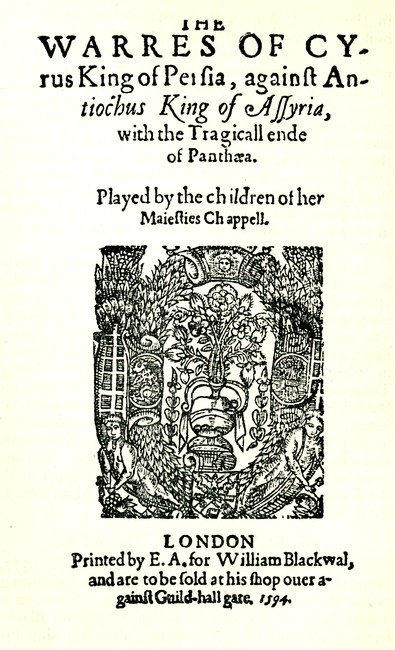
(Original Image)
Richard Farrant, on taking possession, turned the rooms into a theatre for the convenience of the boys in rehearsing their plays before performing before the Queen. The owner of the property was much displeased at Farrant’s procedure, vigorously complaining that the tenant had damaged the property by converting the rooms into a theatre.
No views or records of the interior of this theatre exist, therefore, in reconstructing the stage, or auditorium, from imagination, conjecture must take the place of facts. Whether galleries surrounded the stage, as we find in the public theatres, or whether the spectators were seated on a level in front of the stage, is a matter of dispute. Another point of controversy is whether the stage protruded into the auditorium or continued from east to west in a straight line, as seen in a modern stage. These questions at present cannot be determined with certainty. Until Professor Wallace discovered the documents relating to the Blackfriars property nothing was known about this early theatre. The Children of the Chapel Royal and the Children of Windsor regularly acted here, and for a few years were exceedingly successful, owing to their being under the immediate patronage of the Queen. Farrant, their Master, wrote plays for them, but none have survived. At Farrant’s death, in 1580, the theatre was managed by his widow, but she was unable for long to carry out the terms of the lease, and, after endless litigation, extending over four years, the theatre again came into the possession of the original owner, Sir William More.
THE LOVERS Melancholy.
ACTED AT THE PRIVATE HOVSE IN THE BLACKE Friers, and publikely at the Globe by the Kings Maiesties Seruants.
LONDON, Printed for H. Seile, and are to be sold at the Tygers head in Saint Pauls Church-yard. 1629.
(Original Image)
During the four years of quarrelling and bickering, the widow Farrant sold the lease to Hunnis, a celebrated Master of the Children of the Chapel, who continued training the children and producing plays. The other company, the Children of Windsor, ceased playing there two years before the death of Farrant. Hunnis, after two years’ ownership, was so much harassed by the proprietor, that he, in his turn, leased the theatre to Henry Evans, who took over the management. This new arrangement lasted but for a brief period, for in the same year Evans disposed of the lease to the Earl of Oxford, who placed here his company of boy actors. But eventually the Earl made a present of the lease to Lyly, the poet and dramatist, who managed the theatre until 1584, when an order of the Court awarded the premises to Sir William More. This ends the history of the first Blackfriars Theatre.
The second Blackfriars Theatre dates from the year 1596. James Burbage, the father of Richard Burbage, purchased from Sir William More, for £600, the buildings that lay between the office on the north and Lord Hunsdon’s mansion on the south. After the purchase of the property he immediately remodelled these rooms, making them suitable for a theatre.
James Burbage died in 1597, and his sons leased the second Blackfriars Theatre to Henry Evans, in conjunction with Nathaniel Gyles, who succeeded Hunnis as Master in 1597. The Children of the Chapel occupied the stage, acting plays written by all the celebrated dramatists of the period, with the exception of Shakespeare, whose plays are not mentioned as acted by the Children. Most critics, including Professor Wallace himself, contend that Shakespeare acted in this theatre. There does not exist an item of evidence in support of this theory, beyond a statement made by Burbage’s sons many years after Shakespeare’s death, that Richard Burbage installed Shakespeare at this theatre, but in what capacity is nowhere mentioned; and I doubt very much if Shakespeare ever set foot upon the stage, in spite of the above statement. No authentic views of this theatre are known; Professor Baker gives an illustration of the exterior of this theatre, but its authenticity is not beyond doubt. The second Blackfriars Theatre was situated in a different part of the building from the first. When Burbage purchased the property, several rooms on the south side were converted into one large hall, measuring 66 by 46 feet. The room on the north side was formerly the home of the boy actors, under Farrant. The Blackfriars was a private playhouse, the word “private” denoting that the theatre was roofed and performances were given at night time, or on account of the theatre being within the liberties of the City, the proprietor safeguarded himself by this designation in order to comply with the Act of Common Council; one clause of which exempted from penalties any private dwelling house exhibiting Enterludes, Comedies and Tragedies. The charges were somewhat higher than those in force at the public theatres. At this theatre, stools were allowed upon the stage, Although called a private theatre, anyone by paying the higher price was allowed admittance.
WHITEFRIARS THEATRE
There is some slight evidence that a stage for acting existed in the vicinity of Whitefriars as early as 1574. Richard Rawlidge, in his tract already referred to, enumerates, among other playhouses in the year 1576, “one in Whitefriars.” Fleay mentions that this is the only reference to the old Whitefriars playhouse until 1610. Professor Lawrence is again at variance with the usual authorities: he would assign the opening of the new Whitefriars, circa 1608. According to a burial register of St. Dunstan’s Parish, Whitefriars, in September 29th, 1607, which records the following interment: “Gerry out of the playhouse in the Friars buried.” Another entry is: “We present one playhouse in the same precinct, not fitting these to be now tolerable.”
THE INSATIATE Countesse.
A TRAGEDIE: Acted at VVhite-Fryers.
Written
By IOHN MARSTON.

LONDON:
Printed by T. S. for Thomas Archer, and are to be sold at his Shop in Popes-head-Pallace, neere the Royall-Exchange. 1613.
(Original Image)
By the date 1607 both our professors have misdated the opening of the theatre. Another valid proof of how greatly we are in need of a veritable authentic history of the early theatres.
The place in which the stage was first set up stood in the Refectory of the demolished Monastery of the Carmelites, situated between the modern Bouverie and Whitefriars Streets, in Fleet Street. The early history of this theatre is a total blank, both as regards the stage and the company of actors, who gave performances there.
If conjecture is permissible, probably strolling players were allowed the use of the stage, or more likely a regular company for want of a better place, acted here. The performers were safe from molestation, on account of the ground being ecclesiastical property, therefore not being subject to the jurisdiction of the City Authorities.
In 1607, or earlier, this old hall was probably converted into a regular theatre, and from that date continued as such until 1616, when for an indefinite period the place was abandoned. On being re-opened, acting took place as usual, subsequently being finally abolished in 1621.
THE Excellent Comedy, called THE OLD LAW:
OR
A new way to please you.
By { Phil. Maßinger.
Tho. Middleton.
William Rowley.
Acted before the King and Queene at Salisbury House, and at severall other places, with great Applause.
Together with an exact and perfect Catalogue of all the Playes, with the Authors Names, and what are Comedies, Tragedies, Histories, Pastoralls, Masks, Interludes, more exactly Printed then ever before.
LONDON, Printed for Edward Archer, at the signe of the Adam and Eve, in Little Britaine. 1656.
(Original Image)
The Children of the Queen’s Revels made their home here. Many of the ablest dramatists wrote plays for them. Ben Jonson’s “Epicene” was one of the first plays they produced. A list of actors’ names is prefixed to the printed edition of 1612. The celebrated actor, Richard Field, is the first actor named.
THE SALISBURY COURT THEATRE
After the abolition of the Whitefriars Playhouse, another arose in the same district, and was called the Salisbury Court Theatre. The site is now occupied by the Salisbury Hotel, in Salisbury Square, Fleet Street. Edward Sackville, fourth earl of Dorset, leased a piece of land to Richard Gunnel and William Bargrave for forty-one and a half years, at a rental of £100 per annum.
The company of the King’s Revels were the first who occupied the house. A few years later we find the Prince’s men acting there. Among other plays produced by them was Marmion’s “Holland’s Leaguer,” lately and often acted by Prince Charles’ men at the Salisbury Court Theatre. A list of actors is prefixed to the first edition of this play, printed in 1632. In 1635, the Revel’s company again were in possession of this theatre, and produced a play called “The Spargus Garden.” The theatre continued in existence for many years, and was not abandoned until the fatal year 1649, when all theatres, without exception, were finally closed. At the Restoration this theatre was still in existence, but in a very dilapidated state. After being made habitable, play-acting was again resumed. Pepys records a visit to this theatre in his Diary. The fire of London counted this building among its victims. No views of any description are known.
THE COCKPIT
This small, roofed private theatre was first opened in 1615, and was partially demolished by a band of wild apprentices. The cause of their action is not known. Speedily being rebuilt, it continued under the name of the Phœnix as a playhouse, until 1649, when the building was dismantled.
The Famous TRAGEDY OF THE RICH IEVV OF MALTA.
AS IT WAS PLAYD BEFORE THE KING AND QVEENE, IN HIS MAJESTIES Theatre at White-Hall, by her Majesties Servants at the Cock-pit.
Written by CHRISTOPHER MARLO.

LONDON: Printed by I. B. for Nicholas Vavasour, and are to be sold at his Shop in the Inner-Temple, neere the Church. 1633.
(Original Image)
THE TRAGEDY OF HOFFMAN
OR
A Reuenge for a Father.
As it hath bin diuers times acted with great applause, at the Phenix in Druery-lane.

LONDON, Printed by I. N. for Hugh Perry, and are to bee sold at his shop, at the signe of the Harrow in Brittaines-burse. 1631.
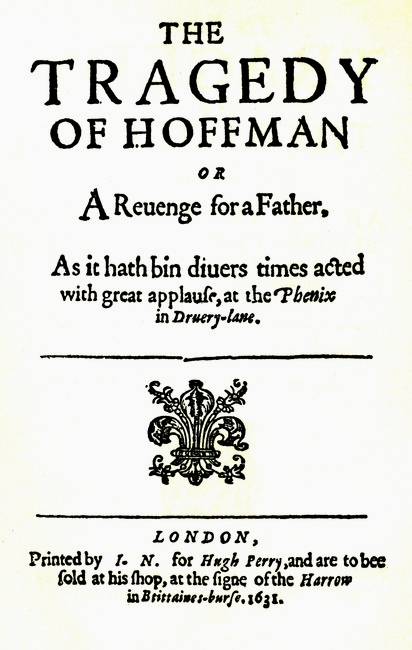
(Original Image)
The company of the Lady Elizabeth, daughter of James I, acted at this house. A list of actors’ names is recorded in the Herbert MSS. After the Restoration the theatre was once more used for play-acting, the last recorded performance taking place in 1664. Cockpit Court, Drury Lane, marked in Strype’s map of London, 1720, stood on the site of the old theatre. In later years the Court was known as Pit Court, but now this place has entirely vanished. Formerly a cockpit existed in this neighbourhood, from which the theatre was named. Like so many other theatres of this period, no authentic views are known.
ST. PAUL’S SINGING SCHOOL
Many printed plays have inscribed on their title pages: “As played by the Children of Powles.” Very little is known of their place of acting. The exact site on which that part of the Cathedral was allotted to these boy actors still remains a point of discussion. Many authorities assert that the music room of the choir in St. Gregory’s Church, in a corner of St. Paul’s, was the place assigned to them; others consider the yard adjoining Convocation House, a more convenient spot, and thoroughly suitable for a dramatic performance. Professor Lawrence is in favour of the singing school, near the Convocation House. Until further evidence is forthcoming the question cannot be finally determined. St. Paul’s singing school was built in the year 1581, and remained in use until 1596, when it was suppressed. A few years later this room may have been occupied by the Children of St. Paul’s, and many a famous play of that period was probably acted there. All the great dramatists, with the exception of Shakespeare, wrote for the Boy Actors. The place served as a training ground for young actors, who afterwards joined the professional men’s companies. Shakespeare bitterly satirized these juveniles in “Hamlet.”
THE PVRITAINE
Or
THE VVIDDOVV of Watling-streete.
Acted by the Children of Paules.
Written by W. S.

Imprinted at London by G. ELD.
1607.
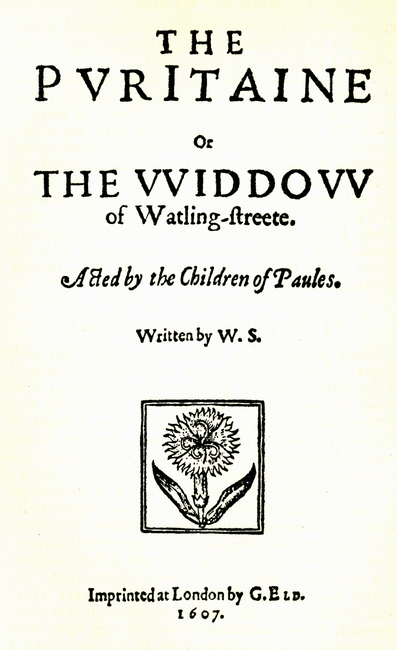
(Original Image)
A Most pleasant Comedie of Mucedorus the kings sonne of Valentia and Amadine the Kings daughter of Arragon, with the merie conceites of Mouse.
Newly set foorth, as it hath bin sundrie times plaide in the honorable Cittie of London.