APPENDIX
Reading edition
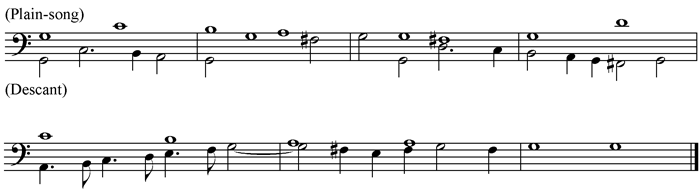
1. Example of Descant [Lucrece, 1134] from Morley, 1597 (see Introduction, p. 6 and p. 24).
[Listen]
If the lower part was added extempore, it was called Descant, but if written down as here, it was called Prick-song, because 'pricked' down. The Plain-song is perhaps more often found in a lower part, the Descant being higher. From the position of the added part, the above example is called 'bass' descant.
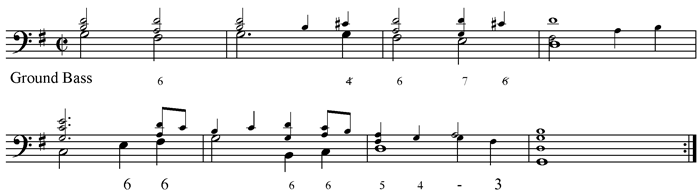
2. Divisions on a Ground Bass for viol-da-gamba, by Christopher Sympson, 1665, see p. 28. Rom. III, v, 25.
[Listen]
The 'Ground' itself is in large notes, the necessary chords (which were never written down) are indicated in small notes. This the Organist or Harpsichordist plays again and again, as often as necessary.
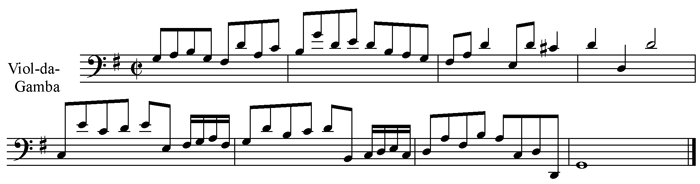
Here is a Division for the Viol, such as the player would produce extempore, with the above Ground before him.
Division No. 1.
[Listen]
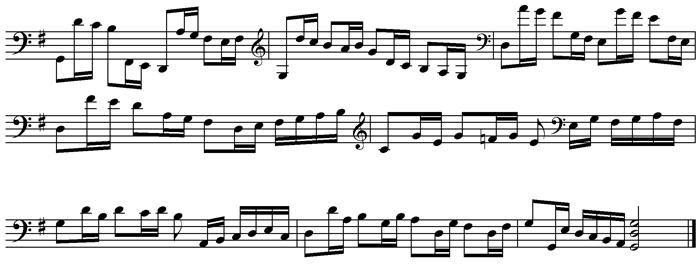
Division No. 3 (more elaborate).
[Listen]
3. Example of Sol-Fa, 16th and 17th centuries, see p. 35. Lear I, ii, 137.

[Listen]
The augmented fourths formed by the notes fa and mi, marked with x, are the mi contra fa, which diabolus est, or 'is the divider,' see p. 36.
Solmisation of the six notes of the Hexachord, 11th century, see p. 37. Shrew III, i, 72.

[Listen]
The six notes from F, with B flat, were called the 'Soft' Hexachord.
4. Lesson for the Lute, by Thomas Mace, b. 1613, from Musick's Monument, 1676, see p. 55. Shrew III, i, 58.
"My Mistress."
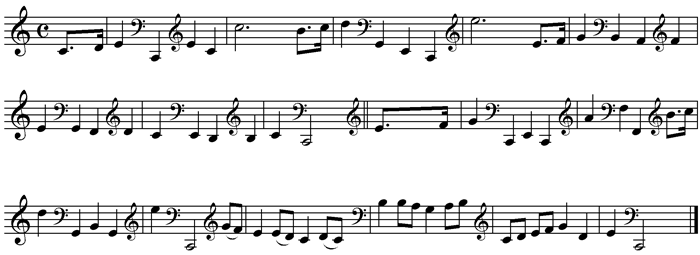
[Listen]
Cf. p. 30, on 'Broken' music.
5. Tune of Light o' Love, original words not known, but date before 1570, p. 70. Much Ado V, iv, 41, etc.
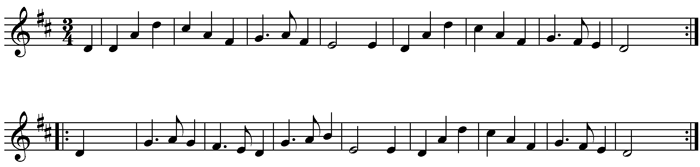
[Listen]
6. Parson Hugh's song, 'To Shallow Rivers,' tune anonymous, date probably 16th century, p. 71. Merry Wives III, i, 18.
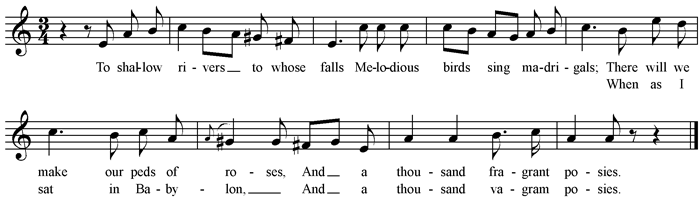
[Listen]
7. 'Come Live with Me,' tune printed 1612, but probably much older. See p. 71. Marlowe's 'Passionate Pilgrim,' XX., or Merry Wives III, i, 18.
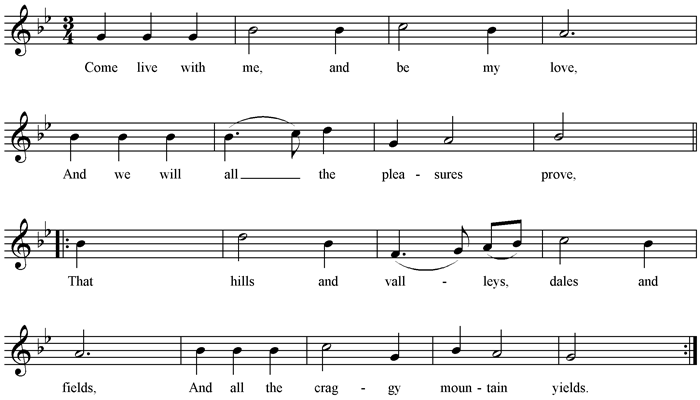
[Listen]
8. Peg-a-Ramsey, p. 71. Tw. Nt. II, iii, 76.
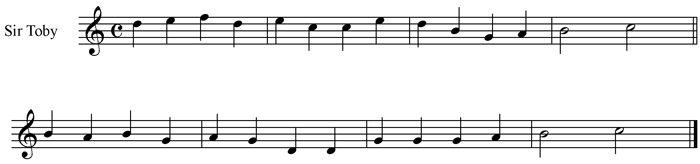
[Listen]
9. 'Three Merry Men be We,' p. 71. Tw. Nt. II, iii, 76. Words from Peele's 'Old Wives Tale,' 1595, where it is sung. Music from J. Playford, 1650 circ., but may be older.
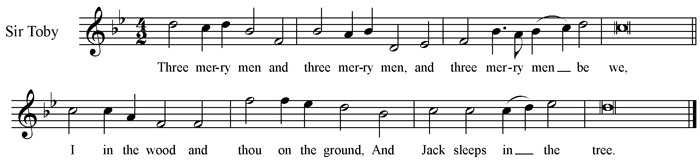
[Listen]
10. 'There Dwelt a Man in Babylon,' p. 71. Tw. Nt. II, iii, 80. Music anon., but most probably later than Shakespeare's time.
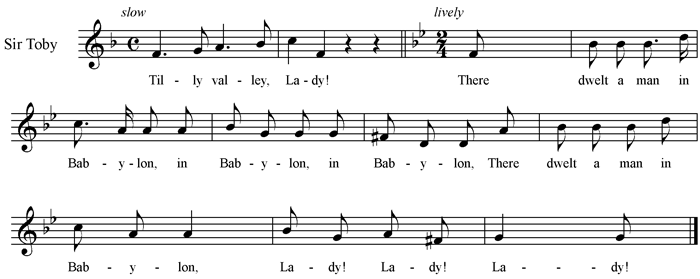
[Listen]
Here is one verse of the 'Ballad of Constant Susanna,' to which Toby refers.
'There dwelt a man in Babylon Of reputation great by fame; He took to wife a faire woman, Susanna she was callde by name. A woman faire and vertuous, Lady, lady! Why should we not of her learn thus To live godly?'
11. 'Farewell, Dear Heart,' p. 72. Tw. Nt. II, iii, 102.
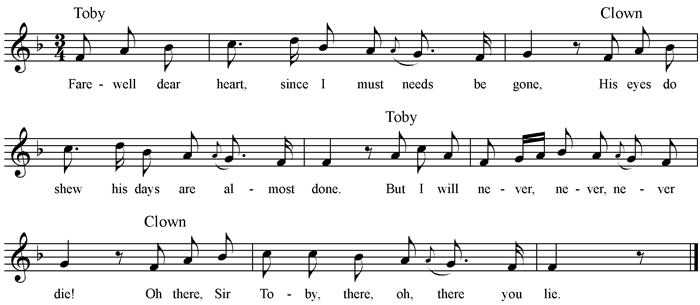
[Listen]
This can hardly be the original tune to "Corydon's Farewell to Phillis," from parts of the first and second verses of which the above words are quoted. See Percy's "Reliques," Vol. I.
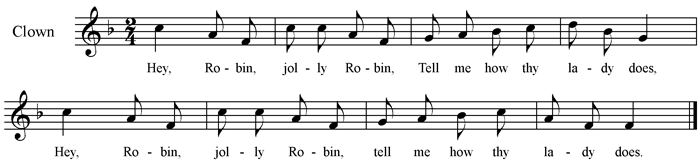
12. Here are two relics of music for the Clown in Tw. Nt. IV, ii, probably of the same period as the above.
[Listen]

[Listen]
For the rest of the words of 'A Robyn, Jolly Robyn,' see Percy's Reliques, Vol. I. p. 148.
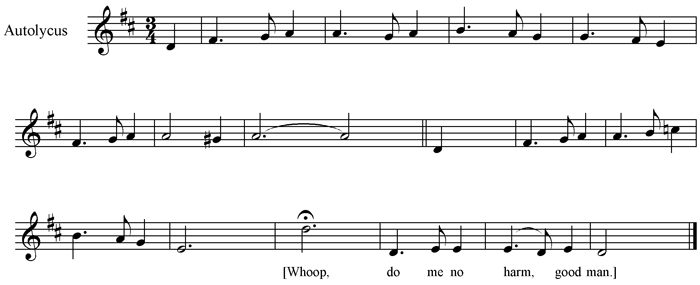
13. 'Whoop, do me no harm, good man,' p. 72. Winter's Tale IV, iii, 198. The rest of the words unknown, but several ballads printed in latter part of 16th century go to this tune—
[Listen]
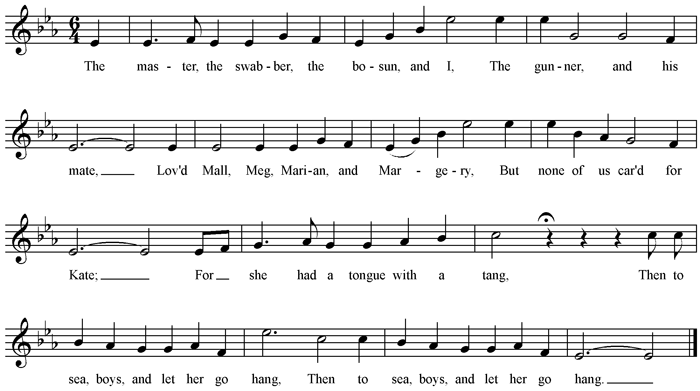
14. Stephano's 'scurvey tunes,' Tempest II, ii, 41, see p. 73. "As sung by Mr Bannister" [1667].

[Listen]
[Listen]
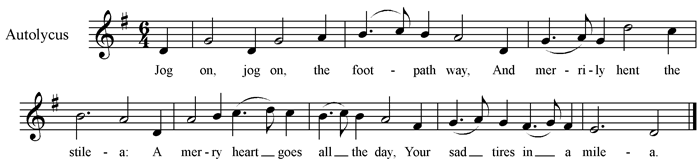
15. 'Jog On,' p. 72, Winter's Tale IV, ii, 125. Two more stanzas were first printed 1661, see Chappell, Vol. I. 160. The tune is from the Fitzwilliam Virginal Book (Queen Elizabeth's Virginal Book), where it has the name
Hanskin.
[Listen]
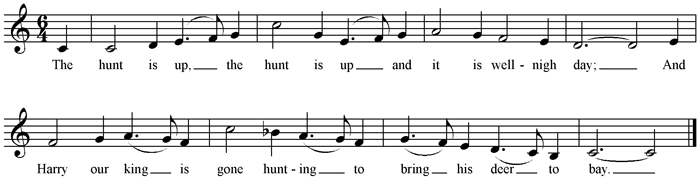
16. 'The Hunt is up,' see p. 73, and Rom. and Jul. III, v, 34. The tune is at least as old as 1537, when John Hogon was proceeded against for singing it with certain political words.
[Listen]
Grove [see under Ballad] gives quite another tune, to which 'Chevy Chase' also was sung.
The tune here printed was also sung (1584) to 'O sweete Olyver, leave me not behind the,' but altered to four in a bar. See As You III, iii, 95, where a verse is given which will easily fit to the music.
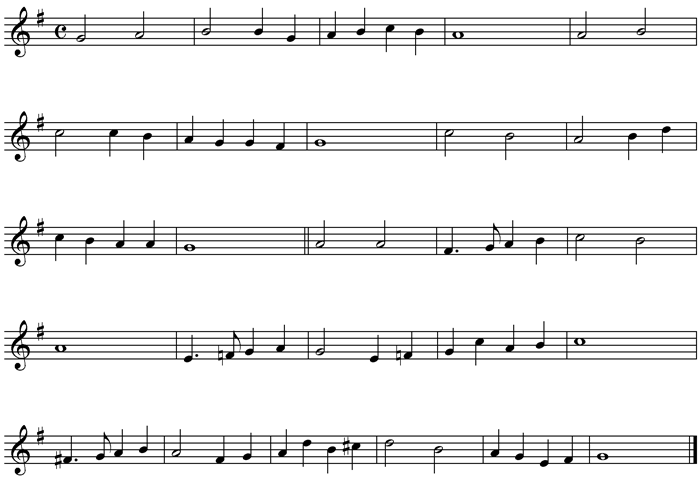
17. 'Heart's Ease,' p. 73. Rom. IV, v, 100. Words not known. Tune before 1560.
[Listen]
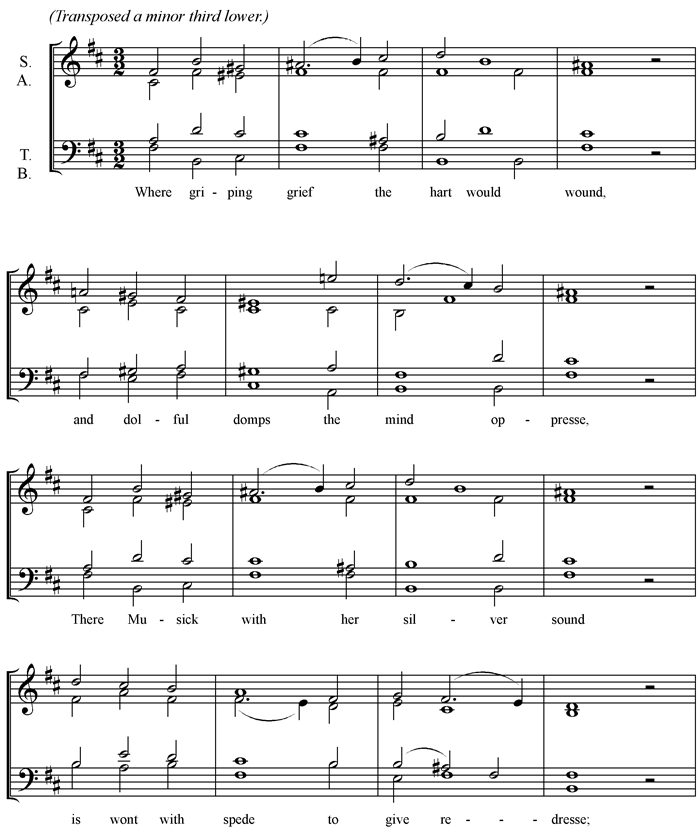
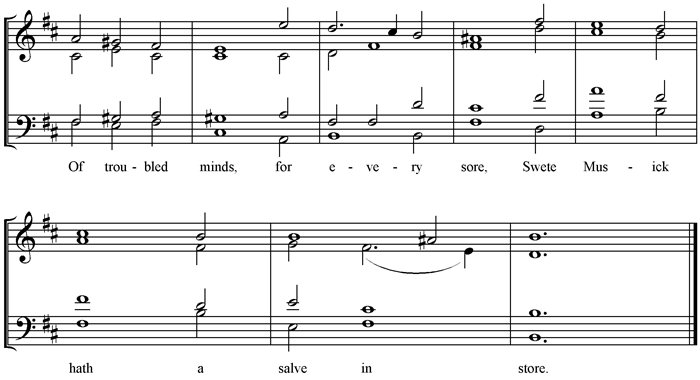
18. 'Where Griping Grief,' p. 73, Rom. IV, v, 125, by Rich. Edwards, poet and composer, 1577.
[Listen]
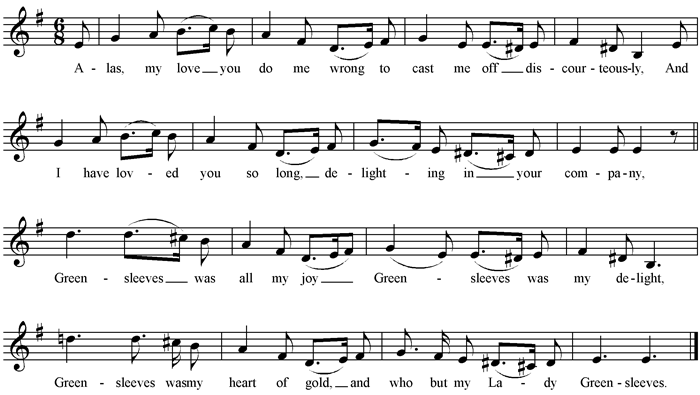
19. 'Green Sleeves,' see p. 74, and Wiv. II, i, 60, etc. The tune is probably of Henry VIII.'s time.
[Listen]
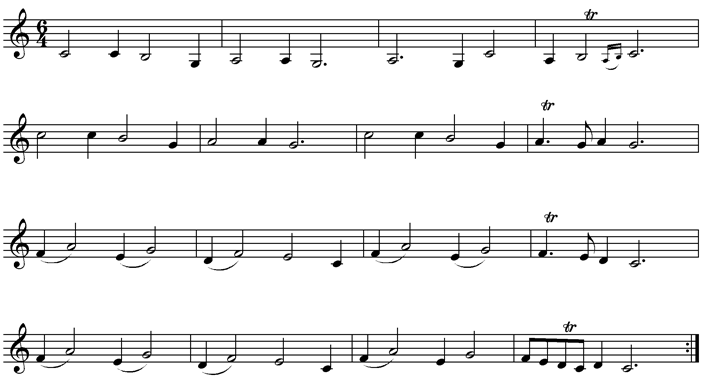
20. 'Carman's Whistle,' p. 76, H. 4. B. III, ii, 320. Tune as given by Byrd, who wrote variations on it before 1591.
[Listen]
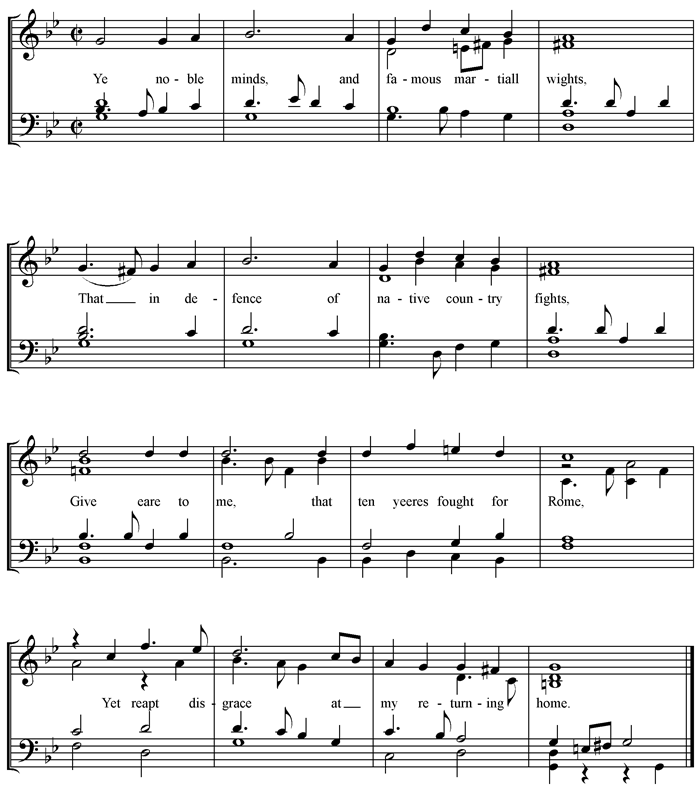
21. 'Fortune my Foe,' p. 76, Merry Wiv. III, iii, 62. This old tune is, at latest, of Elizabeth's day, and most likely much older. The words here set are given in Burney, and the harmony is by Byrd, who wrote variations on it for Queen Elizabeth's Virginal Book.
[Listen]
The above words are the first verse of 'Titus Andronicus's Complaint,' which Burney says was originally written to this tune. The ballad is given in full in Percy's Reliques, Vol. I. p. 180.
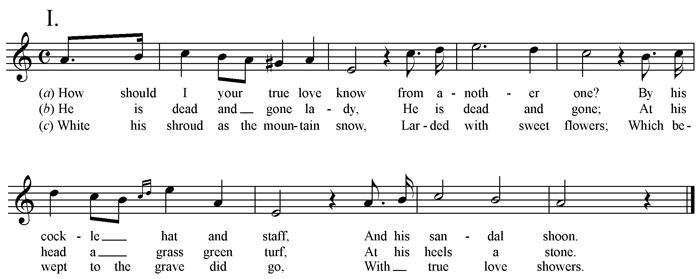
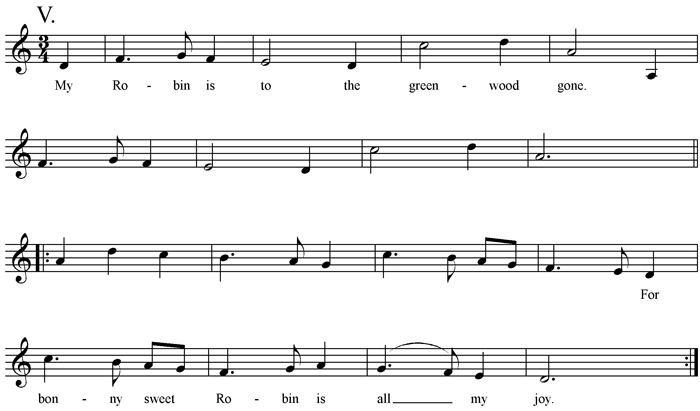
22. Ophelia's Songs, p. 76, Hamlet IV, v.
[Listen]
This is certainly old, early 16th century. The tune has a striking likeness to 'Walsingham,' which is the first piece in the Fitzwilliam Virginal Book. See Percy's Reliques, Vol. II. p. 75. But the date of the next is not so certain, though probably it is of Shakespeare's time.
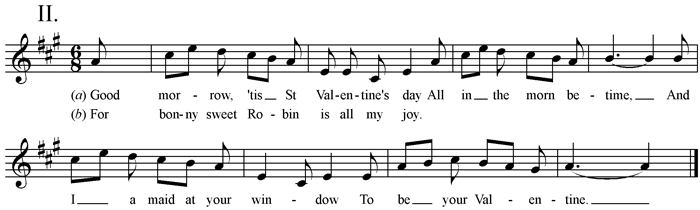
[Listen]
The next two are of the same period as I.

[Listen]
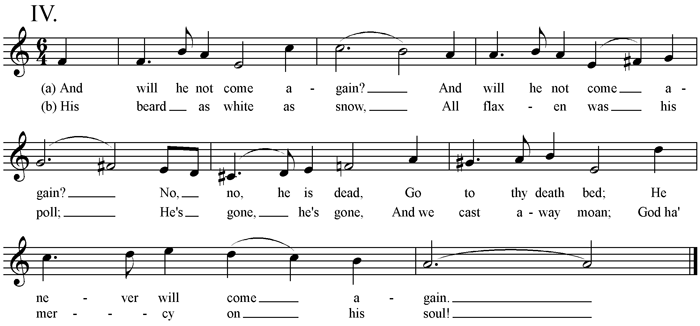
[Listen]
L. 184, 'Bonny sweet Robin.' With the exception of this one line, and the title, 'My Robin is to the greenwood gone,' nothing remains of this song, but the following tune, which is of some date before 1597.
[Listen]
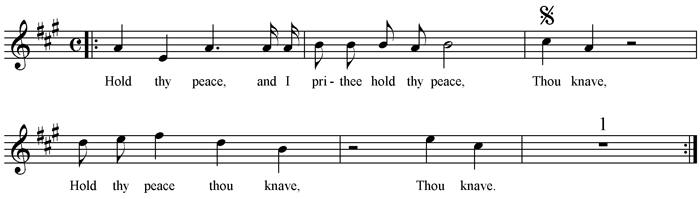
23. Catches, of 16th century, prob. long anterior to Shakespeare.
I. 'Hold thy peace,' see p. 77, Tw. Nt. II, iii. For three voices, Sir Toby, Sir Andrew, and Feste the clown, who begins the catch. The second man follows when the first has arrived at . For the explanation see p. 90.

[Listen]
'Thou knave' will be heard nine times for every once the whole tune is sung by one of the voices.
II. 'Jack boy, ho boy, news,' see p. 92, and Shrew IV, i, 42. This is very old, prob. quite early 16th century (see Introduction).
For four voices. The second man comes in at , as before.
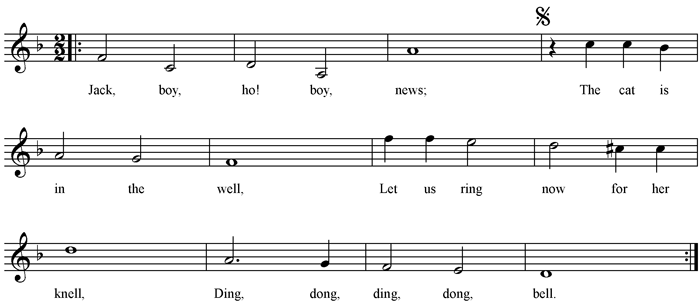
[Listen]
24. Threeman songs (corrupted into 'Freeman,' see p. 83). These were entirely different from Catches. A Threeman song is merely (as a rule) a song with three parts,—e.g., two trebles and a tenor, etc. Winter's Tale IV, ii, 41, and IV, iii, 285-327.
Here is a Threeman song, published in 1609, but probably much older than that.
Transposed down a 4th.
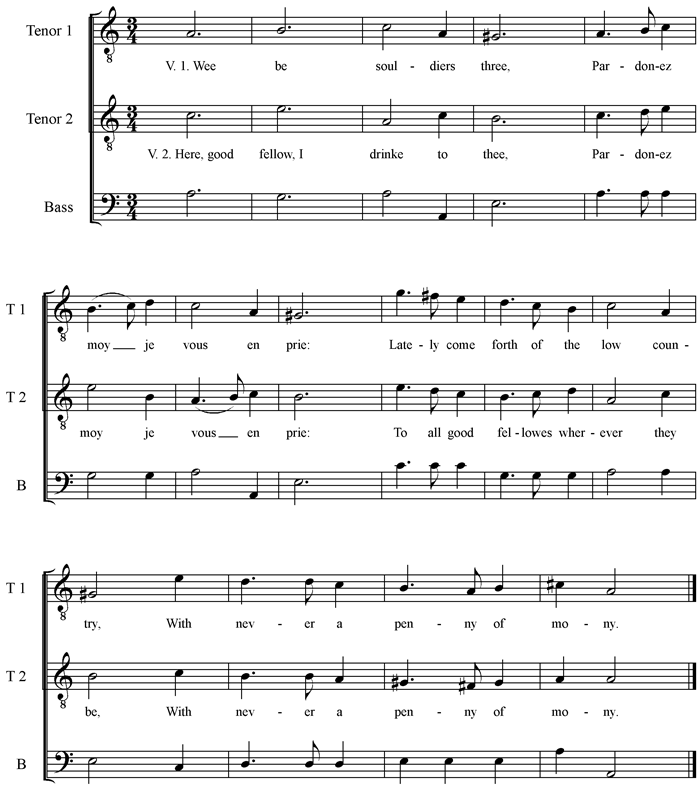
[Listen]
There are two more verses of the same sort.
25. 'Canst thou not hit it,' L.L.L. IV, i, 125. No more words known, except this one verse.
The tune is mentioned as a dance in an Elizabethan play, and is alluded to in an old ballad 'Arthur a Bradley.'
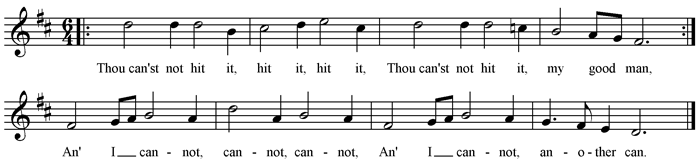
[Listen]
26. Dances. [Also see Note on Arbeau's Orchésographie.]
(a.) Pavan and Galliard, 'St Thomas Wake,' by Dr Bull, from Parthenia, printed 1611. (Bull was born 1563.) See p. 114.
Pavan [if played quick became Passamezzo. Tw. V, i, 200].
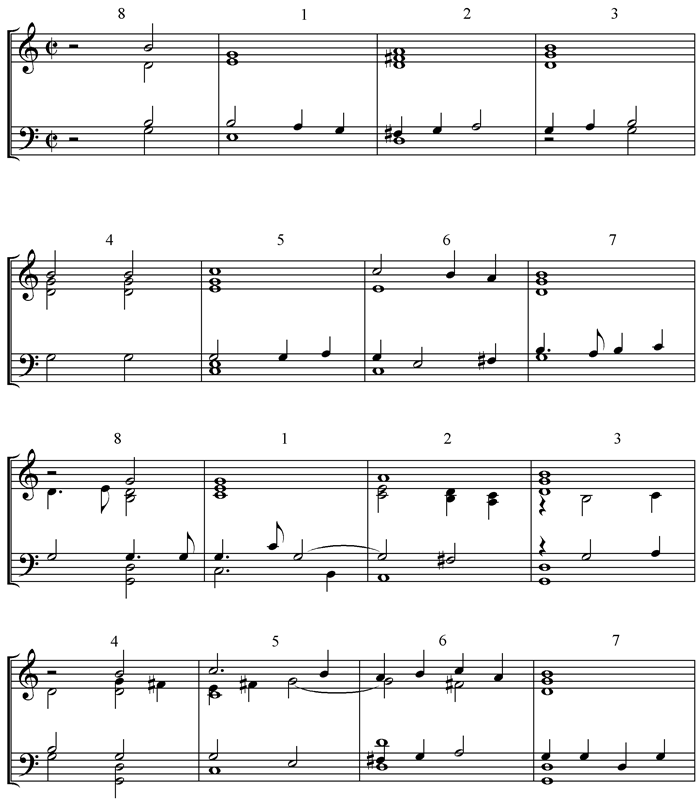
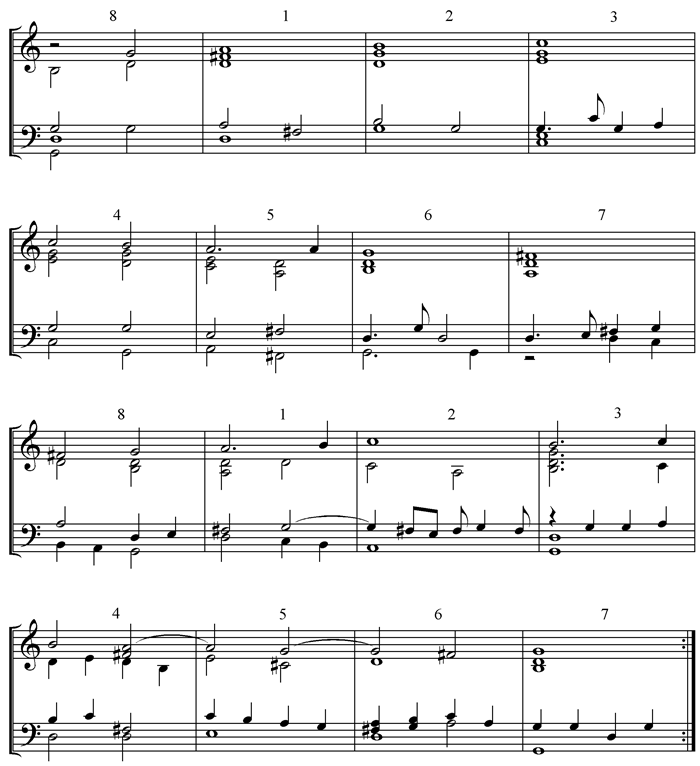
[Listen]
Galliard St Thomas Wake, the same music but in triple time. Tw. I, viii, 127, H. 5. I, ii, 252.
Galliard, or Cinquepace.
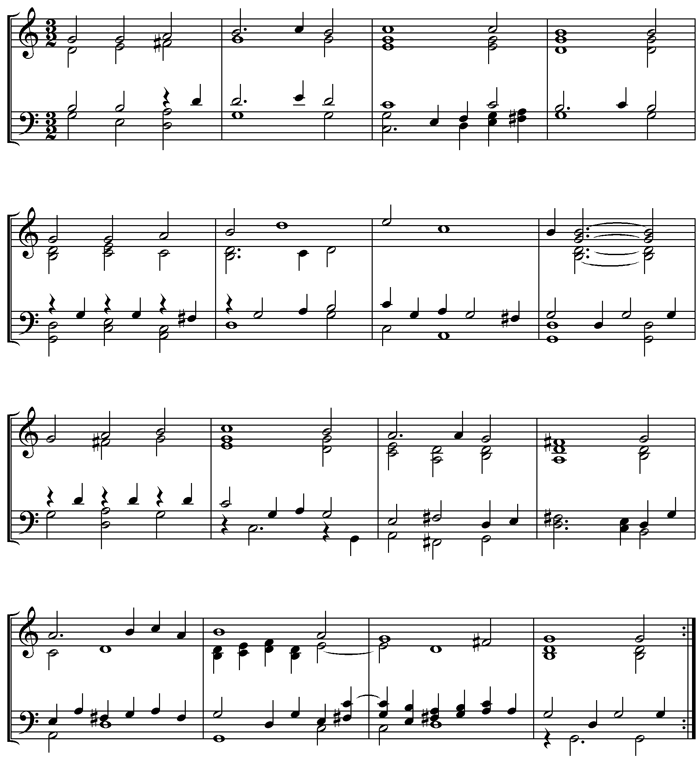
[Listen]
(b.) 1. Part of a 'Passamezzo,' date 1581. (See Note on Arbeau's Orchésographie.) Tw. V, i, 200. See p. 135.
Passe mezzo, or Measure (As You V, iv, 178, etc.)
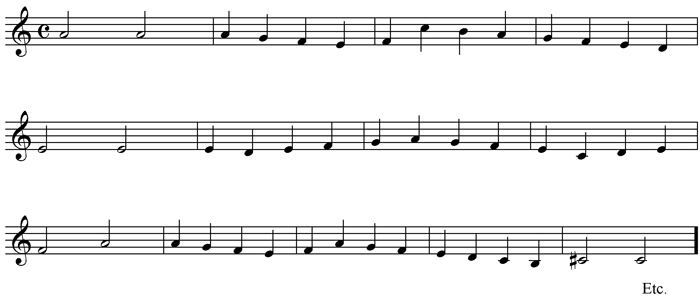
[Listen]
(b.) 2. The first 'strain' of a German Pavan for the Lute, dating 1562.
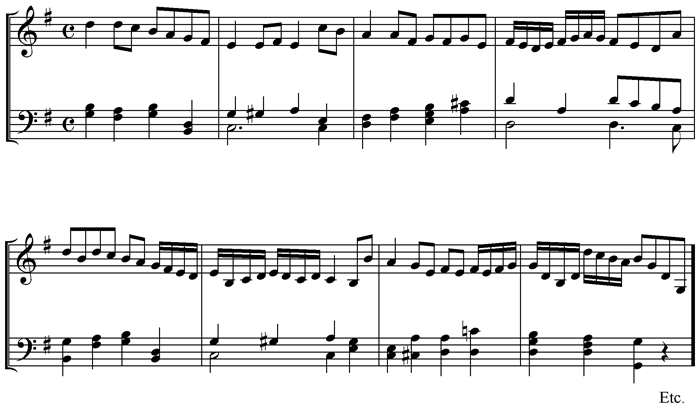
[Listen]
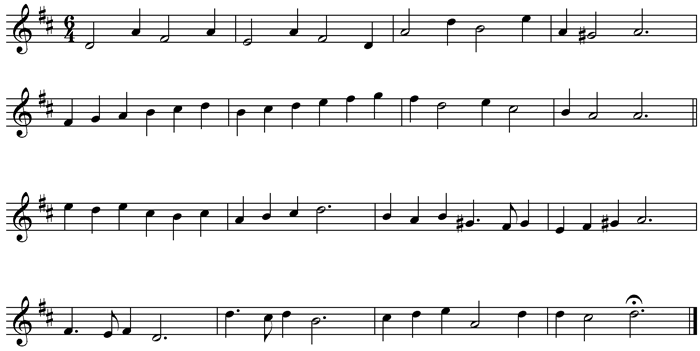
(c.) An English 'Haye,' or 'Raye,' or 'Round,' date 1678. See p. 131, L.L.L. V, i, 148.
For a French 'Haye,' see Note on Arbeau's Orchésographie. Tune only given [see Stainer and Barrett's Dict. of Musical Terms].
[Listen]
It will be noticed that the steps of the Haye, as given in 'Orchésographie,' can be adapted to this tune. The dotted minim value of this corresponds with the semibreve value of the other.
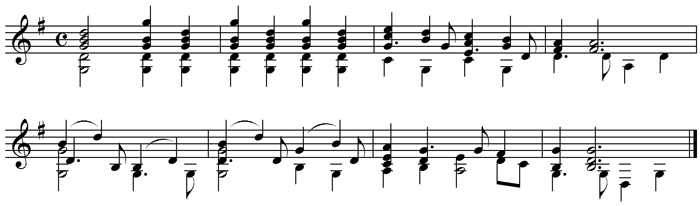
(d.) 1. The King's Hunting Jigg, by Dr Bull (1563-1628). See p. 117. Hamlet II, ii, 504, etc.
[Listen]
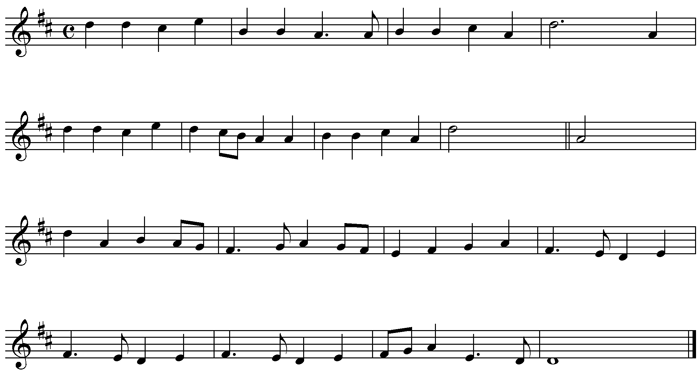
(d.) 2. The Cobbler's Jig. 1622. See p. 125.
[Listen]
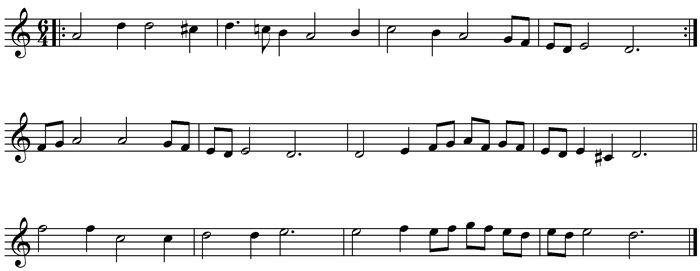
(e.) 1. An English Morris, 1650, see p. 132. All's Well II, ii, 20, etc.
[Listen]
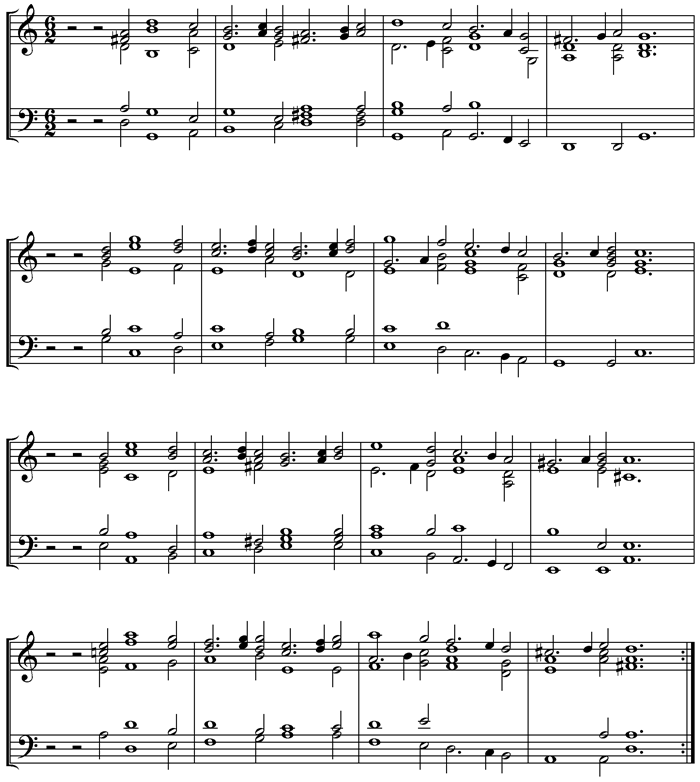
(e.) 2. Italian Moresca, by Claudio Monteverde, from his opera 'Orfeo,' 1608. This at all events must have had a different step to the Morisque of Arbeau. (See Note on the 'Orchésographie.')
This dance is certainly in triple rhythm, so the common-time sign probably indicates it should be played fast enough to give the effect of two beats to the bar.
[Listen]
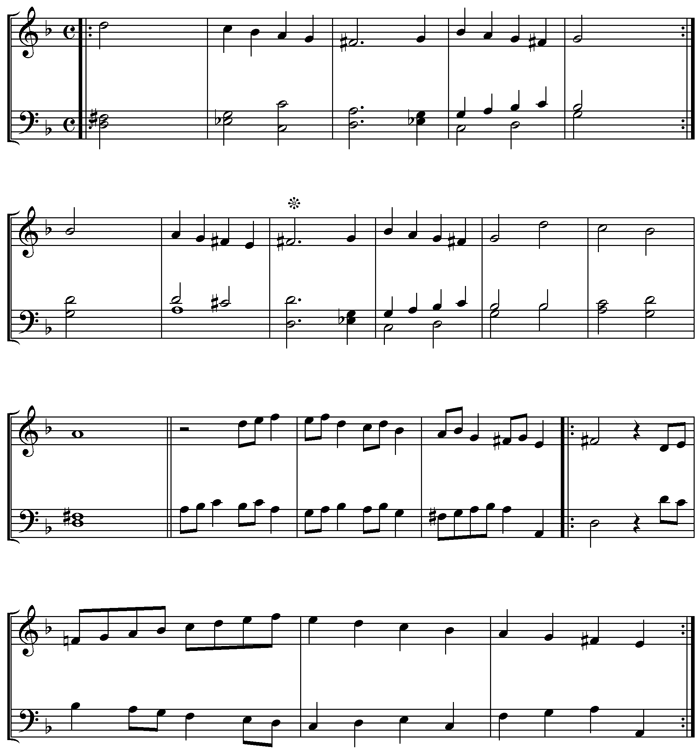
(f.) Part of 'My Ladye Carey's Dumpe,' circa 1600. See p. 127. Two Gent. III, ii, 83, etc.
[Listen]
Then return to . This is about one third of it. The last strain of all is the first here printed, but in four parts, and with extraordinary harmony, the E's being carefully marked ♮.

N.B.—For Cinquepace, Canaries, Brawl, Lavolt, Courante, Haye, Morisque, see the Note on 'Orchésographie.'
27. Musical Stage Directions. See p. 165, and ff.
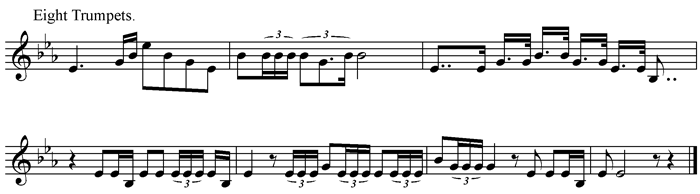
(a.) Flourish, believed to be of Charles II.'s time. See p. 167.
[Listen]
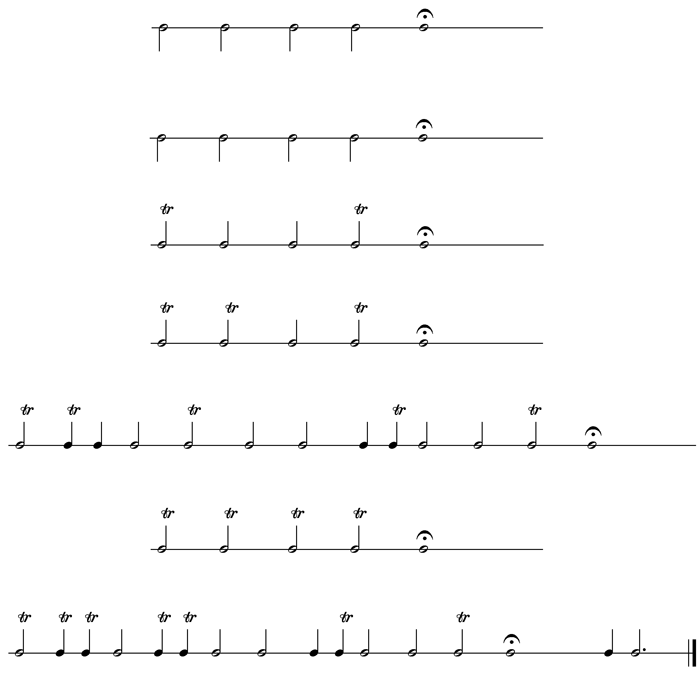
(b.) The Ancient English Drum March, revived in 1610. See p. 172. H. 6. A. III, iii, 30.
THE VOLUNTARY.

[Listen]
THE MARCH.
[Listen]
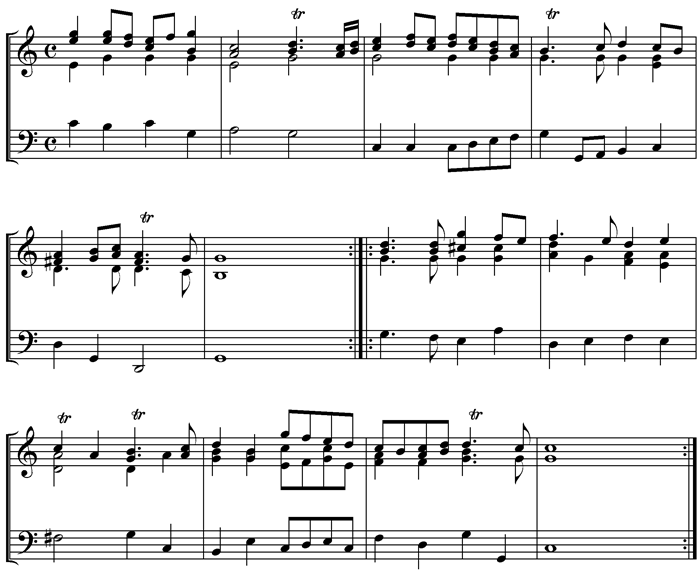
(c.) Military March of the French 'Gardes de la Marine,' written by Lully, 1670. For Hautboys in four parts. See p. 172. Cf. H. 6. A. III, iii, 33.
Batterie de Tambour.

[Listen]
Air des Hautbois.
[Listen]
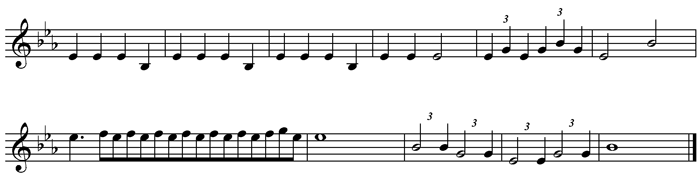
(d.) A 'sonnerie' of French Cavalry, 1636 (Louis XIII.). See p. 178. I connect this with 'sennet.'
Boute-selle (i.e., 'to horse').
[Listen]
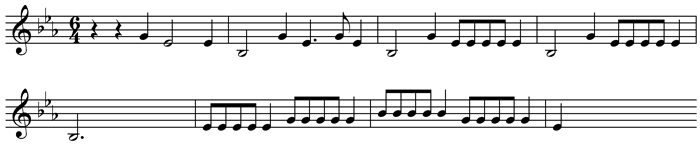
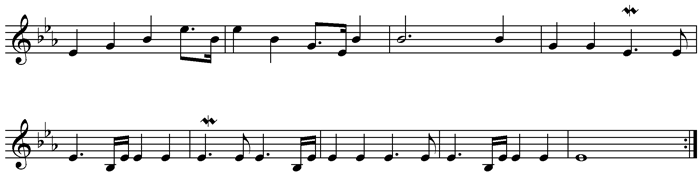
(e.) Tucket, p. 180. H. 5. IV, ii, 35.
1. An Italian Tucket, date 1638.
[Listen]
2. French Tucket, 1643.
[Listen]
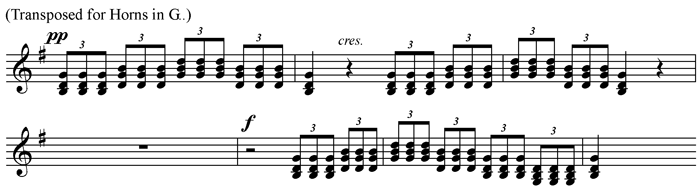
(f.) 1. Old French hunting fanfare. Perhaps may be connected with 'Horns wind a Peal.' Titus II, ii, 10. See p. 183.
Four Horns.

[Listen]
(f.) 2. The imitation (by violins) of a hunting call in Purcell's 'Dido and Æneas,' 1675. See p. 183.
[Listen]